CITES Report Urges India to Halt Wildlife Imports Pending Stronger Checks

CITES Report

CITES Report Latest News

  • A CITES verification mission has advised India to halt imports of critically endangered species — including gorillas, orangutans, chimpanzees, and snow leopards — until stronger checks and due diligence measures are implemented.
  • The report warned of illegal harvesting of wild animals falsely declared as captive-bred and asked India to provide credible evidence to the CITES Secretariat in Geneva proving its compliance with global wildlife trade safeguards.

About CITES

Structure and Mechanism

  • Species protected under CITES are classified into three Appendices:
    • Appendix I: Species threatened with extinction; trade permitted only in exceptional circumstances.
    • Appendix II: Species not necessarily threatened but whose trade must be controlled to avoid overexploitation.
    • Appendix III: Species protected in at least one country that has asked other Parties for assistance in controlling trade.
  • Trade in CITES-listed species requires export and import permits issued by designated national CITES authorities in each member country.

India and CITES

  • India joined CITES in 1976, and no international wildlife trade is permitted without export and import permits issued by designated CITES authorities.
  • The Directorate of Wildlife Preservation under the Ministry of Environment, Forest and Climate Change (MoEFCC) serves as India’s CITES Management Authority.
  • CITES implementation in India aligns with the Wildlife (Protection) Act, 1972, which governs the trade, acquisition, and possession of wildlife species and derivatives.

CITES Mission Flags Gaps in India’s Wildlife Import Procedures

  • A CITES verification mission has urged India to suspend imports of critically endangered species — such as gorillas, orangutans, chimpanzees, and snow leopards — until it strengthens due diligence and verification systems to prevent illegal wildlife trade.
  • The mission warned against the illegal capture of wild animals falsely declared as captive-bred and asked India to provide evidence of compliance to the CITES Secretariat in Geneva.

Background: Inspection Triggered by Gujarat Zoo Imports

  • At a CITES Standing Committee meeting in Geneva (February 2025), member countries raised concerns about wildlife imports to the Greens Zoological Rescue & Rehabilitation Center (GZRRC) in Jamnagar, Gujarat, operated by Vantara.
  • This led to a CITES inspection mission, which also visited the Radha Krishna Temple Elephant Welfare Trust (RKTEWT).

Key Findings of the Report

  • The mission found that while all imports had valid CITES permits, questions remained about:
    • The true origin of animals,
    • The accuracy of source (captive-bred) and purpose (zoo) codes, and
    • The extent of India’s due diligence in verifying imports.
  • Under India’s Wildlife Protection Act, zoos can only acquire or transfer animals from other recognised zoos.
  • However, many imports came from commercial breeding facilities, not zoos — raising concerns about wild-caught animals being mislabelled as captive-bred.

Animal Holdings and Facility Standards

  • The CITES Secretariat noted that both facilities - GZRRC and RKTEWT - maintain exceptionally high welfare standards and that their representatives denied buying any animals.

Contradictory Records on Czech Republic Imports

  • The Czech CITES authority told the Secretariat that animals sent to GZRRC were sold, not rescued, contradicting India’s claim.

Questionable Origins of Animals from Africa and South America

  • Three African elephants imported from Tunisia were found to be wild-caught from Burkina Faso.
  • 363 animals, including primates, crocodilians, and anteaters, exported from Guyana, were marked as wild (source code W) and for zoos (purpose code Z) — raising concerns of misclassification.

Imports from Unlikely or Unverified Sources

  • The report listed multiple imports via the UAE claiming “captive-bred” origins from countries with no breeding programs — such as:
    • Chimpanzees from Egypt, Iraq, Kuwait
    • Bonobo from Iraq
    • Gorilla from Haiti
    • Cheetahs from Syria
  • It also noted imports of Appendix-I species under “confiscation” (code I) — including jaguars, ocelots, margays, jaguarundis, chimpanzees, orangutans, and cheetahs — with unknown origins from Mexico and the UAE.

CITES Recommendations for India

  • The CITES Secretariat recommended that India:
    • Review and strengthen its import procedures urgently to ensure authenticity of captive-bred claims.
    • Verify all flagged imports with source or transit countries — including Congo, Germany, Guyana, Iraq, Mexico, Syria, and the UAE — to confirm origins.
    • Take corrective action if animals were found to be sourced from the wild under false captive-bred claims.

Next Steps and Reporting Deadline

  • The CITES Standing Committee, meeting in Samarkand, Uzbekistan, on November 23, will review India’s case.
  • The Secretariat has asked India to take corrective measures and submit a detailed compliance report within 90 days.

Source: IE | CNBC | CITES

CITES Report FAQs

Q1: What did the CITES report recommend for India?

Ans: It advised India to halt imports of critically endangered species until it strengthens verification systems to prevent illegal wildlife trade and mislabelled captive-bred claims.

Q2: Which species are affected by the CITES recommendation?

Ans: The report highlighted gorillas, orangutans, chimpanzees, snow leopards, and other Appendix-I animals at risk of illegal capture and trade.

Q3: Why was India’s wildlife import process under scrutiny?

Ans: Imports to Gujarat’s Greens Zoological Rescue & Rehabilitation Center raised questions about origin, source codes, and India’s due diligence in verifying trade legality.

Q4: What gaps did the CITES mission identify?

Ans: It found inconsistencies in import documentation, unclear animal origins, and weak follow-up verification with exporting countries such as Congo and the UAE.

Q5: What action must India take now?

Ans: CITES asked India to review all imports, verify authenticity with source nations, and submit a compliance report within 90 days to the Standing Committee.
Supreme Court Relief on AGR Dues Gives Vodafone Idea a Lifeline

AGR Dues

AGR Dues Latest News

  • Recently, the Supreme Court permitted the government to review and recalculate Vodafone Idea’s adjusted gross revenue (AGR) dues up to FY 2016–17, including interest and penalties. This marks a significant relief for the cash-strapped telecom company, as it could reduce its financial liabilities.
  • AGR refers to the basis on which telecom operators pay licence fees and spectrum usage charges to the government.

Supreme Court Clarification on Vodafone Idea’s AGR Dues

  • The recent Supreme Court’s clarification followed its earlier order, allowing Vodafone Idea (Vi) to seek a review and reassessment of AGR dues up to FY17.
  • The Department of Telecommunications (DoT) had earlier raised an additional demand of ₹5,600 crore for that period, adding to Vi’s total AGR dues of around ₹83,400 crore.

Why the Clarification Matters

  • The Court’s clarification ensures that Vi’s relief extends to the full AGR reassessment up to FY17 — not just the ₹5,600 crore additional demand.
  • Had the relief been limited, the financial benefit would have been minimal. 
  • Vi’s petition had sought cancellation of the extra demand and a comprehensive reconciliation of all dues.
  • Following the Court’s oral observation, Vodafone Idea’s share price surged nearly 10%, reflecting renewed investor optimism over the potential reduction in liabilities.

Government’s Stake and Industry Implications

  • The government, now holding nearly 49% equity in Vodafone Idea after converting ₹36,950 crore in dues into shares, remains the largest shareholder.
  • It has a strategic interest in keeping Vi afloat, as the company is one of India’s three private telecom operators, crucial for maintaining a competitive three-player market.

Outlook

  • The clarification acts as a lifeline for Vi, giving it room to restructure debt, attract investors, and stabilise operations, while aligning with the government’s goal of ensuring a balanced telecom ecosystem in India.

Vodafone Idea’s AGR Burden and Survival Challenge

  • Vodafone Idea (Vi) owes the government ₹83,400 crore in adjusted gross revenue (AGR) dues, with annual instalments of ₹18,000 crore starting March next year.
  • Including penalties and interest, Vi’s total government liabilities could reach ₹2 trillion, creating an unsustainable financial burden for the debt-laden telecom operator.

Financial Distress and Weak Cash Flows

  • With shrinking revenues and subscriber losses, Vi faces severe cash flow constraints, making it nearly impossible to meet AGR payments on schedule.
  • The Supreme Court’s order allowing reassessment of dues offers crucial relief, as investors have avoided the company due to its overwhelming liabilities.

Warning of Potential Collapse

  • In its earlier petition, Vi cautioned that without bank funding, it cannot operate beyond FY 2025–26, as it lacks the resources to pay the ₹18,000 crore AGR instalment due in March 2026.
  • The company said that without fresh capital, planned network investments would stall, halting its capex cycle and eroding the value of government equity acquired through the ₹36,950 crore dues-to-equity conversion.

No Scope for Further Infusion

  • Vi also told the Court that promoters and shareholders cannot inject additional funds, and banks are unwilling to lend given its precarious finances.
  • If forced to continue ₹18,000 crore annual payments for six years, the company warned it would face “extreme financial stress” and possibly collapse, undermining both private and government stakes in the firm.

Government’s Equity Lifeline Keeps Vodafone Idea Afloat

  • The Indian government now owns nearly 49% of Vodafone Idea (Vi) after converting ₹36,950 crore of the company’s dues into equity in March 2025.
  • Before this conversion, the government’s stake stood at around 23%, making it now the single-largest shareholder in the debt-ridden telecom firm.
  • The equity was acquired at a premium exceeding 47%, due to existing legal and pricing regulations.

Second Major Lifeline from the Centre

  • This is the second rescue measure extended to Vi.
  • Earlier, under the 2021 telecom relief package, the government had in February 2023 converted ₹6,133 crore of interest dues into equity — marking the first phase of its intervention to stabilise the company.

Mounting Debt and Liabilities

  • As of December 2024, Vodafone Idea’s total debt stood at approximately ₹2.3 lakh crore, including:
    • ₹77,000 crore in AGR dues, and
    • ₹1.4 lakh crore in spectrum liabilities.
  • The company’s massive debt load has hindered its ability to invest and compete effectively with larger rivals like Jio and Airtel.

Purpose of the Equity Conversion

  • The equity conversion was crucial for Vi to manage its spectrum repayment obligations.
  • Without it, the company would have faced an annual payment of around ₹40,000 crore once the moratorium on spectrum dues expires in September 2025, threatening its operational continuity.

Conclusion

  • The move underscores the government’s intent to preserve a three-player private telecom market and protect its substantial financial exposure in the sector.
  • While the equity conversion offers short-term relief, Vodafone Idea’s survival hinges on raising fresh capital and restoring investor confidence in the coming years.


Source: IE | FE

AGR Dues FAQs

Q1: What relief did the Supreme Court give Vodafone Idea?

Ans: The Court allowed the government to review and recalculate Vodafone Idea’s AGR dues up to FY 2016–17, including interest and penalties.

Q2: Why is this clarification important?

Ans: It enables a full reassessment of dues, not just additional ₹5,600 crore demands, providing significant financial relief to the struggling telecom operator.

Q3: How large are Vodafone Idea’s total liabilities?

Ans: Vi owes around ₹83,400 crore in AGR dues and faces total government liabilities near ₹2 trillion including penalties and spectrum costs.

Q4: How much stake does the government hold in Vodafone Idea?

Ans: After converting ₹36,950 crore dues into equity, the government now owns nearly 49% — becoming Vi’s largest shareholder and key stabilising partner.

Q5: What challenges does Vodafone Idea still face?

Ans: Despite relief, Vi must raise fresh capital, repay ₹18,000 crore annually from March 2026, and expand network capacity to regain market confidence.

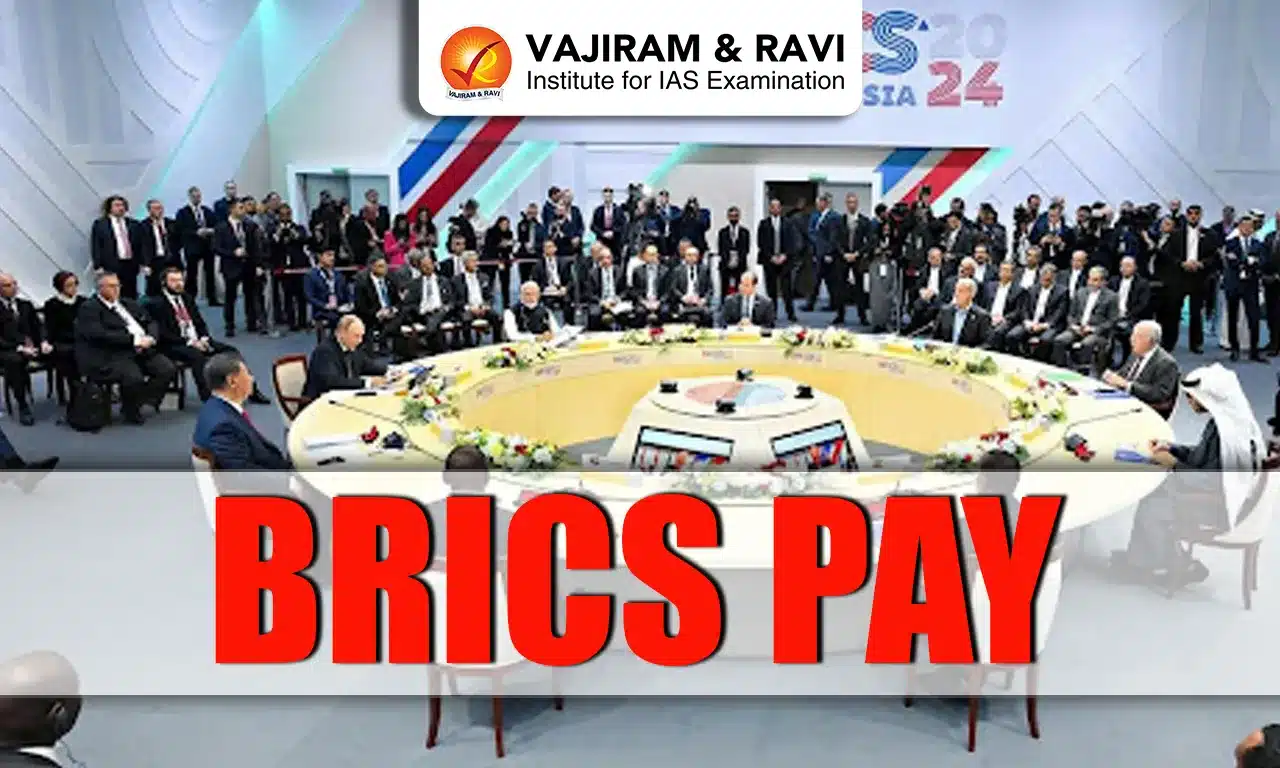
BRICS Pay – Redefining Global Financial Architecture

BRICS Pay

BRICS Pay Latest News

  • BRICS nations are advancing plans to operationalise BRICS Pay, a cross-border payment system aimed at reducing dependence on the U.S.-controlled SWIFT network and promoting financial sovereignty among member countries.

Introduction

  • The BRICS grouping, comprising Brazil, Russia, India, China, and South Africa, has embarked on an ambitious mission to challenge the global financial dominance of the U.S.-led SWIFT system. 
  • The recent unveiling of the BRICS Cross-Border Payments Initiative, or “BRICS Pay,” marks a decisive step in their long-standing quest to establish a more inclusive, multipolar financial order. 
  • This effort aims to promote local currency settlements, protect member nations from Western sanctions, and strengthen the group’s financial sovereignty.
  • The motivation behind this move has intensified since Russia faced sweeping Western sanctions in 2014 and 2022, leading the bloc to pursue alternative transaction mechanisms insulated from U.S. influence.

Evolution of BRICS Financial Cooperation

  • The journey towards financial independence for BRICS began at the Fortaleza Summit (2014), where member nations established the New Development Bank (NDB) and the Contingent Reserve Arrangement (CRA), the first financial institutions created by developing nations to rival Western-dominated entities like the IMF and World Bank.
  • In 2015, after the U.S. and EU imposed sanctions on Russia following the annexation of Crimea, BRICS members intensified discussions on using local currencies for trade and investment. 
  • By 2017, the grouping had agreed to strengthen currency cooperation through swap arrangements and local currency settlements.
  • This groundwork culminated in the Kazan Summit (2024), where the leaders launched the BRICS Cross-Border Payments Initiative, BRICS Pay, and underscored the importance of “strengthening correspondent banking networks within BRICS and enabling settlements in local currencies.”

The BRICS Pay Initiative

  • BRICS Pay represents the grouping’s most concrete step to reduce reliance on the SWIFT network, a Belgium-based system used by over 11,000 banks for global money transfers. 
  • SWIFT’s control by G-10 central banks, especially under U.S. influence, has long been criticised for allowing the weaponisation of the global financial system through sanctions.
  • The prototype of BRICS Pay was demonstrated in Moscow in October 2024, marking a milestone in the bloc’s efforts to build an independent payment ecosystem.
  • The project is being developed by the BRICS Payment Task Force (BPTF), which aims to ensure interoperability between national payment systems. 
  • Each BRICS nation already possesses a robust digital payment infrastructure:
    • India - Unified Payments Interface (UPI)
    • China - Cross-Border Interbank Payment System (CIPS)
    • Russia - System for Transfer of Financial Messages (SPFS)
    • Brazil - Pix Instant Payment System
    • South Africa - South African Multiple Option Settlement (SAMOS)
  • Together, these systems form the technological backbone of BRICS Pay, offering a credible alternative to SWIFT within the bloc and potentially to other developing economies.

Strategic Motivation and Political Context

  • The desire to establish BRICS Pay stems from three key motivations:
    • Financial Sovereignty: Reducing dependency on the U.S. dollar and mitigating exposure to Western sanctions.
    • Economic Efficiency: Lowering transaction costs and settlement times for trade among member nations.
    • Geopolitical Assertion: Establishing the BRICS bloc as a counterweight to Western economic dominance.
  • The inclusion of Iran, a nation long targeted by Western sanctions, in BRICS in 2024 further emphasised the grouping’s goal of building a sanctions-proof global payments system.
  • However, this initiative has drawn strong reactions. 
  • Former U.S. President Donald Trump threatened 100% tariffs on BRICS members if they attempted to “create a new currency or back any other currency to replace the mighty U.S. dollar,” underscoring the geopolitical sensitivity of the move.

Challenges in Implementing BRICS Pay

  • Despite its promise, BRICS Pay faces multiple hurdles:
    • Divergent National Interests: Each member is promoting its own payment system globally. For instance, India’s UPI is expanding into Asia and Africa, while China’s CIPS operates in over 120 countries. Aligning these platforms under one interoperable framework remains a major challenge.
    • Technical Interoperability: Integrating five distinct digital payment ecosystems requires harmonised regulatory and security standards.
    • Currency Coordination: The absence of a unified BRICS currency limits the system’s potential to function seamlessly.
    • Trust Deficit: Smaller BRICS members may fear Chinese dominance, given the internationalisation of the yuan and its inclusion in the IMF’s Special Drawing Rights (SDR) basket.
  • Moreover, the creation of a common BRICS currency remains distant. 

Global Implications

  • If successful, BRICS Pay could fundamentally alter the global financial landscape. It would provide developing nations with an alternative to SWIFT, fostering multipolarity in global finance and reducing the dollar’s overwhelming dominance.
  • Experts suggest that even a regionalised adoption, covering intra-BRICS trade and transactions, would signal a significant geopolitical shift. 
  • The growing popularity of local currency settlements, especially in energy trade between India, Russia, and China, aligns with this vision.
  • However, the initiative’s success depends on sustained political will, technical integration, and trust among the members, factors that will determine whether BRICS Pay becomes a global disruptor or remains a regional experiment.

Source: TH

BRICS Pay FAQs

Q1: What is BRICS Pay?

Ans: BRICS Pay is a proposed cross-border digital payment system that enables transactions in local currencies among BRICS nations, reducing reliance on the SWIFT network.

Q2: Why did BRICS develop BRICS Pay?

Ans: It was developed to promote financial sovereignty, enable trade in local currencies, and reduce exposure to U.S.-led sanctions.

Q3: Which countries’ systems will support BRICS Pay?

Ans: The initiative will build on Russia’s SPFS, China’s CIPS, India’s UPI, and Brazil’s Pix systems.

Q4: Why is a BRICS currency unlikely soon?

Ans: Differences in macroeconomic policies and China’s dominance in currency internationalization make a common currency difficult to achieve in the near term.

Q5: How does BRICS Pay challenge SWIFT?

Ans: By creating an interoperable alternative payment system independent of Western control, BRICS Pay challenges SWIFT’s monopoly over international money transfers.

QS Asia University Rankings 2026 – Indian Institutions Slip Amid Rising East and Southeast Asian Competition

QS Asia University Rankings 2026

QS Asia University Rankings 2026 Latest News

  • The QS World University Rankings: Asia 2026, released by global higher education analyst QS Quacquarelli Symonds, revealed a decline in the rankings of most top Indian institutions.
  • Despite improvement in absolute scores, 9 out of 10 leading Indian universities—including seven IITs—fell in rank due to stronger performance by universities from China, Singapore, Hong Kong, South Korea, and Malaysia.

Key Highlights of QS Asia Rankings 2026

  • Top performers in Asia:
    • The University of Hong Kong topped the rankings, overtaking Peking University (China), which slipped to second place.
    • National University of Singapore (NUS) and Nanyang Technological University (NTU) shared the third position.
    • East and Southeast Asian universities—especially from China, South Korea, and Malaysia—showed consistent upward mobility, driven by investment in research collaboration and internationalisation.
  • Performance of Indian institutions:
    • Among the top Indian universities, IIT Delhi retained its position as India’s best institution but fell 15 places to 59th (from 44th in 2025).
    • IIT Bombay witnessed the sharpest decline, dropping 23 places to 71st.
    • Other IITs—Madras, Kanpur, and Kharagpur—also recorded their lowest ranks in recent years.
    • The only Indian institution showing improvement was Chandigarh University, rising from 120 to 109.

Reasons Behind India’s Relative Decline

  • Intensifying regional competition:
    • Universities in China, Hong Kong, Singapore, South Korea, and Malaysia have significantly improved in research productivity, faculty resources, and global engagement.
    • QS noted a “clear eastward concentration” of top performance in higher education.
  • Expanded ranking scope and competition:
    • The 2026 rankings included 1,529 institutions, adding 552 new entrants.
    • China added 261 new institutions—more than any other country—while India added 137, bringing its total to 294.
    • The expansion increased competition and volatility in the results.

Decline in Key Performance Metrics of Indian Institutes

  • Citations per paper (research impact):
    • IIT Delhi (31.5), IIT Bombay (20.0), and IIT Madras (20.3) scored significantly below Asian peers scoring in the high 90s.
    • Indicates lower research visibility and fewer highly cited publications.
  • Faculty-student ratio:
    • IITs face resource constraints and large class sizes.
    • Scores range from 16.5 (IIT Kharagpur) to 40.9 (IIT Delhi), compared to 80–90 among top Asian universities.
  • Internationalisation metrics:
    • Poor performance in International Student Ratio (ISR) and International Faculty indicators.
    • IITs scored between 2.5 (IIT Kharagpur) and 12.3 (IIT Roorkee).
    • Lack of foreign student or faculty participation limits global exposure and cross-border collaboration.

Positive Aspects

  • Indian institutions maintained strong scores (80–90 range) in:
    • Academic reputation
    • Employer reputation
    • Staff with PhD
    • Papers per faculty
  • India continues to expand its footprint with 294 universities represented in the 2026 rankings, the second highest in Asia after China.

Comparative Regional Trends

  • China and Hong Kong: Sustained dominance with large-scale investment in R&D.
  • South Korea: Universities like Yonsei and Korea University show upward mobility due to strategic investment in international partnerships.
  • Malaysia: Institutions such as Universiti Malaya and Universiti Putra Malaysia improved rankings, aided by faculty-student ratio and international faculty/student metrics.

Way Forward for Indian Institutions

  • Enhance research impact: Focus on high-quality publications and internationally co-authored research to improve citations per paper.
  • Improve faculty-student ratio: Recruit more faculty and expand infrastructure to reduce student load per teacher.
  • Promote internationalisation: Facilitate foreign student exchange, visiting faculty, and global academic collaborations.
  • Strengthen research ecosystem: Incentivise interdisciplinary and industry-linked research, ensuring global visibility.
  • Policy support: Government and institutions must align policies with National Education Policy (NEP) 2020 goals of global competitiveness and innovation.

Conclusion

  • The QS Asia Rankings 2026 underscore a concerning trend for Indian higher education—while absolute performance has improved, relative standing has fallen due to stronger regional competitors. 
  • To climb the global ladder, India must bridge gaps in research impact, faculty resources, and internationalisation, aligning with the NEP 2020 vision of making Indian universities globally competitive and innovation-driven.

Source: IE

QS Asia University Rankings 2026 FAQs

Q1: What is the key finding of the QS Asia University Rankings 2026?

Ans: Nine of the top ten Indian institutions, including seven IITs, saw a decline in their rankings.

Q2: Which metrics have contributed most to the decline of Indian institutions in the QS Asia Rankings 2026?

Ans: Indian institutions lagged in citations per paper, faculty-student ratio, and internationalisation metrics such as international student and faculty ratios.

Q3: In which areas have Indian institutions performed well according to the 2026 rankings?

Ans: Indian institutions scored highly in academic reputation, employer reputation, staff with PhD, and papers per faculty.

Q4: What factors have led to improved performance by East and Southeast Asian universities?

Ans: Sustained investment in research collaboration, faculty resources, and international engagement.

Q5: What measures can Indian institutions adopt to enhance their global competitiveness in future rankings?

Ans: They should strengthen research impact, faculty recruitment, and international partnerships, aligning with NEP 2020 goals.

Enquire Now