
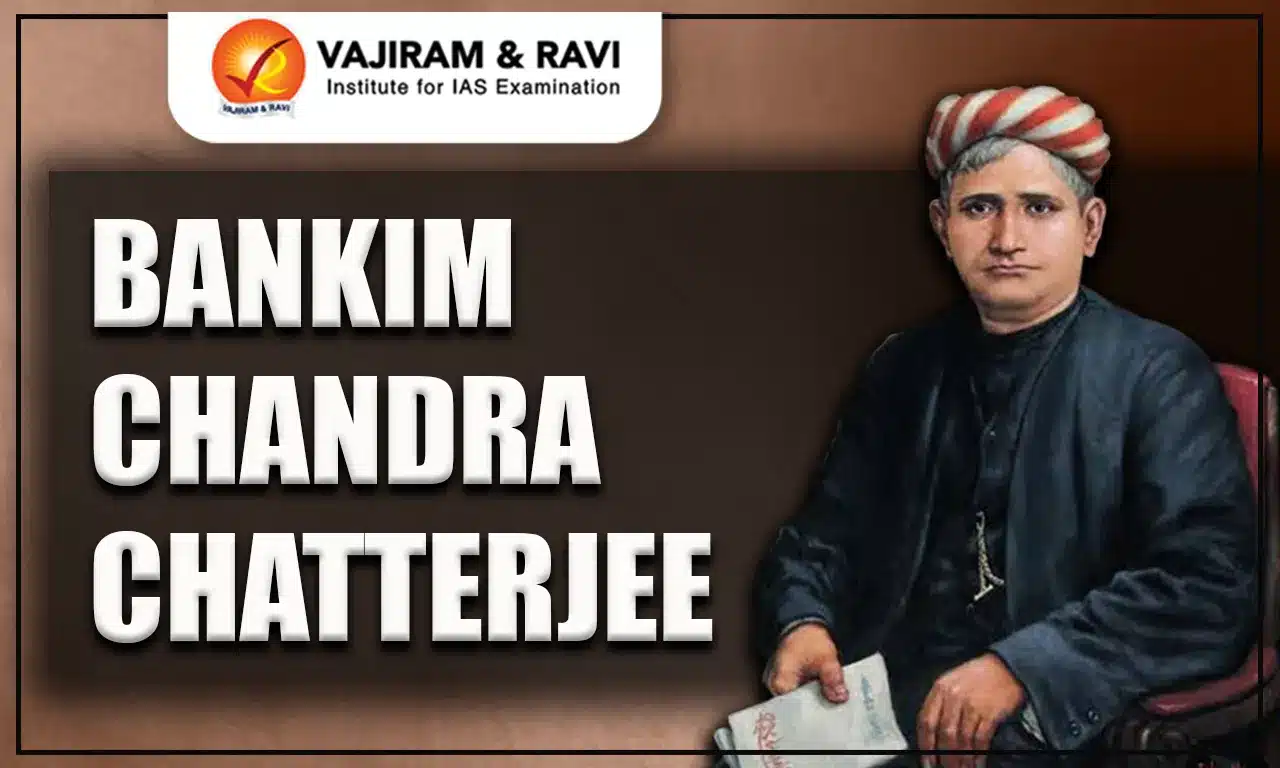
Bankim Chandra Chatterjee stands as one of the defining figures of Bengali literature and modern Indian thought. His writings not only reshaped the literary landscape but also stirred a sense of national pride during British colonial rule. Born in 1838 at Naihati in Bengal, Bankim received both Bengali and English education, which exposed him to Western philosophy and literature while grounding him in Indian traditions.
He studied at Presidency College in Calcutta and later served in various administrative roles under the British East India Company. Through his novels, essays, and poetry, Bankim articulated the cultural spirit of India and inspired generations with a vision of freedom and selfhood, leaving an indelible mark on both literature and the nationalist movement.
Bankim Chandra Chatterjee
- Bankim Chandra Chatterjee was not just a novelist but also a poet, journalist, and intellectual voice of his time.
- As a member of the Brahmo Samaj, he advocated for social and religious reforms aimed at addressing issues within contemporary Hindu society.
- Widely regarded as the father of modern Bengali literature, his writings combined literary excellence with social consciousness.
- His philosophical works captured the socio-political environment of the era, inspiring the growth of Indian nationalism.
- While deeply influenced by European literature and philosophy, his narratives remained rooted in Indian culture, often drawing from Hindu mythology and history.
Bankim Chandra Chatterjee Literary Contributions
Bankim Chandra Chatterjee contributions to Indian literature stand out for their originality and impact. He broke away from the classical mold and infused modern themes such as social reform, nationalism, and the conflict between colonial rule and Indian identity into his works. As one of the first to write novels in Bengali, he shaped the language into a powerful medium of modern literature. His fiction introduced realism, portraying human emotions, societal challenges, and the tension between tradition and modernity.
Beyond literature, Bankim became a voice of awakening. His writings carried the spirit of nationalism, celebrating India’s unity and heritage while inspiring self-reliance and the struggle for freedom. His legacy lies in how he used literature not just for storytelling, but as a tool to ignite collective pride and resistance against colonial domination.
Bankim Chandra Chatterjee Notable Work
- Anandmath (1882): His most famous and influential novel, set during the Sannyasi Rebellion of the 1770s. It blends history, mythology, and patriotism, highlighting the struggle of Bengalis against British imperialism. The book is remembered above all for introducing Vande Mataram, which later became a rallying cry of India’s independence movement.
- Durgeshnandini (1865): One of his earliest historical novels, set in 17th-century Bengal. It follows the trials of Lady Durgeshnandini as she navigates political intrigue and personal challenges.
- Kapalkundala (1866): A powerful narrative centered on a young woman caught between love and moral duty. The novel critiques contemporary social practices while weaving in strong emotional and ethical dilemmas.
- Rajmohan’s Wife (1864): His first novel, written in English, before he switched to Bengali. It explores human emotions, domestic strife, and societal constraints, offering a glimpse of Bankim’s early literary style.
- Vande Mataram (1870): A patriotic poem that transcended literature to become a cultural symbol. It was first sung at the Indian National Congress session in 1896 and went on to inspire generations during the freedom struggle.
Bankim Chandra Chatterjee Death
Bankim Chandra Chatterjee passed away on 27 September 1833, leaving a legacy that continues to shape Indian literature, reform, and politics. A true pioneer of the Bengal Renaissance, Raja Ram Mohan Roy laid the foundation for India’s cultural and intellectual awakening in the 19th century. His reformist zeal challenged outdated traditions and inspired generations to dream of a modern, progressive nation.
Roy’s legacy goes beyond social reform. He helped build the political and cultural consciousness of India, creating an intellectual environment that later guided leaders like Rabindranath Tagore and Subhas Chandra Bose. Though the iconic patriotic song Vande Mataram was penned by Bankim Chandra Chattopadhyay, the spirit of national resurgence that Roy initiated made such expressions of freedom possible. His life’s work remains a cornerstone of India’s journey toward independence.
Bankim Chandra Chatterjee FAQs
Q1: Which national anthem was written by Bankim Chandra Chatterjee?
Ans: Bankim Chandra Chatterjee did not write India’s national anthem (Jana Gana Mana by Rabindranath Tagore). He wrote Vande Mataram, which became India’s national song, not anthem.
Q2: Who is the father of Vande Mataram?
Ans: Bankim Chandra Chatterjee is regarded as the author and father of Vande Mataram. He included the song in his 1882 novel Anandamath.
Q3: Are Bankim Chandra Chattopadhyay and Chatterjee the same?
Ans: Yes. “Chattopadhyay” is the original Bengali surname, while “Chatterjee” is its anglicized form. Both refer to the same person.
Q4: Which poem was written by Bankim Chandra Chatterjee?
Ans: His most famous poem is Vande Mataram. Apart from that, he wrote several works of poetry and prose, including Anandamath, Kapalkundala, and Durgeshnandini.
Q5: Why do Muslims oppose Vande Mataram?
Ans: Some Muslim groups opposed Vande Mataram because parts of it personify the nation as a Hindu goddess (Durga).
