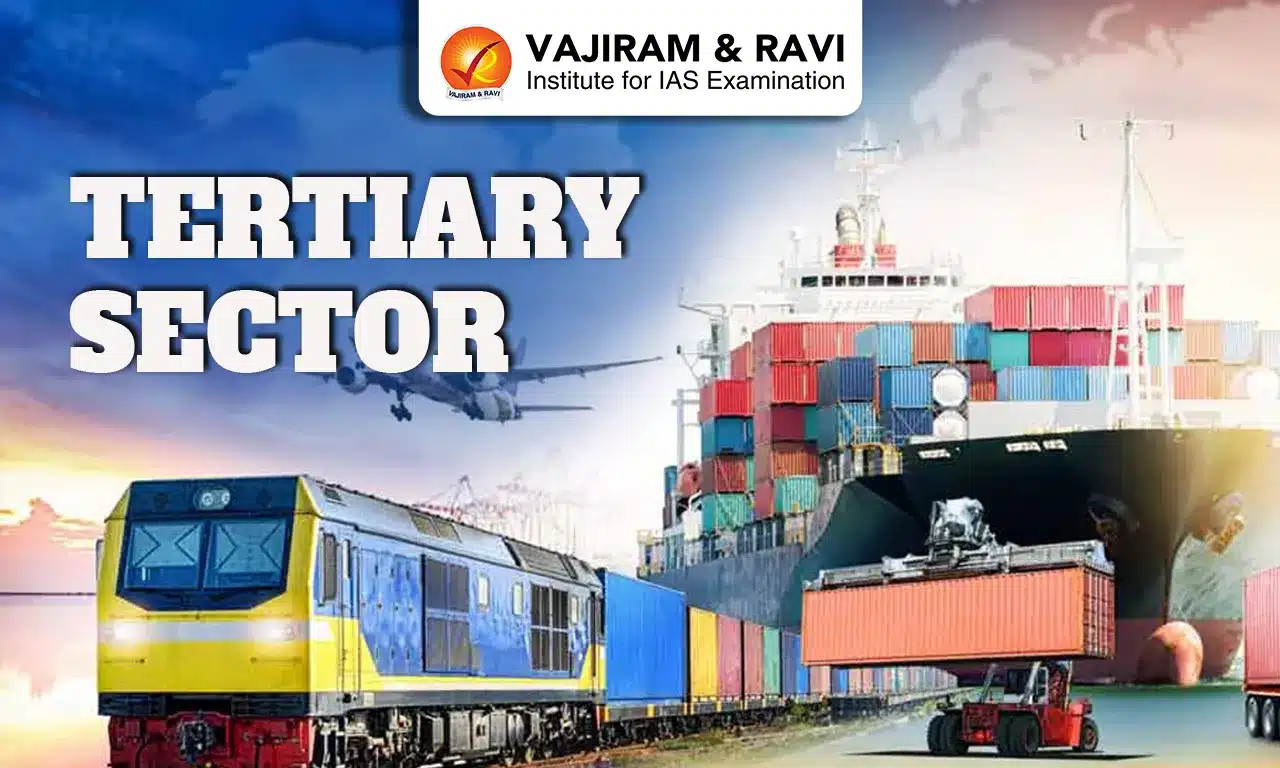
The Tertiary Sector, often called the “Services Sector,” covers economic activities that do not produce tangible goods but provide services, such as trade, transport, finance, information technology, healthcare, education and real estate. In India, this sector has emerged as the most dominant segment of the economy, surpassing agriculture and industry. It plays a vital role in employment, GDP contribution, innovation and global linkage.
Tertiary Sector
The Tertiary Sector refers to all activities concerned with providing services rather than manufacturing goods. These services support both the primary sector (agriculture & mining) and the secondary sector (manufacturing & industry), and extend to modern areas like IT, banking, logistics, hospitality and knowledge services. In simple terms: if it is not growing something physical, but delivering a service- information, transportation, finance, entertainment, it belongs to the tertiary sector.
Also Read: Primary Sector
Tertiary Sector in India
India’s Services Sector has grown strongly in recent decades, becoming the largest contributor to the country’s Gross Value Added (GVA). According to MOSPI provisional estimates for FY 2024-25, the services (tertiary) sector accounted for about 55% of Gross Value Added (GVA), with nominal services GVA at approximately ₹164.93 lakh crore (≈ ₹16.493 trillion). At the state level, in Telangana the Tertiary Sector accounted for about 63.1 % of Gross State Value Added (GSVA) in 2023-24, well above the national average.
These figures reflect structural change: India’s economy is increasingly service-led, moving away from heavy reliance on agriculture or manufacturing. This makes the tertiary sector critical for growth, job creation and global positioning.
Tertiary Sector Classification
Economists often divide the Tertiary Sector into two additional categories for better understanding. Together, these sectors form the modern service-based economy that dominates most developed nations today.
- Quaternary Sector- Deals with information services, such as IT, research, data management, and communication.
- Quinary Sector- Involves human services like health, education, and public administration.
Tertiary Sector Components
The Tertiary Sector can be broadly broken into the following categories:
- Trade, Hotels, Transport, Communication & Broadcasting: Involves wholesale & retail trade, hospitality, logistics, broadcasting services. For India in 2024-25, this sub-group contributed about 17.51% of total GVA.
- Financial, Real Estate & Professional Services: Banking, insurance, real estate, business services and professional consulting. In 2024-25, this group accounted for around 22.92% of GVA.
- Public Administration, Defence & Other Services: Government services, civic administration, health & education services, and other community & personal services. Their share in 2024-25 was about 14.50%.
Tertiary Sector Role in Indian Economy
The Tertiary Sector or Service Sector plays a vital role in the Indian Economy:
- Contribution to GDP / GVA: As noted earlier, the tertiary sector contributed about 55 % of India’s GVA in recent years. This indicates that more than half of economic value comes from services, underscoring their importance in the growth story.
- Employment and Urbanisation: While manufacturing and agriculture are job-intensive, services have increasingly generated employment in urban and semi-urban areas, especially in IT, BPO, banking, hospitality and logistics. This has led to demographic shifts, growth of cities, and new kinds of employment.
- International Trade & Export Earnings: Services such as IT-ITeS, tourism, financial services and telecommunications contribute significantly to India’s exports and global engagement. The expansion of digital services positions India in the global value-chain for services.
- Linkage to Other Sectors: The tertiary sector acts as a facilitator: financial services provide credit, transport moves goods, telecom connects markets, real estate supports infrastructure. Without a strong services sector, agriculture and manufacturing cannot scale effectively.
- Innovation and Knowledge Economy: Knowledge-based services (software, R&D, analytics) are part of the tertiary domain. These activities drive modern economy, value creation, and future competitiveness.
Tertiary Sector Global Context
Globally, advanced economies tend to derive more than 70 % of their GDP from services. India’s ~55 % share suggests it has significantly advanced in structural transformation but still has scope to deepen services-led growth and cover employment deficits. The increase in the services share over decades reflects the shift from agrarian to services economy.
Tertiary Sector Global Importance
The Tertiary Sector has become the largest and fastest-growing sector in most developed economies. According to economic theorists like AGB Fisher, Colin Clark, and Jean Fourastié, the rise of the service sector is a natural result of industrial progress.
Tertiary Sector Employment
Government labour statistics and PIB commentary estimate the services sector provides about 30% of employment in India (PLFS / PIB) As noted by global analyst Kenichi Ohmae, the Service Sector now employs the majority of workers. These workers include professionals in finance, technology, healthcare, and other skilled roles, showing that services are not limited to low-paying jobs but include highly skilled and well-compensated positions.
- United States: Around 70% of the workforce
- Japan: About 60%
- Taiwan: Around 50%
Tertiarisation
Tertiarisation is the economic process where a country shifts from agriculture and manufacturing towards a service-based economy driven by information and technology. The shift towards the service economy has been strengthened by factors such as:
- Growth in information technology
- Increase in global trade in services
- Development of transport and communication networks
- Rising consumer demand for education, healthcare, and leisure
As a result, the Tertiary Sector now contributes the highest share to GDP in most advanced economies.
Tertiary Sector and International Trade
In earlier times, services were less traded internationally compared to goods. However, technological progress, especially in digital communication, data transfer, and online platforms, has made services a global commodity.
Today, international trade includes large volumes of financial services, IT outsourcing, and digital content, showing that even intangible services can cross borders efficiently.
Tertiary Sector Challenges
Despite its growth, the service sector faces several issues. Here are key challenges with suggested reforms:
- Intangibility of Services- Customers often find it hard to judge service quality. Way Forward: Promote transparency and build customer trust through reviews and certifications
- High Dependence on Human Skills- Service quality depends on workers’ competence. Way Forward: Invest in training and skill development programs.
- Rising Operational Costs- High wages and rent increase service costs. Way Forward: Encourage digital transformation and automation.
- Limited Standardization- Difficult to maintain uniform quality. Way Forward: Introduce industry-specific quality control measures.
- Customer Retention Challenges- Easy switching between providers. Way Forward: Improve customer loyalty programs and personalized services.
- Data Security Issues- Risk of cybercrime and privacy breaches. Way Forward: Strengthen cybersecurity and digital literacy.
- Unorganized Workforce in Developing Nations- Many workers lack job security. Way Forward: Promote formalization and regulatory frameworks.
- Digital Divide- Rural areas lack access to service infrastructure. Way Forward: Expand broadband connectivity and digital inclusion.
- Economic Inequality- Service jobs often have large income gaps. Way Forward: Introduce fair wage policies and social protection schemes.
- Global Competition- Intense international rivalry in service exports. Way Forward: Focus on niche markets and quality improvement.
Tertiary Sector Recent Developments
The Tertiary Sector worldwide has shown several advancements and progress in recent time:
- In Telangana, the tertiary sector’s share rose to 63.1 % in 2023-24, higher than national average of ~55 %. This shows how states with strong services leap ahead.
- The post-COVID era has accelerated services like digital payments, e-commerce, telemedicine and remote learning, giving a boost to services growth.
- The Government’s push for “Digital India”, “Smart Cities”, “Logistics Ease” and “Tourism” are reinforcing tertiary sector momentum.
- As India engages more in global services exports (IT, business services, digital platforms), the tertiary sector is set to play an even larger role in future growth.
- The World Bank (2023) reported that services account for over 65% of global GDP.
- India’s service sector contributes nearly 55% to its GDP (2023-24), driven by IT, finance, and tourism.
- Digital transformation and AI-based services are expanding globally, making services more efficient and accessible.
- Online education, telemedicine, and digital finance are emerging as leading sub-sectors.
Tertiary Sector Future Aspect
Given current trends, the Tertiary Sector is likely to:
- Increase its GVA share further, potentially surpassing 60 % if structural reforms continue.
- Create higher value jobs in knowledge services- AI, fintech, healthcare, creative industries.
- Drive rural and regional growth if the services wave spreads to tier-2/3 cities through digital infrastructure.
- Strengthen India’s position globally as a services hub, offering cost-competitive talent, large consumer market and technological adoption.
- For policymakers, unlocking the full potential of the tertiary sector will involve addressing infrastructure, skill-development, formalisation, regional imbalance and enabling policies for new-age services.
Tertiary Sector UPSC
The Tertiary Sector is the backbone of India’s modern economy, it contributes more than half of economic output, drives employment in urban and digital spheres, and links every other part of the economy together. As India moves towards a “services-led” growth model, strengthening this sector through policy reforms, infrastructure, skills and regional inclusion will be critical.
Tertiary Sector FAQs
Q1: What is meant by the Tertiary Sector?
Ans: The tertiary sector includes service-oriented activities such as trade, transport, finance, IT, education, health and communication, rather than manufacturing or raw-material production.
Q2: What share does the Tertiary Sector contribute to India’s economy?
Ans: In fiscal 2024-25, the services (tertiary) sector contributed around 55 % of India’s Gross Value Added.
Q3: Which are the main sub-segments of the Tertiary Sector in India?
Ans: Major sub-segments include: trade/hospitality/transport; financial & real-estate & professional services; public administration & other services.
Q4: Why is the Tertiary Sector important for India’s growth?
Ans: Because it provides jobs, links other sectors (industry and agriculture), supports exports, and helps India leap ahead in the knowledge economy.
Q5: What are the key challenges facing the Tertiary Sector?
Ans: Key challenges include informal and low-quality jobs, regional imbalance, need for skills, infrastructure gaps and reliance on urban centres.