UPSC Daily Quiz 14 November 2025

UPSC Daily Quiz

The Daily UPSC Quiz by Vajiram & Ravi is a thoughtfully curated initiative designed to support UPSC aspirants in strengthening their current affairs knowledge and core conceptual understanding. Aligned with the UPSC Syllabus 2025, this daily quiz serves as a revision resource, helping candidates assess their preparation, revise key topics, and stay updated with relevant issues. Whether you are preparing for Prelims or sharpening your revision for Mains, consistent practice with these Daily UPSC Quiz can significantly enhance accuracy, speed, and confidence in solving exam-level questions.

[WpProQuiz 22]

UPSC Daily Quiz FAQs

Q1: What is the Daily UPSC Quiz?

Ans: The Daily UPSC Quiz is a set of practice questions based on current affairs, static subjects, and PYQs that help aspirants enhance retention and test conceptual clarity regularly.

Q2: How is the Daily Quiz useful for UPSC preparation?

Ans: Daily quizzes support learning, help in revision, improve time management, and boost accuracy for both UPSC Prelims and Mains through consistent practice.

Q3: Are the quiz questions based on the UPSC syllabus?

Ans: Yes, all questions are aligned with the UPSC Syllabus 2025, covering key areas like Polity, Economy, Environment, History, Geography, and Current Affairs.

Q4: Are solutions and explanations provided with the quiz?

Ans: Yes, each quiz includes detailed explanations and source references to enhance conceptual understanding and enable self-assessment.

Q5: Is the Daily UPSC Quiz suitable for both Prelims and Mains?

Ans: Primarily focused on Prelims (MCQ format), but it also indirectly helps in Mains by strengthening subject knowledge and factual clarity.

Particularly Vulnerable Tribal Groups (PVTGs), List, Criteria, Location, Population

Particularly Vulnerable Tribal Groups

Particularly Vulnerable Tribal Groups (PVTGs) are the most disadvantaged sub-groups among India’s Scheduled Tribes. Identified for their extreme socio-economic backwardness, isolation, and fragile livelihoods, PVTGs require targeted, habitat-level interventions for survival and development. This article explains who PVTGs are, how they were identified, where they live, the scale of their deprivation, government responses, legal and programmatic safeguards, recent developments, and practical recommendations- all using authoritative, government and international sources.

Particularly Vulnerable Tribal Groups (PVTGs)

The Particularly Vulnerable Tribal Groups (PVTGs) category first emerged from the Dhebar (Tribal) Commission (1960-61) which recognised that some tribal communities were far more isolated and backward than others and needed special focus. In the Fifth Five-Year Plan (1974-79) the government officially listed 52 Primitive Tribal Groups; the category was renamed Particularly Vulnerable Tribal Groups (PVTGs) and expanded over time to 75 groups currently notified by the Government of India. The designation is meant to identify communities with features such as pre-agricultural technology, subsistence economy, stagnant or declining population, and very low literacy, so that special development measures can be designed. 

Particularly Vulnerable Tribal Groups (PVTGs) Identification Criteria

PVTGs are identified using a combination of socio-economic and demographic features. Typical criteria used by official bodies include:

  • Dependence on forest or pre-agricultural livelihood systems.
  • Low levels of literacy and health indicators.
  • Small, stagnant, or declining population.
  • Relative isolation and limited contact with mainstream services.

These criteria guided the original Dhebar recommendations and subsequent government notifications; they also underpin habitat-level development planning under the central Development of PVTGs scheme. 

Particularly Vulnerable Tribal Groups (PVTGs) Location

The Government of India recognises 75 PVTGs, spread across 18 States and the Union Territory of Andaman & Nicobar Islands. The official list and state-wise names are published by the Ministry of Tribal Affairs. PVTGs live in small, often remote habitations across many districts; some groups number only a few dozen persons while others run into hundreds of thousands. 

Particularly Vulnerable Tribal Groups (PVTGs) Population

Population estimates and concentration: recent habitation-level surveys and ministry data indicate an estimated population around 4.5-4.8 million (≈47-48 lakh) across the country. The largest PVTG populations are concentrated in states such as Madhya Pradesh, Maharashtra, Andhra Pradesh (including Telangana) and Odisha, while many island and forest groups are numerically tiny (for example the Sentinelese and other Andaman tribes). Official and press summaries provide state-wise breakdowns used for targeted planning.

Particularly Vulnerable Tribal Groups (PVTGs) List

The list of Particularly Vulnerable Tribal Groups (PVTGs) is tabulated below as per the details of the state it is located:

Particularly Vulnerable Tribal Groups (PVTGs) List
Sl. No. Name of PVTG Notified State / UT Population (2011)

1

Chenchu

Andhra Pradesh, Telangana

64,227

2

Bodo Gadaba

Andhra Pradesh, Telangana

38,081

3

Gutob Gadaba

Andhra Pradesh, Telangana

-

4

Dongria Khond

Andhra Pradesh, Telangana

1,03,290

5

Kultia Khond

Andhra Pradesh, Telangana

-

6

Kolam

Andhra Pradesh, Telangana

44,912

7

Konda Reddi

Andhra Pradesh, Telangana

1,07,747

8

Kondasavara

Andhra Pradesh, Telangana

1,39,424

9

Bondo Porja

Andhra Pradesh, Telangana

-

10

Khond Porja

Andhra Pradesh, Telangana

-

11

Parengi Proja

Andhra Pradesh, Telangana

36,502

12

Thoti

Andhra Pradesh, Telangana

4,811

13

Asur

Bihar, Jharkhand

4,129

14

Birhor

Bihar, Jharkhand

377

15

Birjia

Bihar, Jharkhand

208

16

Hill Kharia

Bihar, Jharkhand

11,569

17

Korwa

Bihar, Jharkhand

452

18

Mal Paharia

Bihar, Jharkhand

2,225

19

Parhaiya

Bihar, Jharkhand

647

20

Sauria Paharia

Bihar, Jharkhand

1,932

21

Savar

Bihar, Jharkhand

80

22

Kolgha

Gujarat

67,119

23

Kathodi

Gujarat

13,632

24

Kotwalia

Gujarat

24,249

25

Padhar

Gujarat

30,932

26

Siddi

Gujarat

8,661

27

Jenu Kuruba

Karnataka

36,076

28

Koraga

Karnataka

14,794

29

Cholanaikayan

Kerala

124

30

Kadar

Kerala

2,949

31

Kattunayakan

Kerala

18,199

32

Koraga

Kerala

1,582

33

Kurumba

Kerala

2,586

34

Abujh Maria

Madhya Pradesh, Chhattisgarh

50,93,124

35

Baiga

Madhya Pradesh, Chhattisgarh

4,14,526

36

Bharia

Madhya Pradesh, Chhattisgarh

1,93,230

37

Birhor

Madhya Pradesh, Chhattisgarh

52

38

Hill Korwa

Madhya Pradesh, Chhattisgarh

39

Kamar

Madhya Pradesh, Chhattisgarh

666

40

Sahariya

Madhya Pradesh, Chhattisgarh

165

41

Katkari/Kathodi

Maharashtra

2,85,334

42

Kolam

Maharashtra

1,94,671

43

Maria Gond

Maharashtra

16,18,090

44

Maram Naga

Manipur

27,524

45

Chuktia Bhunjia

Odisha

2,378

46

Birhor

Odisha

596

47

Bondo

Odisha

12,231

48

Didayi

Odisha

8,890

49

Dongria Khond

Odisha

6,306

50

Juang

Odisha

47,095

51

Kharia

Odisha

2,22,844

52

Kutia Khond

Odisha

7,232

53

Lanjia Saura

Odisha

5,960

54

Lodha

Odisha

9,785

55

Mankirdia

Odisha

2,222

56

Paudi Bhuya

Odisha

5,788

57

Saura

Odisha

5,34,751

58

Saharia

Rajasthan

1,11,377

59

Irular

Tamil Nadu

1,89,661

60

Kattunayakan

Tamil Nadu

46,672

61

Kota

Tamil Nadu

308

62

Korumba

Tamil Nadu

6,823

63

Paniyan

Tamil Nadu

10,134

64

Toda

Tamil Nadu

2,002

65

Raing

Tripura

1,88,220

66

Buksa

Uttar Pradesh, Uttarakhand

4,710

67

Raji

Uttar Pradesh, Uttarakhand

2,241

68

Birhor

West Bengal

2,241

69

Lodha

West Bengal

1,08,707

70

Toto

West Bengal

66,627

71

Great Andamanese

Andaman & Nicobar Islands

44

72

Jarawa

Andaman & Nicobar Islands

380

73

Onge

Andaman & Nicobar Islands

101

74

Sentinelese

Andaman & Nicobar Islands

15

75

Shompen

Andaman & Nicobar Islands

229

Particularly Vulnerable Tribal Groups (PVTGs) Demographic Profile

Authoritative reports (government and UN) consistently show PVTGs as lagging behind on almost all human-development indicators: very low literacy rates, poor nutrition and health metrics, inadequate housing, limited access to safe water and sanitation, and fragile livelihoods dependent on forest produce, hunting and gathering or marginal agriculture. Many PVTG villages are not fully covered by basic services (schools, health centres, roads) and have weak market and institutional linkages, a pattern documented in government scheme appraisals and international studies.

Particularly Vulnerable Tribal Groups (PVTGs) Challenges

Key challenges faced by Particularly Vulnerable Tribal Groups (PVTGs) are:

  1. Geographic isolation and service exclusion. Many PVTG habitations are remote, which makes regular delivery of health, education, and social protection services difficult.
  2. Fragile, subsistence livelihoods. Dependence on forest resources or primitive cultivation leaves PVTGs vulnerable to ecological change and market shocks.
  3. Low literacy and human capital deficits. Extremely low school completion rates limit opportunities for skilled employment and socio-economic mobility.
  4. Land, forest and habitat rights. Lack of secure land/forest rights and weak implementation of the Forest Rights Act undermines stability and livelihoods.
  5. Demographic fragility. Some groups have very small and vulnerable populations; mortality, out-migration and poor reproductive health further risk their survival.

Way Forward:

The Government of India and state governments operate a set of measures specifically for PVTGs:

  • Development of PVTGs Scheme (Ministry of Tribal Affairs): 100% central grants to states for habitat-level, comprehensive development plans (Conservation-cum-Development) addressing housing, health, education, livelihoods, and cultural preservation. States submit CCD plans and receive grants-in-aid.
  • Forest Rights & Habitat Rights: The Scheduled Tribes and Other Traditional Forest Dwellers (Recognition of Forest Rights) Act, 2006 (FRA) provides a process for recognition of individual and community rights. Special attention has been advised for PVTG habitats to secure land and grazing rights, though implementation varies across states. UNDP and ministry guidance highlight the need to process habitat rights for PVTGs under FRA.
  • Science & Technology interventions: Department of Science & Technology and other ministries run special calls and SEED projects to pilot appropriate technologies and livelihood solutions for PVTGs (for example, drought-resistant cropping, post-harvest solutions, micro-enterprises).
  • Integrated flagship initiatives: Recent national efforts such as PM-JANMAN (Pradhan Mantri Janjati Adivasi Nyaya Maha Abhiyan) target tribal districts and PVTG habitations with coordinated multi-departmental interventions (housing, water, health, education, livelihoods). Media reports and official releases describe pilots in districts such as Malkangiri (Odisha) addressing PVTG needs.

Particularly Vulnerable Tribal Groups (PVTGs) Recent developments

Policymakers have recognised the need for better data on Particularly Vulnerable Tribal Groups (PVTGs). The Ministry of Tribal Affairs has promoted habitation-level surveys to identify and enumerate PVTG families more accurately; this has produced updated population estimates (around 47-48 lakh) and detailed lists for planning. Parliamentary responses and ministry documents have also reiterated the total count of 75 PVTGs and the need for separate or focused enumeration to improve service delivery. Calls for a dedicated PVTG census/enumeration and strengthened monitoring have gained traction in recent years. Success stories and targeted interventions:

  • Habitat-level micro-planning: States that implement CCD plans with geo-tagging of houses, provision of identity documents, and targeted livelihood packages show measurable improvements in access to entitlements. The PIB and state schemes document examples of house construction, provisioning of essential documents, and livelihood inputs as outcomes of focused schemes.
  • PM-JANMAN pilots: Integrated, multi-departmental actions in PVTG clusters (water, roads, Anganwadi expansion, mobile health units, skill training) are improving access and reducing extreme vulnerability in identified villages. Early media reports show tangible outputs like houses, drinking water systems and connectivity in tribal blocks.

Particularly Vulnerable Tribal Groups (PVTGs) Misuse Risk

While special laws and schemes exist, implementation gaps remain: under-utilisation of funds, poor convergence between departments, weak monitoring, and bureaucratic delays. Parliamentary records also reveal issues such as incomplete CCD plans or slow processing of FRA claims. Concerns raised in policy reviews stress that without community participation and culturally sensitive delivery, programs may not reach intended beneficiaries; hence robust social audits and local ownership are essential. 

Particularly Vulnerable Tribal Groups (PVTGs) UPSC

Particularly Vulnerable Tribal Groups (PVTGs) are among India’s most vulnerable communities. The official identification of 75 PVTGs and recent habitation surveys give planners a clearer path to focused action. Effective change will hinge on secure habitat rights, culturally sensitive, convergent CCD plans, better data and monitoring, and PVTG leadership in development design. With measured, rights-based interventions and strong institutional commitment, it is possible to move from preservation to dignity and self-reliant development for PVTGs 

Practical recommendations policy and programmatic for the Particularly Vulnerable Tribal Groups (PVTGs) has been listed below:

  1. Dedicated enumeration & data systems: Conduct a separate, habitable-level PVTG enumeration to create an accurate baseline for planning and tracking outcomes.
  2. Strengthen habitat rights via FRA: Prioritise processing of individual and community rights for PVTG habitats with technical and legal support.
  3. Convergent, locally led CCD plans: Ensure CCD plans are co-created with PVTG communities, reflect cultural needs, and have measurable indicators and geo-tagged deliverables.
  4. Resilience and livelihoods: Invest in climate-resilient, culturally appropriate livelihoods and market linkages (Van Dhan, NTFP value chains, agro-forestry tech).
  5. Health, education & identity: Prioritise mobile health units, bridge education models, and ensure all families have Aadhaar, ration cards and documents to access entitlements.
  6. Participatory monitoring: Institutionalise social audits, local grievance redress, and third-party evaluations to reduce leakages and ensure accountability.

Particularly Vulnerable Tribal Groups (PVTGs) FAQs

Q1: Who are Particularly Vulnerable Tribal Groups (PVTGs) in India?

Ans: PVTGs are the most disadvantaged tribal communities identified by the Government of India based on features like low literacy, pre-agricultural livelihood, small population, and high vulnerability.

Q2: How many Particularly Vulnerable Tribal Groups (PVTGs) are there in India?

Ans: India has 75 officially notified PVTGs spread across 18 States and 1 UT (Andaman and Nicobar Islands).

Q3: What makes Particularly Vulnerable Tribal Groups (PVTGs) different from other Scheduled Tribes?

Ans: PVTGs have more severe socio-economic challenges such as declining population, extreme isolation, fragile livelihoods, and very low access to basic services.

Q4: Which scheme supports Particularly Vulnerable Tribal Groups (PVTGs) development?

Ans: The Development of PVTGs (CCD Plan) under the Ministry of Tribal Affairs provides 100 percent central funding for housing, health, education, and livelihood support.

Q5: What is the biggest challenge in improving Particularly Vulnerable Tribal Groups (PVTGs) conditions?

Ans: The biggest challenge is the remoteness and isolation of PVTG habitats, which affects delivery of health care, education, identity documents, and welfare schemes.

Mahila Aarogyam Kaksh, Features, Policy, Objectives, Implementation

Mahila Aarogyam Kaksh

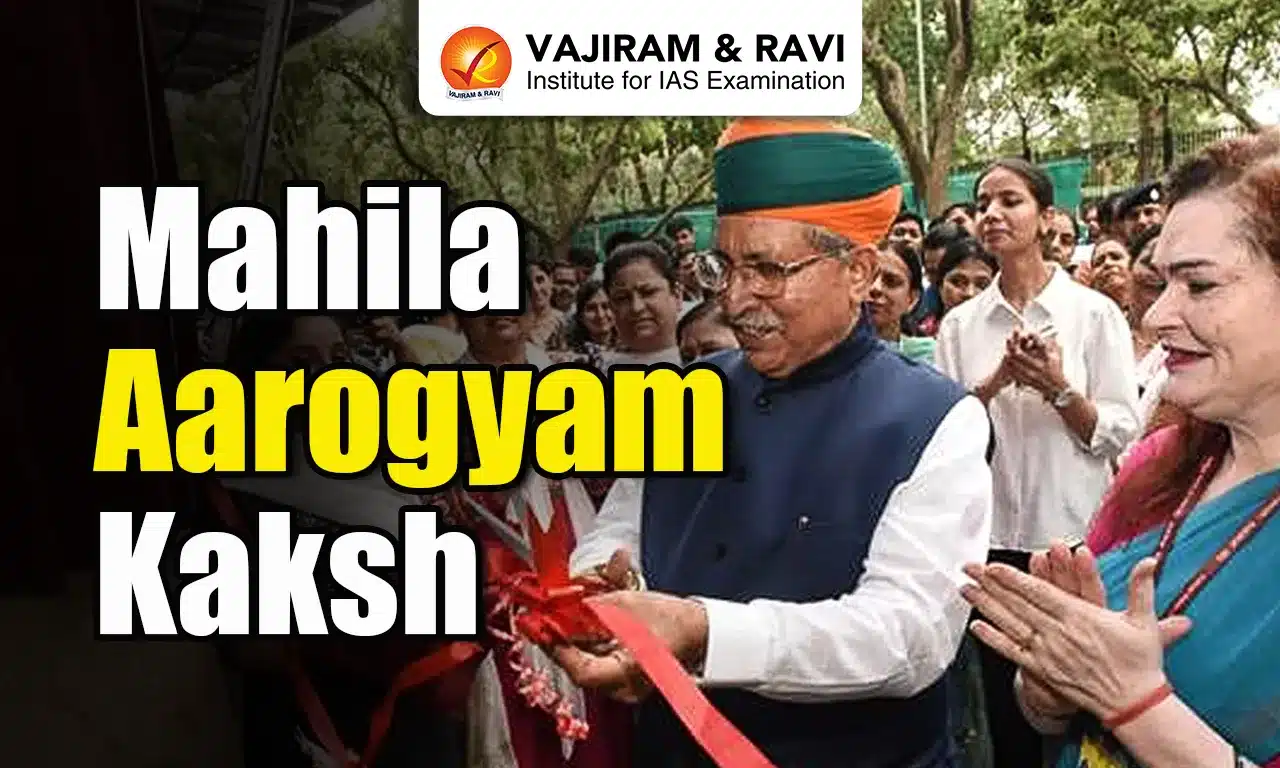
“Mahila Aarogyam Kaksh” (Women’s Health & Wellness Zone) is a pioneering workplace initiative launched by the Department of Legal Affairs, Ministry of Law & Justice, at Shastri Bhawan, New Delhi on 18 July 2025. The facility converts an underused space into a women-only wellness zone with gym equipment and a private lactation room, aiming to institutionalize health, dignity and inclusion for female government employees. The launch was officiated by Union Minister Arjun Ram Meghwal.

Mahila Aarogyam Kaksh

Mahila Aarogyam Kaksh is a dedicated fitness, wellness and support space for women working within government offices. It is designed to address both physical fitness and family-care needs by providing: (a) a women-only gym to promote physical activity and mental well-being; and (b) a private lactation room for nursing mothers to express and store breastmilk in privacy and comfort. The initiative expressly aligns with national drives such as the Fit India Movement and the broader vision of a healthy, inclusive workplace.

Mahila Aarogyam Kaksh Objectives

Mahila Aarogyam Kaksh aims to:

  • Promote physical fitness and mental health among women employees.
  • Institutionalize maternal friendliness at the workplace by offering dedicated lactation facilities and nursing breaks.
  • Improve work-life balance, increase retention of female staff, and reduce stigma around breastfeeding in workplaces.
  • Create a replicable model that other ministries, departments and public institutions can adopt.

Mahila Aarogyam Kaksh Features

The Shastri Bhawan Mahila Aarogyam Kaksh includes several features and accessibilities as mentioned here:

  • A women-only gym area equipped with basic exercise machines and space for yoga or group fitness sessions to support cardiovascular and musculoskeletal health.
  • A private, hygienic lactation room with a comfortable chair, privacy partitioning, and arrangements for temporary milk storage, supporting the Maternity Benefit Act’s provisions and international best practices on breastfeeding at work.
  • Signage, information materials, and guidance on nutrition, maternal health, and workplace mental health.
  • Integration with local health outreach (where feasible) for preventive checks and awareness sessions, consistent with Government advisories on workplace gender-friendly infrastructure.

Mahila Aarogyam Kaksh Policy

Mahila Aarogyam Kaksh rests on a strong policy and legal foundation:

  • Maternity Benefit (Amendment) Act, 2017: The Act expanded maternity leave and mandates provisions such as nursing breaks and crèche facilities for establishments with 50 or more employees, establishing the legal case for lactation spaces and childcare infrastructure at workplaces. Mahila Aarogyam Kaksh operationalizes these obligations in a government office.
  • Government advisories on gender-friendly workplace spaces: Recent government guidance (Ministries & Departments advisory) recommends allocating space for feeding rooms, restrooms, yoga rooms and crèches in public buildings, Mahila Aarogyam Kaksh follows this blueprint.
  • Supreme Court guidance (2025): The Supreme Court has emphasized that breastfeeding in public and the workplace should not carry stigma and has urged appropriate infrastructure, reinforcing the rationale for protected lactation rooms.
  • National & international best practice guidance: WHO/UNICEF and ILO recommend workplace breastfeeding support and private lactation rooms, citing benefits for maternal and child health and for employee retention. Mahila Aarogyam Kaksh aligns with these global standards.

Mahila Aarogyam Kaksh Shastri Bhawan Implementation

The Department of Legal Affairs converted an unused garage into the Mahila Aarogyam Kaksh, illustrating a low-cost, high-impact repurposing strategy. The inauguration press release and media coverage highlight:

  • Leadership & ownership: Initiative led by the Department of Legal Affairs under the Ministry of Law & Justice, inaugurated by Union Minister Arjun Ram Meghwal.
  • Facilities: Gym equipment for women, private lactation room for nursing mothers, informational displays on wellbeing, and provisions for routine fitness activities or sessions.
  • Intended outcomes: Normalize breastfeeding at workplaces, reduce barriers for women returning from maternity leave, and encourage other ministries to replicate the model.

This makes Shastri Bhawan an early adopter and model site for public-sector workplace wellness.

Mahila Aarogyam Kaksh Benefits

The expected outcome and benefits of the Mahila Aarogyam Kaksh are:

  1. Health and productivity gains: Regular physical activity improves cardiovascular and mental health, which can lower absenteeism and enhance productivity. The facility makes fitness accessible during the workday.
  2. Support for breastfeeding & infant nutrition: Provision of lactation rooms supports exclusive breastfeeding practices recommended by WHO/UNICEF, with health benefits for infants and mothers. Workplace support increases breastfeeding duration and reduces infant morbidity.
  3. Retention of female employees: By addressing childcare and breastfeeding needs, workplaces can improve retention rates for women after maternity leave, an objective consistent with the Maternity Benefit law and labour studies.
  4. Cultural change: Visible, institutionalized support reduces stigma around breastfeeding and normalizes women’s health needs in professional spaces. The Supreme Court’s 2025 guidance underscores the social importance of such steps.
  5. Scalability: The repurposing model, converting unused space into wellness rooms, is low-cost and can be scaled across central and state government buildings and public sector undertakings. 

Mahila Aarogyam Kaksh Challenges

The Mahila Aarogyam Kaksh faces several challenges and criticism for various reasons as listed below along with their suggested reforms:

  1. Space & retrofitting constraints: Not all offices have spare space; retrofitting may require capital and design input to ensure privacy and hygiene. Practical guidance (UNICEF/WHO) should be followed for safe lactation facilities.
  2. Maintenance & hygiene: Regular cleaning, secure milk storage (where provided), and upkeep of gym equipment are vital. Departments must budget for recurring maintenance.
  3. Usage norms & scheduling: Clear usage protocols, booking systems for lactation rooms and time slots for fitness areas, are needed to prevent conflicts and ensure equitable access.
  4. Awareness & culture change: Infrastructure alone is insufficient; awareness drives and sensitization of all staff are required to remove stigma and ensure respectful use. The Supreme Court and central advisories call for such cultural shifts.
  5. Extending benefits to contractual staff: Ensuring that contractual/outsourced women staff (common in government offices) have equal access requires policy clarity and enforcement under labour laws.

Scalability and Policy Recommendations:

  1. Adopt a Ministry-wide policy: Central ministries should issue internal circulars to institutionalize Mahila Aarogyam Kaksh as a standard feature in buildings employing women staff. This can mirror the Ministry advisory recommending feeding rooms, crèches and yoga spaces.
  2. Minimum standards & technical guidelines: Use WHO/UNICEF guidance for lactation rooms and national labour rules (Maternity Benefit Act) to set minimum specs, privacy, seating, ventilation, and sanitary disposal.
  3. Budgeting & maintenance plans: Departments should allocate small recurring budgets for cleaning, minor repairs, and equipment replacement, costs are modest compared to benefits in retention and morale.
  4. Monitoring & reporting: Include workplace wellbeing indicators (number of lactation-room users, session attendance, employee satisfaction) in employee welfare reports.
  5. Extend to the wider public sector and private employers: Encourage PSUs, state departments and large private employers to replicate the model, linked to corporate social responsibility and women-friendly workplace certification initiatives.
  6. Training & sensitization: Regular gender-sensitivity workshops help normalize breastfeeding and support women’s health needs at work. This aligns with court guidance and ministry advisories. 

Mahila Aarogyam Kaksh UPSC

Mahila Aarogyam Kaksh is a practical, rights-based step to make workplaces more inclusive for women. By combining fitness, lactation support and awareness, it operationalizes legal obligations (Maternity Benefit law) and international best practices (WHO/UNICEF). If replicated across government and large workplaces, it can meaningfully support women’s health, workplace continuity and gender equality in employment.

Mahila Aarogyam Kaksh FAQs

Q1: What is Mahila Aarogyam Kaksh?

Ans: It is a dedicated women’s wellness zone in government offices that provides a women-only gym and a private lactation room to support health, fitness and maternal needs at the workplace.

Q2: Who launched the Mahila Aarogyam Kaksh initiative?

Ans: The first Mahila Aarogyam Kaksh was launched by the Department of Legal Affairs, Ministry of Law & Justice, and inaugurated by Union Minister Arjun Ram Meghwal.

Q3: What facilities are available inside Mahila Aarogyam Kaksh?

Ans: It typically includes a fitness area with exercise equipment, a separate lactation room with privacy, and informational material on women’s health and wellness.

Q4: Why is a lactation room important in workplaces?

Ans: A lactation room allows nursing mothers to express milk privately, fulfilling the Maternity Benefit Act’s provisions and supporting WHO-recommended breastfeeding practices.

Q5: Can other government departments adopt the Mahila Aarogyam Kaksh model?

Ans: Yes, the initiative is designed to be replicated across ministries, PSUs and public offices by converting unused spaces into functional women-friendly wellness zones.

United Nations Environment Programme (UNEP), Headquarter, Established

United Nations Environment Programme

The United Nations Environment Programme (UNEP) is the principal global institution responsible for coordinating the environmental activities of the United Nations. It plays a central role in shaping the global environmental agenda, supporting sustainable development, and assisting nations in adopting sound environmental policies. Over the decades, UNEP has contributed significantly to addressing climate change, biodiversity loss, pollution, and the conservation of fragile ecosystems such as wetlands, forests, and marine systems.

This article provides a comprehensive UPSC-friendly overview of UNEP, its history, mandate, structure, functions, programmes, and major global reports.

United Nations Environment Programme (UNEP)

UNEP stands for the United Nations Environment Programme, which acts as the environmental pillar of the UN system. It leads global environmental governance and supports countries in meeting environmental targets under frameworks like the 2030 Agenda for Sustainable Development, the Paris Agreement, and biodiversity conventions.

Key points:

  • UNEP formulates global environmental strategies and supports their implementation.
  • It is the authoritative entity for global environmental monitoring and advocacy.
  • UNEP works closely with governments, NGOs, scientists, private sectors, and civil bodies to address environmental risks.
  • Headquarters: Nairobi, Kenya.
  • Current Head: Executive Director appointed by the UN Secretary-General (UPSC may ask the name in prelims).

United Nations Environment Programme (UNEP) Historical Background

Growing industrialisation and pollution in the 1960s prompted global concern regarding environmental degradation. To discuss these issues, the United Nations Conference on the Human Environment was held in Stockholm in 1972, a landmark global environmental summit.

Important developments from the Stockholm Conference:

  • Adoption of the Stockholm Declaration framing 26 environmental principles.
  • Establishment of a dedicated body for global environmental governance: UNEP.
  • Recognition of the environment as a shared global responsibility.
  • UNEP became the first UN agency headquartered in a developing country, highlighting environmental issues of the Global South.

United Nations Environment Programme (UNEP) Objectives

UNEP’s mandate revolves around promoting environmental sustainability globally.

Major Objectives

  • Coordinate global responses to environmental challenges.
  • Support countries in environmental planning, policy-making, and capacity building.
  • Promote sustainable development by integrating environmental considerations into economic and social planning.
  • Facilitate international environmental treaties, negotiations, and scientific assessments.
  • Address pollution, resource depletion, climate change, and biodiversity loss.

United Nations Environment Programme (UNEP) Structure

UNEP operates through a well-defined structure designed to ensure broad participation and effective policy implementation.

  1. United Nations Environment Assembly (UNEA): UNEA is the world’s highest-level decision-making body on environmental issues, comprising all UN member states. It meets biennially to set global priorities, adopt resolutions, and guide UNEP’s overall policy direction. The inclusive structure ensures equal representation from developing and developed nations.
  2. Committee of Permanent Representatives (CPR): The CPR acts as the main advisory body to UNEA and helps in preparing its agenda. It consists of accredited diplomats based in Nairobi and ensures the smooth functioning of UNEP activities throughout the year.
  3. Secretariat: The UNEP Secretariat, led by the Executive Director, implements UNEA decisions and oversees day-to-day operations. It coordinates with governments, NGOs, research organisations, and regional offices across the world to execute environmental programmes.
  4. Regional and Thematic Offices: UNEP functions through multiple regional offices in Asia-Pacific, Africa, Europe, Latin America, West Asia, and North America. These offices ensure that environmental initiatives address region-specific priorities and challenges.

United Nations Environment Programme (UNEP) Functions

UNEP performs several critical functions that shape global environmental governance:

Develops and supports global environmental treaties, such as the CBD, CITES, and Minamata Convention.

  • Hosts secretariats of major environmental conventions and supports the negotiation of new environmental agreements.
  • Publishes authoritative research and assessments, including the Global Environment Outlook and Emissions Gap Report.
  • Supports developing countries with environmental capacity building, funding, and technical assistance.
  • Promotes environmental awareness through campaigns and educational programmes targeting youth and civil society.
  • Coordinates global responses to environmental emergencies, pollution, and natural disasters.
  • Advances global guidelines and frameworks on chemicals, waste management, and environmental standards.
  • Collaborates with governments and NGOs to ensure environmental policies are implemented effectively.

United Nations Environment Programme (UNEP) Initiatives

  1. Clean Up the World (1993): This initiative mobilises volunteers globally to clean parks, water bodies, streets, and public spaces. It encourages local communities to adopt sustainable waste management practices and promotes environmental activism at the grassroots level.
  2. Billion Tree Campaign (2006): Launched to combat deforestation and climate change, this campaign aimed at planting billions of trees worldwide. It encouraged nations, communities, and individuals to undertake reforestation and promote ecosystem restoration.
  3. Seal the Deal (2009): A global campaign aimed at encouraging world leaders to finalise a legally binding climate agreement during the Copenhagen Summit. It mobilised public support for strong global action on climate change.
  4. APELL (Awareness and Preparedness for Emergencies at Local Level): APELL enhances local community preparedness for industrial accidents, chemical leaks, and environmental emergencies. It was developed after several industrial disasters highlighted the need for strong emergency planning.
  5. TUNZA Youth Programme: This initiative engages youth through environmental education, competitions, leadership programmes, and global summits. It encourages young people to contribute to environmental protection and sustainability.
  6. Faith for Earth Initiative: Launched in 2017, this programme connects religious organisations with global environmental action. It recognises the power of faith leaders in mobilising public support for eco-friendly lifestyles and sustainable development.
  7. UN-REDD Programme: A collaborative programme with FAO and UNDP, aimed at reducing emissions from deforestation and forest degradation. It supports forest conservation and sustainable land-use practices.
  8. Global Peatlands Initiative: Works to protect peatlands, which are among the largest natural carbon sinks. It aims to reduce emissions caused by peatland degradation.
  9. Greening the Blue: Aims to make the UN’s internal operations environmentally sustainable by reducing its waste, emissions, and resource consumption.

United Nations Environment Programme (UNEP) Reports Published

  1. Global Environment Outlook (GEO): Provides a comprehensive assessment of the state of the global environment. Released every four years, it highlights emerging challenges, progress made, and policy recommendations.
  2. Emissions Gap Report: Examines the gap between current global emissions and the reductions needed to meet the Paris Agreement targets. It identifies major emitters, their progress, and urgent global actions required.
  3. Adaptation Gap Report: Assesses global progress in climate adaptation and identifies financial, technological, and policy gaps. It helps countries strengthen resilience against climate impacts.
  4. Global Biodiversity Outlook (GBO): Evaluates global biodiversity trends and assesses the implementation of biodiversity targets under the Convention on Biological Diversity.
  5. Global Air Quality Assessment: Analyses global air pollution levels, their health impacts, pollution sources, and offers policy guidance for cleaner air.
  6. Frontiers Report: Highlights emerging environmental challenges such as zoonotic diseases, microplastics, and antimicrobial resistance.
  7. Food Waste Index Report: Measures global food waste and provides strategies for reducing wastage across the food supply chain.

United Nations Environment Programme (UNEP) Conventions

The United Nations Environment Programme (UNEP) plays a central role in hosting and supporting several major global environmental conventions that govern biodiversity, chemicals, waste management, and pollution control. These conventions provide legally binding frameworks for nations to cooperate on protecting ecosystems and regulating harmful environmental practices.

Conventions Hosted by UNEP

  • Convention on Biological Diversity (CBD): Promotes conservation of biodiversity, sustainable use of biological resources, and fair sharing of benefits arising from genetic resources.
  • CITES (Convention on International Trade in Endangered Species of Wild Fauna and Flora): Regulates international trade in endangered species to prevent their exploitation.
  • Minamata Convention on Mercury: Aims to protect human health and the environment from mercury pollution by phasing out mercury use and reducing emissions.

Conventions Supported by UNEP

  • Montreal Protocol & Vienna Convention: Global framework to phase out ozone-depleting substances, widely regarded as the most successful environmental treaty.
  • Basel Convention: Controls transboundary movement and disposal of hazardous waste.
  • Stockholm Convention: Eliminates or restricts persistent organic pollutants (POPs).
  • Rotterdam Convention: Promotes prior informed consent in the trade of hazardous chemicals and pesticides.
  • UNFCCC (United Nations Framework Convention on Climate Change): UNEP provides scientific and technical support to climate processes.
  • UNCCD (United Nations Convention to Combat Desertification): Supports global efforts to prevent land degradation and desertification.

United Nations Environment Programme (UNEP) UPSC

India collaborates extensively with United Nations Environment Programme (UNEP) on climate policy, biodiversity conservation, waste management, and circular economy initiatives. India hosted World Environment Day 2018, focusing on Beat Plastic Pollution. India also participates in UNEP’s resource efficiency projects, sustainable finance dialogues, and ecosystem restoration programmes. UNEP supports India’s environmental legislation, national action plans, and green technology initiatives through various collaborations.

United Nations Environment Programme (UNEP) FAQs

Q1: What is UNEP?

Ans: The United Nations Environment Programme (UNEP) is the leading global authority on environmental issues, responsible for coordinating environmental activities within the UN system.

Q2: When was UNEP established?

Ans: UNEP was established in 1972 following recommendations from the Stockholm Conference on the Human Environment. It was created to provide a coordinated global response to emerging environmental crises.

Q3: Where is UNEP headquartered?

Ans: UNEP’s headquarters is located in Nairobi, Kenya. It is the only major UN agency headquartered in a developing country, promoting a balanced global approach to environmental issues.

Q4: What is the main objective of UNEP?

Ans: Its main goal is to promote environmental sustainability by guiding global policy, supporting treaties, and providing solutions to climate change, biodiversity loss, pollution, and resource management.

Q5: What is the UNEA?

Ans: The United Nations Environment Assembly (UNEA) is the world’s highest decision-making body on environmental matters. It brings together all UN member states to adopt resolutions and set global environmental priorities.

Ek Bharat Shreshtha Bharat Abhiyan, Objectives, Implementation, Impact

Ek Bharat Shreshtha Bharat Abhiyan

Ek Bharat Shreshtha Bharat (EBSB) is a flagship Government of India initiative launched to strengthen the spirit of national integration through sustained people-to-people engagement across States and Union Territories (UTs). By pairing different States/ UTs for cultural, linguistic, educational, and touristic exchange, the Abhiyan seeks to celebrate India’s unity in diversity and promote mutual understanding. This initiative fosters long-term cooperation, helping citizens appreciate cultural pluralism while reinforcing national cohesion.

Ek Bharat Shreshtha Bharat Abhiyan

Ek Bharat Shreshtha Bharat (translated as “One India, Best India”) is a structured scheme initiated by the Government of India, first mooted by Prime Minister Narendra Modi on 31st October 2015, on Rashtriya Ekta Divas (National Unity Day), commemorating Sardar Vallabhbhai Patel. 

Under this programme, all 36 States and UTs are paired for a year-long engagement cycle, during which the paired regions collaborate across multiple domains- culture, language, literature, cuisine, festivals, tourism, sports, and more. The Ministry of Education, along with other Central ministries such as Culture, Tourism, Youth Affairs, Sports, Home Affairs, and Railways, coordinates the activities. 

Ek Bharat Shreshtha Bharat Abhiyan Objectives

The key objectives and ambition of the Ek Bharat Shreshtha Bharat Abhiyan has been listed below:

  1. National Integration: Promote a sense of shared identity by connecting citizens of different states through cultural and linguistic exchange.
  2. Cultural Exchange: Facilitate people-to-people contact to appreciate each other’s traditions, art, festivals, and cuisine.
  3. Tourism Promotion: Encourage tourism by showcasing the tourist heritage of paired states.
  4. Educational Linkages: In schools and colleges, students participate in inter-state exchanges, promote bilingual learning, and share best practices.
  5. Sustainable Engagement: Maintain long-term relationships between regions, leveraging both government and community participation.

Ek Bharat Shreshtha Bharat Abhiyan Process

Ek Bharat Shreshtha Bharat pairs states/UTs in specific combinations, ensuring cultural and geographic diversity in each pairing. Some of the notable pairings include:

  • Jammu & Kashmir & Ladakh paired with Tamil Nadu
  • Andhra Pradesh with Punjab
  • Himachal Pradesh with Kerala
  • Maharashtra with Odisha, Goa with Jharkhand, and Delhi with Sikkim

These pairings rotate and evolve, with activity calendars jointly prepared by the paired regions for year-long engagement. 

Ek Bharat Shreshtha Bharat Abhiyan Components

Under Ek Bharat Shreshtha Bharat Abhiyan, the following key domains of interaction are promoted:

  1. Cultural Exchange: Joint celebrations of festivals, cultural performances, dance, music, and arts from paired states.
  2. Educational Exchange: Schools and colleges adopt art-integrated projects, inter-state student visits, and language-learning activities. Over 2.5 crore students have participated in EBSB activities at school level (2022) and 3.8 lakh EBSB clubs have been formed across CBSE, KVS, NVS, and other schools.
  3. Sports Exchange: Sporting events between paired states, such as roll ball, handball, etc., to foster friendly competition.
  4. Tourism & Cuisine: Promotion of tourism through inter-state travel and showcasing local cuisines.
  5. Literary & Linguistic Exchange: Literary competitions, language workshops, and book translation to deepen mutual appreciation.
  6. Governance and Best Practices Sharing: Paired states exchange governance models, development strategies, and administrative innovations.

Ek Bharat Shreshtha Bharat Abhiyan Implementation

The Revised Guidelines (August 2025) for Ek Bharat Shreshtha Bharat Abhiyan in schools emphasize a structured, measurable implementation. 

  • Monitoring: District Education Officers act as nodal officers to collect data on monthly activities and upload reports to the EBSB portal.
  • Reporting: Schools collect photos, short videos, and reports of events, and upload them.
  • Central Oversight: The Department of School Education & Literacy and Central Ministries jointly review paired-state activities annually. 

Ek Bharat Shreshtha Bharat Abhiyan Impact

Since the inception of Ek Bharat Shreshtha Bharat Abhiyan, it has shown several impacts and outcomes as:

  • All 36 States/ UTs have been paired for inter-state engagement. 
  • In 2022, about 2.5 crore students participated in school-level EBSB activities. 
  • 3.8 lakh EBSB clubs have been created across CBSE, KVS, NVS, and other schools.
  • The Centre for Cultural Resources and Training (CCRT) organizes orientation courses under EBSB to train teachers and cultural ambassadors, aligning with NEP-2020. 
  • Youth Engagement: In 2025, the national integration camp in Tripura was conducted under the EBSB theme, promoting leadership, cultural exchange, and social harmony among young Scouts & Guides. 

Ek Bharat Shreshtha Bharat Abhiyan Achievements

Since its implementation the EBSB Abhiyan has shown several achievements:

  1. Strengthened National Unity: By pairing regions with very different languages and cultures, EBSB fosters empathy, understanding, and respect.
  2. Educational Enrichment: Through peer learning and shared cultural projects, students understand the diversity of India and build a pan-Indian identity.
  3. Youth Leadership: Sporting and cultural exchanges empower young people as ambassadors of national integration.
  4. Linguistic Preservation: Exchange programs encourage the appreciation of regional languages, helping preserve linguistic heritage.
  5. Cultural Tourism: Encourages states to promote their tourism circuits based on cultural ties, boosting the economy and tourism.
  6. Institutionalization: EBSB is embedded in the education system (school clubs, reporting system) ensuring sustainability.

Ek Bharat Shreshtha Bharat Abhiyan Challenges

Despite several advancements and progress, the Ek Bharat Shreshtha Bharat Abhiyan faces several criticism and challenges:

  • Sustaining Engagement: Once-yearly pairing may not build deep, sustained relationships; there is a risk of tokenistic cultural exchanges.
  • Unequal Participation: Not all States/UTs may have the same capacity or enthusiasm to engage, especially in remote or less-resourced areas.
  • Measurement of Impact: While activity numbers are tracked, measuring true attitudinal change (unity, understanding) is harder.
  • Digital Divide: Uploading reports, photos, and data requires digital access; remote schools may lag in participation.
  • Overlapping Programmes: With many government programs, EBSB's identity sometimes overlaps with other integration schemes, diluting focus.

Way Forward:

  • Deepening Partnerships: Encourage long-term “twinning” projects between paired states beyond one year, including shared infrastructure, youth forums, and governance models.
  • Enhanced Monitoring & Evaluation: Develop impact metrics (surveys, attitudinal studies) to assess change in national integration, not just event participation.
  • Inclusive Participation: Provide additional support to under-resourced states/UTs (funding, digital tools) to ensure full engagement.
  • Digital Strengthening: Expand the EBSB portal to include mobile-friendly reporting, virtual exchanges, and virtual cultural tours.
  • Synergies with Other Schemes: Align EBSB with NEP-2020, Aman Bharat, and tourism promotion schemes to maximize synergy and policy coherence.
  • Youth Mentorship: Launch cross-state youth leadership programs to nurture long-term ambassadors who will carry forth national integration.

Ek Bharat Shreshtha Bharat Abhiyan UPSC

Ek Bharat Shreshtha Bharat is more than a symbolic initiative; it is a structural attempt to weave India’s rich diversity into a cohesive national identity. By pairing States and UTs and promoting systematic cultural, educational, and social exchanges, EBSB creates a platform for India’s citizens to understand each other deeply. In an era of rapid change and global uncertainty, such initiatives help build a more unified, resilient, and inclusive India.

  • In August 2025, the Ministry of Education issued revised EBSB guidelines to strengthen school-level coordination and digital reporting mechanisms.
  • At the Akhil Bharatiya Shiksha Samagam 2025, under the NEP-2020, the Bhasha Sagar App was launched to facilitate multilingual learning across India as part of EBSB.
  • Cultural events under EBSB continue in 2025: The National Integration Camp in Tripura emphasized youth participation and inter-state mutual understanding.

Ek Bharat Shreshtha Bharat Abhiyan FAQs

Q1: What is the main goal of Ek Bharat Shreshtha Bharat Abhiyan?

Ans: To foster national integration by encouraging structured cultural and people-to-people engagement across Indian states and UTs.

Q2: How are States and UTs paired under Ek Bharat Shreshtha Bharat Abhiyan?

Ans: All 36 States/UTs are paired in matched combinations. e.g., Himachal Pradesh - Kerala; Maharashtra - Odisha.

Q3: Which sectors does Ek Bharat Shreshtha Bharat Abhiyan cover?

Ans: Education, culture, sports, tourism, language, literature, cuisine, and heritage exchanges.

Q4: How many students participate in Ek Bharat Shreshtha Bharat Abhiyan school-level activities?

Ans: In 2022, nearly 2.5 crore students took part, and 3.8 lakh EBSB clubs were formed.

Q5: How is Ek Bharat Shreshtha Bharat Abhiyan monitored and reported?

Ans: Through a dedicated portal where district nodal officers upload monthly reports, photos, and activity data.

Mudh-Nyoma Airbase

Mudh-Nyoma Airbase

Mudh-Nyoma Airbase Latest News

Chief of the Air Staff Air Chief Marshal AP Singh recently inaugurated the Mudh-Nyoma airbase in Ladakh by landing a C-130J special operations aircraft there.

About Mudh-Nyoma Airbase

  • It is an Indian Air Force (IAF) base located in Nyoma, in southeastern Ladakh.
  • It is located at a height of 13,700 feet and is 23 km from the contested Line of Actual Control (LAC) with China. 
  • Nyoma is the fourth IAF base in Ladakh, the highest airfield in the country, and the fifth highest in the world now.
  • It lies close to the southern bank of the Pangong Tso and earlier had a mud-paved landing ground.
  • The responsibility of upgrading the airbase was entrusted to the Border Roads Organisation (BRO). The work began in September 2023.
  • It underwent a ₹230 crore upgrade, which included extending the original airstrip into a 2.7 km ‘rigid pavement’ runway, a new ATC complex, hangars, a crash bay, and accommodation.
  • The airfield is designed to house a number of military unmanned, rotary-wing, fixed-wing aircraft, including heavier transport planes, like the C-17 Globemaster III, and fighter jets, like the Sukhoi-30MKI.
  • The infrastructure at the airbase includes necessary facilities for maintenance and sustaining air and ground crews, essential for operations in a region where winter temperatures can plummet to below minus 20°C. 

Source: HT

Mudh-Nyoma Airbase FAQs

Q1: Mudh–Nyoma Airbase is located in which region of India?

Ans: Southeastern Ladakh

Q2: Mudh–Nyoma Airbase is roughly how far from the Line of Actual Control (LAC) with China?

Ans: 23 km

Q3: Which organisation is responsible for upgrading the Mudh–Nyoma Airbase?

Ans: Border Roads Organisation (BRO)

National Database for Emergency Management

National Database for Emergency Management

National Database for Emergency Management Latest News

Recently, the Ministry of Road Transport has made it mandatory for all Detailed Project Reports of highway projects to include analysis using the National Database for Emergency Management (NDEM). 

About National Database for Emergency Management

  • It is a unique Geo-portal to disseminate space-based inputs along with services of forecasting organizations addressing all natural disasters in India.
  • It is a national repository of multi-scale geospatial databases coupled with decision support system tools.
  • It is developed by the Indian Space Research Organisation (ISRO) under the guidance of the National Disaster Management Authority (NDMA).
  • The NDEM portal is maintained by the National Remote Sensing Centre (NRSC).
  • NDEM services have been operationalised since 2013 providing timely information along with disaster specific products for effective decision making.

Key Features of National Database for Emergency Management

  • It provides multi-temporal satellite data and thematic layers that help identify areas vulnerable to floods, landslides, earthquakes, and other natural hazards.
  • It also offers decision-support tools for monitoring and managing such hazards.
  • It is a unique and homogenous database served for the entire country with essential database elements for addressing emergency/disaster management in the country. 
  • It assists the decision makers, disaster management officials of all States/UTs, NDRF/SDRF for preparedness, hazard/risk zonation, damage assessment and emergency response.

Source: NIE

National Database for Emergency Management FAQs

Q1: What is the primary objective of National Database for Emergency Management?

Ans: To create a national repository of geospatial data

Q2: Who maintains National Database for Emergency Management?

Ans: National Remote Sensing Centre

Key Facts about Botswana

Key Facts about Botswana

Botswana Latest News

Recently, India and Botswana formally announced the translocation of eight Cheetahs from the African nation during the State visit of the President of India.

About Botswana

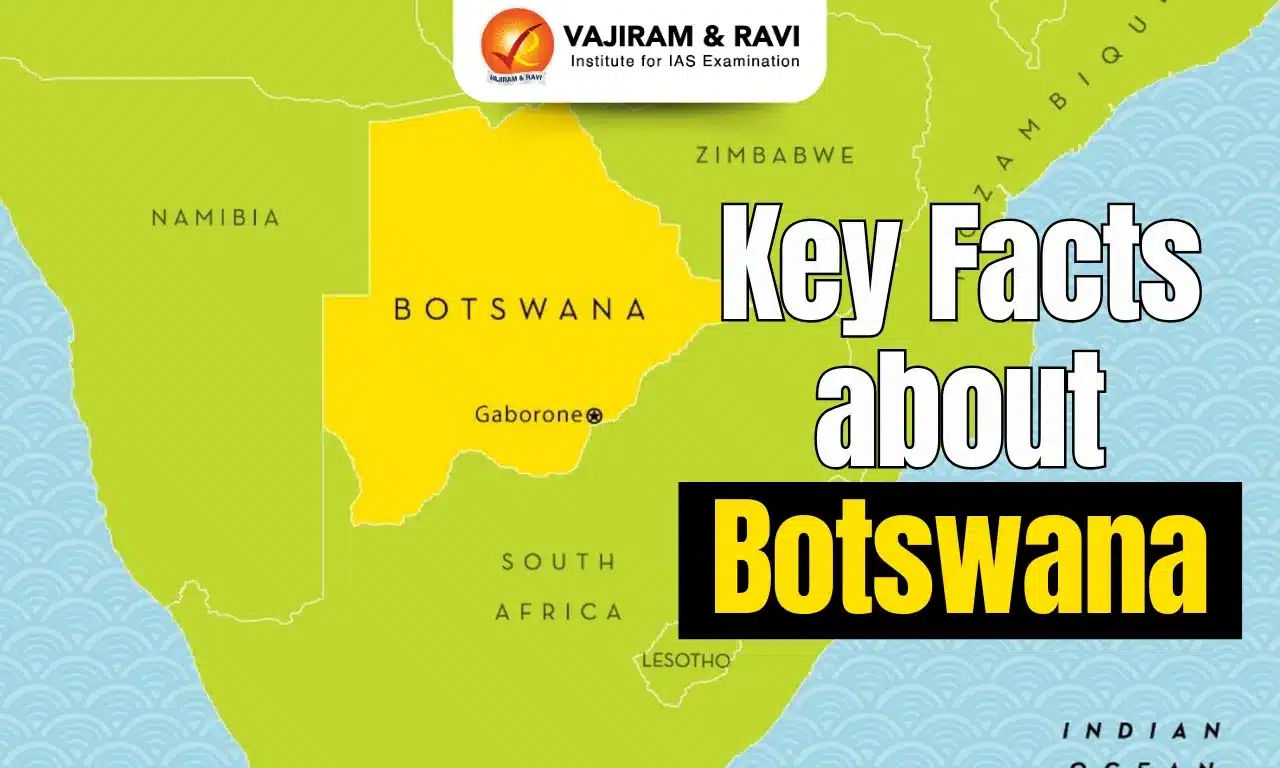
  • It is a landlocked country located in the center of Southern Africa.
  • Bordering Countries: It is bordered by four countries - Namibia to the north and west, South Africa to the south and southeast, Zimbabwe to the northeast, and it also borders Zambia to the north.
  • Botswana is a member of the United Nations, the Commonwealth, the African Union, and the Southern African Development Community.
  • Capital City: Gaborone

Geographical Features of Botswana

  • The country is divided into three main environmental regions.
    • Hardveld Region: It consists of rocky hill ranges and areas of shallow sand cover in eastern Botswana.
    • Sandveld Region: It is the area of deep Kalahari sand covering the rest of the country.
    • Ancient lake beds: It is superimposed on the northern sandveld in the lowest part of the Kalahari Basin.
  • Major Rivers: The main rivers in Botswana are Okavango, Chobe, Limpopo and Molopo.
  • Okavango Delta is one of a very few large inland delta systems without an outlet to the sea, known as an endorheic delta.
  • Desert: The massive Kalahari Desert covers more than 70 percent of Botswana.
  • Climate: It consists of semiarid; warm winters and hot summers
  • Natural Resources: Diamonds, copper, nickel, salt, soda ash, potash, coal, iron ore, silver

Source: TH

Botswana FAQs

Q1: What is the capital of Botswana?

Ans: Gaborone

Q2: What language is mostly spoken in Botswana?

Ans: Setswana

Metformin

Metformin

Metformin Latest News

Metformin may weaken the benefits of exercise, a new study suggests.

About Metformin

  • Metformin (1,1-dimethylbiguanide hydrochloride) is an anti-diabetic medication (biguanide).
  • It is commonly prescribed to help manage type 2 diabetes. 
  • Metformin works in a few different ways to help keep your blood glucose (sugar) from getting too high.
    • Metformin decreases the amount of glucose your body absorbs from things you eat and drink. 
    • Metformin reduces the amount of glucose that your liver makes. 
    • Metformin also helps your body’s own insulin to work better. (Insulin is a hormone that helps your body use glucose as a source of energy.) 
  • It is the most widely used glucose-lowering medication used around the world.
  • Metformin, listed among the World Health Organization’s essential medicines since 2011, is generally safe but may cause mild gastrointestinal upsets, give a metallic taste, or, rarely, may cause lactic acidosis (a buildup of lactic acid in your blood) in kidney-impaired patients.

Source: MNT

Metformin FAQs

Q1: What is metformin used for?

Ans: It is commonly prescribed to help manage type 2 diabetes.

Q2: What is the biggest side effect of metformin?

Ans: Lactic acidosis (a buildup of lactic acid in your blood)

Q3: The risk of Metformin-induced lactic acidosis is higher in which group?

Ans: Kidney-impaired patients.

Mission Sudarshan Chakra, History, Objective, Structure, Deployment

Mission Sudarshan Chakra

Mission Sudarshan Chakra is India’s ambitious next-generation defence initiative aimed at building a multi-layered, AI-enabled, integrated national security shield capable of countering evolving threats ranging from ballistic missiles and hypersonic weapons to drones, swarm attacks, cyber intrusions, and hybrid warfare. Designed by the Defence Research and Development Organisation (DRDO), the mission marks one of India's most transformative military modernisation programmes, combining surveillance, cyber defence, missile interception, space-based monitoring, and offensive strike capabilities into one interlocked system.

Planned to be deployed in stages between 2030 and 2035, Mission Sudarshan Chakra will serve as both a shield and a sword, protecting critical infrastructure while also enabling rapid and precise retaliatory strikes.

Mission Sudarshan Chakra

Mission Sudarshan Chakra represents India’s shift towards a holistic, multi-domain defence ecosystem that integrates land, air, sea, space, and cyber capabilities. Inspired by Lord Krishna’s divine weapon, the system envisions a networked architecture of radars, satellites, sensors, missiles, drones, directed-energy weapons, and AI-driven command systems.

Announced by the Prime Minister on August 15, 2025, the initiative aims to strengthen India’s existing defence assets, such as the Integrated Air Command and Control System (IACCS), Akashteer, and the Trigun system, and unify offensive and defensive layers under one national security umbrella.

Mission Sudarshan Chakra Objectives

Mission Sudarshan Chakra is designed to achieve the following goals:

  • Establish a national multi- domain shield for real-time threat detection, interception, and retaliation.
  • Protect India’s population centres, economic corridors, military bases, and strategic assets.
  • Counter new-age threats such as hypersonic vehicles, swarm drones, loitering munitions, artillery rockets, cyber warfare, and hybrid attacks.
  • Integrate land-based, sea-based, and space-based surveillance systems.
  • Strengthen the existing missile defence ecosystem, including ballistic missile defence readiness.
  • Enhance AI-driven data analysis, predictive threat modelling, and automated battle-management.
  • Promote complete indigenisation under Atmanirbhar Bharat.

Mission Sudarshan Chakra Historical Background

Mission Sudarshan Chakra was formally announced during the Independence Day speech of 2025. The decision was shaped by rising cross-border threats, including:

  • Chinese-origin cyberattacks after the 2020-2021 China-India border tensions.
  • The 2025 Pahalgam attack.
  • Drone and missile attacks targeting sensitive religious sites, including the Golden Temple.
  • Nuclear threats issued by senior Pakistan military leadership.
  • Announcement of Pakistan’s Army Rocket Force.

These events demonstrated the need for an advanced, unified, and automated defence architecture capable of countering multi-vector attacks on India’s growing economic and technological assets.

Mission Sudarshan Chakra Structure

Mission Sudarshan Chakra aims to create a national surveillance and strike network based on AI-enabled analysis, big data processing, and real-time coordination across all military branches. Key Features of the Architecture:

  • Integration of national radars, satellites, and command centers to form a seamless threat-monitoring grid.
  • AI-based threat modelling to predict and neutralize attacks.
  • A surveillance layer covering entire India plus 2,500 km beyond borders.
  • Real-time coordination between the Indian Army, Navy, Air Force, and intelligence agencies.
  • Ability to launch soft kill (jamming) and hard kill (missile interception) responses.
  • Support for hypersonic interceptors with coverage up to 2,500 km and altitude up to 150 km.
  • Nationwide drone-countering systems, laser-based weapons, and directed-energy weapons.
  • Capability to detect and neutralize missiles, drones, artillery shells, and swarm-based threats.

Mission Sudarshan Chakra Components

The major components of the Mission Sudarshan Chakra have been discussed below:

  • Integrated Surveillance Grid
    • Marine, land, aviation, and space-based sensors.
    • Over-the-horizon radars and long-range air surveillance radars.
    • Real-time satellite imagery through Space Based Surveillance (SBS).
    • Continuous monitoring of the Indian mainland and island territories.
  • Multi-layer Interceptor System
    • Hypersonic and ballistic missile interceptors.
    • Short-, medium-, and long-range surface-to-air missiles.
    • Directed-energy weapons and laser-based interceptors.
    • Close-range anti-drone and counter-UAS systems.
  • Centralised AI-enabled Command and Control
    • Automated target allocation using AI and large language models.
    • Integration with IACCS and Akashteer.
    • Real-time battle management and threat prioritisation.
    • Coordination with intelligence agencies and military commands.
  • Integration with Offensive Strike Assets
    • Links with Integrated Rocket Force (IRF).
    • Real-time retaliation capability against hostile launch sites.
    • Use of precision-guided munitions, hypersonic missiles, and DEWs.

Mission Sudarshan Chakra Subsystems

The Sub-system of the Mission Sudarshan Chakra has been given below:

Raksha Kavach

Introduced by DRDO in 2025, Raksha Kavach is a pre-cursor multi-layer defence module consisting of:

  • VSHORAD
  • Dharashakti Electronic Warfare System
  • Arudhra Medium Power Radar
  • QRSAM
  • DRDO AEW&C
  • ATAGS
  • D-4 System
  • Space-based surveillance
  • UAVs
  • Satellite communication systems
  • Ugram assault rifle

How Raksha Kavach Works:

  1. Layer-1: Space-based surveillance identifies threats.
  2. Layer-2: AEW&C aircraft perform extended surveillance.
  3. Layer-3: Ground radars track incoming objects.
  4. Layer-4: Command center activates missiles or jamming systems.
  5. Layer-5: Neutralisation through SAMs, EW systems, or laser-based systems.

Integrated Air Defence Weapon System (IADWS)

Tested on 23 August 2025, this system integrates:

  • QRSAM
  • Advanced VSHORADS
  • 5 kW laser-based directed-energy weapon
  • Centralised Command and Control (C2C2)

The system successfully destroyed multiple UAV and drone targets simultaneously. Key Abilities of the system are:

  • Multi-layer drone and missile defence
  • Real-time battle management
  • Precision interception of cruise missiles, UAVs, and aircraft
  • Multi-target simultaneous engagement

Truck-mounted AK-630

  • High-rate fire 30mm CIWS
  • Used for protecting border and LoC zones against UAVs, rockets, artillery, and mortars
  • Can fire 3,000 rounds per minute
  • Equipped with all-weather electro-optical fire control

Radars and Satellites

Mission Sudarshan Chakra will deploy 6,000-7,000 radars, connected to:

  • Space-based early warning satellites
  • Over-the-horizon radars
  • Airborne warning platforms

The combined grid will provide deep visibility into hostile territories.

Mission Sudarshan Chakra Deployment

The Mission Sudarshan Chakra Planning and Deployment has been discussed here. A high-level committee established in 2025 is preparing a detailed roadmap.

Timeline of the Mission Sudarshan Chakra:

  • Phase-1 (2030)- Foundational grid, initial interceptor systems, and AI-command modules.
  • Phase-2 (2035)- Full-spectrum national shield with upgraded hypersonic interceptors and expanded satellite network.

Priority Areas for Deployment:

  • Nuclear power plants
  • ISRO facilities
  • Industrial corridors
  • Financial centers
  • Forward bases and border infrastructure

Mission Sudarshan Chakra International Collaboration

Russia has expressed support and readiness to collaborate with India on Mission Sudarshan Chakra (August 2025 briefing by Russian chargé d’affaires Roman Babushkin). However, the programme remains fundamentally indigenous under Atmanirbhar Bharat.

Mission Sudarshan Chakra Budget

The expected requirements include:

  • ₹130,000-₹170,000 crore for complete implementation
  • ₹25,000 crore annually for operations

Military analysts recommend balanced planning due to the significant financial outlay, suggesting a phased and strategic deployment focusing on high-risk zones first.

Mission Sudarshan Chakra Challenges

Despite of several advancements and progress, the Mission Sudarshan Chakra faces several backlashes and criticism:

  1. High Financial Cost
    • Challenge: Massive capital and operational expenses.
    • Way Forward: Phased implementation focused on high-priority regions first.
  2. Technology Integration Complexity
    • Challenge: Integrating radars, satellites, sensors, and weapons across services.
    • Way Forward: Develop unified, interoperable standards within DRDO and defence forces.
  3. Multi-domain Data Overload
    • Challenge: Managing large volumes of real-time data.
    • Way Forward: Expand AI-driven analytics and quantum computing capacity.
  4. Indigenous Capability Gaps
    • Challenge: Limited domestic production of advanced systems. 
    • Way Forward: Expand private-sector collaboration and R&D incentives.
  5. Cybersecurity Vulnerabilities
    • Challenge: AI-enabled systems are high-value cyber targets. 
    • Way Forward: Build advanced cyber hardening, zero-trust architectures, and redundant backups.
  6. Rapidly Evolving Threats
    • Challenge: Hypersonic and autonomous weapons evolve fast. 
    • Way Forward: Continuous upgrades through adaptive design and modular components.
  7. Workforce and Skill Deficit
    • Challenge: Need for specialists in AI, quantum tech, and EW systems. 
    • Way Forward: Dedicated defence-tech training and academic partnerships.
  8. Inter-Agency Coordination
    • Challenge: Synchronising military, intelligence, and research bodies. 
    • Way Forward: Strengthen centralised command mechanisms with clear protocols.
  9. Space-based Limitations
    • Challenge: Growing dependency on satellites. 
    • Way Forward: Harden space assets and expand redundancy through multiple platforms.
  10. Border and Terrain Challenges
    • Challenge: Difficult terrain for deployment across Himalayas and coasts. 
    • Way Forward: Use drones, aerostats, and high-altitude radars for extended monitoring.

Mission Sudarshan Chakra UPSC

Mission Sudarshan Chakra represents a historic leap in India’s defence modernisation, transforming the nation’s security paradigm through integrated surveillance, AI-enabled warfighting, and multi-layered missile defence. Once fully operational by 2035, it will provide India with an unprecedented defence shield, countering threats across land, air, sea, space, and cyberspace while ensuring that India remains prepared for future challenges in an evolving global security environment.

Mission Sudarshan Chakra FAQs

Q1: What is Mission Sudarshan Chakra?

Ans: Mission Sudarshan Chakra is an initiative aimed at modernising and strengthening India’s border infrastructure through technology-driven systems.

Q2: Why was Mission Sudarshan Chakra launched?

Ans: Mission Sudarshan Chakra was launched to improve surveillance, border security, and rapid response capabilities across sensitive border regions.

Q3: Which agency implements Mission Sudarshan Chakra?

Ans: Mission Sudarshan Chakra is implemented by the Border Security Force with support from central security and infrastructure bodies.

Q4: What technologies are used under Mission Sudarshan Chakra?

Ans: Mission Sudarshan Chakra uses smart fencing, sensors, high-tech cameras, command-and-control systems, and advanced communication tools.

Q5: How will Mission Sudarshan Chakra benefit border management?

Ans: Mission Sudarshan Chakra will strengthen real-time monitoring, reduce infiltration risks, and support faster decision-making for border forces.


ESCAPEDE Mission

ESCAPEDE Mission

ESCAPEDE Mission Latest News

Recently, Blue Origin has successfully launched Nasa’s highly anticipated Escapade mission to Mars.

About ESCAPEDE Mission

  • The ESCAPADE (Escape and Plasma Acceleration and Dynamics Explorers) mission is the first coordinated multi-spacecraft orbital science mission to Mars.
  • Its twin orbiters are known as Blue and Gold which will take simultaneous observations from different locations around Mars.
  • It is part of NASA’s SIMPLEx (Small Innovative Missions for Planetary Exploration) program.
  • This mission has chosen ‘launch and loiter’ strategy
    • It means the satellites will launch from Earth toward the Lagrange 2 Point (L2), a point in space where the balance of Earth and Sun’s gravitational pull ensures that a spacecraft stays put.
    • The spacecraft will stay loiter at L2 until the apt window for Mars travel opens up, and then it will move toward Mars in late 2026.

Objectives of ESCAPEDE Mission

  • It will reveal the planet’s real-time response to space weather and how the Martian magnetosphere changes over time,
  • These spacecraft will travel to Mars to study the interaction between solar wind, streams of charged particles from the Sun, and the Martian magnetic field.
  • Understanding how solar wind strips Mars of its atmosphere is critical for planetary science and future human exploration.

Source: India Today

ESCAPEDE Mission FAQs

Q1: What is the primary objective of the ESCAPADE Mission?

Ans: To investigate Mars' hybrid magnetosphere and atmospheric escape.

Q2: Which organization is leading the ESCAPADE Mission?

Ans: UC Berkeley's Space Sciences Laboratory

Hydrogen Valley Innovation Clusters

Hydrogen Valley Innovation Clusters

Hydrogen Valley Innovation Clusters Latest News

Recently, the union Minister of State (Independent Charge) for Science and Technology announced that four Hydrogen Valley Innovation Clusters (HVICs) are being developed across the country.

About Hydrogen Valley Innovation Clusters

  • These are being developed across the country to demonstrate the full green hydrogen value chain — from production and storage to transport and utilization.
  • Funding: Total investment of ₹485 crore.
  • The HVIC project is aimed at “building a local hydrogen ecosystem by connecting supply and demand across sectors like transport, industry, and energy, while also fostering research, innovation, and skills.
  • These clusters were originally conceptualized by the Department of Science and Technology, and now integrated under National Green Hydrogen Mission (NGHM).
  • These four Hydrogen Valleys are coming up in Pune, Jodhpur, Bhubaneshwar and Kerala. 

What is Green Hydrogen?

  • Green Hydrogen is produced using renewable energy, such as solar or wind power, instead of fossil fuels.
  • In this process water is split into hydrogen and oxygen through electrolysis, using electricity from solar panels or wind turbines.
  • According to standards notified by Govt of India, Hydrogen made this way is considered “green” if the total emissions from the process are very low, not more than 2 kg of CO₂ equivalent for every 1 kg of Hydrogen produced.
  • Green Hydrogen can also be produced by converting biomass (like agricultural waste) into hydrogen, as long as emissions remain below the same limit.

Source: PIB

Hydrogen Valley Innovation Clusters FAQ's

Q1: What is the primary objective of Hydrogen Valley Innovation Clusters ?

Ans: To develop green hydrogen production and usage.

Q2: Which ministry has released revised guidelines for setting up HVICs?

Ans: Ministry of New and Renewable Energy

Omen Drone

Omen Drone

Omen Drone Latest News

America's Anduril and the UAE's state-owned defence conglomerate, EDGE Group, will jointly develop the Omen drone at a new, 50,000 square feet (4,645 square metres) research centre in Abu Dhabi.

About Omen Drone

  • It is a new tail-sitting vertical takeoff and landing drone with a hybrid-electric propulsion system. 
  • It will be developed by America's Anduril and the UAE's state-owned defence conglomerate, EDGE Group.
  • It is intended to be modular and adaptable to a wide array of military and non-military missions. 
  • The Omen drone is designed to complement larger systems in tactical roles such as maritime surveillance, critical infrastructure protection, and persistent ISR coverage over choke points and coastal areas. 

Omen Drone Features

  • Omen is a twin-rotor aircraft that takes off from and lands in a tail-sitting position, where it stands about 10 feet tall. 
  • It features relatively long and slender main wings, mounted toward the rear of the fuselage, together with canard foreplanes on either side of the nose. 
  • It also has a twin-boom tail configuration extending from the rear of the nacelles on each wing.
  • It is compact, foldable, and transportable by a two-person team without heavy infrastructure, allowing deployment from rough terrain or forward sites.
  • It is designed to switch between two flight modes: it can take off, hover, and land vertically like a drone or helicopter but can also transition to airplane-style flight for longer and faster missions. 
  • Its open architecture supports modular payloads like electro-optical or infrared sensors and communication relays.

Source: TH

Omen Drone FAQs

Q1: The Omen drone is being jointly developed by which two entities?

Ans: America's Anduril and the UAE's state-owned defence conglomerate, EDGE Group.

Q2: The Omen drone takes off and lands in what configuration?

Ans: Tail-sitting vertical mode.

Q3: Which capability allows the Omen drone to perform longer, faster missions?

Ans: Transition to airplane-style flight.

Invar Missile

Invar Missile

INVAR Missile Latest News

The Ministry of Defence recently inked an agreement with Bharat Dynamics Limited for the procurement of INVAR Anti-Tank Missiles worth over 2 thousand 95 crore rupees to enhance the lethality of T-90 tanks.

About INVAR Missile

  • It is an anti-tank guided missile (ATGM) designed to be launched from tank platforms. 
  • The Invar missile, capable of being fired from the barrel of T-90 tanks, has been in active deployment by Indian forces and is known for its long-range precision strike capability.
  • The missile can neutralise adversaries tanks fitted with Explosive Reactive Armour Protection. 
  • The Invar missile is built by Rosoboronexport of Russia, and it is produced under license in India by Bharat Dynamics Limited (BDL).

INVAR Missile Features

  • The missile uses semi-automatic laser beam-riding guidance, making it resistant to electronic jamming.
  • It can destroy both stationary and moving targets traveling at speeds up to 70 kilometres per hour.
  • Weighing 17.2 kilograms with a length of 695 millimetres, the Invar features a tandem warhead specifically designed to defeat explosive reactive armour, a defensive system commonly fitted to modern battle tanks. 
  • The missile is fired through the tank’s main gun barrel and guided to the target by the gunner using the vehicle’s integrated fire-control optics.
  • Other technical features include a length of 695 mm (missile) and 395 mm (throwing device).
  • It has a calibre of 125 mm and a range of 5000 m.

Source: NOA

INVAR Missile FAQs

Q1: The INVAR missile is primarily used as which type of weapon?

Ans: Anti-tank guided missile.

Q2: Which country originally designed the INVAR missile?

Ans: Russia

Q3: In India, the INVAR missile is produced under licence by which organisation?

Ans: Bharat Dynamics Limited (BDL)

Q4: The INVAR missile uses which guidance mechanism?

Ans: Semi-automatic laser beam-riding guidance.

Q5: What is the maximum range of the INVAR missile?

Ans: 5,000 m

Fourier Transform InfraRed Spectroscopy

Fourier Transform InfraRed Spectroscopy

Fourier Transform Infrared Spectroscopy Latest News

Recently, a report explains how experts use the Fourier Transform Infrared Spectroscopy (FTIR) to analyse post-blast forensic investigations.

About Fourier Transform Infrared Spectroscopy

  • It is also known as FTIR Analysis or FTIR Spectroscopy.
  • It is a powerful analytical tool for identifying chemical constituents and elucidating compound structures in various real-world samples.
  • It does this by analyzing the vibrational modes of molecular functional groups.
  • Working: The FTIR analysis method uses infrared light to scan test samples and observe chemical properties.
  • It gives information about molecular vibrations, provides identification of functional groups and also identifies chemical components, molecules and molecular segments. 
  • This technique is useful for analyzing the chemical composition of smaller particles, typically 10 -50 microns, as well as larger areas on the surface.
  • It is a technique used to obtain an infrared spectrum of absorption or emission of a solid, liquid or gas.

Applications of Fourier Transform Infrared Spectroscopy

  • Industries: It is an established technique for quality control when evaluating industrially manufactured material.
  • Environment: It is used for monitoring air quality, testing water quality, and analyzing soil to address environmental and health concerns caused by increasing pollution levels.    
  • Chemical Field: It is used to identify organic, polymeric, and, in some cases, inorganic materials.

Source: TH

Fourier Transform Infrared Spectroscopy FAQs

Q1: What is the primary principle of FTIR spectroscopy?

Ans: Absorption of infrared radiation

Q2: What is the typical range of infrared radiation used in FTIR spectroscopy?

Ans: 400-4000 cm-1

Penganga River

Penganga River

Penganga River Latest News

Four women and three children trapped for almost two hours in the gushing water of the Penganga River, near the famous Sahastrakund waterfall, were rescued recently.

About Penganga River

  • The Painganga River (also known as the Penganga River) is the chief river of the Yavatmal district in Maharashtra state.
  • It is a major tributary of the Wardha River, the other major river in the district. 
  • Origin:
    • It originates in the Ajantha ranges in Aurangabad district in Maharashtra.
    • It then flows through Buldhana & Washim District & flows through the border of Washim & Hingoli District. 
    • Then it acts as a boundary between Yavatmal and Nanded districts of Maharashtra. 
    • The river flows along the State border between Maharashtra and Telangana before converging into Wardha river.
    • The Wardha River flows into the Wain Ganga River to form the Pranhita River, which finally joins the Godavari River, which empties into the Bay of Bengal.
  • The total length of the river is 676 km.
  • It is deeply entrenched and difficult to navigate.
  • Major Tributaries: The main tributaries of the river are Adan, Kas, Arunavati, Kayadhu, and Pus.
  • The Penganga River gets flooded in the rainy and winter seasons and partially flooded in the summer.
  • There are two dams being constructed on the river, namely Upper Painganga and Lower Painganga. This dam is also known as Isapur Dam.

Source: TOI

Penganga River FAQs

Q1: The Penganga River is a major tributary of which river?

Ans: Wardha River

Q2: Where does the Penganga River originate?

Ans: It originates in the Ajantha ranges in Aurangabad district in Maharashtra.

Q3: What is the total length of the Penganga River?

Ans: 676 km

SEBI Panel Recommends New Conflict-of-Interest Rules for Transparency

Conflict of Interest

Conflict of Interest Latest News

  • SEBI’s High-Level Committee has recommended major reforms to strengthen its conflict-of-interest and disclosure framework. 
  • Key proposals include a multi-tier disclosure system requiring senior officials—from the chairman to chief general managers—to publicly declare their assets and liabilities. 
  • The committee also suggested investment restrictions, structured recusal norms, and a stronger whistle-blower mechanism to protect investors and ensure fair market functioning.
  • The reforms gain importance as the committee was formed after allegations of conflict of interest against former SEBI chief Madhabi Puri Buch
  • The expert panel reviewed existing rules and proposed measures to enhance transparency, accountability, and ethical governance within SEBI.

Background: The Formation of SEBI Committee

  • SEBI set up the High-Level Committee (HLC) in March after allegations by Hindenburg Research against former SEBI chief Madhabi Puri Buch. 
  • The short seller claimed that Buch and her husband had undisclosed stakes in offshore funds linked to the Adani Group and involved in an alleged money-siphoning scheme — allegations denied by both the Buchs and the Adani Group.
  • The committee was tasked with reviewing SEBI’s conflict-of-interest and disclosure framework, assessing its adequacy, and recommending reforms to strengthen transparency, accountability, and ethical standards.
  • The committee was chaired by Pratyush Sinha, former Chief Vigilance Commissioner and retired IAS officer. Its members included several eminent former regulators and industry leaders.

Mandatory Public Disclosure for SEBI’s Senior Officials

  • The committee proposed that SEBI’s chairman, whole-time members, and chief general managers and above must publicly disclose their assets and liabilities due to their high decision-making powers. 
  • It also recommended that applicants for these senior roles reveal any actual, potential, or perceived financial and non-financial conflict-of-interest risks to the appointing authority.

Uniform Investment and Trading Restrictions for Senior Officials

  • The committee recommended applying the same investment and trading restrictions to the SEBI chairman and whole-time members as those applicable to employees under existing rules. 
  • It proposed including them within the definition of “insider” under insider trading regulations. 
  • Senior officials may invest only in professionally managed pooled schemes regulated by financial authorities, with restrictions applying prospectively.
  • Part-time members are exempt from these limits but must still disclose interests and avoid trading on unpublished price-sensitive information. 
  • The rules will also extend to spouses and financially dependent relatives. 
  • Upon taking office, the chairman and whole-time members must choose to liquidate, freeze, or sell their existing holdings — either through a trading plan or with prior approval.

Broader “Family” Definition to Strengthen Conflict-of-Interest Checks

  • The committee proposed expanding SEBI’s definition of “family” for board members to align with employee rules and global best practices. 
  • Instead of limiting it to a spouse and minor dependent children, the revised definition includes anyone related by blood or marriage who is substantially dependent, as well as individuals for whom the member or employee is a legal guardian. 
  • This broader scope enhances transparency and ensures consistent conflict-of-interest safeguards for all board members and employees, including contractual and deputed staff.

Other Key Proposals

  • The committee recommended a formal and transparent recusal system to manage conflict-of-interest situations. 
  • It suggested publishing an annual summary of recusals made by the chairman, whole-time members, part-time members, and senior SEBI officials (CGM level and above) in the SEBI Annual Report — a practice currently not followed.

Secure and Anonymous Whistleblower Mechanism

  • The panel called for a strong whistleblower framework that ensures confidentiality, anonymity, and protection from retaliation. 
  • It should enable reporting of potential, actual, or perceived conflicts of interest by SEBI officials, board members, intermediaries, market institutions, participants, and the general public, safeguarding institutional integrity beyond just serving as a complaint channel.

Post-Retirement Cooling-Off Restrictions

  • The committee recommended a two-year ban on former SEBI members, employees, consultants, and advisors from appearing before or against SEBI in recognition, adjudication, settlement, or approval matters. 
  • This is aimed at preventing undue influence and strengthening ethical governance.

Ban on Gifts and Benefits

  • To avoid influence and conflicts of interest, the committee advised prohibiting the chairman and whole-time members from accepting any gifts, directly or indirectly, from people with whom they have official dealings — in line with existing SEBI employee regulations.

New Ethics and Compliance Architecture

  • The committee proposed creating a dedicated Office of Ethics and Compliance (OEC) and an Oversight Committee on Ethics and Compliance (OCEC). 
  • These bodies would strengthen ethical governance standards and monitor compliance with SEBI’s conflict-of-interest framework.

Technology-Driven Conflict Monitoring System

  • A modern, secure system powered by artificial intelligence and data analytics was recommended to proactively detect, predict, and address conflict-of-interest risks. 
  • This technology-based infrastructure aims to enhance transparency and safeguard market integrity.

Source: IE | OB | MC

Conflict of interest FAQs

Q1: Why was SEBI’s committee formed?

Ans: The panel was created after conflict-of-interest allegations against former SEBI chief Madhabi Puri Buch. It reviewed existing rules and proposed stronger transparency and disclosure norms.

Q2: What public disclosures did the committee recommend?

Ans: Senior SEBI officials—including the chairman, whole-time members, and CGM-level staff—must publicly disclose assets, liabilities, and any financial or non-financial conflict-of-interest risks.

Q3: What investment restrictions are proposed?

Ans: Senior officials must follow uniform trading rules, be classified as ‘insiders,’ restrict investments to regulated pooled schemes, and choose how to manage existing holdings upon joining.

Q4: How does the committee redefine “family”?

Ans: The expanded definition covers spouses, blood or marital relatives who are dependent, and individuals for whom officials serve as legal guardians, ensuring broader conflict monitoring.

Q5: What other reforms strengthen SEBI’s ethics framework?

Ans: Recommendations include a transparent recusal system, whistleblower protection, post-retirement cooling-off periods, gift restrictions, and a new AI-backed ethics and compliance infrastructure.

Inside America’s Government Shutdown: Budget Deadlock Explained

US Government Shutdown Oil

US Government Shutdown Oil Latest News

  • US President Donald Trump signed a stopgap bill recently, ending the longest government shutdown in US history. 
  • A shutdown occurs when the government runs out of funds, forcing federal agencies to halt operations and hurting the economy. 
  • Since the budget system began in 1976, the US has faced 11 shutdowns, with the latest lasting 43 days — surpassing the previous record of 34 days during Trump’s earlier term.

Why Government Shutdowns Happen in the US but Not in India

  • A US government shutdown occurs not because the country runs out of money, but because the government loses legislative permission to tax and spend
  • Unlike India — where the Executive is part of Parliament and a budget failure forces the government to resign — the US President is separate from Congress
  • This separation means the President cannot ensure passage of the budget and need not resign if it fails. 
  • When Congress, divided along party lines, cannot agree on the budget, the federal government shuts down. 
  • In the recent shutdown, Republicans lacked the 60 Senate votes needed, and the deadlock ended only when eight Democrats supported the resolution.

How the US Budget Cycle Works

  • The US fiscal year runs from October 1 to September 30. The shutdown began on October 1 because the Trump administration could not get its budget approved by Congress in time.

Budget Preparation Begins in February

  • The budget process starts much earlier. By the first Monday of February, the President must submit the budget proposal to Congress. 
  • Both chambers — the House and the Senate — then engage in months of deliberations, debates, and amendments on taxation and spending priorities. 
  • These discussions often become contentious.

Source of Conflict in the Recent Budget Debate

  • A key point of disagreement during this shutdown was the scope and funding of the Supplemental Nutrition Assistance Program (SNAP), formerly known as the food stamps programme. 
  • Such policy disagreements create delays in approving appropriations.

October 1: The Hard Deadline

  • According to the Congressional Research Service, October 1 is a strict deadline for Congress to pass appropriations. 
  • When the fiscal year ends, previous funding expires, and by law, the government cannot spend money without new appropriations.

Why a Shutdown Happens

  • If Congress does not approve funding by October 1 — creating a “funding gap” — federal agencies must begin shutting down affected programmes and activities. 
  • This legal requirement triggers a government shutdown until a new budget or stopgap bill is passed.

Rising US Budget Deficit

  • According to the Congressional Budget Office, the US recorded a $1.8 trillion budget deficit in FY2025
  • Government receipts were $5.2 trillion, while spending reached $7 trillion, creating a large fiscal gap.
    • For comparison, the entire Indian GDP is under $4 trillion, and the central government’s total budget expenditure is about $0.6 trillion.
    • This highlights the massive scale of US finances and deficits.
  • The FY2025 deficit equalled 5.9% of US GDP, much higher than the long-term average of 3.8% (1975–2025). 
    • A deficit means the government must borrow more to sustain its expenditure.
  • Larger deficits add to the rising mountain of public debt. One consequence is rising interest payments, which have now become the second-largest expenditure item for the US government, as shown in official data.

Presidential vs Parliamentary System: A Warning for India

  • The US shutdown illustrates how a presidential system can suffer severe governance breakdowns when the executive and legislature disagree. 
  • In contrast, India’s parliamentary system ensures continuity of government, even with its own limitations. 
  • While system choice depends on many factors, this episode highlights why a developing country like India may struggle to withstand long, disruptive shutdowns that a presidential model can trigger.

Source: IE | AJ | BBC

US Government Shutdown FAQs

Q1: What causes a US government shutdown?

Ans: A shutdown occurs when Congress fails to approve funding, blocking the government’s legal authority to spend. This happens due to political deadlocks between the executive and legislature.

Q2: How does the US budget cycle operate?

Ans: The fiscal year begins October 1. Budget proposals start in February, followed by extensive congressional debates. If appropriations aren’t passed by October 1, a shutdown begins.

Q3: Why is the US budget deficit a major concern?

Ans: The FY2025 deficit reached $1.8 trillion, or 5.9% of GDP—far above historical averages—leading to rising public debt and high interest payments.

Q4: Why does India avoid government shutdowns?

Ans: India’s parliamentary system links the executive to the legislature, ensuring budgets pass. Failure to pass a budget results in government resignation, preventing shutdowns.

Q5: What lesson does the US shutdown offer India?

Ans: The shutdown reveals vulnerabilities in presidential systems. A developing country like India may struggle to withstand prolonged governance disruptions caused by budget gridlocks.

Draft Seeds Bill 2025 – Reforming India’s Seed Regulation Framework

Draft Seeds Bill 2025

Draft Seeds Bill 2025 Latest News

  • The Ministry of Agriculture & Farmers Welfare has released the Draft Seeds Bill 2025 for public comments, aiming to replace the outdated Seeds Act, 1966 and the Seeds (Control) Order, 1983
  • The legislation seeks to modernise India's seed sector, ensure farmer protection, improve seed quality, and promote innovation and ease of doing business.

Background

  • India attempted to introduce a new Seeds Bill earlier in 2004 and 2019, but both were withdrawn after farmer protests.
  • The 2025 draft seeks to align with evolving agri-technology, global seed markets, and domestic regulatory needs.

Key Features of the Draft Seeds Bill 2025

  • Ensuring quality and affordability of seeds:
    • Regulates sale, import, export, and distribution of seeds.
    • Mandatory adherence to Indian Minimum Seed Certification Standards (conforming minimum limit of germination, genetic purity, physical purity, seed health, traits).
  • Mandatory registration of seed varieties:
    • All varieties (except farmers’ varieties and varieties produced exclusively for export) must be registered.
    • Existing notified varieties under the 1966 Act will be deemed registered.
    • Aims to ensure traceability and accountability.
  • Registration of dealers and distributors: Every dealer/distributor must obtain a State government registration certificate before any seed-related business activity.
  • Liberalised seed imports:
    • The Central Government may permit import of unregistered varieties for research and trials under regulated conditions.
    • Intended to promote innovation and access to global germplasm.
  • Decriminalisation of minor offences: Minor and trivial offences are to be decriminalised to enhance Ease of Doing Business.
  • Strict penal provisions for major offences:
    • Categories: Trivial, Minor, Major offences.
    • Major offences: Include sale of spurious seeds, sale of non-registered varieties, operating without registration, etc.
    • Penalties: Up to Rs 30 lakh fine, imprisonment up to 3 years.
  • Institutional mechanisms: Establishment of Central and State Seeds Committees for policy coordination, regulation, and oversight.
  • Farmers’ rights:
    • Ensures protection from poor-quality seeds.
    • Farmers retain the right to save, use, exchange and sell their own varieties (not branded seeds).

Stakeholder Perspectives

  • Farmer organisations:
    • Express apprehension that the Bill is "pro-corporate" and may favour multinational seed companies.
    • Past Bills were withdrawn due to farmer protests; similar resistance expected.
    • Concerns about potential restrictions on farmers’ autonomy and increased corporate control.
  • Seed industry associations:
    • Welcome the Bill as a step towards modernisation, innovation, and improved regulatory clarity.
    • Federation of Seed Industry of India (FSII) appreciates recognition of research-based companies and streamlined procedures.

Challenges and Concerns

  • Farmer distrust and fear of corporate control: Historical resistance due to perceived dilution of farmers’ rights. Fear of monopolisation by private seed companies.
  • Balancing regulation with innovation: Mandatory registration may increase compliance costs for smaller producers. Risk of stifling indigenous seed diversity.
  • Implementation capacity: Ensuring uniform enforcement of quality standards across States. Need for adequate testing labs, certification agencies, and monitoring systems.
  • Trade-off between decriminalisation and accountability: Decriminalising minor offences must not compromise farmer protection.
  • Legal and federal challenges: State–Centre coordination is essential as agriculture is a State subject, while seed regulation falls under central domain.

Way Forward

  • Transparent and inclusive consultations: Incorporate feedback from farmer unions, seed companies, scientists, and civil society to ensure balanced legislation.
  • Strengthening testing and certification infrastructure: Expand accredited seed labs and certification bodies across States.
  • Protecting farmers' traditional rights: Clear provisions safeguarding saving, exchanging, and selling of farmers’ varieties. Avoid over-regulation of small traditional seed producers.
  • Promote public sector seed research: Increase investment in ICAR and State Agricultural Universities to compete with private seed R&D.
  • Awareness and capacity building: Educate farmers about registration, certification and grievance redressal mechanisms.

Conclusion

  • The Draft Seeds Bill 2025 represents a major attempt to modernise India’s seed regulatory framework by ensuring quality, traceability, and accountability. 
  • While it aims to protect farmers and promote innovation, its success will depend on transparent stakeholder consultations, balancing farmers' rights with industry interests, and establishing robust implementation mechanisms. 

Source: TH | IE

Draft Seeds Bill 2025

Q1: What is the significance of the Draft Seeds Bill 2025?

Ans: It modernises India’s seed regulation by ensuring quality control, mandatory registration, farmer protection, etc.

Q2: How does the Draft Seeds Bill 2025 seek to balance farmers’ rights with industry innovation?

Ans: It protects farmers through quality standards and rights over farmers’ varieties while promoting innovation via recognition of research-based seed companies.

Q3: Why strict penalties for major offences included in the Draft Seeds Bill 2025?

Ans: It aims to curb spurious and non-registered seeds, safeguard farmers from losses, and enhance accountability in the seed supply chain.

Q4: What are the major concerns raised by farmer organisations regarding the Draft Seeds Bill 2025?

Ans: Farmer groups fear the Bill favours corporates, may curb farmers’ autonomy, and could replicate earlier “anti-farmer” provisions.

Q5: How the Seeds Bill, 2025 promotes Ease of Doing Business in the seed sector?

Ans: The Bill decriminalises minor offences, streamlines registration, recognises research-based companies, etc.

National Migration Survey in 2026 to Map Internal Mobility

Migration Survey

Migration Survey Latest News

  • The Ministry of Statistics and Programme Implementation (MoSPI) has announced a year-long National Migration Survey to be conducted from July 2026 to June 2027.

Migration in India

  • Migration in India refers to the movement of people from one place to another within the country for reasons such as employment, marriage, education, or better living conditions.
  • As per the Periodic Labour Force Survey (PLFS) 2020-21, 28.9% of India’s population were migrants.
  • Female migration (48%) is far higher than male migration (5.9%) in rural areas, mainly due to marriage, while most male migration is employment-driven (67%).
  • Major migration flows are rural-to-urban (for jobs and education) and inter-state, especially from states like Bihar, Uttar Pradesh, and Odisha to industrial hubs such as Delhi, Maharashtra, and Gujarat.
  • Migration contributes to urbanisation, labour market flexibility, and remittance flows, but also poses challenges like informal employment, housing shortages, and social security gaps.

About the National Migration Survey 2026

  • The survey will be conducted under the aegis of the National Sample Survey (NSS), which has been India’s principal source of household-level socio-economic data since 1950. 
  • It will cover almost all states and union territories, except the Andaman and Nicobar Islands, due to logistical constraints.
  • The objective of the survey is to generate reliable and up-to-date estimates of:
    • Migration rates and trends (rural-to-urban, inter-state, and intra-state)
    • Short-term and seasonal migration patterns
    • Reasons for migration (economic, social, educational, or marital)
    • Employment and income profiles of migrants
    • Return migration and its socio-economic effects
    • Impact of migration on household welfare and community development
  • MoSPI has already released a draft questionnaire and concept note on its website and invited public feedback and expert comments by November 30, 2025.

Evolution of Migration Surveys in India

  • India has a long history of tracking internal migration through the NSS system. 
  • Migration data was first collected in the 9th NSS round (1955), followed by dedicated surveys such as the 18th round (1963-64) and the 64th round (2007-08).
  • Since 2008, migration data has only been gathered intermittently through:
    • The PLFS 2020-21 estimated India’s migration rate at 28.9% of the total population.
    • The Multiple Indicator Survey (2020-21) offered limited insights into internal mobility.
  • However, experts have noted that India lacks a continuous and updated dataset on migration, especially post-pandemic, when labour displacement and reverse migration became major socio-economic concerns. The new survey seeks to bridge this gap.

Key Features of the 2026 Migration Survey

  • Revised Definitions and Improved Coverage
    • The upcoming survey introduces updated definitions to capture modern migration trends more accurately. 
    • A person will now be classified as a short-term migrant if they have stayed away from their usual residence for 15 days to six months within the last year for employment or job search, a shift from the previous threshold of one to six months.
    • The survey will also focus on individual migration patterns rather than entire households, as the proportion of households migrating together has historically been low.
  • Comprehensive Scope of Data
    • The questionnaire includes new questions designed to assess the broader impact of migration on the individual’s quality of life, such as:
    • Changes in income, healthcare access, and social stability post-migration.
    • Experiences with housing, employment, and local integration.
    • Challenges faced at the destination and the intent to relocate again.
  • Integration with Policy Planning
    • MoSPI has emphasised that the data will support evidence-based policymaking in critical sectors:
    • Urban Development: Informing city-level housing, transport, and infrastructure planning.
    • Employment Generation: Identifying labour shortages and skill gaps across regions.
    • Social Protection: Enhancing portability of welfare benefits for migrant workers.
    • Regional Development: Assessing how migration affects remittance flows and rural economies.

Significance of the Migration Survey

  • Migration is a vital dimension of India’s economic and social landscape. Internal migration contributes to:
    • Urbanisation and industrial growth by supplying labour to construction, manufacturing, and services.
    • Rural resilience through remittances that support education, healthcare, and household consumption.
  • However, migration also poses challenges such as informal employment, lack of social security, and urban congestion. Comprehensive data is essential to address these issues effectively.
  • The upcoming survey will fill a critical data gap since the last dedicated migration study conducted in 2007-08, helping policymakers design more targeted interventions in urban planning, labour mobility, housing, and social security.

Source: IE | ET

Migration Survey FAQs

Q1: What is the purpose of the National Migration Survey 2026?

Ans: It aims to collect comprehensive data on migration rates, reasons, and socio-economic impacts to guide evidence-based policymaking.

Q2: Who will conduct the survey?

Ans: The survey will be carried out by the National Statistical Office (NSO) under the Ministry of Statistics and Programme Implementation.

Q3: When will the survey take place?

Ans: The survey will be conducted over a year, from July 2026 to June 2027.

Q4: What are the key focus areas of the survey?

Ans: It will study short-term migration, return migration, employment outcomes, income changes, and gender-based migration trends.

Q5: How will the survey benefit policymakers?

Ans: The data will help design targeted interventions in urban planning, employment generation, social security, and regional development.

Daily Editorial Analysis 14 November 2025

Daily Editorial Analysis

Donald Trump Shakes Up the Global Nuclear Order

Context

  • The global nuclear landscape today is marked by a profound contradiction. On one hand, the world has not witnessed the use of nuclear weapons since 1945, and global stockpiles have declined dramatically.
  • On the other, the international nuclear order is under severe strain, as treaties weaken and geopolitical tensions rise.
  • Recent actions, especially those involving the United States under President Donald Trump, threaten to undermine decades of painstaking progress.

Achievements Under Strain

  • At first glance, the evolution of nuclear governance seems impressive.
  • Nuclear arsenals have fallen from 65,000 warheads in the late 1970s to fewer than 12,500 today, and the number of nuclear-armed states has stabilised at nine, far below earlier predictions.
  • The Nuclear Non-Proliferation Treaty (NPT) has played a central role in limiting proliferation.
  • Yet despite these successes, the prevailing sense is that the nuclear order is fraying.
  • Once reinforced by clear norms and strong arms-control frameworks, it now faces mounting pressure from political shifts, technological competition, and eroding trust.

Ambiguity and Escalation: Trump’s Nuclear Testing Announcements

  • President Trump’s October 2025 declaration that the U.S. would resume testing our nuclear weapons on an equal basis with Russia and China ignited global concern.
  • The ambiguity surrounding his words, whether he referred to explosive tests or systems tests, created alarm, especially given the tense strategic environment.
  • His comments also revealed confusion regarding the institutional management of nuclear testing, referring incorrectly to the Department of War.
  • Nevertheless, the announcement aligned with a broader pattern: all major powers are involved in nuclear modernisation, signalling a new era of destabilising technologies.
  • Russia’s tests of the Burevestnik nuclear-powered cruise missile and the Poseidon underwater nuclear drone, along with China’s advances in hypersonic glide vehicles, exemplify this shift.
  • Meanwhile, the U.S. is producing new low-yield warheads, weapons widely viewed as more ‘usable’, thereby threatening the long-standing nuclear taboo.

The CTBT: A Norm Without Force

  • The Comprehensive Test Ban Treaty (CTBT), intended to prohibit all nuclear explosions, remains unenforced nearly three decades after its negotiation.
  • Although 187 states have signed it, key nuclear powers, including the United States and China, have not ratified it, while Russia withdrew its ratification in 2023.
  • A major flaw lies in the lack of a definition of nuclear test. The U.S. pushed for flexibility, allowing zero-yield subcritical tests and thereby creating room for differing interpretations.
  • As a result, the CTBT established only a partial norm, not a fully enforceable prohibition.
  • The U.S. allegation in 2019–20 that Russia and China may have conducted low-yield tests deepened mistrust, even though the CTBT’s own monitoring system found no evidence of violations.

A Renewed Arms Race and Its Global Consequences

  • The world stands on the verge of a new nuclear arms race.
  • The New START treaty, the last remaining U.S.–Russia arms-control agreement, will expire in February 2026, with no replacement in sight. Meanwhile, China’s nuclear arsenal is expanding rapidly, expected to exceed 1,000 warheads by 2030.
  • A resumption of nuclear-explosive testing, especially by the United States, would trigger cascading reactions:
    • China, having conducted only 47 tests, would gain valuable data.
    • India and Pakistan would likely resume testing to validate new designs.
    • North Korea could seize the opportunity to perfect its arsenal.
    • Other potential nuclear aspirants may view the breakdown of norms as permission to begin weapons programmes.
  • Thus, the collapse of the CTBT norm risks the unravelling of the wider NPT-based non-proliferation system.

Technological Shifts and Doctrinal Uncertainty

  • Emerging technologies, hypersonic missiles, dual-use unmanned platforms, low-yield warheads, and new capabilities in cyber and space domains, are reshaping nuclear strategy.
  • These developments shorten decision-making time, increase the risk of misinterpretation, and blur the lines between conventional and nuclear conflict.
  • In such an environment, any weakening of the nuclear taboo becomes extremely dangerous.

The Taboo and the Task Ahead

  • For decades, the unwritten yet powerful rule that nuclear weapons must never be used has anchored global stability.
  • But this nuclear taboo is not self-sustaining. It relies on political restraint, robust institutions, and sustained diplomatic engagement, conditions now in decline.
  • The irony is stark: the United States, long the principal architect of the nuclear order, may now become the catalyst for its disintegration.
  • As the UN Secretary-General warns of alarmingly high nuclear risks, the world faces a critical challenge: to rebuild and adapt the nuclear order for the fractured geopolitics of the 21st century while ensuring that the prohibition on nuclear use remains intact.

Conclusion

  • The stability of the nuclear order is not guaranteed. It is the product of deliberate choices, shared norms, and cooperative frameworks that are now eroding.
  • President Trump’s remarks on resuming nuclear testing highlight the fragility of the system: with each rhetorical or policy shift, the world edges closer to a renewed era of nuclear brinkmanship.
  • The international community must act decisively to preserve and modernise the nuclear order. The stakes could not be higher: ensuring that nuclear weapons remain forever unused.

Donald Trump Shakes Up the Global Nuclear Order FAQs

 Q1. Why is the current global nuclear order considered contradictory?
Ans. It is considered contradictory because nuclear weapons have not been used for 80 years and arsenals have shrunk, yet the international nuclear order is now under severe strain.

Q2. What recent action by President Trump raised concerns about nuclear stability?
Ans. President Trump raised concerns by announcing that the United States would resume nuclear testing to match Russia and China.

Q3. Why has the Comprehensive Test Ban Treaty (CTBT) not entered into force?
Ans. The CTBT has not entered into force because several key states, including the United States and China, have not ratified it.

Q4. What effect could the resumption of nuclear-explosive testing have globally?
Ans. The resumption of nuclear-explosive testing could trigger a new arms race and encourage countries like China, India, Pakistan, and North Korea to resume or expand testing.

Q5. What major challenge does the international community face regarding nuclear weapons?
Ans. The major challenge is to build a new nuclear order suited to current geopolitics while ensuring that the taboo against nuclear use remains intact.

Source: The Hindu


The Tamil Nadu Model of Sub-State Climate Action

Context

  • Tamil Nadu’s climate strategy is built on ground-level leadership, ensuring policies translate into measurable action.
  • To achieve this, the State established the Tamil Nadu Green Climate Company (TNGCC), one of India’s earliest dedicated climate coordination agencies.
  • Through four missions — the Climate Change Mission, Green Tamil Nadu Mission, Wetlands Mission, and Coastal Restoration Mission — TNGCC leads efforts in reducing emissions, restoring ecosystems, and strengthening community livelihoods.
  • This article explains how Tamil Nadu is creating a strong model for climate action at the district level.
  • It shows how leadership on the ground, new climate institutions, detailed planning of emissions, and active community participation are helping the State move toward a net-zero future much before 2070.

Tamil Nadu’s Net Zero Roadmap: Ambition Ahead of 2070

  • Tamil Nadu has released a comprehensive Greenhouse Gas (GHG) inventory (2005–2019) and a detailed Net Zero Pathway to achieve net zero well before India’s 2070 target.
  • The inventory shows promising trends: though highly industrialised, Tamil Nadu contributed only 7% of India’s total emissions in 2019 and reduced its emission intensity to GDP by nearly 60% since 2005.
  • Key Drivers of Emission Reduction
    • The State’s progress comes from strong sectoral interventions such as rapid expansion of renewable energy, improved energy efficiency, industrial decarbonisation, and an ambitious electric-mobility programme aimed at electrifying all public transport.
    • Renewable energy now makes up 60% of installed power capacity and 30% of total electricity generation in the State.
  • Bottom-Up Climate Action: District-Level Decarbonisation
    • Tamil Nadu has launched a bottom-up climate action framework, including district-level decarbonisation plans and a real-time Climate Action Tracker developed with the Vasudha Foundation.
    • Four pilot districts — The Nilgiris, Coimbatore, Ramanathapuram and Virudhunagar — show potential to abate up to 92% of projected emissions by 2050 through clean energy, mobility transition, industrial efficiency and nature-based solutions.
    • These districts can also sequester nearly three million tonnes of CO₂ equivalent by 2050.
  • Climate Risks: The Need for Urgent Action
    • The district Climate Action Plans are based on detailed GHG inventories and climate variability assessments.
    • Findings warn that if emissions remain unabated, warm days could rise by nearly 95% by 2100, accompanied by higher precipitation and wetter monsoons.
    • The impacts would be especially severe in vulnerable regions like The Nilgiris.

Sectoral Drivers of Emissions in Tamil Nadu’s Pilot Districts

  • GHG emissions vary across the four pilot districts.
    • Nilgiris & Coimbatore: Road transport is the highest contributor (43% and 36%), followed by residential energy (20% and 12%).
    • Virudhunagar: Cement (37%), road transport (20%), and industrial energy (16%) dominate emissions.
    • Ramanathapuram: Public electricity generation (28%) and rice cultivation (12%) are major contributors.
  • Using emissions trajectories and sector analysis, the action plans outline yearly, shovel-ready projects from 2025 in areas such as electric mobility, waste management, forest restoration and industrial decarbonisation.
    • Nilgiris: Can reach net zero by 2030 under a moderate scenario.
    • Ramanathapuram: Can achieve net zero by 2047 under an aggressive pathway requiring lifestyle shifts.
    • Coimbatore & Virudhunagar: With higher industrialisation, they can become net zero by 2055.
  • The approach positions climate action as a catalyst for green growth that protects both people and nature, rather than viewing it as a development constraint. Tamil Nadu plans to replicate similar district-level climate strategies across all 38 districts.

Monitoring Progress Through the Climate Action Tracker

  • A real-time Climate Action Tracker ensures transparency and accountability, based on the principle that “what gets measured, gets done.”
  • A dedicated Project Management Unit (PMU) is being set up in each pilot district to support implementation.

Tamil Nadu’s Community-Centred, Nature-Driven Climate Strategy

  • Tamil Nadu is advancing climate action through large-scale afforestation, mangrove and wetland restoration, and biodiversity protection.
  • With 20 Ramsar sites and 30% of its land under protection, the State is also restoring coastal ecosystems along its 1,068-km shoreline while supporting local livelihoods.
  • By expanding decarbonisation efforts to agriculture, livestock and waste, Tamil Nadu is widening the scope of its low-carbon transition.
  • Central to this approach is community participation, ensuring climate action is visible, verifiable and locally driven.
  • Tamil Nadu’s model demonstrates how national net-zero goals can be strengthened through local innovation and evidence-based governance.

The Tamil Nadu Model of Sub-State Climate Action FAQs

Q1. What makes the Tamil Nadu Green Climate Company (TNGCC) significant?

Ans. TNGCC is one of India’s first dedicated climate agencies, coordinating four missions focused on emissions reduction, ecosystem restoration, coastal protection, and livelihood resilience across the State.

Q2. How has Tamil Nadu progressed toward its net-zero goal?

Ans. Tamil Nadu reduced emission intensity by nearly 60% since 2005, expanded renewable energy to 60% of installed capacity, and developed a detailed Net Zero Pathway.

Q3. What role do district-level climate plans play in Tamil Nadu’s strategy?

Ans. District decarbonisation plans offer shovel-ready projects and real-time tracking, enabling four pilot districts to potentially abate 92% of emissions by 2050.

Q4. What are the major emission sources in the four pilot districts?

Ans. Road transport dominates emissions in Nilgiris and Coimbatore; cement and industrial energy in Virudhunagar; electricity generation and rice cultivation in Ramanathapuram.

Q5. How does Tamil Nadu integrate community participation in climate action?

Ans. By involving local communities in restoration, coastal protection, agriculture and waste transitions, Tamil Nadu ensures climate action remains transparent, participatory and aligned with local needs.

.Source: TH

Daily Editorial Analysis 14 November 2025 FAQs

Q1: What is editorial analysis?

Ans: Editorial analysis is the critical examination and interpretation of newspaper editorials to extract key insights, arguments, and perspectives relevant to UPSC preparation.

Q2: What is an editorial analyst?

Ans: An editorial analyst is someone who studies and breaks down editorials to highlight their relevance, structure, and usefulness for competitive exams like the UPSC.

Q3: What is an editorial for UPSC?

Ans: For UPSC, an editorial refers to opinion-based articles in reputed newspapers that provide analysis on current affairs, governance, policy, and socio-economic issues.

Q4: What are the sources of UPSC Editorial Analysis?

Ans: Key sources include editorials from The Hindu and Indian Express.

Q5: Can Editorial Analysis help in Mains Answer Writing?

Ans: Yes, editorial analysis enhances content quality, analytical depth, and structure in Mains answer writing.

Children’s Day 2025, Nov 14, Theme, Significance, Nehru’s Vision

Children's Day 2025

Children’s Day in India is celebrated every year on November 14 to honor the birth anniversary of Pandit Jawaharlal Nehru, the first Prime Minister of India. He was known for his deep affection and care for children and believed that the future of a nation lies in their education and proper upbringing. The day is dedicated to promoting the rights, education, and welfare of children, emphasizing the need to ensure a happy and secure childhood for all.

Children's Day 2025

Children’s Day has a long history rooted in post-independence India. Before 1959, India observed Children’s Day on November 20, following the Universal Children’s Day declared by the United Nations. However, after Pandit Jawaharlal Nehru’s death in 1964, the date was shifted to November 14, his birthday, as a tribute to his immense love and commitment toward children’s welfare. Since then, the day has been celebrated across the nation with enthusiasm and educational activities in schools and institutions.

Children’s Day 2025 Theme

Although the official theme for Children’s Day 2025 has been announced by the Government of India as- “For Every Child, Every Right”. In previous years, themes such as “Better Future for Every Child” and “Equality and Inclusion” have encouraged awareness of child rights and holistic development. The theme for 2025 will continue this focus, promoting child-centered policies and actions across the country.

Pandit Jawaharlal Nehru

Pandit Jawaharlal Nehru (1889-1964) was one of the key architects of modern India. Apart from being India’s first Prime Minister, he was a visionary leader who emphasized scientific thinking, industrial growth, and education. Nehru believed that children are the foundation of a nation’s progress, often calling them “buds of the garden of life.” Because of his warm affection toward young minds, children fondly called him ‘Chacha Nehru’. His ideals continue to inspire India’s efforts in education and child development even today.

Nehru’s Vision for Education

Pandit Nehru believed that education was the key to national development. He envisioned education not only as a tool for academic growth but also for moral and emotional development. Nehru’s focus on scientific temper and rational thinking continues to shape India’s educational philosophy today. His ideas led to the establishment of institutions such as:

  • Indian Institutes of Technology (IITs)
  • All India Institute of Medical Sciences (AIIMS)
  • University Grants Commission (UGC)
  • National Institutes of Technology (NITs)

Children's Day 2025 Celebrations Across India

Children’s Day 2025 will be celebrated with great enthusiasm in schools, NGOs, and government institutions. Some common activities include:

  • Cultural programs, song and dance performances by students
  • Drawing, essay writing, and speech competitions on Nehru’s life and child rights
  • Distribution of sweets, gifts, and educational materials
  • Special addresses by teachers and leaders highlighting the importance of child welfare
  • Community and NGO programs focused on underprivileged children
  • Many organizations also take this opportunity to launch new educational or health initiatives for children, reinforcing the day’s purpose beyond celebration.

Children's Day 2025 Significance

Children’s Day holds immense significance as it reminds society of its responsibility towards ensuring the rights, safety, and education of every child. The celebration promotes awareness about issues like child labor, lack of education, malnutrition, and discrimination. It also highlights the importance of providing equal opportunities for all children, regardless of their background. By honoring Nehru’s vision, the day emphasizes the message that nurturing children today leads to a stronger, more progressive India tomorrow.

Children's Day 2025 Government Initiatives

The Indian government has implemented several schemes to ensure the welfare and development of children. Key initiatives include:

  • Integrated Child Development Services (ICDS): Provides nutrition, health care, and preschool education.
  • Mid-Day Meal Scheme: Ensures nutritious food for schoolchildren to promote attendance and health.
  • Right to Education Act (RTE), 2009: Guarantees free and compulsory education for children aged 6 to 14 years.
  • Beti Bachao Beti Padhao: Promotes the education and empowerment of girl children.
  • National Child Labour Project (NCLP): Works to rescue and rehabilitate child laborers.
  • PM POSHAN Abhiyaan: Strengthens child nutrition and food security across schools.

Children’s Rights in India

Children’s rights are legally and constitutionally protected in India. These legal frameworks uphold children’s right to safety, education, and dignity. Key provisions include:

  1. Article 21A- Right to free and compulsory education for all children between 6-14 years.
  2. Article 24- Prohibition of child labor in hazardous employment.
  3. Article 39(e) & (f)- Protection from exploitation and promotion of healthy development.
  4. Article 45- Directive to provide early childhood care and education.
  5. The Juvenile Justice (Care and Protection of Children) Act, 2015- Ensures care and protection for children in need.
  6. The Protection of Children from Sexual Offences (POCSO) Act, 2012- Safeguards children from abuse and exploitation.

Children's Day 2025 Challenges

Despite progress, India still faces challenges in ensuring children’s welfare:

  1. Child Labor: Many children are still engaged in informal and unsafe work sectors.
  2. Malnutrition: Over one-third of children under five suffer from stunted growth (NFHS-5, 2021).
  3. Dropout Rates: Economic hardship and gender bias affect school attendance in several states.
  4. Child Abuse and Exploitation: Cases of violence and abuse remain a concern despite existing laws.
  5. Access to Healthcare: Rural and marginalized children face limited access to quality healthcare and vaccination.

Way Forward:

To address these challenges, a multi-dimensional approach is needed.

  • Strengthen Implementation: Ensure existing child protection and education schemes are effectively implemented.
  • Community Participation: Involve parents, teachers, and local leaders in spreading awareness.
  • Digital Education Access: Expand technology-based learning to bridge urban-rural divides.
  • Health and Nutrition Programs: Regular health check-ups, balanced meals, and mental health support for children.
  • Skill Development: Promote vocational and life skill programs to prepare youth for future employment.

Children's Day 2025 Recent Developments

In recent years, several developments have strengthened child welfare in India:

  • Launch of the PM eVidya program for digital learning under the National Education Policy 2020.
  • Saksham Anganwadi and Poshan 2.0 launched to enhance nutrition and health services.
  • Expansion of National Digital Library for Children and Adolescents (NDLCA).
  • Child Helpline 1098 has been upgraded for faster response to emergencies.
  • The government and UNICEF jointly celebrating World Children’s Day with innovative campaigns for inclusion, mental health, and digital safety.

Importance of Education in Child Development

Education plays a vital role in shaping a child’s personality, moral values, and social understanding. It helps children become self-reliant and informed citizens. By promoting inclusive education, India ensures that no child is left behind due to poverty, gender, or disability. The integration of modern technologies and creative learning methods under the National Education Policy (NEP) 2020 aims to provide holistic education and fulfill Nehru’s dream of an enlightened youth.

Children’s Day UPSC

While Children’s Day is celebrated with cultural programs and fun activities, its real essence lies in taking collective action for children’s welfare. It is a reminder to families, educators, and policymakers that children must be protected from exploitation and given equal access to opportunities. Beyond sweets and songs, the day calls for strengthening educational systems, addressing inequalities, and building a future where every child thrives with dignity and happiness.

Children’s Day 2025 is not just a celebration but a reflection of India’s commitment to its youngest citizens. It reminds society that children are the future torchbearers of peace, progress, and prosperity. As we honor the memory of Pandit Jawaharlal Nehru, we must reaffirm our pledge to create a world where every child enjoys education, health, and happiness. By investing in children today, we build a stronger, more compassionate India tomorrow.

Children’s Day 2025 FAQs

Q1: When is Children’s Day celebrated in India?

Ans: Children’s Day is celebrated every year on November 14 to mark the birth anniversary of Pandit Jawaharlal Nehru.

Q2: Why is Jawaharlal Nehru called Chacha Nehru?

Ans: Children affectionately called him “Chacha Nehru” because of his warm affection, kindness, and deep concern for their welfare and education.

Q3: What is the main purpose of celebrating Children’s Day?

Ans: The day promotes awareness about children’s rights, education, and well-being, and reminds everyone of their responsibility towards child welfare.

Q4: How is Children’s Day celebrated in schools?

Ans: Schools organize cultural programs, games, speeches, and competitions, while teachers often perform or distribute gifts to make the day special.

Q5: What is the message of Children’s Day 2025?

Ans: Children’s Day 2025 emphasizes child empowerment, equality, and education, encouraging society to nurture young minds for a better future.

Enquire Now