United Nations Human Settlement Programme (UN-Habitat)

United Nations Human Settlement Programme (UN-Habitat)

Urbanisation has become one of the most defining global trends of the 21st century, creating both opportunities and challenges for countries across the world. Rapid population growth, rising demand for housing, pressure on basic services and increasing inequality have made sustainable urban development a global priority. To address these concerns, the United Nations created specialised institutions focused on human settlements. Among them, UN-Habitat stands as the central programme dedicated to achieving sustainable, inclusive and well-planned urban growth. It works with governments, local authorities and global partners to promote equitable cities where adequate shelter and opportunities are available for all.

United Nations Human Settlement Programme (UN-Habitat)

The United Nations Human Settlements Programme, commonly known as UN-Habitat, is the UN agency responsible for promoting sustainable urban development and adequate shelter for all. Established in 1977 after the Habitat I Conference (1976), it operates from its headquarters in Nairobi, Kenya. Its mandate is derived from several UN General Assembly resolutions and from the Habitat Agenda adopted during Habitat II (1996). Today, UN-Habitat works in over 70 countries and leads global efforts to reduce slums, promote safe housing, enhance urban resilience and support innovative urban planning. It also guides member states in implementing the New Urban Agenda.

Also Read: World Trade Organisation

United Nations Human Settlement Programme (UN-Habitat) Historical Background

The history of UN-Habitat reflects almost five decades of global efforts to create sustainable and inclusive human settlements. Its origins lie in global concerns over rapid urbanisation in the 1970s, when countries realised that existing housing and urban planning systems were not sufficient to meet the needs of expanding populations. The first major step was the United Nations Conference on Human Settlements, or Habitat I, held in Vancouver in 1976. Its recommendations led to the creation of the United Nations Centre for Human Settlements in 1977, later transformed into UN-Habitat. Over the years, the programme has evolved to address emerging challenges such as climate change, migration, slum expansion and disaster risks.

Major Historical Milestones of United Nations Human Settlement Programme (UN-Habitat) are:

  • 1976- Habitat I Conference in Vancouver focuses on housing shortages, rising slums and sustainable urban planning.
  • 1977- UN General Assembly establishes the United Nations Centre for Human Settlements (Habitat).
  • 1996- Habitat II in Istanbul adopts the Habitat Agenda, emphasising two goals: adequate shelter for all and sustainable human settlements.
  • 2001- Creation of the World Urban Forum to address global urbanisation challenges.
  • 2002- Habitat Centre transformed into the United Nations Human Settlements Programme (UN-Habitat) via UNGA Resolution 56/206.
  • 2015- UN-Habitat mandated to support Sustainable Development Goal 11: Sustainable Cities and Communities.
  • 2016- New Urban Agenda adopted at Habitat III in Quito, strengthening UN-Habitat’s role.
  • 2019- First UN-Habitat Assembly convened in Nairobi.
  • 2024- Anacláudia Rossbach appointed as Executive Director.

United Nations Human Settlement Programme (UN-Habitat) Purpose

UN-Habitat’s mandate is derived primarily from the Habitat Agenda and a series of UN General Assembly resolutions. Its central mission is to promote socially and environmentally sustainable towns and cities. In doing so, it supports governments in addressing housing challenges, improving urban governance, and strengthening resilience to disasters and climate change.

United Nations Human Settlement Programme (UN-Habitat) Objectives

Key Objectives of the United Nations Human Settlement Programme (UN-Habitat) has been listed below:

  • Promote adequate shelter for all people regardless of income or social background.
  • Support sustainable, inclusive and climate-resilient urban development.
  • Strengthen urban governance through transparent and participatory decision-making.
  • Reduce slum populations and improve living conditions in informal settlements.
  • Enhance access to water, sanitation and urban basic services.
  • Support countries in implementing the New Urban Agenda and SDG 11.
  • Promote data-driven and research-backed urban planning approaches.

Also Read: United Nations Environment Programme

United Nations Human Settlement Programme (UN-Habitat) Organizational Structure

UN-Habitat’s governance structure is designed to ensure accountability, representation and effective decision-making across all UN member states. It consists of three core bodies.

  1. UN-Habitat Assembly
  • Composed of all 193 UN member states.
  • Meets once every four years in Nairobi.
  • Sets global priorities and approves the strategic plan.
  • First assembly held in May 2019, presided over by Mexico.
  1. Executive Board
  • Consists of 36 member states elected by the Assembly.
  • Meets three times a year to oversee implementation of policies.
  • Ensures transparency in financial and programmatic operations.
  1. Committee of Permanent Representatives (CPR)
  • Includes all permanent representatives accredited to the UN Office in Nairobi.
  • Acts as a continuous oversight and advisory body.

United Nations Human Settlement Programme (UN-Habitat) Secretariat

The Secretariat runs day-to-day operations and is headed by the Executive Director. The Executive Director is nominated by the UN Secretary-General and approved by the UN General Assembly. List of Executive Directors

  • Arcot Ramachandran (1978-1992)
  • Elizabeth Dowdeswell (1993-1994)
  • Wally N’Dow (1994-1997)
  • Darshan Johal (1997-1998)
  • Klaus Töpfer (1998-2000)
  • Anna Tibaijuka (2000-2010)
  • Joan Clos (2010-2018)
  • Maimunah Mohd Sharif (2018-2024)
  • Anacláudia Rossbach (2024-Present)

Also Read: International Labour Organisation

United Nations Human Settlement Programme (UN-Habitat) Functions

UN-Habitat implements projects across more than 70 countries with a focus on seven thematic areas essential to urban sustainability.

1. Urban Legislation, Land and Governance

UN-Habitat helps countries develop inclusive and transparent legal frameworks that support the right to shelter, gender equality and equitable land distribution. Its work aims to reduce land conflicts, increase access to secure housing and strengthen local governance systems.

Key Functions:

  • Support land reforms and property rights.
  • Develop urban laws that promote equitable development.
  • Strengthen institutions for better governance.

2. Urban Planning and Design

UN-Habitat promotes compact, well-connected and integrated urban planning systems. Its planning tools help cities reduce congestion, strengthen resilience and ensure equitable access to public spaces.

Focus Areas:

  • Climate-resilient urban design.
  • Sustainable transport systems.
  • Public space improvement initiatives.

3. Urban Economy

The programme assists governments in creating cities that support livelihoods and economic opportunities.

  • Strengthening local economic development.
  • Creating job opportunities through urban regeneration.
  • Supporting financial inclusion.

4. Urban Basic Services

UN-Habitat works to expand access to water, sanitation, energy and waste management.

  • Increasing safe drinking water access.
  • Supporting low-income community sanitation.
  • Expanding affordable clean energy services.

5. Housing and Slum Upgrading

One of UN-Habitat’s most significant areas of work is slum upgrading.

  • Improving housing quality in informal settlements.
  • Supporting affordable housing finance systems.
  • Helping countries reduce the number of slum dwellers.

6. Risk Reduction and Rehabilitation

It supports cities in preparing for disasters, climate shocks and post-conflict rehabilitation.

  • Disaster-risk mapping.
  • Resilient infrastructure projects.
  • Recovery support for displaced populations.

7. Urban Research and Capacity Development

Through global data and research platforms, UN-Habitat strengthens evidence-based policymaking.

  • Global Urban Observatory.
  • Training for local governments.
  • Knowledge-sharing platforms.

United Nations Human Settlement Programme (UN-Habitat) Initiatives

Major Global Initiatives of the United Nations Human Settlement Programme (UN-Habitat) has been discussed below:

  1. World Urban Forum (WUF): Created in 2001, WUF is the world’s leading conference on sustainable urbanisation. Held biennially, it serves as a global platform for governments, experts and civil society to exchange solutions for urban challenges.
  2. World Urban Campaign (WUC): The WUC promotes the New Urban Agenda through global advocacy. It involves governments, NGOs, private sector institutions and research bodies to promote affordable housing, sustainable mobility and inclusive planning.
  3. World Habitat Day: Celebrated on the first Monday of October every year, it encourages global reflection on the right to adequate shelter and collective responsibility for human habitat.
  4. UN-Habitat Scroll of Honour Award: Established in 1989, this prestigious award recognizes outstanding contributions to urban development and poverty reduction.
  5. UN Advisory Committee of Local Authorities (UNACLA): Established in 2000, UNACLA strengthens collaboration between the UN system and local authorities worldwide.

United Nations Human Settlement Programme (UN-Habitat) Challenges

Urbanisation is expanding faster than global planning capacities, creating pressure on housing, basic services and climate-resilient infrastructure while limiting UN-Habitat’s operational impact. Key Challenges:

  • Insufficient and irregular financial contributions from member states.
  • Rapid slum expansion in developing countries.
  • Weak local governance and limited institutional capacity.
  • Rising climate risks, disasters and urban displacement.
  • Inadequate access to updated urban data for planning.
  • Political disagreements delaying implementation of global urban commitments.
  • Growing inequalities and unaffordable housing markets.

Way Forward:

  • Strengthen member-state funding commitments to ensure stable programme financing.
  • Expand partnerships with local governments for more effective implementation.
  • Promote innovation through digital planning tools and geospatial technologies.
  • Increase global coordination for climate-resilient infrastructure.
  • Enhance community participation in slum-upgrading projects.
  • Integrate gender equality and youth engagement across programmes.
  • Improve research and data systems for evidence-based decision-making.
  • Support affordable housing finance models.
  • Strengthen post-disaster urban rehabilitation mechanisms.
  • Improve technical capacity-building for developing countries.

United Nations Human Settlement Programme (UN-Habitat) UPSC

UN-Habitat continues to play a vital role in shaping sustainable and inclusive urban development across the world. By working with national governments, local authorities and global institutions, it helps cities manage rapid urban growth while ensuring safety, resilience and equity. Although challenges remain, such as rising slum populations, climate vulnerability and limited financial resources, the programme’s global presence and knowledge platforms provide essential support for future urban planning. As the world becomes more urban than ever before, UN-Habitat’s work remains central to building cities that are inclusive, sustainable and resilient for all.

United Nations Human Settlement Programme (UN-Habitat) FAQs

Q1: What is United Nations Human Settlement Programme (UN-Habitat)?

Ans: UN-Habitat is a UN programme that promotes sustainable cities and adequate housing through global policies, research and urban development projects.

Q2: When was UN-Habitat established?

Ans: UN-Habitat was created in 1977 following the first UN Conference on Human Settlements (Habitat I) held in Vancouver in 1976.

Q3: What is the main goal of United Nations Human Settlement Programme (UN-Habitat)?

Ans: Its primary goal is to support socially inclusive, safe, resilient and sustainable human settlements worldwide.

Q4: Which countries are part of United Nations Human Settlement Programme (UN-Habitat)?

Ans: All 193 UN member states participate through the UN-Habitat Assembly and governance bodies.

Q5: What are UN-Habitat’s major focus areas?

Ans: Key focus areas include housing, slum upgrading, urban planning, governance, basic services and climate-resilient urban development.
United Nations Population Fund (UNFPA), Structure, Campaigns

United Nations Population Fund

The United Nations Population Fund (UNFPA) is the UN agency responsible for advancing global reproductive health, population data systems, gender equality, and bodily autonomy. Established in 1969, UNFPA today works in over 150 countries, covering regions across Africa, Asia-Pacific, Latin America, the Caribbean, the Arab States and Europe. With more than 3,111 staff (2022), UNFPA plays a central role in improving maternal health, preventing gender-based violence, supporting national population policies, and promoting the rights of women and young people.

United Nations Population Fund (UNFPA)

The abbreviation UNFPA's full form is the United Nations Population Fund. It was originally called the United Nations Fund for Population Activities when it was established in 1967, but its name was officially changed in 1987 while the UNFPA abbreviation was retained.

United Nations Population Fund (UNFPA) functions as a key partner for governments by helping them develop strong public health systems and gender-responsive initiatives. It funds training for healthcare workers, improves access to essential services in remote areas, and encourages countries to adopt evidence-based population policies. The organisation also leads global campaigns against harmful practices like early marriage and gender-based violence. Through research support and capacity building, UNFPA helps nations shape development strategies that protect human dignity and equal opportunity.

Also Read: United Nations Environment Programme

United Nations Population Fund (UNFPA) Historical Development

UNFPA originated from a series of global concerns about rising population pressures during the 1960s. In December 1966, twelve Heads of State issued a declaration urging the UN to take a leadership role in global population issues. Following this, the UN Secretary-General created a population trust fund in 1967. UNFPA (then called the United Nations Fund for Population Activities) began operations in 1969 under the United Nations Development Fund. Key milestones in evolution:

  • 1971- Placed under the authority of the UN General Assembly, establishing its independent status.
  • 1987- Renamed the United Nations Population Fund (UNFPA), though the abbreviation continued unchanged.
  • 2015- UNFPA becomes a principal driver for SDGs 3, 4 and 5.
  • 2025- UNFPA releases major reports warning about declining global fertility rates.

United Nations Population Fund (UNFPA) Purpose

UNFPA focuses on ensuring reproductive rights, preventing gender-based violence, and strengthening population data systems. Its three Transformative Goals, aligned with the Sustainable Development Goals (SDGs), guide global operations:

  1. Zero Preventable Maternal Deaths: UNFPA leads global maternal health initiatives, with a strong focus on emergency obstetric care, skilled birth attendance, and midwifery training.
  2. Zero Unmet Need for Family Planning: This involves expanding voluntary access to contraceptives, supply-chain strengthening, and improving reproductive choices.
  3. Zero Gender-Based Violence and Harmful Practices: UNFPA supports shelters, legal assistance, psychosocial support, and survivor-centric GBV response systems. These targets aim to transform reproductive health outcomes by 2030.

United Nations Population Fund (UNFPA) and SDGs

United Nations Population Fund (UNFPA) directly contributes to Sustainable Development Goals:

  • SDG 3 (Good Health and Well-being)- Maternal health, reproductive rights, family planning.
  • SDG 4 (Quality Education)- Gender equity in schooling, sexuality education.
  • SDG 5 (Gender Equality)- Ending child marriage, harmful practices, GBV interventions.
  • UNFPA also indirectly strengthens SDGs 1 (No Poverty), 8 (Decent Work), and 10 (Reduced Inequalities).

United Nations Population Fund (UNFPA) Global Fertility

In June 2025, UNFPA released a landmark global report warning about an unprecedented decline in fertility across the world. The study surveyed 14,000 individuals across 14 countries, including India, USA, Sweden, Brazil, Indonesia, Morocco, Nigeria, and South Africa, collectively representing nearly one-third of the global population. Key findings:

  • People around the world are having fewer children than desired.
  • Major reasons: high childcare costs, career pressures, unstable incomes, and gender-unequal care burdens.
  • UNFPA leadership highlighted this as a major demographic turning point.

United Nations Population Fund (UNFPA) Organizational Structure

The Executive Directors of the United Nations Population Fund (UNFPA) are listed below:

  1. Rafael M. Salas (1969-1987)
  2. Nafis Sadik (1987-2000)
  3. Thoraya Ahmed Obaid (2001-2010)
  4. Babatunde Osotimehin (2011-2017)
  5. Natalia Kanem (2017-2025)
  6. Diene Keita (2025-Present)

Also Read: World Trade Organisation

United Nations Population Fund (UNFPA) Areas of Work

UNFPA is the largest multilateral funder of reproductive and population health programs globally. Key Workstreams Include:

  1. Family Planning and Reproductive Health: Includes contraceptive distribution, safe delivery systems, midwifery programs, reproductive rights promotion.
  2. Maternal Health and Obstetric Care: UNFPA supports emergency obstetric care units, midwife training, and healthcare infrastructure.
  3. Eliminating Gender-Based Violence: GBV prevention, safe houses, legal support, and emergency response in humanitarian zones.
  4. Population Data Systems: Assists nations with census operations, demographic analysis, and population policy formulation.
  5. Ending Harmful Practices: UNFPA leads global interventions against:
    • Female Genital Mutilation (FGM)
    • Child Marriage
    • Obstetric Fistula

United Nations Population Fund (UNFPA) Process

United Nations Population Fund (UNFPA) works through partnerships with: National governments, Local NGOs, UN agencies (UNICEF, WHO, UNDP), Philanthropic foundations, Private sector entities, UNFPA also co-sponsors the Special Programme on Human Reproduction.

United Nations Population Fund (UNFPA) Budget

In 2016, UNFPA received $848 million, including: $353 million in core resources and $495 million for earmarked programs. The COVID-19 pandemic led to an 85 percent aid cut from the United Kingdom, affecting several maternal health initiatives.

United Nations Population Fund (UNFPA) Campaigns

Major Global Campaigns that have been led by the United Nations Population Fund (UNFPA) has been listed below:

  1. Campaign to End Obstetric Fistula (Active in 40+ countries)
  • Launched in 2003
  • Aims to prevent and treat obstetric fistula
  • Over 2 million women live with untreated fistula in Africa and South Asia
  • Nearly 800 women die daily due to childbirth complications
  1. Campaign to End Female Genital Mutilation (FGM)
  • 100-140 million women affected globally
  • UNFPA-UNICEF joint program (2007)
  • Invested $44 million to reduce FGM by 40 percent in 16 nations by 2015

United Nations Population Fund (UNFPA) and United States Government

UNFPA funding has historically fluctuated due to US domestic politics.

  • Withholding of Funds: Under the Kemp-Kasten Amendment (1985), multiple US administrations cited alleged involvement in coercive abortion programs, especially in China.
  • Investigations: A US State Department fact-finding team concluded there was no evidence that UNFPA supported forced abortions.
  • Funding Restorations: In 2009, President Barack Obama reinstated funding, aligning the US with 180 donor nations.
  • Funding Cut Again in 2017: The Trump administration withdrew support, citing coercion concerns which UNFPA denied.

United Nations Population Fund (UNFPA) International Coordination

United Nations Population Fund (UNFPA) collaborates with various international organization for several campaigns and motives as given below. These collaborations help integrate population issues into global development policies.

  • UN Commission on Population and Development
  • UN DESA Population Division
  • Global Fund
  • WHO, UNICEF
  • Regional bodies (AU, ASEAN, EU)

United Nations Population Fund (UNFPA) Challenges

Despite of various advancements and progress, United Nations Population Fund (UNFPA) faces several backlashes and criticism as highlighted below:

  1. Funding Volatility: Political decisions by major donors affect core programs. Way Forward: Diversify funding sources, strengthen private sector partnerships.
  2. Rising Global Humanitarian Crises: Conflict zones increase maternal mortality and GBV. Way Forward: Expand emergency reproductive health kits and mobile clinics.
  3. Cultural Resistance to Reproductive Rights: FGM, child marriage, and early pregnancies persist. Way Forward: Community-based interventions and local leadership training.
  4. Fertility Decline and Ageing Populations: UNFPA warns of global demographic imbalance. Way Forward: Evidence-based fertility policies, childcare subsidies, work-life reforms.
  5. Misinformation and Political Backlash: Reproductive rights face ideological opposition. Way Forward: Strengthen awareness campaigns and rights-based advocacy.

United Nations Population Fund (UNFPA) UPSC

The United Nations Population Fund remains central to global reproductive rights, demographic research, and gender equality. Despite political challenges and funding constraints, UNFPA’s mission continues to shape maternal health outcomes and empower millions worldwide. Its role in the SDG framework and its transformative goals make UNFPA indispensable in addressing global demographic challenges and ensuring the rights and dignity of women and youth globally. Various recent advancements and developments are:

  • 2023: UNFPA released the State of World Population Report highlighting 44% of global pregnancies are unintended.
  • 2024: Humanitarian corridors in Gaza supplied reproductive health kits and maternal aid.
  • 2025: Global fertility decline flagged as a major demographic turning point.
  • 2025: New Executive Director Diene Keita begins leadership focusing on youth, digital health, and climate-resilient reproductive systems.
  • 2025: UNFPA expands its Data for Demographic Resilience initiative.

United Nations Population Fund (UNFPA) FAQs

Q1: What is the main objective of United Nations Population Fund (UNFPA)?

Ans: UNFPA aims to ensure universal access to reproductive health services, promote gender equality, and help countries use population data for informed policymaking.

Q2: Does United Nations Population Fund (UNFPA) work only in developing countries?

Ans: No, UNFPA assists both developing and middle-income countries across all regions where reproductive health gaps, demographic challenges, or gender issues persist.

Q3: How does United Nations Population Fund (UNFPA) support young people?

Ans: It provides programmes on sexuality education, youth-friendly health services, leadership training, and safe spaces, especially for adolescents in vulnerable environments.

Q4: Is United Nations Population Fund (UNFPA) involved in humanitarian crises?

Ans: Yes, UNFPA delivers emergency reproductive health kits, safe childbirth support, GBV response services, and mobile clinics in conflict and disaster zones.

Q5: How is United Nations Population Fund (UNFPA) funded?

Ans: UNFPA receives voluntary contributions from governments, international organizations, private foundations, and individual donors, which sustain its global programmes.

United Nations Development Programme (UNDP), Functions, Structure

United Nations Development Programme

The United Nations Development Programme (UNDP) is the world’s largest development agency within the United Nations system. It works in 177 countries to reduce poverty, strengthen democratic institutions, support crisis recovery, and promote sustainable development. UNDP plays a leading role in helping nations work toward the Sustainable Development Goals (SDGs), while focusing on fairness, human dignity, and long-term growth. Established in 1965, the organisation remains central to global development efforts.

United Nations Development Programme (UNDP)

The United Nations Development Programme (UNDP) was formed on 22 November 1965 and continues to serve as a key international actor in development cooperation. It provides technical expertise, financial assistance, and policy support to developing nations. Its mandate covers poverty reduction, crisis prevention, democratic governance, environmental sustainability, and development financing. UNDP works closely with governments, civil society, international institutions, and private partners to deliver development results. Its programmes ensure that development is inclusive, resilient, and sustainable.

Also Read: United Nations Environment Programme

United Nations Development Programme (UNDP) Historical Background

The United Nations Development Programme (UNDP) emerged from the merger of the Expanded Programme of Technical Assistance (EPTA) and the UN Special Fund.

  • EPTA, formed in 1949, focused on economic assistance and capacity building for developing countries.
  • The Special Fund, created in 1958, aimed to prepare nations for long-term development by supporting large-scale technical projects.
  • The merger was recommended by the United Nations Economic and Social Council (ECOSOC) to reduce duplication of tasks and make development support more systematic.
  • By 1966, the merger was complete, and the UNDP began functioning as the primary global development agency of the UN.

United Nations Development Programme (UNDP) Purpose

UNDP’s core mandate is to help countries eliminate poverty, reduce inequality, and achieve sustainable human development. It also focuses on building local capacity so that nations can eventually manage development independently. UNDP assists countries in planning economic strategies, improving governance systems, and strengthening institutions. It also supports countries during crises such as natural disasters, conflicts, and public health emergencies. UNDP’s work is closely linked with the SDGs and international development frameworks.

United Nations Development Programme (UNDP) Organizational Structure

United Nations Development Programme (UNDP)

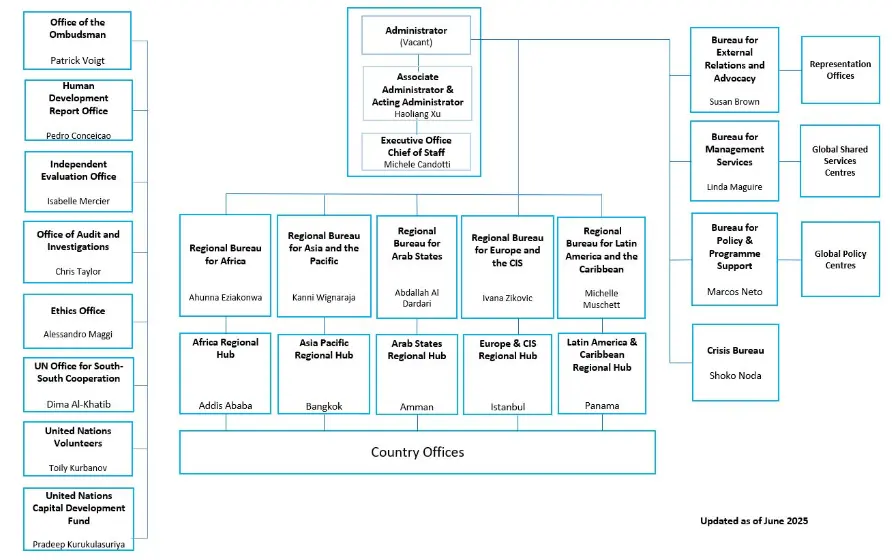
United Nations Development Programme (UNDP) is headquartered in New York City and operates through a network of country offices. It is led by an Administrator who holds the rank of Under-Secretary-General of the United Nations. The Administrator oversees a global workforce and supervises regional bureaus that manage development programmes across continents. As of 2025, Haoliang Xu is serving as the Acting Administrator. UNDP employs 7,394 staff worldwide (2022).

United Nations Development Programme (UNDP) Global Presence

UNDP works in 177 countries and territories, making it the largest development assistance agency in the UN system. Country offices collaborate directly with national governments to design policies, prepare development frameworks, and execute long-term programmes.

United Nations Development Programme (UNDP) Budget

UNDP is financed entirely through voluntary contributions from UN member states. It does not receive funding through compulsory UN assessments. Funding includes core contributions and earmarked resources for specific programmes. United Nations Development Programme (UNDP)’s total budget in 2022 was US$6.73 billion. UNDP has been rated highly for financial transparency and ranked first in the Aid Transparency Index (2015, 2016) with a score of 93.3%.

Also Read: International Labour Organisation

United Nations Development Programme (UNDP) Areas of Work

United Nations Development Programme (UNDP) focuses on five main development challenges. These areas guide its country-level and global operations.

  • Democratic Governance: UNDP supports democratic transitions by improving electoral systems, strengthening public institutions, and promoting citizen participation. It offers technical support for elections, public administration reforms, anti-corruption frameworks, and inclusive governance systems. Many countries rely on UNDP for training officials, improving public service delivery, and creating mechanisms for accountability.
  • Poverty Reduction: Poverty reduction is central to UNDP’s mission. It helps countries design policies that widen access to economic opportunities, promote financial inclusion, and strengthen social protection systems. UNDP also assists in reforming trade, promoting debt relief, and attracting investment to boost local economies. A 2013 independent evaluation noted that UNDP effectively supported national poverty programmes but required stronger monitoring mechanisms.
  • Crisis Prevention and Recovery: UNDP’s crisis-related work includes conflict prevention, disaster management, and peacebuilding. It supports countries in early recovery, demobilization of ex-combatants, reintegration of displaced communities, and restoration of essential services. During humanitarian crises, UNDP often works alongside UN agencies to stabilize governance and rebuild infrastructure. After foreign aid to Afghanistan was suspended in 2021, UNDP funded 25,000 health workers to maintain essential health services.
  • Environment and Energy: UNDP addresses climate change, biodiversity loss, land degradation, renewable energy access, and pollution control. It supports countries in transitioning to clean energy, managing natural resources responsibly, and protecting ecosystems. Key environmental programmes include:
    • BIOFIN (Biodiversity Finance Initiative)- works in 30 countries to develop biodiversity financing plans.
    • Equator Prize- recognizes local communities protecting biodiversity.
    • Sustainable land and water management initiatives across Asia, Africa, and Latin America.
  • HIV/ AIDS Response: UNDP works on reducing HIV impact through awareness programmes, policy reforms, and strengthening health systems. The Global Commission on HIV and the Law (2012) is a major initiative supported by UNDP to improve the legal environment for people affected by HIV.

United Nations Development Programme (UNDP) Initiatives

United Nations Development Programme (UNDP) runs several global programmes to drive innovation and collaboration:

  • Human Development Report (since 1991)- Introduced the Human Development Index (HDI) which measures development beyond income.
  • World Alliance of Cities Against Poverty
  • ART Global Initiative
  • Territorial Approach to Climate Change
  • Global Policy Centres in Seoul, Nairobi, Oslo, Singapore, and Istanbul

United Nations Development Programme and SDGs

United Nations Development Programme (UNDP) is the custodian agency for several SDG indicators and plays an integrating role within the UN system to coordinate SDG implementation. It supports countries in preparing SDG frameworks, aligning national budgets, and strengthening data systems. UNDP’s support is essential for countries that struggle with institutional capacity or financial challenges.

United Nations Development Programme and UN Coordination

United Nations Development Programme (UNDP) serves as the Vice-Chair of the UN Sustainable Development Group (UNSDG). It works through the Resident Coordinator (RC) System to ensure all UN agencies collaborate effectively at the country level.

  • Resident Coordinators operate in over 130 countries.
  • They lead joint UN efforts, ensure unified planning, and coordinate humanitarian and development assistance.

United Nations Development Programme (UNDP) Innovations

Launched in 2014, the Innovation Facility supports creative development solutions. It offers seed funding, digital tools, and technical expertise. In 2015, it supported 62 initiatives across 45 countries, contributing to 16 SDGs. Its innovation labs test artificial intelligence, blockchain, and data systems for development challenges.

United Nations Development Programme (UNDP) Controversies

UNDP has faced several allegations over the years. These incidents highlighted internal weaknesses, whistleblower protection issues, and governance challenges. These include:

  • NSA surveillance exposure (2013): Documents revealed UNDP emails were monitored by international intelligence agencies.
  • Gaza Project Allegations (2016) involving claims of resource misuse.
  • North Korea Financial Irregularities reported by former staff.
  • Russia GEF Project Corruption (2010-2014) where misappropriation of funds was alleged.
  • Iraq Stabilization Fund Corruption Scandal (2024) involving 136 reported corruption cases.

United Nations Development Programme (UNDP) Challenges

United Nations Development Programme (UNDP) faces numerous operational, financial, and structural challenges while working globally. The following are the major concerns and recommended solutions:

  1. Dependence on voluntary contributions, leading to unpredictable funding.
  2. Weak accountability mechanisms in crisis-hit and fragile states.
  3. Difficulty in monitoring outcomes in long-term development projects.
  4. Governance and corruption allegations affecting credibility.
  5. Slow bureaucratic procedures delaying implementation.
  6. Challenges in whistleblower protection, as observed in recent scandals.
  7. Climate change complexities making adaptation and mitigation expensive.
  8. Increasing geopolitical tensions affecting development work.

Way Forward:

  • Introduce stronger financial oversight mechanisms, especially in fragile states.
  • Strengthen digital monitoring systems to track project outcomes in real time.
  • Enhance whistleblower protection policies to ensure transparency.
  • Diversify funding sources to reduce reliance on a few donors.
  • Promote climate financing partnerships with private and public actors.
  • Simplify internal procedures for faster project delivery.
  • Expand capacity-building programmes for national institutions.
  • Improve community-level participation to ensure sustainable results.

United Nations Development Programme in India

United Nations Development Programme (UNDP) has operated in India since 1951, working on governance, livelihoods, energy, disaster resilience and inclusion. UNDP-India supports national priorities such as poverty alleviation, climate action, gender equality and strengthening institutions to deliver public services. Recent UNDP-India work includes support for state-level climate planning, social protection design, and data systems that underpin SDG tracking. 

United Nations Development Programme (UNDP) UPSC

UNDP remains one of the most influential actors in global development. For more than six decades, it has supported developing nations through poverty eradication, governance reforms, crisis recovery, and environmental sustainability. While the organisation faces stiff challenges related to funding, corruption allegations, and operational limitations, its global presence and technical expertise continue to make it indispensable. Strengthening internal governance and building more transparent systems will further enhance United Nations Development Programme (UNDP)’s impact in the coming decades.

To deliver on the SDGs and respond to emerging shocks, UNDP’s priorities include: scaling climate-resilient development, deepening impact in fragile contexts, expanding data and digital systems for better policy making, and mobilizing blended finance for SDG investments. Increasing core funding and improving country-level partnerships will be crucial so UNDP can remain agile and catalytic, helping governments secure equitable, resilient development pathways.

United Nations Development Programme FAQs

Q1: What is the United Nations Development Programme (UNDP)?

Ans: UNDP is the United Nations’ global development agency that works in more than 170 countries to reduce poverty, strengthen governance, and promote sustainable development.

Q2: When was United Nations Development Programme established?

Ans: UNDP was created in 1966 through the merger of two UN funds focused on technical assistance and development support.

Q3: What are the main focus areas of United Nations Development Programme?

Ans: UNDP works across three core areas: poverty reduction, democratic governance, and climate and disaster resilience.

Q4: What is the Human Development Report released by United Nations Development Programme?

Ans: The Human Development Report (HDR) is an annual flagship publication of UNDP that presents the Human Development Index (HDI) and analyzes global development trends.

Q5: How does United Nations Development Programme support countries like India?

Ans: UNDP helps India with sustainable development planning, climate action, digital governance, livelihood improvement, and poverty reduction through policy support and on-ground programmes.

UPSC Daily Quiz 15 November 2025

UPSC Daily Quiz

The Daily UPSC Quiz by Vajiram & Ravi is a thoughtfully curated initiative designed to support UPSC aspirants in strengthening their current affairs knowledge and core conceptual understanding. Aligned with the UPSC Syllabus 2025, this daily quiz serves as a revision resource, helping candidates assess their preparation, revise key topics, and stay updated with relevant issues. Whether you are preparing for Prelims or sharpening your revision for Mains, consistent practice with these Daily UPSC Quiz can significantly enhance accuracy, speed, and confidence in solving exam-level questions.

[WpProQuiz 23]

UPSC Daily Quiz FAQs

Q1: What is the Daily UPSC Quiz?

Ans: The Daily UPSC Quiz is a set of practice questions based on current affairs, static subjects, and PYQs that help aspirants enhance retention and test conceptual clarity regularly.

Q2: How is the Daily Quiz useful for UPSC preparation?

Ans: Daily quizzes support learning, help in revision, improve time management, and boost accuracy for both UPSC Prelims and Mains through consistent practice.

Q3: Are the quiz questions based on the UPSC syllabus?

Ans: Yes, all questions are aligned with the UPSC Syllabus 2025, covering key areas like Polity, Economy, Environment, History, Geography, and Current Affairs.

Q4: Are solutions and explanations provided with the quiz?

Ans: Yes, each quiz includes detailed explanations and source references to enhance conceptual understanding and enable self-assessment.

Q5: Is the Daily UPSC Quiz suitable for both Prelims and Mains?

Ans: Primarily focused on Prelims (MCQ format), but it also indirectly helps in Mains by strengthening subject knowledge and factual clarity.

International Labour Organisation (ILO), Headquarter, Objectives, History

International Labour Organisation (ILO)

The International Labour Organisation (ILO) is a UN specialised agency founded in 1919 to promote social justice and fair working conditions worldwide. Its core objective is to ensure decent work for all by strengthening labour rights, social protection, and tripartite dialogue among governments, employers, and workers. The ILO performs key functions such as setting international labour standards, monitoring compliance, providing technical assistance, and supporting member countries in labour reforms. It has developed 189 conventions, including eight fundamental ones covering forced labour, child labour, equality, and freedom of association.

International Labour Organisation (ILO)

ILO stands for the International Labour Organisation is one of the most influential international bodies working to ensure fairness, dignity, and justice for workers worldwide. Since its inception, the ILO has shaped labour rights, protected vulnerable workers, and set global standards for humane working conditions. Its tripartite model and commitment to social justice make it a cornerstone of global governance in labour welfare.

Also Read: United Nations Environment Programme

International Labour Organisation (ILO) Objectives

The International Labour Organisation (ILO) aims to create a global environment where workers can enjoy decent employment without exploitation. Its objectives promote dignity, fairness, security, and equality in the world of work. Through its Decent Work Agenda, the ILO works to expand social protection, empower workers, and strengthen industrial relations.

  • Promote labour standards and fundamental rights at work.
  • Ensure equal opportunity and treatment for men and women in employment.
  • Strengthen social protection for workers across all sectors.
  • Encourage social dialogue and tripartism for better policymaking.

International Labour Organisation (ILO) History

The International Labour Organisation (ILO) was established after World War I to promote global labour rights and later became the first specialised agency of the UN, continuously working for social justice and fair labour standards worldwide. Over time, it has played a significant role in shaping labour reforms, supporting decolonization, and strengthening democratic labour movements.

  • Established in 1919 under the Treaty of Versailles as part of the League of Nations.
  • Became the first specialised agency of the United Nations in 1946.
  • Headquarter: Geneva, Switzerland.
  • Founded on the belief that social justice is essential for universal and lasting peace.
  • Works to promote internationally recognised human and labour rights.
  • Awarded the Nobel Peace Prize in 1969 for advancing peace and workers’ welfare.

Also Read: World Trade Organisation

International Labour Organisation (ILO) Structure

The International Labour Organisation (ILO) functions through a unique tripartite structure that brings together representatives of governments, employers, and workers to frame labour standards. These bodies collectively design policies, supervise implementation, and ensure global cooperation on labour rights.

  1. International Labour Conference (ILC): The ILC acts as the highest decision-making body of the ILO, responsible for setting international labour standards and shaping the broad policy direction of the organisation. It gathers annually in Geneva, serving as a global parliament of labour where representatives from all member states participate.
    • Functions as the International Parliament of Labour.
    • Sets International Labour Standards (ILS) through conventions and recommendations.
    • Meets annually in Geneva with participation from all member states.
    • Acts as a forum for global discussion on major social, economic, and labour issues.
  1. Governing Body: The Governing Body serves as the executive council of the ILO, responsible for policy decisions, monitoring progress, and approving the program and budget. It meets three times a year in Geneva to develop strategies and recommend actions for implementation by the secretariat.
    • Acts as the executive council overseeing all major ILO decisions.
    • Meets three times a year in Geneva to frame policies, programs, and the budget.
    • Supported by tripartite committees on major industries and specialized sectors.
    • Assisted by expert committees on vocational training, safety, workers’ education, women’s issues, and youth employment.
  1. International Labour Office: The International Labour Office is the permanent secretariat of the ILO and the operational hub for all its activities. It works closely under the direction of the Director-General and the supervision of the Governing Body to implement policies and prepare technical documents, reports, and research studies.
    • Serves as the permanent secretariat and headquarters of ILO operations.
    • Implements policies and programs under the Director-General and Governing Body.
    • Acts as the focal point for research, publications, labour statistics, and technical assistance.
    • Conducts regional meetings to address issues of special concern to regional member states.

International Labour Organisation (ILO) Functions

The International Labour Organisation (ILO) performs a wide range of functions aimed at establishing social justice, promoting fair labour standards, and ensuring the protection of workers across the world. It sets international labour norms, provides technical support to countries, and monitors compliance to improve working conditions globally.

  • Formulates International Labour Standards (ILS): Creates conventions and recommendations to improve wages, working hours, safety, and rights at work.
  • Supervises Implementation: Monitors whether member countries follow the labour standards they have ratified.
  • Provides Technical Assistance: Offers expertise in areas like labour law reform, employment policies, social security, and workplace safety.
  • Supports Employment Promotion: Helps nations design programs for job creation, skill development, and fair recruitment practices.
  • Conducts Research & Publishes Reports: Produces global reports on labour trends, working conditions, and economic changes.
  • Encourages Social Dialogue: Facilitates cooperation among governments, employers, and workers for policy-making and dispute resolution.
  • Promotes Social Protection: Works on programs related to health insurance, maternity benefits, pensions, and protection of vulnerable workers.
  • Eliminates Child Labour & Forced Labour: Assists countries in implementing strategies to end exploitation and ensure safe, dignified work for all.

Core Conventions of the International Labour Organisation (ILO)

The eight fundamental conventions form the global foundation for worker protection. They address child labour, forced labour, discrimination, and the right to organize. They are part of the wider UN Human Rights Framework and ratification reflects a nation’s commitment to fair labour standards.

  1. Forced Labour Convention (No. 29)
  2. Abolition of Forced Labour Convention (No. 105)
  3. Equal Remuneration Convention (No. 100)
  4. Discrimination Convention (No. 111)
  5. Minimum Age Convention (No. 138)
  6. Worst Forms of Child Labour Convention (No. 182)
  7. Freedom of Association Convention (No. 87)
  8. Right to Organise and Collective Bargaining Convention (No. 98)

Also Read: World Organisations and Their Headquarters

ILO Declaration on Fundamental Principles and Rights at Work (1998)

The 1998 Declaration mandates all member states, regardless of ratification, to promote eight core labour rights. These rights represent the minimum standard required for decent work and human dignity.

Four Categories of Fundamental Rights

  • Freedom of Association & Collective Bargaining
  • Elimination of Forced Labour
  • Abolition of Child Labour
  • Elimination of Discrimination in Employment

International Labour Organisation (ILO) and India

India has been an active member of the ILO since its inception and continues to play a significant role in shaping global labour standards. The country participates in all major ILO forums and has collaborated with the organization on issues like child labour elimination, social protection, and workers’ welfare.

  • India is a founding member of the ILO (since 1919).
  • One of the few countries with a permanent seat on the ILO Governing Body.
  • Has ratified multiple ILO conventions, including those on forced labour, equal remuneration, and worst forms of child labour.
  • Collaborates with ILO on child labour eradication, social security reforms, and skill development initiatives.
  • ILO supports India in modernizing labour codes, improving workplace safety, and promoting formal employment.
  • India participates actively in International Labour Conference discussions and regional ILO programs.
  • India’s Ratification Status
      • Ratified 6 out of 8 core conventions.
      • Has not ratified Conventions 87 and 98.
      • Works closely with the ILO on child labour, social security, and skill development.
  • Core ILO Conventions Ratified by India
      • Forced Labour Convention (No. 29)
      • Abolition of Forced Labour Convention (No. 105)
      • Equal Remuneration Convention (No. 100)
      • Discrimination (Employment and Occupation) Convention (No. 111)
      • Minimum Age Convention (No. 138)
      • Worst Forms of Child Labour Convention (No. 182)
  • Core Conventions Not Ratified by India
    • Freedom of Association and Protection of the Right to Organise Convention, 1948 (No. 87)
    • Right to Organise and Collective Bargaining Convention, 1949 (No. 98)

ILO Global Commission on the Future of Work

The ILO established the Global Commission to understand challenges posed by automation, AI, climate change, and demographic shifts. The Commission promotes a human-centred future of work, focusing on adaptability, new skills, and sustainable employment. It encourages nations to invest in people and redesign institutions of work.

Key Focus Areas

  • Skill development for the future workforce.
  • Adapting laws to new technologies.
  • Ensuring inclusive economic growth.
  • Addressing climate-change–induced job transitions.

Reports released by the International Labour Organisation (ILO)

The International Labour Organisation publishes several flagship reports that analyse global employment trends, wages, social protection, labour rights, and workplace conditions.

  • World Employment and Social Outlook (WESO): Provides global and regional trends on employment, unemployment, labour income, productivity, and job quality.
  • Global Wage Report: Analyses global wage patterns, wage inequality, purchasing power, and wage growth trends.
  • World Social Protection Report: Examines coverage and performance of social protection systems (pensions, health, maternity, unemployment benefits).
  • ILO World Report on Child Labour: Provides statistics, trends, and policy recommendations to eliminate child labour globally.
  • The State of Social Justice 2025: A recent flagship ILO report emphasises how climate change, technological advancements, and demographic shifts are converging with existing global inequalities

The Labour Movement in India

The labour movement in India evolved gradually alongside industrialization, beginning in the late 19th century when workers first began raising concerns about harsh working conditions. Over the decades, these scattered protests transformed into organised trade unions advocating for better wages, safety, and rights.

  • Early Phase (1850s-1918): Sporadic, unorganised worker protests highlighted exploitation, poor wages, and long working hours.
  • First Major Agitation (1875): Led by S.S. Bengalee in Bombay, focusing on the plight of women and child workers.
  • Factory Commission & Act: The 1875 agitation resulted in the first Factory Commission and the Factories Act of 1881.
  • First Labour Union (1890): M.N. Lokhande founded the Bombay Mill Hands Association, marking the beginning of organised trade unionism.
  • Second Phase (1918–1947): Trade unions evolved on modern lines, with political groups like the Congress and Communists mobilising workers.
  • 1920s Growth: Rise of All India Trade Union Congress (AITUC) and national-level labour organisations.
  • Features of the Movement: Led by social reformers, focused on welfare, lacked a pan-India presence initially, and advocated issues like women and child labour protection.
  • Impact: Strengthened collective bargaining, shaped labour legislation, and linked worker rights with India's freedom struggle.

International Labour Organisation (ILO) FAQs

Q1: What is the ILO and why was it created?

Ans: The ILO is a specialized UN agency founded in 1919 to promote social justice and internationally recognized labour rights. It was created after World War I on the belief that lasting peace is possible only if it is based on fair working conditions.

Q2: Where is the headquarters of the ILO located?

Ans: The ILO headquarters is located in Geneva, Switzerland, where all major conferences and policy decisions are held.

Q3: Why is the ILO called a tripartite organization?

Ans: Because it brings together governments, employers, and workers on a single platform to frame labour standards and policies—making it the only UN agency with such a tripartite structure.

Q4: What is the main objective of the ILO?

Ans: Its primary objective is to promote decent work, ensure labour rights, encourage employment opportunities, and enhance social protection for all workers.

Q5: How many member countries are part of the ILO?

Ans: The ILO currently has 187 member states, representing governments, employers, and worker groups from around the world.

National Film Awards 2025, Winners List, Category, Films

National Film Awards 2025

The National Film Awards 2025 stand as one of the highest honours in Indian cinema, celebrating artistic brilliance, technical expertise, and storytelling excellence across the country’s multilingual film ecosystem. Conducted annually by the Government of India, these awards acknowledge the best films, performances, and cinematic contributions released in the previous year, making them a benchmark of credibility and prestige.

What makes the National Film Awards truly unique is their transparent and unbiased selection process. Only films certified by the Central Board of Film Certification (CBFC) between 1 January and 31 December of the previous year are eligible. The winners are selected by an independent jury functioning under the Directorate of Film Festivals (DFF), ensuring a fair evaluation of creative merit. The awards are presented by the President of India, highlighting their national importance and respect.

71st National Film Awards 2025 

The 71st National Film Awards 2025 honoured the finest achievements in Indian cinema, reflecting an extraordinary year that balanced mainstream entertainment with meaningful, content-driven films. This edition highlighted the diversity of Indian cinema, bringing regional stories, socially relevant themes, and groundbreaking performances into the spotlight.

One of the biggest highlights was Shah Rukh Khan winning his first-ever National Film Award for Jawan, sharing the honour with Vikrant Massey for his powerful role in 12th Fail. Rani Mukerji also made headlines by winning Best Actress for her moving portrayal in Mrs Chatterjee Vs Norway. Regional cinema shone brightly, earning recognition across languages including Malayalam, Tamil, Telugu, Assamese, Bengali, Marathi, and Gujarati.

National Film Awards 2025 - Complete Winners List

Below is the detailed table of winners across major categories:

Category Winner(s) Film(s)
Best Actor Shah Rukh Khan, Vikrant Massey Jawan, 12th Fail
Best Actress Rani Mukerji Mrs Chatterjee Vs Norway
Best Supporting Actor Vijayaraghavan, Muthupettai Somu Bhaskar Pookkalam, Parking
Best Supporting Actress Urvashi, Janaki Bodiwala Ullozhukku, Vash
Best Feature Film 12th Fail
Best Film (Hindi) Kathal – A Jackfruit Mystery
Best Film (Telugu) Bhagavanth Kesari
Best Film (Tamil) Parking
Best Film (Punjabi) Godday Godday Chaa
Best Film (Odia) Pushkara
Best Film (Marathi) Shyamchi Aai
Best Film (Malayalam) Ullozhukku
Best Film (Kannada) Kandeelu: The Ray of Hope
Best Film (Gujarati) Vash
Best Film (Bengali) Deep Fridge
Best Film (Assamese) Rongatapu 1982
Best Direction Sudipto Sen The Kerala Story
Best Choreography Vaibhavi Merchant Rocky Aur Rani Kii Prem Kahaani
Best Action Direction Nandu & Prudhvi Hanu-Man
Best Lyrics Kasarla Shyam Balagam
Best Music Direction G.V. Prakash Kumar (Songs), Harshavardhan Rameshwar (BGM) Vaathi, Animal
Best Male Playback Singer P.V.N.S. Rohit Baby
Best Female Playback Singer Shilpa Rao Jawan
Best Cinematography Prasanthanu Mohapatra The Kerala Story
Best Editing Midhun Murali Pookkaalam
Best Sound Design Sachin Sudhakaran, Hariharan Animal
Best Production Design Mohandas 2018 – Everyone is a Hero
Best Make-up Artist Shrikanth Desai Sam Bahadur
Best Costume Designer Sachin, Divya, Nidhhi Sam Bahadur
Special Mention M.R. Radhakrishnan (Re-recording Mixer) Animal

71st National Film Awards 2025 - Major Highlights

The 71st National Film Awards 2025 highlighted the triumph of powerful storytelling with 12th Fail winning Best Feature Film and Shah Rukh Khan securing his first-ever National Award for Jawan. The ceremony also celebrated the rise of regional cinema, honouring diverse films from Malayalam, Tamil, Telugu, Marathi, and other industries, while mainstream entertainers like Rocky Aur Rani Kii Prem Kahaani and socially driven films like Sam Bahadur added depth to this remarkable year in Indian cinema.

1. 12th Fail Wins Best Feature Film

12th Fail emerged as one of the biggest winners of the year. Directed by Vidhu Vinod Chopra, the film resonated with audiences through its inspiring narrative based on real events. Its raw, emotional storytelling and Vikrant Massey’s remarkable performance helped the film earn the top honour.

The film’s success reaffirmed the growing demand for grounded, real-life stories that connect deeply with viewers across India.

2. Shah Rukh Khan Wins His First National Award

Shah Rukh Khan’s victory for Jawan marked a historic moment, as it was his first National Film Award in a decades-long career. His dual role and impactful performance in the blockbuster film earned widespread acclaim. Sharing the award with Vikrant Massey added emotional significance to the announcement.

3. Regional Cinema Shines Bright

This year’s awards once again highlighted the richness of regional filmmaking. Malayalam films like Ullozhukku, Tamil films like Parking, and Telugu films like Bhagavanth Kesari received top honours. This recognition showcases India’s cultural and linguistic diversity while strengthening regional industries.

71st National Film Awards 2025 - Ceremony Details

The award ceremony took place on 23 September 2025 at Vigyan Bhawan, New Delhi, with President Droupadi Murmu presenting the honours. The winners were originally announced on 1 August 2025 at a press conference held at the National Media Centre.

Key recognitions included:

  • Dadasaheb Phalke Award: Mohanlal
  • Best Feature Film: 12th Fail
  • Best Director: Sudipto Sen (The Kerala Story)
  • Best Popular Film Providing Wholesome Entertainment: Rocky Aur Rani Kii Prem Kahaani
  • Best Feature Film Promoting National, Social & Environmental Values: Sam Bahadur

National Film Awards 2025 FAQs

Q1: Who won the National Film Award in 2025?

Ans: At the 71st National Film Awards held on September 23, 2025, in New Delhi, the Best Actor award was shared by Shah Rukh Khan for Jawan and Vikrant Massey for 12th Fail. Rani Mukerji received the Best Actress award for her role in Mrs. Chatterjee Vs Norway.

Q2: Why did Shah Rukh Khan get the National Award?

Ans: Shah Rukh Khan was honored with the Best Actor award for his performance in Jawan, marking his first National Film Award after over three decades in the industry.

Q3: Where is the Indian Film Awards 2025?

Ans: The 71st National Film Awards ceremony took place at Vigyan Bhawan, New Delhi, on September 23, 2025.

Q4: What time is the 71st National Film Awards?

Ans: The ceremony commenced at 4:00 PM IST on September 23, 2025.

Q5: Who won the Film of the Year 2025?

Ans: The award for Best Feature Film was presented to 12th Fail, directed by Vikrant Massey, which also won multiple other awards.

Sir Creek Dispute, Map, Origin, Importance, Key Details

Sir Creek Dispute

The Sir Creek dispute between India and Pakistan is one of the long-standing territorial disagreements between the two neighbours, with its origins tracing back to pre-independence India. While it often takes a backseat in the broader India-Pakistan relationship, the dispute is important due to its strategic, economic, and ecological implications. Understanding the issue is important for UPSC aspirants, particularly in the International Relations segment. 

Sir Creek Dispute in News

Defence Minister Rajnath Singh recently issued a stern warning to Pakistan over its military build-up near the Sir Creek region, stating that any misadventure would invite a response so strong that it could “change both history and geography.” Speaking at a public event on the occasion of Shastra Pujan, he accused Pakistan of deliberately stirring up the long-standing Sir Creek dispute despite India’s repeated efforts to resolve it through dialogue. Singh discussed that the recent expansion of Pakistani military infrastructure in areas adjoining Sir Creek, a strategically sensitive zone along the Gujarat coastline, indicates Pakistan’s unclear intentions and provocative posture.

Sir Creek

Sir Creek is a 96-kilometre strip of water located in the marshlands of the Rann of Kutch in Gujarat. Geographically, it forms a boundary between India’s Kutch region and Pakistan’s Sindh province before opening into the Arabian Sea. Historically, it was known as Ban Ganga and acquired the name “Sir Creek” during the colonial era, named after a British official.

Sir Creek Map

Here is geographical representation of Sir Creek:

Sir Creek Map

Sir Creek Nature of the Dispute

  • The core of the Sir Creek Dispute lies in the differing interpretations of the maritime boundary between India and Pakistan. Before India’s independence, the region was part of the Bombay Presidency. Post-partition in 1947, Kutch remained with India while Sindh became part of Pakistan.
  • Pakistan claims the entirety of Sir Creek based on the Bombay Government Resolution of 1914, signed between the Rao of Kutch and the Sindh provincial government. According to Pakistan, the eastern flank of the creek forms the boundary. India, however, considers this green line indicative rather than definitive. Instead, India relies on a 1925 map, along with the mid-channel pillars constructed in 1924, to argue that the boundary lies along the mid-channel of the creek (red line on the map).
  • India invokes the Thalweg Principle of international law, which stipulates that the boundary between two political entities along a waterway should follow the center of the principal navigable channel. Pakistan rejects this argument, claiming that Sir Creek is non-navigable, whereas India maintains that the creek is navigable during high tides, and fishing trawlers regularly use it to reach the Arabian Sea.

Sir Creek Dispute Origin

The Sir Creek Dispute dates back to 1908, when disagreements arose between the ruler of Kutch and the Sindh government over firewood collection in the creek area. To settle the issue, the Bombay Government Resolution of 1914 was issued. The resolution contained conflicting provisions:

  • Paragraph 9 said that the boundary should be to the east of the creek, implying the entire creek would belong to Pakistan.
  • Paragraph 10, however, applied the Thalweg Principle, noting that Sir Creek is navigable most of the year, making the mid-channel the effective boundary.

This inherent contradiction has been the basis of prolonged disagreement between the two countries.

Sir Creek Importance

Sir Creek holds strategic, economic, and ecological significance:

  • Strategic Importance: The creek lies near the Rann of Kutch, an area where India and Pakistan clashed during the 1965 war. Control over this region influences maritime security and surveillance.
  • Economic Significance: It is one of the largest fishing grounds in Asia, supporting the livelihoods of thousands of fishermen. Furthermore, potential oil and gas reserves under the seabed could provide significant economic benefits, though exploration remains stalled due to the dispute.
  • Ecological Value: Sir Creek is an ecologically sensitive area, home to flamingoes and other migratory birds during winter, making it important for biodiversity conservation.

Sir Creek Attempts at Resolution

Several attempts have been made to resolve the Sir Creek issue:

  • After the 1965 war, British Prime Minister Harold Wilson intervened, leading to the establishment of a tribunal. The 1968 verdict granted Pakistan only 10% of its claim.
  • During the 1997 composite dialogue, Sir Creek was discussed as a part of broader efforts to improve bilateral relations.
  • Tensions increased in 1999 when an Indian fighter plane shot down a Pakistani surveillance aircraft over the creek. India alleged an airspace violation, while Pakistan denied it.
  • Between 2005 and 2007, joint surveys were conducted to assess the area for potential resolution.

Despite these efforts, a final agreement has remained elusive, largely due to differing interpretations of historical maps and legal principles.

Way Forward

Resolving the Sir Creek dispute is important for many reasons:

  • Humanitarian Aspect: Fishermen from both countries are frequently detained for accidentally crossing perceived borders, creating tensions and disrupting livelihoods.
  • Strategic and Economic Gains: A resolution would allow exploration of oil and gas reserves and better control of maritime boundaries.
  • Low-Hanging Fruit: Among the numerous Indo-Pakistan disputes, Sir Creek is often considered a simpler, less politically charged issue, making it a potential candidate for early resolution.

Sir Creek Dispute FAQs

Q1: What is the Sir Creek issue between Pakistan and India?

Ans: A long-standing border and maritime dispute over the ownership and boundary of the Sir Creek region between India and Pakistan.

Q2: Where is Sir Creek in India?

Ans: In the Rann of Kutch region of Gujarat, along the India-Pakistan border.

Q3: Is Sir Creek the westernmost point of India?

Ans: No, the westernmost point of India is Guhar Moti in Gujarat; Sir Creek lies nearby but is not the extreme point.

Q4: What is the Sir Creek Dispute?

Ans: A disagreement between India and Pakistan over the maritime boundary and territorial claims in the Sir Creek area.

Q5: When did the Sir Creek Dispute begin?

Ans: The dispute originated in 1908, during the pre-independence period over territorial and resource claims.

Global Financial Stability Report (GFSR), Objectives, October Report

Global Financial Stability Report

The Global Financial Stability Report (GFSR) is one of the most important flagship publications of the International Monetary Fund (IMF). For UPSC aspirants, GFSR is crucial for topics under Economy, International Reports, Global Financial Risks, and Current Affairs. The report provides insights into global financial vulnerabilities, market trends, and systemic risks that can impact the global economy, including India.

What is the Global Financial Stability Report (GFSR)?

The GFSR is a semi-annual report released by the International Monetary Fund (IMF) that assesses the stability of global financial markets. It analyzes emerging risks in banking, capital markets, global debt conditions, liquidity pressures, and financial vulnerabilities across economies.

Key Features of the GFSR

  • Provides early warnings on global financial risks.
  • Examines the resilience of banking and non-banking financial sectors.
  • Gives policy recommendations to ensure financial stability.
  • Monitors global inflation trends, interest rate impacts, and fiscal vulnerabilities.

Global Financial Stability Report (GFSR) Objectives

The primary goal of the GFSR is to promote global financial stability by identifying early signs of risk and recommending timely policy action. It ensures that economies remain resilient even during periods of uncertainty such as inflationary pressure, recession threats, or geopolitical conflicts. The report also aims to educate member countries on how to maintain stable banking structures and reduce systemic stress.

  • Identify financial vulnerabilities that can disrupt global stability.
  • Guide policymakers with evidence-based recommendations.
  • Strengthen crisis preparedness by studying past market shocks.
  • Promote balanced and sustainable economic growth worldwide.
  • Support developing nations in building stronger financial systems.

GFSR October Report (Latest) Detailed Discussion

The GFSR October 2025 Edition: “Shifting Ground beneath the Calm” highlights rising concerns over global financial conditions due to persistent inflation, tightening monetary policies, and growing debt burdens. The report stresses that financial markets remain highly sensitive to interest rate changes, geopolitical risks, and weaknesses within regional banking systems.

Major Discussions in GFSR October 2025 Report

  • High interest rates may persist, increasing borrowing costs for governments, corporations, and individuals worldwide.
  • Debt vulnerabilities have deepened, with global debt surpassing $300 trillion.
  • Emerging markets face pressure from currency depreciation and inflationary shocks.
  • Mid-sized banks in advanced economies remain fragile, especially in the US and Europe.
  • Climate-related financial risks are increasing, urging economies to prepare for transition risks.
  • Digital finance and crypto-assets pose new vulnerabilities, requiring stricter regulations and cybersecurity.
  • High debt and fiscal deficits are raising long-term bond yields, increasing the risk of spillovers to banks and NBFIs, especially in countries dependent on limited investor bases.

India’s Position in the Global Financial Stability Report (GFSR)

The Global Financial Stability Report (GFSR) acknowledges India as one of the most resilient and fastest-growing major economies amid global uncertainty. India’s strong domestic demand, controlled banking sector stress, and large forex reserves help maintain financial stability.

  • Banking sector is stable, with improving asset quality and capital adequacy.
  • Forex reserves remain strong, providing a buffer against external shocks.
  • Inflation remains a concern, driven by food prices and global crude oil volatility.
  • India is relatively insulated from global tightening due to strong regulatory frameworks.
  • Digital finance is expanding rapidly, though cyber risks require better protection.

Global Financial Stability Report (GFSR): Opportunities and Challenges for India

India’s macroeconomic environment is stable, but external pressures from global markets continue to influence its financial outlook. The GFSR highlights both the strengths India possesses and areas requiring further attention.

Opportunities

  • Strong digital public infrastructure supports financial inclusion.
  • Growing domestic consumption attracts foreign investment.
  • Stable banks enhance investor confidence.
  • Green finance and renewable energy markets open new growth paths.

Challenges

  • Inflationary pressures due to food and fuel prices.
  • Slowdown in exports as global demand weakens.
  • Fiscal pressure from subsidies and welfare schemes.
  • Cybersecurity vulnerabilities in fast-growing fintech platforms.

Policy Recommendations for India by GFSR

To maintain resilience, the IMF suggests several policy measures tailored to India’s economic structure. These recommendations aim to further strengthen India’s financial system and reduce global shock exposure.

  • Strengthen regulatory supervision of NBFCs and digital lending companies.
  • Promote fiscal consolidation to keep government debt under control.
  • Enhance cyber risk monitoring across financial institutions.
  • Increase investments in renewable energy to reduce oil dependency.
  • Promote green bonds and sustainable finance models.

Conclusion

The Global Financial Stability Report (GFSR) remains an essential resource for assessing international financial developments and understanding how global shocks impact domestic economies. For UPSC aspirants, it offers valuable insights into global risks, financial vulnerabilities, and international economic strategies. The October GFSR highlights challenges such as high global interest rates, rising debt, and emerging digital risks. Despite these uncertainties, India stands out as a relatively strong and resilient economy, supported by robust financial reforms and stable economic fundamentals.

Global Financial Stability Report (GFSR) FAQs

Q1: What is the Global Financial Stability Report (GFSR)?

Ans: The GFSR is a flagship report released twice a year by the International Monetary Fund (IMF). It assesses global financial markets, highlights vulnerabilities, and gives policy recommendations to maintain financial stability.

Q2: Who publishes the Global Financial Stability Report?

Ans: The report is published by the International Monetary Fund (IMF). It is one of its key global surveillance documents along with the World Economic Outlook (WEO) and Fiscal Monitor.

Q3: How often is the GFSR published?

Ans: The GFSR is released semi-annually, typically in April and October. Special updates may be released during global crises or extraordinary financial events.

Q4: What is the purpose of the GFSR?

Ans: The GFSR aims to evaluate the strength and resilience of global financial systems. It identifies emerging risks such as debt stress, banking instability, inflation pressures, and digital finance threats, and suggests corrective policy measures.

Q5: What is the difference between GFSR and WEO?

Ans: The GFSR focuses on financial stability, risks, and markets, while the World Economic Outlook (WEO) analyzes global growth trends, GDP projections, and economic performance. Both are IMF publications but cover different aspects of the global economy.

Electronics Development Fund

Electronics Development Fund

Electronics Development Fund Latest News

The Electronics Development Fund has played a pivotal role in nurturing innovation and entrepreneurship in India’s electronics and IT sectors. 

About Electronics Development Fund

  • It was launched by the Government of India on 15 February 2016.
  • The Fund aims to promote research, development, and entrepreneurship in the fields of electronics, nano-electronics, and information technology.
  • It functions as a Fund of Funds, designed to invest in professionally managed Daughter Funds such as early-stage angel and venture funds.
    • Each Daughter Fund supported under the scheme is required to be registered in India and comply with all applicable laws and regulations, including the SEBI (Alternative Investment Funds) Regulations, 2012, as Category I or Category II AIFs. 

Key Objectives of Electronics Development Fund

  • Promote Innovation and R&D: To foster research and development in electronics, nano-electronics, and information technology by supporting market-driven and industry-led innovation.
  • Support Daughter Funds: To invest in professionally managed Daughter Funds such as early-stage angel and venture funds that, in turn, provide capital to startups and technology ventures.
  • Encourage Product and Technology Development: To nurture entrepreneurship by supporting companies involved in the creation of new products, processes, and technologies within the country.
  • Strengthen Domestic Design Capabilities: To enhance India’s capacity for indigenous design and development in the Electronics System Design and Manufacturing (ESDM) sector.
  • Build a National IP Resource Pool: To generate a strong base of intellectual property in key technology areas and encourage ownership of innovation within India.
  • Facilitate Strategic Acquisitions: To enable acquisition of foreign technologies and companies where such products are imported in large volumes, promoting self-reliance and reducing import dependence.

Source: PIB

Electronics Development Fund FAQs

Q1: What is the primary objective of the Electronics Development Fund (EDF)?

Ans: To promote electronics manufacturing in India.

Q2: What is an electronic development fund?

Ans: It is a Fund of Funds which will foster R&D and innovation in technology sectors like electronics, IT and nano-electronics.

Man-Portable Autonomous Underwater Vehicles

Man-Portable Autonomous Underwater Vehicles

Man-Portable Autonomous Underwater Vehicles Latest News

Recently, new generations of man-portable autonomous underwater vehicles (MP-AUVs) have been successfully developed by the Defence Research and Development Organisation.

About Man-Portable Autonomous Underwater Vehicles

  • It is developed for mine countermeasure missions.
  • It is developed by the Naval Science & Technological Laboratory (NSTL), Visakhapatnam of Defence Research and Development Organisation (DRDO).

Key Features of Man-Portable Autonomous Underwater Vehicles

  • Rapid Response: It offers rapid response capability with reduced operational risk and logistic footprint for naval mine warfare applications.
  • Autonomous Classification: It has deep learning based target recognition algorithms enabling autonomous classification, significantly reducing operator workload and mission time.
  • Advanced equipment: It comprises multiple AUVs equipped with Side Scan Sonar and Under Water cameras as primary payloads for real-time detection & classification of Mine-Like Objects.
  • Enhanced situational awareness: It has a robust underwater acoustic communication network which allows seamless data exchange between AUVs during missions and providing greater situational awareness.

Key Facts about Defence Research and Development Organisation

  • It is the R&D wing of the Ministry of Defence, Govt of India, with a vision to empower India with cutting-edge defence technologies.
  • Formation: It was formed in 1958 by merging the then-existing Technical Development Establishment (TDEs) of the Indian Army and the Directorate of Technical Development and Production (DTDP) with the Defence Science Organisation (DSO).
  • It is responsible for the indigenous design, development and production of state-of-the-art weapon systems required by the Armed Forces.
  • Headquarters: New Delhi.

Source: PIB

Man-Portable Autonomous Underwater Vehicles FAQs

Q1: Which organization developed the MP-AUV?

Ans: DRDO

Q2: What is the primary objective of MP-AUVs?

Ans: To conduct mine countermeasure operations.

Palar River

Palar River

Palar River Latest News

A 60-year-old woman was washed away in a flash flood in the Palar river near Katpadi town in Vellore, Tamil Nadu, recently.

About Palar River

  • It is a river in southern India. 
  • Course:
    • It originates from the Nandidurg hills in the Kolar district of Karnataka, flowing as an underground stream (Guptagamini) before emerging near Bethamangala town.
    • It flows 93 km in Karnataka, 33 km in Andhra Pradesh, and 222 km in Tamil Nadu before finally reaching its confluence in the Bay of Bengal at Vayalur, about 100 km south of Chennai.
  • The total area of the Palar River Basin is 17,633.19 sq.km.
  • The river has seven tributaries, with the Cheyyar River and Ponnai River being the most significant.
  • The cities of Ramanaickenpet, Vaniyambadi, Ambur, Vellore, Melvisharam, Arcot, Walajapet (Anaicut), Kanchipuram, and Chingleput are located on the banks of Palar River.
  • Many ancient temples, such as the Kolaramma Temple and Someswara Temple in Kolar and the Kanchipuram temples, are situated along its banks, making the river sacred and culturally significant.
  • The Arcot Dam, built on the river in Tamil Nadu, is historically significant and is one of the oldest irrigation dams in the region.

Source: TH

Palar River FAQs

Q1: The Palar River originates in which Indian state?

Ans: Karnataka

Q2: The Palar River finally drains into which water body?

Ans: Bay of Bengal

Q3: Which are major tributaries of the Palar River?

Ans: The river has seven tributaries, with the Cheyyar River and Ponnai River being the most significant.

Strait of Hormuz

Strait of Hormuz

Strait of Hormuz Latest News

Iran seized a Marshall Islands-flagged oil tanker as it travelled through the narrow Strait of Hormuz recently, turning the ship into Iranian territorial waters in the first such interdiction in months in the strategic waterway.

About Strait of Hormuz

  • It is a narrow waterway between Iran and the Arabian Peninsula, specifically the United Arab Emirates, and Musandam (Oman).
  • The Gulf of Oman is on the strait’s east, while the Persian Gulf is on the west. 
  • It is the only sea channel linking the oil-rich Persian Gulf (west) with the Gulf of Oman and the Arabian Sea (southeast).
  • Iran is located on the north coast, while the UAE is on the south coast. 
  • The strait is 167 kilometers long.
  • At its narrowest point, the Strait of Hormuz is only 29 nautical miles wide (54 km). 
  • The strait consists of 2-mile-wide navigable channels (3 km) for inbound and outbound shipping as well as a 2-mile-wide buffer zone.
  • Some of the islands located in the Strait of Hormuz are Hengam, Hormuz, and Qishm. 
  • The Strait of Hormuz is considered one of the world’s most economically important choke points.
  • About 30% of the world’s liquefied gas and 25% of oil pass through the Strait of Hormuz.

Source: TH

Strait of Hormuz FAQs

Q1: The Strait of Hormuz connects the Persian Gulf with which water body?

Ans: Arabian Sea via the Gulf of Oman.

Q2: Iran is located on which side of the Strait of Hormuz?

Ans: North

Q3: The Strait of Hormuz is approximately how long?

Ans: The strait is 167 kilometers long.

RBI Trade Relief Measures: Moratorium, Extended Credit Tenor & Support for Exporters

RBI Trade Relief Measures

RBI Trade Relief Measures Latest News

  • The RBI has introduced immediate trade relief measures to help exporters struggling with debt servicing amid global trade disruptions. 
  • These include a loan moratorium, longer export credit tenors, and relaxed asset classification norms, applicable to banks, NBFCs, cooperative banks, and all-India financial institutions.
  • The announcement follows signals from the US about reducing high tariffs on India. 
  • Key exporting sectors such as chemicals, plastics, rubber, leather, apparel, footwear, iron and steel products, and electrical machinery are covered under RBI’s relief framework.

RBI Unveils Relief Package for Tariff-Hit Exporters

  • The RBI announced a series of trade relief measures to ease working capital stress, enhance borrowing access, and defer repayments for exporters affected by global trade disruptions. 
  • These measures, effective immediately, cover 20 tariff-hit export sectors including chemicals, plastics, textiles, leather, metals, machinery, vehicles, footwear, and fisheries.
  • These steps aim to ease compliance pressures for exporters facing global trade disruptions.

Loan Moratorium to Ease Debt Burden

  • The RBI has announced a moratorium on term loan repayments and interest recovery for working capital loans due between September 1 and December 31, 2025. 
  • During this period, interest will accrue only on a simple interest basis, with no compounding.
  • Accrued interest will be converted into a funded interest term loan, repayable between April and September 2026. 
  • For working capital loans, lenders may revise drawing power or reassess limits to support affected borrowers.

Improved Access to Working Capital

  • The RBI has increased the maximum repayment period for pre-shipment and post-shipment export credit from 270 days to 450 days for loans disbursed up to March 31, 2026.
  • For packing credit availed before August 31, 2025, where shipments could not occur, lenders may permit repayment through legitimate alternative sources, including domestic sales or proceeds from substitute export orders.

Safeguards for Asset Quality

  • The RBI announced that any moratorium or deferment granted will not count toward days past due.
  • With this, it ensured that borrowers’ accounts are not downgraded under Income Recognition, Asset Classification and Provisioning (IRACP) norms. 
  • These relief actions — including revised drawing power — will not be treated as restructuring, and Credit Information Companies must ensure borrowers’ credit histories remain unaffected.
  • Only exporters with standard asset classification as of August 31, 2025, are eligible.
  • Relief measures will require 5% provisioning on such loans, though analysts say this is unlikely to significantly impact profitability.
  • Lenders must adopt a formal policy defining eligibility and publicly disclose criteria.

Relaxations Under FEMA for Export Realisation

  • The RBI extended the deadline for realising export proceeds from 9 to 15 months.
  • It also increased the shipment period against advance payments from 1 to 3 years, easing compliance pressures for exporters facing delays.

Recent Government Measures to Boost Export Ecosystem

  • The government has extended key timelines to ease pressures on exporters: 
    • the period for realisation and repatriation of export proceeds has been increased from 9 to 15 months;
    • the shipment window for goods against advance payments has been extended from 1 to 3 years.
  • In addition, the Union Cabinet approved two major initiatives worth ₹45,060 crore to strengthen India’s export ecosystem. 
  • These include: 
  • Industry leaders say these measures will particularly benefit MSMEs facing tariff-related disruptions, enhance market access, ease liquidity constraints, and address longstanding challenges in logistics, credit availability, and export infrastructure.

Source: TH | IE | LM

RBI Trade Relief Measures FAQs

Q1: What are the key RBI trade relief measures announced in 2025?

Ans: RBI introduced a loan moratorium, extended export credit tenor to 450 days, relaxed asset classification norms, and eased FEMA rules to support tariff-hit exporters.

Q2: Which sectors benefit from RBI’s trade relief package?

Ans: Twenty sectors, including chemicals, plastics, textiles, leather, footwear, metals, machinery, vehicles, and fisheries, are eligible for relief due to global tariff disruptions.

Q3: How does the RBI moratorium help exporters?

Ans: Exporters can defer loan and interest payments from September to December 2025, with simple interest charged and repayment scheduled between April and September 2026.

Q4: What changes did the RBI make to export credit norms?

Ans: RBI extended pre- and post-shipment credit repayment from 270 to 450 days and allowed liquidation of packing credit through legitimate alternative sources.

Q5: What government measures complement RBI’s relief steps?

Ans: The government extended export realisation timelines, expanded shipment windows, and approved ₹45,060 crore initiatives including CGSE and the Export Promotion Mission to boost liquidity.

Why Germany’s Economy Is Stagnating and the Reforms Needed for Recovery

Germany Economic Stagnation

Germany Economic Stagnation Latest News

  • Germany, the world’s third-largest economy with a $5 trillion GDP, is experiencing near-zero growth this year, with output expected to rise only 0.2%
  • This stagnation follows two consecutive years of recession, marking a prolonged period of weak economic performance. 
  • These findings come from the annual report of the German Council of Economic Experts, an independent body established in 1963 to assess the country’s macroeconomic trends.

Germany’s Return as the “Sick Man of Europe”

  • Germany is again being labelled the “sick man of Europe,” with chronic stagnation requiring long-term structural reforms. 
  • The economy has grown only 0.1% since 2019, far below the US and euro area. Forecasts remain bleak, with potential growth expected at just 0.4% per year.

New Economic Challenges: From Worker Shortages to Rising Labor Costs

  • Unlike the early 2000s, Germany now faces worker shortages, not job scarcity.
    • 20 million workers will retire in the next decade, while only 12.5 million will enter the labor force.
    • Aging populations mean fewer hours worked and higher labor costs.
    • Unit labor costs have risen due to sluggish productivity and higher wages.
  • Employment stability measures like short-time work hinder structural change by discouraging worker mobility into more productive sectors.

Manufacturing Decline and High Energy Costs

  • Germany’s manufacturing sector—once the engine of growth—has been declining since 2018.
  • Key factors:
    • Loss of competitiveness
    • Weak foreign demand
    • Rising trade fragmentation
    • Threat of US tariffs
    • Competition from China
  • Energy-intensive industries have suffered from persistently high energy costs, making Germany less attractive for emerging sectors like AI and data centers.

Dependence on Legacy Industries and Weak Capital Markets

  • Germany’s strength in automotive, chemicals, and mechanical engineering has created over-reliance on legacy “mid-tech” sectors. 
  • This limits diversification into high-tech fields like IT and biotechnology.
  • Capital markets remain shallow:
    • Heavy dependence on banks
    • Insufficient venture capital, especially for scale-ups
    • Lack of large institutional investors willing to back European funds
  • This pushes promising start-ups to relocate to the US.

Germany’s Economy Falling Behind Europe and the World

  • Germany is no longer leading the euro area; instead, it is lagging behind both European and global growth averages. 
  • The German Council of Economic Experts attributes the slowdown to a combination of cyclical weaknesses, structural challenges, and major geopolitical shifts that have disrupted the traditional German export-driven model.

Geopolitical Shifts Undermining Germany’s Economic Model

  • A key disruption has been the change in US leadership and America’s reduced willingness to provide economic and security guarantees to allies like Germany. 
  • This has forced Berlin and other European countries to reconsider their security frameworks and allocate more resources to defence and trade resilience.
  • Fragmentation within the European Single Market has also prevented EU nations from crafting strong collective responses to global challenges, weakening competitiveness.

Domestic Challenges Intensifying the Slowdown

  • Germany faces internal pressures as well:
    • Declining industrial competitiveness
    • Rapid demographic ageing
    • Weak implementation of Chancellor Friedrich Merz’s fiscal package despite ambitious promises for infrastructure and defence investments

Policy Recommendations to Boost Growth

  • The German Council of Experts suggests four key steps:
    • Better targeted fiscal spending to increase productive investment.
    • Stronger European economic integration, removing barriers to a true single market for goods and services.
    • Corporate tax cuts to incentivise business investment.
    • Reducing wealth inequality, including a state-subsidised long-term investment account to improve financial security, especially for older citizens.
  • If Germany fails to revive growth soon, India — with a GDP nearing $4 trillion — may surpass it to become the world’s third-largest economy.

Source: IE | IMF

Germany Economic Stagnation FAQs

Q1: Why is Germany’s economy considered the ‘sick man of Europe’ again?

Ans: Germany has seen near-zero growth since 2019, faces aging workforce pressures, rising labour costs, and declining competitiveness, leading to prolonged economic stagnation.

Q2: What structural challenges are slowing Germany’s growth?

Ans: Labour shortages, demographic ageing, high energy prices, manufacturing decline, and dependence on mid-tech industries are key structural issues weakening economic performance.

Q3: How do high energy costs affect Germany’s economy?

Ans: Elevated energy prices have reduced industrial output, discouraged new investments, and made Germany less attractive for energy-intensive sectors like AI and data centres.

Q4: Why are weak capital markets a barrier to innovation in Germany?

Ans: Germany relies heavily on bank financing, lacks large venture capital funds, and sees startups move to the US for deeper markets and better exit opportunities.

Q5: What reforms could help revive Germany’s economic growth?

Ans: Experts recommend targeted fiscal investments, deeper EU market integration, corporate tax cuts, stronger capital markets, and policies addressing labour shortages through childcare, migration, and flexible retirement.

Belem Health Action Plan Launched at COP30 – Explained

COP30

COP30 Latest News

  • At COP30 in Belem, global philanthropies pledged $300 million and launched the Belem Health Action Plan to tackle the growing health impacts of climate change through integrated adaptation measures.

Introduction

  • The intersection of climate change and public health took centre stage at the 30th UN Climate Conference (COP30) in Belem, Brazil, as global leaders, philanthropies, and health experts launched the Belem Health Action Plan (BHAP)
  • The plan aims to strengthen health systems to withstand the escalating effects of climate change.
  • Accompanying this initiative, a coalition of more than 35 major philanthropic organisations, including Bloomberg Philanthropies, Gates Foundation, Rockefeller Foundation, and IKEA Foundation, announced a $300 million commitment under the Climate and Health Funders Coalition to address the dual crisis of climate and health.
  • It is the first coordinated global effort to channel adaptation finance specifically towards climate-linked health outcomes, placing human well-being at the core of climate action.

Background: The Health Cost of Climate Change

  • Climate change has emerged as the gravest health threat of the 21st century, worsening air pollution, intensifying heatwaves, and driving the spread of infectious diseases. 
  • The 2025 Lancet Countdown Report on Health and Climate Change has become a key reference for the initiative. According to the report:
    • Heat-related deaths have surged by 23% since the 1990s, now reaching 546,000 deaths annually.
    • Over 154,000 deaths were linked to wildfire smoke exposure in 2024 alone.
    • The global dengue transmission potential has risen by 49% since the 1950s.
  • Experts warn that every country is now facing health impacts from climate change, with 3.3 billion people globally at heightened risk, especially those in low- and middle-income nations where health infrastructure remains fragile.

Launch of the Belem Health Action Plan

  • The BHAP was launched by 80 countries and organisations at COP30, building on findings from the Lancet Countdown report. 
  • It seeks to integrate climate adaptation with public health strategies, making health systems more resilient, equitable, and climate-ready.
  • Core Focus Areas of the BHAP
    • Building Climate-Resilient Health Systems: Strengthening surveillance, early warning, and response systems to handle heatwaves, floods, vector-borne diseases, and air pollution.
    • Investing in Research and Innovation: Supporting research into climate-sensitive diseases and developing adaptive technologies for healthcare delivery.
    • Health Equity and Justice: Ensuring vulnerable communities, such as children, women, outdoor workers, and low-income groups, receive targeted support.
    • Capacity Building: Enhancing healthcare workforce training to manage climate-related emergencies.
    • Integrated Policy Frameworks: Aligning climate, health, and development policies across countries for coordinated action.
  • The Plan also calls for “shifting funding and power to communities most affected by climate change,” ensuring that adaptation resources directly benefit those on the frontlines.

Philanthropic Commitment

  • The Climate and Health Funders Coalition, comprising over 35 leading philanthropic entities, pledged an initial $300 million to implement the Belem Health Action Plan and accelerate climate-health solutions. The inaugural funding will focus on:
    • Extreme heat mitigation and development of early warning systems.
    • Reducing air pollution, particularly from urban and industrial emissions.
    • Combating climate-sensitive infectious diseases such as malaria, dengue, and cholera.
    • Integrating climate and health data systems to enable better risk forecasting and resource allocation.

Addressing the Adaptation Finance Gap

  • A recurring theme at COP30 was the severe adaptation finance gap
  • According to the UN Adaptation Gap Report 2025, developing countries will require $310-365 billion annually by 2035 to adapt effectively to climate change. 
  • Yet, current funding flows hover around $40 billion per year, far below what is needed.
  • In India’s case, the 2023 National Communication to the UNFCCC estimated that the country will need $643 billion by 2030 to meet its adaptation goals. 
  • India has already spent $146 billion in 2021-22, representing 5.6% of GDP, up from 3.7% in 2015-16, underscoring its commitment to climate adaptation.
  • The BHAP and the accompanying philanthropic pledge are designed to narrow this gap, particularly by directing funds towards health-related adaptation, which has traditionally received limited attention.

Global Impact and Collaborative Framework

  • The BHAP underscores the principle that “protecting the environment is protecting people’s health.” 
  • It introduces a multi-sectoral approach where health ministries, climate departments, and global agencies collaborate to:
    • Mainstream health into climate policies.
    • Foster cross-country sharing of data and best practices.
    • Develop global standards for measuring health impacts of climate change.
  • By prioritising health in climate discussions, COP30 has expanded the definition of climate adaptation, from protecting ecosystems to safeguarding human life and well-being.

Source: IE | DowntoEarth

COP30 FAQs

Q1: What is the Belem Health Action Plan?

Ans: It is a global framework launched at COP30 to strengthen health systems and promote health equity amid climate change impacts.

Q2: How much funding was announced for climate-health action at COP30?

Ans: Over $300 million was pledged by the Climate and Health Funders Coalition comprising 35 global philanthropies.

Q3: What are the main focus areas of the Belem Health Action Plan?

Ans: Key areas include climate-resilient health systems, research, health equity, and early warning systems for climate-related health threats.

Q4: Why is climate change considered a public health crisis?

Ans: Rising temperatures, air pollution, and extreme weather are increasing disease spread, malnutrition, and heat-related deaths globally.

Q5: How does the Belem Health Action Plan address global inequality?

Ans: It prioritises low- and middle-income countries and vulnerable communities disproportionately affected by climate change.

RuTAG Initiative

RuTAG Initiative

RuTAG Initiative Latest News

Recently, the Principal Scientific Adviser (PSA) to the Government of India chaired the second annual review meeting of the Rural Technology Action Group (RuTAG) 2.0 initiative.

About RuTAG Initiative

  • The Rural Technology Action Group (RuTAG) is an initiative of the Office of the Principal Scientific Adviser (OPSA) which was launched in 2004.
  • It was conceptualized as a mechanism to provide a higher level of Science &Technology intervention and support for rural areas.
  • Under this initiative, the interventions are designed to be primarily demand-driven, focusing on bridging technology gaps at the grassroots level, upgrading technology, and providing training and demonstrations through innovative projects.

Objectives of RuTAG Initiative

  • Connecting Stakeholders: Collaborating with stakeholders Non-Government Organizations, Self Help Groups, Community Organizations, and Start-ups to identify sector-specific technology needs.
  • Demand-driven technologies: Developeing technologies based on socio-economic data coherent with national/regional priorities.
  • Prototype Validation: ValidatIng developed prototypes and explored commercialization with scalability aspects.
  • Commercialization: Commercializing the potentially validated technologies for national/global markets.

What is RuTAG 2.0?

  • It was launched by the Office of the PSA in April 2023.
  • Focus: With a focus on commercialization and broader dissemination of developed technologies as products, ensuring wider accessibility and socio-economic impact.
  • It will emphasize translating innovation into market-ready products reflecting its commitment to driving transformative changes in rural areas and empowering communities for sustainable development.

Source: PIB

RuTAG Initiative FAQs

Q1: What is the primary objective of the RuTAG Initiative?

Ans: To provide science and technology support for rural areas.

Q2: What is the goal of the RuTAG Smart Village Centre?

Ans: To provide technological solutions for rural challenges.

Katarniaghat Wildlife Sanctuary

Katarniaghat Wildlife Sanctuary (KWS)

Katarniaghat Wildlife Sanctuary Latest News

A 55-year-old farmer was mauled to death by a leopard in a field adjoining a forest area here under the Kakraha Range of the Katarniaghat Wildlife Sanctuary recently.

About Katarniaghat Wildlife Sanctuary

  • It is situated in the Upper Gangetic plain, falling in the Terai of the Bahraich district of Uttar Pradesh.
  • In 1987, it was brought under the purview of the ‘Project Tiger’, and together with the Kishanpur Wildlife Sanctuary and the Dudhwa National Park, it forms the Dudhwa Tiger Reserve.
  • The total area of the sanctuary is 400.09 sq.km.
  • Sharing an international border with Nepal, this sanctuary was established to protect its Gharial (Gavialis gangeticus) population. 
  • It provides strategic connectivity between the tiger habitats of Dudhwa and Kishanpur in India and the Bardia National Park in Nepal. 
  • Vegetation: Katarniyaghat's vegetation consists of grasslands, mixed deciduous forests, and moist deciduous forests with sal trees. 
  • Flora: It is predominantly Sal Forest with its associate tree species like Terminalia alata (Asna), Lagerstroemia parviflora (Asidha), Adina cordifonia (Haldu), Mitragyna parpiflora (Faldu), Gamelina arborea (Gahmhar), etc.
  • Fauna:
    • It is home to a number of endangered species, including the gharial, tiger, rhino, Gangetic dolphin, Swamp deer, Hispid hare, Bengal florican, the White-backed and Long-billed vultures.
    • The Gairwa River, which flows in the KWS area, is declared a sanctuary for Mugger and Gharial. It is also home to rare turtles, freshwater fish, and a host of aquatic life.
    • It is among the few places in India where freshwater dolphins, also known as Gangetic dolphins, are found in their natural habitat.

Source: PTI

Katarniaghat Wildlife Sanctuary FAQs

Q1: Katarniaghat Wildlife Sanctuary is located in which Indian state?

Ans: Uttar Pradesh

Q2: Katarniaghat Wildlife Sanctuary lies in which geographical region?

Ans: Upper Gangetic Plain (Terai region).

Q3: Katarniaghat Wildlife Sanctuary forms part of which tiger reserve?

Ans: Dudhwa Tiger Reserve

Sickle Cell Disease

Sickle Cell Disease

Sickle Cell Disease Latest News

A decade-long study by a Gurugram hospital has found success in curing Sickle Cell Disease among children through bone marrow (stem cell) transplantation, placing India among the leading nations in advanced paediatric transplant outcomes.

About Sickle Cell Disease

  • It is a group of inherited blood cell disorders that affect hemoglobin, the protein that carries oxygen through the body.
  • SCD can cause episodes of severe pain and lead to life-threatening complications. 
  • The most common and severe type of SCD is sickle cell anemia.
  • How Does it Affect Blood Flow?
    • Normally, RBCs are disc-shaped and flexible enough to move easily through the blood vessels.
    • People with SCD have atypical hemoglobin molecules called hemoglobin S, which can distort RBCs into a sickle, or crescent, shape.
    • When RBCs sickle, they do not bend or move easily and can block blood flow to the rest of the body.
    • SCD interferes with the delivery of oxygen to the tissues.
  • What causes it?
    • The cause of SCD is a defective gene, called a sickle cell gene.
    • A person will be born with SCD only if two genes are inheritedone from the mother and one from the father.
  • Symptoms:
    • Early stage: Extreme tiredness or fussiness from anemia, painfully swollen hands and feet, and jaundice.
    • Later stage: Severe pain, anemia, organ damage, and infections.
  • Treatments:
    • A bone marrow transplant (stem cell transplant) can cure SCD.
    • However, there are treatments that can help relieve symptoms, lessen complications, and prolong life.
    • Gene therapy is also being explored as another potential cure.
    • The UK recently became the first country to approve gene therapy treatment for SCD.

Source: NDTV

Sickle Cell Disease FAQs

Q1: Sickle Cell Disease primarily affects which component of blood?

Ans: Hemoglobin in red blood cells.

Q2: What is the most common and severe form of Sickle Cell Disease (SCD)?

Ans: The most common and severe type of SCD is sickle cell anemia.

Q3: What shape do red blood cells take in individuals with Sickle Cell Disease (SCD)?

Ans: People with SCD have atypical hemoglobin molecules called hemoglobin S, which can distort RBCs into a sickle, or crescent, shape.

Uturuncu Volcano

Uturuncu Volcano

Uturuncu Volcano Latest News

A team recently mapped the inside of Bolivia’s Uturuncu volcano and found that its strange surface motions come from hot fluids and gases moving below the crater, not rising magma ready to erupt.

About Uturuncu Volcano

  • It is a large dormant volcano located in southwestern Bolivia, within the Andes Mountains.
  • It is a stratovolcano dominated by dacitic lava domes and flows.
  • Elevation: About 6,008 meters (19,711 feet) above sea level — it is the tallest mountain in the southern part of Bolivia.
  • Uturuncu last erupted 250,000 years ago, yet is seismically active and lies at the centre of a 70 km diameter uplifted region. 
  • Beneath Uturuncu at a depth of about 10 to 20 kilometers lies a vast reservoir of magma called the Altiplano-Puna Magma Body. 
    • Spanning roughly 200 kilometers, it is the biggest known active magma body in the planet’s crust.
  • The volcano displays a distinct "sombrero" shape, with the center rising and the surrounding areas sinking.
  • Uturuncu is known as a “zombie” volcano because of its ongoing but non-eruptive activity.
    • The “zombie”-like unrest of Uturuncu is due to the movement of liquid and gas beneath the crater, with a low likelihood of an imminent eruption.
  • The volcano currently experiences hundreds of small earthquakes per year.

Source: EARTH

Uturuncu Volcano FAQs

Q1: Uturuncu Volcano is located in which country?

Ans: Bolivia

Q2: Uturuncu is best described as which type of volcano?

Ans: It is a stratovolcano.

Q3: What is the name of the massive magma reservoir beneath Uturuncu?

Ans: Altiplano-Puna Magma Body

Q4: Why is Uturuncu referred to as a “zombie” volcano?

Ans: It shows ongoing unrest without an imminent eruption.

Ambaji Marble

Ambaji Marble

Ambaji Marble Latest News

Recently, the Ambaji Marble has been awarded the Geographical Indication (GI) tag for its high-quality white stone.

About Ambaji Marble

  • It is named after the town of Ambaji in the state of Gujarat, where it is predominantly quarried. 
  • It is a type of marble known for its milky white colour, durability and natural beauty.

Features of Ambaji Marble

  • Appearance: It is characterized by its pristine white color, which often features subtle gray or beige veining.
    • The veins can vary in intensity and they occur naturally due to the presence of minerals and impurities during the marble formation process.
  • Durability: It has very long-lasting shine and durability
  • Applications of Ambaji Marble: It has been used in the construction of Ambaji temple and many other religious places, memorials and grand buildings.

Key Facts about Marble

  • It is a metamorphic rock that forms when limestone is subjected to the heat and pressure of metamorphism.
  • Composition: It is composed primarily of the mineral calcite (CaCO3) and usually contains other minerals, such as clay minerals, micas, quartz, pyrite, iron oxides, and graphite.

Formation of Marble

  • Under the conditions of metamorphism, the calcite in the limestone recrystallizes to form a rock that is a mass of interlocking calcite crystals.
  • A related rock, dolomitic marble, is produced when dolostone is subjected to heat and pressure.
  • The transformation of limestone into marble usually occurs at convergent plate boundaries, where large areas of Earth’s crustare exposed to the heat and pressure of regional metamorphism.
  • Some marble also forms by contact metamorphism when a hot magma body heats adjacent limestone or dolostone.

Source: TH

Ambaji Marble FAQs

Q1: Where is Ambaji Marble primarily found?

Ans: Gujarat

Q2: What is the primary composition of Ambaji Marble?

Ans: Calcium carbonate

Hepatitis A

Hepatitis A

Hepatitis A Latest News

Recently, public health experts opined that Hepatitis A deserves a place in India’s universal immunisation programme  due to its multiple outbreaks across many states in India.

About Hepatitis A

  • Hepatitis A is an inflammation of the liver caused by the hepatitis A virus (HAV). 
  • It occurs throughout the world.
  • It is especially common in countries in Latin America, Africa, the Middle East, Asia, the Caribbean, and the Western Pacific.
  • Unlike hepatitis B and C, hepatitis A does not cause chronic liver disease but it can cause mild to severe symptoms and rarely fulminant hepatitis (acute liver failure).
  • Symptoms: Fever, malaise, loss of appetite, Nausea, diarrhoea, abdominal discomfort, Dark urine and jaundice.

Transmission of Hepatitis A

  • It is transmitted primarily by the faecal-oral route; that is when an uninfected person ingests food or water that has been contaminated with the faeces of an infected person. 
  • The virus can also be transmitted through close physical contact with an infectious person.

Treatment for Hepatitis A

  • There is no specific antiviral treatment for hepatitis A.
  • Its treatment mainly focuses on supportive care to relieve symptoms and ensure adequate hydration and nutrition.

Source: TH

Hepatitis A FAQs

Q1: What is the primary cause of Hepatitis A?

Ans: Hepatitis A virus (HAV)

Q2: Which of the following is a common mode of transmission for Hepatitis A?

Ans: Contaminated food and water

Daily Editorial Analysis 15 November 2025

Daily Editorial Analysis

Flexible Inflation Targeting, A Good Balance

Context

  • As India approaches the 2026 deadline for reviewing its Flexible Inflation Targeting (FIT) framework, currently defined as maintaining inflation at 4% ± 2%, the Reserve Bank of India (RBI) has initiated a substantive discussion on the future direction of monetary policy.
  • Three core questions guide this review: whether policy should target headline or core inflation; what constitutes an acceptable level of inflation; and what the appropriate inflation band should be.
  • Each issue has profound implications for macro­economic stability, household welfare, and policy coordination.

Inflation Control as a Policy Priority

  • The foundation of the argument is the recognition that inflation control is an essential objective of monetary policy.
  • High inflation operates as a regressive consumption tax, impacting poor households disproportionately, eroding real savings, discouraging investment, and generating economic uncertainty.
  • The Chakravarty Committee had earlier suggested an acceptable rise in prices of about 4%, although the reasoning was not fully transparent.
  • Since the dismantling of automatic monetisation in 1994, the RBI has enjoyed increased functional autonomy, culminating in the formal adoption of FIT in 2016.
  • Since then, inflation has generally remained range-bound despite multiple external and domestic shocks. This stability underscores the success of a still-evolving framework.

Headline vs Core Inflation: What Should Monetary Policy Target?

  • A persistent debate concerns whether policy should target headline inflation (total CPI) or core inflation (excluding food and fuel).
  • The argument for targeting core inflation assumes that food inflation is driven mainly by supply shocks and is beyond the scope of monetary intervention.
  • However, several observations contradict this view:
  • Food inflation is not always exogenous. During periods of expansionary monetary policy, food inflation tends to accelerate more strongly, indicating that monetary conditions matter.
  • General inflation arises from excess liquidity, not simply individual price movements. As Milton Friedman argued in his 1963 Mumbai lecture, inflation results when aggregate demand expands alongside money supply.
  • Indian data demonstrate second-round effects of food inflation, whereby rising food prices fuel increases in wages and input costs, eventually influencing the general price level if liquidity conditions permit.
  • These dynamics reinforce the conclusion that headline inflation should remain the primary target of monetary policy.
  • Doing so ensures broader protection for household welfare, prevents inflationary spirals, and aligns with the ultimate goal of price stability.

Determining the Acceptable Level of Inflation

  • The question of an appropriate inflation rate intersects with the long-standing debate over the Phillips Curve.
  • While early interpretations suggested a trade-off between inflation and growth, later theory and evidence, especially from Friedman and Phelps, established that any such trade-off is short-term and vanishes once expectations adjust.
  • Empirical evidence for India since 1991 reveals a non-linear relationship between inflation and growth. A quadratic estimation finds an inflection point around 3.98%, implying:
  • Inflation up to about 4% may support growth.
  • Inflation above 4–6% harms growth significantly.
  • Forward-looking simulations for the 2026–2031 period suggest that the acceptable inflation rate may lie slightly below 4%, assuming stable fiscal and external conditions.
  • This indicates that there is little justification for raising the inflation target above 4%.

Reconsidering the Inflation Band: Adequacy of ±2%

  • India’s current inflation band of 4% ± 2% has offered the RBI sufficient flexibility to navigate uncertainties. However, two issues deserve attention:
  • Duration near the upper limit matters. The framework does not specify how long inflation may remain close to the 6% upper bound. Prolonged stays near this limit risk undermining the credibility and intent of FIT.
  • Growth falls sharply when inflation exceeds 6%. Empirical patterns show that inflation above 6% correlates with a marked decline in growth, weakening any case for a wider band.
  • The strength of the band is also tied to fiscal discipline. Historically, high inflation in the 1970s and 1980s stemmed from monetisation of fiscal deficits.
  • Key reforms including the abolition of ad hoc treasury bills and the Fiscal Responsibility and Budget Management (FRBM) Act, curbed this risk.
  • FIT logically follows from these reforms. Thus, FRBM and FIT must operate together. Weakening either framework would threaten macroeconomic stability.

Conclusion

  • India’s review of the FIT framework represents a crucial opportunity to refine its approach to price stability.
  • Headline inflation should remain the primary target, given its broader welfare relevance and demonstrated linkages with core inflation.
  • An acceptable inflation rate of around 4%, or slightly lower, aligns with India’s empirical growth-inflation dynamics.
  • The present ±2% inflation band provides adequate flexibility, but monetary authorities must avoid prolonged proximity to the upper limit to maintain credibility.
  • Ultimately, India’s monetary–fiscal coordination, anchored through the FRBM Act and the FIT framework, remains essential for ensuring macroeconomic stability, safeguarding household welfare, and sustaining durable economic growth.

Flexible Inflation Targeting, A Good Balance FAQs

Q1. Why is inflation control considered essential in India?

Ans. Inflation control is essential because high inflation harms poor households, reduces savings, and creates economic instability.

Q2. Which inflation measure is more suitable for India’s monetary policy target?
Ans. Headline inflation is more suitable because it captures food-price shocks and reflects their broader impact on wages and overall prices.

Q3. What is the estimated acceptable level of inflation for India?
Ans. The acceptable level of inflation for India is around 4%, or slightly below.

Q4. What happens when inflation exceeds 6%?
Ans. When inflation exceeds 6%, economic growth declines sharply.

Q5. Why must FIT and FRBM frameworks work together?
Ans. FIT and FRBM must work together because fiscal discipline supports price stability and prevents inflation driven by deficit monetisation.

 Source: The Hindu


The Great Nicobar Project and a Ministry in Knots

Context

  • Recently, the Union Environment Ministry informed the National Green Tribunal that the ₹92,000-crore Great Nicobar mega infrastructure project will significantly affect the island’s rich forests and biodiversity.
  • The project — which includes a transshipment port, airport, power plant, and tourism township — has faced intense legal scrutiny.
  • Defending the 2022 environmental clearance, the government acknowledged that Galathea Bay, the proposed port site, contains over 20,000 live coral colonies, more than 50 nesting mounds of the endemic Nicobar Megapode (a Schedule I species), and is an active nesting ground for the Giant Leatherback turtle.
  • The Ministry stated it was aware of these impacts and has committed to mitigation and conservation measures extending until 2052.
  • This article highlights the serious environmental, legal, and procedural contradictions surrounding the ₹92,000-crore Great Nicobar infrastructure project.
  • It reveals how the Environment Ministry’s own admissions, CRZ reclassification disputes, and overlooked ecological data undermine the integrity of its clearance process.

Environment Ministry’s Contradiction on Great Nicobar Conservation

  • The Ministry’s justification of mitigation measures for the Great Nicobar project raises deeper concerns about why such measures are needed in the first place.
  • By treating the project as inevitable and offering mitigation as a remedy, the Ministry obscures its own role in permitting it and neglecting its core mandate of conservation.
  • A major contradiction lies in the 2021 decision of the National Board for Wildlife to denotify the Galathea Bay Wildlife Sanctuary — an area proposed since 1997 to protect leatherback turtles, corals, megapodes, mangroves and saltwater crocodiles.
  • The same institution responsible for safeguarding this critical habitat removed its protection, only to later propose conservation plans, highlighting a clear conflict between statutory duty and actual decision-making.

Controversy Over CRZ Classification and Procedural Transparency

  • Under Indian law, ecologically sensitive coastal areas — including mangroves, coral reefs, turtle nesting sites and protected areas — fall under CRZ-1A, where major construction like a port is strictly prohibited.
  • Galathea Bay meets all these criteria. Yet, despite this, the Environment Ministry has tried to justify the Great Nicobar port project, creating contradictions in its own regulatory framework.
  • The issue became stark after the NGT’s April 2023 order confirming that the port site had over 20,600 coral colonies and fell within CRZ-1A, where ports are banned.
  • The Tribunal asked a high-powered committee to reassess the site.
  • This committee relied on a confidential survey by the National Centre for Sustainable Coastal Management (NCSCM), which unexpectedly concluded that no part of the project area was CRZ-1A, thereby making the port “permissible” as CRZ-1B.
  • This reasoning is circular: CRZ-1A areas were seemingly reclassified as CRZ-1B solely to allow the project.
  • Moreover, neither the NCSCM report nor the committee’s submission has been made public.
  • The Ministry has withheld them on the grounds of defence sensitivity, even though the denotification of the wildlife sanctuary and the CRZ downgrade were done for commercial development, not defence purposes.

Ministry’s Own Admission Undermines CRZ Reclassification Claims

  • Forest Department data shows over 600 leatherback turtle nestings in 2024, one of the highest recorded for Great Nicobar.
  • If these ecological facts are accurate, Galathea Bay clearly qualifies as CRZ-1A, deserving maximum protection.
  • This directly contradicts the high-powered committee and NCSCM reports claiming the site is not CRZ-1A.
  • The contradiction raises deeper concerns: either the Ministry’s legal submission or the committee’s scientific assessment is flawed.
  • This inconsistency points to serious issues of scientific integrity, procedural propriety, and transparency in the approvals granted for the project.

The Great Nicobar Project and a Ministry in Knots FAQs

Q1. Why is the Great Nicobar project facing intense scrutiny?

Ans. It threatens a biodiversity-rich island, including coral colonies, leatherback turtle nesting sites, and megapode habitats, prompting legal challenges and questions on the validity of its environmental clearance.

Q2. What contradiction exists in the Ministry’s conservation stance?

Ans. The Ministry promotes mitigation plans while having previously denotified the Galathea Bay Wildlife Sanctuary, undermining its mandate to protect habitats it later claims to conserve.

Q3. Why is the CRZ reclassification controversial?

Ans. Though Galathea Bay meets all CRZ-1A criteria, confidential assessments reclassified it as CRZ-1B, seemingly to permit port construction, raising transparency and procedural concerns.

Q4. How does the Ministry’s admission challenge its own committee reports?

Ans. The Ministry acknowledged active turtle nesting and coral presence, contradicting committee findings that denied CRZ-1A classification and exposing flaws in the scientific assessment process.

Q5. What larger governance issue does the case illustrate?

Ans. It highlights inconsistencies between environmental law, decision-making, and scientific evaluation, raising concerns about the credibility of regulatory processes for ecologically sensitive development projects.

Source: TH

Daily Editorial Analysis 15 November 2025 FAQs

Q1: What is editorial analysis?

Ans: Editorial analysis is the critical examination and interpretation of newspaper editorials to extract key insights, arguments, and perspectives relevant to UPSC preparation.

Q2: What is an editorial analyst?

Ans: An editorial analyst is someone who studies and breaks down editorials to highlight their relevance, structure, and usefulness for competitive exams like the UPSC.

Q3: What is an editorial for UPSC?

Ans: For UPSC, an editorial refers to opinion-based articles in reputed newspapers that provide analysis on current affairs, governance, policy, and socio-economic issues.

Q4: What are the sources of UPSC Editorial Analysis?

Ans: Key sources include editorials from The Hindu and Indian Express.

Q5: Can Editorial Analysis help in Mains Answer Writing?

Ans: Yes, editorial analysis enhances content quality, analytical depth, and structure in Mains answer writing.

Enquire Now