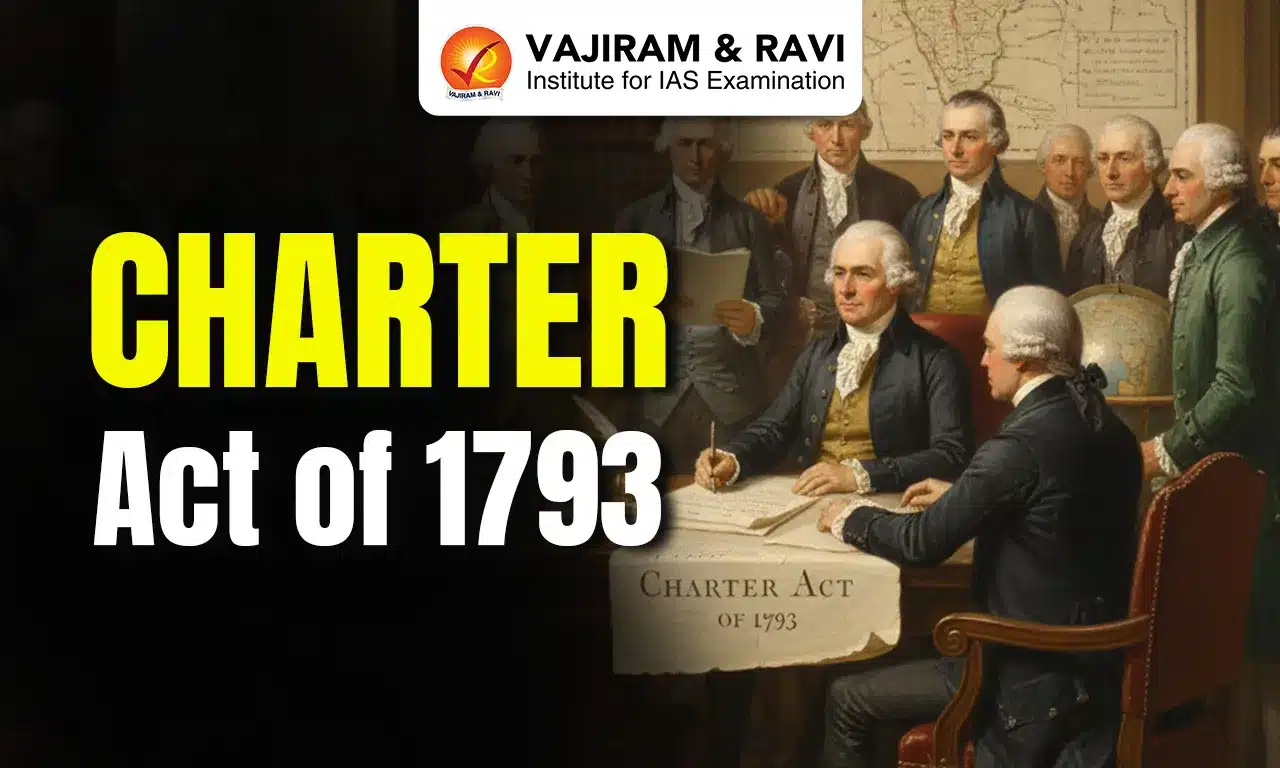
The Charter Act of 1793 was a major law passed by the British Parliament to renew and regulate the East India Company’s role in India. It reaffirmed the Company’s trade rights, strengthened its administrative structure, and clarified that its political authority acted on behalf of the British Crown. This act consolidated British power in India, laying foundations for how the Company would govern Indian territories in the years ahead.
What Is the Charter Act of 1793?
The Charter Act of 1793 (also called the East India Company Act, 1793) extended the East India Company’s charter for another twenty years. It maintained the Company’s exclusive trade rights in India, reinforced its political role, and gave greater power to the Governor-General. At the same time, it strengthened British governmental oversight and confirmed that the Company governed Indian territories on behalf of the British Crown.
Charter Act of 1793 Historical Background
To understand why the Charter Act of 1793 was passed, we need to look at previous laws and political developments.
- Regulating Act of 1773: This was the first major step by Parliament to regulate the East India Company. It created a Supreme Council in Bengal and established a Supreme Court in Calcutta.
- Pitt’s India Act of 1784: This act introduced a dual system of governance: the East India Company managed commerce, while the British government (through the Board of Control) overseen political matters.
- Amendment Act of 1786: In 1786, a supplementary act strengthened the Governor-General’s power. Lord Cornwallis, then Governor-General of Bengal, was given the authority to override his council in certain cases.
- By the early 1790s, the East India Company had grown powerful politically and financially, owning large territories in India and generating large revenues. British policymakers saw the need to renew its charter but also to impose more control, both to secure profits and maintain political stability.
Charter Act of 1793 Provisions
The Charter Act of 1793 introduced several important provisions. We can divide them into political, economic, administrative, and judicial categories.
Political Provisions:
- The Act made it clear that the East India Company’s political role was on behalf of the British Crown, not for its own sovereignty.
- Royal approval was required for key appointments: the Governor-General, governors of presidencies (Madras, Bombay), and the Commander-in-Chief all needed the King’s sanction.
- When the Governor-General was present in Bombay or Madras, he outranked the governors of those presidencies.
- In Bengal, if the Governor-General was absent, he could appoint a Vice-President from among the civilian council members.
Economic/ Trade Provisions:
- The Company’s trade monopoly in India was renewed for another twenty years.
- The Company was required to pay a fixed sum of £500,000 (5 lakh pounds) annually to the British government from its Indian revenues, after covering its expenses.
- Salaries and pensions for the Board of Control (in London) and other officials involved in Indian governance were to be paid from Indian revenue.
- The Act allowed “privilege trade” (also called “country trade”): the Company could grant licences to individuals (including its own employees) to trade in India. This opened the door for private trade (for example, opium trade to China).
- Senior Company officials were not permitted to leave India without permission. If they did so without permission, it was treated as resignation.
- The Company’s dividends for its shareholders could be raised up to 10%.
Administrative Provisions:
- The Governor-General was given expanded powers: he could override his Council in certain situations (a power previously given to Cornwallis in 1786, now extended to all future Governors-General).
- Control over the presidencies of Madras and Bombay was strengthened: the Governor-General had executive authority over them.
- The Board of Control (based in Britain) had its composition altered. It would now consist of a President and two junior members (not necessarily from the Privy Council).
Also Read: Charter Act 1833
Judicial/ Legal Provisions:
- The Act separated the revenue administration from judicial functions. This meant that district collectors or revenue officers no longer acted as judges in revenue courts (the “Maal Adalats” were abolished).
- It reaffirmed the existing higher courts: the Sadar Diwani Adalat (civil appeals) and the Sadar Nizamat Adalat (criminal appeals) in Calcutta remained, with the Governor-General and Council assisting, along with native law officers.
- Provincial appellate courts continued at Calcutta, Dacca, Murshidabad, and Patna to hear lower-level appeals.
Charter Act of 1793 Governor-General
During the period of the Charter Act of 1793, John Shore was the Governor-General of Bengal, and his role reflected the new powers granted by the Act.
- John Shore (Governor-General, 1793-1796): He was in office precisely when this Act came into force. He operated under the new framework, which gave him substantial power to override his Council when necessary.
- Role under the Act: Under this Act, Shore’s authority was not just administrative but also executive: he could enforce decisions, manage presidencies, and act with greater autonomy because the Act recognized stronger central power.
- While the Act extended Cornwallis’s “override” power (first granted in 1786) to future Governors-General, Shore was the first to benefit from this in practice.
Also Read: Charter Act 1853
Charter Act of 1793 Impact
The Charter Act of 1793 created wide-ranging effects on administration, economy, politics, and judiciary by strengthening central authority and expanding Company control.
1. Administrative Impact
- Increased power of the Governor-General weakened provincial autonomy.
- Strengthened centralized decision-making across presidencies.
- Separation of revenue and judicial functions improved administrative clarity.
- Continued British dominance in senior offices without Indian participation.
- Standardized administrative processes across territories.
2. Political Impact
- Reaffirmed the Company’s rule as an extension of the British Crown.
- Reduced independence of Madras and Bombay governments.
- Governor-General gained overriding authority, reducing council resistance.
- Strengthened British control over Indian territories.
- Reinforced the dual-control structure created under Pitt’s India Act.
3. Economic Impact
- Renewed East India Company’s trade monopoly for 20 years.
- Increased financial burden on India due to salaries paid from Indian revenues.
- Allowed licensed private trade, expanding commercial activities.
- Permitted Company dividends up to 10 percent.
- Supported revenue extraction to fund British administrative costs.
4. Judicial Impact
- Abolished revenue courts (Maal Adalats), clarifying judicial functions.
- Sustained higher courts like Sadar Diwani and Sadar Nizamat Adalats.
- Encouraged professional judicial processes.
- Reduced misuse of revenue powers by collectors.
- Continued British dominance in judicial administration.
5. Social Impact
- No policy introduced for education, social reform, or welfare.
- Limited Indian participation maintained social distance between rulers and subjects.
- Privilege trade indirectly affected local communities and artisans.
- Increased central authority shaped social hierarchy under colonial rule.
- Strengthened British socio-political dominance in Indian society.
Charter Act of 1793 Significance
The Charter Act of 1793 was not revolutionary, but it had deep and lasting significance in the evolution of British governance in India:
- Consolidation, not radical change: The Act reaffirmed existing structures rather than disrupt them, giving stability to the British administration.
- Strengthened central power: More authority was given to the Governor-General, making administration more centralized.
- Financial exploitation: By charging administrative salaries to Indian revenues, the Act deepened the economic burden on Indian territories.
- Trade control: The renewal of the Company's monopoly ensured continued economic domination, but the allowance for “country trade” also opened new trade channels.
- Judicial reform: Separating revenue collection from judicial duties meant more impartial justice and stronger legal institutions.
- Political legitimacy: By affirming that the Company acted on behalf of the Crown, the Act clarified that British sovereignty over India was through the Crown, not just the Company.
- Administrative continuity: It ensured continuity through reappointment of officials and stable governance for another two decades.
Charter Act of 1793 Drawbacks
Although the Charter Act of 1793 strengthened British control, it had several important limitations and negative consequences:
- No Indian representation: Indians had no real role in governance or high administration under this Act.
- Economic burden on Indian revenue: Paying British officials from Indian revenues transferred the financial cost of administration to India.
- Trade monopoly persisted: The continuation of the Company’s monopoly limited free trade and economic opportunities for others.
- Encouragement of “country trade”: The license trade (privilege trade) included opium trade with China, which had long-term negative effects.
- Centralization risk: Stronger power to the Governor-General meant less autonomy for local presidencies, reducing decentralization.
- Administrative overreach: The Governor-General’s expanded powers could suppress dissent within his Council.
- Senior official restrictions: Ban on leaving without permission curtailed freedom for Company officers and discouraged initiative.
- Limited judicial reform: While there was separation of powers, only limited improvements were made; system still favored British officers.
- Salaries tied to Indian revenue: Paying the Board of Control from Indian income entrenched financial dependence.
- Short-term charter: Extending for only 20 years meant uncertainty, requiring further renewal and leaving room for future conflicts.
Charter Act of 1793 Impact on Later Charters (1813 & 1833)
The Charter Act of 1793 laid the foundation for future reforms by strengthening centralized authority, formalizing Crown supervision, and clarifying administrative powers. These features exposed governance gaps that later Acts addressed.
- Continued monopoly led to demand for free trade, prompting the Charter Act of 1813.
- Centralized administration highlighted the need for clearer legislative powers, shaping the Charter Act of 1833.
- Increasing political control set the stage for complete restructuring under later Acts.
- Financial dependence on Indian revenue pushed future reforms toward accountability.
Charter Act of 1793 UPSC
The Charter Act of 1793 was a careful balance of British expansion and control. It offered stability by renewing the East India Company’s charter, reaffirmed its trade monopoly, and strengthened central governance under the Governor-General. At the same time, it institutionalized financial burdens on Indian territories and limited meaningful participation by Indians. In effect, the Act advanced British imperial interests while laying down administrative and judicial structures that would influence the course of colonial governance for decades.
Charter Act of 1793 FAQs
Q1: What was the main purpose of the Charter Act of 1793?
Ans: Its main purpose was to renew the East India Company’s powers and continue its trade monopoly for 20 more years.
Q2: Did the Charter Act of 1793 change the administrative structure?
Ans: Yes, it strengthened the Governor-General’s authority and reduced the independence of provincial presidencies.
Q3: How did the Charter Act of 1793 affect trade?
Ans: It continued the Company’s trade monopoly but allowed licensed private “country trade,” including opium trade to China.
Q4: Which Governor-General worked under the Charter Act of 1793?
Ans: John Shore (1793-1796) was the Governor-General when the Act was implemented.
Q5: Did the Charter Act of 1793 include Indians in governance?
Ans: No, the Act did not provide Indians any meaningful role in high administration or decision-making.