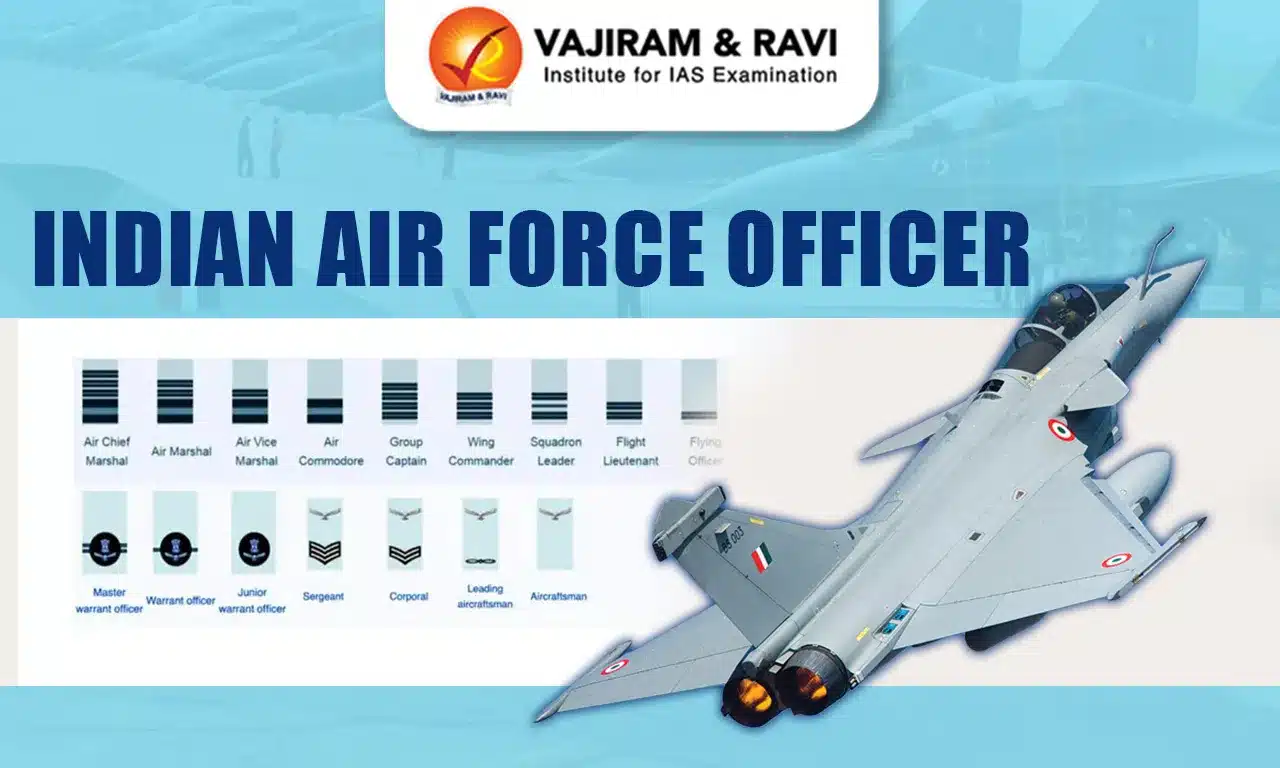
The Indian Air Force (IAF) operates under a well-organized rank structure, which clearly defines the responsibilities, authority, and hierarchy of its personnel. Each rank is associated with a unique insignia worn on the uniform to visually distinguish the level and role of the officer or airman. These ranks are broadly categorized into three main groups, Commissioned Officers, Junior Commissioned Officers (JCOs), and Non-Commissioned Officers (NCOs)/Airmen.
Indian Air Force Ranks Overview
The Indian Air Force Ranks are majorly divided into three categories including, which has its own set of responsibilities and is distinguished by unique insignias. Understanding these ranks is essential to recognize the structure and chain of command within the IAF.
- Commissioned Officers
- Junior Commissioned Officers (JCOs)
- Non-Commissioned Officers (NCOs) and Airmen
Commissioned Officer Ranks in the Indian Air Force
In the Indian Air Force (IAF), Commissioned Officers form the highest tier of the service hierarchy and are entrusted with leadership, strategic planning, and high-level decision-making responsibilities. Their ranks reflect their authority, expertise, and years of service. Each rank is associated with a distinct insignia that symbolizes the officer’s position and duties within the force. The table below offers a detailed overview of the various Commissioned Officer Ranks in the Indian Air Force, along with their insignia descriptions and primary roles.
| Commissioned Officer Ranks in the Indian Air Force | ||
| Rank | Insignia | Role |
|
Flying Officer |
One thin stripe |
Entry-level officer, handles basic operations |
|
Flight Lieutenant |
Two thin stripes |
Supervisory roles, manages small teams |
|
Squadron Leader |
One thick stripe |
Leadership roles, oversees squadrons |
|
Wing Commander |
One thick stripe and one thin stripe |
Commands wings or operational units |
|
Group Captain |
Four thin stripes (similar to Navy Captain rank) |
Senior operational roles, handles major units |
|
Air Commodore |
One thick stripe with an eagle emblem |
Commanding large units, strategic roles |
|
Air Vice Marshal |
One thick stripe, eagle emblem, and a star |
Senior strategic planning and management |
|
Air Marshal |
One thick stripe, eagle emblem, and two stars |
Top-level leadership and policy-making |
|
Air Chief Marshal |
National emblem with a three-star rank |
Highest-ranking officer, Chief of Air Staff |
Indian Air Force Rank and Insignia for Junior Commissioned Officers (JCOs)
In the Indian Air Force (IAF), Junior Commissioned Officers (JCOs) serve as the vital link between Commissioned Officers and the lower ranks. They play a crucial role in overseeing day-to-day operations, ensuring discipline, and managing personnel at the unit level. JCOs carry considerable experience and authority, often entrusted with supervisory and instructional duties. The following table presents the Indian Air Force Rank and Insignia for Junior Commissioned Officers (JCOs) along with their corresponding insignias and responsibilities.
| Indian Air Force Rank and Insignia for Junior Commissioned Officers (JCOs) | ||
| Rank | Insignia | Role |
|
Master Warrant Officer |
IAF Crest with wreaths |
Senior-most JCO, supervisory roles |
|
Warrant Officer |
IAF Crest |
Manages specific units, supervises teams |
|
Junior Warrant Officer |
IAF Crest (smaller version) |
Entry-level JCO, assists in supervision |
Indian Air Force Rank and Insignia for Non-Commissioned Officers (NCOs) and Airmen
Non-Commissioned Officers (NCOs) and Airmen constitute the foundation of the Indian Air Force, playing a vital role in executing technical tasks, ground operations, and routine maintenance of aircraft and equipment. These personnel are essential for the smooth functioning of the IAF’s infrastructure and operations. The table below provides an overview of the Indian Air Force Rank and Insignia for Non-Commissioned Officers (NCOs) and Airmen, highlighting their insignias and functional responsibilities.
| Indian Air Force Rank and Insignia for Non-Commissioned Officers (NCOs) and Airmen | ||
| Rank | Insignia | Role |
|
Sergeant |
Three chevrons |
Supervisory role, manages small teams |
|
Corporal |
Two chevrons |
Assists in technical and operational tasks |
|
Leading Aircraftman |
One chevron |
Entry-level NCO, handles basic responsibilities |
|
Aircraftman |
No insignia |
Entry-level airman, supports technical work |
What are Insignias in Indian Airforce?
The insignias of the Indian Air Force serve as important visual symbols that represent rank, authority, and role within the force. These insignias are typically worn on the shoulders by Commissioned Officers, while Junior Commissioned Officers (JCOs), Non-Commissioned Officers (NCOs), and Airmen wear them on the sleeves or chest, depending on the rank. Each insignia is designed to convey:
- The wearer’s position within the IAF hierarchy
- The scope and level of responsibility held
- The individual’s expertise, leadership, and operational role
Career Progression in the Indian Air Force
Career progression in the Indian Air Force (IAF) follows a structured and merit-based path, ensuring that only the most capable individuals advance through the ranks. Below is an overview of how personnel move upward in their careers:
- Entry-Level Ranks: Officers begin their journey as Flying Officers after commissioning, whereas Airmen start as Aircraftmen following basic training.
- Promotions: Advancement to higher ranks is based on a combination of factors including performance evaluations, length of service, seniority, and success in departmental or promotional examinations.
- Training: At every stage of promotion, personnel undergo rigorous and specialized training programs to prepare them for expanded roles, leadership duties, and technical responsibilities.
Importance of Indian Air Force Rank and Insignia
Ranks and insignias in the Indian Air Force are more than just symbols, they serve critical operational and organizational functions that enhance the force's overall effectiveness:
- They establish a well-defined chain of command, ensuring order, accountability, and adherence to military protocol.
- Insignias represent an individual’s achievements, service, and dedication, instilling pride and motivating personnel to strive for higher responsibilities.
- By making ranks easily identifiable, insignias facilitate effective coordination and teamwork across various units and roles within the Air Force.
Historical Evolution of Indian Air Force Rank and Insignia
The Indian Air Force's rank structure, originally modeled on the British Royal Air Force, has progressively evolved to reflect India’s distinct identity and operational priorities. This showcases the journey of the Indian Air Force from its colonial past to a modern, self-reliant air power. Each rank ranging from Aircraftman to Air Chief Marshal represents a clearly defined role within a disciplined hierarchy. These ranks and insignias are more than designations; they represent the professionalism, honor, and dedication that form the core of the Indian Air Force.
Indian Air Force Officer Ranks FAQs
Q1: What are the ranks in the Indian Air Force?
Ans: Ranks in the Indian Air Force include Flying Officer, Flight Lieutenant, Squadron Leader, Wing Commander, Group Captain, Air Commodore, Air Vice Marshal, Air Marshal, Air Chief Marshal.
Q2: What is the order of rank for Air Force officers?
Ans: The officer rank order is: Flying Officer - Flight Lieutenant - Squadron Leader - Wing Commander - Group Captain - Air Commodore - Air Vice Marshal - Air Marshal - Air Chief Marshal.
Q3: What is an IAF officer?
Ans: An IAF officer is a commissioned officer in the Indian Air Force, responsible for national air defense, aerial warfare operations, leadership, and administrative duties across multiple domains.
Q4: Who is the lowest rank Air Force officer?
Ans: The lowest commissioned officer rank in the Indian Air Force is Flying Officer, which is equivalent to a Lieutenant in the Indian Army or Sub-Lieutenant in Navy.
Q5: Who is the 5 star officer in Air Force?
Ans: The honorary five-star rank in the Indian Air Force is Marshal of the Air Force—awarded only once to Arjan Singh for exceptional service.