Mekedatu Dam Project

Mekedatu Dam Project

Mekedatu Dam Project Latest News

Recently, the Karnataka government decided that it would submit a “revised” Detailed Project Report (DPR) to the Centre on the Mekedatu balancing reservoir across the interstate river Cauvery.

About Mekedatu Dam Project

  • It is a multi-purpose (drinking water and power) project involving the construction of a balancing reservoir near Kanakapura in the Ramanagara district, Karnataka
  • It is about 90 km away from Bengaluru and 4 km ahead of the border with Tamil Nadu.
  • The project is proposed at the confluence of the Cauvery River with its tributary Arkavathi.
  • The plan involves building a 99-metre-high, 735-metre-long concrete gravity dam, an underground powerhouse, and a water conductor system.
  • While the dam will have a capacity of holding about 66 thousand million cubic feet (tmcft) of water, it would generate 400 MW of hydroelectricity once operational. 
  • Once completed, it is expected to supply over 4 TMC (thousand million cubic feet) of water to Bengaluru city for drinking purposes.
  • Issue:
    • Tamil Nadu, the lower riparian state, has been opposing the project, raising apprehensions that the state would be affected if the project takes shape. 
    • Tamil Nadu says, Mekedatu area represents the last free point in Karnataka from where Cauvery water flows unrestricted into Tamil Nadu, and the Mekedatu dam project is an attempt by Karnataka to block this free flow of water.

Source: TH

Mekedatu Dam Project FAQs

Q1: The Mekedatu Dam Project is proposed to be constructed in which location?

Ans: Near Kanakapura in the Ramanagara district, Karnataka.

Q2: The Mekedatu project is planned at the confluence of which two rivers?

Ans: The project is proposed at the confluence of the Cauvery River with its tributary Arkavathi.

Q3: What is the primary purpose of the Mekedatu Dam Project?

Ans: To provide drinking water to the Bengaluru city and to generate hydroelectric power.
Hawfinch

Hawfinch

Hawfinch Latest News

A Hawfinch bird, a species native to Europe, North Africa, and East Asia, was recently recorded at Jim Corbett National Park in Uttarakhand.

About Hawfinch

  • It is a large passerine bird native to Europe, North Africa, and East Asia.
  • It is the biggest bird of the Fringillidae family.
  • Scientific Name: Coccothraustes coccothraustes

Hawfinch Distribution

  • Hawfinches are found across Europe, Eastern Asia (the Palearctic including North Japan), and North Africa (Morocco, Tunisia, and Algeria). 
  • They are mainly resident in Europe, but many Asian birds migrate further south in the winter.
  • Habitat: The hawfinch frequents deciduous and mixed forests, orchards, parks, and also the vegetation along the streams.

Hawfinch Features

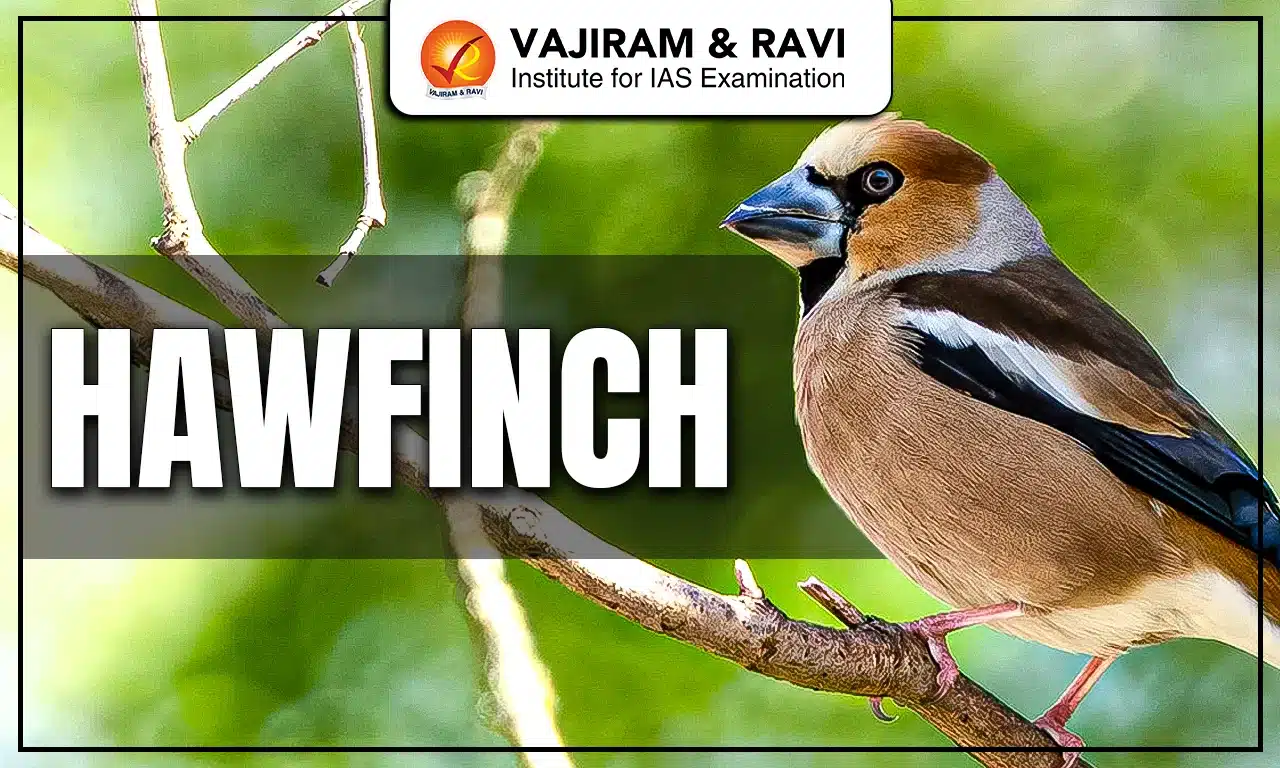
  • It is a robust, heavy-billed finch about 18 cm long, with a wingspan of 29–33 cm. 
  • It has a thick neck, a large round head, and a wide, strong conical beak with a metallic appearance. 
  • It has short pinkish legs with a light hue, and it has a short tail. It has brown eyes. 
  • The plumage of the female is slightly paler than that of the male. 
  • The overall color is light brown, its head having an orange hue to it.
  • Its eyes have a black circle around them.
  • Its powerful beak allows it to crack hard seeds, nuts, and berries. 

Hawfinch Conservation Status

It is classified as 'Least Concern' under the IUCN Red List.

Key Facts about Jim Corbett National Park

  • It is located in the Nainital district of Uttarakhand.
  • It is part of the larger Corbett Tiger Reserve.
  • It is part of the sub-Himalayan ecosystem.
  • It is India’s oldest national park.
    • It was established in 1936 as Hailey National Park.
    • It was later renamed in 1957 in memory of Jim Corbett, a famous hunter and conservationist who played a key role in the establishment of the park.
  • It covers an area of over 520 sq.km.
  • Rivers:
    • The eastern periphery of Corbett National Park is entirely fed by the Kosi River.
    • The Ramganga River (West), along with its significant tributaries Sonanadi, Palain, and Mandal, forms the prominent hydrological resource for the Corbett.
  • Flora: Almost three-quarters of the park is encompassed by deciduous forest, including peepal, rohini, and mango trees. Another 10% of the park is accounted for by grasslands. 
  • Fauna: Bengal tigers, Indian elephants, leopards, sloth bears, deer, and over 600 species of birds.

Source: HT

Hawfinch FAQs

Q1: The Hawfinch is native to which of the following regions?

Ans: Europe, North Africa, and East Asia.

Q2: What is the scientific name of the Hawfinch?

Ans: Coccothraustes coccothraustes

Q3: What is the IUCN conservation status of the Hawfinch?

Ans: Least Concern

Bnei Menashe

Bnei Menashe Community

Bnei Menashe Latest News

Israel's government recently approved a proposal to bring all the remaining 5,800 Jews from India's north-eastern region, commonly referred to as Bnei Menashe, over the next five years.

About Bnei Menashe

  • Bnei Menashe is an ethnic community that hails from the northeastern states of Mizoram and Manipur. 
  • They claim to be the descendants of the biblical tribe of Manasseh, considered one of the "lost tribes" of Israel. 
  • They are Christians converted into Jews and observe traditional Jewish practices and celebrate holidays such as Sukkot. 
  • Historians believe this community may have arrived in India within the last 300–500 years.
  • Their ancestors were exiled long before the Roman dispersion, but they continued to practice Judaism across the generations, even if not in a contemporary Orthodox way. 
  • Once they  came into contact with Israel and global Jewry in the 1980s, they embraced modern Jewish learning and practice.
  • Nearly half of the 'Bnei Menashe' population migrated to Israel over a period of time and became its citizens.
  • According to the recent Israeli Government plan, approximately 1,200 community members are expected to immigrate to Israel by the end of 2026. 
  • A second stage, slated for completion by 2030, will bring an additional 4,600 people, effectively completing the arrival of the entire community. 

Source: TH

Bnei Menashe FAQs

Q1: The Bnei Menashe community primarily hails from which Indian states?

Ans: Mizoram and Manipur

Q2: Which biblical tribe do the Bnei Menashe claim to descend from?

Ans: Bnei Menashe claim to be the descendants of the biblical tribe of Manasseh, considered one of the "lost tribes" of Israel.

Q3: When do historians believe the Bnei Menashe may have arrived in India?

Ans: Historians believe this community may have arrived in India within the last 300–500 years.

Entrepreneur-in-Residence Programme

Entrepreneur-in-Residence Programme

Entrepreneur-in-Residence Programme Latest News

Recently, the Union Minister of State for Science & Technology said that the Entrepreneur-in-Residence (EIR) Programme is gaining popularity among young startups, innovators.

About Entrepreneur-in-Residence Programme

  • It is one of the programs introduced under National Initiative for Developing and Harnessing Innovations (NIDHI).
  • It aims to encourage graduate students to take to entrepreneurship as a prospective career option by providing financial and non-financial support in the form of a fellowship. 

Features of Entrepreneur-in-Residence (EIR) Programme

  • Financial Support: Recipient is eligible to get financial support of up to INR 30,000/- monthly.
  • It is offered to graduate students for a maximum period of 12 months.
  • The Programme includes access to the infrastructure facilities at the TBI, mentoring support and guidance, technical and financial advice, industry connections etc.
  • Implementation: It is implemented by the Dept. of Science and Technology, Govt. of India in association with NCL Venture Centre, Pune.

What is the NIDHI Programme ?

  • National Initiative for Developing and Harnessing Innovations (NIDHI) as an umbrella programme for nurturing ideas and innovations (knowledge-based and technology-driven) into successful startups.

 Source: PIB

Entrepreneur-in-Residence Programme FAQs

Q1: What is the primary objective of the EIR Programme?

Ans: To encourage graduate students to pursue entrepreneurship as a career option

Q2: What is the financial support provided to EIR fellows?

Ans: Up to ₹30,000 monthly for 12 months

Young Stellar Objects

Young Stellar Objects

Young Stellar Objects Latest News

Recently, a team of researchers has decoded the early lives of young stars called Young Stellar Objects (YSO) using a decade of data from NASA satellites Wide-field Infrared Survey Explorer (WISE) and its extended mission NEOWISE.

About Young Stellar Objects

  • These are stars in the earliest stages of their lives where stars stably fuse hydrogen in their cores.
    • This is the stage before the stars enter the main sequence of what is called the Hertzsprung-Russell diagram (a plot showing stars in various stages of evolution based on their temperature and brightness).
  • These objects typically reside within dense molecular clouds rich in gas and interstellar material.
  • Formation: YSOs form from the collapse of dense molecular clouds, triggered by events like nearby supernova explosions, stellar radiation, or turbulence in the interstellar medium.
  • Types: There are two principal kinds of YSOs: Protostars and Pre-main sequence stars.

Stages of Young Stellar Objects

  • Class 0 and Class I phases: These are mostly visible in infrared and radio wavelengths due to their thick dust envelopes.
  • Class II and Class III: In this phase the object becomes visible in optical wavelengths as it clears away its surrounding envelope.

Significance of studying Young Stellar Objects

  • Understanding Star Formation: They provide insights into the processes that lead to star formation, including magnetic activity, stellar winds, and outflows.
  • Planet Formation: They help in understanding the conditions that lead to planet formation and the early solar system.

Source: PIB

Young Stellar Objects FAQs

Q1: Where are Young Stellar Objects typically found?

Ans: Dense molecular clouds

Q2: What are the stages of YSOs in order?

Ans: Class 0, Class I, Class II, Class III

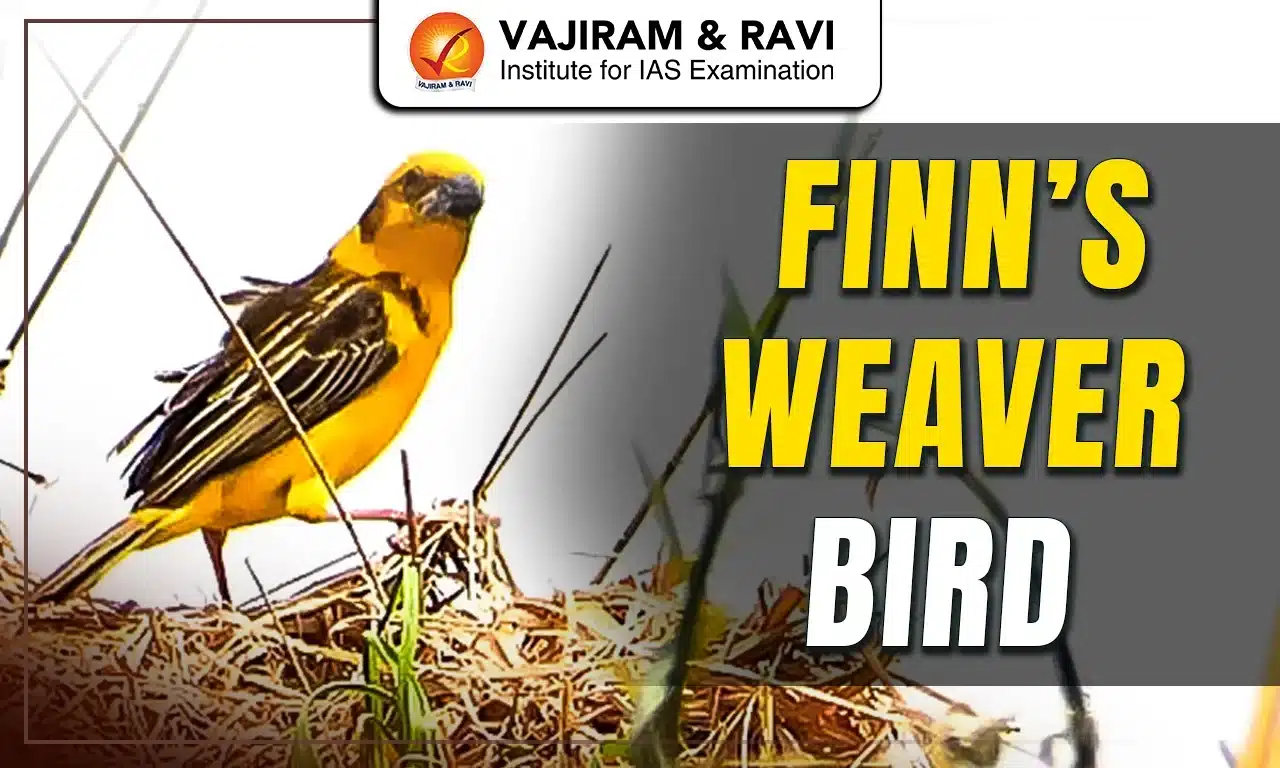
Finn’s Weaver Bird

Finn’s Weaver Bird

Finn’s Weaver Bird Latest News

Recently, Ornithologists have been alerted that the Finn’s Weaver bird is silently disappearing from the marshy lowlands of the Terai region in India.

About Finn’s Weaver Bird

  • Finn's weaver (Ploceus megarhynchus ) is also known as Finn's baya and yellow weaver is a weaver bird species.
  • The weaver bird was named Finn’s Weaver after Frank Finn, the British officer.
  • Distribution: It is native to the Ganges and Brahmaputra valleys in India and Nepal.
  • Habitat: They live close to dams and reservoirs. Water, marshy soil, tall grasses, Semal (silk cotton) and Shisham (rosewood) trees make up its natural habitat.
  • These birds build their nests on tall grass and these trees.
  • Weaver birds are largely granivorous birds, with adults feeding mainly on seeds, supplemented with invertebrates
  • Threats: Human activities including expansion of agriculture, grass cutting, construction work, residential buildings, and increase in industrial units across the Terai has disrupted the natural habitat of these birds. 

Conservation Status of Finn’s Weaver Bird

Source: DTE

Finn’s Weaver Bird FAQs

Q1: What is the scientific name of Finn's Weaver Bird?

Ans: Ploceus megarhynchus

Q2: Where is Finn's Weaver Bird primarily found?

Ans: Ganges and Brahmaputra valleys in India and Nepal

International Astronomical Union (IAU)

International Astronomical Union

International Astronomical Union (IAU) Latest News

A 3.5-billion-year-old Martian crater has been named after pioneering Indian geologist M.S. Krishnan, following the International Astronomical Union’s (IAU’s) approval of this and several other Kerala-proposed names for Martian landforms.

About International Astronomical Union (IAU)

  • It was founded in 1919 as a senior body governing international professional astronomical activities worldwide.
  • Its mission is to promote and safeguard the science of astronomy in all its aspects, including research, communication, education, and development, through international cooperation. 
  • Activities:
  • Definition of fundamental astronomical and dynamical constants and unambiguous astronomical nomenclature
  • Rapid dissemination of new discoveries
  • Organization of international observing campaigns
  • Promotion of educational activities in astronomy to early informal discussions of possible future international large-scale facilities.
  • It is the only organization recognized professionally for the naming of astronomical bodies, which it does solely on the basis of merit, history, or discoverer’s privilege. 
  • The IAU holds a general assembly every three years in varying parts of the world. The long-term policy of the IAU is defined by the General Assembly.
  • Headquarters: Paris, France.
  • A key activity of the IAU is the organization of scientific meetings. Every year the IAU sponsors 9 international IAU Symposia. 
  • Membership:
    • Its individual Members — structured into Divisions, Commissions, and Working Groups — are professional astronomers from all over the world, at the Ph.D. level and beyond, who are active in professional research, education and outreach in astronomy. 
    • The IAU also has Junior Members. 
    • The IAU has a total membership of 12742. 
    • These members are labeled as "active" in the IAU database, meaning they have a valid email (are able to vote and stay connected to the IAU activities) and are affiliated to at least one Division. 
    • IAU membership spans 92 countries. Out of those countries, 85 are National Members.

Source: TH

International Astronomical Union (IAU) FAQs

Q1: In which year was the International Astronomical Union (IAU) founded?

Ans: It was founded in 1919.

Q2: What is the primary mission of the IAU?

Ans: Promote and safeguard the science of astronomy through international cooperation.

Q3: Where is the headquarters of the International Astronomical Union (IAU) located?

Ans: Paris, France

Q4: How often does the International Astronomical Union (IAU) hold its General Assembly?

Ans: The IAU holds a general assembly every three years in varying parts of the world.

Amylotropic Lateral Sclerosis

Amylotropic Lateral Sclerosis

Amyotrophic Lateral Sclerosis Latest News

A research paper highlighted that the number of cases of Amyotrophic Lateral Sclerosis (ALS) in the world will increase from 222,801 in 2015 to 376,674 in 2040, representing an increase of 69%. 

About Amyotrophic Lateral Sclerosis

  • It is also known as Lou Gehrig’s disease, is a progressive neurological disorder that affects muscle movement. 
  • It can occur at any age but symptoms commonly develop between the age of 55 and 75, with men more than women likely to develop the condition.
  • Causes: In few people with ALS, a genetic cause can be identified. For the rest, the cause is not known.

How does ALS Affect the Body?

  • In people with ALS, the motor neurons degenerate and die and messages sent by the brain do not reach the muscles which results in muscle atrophy (lose strength and become weak).
  • Eventually, the brain loses control over voluntary movements including walking, chewing and even breathing, as the condition progresses. 

Symptoms and Progression of ALS

  • It includes muscle twitches in the arms, leg, shoulders or tongue; muscle cramps;
  • Tightness or stiffness of muscles; muscle weakness in a limb or the neck; and difficulty in chewing or swallowing. 

Treatment for Amyotrophic Lateral Sclerosis

  • There is no treatment to reverse nerve degeneration, but some therapy may help to delay progression.
  • A treatment would include physical, occupational and speech therapy to improve quality of life. 

Source: TH

Amyotrophic Lateral Sclerosis FAQs

Q1: Which type of neurons are affected in ALS?

Ans: Motor neurons

Q2: What is another name for Amyotrophic Lateral Sclerosis (ALS)?

Ans: Lou Gehrig's disease

Enquire Now