
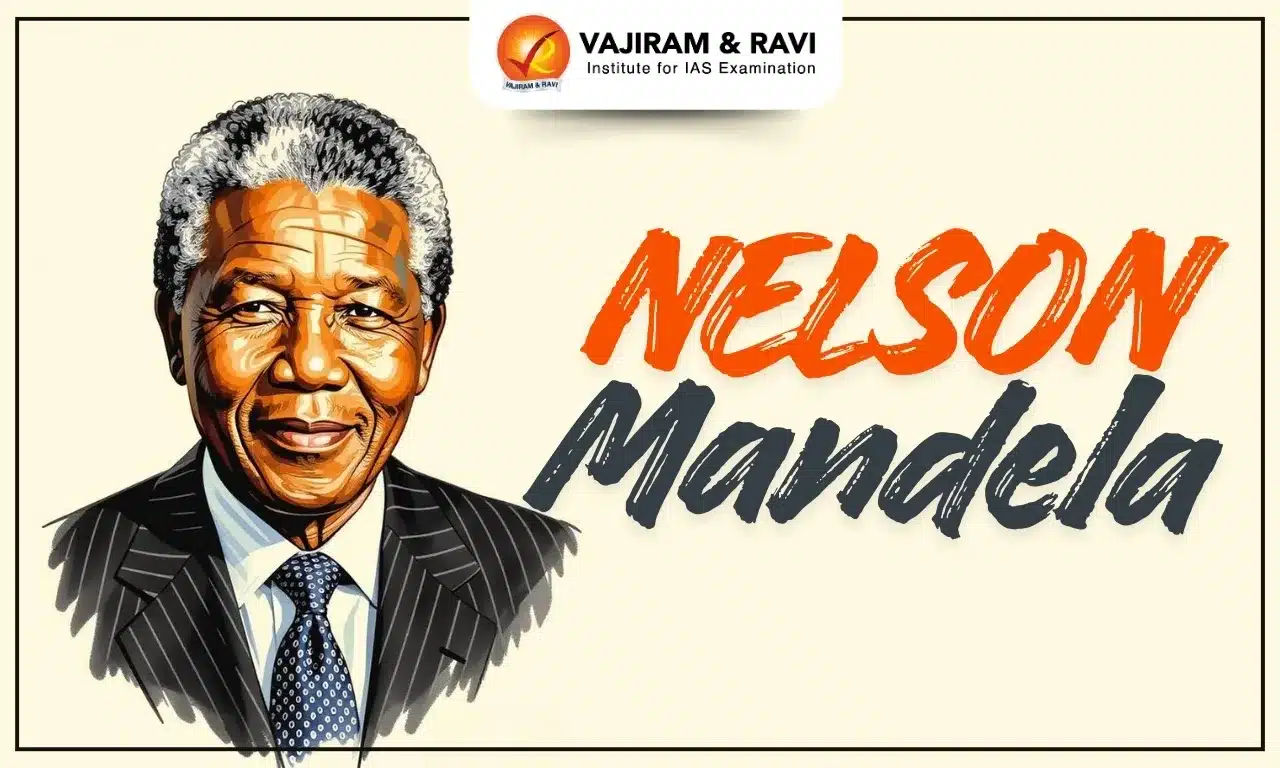
Nelson Mandela, a Nobel Laureate and Philanthropist, is remembered as the South African Anti-Apartheid Leader who fought for Human Rights. His resilience played a great role in abolishing Apartheid (a system that segregated or discriminated on the basis of “Race”) in 1948. He was the first Black President of South Africa from 1994 to 1999. He was the leader of African National Congress and played an important role in the establishment of democratic South Africa.
Nelson Mandela
Nelson Mandela was born on July 18th, 1918 in Mvezo, Cape Province, Union of South Africa. His birth anniversary (18 July) was declared as “Nelson Mandela International Day” by the United Nations in 2009. By birth Rolihlahla Mandela (childhood name) belonged to the Thembu Royal Lineage. He pursued Law from the University of Witwatersrand and became one of the few Black Law Graduates. With Oliver Tambo he established South Africa’s first Black Law Firm in 1952.
Anti-Apartheid Movement of Nelson Mandela
After 1948, various Apartheid Laws were being expanded by the National Party, such as- Population Registration Act 1950, Bantu Education Act 1953, etc. Mandela, a leader of ANC (joined 1943) and co-founder of ANC Youth League (1944), led the Defiance Campaign 1952 against these laws using non-violent resistance and civil disobedience. He also contributed to the drafting of the Freedom Charter of 1955.
The Sharpeville Massacre 1960 (in which 69 peaceful protestors were killed by Police) led to the shift from peaceful protest to arm resilience, followed by the formation of armed wing “Umkhonto we Sizwe” by ANC with Mandela as the Founder along with mass burning of the ‘Passbooks’ in solidarity.
Also Read: Mahatma Gandhi
Nelson Mandela Imprisonment
In 1962, Mandela was arrested and sentenced for five years. While serving the sentence, he was put on a trial (Rivonia Trial) in 1964 for sabotage and conspiracy to overthrow the Government. He gave a famous speech stating that he is ready to die for his ideals and beliefs. In this trial he was further sentenced with life imprisonment along with other leaders arrested and sent to the Robben Island Prison, where he spent 18 years followed by Pollsmoor Prison and Victor Verster Prison. During this period, his messages were conveyed internationally by his followers which led to the increase in global sanctions on apartheid including UN General Assembly Resolution 1761 (1962), etc. He was released from prison after 27 years in 1990 after President Klerk initiated reforms.
Nelson Mandela Presidency
After his release, ANC was legalized and various negotiations began for a democratic transformation, leading to the Convention for a Democratic South Africa (CODESA) in 1991-93. The first Multiracial Election of South Africa was held on April 27 1994, which elected Nelson Mandela as the President in 1994 till 1999. As President he guided the drafting of the Constitution (1966) while guaranteeing Universal Suffrage, Equality and other rights. He established Truth and Reconciliation Commission (TRC) under A. Desmond Tutu in 1995 to investigate the violation of apartheid and assist the victims. Mandela Government focussed on Reconstruction and Development Programme (RDP) which addressed housing, healthcare, education and other issues. The significant achievement was construction of ~1.1 million houses and enrollment of primary schools for Black Children.
Nelson Mandela Achievements
For his remarkable and iconic role, Nelson Mandela received more than 260 Awards and Honours. These include one of the prestigious Nobel Prize, Bharat Ratna , Presidential Medal of Freedom, Order of Merit, and other honours such as Honorary Degrees (250+) and citizenship from various nations worldwide. The significant awards include:
- Lenin Peace Prize (1990): Awarded by the Soviet Union.
- Bharat Ratna (1990): India's highest civilian award.
- Nishan-e-Pakistan (1992): Pakistan's highest civilian award.
- Nobel Peace Prize (1993): Mandela and Klerk jointly received for peaceful end of apartheid.
- Philadelphia Liberty Medal (1993): Awarded by the U.S. National Constitution Center.
- Order of Merit (1995): Awarded by the United Kingdom.
- Sakharov Prize for Freedom of Thought (1988): Awarded by the European Parliament for his dedication to human rights.
- Congressional Gold Medal (1998): Awarded by the U.S. Congress.
- Presidential Medal of Freedom (2002): The highest civilian award in the United States.
- Nelson Mandela International Day (2009): UN General Assembly designated July 18 to honor him.
Nelson Mandela UPSC
Nelson Mandela is globally regarded as one of the most influential political figures of the 20th century. He played a crucial role in the national as well as international issues including mediation of the conflicts such as Burundi and Democratic Republic Congo. He emphasized on education stating- “Education Is the most powerful weapon to change the world” and also advocated for various healthcare concerns. He passed away on December 05th, 2013 in Johannesburg at the age of 95, leaving a remark of his life around the world. His autobiography “Long Walk to Freedom” (1994) remains a primary source for his principles and philosophies.
Nelson Mandela FAQs
Q1: Who was Nelson Mandela?
Ans: Nelson Mandela was a South African Anti-Apartheid leader, a Nobel laureate and the first Black President of South Africa.
Q2: What was Nelson Mandela Known for?
Ans: Nelson Mandela is known for his struggle against the apartheid and promotion of reconciliation, democracy, and human rights.
Q3: Why was Nelson Mandela imprisoned?
Ans: Mandela was imprisoned in 1962 for 27 years for opposing apartheid and being a part of the anti-government resistance movements.
Q4: What role did Nelson Mandela play after becoming the President?
Ans: Mandela focused on the National Reconciliation, Development, and creation of equality promoting policies in South Africa.
Q5: What are the major achievements of Nelson Mandela?
Ans: Mandela was awarded more than 260 awards and honours including Nobel Peace Prize 1993 and Bharat Ratna 1990 for his contribution.
