Grey Seal

Grey Seal

Grey Seal Latest News

Recently, researchers found that seal milk comprises 332 different kinds of oligosaccharides

About Grey Seal

  • It is a large seal of the family Phocidae.
  • It is also known as the Atlantic seal and the horsehead seal.
  • It is found on both shores of the North Atlantic Ocean. 
  • Distribution: They are found across the North Atlantic Ocean in coastal areas from mid-Atlantic to the Baltic Sea.
  • Habitat: These seals spend the majority of their lives in coastal waters; when on land, they occur on rocky coasts, islands, and sandbars, as well as on ice shelves and icebergs.
  • Conservation Status: IUCN: Least Concern

Characteristics of Grey Seals

  • Appearance: Males can reach 10 feet long and females are smaller in size. Its pups have white fur known as lanugo. This white fur helps absorb sunlight and trap heat to keep the pups warm. 
  • Gray seals are diurnal animals, being active during the day and sleeping at night. 
  • It shows a ‘bottling’ behavior i.e when the seal is in a vertical position in the water with only its head up above the surface.
  • Diet: Gray seals are carnivores (piscivores). They feed on a wide variety of fish, mostly benthic or demersal species.
  • Life Span: Their lifespan ranges from 25 to 35 years.

Source: IE

Grey Seal FAQs

Q1: Where is the Grey Seal found?

Ans: North Atlantic Ocean

Q2: What is the conservation status of the Grey Seal?

Ans: Least Concern

Tex-RAMPS Scheme

Tex-RAMPS Scheme

Tex-RAMPS Scheme Latest News

Recently, the Government of India has approved the Textiles Focused Research, Assessment, Monitoring, Planning and Start-up (Tex-RAMPS) Scheme.

About Tex-RAMPS Scheme

  • It will be implemented as a Central Sector Scheme, fully funded by the Ministry of Textiles.
  • Total outlay: ₹305 crore for the period FY 2025-26 to FY 2030-31.
  • It is designed to address critical gaps in research, data systems, and innovation support and capacity development.

Components of Tex-RAMPS Scheme

  • Research & Innovation: It promotes advanced research in smart textiles, sustainability, process efficiency, and emerging technologies to boost India’s innovation capacity.
  • Data, Analytics & Diagnostics: It creates robust data systems including employment assessments, supply chain mapping, and the India-Size study to facilitate evidence-based policymaking.
  • Integrated Textiles Statistical System (ITSS): A real-time, integrated data and analytics platform to support structured monitoring and strategic decision-making.
  • Capacity Development & Knowledge Ecosystem: It strengthens State-level planning, dissemination of best practices, capacity building workshops, and organisation of sectoral events.
  • Start-up & Innovation Support: It supports incubators, hackathons, and academia-industry collaborations to nurture high-value textile start-ups and entrepreneurship.

Source: PIB

Tex-RAMPS Scheme FAQs

Q1: What is the primary objective of the Tex-RAMPS Scheme?

Ans: To boost research and innovation in the textile sector

Q2: What is the duration of the Tex-RAMPS Scheme?

Ans: 2025-2031

International Institute for Democracy and Electoral Assistance

International Institute for Democracy and Electoral Assistance

International Institute for Democracy and Electoral Assistance Latest News

Chief Election Commissioner of India is set to assume the role of the Chairperson of the International Institute for Democracy and Electoral Assistance (International IDEA) for the year 2026.

About International Institute for Democracy and Electoral Assistance

  • It is an inter-governmental organisation established in 1995.
  • It works to strengthen democratic institutions and electoral processes worldwide.
    • International IDEA has been granted UN observer status.
  • Objective:  The objectives of the Institute are to support stronger democratic institutions and processes, and more sustainable, effective and legitimate democracy.
  • Member countries: It currently has 35 member countries, with the United States and Japan as observers. India is a founding member of International IDEA
  • Governance: The Institute's governance consists of a Council of Member States, a Steering Committee, a Finance and Audit Committee, a Board of Advisers and a Secretariat, led by the Secretary-General.
    • Each year, the Council elects a Chair and two Vice Chairs among its Member States. 
  • Core Functions: Its working modalities include four elements: knowledge production, capacity development, advocacy as well as convening of dialogues.
  • It focuses on six workstreams namely:
    • Electoral Processes
    • Constitution-Building 
    • Democracy Assessment
    • Political Participation and Representation
    • Climate Change and Democracy
    • Digitalization and Democracy
  • Secretariat: Stockholm, Sweden

Source: TH

International Institute for Democracy and Electoral Assistance FAQs

Q1: Where is the headquarters of International IDEA located?

Ans: Stockholm, Sweden

Q2: What is the primary objective of International IDEA?

Ans: To support sustainable democracy worldwide

Sirpur Archaeological Site

Sirpur Archaeological Site

Sirpur Archaeological Site Latest News

The government is planning to prepare Chhattisgarh’s 5th Century Sirpur archaeological site for UNESCO tag.

About Sirpur Archaeological Site

  • Location: It is located in Mahasamund district of Chhattisgarh.
  • It is a 5th–12th Century archaeological site located on the banks of the Mahanadi.
  • It was the flourishing capital of Dakshina Kosala under the Panduvanshi and later Somavamshi kings.
  • It is a multi-religious urban centre first discovered in 1882 by Alexander Cunningham in 1871.

Key Features of Sirpur Archaeological Site

  • Excavations revealed 22 Shiva temples, five Vishnu temples, 10 Buddhist viharas and three Jain viharas.
  • Notable Structures
    • Lakshmana Temple (dedicated to Vishnu): It is one of India’s finest brick temples which was built around the 7th Century.
    • Surang Tila complex: It is built on a high terrace and has multiple shrines in the panchayatana style (one main shrine surrounded by four subsidiary ones).
    • Tivaradeva Mahavihara: It houses a significant Buddha statue.
  • It was a major Buddhist centre with large viharas, meditation halls and excavated stupas.
  • It also has a 6th Century market complex, showing Sirpur was both a religious and commercial hub.

Source: IE

Sirpur Archaeological Site FAQs

Q1: Where is the Sirpur Archaeological Site located?

Ans: Mahasamund district, Chhattisgarh

Q2: On which river the Sirpur Archaeological Site located?

Ans: Mahanadi

Vikram-I Rocket

Vikram-I Rocket

Vikram-I Rocket Latest News

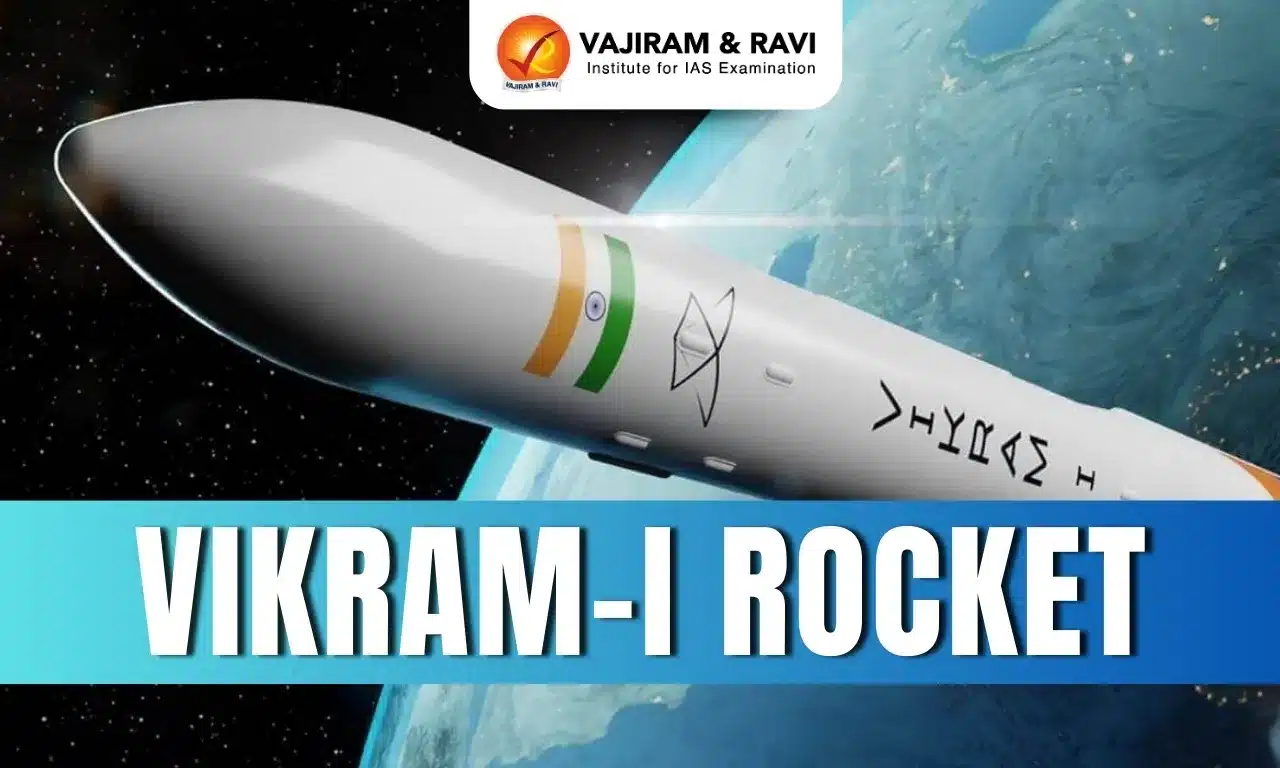
Recently, the Prime Minister of India unveiled Skyroot Aerospace’s first orbital rocket, Vikram-I.

About Vikram-I Rocket

  • It is developed by Skyroot Aerospace.
  • It is India’s new private orbital-class launch vehicle named after the notable space pioneer Vikram Sarabhai. 

Features of Vikram-I Rocket

  • Thrust: It produces 1,200 kN of thrust using an all-carbon composite structure for enhanced lightweight strength and efficiency.
  • Design: The design emphasises simplicity, reliability, and the ability to launch within 24 hours from any location.
  • Stages: It has four stages and the first three stages are solid-fuelled, providing robust initial thrust, topped by a hypergolic liquid upper stage for precise orbital adjustments.
    • Stage 4 uses a cluster of four Raman engines. These are hypergolic engines, (meaning they ignite instantly when two chemicals, MMH fuel and NTO oxidiser, come into contact.
  • It is built to target the small-satellite segment and is capable of placing multiple satellites into orbit in a single mission.
  • Payload Capacity: It can deploy up to 350 kg into low Earth orbit (LEO) and 260 kg into a sun-synchronous orbit (SSO).
  • Innovation: Other key innovations include 3D-printed engines, ultra-low-shock pneumatic separation systems, and advanced avionics for real-time guidance.

Source: India Today

Vikram-I Rocket FAQs

Q1: Who developed Vikram-I Rocket?

Ans: Skyroot Aerospace

Q2: Who is known as the Father of the Indian Space Program?

Ans: Vikram Sarabhai

Enquire Now