Human Development in India, India’s Performance, Challenges

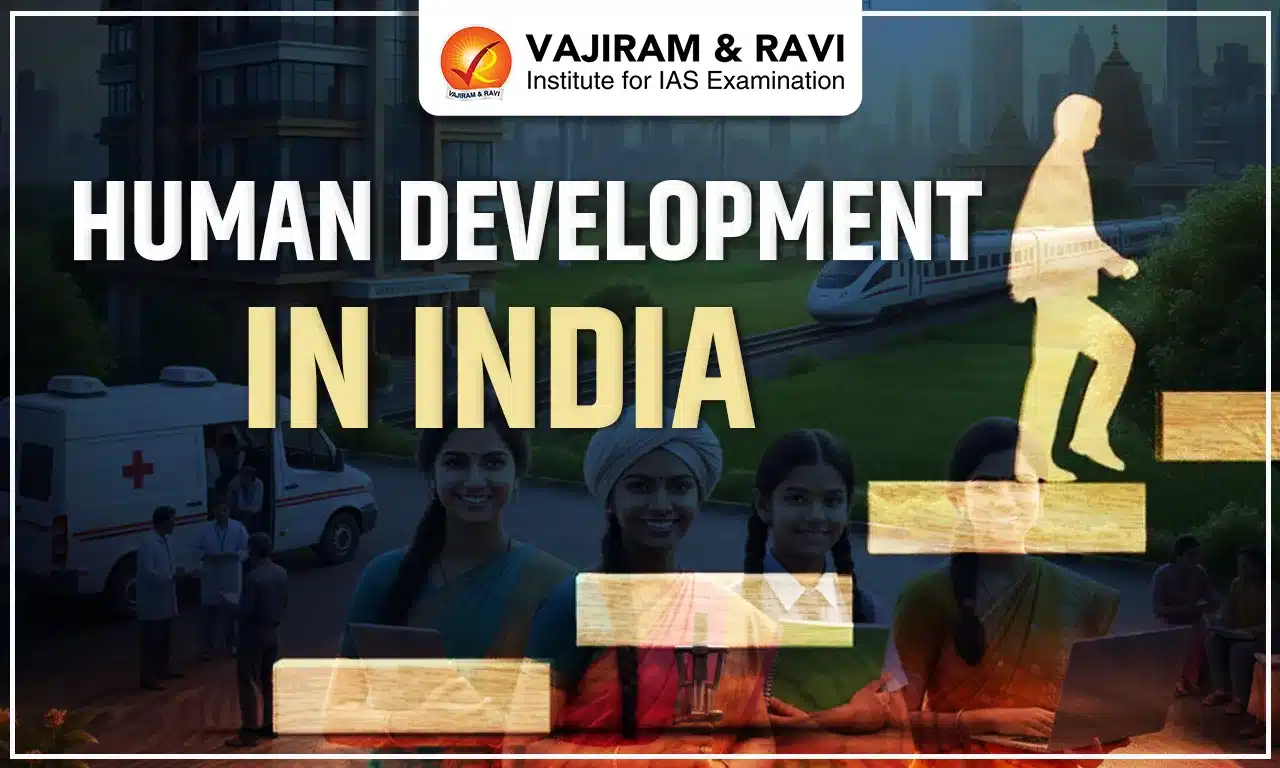
Human Development in India

The Human Development Index is a composite measure assessing a country’s progress in health, education, and standard of living. It uses indicators such as life expectancy, years of schooling, and per capita income. HDI provides a broader understanding of well-being beyond GDP-centric growth. It helps compare countries and evaluate policy outcomes in human development.

The article highlights details related to Human Development in India, HDI and its components, Government Initiatives for Human Development in India, challenges and way forward for better India.

Human Development in India

Human development in India has steadily improved over the decades, supported by rising literacy, expanding healthcare access, and social welfare schemes. 

According to UNDP’s Human Development Report 2024, India ranks 134 out of 193 countries, with an HDI value of 0.644, showing consistent progress from 0.556 in 2010. 

Life expectancy has increased to 67.7 years, while school expectancy stands at 12.6 years, reflecting gains in education and health.

Human Development Index (HDI)

The Human Development Index (HDI), introduced by UNDP in 1990, provides a composite measure of human progress that captures the essence that economic growth is important, but without education, health, and dignity, true development cannot take place. 

Importance of HDI for India

  • Offers global benchmarking of India's human development outcomes
  • Highlights gaps in states’ performance and guides policy focus
  • Helps measure long-term social investments (health, education)
  • Enhances accountability through global comparisons

Components of Human Development Index (HDI)

Human Development Index (HDI) is calculated using three major dimensions that reflect basic human capabilities. These indicators provide a well-rounded understanding of how societies are progressing beyond economic wealth.

  1. Health
  • Indicator: Life expectancy at birth
    Reflects overall health conditions, nutrition levels, quality of medical care, disease control, and sanitation coverage.
  • India’s life expectancy is around 70.1 years (UNDP 2023), still below the global average (73.4 years).
  1. Education
  • Indicators: Mean Years of Schooling (MYS) + Expected Years of Schooling (EYS)
  • Mean years of schooling in India: 6.6 years (UNDP 2023)
    Expected years of schooling: 11.9 years
  • Education quality remains a key area of concern despite high enrollment.
  1. Standard of Living
  • Indicator: Gross National Income (GNI) per capita (PPP)
  • India’s GNI per capita (PPP): $6,951 (UNDP 2023)
  • Income inequality remains high; top 10% hold over 57% of national income.

India’s Performance in Global Human Development Index

India ranks 134 out of 193 countries in HDI 2023, placing it in the medium human development category. Over the decades, India's HDI has steadily improved from 0.434 in 1990 to 0.644 in 2023, reflecting better access to education, healthcare, and economic opportunities. But issues like malnutrition, learning losses, gender inequality, and low public spending slow progress.

Facts on India’s HDI Performance

  • HDI Value (2023): 0.644
  • Category: Medium Human Development
  • Gender Development Index (GDI): 0.820, indicating gender-based inequality
  • Inequality-adjusted HDI (IHDI) drops by over 25% due to inequality in access

Reasons for Moderate HDI Rank

  • Low public health expenditure (~2.1% of GDP)
  • High malnutrition among children (35% stunting in NFHS-5)
  • Skewed income distribution
  • Rural-urban and north-south gaps

Human Development NITI Aayog’s Role and SDG Progress

NITI Aayog is central to India’s human development strategy through evidence-based policymaking and tracking progress on Sustainable Development Goals (SDGs). Its SDG India Index ranks states, encouraging competition and targeted interventions. 

States like Kerala, Himachal Pradesh, and Tamil Nadu consistently perform well due to strong health and education systems.

NITI Aayog Contributions to Human Development

  • SDG India Index: Tracks progress in No Poverty, Zero Hunger, Health, Education, Gender Equality, etc.
  • Aspirational Districts Programme (ADP): Focuses on 112 underdeveloped districts, improving health, nutrition, education, and agriculture.
  • POSHAN Abhiyaan & Nutrition Strategy: Reduces stunting, anemia, and malnutrition.
  • Education Quality Improvement: Learning outcomes monitored through NIPUN Bharat and school infrastructure reforms.

SDG Achievements

  • Over 41.5 crore people lifted out of multidimensional poverty since 2005-06.
  • Clean cooking fuel access via Ujjwala: 10 crore+ beneficiaries.
  • Improved sanitation coverage through Swachh Bharat: Open Defecation Free (ODF) status across rural India.

Human Development in India Government Initiatives

India's development model relies heavily on welfare-driven and rights-based schemes to address multidimensional deprivation. These initiatives cover social security, health, nutrition, digital empowerment, and gender equality.

1. Health Initiatives

  • Ayushman Bharat (PM-JAY): World's largest health insurance program offering ₹5 lakh per family
  • Health and Wellness Centres (HWCs): Strengthening primary healthcare
  • National Health Mission (NHM): Maternal, newborn, and child health focus
  • Mission Indradhanush: It aims for universal immunisation coverage.

2. Education Initiatives

  • Samagra Shiksha Abhiyan: School infrastructure + quality improvement
  • NEP 2020: Modernization, flexibility, multi-disciplinary approaches
  • PM POSHAN (Mid-Day Meal): Nutrition for school children
  • Right to Education Act (RTE), 2009: It guarantees free and compulsory education for children aged 6-14.

3. Nutrition & Social Protection

  • POSHAN Abhiyaan: Targets stunting, wasting, anaemia
  • ICDS: Maternal-child nutrition & early childhood care
  • MGNREGA: Largest rural employment program ensuring wage security
  • NFSA: Subsidised food grains for 81.35 crore people

4. Housing, Sanitation & Financial Inclusion

  • PM Awas Yojana: Affordable housing for rural and urban poor
  • Swachh Bharat Mission: Sanitation success with 11 crore toilets
  • PM Jan Dhan Yojana: 51 crore+ bank accounts → financial inclusion

Challenges to Human Development in India

Human Development in India faces multiple structural challenges arising from socio-economic inequality, regional imbalances, and gaps in health, education, and employment.

1. Health and Nutrition Challenges

  • High Child Malnutrition: NFHS-5 shows 35.5% children stunted, 19.3% wasted, and 57% women (15-49 years) are anemic.
  • Low Health Spending: India’s public health expenditure is around 2.1% of GDP, lower than WHO’s recommended 5%.
  • High Out-of-Pocket Expenditure (OOPE): OOPE accounts for ~48% of total health spending, pushing millions into poverty every year.

2. Educational Inequality

  • Foundational Learning Gap: ASER 2023 shows only 43% of Class 5 students can read a Class 2-level text; numeracy outcomes equally poor.
  • Dropout Rates: Secondary level dropout is ~14.6%, higher among girls due to early marriage and domestic responsibilities.
  • Digital Divide: During COVID-19, ~29% students lacked access to smartphones or internet for online learning.

3. Gender Inequality

  • Gender Gap in Workforce: Women contribute only 18% to India’s GDP compared to the global average of 37%.
  • Violence & Safety Concerns: NFHS-5 reports 29% of women face domestic violence.
  • Education Gap: Though gender parity has improved, female dropout rates after Class 8 are still high.

4. Social Exclusion & Inequality

  • Caste-Based Disparities: SC/ST communities face gaps in education, health, and income due to historical discrimination.
  • Disabled Population Challenges: 2.2% of India’s population is disabled; access to education and employment remains limited.

5. Regional and Social Disparities

  • State-Level HDI Gaps: Kerala’s HDI (0.782) is comparable to Eastern Europe, while Bihar’s HDI (~0.576) resembles low-income countries.
  • North-South Divide: Southern states (Kerala, TN, Karnataka) lead in health and education, while BIMARU states lag.
  • SC/ST & Minority Deprivation: Poverty among STs is ~33%, almost triple the national average (NITI Aayog MPI 2023).
  • Urban-Rural Divide: Rural poverty is 2.5 times higher than urban poverty; access to schools and hospitals also uneven.

Way Forward

Strengthening Human Development in India requires a multidimensional strategy that focuses on reducing inequalities, boosting public investment, and enhancing the quality of essential services. India must shift from welfare-driven approaches to capability-building models that empower individuals through education, health, skills, and social protection

1. Increase Public Investment in Health & Education

  • Raise health expenditure to 3% of GDP and education expenditure to 6% of GDP as recommended by the NEP and WHO.
  • Strengthen primary health infrastructure by expanding Health & Wellness Centres (HWCs).

2. Address Malnutrition & Improve Public Health Outcomes

  • Expand POSHAN Abhiyaan with stronger monitoring through real-time nutrition dashboards.
  • Integrate ICDS, PM Poshan, and health services for a life-cycle approach to child and maternal health.
  • Increase access to safe drinking water and sanitation to reduce diarrheal diseases, which account for 10% of child deaths.

3. Reduce Income Inequality & Expand Decent Employment

  • Promote labour-intensive industries like textiles, tourism, food processing, and MSMEs.
  • Strengthen skilling under PMKVY, Skill India Mission, and link skills to market demand.
  • Expand formalisation through EPFO/ESIC enrollment to reduce informal workforce dependency.

4. Strengthen Social Protection

  • Expand coverage of PM-JAY, pensions, maternity benefits, and unemployment support.
  • Improve DBT efficiency through Aadhaar-linked accounts while ensuring inclusion and grievance redressal.

5. Promote Climate-Resilient Development

  • India loses 1.8% of GDP annually due to climate disasters (UNEP 2023).
  • Implement climate-smart agriculture; 50% of farmers still depend on monsoons.
  • Renewable energy: India has 180+ GW installed RE capacity; expanding to meet the 500 GW target by 2030.
  • Improve air quality: 14 of the world’s top 20 polluted cities are in India; NCAP aims for 40% PM reduction by 2026.

6. Improve Governance, Transparency & Service Delivery

  • India ranks 111/125 on the Global Hunger Index due to weak state capacity and leakages.
  • Implement social audits in PDS, MGNREGA, PMAY, etc.
  • Strengthen Panchayati Raj Institutions, only 1.5% of GDP is spent through local bodies, far below global norms (5-7%).

Human Development in India FAQs

Q1: What is human development according to UNDP?

Ans: Human development means expanding people’s choices and improving their well-being through better health, education, and quality of life.

Q2: What is India’s rank in HDI?

Ans: India ranked 134th in 2023 with an HDI value of 0.644, placing it in the medium human development category.

Q3: Which state has the highest human development indicators in India?

Ans: Kerala consistently ranks highest due to high literacy, long life expectancy, and robust public health systems.

Q4: What are the biggest challenges to human development in India?

Ans: Major challenges include malnutrition, poor learning outcomes, unemployment, gender inequality, and regional disparities.

Q5: What role does NITI Aayog play in human development?

Ans: It monitors SDG progress, runs the Aspirational Districts Programme, and supports evidence-based policymaking to improve health, nutrition, and education.

South America, Map, Geographical Features, Political Landscape

South America

South America is one of the most diverse continents of the world. It is the 4th largest continent, covering 12 countries in 17.84 million sq. km. The region is the centre of attraction for its rich biodiversity, concern for climate change, emerging political trends, Amazon Conservation and other significant strategies that have a major impression of South America Globally.

South America Geography

The geographical features of South America play an important role in the climate regulation and distribution of resources. The major highlights of the South America Geography are:

  • Andes Mountains: They form the longest continental mountain range in the world expanding 7000 km in the west of the continent.
  • Amazon Basin: It covers about 40% of South America and hosts the Amazon River.
  • Atacama Desert: It is the driest non-polar desert located in Chile. It receives almost no rainfall annually.
  • Patagonia Region: It is a crucial glacial zone shared by Argentina and Chile highly concerned for global warming.
  • Fresh Water: About 20 to 25% of the total fresh water reserve of the world is present in South America.
  • Rivers: The major rivers and systems include: Amazon River, Parana-Paraguay River System, Orinoco River, etc contributing to global hydrological cycle and biodiversity.

South America Political Landscape

The Political Environment of South America is shaped by the leadership transitions, economic trends and political movements. The major Political highlights can be seen below:

  • The shift between Left and right leaning governments often redefine the regional policies of South America on trade, social issues and international relations.
  • Brazil has the largest GDP and influences integrity through organizations MERCOSUR and UNASUR.
  • The ongoing political and economic crisis in Venezuela, in which over 7 million people are displaced or leaving the nation, is the highly concerning regional challenge for the continent.
  • The failed Constitutional Reform of Chile and Political Instability have grabbed global attention at large.

South America International Relations

The Countries of South America are the major suppliers of minerals, energy, etc. which makes them the center of Geopolitical Competition. The key highlights are:

  • Lithium Triangle (Bolivia, Chile and Argentina): It holds about half of the overall Lithium reserves of the world which makes it crucial for the Global EV supply chain. Although there is a growing debate on the nationalism of resources especially in Bolivia and Chile.
  • China has become South America’s largest trading partner through increased economic engagement.
  • The role of Brazil in BRICS strengthens South America’s collective voice at the global level.
  • Colombia and Brazil play a significant role in the international climate negotiations and discussion on energy transitions.

South America-India Relations

India and South America have expanded their trade, energy, technology and agriculture together with time significantly. Major areas of collaborative engagement of India and South America are:

  • India, Latin America and Caribbean trade was USD 35.73 billion in 2023-24, a decline from earlier.
  • India’s energy security has been strengthened with the import of Crude Oils from South America (Brazil, Colombia, Guyana).
  • India has Preferential Trade Agreements with both Chile (2007) and MERCOSUR (2009) aiming to expand the market access through reciprocal tariff preference.
  • India has developed several collaborations with South America in sectors like Pharmaceuticals, Informational Technology, Space Technologies, etc.

South America Environment

South America deals with the debates and discussions on environmental and climate issues highly related to the significance of Amazon. Major areas of discussion are:

  • Deforestation of Amazon has reached a high level in 2019-2022, which has made it a global climate concern.
  • The Amazon rainforest stores about 90 to 140 billion metric tonnes of Carbon (IPCC) making it significant for climate stability.
  • Various highlighting issues include: Forest Fire, Mining, Cattle Ranching, Illegal Logging, etc.
  • The commitment of Brazil for Carbon Neutrality for 2050 has made it a central figure for climate diplomacy in the world.
  • During COP26, over 130 countries, including Brazil, pledged to end deforestation by 2030.

South America Economic Features

The economy of South America is highly linked with the commodities making it sensitive to the global market fluctuations. The major economic insights of South America are:

  • It is the major exporter of Soybean, Copper, Iron Ore, Beef and Coffee.
  • World’s Top producer of Copper includes Peru and Chile of South America.
  • The economic instability in Argentina (2023) due to inflation rates crossing 211.4% has highly impacted the regional finances.
  • Guyana has become the fastest growing economy of the world, with GDP growth rates reaching over 62% in 2022, due to new offshore oil reserves discovery since 2015.

South America FAQs

Q1: What is South America known for?

Ans: South America is known for the Amazon rainforest, the Andes Mountains, rich biodiversity, major river systems, and large mineral and agricultural resources.

Q2: Which is the largest country in South America?

Ans: Brazil is the largest country in South America, covering nearly 48% of the continent’s total land area.

Q3: Why is South America important for global climate?

Ans: South America hosts the Amazon rainforest, which stores around 90-140 billion metric tons of carbon, vital for global climate regulation.

Q4: What is the Lithium Triangle in South America?

Ans: The Lithium Triangle includes Bolivia, Chile, and Argentina, holding about half of the global lithium reserves essential for EV batteries.

Q5: What is India’s main trade interest in South America?

Ans: India imports crude oil, copper, gold, and agricultural products from South America, with bilateral trade crossing USD 35.73 billion in 2023-24.

Cash Reserve Ratio (CRR), Objectives, Impact, CRR vs SLR

Cash Reserve Ratio

Cash Reserve Ratio (CRR) is the share of a bank’s total deposit that it keeps with the Reserve Bank of India (RBI) in the form of cash only. However, the RBI doesn’t provide any interest on the CRR, and the banks cannot use this amount for lending or investment purposes.

Statutory Liquidity Ratio (SLR) is the percentage of deposits that the banks have to keep with themselves in the form of liquid cash, gold deposit, or government securities. This SLR is used to control inflation and increasing SLR reduces the money supply, which helps in controlling inflation.

What is Cash Reserve Ratio?

The Cash Reserve Ratio (CRR) is a monetary policy tool of the Reserve Bank of India (RBI) in which banks are required to keep a percentage of their total deposit with the central bank, i.e., RBI. This reserve is used to control the money supply, manage inflation, and to make sure that banks have enough funds to meet the withdrawal demands.

The banks cannot use these amounts for any other purposes, such as lending and investment purposes. 

The Cash Reserve Ratio (CRR) applies only to commercial banks and regional rural banks, and Non-Banking Financial Companies (NBFC) are excluded.

The RBI Act 1949, Section 42, gave a provision for the RBI to announce a Cash Reserve Ratio (CRR) between 3%-15%. This was amended in 2007 by removing the lower ceiling making it 0-15%.

Cash Reserve Ratio Objectives

  • Ensure safety of depositor money: CRR keeps a part of bank deposits with the RBI so banks don’t run out of cash during emergencies.
  • Control money supply: By raising or lowering CRR, RBI can instantly increase or reduce the amount of money banks can lend.
  • Manage inflation: Higher CRR reduces excess money in the system, helping control rising prices.
  • Maintain financial stability: It acts as a buffer so banks remain healthy and the financial system stays stable.
  • Improve liquidity discipline: It ensures banks don’t over-lend and always maintain a minimum level of ready cash.
  • Support RBI’s monetary policy: CRR works as a key tool for RBI to regulate credit flow in the economy.

Incremental Cash Reserve Ratio

  • The Incremental Cash Reserve (I-CRR) is a temporary additional reserve requirement imposed by the Reserve Bank of India (RBI) on only the incremental (new) deposits, not the total deposits of banks.
  • It is used when there’s a sudden surge in bank deposits/liquidity (for example, due to currency circulation changes), so that the RBI can absorb surplus liquidity and prevent potential macroeconomic disruption.
  • On 10 August 2023, RBI mandated that all scheduled banks maintain an I-CRR of 10% on increases in their Net Demand and Time Liabilities (NDTL) during the period 19 May 2023 to 28 July 2023.
  • This action was taken due to surplus liquidity in the banking system, caused by, among other things, the return of old currency notes (₹ 2,000 notes) to banks.

Impact of Cash Reserve Ratio on the Indian Economy

Cash Reserve Ratio (CRR) plays a key role in managing liquidity and controlling money supply in the Indian economy. Changes in CRR directly influence inflation, the lending capacity of banks, and overall economic activity.

Impact of Increasing CRR

  • Liquidity in banks decreases as more funds must be kept with the RBI.
  • The lending capacity of the banks reduces, which slows down credit growth to businesses and households.
  • Interest rates may rise due to tighter liquidity conditions.
  • It helps in controlling inflation by reducing excess money supply in the economy.

Impact of Decreasing CRR

  • Banks gain more liquidity as fewer funds are with the RBI.
  • Lending increases, promoting credit growth and supporting investment and consumption.
  • Interest rates may ease due to better liquidity conditions.
  • Boosts economic activity and supports growth during slowdowns.

CRR vs Statutory Liquidity Ratio (SLR)

CRR and Statutory Liquidity Ratio (SLR) are two key monetary tools used by the RBI to regulate liquidity and ensure stability in the banking system. CRR requires banks to keep a portion of their deposits as cash with the RBI, while the Statutory Liquidity Ratio (SLR) mandates banks to hold a percentage of deposits in liquid assets like gold or government securities with itself. Together, they control money supply, influence lending capacity, and maintain financial discipline in the economy.

Cash Reserve Ratio FAQs

Q1: What is Cash Reserve Ratio (CRR)?

Ans: CRR is the percentage of a bank’s total deposits that must be kept as cash with the Reserve Bank of India (RBI).

Q2: Why does RBI use CRR?

Ans: RBI uses CRR to control liquidity, manage inflation, and ensure banking system stability.

Q3: Does CRR earn interest for banks?

Ans: No, banks do not earn any interest on the money kept with RBI as CRR.

Q4: How does increasing CRR affect the economy?

Ans: It reduces liquidity, tightens credit, and helps control inflation.

Q5: How does decreasing CRR affect the economy?

Ans: It increases liquidity, boosts lending, and supports economic growth.

MH-60R Seahawk Helicopter

MH-60R Seahawk Helicopter

MH-60R Seahawk Helicopter Latest News

Recently, India sealed a ₹7,995-crore deal with the U.S. as part of a “follow on support” package for the Indian Navy's fleet of 24 MH-60R Seahawk helicopters for five years.

About MH-60R Seahawk Helicopter

  • It is often called the “Romeo” is a state-of-the-art naval helicopter.
  • It is manufactured by US defence major Lockheed Martin.

Features of MH-60R Seahawk Helicopter

  • All Weather Capability: It is an all-weather helicopter designed with state-of-the-art avionics and sensors.
  • Multi mission: It is designed for anti-submarine warfare (ASW), anti-surface warfare (ASuW), maritime surveillance, search and rescue, medical evacuation, and ship-borne operations.
  • Advanced Sensors: It is one of the world’s best submarine-hunting helicopters, equipped with advanced sensors like the AN/AQS-22 ALFS dipping sonar, sonobuoys, and multi-mode radar.
  • It also carries the powerful Mk-54 torpedo, allowing it to detect, track, and engage underwater threats.
  • For surface warfare missions, the MH-60R can carry AGM-114 Hellfire missiles, lightweight torpedoes, and machine guns.
  • It is combined with electro-optical sensors and radar systems that can identify hostile ships, fast attack craft, or suspicious vessels and neutralise them with precision.

Source: TH

MH-60R Seahawk Helicopter FAQs

Q1: What is the nickname of the MH-60R Seahawk Helicopter?

Ans: Romeo

Q2: What is the range of the MH-60R Seahawk Helicopter?

Ans: 400 km (approx.)

National Mission for Mentoring

National Mission for Mentoring

National Mission for Mentoring Latest News

Recently, the University Grants Commission (UGC) has called on all higher educational institutions (HEIs) across India to nominate teaching faculty under the National Mission for Mentoring (NMM). 

About National Mission for Mentoring

  • It is the flagship initiative of the Department of School Education and Literacy, Ministry of Education.
  • It is in line with the National Education Policy (NEP) 2020.
  • It provides platforms for professionals and experts where they can share knowledge, skills and expertise as a Mentor with Mentee teachers and help them in their journey to become effective teachers. 
  • It was launched on 29th July 2022 in selected 30 Central Schools (15 KVs, 10 JNVs, 5 CBSE) across the country.
  • It aims to create a supportive environment, enhance mentorship experiences and contribute to individual and collective growth.
  • National Council for Teacher Education (NCTE) has been assigned to develop and design the modalities for National Mission for Mentoring (NMM).
    • NCTE released a comprehensive document on the mission (NMM – The Blue Book) with a detailed roadmap of its framework and implementation strategy.
  • Important stakeholders: Mentor (the guide), Mentee (the teacher) and The Nodal officers/administration
  • Implementation strategy
    • Pilot phase: It was first tested in 30 Central Schools (15 Kendriya Vidyalayas, 10 Jawahar Navodaya schools, and 5 CBSE schools) with 60 mentors, some even Padma Awardees.
    • Building capacity: Seminars and workshops are conducted to teach “Master Mentors” who can subsequently teach others.
    • Incentivisation: Although participation is voluntary, the NMM manual encourages participants to do so with certificates, performance credits and other incentives.

 Source: TH

National Mission for Mentoring FAQs

Q1: What is the primary objective of the National Mission for Mentoring?

Ans: To enhance teacher training and professional development

Q2: Who is leading the National Mission for Mentoring initiative?

Ans: National Council of Teacher Education (NCTE)

Rustic Bunting

Rustic Bunting

Rustic Bunting Latest News

Birders recently spotted a rare species, the rustic bunting (emberiza rustica) at Najafgarh Jheel on the Delhi-Gurugram border, marking the first time the passerine bird, which is also elusive across India, was spotted in the national capital region (NCR).

About Rustic Bunting

  • It is a passerine bird in the bunting family Emberizidae.
  • Scientific Name: Emberiza rustica

Rustic Bunting Distribution

  • Its breeding range extends from the Nordic regions to eastern Siberia.
  • It migrates to southeast Asia and parts of East Asia, including Japan, Korea, and eastern China, during the winter months. 
  • There are only a handful of records of it being seen across India – predominantly in the northeast and across the Himalayan belt.

Rustic Bunting Features

  • It is relatively small but with a stocky body.
  • The compact body measures around 15-16 cm in length and weighs about 20-25 grams. 
  • Males and females exhibit some differences in their plumage, especially during the breeding season. 
  • Males boast a striking appearance with their black heads adorned with white stripes above and below the eyes, creating a distinctive facial pattern. 
  • Their upperparts are a combination of brown and black, with the brown being more prominent on the wings and back, creating a beautifully mottled effect. 
  • The breast and underparts are a soft pinkish-buff, transitioning to white on the belly. 
  • In contrast, females and non-breeding males are more subdued in color, featuring browner heads with less distinct facial patterns, and overall, their plumage is more uniformly brown and less vibrant.

Rustic Bunting Conservation Status

It is classified as 'Near Threatened' under the IUCN Red List.

Source: HT

Rustic Bunting FAQs

Q1: In which regions does the Rustic Bunting typically breed?

Ans: Its breeding range extends from the Nordic regions to eastern Siberia.

Q2: To which parts of Asia does the Rustic Bunting migrate during winter?

Ans: It migrates to southeast Asia and parts of East Asia.

Q3: What is the IUCN Red List status of Rustic Bunting?

Ans: Near Threatened

India Internet Governance Forum

India Internet Governance Forum

India Internet Governance Forum Latest News

Recently, the fifth edition of the India Internet Governance Forum (IIGF‑2025) concluded with a clear vision for inclusion, stronger digital infrastructure and responsible AI.

About India Internet Governance Forum

  • It is the Indian chapter of the United Nations Internet Governance Forum (UN IGF) which was established in 2021.
  • It is a global multi-stakeholder platform that fosters dialogue on public policy issues related to the Internet.
  • It aims to maximize the opportunities of the Internet while addressing associated challenges and risks.
  • IIGF promotes collaborative discussions among representatives from government, civil society, industries, technical communities, think tanks, and industry associations.
  • It is guided by a 14-member multi-stakeholder committee, IIGF Known for its inclusive and collaborative approach.
  • Role of IIGF: It plays a vital role in shaping policies for an open, secure, and accessible Internet, addressing issues such as cybersecurity, digital inclusion, data privacy, and emerging technologies.
  • Theme of the fifth edition of IIGF: “Advancing Internet Governance for an Inclusive and Sustainable Viksit Bharat.” 

What is Internet Governance ?

  • It is the process of developing norms and principles that impact the way the Internet is used and functions.
  • It includes solving technical issues, setting regulatory frameworks, and policymaking to respond to social, economic and security matters, as well as questions of trust, standard-setting, accountability and jurisdiction. 

Source: PIB

India Internet Governance Forum FAQs

Q1: What is the primary objective of the India Internet Governance Forum?

Ans: To foster dialogue on public policy issues related to the Internet

Q2: What is the theme of IIGF 2025?

Ans: Advancing Internet Governance for an Inclusive and Sustainable Viksit Bharat.

Syntactic Foam

Syntactic Foam

Syntactic Foam Latest News

A crucial set of tests on the Samudrayaan, India’s first manned-submersible dive into the ocean, is likely only mid-next year following a delay in the procurement of syntactic foam cladding from France.

About Syntactic Foam

  • A syntactic foam is a composite material that is produced by filling a metal, polymer, or ceramic with pre-formed inorganic hollow spheres known as micro balloons.
  • Syntactic’ is a term that refers to the ordered positioning of the spheres, and the word ‘foam’ alludes to the closed cellular structure.
  • Most of the advantageous features of the material are a result of the hollow spheres inside of the syntactic foam.

Syntactic Foam Properties

  • Lightweight with High Strength: The use of hollow microspheres allows foam to maintain a low weight while offering excellent compressive strength.
  • Superior Buoyancy: Its inherent low density makes it ideal for subsea applications where buoyancy is critical.
  • Thermal and Acoustic Insulation: It reduces thermal conductivity and dampens noise, improving performance in marine and aerospace environments.
  • Corrosion and Water Resistance: The closed-cell structure prevents water absorption, enhancing its longevity in saltwater and chemically aggressive environments.

Syntactic Foam Applications

  • Subsea and Offshore: Ideal for remotely operated vehicles (ROVs), autonomous underwater vehicles (AUVs), and pipeline insulation.
  • Aerospace: Used in satellite components and structural parts where weight reduction is essential without sacrificing strength.
  • Defense and Military: Employed in sonar domes, buoyancy modules, and lightweight armor due to its impact resistance.
  • Automotive and Sports: Increasingly adopted for lightweight, high-impact applications such as crash protection and performance gear.

What is the Samudrayaan Project?

  • It is India’s first manned mission to explore the deep ocean. 
  • It is aimed to develop a self-propelled manned submersible to carry three human beings to a water depth of 6,000 meters in the ocean with a suite of scientific sensors and tools for deep ocean exploration. 
  • It is designed to study the deep ocean resources and conduct biodiversity assessments as well. 
  • The mission will not disturb the ecosystem as the submersible is used solely for exploration purposes. 
  • The project is part of the larger Deep Ocean Mission, which supports the Central Government’s Blue Economy policy.
  • Nodal Ministry: Ministry of Earth Sciences (MoES).

What is MATSYA 6000?

  • It is a manned submersible vehicle developed by the National Institute of Ocean Technology (NIOT), Chennai. 
  • It was developed under the Samudrayaan mission to facilitate humans in the deep ocean in exploring mineral resources.

Source: TH

Syntactic Foam FAQs

Q1: What is syntactic foam?

Ans: A composite made by filling a matrix with hollow inorganic microspheres.

Q2: What does the term ‘syntactic’ refer to in syntactic foam?

Ans: It refers to the ordered positioning of the spheres.

Q3: Why is syntactic foam preferred for subsea applications?

Ans: Because of it's excellent compressive strength and superior buoyancy.

National Productivity Council (NPC)

National Productivity Council

National Productivity Council Latest News

The Delhi High Court recently quashed the Lokpal of India’s proceedings against Defence Secretary Rajesh Kumar Singh, a 1989-batch IAS officer, and other officials in a case alleging irregularities in promotions at the National Productivity Council (NPC).

About National Productivity Council

  • NPC, established in 1958, is an autonomous organization under the Department for Promotion of Industry & Internal Trade, Ministry of Commerce and Industry.
  • It is a multipartite, non-profit organization with equal representation from employers’ & workers’ organizations and the Government, apart from technical & professional institutions and other interests. 
  • Headquarters: New Delhi
  • National Productivity Council Objectives:
    • To increase awareness of productivity in general, especially of the concepts and techniques aimed at strengthening the microeconomic foundations of economic development, rooted in operating practices and strategies of the organizations.
    • To function as a think tank of the Government on measures needed to enhance focus on productivity
    • To be among the premier productivity consultancy and training organizations of the country in the first phase and of the South & Southeast Asian region in the long run.
    • To raise financial resources to sustain its operations on its own on a self-generating and continuing basis.
  • National Productivity Council Functions:
    • Consultancy to organizations on productivity improvement.
    • Training of personnel at different levels.
    • Dissemination of productivity information through seminars, workshops, conferences, etc.
    • Productivity Research and Database.
    • Productivity Publications.
    • Productivity Awards.
  • NPC has professionals from diverse fields to provide Consultancy, Capacity Building, and Project Monitoring Unit (PMU) services to various organisations, including Central Government Ministries and State Governments.
  • It is a constituent of the Tokyo-based Asian Productivity Organisation (APO), an Inter-Governmental Body of which the Government of India is a founding member.

Source: TP

National Productivity Council FAQs

Q1: The National Productivity Council (NPC) was established in which year?

Ans: 1958

Q2: National Productivity Council (NPC) functions under which ministry?

Ans: Ministry of Commerce and Industry

Q3: Where is the headquarters of the National Productivity Council located?

Ans: New Delhi

Q4: National Productivity Council is a constituent of which international organisation?

Ans: It is a constituent of the Tokyo-based Asian Productivity Organisation (APO).

Central Board of Indirect Taxes and Customs (CBIC)

Central Board of Indirect Taxes and Customs (CBIC)

Central Board of Indirect Taxes and Customs (CBIC) Latest News

The Central Board of Indirect Taxes and Customs (CBIC) ‘GST & Customs Pavilion’ has bagged the Gold Prize in the ‘Public Outreach and Communication’ category at the India International Trade Fair (IITF) 2025 in New Delhi recently.

About Central Board of Indirect Taxes and Customs 

  • CBIC, formerly known as the Central Board of Excise and Customs (CBEC), is one of the Boards constituted under the statute the Central Boards of Revenue Act, 1963.
  • It is the apex body under the Department of Revenue, Ministry of Finance, responsible for administering indirect taxes in India.
  • It deals with the tasks of 
    • Formulation of policy concerning levy and collection of Customs, Central Excise duties, Central Goods & Services Tax and IGST. 
    • Prevention of smuggling and administration of matters relating to Customs, Central Excise, Central Goods & Services Tax, IGST, and Narcotics to the extent under CBIC's purview.
  • The Board is the administrative authority for its subordinate organizations, including Custom Houses, Central Excise and Central GST Commissionerates, and the Central Revenues Control Laboratory.
  • The CBIC is headed by a Chairman and has 6 members in addition to the Chairman.

Source: PIB

Central Board of Indirect Taxes and Customs (CBIC) FAQs

Q1: Central Board of Indirect Taxes and Customs (CBIC) is constituted under which act?

Ans: Central Boards of Revenue Act, 1963

Q2: Central Board of Indirect Taxes and Customs (CBIC) functions under which ministry?

Ans: It is the apex body under the Department of Revenue, Ministry of Finance.

Q3: What subordinate organisations fall under the administrative control of Central Board of Indirect Taxes and Customs (CBIC)?

Ans: Custom Houses, Central Excise and Central GST Commissionerates, and the Central Revenues Control Laboratory.

Lake Biwa

Lake Biwa

Lake Biwa Latest News

Researchers recently unearthed a remarkably well-preserved ancient relic, a nearly intact pottery vessel, in Japan, dating back over 10,000 years.

About Lake Biwa

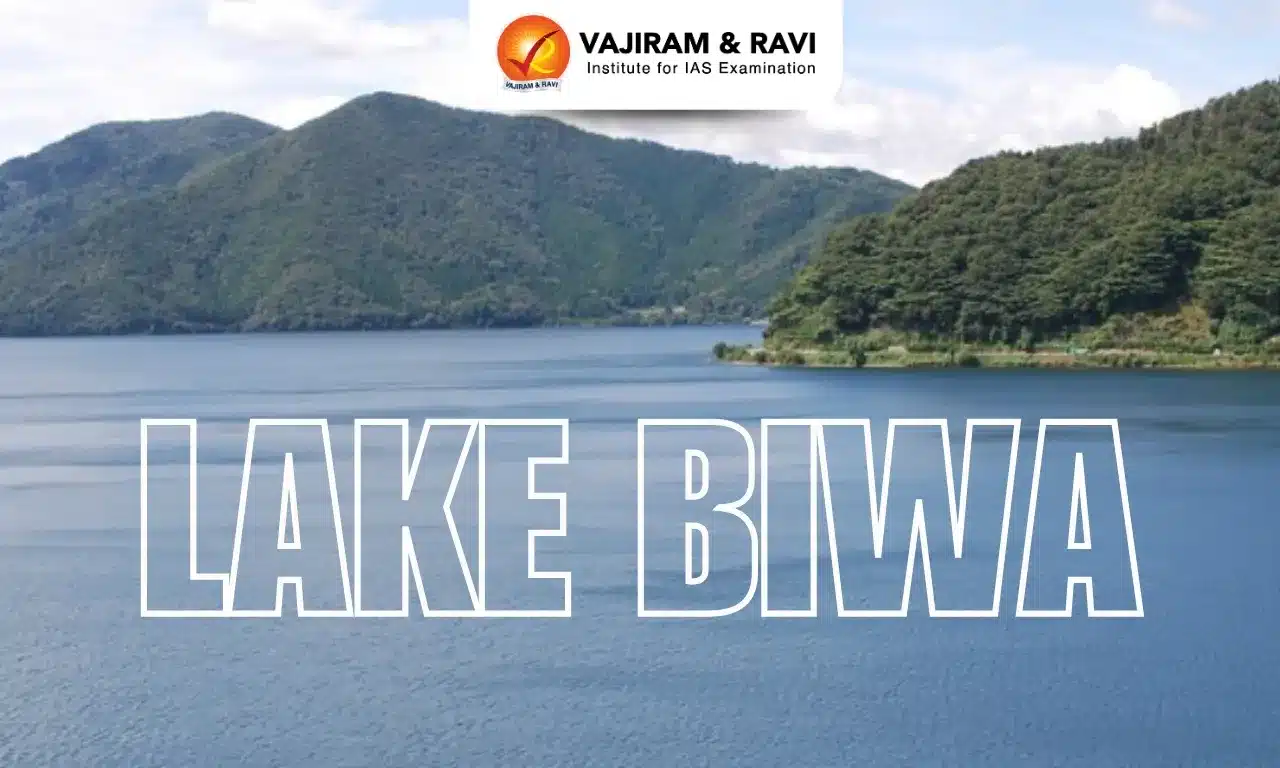
  • It is the largest freshwater lake in Japan.
  • It is located in Shiga ken (prefecture), west-central Honshu. 
  • Approximately 64 km long from north to south, the lake covers an area of 672 sq.km.
  • Its name refers to the biwa, a Japanese musical instrument that the lake resembles in shape.
  • It is believed to be one of the world's oldest lakes, formed at least four million years ago.
  • The lake occupies a structural depression and is fed by small rivers flowing from the encircling mountains. 
  • The sole outlet, the Yodo River, flows from Lake Biwa’s southern tip, past Seta southwest to Ōsaka Bay.
  • Lake Biwa is a breeding ground for freshwater fish, including trout, and supports a pearl culture industry. 
  • It also serves as a reservoir for the cities of Kyōto and Ōtsu and is a valuable resource for nearby textile industries.
  • It was designated as a Ramsar site in 1993.

Source: IDR

Lake Biwa FAQs

Q1: Lake Biwa is located in which country?

Ans: Japan

Q2: Which river serves as the sole outlet of Lake Biwa?

Ans: Yodo River

Q3: In which year was Lake Biwa designated as a Ramsar site?

Ans: 1993

Q4: Which major Japanese cities depend on Lake Biwa as a reservoir?

Ans: Kyōto and Ōtsu

Golden Jackal

Golden Jackal

Golden Jackal Latest News

The Golden Jackal Ambassadors’ scheme is to be launched by Tenkasi District Forest Division of Tamil Nadu for conserving the rapidly dwindling Golden Jackals.

About Golden Jackal

  • It is also known as the common jackal or reed wolf is a medium-sized wolf-like canid.
  • It is strictly nocturnal in areas inhabited by humans, but may be partly diurnal elsewhere.
  • They dig caverns for shelter, or use crevices in rocks, or caverns that were dug by other animals.
  • They live in mated pairs and are strictly monogamous.
  • Habitat: These animals are abundant in valleys and along rivers and their tributaries, canals, lakes, and seashores, but are rare in foothills and low mountains.
  • Distribution: North and East Africa, Southeastern Europe and South Asia to Burma.
    • They are quite widespread across India. Right from the Himalayan foothills, down to the Western Ghats, the Golden Jackal has a wide distribution.
  • Diet: They are omnivores. These opportunistic foragers have a rather diverse diet.

Conservation Status of Golden Jackal

  • IUCN: Least Concern
  • CITES: Appendix III
  • Wildlife Protection Act, 1972: Schedule I

 Source: TH

Golden Jackal FAQs

Q1: What is the scientific name of the Golden Jackal?

Ans: Canis aureus

Q2: What is the diet of the Golden Jackal?

Ans: Omnivorous

Indian Pharmacopoeia Commission

Indian Pharmacopoeia Commission

Indian Pharmacopoeia Commission Latest News

Recently, Indian Pharmacopoeia Commission signs 3 MoUs with Nagaland Medical Council, Nagaland State Drugs Control Administration (NSDCA) and Nagaland State Pharmacy Council.

About Indian Pharmacopoeia Commission

  • It is an autonomous Institution of the Ministry of Health and Family Welfare, Govt. of India.
  • It is created to set standards of drugs in the country.

Functions of Indian Pharmacopoeia Commission

  • Its basic function is to regularly update the standards of drugs commonly required for treatment of diseases prevailing in this region.
  • It publishes official documents for improving Quality of Medicines by way of adding new and updating existing monographs in the form of Indian Pharmacopoeia (IP).
  • It further promotes rational use of generic medicines by publishing National Formulary of India.
  • It prescribes standards for identity, purity and strength of drugs essentially required from the health care perspective of human beings and animals.
  • It also provides IP Reference Substances (IPRS) which act as a fingerprint for identification of an article under test and its purity as prescribed in IP.

What is Pharmacopoeia?

  • The Pharmacopoeias are official compendia of quality standards of the drugs being imported, manufactured for sale, stocked or exhibited for sale or distributed in India.

Source: PIB

Indian Pharmacopoeia Commission FAQs

Q1: Under which ministry does the Indian Pharmacopoeia Commission function?

Ans: Ministry of Health and Family Welfare

Q2: What is the Indian Pharmacopoeia Commission?

Ans: A standards-setting body for pharmaceuticals in India

India’s Q2 FY26 GDP Growth Accelerates to 8.2%

GDP Growth

GDP Growth Latest News

  • India’s GDP growth for Q2 FY26 (July-September 2025) surged to 8.2%, marking a six-quarter high, driven by strong performance in manufacturing, construction, and financial services.

Overview of India’s GDP Performance in Q2 FY26

  • India’s economy outpaced expectations, recording 8.2% real GDP growth, significantly higher than the consensus forecast of around 7.3%. 
  • This marks the fourth consecutive quarter of acceleration, signalling robust economic momentum despite global uncertainties. 
  • The government attributed this growth to a combination of pro-growth reforms, elevated public investment, strong services activity, and rising private consumption, particularly after the recent GST rate cuts that boosted discretionary spending. 

Sectoral Performance Driving GDP Expansion

  • Manufacturing and Industry Rebound
    • Manufacturing GVA rose by 9.1% in Q2, the fastest in six quarters, reflecting higher industrial output, improved capacity utilisation, and resilient demand. 
    • This compares to 7.7% in Q1 and just 2.2% in the same quarter of the previous fiscal. 
    • Industry as a whole grew 7.7%, supported by robust construction activity (7.2% growth). Mining was the only laggard, contracting due to monsoon disruptions. 
  • Services Sector Continues Dominance
    • The services sector expanded by over 9% for the second consecutive quarter, led by:
      • Financial, Real Estate & Professional Services: 10.2%
      • Public Administration, Defence & Other Services: 9.7% 
    • These components played a pivotal role in pushing overall GDP beyond forecasts.
  • Agriculture Shows Mild Improvement
    • Agriculture GVA grew 3.5%, supported by stable food inflation and better kharif output, though still lower than industry and services contributions. 

Consumption and Investment Trends

  • Private Consumption Strengthens
    • Private Final Consumption Expenditure (PFCE) grew 7.9%, up from 7% in Q1, driven by:
    • Lower food inflation
    • GST rationalisation
    • Moderation in interest rates
    • Improvement in rural demand
    • Economists highlighted that lower inflation boosted discretionary spending, reinforcing consumption-led growth. 
  • Investment Activity Supported by Capex
    • Gross Fixed Capital Formation (GFCF) grew 7.3%, aided by:
      • A 31% rise in government capital expenditure
      • Early signs of revival in private investment
      • Stronger credit flow to the industry 
    • Economists noted, however, that private investment remains sensitive to global risks, especially higher U.S. tariffs. 

Fiscal and Nominal Growth Concerns

  • Despite strong real growth, India’s nominal GDP growth slipped to 8.7%, a four-quarter low. Economists warned that low nominal growth could strain fiscal math, as tax revenues rose only 4% in the first seven months of FY26. 
  • To meet the budget target of 12.5% gross tax revenue growth, revenues must grow 22.3% in the remaining months of FY26, an ambitious requirement. 

Revised Growth Outlook

  • The Chief Economic Advisor revised India’s FY26 GDP growth projection to at least 7%, up from 6.3-6.8% previously. 
  • The RBI may also revise its 6.8% projection upward as the Q2 figure far exceeded expectations, especially ahead of the Monetary Policy Committee’s meeting.
  • However, economists expect growth to moderate to 6.1% in the second half of FY26 due to normalisation of capital expenditure and global headwinds. 

Macroeconomic Implications

  • Monetary Policy
    • With retail inflation at 0.25% in October, the lowest on record, the RBI was widely expected to initiate a rate cut. The strong GDP print may influence the central bank’s rate trajectory, but does not diminish easing expectations. 
  • Demand-Side Resilience
    • The combined effect of falling inflation, consumption revival, and government spending indicates durable economic momentum.
  • Global Risks
    • Persistent uncertainties, global slowdown, geopolitical tensions, and tighter trade conditions could weigh on export-linked sectors.

Source : TH | IE

GDP Growth FAQs

Q1: What was India’s GDP growth rate in Q2 FY26?

Ans: India recorded 8.2% GDP growth, the highest in six quarters.

Q2: Which sectors drove the Q2 GDP surge?

Ans: Manufacturing (9.1%), services (9%+), and construction (7.2%) led the growth.

Q3: What boosted private consumption in Q2 FY26?

Ans: Lower inflation and GST cuts significantly lifted consumer spending.

Q4: Why is nominal GDP growth a concern?

Ans: Nominal growth slowed to 8.7%, raising challenges for tax revenue targets.

Q5: What is the revised GDP outlook for FY26?

Ans: The government now expects at least 7% growth for the full fiscal year.

Bharat NCAP 2.0: New Safety Rules, Crash Tests & Stricter Star Ratings Explained

Bharat NCAP 2.0

Bharat NCAP 2.0 Latest News

  • The Ministry of Road Transport and Highways has released a revised draft of the Bharat New Car Assessment Programme (Bharat NCAP), updating the 2023 version that is valid until September 2027. 
  • The new draft significantly broadens the programme’s scope by adding new mandatory crash tests, revised scoring criteria, and expanded assessment verticals.
  • A major shift in the draft is the inclusion of vulnerable road user (VRU) protection tests, especially for pedestrians, who make up over 20% of road accident fatalities in India. 
  • For the first time, vehicles will be evaluated on pedestrian safety features such as impact protection, braking systems, and design elements that reduce injury risks.
  • Overall, the revised Bharat NCAP aims to enhance road safety by encouraging manufacturers to produce vehicles with higher crashworthiness and better protection for both occupants and pedestrians.

Bharat NCAP: India’s Vehicle Crashworthiness Rating System

  • Bharat New Car Assessment Programme (Bharat NCAP) is a voluntary vehicle safety rating system that evaluates cars based on crashworthiness, going beyond basic roadworthiness requirements. 
  • Cars are tested using India-specific crash protocols, and those performing best receive a five-star safety rating.
  • Designed to give Indian consumers clearer safety information, Bharat NCAP aligns with global NCAP models but adapts them to Indian conditions and technologies. 
  • Manufacturers can voluntarily submit vehicles for testing and use the ratings in marketing. 
  • The Central Institute of Road Transport (CIRT), Pune, is the authorised agency for issuing Bharat NCAP ratings.

Key Changes Proposed in Bharat NCAP 2.0

  • Bharat NCAP 2025 broadens its evaluation method. 
  • Instead of the earlier three verticals — AOP (Adult Occupant Protection), COP (Child Occupant Protection), and SAT (Safety Assist Technologies) — the new programme rates vehicles across five assessment areas:
    • Safe Driving – 10%
    • Accident Avoidance – 10%
    • Crash Protection – 55%
    • Vulnerable Road User Protection – 20%
    • Post-Crash Safety – 5%
  • This gives a more holistic picture of a vehicle’s overall safety performance.

More Comprehensive Crash Tests

  • The earlier version required three crash tests.
  • Bharat NCAP 2.0 increases this to five mandatory crash tests:
    • 64 km/h frontal impact against a deformable barrier
    • 50 km/h lateral impact with a mobile deformable barrier
    • 32 km/h oblique side impact against a rigid pole
    • 50 km/h frontal impact against a full-width rigid barrier
    • 50 km/h rear impact against a mobile rigid barrier
  • These tests help assess injury risk in real-world crash scenarios.

Enhanced Injury Assessment

  • Using Anthropomorphic Test Devices (ATDs) (crash-test dummies), the new draft evaluates injury risk for:
    • Adult occupants
    • Driver, front passenger and rear-seat occupants
    • Child occupants
  • This ensures a more precise measurement of protection across all seating positions.

Protection for Vulnerable Road Users

  • For the first time, Bharat NCAP incorporates tests to assess:
    • Pedestrian injury risk
    • Cyclist safety measures
  • This addresses India’s high share of pedestrian fatalities.

Vulnerable Road User Protection: Key Safety Measures in Bharat NCAP 2.0

  • Bharat NCAP 2025 introduces a dedicated Vulnerable Road User Protection vertical with 20% weightage, assessing how well vehicles protect pedestrians, cyclists, and motorcyclists during crashes.

Mandatory Impact Tests

  • Pedestrian legform impact on the vehicle bumper
  • Adult headform impact on the bonnet/windshield
  • Child headform impact on the bonnet/windshield
  • These tests evaluate how vehicle design minimizes injury during collisions.

Optional AEBS Assessments

  • Performance of Autonomous Emergency Braking Systems (AEBS) is assessed for:
    • Child pedestrian detection
    • Adult pedestrian detection
    • Car-to-motorcyclist rear-end scenarios

Accident-Avoidance Technologies

  • This new vertical focuses on driver-assist technologies that help prevent crashes before they occur.
  • Key Requirements
    • Electronic Stability Control (ESC): Mandatory for eligibility under Bharat NCAP 2.0
      • ESC helps maintain vehicle stability, especially during skids or sudden manoeuvres.
    • AEBS: Optional but encouraged to enhance star ratings

Post-Crash Safety Measures

  • A new vertical ensures vehicles help protect occupants after a crash.
    • Mandatory Evaluations
      • Energy Management for Fire & Electrical Hazards - Ensures protection from electric shocks, especially in EVs
      • Occupant Extrication Assessment - Checks ease of door opening; Evaluates seatbelt buckle release after collision.
  • These measures ensure emergency responders can rescue occupants quickly.

Revised Star Rating System Under Bharat NCAP 2.0

  • Bharat NCAP 2.0 introduces a stricter star-rating structure to enhance vehicle safety standards. 
  • The thresholds for 4-star and 5-star ratings have been raised to 65 and 80 points, up from 60 and 70 in the 2023 framework. 
    • The thresholds for 1-star, 2-star, and 3-star ratings are fixed at 30, 40, and 50 points, respectively.
  • A minimum Adult Occupant Protection (AOP) score of 55% within the Crash Protection vertical is mandatory to qualify for 3 stars or above. Falling short results in a 1-star penalty.

Additional safeguards include

  • A 5-star vehicle cannot score zero in any assessment vertical; otherwise, its rating is capped at 4 stars.
  • No injury values in the red zone for adult or child ATDs (Anthropomorphic Test Device — commonly known as a crash test dummy) are permitted in a 5-star rating before modifiers are applied.

Source: IE | NDTV

Bharat NCAP 2.0 FAQs

Q1: What is Bharat NCAP 2.0?

Ans: Bharat NCAP 2.0 is an updated Indian crashworthiness rating system that expands safety assessments, adds new crash tests, and emphasises pedestrian protection to enhance road safety.

Q2: What are the new assessment areas introduced?

Ans: The updated framework evaluates vehicles across five areas: safe driving, accident avoidance, crash protection, vulnerable road user protection, and post-crash safety.

Q3: How many crash tests are now mandatory?

Ans: Bharat NCAP 2.0 increases mandatory crash tests from three to five, adding full-width frontal and rear-impact assessments for more realistic crash evaluation.

Q4: How does the programme protect pedestrians and cyclists?

Ans: It adds mandatory headform and legform impact tests and optional AEBS evaluations to reduce injuries to pedestrians, cyclists, and motorcyclists.

Q5: What changes affect the star rating system?

Ans: The threshold for 4- and 5-star ratings is higher, requiring minimum AOP scores and prohibiting zero vertical scores for a top rating.

Sirpur UNESCO Bid: India’s Plan to Transform the 5th Century Heritage Site

Sirpur UNESCO Bid

Sirpur UNESCO Bid Latest News

  • Sirpur, a 5th–12th Century archaeological site in Chhattisgarh, is undergoing a major upgrade as the government seeks UNESCO World Heritage status. 
  • A recent joint inspection by the Archaeological Survey of India (ASI) and the Sirpur Special Area Development Authority (SADA) marks a significant step in advancing its nomination.
  • Located two hours from Raipur on the banks of the Mahanadi, Sirpur hosts 34 Hindu, Jain, and Buddhist monuments. 
  • The planned facelift includes battery-operated golf carts, digital exhibits, and immersive storytelling modules to enhance visitor experience and strengthen the site’s UNESCO credentials.

UNESCO World Heritage Tag

  • The UNESCO World Heritage tag is an international recognition awarded to cultural or natural sites of “outstanding universal value” — places considered important for all humankind, transcending national boundaries. 
  • Sites may include ancient monuments, historic cities, natural landscapes, ecosystems, or mixed cultural-natural heritage.
  • The designation is given by the UNESCO World Heritage Committee, which evaluates nominations submitted by member countries. 
  • Once inscribed, a site gains global visibility, higher tourism potential, and improved opportunities for funding and technical assistance. 
  • Importantly, the tag also obligates governments to ensure stronger protection, conservation, and sustainable management of the site.
  • Overall, the UNESCO tag serves as a powerful tool for safeguarding heritage while boosting international prestige, research interest, and local development.

Sirpur’s Historical Significance

  • Sirpur — also known as Shripur or Sripura — was a vibrant multi-religious urban centre first documented in 1882 by Alexander Cunningham, ASI’s first Director-General.
  • Excavations from the 1950s to the 2000s uncovered a rich tapestry of monuments dating back to the 5th Century AD, showcasing the city’s cultural and architectural splendour.

A Multi-Religious Heritage Hub

  • The site contains 22 Shiva temples, five Vishnu temples, 10 Buddhist viharas, and three Jain viharas.
  • It flourished as the capital of Dakshina Kosala under the Panduvanshi and Somavamshi dynasties.
  • Archaeological remains include palace complexes, markets, residences, stupas, brick temples, meditation cells, and ancient water systems.

Remarkable Monuments and Architecture

  • Lakshmana Temple (7th Century) is one of India’s finest brick temples, dedicated to Vishnu.
  • Surang Tila stands on a high terrace with a steep staircase of 37 steps and features a dramatic panchayatana layout.
    • The Panchayatana layout is a temple architectural style featuring a central shrine surrounded by four smaller subsidiary shrines at each corner of a square, making a total of five shrines
  • Large Buddhist viharas and stupas point to Sirpur’s role as a major Buddhist centre, including the Tivaradeva Mahavihara with its notable Buddha statue.

A Sacred Riverine Cultural Landscape

  • Sirpur’s location along the Mahanadi River enhances its spiritual and cultural significance. 
  • The presence of ghats, temples, and ancient settlements forms a rich riverine landscape that aligns with UNESCO’s vision of combined natural and cultural heritage — strengthening Sirpur’s case for World Heritage status.

What the Govt Plans To Do

  • Tourists currently spend nearly three hours navigating scattered village tracks to see Sirpur’s monuments. 
  • The Chhattisgarh government plans to reduce this by an hour through paved heritage pathways and battery-operated vehicles, enabling smoother and eco-friendly movement across the site.

Thematic Clusters and Integrated Pathways

  • Sirpur naturally divides into four heritage zones:
    • Buddhist Monastic Cluster
    • Hindu Temple Cluster
    • Civic–Administrative Zone
    • Riverine Sacred Landscape
  • A primary pathway will link all four thematic clusters, while a secondary pathway will provide last-mile access to each monument, ensuring a coherent visitor experience.

Land Transfer for Unified Site Management

  • To strengthen conservation and streamline administration, the ASI has requested 30 hectares of state land around the site. 
  • This includes land near major monuments, approach routes, buffer zones, and areas needed for heritage management infrastructure.
  • Identified archaeological mounds and zones with high potential will undergo fresh surveys and excavations, allowing ASI to uncover more structures and strengthen Sirpur’s bid for UNESCO World Heritage status.

Source: IE | UNESCO

Sirpur UNESCO Bid FAQs

Q1: Why is Sirpur being upgraded?

Ans: Sirpur is undergoing major restoration, accessibility improvements, and visitor experience enhancement as part of India’s effort to secure UNESCO World Heritage status.

Q2: What makes Sirpur historically significant?

Ans: Sirpur hosts 34 Hindu, Jain, and Buddhist monuments, including Lakshmana Temple, Surang Tila, ancient markets, viharas, and a rich 5th–12th century urban landscape.

Q3: How does a UNESCO tag benefit Sirpur?

Ans: A UNESCO tag enhances tourism, global recognition, conservation funding, and international support while mandating improved protection and sustainable management.

Q4: What are the government’s key development plans?

Ans: Plans include paved heritage pathways, battery-operated carts, thematic clusters, improved site management, and new excavations to strengthen Sirpur’s nomination.

Q5: How will visitor movement be improved?

Ans: Integrated primary and secondary pathways will cut travel time by one hour and provide seamless access to monuments across all four thematic clusters.

Ramsar Sites in India, State-wise List, Largest, Smallest & Oldest Sites

ramsar sites in india

India is home to 94 Ramsar Sites across 28 states and union territories, each recognized for its ecological, hydrological, and biodiversity significance. The largest Ramsar site is the Sundarban Wetland in West Bengal (4,230 km²), while the smallest sites include Renuka Lake in Himachal Pradesh and Vembannur Wetland Complex in Tamil Nadu (both under 1 km²). The oldest Ramsar sites, Chilika Lake in Odisha and Keoladeo Ghana National Park in Rajasthan, were designated in 1981, reflecting India’s long-standing commitment to wetland conservation.

What is a Ramsar Site?

A Ramsar Site is a wetland recognized under the Ramsar Convention (1971) for its international importance in conserving biodiversity and sustaining ecological balance. These wetlands provide critical habitats for migratory birds, endangered species, and unique flora and fauna. They help in groundwater recharge, flood control, and climate regulation, while supporting local livelihoods like fishing and agriculture. As of November 2025, India currently has 94 Ramsar Sites spread across 28 states and union territories, highlighting the country’s rich wetland diversity.

Ramsar Sites in India State-wise List

India has 94 Ramsar sites spread across 28 states and union territories, each recognized for its ecological, hydrological, and biodiversity significance. These wetlands range from large brackish lagoons to small freshwater lakes, supporting unique flora, fauna, and migratory birds.

Ramsar Sites in India State-wise List

S.No

Ramsar Site

State/UT

Designated Year

Area (km²)

1

Kolleru Lake

Andhra Pradesh

2002

901

2

Deepor Beel

Assam

2002

40

3

Kanwar (Kabar) Taal

Bihar

2020

26.2

4

Nagi Bird Sanctuary

Bihar

2023

2

5

Nakti Bird Sanctuary

Bihar

2023

3.3

6

Nanda Lake

Goa

2022

0.42

7

Khijadia WLS

Gujarat

2021

6

8

Nalsarovar BS

Gujarat

2012

123

9

Thol Lake

Gujarat

2021

6.99

10

Wadhvana Wetland

Gujarat

2021

10.38

11

Bhindawas WLS

Haryana

2021

4.11

12

Sultanpur NP

Haryana

2021

142.5

13

Chandra Taal

Himachal Pradesh

2005

0.49

14

Pong Dam Lake

Himachal Pradesh

2002

156.62

15

Renuka Lake

Himachal Pradesh

2005

0.2

16

Ranganathituu BS

Karnataka

2022

5.18

17

Magadi Kere Conservation Reserve

Karnataka

2024

0.5

18

Ankasamudra Bird Conservation Reserve

Karnataka

2024

0.98

19

Aghanashini Estuary

Karnataka

2024

4.8

20

Ashtamudi Wetland

Kerala

2002

614

21

Sasthamkotta Lake

Kerala

2002

3.73

22

Vembanad-Kol Wetland

Kerala

1905

1,512.5

23

Bhoj Wetland

Madhya Pradesh

2002

32

24

Sakhya Sagar

Madhya Pradesh

2022

2.48

25

Sirpur Wetland

Madhya Pradesh

2022

1.61

26

Yashwant Sagar

Madhya Pradesh

2022

8.22

27

Tawa Reservoir

Madhya Pradesh

2024

200

28

Lonar Lake

Maharashtra

2020

4.27

29

Nandur Madhameshwar

Maharashtra

2019

14

30

Thane Creek

Maharashtra

2022

65.21

31

Loktak Lake

Manipur

1990

266

32

Pala Wetland

Mizoram

2021

18.5

33

Ansupa Lake

Odisha

2021

2.31

34

Bhitarkanika Mangroves

Odisha

2002

650

35

Chilika Lake

Odisha

1981

1,165

36

Hirakud Reservoir

Odisha

2021

654

37

Satkosia Gorge

Odisha

2021

981.97

38

Tampara Lake

Odisha

2021

3

39

Beas CnR

Punjab

2019

64

40

Harike Wetland

Punjab

1990

41

41

Kanjli Wetland

Punjab

2002

1.83

42

Keshopur-Miani CmR

Punjab

2019

34

43

Nangal WLS

Punjab

2019

1

44

Ropar Wetland

Punjab

2002

13.65

45

Keoladeo National Park

Rajasthan

1981

28.73

46

Sambhar Lake

Rajasthan

1990

240

47

Chitrangudi BS

Tamil Nadu

2021

2.6

48

Gulf of Mannar Marine BR

Tamil Nadu

2022

526.72

49

Kanjirankulam BS

Tamil Nadu

2022

0.96

50

Karikili BS

Tamil Nadu

2022

0.584

51

Koonthankulam BS

Tamil Nadu

2021

0.72

52

Pallikaranai Marsh Reserve Forest

Tamil Nadu

2022

12.475

53

Pichavaram Mangrove

Tamil Nadu

2022

14.786

54

Point Calimere WLS & BS

Tamil Nadu

2002

389

55

Suchindram Theroor Wetland Complex

Tamil Nadu

2022

0.94

56

Udhayamarthandapuram BS

Tamil Nadu

2022

0.44

57

Vaduvur BS

Tamil Nadu

2022

1.12

58

Vedanthangal BS

Tamil Nadu

2022

0.4

59

Vellode BS

Tamil Nadu

2022

0.77

60

Vembannur Wetland Complex

Tamil Nadu

2022

0.2

61

Karaivetti Bird Sanctuary

Tamil Nadu

2024

4.5

62

Longwood Shola Reserve Forest

Tamil Nadu

2024

1.16

63

Nanjarayan Bird Sanctuary

Tamil Nadu

2024

1.3

64

Kazhuveli Bird Sanctuary

Tamil Nadu

2024

1,513

65

Rudrasagar Lake

Tripura

2005

2.4

66

Hokera Wetland

UT of Jammu & Kashmir

2005

13.75

67

Hygam Wetland CnR

UT of Jammu & Kashmir

2022

8.02

68

Shallbugh Wetland CnR

UT of Jammu & Kashmir

2022

16.75

69

Surinsar-Mansar Lakes

UT of Jammu & Kashmir

2005

3.5

70

Wular Lake

UT of Jammu & Kashmir

1990

189

71

Tso Kar

UT of Ladakh

2020

95.77

72

Tsomoriri

UT of Ladakh

2002

120

73

Bakhira WLS

Uttar Pradesh

2021

28.94

74

Haiderpur Wetland

Uttar Pradesh

2021

69

75

Nawabganj BS

Uttar Pradesh

2019

2

76

Parvati Arga BS

Uttar Pradesh

2019

7

77

Saman BS

Uttar Pradesh

2019

5

78

Samaspur BS

Uttar Pradesh

2019

8

79

Sandi BS

Uttar Pradesh

2019

3

80

Sarsai Nawar Jheel

Uttar Pradesh

2019

2

81

Sur Sarovar (Keetham Lake)

Uttar Pradesh

2020

4.31

82

Upper Ganga River (Brijghat to Narora)

Uttar Pradesh

2005

265.9

83

Asan Barrage

Uttarakhand

2020

4.44

84

East Kolkata Wetlands

West Bengal

2002

125

85

Sundarban Wetland

West Bengal

2019

4,230

86

Sakkarakottai Bird Sanctuary

Tamil Nadu

2025

87

Therthangal Bird Sanctuary

Tamil Nadu

2025

88

Khecheopalri Wetland

Sikkim

2025

89

Udhwa Lake

Jharkhand

2025

90

Khichan (Phalodi)

Rajasthan

2025

91

Menar (Udaipur)

Rajasthan

2025

92

Gokul Jalashay

Bihar

2025

93

Udaipur Jheel

Bihar

2025

94

Gogabeel Lake

Bihar

2025

-

Newly Added Ramsar Sites in India

In 2025, India added 9 new Ramsar Sites, reflecting its ongoing commitment to wetland conservation and biodiversity protection. These sites span several states and union territories, including Tamil Nadu, Sikkim, Jharkhand, Rajasthan, and Bihar.

Newly Added Ramsar Sites in India

S.No

Ramsar Site

State/UT

Designated Year

1

Sakkarakottai Bird Sanctuary

Tamil Nadu

2025

2

Therthangal Bird Sanctuary

Tamil Nadu

2025

3

Khecheopalri Wetland

Sikkim

2025

4

Udhwa Lake

Jharkhand

2025

5

Khichan (Phalodi)

Rajasthan

2025

6

Menar (Udaipur)

Rajasthan

2025

7

Gokul Jalashay

Bihar

2025

8

Udaipur Jheel

Bihar

2025

9

Gogabeel Lake

Bihar

2025

Ramsar Sites in India Description

This table provides a comprehensive list of all 94 Ramsar Sites in India, including their state/UT and a brief description highlighting ecological, cultural, and conservation importance. It serves as a handy reference for understanding India’s wetlands and their significance for biodiversity, migratory birds, and local livelihoods.

Ramsar Sites in India Description

S.No

Ramsar Site

State/UT

Description

1

Kolleru Lake

Andhra Pradesh

Nutrient-rich freshwater lake between Godavari and Krishna basins, supports fisheries and agriculture; endangered Spot-Billed Pelican.

2

Deepor Beel

Assam

Permanent freshwater lake near Guwahati; habitat for Grey Pelican, Lesser & Greater Adjutant Storks, Baer’s Pochard.

3

Kanwar Taal

Bihar

Oxbow lake in Indo-Gangetic plain; hosts critically endangered vultures and waterbirds like Baer’s Pochard.

4

Nagi Bird Sanctuary

Bihar

Created from damming Nagi River; wintering site for Baer’s Pochard and steppe eagle; large bar-headed goose congregation.

5

Nakti Bird Sanctuary

Bihar

Man-made wetland from Nakti Dam; habitat for red-crested pochard and vulnerable catfish.

6

Gokul Jalashay

Bihar

Oxbow lake on Ganga’s southern edge; supports 50+ bird species; local communities depend on it for fishing and agriculture.

7

Udaipur Jheel

Bihar

Oxbow lake in Udaipur WLS; home to 280 plant species and migratory birds including vulnerable common pochard.

8

Nanda Lake

Goa

Freshwater marsh near Zuari River; supports aquatic biodiversity despite small size (0.42 km²).

9

Khijadia WLS

Gujarat

Freshwater wetland in Jamnagar; endangered Pallas’s Fish-Eagle, Indian Skimmer, and Bdellium-Tree.

10

Nalsarovar BS

Gujarat

Largest natural freshwater lake in Thar Desert; supports endangered Indian Wild Ass and Sociable Lapwing.

11

Thol Lake

Gujarat

Human-made reservoir; supports Blackbucks and endangered birds like White-Rumped Vulture.

12

Wadhvana Wetland

Gujarat

Semi-arid man-made wetland; habitat for Pallas’s Fish-Eagle, Sarus Crane, Common Pochard.

13

Bhindawas WLS

Haryana

Human-made freshwater wetland; hosts Egyptian Vultures and Pallas’s Fish-Eagle.

14

Sultanpur NP

Haryana

Near Delhi; IBA wetland supporting Sociable Lapwing, Egyptian Vultures, Saker Falcon, Black-Bellied Tern.

15

Chandra Taal

Himachal Pradesh

High-altitude lake; habitat for Snow Leopard, Himalayan Ibex, Blue Sheep; threatened by overgrazing.

16

Pong Dam Lake

Himachal Pradesh

Reservoir on Beas River; lies on Trans-Himalayan Flyway for migratory waterfowl.

17

Renuka Lake

Himachal Pradesh

Freshwater wetland with karst formations; named after sage Parshuram’s mother.

18

Udhwa Lake

Jharkhand

Oxbow wetland; supports Oriental White-Backed Vulture, Pallas’s Fish Eagle, Lesser Adjutant.

19

Aghanashini Estuary

Karnataka

Free-flowing river estuary; mangroves support fish, prawns, and bird diversity; important nutrient cycling.

20

Ankasamudra Bird CnR

Karnataka

Near Hampi; 175 bird species including 11 IUCN-listed species; nesting and breeding site.

21

Magadi Kere CnR

Karnataka

Saline wetland attracting migratory waterfowl; hosts bar-headed goose, Grey & Purple Herons.

22

Ranganathituu BS

Karnataka

Part of Kaveri River; habitat for Mugger Crocodile, Smooth-Coated Otter, Painted Stork, Grey Pelican.

23

Ashtamudi Wetland

Kerala

Backwater ecosystem; second-largest estuary in Kerala; supports fisheries and National Waterway 3.

24

Sasthamkotta Lake

Kerala

Largest freshwater lake in Kerala; exceptionally pure water supporting diverse aquatic life.

25

Vembanad-Kol Wetland

Kerala

Largest brackish lake in Kerala; supports paddy cultivation and migratory birds; second-largest Ramsar site in India.

26

Bhoj Wetland

Madhya Pradesh

Two human-made lakes in Bhopal; habitat for Sarus Crane.

27

Sakhya Sagar

Madhya Pradesh

Reservoir near Madhav National Park; hosts Mugger, Smooth-Coated Otter, Hump-Backed Mahseer.

28

Sirpur Wetland

Madhya Pradesh

Human-made wetland in Indore; supports Common Pochard, Egyptian Vulture, Indian River Tern.

29

Tawa Reservoir

Madhya Pradesh

Within Satpura Tiger Reserve; fish spawning ground and habitat for Indian giant squirrel.

30

Yashwant Sagar

Madhya Pradesh

IBA wetland in Indore region; important for migratory and resident birds.

31

Lonar Lake

Maharashtra

Meteorite crater lake; hypersaline and alkaline, hosts haloarchaea producing pink pigment.

32

Nandur Madhameshwar

Maharashtra

Created by Godavari-Kadwa confluence; hosts leopards and endangered bird species.

33

Thane Creek

Maharashtra

Large brackish water creek; fringed by mangroves; supports flamingos and diverse avifauna.

34

Loktak Lake

Manipur

Largest freshwater lake in northeast India; features floating phumdis and Keibul Lamjao, the only floating national park.

35

Pala Wetland

Mizoram

Natural lake in Indo-Burma hotspot; supports Sambar Deer, Barking Deer, Hoolock Gibbon.

36

Ansupa Lake

Odisha

Freshwater oxbow of Mahanadi River; largest freshwater lake in Odisha; endangered birds and fish.

37

Bhitarkanika Mangroves

Odisha

Part of Bhitarkanika WLS; supports Olive Ridley Turtles, Saltwater Crocodiles.

38

Chilika Lake

Odisha

India’s first Ramsar site (1981); brackish water lagoon; home to Irrawaddy dolphins; major migratory bird hub.

39

Hirakud Reservoir

Odisha

Large earthen dam; moderates floods in Mahanadi delta.

40

Satkosia Gorge

Odisha

Mosaic of rivers and forests; home to tigers and endangered turtles.

41

Tampara Lake

Odisha

Formed during 1766 battle; now connected to Rushikulya River for flood control.

42

Beas CnR

Punjab

189 km stretch of Beas River; hosts Indus River dolphin and reintroduced Gharial.

43

Harike Wetland

Punjab

Shallow reservoir at Beas-Sutlej confluence; important for migratory birds.

44

Kanjli Wetland

Punjab

Associated with Guru Nanak; freshwater wetland supporting local biodiversity.

45

Keshopur-Miani CmR

Punjab

Mosaic of marshes and ponds; supports Common Pochard, Spotted Pond Turtle.

46

Nangal WLS

Punjab

Bhakra-Nangal reservoir; historically significant; endangered Indian Pangolin and Leopard.

47

Ropar Wetland

Punjab

Formed by Sutlej River barrage; supports Smooth Indian Otter, Hog Deer, Sambar.

48

Keoladeo NP

Rajasthan

Complex of seasonal marshes; invasive grasses threaten Siberian Crane; on Montreux Record in 1990.

49

Sambhar Lake

Rajasthan

India’s largest inland saltwater lake; wintering site for flamingos.

50

Khichan Wetland

Rajasthan

Thar Desert wetland; wintering site for migratory demoiselle cranes.

51

Menar Wetland Complex

Rajasthan

Monsoon-fed freshwater ponds; supports vultures, waterbirds, and local flora.

52

Khecheopalri Wetland

Sikkim

Sacred lake in Demazong valley; revered by Hindus and Buddhists; near Kanchenjunga.

53

Chitrangudi BS

Tamil Nadu

IBA adjacent to Kanjirankulam; supports Grey Pelican, Painted Stork, Little Egret.

54

Gulf of Mannar Marine BR

Tamil Nadu

First marine biosphere reserve in South Asia; Dugong, Hawksbill Turtle, Humpback Dolphin.

55

Kanjirankulam BS

Tamil Nadu

Affected by invasive Prosopis trees; hosts Painted Stork, Oriental Darter.

56

Karaivetti BS

Tamil Nadu

Irrigation tank; freshwater feeding ground for migratory birds like Bar-headed Goose.

57

Karikili BS

Tamil Nadu

Near Kanchipuram; supports Oriental Darter, Spot-Billed Pelican.

58

Kazhuveli BS

Tamil Nadu

Brackish lake; important migratory bird path and spawning ground for fish.

59

Koonthankulam BS

Tamil Nadu

Human-made wetland; IBA maintained by local community.

60

Longwood Shola RF

Tamil Nadu

Urban shola forest in Nilgiris; retains water, regulates microclimate.

61

Nanjarayan BS

Tamil Nadu

Historical freshwater lake; nesting habitats for waterbirds and flapshell turtles.

62

Pallikaranai Marsh RF

Tamil Nadu

Coastal marsh; buffers Chennai floodwaters.

63

Pichavaram Mangrove

Tamil Nadu

Large mangrove forest; spiritual value; supports endangered birds and Olive Ridley Turtle.

64

Point Calimere WLS & BS

Tamil Nadu

Last remnants of dry evergreen forests; hosts Spoon-Billed Sandpiper and Grey Pelican.

65

Suchindram Theroor Wetland Complex

Tamil Nadu

IBA; inland perennial man-made tank on Central Asian flyway.

66

Udhayamarthandapuram BS

Tamil Nadu

Stores monsoon floodwaters; maintains dry-season water flow.

67

Vaduvur BS

Tamil Nadu

Large human-made tank; shelter for migratory birds.

68

Vedanthangal BS

Tamil Nadu

Freshwater wetland; protected by locals; guano enriches agriculture.

69

Vellode BS

Tamil Nadu

Supports Indian River Tern, Oriental Darter, Painted Stork.

70

Vembannur Wetland Complex

Tamil Nadu

Human-made inland tank; habitat for Spot-Billed Pelican and Spotted Greenshank.

71

Karaivetti BS

Tamil Nadu

Freshwater lake; attracts migratory waterbirds.

72

Rudrasagar Lake

Tripura

Reservoir fed by perennial streams; habitat for Three-Striped Roof Turtle.

73

Hokera Wetland

UT of JK

Natural wetland near Srinagar; hosts White-Eyed Pochard.

74

Hygam Wetland CnR

UT of JK

Downstream of Wular Lake; threatened by siltation.

75

Shallbugh Wetland CnR

UT of JK

Prevents flooding; supports Steppe Eagle, Pallas’s Fish-Eagle.

76

Surinsar-Mansar Lakes

UT of JK

Composite freshwater lake; semi-arid Punjab plains; linked to Mahabharata mythology.

77

Wular Lake

UT of JK

Largest freshwater lake in India; fed by Jhelum; supports rich biodiversity.

78

Tso Kar

UT of Ladakh

High-altitude hypersaline and freshwater lakes; breeding site for Black-Necked Cranes.

79

Tsomoriri

UT of Ladakh

Freshwater-brackish lake; only breeding site in India for Black-Necked Cranes and Bar-Headed Geese.

80

Bakhira WLS

Uttar Pradesh

Freshwater marsh near Gorakhpur; hosts Egyptian Vultures, Greater Spotted Eagle.

81

Haiderpur Wetland

Uttar Pradesh

Formed by Madhya Ganga Barrage; supports Gharial, Golden Mahseer, Hog Deer.

82

Nawabganj BS

Uttar Pradesh

Shallow marsh near Lucknow; renamed Chandra Shekhar Azad BS; Egyptian Vulture and Pallas’s Fish Eagle.

83

Parvati Arga BS

Uttar Pradesh

Freshwater oxbow lakes; home to Red-Headed Vulture, Indian Vulture.

84

Saman BS

Uttar Pradesh

Seasonal oxbow lake on Ganges floodplain; Sarus Crane, Greater Spotted Eagle.

85

Samaspur BS

Uttar Pradesh

Perennial lowland marsh; Egyptian Vulture, Pallas’s Fish Eagle.

86

Sandi BS

Uttar Pradesh

Freshwater wetland; supports Sarus Crane.

87

Sarsai Nawar Jheel

Uttar Pradesh

Marsh; name from Sarus Crane; pilgrimage site nearby.

88

Sur Sarovar (Keetham Lake)

Uttar Pradesh

Created for Agra water supply; supports Greater Spotted Eagle.

89

Upper Ganga River

Uttar Pradesh

Stretch from Brijghat to Narora; endangered Ganges River Dolphin and Gharial.

90

Asan Barrage

Uttarakhand

Formed by damming Asan River; supports Red-Headed Vulture, White-Rumped Vulture, Baer’s Pochard.

91

East Kolkata Wetlands

West Bengal

Multiple-use wetland; feeds world’s largest wastewater-fed aquaculture.

92

Sundarban Wetland

West Bengal

Largest Ramsar site in India; mangrove forest; Northern River Terrapin, Irrawaddy Dolphin.

93

Newly Added Sites (2025)

Multiple States

Includes Sakkarakottai BS, Therthangal BS (TN), Khecheopalri Wetland (Sikkim), Udhwa Lake (Jharkhand), Khichan (Rajasthan), Menar (Rajasthan), Gokul Jalashay, Udaipur Jheel (Bihar) and Gogabeel Lake (Bihar).

Ramsar Sites in India Largest, Smallest and Oldest

The detailed list of Lagest, Smallest and Oldest Ramsar Sites in India have been listed below.

The Sundarban Wetland, Kazhuveli Bird Sanctuary, and Vembanad-Kol Wetland are among India’s largest Ramsar sites, spanning over 1,500 km² each. These wetlands play a crucial role in biodiversity conservation, supporting diverse flora, fauna, and migratory birds.

Largest Ramsar Sites in India

Rank

Ramsar Site

State

Area (km²)

1

Sundarban Wetland

West Bengal

4,230

2

Kazhuveli Bird Sanctuary

Tamil Nadu

1,513

3

Vembanad-Kol Wetland

Kerala

1,512.5

4

Chilika Lake

Odisha

1,165

5

Satkosia Gorge

Odisha

981.97

6

Kolleru Lake

Andhra Pradesh

901

Renuka Lake, Vembannur Wetland Complex, and Vedanthangal Bird Sanctuary are India’s smallest Ramsar sites, each under 1 km² in area. Despite their size, these sites are ecologically significant, providing critical habitats for endangered species and local communities.

Smallest Ramsar Sites in India

Rank

Ramsar Site

State

Area (km²)

1

Renuka Lake

Himachal Pradesh

0.2

2

Vembannur Wetland Complex

Tamil Nadu

0.2

3

Vedanthangal BS

Tamil Nadu

0.4

4

Nanda Lake

Goa

0.42

5

Udhayamarthandapuram BS

Tamil Nadu

0.44

Chilika Lake and Keoladeo Ghana National Park were the first Indian wetlands recognized under the Ramsar Convention in 1981. They are internationally renowned for their rich biodiversity, especially migratory waterbirds, and long-standing conservation importance.

Oldest Ramsar Sites in India

Rank

Ramsar Site

Year of Designation

1

Chilika Lake

1981

2

Keoladeo Ghana NP

1981

Importance of Ramsar Sites in India

Ramsar sites are wetlands of international importance that support biodiversity, regulate water cycles, and sustain livelihoods of local communities. They play a vital role in flood control, groundwater recharge, and climate regulation. 

  • Provide habitat for migratory and endangered species.
  • Support fisheries, agriculture, and tourism-based livelihoods.
  • Act as natural water purifiers and carbon sinks.
  • Help in flood mitigation and groundwater replenishment.
  • Contribute to climate regulation and ecosystem services.

Montreux Record in India

The Montreux Record is a register of Ramsar sites facing ecological changes due to human activities or natural factors. Inclusion highlights wetlands requiring priority conservation and restoration efforts. There are only 2 Ramsar Sites in India in the Montreux Record.

Indian Ramsar Sites on the Montreux Record

Ramsar Site

State

Reason for Inclusion

Year Listed

Keoladeo Ghana National Park

Rajasthan

Water shortage and unbalanced grazing

1990

Loktak Lake

Manipur

This lake is affected by factors such as human-induced changes and pollution

1993

Ramsar Sites in India FAQs

Q1: What is a Ramsar Site?

Ans: A Ramsar Site is a wetland designated as being of international importance under the Ramsar Convention (1971) for its biodiversity, ecological, and hydrological value.

Q2: How many Ramsar Sites are there in India?

Ans: As of November 2025, India has 94 Ramsar Sites spread across 28 states and union territories.

Q3: Which is the largest Ramsar Site in India?

Ans: The Sundarban Wetland in West Bengal is the largest Ramsar Site in India, covering 4,230 km².

Q4: Which is the smallest Ramsar Site in India?

Ans: The Renuka Lake (Himachal Pradesh) and Vembannur Wetland Complex (Tamil Nadu) are the smallest Ramsar Sites, each under 1 km².

Q5: Which are the oldest Ramsar Sites in India?

Ans: Chilika Lake (Odisha) and Keoladeo Ghana National Park (Rajasthan), both designated in 1981, are the oldest Ramsar Sites.

Daily Editorial Analysis 29 November 2025

Daily Editorial Analysis

The ‘Impartiality’ of a Nominated Governor

Context

  • The renewed scrutiny of the role of Governors in India has brought attention back to the intentions of the framers of the Constitution and the divergence between those intentions and contemporary practices.
  • As the Constitution was adopted on November 26, 1949, the Constituent Assembly engaged in extensive debate to ensure that institutions such as the Governor’s office operated within the spirit of parliamentary democracy.
  • The evolving debate on the role of Governors highlights a clear divergence between constitutional intention and administrative practice.

The Vision of the Constitution’s Framers

  • The Assembly voiced strong concerns about the impartiality and democratic legitimacy of a nominated Governor.
  • Many feared that such an appointee, being selected by the Centre rather than elected by the people, could be susceptible to political influence, mirroring the colonial-era Governors under the Government of India Act, 1935.
  • The apprehension was that post-independence India might replicate the hierarchical power structures of the British Raj.
  • Throughout these debates, Dr. B.R. Ambedkar clarified that the Governor was intended to be a purely constitutional Governor, required to act strictly on the advice of the Council of Ministers.
  • He emphasised that the Governor’s responsibility was to make the parliamentary system work, not to rival the elected Ministry.
  • This design ensured that democratic authority remained solely with elected representatives, not with nominated functionaries.

The Question of Discretion: Limited and Clearly Defined

  • A major concern related to the Governor’s discretionary powers.
  • Members feared that granting any discretionary authority risked reintroducing the overriding powers of colonial Governors.
  • Ambedkar responded categorically that the Constitution provided only a very limited discretion, applicable only in explicit circumstances such as choosing a Chief Minister when no party commands a clear majority.
  • He repeatedly asserted that no power of discretion is to be inferred unless expressly provided.
  • This principle was essential in ensuring that Governors could not unilaterally expand their authority through interpretation or convention.
  • The office was meant to be restrained, predictable, and firmly subordinate to the democratic executive.

The Debate on Withholding Assent to Bills

  • The power to withhold assent or reserve Bills for the President also triggered significant debate.
  • Critics argued that allowing a nominated Governor to impede legislation passed by an elected Assembly threatened the very basis of representative government.
  • Leaders such as G. Ranga warned that permitting such control would be dangerous, as it placed elected legislatures at the mercy of an unelected figure.
  • Ambedkar clarified that this power was not a discretionary veto but a procedural safeguard meant only for exceptional cases involving federal concerns or violations of constitutional principles.
  • He stressed that the Governor was not a judge of legislative wisdom, stating that where the Constitution required action on ministerial advice, he must act on advice.
  • His assurance that there was no ground for fear that the Governor will become a rival authority captured the framers’ determination to uphold democratic supremacy.

The Framers’ Expectations and Changed Realities

  • Ambedkar extended the principle of limited authority even to emergencies, asserting that Governors did not gain special powers and remained bound by ministerial advice.
  • His confidence in the restrained nature of the office led him to remark that the role was so limited, so nominal, so ornamental that few would even desire it.
  • In contrast, present-day political realities reveal a growing departure from this constitutional vision.
  • In several States, Governors have been accused of delaying assent, withholding decisions, and engaging in political disagreements, challenging the norms of cooperative federalism.
  • The constitutional requirement to act as soon as possible has, in some instances, been reinterpreted as ‘as late as possible’, causing friction between State governments and the gubernatorial office.
  • These developments echo R. Narayanan’s profound question on the 50th anniversary of the Republic: “Has the Constitution failed us, or have we failed the Constitution?”
  • The evidence suggests that constitutional function is compromised not by structural flaws but by individuals who disregard the ethical and moral responsibilities embedded in their offices.

Conclusion

  • The framers envisioned a Governor who was neutral, restrained, and bound by democratic accountability.
  • Contemporary deviations do not reflect ambiguity in constitutional design but a failure to adhere to constitutional morality.
  • Ambedkar’s caution that if the system breaks down, Man was vile, remains a powerful reminder that democratic institutions rely not only on legal provisions but also on the integrity of those entrusted with authority.
  • Upholding the limited authority, constitutional propriety, and democratic ethos intended by the framers is essential for preserving the balance of India’s parliamentary democracy.

The ‘Impartiality’ of a Nominated Governor FAQs

 Q1. What role did Dr. B.R. Ambedkar envision for the Governor?

Ans. Dr. B.R. Ambedkar envisioned the Governor as a purely constitutional figure who must act on the advice of the Council of Ministers.

Q2. Why were Constituent Assembly members concerned about a nominated Governor?

Ans. They were concerned because a nominated Governor might be influenced by the Centre and resemble the colonial Governors of 1935.

Q3. How did Ambedkar describe the Governor’s discretionary powers?

Ans. Ambedkar described the Governor’s discretionary powers as very limited and applicable only in explicitly stated situations.

Q4. What safeguard did Ambedkar cite regarding reservation of Bills?

Ans. He stated that reserving Bills for the President was not a discretionary veto but a limited procedure meant for cases involving federal or constitutional concerns.

Q5. What contemporary issue contradicts the framers’ expectations?

Ans. The contemporary issue is that some Governors delay or withhold assent to Bills, acting contrary to the constitutional requirement to decide “as soon as possible.”

Source: The Hindu


India’s Disaster Response, A Slippery Slope for Federalism

Context

  • The inter-governmental transfer of disaster-relief resources in India shows a growing asymmetry between the Union and the States, reflected in the widening gap between assessed needs and actual disbursements.
  • The Centre’s response to the Wayanad landslides has intensified concerns about whether India’s fiscal federal structure is shifting from a cooperative model to a more centralised and conditional regime of disaster-risk finance.
  • As climate shocks intensify, these tensions expose weaknesses in the fiscal foundations of India’s disaster-response system.

Growing Strain in India’s Disaster-Financing Framework

  • Greater Central Control

    • The Wayanad tragedy of July 2024, which killed nearly 300 people and damaged thousands of homes, illustrated this imbalance starkly.
    • Against Kerala’s recovery needs of ₹2,200 crore, the Union approved only ₹260 crore, roughly 11% of the requested amount.
    • Similar shortfalls in other States indicate a pattern where cooperative federalism is weakening, and disaster situations have become fiscal stress tests for State budgets.
    • India’s disaster-response financing, established under the Disaster Management Act, 2005, is built on a two-tier structure.
    • The State Disaster Response Fund (SDRF), funded largely by the Centre, supports immediate relief, while the National Disaster Response Fund (NDRF) supplements it when calamities are classified as severe.
    • Although this design appears balanced, practice reveals a shift toward greater central control.
  • Outdated and Rigid Relief Norms

    • Compensation ceilings, ₹4 lakh per life lost and ₹1.2 lakh for a fully damaged house, have seen minimal revision in a decade, failing to match rising reconstruction costs.
    • A second issue is the ambiguity in classifying disasters as severe, giving the Centre wide discretionary power over access to NDRF support.
    • Third, aid releases are procedural rather than automatic, requiring multiple approvals that delay relief during critical moments.
    • Finally, the Finance Commission’s allocation criteria focus on population and area rather than actual hazard exposure, creating allocations that do not reflect vulnerability to floods, landslides, or cyclones.

The Drift Toward Centralisation

  • The Wayanad case highlighted how institutional weaknesses shape outcomes.
  • The Centre pointed to Kerala’s unspent SDRF balance of ₹780 crore and an earlier interest-free loan of ₹529 crore as grounds to limit additional aid.
  • However, SDRF balances often represent ongoing commitments rather than idle funds, especially because fund instalments arrive late in the fiscal year while disasters are seasonal.
  • SDRF rules also restrict spending to immediate relief, not reconstruction or livelihood restoration, compelling States to retain reserves to address future shocks.
  • Delays in classifying the Wayanad landslides as a severe disaster further restricted Kerala’s access to NDRF funds.
  • Other States, including Himachal Pradesh, Uttarakhand, and Assam—received larger packages for comparable disasters, exposing inconsistencies in disaster categorisation.
  • Similar mismatches emerged after Cyclone Gaja (2018) in Tamil Nadu and the 2019 floods in Karnataka.
  • Across these instances, the combination of slow approvals, rigid norms, and inadequate allocations reflects a move from cooperative federalism toward bureaucratic negotiation.

The Way Forward

  • Learning from Global Models

    • International best practices show how data-driven and rules-based systems can reduce delays and improve accountability.
    • The United States’ FEMA uses per-capita damage thresholds to determine federal support. Mexico’s former FONDEN triggered instant payouts when rainfall or wind-speed thresholds were crossed.
    • The Philippines relies on rainfall and fatality indices, while African and Caribbean regional insurance pools use satellite-based parametric triggers for rapid disbursements.
    • Australia links federal relief to the proportion of State expenditure relative to revenue. These mechanisms demonstrate that clear, objective triggers can minimise discretion and speed up relief.
    • India could adopt triggers such as rainfall intensity, fatalities per million, or loss-to-GSDP ratios to strengthen transparency and trust.
  • Rebuilding the Federal Spirit

    • The Sixteenth Finance Commission has a crucial opportunity to redesign India’s disaster-financing architecture.
    • Key reforms include updating compensation norms to reflect current costs, revising allocation criteria through a comprehensive vulnerability index, and ensuring that assistance remains grant-based rather than debt-based.
    • States should have operational autonomy over disaster funds, with the Union focusing on post-audit verification instead of prior approvals.
    • Such reforms would not weaken central oversight but would reinforce a rules-based, cooperative federal system capable of responding swiftly and equitably.

Conclusion

  • Disasters expose both physical and institutional vulnerabilities. When relief becomes a matter of negotiation instead of solidarity, fiscal federalism comes under strain.
  • India’s system must evolve from procedural dependence to a rules-based partnership that delivers timely, predictable, and equitable assistance. If federalism fails during crises, it fails precisely when citizens need it most.
  • The Wayanad tragedy underscores the urgency of rebuilding the fiscal foundations of India’s disaster-response framework before the next catastrophe strikes.

India’s Disaster Response, A Slippery Slope for Federalism FAQs

 Q1. What key imbalance does India’s disaster-financing system currently face?
Ans. India’s disaster-financing system faces a growing imbalance between the assessed needs of States and the actual financial assistance released by the Union government.

Q2. Why is the Wayanad landslide case significant for understanding fiscal federalism?
Ans. The Wayanad case is significant because it highlights how severe the gap can be between State losses and Union aid, revealing a shift toward increased central discretion.

Q3. What major flaw exists in the criteria used by the Finance Commission for fund allocation?
Ans. The major flaw is that the criteria rely on population and area rather than using accurate indicators of hazard exposure and disaster vulnerability.

Q4. How do global disaster-financing models differ from India’s system?
Ans. Global models differ by using automatic, data-driven triggers for releasing funds, which reduces discretion and speeds up relief.

Q5. What reform is essential for restoring cooperative federalism in disaster response?
Ans. It is essential to adopt a rules-based financing framework that updates relief norms, aligns allocations with vulnerability, and grants States greater operational control over disaster funds.

 Source: The Hindu


Post-Facto Environmental Clearances - A Threat to India’s Environmental Jurisprudence

Context

  • India faces one of the world’s gravest pollution crises, with 83 of the top 100 most polluted global cities.
  • Amid this deteriorating environmental scenario, the Supreme Court’s recent decision (2:1 verdict on Nov 18, 2025) to allow post-facto environmental clearances has triggered deep concern regarding environmental governance and constitutional rights under Article 21.

Background - The Pollution Emergency

  • Delhi’s toxic air leads to children losing lung function before age 10.
  • Farmers in Punjab and Haryana inhaling carcinogenic particulates annually in winters.
  • Cities witnessing an overload of respiratory
  • Therefore, environmental safeguards are not procedural formalities but life-saving protections.

The Supreme Court’s Reversal

  • Earlier position: In the Vanashakti vs Union of India (May 2025), post-facto environmental clearances declared outright illegal.
  • Recent judgment:
    • SC recalls Vanashakti judgment.
    • Allows retrospective clearances for “permissible activities” under existing regulatory frameworks.
    • It is seen as an erosion of the principle of prior environmental clearance.
  • Implications of recent judgment:
    • It provides legal amnesty to violators, and undermines preventive environmental governance.
    • It contradicts the constitutional right to clean the environment under Article 21.

Why Prior Environmental Clearance Matters

  • It is derived from Right to Life (Article 21), and includes clean air, clean water, and a healthy environment.
  • Hence, prevention, not post-damage remediation, is the foundation of environmental law, and post-facto approvals reward violators and discourage compliance.

Systemic Dilution of Environmental Safeguards (Five Key Examples)

  • Draft EIA Notification 2020 and 2021 OM

    • The Draft Environmental Impact Assessment Notification 2020 (along with an Office Memorandum of 2021), attempted to institutionalise post-facto clearances.
    • Reduced compliance reporting, public participation, and expanded the list of industries exempt from EIA.
    • The SC’s current judgment dangerously echoes this framework that was widely criticised as pro-industry, anti-environment.
  • Amendments to Forest Conservation Act (FCA)

    • It narrowed the definition of “forest land”, and excluded lands earlier protected under T.N. Godavarman jurisprudence (1996).
    • It allowed strategic/linear projects to bypass safeguards - increased diversion of forests, especially in tribal northeast (NE) India.
  • Sectoral exemption

    • Coal, oil and gas, and construction pushed into lower-regulation categories.
    • For instance, projects classified under “B2” categories require no EIA, no public hearing, and minimal environmental oversight.
    • This has enabled a range of mining and industrial activities to bypass the most important safeguard — public consultation — core to environmental democracy.
  • Coastal Regulation Zone (CRZ) Notification 2018

    • It significantly weakened protections for fragile coastal ecosystems, allowing construction closer to shorelines.
    • Ecologically fragile coasts, already facing erosion, rising sea levels, and cyclones, were effectively handed over for commercial exploitation at a time when global climate risks demand increased protection, not deregulation.
  • Fast-tracking clearances

    • Rubber-stamp expert committees cleared over 95% projects (in the last decade) with minimal scrutiny/field verification - turning a safeguard mechanism into a clearance factory.
    • Public hearings have been curtailed or undermined, reducing affected communities to mere spectators in decisions affecting their survival.

Challenges and Way Ahead

  • Court decision emboldens non-compliance - Ensure judicial review remains a bulwark against environmental dilution.
  • Weakens deterrence against polluting industries - Reinforce prior environmental clearance as an inviolable principle.
  • Erodes public trust in regulatory institutions - Strengthen EIA processes with mandatory public hearings.
  • Increased ecological degradation in forests, coasts, tribal areas - Restore broadened definition of forests and safeguard ecological hotspots.
  • Conflict between economic expediency and environmental justice - Reform expert appraisal committees for transparency and accountability. Align national regulations with global climate commitments and SDGs.

Conclusion

  • The SC’s approval of post-facto environmental clearances marks a troubling departure from India’s progressive environmental jurisprudence.
  • In a country where millions breathe toxic air and ecological degradation is rampant, weakening preventive safeguards threatens constitutional rights and intergenerational equity.
  • History may judge this moment as a turning point when environmental protection gave way to administrative convenience—unless corrective steps are taken urgently.

Post-Facto Environmental Clearances FAQs

Q1. What is the constitutional basis of prior environmental clearance in India?

Ans. Prior environmental clearance flows from Article 21, which guarantees the right to a healthy environment as part of the Right to Life.

Q2. What are the implications of the Supreme Court’s decision to allow post-facto environmental clearances?

Ans. The judgment legitimises violations, weakens preventive environmental governance, and undermines jurisprudence safeguarding environmental rights.

Q3. How have recent policy changes diluted environmental safeguards in India?

Ans. Through measures like EIA 2020, FCA amendments, CRZ 2018, B2 exemptions, and fast-tracking of clearances with minimal scrutiny.

Q4. Why is public participation considered a cornerstone of environmental democracy?

Ans. Public participation ensures community oversight, transparency, and accountability, especially through EIAs and public hearings.

Q5. What are the challenges arising from sectoral exemptions such as the B2 category?

Ans. It bypasses EIAs and public hearings, enabling high-impact industrial activities to operate without adequate environmental assessment.

Source: IE

Daily Editorial Analysis 29 November 2025 FAQs

Q1: What is editorial analysis?

Ans: Editorial analysis is the critical examination and interpretation of newspaper editorials to extract key insights, arguments, and perspectives relevant to UPSC preparation.

Q2: What is an editorial analyst?

Ans: An editorial analyst is someone who studies and breaks down editorials to highlight their relevance, structure, and usefulness for competitive exams like the UPSC.

Q3: What is an editorial for UPSC?

Ans: For UPSC, an editorial refers to opinion-based articles in reputed newspapers that provide analysis on current affairs, governance, policy, and socio-economic issues.

Q4: What are the sources of UPSC Editorial Analysis?

Ans: Key sources include editorials from The Hindu and Indian Express.

Q5: Can Editorial Analysis help in Mains Answer Writing?

Ans: Yes, editorial analysis enhances content quality, analytical depth, and structure in Mains answer writing.

Enquire Now