
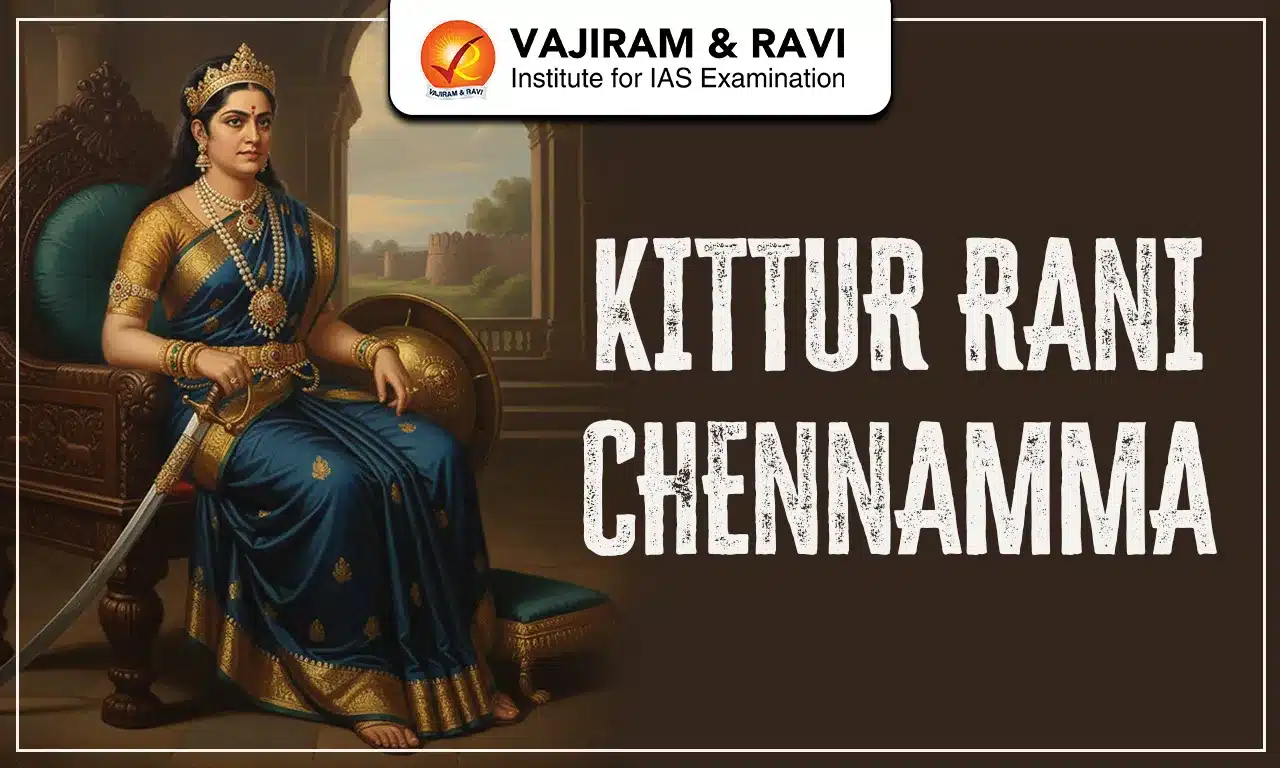
Kittur Rani Chennamma is one of the few early rulers who resisted the expansion of the British before 1857. She launched an armed rebellion in 1824 against the attempt of the East India Company to annex the princely state of Kittur. She opposed the interventionist policies of the British, especially the imposition of Doctrine of Lapse-like succession even before it was formally adopted and articulated by Dalhousie in 1848.
Kittur Rani Chennamma
Kittur Rani Chennamma was born in 1778 at Kakati Village in present day Belagavi District of Karnataka. She was mastered in horse riding, swordsmanship, and various other skills. Chennamma was married to the ruler of Kittur Mallasarja who later died in 1816. Eventually her son was crowned till his death in 1824. To protect her kingdom from annexation, she adopted Shivalingappa. In response, the East India Company refused to recognize the adoption which led to the conflict between the Rani Chennamma of Kittur and the British.
Kittur Rani Chennamma British Conflict
The conflict between Kittur Rani Chennamma and the British intensified when St. John Thackeray (Collector of Dharwad under British East India Company) attempted to capture the control of Kittur amid the rejection of adoption of Shivalingappa. The reports of the British show the annual revenue of Kittur at that time was above Rs. 3 lakhs, which highlighted it strategically. Chennamma through diplomatic letters sought recognition of her adopted son as ruler but the company rejected and continued administrative takeover of the state of Kittur.
Also Read: Freedom Fighters of India
Kittur Rani Chennamma 1824 Revolt
The tension rose when Thackaray marched toward Kittur with armed forces to enforce the British claim in October 1824. Chennamma set up her army under Sangolli Rayanna and Gurusiddappa (trusted commanders). In the first round of war, Thackaray was killed and the British Forces suffered heavy losses. But in the next course of war, despite strong resistance, Kittur Fort fell and Kittur Rani Chennamma was captured. She was imprisoned at Bailhongal till she died in 1829.
Also Read: Slogans of Freedom Fighters
Kittur Rani Chennamma Memorial
The revolt of 1824 is documented in the Kannada works of M M Kalburgi and Basavaraja Naikar. Kittur Rani Chennamma Samadhi is located at Bailhongal which is now a preserved memorial site under the Archaeology Department of Karnataka. Chennamma’s victory and legacy is commemorated annually at the Kittu Utsav (October 22 to 24) organized by the Karnataka Government each year. The literary works include Kitturu Samsthana Sahitya (Parts I to III), Kalburgi’s academic writings, and Sangamesh Tammanagoudar’s Kitturu Rani Chennamma. The Government has established her Statues at Bengaluru, Belagavi, Hubballi, Kittur, and prominently at Parliament House, New Delhi, unveiled on 11 September 2007 by President Pratibha Patil. Other honours include commissioning of the Ship Kittur Chennamma (1983-2011) by Indian Coast Guard, Rani Chennamma Express by Indian Railway and release of ₹200 commemorative coin in 2025 marking the 200 years anniversary of the Victory of Rani Chennamma.
Kittur Rani Chennamma FAQs
Q1: Who was Kittur Rani Chennamma?
Ans: Kittur Rani Chennamma was the queen of Kittur and an early Indian ruler who resisted British expansion by leading an armed rebellion in 1824.
Q2: Why did Rani Chennamma revolt against the British?
Ans: She revolted after the East India Company rejected her adopted son Shivalingappa’s succession, an action similar to the later Doctrine of Lapse.
Q3: What triggered the 1824 conflict of Kittur Rani Chennamma with the British?
Ans: Collector St. John Thackeray attempted to take over Kittur’s administration, leading to a military confrontation initiated by the British.
Q4: What was the outcome of Kittur Rani Chennamma’s revolt?
Ans: Her forces initially defeated the British and killed Thackeray, but Kittur later fell, and she was imprisoned at Bailhongal until her death in 1829.
Q5: How is Kittur Rani Chennamma remembered today?
Ans: Her legacy is honored through memorials, literary works, annual Kittur Utsav celebrations, statues across Karnataka and Delhi, and national commemorations.

