
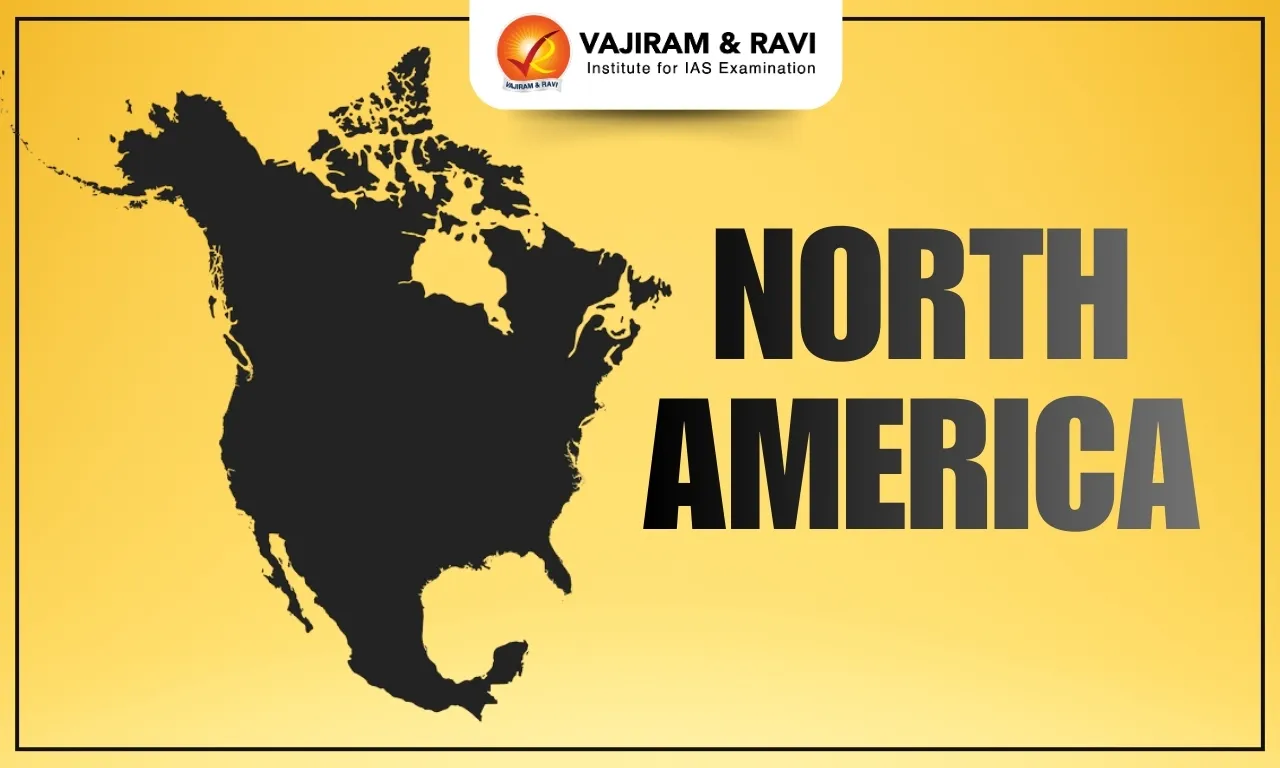
North America is the third largest continent covering about 24.71 million sq. km area. It consists of 23 countries. The continent highlights major global discussions on climate, trade, security alliances, geopolitics, technology, migration, etc. concerns. The continent is located between 7°N to 85°N latitude and 20°W to 179°W longitude, consisting of five time zones. It has the United States, Canada and Mexico as the largest economies, eventually creating a high impact of North America at global level.
North America Geographical Features
The geography of North America includes few of the major physical features of the world that impact the population, climate and resources. Key geographical highlights of North America are:
- Rocky Mountains: extend from Canada to the US (~4800 km); influence climate and water flow.
- The Appalachian Mountains: one of the oldest fold mountains of the world.
- Great Plains: crucial for global grain supply; forms one of the largest agricultural belts.
- Mississippi-Missouri River System: 4th longest river system globally (6275 km) vital for US agricultural exports.
- The Great Lakes: largest freshwater lake system on earth (21% of total surface freshwater); Lake Superior is the largest among them, forming the US-Canada Boundary.
- 49° N: 49th Parallel line forms the US-Canada land border naturally established through the Oregon Treaty of 1846.
- Arctic Control: Canada, the US (Alaska), and Denmark (Greenland) control North America's Arctic territories and adjacent maritime zones, a highly disputed concern.
- Tectonic Activity: The San Andreas Fault creates a boundary between Pacific and North American Plate which makes California a major seismic hotspot.
North America Polity
The Politics of North America shapes the agreements for trade, technology, institutions, security alliances, etc. significantly. The major political trends are highlighted below:
- The United States: It is the major political, economic and military power globally and has strong influence through NATO, G7 and multilateral bodies.
- Canada: It is shaped through federal structure with multiculturalism. It focuses majorly on environmental and social policies.
- Mexico: It is highly concerned for migration, drug trafficking, economic reforms and relations with the US.
- The US-Mexico Border: It is highly concerned over illegal migration, drug trafficking and security issues.
- NAFTA: The North American Free Trade Agreement (NAFTA) has been replaced with the United States Mexico Canada Agreement (USMCA) in 2020. It impacted supply chains, digital trade, labour standards, etc.
North America International Relations
North America is the central figure in the International System as it shapes the military, economic and technological developments globally. The major international aspects of North America are:
- Global Alliances: North America (mainly US, Canada, Mexico) lead global alliances- NATO, NORAD, UN, OAS, USMCA, G7, G20, WTO, IMF, World Bank, etc. that collectively shape the security and trade of the continent.
- Largest Trade Bloc: the US, Canada and Mexico region through USMCA forms a $28 trillion collective GDP.
- Tech Leadership: It dominates the global tech leadership by controlling ~35-40% of Cloud Infrastructure and AI research investments.
- Energy: US is largest producer of Oil and Gas, exports to Europe and Asia.
- US-China Rivalry: The geopolitical competition has sparked the US CHIPS and Science Act ($ 52 billion) aiming to curb China’s tech and boost domestic supply chains.
- US-Canada Mineral Strategy: Critical Mineral Strategy (Canada) promotes joint supply of minerals (Lithium, Cobalt, Graphite, etc.) with the US making it crucial for clean energy.
- Trade with Asia: IPEF is majorly driven by the US, impacting clean energy, digital trade and supply chain.
India-North America Relations
India and North America share a huge political, economic and technological relations with North American countries. The major areas of engagement are:
- The trade between India and US reached $132.2 billion (2025) which makes US one of the top trading partners of India.
- India has collaborated in several sectors including defense agreements, joint military exercises (e.g., YUDH ABHYAS-2024), semiconductor collaboration and space research with North America.
- Canada hosts one of the largest Indian Diaspora with more than 1.8 million people belonging to India. It influences the bilateral ties between India and Canada.
- In Latin America, Mexico is India’s second largest trading partner in Pharmaceuticals, IT, machinery, etc.
North America Environment
North America has been facing several environmental challenges linked to climate change, extreme events of weather, biodiversity loss, etc. The major debates in North America related to the climate change is around the following issues:
- Arctic Melting: The regions of Canada, Alaska and Greenland have accelerated opening of new sea routes, the Northwest Passage ( Canada and Alaska) and the Northern Sea Route ( Russia and Norway), and have spiked geopolitical competition.
- Extreme Weather Events are often faced by the US including Hurricanes, Wildfires, Tornadoes, Droughts, etc, signify increasing billion dollar disasters.
- The Wildfire of Canada (2023) has marked a record of burning more than 15 million hectares.
- Cities like Monterrey (Mexico) face chronic shortage of water, increasing tension around the area.
North America Economy
The economic features of North America are being one of the most advanced and productive. However it faces several structural disparities and sectoral transitions. The major economic insights of North America are:
- Under USMCA, the United States, Canada and Mexico collectively form one of the largest Economic Regions of the world, accounting ~30% of GDP Globally.
- The Largest Oil and Gas Producer (US), Major Automobile Exporter (Mexico) and Third Largest Oil Reserve (Canada) makes it a manufacturing and energy hub.
- The continent accounts for ~25% of maize production globally, with the US as the largest exporter.
- North America hosts ~50% of the top tech companies of the World including Meta, Microsoft, Apple, Alphabet (Google), IBM, etc. (US leading ~35% share in Global Digital Economy Value).
North America FAQs
Q1: How many countries are there in North America?
Ans: North America has 23 countries including the United States, Canada and Mexico as the leading powers globally.
Q2: Which is the largest economy of North America?
Ans: The United States is the largest Economy of North America that contributes ~$29 trillion GDP.
Q3: Which is the largest physical feature in North America?
Ans: The Rocky Mountains are the largest physical feature of the continent. They stretch over 4800 km from Canada to the United States (Southwestern).
Q4: What are the major Global Alliances of North America?
Ans: North America through the US, Mexico and Canada leads the alliances like NATO, WTO, UN, etc. impacting the image of North America Globally.
Q5: Which is the largest fresh water lake?
Ans: The Largest Surface Freshwater Lake system is- the Great Lakes (Lake Superior largest among them) is in North America.
