IndiGo Flight Disruptions Explained: FDTL Rules, Crew Shortages & DGCA Action

IndiGo Flight Disruptions

IndiGo Flight Disruptions Latest News

  • IndiGo has faced widespread flight cancellations and delays in recent days, disrupting thousands of passengers. 
  • The core reason is an acute crew shortage triggered by the rollout of the new Flight Duty Time Limitation (FDTL) norms, whose final phase took effect last month.
  • India’s largest airline, which handles over 60% of domestic traffic, was not adequately prepared for the stricter duty and rest requirements. 
  • As a result, punctuality has collapsed — only 19.7% of flights were on time on December 3.

Why IndiGo Is Hit Harder Than Other Airlines

    • The new FDTL (Flight Duty Time Limitation) rules technically apply to all domestic airlines, but IndiGo has suffered disproportionately. Industry insiders point to several reasons:
  • Massive Scale and High-Frequency Network - IndiGo operates the largest network and highest number of daily flights in India. This amplifies the impact of crew shortages compared to smaller carriers.
  • Heavy Late-Night and Early-Morning Operations - IndiGo runs a significant share of “red-eye” and early-morning flights—segments most affected by stricter rest requirements under the new FDTL norms.
  • Extremely High Crew and Aircraft Utilisation - IndiGo’s operational model relies on squeezing maximum utilisation from crew and aircraft. This leaves little slack in the system when new regulations reduce permissible flying hours.

Why Other Airlines Are Less Affected

  • Other carriers currently have lower-than-optimal aircraft utilisation, largely due to:
    • Delayed new aircraft deliveries
    • Aircraft grounded for refits
  • This means more pilots are available per aircraft, giving them greater flexibility in rostering and making it easier to absorb the impact of the new FDTL norms.

What the New FDTL Norms Changed

  • The revised Flight Duty Time Limitation (FDTL) norms introduced multiple fatigue-mitigation measures:
    • Weekly rest increased from 36 to 48 hours
    • Night landings capped at two, down from six
    • Definition of night hours extended by one hour
  • These changes significantly tightened crew availability and operational flexibility, particularly for airlines with heavy night operations.

Implementation Timeline and Industry Pushback

  • The norms were originally planned for June 2024, but airlines—including IndiGo—opposed immediate rollout, arguing they needed more crew and a phased transition.
  • The DGCA implemented the rules in two phases (July and November) after a Delhi High Court directive.
  • Phase 1: Longer weekly rest — IndiGo handled this relatively well
  • Phase 2: Stricter night-time limits — hit IndiGo disproportionately

Operational Domino Effect: Why Delays Turn Into Meltdowns

  • IndiGo primarily operates narrow-body A320s, each flying multiple legs a day.
  • If a crew hits its duty limit due to earlier delays, the airline must scramble for replacements. 
  • With minimal buffer staff and high utilisation:
    • Small delays cascade into major disruptions
    • Crew shortages intensify
    • Cancellations multiply rapidly
  • This structural sensitivity explains why IndiGo’s operations unraveled faster than those of other carriers.

Scale of Disruptions and Decline in On-Time Performance

  • In November, IndiGo recorded 1,232 flight cancellations. 
  • IndiGo’s on-time performance (OTP) fell sharply from 84.1% in October to 67.7% in November, and has deteriorated further in December, undermining its long-held reputation for punctuality.

IndiGo’s Explanation: Multiple Operational Stress Points

  • The airline attributed the disruptions to several “unforeseen operational challenges”, including:
    • Minor technology glitches
    • Winter schedule adjustments
    • Adverse weather conditions
    • Rising congestion in the aviation system
    • Full implementation of the new FDTL rules
  • Together, these factors compounded crew shortages and amplified delays.

Steps IndiGo Is Taking to Stabilise Operations

  • According to the DGCA, IndiGo has initiated corrective actions, including:
  • Strengthening Crew Planning and Rostering - Better alignment of crew assignments with FDTL rest and duty requirements.
  • Improving Coordination with ATC and Airports - Enhanced communication to manage airspace constraints and reduce avoidable bottlenecks.
  • Enhancing Turnaround and Disruption Management - Accelerating ground processes and improving responses to cascading delays.
  • These measures aim to gradually stabilise IndiGo’s operations while staying compliant with FDTL norms.

Pilot Bodies Blame IndiGo for Poor Preparedness

  • Pilot associations argue that IndiGo was not prepared for the new FDTL rules despite having ample notice.
  • They said the disruptions reflect failures in proactive resource planning, suggesting airlines may be trying to pressure the DGCA into diluting the norms.
  • They accused IndiGo of operating with a “prolonged and unorthodox lean manpower strategy”, especially in flight operations.
  • They claim the current crisis is the direct result of:
    • A hiring freeze despite a two-year runway
    • Non-poaching agreements
    • Pilot pay freeze
    • Short-sighted planning and underinvestment in staffing

Source: IE | LM

IndiGo flight disruptions FAQs

Q1: What triggered IndiGo’s operational meltdown?

Ans: The final rollout of stricter FDTL norms caused acute crew shortages. IndiGo, heavily dependent on night operations, was unprepared, leading to widespread delays and cancellations.

Q2: Why was IndiGo affected more than other airlines?

Ans: IndiGo’s large scale, high-frequency network, lean staffing, and heavy red-eye schedule made it uniquely vulnerable to reduced duty hours and restricted night landings.

Q3: What changes do the new FDTL norms introduce?

Ans: Rules mandate longer weekly rest, limit night landings, and expand night-hour definitions. These fatigue-mitigation measures significantly shrink crew availability across airlines.

Q4: How severe were IndiGo’s disruptions?

Ans: In November, IndiGo cancelled 1,232 flights, with punctuality dropping from 84% to 67%. By early December, OTP had fallen further, severely impacting passengers nationwide.

Q5: What corrective steps is IndiGo taking?

Ans: It is strengthening crew rostering, improving ATC coordination, enhancing turnaround processes, and adjusting schedules. DGCA has sought explanations and mitigation plans.

India’s High-Density Rail Corridors: Expansion Plan, Congestion Forecast & Key Upgrades

High Density Network Rail Corridors

High Density Network Rail Corridors Latest News

  • The Centre has approved adding a third and fourth rail line on the 32 km Badlapur–Karjat stretch in Maharashtra, extending the Mumbai Suburban Corridor and strengthening a key segment of the 1,238-km Mumbai–Chennai High Density Network (HDN). 
  • This corridor—one of India’s most saturated—links Mumbai to Chennai via Pune, Solapur, Guntakal and Arakkonam.
  • The decision is part of Indian Railways’ broader plan to decongest all seven High Density Network corridors, which make up just 16% of the total network but carry 41% of all rail traffic. 
  • As passenger and freight demand surges, expanding and improving the HDN has become crucial to ensuring smoother, more efficient railway operations.

About High Density Network (HDN)

  • The High Density Network (HDN) comprises passenger–freight corridors where train operations are running beyond optimal capacity, causing congestion, delays, and reduced efficiency.
  • Out of 69,181 route-km of Indian Railways, the HDN accounts for 11,051 route-km (15.97%).
  • These highly saturated corridors are divided into 237 sections, each with varying levels of utilisation.

HDN Is Overloaded

  • A rail network ideally functions at 70–80% capacity for smooth operations. 
  • The HDN far exceeds this:
    • Only 4.60% of HDN routes operate below 80% capacity
    • 18.89% operate at 80–100%
    • 32.75% at 100–120%
    • 29.53% at 120–150%
    • 14.11% run at over 150% capacity
  • This means 95% of the HDN runs above the optimal threshold, many well beyond designed limits.
  • A majority of HDN sections operate at stress levels where delays and bottlenecks are unavoidable.

An Example: The Overburdened Karjat–Lonavala Section

  • On the 28-km Karjat–Lonavala stretch (part of the Mumbai–Chennai HDN):
    • 67 trains run each way per day
    • Maximum capacity: 40 trains
  • This results in 167% capacity utilisation — far above ideal levels.

How HDN Compares With the Overall Indian Railways Network

  • According to the National Rail Plan (2051 vision document):
    • 45% of the entire Indian Railways network operates below 70% utilisation
    • 29% operates at 70–100%
    • 25% runs at 100–150%
    • Only 1% exceeds 150% utilisation
  • In contrast, the HDN is severely overloaded, highlighting why expansion and decongestion of these seven corridors is a top priority.

India’s Seven High Density Rail Corridors: Nationwide Coverage

  • The High Density Network (HDN) spans all four regions of India, consisting of seven highly saturated corridors:
    • Howrah–Delhi (1,422 km) - Only 31.34 km (just two sections) operate below 80% capacity. The entire remaining corridor is heavily saturated.
    • Howrah–Mumbai (2,039 km) - Only 85.2 km operates below 80% capacity. Most of this Golden Diagonal corridor faces high congestion due to intensive freight and passenger load.
    • Mumbai–Delhi (1,322 km) - One of the only two HDNs without any section exceeding 150% utilisation. The Western Dedicated Freight Corridor (WDFC) runs parallel, absorbing freight pressure.
    • Delhi–Guwahati (1,876 km) - A staggering 96% of the corridor operates above 80% utilisation. Faces both heavy passenger movement and significant freight demand.
    • Delhi–Chennai (2,037 km) - Nearly 52% of the corridor is running at 120–150% capacity, one of the highest saturation ratios in the network.
    • Howrah–Chennai (1,117 km) - 50% of this corridor operates at 120–150% utilisation, indicating tight capacity.
    • Mumbai–Chennai Corridor - Almost 90% of the corridor sees utilisation in the 80–120% range. This corridor remains extremely busy, with several sections nearing saturation.

Future Congestion Projections

  • The National Rail Plan warns that without major upgrades, HDN congestion will rise dramatically:
    • By 2051, no HDN section will operate below 100% capacity utilisation.
    • 92% of the HDN will exceed 150% utilisation, far beyond safe or efficient levels.

Near-Term Outlook: Heavy Overload by 2031

  • By 2031, the HDN is projected to be severely overstretched:
    • 50% of HDN will operate above 150% utilisation
    • 39% between 100–150%
    • Only 9% will remain within 70–100% capacity
  • This indicates that demand growth is outpacing infrastructure expansion.

Line Expansion: The Core Strategy for Decongestion

  • While multiple operational reforms help improve train movement, line expansion—doubling, tripling, quadrupling, and even penta/hexa lining—is the most critical decongestion measure.

Recent Progress in Line Expansion

  • Indian Railways has aggressively expanded capacity:
    • 1,983 km completed in 2021–22
    • 3,185.5 km in 2022–23
    • 2,244 km in 2023–24
    • 2,900+ km in 2024–25
  • This is helping, but far more expansion is needed given HDN congestion levels.

Role of Dedicated Freight Corridors (DFCs)

  • The Eastern DFC (fully operational) and Western DFC (96.4% complete) are expected to divert freight traffic away from HDN, freeing capacity for passenger trains.
  • This is one of the most impactful steps in reducing HDN load.

Source: IE | HT

High Density Network Rail Corridors FAQs

Q1: What is the High Density Network (HDN)?

Ans: The HDN consists of India’s busiest passenger–freight corridors, covering 11,051 km, where 95% of sections operate above optimal capacity, causing delays and efficiency losses.

Q2: Why is HDN expansion considered urgent?

Ans: By 2051, projections show no HDN section operating below 100% capacity, and 92% exceeding 150%, making decongestion essential for future rail reliability and growth.

Q3: Which are India’s seven High Density Corridors?

Ans: The corridors include Howrah–Delhi, Howrah–Mumbai, Mumbai–Delhi, Delhi–Guwahati, Delhi–Chennai, Howrah–Chennai, and Mumbai–Chennai, spanning all regions of the country.

Q4: What strategies is Railways using to decongest HDN routes?

Ans: Key strategies include doubling, tripling, quadrupling, and multi-tracking lines, alongside capacity expansion through Eastern and Western Dedicated Freight Corridors.

Q5: What upgrades are proposed under the National Rail Plan?

Ans: The plan recommends converting most HDN corridors to triple or quadruple lines, especially HDN 1, 2, 3, 4, 6, and 7, to handle rising passenger and freight demand.

Health and National Security Cess on Demerit Goods

Demerit Goods

Demerit Goods Latest News

  • The Union Finance Minister recently introduced the Health Security Se National Security Cess Bill, 2025 in Parliament, clarifying that the proposed cess will apply only to demerit goods such as pan masala and will not affect essential commodities.

Health and National Security Cess 

  • The proposed cess marks a new fiscal instrument designed to raise dedicated funds for two domains the government considers critical, health and national security. 
  • It will be levied exclusively on demerit goods, especially those associated with high public health risks, such as pan masala.
  • According to the Finance Minister, these goods impose substantial health burdens on society, and the cess serves a dual purpose: discouraging consumption and generating revenue for public welfare. 
  • The government has emphasised that no essential household goods will attract this cess, ensuring no inflationary impact on everyday consumption. 

Key Features of the Proposed Cess

  • Cess Applicable Only on Demerit Goods
    • The cess will apply on specified goods linked to significant health risks, such as pan masala, which has long been under scrutiny due to its public health impacts.
    • The government clarified that the cess is not consumption-based; rather, it will be imposed on a capacity-based, machine-linked system in manufacturing units. 
    • Each factory’s liability will depend on its installed machinery and production processes. 
    • This structure aims to reduce tax evasion and bring transparency to sectors historically difficult to regulate. 
  • Revenue Sharing with States
    • A notable aspect is that a portion of revenue collected will be shared with states, specifically for health awareness initiatives and health-related schemes.
    • This is an important deviation from traditional cesses, which are generally not shareable with states, a point that has drawn federalism-related criticism in the past. 
    • By explicitly providing for shared revenue, the Centre aims to strengthen cooperative fiscal federalism. 
  • No Adverse Impact on GST System
    • The Minister clarified that the cess will not interfere with GST revenue sharing or GST Council mechanisms. For example:
    • Pan masala currently attracts 28% GST + compensation cess.
    • The proposed cess is independent of GST and relates instead to production capacity.
    • It ensures no disruption of the GST compensation framework. 

Objectives Behind the Cess

  • Dedicated Resource for National Priorities
    • The Bill’s stated purpose is to augment resources for national security and public health expenditure, two high-priority domains with rising fiscal demands. 
    • The government argued that linking revenue collection directly to demerit goods enhances both accountability and predictability in funding. 
  • Deterrence Through Targeted Taxation
    • By taxing goods associated with lifestyle health risks, the cess intends to act as a disincentive, similar to the rationale behind “sin taxes” in public finance. 
    • The Minister noted that the cess is intended to impose a social cost on harmful products to reduce their usage over time.

Concerns and Criticisms Raised in Parliament

  • Burden on MSMEs
    • Opposition members argued that capacity-based taxation could hurt small manufacturing units, especially MSMEs, which may struggle with compliance and cost burdens. 
    • They claimed the system may disproportionately affect smaller players who lack the capital to upgrade machinery or navigate bureaucratic procedures. 
  • Fear of ‘Inspector Raj’
    • Concerns were raised that capacity-based cesses could lead to increased inspection and regulatory oversight, potentially reviving the spectre of “inspector raj.” 
    • Members feared this could open the door to harassment, rent-seeking, and operational disruptions in smaller factories. 
  • Debate over Alternative Approaches
    • Some MPs argued that if the intent is to curb harmful consumption, outright bans, as seen in Bihar for pan masala, would be a more effective strategy. 
    • Others criticised the government for relying increasingly on cesses, calling it “cessification of governance.” 

Government’s Defence and Rationale

  • The Treasury benches strongly defended the Bill, highlighting:
    • Transparency in revenue utilisation, claiming that this is the first legislation explicitly committing to tracing the use of every rupee collected from demerit goods.
    • National interest, asserting that funding for health and security should receive unanimous support.
    • Reduction in tax evasion, especially in the pan masala sector, due to machine-linked assessment.

Source: TH | IE

Demerit Goods FAQs

Q1: On which goods will the Health and National Security Cess be levied?

Ans: It will be applied only on demerit goods such as pan masala, not on essential commodities.

Q2: Will the cess affect GST revenues?

Ans: No, the cess is outside the GST framework and does not impact GST collections or sharing.

Q3: How will the revenue from the cess be used?

Ans: Revenue will fund national security and public health and will be shared with states for health schemes.

Q4: Why is the cess capacity-based?

Ans: A machine-linked, capacity-based method aims to reduce tax evasion in sectors like pan masala production.

Q5: What are the main criticisms of the proposed cess?

Ans: Concerns include burdening MSMEs, increasing bureaucratic interference, and over-reliance on cesses.

Daily Editorial Analysis 5 December 2025

Daily Editorial Analysis

A Day to Pause and Come Down to Earth

Context

  • Every year on December 5, World Soil Day invites the global community to pause and reflect on one of the most fundamental yet overlooked elements of human existence: soil.
  • Far from being inert dirt, soil is a living resource that sustains ecosystems, food systems, and ultimately civilisation itself.
  • The 2025 theme, Healthy Soils for Healthy Cities, marks a deliberate shift in focus from rural landscapes to the urban world.
  • In doing so, it underscores a powerful but often neglected reality: even in the heart of the world’s busiest cities, soil remains a dynamic ally in shaping a resilient and sustainable future.

Urban Soil: The Hidden Engine of City Resilience

  • As the global population becomes increasingly urban, now exceeding 56%, cities face mounting challenges.
  • Food insecurity, climate-induced heat, pollution, and flooding threaten the health and safety of millions.
  • Beneath these problems, however, lies a crucial yet frequently invisible solution: urban soil.
  • Urban soil rarely commands attention, as it is overshadowed by concrete skylines and technological innovation. Yet it performs vital ecosystem functions.
  • Healthy soil acts simultaneously as a living filter, a natural sponge, and a powerful carbon sink.
  • Its biological richness, a teaspoon of soil holds more organisms than the Earth has people, enables it to perform roles that are indispensable to urban well-being.

Significant Roles of Healthy Urban Soil

  • Mitigating Climate Change

    • One of the roles is mitigating climate change and extreme heat, especially in urban heat islands, where temperatures soar several degrees above surrounding rural areas.
    • Soils covered with vegetation absorb heat, store carbon, and moderate microclimates, functioning like natural air conditioners.
    • Water Management
    • Urban soil also plays a central role in water management. As cities expand, impermeable concrete surfaces worsen flood risk, preventing water from infiltrating the ground.
    • Healthy soil behaves differently: it absorbs rainfall, filters runoff, and replenishes groundwater, forming the front line of defence against climate-intensified storms.
  • Local Food Production and Human Well-Being

    • Furthermore, as urban agriculture grows, whether on rooftops, in community gardens, or through backyard plots, fertile soil becomes a cornerstone of local food production, reducing supply chain vulnerabilities.
    • These soil-based habitats also support biodiversity, from microbes and earthworms to essential pollinators.
    • Finally, soil-dependent green spaces nourish not only ecosystems but also human well-being.
    • Access to nature, often called Vitamin N, reduces stress, enhances mental health, and encourages physical activity, linking soil health directly with the quality of urban life.

The Threat to Urban Soil

  • Despite its value, urban soil is among the most degraded natural resources.
  • The FAO reports that nearly one-third of global soils are already compromised, a condition amplified in urban environments.
  • Industrial contamination, compaction from construction, loss of organic matter, and extensive soil sealing by asphalt and concrete suffocate soil ecosystems.
  • These pressures undermine plant growth, weaken urban food systems, and diminish the natural services cities depend upon.
  • Thus, the 2025 World Soil Day theme represents not only a celebration but also an urgent call to action.

Towards Healthier Cities: A Blueprint for Urban Soil Stewardship

  • The Healthy Soils for Healthy Cities campaign offers a roadmap for transforming urban landscapes and empowering communities to value and protect the soil beneath their feet.
  • First, urban soil restoration and protection are essential. This includes rehabilitating degraded areas through compost, organic amendments, and regular soil testing.
  • Equally important is limiting further soil sealing during construction, preserving soil’s capacity to breathe and function.
  • Second, cities must promote green infrastructure that integrates soil as a core element.
  • Replacing unnecessary concrete with rain gardens, parks, tree belts, and other soil-based systems cools cities, enriches biodiversity, and strengthens climate resilience.
  • Third, urban agriculture should be championed for its environmental, social, and nutritional benefits.
  • From balcony containers to community allotments, growing food reconnects residents with the natural world and enhances soil health.
  • Fourth, residents and planners alike must adopt responsible soil management practices, including reducing chemical inputs, planting native species, and protecting topsoil through mulching.
  • Finally, strengthening soil literacy is vital.
  • Schools, community groups, and households can all contribute by learning about soil ecosystems, conducting soil tests, and practicing composting, turning organic waste into nourishment for urban soil.

Conclusion

  • On this World Soil Day, the message is unmistakable: the strength of a city rests not only in its architecture but also in the living soil that lies beneath it.
  • Healthy soils form the foundation of healthy cities, shaping climate resilience, food security, biodiversity, and public well-being.
  • As urban populations continue to rise, caring for soil becomes not just an environmental responsibility but a social imperative.
  • By nurturing the ground beneath our feet, we safeguard our health, our cities, and our shared future.

A Day to Pause and Come Down to Earth FAQs

 Q1. What is the main theme of World Soil Day 2025?
Ans. The main theme of World Soil Day 2025 is “Healthy Soils for Healthy Cities.”

Q2. Why are urban soils important for climate resilience?
Ans. Urban soils help absorb heat, store carbon, and moderate temperatures, making cities more resilient to climate change.

Q3. How do healthy soils help prevent flooding in cities?
Ans. Healthy soils act like sponges that absorb rainfall, filter runoff, and reduce the risk of urban flooding.

Q4. What role does urban agriculture play in cities?
Ans. Urban agriculture provides fresh food, strengthens local food systems, and depends on fertile, healthy soil.

Q5. What is one key action citizens can take to improve urban soil health?
Ans. Citizens can improve urban soil health by composting kitchen waste to create nutrient-rich organic matter.

 Source: The Hindu


A Missing Link in India’s Mineral Mission

Context

  • India’s evolving strategy for critical minerals reflects a recognition that value lies not in extraction but in transforming ores into high-purity materials essential for clean energy and advanced manufacturing.
  • The Union Cabinet’s new ₹7,280-crore rare-earth magnet scheme and the G-20 framework on critical minerals indicate a strategic shift toward midstream value creation.
  • This shift is urgent, as the resilience of future industries depends on control over refining capacity rather than simply on mineral reserves.

The Global Context: A Chokepoint in the Midstream

  • Critical mineral supply chains have become instruments of geopolitical influence.
  • China dominates over 90% of rare-earth and graphite refining and most lithium and cobalt processing, creating a global bottleneck.
  • Temporary export controls in 2025 showed how easily these supply chains can be disrupted. India’s dependence on imported refined materials, despite domestic mining reforms, therefore represents a significant vulnerability.
  • India imports nearly all its lithium, nickel, and cobalt, even though these materials underpin renewable energy systems, semiconductors, telecommunications, pharmaceuticals, and defence manufacturing.
  • Without domestic refining capacity, India remains exposed to geopolitical shocks and global price distortions.

India’s Processing Gap: A Structural Weakness

  • India already mines and processes several critical minerals, copper, graphite, silicon, tin, titanium, rare earths, and zirconium, but refining capacity lags in both quality and scale.
  • Battery-grade graphite requires 99.95% purity, far above current domestic levels.
  • Rare earths are processed into oxides but not separated into the metals needed for magnets, and tin production meets only a fraction of domestic demand.
  • This gap traps India in low-value roles: exporting raw materials while importing high-value components.
  • Such dependence threatens the broader economy and undermines aspirations for technological self-reliance.

Five Strategic Interventions for Building Refining Capacity

  • Transform Centres of Excellence into Engines of Applied Innovation

    • The nine Centres of Excellence under the National Critical Mineral Mission must prioritise commercially deployable processing technologies with clear metrics for purity, recovery, cost, and waste.
    • Collaboration among IITs, NITs, industry, and research institutions is essential to accelerate the transition from laboratory innovation to industrial deployment.
  • Mobilise Secondary Resources as Domestic Mineral Sources

    • India generates massive quantities of industrial waste, coal fly ash, red mud, zinc residues, and steel slag, that contain recoverable critical minerals.
    • Pilot studies show recovery is viable, but scaling requires incentives, streamlined environmental clearances, and integration with proposed Critical Minerals Processing Parks.
    • Leveraging secondary resources can significantly reduce import dependence while lowering environmental impact.
  • Build a Skilled Workforce in Advanced Refining Technologies

    • Most of India’s metallurgical workforce is trained for bulk metals, not for hydrometallurgy and advanced chemical refining, which critical minerals require.
    • A dedicated skilling programme must introduce new curricula, fund train-the-trainer modules, and expand apprenticeships with established refiners.
    • This can create thousands of specialised jobs in mineral-rich states such as Odisha, Gujarat, and Jharkhand.
  • De-risk Investments Through Market-Shaping Tools

    • Global critical mineral prices are often kept artificially low, discouraging new entrants.
    • India’s planned mineral stockpile could become an active market stabiliser, offering offtake guarantees and price assurance during downturns.
    • Key sectors, defence, pharmaceuticals, electronics, should commit to partial domestic sourcing, ensuring steady demand and investor confidence.
    • Refiners must meet strict quality and reliability standards to build trust across supply chains.
  • Leverage Mineral Diplomacy to Build Processing Partnerships

    • India’s overseas acquisitions in Argentina and Zambia must be complemented by strong domestic refining.
    • Processing strength converts resource access into strategic leverage, enabling co-investment agreements rather than raw-ore transactions.
    • Partnerships such as the Australia-Canada-India Technology and Innovation framework demonstrate how trilateral cooperation can advance processing technologies.
    • Multilateral forums, from BRICS to the G-20, should integrate critical mineral processing into trade and investment dialogues.

Strategic Implications: Refining as the Foundation of Autonomy

  • In critical mineral supply chains, processing determines power. Mines represent potential, but refineries create strategic capability.
  • Investing in midstream capacity reduces import dependence, anchors high-value industries, generates skilled employment, and enhances geopolitical resilience.
  • The key question is no longer whether India has sufficient mineral reserves but whether it can refine those minerals into high-purity materials that feed the industries of the future.

Conclusion

  • India’s most pressing mineral challenge lies not in extraction but in developing the refining infrastructure essential for technological and strategic autonomy.
  • By combining innovation, recycling, workforce development, investment support, and international collaboration, India can transition from a supplier of raw materials to a producer of high-value, strategically indispensable materials.
  • True autonomy in the clean-energy era will be defined not by what nations mine but by what they can refine.

A Missing Link in India’s Mineral Mission FAQs

 Q1. Why is processing more important than mining in critical mineral supply chains?
Ans. Processing is more important because it transforms raw ores into high-purity materials that power modern industries and create strategic leverage.

Q2. What makes India vulnerable in the global critical minerals landscape?
Ans. India is vulnerable because it depends heavily on imported refined materials despite possessing mineral reserves.

Q3. How can secondary resources help India reduce import dependence?
Ans. Secondary resources can help by allowing critical minerals to be recovered from industrial waste such as fly ash and red mud.

Q4. Why does India need specialised metallurgical training for critical minerals?
Ans. India needs specialised training because critical minerals require advanced hydrometallurgical and chemical refining skills not covered by traditional metallurgy.

Q5. How can mineral diplomacy strengthen India’s position in global supply chains?
Ans. Mineral diplomacy can strengthen India’s position by enabling co-investment partnerships that convert overseas mineral access into processing and technological advantage.

Source: The Hindu


Census 2027 - Counting India, Renewing the Republic

Context

  • India has missed the decennial Census for the first time in 143 years.
  • With the last Census conducted in 2011, the next round — now termed Census 2027 — marks a 16–17-year gap.
  • This has raised pressing concerns for governance, welfare delivery, federalism, representation, and democratic accountability.

The Constitutional Significance of Census 2027

  • Why the delay matters

    • The 2021 Census was cancelled despite elections being held during the pandemic.
    • India has been functioning using outdated 2011 population data, affecting welfare schemes, urban planning, fiscal federalism (Finance Commission transfers), and budgeting and policy design.
  • Renaming to "Census 2027" (rather a delayed Census 2021)

    • It enables the first Lok Sabha delimitation since 1976, frozen by the 84th Constitutional Amendment until “the first Census after 2026”.
    • It will also trigger women’s reservation (dependent on delimitation) — though the government’s 2029 promise is mathematically impossible given delimitation’s four-to-six-year track record.

Census 2027 - India’s First Digital Census

  • Advantages: Tablet-based enumeration will result in faster enumeration and fewer errors. It enables real-time monitoring and quicker publication.
  • Concerns:
    • Potential linkage with Aadhaar, national population register (NPR), and voter rolls risks of surveillance, privacy violations, and citizen profiling.
    • Need for strict legal safeguards ensuring data use only for statistical purposes, no law-enforcement or citizenship verification usage, independent data-protection audits.

The Debate on Caste Enumeration

  • Historical background

    • 1931: Caste was last comprehensively counted under the colonial administration. Independent India: Counting of Scheduled Castes and Scheduled Tribes for reservation - rationale was nation-building.
    • 2011 Socio-Economic and Caste Census (SECC): It attempted to count all castes, but its findings remain unreleased — officially due to data quality concerns, unofficially due to political sensitivities.
  • Why caste data matters

    • Informs debates on OBC reservations, social justice policies, and resource allocation.
    • Provides evidence for marginalised groups.
    • Not collecting caste data leads to policy dependent on political assertions, not demographic facts.
  • Government ambiguity

    • No clarity on whether Census 2027 will enumerate caste. Indecision threatens accuracy, legitimacy, and transparency.

Migration - India’s Biggest Statistical Blind Spot

  • Current distortion

    • Migrant workers counted in home states, not where they work.
    • They remain registered as voters in ancestral villages, not cities where they live.
  • Consequences

    • Urban governance becomes unaccountable to migrant populations.
    • Rural areas receive allocations for people who no longer reside there.
    • Millions become non-participatory economic contributors.
  • Legal provisions

    • Electoral law requires registration where a person is “normally resident” for more than six months.
    • Requires inter-state coordination and updated electoral rolls.

Ensuring Transparency and Federal Trust

  • Key requirements

    • Real-time access to enumeration data for states.
    • Public dashboards tracking district-level progress.
    • Independent audits before publication.
    • The 2011 SECC experience — caste data unreleased for over a decade — must not be repeated.
  • Purpose

    • Census must be seen as an instrument of fairness, not control. Federal trust depends on transparency and procedural integrity.

Challenges and Way Forward

  • Over 16 year data vacuum: Affect welfare, planning, and fiscal transfers. Comprehensive enumeration including caste with scientific methodology.
  • Migration miscount: This will distort electoral representation and urban governance. Therefore, accurate counting of migrants based on actual residency is needed.
  • Privacy and surveillance risks from digital data: Robust data-protection framework—legal firewalls preventing linkage with Aadhaar/NPR.
  • Potential politicisation of enumeration and data release: Federal transparency through real-time data access and independent audits. Timely publication of all data collected to avoid SECC-like opacity.
  • Ambiguity on caste enumeration and risk of delimitation delays: Affecting welfare policies, women’s reservation and federal representation. Clear communication on delimitation timelines, women’s reservation, and scope of the digital Census.

Conclusion

  • Census 2027 is more than a demographic exercise — it is a constitutional, political, and moral moment for the Republic.
  • After a 17-year gap, India must ensure a comprehensive, transparent, accurate, and protected census.
  • A democracy that stops counting its people risks ignoring them; a democracy that counts with fairness and foresight governs with justice.

Census 2027 FAQs

Q1. Why is the delay in conducting the Census a challenge for governance in India?

Ans. Because policies, welfare schemes, and fiscal transfers are still based on outdated 2011 data, creating severe planning distortions.

Q2. How does the 84th Constitutional Amendment relate to Census 2027?

Ans. It mandates delimitation only after “the first Census after 2026,” making Census 2027 the trigger for future delimitation and women’s reservation.

Q3. What are the implications of not collecting caste data in Census 2027?

Ans. Policy-making on OBC reservations and social justice will continue relying on political claims instead of demographic evidence.

Q4. Why is migration a critical blind spot in population enumeration?

Ans. Because migrants are counted in home states but live in cities where they are unrepresented, distorting both governance and electoral rolls.

Q5. What are the key privacy concerns associated with a digital-first Census?

Ans. Risks of linking Census data with Aadhaar/NPR, enabling surveillance or citizen profiling without stringent legal safeguards.

Source: IE

Daily Editorial Analysis 5 December 2025 FAQs

Q1: What is editorial analysis?

Ans: Editorial analysis is the critical examination and interpretation of newspaper editorials to extract key insights, arguments, and perspectives relevant to UPSC preparation.

Q2: What is an editorial analyst?

Ans: An editorial analyst is someone who studies and breaks down editorials to highlight their relevance, structure, and usefulness for competitive exams like the UPSC.

Q3: What is an editorial for UPSC?

Ans: For UPSC, an editorial refers to opinion-based articles in reputed newspapers that provide analysis on current affairs, governance, policy, and socio-economic issues.

Q4: What are the sources of UPSC Editorial Analysis?

Ans: Key sources include editorials from The Hindu and Indian Express.

Q5: Can Editorial Analysis help in Mains Answer Writing?

Ans: Yes, editorial analysis enhances content quality, analytical depth, and structure in Mains answer writing.

RELOS Agreement and India-Russia Relations, Objectives, News

RELOS Agreement and India-Russia Relations

Why in News?

Russia has officially approved the Reciprocal Exchange of Logistics Support (RELOS) agreement with India ahead of President Vladimir Putin’s India Visit 2025.

Reciprocal Exchange of Logistics Agreement (RELOS) Agreement

The Reciprocal Exchange of Logistics Agreement (RELOS) is a bilateral military logistics pact between India and Russia that allows their armed forces to access each other's military facilities for refuelling, repairs, supplies, berthing, and maintenance.

This agreement significantly strengthens India–Russia defence cooperation and expands India’s strategic reach from the Indo-Pacific to the Arctic and Eurasian regions.

Also Read: India-Russia Relations

RELOS Agreement Objectives

  • Provide reciprocal access to each other’s military bases, ports, and airfields for refuelling, repairs, and logistical support.
  • Strengthen defence cooperation by enabling smoother logistics during joint exercises and coordinated operations.
  • Enhance operational efficiency by reducing deployment time and costs, especially for long-range naval missions.
  • Support faster and more coordinated humanitarian assistance and disaster relief (HADR) operations during emergencies.

RELOS and India-Russia Defence Cooperation

The RELOS Agreement represents a strategic leap in India-Russia defence ties, complementing decades of military collaboration. It formalizes logistics support, allowing reciprocal access to over 40 Russian naval and air bases, including key Arctic and Pacific facilities, which significantly extends India’s operational reach beyond the Indian Ocean.

  • Boosts Interoperability: RELOS facilitates seamless coordination during joint exercises such as INDRA (tri-service), enabling Indian and Russian forces to deploy over 20 ships, multiple aircraft, and ground units simultaneously.
  • Enhances Naval Reach: Indian Navy access to Russian ports like Vladivostok, Petropavlovsk-Kamchatsky, and Murmansk allows for long-range maritime patrols, Arctic missions, and monitoring of strategic sea lanes covering over 70% of India’s maritime trade.
  • Supports Defence Supply Chains: With RELOS, maintenance, repairs, and refuelling of critical platforms like Su-30MKI, T-90 tanks, MiG and Sukhoi fleets, and S-400 air defence systems can be coordinated more efficiently, reducing delays caused by logistics gaps.
  • Strengthens Strategic Trust: Logistic support under RELOS complements joint projects such as BrahMos cruise missile development and submarine cooperation, reinforcing a bilateral defence trade worth over USD 13 billion in the last decade.

RELOS vs India’s Other Logistics Agreements (LEMOA, COMCASA, BECA)

India has multiple logistics and defence cooperation agreements with different countries to enhance operational reach and interoperability. RELOS with Russia complements these pacts but offers unique strategic advantages.

LEMOA (Logistics Exchange Memorandum of Agreement)

  • Allows India and the U.S. to use each other’s military bases for refuelling, replenishment, and repairs.
  • Primarily focuses on the Indo-Pacific and Indian Ocean regions.
  • Supports joint naval and air exercises, enhancing operational interoperability.

COMCASA (Communications Compatibility and Security Agreement)

  • Enables secure encrypted communications between Indian and U.S. military forces.
  • Supports integration of Indian platforms into advanced U.S. defence networks.
  • Facilitates real-time coordination during joint operations and exercises.

BECA (Basic Exchange and Cooperation Agreement)

  • Grants access to geospatial, satellite, and navigation data for improved targeting and situational awareness between Indian and U.S.
  • Enhances accuracy of precision-guided weapons and missile systems.
  • Strengthens surveillance and reconnaissance capabilities during long-range missions.

RELOS Agreement and India-Russia Relations FAQs

Q1: What is the RELOS Agreement?

Ans: The Reciprocal Exchange of Logistics Support (RELOS) is a bilateral military pact that allows India and Russia to use each other’s bases, ports, and airfields for refuelling, repairs, berthing, and other logistical support.

Q2: Why is RELOS important for India?

Ans: It expands India’s operational reach to Russia’s Arctic, Far East, and Pacific bases, enhances defence interoperability, reduces deployment costs by 20–25%.

Q3: How does RELOS differ from LEMOA, COMCASA, and BECA?

Ans: Unlike the U.S.-aligned agreements, RELOS provides India access to Russian territories, Arctic routes, and long-range deployment support, balancing India’s logistics network between Western and Eurasian partners.

Q4: Will RELOS impact India’s other defence partnerships?

Ans: No. RELOS complements India’s multi-aligned strategy by diversifying logistics support, maintaining operational flexibility, and reinforcing strategic autonomy.

Q5: What are the key operational benefits of RELOS?

Ans: It enables faster joint exercises, coordinated maritime patrols, humanitarian missions, and maintenance of Russian-origin platforms that constitute 60–70% of India’s military inventory.

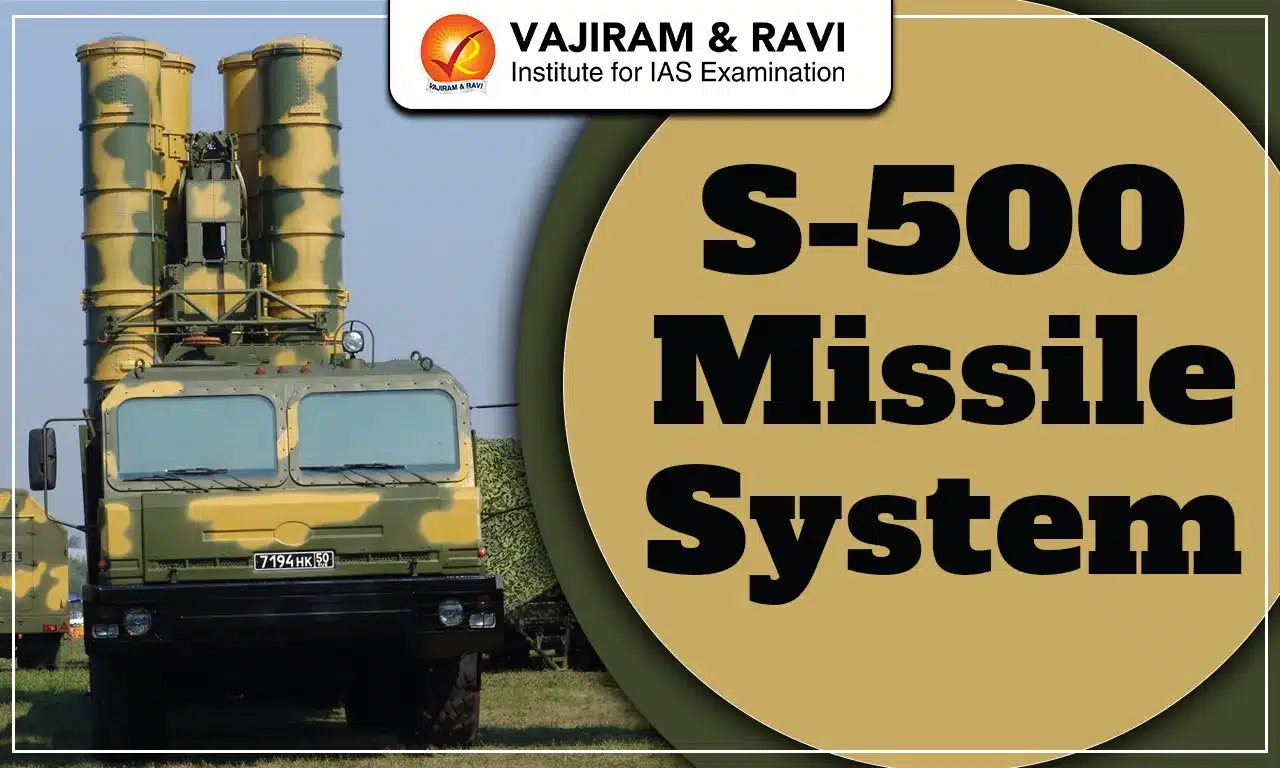
S-500 Missile System, Features, Range, Speed, Comparison

S-500 Missile System

The S-500 Missile System, also known as 55R6M “Triumfator-M” or Prometey, is Russia’s most advanced mobile surface-to-air and anti-ballistic missile platform. It is designed to counter modern hypersonic threats and supplements the S-400 and A-235 missile systems. It was developed by Almaz-Antey and officially entered service on 16 September 2021 with the Russian Space Forces. It is capable of intercepting ballistic missiles, hypersonic weapons, aircraft, UAVs, and even low-orbit satellites.

S-500 Missile System Features

The S-500 Missile System features cutting-edge radars, long-range interception, modern hypersonic defense, and multi-target engagement capabilities as detailed below:

  • Designed to intercept ballistic missiles, hypersonic cruise missiles, aircraft, and low-Earth orbit satellites at ranges up to 600 km.
  • Air-defense range is approximately 500 km, with the ability to track and engage 10 hypersonic targets flying at 7 km/s.
  • Target altitude capability reaches 180-200 km, enabling near-space interception.
  • Response time is under 4 seconds, faster than S-400.
  • Components include 77P6 launch vehicles, 91N6A(M) radars, 96L6-TsP radar, 76T6, and 77T6 engagement radars.
  • Uses 40N6M, 77N6, and 77N6-N1 missiles.

S-500 Missile System and S-400 Comparison

The S-500 Missile System  significantly advances in several aspects including interception altitude, response time, and hypersonic engagement capabilities as compared to the S-400 system. The major difference is listed below:

  • Range: S-400 reaches 380 km, while the S-500 Missile System extends to 600 km, offering deeper strategic defense.
  • Satellite Capability: S-400 lacks ASAT functionality; the S-500 Missile System can target LEO satellites.
  • Response: S-400 response is <10 seconds; S-500 reacts within 3-4 seconds, enhancing survivability.
  • Altitude: S-400 intercepts around 30-40 km, whereas the S-500 Missile System can engage targets at 200 km, reaching near-space.
  • Radar: The S-500 Missile System offers superior multi-band radar detection compared to S-400’s high but limited stealth tracking.
  • Hypersonic Interception: S-400 has limited capability, while the S-500 Missile System reportedly can neutralize hypersonic targets traveling Mach 5-7.

S-500 Missile System UPSC

Recently during the visit of Russian President Vladimir Putin to India (Dec 4, 2025), the Defence Minister is expected to show interest in the S-500 Missile System amid ongoing defense discussions.

  • In September 2021, Russia indicated that India could be the first potential export customer for the S-500 Missile System.
  • Various reports in September 2025 suggested India’s interest following the S-400’s performance in Operation Sindoor, though later reports clarified no immediate purchase decision.
  • High cost, complex maintenance, specialized training, and integration challenges remain key issues for India.
  • During President Vladimir Putin’s visit, discussions between Indian Defence Minister Rajnath Singh and Russian Defence Minister Andrey Belousov may include timely supply of military hardware and potential future procurement of the S-500 Missile System.
  • Export availability remains limited, and political negotiations are expected to be prolonged.

S-500 Missile System FAQs

Q1: What is the S-500 Missile System?

Ans: The S-500 Missile System is Russia’s next-generation long-range air-defence and anti-ballistic missile system designed to intercept aircraft, ballistic missiles, hypersonic weapons, and low Earth orbit satellites.

Q2: What is the range of the S-500 Missile System?

Ans: The S-500 Missile System has an operational range of 600 km for ballistic missile defence and about 500 km for air-defence roles, with an engagement altitude of up to 200 km.

Q3: Can the S-500 Missile System intercept hypersonic missiles?

Ans: Russia claims the S-500 Missile System can intercept hypersonic missiles flying at up to 7 km/s.

Q4: Which missiles are used in the S-500?

Ans: The S-500 Missile System uses 40N6M, 77N6, and 77N6-N1 missiles.

Q5: How is the S-500 Missile System different from the S-400?

Ans: The S-500 Missile System offers greater range (600 km), near-space interception capability, anti-satellite roles, faster response time, and improved detection of stealth and hypersonic targets compared to the S-400.

DRDO Successfully Tests Fighter Aircraft Escape System

DRDO Successfully Tests Fighter Aircraft Escape System

The Defence Research and Development Organisation (DRDO) has successfully tested a fighter aircraft escape system, also known as an ejection system. The test ensures that pilots can safely exit aircraft in emergencies, saving lives and enhancing operational safety. The test was conducted in collaboration with Aeronautical Development Agency (ADA) and Hindustan Aeronautics Limited (HAL).

What is a Fighter Aircraft Escape System?

A fighter aircraft escape system is designed to help pilots escape from a failing aircraft. It uses an ejection seat, explosives, and a parachute to ensure a safe landing.

Fighter Aircraft Escape System Test Significance

  • Pilot Safety: Provides a reliable mechanism for pilots to escape in emergencies.
  • Indigenous Technology: Reduces dependency on foreign suppliers, promoting Make in India.
  • Air Force Readiness: Boosts confidence and operational effectiveness of the Indian Air Force (IAF).
  • Strategic Advantage: Improves India’s self-reliance in critical defense systems.
  • Technological Progress: Demonstrates DRDO’s capability in advanced aviation safety technology.

DRDO’s Role in Aviation Safety

DRDO has been developing life-saving systems for fighter jets and training aircraft. It has successfully created indigenous ejection seats and pilot life-support systems for high-altitude missions. These innovations strengthen India’s defense technology ecosystem and ensure the safety of armed forces personnel.

Challenges in Development

  • High-speed Ejection: Must work under supersonic speed and extreme G-forces.
  • Safe Parachute Deployment: Effective at different altitudes and weather conditions.
  • Aircraft Integration: Must not affect aircraft performance while being reliable.
  • Advanced Materials: Needs to withstand high temperatures and explosive forces.

Way Forward

The next steps include integration into operational aircraft, additional field trials, and mass production for deployment in the IAF. This aligns with India’s focus on Atmanirbhar Bharat in defense. It also enhances national security and strengthens India’s position as a self-reliant defense power.

About Defence Research and Development Organisation (DRDO)

The Defence Research and Development Organisation (DRDO) is India’s premier agency responsible for research and development in defense technology. Established in 1958, it functions under the Department of Defence Research and Development, Ministry of Defence.

Key Functions of DRDO

  • Development of Weapons and Equipment: Designs and develops missiles, fighter aircraft systems, tanks, naval systems, and small arms.
  • Advanced Research: Focuses on aerospace, electronics, materials, and artificial intelligence for defense applications.
  • Life-Saving Systems: Develops pilot ejection systems, protective gear, and life-support systems for armed forces.
  • Testing and Evaluation: Conducts trials to ensure reliability, safety, and performance of all defense systems.

Major Achievements

  • Development of Agni and Prithvi missile series.
  • Indigenous fighter aircraft systems and ejection seats.
  • Light Combat Aircraft (LCA) Tejas development.
  • Advanced radar, sonar, and electronic warfare systems.

DRDO Successfully Tests Fighter Aircraft Escape System FAQs

Q1: What is a fighter aircraft escape system?

Ans: It is a life-saving system that allows pilots to safely eject from a fighter aircraft during emergencies using an ejection seat and parachute.

Q2: Who developed the system in India?

Ans: The system was developed and tested by the Defence Research and Development Organisation (DRDO).

Q3: Why is it important?

Ans: It enhances pilot safety, ensures operational readiness, and reduces dependence on imported ejection systems.

Q4: How does it work?

Ans: The ejection seat propels the pilot out of the aircraft within seconds. A parachute then deploys for a controlled landing.

Q5: In which situations is it used?

Ans: It is used during emergencies such as aircraft failure, mid-air collision, fire, or system malfunction.

Putin’s India Visit 2025, Annual Summit, Impact on India-Russia Ties

Putin's India Visit 2025

Russian President Vladimir Putin is scheduled for a state visit to India on 4-5 December 2025, coinciding with the 23rd India-Russia Annual Summit. This visit comes amid shifting global geopolitics, including sanctions on Russia, U.S. tariff pressures on India, and global energy volatility. 

During the summit, both nations are expected to reaffirm their Special and Privileged Strategic Partnership, a cornerstone of bilateral relations since 2000.

Putin's India Visit 2025 Why Now?

The timing of Putin's India Visit 2025 is significant for several reasons:

Institutionalised Annual Summits: India and Russia have held annual summits since the 2000 Strategic Partnership Declaration to reinforce long-term cooperation.
First Visit Since 2021: This is Putin’s first visit to India after a gap of four years, underlining renewed engagement.

Recent Developments:

  • Russia acknowledges U.S. pressure on India regarding trade and tariffs.
  • Russia seeks a “third-country-proof” payment mechanism to facilitate smoother bilateral trade.

Historical Anchoring:

  • The 1971 Treaty of Peace, Friendship and Cooperation laid the foundation for a strategic partnership.
  • Since the Soviet era, India and Russia have maintained deep defence, energy, and nuclear synergies.

Also Read: RELOS Agreement

India-Russia Bilateral Relations Evolution

India-Russia Bilateral Relations have evolved from strategic and defence-focused ties during the Cold War to multi-dimensional cooperation today. The partnership has strengthened through defence deals, energy trade, nuclear collaboration, and regional/global forum coordination.

  • 1971: USSR supported India during the Bangladesh Liberation War, using its UNSC veto three times in India’s favour.
  • Cold War Era: Transfer of advanced military platforms to India strengthened defence capability.
  • 2000: Strategic Partnership formalised, leading to annual summits.
  • 2010: Upgraded to Special & Privileged Strategic Partnership, signalling deeper trust.
  • 2019 onwards: Renewed engagement through initiatives like the Eastern Economic Forum and India’s “Act Far East Policy.”
  • Post-2022: Russia became India’s largest crude oil supplier via discounted oil arrangements amid sanctions.

Also Read: India-Russia Relations

Defense and Military Cooperation

Defence remains central to the India-Russia partnership. Key acquisitions, joint development, and localisation initiatives strengthen India’s military readiness while boosting indigenous capabilities.

Key Acquisitions:

  • S-400 Triumf (5 regiments): Deliveries ongoing.
  • Sukhoi & MiG fighter fleet: Backbone of Indian Air Force.
  • T-72 & T-90 tanks: Central to mechanised forces.

Joint Development:

  • BrahMos supersonic cruise missile: Jointly developed.
  • Potential discussions on Su-57 fighter jets and air defence upgrades.

Recent Moves:

  • Russia is offering deeper localisation including engine upgrades, spare-part manufacturing, and joint Maintenance, Repair, and Overhaul (MRO) facilities.

Energy and Nuclear Cooperation

Energy and nuclear cooperation form another strategic pillar of the partnership:

Oil & Gas:

  • Russia: India’s top crude supplier
  • Discounts sustained despite sanctions
  • Push for stable long-term contracts

Civil Nuclear Cooperation:

  • Kudankulam Nuclear Power Plant (Units 1-6)
  • Unit-6 reactor pressure vessel supplied in 2025
  • Discussions on SMRs (Small Modular Reactors)

Trade Snapshot (FY 2024-25):

  • Bilateral trade: ~$68.7 billion
  • Exports: $4.9 billion
  • Imports: $63.8 billion (mainly oil)

India-Russia Annual Summit 2025 Significance

The 23rd India-Russia Annual Summit 2025 on 4-5 December 2025 holds major diplomatic, economic, and defence importance at a time of shifting global geopolitics, energy volatility, and Western sanctions on Russia.

Diplomatic Significance

  • Reaffirmation of Strategic Partnership despite global tensions and sanctions.
  • Strengthens India’s strategic autonomy by maintaining balanced ties with Russia, the U.S., Europe, and the Global South.
  • Russia’s continued support for India’s bid for a UNSC permanent seat.
  • Reinforces cooperation in BRICS, SCO, RIC, G-20, and the Arctic.
  • Helps India maintain influence in Eurasia and Central Asia, where Russia remains a major player.

Economic & Energy Significance

  • Russia remains India’s largest crude supplier, providing discounted oil post-2022.
  • Expected creation of a non-USD, “third-country-proof” payment mechanism to bypass sanctions.
  • Push for long-term oil & gas supply contracts for price stability.
  • Discussion on expanding civil nuclear projects, possibly Kudankulam Units 7-8 or SMR cooperation.
  • Boost to connectivity projects like INSTC and the Chennai-Vladivostok maritime corridor.

Defence Significance

  • Ensures continuity in major defence deliveries including S-400, spare parts, engines.
  • Expansion of joint defence manufacturing, including localisation of components for Su-30, T-90, and helicopters.
  • Strengthens BrahMos cooperation and potential upgrades in air defence systems.
  • Discussions on joint R&D in hypersonic systems, UAVs, aircraft engines, etc.
  • Establishment of joint MRO hubs to reduce dependency and delays.
  • Helps India maintain operational readiness, as 60-70% of India’s defence equipment is Russian-origin.

Challenges in India-Russia Relations

  • Severe Trade Imbalance: Russia-India trade is heavily skewed in Russia’s favour (imports ~$63.8 bn vs exports ~$4.9 bn), creating long-term sustainability concerns and limiting India’s bargaining power.
  • Sanctions & Payment Mechanism Issues: Western sanctions complicate rupee-ruble settlements, banking channels, and large defence/energy payments, slowing trade and creating financial uncertainty.
  • Defence Dependence & Delivery Delays: With 60-70% of India’s military equipment being Russian-origin, supply delays after the Ukraine conflict and reduced production capacity affect India’s operational readiness.
  • Russia’s Growing Proximity to China: Deepening Russia-China strategic and defence ties, especially amid India-China border tensions, reduce India’s leverage and introduce new security challenges.
  • Diverging Geopolitical Alignments: India’s closer partnerships with the U.S., QUAD, and Indo-Pacific frameworks diverge from Russia’s Eurasian and China-centric approach, creating diplomatic friction.

Way Forward

  • Rebuild Strategic Trust: Regular high-level consultations and transparency on defence ties with China can prevent strategic misperceptions.
  • Expand Non-Defence Trade: Prioritise trade in pharma, IT, agriculture, and logistics to reduce overdependence on energy and defence sectors.
  • Secure Long-Term Energy Deals: Finalise multi-year contracts on discounted oil, LNG, nuclear fuel, and critical minerals to stabilise India’s energy basket.
  • Advance Connectivity Projects: Fast-track INSTC, Chennai–Vladivostok Maritime Corridor, and Eurasian Economic Union FTA to cut logistics costs and boost market access.
  • Strengthen People-Centric Engagement: Improve medical education standards for Indian students in Russia, boost tourism, and increase cultural/academic exchanges for durable ties.

Putin's India Visit 2025 FAQs

Q1: Why is Vladimir Putin visiting India in 2025?

Ans: Putin is visiting India to participate in the India–Russia Annual Summit 2025, aimed at strengthening strategic, defence, energy, and economic cooperation.

Q2: What is the main agenda of the India–Russia Annual Summit 2025?

Ans: The agenda includes discussions on defence modernisation, long-term energy cooperation, nuclear projects, trade expansion, and geopolitical coordination on regional security.

Q3: How often do India and Russia hold Annual Summits?

Ans: India and Russia hold annual leaders’ summits since 2000, making it one of India’s most institutionalised strategic dialogues.

Q4: What are the key defence outcomes expected from the visit?

Ans: Expected outcomes include progress on Su-30MKI upgrades, joint production of spare parts, BrahMos expansion, and new agreements on air defence and maintenance support.

Q5: How will this visit impact India’s energy security?

Ans: India aims to secure discounted crude supplies, expand LNG trade, boost nuclear reactor cooperation, and explore investments in Arctic energy projects.

Monetary Policy in India, Types, Objectives, Significance

Monetary Policy in India

Monetary Policy in India frames an important outline of the Indian economy as it helps the RBI as well as the government in controlling the supply of money, inflation and the stability of the Indian economy. In this article, we are going to cover all about the Monetary Policy in India, its types, important monetary tools and related concepts. 

Monetary Policy in India

Monetary Policy is a macroeconomic policy tool used by the Central Bank to manage the money supply in the Indian economy in order to achieve the macroeconomic goals of the country. The central bank uses various monetary instruments to manage the credit availability in the market to fulfil all the objectives of the economic policy. 

The Reserve Bank of India Act 1934 makes it necessary for the Reserve Bank of India to create monetary policies of India. Before 2016, the governor of RBI was responsible for formulating Monetary Policy in India and after 2016, the Finance Act of India 2016 was enacted that led to the creation of the Monetary Policy Committee. This committee is responsible for formulating the monetary policy of India. 

Monetary Policy Objectives 

The Monetary Policy of India has the following objectives: 

  • Maintaining price balance
  • Provide employment opportunities 
  • Managing the exchange rates 
  • Accelerating the growth of economy

Monetary Policy Types 

There are two types of Monetary Policy- Expansionary Monetary Policy and Contractionary Monetary Policy

Expansionary Monetary Policy

Also known as Accommodative Monetary Policy, its primary objective is to increase the money supply in the economy to stimulate growth. The key measures include:

  • Decreasing interest rates – Makes borrowing cheaper for consumers and businesses, encouraging spending and investment.
  • Lowering reserve requirements for banks – Allows commercial banks to lend more, increasing liquidity in the market.
  • Purchasing government securities – The RBI injects money into the economy by buying securities, thereby increasing available funds.

This policy is aimed at boosting economic activity, encouraging consumer spending, and reducing unemployment. However, if overused, it can lead to inflationary pressures or even hyperinflation.

Contractionary Monetary Policy

This policy is designed to reduce the money supply in the economy, primarily to control inflation. The key measures include:

  • Raising interest rates – Makes borrowing costlier, discouraging excessive spending and investment.
  • Increasing reserve requirements for banks – Limits the amount banks can lend, tightening liquidity in the market.
  • Selling government bonds – Withdraws money from the economy as buyers pay the RBI for these securities.

The primary goal is to control rising prices and maintain economic stability.

Monetary Policy Committee (MPC)

Features of Indian Monetary Policy Committee include:

  • The setting of MPC  was recommended by the Urjit Patel Committee. 
  • Section 45ZB of amended RBI Act 1934, provides for the establishment of 6-member monetary policy committee. 
  • MPC has to meet at least 4 times a year. 
  • The committee consists of 6 members. 
  • The MPC members can hold the office for a term of 4 years and are not eligible for re-appointment. 
  • The RBI Governor has a casting vote in the case of a tie. 

Monetary Policy Tools in India 

Various instruments used by the RBI to control the money supply can be categorized into two categories:

  • Quantitative Tools – Quantitative tools of monetary policy are aimed at controlling the cost and quantity of credit.
  • Qualitative Tools – Qualitative tools of monetary policy are aimed at controlling the use and direction of credit.
    • The qualitative measures do not regulate the total amount of credit created by commercial banks. Rather, they make a distinction between good credit and bad credit and regulate only such credit which creates economic instability. Therefore, qualitative measures are known as the selective measures of credit control.

Monetary Policy Quantitative Tools

Major instruments coming in this category are explained below:

  1. Bank Rate (Discount Rate) 

  • Bank Rate is the rate at which the RBI buys or rediscounts Bills of Exchange or Commercial Papers from Scheduled Commercial Banks. 
  • Higher Bank Rate means banks avoid borrowing money from RBI and the money supply decreases. 
  • Lower Bank Rate means banks borrow more money and the money supply increases. 
  1. Reserve Requirements

A regulation that specifies the minimum reserves banks must maintain.
Two components:

a) Cash Reserve Ratio (CRR)

  • Percentage of a bank’s total Demand and Time Liabilities (DTL) deposited with RBI in cash.
  • No interest is paid on CRR deposits.

  • When CRR increases, there is less money available for lending and money supply decreases. 
  • When the CRR decreases, money money is available for lending and the money supply in the economy increases. 

b) Statutory Liquidity Ratio (SLR)

  • Percentage of Net Demand and Time Liabilities (NDTL) maintained by banks in cash, gold, SLR securities, or a combination.
  • It is not mandatory to deposit SLR to the RBI. 
  • Range prescribed by RBI: 0%–40%.
  • When SLR increases, banks have less lending capacity and money supply decreases. 
  • When SLR decreases, banks have more lending capacity and the money supply increases. 

3. Liquidity Adjustment Facility (LAF)

Helps banks manage daily liquidity mismatches via:

  1. a) Repo Rate – Interest rate at which RBI lends short-term funds to SCBs against approved securities.
  2. b) Reverse Repo Rate – Interest rate at which RBI borrows from SCBs (banks park excess funds with RBI).

4. Marginal Standing Facility (MSF)

  • Introduced in 2011 by the Narasimhan Committee recommendation.
  • Allows SCBs to borrow overnight loans (up to 1% of NDTL) from RBI at Repo Rate + 0.25%.
  • Marginal Standing Facility is used when funds via LAF are exhausted.
  • Minimum: ₹1 crore, in multiples thereof.

5. Open Market Operations (OMOs)

  • Buying/selling of government securities by RBI.
  • Buy securities in order toInject liquidity into the economy.
  • Sell securities in order to withdraw liquidity from the economy.

6. Market Stabilization Scheme (MSS)

  • RBI sells Market Stabilization Bonds (MSBs) to absorb excess liquidity.
  • Mainly used for sterilization of surplus funds in the system.

7. Term Repos

  • Introduced in Oct 2013 for tenors of 7, 14, or 28 days.
  • Provides liquidity for longer than overnight.
  • Helps develop the inter-bank money market and improve monetary policy transmission.

Monetary Policy Qualitative Tools

Major instruments coming in this category are explained below

  1. Margin Requirements

  • Margin Requirements is the difference between the value of securities offered as collateral and the actual value of the loan granted.
  • Introduced to control credit flow to specific sectors.
  • High margin leads to less loan sanctioned and reduced credit to that sector.

2. Consumer Credit Regulation

  • Consumer credit regulation means loans given by banks in installments for purchasing consumer durables.
  • RBI’s Control Measures:
    • Increase down payment required.
    • Reduce the number of repayment installments.
  • Used when excess demand for consumer goods pushes prices upward.

3. Moral Suasion

  • Moral Suasion means persuasion and requests by RBI to banks to follow monetary policy guidelines.
  • Relies on cooperation rather than compulsion to maintain desired money supply levels.

4. Direct Action

  • Direct Action means penal or restrictive measures against non-cooperative banks.
  • Examples include: 
    • Refusal to rediscount bills.
    • Charging penal interest rates.

5. Rationing of Credit (Credit Ceiling)

  • Rationing of credit means RBI sets a maximum limit on loans that Scheduled Commercial Banks (SCBs) can grant.
  • This tightens lending and controls credit expansion.

6. Priority Sector Lending

  • RBI mandates banks to allocate a specific portion of lending to sectors like:
    • Agriculture & allied activities
    • Micro & small enterprises
    • Housing for low-income groups
  • Ensures credit availability to socially important but underfunded sectors.

Monetary Policy Significance

Introduction of Monetary Policy on India has the following significance: 

  • Helps maintain price stability and economic growth of the country. 
  • Helps in managing inflation. 
  • Helps determine variables like consumption, savings, investment and capital formation. 
  • Control over the money supply market helps in balancing the currency exchange rates.

Monetary Policy in India FAQs

Q1: What is the Monetary Policy of India?

Ans: It is the process by which the Reserve Bank of India manages money supply and interest rates to achieve economic objectives like growth, inflation control, and financial stability.

Q2: What is Fiscal Policy?

Ans: It refers to the government's use of taxation, spending, and borrowing to influence the economy.

Q3: What is the meaning of Bank Rate?

Ans: It is the rate at which the RBI is willing to buy or rediscount bills of exchange from commercial banks.

Q4: What do you mean by Moral Suasion?

Ans: It is the RBI’s method of persuading banks to follow its monetary policy guidelines without using legal force.

Q5: What is Expansionary Monetary Policy?

Ans: It is a policy aimed at increasing money supply and stimulating economic growth, often by lowering interest rates and reserve requirements.

Difference Between Western Ghats and Eastern Ghats

Difference between Western Ghats and Eastern Ghats

The Western and Eastern Ghats are prominent mountain ranges flanking the western and eastern coasts of India, respectively. The Western Ghats are geologically older and more continuous in structure compared to the Eastern Ghats. In contrast, the Eastern Ghats are fragmented and less elevated, primarily due to prolonged erosion by rivers such as the Godavari, Mahanadi, and Krishna, which have carved through the range over time. Both ranges play a crucial role in shaping India’s climate, biodiversity, and watershed systems.

Physiographic Divisions of India

The Western Ghats and Eastern Ghats are part of the Peninsular Plateau region, forming the major mountain systems along India's western and eastern coasts respectively. India can be broadly divided into the following physiographic divisions:

  1. The Northern and Northeastern Mountains
  2. The Northern Plains
  3. The Peninsular Plateau
  4. The Indian Desert
  5. The Coastal Plains
  6. The Islands

Difference Between Western Ghats and Eastern Ghats

The table below includes the Difference Between Western Ghats and Eastern Ghats:

Difference Between Western Ghats and Eastern Ghats
Feature Western Ghats Eastern Ghats

Location

Run parallel to the western coast of India

Run parallel to the eastern coast of India

Extent

From Gujarat to Kerala (through Maharashtra, Goa, Karnataka, and Tamil Nadu)

From Odisha to Tamil Nadu (via Andhra Pradesh)

Continuity

Continuous mountain chain with few passes

Discontinuous, broken by rivers like Mahanadi, Godavari, Krishna, and Cauvery

Average Elevation

Higher (900–1600 meters)

Lower (600–900 meters)

Highest Peak

Anamudi (2,695 m) in Kerala

Arma Konda (1,680 m) in Andhra Pradesh

Drainage

Source of west-flowing rivers like Mandovi, Zuari, and Periyar

Rivers cut through and drain into the Bay of Bengal

Rainfall

Heavy rainfall due to southwest monsoon

Less rainfall due to distance from monsoon winds

Ecological Importance

Rich biodiversity; UNESCO World Heritage Site

Comparatively less biodiversity

Climatic Impact

Blocks monsoon winds, causing heavy rainfall on windward side

Allows monsoon winds to pass; hence less rainfall

Soil Type

Laterite and red soils

Red and alluvial soils

Agriculture

Plantation crops like tea, coffee, spices

Rice, millets, pulses

Western Ghats

The Western Ghats, also known as the Sahyadri Hills, stretch along the western edge of the Deccan Plateau. They are well-known for their biodiversity and serve as the origin point for several important rivers. Due to their steep slopes, they are less suitable for large-scale settlements but ideal for plantation farming. The region is also home to several national parks and wildlife sanctuaries.

Eastern Ghats

The Eastern Ghats are older and more eroded compared to the Western Ghats. They are not continuous and have been dissected by major rivers that drain into the Bay of Bengal. These hills are rich in minerals and support agriculture, particularly rice cultivation. While their biodiversity is lower than that of the Western Ghats, they still host several endemic species and protected areas.

Also Check Related Articles
Difference between NITI Aayog and Inter-State Council Difference Between Economic Survey and Union Budget
Difference Between Tropical Evergreen and Tropical Deciduous Forests Difference Between Ordinary Bill and Money Bill
Difference Between Legislative and Executive Difference between Himalayan and Peninsular Plateau
Difference Between Vedas and Upanishads Difference Between Scheduled and Non-Scheduled Banks
Difference Between Written and Unwritten Constitution Difference between NITI Aayog and Planning Commission
Difference between Colonialism and Imperialism Difference between Fundamental Rights and Directive Principles of State Policy
Difference between Procedure Established by Law and Due Process of Law Difference Between Democracy and Republic
Difference between Creamy Layer and Non-Creamy Layer of OBC Difference between Rajya Sabha and Vidhan Sabha
Difference Between Western Ghats and Eastern Ghats

Difference Between Western Ghats and Eastern Ghats FAQs

Q1: Which is higher: Western Ghats or Eastern Ghats?

Ans: Western Ghats are higher, with an average elevation of 900–1600 meters.

Q2: What is the highest peak of the Western Ghats?

Ans: Anamudi in Kerala is the highest peak at 2,695 meters.

Q3: Are the Eastern Ghats continuous?

Ans: No, the Eastern Ghats are discontinuous and are cut through by several rivers.

Q4: Which ghats receive more rainfall?

Ans: The Western Ghats receive more rainfall due to their proximity to monsoon winds.

Q5: Why are the Western Ghats ecologically important?

Ans: They are one of the world’s eight "hottest hotspots" of biodiversity and a UNESCO World Heritage Site.

World Soil Day 2025, Theme, History, Significance

World Soil Day 2025

The World Soil Day 2025 is celebrated annually on December 5 which serves as a global reminder of the crucial roles of soil in sustaining life, supporting the ecosystem and promoting food production. The day raises awareness about soil health, sustainable land management, and the urgent need to prevent soil degradation caused by climate change, pollution, and rapid urban expansion. It encourages governments, organisations, and communities to adopt practices that maintain soil fertility and ecological balance.

World Soil Day 2025

This year, World Soil Day 2025 will be celebrated on December 5, 2025, with the global theme “Healthy soils for healthy cities.” It was established by the International Union of Soil Sciences (IUSS), gained formal recognition when the FAO endorsed it in 2013, followed by its adoption by the UN General Assembly in the same year. It is now commemorated globally through awareness campaigns, educational workshops, public outreach programmes, and collaborations promoting sustainable soil management.

World Soil Day 2025 Theme

The theme for the World Soil Day 2025 has been announced as- “Healthy soils for healthy cities”. It highlights the importance of urban soils and the pressures they face from rapid urbanisation, soil sealing, pollution, and loss of organic matter. Healthy urban soils contribute to food production, water purification, carbon storage, temperature regulation, and biodiversity conservation. As cities expand, preserving soil health becomes essential for climate resilience, urban planning, and sustainable development.

World Soil Day Historical Background

The idea of a dedicated global soil day was first proposed by the International Union of Soil Sciences (IUSS) in 2002. The initiative received official support from the FAO in 2013, paving the way for its recognition by the UN General Assembly in December 2013. The UN selected December 5 to honour the memory of King Bhumibol Adulyadej of Thailand, who championed sustainable soil management. The first official observance was held on December 5, 2014.

World Soil Day 2025 Significance

The World Soil Day highlights the importance of Soil. More than 95% of global food production is dependent on soils, making them essential for global nutrition and agricultural productivity. Soils provide 15 of the 18 essential nutrients required by plants, making them vital for healthy crops. Degradation of soils through erosion, contamination, and overuse directly threatens food security, rural livelihoods, and environmental stability. Healthy soils also act as major carbon sinks, contributing to climate regulation.

World Soil Day 2025 and Soil Conservation

India has a long history of soil conservation efforts. One early movement, the Mitti Bachao (Save the Soil) Movement, began in Hoshangabad (Narmadapuram), Madhya Pradesh, in 1977, when local communities protested soil degradation caused by the Tawa Dam’s impacts on agricultural land. Today, India continues to emphasise sustainable land use through schemes promoting soil testing, organic farming, watershed development, and climate-resilient agriculture. Healthy soil management relies on tested and effective practices such as: Minimum tiltage, Crop rotation, organic matter addition, cover cropping, etc. These methods strengthen soil resilience and support long-term agricultural sustainability.

World Soil Day 2025 FAQs

Q1: What is World Soil Day 2025?

Ans: World Soil Day 2025 is observed on December 5 to raise global awareness about soil health and promote sustainable soil management practices.

Q2: What is the theme of World Soil Day 2025?

Ans: The theme for World Soil Day 2025 is “Healthy soils for healthy cities,” highlighting the role of soils in urban sustainability and climate resilience.

Q3: Who established World Soil Day?

Ans: World Soil Day was proposed by the International Union of Soil Sciences (IUSS) in 2002 and officially recognised by the FAO and UNGA in 2013.

Q4: Why is soil health important?

Ans: Healthy soils support 95% of global food production, store carbon, regulate water, maintain biodiversity, and ensure long-term sustainability.

Q5: How is World Soil Day 2025 celebrated globally?

Ans: It is marked through campaigns, workshops, educational events, policy discussions, and community initiatives promoting sustainable soil management worldwide.

Enquire Now