
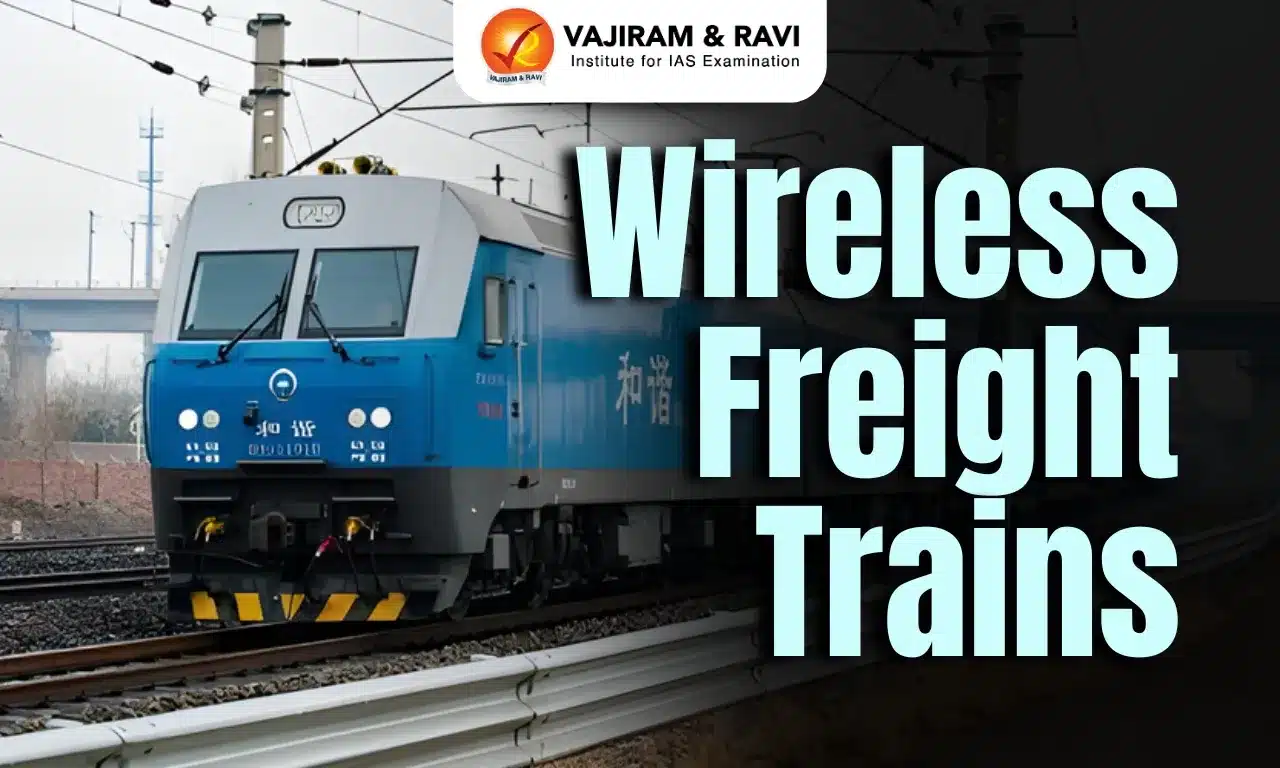
Wireless Freight Trains Latest News
- China recently demonstrated a major advance in rail technology by successfully operating seven fully loaded freight trains as a single coordinated unit without physical coupling.
- Using a wireless control system, each train—carrying about 5,000 tonnes—ran at much closer intervals than normally possible.
- This innovation allows for safer, synchronised movement, effectively increasing freight capacity and efficiency.
- The technology could significantly strengthen China’s already dominant rail freight network by enabling faster transport of larger cargo volumes without expanding physical infrastructure.
Wireless Control System Behind China’s Multi-Train Run
- China’s seven-train freight operation was enabled by a wireless control system deployed on the Baoshen Railway in Inner Mongolia.
- Instead of using traditional mechanical couplings, the trains were synchronised through a wireless network that coordinated their movement as a single unit.
- The system was developed by China Shenhua Energy, a subsidiary of the state-owned CHN Energy group, overcoming the key challenge of linking multiple heavy freight trains without physically joining them.
Technology Behind China’s Wireless Train Convoy
- China’s wireless freight convoy is powered by a “two-dimensional control mode” developed by China Shenhua Energy and domestic partners.
- The system combines relative speed control with absolute distance monitoring, using continuous communication between trains and ground systems.
- This virtual coupling allows trains to adjust dynamically to speed changes, shorten braking distances, and safely operate at closer intervals without physical connections.
Safe Spacing Through Wireless Synchronisation
- Despite operating closely on the same track, the seven freight trains maintained safe distances during the trial.
- CHN Energy said each train ran about 1,091 metres apart at a speed of 60 kmph.
- Using wireless communication and precise control, the system synchronised acceleration and braking across all trains without mechanical couplers.
- According to China Central Television (CCTV) report, the operation was completed without any collision or separation, demonstrating that wireless coordination can ensure both safety and efficiency in multi-train freight movement.
Implications for China’s Rail Freight Capacity
- The successful wireless multi-train operation could significantly boost China’s freight capacity—by up to 50%—without requiring new rail infrastructure.
- The breakthrough aligns with China’s strategy of using advanced technology to increase loading efficiency.
- CHN Energy noted that since 2022, the project has been tested across multiple heavy-haul scenarios, offering a scalable model for rail systems worldwide.
Why Wireless Multi-Train Control Matters for China
- China’s rail freight volumes continue to surge, with over 3 billion tonnes moved in the first nine months of the year.
- Expanding capacity by building new lines is expensive, making efficiency-enhancing technologies more attractive. Wireless group train control allows longer trains, shorter intervals, and denser convoys without new infrastructure.
- The system can also raise station “throat capacity,” enabling more trains to enter and exit efficiently.
- As China expands international services like China Railway Express across Europe and Asia, mastering such technology strengthens its freight competitiveness and positions it as a global leader in heavy-haul rail operations.
Wireless Freight Trains FAQs
Q1: What are China wireless freight trains?
Ans: China wireless freight trains are multiple heavy trains digitally synchronised through wireless control, allowing them to operate as a single convoy without physical coupling.
Q2: How does virtual coupling work in China’s rail system?
Ans: Virtual coupling uses wireless communication, relative-speed control and absolute-distance monitoring to synchronise braking and acceleration among trains running close together.
Q3: How was safety ensured during the wireless train trial?
Ans: The trains maintained about 1,091 metres distance at 60 kmph, with fully synchronised acceleration and braking, ensuring no collision or separation occurred.
Q4: Why is this technology important for China’s rail freight capacity?
Ans: China wireless freight trains can raise cargo capacity by up to 50% without building new tracks, making freight expansion cheaper and faster.
Q5: What global significance does this railway technology hold?
Ans: The system offers a scalable model for heavy-haul railways worldwide, especially where infrastructure expansion is costly or geographically constrained.
