Key Facts about Syria

Key Facts about Syria

Syria Latest News

Recently, the US military carried out a strike against the Islamic State group in Syria.

About Syria

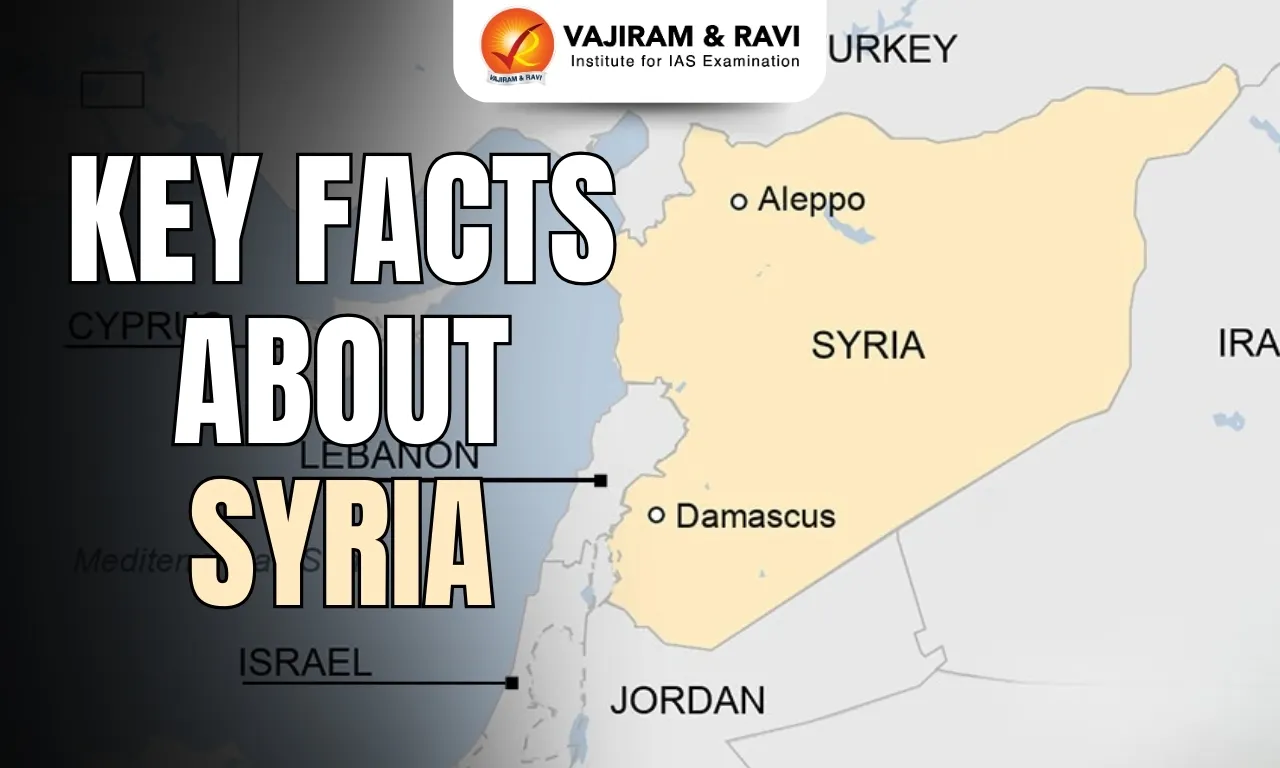
  • Location: It is located on the east coast of the Mediterranean Sea in southwestern Asia.
  • Bordering Countries: It is bordered by Turkey in the north, Lebanon in the west, Iraq in the east, Jordan in the south and Israel in the southwest.
  • Capital City: Damascus

Geographical Features of Syria

  • Syria's geography offers two major regions, a western and an eastern part.
    • The western region features narrow, fertile coastal plains along the eastern Mediterranean Sea.
    • The eastern part of the country is the realm of the Syrian Desert which is a mixture of dry steppe and true desert landscape.
  • Rivers: Euphrates River flows across Syria before entering Iraq.
  • Lakes: Lake al-Assad (a man-made reservoir,) created by a dam on the Euphrates River.
  • Desert: Southern and eastern Syria are part of the northern Syrian Desert.
  • Highest Point: Mt Hermon (2,814 m)

Source: News On Air

Syria FAQs

Q1: Which is the capital city of Syria?

Ans: Damascus

Q2: Which are the major ethnic groups of Syria?

Ans: Kurds, Arabs and Turkmens
Raccoon Roundworm

Raccoon Roundworm

Raccoon Roundworm Latest News

Recently, Europe is on alert after a new study revealed the raccoon roundworm, Baylisascaris procyonis, has firmly taken hold in wild raccoons across nine countries.

About Raccoon Roundworm

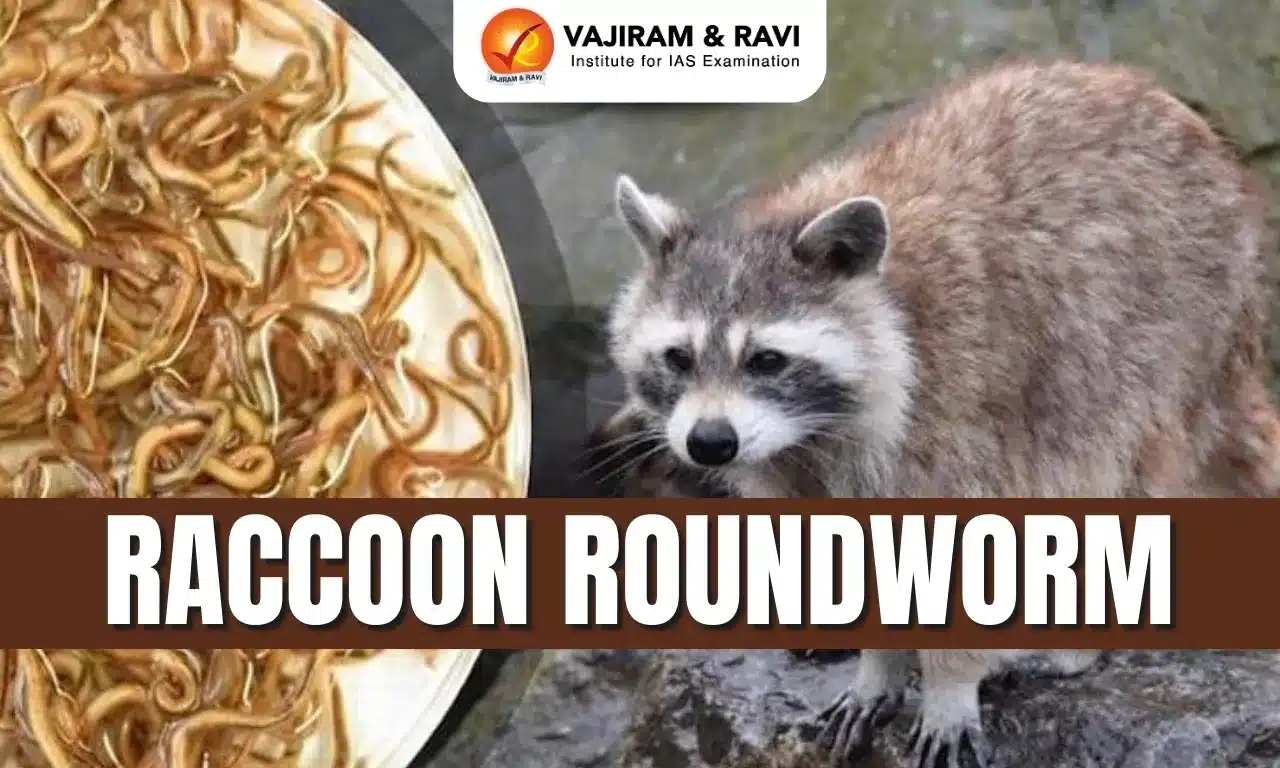
  • The raccoon roundworm (Baylisascaris procyonis) is the common large roundworm or ascarid found in the small intestinal tract of raccoons. 
  • It infects raccoons in parts of North America, Europe and Japan, and less commonly in South America.
  • The parasite is indigenous to North America and emerging in Europe and Asia after the introduction of North American raccoons for the commercial fur trade in the early 20th century.
  • It can cause severe disease in humans and other animals.
  • Primary Hosts of Raccoon Roundworm: Racoons (​Procyon lotor​), Wild and domestic canids

Transmission & Life Cycle of Raccoon Roundworm

  • Infection occurs through ingestion of infective eggs or infected paratenic hosts.
  • Eggs passed in racoon faeces are shed in the environment and take 2-4weeks to embryonate  and become infective.
  • Many mammals and birds can become paratenic hosts after consuming the eggs.
  • Once infective eggs are ingested, the eggs hatch and larvae penetrate the intestinal wall where they can migrate to various tissues (liver, lungs, eyes, and brain), and infect the host.
  • Treatment and Control: Raccoons can be successfully treated with several anthelmintics to kill the adult worms.

Source: India Today

Raccoon Roundworm FAQs

Q1: What is the scientific name of Raccoon Roundworm?

Ans: Baylis ascaris procyonis

Q2: What is the primary health risk of Raccoon Roundworm infection in humans?

Ans: Neurological damage

Southern Ocean

Southern Ocean

Southern Ocean Latest News

Recently, scientists have found the Southern Ocean mitigates global surface warming by taking up a large portion of the carbon released by human activities.

About Southern Ocean

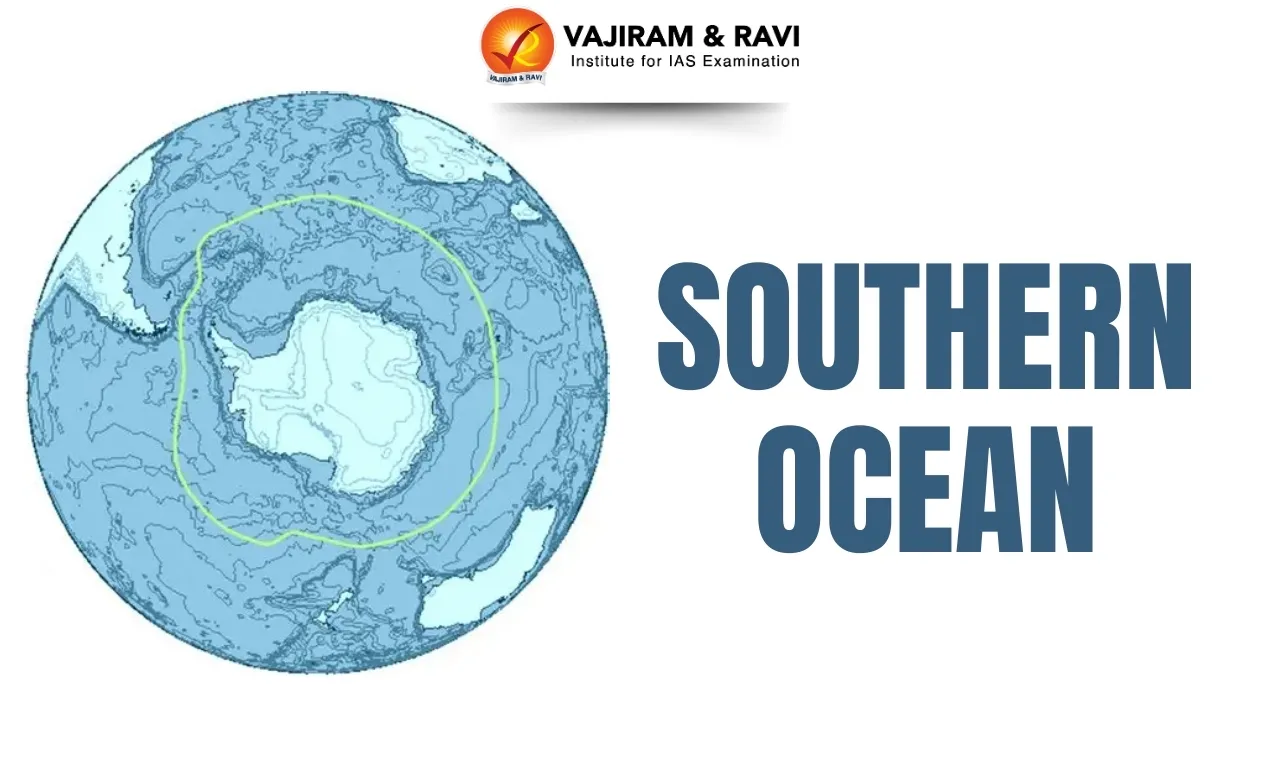
  • The Southern Ocean is also known as the Antarctic Ocean, is the fourth-largest ocean by surface area.
  • The International Hydrographic Organization describes the Southern Ocean as the World Ocean’s southernmost portion.
  • It is located on the lower end of the Pacific, Atlantic, and Indian Ocean, and includes the tributary seas around the Antarctic region. 
  • It is known for its strong winds, intense storms, dramatic seasonal changes and cold temperatures.
  • It is dominated by the Antarctic Circumpolar Current (ACC) which isthe longest, strongest, deepest-reaching current on earth. 
  • Formation: It was formed around 34 million years ago when Antarctica and South America drifted apart, creating the Drake Passage.
  • Biodiversity: Powerful currents, cold temperatures and nutrient and oxygen-rich waters make the Southern Ocean one of the most productive marine ecosystems on Earth.

Role of Southern Ocean

  • It plays an important role in the circulation of water around the globe.
  • It also plays a key role in regulating the earth’s climate through its currents, seasonal sea ice and by absorbing heat and carbon dioxide from the atmosphere.

Source: TH

Southern Ocean FAQs

Q1: What is a notable feature of the Southern Ocean?

Ans: Strongest winds and currents

Q2: Which ocean is also known as the Antarctic Ocean?

Ans: Southern Ocean

World Anti-Doping Agency

World Anti-Doping Agency

World Anti-Doping Agency Latest News

Recently, for the third consecutive year, India has topped the World Anti-Doping Agency’s (WADA) global list of offenders.

About World Anti-Doping Agency

  • It was established in 1999 as an international independent agency to lead a collaborative worldwide movement for doping-free sport.
  • Role: To develop, harmonize and coordinate anti-doping rules and policies across all sports and countries.
  • Its activities include scientific and social science research; education; intelligence & investigations; development of anti-doping capacity; and monitoring of compliance with the World Anti-Doping Program.
  • Headquarter: Montreal, Canada.

Governance Structure of World Anti-Doping Agency

  • Foundation Board (Board): It consists of 42-member and it is the agency’s highest policy-making body, is jointly composed of representatives of the Olympic Movement (the IOC, National Olympic Committees, International Sports Federations, and athletes) and representatives of governments from all five continents.
  • Executive Committee (ExCo): It consists of 16-member to which the Board delegates the management and running of the agency, including the performance of all its activities and the administration of its assets.

Source: IE

World Anti-Doping Agency FAQs

Q1: What is the primary objective of WADA?

Ans: To promote, coordinate, and monitor anti-doping efforts in sports

Q2: Where is WADA headquartered?

Ans: Montreal, Canada

Enquire Now