Key Facts about Syria

Key Facts about Syria

Syria Latest News

Recently, the US military carried out a strike against the Islamic State group in Syria.

About Syria

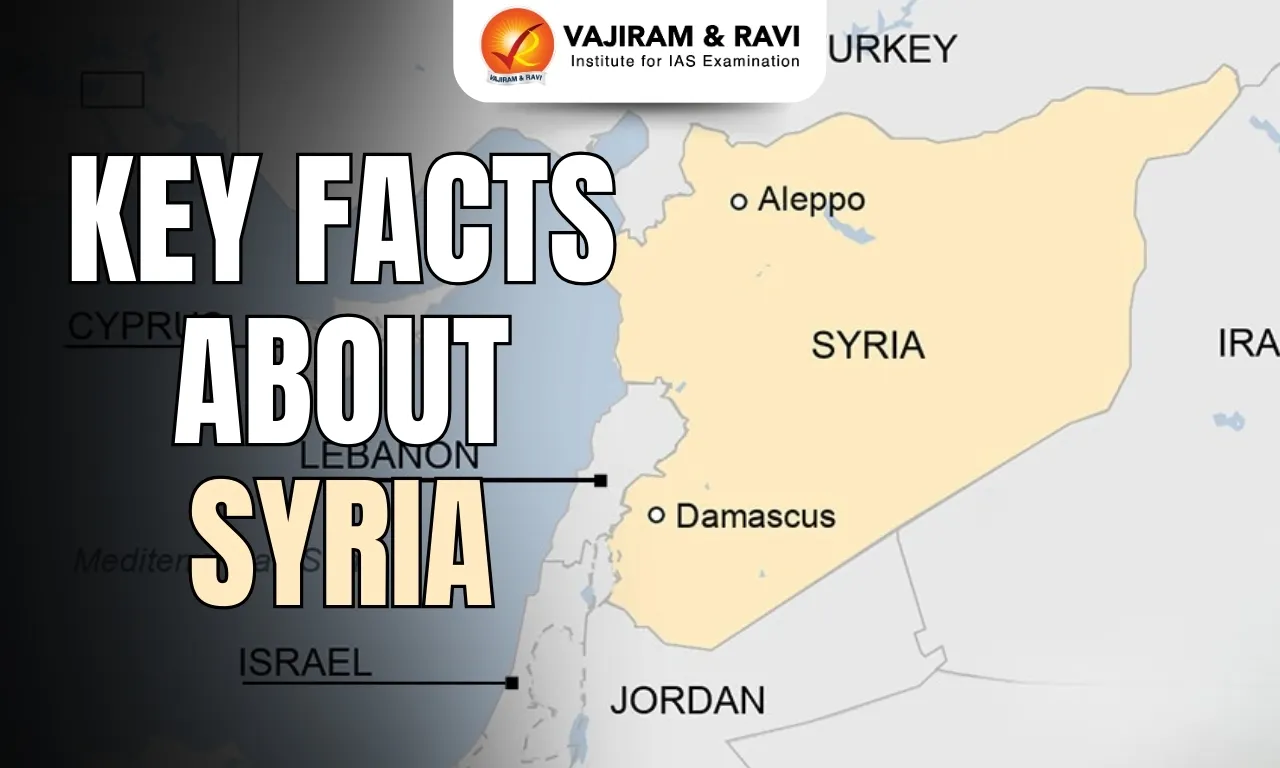
  • Location: It is located on the east coast of the Mediterranean Sea in southwestern Asia.
  • Bordering Countries: It is bordered by Turkey in the north, Lebanon in the west, Iraq in the east, Jordan in the south and Israel in the southwest.
  • Capital City: Damascus

Geographical Features of Syria

  • Syria's geography offers two major regions, a western and an eastern part.
    • The western region features narrow, fertile coastal plains along the eastern Mediterranean Sea.
    • The eastern part of the country is the realm of the Syrian Desert which is a mixture of dry steppe and true desert landscape.
  • Rivers: Euphrates River flows across Syria before entering Iraq.
  • Lakes: Lake al-Assad (a man-made reservoir,) created by a dam on the Euphrates River.
  • Desert: Southern and eastern Syria are part of the northern Syrian Desert.
  • Highest Point: Mt Hermon (2,814 m)

Source: News On Air

Syria FAQs

Q1: Which is the capital city of Syria?

Ans: Damascus

Q2: Which are the major ethnic groups of Syria?

Ans: Kurds, Arabs and Turkmens

Raccoon Roundworm

Raccoon Roundworm

Raccoon Roundworm Latest News

Recently, Europe is on alert after a new study revealed the raccoon roundworm, Baylisascaris procyonis, has firmly taken hold in wild raccoons across nine countries.

About Raccoon Roundworm

  • The raccoon roundworm (Baylisascaris procyonis) is the common large roundworm or ascarid found in the small intestinal tract of raccoons. 
  • It infects raccoons in parts of North America, Europe and Japan, and less commonly in South America.
  • The parasite is indigenous to North America and emerging in Europe and Asia after the introduction of North American raccoons for the commercial fur trade in the early 20th century.
  • It can cause severe disease in humans and other animals.
  • Primary Hosts of Raccoon Roundworm: Racoons (​Procyon lotor​), Wild and domestic canids

Transmission & Life Cycle of Raccoon Roundworm

  • Infection occurs through ingestion of infective eggs or infected paratenic hosts.
  • Eggs passed in racoon faeces are shed in the environment and take 2-4weeks to embryonate  and become infective.
  • Many mammals and birds can become paratenic hosts after consuming the eggs.
  • Once infective eggs are ingested, the eggs hatch and larvae penetrate the intestinal wall where they can migrate to various tissues (liver, lungs, eyes, and brain), and infect the host.
  • Treatment and Control: Raccoons can be successfully treated with several anthelmintics to kill the adult worms.

Source: India Today

Raccoon Roundworm FAQs

Q1: What is the scientific name of Raccoon Roundworm?

Ans: Baylis ascaris procyonis

Q2: What is the primary health risk of Raccoon Roundworm infection in humans?

Ans: Neurological damage

Data Exclusivity and Its Implications for India’s Generic Drug Industry

Data Exclusivity

Data Exclusivity Latest News

  • The Union government is exploring the introduction of data exclusivity in the pharmaceutical sector, raising concerns about delayed access to affordable generic medicines and the future of India’s generics-driven drug industry.

Understanding Data Exclusivity

  • When a pharmaceutical company develops a new drug, it must submit extensive clinical trial data to the drug regulator to prove the medicine’s safety and effectiveness. 
  • Traditionally, once a drug’s patent period ends, other manufacturers are allowed to produce generic versions using abbreviated approval processes based on bioequivalence studies.
  • Data exclusivity changes this system. It grants the innovator company exclusive rights over its clinical trial data for a fixed period. 
  • During this time, regulators are not allowed to rely on this data to approve generic versions, even if the patent has expired. 
  • As a result, generic manufacturers must either wait for the exclusivity period to end or conduct their own costly clinical trials.
  • This protection works alongside patents, but it is distinct from them. While patents protect the invention, data exclusivity protects the underlying test data.

India’s Pharmaceutical Model and the Role of Generics

  • India’s pharmaceutical sector is globally known for its generic drug manufacturing capacity. 
  • Nearly 90% of Indian pharmaceutical companies focus on generics rather than on developing new molecules. This model has ensured:
    • Affordable medicines for domestic patients
    • A strong export presence in developing countries
    • India’s reputation as the “pharmacy of the Global South”
  • Crucially, India’s drug laws currently do not provide data exclusivity, which allows generic companies to enter the market immediately after patent expiry.

Government’s Current Approach

  • According to the report, the government has recently held inter-ministerial and industry-level consultations involving the Commerce Ministry, the Department for Promotion of Industry and Internal Trade (DPIIT), the pharmaceuticals department, and the health ministry to examine how data exclusivity could be implemented.
  • The move is reportedly linked to trade negotiations, particularly with the European Free Trade Association (EFTA), and the expectation that stronger intellectual property protections could attract large-scale foreign investment.
  • However, the Health Ministry has officially stated that there is no proposal from its side to introduce data exclusivity, indicating divergence within the government.

Impact on Access to Affordable Medicines

  • Introducing data exclusivity could have serious consequences for public health and the affordability:
    • Delayed entry of generics even after patent expiry
    • Higher drug prices due to an extended market monopoly
    • Reduced availability of life-saving medicines for low-income populations
  • A key concern is that data exclusivity can protect even off-patent drugs, allowing innovator companies to retain exclusivity beyond the standard 20-year patent term. This can effectively extend monopolies without fresh innovation.

Implications for India’s Generic Industry

  • Experts argue that data exclusivity may weaken India’s generics-led growth model. 
  • Since most Indian firms do not invest in original drug discovery, requiring them to conduct full clinical trials would significantly raise costs and reduce competitiveness.
  • It could also undermine patent challenges and compulsory licensing, tools that India has used to balance innovation with public health needs. 
  • Past cases, such as court-approved generic production of expensive rare-disease drugs, may become harder if regulatory approval itself is blocked.

Role of the Drug Regulator

  • The Central Drugs Standard Control Organisation (CDSCO) has issued a notice suggesting that current regulations create an “uneven playing field” between original drug developers and generic manufacturers. 
  • Critics argue that this framing indirectly supports a data exclusivity-based regulatory approach, without openly stating so.
  • Public health activists have warned that such regulatory incentives could lead to:
    • Evergreening of patents
    • Unnecessary clinical trials
    • Delays in access to cheaper medicines
    • Expansion of monopolies over traditional or existing drugs

Way Forward

  • India currently has no international legal obligation to introduce data exclusivity. Any move in this direction must balance:
    • Innovation incentives
    • Trade and investment goals
    • Public health priorities
    • Constitutional commitments to affordable healthcare

Source: IE

Data Exclusivity FAQs

Q1: What is data exclusivity in pharmaceuticals?

Ans: It is a provision that prevents regulators from using an innovator’s clinical trial data to approve generic drugs for a fixed period.

Q2: How is data exclusivity different from patents?

Ans: Patents protect the invention, while data exclusivity protects the clinical trial data submitted for regulatory approval.

Q3: Why is data exclusivity controversial in India?

Ans: It can delay access to affordable generic medicines and weaken India’s generics-based pharmaceutical industry.

Q4: Does India have an international obligation to implement data exclusivity?

Ans: No, India is not legally bound under any trade agreement to introduce data exclusivity.

Q5: How could data exclusivity affect public health?

Ans: It may increase drug prices and delay the availability of life-saving medicines, especially for poorer populations.

Elephant–Train Collisions in India: Causes, Impact, and Prevention Measures

Elephant–Train Collisions

Elephant–Train Collisions Latest News

  • Recently, seven elephants were killed when the Delhi-bound Rajdhani Express hit a herd in Assam’s Hojai district. 
  • The impact derailed the locomotive and five coaches, but no passengers were injured.

Elephant Deaths on Railway Tracks: Scale and Causes

  • India is home to over half of the world’s Asian elephant population, and train collisions have emerged as a major human-caused threat to their survival. 
  • Railway accidents are among the leading anthropogenic causes of elephant deaths in the country.

Alarming Mortality Data

  • Between 2010 and 2020, at least 1,160 elephants died due to non-natural causes. 
  • Electrocution was the biggest killer (741 deaths), followed by train hits (186 deaths). 
  • Notably, electrocution is often linked to high-voltage overhead railway lines, indirectly tying rail infrastructure to multiple causes of death.

Impact of Linear Transport Infrastructure (LTI)

  • Railways, roads, and canals cutting through forests fragment elephant habitats. 
  • Such infrastructure can trap herds, restrict access to food and water, and increase stress, negatively affecting long-term health and survival.

Night-Time Collisions and Behavioural Factors

  • Studies show that most train–elephant collisions occur at night
  • Male elephants are disproportionately affected, as they cross tracks more frequently, especially during crop-harvest seasons when they engage in crop-raiding, increasing exposure to railway lines.

Preventing Elephant–Train Collisions: Why Crossings Matter

  • According to the Handbook to Mitigate the Impacts of Roads and Railways on Asian Elephants (2023) by the International Union for Conservation of Nature (IUCN), the most effective strategy is avoiding elephant habitats and migration corridors while planning infrastructure. 
  • Mitigation measures are not substitutes for careful route selection, but are necessary when avoidance is impractical.

Wildlife Crossing Structures: The Core Solution

  • Well-designed wildlife crossing structures, combined with fencing, can reduce wildlife mortality by up to 98%. 
  • These crossings form the backbone of effective mitigation strategies for roads and railways cutting through elephant landscapes.

Types of Crossings and Design Principles

  • Crossings can be underpasses (beneath bridges or flyovers) or overpasses (over tunnels or green bridges). 
  • The choice depends on terrain and animal behaviour. For elephants, openness is critical—they avoid confined spaces. 
  • The handbook recommends minimum heights of 6–7 metres, adjusted for crossing length, to ensure usage.

Placement Based on Elephant Movement

  • Where and how many crossings are built matters as much as design. 
  • Camera traps and GPS telemetry are used to map elephant movement and identify collision hotspots. 
  • These data guide the optimal placement of crossings.

Fencing as a Support Tool

  • Strategic fencing along high-risk stretches prevents elephants from straying onto tracks and gently channels them toward designated crossings, enhancing the effectiveness of the entire mitigation system.

Using Technology to Prevent Elephant–Train Collisions

  • Role of Early-Warning Systems - Alongside habitat avoidance and physical measures like crossings and fencing, technology-based early-warning systems are emerging as effective non-structural solutions to reduce elephant–train accidents by alerting train operators in advance.
  • Types of Sensor-Based Technologies - Early-warning systems can be locomotive-based or ground-based. Locomotive systems use Forward Looking Infrared (FLIR) cameras, capable of detecting obstructions up to 750 metres, even in poor visibility. 
    • Ground-based systems deploy cameras, acoustic, or seismic sensors at known elephant crossing points.
  • AI and Machine Learning as Game Changers - Earlier, these systems were limited by the massive data they generated and difficulties in distinguishing real threats from false alarms. 
    • Artificial intelligence and machine learning now allow faster, more accurate analysis, greatly improving reliability and response time.

Indian Railways’ Pilot Initiatives

  • Indian Railways has begun deploying AI-based early-warning systems, though adoption remains limited. 
  • In 2023, the Northeast Frontier Railway pioneered AI monitoring to protect elephants, followed by a similar rollout along the Kerala–Tamil Nadu border in 2024. 
  • Early results from these pilots have been encouraging, suggesting strong potential for wider implementation.

Source: IE | BBC

Elephant–Train Collisions FAQs

Q1: Why are elephant–train collisions common in India?

Ans: Elephant–train collisions in India occur due to railways cutting through elephant habitats, night-time movement, and increased crossings during crop-raiding seasons.

Q2: How serious is the elephant mortality caused by trains?

Ans: Between 2010 and 2020, at least 186 elephants died in train hits, making rail accidents one of the leading human-caused threats to Asian elephants.

Q3: How do railway lines affect elephant habitats?

Ans: Railways fragment habitats, trap herds, restrict access to food and water, and increase stress, indirectly harming elephant health and survival.

Q4: What role do wildlife crossings play in prevention?

Ans: Well-designed underpasses or overpasses, combined with fencing, can reduce elephant–train collisions by up to 98%, according to global conservation guidelines.

Q5: How can technology reduce elephant–train collisions?

Ans: AI-based early-warning systems using FLIR cameras and sensors help detect elephants in advance, allowing train operators to slow down and avoid collisions.

Securities Markets Code Bill 2025: One Law, One Market for India’s Capital Markets

Securities Markets Code Bill 2025

Securities Markets Code Bill 2025 Latest News

  • The Securities Markets Code (SMC), 2025, tabled in Parliament, proposes a sweeping overhaul of India’s securities regulation framework. It aims to strengthen investor protection, reduce compliance burdens, improve regulatory governance, and promote ease of doing business.
  • The Bill grants greater powers to Securities and Exchange Board of India (SEBI), decriminalises minor violations, and bolsters market infrastructure institutions. 
  • Crucially, it consolidates three existing laws—the Securities Contracts (Regulation) Act, 1956, the SEBI Act, 1992, and the Depositories Act, 1996—into a single, comprehensive code.

What the Securities Markets Code Bill, 2025 Replaces

  • The Securities Markets Code Bill, 2025 proposes to merge and replace three existing securities laws—the Securities Contracts (Regulation) Act, 1956 (SCRA), the SEBI Act, 1992, and the Depositories Act, 1996. 
  • These decades-old statutes contain overlapping and redundant provisions that no longer align with today’s technology-driven, complex markets. 
  • The consolidation—first announced in Budget 2021—aims to move toward a single, principle-based framework that reduces interpretative conflicts and improves legal certainty.
  • Stronger and More Representative Regulator - Under the Code, the board of Securities and Exchange Board of India will expand from 9 to 15 members, adding representatives from the Central Government, the Reserve Bank of India, and more whole-time members to strengthen governance and expertise.
  • Tighter Conflict-of-Interest Norms - While earlier laws required disclosure of pecuniary interests, the new Code broadens the scope to include family members’ interests, mandating disclosure and recusal to enhance transparency and integrity in decision-making.
  • Investor-Centric Additions - The Code formally incorporates an Investor Charter, which earlier had no explicit statutory backing. It also introduces a statutory Ombudsman as an independent grievance redressal authority, distinct from enforcement wings—addressing a long-standing gap in investor protection.

Key Provisions of the Securities Markets Code, 2025

  • Strengthening SEBI’s Governance
    • The Code empowers the government to remove SEBI Board members for conflicts of interest or convictions involving moral turpitude. 
    • It mandates disclosure of direct or indirect interests and expands the Board from 9 to 15 members, adding Central Government and RBI representation and more whole-time members.
  • Easier, Proportionate Compliance
    • Contraventions are reclassified into two buckets. 
    • Lesser violations (including fraudulent and unfair practices) are decriminalised and attract only civil penalties, while market abuse—serious misconduct harming market integrity—may invite both civil penalties and criminal action. 
    • This aims to reduce compliance burden while preserving deterrence.
  • Stronger Investor Protection
    • The Code requires Securities and Exchange Board of India to specify an Investor Charter, standardise grievance redressal across intermediaries and issuers, and appoint Ombudsperson(s) for time-bound resolution. 
    • It also opens public consultations to investors, improving transparency and participation.
  • Simplified Rules for Regulated Entities
    • A consolidated registration framework is proposed for intermediaries and pooled investment vehicles. 
    • Stock exchanges, clearing corporations, and depositories are brought under a single code, with SEBI allowed to delegate registration functions to MIIs and SROs to streamline oversight.
  • Better Inter-Regulatory Coordination
    • The Bill enables coordination among regulators to ease listing of other regulated instruments and improve interoperability among Market Infrastructure Institutions (MIIs), supporting smoother market operations, improved investment climate, and stronger market-making.

Aligning India’s Securities Law with Global Best Practices

  • The Securities Markets Code Bill, 2025 incorporates international best practices by strengthening regulatory governance, accountability, and transparency. 
  • It introduces regulatory impact assessments, ensures arm’s-length separation between investigation and adjudication, establishes an Ombudsperson for investor grievances, and enables inter-regulatory coordination. 
  • Experts note that by combining enhanced penalties, clearer adjudication, and greater regulatory flexibility for innovation, the consolidation of multiple laws into a single code marks a significant step toward a modern, globally aligned securities framework.

Source: IE | PRS

Securities Markets Code Bill 2025 FAQs

Q1: What is the Securities Markets Code Bill 2025?

Ans: The Securities Markets Code Bill 2025 is a comprehensive law that consolidates India’s securities regulations to improve investor protection, governance, and ease of doing business.

Q2: Which laws does the Securities Markets Code Bill replace?

Ans: The Bill replaces the SCRA 1956, SEBI Act 1992, and Depositories Act 1996, merging them into a single, principle-based regulatory framework.

Q3: How does the Securities Markets Code Bill strengthen SEBI?

Ans: It expands SEBI’s board, tightens conflict-of-interest rules, grants stronger enforcement powers, and allows delegation to market infrastructure institutions.

Q4: How does the Bill improve ease of compliance?

Ans: It decriminalises minor violations, introduces proportionate penalties, and distinguishes serious market abuse from procedural lapses, reducing compliance burden.

Q5: Why is the Securities Markets Code Bill 2025 important?

Ans: The Bill modernises regulation, enhances transparency, strengthens investor grievance redressal, and aligns India’s capital markets with global best practices.

Southern Ocean

Southern Ocean

Southern Ocean Latest News

Recently, scientists have found the Southern Ocean mitigates global surface warming by taking up a large portion of the carbon released by human activities.

About Southern Ocean

  • The Southern Ocean is also known as the Antarctic Ocean, is the fourth-largest ocean by surface area.
  • The International Hydrographic Organization describes the Southern Ocean as the World Ocean’s southernmost portion.
  • It is located on the lower end of the Pacific, Atlantic, and Indian Ocean, and includes the tributary seas around the Antarctic region. 
  • It is known for its strong winds, intense storms, dramatic seasonal changes and cold temperatures.
  • It is dominated by the Antarctic Circumpolar Current (ACC) which isthe longest, strongest, deepest-reaching current on earth. 
  • Formation: It was formed around 34 million years ago when Antarctica and South America drifted apart, creating the Drake Passage.
  • Biodiversity: Powerful currents, cold temperatures and nutrient and oxygen-rich waters make the Southern Ocean one of the most productive marine ecosystems on Earth.

Role of Southern Ocean

  • It plays an important role in the circulation of water around the globe.
  • It also plays a key role in regulating the earth’s climate through its currents, seasonal sea ice and by absorbing heat and carbon dioxide from the atmosphere.

Source: TH

Southern Ocean FAQs

Q1: What is a notable feature of the Southern Ocean?

Ans: Strongest winds and currents

Q2: Which ocean is also known as the Antarctic Ocean?

Ans: Southern Ocean

World Anti-Doping Agency

World Anti-Doping Agency

World Anti-Doping Agency Latest News

Recently, for the third consecutive year, India has topped the World Anti-Doping Agency’s (WADA) global list of offenders.

About World Anti-Doping Agency

  • It was established in 1999 as an international independent agency to lead a collaborative worldwide movement for doping-free sport.
  • Role: To develop, harmonize and coordinate anti-doping rules and policies across all sports and countries.
  • Its activities include scientific and social science research; education; intelligence & investigations; development of anti-doping capacity; and monitoring of compliance with the World Anti-Doping Program.
  • Headquarter: Montreal, Canada.

Governance Structure of World Anti-Doping Agency

  • Foundation Board (Board): It consists of 42-member and it is the agency’s highest policy-making body, is jointly composed of representatives of the Olympic Movement (the IOC, National Olympic Committees, International Sports Federations, and athletes) and representatives of governments from all five continents.
  • Executive Committee (ExCo): It consists of 16-member to which the Board delegates the management and running of the agency, including the performance of all its activities and the administration of its assets.

Source: IE

World Anti-Doping Agency FAQs

Q1: What is the primary objective of WADA?

Ans: To promote, coordinate, and monitor anti-doping efforts in sports

Q2: Where is WADA headquartered?

Ans: Montreal, Canada

Enquire Now