
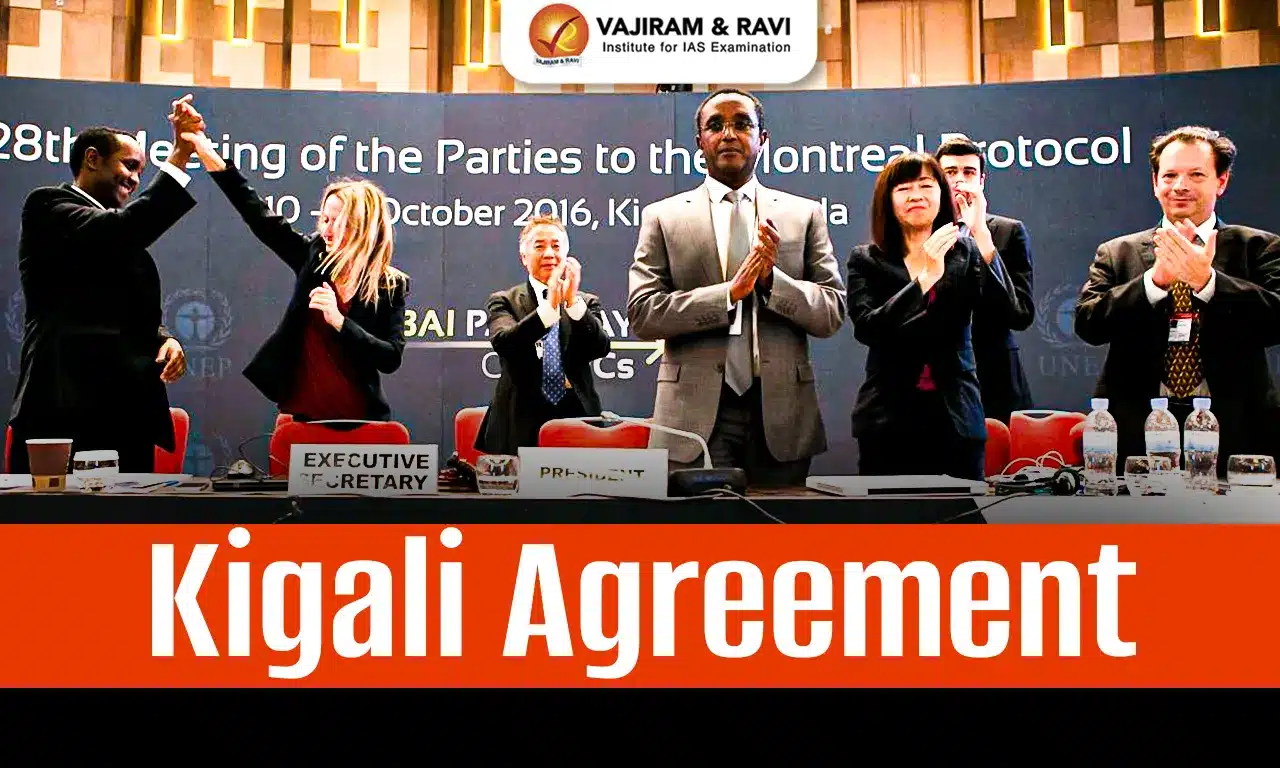
The Kigali Agreement is a landmark international climate accord adopted in October 2016 to control hydrofluorocarbons, chemicals widely used in cooling technologies. It functions as an amendment to the Montreal Protocol and addresses climate change rather than ozone depletion directly. By legally binding countries to phase down high global warming potential gases, the Kigali Agreement connects ozone protection with climate mitigation. Scientific assessments estimate that its full implementation can significantly limit long-term temperature rise while supporting sustainable industrial transitions worldwide.
Kigali Agreement
The Kigali Agreement, formally known as the Kigali Amendment to the Montreal Protocol, mandates a gradual reduction in hydrofluorocarbons across developed and developing economies. Signed on 15 October 2016 in Kigali, Rwanda, it entered into force on 1 January 2019 after achieving the required ratifications. As of 2025, over 170 countries and the European Union are parties. The agreement is legally binding and establishes differentiated timelines based on economic capacity and climatic conditions.
Kigali Agreement History
The Kigali Agreement emerged from growing concerns over climate impacts of non-ozone-depleting refrigerants.
- Discovery of ozone depletion science: Ozone damage linked to CFCs identified by Crutzen, Molina, and Rowland in 1974.
- Montreal Protocol adoption: Global treaty signed in 1987 to eliminate ozone-depleting substances.
- Shift to HFCs: HFCs adopted worldwide as CFC substitutes during the 1990s.
- Climate concern recognition: IPCC highlighted HFCs’ high global warming potential in early 2000s.
- Negotiation launch: Formal talks on HFC control initiated under Montreal Protocol framework in 2015.
- Adoption in Kigali: Amendment adopted by 197 parties on 15 October 2016.
- Entry into force: Kigali Amendment became effective globally on 1 January 2019.
Kigali Agreement Objectives
The Kigali Agreement aims to address climate change through targeted chemical regulation.
- HFC phase-down: Reduce global HFC consumption and production by 80–85 percent by late 2040s.
- Climate mitigation: Avoid up to 0.5°C global temperature rise by 2100.
- Legal enforcement: Establish binding international obligations with compliance mechanisms.
- Equity-based approach: Different timelines for developed, emerging, and developing economies.
- Technology transition: Promote adoption of low-global-warming refrigerants.
- Financial support: Assist developing nations through multilateral funding mechanisms.
Kigali Agreement Features
The Kigali Agreement introduces structured, science-based controls under an existing treaty.
- Legally binding nature: Obligations enforceable under international environmental law.
- Three compliance groups: Countries classified based on development status and climate needs.
- Baseline calculation: Reduction targets measured against specific historical consumption periods.
- Temperature waiver: Special flexibility for nations with sustained extreme heat conditions.
- Multilateral Fund access: Financial assistance for technology transfer and capacity building.
- Periodic review: Technology and Energy Assessment Panel evaluates alternatives and safety standards.
- High mitigation potential: Expected to prevent emissions equivalent to 70 billion tonnes CO₂.
Montreal Protocol
The Montreal Protocol provides the legal and institutional foundation for the Kigali Agreement.
- Adoption year: Signed in 1987 and entered into force in 1989.
- Universal participation: Ratified by all 197 UN member states.
- Primary objective: Eliminate ozone-depleting substances like CFCs and halons.
- Environmental success: Achieved over 98 percent phase-out of controlled ODS chemicals.
- Ozone recovery: Scientific projections indicate near-complete ozone layer recovery by mid-21st century.
- Multiple amendments: Kigali represents the eighth amendment to the Protocol.
- Institutional strength: Features financial mechanisms, compliance committees, and technical panels.
Kigali Agreement in India Recent Developments
India’s engagement with the Kigali Agreement reflects a balance between climate responsibility and development needs.
- Ratification status: India ratified the Kigali Amendment on 27 September 2021.
- Compliance group: Placed in third group with phase-down starting in 2028.
- Reduction pathway: Targets include 10 percent cut by 2032 and 85 percent by 2047.
- Low consumption share: India accounts for nearly 3 percent of global HFC usage.
- Policy action: Voluntary ban on HFC-23 production reduces 100 million tonnes CO₂ equivalent emissions.
- National strategy: India committed to finalizing HFC phase-down roadmap by 2023.
- Regulatory reform: Amendments to ODS Rules planned by mid-2024.
- Climate benefit: Expected prevention of 105 million tonnes CO₂ equivalent emissions.
- Industrial transition: Encourages domestic innovation in low-GWP refrigerants and equipment.
- Global role: Strengthens India’s alignment with Paris Agreement climate objectives.
Kigali Agreement FAQs
Q1: What is the Kigali Agreement?
Ans: The Kigali Agreement is a 2016 amendment to the Montreal Protocol to phase down hydrofluorocarbons globally.
Q2: Why is the Kigali Agreement important for climate change?
Ans: It targets high global warming potential HFCs and can prevent up to 0.5°C temperature rise by 2100.
Q3: When did the Kigali Agreement come into force?
Ans: The Kigali Agreement became effective on 1 January 2019 after sufficient country ratifications.
Q4: How does the Kigali Agreement treat developing countries?
Ans: It provides delayed timelines, financial support, and technology transfer for developing and hotter countries.
Q5: What is India’s commitment under the Kigali Agreement?
Ans: India will start phasing down HFCs from 2028 and achieve an 85% reduction by 2047.
