Chenab Valley

Chenab Valley

Chenab Valley Latest News

One soldier was killed in a major anti-terror operation by security forces against a group of terrorists hiding in the Chenab Valley’s Kishtwar district recently.

About Chenab Valley

  • The Chenab Valley, otherwise called the Chenab Region, is the river valley of the Chenab River moving through the Kishtwar, Doda, and Ramban locale of Jammu Division in Jammu and Kashmir.
  • It is theeastern region of Jammu and Kashmir. 
  • To the north lies the majestic Pir Panjal range and to the south, the Zanskar range. 
  • Deep gorges, lush meadows, and cascading rivers form a beautiful landscape that defines the Chenab Valley.
  • It covers an area of 11,885 sq.km.
  • The people of Chenab Valley are referred to as Chenabis” or simply “Chenabi“.
  • The region is a mosaic of ethnic groups, with multiple languages spoken, including Kashmiri, Gojri, Bhaderwahi, Sarazi, Kishtwari, and Padari.
  • It is home to several tourist attractions, such as Bhaderwah, Jai Valley, Padri Pass, Sinthan Top, Lal Draman, and Jantroon Dhar
  • Its hydroelectric potential is harnessed by significant dams like Baglihar Dam, Dulhasti Dam, and Salal Dam.
  • The region is traversed by National Highway 244.

Chenab Valley FAQs

Q1: Where is Chenab Valley located?

Ans: It is situated in the Jammu region of Jammu and Kashmir.

Q2: Which three districts make up the Chenab Valley?

Ans: Kishtwar, Doda, and Ramban

Q3: Which river is known as the moon river?

Ans: Chenab

SourceTH

Chagos Archipelago

Chagos Islands

Chagos Islands Latest News

India recently welcomed the UK's decision to hand over the sovereignty of Chagos Islands including tropical atoll of Diego Garcia to Mauritius under a historic deal.

About Chagos Islands

  • It is an island group located in the central Indian Ocean.
  • It is about 1,000 miles (1,600 km) south of the southern tip of the Indian subcontinent.
  • It is an overseas territory of the United Kingdom that was established on November 8, 1965.
  • The principal islands in the archipelago include the Diego Garcia atoll, Danger Island, Egmont Islands, Eagle Islands, Nelsons Island, Peros Banhos atoll, Three Brothers Islands, and the Solomon Islands. 
    • Diego Garcia covers an area of about 30 sq.km. and is the largest and the most southerly island of the Chagos Archipelago.
    • Diego Garcia houses a strategic US military base.
  • The islands feature flat and low terrain, and most areas of the islands do not exceed more than 2 m in elevation. 
  • There are no rivers and lakes on the islands. 
  • Climate
    • It experiences a tropical marine climate with high temperatures and elevated humidity levels. 
    • The island’s climate is heavily moderated by the trade winds which blow over the islands.

Chagos Islands History

  • The archipelago’s first inhabitants, primarily enslaved people from Madagascar and Mozambique, were forcibly brought to the islands by French enslavers, to work on coconut plantations. 
  • Centuries later, they had unshackled themselves from slavery and became Chagossians, an indigenous people with a distinct language and culture.
  • In 1965, the British convinced Mauritian nationalist politicians to give up their claimto the Chagos Islands in exchange for independence.
  • In 1966, Chagos became the ’British Indian Ocean Territory‘ (BIOT) and was denied any claim to independence. 
  • This led to the removal of the peoples living there, most of whom relocated to Mauritius.
  • The UK made an agreement with the United States to host a military base in the islands for Indian Ocean defenses.
  • Mauritius, which gained independence from Britain in 1968, has consistently maintained its claim over the Chagos Islands.
  • In 2019, the International Court of Justice (ICJ) dismissed the UK's right to govern the Chagos Islands and called on its government to withdraw from the archipelago.

Chagos Islands FAQs

Q1: Where are the Chagos Islands located?

Ans: Central Indian Ocean

Q2: Which is the largest island in the Chagos Archipelago?

Ans: Diego Garcia

Q3: What year did Mauritius gain independence from the British?

Ans: 1968

SourceNDTV

Charaka and Sushruta

Charaka and Sushruta

Charaka and Sushruta Latest News

The Vice-President of India addressed a gathering during the unveiling of statues of Charaka and Sushruta at Raj Bhavan, Goa.

About Charaka and Charaka Samhita

  • Charaka, a court physician during the Kushan period, is considered the Father of Medicine in India.
  • He revised the ancient Agnivesha Samhita into what became the Charaka Samhita, a foundational text of Ayurveda.
  • Charaka Samhita covers topics such as physiology, diagnosis, prevention, and internal medicine.
  • The text is part of the Bṛhat-Trayi (Great Trilogy) of Ayurveda, alongside the Sushruta Samhita and Ashtanga Hridaya.
  • The Charaka Samhita was later expanded by Dṛḍhabala, making it an encyclopaedic treatise.
  • Charaka emphasised ethics in medicine, highlighting the importance of physician conduct, diet, and preventive care.
  • It remained authoritative for over two millennia, and was translated into Arabic, Latin, and other foreign languages, showing its global medical relevance.

About Sushruta

  • Sushruta, dating back to the 7th century BCE, is revered as the Father of Surgery and possibly the world’s first documented surgeon.
  • He authored the Sushruta Samhita, which elaborates on over 300 surgical procedures120 surgical instruments, and various types of fractures and dislocations.
  • Innovations include rhinoplasty (nasal reconstruction)skin graftingcataract surgery, and caesarean sections.
  • The Sushruta Samhita also integrates anatomical knowledge, surgical training, patient carehygiene, and scientific observation.
  • Sushruta’s teachings display principles of evidence-based medicine, centuries before modern systems emerged.

Charaka and Sushruta FAQs

Q1: Who was Charaka?
Ans: Charaka was an ancient Indian physician known as the father of Indian medicine and the author of the Charaka Samhita, a foundational text of Ayurveda.

Q2: Who was Sushruta?
Ans: Sushruta was a pioneering surgeon of ancient India and author of the Sushruta Samhita, which laid the foundations of surgical practices in Ayurveda.

Source: PIB

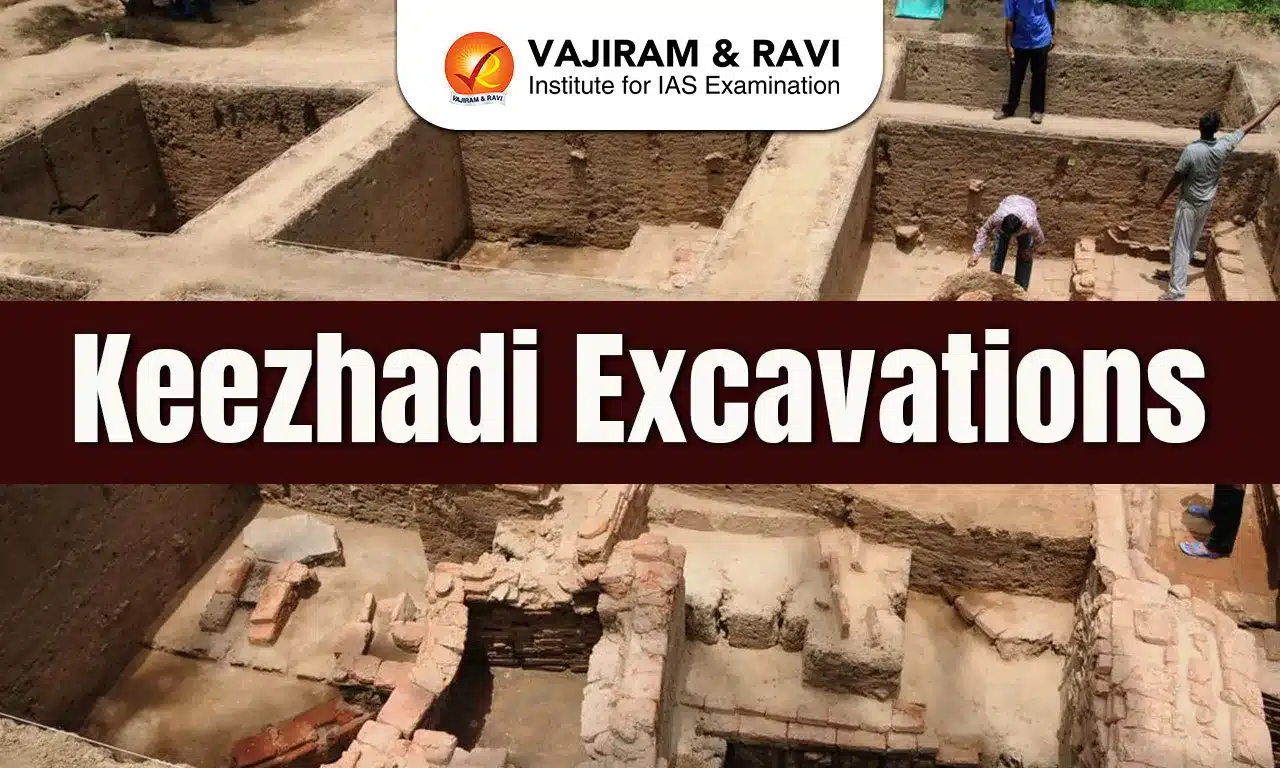
Keezhadi Excavations

Keezhadi Excavations

Keezhadi Excavations Latest News

The Archaeological Survey of India (ASI) has asked Amarnath Ramakrishna, the archaeologist who led the Keezhadi excavations, to resubmit his excavation report after revisions.

About Keezhadi Excavation

  • The Keezhadi excavation site is located near Madurai in Tamil Nadu, along the Vaigai River.
  • It is a major urban Sangam-era settlement, estimated to date between the 5th century BCE and the 3rd century CE.
  • It represents one of the most significant archaeological findings in Tamil Nadu since the Adichanallur site.
  • Excavations reveal an urban, literate, and craft-oriented society, suggesting early urbanisation in South India independent of North Indian influences.

Sangam Period

  • The term ‘Sangam’ is derived from the Sanskrit word ‘Sangha’, meaning an assembly or association, and refers to Tamil literary academies under the Pandya kings.
  • Sangam literature provides vital insights into ancient Tamil society, covering aspects like governance, economy, trade, war, social life, and agriculture.
  • Key texts include:
    • Tolkappiyam (oldest Tamil grammar),
    • Pattupattu (Ten Idylls),
    • Ettutogai (Eight Anthologies),
    • Padinenkilkanakku (Eighteen Minor Works),
    • The three great epics (Silappadikaram, Manimekalai, and Civaka Cintamani).

Keezhadi Excavations FAQs

Q1: Where is Keezhadi located?
Ans: Keezhadi is an archaeological site near Sivaganga district in Tamil Nadu, situated on the banks of the Vaigai River.

Q2: What period does the Keezhadi excavation belong to?
Ans: The site dates back to the Sangam period (6th century BCE to 3rd century CE), revealing a highly urbanised civilisation.

Source: TH

Nagarahole Tiger Reserve

Nagarhole Tiger Reserve

Nagarhole Tiger Reserve Latest News

Members of 52 Jenu Kuruba tribal families inside the Nagarahole Tiger Reserve (NTR) in Ponnampet taluk of Kodagu district recently put up a board in their haadi (hamlet) claiming land rights under the Forest Rights Act (FRA).

About Nagarhole Tiger Reserve

  •  It is situated in the districts of Mysore and Kodagu in Karnataka.
  •  It is located at the tri-junction area of the States of Karnataka, Tamil Nadu, and Kerala.
  • Geographically, it is an “ecological confluence” of the Western and Eastern Ghats.
  • The reserve is named after a small river, ‘Nagarahole’ (literally a snake stream in Kannada), which meanders within the habitat before joining the river Kabini.
  • It is part of the larger Nilgiri Biosphere Reserve, which is recognized as a UNESCO World Heritage Site.
  • It is flanked by the Bandipur Tiger Reserve on its southeastern side and the Wayanad Wildlife Sanctuary of Kerala on the southwest. 
  • Rivers: It is surrounded by the River Kabini in its north and River Moyar in its south.
  • Vegetation
    • The dry eastern limits of the reserve has dry deciduous forests. 
    • Towards the west, with the increase in rainfall, the vegetation changes to tropical moist and semi-evergreen forests. 
    • The forests are interspersed with swampy fallows called ‘hadlu’, which are dominated by grasses and sedges, favoured by wild herbivores.
  • Flora: It includes rosewoodIndian kino tree, sandalwood, Indian laurel, clumping bamboo, giant clumping bamboo, etc.
  • Fauna:
    • It is a shelter for the largest population of wild Asian elephants in South Asia. 
    • It comprises other mammals such as Bengal tiger, gaur, sloth bear, golden jackal, dhole, four-horned antelope, etc.

Nagarhole Tiger Reserve FAQs

Q1: Nagarhole Tiger Reserve is located in which Indian state?

Ans: Nagarhole Tiger Reserve is located in which Indian state?

Q2: Nagarhole Tiger Reserve is part of which larger biosphere reserve?

Ans: Nilgiri Biosphere Reserve

Q3: What is the significance of the location of Nagarhole Tiger Reserve?

Ans: It is at the ecological confluence of the Western and Eastern Ghats.

SourceTOI

Tiangong Space Station

Tiangong Space Station

Tiangong Space Station Latest News

Chinese scientists have discovered a new species of bacteria named Niallia tiangongensis on board the Tiangong Space Station. 

About Tiangong Space Station

  • The Tiangong Space Station, translating to ‘Sky Palace’, is a Chinese-owned and operated permanently crewed space station in Low Earth Orbit (LEO).
  • It represents the third and final step of China’s Manned Space Program. 
  • The first module of the space station was launched in April 2021, following two precursor missions, Tiangong-1 and Tiangong-2. 
  • The station consists of a core module known as Tianhe, which connects two science modules, Wentian and Mengtian, as well as a planned space telescope module, Xuntian.
  • Tiangong is much smaller than the International Space Station (ISS), with only three modules compared with 16 modules on the ISS. 
  • Tiangong is also considerably lighter than the ISS, which weighs about 400 tons (450 metric tons); the Chinese station is about 20% as massive.
  • It can accommodate up to three astronauts at a time for six-month stays. It can also support six astronauts at a time during crew handovers.
  • The aims of the Tiangong Space Station are to:
    • Build a long-term, reliable space station in orbit.
    • Guarantee the long-term health and safety of stationed astronauts.
    • Provide conditions for scientific and technological experiments in space.
  • The station serves as an in-orbit laboratory with 23 enclosed experiment racks, each covering a different proposed experiment in the fields of:
    • Space life sciences and biotechnology
    • Microgravity fluid physics and combustion
    • Material science in space
    • Fundamental physics in microgravity
  • The space station also features platforms for exposed and unpressurised external experiments.

Tiangong Space Station FAQs

Q1: What is the name of the core module of the Tiangong Space Station?

Ans: Tianhe

Q2: In which year was the first module of the Tiangong Space Station launched?

Ans: 2021

Q3: How many astronauts can Tiangong accommodate during crew handovers?

Ans: 6

SourceNDTV

Self Reliant India (SRI) Fund Scheme

Self Reliant India (SRI) Fund

Self Reliant India (SRI) Fund Scheme Latest News

The Self Reliant India (SRI) Fund scheme, which supports MSMEs with equity infusion, has invested around Rs 10,979 crore in 577 MSMEs as of March 2025 since its launch.

About Self Reliant India (SRI) Fund Scheme

  • The Self Reliant India (SRI) Fund has been set up to infuse Rs. 50,000 crore as equity funding in those MSMEs which have the potential and viability to grow and become large units. 
  • Under this fund of Rs. 50,000 crore, there is a provision of Rs. 10,000 Crore from the Government of India and Rs. 40,000 Crore through Private Equity/Venture Capital funds.
  • SRI fund operates through a mother-fund and daughter-fund structure for equity or quasi-equity investments. 
  • The SRI Fund is being implemented by NSIC Venture Capital Fund Limited (NVCFL), which is an Alternative Investment Fund (AIF) of Category II registered with SEBI. 
  • SRI fund is oriented to provide the funding support through NVCFL to the Daughter Funds for onward provision to MSMEs as growth capital, in the form of equity or quasi-equityfor the following:
    • Enhancing equity/equity-like financing to MSMEs and listing of MSMEs on stock exchanges.
    • Supporting faster growth of MSME businesses and thereby ignite the economy and create employment opportunities.
    • Supporting enterprises which have the potential to graduate beyond the MASME bracket and become National/International Champions.
    • Supporting MSSMEs, which help make India self-reliant by producing relevant technologies, goods, and services.
  • The Daughter Funds shall invest at least 5 times the amount of capital contribution received from SRI Fund (net of fees and expenses) in MSMEs, covered under the Micro, Small & Medium Enterprises Development Act, 2006.

Self Reliant India (SRI) Fund Scheme FAQs

Q1: What is the total corpus of the Self Reliant India (SRI) Fund?

Ans: ₹50,000 crore

Q2: The SRI Fund is implemented by which organization?

Ans: NSIC Venture Capital Fund Limited (NVCFL)

Q3: The SRI Fund follows which investment model?

Ans: Mother-Fund and Daughter-Fund Structure.

SourceFE

Autism Spectrum Disorder (ASD)

Autism Spectrum Disorder (ASD)

Autism Spectrum Disorder (ASD) Latest News

According to the CDC (USA), the prevalence of autism has risen from 1 in 36 children (2020) to 1 in 31 (2022).

About Autism Spectrum Disorder (ASD)

  • Autism Spectrum Disorder (ASD) is a neurodevelopmental condition caused by differences in brain development, affecting communicationsocial interactionbehaviour, and learning patterns.
  • Symptoms of ASD typically appear before the age of 3 years, though diagnosis is often delayed, particularly in low-awareness settings.
  • People with ASD may display repetitive behavioursnarrow interests, and may have unusual learning styles or motor skills.

Autism Spectrum Disorder (ASD) Causes

  • ASD is not caused by a single factor. It results from a complex interaction of genetic and environmental influences.
  • Genetics plays a strong role, with studies showing heritability estimates of up to 91% (Tick et al., JAMA, 2016).
  • Environmental contributors such as advanced parental ageprenatal exposure to air pollutants, and maternal health are being studied, but no single environmental toxin has been conclusively proven to cause autism.
  • Vaccines do not cause autism. This claim stems from a discredited study, and continued misinformation can lead to dangerous vaccine hesitancy.

Autism Spectrum Disorder (ASD) FAQs

Q1: What is Autism Spectrum Disorder (ASD)?
Ans: ASD is a neurodevelopmental disorder characterised by challenges in social interaction, communication, and repetitive behaviours, manifesting in early childhood.

Q2: Is ASD a single condition?
Ans: No, ASD is a spectrum that includes a range of conditions such as Asperger syndrome, childhood disintegrative disorder, and pervasive developmental disorder.

Q3: How is ASD diagnosed?
Ans: Diagnosis is based on behavioural assessments, developmental history, and screening tools, usually by pediatric neurologists or psychologists.

Source: TH

Why Population Growth Alone Can’t Save Asiatic Lions in Gujarat

Asiatic Lion Conservation

Asiatic Lion Conservation Latest News

  • The latest lion population estimate in Gujarat shows 891 Asiatic lions, marking a 32% increase since 2020. Their geographical range has expanded by 17%, now covering 35,000 sq km across 58 talukas in 11 districts.

image4.webp

  • However, experts stress that while the numbers are encouraging, sustaining this success will require continued and enhanced conservation measures beyond mere population counts.

The Recovery of the Asiatic Lion: A Journey in Phases

  • From Near Extinction to Steady Growth
    • In the 1960s, Asiatic lions were fewer than 200, confined to the Gir forest, which was given special protection. 
    • The population grew slowly and remained under 300 until 1995, when lions began moving beyond forest boundaries.
  • Doubling the Range, Modest Gains (1990–2005)
    • Between 1990 and 2005, the lion’s habitat range expanded from 6,600 sq km to 13,000 sq km, yet population growth was limited — from 284 to 359 (a 26% rise).
  • A Surge in Numbers (2005–2020)
    • The next 15 years saw the range double again to 30,000 sq km, with already settled satellite populations contributing to a significant 88% rise in numbers — from 359 to 674.
  • Recent Trends and Methodological Gaps
    • The latest estimates confirm the growth pattern and mark only the second time (after 2015) that the population growth outpaced range expansion. 
    • However, concerns remain, as the absence of standard error margins in the data makes the estimates scientifically less robust.

Asiatic Lions: Expanding Territory, Limited Habitat

  • New Territories, Same Challenges
    • In the past five years, Asiatic lions have moved into three new regions — Barda Wildlife Sanctuary, Jetpur, and Babra-Jasdan. 
    • Their spread across 358 locations and the rise to nearly 900 individuals led to the IUCN upgrading their status from “critically endangered” to “endangered” in 2008.
  • Disproportionate Growth vs. Range Expansion
    • While the lion’s range expanded by 430% since 1990, their population rose by only 214%. 
    • This disparity reveals that area expansion hasn’t translated proportionally into population growth.
  • Shortage of Protected Wilderness
    • The Saurashtra peninsula lacks sufficient protected areas beyond Gir National Park and a few small sanctuaries like Pania, Girnar, Mitiyala, and Berda. 
    • As these reach carrying capacity, lions increasingly wander into wastelands, farmlands, and plantations, relying on fragmented patches of natural vegetation.
  • Lions Outside Forests
    • Only 56% of Gujarat’s lions were found in forested zones. 
    • In 2020, data showed a stark contrast in population density — 15.2 per 100 sq km in forests vs. 1.65 in non-forested areas — highlighting the unsuitability of much of the expanded range for sustainable habitation.

Living on the Edge: Challenges of Lions in Human-Dominated Landscapes

  • Non-Forest Habitats Pose Risks
    • Lions increasingly inhabiting areas near human settlements face unsafe conditions. 
    • While officially unreported, many lion deaths occur from electrocution, drowning in wells, or being shot in self-defence, indicating retaliatory killings.
  • Pride and Proximity
    • Unlike leopards, lions are widely tolerated in Gujarat, considered symbols of pride. 
    • Their frequent rescues and medical interventions make them accustomed to human presence — but this over-familiarity can turn dangerous.
    • Experts warn that many lions in human-dominated habitats show aggression. 
    • Unprovoked attacks have been reported, making the situation ecologically unstable and socially fragile.
  • Limits of Social Carrying Capacity
    • Co-existence is viable only when humans and lions share time or space—not both. Frequent encounters in shared areas raise tensions and risks.
  • Temporary Peace and Precarious Diet
    • Current peace is maintained through awareness campaigns, media involvement, compensation for livestock loss, and availability of wild prey like boars. 
    • However, many lions also feed on dumped livestock carcasses, which increases disease risk due to contamination and contact with village dogs.

Future of the Pride: Relocation and Habitat Challenges for Asiatic Lions

  • Delay in Supreme Court-Directed Relocation
    • Despite a 2013 SC order mandating the relocation of Asiatic lions from Gujarat to Madhya Pradesh within six months, the move has been delayed for over 12 years. 
    • Gujarat had assured compliance seven years ago, but the transfer remains unfulfilled.
  • Project Lion and New Site Identification
    • Launched in August 2020, Project Lion initially proposed seven sites across Madhya Pradesh and Rajasthan for lion relocation. 
    • However, by July 2022, the government restricted assessments to sites within Gujarat only.
  • Natural Dispersal vs. Habitat Constraints
    • Lions have naturally expanded to Barda Wildlife Sanctuary, one of the proposed sites, but its limited size (<200 sq km) can support only a small number of lions, insufficient for long-term conservation.
  • Urgent Need for Safe, Suitable Habitats
    • With ambitions to double the lion population to 2,000, experts stress the need for larger, quality forest habitats away from human settlements.

Asiatic Lion Conservation FAQs

Q1. Why are lion numbers in Gujarat rising?

Ans. Government conservation efforts and natural dispersal helped increase the Asiatic lion population to 891 in Gujarat.

Q2. Why is population growth alone insufficient?

Ans. Lion range expanded faster than numbers, stressing habitats and increasing human-animal conflict in non-forested areas.

Q3. What are the relocation delays?

Ans. Despite a 2013 SC order, Gujarat hasn't shifted lions to MP, citing habitat reassessment within its borders.

Q4. What risks do lions face in human areas?

Ans. Lions near villages risk electrocution, attacks, and disease from feeding on dumped carcasses or livestock.

Q5. What’s needed for long-term lion survival?

Ans. Creating new, protected habitats outside Gujarat is essential to reduce conflict and prevent epidemics in lion populations.

Source: IE | IE

Why India’s Urban Forests Are Crucial for a Healthy and Sustainable Future

Urban Forests in India

Urban Forests in India Latest News

  • The Telangana government's decision to allocate 400 acres of Kancha Gachibowli, one of Hyderabad's last urban forests, for industrial development sparked protests, with officials claiming the land belonged to the state and accusing real estate interests of misleading students. 
  • However, the Supreme Court intervened after 100 acres of trees were felled, criticizing the government and exposing the fragility of urban forests amid unsustainable urban development.

Why Urban Forests Matter

  • Vital for Public Health and Environment
    • Urban forests like Kancha Gachibowli (Hyderabad), Aarey (Mumbai), and the Ridge (Delhi) play a critical role in maintaining healthy urban ecosystems. 
    • They help combat pollution, reduce urban heat islands, and manage stormwater, erosion, and flooding. 
    • By sequestering carbon and absorbing pollutants, they act as natural air purifiers.
  • Legal and Civic Attention
    • Repeated interventions by courts and environmental bodies in cities like Bhopal and Allahabad highlight the increasing threat to urban forests and the need for stronger legal protection.
  • Response to Pollution Crisis
    • Alarming air quality levels, like Delhi's AQI of 494 in November 2024, underline the urgency of preserving urban green cover. 
    • With PM 2.5 and PM 10 pollutants largely from vehicles and construction, urban forests act as effective buffers, with one hectare capable of removing about one ton of air pollutants annually.
  • Biodiversity and Recreation Hubs
    • Urban forests support endangered wildlife and offer city dwellers essential spaces for rest, recreation, and nature connection—qualities increasingly scarce in fast-paced urban life.

The Importance of Judicial Interventions in Protecting Urban Forests

  • Policy and Mission Backing
    • Urban forests are supported by key national frameworks such as the National Forest Policy (1988) and the National Mission for Green India (2014), which stress the importance of afforestation and social forestry. 
    • The Smart Cities Mission and AMRUT (2015) also incorporate ecological goals within urban development.
  • Expanding Legal Definitions and Protection
    • The Godavarman case (1996) was a landmark judgment that expanded the definition of forests to include urban green spaces. 
    • It led to the 2004 Supreme Court order requiring all states to map and monitor their forest areas, helping to build a national conservation framework.
  • Direct Action to Prevent Destruction
    • Judicial bodies have intervened directly to halt or regulate urban deforestation:
      • In 2015, the Delhi High Court ordered the protection of the Delhi Ridge (Aravalli leopard corridor).
      • In 2020, the Supreme Court stayed tree cutting in Aarey Forest, Mumbai, following citizens' protests.
      • In 2024, the Rajasthan High Court took suo motu cognisance of tree felling in Baran district, responding to public outcry.
  • Reinforcing Constitutional Mandates
    • Judicial interventions also align with: 
      • Article 21 (Right to Life), which includes the right to a healthy environment, and 
      • Articles 48A and 51A(g), which promote environmental protection and citizen responsibility toward nature.

Nagar Van Yojana: Greening India's Cities

  • Launched in 2020 by the Ministry of Environment, Forest and Climate Change (MoEF&CC), the Nagar Van Yojana aims to create and expand forested areas within urban spaces to improve ecological balance and quality of urban life.

Ambitious Target

  • The scheme sets a goal of developing 1,000 urban forests by 2027, promoting environmental sustainability and biodiversity within city landscapes.

Encouraging Outcomes

  • As per the India State of Forest Report 2023, the scheme has already contributed to an increase of 1,445.81 km² in tree and forest cover across urban India.

National Commitment to Conservation

  • On World Wildlife Day (March 3, 2025), PM Modi emphasized the importance of wildlife and biodiversity, reinforcing the relevance of initiatives like the Nagar Van Yojana in safeguarding urban ecological health.

The Growing Threat to Urban Forest

  • Urbanisation vs. Environment
    • India’s rapid urban expansion often overlooks environmental sustainability, putting immense pressure on urban forests and natural ecosystems.
  • Impact on Public Well-being
    • The degradation of urban forests poses serious risks to biomedical, social, and cultural well-being, affecting air quality, mental health, and community life.
  • Citizens’ Role is Crucial
    • Protecting urban forests requires active involvement from citizens and civil society, emphasizing collective responsibility in environmental stewardship.
  • A Warning Against Unchecked Urban Sprawl
    • Concrete development must not be allowed to overrun urban green spaces. 
    • Protecting these "green lungs" is essential for ensuring livable and resilient cities.

Urban Forests in India FAQs

Q1. Why do urban forests matter?

Ans. They purify air, cool cities, prevent flooding, and support wildlife in India’s rapidly growing urban areas.

Q2. What is Nagar Van Yojana?

Ans. A 2020 scheme aiming to develop 1,000 urban forests by 2027 to enhance ecological balance and green cover.

Q3. How do courts support urban forests?

Ans. Judicial actions like the Godavarman case and Aarey Forest stay orders help protect urban green spaces.

Q4. What threats do urban forests face?

Ans. Rapid urbanisation, weak enforcement, and encroachments endanger forests like Kancha Gachibowli and others nationwide.

Q5. What can citizens do?

Ans. Active civic engagement, protests, and awareness are key to preserving India’s shrinking urban green lungs.

Source: TH

Supreme Court Stays ED Probe into TASMAC

Federalism and Overreach of Central Agencies

Federalism and Overreach of Central Agencies Latest News

  • The Supreme Court of India has stayed the Enforcement Directorate’s (EDongoing probe into alleged financial irregularities within the Tamil Nadu State Marketing Corporation (TASMAC), the state-run liquor monopoly.
  • This is a significant development with implications for federalism, corruption investigations, and political rivalry.

SC’s Intervention

  • Stay on ED proceedings:
    • A two-judge bench led by Chief Justice of India B R Gavai and Justice A G Masih stayed the ED's money laundering investigation against TASMAC.
    • The court observed that ED’s actions were “violating the federal structure” and that the agency was “crossing all limits.”
  • Key judicial observations:
    • CJI questioned the very premise of lodging a criminal offence against a corporation.
    • Criticism was directed at ED for overstepping its jurisdiction into state matters.

Background of TASMAC and ED Investigations

  • TASMAC overview:
    • TASMAC operates ~7,000 liquor outlets in Tamil Nadu.
    • Functions as a state monopoly in alcohol retail.
  • Initiation of probe:
    • ED probe based on 41 FIRs by Tamil Nadu Vigilance Department (from 2014 onward).
    • Allegations included corruption under the Prevention of Corruption Act, 1988.
    • ED actions: Conducted searches at 20 locations including TASMAC HQ in Chennai, under the Prevention of Money Laundering Act, 2002 (PMLA).

Allegations and Findings

  • Nature of allegations:
    • Overcharging at outlets (Rs 10–30 per bottle).
    • Kickbacks to officials by distillers for supply orders.
    • Bribery in staff transfers and postings.
  • Findings from ED searches:
    • Incriminating data on transfer postings, transport tenders, bar licence tenders, and supplier favoritism.
    • Identification of collusion involving TASMAC staff, distilleries, bottling companies, and associates.
  • Tender manipulations:
    • Mismatches in KYC and demand draft details.
    • Single-bid tenders and allocation to applicants lacking GST/PAN/KYC compliance.

Role of Distilleries and Bottling Companies

  • Financial fraud mechanism:
    • Some distilleries and bottling companies allegedly involved in Rs 1,000 crore fraud.
    • Fabrication of bogus purchases and inflated expenses.
  • Illicit payment network:
    • Distilleries routed funds through bottling companies.
    • Excess payments withdrawn in cash and used for kickbacks.
  • Key techniques used:
    • Manipulated financial records.
    • Concealed cash flows.
    • Systematic evasion to generate unaccounted money. 

Political and Federal Implications

  • Centre-state tensions:
    • DMK-led Tamil Nadu government alleges misuse of central agencies by the BJP-led Union government.
    • ED probe seen as politically motivated ahead of upcoming Assembly elections.
  • Federal structure debate:
    • SC's remarks raise important questions on the autonomy of states.
    • Reiterates concerns over the overreach of central agencies into state jurisdictions.
  • Broader political context: TN Chief Minister was critical of current Union government over issues like Hindi imposition and proposed constituency delimitation.

Conclusion

  • The Supreme Court's intervention may catalyze a redefinition of boundaries between central investigative agencies and state autonomy, reinforcing the principle of cooperative federalism
  • Going forward, ensuring transparency in public sector undertakings like TASMAC will be crucial to restoring public trust and preventing the misuse of institutional powers for political ends.

Federalism and Overreach of Central Agencies FAQs

Q1. Discuss the constitutional implications of the Supreme Court's criticism of the ED's actions in the TASMAC case.

Ans. The Supreme Court's observation that the ED is "violating the federal structure" highlights concerns of institutional overreach by central agencies into the domain of state governance, undermining cooperative federalism.

Q2. What legal provisions are central to the ED's investigation into TASMAC, and how do they intersect with corruption allegations?

Ans. The ED's probe is based on the Prevention of Money Laundering Act, 2002 (PMLA), arising from FIRs under the Prevention of Corruption Act, 1988, linking corruption to laundering of illicit financial gains.

Q3. Explain how the TASMAC case illustrates the challenges of ensuring transparency in public sector tenders.

Ans. The case reveals irregularities like single-bid awards, KYC mismatches, and fictitious documentation, pointing to systemic flaws in tendering and accountability in public sector enterprises.

Q4. Evaluate the political dimensions of ED investigations in states governed by opposition parties, using the TASMAC case as an example.

Ans. The ED probe against TASMAC, amid political rivalry between DMK and BJP, raises questions of selective targeting and politicisation of investigative agencies in a federal democracy.

Q5. What role did distilleries and bottling companies play in the alleged financial fraud involving TASMAC?

Ans. Distilleries and bottling companies allegedly colluded to inflate expenses and create fake transactions to generate over ₹1,000 crore in unaccounted cash used for kickbacks and illicit benefits.

Source: IE | IE

Enquire Now