Caliphaea sinuofurcata

Caliphaea sinuofurcata

Caliphaea sinuofurcata Latest News

Scientists have identified a new species of damselfly, Caliphaea Sinuofurcata, from Arunachal Pradesh.

About Caliphaea sinuofurcata

  • It is a new species of damselfly.
  • It was discovered during biodiversity surveys in the Upper Siang and Lower Dibang Valley districts of Arunachal Pradesh.
  • Proposed to be called the “Bearded Bronzeback,” this stunning insect marks only the second species of the genus Caliphaea recorded in India.
  • While the genus Caliphaea is known from parts of Southeast Asia and China, only one species — C. confusa — was previously recorded in India over 165 years ago.

Features of Caliphaea sinuofurcata

  • The species is visually captivating with the presence of dense, black, beard-like bristlesaround the mouthparts of both males and females. 
  • These hair-like setae on the labium and labrum inspired the proposed English name — the Bearded Bronzeback. 
  • The name sinuofurcata — from the Latin words sinuosus (wavy or sinuous) and furcatus (forked) — refers to the twisted, bifurcated shape of the paraproct, tail structure used for mating and species recognition.
  • The damselfly gleams in metallic copper-green hues, with slender wings faintly tinted in brown, and a body adorned with subtle yellow and olive markings.
  • It inhabits small, rocky seasonal streams in broadleaf evergreen forests at elevations around 1200 to 1300 meters above sea level.
  • Individuals were observed flying low and perching on vegetation near the water, in dappled sunlight. 

Caliphaea sinuofurcata FAQs

Q1: What is Caliphaea sinuofurcata?

Ans: It is a new species of damselfly.

Q2: Caliphaea sinuofurcata was found in which Indian state?

Ans: Arunachal Pradesh

Q3: What is the proposed common name for Caliphaea sinuofurcata?

Ans: Bearded Bronzeback

SourceNET

Bharat Forecasting System (BFS)

Bharat Forecasting System (BFS)

Bharat Forecasting System Latest News

The India Meteorological Department (IMD) will soon adopt the Bharat Forecast System (BFS), which offers the highest resolution among weather models. 

About Bharat Forecasting System 

  • It is an indigenously built advanced weather forecasting system.
  • It was developed by the Pune-based Indian Institute of Tropical Meteorology (IITM).
  • It will provide forecasts with a 6 km resolution — the highest in the world — that would allow forecasters to predict small-scale weather features more accurately.
  • This resolution is advanced in comparison to the previous 12-km Global Forecast System (GFS) used in India so far. 
  • This finer resolution will help in more precise predictions of localised weather events like heavy rainfall and cyclones.
  • It is powered by the Arka supercomputer. This supercomputer has 11.77 petaflops (a unit to measure computer processing speed) and 33 petabytes (a petabyte is 1,000 terabytes (TB)) of storage.
    • The supercomputer is located at IITM, Pune, and will massively reduce forecasting time compared to the older Pratyush supercomputer.
  • Data from a network of 40 Doppler Weather Radars from across the countrywill be used to run the BFS model that would enable the weather office to issue more localised forecasts as well as nowcasts — weather forecasts for the next two hours.
    • Gradually, the number of Doppler radars will increase to 100, which would allow the weather office to issue nowcasts across the country.
  • The BFS can provide 6 km resolution forecasts for the tropical region that falls between 30 degrees South and 30 degrees North Latitudes. The Indian mainland extends between 8.4 degrees north and 37.6 degrees north latitudes.
  • BFS is primarily a numerical weather prediction (NWP) model, but recently integrated AI and machine learning (ML) to enhance its working.
  • Unlike most of the global models, BFS data will remain accessible to researchers worldwide, fostering collaborative advancements in meteorological science.

Bharat Forecasting System FAQs

Q1: What is the Bharat Forecasting System (BFS)?

Ans: An advanced weather forecasting system.

Q2: Which institution developed the Bharat Forecasting System?

Ans: Indian Institute of Tropical Meteorology (IITM), Pune

Q3: What supercomputer powers the Bharat Forecasting System?

Ans: It is powered by the Arka supercomputer. 

SourceIE

Schistura densiclava

Schistura densiclava

Schistura densiclava Latest News

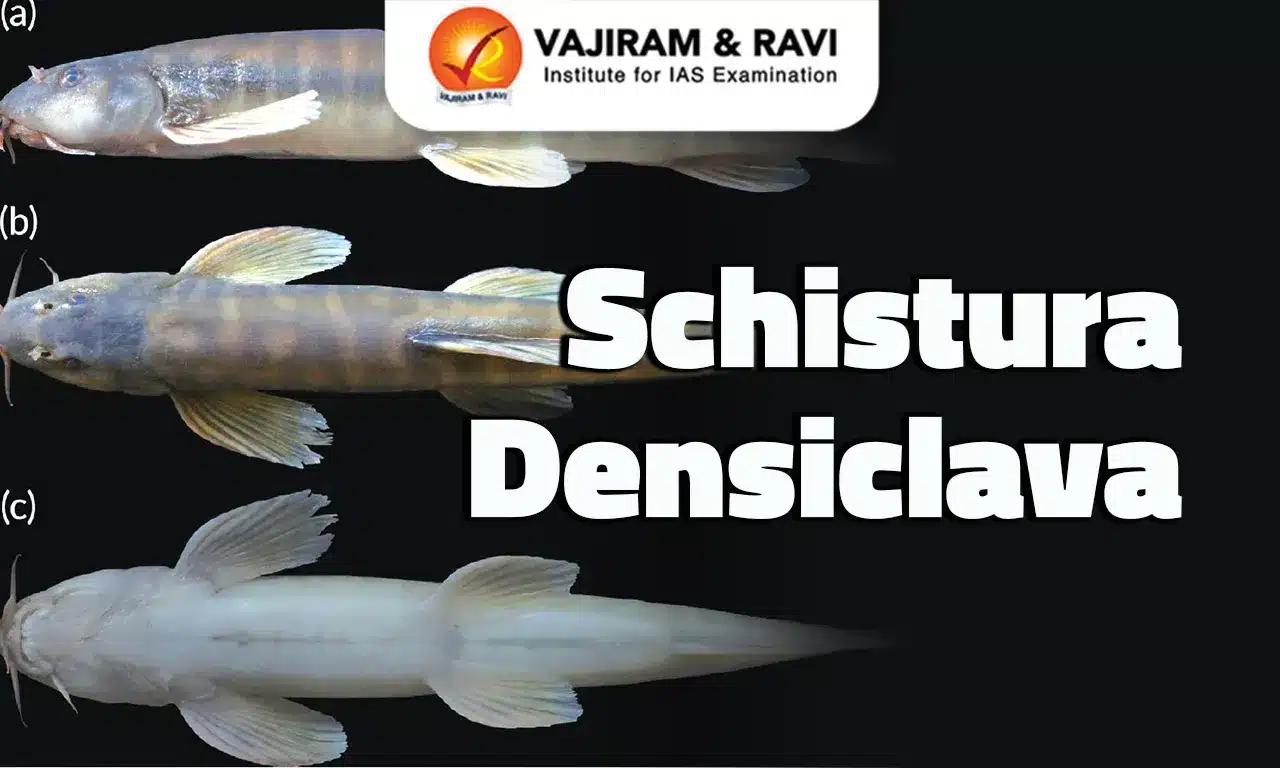
A new species of cave-dwelling loach, named Schistura densiclava, has been discovered from the Krem Mawjymbuin cave in the East Khasi Hills district of Meghalaya.

About Schistura densiclava

  • Schistura densiclava belongs to the family Nemacheilidae, a group of bottom-dwelling freshwater fishes known for adapting to benthic stream habitats.
  • It is classified as a troglophile species, meaning it is adapted to live in cave environments but can also survive in surface (epigean) waters.
  • Unlike most cave-dwelling species that lose pigmentation and eyesightS. densiclavaretains both pigment and functional eyes, allowing it to adapt across environments.

Habitat Characteristics

  • The fish was found in a cool, fast-flowing stream about 60 meters inside the Krem Mawjymbuin cave, where the temperature was 18°C and oxygen levels were low.
  • The cave’s total surveyed length is approximately 1.6 km, and it is located at an altitude of 206 meters.
  • The fish’s habitat is subterranean, indicating specialized adaptations to low-light and low-oxygen environments.

Morphological Features

  • The body is pale yellow-green with 14–20 greyish black or faint black vertical bars.
  • thick dark stripe near the dorsal fin inspired the name "densiclava", which translates to "thick stripe" in Latin.
  • Sexual dimorphism is noted:
    • Males are slimmer, with irregular patterns and puffier cheeks.
    • Females are sturdier, with more consistent markings.

Endemism and Conservation Insight

  • Genetic testing confirmed that Schistura densiclava is a distinct, previously unrecorded species.
  • Its distribution is restricted to a single cave, indicating a high degree of endemism.
  • It becomes Meghalaya's sixth known cave-dwelling fish species, highlighting the state’s rich subterranean biodiversity.

Schistura densiclava FAQs

Q1: What is Schistura densiclava?
Ans:Schistura densiclava is a newly recorded species of freshwater stone loach fish found in the rivers of Meghalaya.

Q2: Where was Schistura densiclava recently identified?
Ans: It was recently recorded in the Mawjymbuin cave in the East Khasi Hills district in Meghalaya.

Q3: Which family does Schistura densiclava belong to?
Ans: It belongs to the family Nemacheilidae, commonly known as stone loaches.

Source: TH

Mosura fentoni

Mosura fentoni

Mosura fentoni Latest News

Scientists recently identified a new extinct species, Mosura fentoni, an early marine predator from around 506 million years ago during the Cambrian period.

About Mosura fentoni

  • Mosura fentoni is a newly discovered Cambrian marine organism found in the Burgess Shale, a globally significant fossil site in British Columbia, Canada.
  • It belongs to the group Radiodonta, which are extinct stem-group arthropods, distant relatives of modern insects, spiders, and crustaceans.
  • Despite being a small-sized species (ranging from 1.5 to 6 cm), M. fentoni displays highly specialised anatomical adaptations.

Unique Morphological Features

  • The body of Mosura fentoni is unusually elongated, with a division into three distinct zones comprising a total of 26 segments:
    • short neck region that supports the head,
    • mesotrunk consisting of six paddle-shaped flaps that function as propulsive organs for swimming,
    • posterotrunk containing up to 16 segments dominated by rows of fine gills.
  • The posterotrunk is proposed to be a specialised breathing tagma, drawing parallels to the oxygen-collecting tails of modern horseshoe crabs, suggesting a highly evolved respiratory mechanism in this ancient organism.

Geological and Paleontological Context

  • The fossil belongs to the Cambrian period, which began around 540 million years ago, following the Precambrian-Cambrian boundary (600–540 Ma).
  • This period witnessed the Cambrian Explosion, also known as the Cambrian Big Bang, marked by the sudden emergence of complex animal life with hard body parts.
  • The transition from soft-bodied Ediacaran fauna to skeleton-bearing Cambrian organisms represents a major biotic shift in Earth’s history.
  • Changes in the carbon (C) and strontium (Sr) isotopic composition of rocks during this period aid in the stratigraphic correlation of Proterozoic-Cambrian boundaries.

Mosura fentoni FAQs

Q1: What is Mosura fentoni?
Ans:Mosura fentoni is a newly discovered extinct marine species from the Cambrian period, dating back around 506 million years, known to be an early marine predator.

Q2: Where was Mosura fentoni discovered ?
Ans: It was found in the Burgess Shale of British Columbia, Canada.

Q3: Which group does Mosura fentoni belong to?
Ans: It belongs to the Radiodonta, a group of extinct stem-group arthropods, which are distant evolutionary relatives of modern insects, crustaceans, and arachnids.

Source: TH

Maldives

Maldives

Maldives Latest News

Maldivian Foreign Minister is on a three-day official visit to India, accompanied by a high-level delegation, marking his third visit to India in 2025.

Key Facts about the Maldives

  • Capital: Male
  • Official language: Dhivehi (an Indo-European language); Arabic, Hindi, and English are also spoken.
  • ReligionIslam is the state religion and plays a central role in national governance.
  • Economy: Heavily dependent on tourism, along with fisheries and foreign aid.
  • Constitution: The 2008 Constitution defines a presidential system with direct elections for a maximum of two five-year terms.
  • The Maldives has a tropical hot and humid climate, influenced by:
    • Northeast monsoon (dry season: November to March), and
    • Southwest monsoon (rainy season: June to August).

Geographical Features

  • It is home to the 7th largest coral reef system in the world, contributing 3.14% of global reef area.
  • The country has no rivers or streams and the average elevation is under 2 meters, making it highly vulnerable to sea-level rise.
  • Barrier reefs provide natural protection against monsoon-related erosion and storm surges.
  • The Maldives is an archipelagic state consisting of about 1,200 coral islands grouped in 26 atolls, located in the north-central Indian Ocean.
  • It is strategically positioned astride major global sea lanes, making it vital for maritime trade and security in the IOR.
  • The country lies south-southwest of India, separated from Lakshadweep by the Eight Degree Channel, a crucial sea route for India’s maritime movement.

Maldives FAQs

Q1: What is the geographical location of the Maldives?
Ans: The Maldives is an island nation in the Indian Ocean, southwest of India and Sri Lanka.

Q2: Why is the Maldives strategically important for India?
Ans: Due to its location near major sea lanes and proximity to India, it plays a key role in India’s maritime security and SAGAR vision.

Q3: What is the capital of the Maldives?
Ans: The capital of the Maldives is Malé.

Source: IE

Coastline Paradox

Coastline Paradox

Coastline Paradox Latest News

The coastline paradox reveals more than a peculiar measurement challenge: it underscores how science evolves with better tools.

Why in the News?

  • In December 2024, the Union Ministry of Home Affairs made an important announcement as part of its 2023-2024 annual report. 
  • It said the length of India’s coastline had increased from 7,516.6 km to 11,098.8 km, and that the length is also currently under review.
  • The 7,516.6 km figure was first recorded in the 1970s based on measurement techniques available at the time. 
  • The new revised figure wasn’t prompted by any territorial expansion through new land/island annexation or geological upheaval, like tectonic activity stretching the shores.
  • The root of the discrepancy lies in geometry, in a problem called the coastline paradox. 

About Coastline Paradox

  • The British mathematician and physicist Lewis Fry Richardson first identified the coastline paradox in the early 1950s. 
  • His Polish-French peer Benoît Mandelbrot examined the problem mathematically in 1967 and also popularised it.
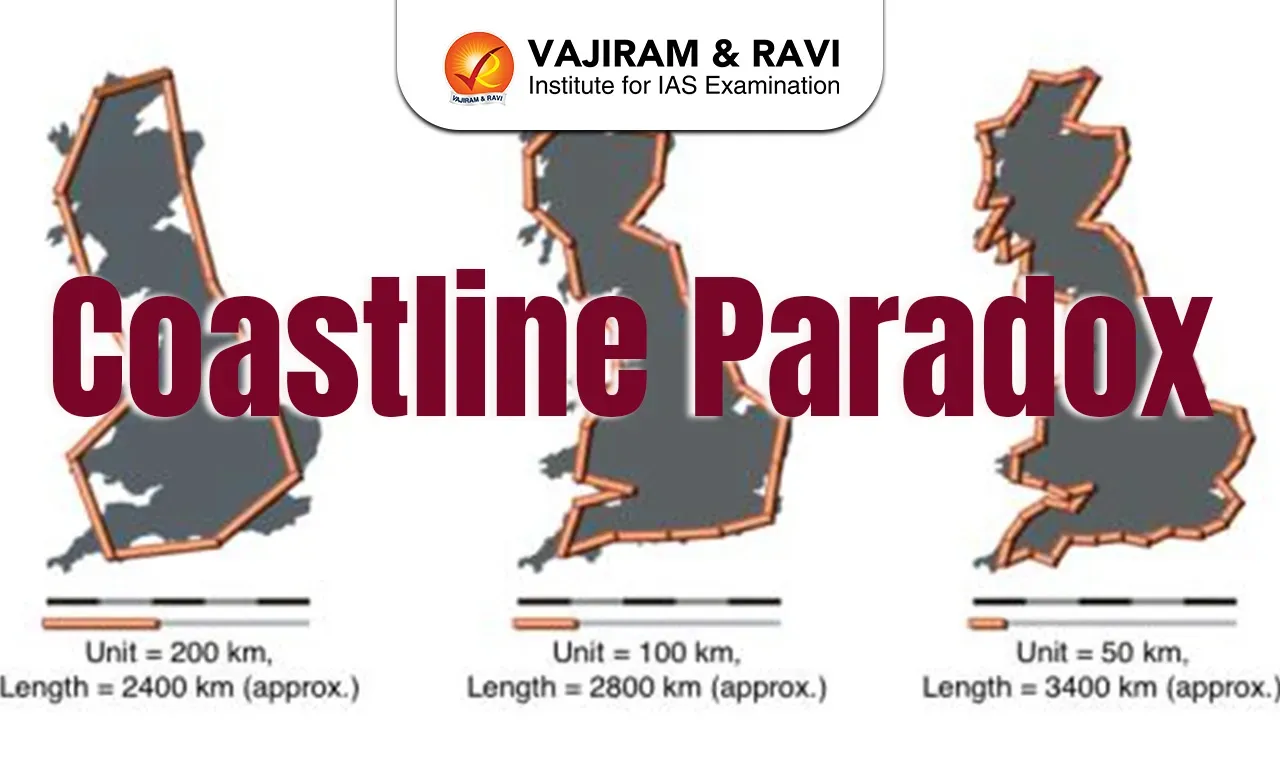
  • The coastline paradox is a problem that comes from how you measure a coastline and that the length actually gets longer the more carefully you measure it. 
  • Meaning that the coastline of a landmass actually does not have a well-defined length but more of a fractal dimension.
  • At the center of the coastline paradox is the observation that as the scale of measurement becomes smaller and more detailed, the measured length of the coastline increases. 
  • This is because smaller scales can capture more of the coastline’s intricate contours and jagged edges, which are overlooked at larger scales.
  • The coastline paradox occurs because coasts are not straight lines, and this makes them difficult, or impossible, to measure definitively. 
  • For example, measuring a coastline with a 200-km-long ruler would smooth over most inlets and bends — but a 50-km ruler would detect them. 
  • At 1 km, the measurement will capture every estuary, tidal flat, and creek. 
  • So the more one refines the scale of the ruler, the longer the total coast becomes.
  • Hypotheticallyusing a measurement unit the size of a water molecule would result in a coastline length approaching infinity.
  • This dependence on scale underscores the inherent paradox: a finite piece of geography yielding a seemingly infinite measurement in cartography.

Coastline Paradox FAQs

Q1: Who discovered the coastline paradox?

Ans: The British mathematician and physicist Lewis Fry Richardson first identified the coastline paradox in the early 1950s. 

Q2: What does the Coastline Paradox demonstrate about measuring coastlines?

Ans: The measured length increases as the scale of measurement becomes smaller.

Q3: Why does measuring a coastline with a smaller ruler result in a longer measured length?

Ans: They capture more of the coastline’s intricate details.

SourceTH

SC Grants Conditional Bail in Free Speech Case: Ali Khan Mahmudabad & Operation Sindoor Controversy

Ali Khan Mahmudabad free speech case

Ali Khan Mahmudabad Free Speech Case Latest News

  • Recently, the Supreme Court granted interim bail to Ashoka University professor Ali Khan Mahmudabad, who was arrested in Haryana over social media posts related to Operation Sindoor—India’s military action against terrorist bases in Pakistan and PoK. 
  • However, the Court refused to halt the ongoing investigation. 
  • The case now depends on whether the SIT can prove that the professor’s posts justify the serious charges against him. 
  • More significantly, it raises a key constitutional question: can unpopular or seemingly unpatriotic social media posts be denied protection under Article 19(1)(a), which guarantees freedom of speech?

Criminal Charges Invoked Against Professor Mahmudabad

  • Professor Ali Khan Mahmudabad faces serious charges under the Bharatiya Nyaya Sanhita (BNS), 2023, following two FIRs.

Charges Under the First FIR

  • Section 152: Penalises acts endangering the sovereignty, unity, and integrity of India. This provision resembles the repealed sedition law under the IPC. (Punishment: Up to 7 years imprisonment)
  • Section 196(1)(b): Targets actions disturbing communal harmony and public tranquillity.
  • Section 197(1)(c): Covers imputations or assertions prejudicial to national integration.
  • Section 299: Criminalises deliberate and malicious acts intended to outrage religious feelings.

Charges Under the Second FIR

  • Section 79: Penalises acts, words, or gestures intended to insult the modesty of a woman.
  • Section 353: Covers statements that conduce to public mischief.
    • Both sections carry a maximum penalty of 3 years imprisonment.

Key Highlight

  • Among all the charges, Section 152 is the most severe, with a potential prison term of up to seven years.
  • The others are punishable with imprisonment of up to three years.

Supreme Court’s Conditional Relief to Professor Mahmudabad

  • The defence lawyer argued that Professor Mahmudabad had no criminal intent and that his social media posts reflected patriotism.

Court’s Observations

  • Justice Surya Kant noted that some of the professor’s words had a “dual meaning” and questioned his motives, accusing him of seeking “cheap popularity” during a time of national crisis. 
  • The Bench emphasized that free speech must not be used in a way that causes harm to others.

Court’s Directions

  • Investigation Participation: The professor must fully cooperate with the ongoing investigation.
  • No Further FIRs: The court directed that no additional FIRs be filed concerning the two contentious posts.
  • Formation of SIT: A three-member SIT comprising senior IPS officers from outside Haryana and Delhi will be formed to assess the true intent and meaning of the posts.
  • Conditional Bail: Interim bail was granted with the following conditions:
    • Surrender his passport.
    • Avoid commenting on or writing about the two posts under investigation.
    • Refrain from expressing views on the Pahalgam terror attack or Operation Sindoor.

‘Unpatriotic’ Speech Is Constitutionally Protected

  • Limits on Restrictions under Article 19(2)
    • The Constitution allows restrictions on free speech only on eight specific grounds under Article 19(2), such as incitement to violence or threat to public order. 
    • The Supreme Court has repeatedly held that no restrictions beyond these are permissible.
  • Key Judicial Precedents
    • Shreya Singhal v. Union of India (2015)
      • The Court struck down Section 66A of the IT Act, ruling that vague terms like “annoyance” or “hatred” cannot justify criminalising speech. 
      • It affirmed that speech which offends or disturbs is still protected under Article 19(1)(a).
    • Kaushal Kishore v. State of Uttar Pradesh (2023)
      • A Constitution Bench reaffirmed that Article 19(2) is exhaustive. 
      • No additional restrictions, however well-intentioned, can be introduced. 
      • It emphasized that people cannot be penalized merely for holding non-conforming opinions.

Inconsistent Judicial Approach to Free Speech Cases

  • Supreme Court’s Recent Precedent (March 2025)
    • While hearing MP Imran Pratapgarhi’s case, the SC set clear standards for registering FIRs under Sections 196, 197(1), and 299 of the Bharatiya Nyaya Sanhita (BNS). 
    • The court stated that speech must be evaluated from the perspective of reasonable, strong-minded, firm and courageous individuals, not from overly sensitive or insecure viewpoints.
  • Strong Defence of Free Expression
    • The court emphasized that even speech which discomforts the judiciary is constitutionally protected. 
  • Criticism of Judicial Inconsistency
    • Analysts have criticized the growing trend of ignoring precedents set by coordinate benches. 
    • They noted a rising tendency among judges to be influenced by personal biases or public sentiment, undermining genuine constitutional protections while maintaining only a superficial appearance of neutrality.

Ali Khan Mahmudabad Free Speech Case FAQs

Q1. What charges are filed against Professor Ali Khan Mahmudabad?

Ans. He faces charges under BNS Sections 152, 196, 197, 299, 79, and 353 for controversial social media posts.

Q2. What relief did the Supreme Court grant to the professor?

Ans. The court granted conditional bail, requiring passport surrender and barring commentary on the case or related incidents.

Q3. What constitutional issue does this case raise?

Ans. It questions if seemingly unpatriotic speech is protected under Article 19(1)(a) of the Indian Constitution.

Q4. What legal precedent supports Mahmudabad’s defense?

Ans. In Shreya Singhal (2015), the SC ruled vague expressions can’t justify criminalising speech under Article 19(1)(a).

Q5. Why is the judiciary facing criticism in this case?

Ans. Experts cite inconsistency and personal bias in judgments, ignoring established free speech precedents by coordinate benches.

Source: TH | IE | FL

IIT Bombay’s Tandem Solar Cell Breakthrough Promises Cheaper and More Efficient Solar Power

Reforming India’s Space Sector

Solar Cell Innovation Latest News

  • Researchers at IIT Bombay have developed a high efficiency tandem solar cell with power conversion efficiency of approximately 30 per cent compared with around 20 per cent now.

Introduction

  • In a landmark development for India’s renewable energy landscape, IIT Bombay has unveiled a next-generation solar cell technology that offers a substantial leap in both efficiency and affordability. 
  • The innovation, developed at the National Centre for Photovoltaic Research & Education (NCPRE), employs a tandem structure combining perovskite and silicon materials to create a solar cell that could significantly boost India’s clean energy capacity.
  • With efficiency rates projected at nearly 30%, compared to the existing 20% in conventional silicon cells, this innovation may reduce the cost of solar power to as low as ₹1 per kilowatt-hour (kWh), making solar energy more accessible and sustainable.

Tandem Solar Cell Technology: A Game-Changer

  • The newly developed technology is based on a four-terminal (4T) tandem solar cell design
  • In this architecture, a semi-transparent halide perovskite-based top cell is layered over a silicon-based bottom cell, allowing both to function independently. 
  • This configuration enhances power conversion efficiency and operational stability.
    • Perovskite Advantage: Halide perovskites are recognized for their exceptional light absorption and low manufacturing cost. IIT Bombay's breakthrough also addresses perovskite’s major drawback, its short lifespan, by extending its durability to around 10 years.
    • Operational Durability: The tandem cell remains stable under heat and low-light conditions, improving its viability across diverse Indian climates.
  • The research team explained that this solution not only improves energy output but also enables better land-use efficiency, which is critical for a densely populated country like India.

Potential Impact on Solar Energy Ecosystem

  • Enhanced Efficiency & Cost Reduction
    • Boosts power conversion efficiency by 25-30% over conventional technologies.
    • Expected to bring down the cost of solar electricity to nearly ₹1 per kWh, a steep drop from the current ₹2.5-4 per unit.
  • Reduced Import Dependence
    • Currently, India heavily relies on China for solar-grade raw materials. Perovskite materials, which can be synthesized using locally available chemicals, will help reduce this dependency.
  • Support for Green Hydrogen Initiatives
    • The Maharashtra government and IIT Bombay are collaborating on a clean energy hub in Uran, with a focus on green hydrogen production using this new solar technology. 
    • High-efficiency tandem cells are vital for the photoelectrochemical splitting of water to produce hydrogen sustainably.

Commercialization and Industrial Collaboration

  • The technology is being scaled up through ART-PV India Pvt. Ltd., a start-up incubated at IIT Bombay’s Society for Innovation and Entrepreneurship (SINE). 
  • It aims to provide a commercial wafer-size solution for tandem cells by December 2027 using indigenous manufacturing tools.
  • Public Sector Engagement: The state government has directed MAHAGENCO, its power generation utility, to evaluate deployment and commercialization opportunities for the technology.

Strategic Importance for India’s Energy Future

  • This development aligns with India’s long-term goals under the National Solar Mission and its Net Zero 2070 commitment. 
  • As land scarcity and material imports continue to challenge India’s renewable energy goals, high-efficiency indigenous solutions like this are critical to scaling up solar energy without proportionate increases in land or capital costs.
  • Additionally, the ability to integrate these cells into rooftops, vehicles (VIPV), and buildings (BIPV) enhances their application versatility, pushing India closer to a decentralized and resilient energy grid.

Solar Cell Innovation by IIT Bombay FAQs

Q1. What is the efficiency of IIT Bombay’s new tandem solar cell?

Ans. The new solar cell has a power conversion efficiency of approximately 30%.

Q2. What makes this solar technology more efficient than existing ones?

Ans. It uses a 4-terminal tandem structure combining perovskite and silicon cells, enabling better light absorption and energy conversion.

Q3. How will this innovation reduce solar power costs?

Ans. It is expected to lower costs to around ₹1 per kWh due to higher efficiency and indigenous manufacturing.

Q4. What is the commercial timeline for this solar cell technology?

Ans. A complete commercial wafer-size solution is expected by December 2027 through ART-PV India Pvt. Ltd.

Q5. How does this technology support green hydrogen production?

Ans. The high open-circuit voltage of tandem cells makes them suitable for efficient solar-to-hydrogen conversion.

Source: IE

Global Warming & Its Impact on Mountain Ranges – Glacier Melt & Climate Change

Default Image

What’s in Today’s Article?

  • Glacier Melting and Climate Change Latest News
  • Key Highlights of the Report
  • Significance of this Study
  • Heat Action Plans in India FAQs

Glacier Melting and Climate Change Latest News

  • A new UNESCO report, The United Nations World Water Development Report 2025 – Mountains and Glaciers: Water Towers, highlights the alarming impact of rising temperatures on the world's mountain ranges. 
  • It reveals that higher elevations are warming faster than lower ones, leading to accelerated glacier melt, increased permafrost thawing, and a decline in snow cover. Snowfall patterns have also become more erratic, further affecting water availability. 
  • Released on March 21 to mark the first-ever World Day for Glaciers, the report underscores the urgent need for climate action to address these critical issues.

Key Highlights of the Report

  • Glacier Melting at an Unprecedented Rate
    • Glaciers worldwide are disappearing faster than ever, with the past three years witnessing the largest glacial mass loss on record. 
    • Since 1975, glaciers (excluding the Greenland and Antarctica ice sheets) have lost over 9,000 billion tonnes of mass, equivalent to an ice block the size of Germany with a thickness of 25 meters. 
    • In 2024 alone, glaciers lost 450 gigatons of mass, with Scandinavia, Svalbard, and North Asia experiencing the largest annual losses.
  • Causes of Accelerated Glacier Melting
    • While rising temperatures remain a primary factor, wildfires and dust storms are also contributing to glacier melt. 
    • The deposition of black carbon and particulate matter on glacier surfaces darkens the ice, increasing solar radiation absorption. 
    • This accelerates melting, particularly in areas and periods of high sunlight exposure.
  • Urgent Need for Climate Action
    • With five of the last six years recording extreme glacier loss, the UNESCO report underscores the critical need for global efforts to mitigate climate change and reduce environmental pollutants to slow down glacier retreat.
  • Accelerating Permafrost Thaw
    • Permafrost, which remains frozen for at least two consecutive years, is rapidly melting due to rising temperatures. 
    • This is concerning as mountain permafrost stores approximately 4.5% of global soil organic carbon. 
    • When thawed, this carbon is released into the atmosphere, exacerbating climate change. 
    • Additionally, permafrost plays a crucial role in stabilizing rock slopes, moraines, and debris-covered areas. 
    • As it melts, these landscapes become more prone to erosion, landslides, and other geological hazards.
  • Decline in Snow Cover
    • Snow cover across nearly all mountain regions has been steadily declining, particularly in spring and summer. 
    • This trend is expected to worsen in the coming decades. 
    • A 2024 study published in Nature revealed a 7.79% global decrease in persistent snow cover between 1979 and 2022, highlighting the widespread impact of warming temperatures on mountain ecosystems.
  • Erratic Snowfall Patterns
    • Atmospheric warming is shifting the altitude at which rainfall transitions to snowfall, leading to reduced snow depth and duration at lower elevations. 
    • In some mountain ranges, more precipitation is falling as rain rather than snow, causing earlier snowmelt and shrinking snow-covered areas. 
    • These changes disrupt water availability, ecosystems, and local communities reliant on snow-fed rivers.

Significance of this Study

  • Mountains: A Vital Source of Freshwater
    • Mountains cover 33 million sq km of the Earth’s surface and play a crucial role in sustaining life. 
    • Nearly 2 billion people depend on freshwater from melting glaciers. 
    • However, rapid glacier melting due to climate change threatens water availability, making flows more erratic, uncertain, and variable. 
    • This will disrupt the timing, quantity, and quality of water resources downstream, impacting agriculture, drinking water supply, and hydropower.
  • Rising Threat of Glacial Lake Outburst Floods (GLOFs)
    • Glacier melting and permafrost thawing are increasing the risk of glacial lake outburst floods (GLOFs)—sudden, catastrophic floods caused by the failure of natural glacial dams.
  • Glacier Melting and Rising Sea Levels
    • Melted glacier ice accounts for 25-30% of the rise in global sea levels. 
    • Between 2006 and 2016, the world lost 335 billion tonnes of glacier ice annually, leading to an almost 1 mm increase in sea levels per year. 
    • Every millimeter of sea level rise puts up to 300,000 people at risk of annual flooding, increasing the urgency for climate action.

Heat Action Plans in India FAQs

Q1. Why are glaciers melting at an unprecedented rate?

Ans. Rising temperatures, black carbon deposition, and dust storms accelerate glacier melt, disrupting ecosystems and water supply.

Q2. How does permafrost thawing impact the environment?

Ans. Thawing releases stored carbon, worsening climate change, and destabilizes slopes, increasing landslides and geological hazards.

Q3. What is the effect of declining snow cover on water availability?

Ans. Reduced snow cover affects river flows, leading to erratic water supply for agriculture, drinking, and hydropower.

Q4. How do glacial lake outburst floods (GLOFs) pose a threat?

Ans. GLOFs cause sudden floods, damaging homes, infrastructure, and displacing thousands, especially in mountain regions.

Q5. Why is climate action urgent for mountain ecosystems?

Ans. Continued glacier loss contributes to rising sea levels, extreme weather, and water crises, affecting billions globally.

Source: IE | UNESCO

Enquire Now