Vajiram & Ravi provides Daily articles for 28 May 2025, tailored for aspirants. We cover all relevant news and events crucial for the exam, ensuring you stay updated & well-prepared.
The Supreme Court recently clarified that when an arrest is made with a warrant, a separate communication of the arrest grounds isn't required, as the warrant itself serves this purpose.
About Warrant of Arrest
This is a written order issued by a judge or magistrate, supported by a sworn affidavit, authorizing the arrest and custody of a person accused of committing a specific offense.
A police officer who executes the warrant shall notify the substance thereof to the person to be arrested and if he demands, shall show him the warrant.
The officer is also obligated to promptly bring the arrested individual before the court without unnecessary delays.
Valid Warrant:
A warrant of arrest should be
in writing
signed by the presiding officer of the Court and
should bear the seal of the Court.
It should also contain the name of the accused, his address, the offence with which he is charged.
If any of these factors is absent, the warrant is not in order, and an arrest made in execution of such a warrant is illegal.
Warrants are of two kinds: Bailable and Non-Bailable.
A bailable warrant is a Court's order which contains a direction that if the person arrested executes a bail with sufficient sureties for his attendance before the Court, he may be released from custody.
In that case it shall further state the number of sureties, the amount of the bond, and the time for attending the Court.
In case of a non-bailable warrant, the direction for bail will not be endorsed on the warrant.
Arrest Without Warrant:
A police officer is empowered to arrest a person without a warrant if there is reasonable suspicion of their involvement in a cognizable offense.
However, in cases of non-cognizable offenses, a police officer cannot effect an arrest without a warrant issued by a magistrate.
Cognizable offenses include serious crimes such as murder, rape, robbery, theft, and offenses against the state.
There are several other situations in which a person can be arrested without a warrant:
Probable Cause: If a law enforcement officer has probable cause to believe that a crime has been committed and that the person to be arrested committed it, they can make an arrest without a warrant.
In the Act of Committing a Crime: If an officer witnesses someone committing a crime, they can make an arrest without a warrant.
Fleeing a Crime Scene: If a person is fleeing from a crime scene and the officer has probable cause to believe they committed the crime, they can be arrested without a warrant.
Escaping from Custody: If a person has escaped or is attempting to escape from lawful custody, they can be arrested without a warrant.
Violation of Probation or Parole: If a person is on probation or parole and violates the terms of their release, they can be arrested without a warrant.
Court Order or Summons Violation: If a person fails to comply with a court order or a summons, they can be arrested without a warrant.
Threat to Public Safety: If there is an immediate threat to public safety or if delaying the arrest to obtain a warrant would result in the destruction of evidence or the escape of the suspect, an arrest without a warrant may be justified.
Warrant of Arrest FAQs
Q1: What is the meaning of arrest warrant?
Ans: It is a legal document giving permission to arrest someone.
Q2: Who is legally empowered to issue a warrant of arrest in India?
Ans: Judge or Magistrate
Q3: What is essential for a valid warrant of arrest?
Ans: It must be in writing, signed, and bear the court’s seal.
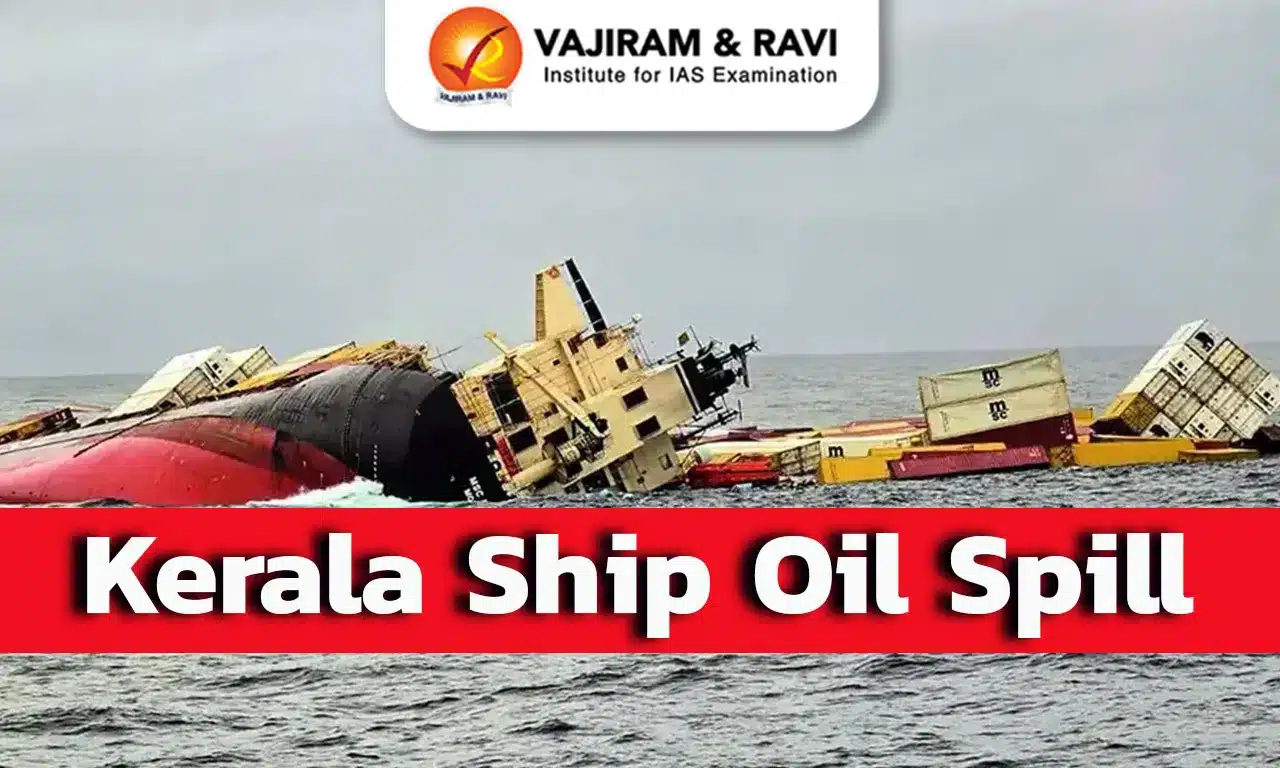
On May 25, a Liberian-flagged cargo ship carrying 640 containers — including 13 with hazardous materials — capsized and sank off the Kerala coast. All crew members were safely rescued by the Indian Coast Guard and Navy.
The incident raised concerns about a possible oil spill. The Indian Coast Guard deployed Saksham, a ship with pollution response equipment, to handle any spill risks.
Cause of Capsizing
The cargo ship MSC ELSA 3 capsized rapidly in the early hours of May 25 due to flooding in one of its cargo holds, as confirmed by the Indian Coast Guard (ICG).
A hold refers to a below-deck compartment used for storing cargo.
The ship had departed from Vizhinjam port and was headed to Kochi at the time of the incident.
Cargo and Fuel Details
The vessel was carrying 640 containers, including:
13 with hazardous cargo
12 with calcium carbide
84.44 metric tonnes of diesel
367.1 metric tonnes of furnace oil
Oil Spill Monitoring
ICG deployed aircraft with advanced oil spill mapping technology to monitor the situation. As of now, no oil spill has been reported.
Oil Spill
An oil spill occurs when oil accidentally enters oceans, seas, or rivers due to natural disasters, human error, or equipment failure.
It spreads quickly and forms a layer on the water surface because of its lighter density.
Environmental Impact
The oil layer blocks sunlight, affecting photosynthesis in marine plants and phytoplankton, which are crucial for oxygen production and food chains.
Harm to Marine Life
Birds lose insulation as oil coats their feathers, leading to hypothermia and drowning.
Fish and invertebrates may suffer reproductive and growth issues, as noted by the US EPA.
Severity Factors
The impact depends on:
Type and volume of oil
Weather conditions
Proximity to sensitive ecosystems
Long-Term Consequences
Severe spills can have decades-long impacts.
For instance, the 2010 Deepwater Horizon disaster released over 4 million barrels of oil over 87 days into the Gulf of Mexico, killing thousands of wildlife.
International Framework Dealing with Oil Spill: MARPOL Convention
Oil spill prevention is governed by the International Convention for the Prevention of Pollution from Ships (MARPOL).
Originated after major oil spill disasters in the 1970s.
The key protocol was issued in 1978.
India is a signatory to MARPOL.
Scope of MARPOL
MARPOL includes six annexes, covering pollution from:
Oil
Noxious liquid substances
Dangerous goods in packaged form
Sewage
Garbage
Air pollution from ships
Domestic Implementation in India
Enforced through the Merchant Shipping Act.
Includes provisions for civil liability and pollution prevention certificates.
Indian ships and foreign ships in Indian waters must comply.
Preparedness and Enforcement
Ports must have oil spill contingency plans.
The Indian Coast Guard is the nodal agency for oil spill response and enforcement.
Methods of Oil Spill Cleanup
Skimming
Involves removing oil from the sea surface before it reaches the coast.
Most effective in calm seas.
In Situ Burning
Involves burning concentrated patches of oil directly on the water.
Quick but may produce toxic fumes.
Chemical Dispersants
Break down oil into smaller droplets.
Helps microbes degrade oil into less harmful substances.
Can be harmful to marine ecosystems.
Challenges in Cleanup
Rapid Spread of Oil - Oil disperses quickly across water surfaces.
Weather Conditions - Rough seas and strong currents hinder cleanup.
Variation in Oil Types - Some oils sink or mix with water (emulsify), making removal harder.
Environmental Trade-offs - Dispersants may impact marine life. Manual cleanup is slow, labour-intensive, and less effective in remote areas.
Advisory for Local Population Following Shipwreck Near Kerala Coast
Public Safety Warning
The Kerala State Disaster Management Authority (KSDMA) has warned locals not to touch any cargo containers or oil that may wash ashore.
Reporting Protocol
Residents are urged to immediately inform the police if they see containers or oil along the shore.
Risk of Oil Contamination
Oil films may appear on the sea surface near the coast.
According to INCOIS, oil pollutants may reach Alappuzha, Ambalapuzha, Arattupuzha, and Karunagappally within 36–48 hours.
These areas are at risk of environmental contamination and need urgent monitoring and response.
Kerala Ship Oil Spill FAQs
Q1. Why did the ship capsize?
Ans. It capsized due to flooding in one of its cargo holds during its voyage from Vizhinjam to Kochi.
Q2. What environmental risk followed the sinking?
Ans. The cargo included oil and hazardous materials, raising concerns of an oil spill and marine ecosystem damage.
Q3. What is MARPOL Convention?
Ans. It’s an international treaty preventing marine pollution from ships; India enforces it via the Merchant Shipping Act.
Q4. How are oil spills cleaned?
Ans. Through skimming, burning, and dispersants—though effectiveness depends on oil type, weather, and proximity to sensitive ecosystems.
Q5. What should locals do now?
Ans. Avoid touching washed-ashore cargo or oil, and report it to police; oil may reach Kollam and Alappuzha coastlines.
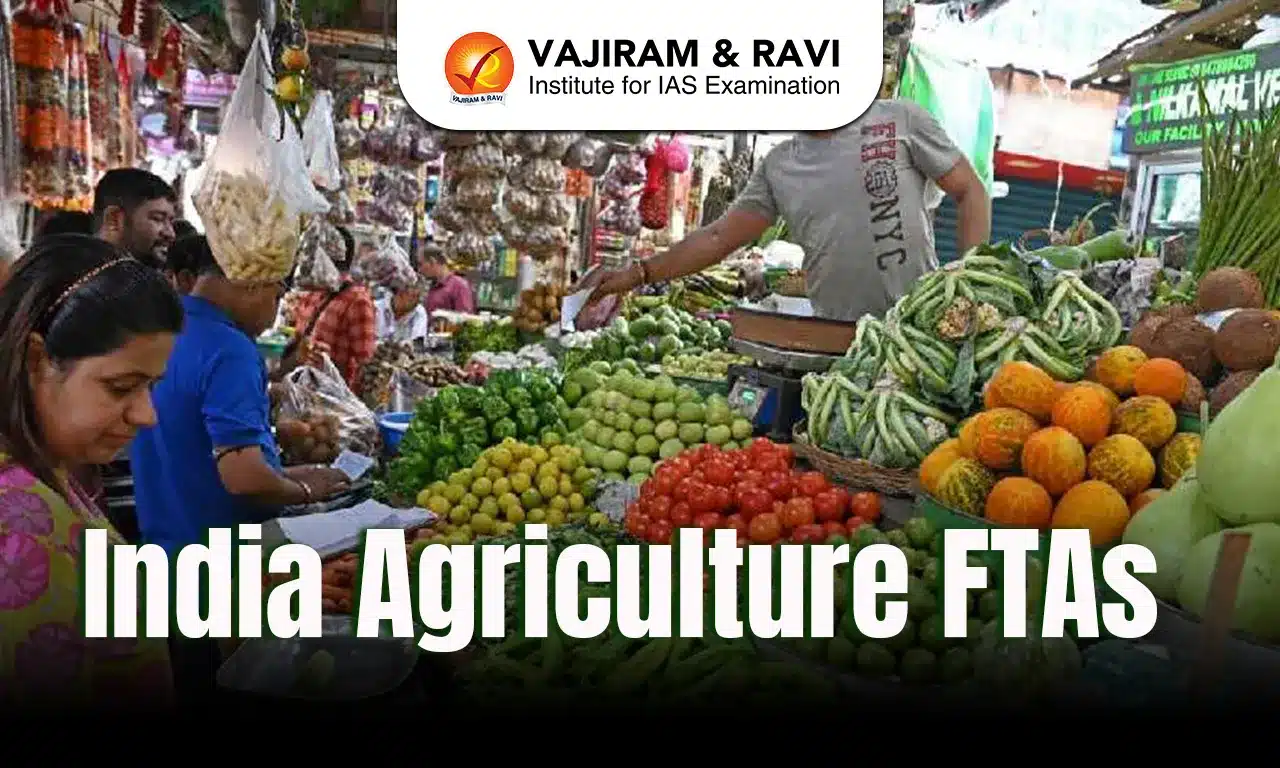
Between 2013-14 and 2024-25, India’s agricultural exports grew modestly by just over 20%, rising from $43.3 billion to $51.9 billion.
In contrast, agricultural imports surged by 148% during the same period, from $15.5 billion to a record $38.5 billion. This sharp rise in imports has led to India’s farm trade surplus shrinking significantly—from $27.7 billion to $13.4 billion.
Notably, in 2024-25 alone, agri-exports rose 6.4%, outpacing the flat overall export growth, while farm imports jumped 17.2%, far above the 6.2% rise in total merchandise imports.
These trends unfold as India negotiates FTAs with the US and EU, both of which are pushing for lower tariffs and greater access to Indian markets for their agricultural products.
Key Export Drivers
Marine Products
It is India’s top farm export, but earnings declined from $8.1 billion in 2022–23 to $7.4 billion in the next two years.
Major markets include the US (35%), China (20%), and EU (15%).
Concern: US tariffs (17.7%) on frozen shrimp could rise further, affecting competitiveness.
Rice Exports at Record Highs
Combined basmati (6.1 mt) and non-basmati (14.1 mt) rice exports hit $12.5 billion in 2024–25.
Markets: Basmati to West Asia; non-basmati to Africa.
Growth in Other Segments
Record-high exports of:
Spices: Especially chilli, cumin, turmeric, mint, etc.
Tobacco: Boosted by crop failures in Brazil and Zimbabwe.
Coffee: Higher demand due to global shortage; India mainly exports robusta beans and powder.
Fruits & Vegetables: Both fresh and processed saw growth.
Export Setbacks
Wheat and Sugar
Exports peaked recently but are now restricted due to domestic shortages.
Wheat peaked at $2.1 billion (2021–22).
Sugar peaked at $5.8 billion (2022–23), with only white sugar exports continuing—processed from imported raw sugar.
Cotton Collapse
India was once a major cotton exporter (over $4.3 billion in 2011–12), but exports have collapsed, turning India into a net importer.
Buffalo Meat
Recovered to $4 billion in 2024–25 but still below the 2013–15 levels of $4.4–4.8 billion.
Interesting Case of Spices
In 2024–25, India witnessed record highs in both spice exports and imports.
While it remains a leading exporter of non-traditional spices like chilli, cumin, turmeric, mint products, oleoresins, and curry powders, it has become a net importer of traditional plantation spices—pepper and cardamom.
Major Agricultural Imports
Vegetable Oils & Pulses Dominate Imports:
India’s top farm imports remain edible oils and pulses.
Pulses imports reached a record $5.5 billion in 2024–25.
Low yields and absence of MSP-backed procurement have deterred domestic expansion.
Oilseed exports (mainly groundnut and sesame) and residual meal provide only partial offset.
Rising Imports Due to Domestic Production Challenges
Cotton
Production has declined from 398 lakh bales (2013–14) to 291 lakh bales (2024–25), owing to stagnant yields and lack of innovation post-GM Bt hybrids.
Natural Rubber
Annual production averaged 8.5 lakh tonnes in recent years, down from 9–9.1 lakh tonnes a decade ago, while consumption has surged to 15 lakh tonnes.
Other Notable Imports
Fruits and Dry Fruits - Includes almonds, pistachios, walnuts, apples, dates, figs, and raisins.
Spices - Mainly pepper and cardamom, which India now imports more of despite being a major spice exporter.
Alcoholic Beverages - Imports of wines and spirits continue to grow, with potential for further rise under new trade deals.
Trade Agreements and Future Implications
The signing of trade agreements with the US, EU, and UK is expected to increase India’s imports of dry fruits, wines, and spirits.
Additionally, the US may push for lower import duties and relaxed non-tariff barriers on genetically modified (GM) crops like maize, soybean, and cotton.
These changes could significantly impact India’s agricultural trade balance, potentially reducing the current surplus.
India Agriculture FTAs FAQs
Q1. How have India’s farm exports performed recently?
Ans. Agri-exports rose 6.4% in 2024–25, driven by rice, spices, and tobacco, despite declines in marine products.
Q2. Why are agri-imports increasing?
Ans. Domestic yield issues and lack of MSP support for pulses, cotton, and oils drive higher imports.
Q3. What’s the trend in spice trade?
Ans. India is a top spice exporter but now imports more pepper and cardamom due to domestic shortfalls.
Q4. How could FTAs impact Indian agriculture?
Ans. FTAs may reduce tariffs, increasing imports of dry fruits, wines, and GM crops, potentially shrinking the trade surplus.
Q5. Which farm sectors are vulnerable?
Ans. Marine exports, cotton, and sugar face risks from trade shifts, high tariffs abroad, and declining domestic output.
Defence Minister Rajnath Singh has approved the execution model for the Advanced Medium Combat Aircraft Programme.
Indigenous Fifth-Generation Fighter Project Gets Green Light
In a strategic boost to India’s self-reliant defence vision, the Ministry of Defence has approved the execution model for the Advanced Medium Combat Aircraft (AMCA) programme.
This decision marks a defining moment in India’s efforts to develop a fifth-generation stealth fighter jet capable of meeting future warfare requirements and matching global standards in air combat technology.
The Aeronautical Development Agency (ADA), in collaboration with private industry partners, will spearhead the development of AMCA, a stealth-heavy, multi-role aircraft.
The plan is to produce five prototypes under a budget exceeding Rs. 15,000 crore.
The Cabinet Committee on Security, led by Prime Minister Narendra Modi, had approved the full-scale engineering development in 2024, with a projected delivery target of 2035.
Features and Capabilities of AMCA
The AMCA is envisioned as a twin-engine, 25-tonne aircraft equipped with advanced stealth characteristics, including internal weapons bays, sensor fusion, and super cruise capability.
These features are designed to significantly reduce radar visibility, allowing the aircraft to engage in deep-penetration missions and precision strikes with minimal detection.
Key technological highlights of the AMCA include:
Internal Fuel Capacity: 6.5 tonnes
Electronic Pilot: AI-assisted decision-making system
Integrated Vehicle Health Management: Predictive maintenance for reduced downtime
Net-centric Warfare Suite: Real-time combat coordination, including seamless integration with Unmanned Aerial Vehicles (UAVs)
Weapon Load: Internal bay capable of carrying 1,500 kg, including four long-range air-to-air missiles and precision-guided munitions
The AMCA's features put it in the same league as advanced fifth-generation fighters like the F-35 Lightning II (USA), Sukhoi Su-57 (Russia), and Chengdu J-20 (China).
These aircraft emphasize stealth, multi-role capabilities, and network-enabled warfare.
Strategic Significance and Global Comparison
The AMCA project aligns with India’s ‘Atmanirbhar Bharat’ initiative, aimed at strengthening indigenous defence production.
By developing a fifth-generation stealth platform, India joins an elite group of nations with cutting-edge aerial combat capabilities.
Unlike fourth-generation fighters or India’s Light Combat Aircraft (LCA) variants, AMCA will possess:
Low Electromagnetic Signature
High Stealth Index
Enhanced Avionics and Situational Awareness
Comparative platforms like the F-35 offer stealth and combat capabilities with internal fuel capacities exceeding 18,000 pounds and payloads of up to 18,000 pounds, while Russia’s Su-57 boasts supersonic speeds and high manoeuvrability.
The AMCA, though smaller in payload and size, promises comparable stealth and digital integration tailored to Indian defence needs.
Challenges Ahead: Engine Development and Timeline
A critical challenge in the AMCA programme lies in developing an appropriate engine.
The current plan involves a joint venture with a foreign Original Equipment Manufacturer (OEM) to develop a next-gen engine that meets thrust, efficiency, and stealth requirements.
The Defence Research and Development Organisation (DRDO) has committed to delivering the first operational AMCA unit by 2035, which marks a ten-year development cycle starting from its sanction in 2024.
India’s ambitious aerospace roadmap also includes other key indigenous defence systems, such as:
LCA Mk II
Very Short Range Air Defence System (VSHORAD)
Man-Portable Anti-Tank Guided Missile (MPATGM)
Generational Leap in Air Warfare Capability
The AMCA programme represents a transformative leap for India’s air power.
The shift from legacy 3rd and 4th generation platforms, like the MiG-21, Mirage 2000, and even the Tejas Mk1, towards a fifth-generation stealth fighter embodies the evolution of India’s defence doctrine into one that prioritizes technology superiority, survivability, and force multiplication.
Each successive generation of fighter jets, from basic jet propulsion in Gen-1 to radar integration in Gen-2, multi-role capabilities in Gen-3, and sensor fusion in Gen-5, reflects the changing nature of aerial warfare.
AMCA’s induction will elevate India’s operational readiness across multiple theatres, including both land and maritime domains.
India’s AMCA Stealth Fighter Jet FAQs
Q1. What is the AMCA programme?
Ans. AMCA is India’s fifth-generation stealth fighter jet project, led by the ADA in collaboration with private industry partners.
Q2. When is AMCA expected to be ready?
Ans. The DRDO has committed to delivering the AMCA by 2035, following its approval in 2024.
Q3. What are the key features of AMCA?
Ans. AMCA includes stealth design, internal weapons bays, AI-based Electronic Pilot, and supercruise capability.
Q4. How does AMCA compare with global fifth-gen fighters?
Ans. AMCA places India alongside nations like the US, Russia, and China with advanced stealth aircraft like the F-35, Su-57, and J-20.
Q5. What is the estimated cost of the AMCA project?
Ans. The initial cost for developing five AMCA prototypes is over ₹15,000 crore.
Every year, May 28th is celebrated as World Dugong Day.
About Dugong
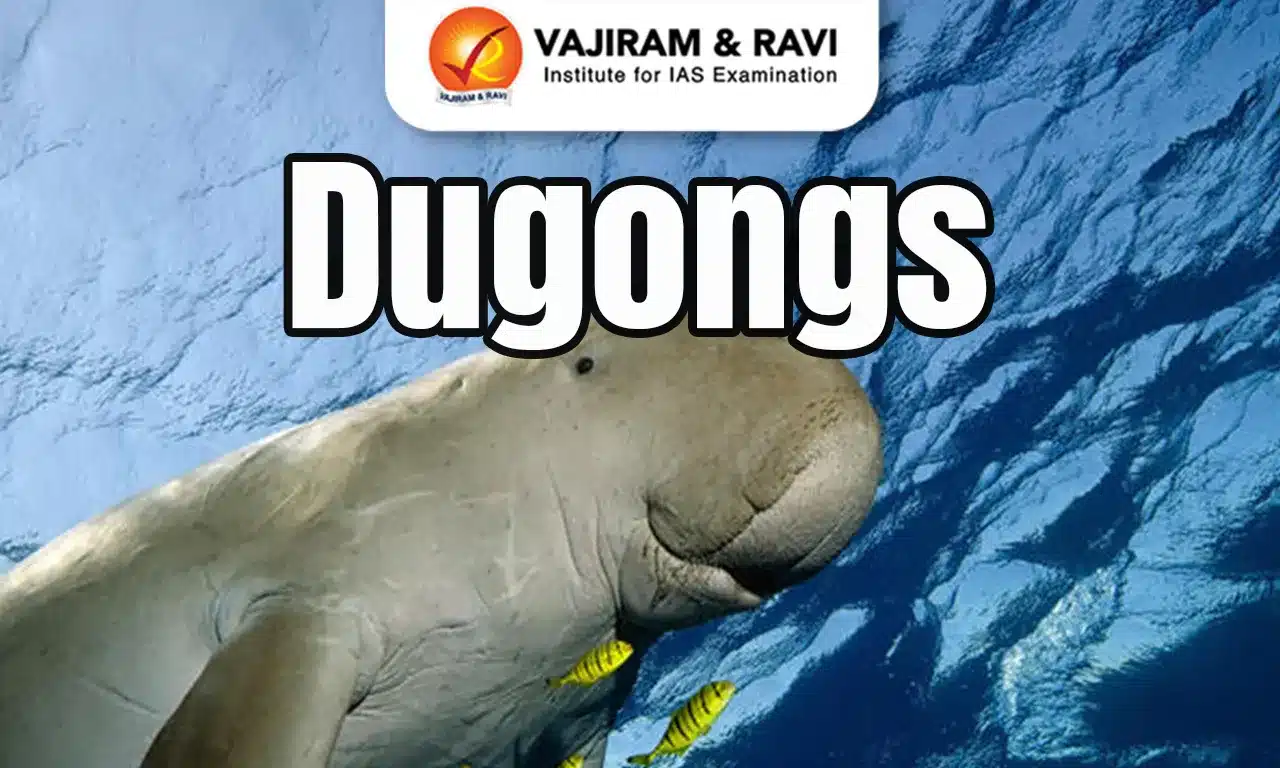
Dugongs (Dugong dugon) are the only herbivorous mammals found in India’s marine ecosystems.
Appearance: It is known as the sea cow, but resembles a cross between a seal and a whale, and is distributed through the Indo-Pacific region.
Distribution: They are found along the Indian coastline, primarily inhabiting warm waters around the Andaman and Nicobar Islands, the Gulf of Mannar, Palk Bay, and the Gulf of Kutch. The dugong is a long-lived species, able to live up to 70 years.
Habitat: Due to their dependence on seagrass beds for habitat and food, dugongs are restricted to shallow waters, where they spend the day feeding on seagrasses of the genera Cymodocea, Halophila, Thalassia, and Halodule.
Reproduction of Dugong
Individuals reach reproductive maturity after only nine or ten years and can give birth at intervals of around three to five years.
Due to its slow reproductive cycle, extended time to maturity, and infrequent calving, a dugong population’s maximum potential growth rate is estimated to be just about 5% per year.
Conservation status of Dugong
IUCN: Vulnerable
CITES: Appendix I
Wildlife Protection Act 1972: Schedule I
Threats: The threats they face worldwide include rapidly declining populations and the ongoing degradation of their seagrass habitats.
Dugong FAQs
Q1: Where is dugong found in India?
Ans: Dugongs are protected in India and occur in Gulf of Mannar, PalkBay, Gulf of Kutch and Andaman and Nicobar islands.
Recently, a group of artists called on the President of India as part of the Artists in Residence programme in Rashtrapati Bhavan.
About Gond Painting
It is a famous folk art of the Gond tribal community of central India.
It originated among the Gond tribe in Madhya Pradesh, Maharashtra, Andhra Pradesh, and Chhattisgarh.
Themes: It features nature, forests, vibrant animals, sun, moon, and stars. Includes mythological stories of deities like Bhima and Parvati, along with mythical creatures like the Shachi bird.
Artists use natural materials like charcoal, colored soil, and plant sap. Applied on mud walls, cloth, or paper using twigs and leaves.
Each Gond artist uses his distinctive pattern and style to fill the images these style signatures are used in collage to make a complete picture such as Dots, fine Lines, Curved Lines, Dashes Fish Scales etc.
About Madhubani Painting
It originated in the Mithila region of Bihar and was traditionally created by women.
Themes: Depicts Hindu mythology, Ramayana, and daily life in India.
Often depicts deities like Krishna, Durga, and Saraswati. Includes festival scenes like Holi and Tussar. Carries symbolic messages related to fertility, good luck, and auspiciousness.
It was historically done on mud walls and cloth; now found on paper and canvas.
Artists often use natural pigments like turmeric, lamp black, and cow dung. Features precise linework, double outlining, and intricate geometric patterns.
Gond Painting and Madhubani Painting FAQs
Q1: What is Gond painting?
Ans: Gond paintings are typically created on various surfaces like paper, cloth, and walls, using natural pigments and brushes made from bamboo sticks.
Q2: What is the difference between madhubani painting and Mithila painting?
Ans: Madhubani painting, also referred to as Mithila Art (as it flourishes in the Mithila region of Bihar), is characterized by line drawings filled in by bright colours and contrasts or patterns.
The 2025 Breakthrough Prize in Fundamental Physics was jointly awarded to four experimental collaborations operating at CERN's Large Hadron Collider (LHC)—ATLAS, CMS, ALICE, and LHCb, with Indian scientists playing a key role in the success of the ALICE and CMS experiments.
About Breakthrough Prizes
The Breakthrough Prizes honor important, primarily recent, achievements in the fields of Life Sciences (with a specific prize dedicated to work related to Parkinson’s Disease, and Neurodegenerative disorders), fundamental physics, and mathematics.
These prestigious awards were founded in 2013 by Mark Zuckerberg and his spouse Priscilla Chan, former Google CEO Sergey Brin, Anne Wojcicki, the founder of the genomics company 23&Me, and tech investors Yuri and Julia Milner.
Often referred to as the “Oscars of Science”, the mission of the Breakthrough Prizes is to recognize individual accomplishments, celebrate scientists as societal heroes, inspire future generations of scientists, and advocate for "science for the benefit of all" as a global, non-political organization.
Each Breakthrough Prize carries a monetary award of $3 million, significantly higher than the Nobel Prize.
Committees of previous laureates choose the winners from candidates nominated in a process that’s online and open to the public.
They attend a televised award ceremony designed to celebrate their achievements and inspire the next generation of scientists. As part of the ceremony schedule, they also engage in a program of lectures and discussions.
Those who make fresh discoveries again remain eligible for future Breakthrough Prizes.
Breakthrough Prizes FAQs
Q1: The Breakthrough Prizes primarily recognize achievements in which fields?
Ans: Life Sciences, Fundamental Physics, and Mathematics
Q2: What is the monetary value of each Breakthrough Prize?
Ans: $3 million
Q3: How are Breakthrough Prize winners selected?
Ans: By committees of previous laureates from public nominations.
Sikkim Chief Minister recently urged the Centre to ensure that Mt. Khangchendzonga, the world’s third-highest peak, regarded as sacred by the people of the State, is made out of bounds for mountaineers.
About Mt. Khangchendzonga
Mt. Khangchendzonga (also known as Kanchenjunga) is the highest peak in India and the third-highest peak in the world after Mount Everest (Chomolongma) in Nepal and K2 in Pakistan.
It is situated in the eastern Himalayas on the border between Sikkim state, northeastern India, and eastern Nepal, 74 km north-northwest of Darjeeling, Sikkim.
It has an elevation of 28,169 feet (8,586 metres).
It is part of the Great Himalaya Range.
The name Khangchendzonga has been variously translated as “Five Treasuries (or Strongboxes) of the Great Snow” or “Great Five-Peaked Fortress of Snow.”, a reference to its five separate summits.
Kanchenjunga has four ridges extending north, east, south, and west. Between them are four glaciers: the Zemu (northeast), the Talung (southeast), the Yalung (southwest), and the Kanchenjunga (northwest).
The mountain and its glaciers receive heavy snow during the summer monsoon season and a lighter snowfall during the winter.
To the east, Khangchendzonga National Park in Sikkim is a mountain wilderness with a wide variety of animal species.
Charles Evans in 1955 led a British expedition up the southwest face in the first successful ascent of Kanchenjunga.
Mt. Khangchendzonga FAQs
Q1: Where is Khangchendzonga located?
Ans: It is situated in the eastern Himalayas on the border between Sikkim state, and eastern Nepal, 74 km north-northwest of Darjeeling, Sikkim.
Q2: What is Kanchenjunga famous for?
Ans: It is the highest peak in India and the third-highest peak in the world.
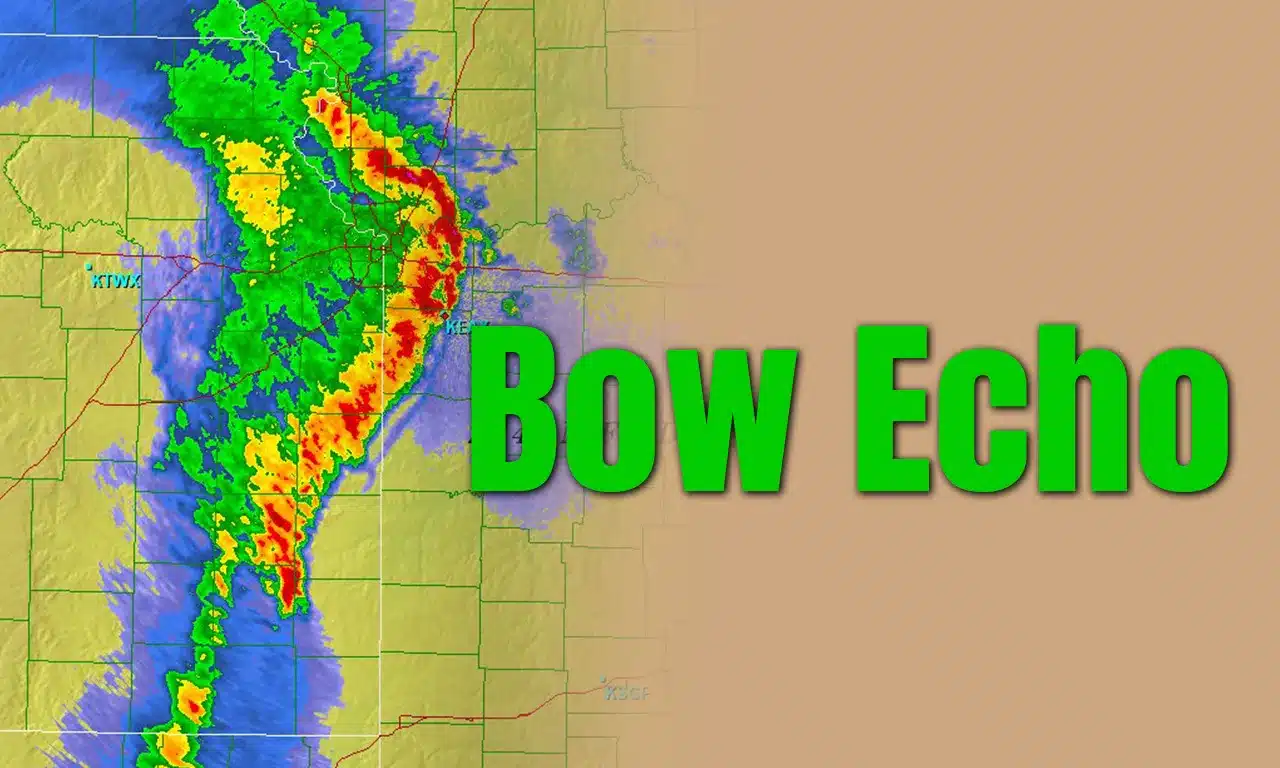
The intense storms that hit Delhi recently looked like a crescent or an archer’s bow which in technical terms are called “bow echoes.”
About Bow Echo
A bow echo is essentially a line of storms, also called a squall line, on the radar that looks like a bow. Note that this squall line can sometimes be embedded in a larger squall line.
A bow echo can extend from 20 km to 100 km, and last between three and six hours.
The term was coined in the 1970s by Ted Fujita, a Japanese American meteorologist known for developing the scale to classify tornadoes.
Formation of Bow Echo
When rain-cooled air comes down to the ground, and spreads out horizontally. As this happens, a boundary called the gust front is created between the rain-cooled air and warm-moist air on the surface.
This front pushes up the warm-moist air into the atmosphere, which forms new thunderstorms.
These new thunderstorms produce more rain, thereby creating more rain-cooled air, which helps the gust front to maintain its strength.
As this process keeps repeating itself, there comes a point when there is an inflow of air on the trailing side of the line of storms and bends it like an archer’s bow.
The cycle lasts as long as new thunderstorms keep forming at the front, helping the system grow and move forward with strong winds.
Bow echoes are not a new phenomenon. In 2022, a bow echo was formed over Delhi and Noida. However, it was short-lived, lasting for an hour, and produced winds of up to 100 kmph.
Bow Echo FAQs
Q1: What is a decharo?
Ans: A derecho (pronounced similar to "deh-REY-cho") is a widespread, long-lived wind storm that is associated with a band of rapidly moving showers or thunderstorms
Q2: What are the different types of bow echoes?
Ans: Three primary initial modes of bow-echo formation are (i) weakly organized cells, (ii) squall lines, and (iii) supercells.
Recently, Rajasthan’s famous dish Ker Sangri has received a Geographical Indication tag.
About Ker Sangri
It is a Rajasthani delicacy made using sangri pods sourced from hardy khejri trees and Ker berries that grow on Ker trees.Both these ingredients are native to the arid regions of the Thar Desert.
Preparation of Ker Sangri
Preparing Ker Sangri is a careful and slow process.
The Ker berries taste bitter when raw but become delicious after being soaked, boiled, and cooked with Sangri, curd, red chillies, and spices. The final dish is tangy, spicy and full of earthy flavour.
Ker Sangri is not just tasty but also healthy. It is high in fibre, low in fat and rich in nutrients. People in Rajasthan usually eat it with bajra roti and ghee, making it a filling and balanced meal.
The Sangri bean grows on the Khejri tree, which is sacred in Rajasthan. The Bishnoi community has protected this tree for hundreds of years and considers it a symbol of life.
Key Facts about the Geographical Indication (GI) tag
It is a sign used on products that have a specific geographical origin and possess qualities or a reputation that are due to that origin.
This is typically used for agricultural products, foodstuffs, wine and spirit drinks, handicrafts and industrial products.
The Geographical Indications of Goods (Registration and Protection) Act, 1999, seeks to provide for the registration and better protection of geographical indications relating to goods in India.
This GI tag is valid for 10 years, following which it can be renewed.
Ker Sangri FAQs
Q1: What is Rajasthani ker sangri?
Ans: Ker Sangri, a Rajasthani specialty, is a combination of wild berries and beans known for their nutritional and medicinal benefits.
Q2: What is Rajasthan's famous food?
Ans: Signature Rajasthani dishes include Dal Baati Churma, Panchratna Dal, Papad ro Saag, Ker Sangri, Gatte ro Saag.