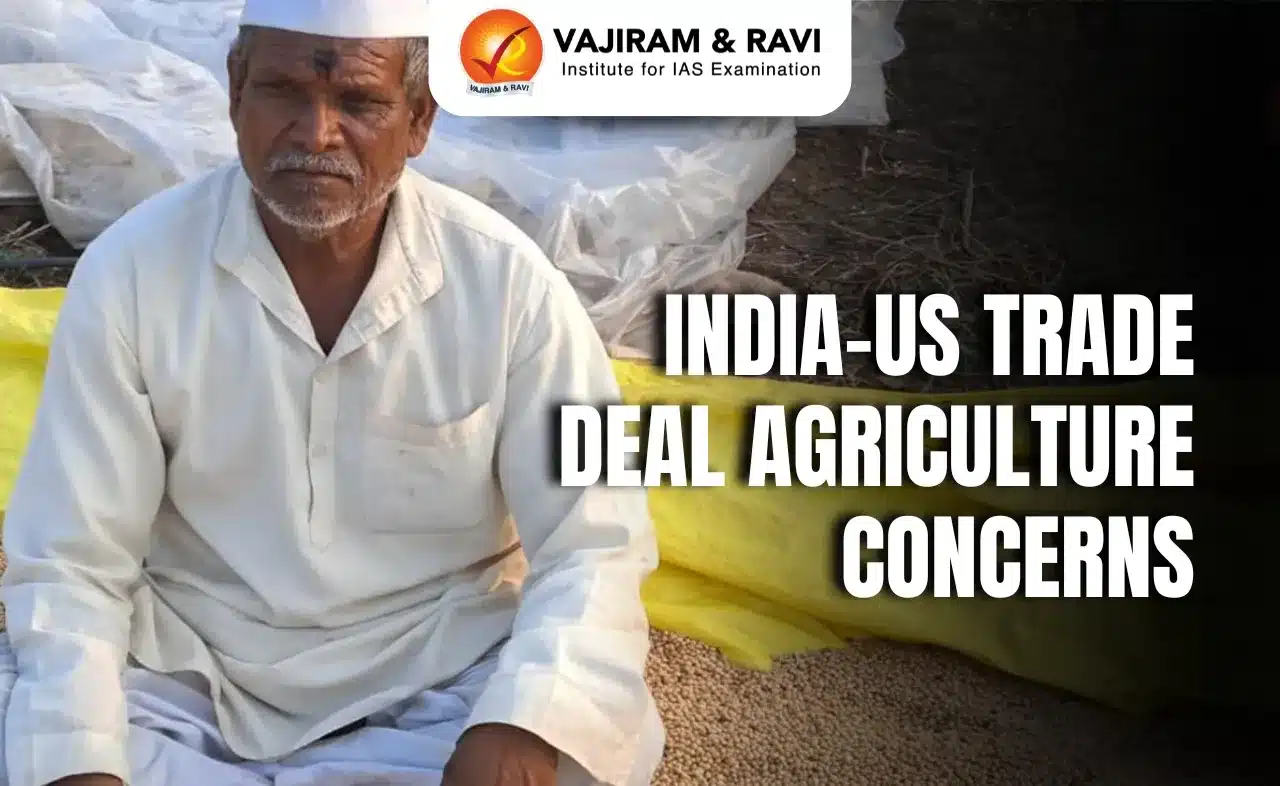
India-US Trade Deal Agriculture Concerns Latest News
- As India and the US push to finalise a bilateral trade deal before the July 9 deadline, two major Indian agri-industries are expressing concern.
- The sugar industry opposes the import of ethanol and genetically modified (GM) maize for fuel blending, while the soybean processing industry is against GM soyabean imports.
- It should be noted that the US is the world’s top producer as well as exporter of both maize and fuel ethanol.
- Also, it is the second biggest producer and exporter of soybean after Brazil.
- With the US seeking new markets amid geopolitical shifts, pressure is mounting on India to ease import restrictions.
- However, these domestic sectors fear such concessions could hurt local producers.
Ethanol Blending A Policy Success
- India’s ethanol blending programme has grown significantly under the Modi government.
- Average ethanol blending in petrol rose from 1.5% (2013-14) to 14.6% (2023-24).
- In the current supply year (Nov 2024–May 2025), the blending ratio reached 18.8%, nearing the 20% target by 2025-26.
Shift from Sugarcane to Grains
- Since 2018-19, sugar mills have started using grains (especially maize and surplus rice) alongside molasses for ethanol.
- In 2024-25, 68% of the 1,047.9 crore litres of ethanol is grain-based.
- Maize alone contributes 483.9 crore litres, overtaking sugarcane-based sources.
Millers' Concerns Over Ethanol Imports
- Sugar millers are worried that sugarcane is losing importance as more ethanol is now being made from grains like maize.
- They fear that if India starts importing ethanol or genetically modified (GM) maize, sugarcane will be pushed aside even more.
- Since sugar consumption in India is not growing, millers see their future in energy—like ethanol-blended diesel or aviation fuel—rather than in producing sugar.
Food vs Fuel Debate
- Millers argue ethanol from sugarcane avoids food/feed conflicts.
- Unlike maize, sugar isn’t a key livestock or poultry feed.
- Diverting maize to fuel may strain supply for animal feed, affecting dairy, poultry, and egg sectors.
India A Key Market for US Ethanol
- The US exported 724.5 crore litres of ethanol in 2024, with India as the third largest buyer (70.8 crore litres worth $441.3 million).
- India restricts ethanol imports to non-fuel industrial use and under licence.
NITI Aayog Push for GM Maize Imports
- A working paper suggests importing cheaper US GM maize for ethanol.
- Its byproduct (DDGS - distiller’s dried grains with solubles) can be exported to avoid domestic feed concerns.
- Authors claim this will help India meet biofuel targets without disturbing local food chains.
Concerns of India’s Soyabean Industry
A NITI Aayog paper suggests importing soyabean, extracting oil for domestic use, and exporting the leftover GM-based de-oiled cake (meal).
SOPA's Opposition to the Plan
- The Soybean Processors Association of India (SOPA) rejects the proposal due to logistical and economic challenges:
- Most solvent extraction units are located inland (MP, Maharashtra), far from ports.
- Transporting imported beans from ports to plants and then exporting the meal is not cost-effective.
- Such a policy threatens the livelihood of nearly 7 million soyabean farmers.
Limited Domestic Demand vs. China
- India processes 11–12 million tonnes of soyabean yearly, with most meal used domestically for food and feed.
- Only ~2 million tonnes is exported, unlike China which crushes over 100 million tonnes annually for its massive livestock industry.
Fears of Foreign Dominance
- If GM meal cannot be sold domestically, processing must shift closer to ports for export.
- This could invite dominance by global agri-trading giants (e.g., ADM, Cargill, Bunge, Louis Dreyfus), pushing out domestic processors.
Import Duty Cuts Add Pressure
- Recently, the Centre reduced the import duty on crude soyabean, palm, and sunflower oil from 27.5% to 16.5%.
- SOPA fears this will undercut local processors by making imported oils cheaper, forcing many to shut or operate below capacity.
Falling Soyabean Prices Hurt Farmers
- Soyabean is currently trading at ₹4,300–₹4,350/quintal in MP and Maharashtra—well below the MSP of ₹5,328.
- Cheap imports of oil or seed could further depress prices and cause farmers to shift to other crops.
Source IE | CNBCTV18
India-US Trade Deal Agriculture Concerns FAQs
Q1: Why is the sugar industry opposing the trade deal?
Ans: Because it fears ethanol and GM maize imports will marginalise sugarcane in India’s biofuel program.
Q2: What does SOPA say about soyabean imports?
Ans: SOPA warns soy imports harm local processors and threaten the livelihood of 7 million farmers.
Q3: What role does ethanol play in India’s energy plans?
Ans: Ethanol-blended fuel is India’s renewable energy priority, targeting 20% blending by 2025-26.
Q4: How are imports affecting soybean farmers?
Ans: Soy prices have fallen below MSP; cheap imports risk shifting farmer interest to other crops.
Q5: What is NITI Aayog's stance on GM imports?
Ans: It suggests importing GM maize and soyabean to meet ethanol goals and export byproducts abroad.