What is Investor Education and Protection Fund Authority (IEPFA)?

Investor Education and Protection Fund Authority

Investor Education and Protection Fund Authority Latest news

The Investor Education and Protection Fund Authority (IEPFA) is in the final phase of testing its Integrated Portal, a unified digital platform designed to streamline claim processes and enhance accessibility for both investors and companies. 

About Investor Education and Protection Fund Authority

  • The Investor Education and Protection Fund Authority (IEPFA) was established in 2016 under the Companies Act, 2013.
  • It manages the Investor Education and Protection Fund (IEPF) and promotes investor awareness and financial protection.
  • Make refunds of shares, unclaimed dividends, matured deposits/debentures etc. to investors and promote awareness among investors.
  • It is dedicated to safeguarding investor interests by facilitating the return of unclaimed shares and dividends and advancing financial literacy nationwide.
  • Initiatives: Through flagship initiatives such as Niveshak Didi, Niveshak Panchayat, and Niveshak Shivir, IEPFA empowers individuals to make informed financial choices and fosters a financially aware citizenry.
  • Nodal Ministry: Ministry of Corporate Affairs
  • The IEPF consists of amounts that remained unclaimed for 7 years, including:
    • Unpaid dividends,
    • Application money is due for refund,
    • Matured deposits and debentures,
    • Interest on investments from the fund,
    • Grants or donations received from the government or other entities

Source: PIB

Investor Education and Protection Fund Authority FAQs

Q1: What is the investor education and protection fund?

Ans: Investor Education and Protection Fund (IEPF) is for promotion of investors' awareness and protection of the interests of investors.

Q2: Which Ministry oversees the IEPFA?

Ans: The IEPFA functions under the Ministry of Corporate Affairs (MCA).

Matri Van Initiative

Matri Van Initiative

Matri Van Initiative Latest News

Recently, the union Minister for Environment, Forest and Climate Change, along with the Union Minister for Housing and Urban Affairs presided over the ceremonial launched  the ‘Matri Van’ initiative.

About Matri Van Initiative

  • It is an initiative under the ‘Ek Ped Maa Ke Naam’ Programme of Government of India.
  • It is a theme based urban forest dedicated to nurturing generations through mother-nature-inspired green efforts - would be developed in an area of 750 acres in the Aravalli Hill area.
  • It is envisioned as a unique ecological and cultural space that will contribute to biodiversity, public well-being, and urban sustainability.
  • This vision would be achieved through a multi-stakeholder collaboration involving CSR partners, Resident Welfare Associations (RWAs), NGOs, multinational corporations (MNCs), school children and government organizations.
  • The main components of the ‘Matri Van’ would include removal of existing bushes like Kabuli Kikar (Prosopis juliflora) and plantation of Dhak/Amaltash Trees along Gurugram-Faridabad Road, while creating theme-based Plantation Groves to restore local ecology in the Aravallis.
  • It would further include nature trails, cycle track, yoga places, sitting places/gazebos, public facilities, parking at four corners, treated water irrigation system/misting/sprinkling, waterbodies at selected locations for conservation of water and to check urban flooding.

Source: PIB

Matri Van Initiative FAQs

Q1: What is meant by urban forestry?

Ans: Urban forestry is the care and management of single trees and tree populations in urban settings for the purpose of improving the urban environment.

Q2: Where is the Aravalli Hills located?

Ans: It is located in the north-western part of India, the Aravalli stretches from Gujrat to Delhi through Rajasthan and Haryana.

Alpine Musk Deer

Alpine Musk Deer

Alpine Musk Deer Latest News

A Central Zoo Authority report reveals a mix-up in identifying the Alpine musk deer for conservation breeding, mistakenly initiating programs for the Himalayan musk deer instead.

About Alpine Musk Deer

  • The Alpine musk deer (Moschus chrysogaster) is a musk deer species found only in Asia.
  • It is not a true deer, but rather its family is closely related to Bovidae, the group that contains antelopes, bovines, sheep, and goats.
  • It is generally solitary and a crepuscular animal.
  • Alpine musk deer is named for having an externally visible musk sac between the male testes. Its fangs grow during mating season and are used for sparring with other males.
  • Habitat: It inhabits coniferous and deciduous forests in the mountain regions at elevations of 3,000–5,000 m.
  • Diet: It is a ruminant herbivore, foremost a browser and feeds mainly on forbs, grasses, moss, lichens, and shoots, leaves and twigs of shrubs.
  • Distribution: It is mainly found in India, Nepal, Bhutan and China.
  • Conservation Status
    • IUCN: Endangered
    • CITES: Appendix I
    • Wildlife Protection Act, 1972: Schedule I 
  • Threats: The main threat to the Alpine musk deer is poaching for its musk, which is used in cosmetic products.

 Source: DTE

Alpine musk deer FAQs

Q1: Where is musk deer found in India?

Ans: Jammu and Kashmir, Himachal Pradesh, Uttarakhand, Sikkim, and Arunachal Pradesh

Q2: What is crepuscular in animals?

Ans: Crepuscular refers to twilight, the time shortly before sunrise and after sunset. In the context of animal ecology, it refers to those species active during these times of day.

PM National Dialysis Programme

PM National Dialysis Programme

PM National Dialysis Programme Latest News

The Government of India has significantly expanded the reach of the Pradhan Mantri National Dialysis Programme (PMNDP) and it is now operational across all 36 States and Union Territories, covering 751 districts.

About PM National Dialysis Programme

  • It was rolled out in 2016 to provide dialysis services free of cost to Below Poverty Line (BPL) beneficiaries at the district hospitals in the country. 
  • It is being implemented under the National Health Mission (NHM) to provide free dialysis services to patients suffering from end-stage kidney failure in Public Private Partnership (PPP) mode.
  • Components: The programme supports both Haemodialysis and Peritoneal Dialysis services. 
  • Under this initiative he PMNDP portal was launched which will integrate all the dialysis centres operational in the state under NHM and facilitate building of renal registry and ensuring portability within the state (one state one dialysis) and later throughout the country (One Nation-One Dialysis).  
  • Funding: The NHM provides financial assistance to States and UTs for establishing and operating dialysis centres to ensure equitable access to kidney care services for all, regardless of geography.
  • Nodal Ministry: Ministry of Health and Family Welfare

Source: DD News

PM National Dialysis Programme FAQs

Q1: What is the concept of dialysis?

Ans: Dialysis is a procedure to remove waste products and excess fluid from the blood when the kidneys stop working properly.

Q2: What are the objectives of National One Health Mission?

Ans: 'To build an integrated disease control and pandemic preparedness system in India by bringing human, animal and environmental sectors together for better health outcomes, improved productivity and conservation of biodiversity. '

Kopili River

Kopili River

Kopili River Latest News

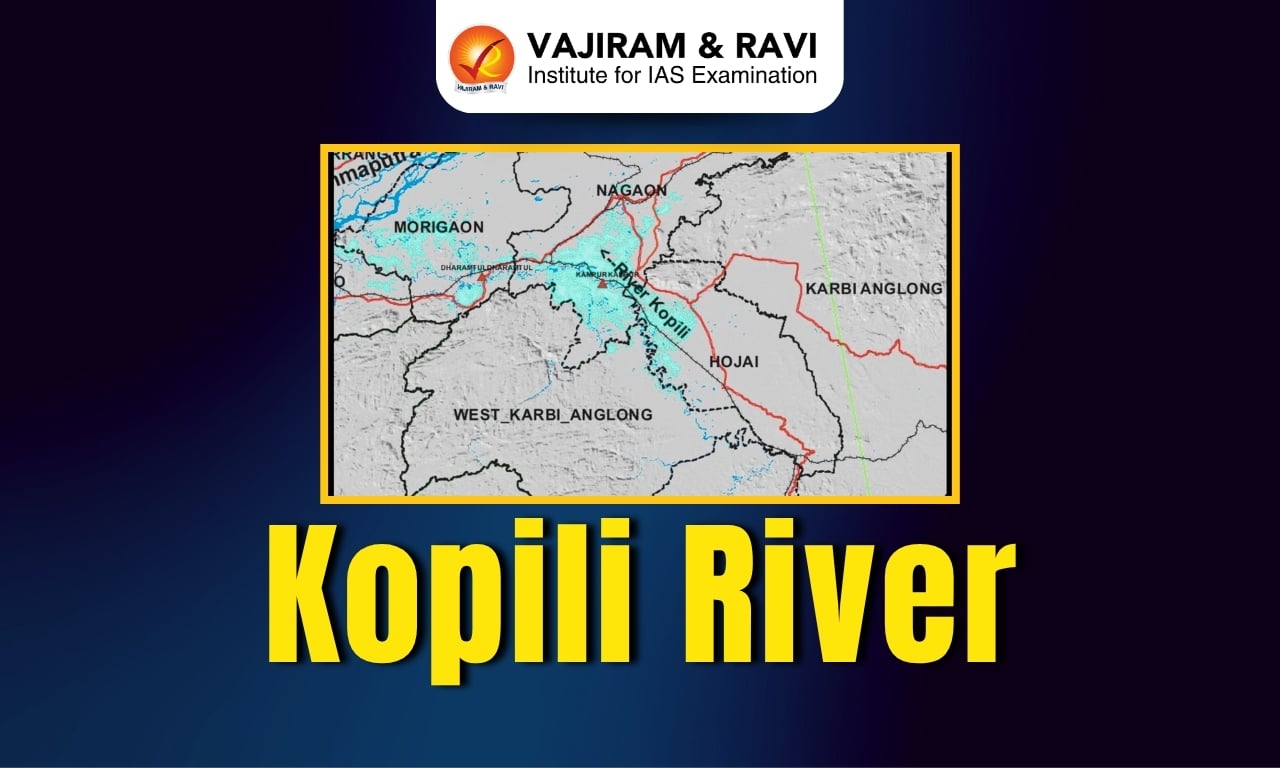
Recently, in a historic step towards the revival of Assam’s river-based trade and sustainable logistics, National Waterway-57 (River Kopili) was operationalized.

About Kopili River

  • It is one of the important major tributaries of the Brahmaputra on its left bank.
  • Origin: The River Kopili rises in the Saipong Reserve Forest of North Cachar Hills District in the Borail Range at an altitude of 1525 meter.
  • Its total length is 256 km of which 78 km from the common border of Meghalaya and Assam and the remaining 178 km lie in Assam.
  • It is an interstate river in Northeast India that flows through the states of Meghalaya and Assam.
  • It is the largest south bank tributary of the Brahmaputra in Assam.
  • The river covers a vast area of North Cachar Hill, Karbi Anglong, Nagaon, and Morigaon District.
  • Here, mainly sixth types of crops produced at Kamrup district and surrounding area, like - Winter Rice, summer rice, rape seed, and wheat, Mustard, Autumn Rice etc.

Source: PIB

Kopili River FAQs

Q1: Where is Kopili River located?

Ans: The Kopili originates in the Meghalaya plateau and flows through Central Assam and the hill districts of Assam before its confluence with the Brahmaputra.

Q2: What are the inland waterways of Assam?

Ans: National Waterway – 2 ( Brahmaputra River)

Apna Ghar Initiative

Apna Ghar Initiative

Apna Ghar Initiative Latest News

The Ministry of Petroleum and Natural Gas recently launched an ambitious initiative named ‘Apna Ghar’ aimed at improving truckers’ long-haul journeys across the country.

About Apna Ghar Initiative

  • It is an initiative of the Ministry of Petroleum and Natural Gas, Government of India.
  • It aims to provide comfortable and hygienic resting spaces for truckers across major highways in the country.
  • As of July 1, 2025, a total of 368 ‘Apna Ghar’ units with 4,611 beds have been set up by Public Sector Oil Marketing Companies (OMCs) at retail fuel outlets along national and state highways. 
  • The facilities at ‘Apna Ghar’ include:
    • Dormitories (10-30) beds
    • Restaurants/Dhabas
    • Self-cooking areas
    • Clean toilets
    • Dedicated bathing areas (Houdas)
    • Purified drinking water facilities
  • Other Features: 
    • Tech Integration:Apna Ghar’ mobile application introduced for reservations, reviews, and driver interaction.
    • Public-Private Execution: Developed and overseen by OMCs at retail fuel outlets.
    • User-Focused Design: Tailored to the requirements of truckers, guided by their feedback and insights from mobile app data analysis.

Source: PIB

Apna Ghar Initiative FAQs

Q1: The 'Apna Ghar' initiative is launched by which ministry?

Ans: Ministry of Petroleum and Natural Gas.

Q2: What is the main objective of the 'Apna Ghar' initiative?

Ans: Providing hygienic and comfortable resting spaces for truckers.

Q3: Who develops and manages the Apna Ghar facilities?

Ans: Public Sector Oil Marketing Companies (OMCs).

Krasheninnikov Volcano

Krasheninnikov Volcano

Krasheninnikov Volcano Latest News

The eruption of the Krasheninnikov volcano was recently recorded for the first time.

About Krasheninnikov Volcano

  • It is an active complex volcano located in the Eastern Kamchatka Peninsula, Russia.
    • The Kamchatka Peninsula lies along the Pacific "Ring of Fire."
    • There are 114 volcanoes on the Kamchatka Peninsula that have erupted during the Holocene Epoch (approximately 12,000 years ago to the present).
  • Krasheninnikov is a stratovolcano and reaches a height of 1,886 meters.  
  • The volcano is located in a collapsed caldera, which formed after a catastrophic eruption which produced 50 cubic km of dacitic pumice 39,600 years ago.
  • It is made up of two eruptive cones in a 9 km wide caldera.  
  • The southern cone of Krasheninnikov contains a crater 800 m wide and 140 m deep.
  • Its last eruption took place about 400 or 600 years ago.
  • 2025 Eruption: Krasheninnikov volcano erupted on 2 August 2025, three days after a nearby magnitude 8.8 earthquake. Ash emissions reached an altitude of 20,000 ft.

What is a Stratovolcano?

  • It is a tall, steep, and cone-shaped type of volcano.
  • Unlike flat shield volcanoes, they have higher peaks.
  • They are typically found above subduction zones, and they are often part of large volcanically active regions, such as the Ring of Fire that frames much of the Pacific Ocean.
  • Strato Volcanoes comprise the largest percentage (~60%) of the Earth’s individual volcanoes, and most are characterized by eruptions of andesite and dacite, lavas that are cooler and more viscous than basalt.
  • These more viscous lavas allow gas pressures to build up to high levels. Therefore, these volcanoes often suffer explosive eruptions. 
  • They are usually about half-half lava and pyroclastic material, and the layering of these products gives them their other common name of composite volcanoes.
  • At the peak, stratovolcanoes usually have a small crater. The crater may be filled with water or ice, or it may contain a volcanic dome during a period of relative inactivity.

Source: TOI

Krasheninnikov Volcano FAQs

Q1: Where is the Krasheninnikov volcano located?

Ans: Kamchatka Peninsula, Russia

Q2: The Krasheninnikov volcano is classified as which type of volcano?

Ans: Stratovolcano

Q3: Approximately how high is the Krasheninnikov volcano?

Ans: 1,886 meters

Q4: What is notable about the structure of the Krasheninnikov volcano?

Ans: It is made up of two eruptive cones in a 9 km wide caldera.

Key Facts about Mahanadi River

Mahanadi River

Mahanadi River Latest News

After a prolonged legal battle over sharing Mahanadi River water in a designated tribunal, Odisha and Chhattisgarh have now expressed willingness to resolve the dispute amicably between themselves.

About Mahanadi River

  • It is one of the major east-flowing peninsular rivers located in the states of Chhattisgarh and Odisha.
  • It ranks second to the Godavari River among the peninsular rivers in respect of water potential.
  • Course:
    • Origin: The river originates from the Sihawa range of hills in the Dhamtari district of Chhattisgarh.
    • It then flows in the eastward direction, cutting a ravine in the Eastern Ghat. 
    • Before joining the Bay of Bengal at False Point through several channels near the major seaport town of Paradip, the river enters the plains of Odisha near Cuttack and forms a delta.
  • Length: 860 km 
  • The river is bounded in the north by Central India hills, in the south and east by the Eastern Ghats, and in the west by the Maikal hill range.
  • The Mahanadi basin extends over the states of Chhattisgarh and Odisha and comparatively smaller portions of Jharkhand, Maharashtra, and Madhya Pradesh, draining an area of 1,41,589 sq.km., which is nearly 4.3% of the total geographical area of the country. 
  • It passes through several major cities and towns, including Raipur, Sambalpur, and Cuttack.
  • It is considered to be one of the most active silt-depositing streams in India.
  • Tributaries: Its main tributaries are Seonath, Jonk, Hasdeo, Mand, Ib, Ong, and Tel
  • Hirakud Dam:
    • The Hirakud Dam, the world’s longest earthen dam (26 km), is constructed across the Mahanadi River, about 15 km from Sambalpur in Odisha.
    • The dam is used for irrigation, flood control, and power generation.
  • Chilika Lake: Chilika, named a wetland of international importance under the Ramsar Convention, gets 61% of its inland flow from the Mahanadi River system, mainly from its distributaries – Daya and Bhargabi.

Source: TH

Mahanadi River FAQs

Q1: Where does the Mahanadi river originate from?

Ans: The river originates from the Sihawa range of hills in the Dhamtari district of Chhattisgarh.

Q2: The Mahanadi River flows into which water body?

Ans: Bay of Bengal

Q3: What is the total length of the Mahanadi River?

Ans: 860 km

Q4: Which cities does the Mahanadi River flow through?

Ans: Raipur, Sambalpur, Cuttack

Market Coupling

Market Coupling

Market Coupling Latest News

The Central Electricity Regulatory Commission’s (CERC) proposed implementation of market coupling in the Day Ahead Market (DAM) segment of power exchanges from January 2026 may have little benefit for the power sector, according to industry officials and analysts.

About Market Coupling

  • Market coupling is an economic model used in energy markets to create a single, uniform price for electricity across different trading platforms or exchanges.
  • India has three power exchanges—Indian Energy Exchange (IEX), Power Exchange India Limited (PXIL), and Hindustan Power Exchange Limited (HPX). 
  • These are voluntary markets, and each of them collects buy and sell bids on their own and, thus, comes up with their own market clearing prices (MCPs). 
  • In simple terms, currently, each power exchange has a different cost of electricity, even though they usually differ from each other only by a few paisa.
  • Market coupling is a model where buy bids and sell bids from all power exchanges in the country will be aggregated and matched to discover a uniform MCP. 
  • It means there will be only one price for the electricity that is to be traded at any point of time through these exchanges. 
  • If implemented, power exchanges will be rendered as a platform where only buy and sell bids will be received and power dispatched to the buyer.

Market Coupling Advantages

  • It can be used to improve the efficiency and integration of multiple interconnected markets in the electricity sector. 
  • This could potentially enable higher utilisation and reduce energy loss. 
  • It can help enhance market liquidity by allowing participants to trade electricity across borders. 
  • This also helps boost the number of participants and the overall trading volumes in the power market.

Source: TH

Market Coupling FAQs

Q1: What is the primary aim of the Market Coupling model in electricity trading?

Ans: To establish a uniform market clearing price across power exchanges.

Q2: What role will power exchanges play once market coupling is implemented?

Ans: They will only collect and submit buy/sell bids.

Q3: How does Market coupling enhances market liquidity?

Ans: Market coupling can help enhance market liquidity by allowing participants to trade electricity across borders.

Denotified, Nomadic and Semi-Nomadic Tribes

Denotified, Nomadic and Semi-Nomadic Tribes

Denotified, Nomadic and Semi-Nomadic Tribes Latest News

Calls are growing for the establishment of a permanent national commission for Denotified, Nomadic, and Semi-Nomadic Tribes with the issue finding primacy in discussions at the national conference of Denotified Tribes (DNTs) held recently in New Delhi.

About Denotified, Nomadic and Semi-Nomadic Tribes 

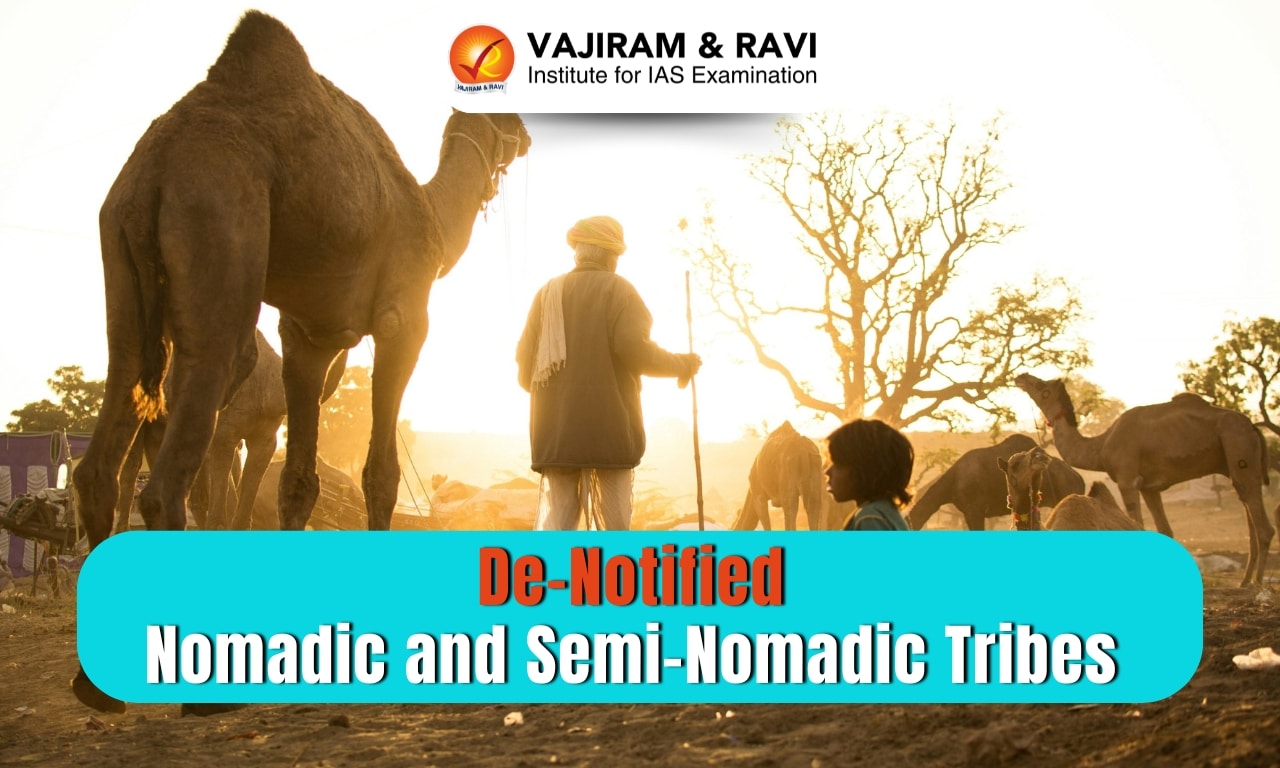
  • Denotified Tribes (DNT) also known as Vimukta Jati, are the tribes that were listed originally under the Criminal Tribes Act of 1871 as criminal tribes. 
    • Once a tribe becomes "Notified" as criminal, all its members were required to register with the local magistrates, failing which they would be charged with a 'crime' under the Indian Penal Code. 
  • After Independence, this Act was repealed in 1952, and the communities were “denotified”, hence the name. 
  • Nomadic Tribes are the communities who usually do not have land and move from one place to another for livelihood.
  • The DNT/NT/SNTs are among the most neglected, marginalised, and economically deprived communities, with most living a life of destitution.
  • Historically, these communities never had access to private land or home ownership and used forests and grazing lands for their livelihood and residential use. 

Status of DNT/NT/SNTs in India

  • In India, roughly 10 percent of the population is Denotified and Nomadic.
  • While the number of Denotified Tribes is about 150, the population of Nomadic Tribes consists of about 500 different communities. 
  • In 2014, the Ministry of Social Justice and Empowerment constituted a National Commission for DNT/NT/SNTs under the chairmanship of Bhiku Ramji Idate for a period of three years- 
    • to prepare a State-wise list of castes belonging to  DNT/NT/SNTs 
    • to suggest appropriate measures in respect of Denotified and Nomadic Tribes that may be undertaken by the Central Government or the State Government. 
  • In 2017, the commission prepared draft lists of DNT/NT/SNTs. 
  • Based on the Commission’s recommendations, the ministry constituted the Development and Welfare Board for Denotified, Nomadic and Semi-Nomadic Communities (DWBDNCs) in 2019. 
    • The Board has been mandated to formulate and implement welfare and development programmes for these communities. 
  • The Renke Commission (2008) was earlier commissioned to identify and list the DNT communities.

Scheme for Economic Empowerment of DNTs (SEED)

  • It was launched by the Ministry of Social Justice and Empowerment for the welfare of De-notified, Nomadic and Semi Nomadic (DNT) Communities. 
  • It has been formulated for families having income from all sources of Rs 2.50 lakh or less per annum and not availing any such benefits from a similar scheme of Centre or state government.
  • Aim: To provide free competitive exam coaching, health insurance, housing assistance and livelihood initiatives at the community level, and financial assistance for construction of houses will be provided to the members of DNT/NT/SNT Communities.
  • An amount of 200 crore has been allocated for this scheme — to be spent over five years from FY2021-22 to FY2025-26.

Source: TH

De-notified, Nomadic and Semi-Nomadic Tribes FAQs

Q1: The Criminal Tribes Act, which labelled many tribes as criminal, was repealed in which year?

Ans: 1952

Q2: What are Nomadic Tribes (NTs)?

Ans: Nomadic Tribes are the communities who usually do not have land and move from one place to another for livelihood.

Q3: Approximately what percentage of India’s population comprises Denotified and Nomadic Tribes?

Ans: 10%

Q4: What is the estimated number of Nomadic Tribes in India?

Ans: Around 500

Assam’s Eviction Drives – The Ripple Effect in Northeast India

Assam’s Eviction Drives

Assam’s Eviction Drives Latest News

  • The Assam government’s intensified eviction drive targeting alleged encroachments on forest and government lands, particularly by Bengali-speaking Muslims, has sparked political controversy and raised regional tensions, affecting inter-State relations in Northeast India.

Genesis and Timeline of Eviction Drives

  • State government’s political commitment:
    • The current government came to power in Assam in 2016, with the slogan to protect jaati (community), maati (land), and bheti (hearth).
    • The first eviction drive began in September 2016, following a Gauhati High Court order to reclaim forestlands near Kaziranga National Park.
  • Subsequent developments:
    • A major incident in 2021 at Gorukhuti in Darrang district resulted in two deaths, raising concerns over human rights.
    • The drive resumed in June 2025, coinciding with corruption charges against the current government, including alleged irregularities in a Gir cow distribution scheme at Gorukhuti.

Socio-Political Roots of the Eviction Policy

  • Long-standing narrative:
    • Evictions are part of a broader anti-infiltration narrative targeting Bengali-speaking Muslims — often derogatorily labeled as "Bangladeshi" or “Miya”.
    • The party in government accuses the previous government of allowing illegal settlement for vote-bank politics.
  • Historical backdrop:
    • Assam's political discourse has been shaped by the Assam Agitation (1979–1985).
    • The Assam Accord set March 24, 1971, as the cut-off date for identifying and deporting illegal immigrants.

Intensification and Polarisation

  • Aggressive measures:
    • The eviction has affected not only Muslims but also non-Muslim communities.
    • Silsako Beel - a major wetland in Guwahati, saw demolition of houses of 130 families, including non-Muslims in 2022.
    • Between 2016 and July 2025, at least five people have died during these drives.
  • Rhetoric and data justification: CM Himanta Biswa Sarma refers to “land jihad” and claims that
    • 15,288.52 bighas of satra (Vaishnav monastery) land are encroached by people of doubtful citizenship.
    • 3,620.9 sq km of forestland under encroachment (as of March 2024).
  • Exemptions and resettlements:
    • The Forest Rights Act 2006 protections apply to tribal dwellers before 2005.
    • Ahom families evicted along with Muslims were fast-tracked for resettlement.

Regional Impact and Neighbouring States’ Reaction

  • Northeast States on alert:
    • Neighbouring states—Nagaland, Manipur, Meghalaya, Arunachal Pradesh, and Mizoram—have heightened border vigilance.
    • Nagaland NGOs accused Assam of pushing evictees into their territory.
  • Preventive actions:
    • Nagaland police intercepted 200 vehicles carrying suspected illegal migrants.
    • Some extremist groups in Nagaland formed task forces to patrol borders.
    • Inner Line Permit issuance was made stricter by bordering States.

Evictions and Inter-State Border Disputes

  • Encroachments and claims:
    • The issue ties into unresolved border disputes among NE States, especially where migrants have allegedly settled.
    • 83,000 hectares of Assam’s land reportedly occupied by Arunachal Pradesh, Mizoram, Nagaland, and Meghalaya.
  • Mutual allegations:
    • Other States accuse Assam of using migrants to settle disputed border lands.
    • In turn, they have evicted suspected migrants, pushing them back to Assam.
  • Judicial intervention: On July 30, 2025, the Gauhati High Court ordered all five States to form high-level committees for coordinated eviction from forestlands.

Conclusion

  • The Assam eviction drive is not just an administrative exercise but a highly politicised and regionally sensitive issue with implications for inter-State relations, ethnic tensions, and borderland governance in the Northeast. 
  • It underscores the delicate balance between land rights, environmental conservation, identity politics, and human rights.

Source: TH

Assam’s Eviction Drives FAQs

Q1: What is the historical context behind Assam’s eviction drives?

Ans: Rooted in the Assam Agitation (1979–85), the drives aim to remove alleged illegal immigrants, mostly Bengali-speaking Muslims.

Q2: How have Assam’s eviction drives affected relations with neighbouring States?

Ans: They triggered border tensions and preventive actions by States like Nagaland, Meghalaya, and Mizoram fearing influx of evictees.

Q3: How is the Forest Rights Act, 2006 applied in Assam’s eviction policy?

Ans: It protects pre-2005 tribal dwellers but is applied selectively, raising equity concerns.

Q4: What human rights concerns arise from these eviction drives?

Ans: Mass displacements without rehabilitation or legal recourse have raised serious human rights and internal migration issues.

Q5: How is the term "land jihad" linked to Assam’s political narrative?

Ans: Used politically by the current government to frame evictions as protection of land and culture against illegal settlers.

UK’s Recognition of Palestine: A Diplomatic Turning Point in Global Geopolitics

UK Recognition of Palestine

UK Recognition of Palestine Latest News

  • British Prime Minister Keir Starmer announced that the UK will recognise the State of Palestine at the upcoming UN General Assembly in September unless Israel agrees to a Gaza ceasefire, facilitates more humanitarian aid, and commits to a two-state peace process.

Growing Global Momentum for Palestinian Statehood Recognition

  • Following British Prime Minister Keir Starmer’s announcement, French President Emmanuel Macron declared that France would formally recognise Palestinian statehood in September. 
  • Canada and Portugal have also expressed similar intentions. 
  • As the 21-month-long Gaza conflict continues, Israel faces a mounting diplomatic challenge, with an increasing number of its traditional Western allies shifting towards supporting Palestinian statehood.

Current Palestine Recognition Drive: A Diplomatic Turning Point

  • Out of 193 UN member states, 147 have already recognised Palestine, but major Western powers had long resisted, linking recognition to a final Israel-Palestine peace settlement. 
  • That stance is now shifting. Russia and China, both UN Security Council (UNSC) permanent members, already recognise Palestine. 
  • If France and the UK follow through on their recent pledges, the U.S. will become the only P5 member opposing recognition, isolating itself diplomatically. 
  • The inclusion of France, the UK, and Canada—key G7 members—adds significant weight, potentially influencing others to follow. 
  • Britain’s move is especially historic, given its central role in the Israel-Palestine conflict since the 1917 Balfour Declaration, which endorsed the creation of a Jewish homeland in Palestine.

The Balfour Declaration: Britain’s Endorsement of a Jewish Homeland in Palestine

  • Issued in November 1917, by British Foreign Secretary Sir Arthur Balfour to Zionist leader Lord Lionel Walter Rothschild, the Balfour Declaration marked Britain’s official support for establishing a Jewish national home in Palestine. 
  • At the time, Palestine was under Ottoman rule, with Jews comprising around 9% of its population. 
  • The declaration was driven by Britain’s desire to gain global Jewish support during World War I. 
    • Earlier efforts, like the Uganda Plan of 1903, had proposed alternative Jewish homelands but were abandoned. 
  • The Balfour Declaration, later endorsed by the U.S., became a pivotal moment in Zionist history, legitimising Jewish claims to Palestine and shaping the geopolitical future of the region.

Britain’s Role in Shaping Post-War Palestine and the Birth of Israel

  • After World War I, Britain found itself balancing conflicting promises—supporting both a Jewish homeland in Palestine and Arab independence. 
  • However, the secret Sykes-Picot Agreement with France had already divided Ottoman territories between them. 
  • Britain established a colonial administration in Palestine under a League of Nations Mandate, facilitating increased Jewish migration and the creation of parallel Jewish institutions, including paramilitary groups. 
  • By the end of World War II, Jews constituted 30% of Palestine’s population. Realising the Mandate was unworkable, Britain backed the idea of partition. 
  • In 1947, Britain informed the UN of its intention to end the Mandate by May 15, 1948. 
  • On May 14, 1948, Zionist leaders unilaterally declared the establishment of Israel, which was immediately recognised by the U.S., triggering the First Arab-Israel War.

Britain’s Recognition of Palestine: A Symbolic Shift After a Century

  • Britain’s decision to recognise Palestine, 108 years after the Balfour Declaration, carries profound symbolic weight given its historic role in the Israel-Palestine conflict. 
  • While the recognition may not immediately alter Israel’s occupation, it signifies a major shift in Britain’s policy stance. 
  • With Israel facing global accusations of genocide and harrowing images of Gaza’s devastation circulating, it has become increasingly untenable for Western nations, including the UK, to support Israel unconditionally. 
  • Britain’s move reflects growing international pressure for a more balanced approach towards the Palestinian cause.

Source: TH

UK Recognition of Palestine FAQs

Q1: Why is the UK’s recognition of Palestine significant?

Ans: It marks a historic policy shift, challenging Israel’s global diplomatic support, especially among Western allies.

Q2: Which countries are joining the recognition drive?

Ans: France, Canada, Portugal, Australia, and others have signalled their intention to recognise Palestine alongside the UK.

Q3: How does this impact the UN Security Council dynamics?

Ans: If UK and France proceed, the U.S. will be isolated as the only P5 member opposing Palestine’s recognition.

Q4: What is the New York Declaration?

Ans: A UN-led phased roadmap co-sponsored by France and Saudi Arabia aiming to resolve the Israeli-Palestinian conflict.

Q5: How is Israel responding to the recognition push?

Ans: Israel criticises it, arguing it rewards Hamas and undermines ceasefire negotiations, escalating diplomatic tensions.

Impact of Trump’s Tariffs on India: Sectors Affected, Trade Talks, and Future Prospects

Trump’s Tariffs on India

Trump’s Tariffs on India Latest News

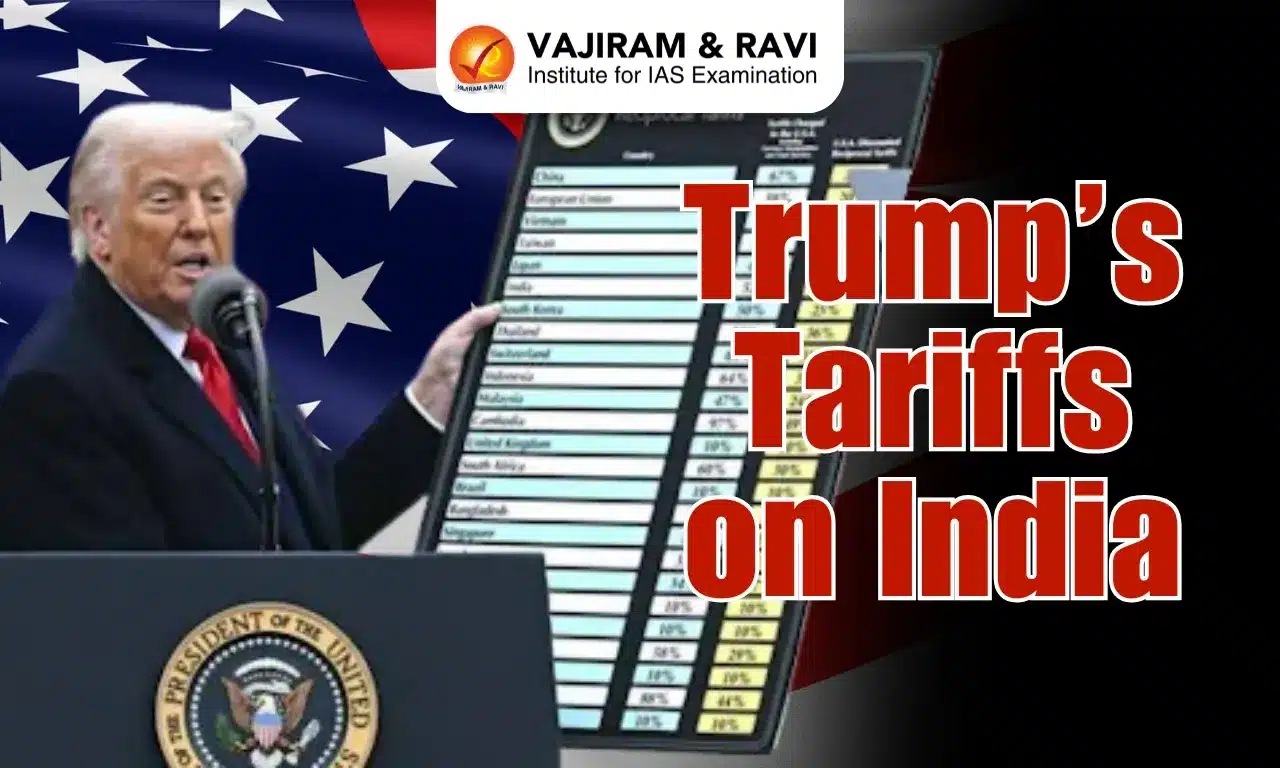
  • U.S. President Donald Trump announced a 25% tariff plus an additional penalty on Indian imports, ending months of speculation. 
  • However, this move has introduced fresh uncertainty over the prospects of a bilateral trade agreement between India and the U.S., complicating future trade negotiations.

Trump Imposes Tariffs on India

  • U.S. President Donald Trump announced a 25% tariff on Indian imports, citing India’s tariff and non-tariff barriers and its energy and defense dealings with Russia as key reasons. 
  • While details of the additional penalty remain unclear, Trump has previously threatened a 10% extra tariff on BRICS nations, which could raise India’s effective tariff rate to 35%
  • Additionally, pending U.S. legislation proposes a 500% tariff on India, China, and Brazil for their continued engagements with Russia, adding further uncertainty to India-U.S. trade relations.

Impact of Trump’s Tariffs on Indian Economy and Key Export Sectors

  • While U.S. importers will bear the direct cost of the new tariffs, Indian goods will become less competitive and more expensive in the U.S. market. 
  • On a macroeconomic level, the tariffs are expected to reduce India’s GDP growth by 0.2%, lowering forecasts from 6.6% to 6.4%, according to Bank of Baroda research. 
  • However, the real impact will be sector-specific, hitting industries like garments, precious stones, auto parts, leather goods, and possibly electronics.
    • These sectors may face pricing disadvantages compared to competitors from Vietnam, South Korea, and Indonesia, who benefit from lower tariffs. 
  • Exporters in these sectors will need to rework their strategies to stay competitive.

The Breakdown of India-U.S. Trade Talks Leading to Tariffs

  • In February 2025, Prime Minister Narendra Modi and President Donald Trump announced plans to finalise the first tranche of a bilateral trade deal by fall, a move seen as a positive commitment to strengthening ties. 
  • This announcement came ahead of Trump’s broader reciprocal tariffs strategy, which pressured other countries to enter negotiations with the U.S. 
  • However, on April 2, Trump launched his Liberation Day tariffs, imposing a 10% baseline tariff globally and additional country-specific tariffs, with India facing a 26% total tariff. 
  • Following backlash, Trump announced a 90-day pause to allow for bilateral negotiations aimed at reducing trade deficits. 
  • The pause, initially set to expire in July, was extended until August 1, but no breakthrough was reached, leading to the imposition of tariffs.

Multiple Frictions Strain India-U.S. Trade Relations

  • While no single incident has soured India-U.S. ties, several points of friction have built up in recent months. 
  • President Trump has consistently criticised India’s tariff and non-tariff barriers and has also raised concerns about India’s continued energy and defense dealings with Russia, accusing it of indirectly financing the Ukraine war. 
  • India, however, has defended its energy security strategy, with Russia supplying 35-40% of its oil imports. 
  • Additionally, India’s refusal to open its agriculture and dairy sectors to foreign competition remains a major sticking point, as it protects vulnerable domestic farmers. 
  • Tensions escalated further when Trump claimed credit for the India-Pakistan ceasefire (Operation Sindoor), a claim firmly rejected by India. 
  • In response to U.S. tariffs on Indian goods like steel and aluminium, India has informed the WTO of its right to impose retaliatory tariffs. 
  • These cumulative issues have set the stage for Trump’s recent tariff imposition, reflecting the growing strains in bilateral ties.

India Faces Imminent Tariffs Amid Uncertain Trade Deal Prospects

  • Despite discussions of a potential “mini-deal” to ease reciprocal tariffs, U.S. President Donald Trump’s recent tariff announcement signals that such a deal is unlikely in the near term. 
  • Both India and the U.S. remain committed to finalising a broader trade agreement by fall 2025, but progress has been complicated by Trump’s decision to link India’s Russia engagements to trade negotiations
  • So far, five rounds of talks have been held, with the next U.S. delegation visit scheduled for late August. 
  • Meanwhile, Trump’s Executive Order, dated July 31, mandates that tariffs on Indian imports will take effect within 7 days, making the imposition of duties imminent and unavoidable for now.

Source: TH

Trump’s tariffs on India FAQs

Q1: Why did Trump impose tariffs on India?

Ans: Due to India’s trade barriers, engagements with Russia, and refusal to open sensitive sectors like agriculture and dairy.

Q2: Which Indian sectors will be hit hardest by tariffs?

Ans: Garments, precious stones, auto parts, leather goods, and possibly electronics will face competitiveness challenges in the U.S. market.

Q3: Will these tariffs significantly impact India’s GDP?

Ans: No, Bank of Baroda estimates India’s GDP growth will fall marginally by 0.2%, but sectoral impacts will be severe.

Q4: Can India and the U.S. still reach a trade deal?

Ans: Both sides are committed to finalising a trade deal by fall 2025, but tensions over Russia complicate negotiations.

Q5: How is India preparing to counter U.S. tariffs?

Ans: India has informed the WTO of its right to impose retaliatory tariffs on American imports like steel and automobiles.

Wind Farms of Thar Desert Record World’s Highest Bird Mortality Rate

Wind Farms

Wind Farms Latest News

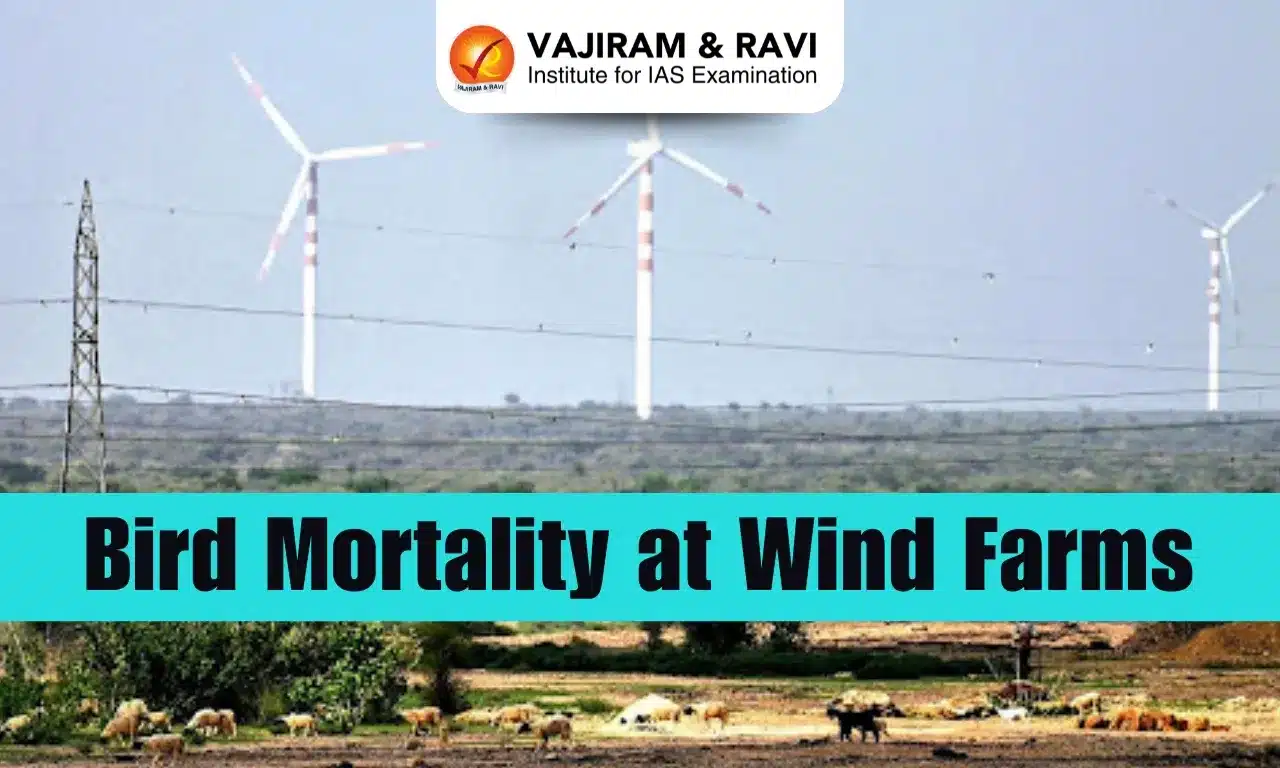
  • A new study has found that wind farms in India’s Thar Desert have the world’s highest recorded bird mortality rates, raising concerns over the environmental impact of renewable energy expansion.

Introduction

  • As India accelerates its push towards renewable energy to meet growing climate commitments and power demands, an unintended consequence has emerged in the form of large-scale bird deaths. 
  • A study by the Wildlife Institute of India (WII) reveals that wind farms in the Thar Desert have the highest recorded bird mortality rates in the world, with critically endangered species such as the Great Indian bustard under threat.

Key Findings on Bird Mortality in the Thar Desert

  • The study, published in Nature Scientific Reports, was conducted across 3,000 sq. km of desert landscape in Jaisalmer, Rajasthan, which hosts about 900 wind turbines and over 270 bird species
  • Researchers conducted seven multi-season surveys around 90 randomly selected turbines, identifying 124 bird carcasses within a 150-meter radius.
  • The annual estimated bird mortality was a staggering 4,464 birds per 1,000 sq. km, after accounting for carcass detection challenges such as scavenging and terrain obstacles. 
  • By contrast, control sites, located 500 to 2,000 meters away from turbines, showed zero bird deaths, confirming the turbines as the primary cause.
  • Notably, the study's mortality estimate of 1.24 bird deaths per turbine per month is significantly higher than previous findings from Kutch and Davangere, which reported 0.47 deaths per turbine annually.

Species at Risk and Regional Vulnerability

  • The Thar Desert forms a crucial segment of the Central Asian Flyway, a major migration route for birds across Eurasia, making it an ecologically sensitive zone. 
  • The area also serves as a prominent wintering ground, further amplifying the risk of avian fatalities due to wind power infrastructure.
  • Among the most vulnerable bird species are raptors, which are long-lived and reproduce slowly. 
  • Their soaring flight patterns and altitude bring them directly into the rotating blades of wind turbines, making them especially susceptible to collisions. 
  • These additional mortalities can lead to population-level impacts, particularly for endangered species.

Proposed Mitigation Measures

  • Several mitigation strategies have been proposed globally and domestically to address the issue of bird deaths at wind farms:
    • Blade painting: Painting one turbine blade black to increase visibility for birds.
    • Timed shutdowns: Halting turbine operations during high-risk periods such as migration seasons or early morning hours.
    • Site selection: Most crucially, experts recommend careful pre-installation site assessments to avoid high-avian-sensitivity zones.
  • One key tool in this regard is the Avian Sensitivity Tool for Energy Planning (AVISTEP), an open-source platform developed by BirdLife International. 
  • It helps developers identify zones classified into ‘low’, ‘moderate’, ‘high’, and ‘very high’ sensitivity to bird species. 
  • However, experts stress that AVISTEP must be complemented by detailed ground-level studies.
  • Despite the severity of impacts, onshore wind energy projects in India are currently not mandated to conduct environmental impact assessments (EIAs) before installation, a gap that requires urgent regulatory attention.

Offshore Wind Energy: An Emerging Focus

  • India is now turning its attention to offshore wind energy, considered a less land-intensive alternative. 
  • The country plans to install 30 GW of offshore wind capacity by 2030, with the Ministry of New and Renewable Energy already issuing 4 GW of bids in Gujarat and Tamil Nadu.
  • With 7,600 km of coastline and 2.3 million sq. km of exclusive economic zones, India has immense potential for offshore wind. 
  • According to the Council on Energy, Environment and Water (CEEW), the addition of offshore wind capacity in states like Gujarat can help ensure grid reliability during peak loads.
  • However, experts caution that marine biodiversity impacts must not be overlooked. 
  • Offshore wind projects involve complex infrastructure that can disrupt marine habitats, increase noise levels, and degrade water quality. 
  • The Gulf of Khambhat EIA report documented the presence of sensitive species like dolphins and sharks, with warnings about construction-phase disturbances.
  • Although EIAs are mandatory for offshore wind projects, concerns remain about the accuracy and duration of ecological assessments, especially in high-biodiversity zones such as the Gujarat coast, which lies along both the Central Asian and African-Eurasian flyways.

Source : TH

Wind Farms MCQs

Q1: Which region has recorded the world’s highest bird death rates at wind farms?

Ans: India’s Thar Desert wind farms have the highest recorded bird mortality rates globally.

Q2: Which species are most vulnerable to wind turbine collisions?

Ans: Raptors and the critically endangered great Indian bustard are among the most affected.

Q3: What mitigation tool helps identify high-risk zones for bird collisions?

Ans: The Avian Sensitivity Tool for Energy Planning (AVISTEP) maps avian-sensitive areas.

Q4: Are onshore wind energy projects in India required to conduct EIAs?

Ans: No, onshore wind projects are currently not mandated to undertake environmental impact assessments.

Q5: What is India’s offshore wind energy target for 2030?

Ans: India aims to install 30 GW of offshore wind capacity by 2030.

Enquire Now