The Simon Commission Report, published in 1930 during a period of intense government repression and the height of the Civil Disobedience Movement, failed to propose dominion status for India. This omission transferred even the most moderate sections of Indian political thought, further intensifying opposition to British rule. In response, the Viceroy extended an invitation to Indian leaders for a Round Table Conference, indicating that the question of granting dominion status would be considered. Consequently, between 1930 and 1932, the British government held a series of Round Table Conferences to deliberate on the future governance structure of India.
First Round Table Conference
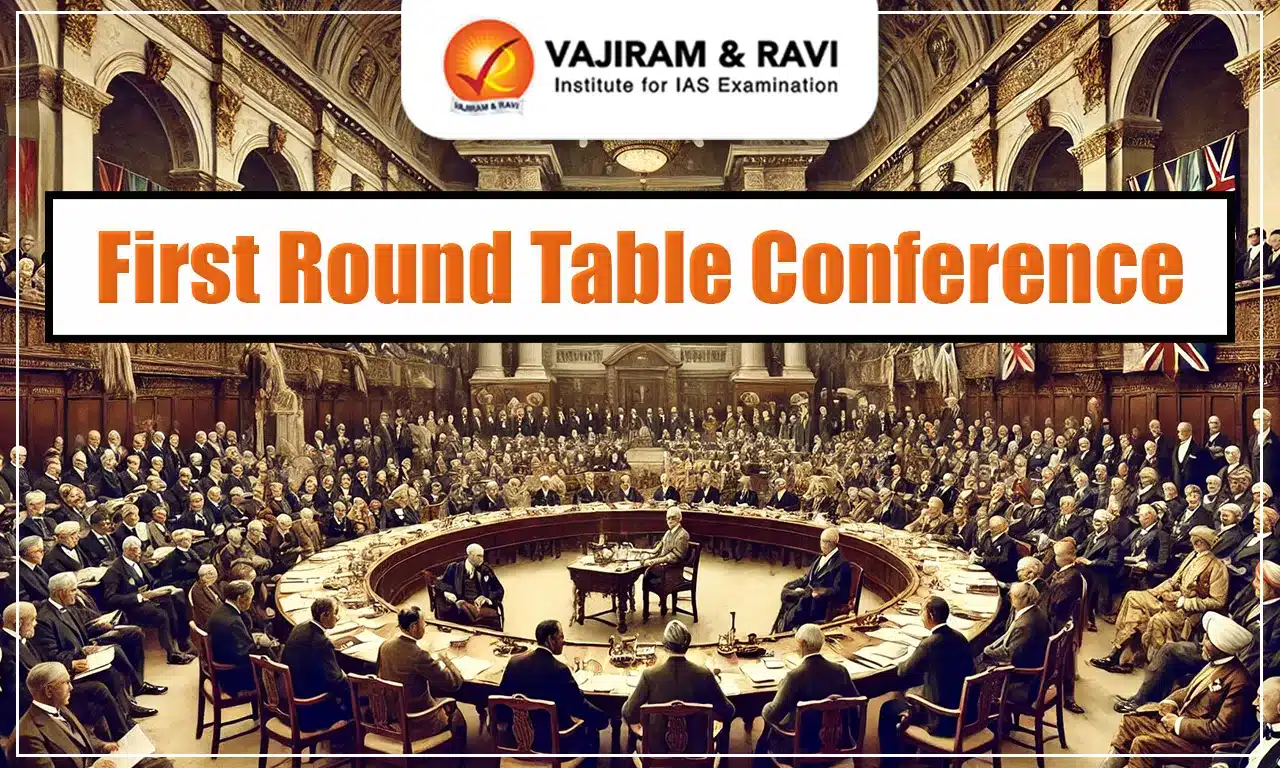
The First Round Table Conference marked the beginning of a series of three conferences convened by the British Government between 1930 and 1932 to deliberate on constitutional reforms in India. These conferences were organized in line with the recommendations of the Simon Commission Report 1930. The inaugural session was formally opened by King George V on 12 November 1930 at the House of Lords in London. The proceedings were presided over by the then Prime Minister of Britain, Ramsay MacDonald.
First Round Table Conference Background
- Several voices within the British political establishment had begun advocating for India to be granted dominion status. Meanwhile, the Indian freedom movement was gaining momentum under the leadership of Mahatma Gandhi, who initiated the cause of swaraj (self-rule).
- The Round Table Conferences were convened based on recommendations made by Muhammad Ali Jinnah to Viceroy Lord Irwin and Prime Minister Ramsay MacDonald, as well as the findings of the Simon Commission.
- The First Round Table Conference, held on November 12, 1930, marked a significant occasion where Indian and British representatives engaged on equal footing for the first time.
- Although the Indian National Congress and several leading industrialists boycotted the event, numerous other Indian political and social groups participated.
First Round Table Conference Features
The first Round Table Conference was held in London from November 1930 to January 1931, under the leadership of British Prime Minister Ramsay MacDonald. It marked the first formal meeting where Indians and British officials sat across the table as political equals. However, the Indian National Congress, then the largest political party in the country, chose to boycott the conference.
Despite this, several key groups did take part, including representatives of the Princely States, the Muslim League, the Justice Party, and the Hindu Mahasabha. But without Congress at the meeting, the talks failed to produce any major breakthrough. The British government came away with one clear lesson: any serious conversation about the constitutional future of India would be incomplete without the Congress.
First Round Table Conference Participants
The First Round Table Conference saw participation from a wide range of representatives. Sixteen delegates came from the three major British political parties, while India was represented by 74 delegates. Among them, 58 were from Indian political parties and 16 from princely states. Other than this, representatives from zamindari estates in Bihar, the United Provinces, and Orissa, as well as from universities, Burma, Sindh, and other provinces, were present.
| First Round Table Conference Participants | |
| Participant | Represented by |
|
Indian Princely States |
Maharaja of Alwar, Maharaja of Baroda, Nawab of Bhopal, Maharaja of Bikaner, Rana of Dholpur, Maharaja of Jammu and Kashmir, Maharaja of Nawanagar, Maharaja of Patiala, Maharaja of Rewa, Chief Sahib of Sangli, Sir Prabhashankar Pattani (Bhavnagar), Manubhai Mehta (Baroda), Sardar Sahibzada Sultan Ahmed Khan (Gwalior), Akbar Hydari (Hyderabad), Mirza Ismail (Mysore), Col. Kailas Narain Haksar (Jammu and Kashmir) |
|
Muslim League |
Aga Khan III (leader of British-Indian delegation), Maulana Mohammad Ali Jauhar, Muhammad Shafi, Muhammad Ali Jinnah, Muhammad Zafarullah Khan, A.K. Fazlul Huq, Hafiz Ghulam Hussain Hidayat Ullah, Dr.Shafa’at Ahmad Khan, Raja Sher Muhammad Khan of Domeli, and A.H. Ghuznavi |
|
Hindu Mahasabha |
B.S. Moonje, M.R. Jayakar, and Diwan Bahadur Raja Narendra Nath |
|
Sikhs |
Sardar Ujjal Singh and Sardar Sampuran Singh |
|
Parsis |
Phiroze Sethna, Cowasji Jehangir, and Homi Mody |
|
Women |
Begum Jahanara Shahnawaz and Radhabai Subbarayan |
|
Liberals |
J.N. Basu, Tej Bahadur Sapru, C.Y. Chintamani, V.S. Srinivasa Sastri, and Chimanlal Harilal Setalvad |
|
Depressed Classes |
B.R. Ambedkar and Rettamalai Srinivasan |
|
Justice Party |
Arcot Ramasamy Mudaliar, Bhaskarrao Vithojirao Jadhav, and Sir A.P. Patro |
|
Labour |
N.M. Joshi and B. Shiva Rao |
|
Indian Christians |
K.T. Pau |
|
Anglo-Indians |
Henry Gidney |
|
Europeans |
Sir Hubert Carr, Sir Oscar de Glanville (Burma), T.F. Gavin Jones, C.E. Wood (Madras) |
|
Government of India |
Nath Law, Bhupendra Nath Mitra, C.P. Ramaswami Iyer, and M. Ramachandra Rao |
First Round Table Conference Issues Discussed
- The First Round Table Conference examined the structure of a federal government for India.
- The constitutional framework for provinces was a key topic of discussion.
- Issues concerning Sindh and the Northwest Frontier Province, as well as the protection of minority rights and defense services, were addressed.
- The principle of executive accountability to the legislature was debated.
- Dr. B. R. Ambedkar advocated for the provision of separate electorates for the Scheduled Castes, referred to at the time as “untouchables.”
- Tej Bahadur Sapru proposed the creation of an All-India Federation, a suggestion that received support from the Muslim League.
- The princely states expressed their willingness to join the federation, provided that their internal autonomy and sovereignty were safeguarded.
First Round Table Conference Outcome
- The First Round Table Conference was held between 1930 and 1931.
- Though reforms were discussed during the conference, none were actually put into practice.
- At the time, Congress leaders were actively leading the Civil Disobedience Movement.
- Because of their absence, the conference made little progress and was largely seen as a failure.
- The British Government soon realised that without the Indian National Congress, no meaningful reforms could move forward.
- They hoped Congress would participate in the next round.
- In March 1931, Gandhi and Lord Irwin signed the Gandhi-Irwin Pact, bringing the Civil Disobedience Movement to an end and paving the way for Congress to join the Second Round Table Conference.
- It became clear to the British that Congress had to play a central role in shaping India’s constitutional future.
First Round Table Conference FAQs
Q1: What was the First Round Table Conference?
Ans: The First Round Table Conference was a series of political discussions held in London in 1930 to consider constitutional reforms in British India.
Q2: When did the First Round Table Conference take place?
Ans: It was held from November 12, 1930, to January 19, 1931, in London at St. James's Palace.
Q3: Who organized the First Round Table Conference?
Ans: The British Government, led by Prime Minister Ramsay MacDonald, organized the conference to discuss India's constitutional future.
Q4: Did the Indian National Congress attend the First Round Table Conference?
Ans: No, the Indian National Congress boycotted the conference due to the Civil Disobedience Movement launched under Mahatma Gandhi’s leadership.
Q5: Who represented India at the First Round Table Conference?
Ans: Delegates included representatives from princely states, Muslim League, Hindu Mahasabha, Dalits (Dr. B.R. Ambedkar), and other minority and special interest groups.