Bad Bank, Full Form, Meaning, Benefits, Framework, Challenges

Bad Bank

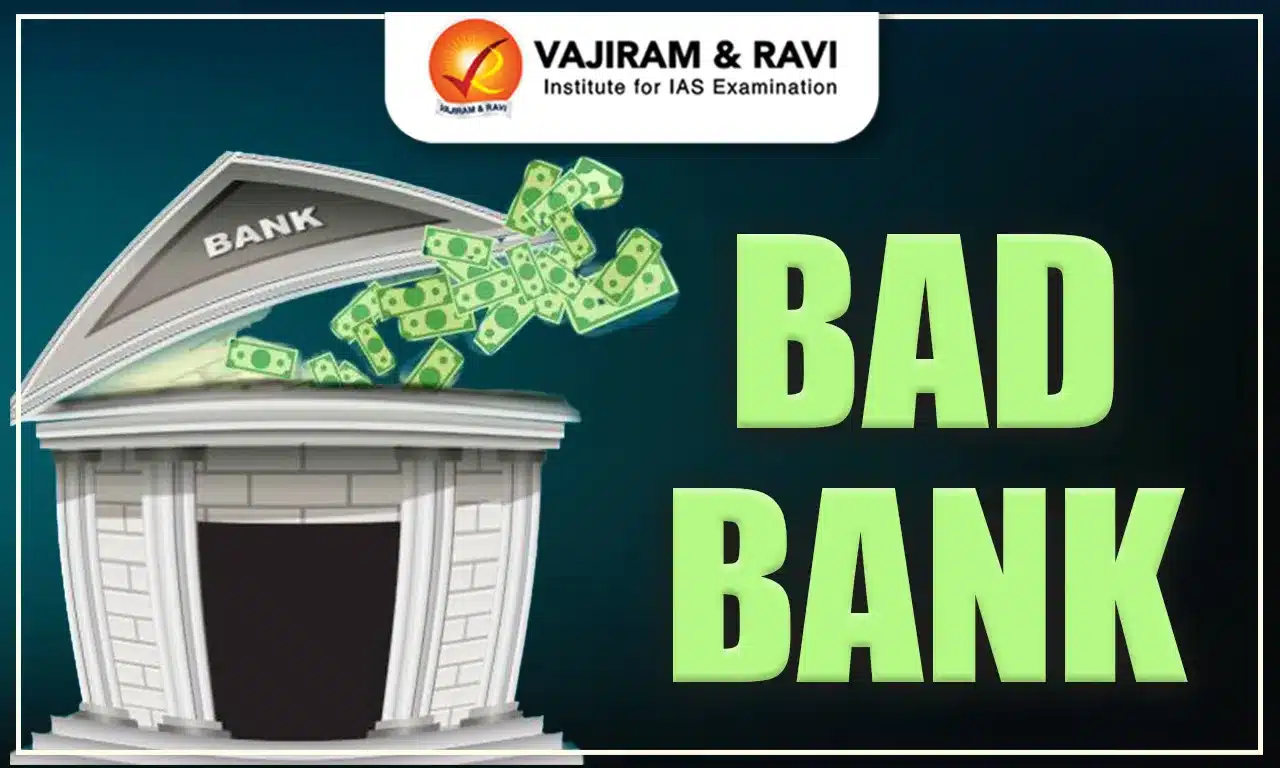
Bad Banks were established in India in 2021 and address India’s growing problem of non-performing assets. These banks are established for especially taking over and resolving stressed loans with the aim of reducing the burdens of non-performing assets on the banking system. These bad banks not only help clean up balance sheets but also revive credit flow in the economy. In this article, we are going to cover Bad Banks, their evolution, framework and benefits and challenges. 

Bad Bank

A Bad Bank is also known as an asset reconstruction company specialised in purchasing non-performing assets from commercial banks and works towards restructuring and recovery. While normal banks are conventional in nature, bad banks don't engage in lending or accepting deposits and its specialized role is to free commercial banks from the problems of bad banks. The Non- Performing Assets are collected at a discounted rate in comparison to its book value and the bad bank then tries to recover as much value as possible. 

Bank banks play an important role in bringing down the burden of NPAs and improve the quality of banks’ balance sheets, release locked capital and allow new credit creation. In this manner, it is also linked to break down the vicious cycle created by the Twin Balance Sheet problem, and its impact on both banks as well as corporations. 

Bad Banks in India Evolution

The concept of Bad Bank is not new in India. It was first suggested through the establishment of the Central Public Sector Asset Rehabilitation Agency in the Economic Survey 2016-17. The economic survey suggested that India requires a centralised mechanism to address the stocking up of NPAs that were responsible for dragging down the financial system. It was in the 2021 Union Budget that Bad Banks were set up by announcing the setting up of a bad bank under a dual structure. This initiative comprises an Asset Reconstruction Company and an Asset Management Company. While ARC would take over stressed assets from banks, the AMC would manage and resolve them with the expertise required for complex debt restructuring. 

Bad Bank Requirement in India

Bank Banks in India are needed for many reasons: 

  1. Economic Recovery: Due to the COVID-19 pandemic, the banking sector came under high stress and the RBI predicted a sharp rise in NPAs due to the six-month loan moratorium and the slowdown in economic activity.
  2. Government Support: A Bad Bank, if managed and funded by professionals like private lenders, and supported by government support, was seen as a smooth approach to deal with the NPA crisis. The involvement of the government provided confidence and was expected to expedite the clean-up process.
  3. Rising NPAs: According to the K.V. Kamath Committee, corporate debt worth ₹15.52 lakh crore became stressed after the pandemic, in addition to ₹22.20 lakh crore already under stress. This huge figure highlighted the need for a centralised mechanism.
  4. Twin Balance Sheet Problem: The growing debt on both banks and corporates created a vicious cycle for banks saddled with bad loans were unable to lend, and corporates trapped in debt were unable to invest affecting the economic growth.

  5. International Precedents: Countries like the USA, Ireland, Sweden, and South Korea had successfully set up Bad Banks or similar mechanisms to manage systemic stress in their financial systems. Their experiences help add weight to India’s decision.

Bad Banks Framework in India 

The establish the Bad Bank concept in India, the government introduced two institutions in India: 

  • National Asset Reconstruction Company Limited (NARCL)
    • NARCL was set up under the Companies Act and later applied to the RBI for registration as an ARC. 
    • The goal was to collect stressed assets worth Rs. 2 lakh crore from commercial banks in a phased manner. 
    • Public sector banks have 51% equity holding in NARCL and make sure that control remains with them. 
  • India Debt Resolution Company Limited (IDRCL)
    • The organisation works with NARCL and works as a resolution manager. The job is to sell stressed assets in a market and recover maximum value .
    • When it comes to ownership, PSBs and other public financial institutions hold up to 49% in IDRCL, and private sector lenders hold a majority stake of 51%. 
    • NARCL-IDRCL together present the institutional framework of Bad Banks of India.

Bad Bank Benefits 

Setting up of bad banks has the following benefits: 

  • Improved Balance Sheets: By transferring NPAs, banks immediately reduce their burden of stressed assets, which helps strengthen their balance sheets.
  • Unlocking of Capital: With reduced provisioning requirements, banks can release previously locked capital, which can then be redirected towards fresh lending.
  • Focus on Core Functions: Banks are freed from the task of loan recovery and can concentrate on their primary roles of deposit mobilization and credit extension.
  • Better Coordination: When multiple banks have exposure to the same stressed borrower, resolution becomes difficult. A Bad Bank consolidates such cases, improving efficiency and speeding up the process.
  • Stimulus for Growth: By reviving credit flow and easing the financial stress of banks, a Bad Bank can contribute indirectly to economic recovery and growth.

Bad Bank Challenges

While Bad Banks have many benefits, there are certainly many challenges that come along with the implementation: 

  • Moral Hazard: Bailing out inefficient banks with taxpayer money creates complacency. Banks might continue risky lending practices, relying on government-backed bailouts in the future.
  • Pricing Dilemma: Determining the right value of NPAs is complex. If assets are sold too cheap, banks suffer heavy losses; if overpriced, the Bad Bank itself risks collapse.
  • Superficial Solution: Just transferring NPAs from one institution to another does not remove the underlying problem. It just covers the problem for some time.
  • Lack of Structural Reform: Unless deeper reforms in governance and accountability are implemented, particularly in PSBs (which account for over 80% of NPAs), bad loans may pile up again.
  • International Lessons: Global experience, such as Sweden’s, shows that Bad Banks work best when NPAs are concentrated in small-value housing loans. In India, however, NPAs are spread across diverse and complex sectors.
  • Financial Constraints: Using funds to set up and sustain a Bad Bank is a challenge in a fiscally strained environment. Also, in a pandemic-hit economy, finding investors willing to buy distressed assets is not easy.

Bad Bank FAQs

Q1: Which bank is known as a bad bank?

Ans: The National Asset Reconstruction Company Limited (NARCL) is commonly referred to as India’s Bad Bank.

Q2: What is the definition of a bad bank?

Ans: A Bad Bank is a financial entity that buys and manages stressed assets or Non-Performing Assets (NPAs) from commercial banks to help clean their balance sheets.

Q3: Why is NARCL called a bad bank?

Ans: NARCL is called a Bad Bank because it acquires bad loans from banks and focuses only on resolving stressed assets rather than regular banking activities.

Q4: What is the full form of Bad Bank?

Ans: Bad Bank is not an acronym, so it has no full form; it is a generic term used for institutions like NARCL and IDRCL that handle NPAs.

Q5: What is an ARC?

Ans: ARC stands for Asset Reconstruction Company, which is a specialized institution that buys NPAs from banks and works on recovering or restructuring them.
Aquatic Ecosystem, Definition, Types, Diagram, Examples

Aquatic Ecosystem

The Aquatic Ecosystem consists of a huge diversity of organisms and habitats that help maintain an ecological balance of our planet.  A study of aquatic ecosystems is important to understand the fundamental ecological concepts and the challenges posed by environmental changes and degradation. In this article, we are going to cover the aquatic ecosystem, its types, its features and threat. 

Ecosystem

An ecosystem is a self-sustaining unit of nature where communities of living organisms interact closely with each other and along with their physical surroundings. These interactions involve the transfer and materials and makes the ecosystem a functional entity. Ecosystems are sub-categorised into size and scale and can be spread across vast areas like forests, seas and deserts or small and contained ponds and fish tanks. 

Aquatic Ecosystem 

An aquatic ecosystem is an ecological system that initiates interactions among organisms in water-dominated environments. Aquatic plants, animals and microbes ecoexist in this aquatic habitat with the help of physical factors like light, temperature and dissolved nutrients helping balance ecological dynamics. 

Aquatic Ecosystem Types

Aquatic Ecosystems can be sub-divided into types on the basis of salinity. These types includes: 

  • Freshwater Ecosystems 
  • Marine Ecosystems
  • These ecosystems are found all over the world and found in the form of estuaries, mangroves, coral reefs, seagrass and meadows.  

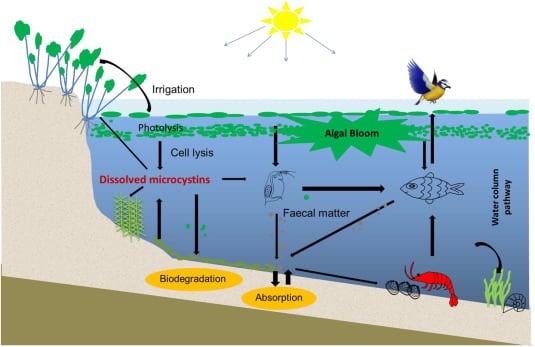
Aquatic Ecosystem Diagram

The aquatic ecosystem can be better understood using this diagram: 

Aquatic Ecosystem Diagram

Aquatic Ecosystem Food Chain

 A food chain in an aquatic ecosystem represents the flow of energy from one organism to another through successive levels of producers, consumers, and decomposers.

  1. Producers (Autotrophs)
  • These are the base of the aquatic food chain.
  • Include phytoplankton, algae, and aquatic plants.
  • They perform photosynthesis using sunlight and nutrients, producing energy-rich compounds.
  1. Primary Consumers (Herbivores/Zooplankton)
  • Feed directly on producers.
  • Include zooplankton, small crustaceans, insect larvae, and mollusks.
  • Act as a crucial link between producers and higher consumers.
  1. Secondary Consumers (Small Carnivores)
  • Feed on primary consumers.
  • Examples: small fish, crabs, frogs, jellyfish.
  1. Tertiary Consumers (Larger Carnivores)
  • Feed on secondary consumers.
  • Examples: large fish, squids, seals, water snakes.
  1. Apex Predators (Top Carnivores)
  • Occupy the top of the food chain.
  • Examples: sharks, dolphins, crocodiles, killer whales.
  1. Decomposers
  • Break down dead organisms and recycle nutrients back into the system.
  • Examples: bacteria, fungi, actinomycetes.

Phytoplankton → Zooplankton → Small Fish → Large Fish → Shark

Freshwater Ecosystem

A freshwater ecosystem is an aquatic ecosystem where the concentration of salts is very low, typically less than 1%. These ecosystems are continuously cycling and include rivers, lakes, and ponds. Though they cover only about 0.8% of the Earth’s surface, freshwater ecosystems are vital for sustaining terrestrial and aquatic life alike.

Examples: Pond ecosystem, lake ecosystem, and river ecosystem.

Freshwater Ecosystems Categories

Depending on the movement of water, freshwater ecosystem has two categories: 

  • Lentic Ecosystems (stagnant water bodies)
  • Lotic Ecosystems (flowing water bodies)

Lentic Freshwater Ecosystem

These are closed systems where water remains largely still with no significant outflow. They usually form in depressions on the Earth’s surface where water accumulates from rainfall, streams, or underground sources. Because water is stagnant, lentic systems often show layering (stratification) with distinct ecological zones.

Lotic Freshwater Ecosystem

These are ecosystems with rapidly moving water flowing in a single direction, such as rivers, streams, springs, and mountain brooks. Their primary role is to channel surplus rainwater back to the oceans. Plant diversity in lotic systems is relatively low compared to lentic ones, as the continuous flow of water poses a survival challenge for rooted plants and larger vegetation.

Freshwater Ecosystems Types

Freshwater habitats are further divided into lakes, flood ponds, and rivers.

  • Lakes: A lake is a relatively deep and large inland water body surrounded by land, often fed or drained by rivers and streams. Natural lakes are typically found in mountainous terrains, rift valleys, or glacial regions. Examples: Loktak Lake, Wular Lake.
  • Flood Ponds: These seasonal ponds fill during monsoons but dry up in other parts of the year. Many organisms like algae, insects, snails, and worms remain dormant in the dry season and become active again when water returns.
  • Rivers: Rivers are flowing freshwater systems that carry rainfall runoff across landscapes before discharging into seas or oceans. They are among the most dynamic freshwater systems.
    Examples: Ganga, Yamuna, Tapti, Krishna, Cauvery, Narmada.

Marine Ecosystem

Marine ecosystems include the largest water bodies on Earth, such as oceans, lagoons, estuaries, mangroves, coral reefs, and even the deep-sea floor. These systems cover nearly 71% of the planet’s surface and are characterized by high salt content.

As one moves from coastal areas to the open ocean, depth increases, leading to the development of various ecological zones. Marine producers range from tiny phytoplankton to massive seaweeds, while consumers include fish, turtles, invertebrates, and mammals. The sunlit surface waters are highly productive, while deeper regions depend on organic matter descending from above.

Marine Ecosystems Zones

Marine ecosystems are divided into zones based on depth, light availability, and ecological conditions:

  • Photic (Euphotic) Zone: Extends to about 200 meters; rich in sunlight and supports abundant photosynthesis by phytoplankton and algae. This is the most productive zone.
  • Disphotic Zone: Extends from 200–1000 meters; receives dim light insufficient for photosynthesis but still supports specialized species adapted to low-light environments.
  • Aphotic Zone: Begins below 1000 meters, completely dark and high-pressure. Life here relies on “marine snow,” i.e., organic debris falling from upper layers.

Marine Ecosystems Influencing Factors

The distribution of marine organisms is affected by:

  • Light availability: highest biodiversity occurs in sunlit zones.
  • Proximity to land:  nutrient inflow from rivers enriches coastal ecosystems.
  • Depth and pressure: organisms adapt uniquely to extreme depths and pressures.

Marine Ecosystems Types 

Marine Ecosystem is sub-divided into the following types: 

  • Open Marine Ecosystem: Also called the euphotic zone, up to 150 meters deep. Hosts plankton, algae, jellyfish, whales, and other freely moving organisms.
  • Ocean Floor Ecosystem: Found at great depths with little or no sunlight. Organisms here often produce their own bioluminescence for survival.
    Examples: crabs, jellyfish, squids, corals, sperm whales.

Estuaries

Estuaries are transitional zones where rivers carrying freshwater and silt meet saline ocean waters. They represent ecotones and are among the most nutrient-rich and biodiverse ecosystems. They combine features of both freshwater and marine ecosystems, estuaries often support more biodiversity than either system alone.Examples: Coastal bays, lagoons, deltas, tidal marshes.

Mangroves

Mangroves are specialized trees growing in salty intertidal zones, particularly in river deltas. These forests are highly productive, act as nurseries for fish and crustaceans, and provide natural coastal protection from erosion, storms, and cyclones. Example: Sundarbans delta in India.

Coral Reefs

Coral reefs, often called the “rainforests of the sea,” are one of the most diverse and productive ecosystems on Earth. They are formed by coral polyps, tiny marine animals that secrete calcium carbonate skeletons. Reefs harbor countless species including sponges, mollusks, fish, turtles, sharks, and dolphins, making them important for marine biodiversity.

Seagrasses

Seagrasses are flowering plants that grow underwater, usually between coral reefs and mangrove habitats. They form dense meadows that serve as feeding grounds and shelters for commercially important species like snappers, lobsters, and crabs. Besides stabilizing sediments, seagrasses filter water and release oxygen, playing an important role in maintaining marine health.

Aquatic Ecosystem FAQs

Q1: What are the three types of aquatic ecosystems?

Ans: The three main types of aquatic ecosystems are freshwater, marine, and estuarine ecosystems.

Q2: What is the aquatic lake ecosystem?

Ans: A lake ecosystem is a lentic freshwater ecosystem where water is stagnant, supporting diverse plants, plankton, fish, and other aquatic life.

Q3: What are the aquatic ecosystems in India?

Ans: India’s aquatic ecosystems include rivers, lakes, wetlands, estuaries, mangroves, coral reefs, and coastal waters.

Q4: What is the freshwater ecosystem?

Ans: A freshwater ecosystem is an aquatic system with low salt concentration (<1%), such as rivers, lakes, and ponds.

Q5: What is seagrass?

Ans: Seagrass refers to flowering marine plants that form underwater meadows, providing food, habitat, and oxygen for marine life.

Dr. Sarvepalli Radhakrishnan, Early Life, Career, Political Leadership

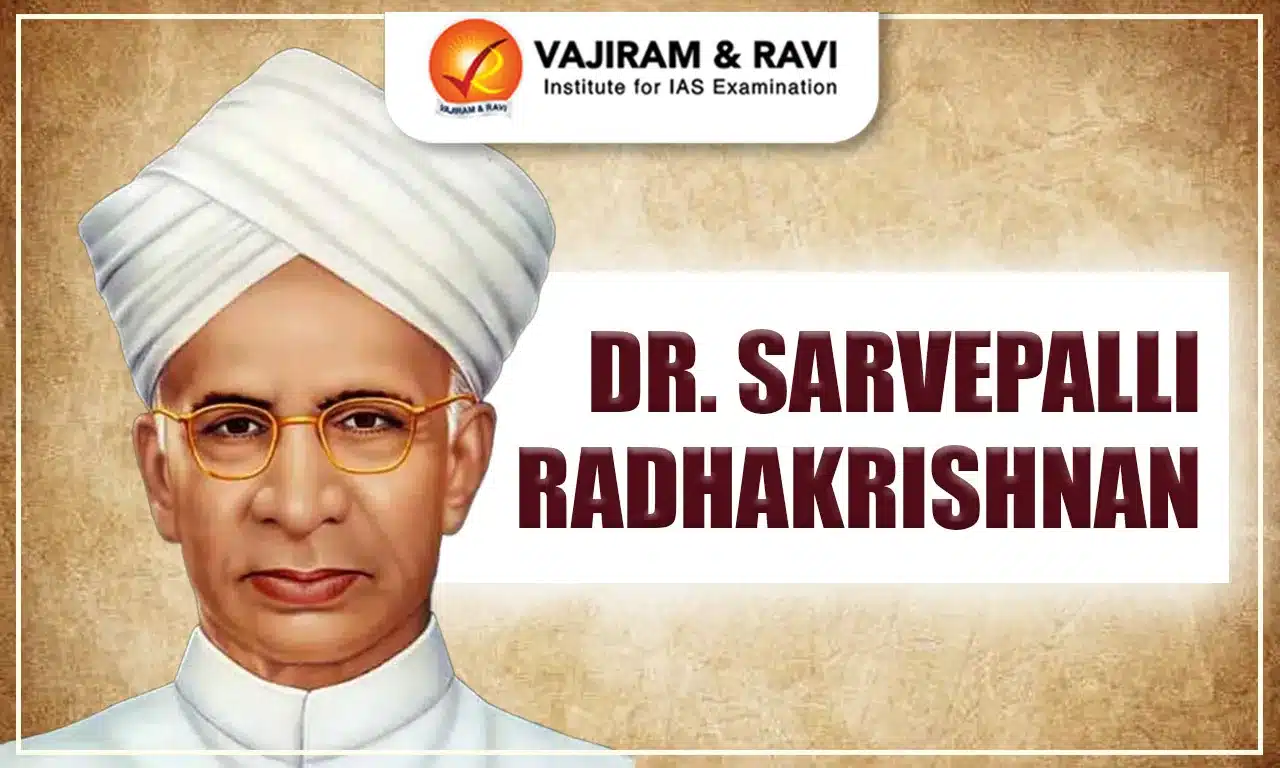
Dr. Sarvepalli Radhakrishnan

Dr. Sarvepalli Radhakrishnan (1888-1975) was a renowned Indian philosopher, scholar, and statesman. He became the First Vice President of India and later went on to serve as the Second President of India. Known for his deep commitment to education and learning, his contributions earned him immense respect, and his birthday, September 5, is observed across India as Teacher’s Day in his honor.

Dr. Sarvepalli Radhakrishnan Early Life

Dr. Sarvepalli Radhakrishnan was born on September 5, 1888, in Tiruttani, then part of the Madras Presidency (now in Tamil Nadu), into a Niyogi Brahmin family of Tamil background. His father worked as a revenue official in a modest position, and Radhakrishnan spent his early years in the spiritually significant towns of Tiruttani and Tirupati. A gifted student, he earned scholarships throughout his academic journey.

He studied at K.V. High School in Tiruttani, the Hermannsburg Evangelical Lutheran Mission School in Tirupati, and later at the Government High Secondary School in Walajapet. Pursuing higher education, he joined Voorhees College before moving on to Madras Christian College, where he completed both his bachelor’s and master’s degrees in philosophy by 1906. This strong academic foundation, coupled with exposure to culture and ethics during his formative years, shaped his future contributions to philosophy and education.

Dr. Sarvepalli Radhakrishnan Career

Though widely celebrated as a philosopher in India, Dr. Sarvepalli Radhakrishnan also earned a lasting reputation on the global stage. He began his academic journey in 1909 as a lecturer in philosophy at Madras Presidency College and later went on to teach at Maharaja’s College, Mysore, and the University of Calcutta.

His writings, particularly The Philosophy of Rabindranath Tagore and The Reign of Religion in Contemporary Philosophy, established him as a serious thinker and earned him recognition well beyond India. Representing the University of Calcutta at international forums, he delivered the prestigious Hibbert Lectures at Oxford, which were later published as An Idealist View of Life. 

His leadership roles as Vice-Chancellor of Andhra University and Banaras Hindu University eventually led to his appointment as the Spalding Professor of Eastern Religions and Ethics at Oxford, where he built intellectual bridges between Indian thought and Western philosophy. Even today, his books and lectures remain an invaluable source of insight and inspiration for scholars, teachers, and students across the world.

Dr. Sarvepalli Radhakrishnan Political Leadership

Sarvepalli Radhakrishnan entered politics after establishing himself as a renowned academic and philosopher. Between 1946 and 1952, he represented India as a delegate to UNESCO and also served as the country’s Ambassador to the Soviet Union from 1949 to 1952. His political rise continued when he was elected the first Vice-President of India in 1952, a position he held for two consecutive terms until 1962. He then became the nation’s second President, serving from 1962 to 1967.

Though not directly involved with the Congress party or the freedom movement, Radhakrishnan was admired as a statesman who combined wisdom, moral authority, and a deep respect for India’s cultural and philosophical heritage. His presidency was noted for his emphasis on education, global understanding, and the promotion of peace. To honor his contribution to learning, his birthday, September 5, is celebrated nationwide as Teacher’s Day.

Dr. Sarvepalli Radhakrishnan Major Achievements

Dr. Sarvepalli Radhakrishnan’s contributions were recognized both in India and abroad with numerous honors. In 1931, he was knighted by King George V for his distinguished work in education. He later received India’s highest civilian honor, the Bharat Ratna, in 1954.

That same year, Mexico awarded him the Order of the Aztec Eagle, while Germany honored him with the Pour le Mérite for Sciences and Arts. His global reputation as a scholar also earned him a place as an Honorary Fellow of the British Academy in 1938, followed by membership in the United Kingdom’s prestigious Order of Merit in 1963.

In the literary and philosophical world, he became the first recipient of the Sahitya Akademi Fellowship in 1968 and had earlier been honored with the German Book Trade Peace Prize in 1961.

In 1975, the year of his passing, he was awarded the Templeton Prize for his lifelong efforts in promoting nonviolence and universal love. Remarkably, he was nominated for the Nobel Prize 27 times, 16 times in Literature and 11 times for Peace though he never received it. In India, his birthday on September 5 continues to be observed as Teacher’s Day, a tribute to his dedication to education and to the role of teachers in shaping society.

Dr. Sarvepalli Radhakrishnan Legacy

The Dr. Sarvepalli Radhakrishnan Legacy lies in the breadth of his contributions as a philosopher, teacher, and statesman. He bridged Indian and Western thought through his work in comparative philosophy, promoted religious harmony, and emphasized the transformative power of ethical education. 

As India’s first Vice President and second President, he upheld democratic values and represented the country with dignity and cultural depth on the global stage. His lifelong commitment to learning is immortalized through Teacher’s Day, celebrated every year on his birthday as a tribute to educators. 

Even today, his writings and ideas inspire leaders, scholars, and students, reminding us of the importance of wisdom, compassion, and education in shaping society. Dr. Radhakrishnan not only strengthened India’s intellectual and diplomatic foundations but also left behind a timeless vision of knowledge as the path to peace and human progress.

Dr. Sarvepalli Radhakrishnan and Teachers Day

In India, Teachers’ Day is celebrated on 5th September, the birth anniversary of Dr. Sarvepalli Radhakrishnan renowned educator, philosopher, and the second President of India. Widely admired for his profound scholarship in philosophy and unwavering dedication to education, Dr. Radhakrishnan taught at prestigious institutions such as the University of Mysore, Calcutta University, and Oxford University.

When he assumed the office of President in 1962, his students and friends proposed celebrating his birthday. Dr. Radhakrishnan, however, suggested that the day be dedicated to honoring teachers instead, recognizing their invaluable role in shaping society. Since then, September 5 has been observed as Teachers’ Day across the nation.

He famously said, “Teachers should be the best minds in the country.” For him, teaching was not just a profession but a noble calling, and he often described teachers as the true nation-builders and architects of the future.

Even today, his legacy continues to inspire both educators and students, reminding us of the transformative power of education. Teachers’ Day celebrations are marked with heartfelt tributes, activities, and expressions of gratitude, reflecting the respect and admiration students hold for their teachers.

Dr. Sarvepalli Radhakrishnan FAQs

Q1: Why is Radhakrishnan's birthday celebrated as Teacher's Day?

Ans: Dr. Radhakrishnan wished his birthday be marked to honor teachers, highlighting their role in shaping society, so 5th September became Teacher’s Day.

Q2: What is Dr. Radhakrishnan famous for?

Ans: He was a philosopher, scholar, India’s second President, and respected teacher, best known for his work in philosophy and promoting education worldwide.

Q3: Why did we celebrate Teacher's Day?

Ans: We celebrate Teacher’s Day to honor educators’ contributions, inspired by Dr. Radhakrishnan’s belief that teachers build the nation’s moral and intellectual foundation.

Q4: Which teacher day is 2025?

Ans: In 2025, Teacher’s Day in India will be celebrated on Friday, 5th September, marking Dr. Radhakrishnan’s birth anniversary.

Q5: When was the first Teachers Day celebrated in India?

Ans: The first Teacher’s Day in India was celebrated on 5th September 1962, after Dr. Radhakrishnan became President.

Global Warming, Causes, Effects, Solutions, Adaptation Strategies

Global Warming

Global Warming is the most serious environmental problem of present times. It is the rise in Earth’s average temperature, caused due to human actions like burning of fossil fuels, destruction of forests and huge industrial operations. This impact creates a ripple effect on the ecosystem, human health and global economy. In this article, we are going to cover global warming, its causes, its effects and efforts to conserve the environment. 

Global Warming

Global warming is defined as the long-term rise in Earth’s average surface temperature, which is mainly linked to human activities. It is closely associated with the phenomenon of climate change, as the emission of greenhouse gases (GHGs) into the atmosphere traps heat and disrupts natural climate systems. While global warming occurs due to natural reasons, such as solar cycles or volcanic eruptions, high temperature warming witnessed in recent centuries is primarily the result of human actions like excessive burning of coal, oil, and natural gas, widespread deforestation, and industrial pollution.

Global Warming Causes

The causes of global warming are divided into natural factors and human-induced factors. While natural causes have always influenced the Earth’s climate over thousands of years, human interference has accelerated the process at an unprecedented pace, leading to severe environmental consequences.

Global Warming due to Natural Causes

  1. Solar Radiation Variations : The Sun’s energy output is not constant. It fluctuates, which leads to small changes in Earth’s temperature. Rare but stronger solar activity can slightly increase global temperatures.
  2. Volcanic Activity:  Major volcanic eruptions release gases and ash into the atmosphere. While aerosols from eruptions temporarily cool the Earth by blocking sunlight, the carbon dioxide emitted contributes to long-term warming.
  3. Earth’s Orbital Changes: The tilt and orbit of the Earth, also known as Milankovitch cycles, affect how much solar energy the Earth receives. Over thousands of years, these natural shifts can cause warming or cooling phases.

Global Warming Caused due to Human Activity

Although natural causes play a role, the main reason for global warming is human activity. Industrialization, urbanization, and unsustainable agricultural practices are releasing high amounts of GHGs into the atmosphere.

  1. Burning of Fossil Fuels: Coal, oil, and natural gas used for electricity, transportation, and industries emit huge quantities of CO₂. Fossil fuel extraction and use also contribute to methane (CH₄) emissions.
  2. Deforestation: Trees act as carbon sinks, absorbing CO₂. Cutting down forests for farming, urban settlements, or timber reduces this absorption capacity, increasing atmospheric CO₂ levels.

  3. Industrial Activities: Manufacturing, cement production, and mining release CO₂ and more harmful gases like hydrofluorocarbons (HFCs) and sulphur hexafluoride (SF₆), which are far stronger than carbon dioxide in trapping heat.
  4. Agriculture: Livestock farming produces methane, while the use of synthetic fertilizers releases nitrous oxide, another powerful greenhouse gas. 

Global Warming Potential 

GWP helps measure how much heat one ton of a gas traps in the atmosphere compared to one ton of carbon dioxide, usually over a 100-year period. This measurement helps policymakers prioritize which gases to target for reduction.

Greenhouse Gas (GHG) Atmospheric Lifetime (Years) Global Warming Potential (GWP) Primary Current Sources

Carbon Dioxide (CO₂)

50–200

1

Fossil fuel use, land use, cement

Methane (CH₄)

12 + 3

21

Fossil fuel use, agriculture

Nitrous Oxide (N₂O)

120

320

Agriculture, one-third anthropogenic

Hydrofluorocarbons

1.5–209

150–11,700

Alternatives to Ozone Depleting Substances

Perfluorocarbons

2,600–50,000

6,500–9,200

Aluminium production, semiconductors

Sulphur Hexafluoride (SF₆)

3,200

23,900

Electric power transmission, magnesium industry

Global Warming Effects 

Global Warming not only affects the natural environment but also human life, economy and health. The effects of global warming include:

Environmental Effects

  • Rising Global Temperatures: Earth’s average temperature has risen by about 1.1°C since pre-industrial times. If unchecked, it could rise further, leading to disrupted weather cycles and strained water resources.
  • Melting Ice and Rising Seas: Arctic and Antarctic ice is melting rapidly, causing sea levels to rise. By 2100, sea levels could increase by 0.6 to 1.1 meters, flooding coastal cities and contaminating freshwater sources.
  • Extreme Weather: Stronger hurricanes, more intense floods, severe droughts, and frequent heatwaves are all linked to warming. These events damage infrastructure, reduce food supplies, and increase disaster risks.

Effects on Ecosystems

  • Biodiversity Loss: Rising temperatures threaten species unable to adapt quickly. Coral reefs face bleaching, polar bears struggle with melting ice, and many amphibians and birds risk extinction.
  • Impact on Agriculture and Vegetation: Crops like wheat, maize, and rice are vulnerable to heat and unpredictable rainfall. Changing growing seasons and more frequent droughts pose food security risks.

Socio-Economic Effects

  • Food Security and Poverty: Reduced agricultural yields cause higher food prices, malnutrition, and poverty, especially in developing nations dependent on farming.
  • Economic Strain: Countries reliant on agriculture, fisheries, and tourism face financial losses. Climate disasters also damage infrastructure and burden government budgets.

Human Health Effects

  • Spread of Diseases: Warmer climates expand the reach of vector-borne diseases like malaria, dengue, and Zika. Waterborne diseases also increase due to poor water quality.
  • Heat-Related Illnesses: Heatwaves cause dehydration, strokes, and heart stress, particularly in elderly and vulnerable populations. Urban heat islands make city dwellers more exposed.

Global Warming Controlling Solutions

In order to control global warming, GHS emissions have to be reduced and adaptation measures have to be taken up. Global warming 

Tackling global warming requires global cooperation and local actions. Both mitigation (reducing GHG emissions) and adaptation (adjusting to unavoidable impacts) are necessary.

Reducing Greenhouse Gas Emissions

  1. Renewable Energy: Shifting to solar, wind, and hydropower reduces dependence on coal and oil. Countries like Germany and China lead, while India is boosting solar capacity.
  2. Energy Efficiency: Using energy-efficient appliances, better building insulation, and public transport helps cut emissions. Electric vehicles powered by renewables offer major potential.
  3. Carbon Capture: Carbon Capture and Storage (CCS) technologies trap CO₂ from industries and store it underground. Projects in Norway and Canada showcase its possibilities.

Promoting Sustainable Agriculture and Reforestation

  1. Sustainable Farming: Practices like organic farming, crop rotation, and precision agriculture reduce methane and nitrous oxide emissions.
  2. Reforestation and Afforestation: Planting and restoring forests enhances carbon absorption. Initiatives like Pakistan’s Billion Tree Tsunami and India’s Green India Mission are examples.

International Efforts to Combat Global Warming

  • Paris Agreement (2015): Nearly 200 nations pledged to keep warming below 2°C and aim for 1.5°C. Countries submit and update climate action plans (NDCs) every five years.
  • Other Global Initiatives: The UNFCCC, Kyoto Protocol, COP meetings, and the Green Climate Fund are vital platforms for cooperation. Businesses also join through sustainability pledges like the Carbon Disclosure Project.

Global Warming Adaptation Strategies

  1. Building Resilient Communities: Developing nations, most vulnerable to climate change, need disaster risk reduction programs, water management, and climate-smart farming. Bangladesh’s floating farms are an example.
  2. Climate-Smart Infrastructure: Building flood barriers, sustainable transport systems, and green buildings reduces risks. Urban green spaces, permeable pavements, and rooftop gardens help fight heat and flooding.

Global Warming FAQs

Q1: What is global warming?

Ans: Global warming is the long-term rise in Earth’s average temperature mainly due to human-induced greenhouse gas emissions like CO₂, CH₄, and N₂O.

Q2: What are the effects of global warming?

Ans: Global warming causes rising sea levels, melting glaciers, extreme weather events, biodiversity loss, agricultural decline, and health hazards.

Q3: What are 10 causes of global warming?

Ans: The 10 causes are burning of fossil fuels, deforestation, industrial pollution, agriculture, waste management, population growth, land-use changes, excessive energy consumption, transportation emissions, and urbanization.

Q4: What pollutants cause global warming?

Ans: The main pollutants are carbon dioxide (CO₂), methane (CH₄), nitrous oxide (N₂O), ozone (O₃), hydrofluorocarbons (HFCs), and sulphur hexafluoride (SF₆).

Q5: What is the Paris Agreement?

Ans: The Paris Agreement (2015) is a global treaty under UNFCCC where countries pledged to limit global warming to below 2°C and ideally to 1.5°C through climate action plans.

UPSC Daily Quiz 4 September 2025

UPSC Daily Quiz

The Daily UPSC Quiz by Vajiram & Ravi is a thoughtfully curated initiative designed to support UPSC aspirants in strengthening their current affairs knowledge and core conceptual understanding. Aligned with the UPSC Syllabus 2025, this daily quiz serves as a revision resource, helping candidates assess their preparation, revise key topics, and stay updated with relevant issues. Whether you are preparing for Prelims or sharpening your revision for Mains, consistent practice with these Daily UPSC Quiz can significantly enhance accuracy, speed, and confidence in solving exam-level questions.

[WpProQuiz 61]  

UPSC Daily Quiz FAQs

Q1: What is the Daily UPSC Quiz?

Ans: The Daily UPSC Quiz is a set of practice questions based on current affairs, static subjects, and PYQs that help aspirants enhance retention and test conceptual clarity regularly.

Q2: How is the Daily Quiz useful for UPSC preparation?

Ans: Daily quizzes support learning, help in revision, improve time management, and boost accuracy for both UPSC Prelims and Mains through consistent practice.

Q3: Are the quiz questions based on the UPSC syllabus?

Ans: Yes, all questions are aligned with the UPSC Syllabus 2025, covering key areas like Polity, Economy, Environment, History, Geography, and Current Affairs.

Q4: Are solutions and explanations provided with the quiz?

Ans: Yes, each quiz includes detailed explanations and source references to enhance conceptual understanding and enable self-assessment.

Q5: Is the Daily UPSC Quiz suitable for both Prelims and Mains?

Ans: Primarily focused on Prelims (MCQ format), but it also indirectly helps in Mains by strengthening subject knowledge and factual clarity.

Incentive Scheme to Promote Critical Mineral Recycling

Incentive Scheme to Promote Critical Mineral Recycling

Incentive Scheme to Promote Critical Mineral Recycling Latest News

The Union Cabinet recently approved a Rs.1,500 crore Incentive Scheme to develop recycling capacity in the country for the separation and production of critical minerals from secondary sources.

About Incentive Scheme to Promote Critical Mineral Recycling

  • It is part of the National Critical Mineral Mission (NCMM), which is aimed at building the domestic capacity of and supply chain resilience in critical minerals. 
  • The Scheme will have a tenure of six years from Financial Year 2025-26 to Financial Year 2030-31. 
  • Total Outlay: Rs.1,500 crore
  • Features:
    • Eligible feedstock is e-waste, Lithium Ion Battery (LIB) scrap, and scrap other than e-waste and LIB scraps. 
    • Expected beneficiaries will be both large, established recyclers, as well as small, new recyclers (including start-ups), for whom one-third of the scheme outlay has been earmarked. 
    • The Scheme will be applicable to investments in new units as well as expansion of capacity and modernization and diversification of existing units. 
    • The Scheme will provide incentive for the recycling value chain, which is involved in the actual extraction of critical minerals, and not the value chain involved in only black mass production.
    • The incentives include a 20% capital subsidy on plant and machinery for projects that commence production within the stipulated timeframe and an operational subsidy tied to incremental sales
    • The operational support will be provided in tranches—40% in the second year and 60% in the fifth year—on meeting specific sales thresholds.
    • To ensure wider participation, the total incentive has been capped at ₹50 crore per large entity and ₹25 crore per small entity, with limits on operating subsidies of ₹10 crore and ₹5 crore, respectively.
  • The Scheme incentives are expected to develop at least 270 kilotons of annual recycling capacity, resulting in around 40 kilotons annual critical mineral production, bringing in about Rs.8,000 crore of investment, and creating close to 70,000 direct and indirect jobs.

Source: PIB

Incentive Scheme to Promote Critical Mineral Recycling FAQs

Q1: The Incentive Scheme to Promote Critical Mineral Recycling is a part of which larger mission?

Ans: National Critical Mineral Mission (NCMM)

Q2: What is the tenure of the Incentive Scheme to Promote Critical Mineral Recycling?

Ans: The Scheme will have a tenure of six years from Financial Year 2025-26 to Financial Year 2030-31.

Q3: What is the total financial outlay of the Incentive Scheme to Promote Critical Mineral Recycling?

Ans: ₹1,500 crore

Q4: The Incentive Scheme to Promote Critical Mineral Recycling provides a capital subsidy of how much on plant and machinery?

Ans: 20%

Unique Disability ID (UDID) Card

Unique Disability ID (UDID) Card

Unique Disability ID (UDID) Card Latest News

Less than 40% of India’s projected population of Persons with Disabilities (PwDs) have been issued a Unique Disability ID (UDID) Card, which enables access to government benefits, data show.

About Unique Disability ID (UDID) Card

  • A UDID card is a single document of identification for Persons with Disabilities (PwDs). 
  • It is the universal ID that is accepted all across the country.
  • As per the Rights of Persons with Disabilities (RPwD) Act, 2016, UDID cards can be issued by home district hospitals as well as the hospital where the PwD is taking medical treatment.
  • The UDID card has a total of 18 digits/characters. 
    • The first 2 characters represent State Code, the next 2 digits for the district code, the next 1 digit for the CMO code, the next 2 digits for disability type, the next 4 digits for year of birth of PwD, the following 6 digits for running number, and the last digit for check sum which is involved for security reasons.
  • Three types of colour-based UDID Cards are issued based on the severity of the disability:
    • White Card: When the disability percentage of a PwD is below 40%.
    • Yellow Card: When the disability percentage of a PwD is above 40% but on or below 80%
    • Blue Card: When the disability percentage of a PwD is above 80%.

Unique ID for Persons with Disabilities Project

  • The UDID Project is initiated by the Department of Empowerment of Persons with Disabilities, Ministry of Social Justice & Empowerment. 
  • It is being implemented to create a national database of PwDs and issue a Unique Disability Identity Card (UDID) to each individual.
  • It also aids in tracking the physical and financial progress of beneficiaries across various administrative levels — village, block, district, state, and national.
  • It aims to build a comprehensive end-to-end system for issuing Universal IDs and Disability Certificates. This system includes:
  • Nationwide availability of PwD data through a centralized web application.
    • Online application submission for Disability Certificate/UDID card (offline submissions are also allowed and digitized later).
    • Efficient assessment process by hospitals or Medical Boards to calculate disability percentage.
    • Elimination of duplicate PwD records.
    • Online renewal and update of information by or on behalf of PwDs.
    • Management Information System (MIS) reporting framework.
    • Integrated management of various government benefits/schemes for PwDs.
    • Support for additional disabilities in the future (currently 21 disabilities, subject to updates).

Source: TH

Unique Disability ID (UDID) Card FAQs

Q1: Which institutions are authorized to issue Unique Disability ID (UDID) cards?

Ans: Home district hospitals and hospitals where PwDs are receiving treatment.

Q2: The Unique Disability ID (UDID) Card contains how many digits/characters?

Ans: 18

Q3: In the structure of the Unique Disability ID (UDID) Card , what do the first 2 characters represent

Ans: State code

Q4: Which colour Unique Disability ID (UDID) Card is issued when the disability percentage is below 40%?

Ans: White Card

Q5: Blue Unique Disability ID (UDID) Card corresponds to which category of disability percentage?

Ans: Above 80%

Land Subsidence

Land Subsidence

Land Subsidence Latest News

Uttarakhand, already battered by natural calamities including cloudbursts, flash floods, and landslides across its mountainous regions, is now facing a new and terrifying phenomenon: widespread land subsidence in Chamoli’s Nanda Nagar.

About Land Subsidence

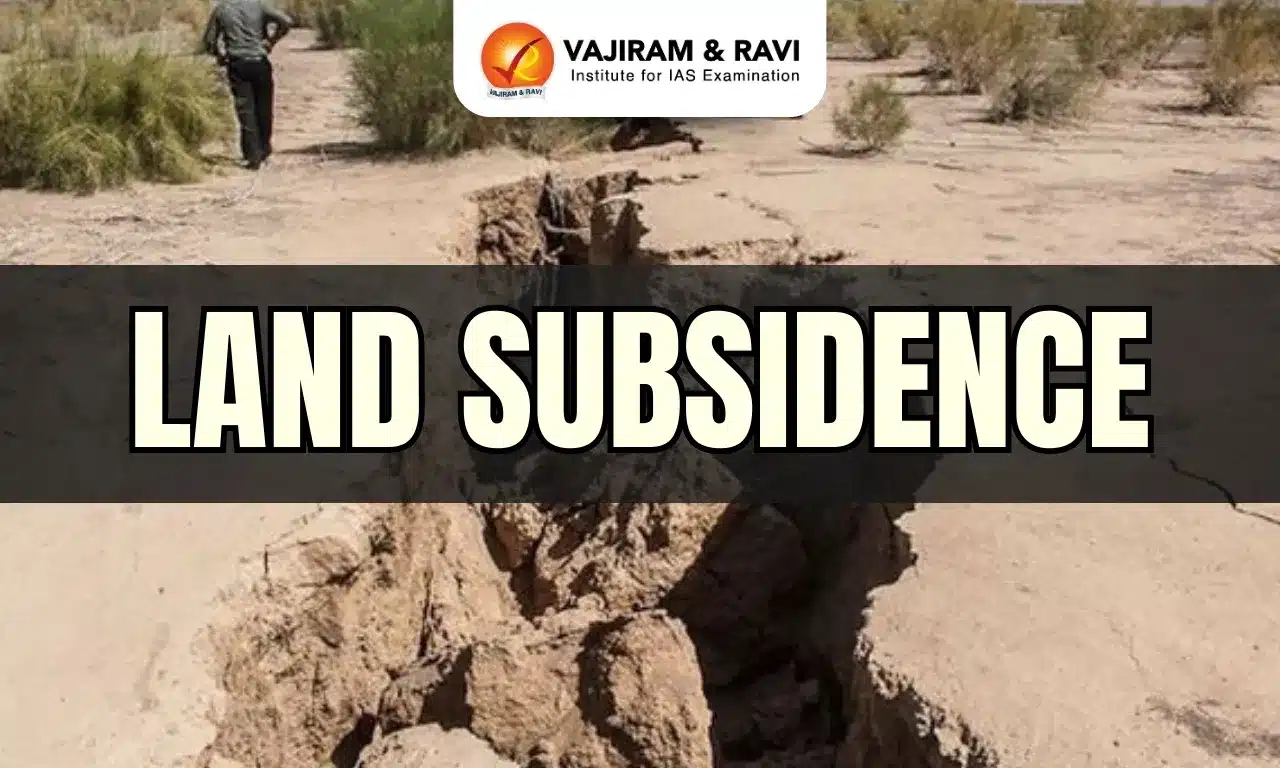
  • Land subsidence is a gradual settling or sudden sinking of the Earth’s surface.
  • This geotechnical phenomenon occurs when the ground loses its ability to support the weight above it, leading to a downward shift. 
  • It can occur as a result of natural factors (e.g., volcanic or seismic activity, collapse of subsurface cavities, compaction of loose fine-grained deposits) or anthropogenic activities (e.g., excessive groundwater (GW) abstraction, mining, subsurface energy extraction).
  • Although it is a gradual process, taking years to decades to develop, land subsidence presents serious socioeconomic, environmental, and security challenges globally.
  • Impacts:
    • Land subsidence can cause damage to infrastructure and lead to increased flood risks and permanent reduction in aquifers' storage capacity. 
    • It can also cause disturbance to water management and possible repercussions such as increased saltwater intrusion as a result of reduction in land elevation and changes in the gradient of streams and drains. 
    • High maintenance costs for roads, railways, pipelines, and buildings are only a few examples of stresses brought upon by land subsidence. 
  • Although land subsidence has been historically observed in low deltaic areas or coastal regions, it is being increasingly observed in large inland areas near densely urban, agricultural, and industrial areas with high groundwater demand.
  • Excess groundwater extraction is believed to be one of the main causes of large-scale and high-magnitude land subsidence.
    • Groundwater overexploitation compacts the underground reservoirs because water is the element partly responsible for holding up the ground. 
    • The excess water withdrawal leads to compaction of the underlying depleted porous formation, thus inducing land subsidence. 
  • The total global extent of land surface susceptible to subsidence has been estimated to be 12 million sq.km.
  • Land subsidence has been observed all around the world, with major sites in the USA,  China, Iran, Indonesia, Taiwan, Vietnam, Egypt, Japan, Mexico, and Italy.

Source: NIE

Land Subsidence FAQ's

Q1: What is meant by land subsidence?

Ans: A gradual settling or sudden sinking of the Earth’s surface.

Q2: Which regions have historically been most prone to land subsidence?

Ans: Low deltaic areas and coastal regions.

Q3: Which anthropogenic activity is a major cause of land subsidence?

Ans: Excess groundwater extraction is believed to be one of the main causes of large-scale and high-magnitude land subsidence.

Karma Puja

Karma Puja

Karma Puja Latest News

The Prime Minister of India wished all fellow countrymen, especially the tribal community on the occasion of Karma Puja.

About Karma Puja

  • It is also called Karam and Karam Parab - is one of the most important tribal festivals in India.
  • It is related to the harvest and a tribute to the Karam tree. (Karam tree symbolises fertility, prosperity and everything that is auspicious). 
  • It is celebrated primarily in Jharkhand, Chhattisgarh, Odisha, Bihar, Madhya Pradesh, West Bengal, and Assam.
  • It is popular especially among the Munda, Ho, Oraon, Baiga, Kharia, and Santhal peoples.
  • It is traditionally celebrated on the Ekadashi tithi (eleventh day) which corresponds to August-September in the Gregorian calendar.
  • How is it celebrated?
    • About a week prior to the festival, young women bring clear sand from the river and sow seven types of grains.
    • A Karam tree branch is planted in the courtyard or 'akhra' on the festival day.
    • Devotees come with jawa (hibiscus) flowers, and the pahan (priest) worships the Karam Raja. Dancing and singing of traditional Karam songs follow.
    • The festival concludes with the immersion of the Karam branch in a river or pond, and the jawa is distributed among the devotees.
    • At the end of the Karam festival, branches from sal or bhelua trees are often planted in the fields with the hope that the Karam Raja/ Devta will protect their crops.

Source: PIB

Karma Puja FAQs

Q1: What happens in Karma Puja?

Ans: In this festival, the branch of the Karam tree is carried by the Karma dancers accompanied by singing and dancing.

Q2: In which state Karma Puja is celebrated?

Ans: Karma Puja, one of the most popular festivals of Jharkhand is related to the harvest and a tribute to the Karam tree.

Niveshak Didi Initiative

Niveshak Didi Initiative

Niveshak Didi Initiative Latest News

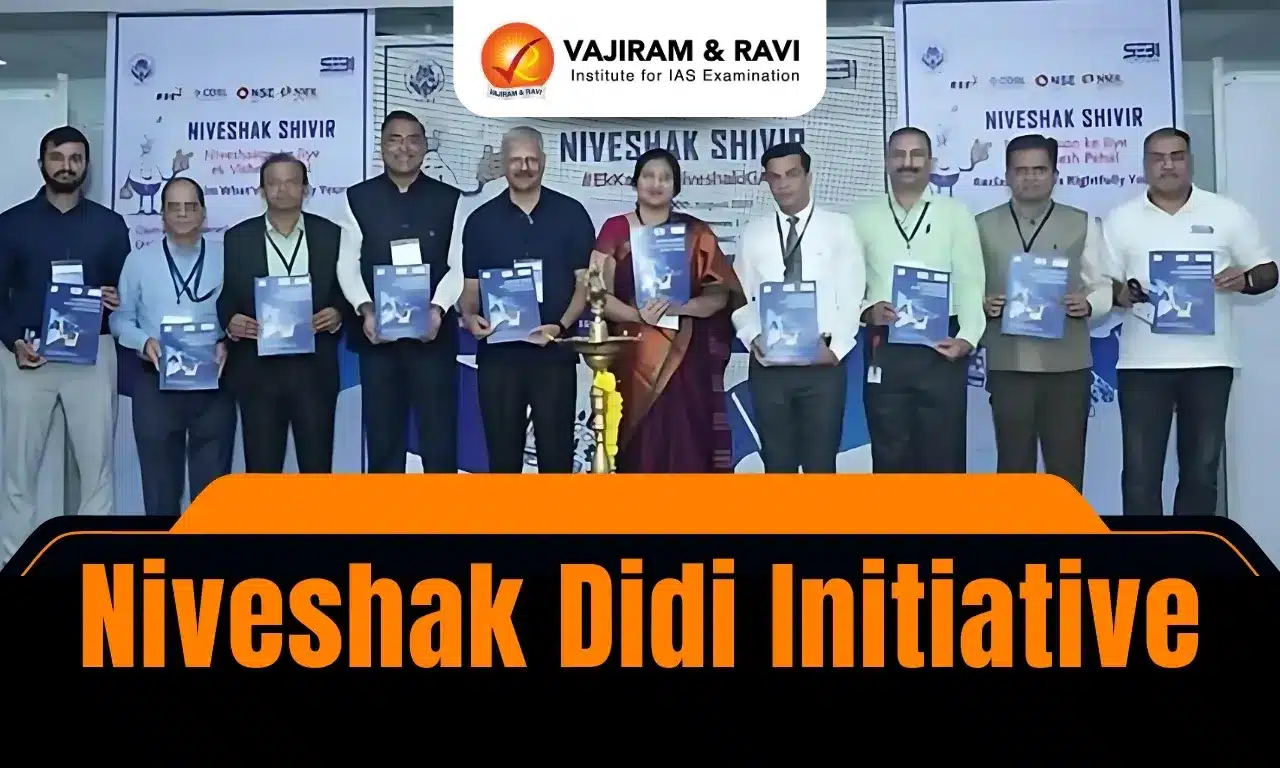
Recently, the Investor Education and Protection Fund Authority (IEPFA) successfully launched Phase II of its flagship financial literacy initiative – Niveshak Didi at Hyderabad.

About Niveshak Didi Initiative

  • Aim: The initiative is aimed at deepening financial awareness and empowering rural communities, particularly women.
  • It is based on the ideology of women for women as rural area women feel more comfortable to share their queries with a female itself.
  • Nodal Ministry: Ministry of Corporate Affairs
  • Launched by: Investor Education and Protection Fund Authority
  • Significance: It serves as a catalyst for bridging knowledge gaps and building confidence in communities.

Key Facts about Investor Education and Protection Fund Authority

  • It was established in 2016 under the Companies Act, 2013.
  • It empowers individuals to make informed financial choices and fosters a financially aware citizenry.
  • Nodal Ministry: Ministry of Corporate Affairs

Functions of Investor Education and Protection Fund Authority

  • It manages the Investor Education and Protection Fund (IEPF) and promotes investor awareness and financial protection.
  • Make refunds of shares, unclaimed dividends, matured deposits/debentures etc. to investors and promote awareness among investors.
  • It is dedicated to safeguarding investor interests by facilitating the return of unclaimed shares and dividends and advancing financial literacy nationwide.
  • Initiatives: Niveshak Didi, Niveshak Panchayat, and Niveshak Shivir,

Source: PIB

Niveshak Didi Initiative FAQs

Q1: What is the Niveshak Didi scheme?

Ans: It trains women postal workers and community leaders to act as financial educators within their local regions.

Q2: What is the meaning of financial literacy?

Ans: It is the knowledge and ability to manage your money in a way that helps you grow stability and feel confident and resilient.

Solar Orbiter Mission

Solar Orbiter Mission

Solar Orbiter Mission Latest News

According to a new study the European Space Agency’s (ESA) Solar Orbiter Mission has traced the origin of Solar Energetic Electrons (SEEs) emerging from the Sun.

About Solar Orbiter Mission

  • It is a joint project of the European Space Agency and NASA which was launched in 2020.
  • Objective: It explores the Sun and heliosphere from close up and out of the ecliptic plane.
  • Payload: It carries six remote-sensing instruments to observe the Sun and the solar corona, and four in-situ instruments to measure the solar wind, energetic particles, and electromagnetic fields.

What are Solar Energetic Electrons (SEE)?

  • These are high-energy particles produced by the Sun.
  • These particles play a key role in shaping the cosmic environment.
  • Sources: They can be emitted during solar flares or coronal mass ejections
  • Recent findings: It is observed that one type of SEE is tied to intense solar flares, explosive bursts from smaller patches of the Sun’s surface, while another stems from coronal mass ejections (CMEs).
  • Between November 2020 and December 2022, the Solar Orbiter observed more than 300 bursts of SEEs.
  • Significance: It will deepen understanding of space weather.

Source: DTE

Solar Orbiter Mission FAQs

Q1: What is the purpose of the Solar Orbiter mission?

Ans: The objective of the mission is to perform close-up, high-resolution studies of the Sun and its inner heliosphere.

Q2: What is a Coronal mass ejections (CMEs) from the Sun?

Ans: These are huge bubbles of coronal plasma threaded by intense magnetic field lines that are ejected from the Sun over the course of several hours.

Graphite Spyware

Graphite Spyware

Graphite Spyware Latest News

Recently, the Trump administration has unfrozen a stalled Biden-era contract with Paragon Solutions, a Graphite spyware company founded in Israel.

About Graphite Spyware

  • Graphite spyware is designed to gain remote access to a mobile phone and essentially take control of it.
  • Working: The user of the spyware can access the mobile user’s photos, read their messages, and track their whereabouts and also monitor encrypted messages sent on platforms such as WhatsApp and Signal.
  • The spyware also enables the phone to be used as a listening device by manipulating its recorder.

What are Spywares?

  • It is malicious software that enters a user’s computer, gathers data from the device and user, and sends it to third parties without their consent.
  • It collects personal and sensitive information that it sends to advertisers, data collection firms, or malicious actors for a profit. 
  • Some of the most commonly used types of spyware include:
    • Adware: This sits on a device and monitors users’ activity then sells their data to advertisers and malicious actors or serves up malicious ads.
    • Infostealer: This is a type of spyware that collects information from devices. It scans them for specific data and instant messaging conversations.
    • Keyloggers: Also known as keystroke loggers, keyloggers are a type of infostealer spyware.

Source: IE

Graphite Spyware FAQs

Q1: What are the 4 types of spyware?

Ans: Spyware is mostly classified into four types: adware, system monitors, tracking including web tracking, and trojans.

Q2: What is the definition of spyware?

Ans: It is malicious software that enters a user's computer, gathers data from the device and user, and sends it to third parties without their consent.

Daily Editorial Analysis 4 September 2025

Daily Editorial Analysis

Concealing a Judge’s Dissent, Eroding Judiciary’s Authority

Context

  • Constitutional democracies are founded not merely on the authority of written laws but on a deeper principle, what South African jurist Etienne Mureinik described as a culture of justification.
  • This principle demands that every exercise of public power must be reasoned, explained, and defended to the people.
  • This standard of accountability, though often demanded by the judiciary from the legislature and executive, appears strikingly absent within India’s own system of judicial appointments.
  • The controversy surrounding Justice B.V. Nagarathna’s reported dissent against the elevation of Justice Vipul M. Pancholi highlights the opacity of the Collegium system and exposes its democratic deficit.

The Problem of Opacity in the Collegium System

  • The Supreme Court of India has long positioned itself as the guardian of transparency and accountability in governance.
  • Yet when it comes to its own internal processes, particularly the Collegium system of judicial appointments, it has consistently resisted disclosure.
  • Established through judicial decisions in the Second Judges Case (1993) and the Third Judges Case (1998), the Collegium vests appointment power in the five senior-most judges of the Supreme Court.
  • These deliberations occur behind closed doors, and their outcomes are often published as terse resolutions devoid of explanation.
  • Justice Nagarathna’s dissent illustrates the dangers of this secrecy. Despite her reportedly grave objections, the Collegium’s published resolution presented an appearance of unanimity.
  • The public learned of her reservations only through media leaks, and the note she wrote remains inaccessible.
  • The government, within 48 hours, confirmed the appointment, leaving unresolved whether her dissent was ever considered.
  • This gulf between what happens in the Collegium and what the public is permitted to know exemplifies how secrecy corrodes institutional legitimacy.

Failed Defences of Secrecy

  • The Court has traditionally defended its opacity on two grounds: the protection of candidates’ reputations and the avoidance of political pressure.
  • On closer examination, both justifications prove unconvincing. Other democracies have managed to reconcile transparency with fairness.
  • Britain’s Judicial Appointments Commission openly discloses criteria and assessments, while South Africa’s Judicial Service Commission debates candidates’ suitability in public hearings.
  • These systems acknowledge that legitimacy flows from openness, even if imperfections remain.
  • By contrast, India’s Collegium continues to function as a private conclave. If reputational harm is a genuine concern, the answer lies not in total secrecy but in carefully structured disclosures that balance Candor with dignity.
  • Likewise, fears of political interference are not alleviated by opacity, since the executive still delays or obstructs inconvenient appointments despite the Collegium’s confidentiality.

The Stakes for Democracy

  • The debate is not limited to the fate of a single judge. Judicial appointments shape constitutional interpretation for generations, influencing issues from civil liberties to federal balance.
  • In democracies, unelected judges are entrusted with significant power precisely because they are expected to safeguard liberty and equality against majoritarian excesses.
  • They do not undermine democracy; they enable its deepest commitments.
  • But the judiciary’s moral authority rests on public confidence.
  • When appointments occur without reasons, or when dissents by serving judges are hidden, the Court undermines its own legitimacy.
  • The principle that every exercise of public power must be justified applies with even greater force to an institution tasked with upholding constitutional morality.

Towards Reform: From Concealment to Justification

  • If the Indian judiciary is to sustain its authority, the Collegium must embrace reform.
  • A system of opaque deliberations is unsustainable in a democracy that increasingly demands transparency from every organ of the state.
  • Past experiments, such as the brief period in 2018 when fuller reasons for appointments were disclosed, should not have been abandoned but improved upon.
  • To retreat into secrecy is to erode public trust and, with it, the independence the Court seeks to preserve.
  • A judiciary that subjects itself to the same standards of openness it demands of others would not weaken its autonomy.
  • On the contrary, it would ground its independence in the confidence of citizens and reinforce the democratic culture of justification.
  • Only by practicing accountability can the judiciary preserve the legitimacy essential to its constitutional role.

Conclusion

  • The controversy surrounding Justice Nagarathna’s dissent exposes a fundamental contradiction: the Supreme Court of India insists on transparency from the executive and legislature while shielding its own decisions from scrutiny.
  • This double standard cannot endure; A judiciary that cloaks itself in secrecy risks eroding the very legitimacy that justifies its power.
  • The Collegium system must evolve to embrace transparency, not retreat from it and to do otherwise is to deny the principle that sustains every constitutional democracy: that power, however exalted, must always be justified.

Concealing a Judge’s Dissent, Eroding Judiciary’s Authority FAQs

 Q1. What does Etienne Mureinik mean by a “culture of justification”?
Ans. Mureinik means that every exercise of public power must be explained and defended, not enforced through fear or secrecy.

Q2. Why is the Collegium system criticized for opacity?
Ans. The Collegium system is criticized because it makes judicial appointments in secrecy, publishes minimal reasons, and hides internal dissent from the public.

Q3. What example highlights the flaws in the Collegium system?
Ans. Justice B.V. Nagarathna’s dissent against Justice Vipul M. Pancholi’s elevation, which was concealed from official records, highlights the flaws in the system.

Q4. How do other democracies ensure more transparency in judicial appointments?
Ans. Countries like Britain and South Africa openly disclose criteria, publish reports, and even hold public interviews to explain their judicial selections.

Q5. What must the Collegium do to preserve its legitimacy?
Ans. The Collegium must embrace transparency and accountability, aligning itself with the same standards it demands of other branches of government.

Source: The Hindu


India’s Recent Maritime Reforms Need Course Correction

Context

  • The passage of the Indian Ports Bill, 2025, in the Rajya Sabha marks a watershed moment in India’s maritime governance.
  • Together with the newly enacted Coastal Shipping Act, 2025, the Carriage of Goods by Sea Bill, 2025, and the Merchant Shipping Act, 2025, this legislative package aims to modernise India’s regulatory framework, replacing archaic provisions with a system better aligned to international practices.
  • While the government hails these reforms as essential to streamlining governance and boosting global competitiveness, closer scrutiny reveals that the package risks centralising power, undermining federalism, and burdening smaller operators in ways that could blunt its long-term effectiveness.

The Indian Ports Act, 2025: A Step Towards Modernisation

  • India’s maritime laws have long been outdated, with the Indian Ports Act of 1908 and the Merchant Shipping Act of 1958 reflecting a world vastly different from today’s globalised shipping industry.
  • The new legislative framework addresses this gap by attempting to bring India in line with international conventions, modern finance tools, and global liability standards.
  • Proponents argue that the Indian Ports Bill, in particular, is designed to facilitate ease of business, promote sustainable port development, and provide coherence in an otherwise fragmented regulatory environment.
  • Such steps are essential for India to expand its trade horizons, attract foreign investment, and enhance its maritime reputation.

A Closer Scrutiny of the Ports Act 2025

  • Federalism Undermined

    • Its most contentious feature is the creation of the Maritime State Development Council, chaired by the Union Minister of Ports, with authority to compel States to follow centrally issued guidelines.
    • While presented as a tool of cooperative federalism, critics see it as a mechanism of subordination, forcing coastal States to align with central projects such as Sagarmala and PM Gati Shakti at the expense of their local priorities.
    • This shift risks reducing the fiscal autonomy and flexibility of States, while leaving them responsible for the practical burdens of port management.
    • In effect, the legislation consolidates authority in New Delhi, weakening the federal compact enshrined in India’s constitutional order.
  • Discretion and Judicial Independence

    • Equally troubling are the provisions that expand discretionary powers and curtail judicial oversight.
    • Clause 17 of the Ports Bill bars civil courts from hearing port-related disputes, directing parties instead to internal resolution mechanisms overseen by the very authorities whose decisions are under challenge.
    • Such an arrangement risks eroding impartiality and deterring private investment, since investors value transparent and independent adjudication.
    • More broadly, the vague and open-ended regulatory powers conferred by the Bills create the potential for arbitrary enforcement, with smaller operators likely to face the greatest compliance burdens.

Some Other Troubling Aspects of the Ports Act

  • Ownership and Control Concerns

    • The Merchant Shipping Act, 2025, though notable for modernising registration rules, safety standards, and liability frameworks, contains significant loopholes in ownership safeguards.
    • Where the earlier law mandated full Indian ownership of Indian-flagged vessels, the new Act permits partial foreign ownership, leaving actual thresholds to government notification.
    • This ambiguity grants the executive excessive discretion and raises fears that India could drift into becoming a flag-of-convenience jurisdiction, where foreign owners effectively control Indian-registered ships.
    • Furthermore, provisions recognising Bareboat Charter-Cum-Demise registrations, while legitimate in principle, risk leaving foreign lessors with long-term control absent clear enforcement rules.
  • Burdening Small Operators

    • The Coastal Shipping Act, 2025, too, reflects a tension between strengthening cabotage protections and expanding central discretion.
    • On paper, it reserves coastal trade for Indian-flagged vessels. Yet it simultaneously empowers the Director General of Shipping to license foreign vessels on sweeping grounds such as national security or strategic alignment.
    • Without precise definitions, such clauses invite arbitrary use, potentially undermining domestic operators.
    • Smaller players, particularly in the fishing industry, may find themselves disproportionately burdened by onerous reporting requirements and bureaucratic compliance, without corresponding support or clarity.

The Way Forward: A Reform in Need of Reform

  • Taken together, the four laws represent an important recognition of the need to update India’s maritime governance.
  • But their reliance on executive discretion, their centralising tendencies, and their inadequate safeguards for judicial independence and small operators risk undermining the very objectives they seek to achieve.
  • India requires a legal framework that facilitates growth while preserving federal balance and ensuring fair competition.
  • For this, ownership thresholds and licensing rules must be specified clearly in law rather than left to administrative notification.
  • Likewise, dispute resolution mechanisms must include impartial judicial oversight, and States must have a meaningful role in planning.

Conclusion

  • The Indian maritime reform package of 2025 is both a bold step forward and a source of new vulnerabilities.
  • By repealing century-old laws and aligning with international practices, it seeks to propel India into the ranks of modern maritime powers.
  • Yet the dangers of over-centralisation, executive overreach, and insufficient protection for small operators cannot be overlooked.
  • Reform is necessary, but it must be inclusive, transparent, and respectful of federal balance if it is to serve as the foundation for India’s maritime future.

India’s Recent Maritime Reforms Need Course Correction FAQs

 Q1. What is the significance of the Indian Ports Bill, 2025?
Ans. The Indian Ports Bill, 2025 is significant because it replaces outdated colonial-era legislation and forms part of a larger package aimed at modernising India’s maritime governance.

Q2. Why has the Ports Act, 2025 been criticised?
Ans. It has been criticised for centralising power in the Union government and limiting the autonomy of coastal States in port development.

Q3. What concern arises from Clause 17 of the Ports Bill?
Ans. Clause 17 raises concern because it bars civil courts from hearing port-related disputes, reducing judicial independence and investor confidence.

Q4. How does the Merchant Shipping Act, 2025 change ownership rules?
Ans. The Act allows partial foreign ownership of Indian-flagged vessels, which critics fear could lead to foreign control and weaken India’s maritime sovereignty.

Q5. What risks does the Coastal Shipping Act, 2025 pose for smaller operators?
Ans. The Act risks burdening smaller operators, such as those in the fishing industry, with heavy compliance requirements and arbitrary licensing rules.

Source: The Hindu


National Sports Governance Act 2025 - Towards Transparency and Accountability in Indian Sports

Context:

  • Passed in the Monsoon Session of Parliament 2025, the National Sports Governance Act 2025 regulates and recognises national sports bodies in India.
  • It aims to end decades of misgovernance, political interference, and litigation in sports administration, replacing the ad-hoc National Sports Development Code of India with a comprehensive legislation.

Historical Background:

  • While it was under colonial rule, India was the first Asian nation to participate in the Olympics in 1900. Yet, it lacked a dedicated sports governance law till 2025.
  • For example, sports federations became fiefdoms of political satraps marked by -
    • Electoral malpractices.
    • Overstaying office bearers.
    • Domination by non-sportspersons (noted by 2014 Parliamentary Standing Committee).
  • More than 350 cases related to malpractices in the governance of various sporting federations are currently pending before different courts.
  • In some cases, the courts were compelled to intervene and appoint a Committee of Administrators (CoA) to govern federations as a stop-gap measure.

Global Penalties due to Misgovernance:

  • Global penalties:

    • Wrestling Federation of India (2023): Suspended for failing to hold timely elections.
    • Amateur Kabaddi Federation of India (2024): Suspended due to absence of elected body.
    • All India Football Federation (AIFF) (2022): Suspended by FIFA for being under court-appointed administrators; impacted Indian Super League 2025–26.
  • Impact of misgovernance:

    • Career setbacks for sportspersons bound by age and time, while political administrators escaped accountability.

Key Provisions of the National Sports Governance Act 2025:

  • Institutional framework:

    • National Sports Board:
      • The Act empowers the Centre to establish a National Sports Board, which will grant recognition to various national sporting federations and their affiliate units.
      • This provision will put an end to the protracted battles for legitimacy waged by rival federations within the same sport.
    • Establishment of National Olympic Committee, National Paralympic Committee, and National and Regional Sports Federations for each sport.
      • Each of the above mentioned bodies has also been mandated to establish a code of conduct in line with the international best practices prevailing in each sport.
    • Governance norms:
      • The Act also mandates that the Executive Committee for every sporting federation must consist of up to 15 members, with at least two outstanding sportspersons and four women.
      • Moreover, the age and tenure limits are also defined to ensure that fresh talent and vigour is inducted in sports administration.
    • Dispute resolution:
      • A National Sports Tribunal will be constituted to adjudicate disputes pertaining to sporting federations.
      • This is a landmark provision as it would -
        • Streamline sports-related litigation by enabling matters to be decided by subject experts.
        • Reduces litigation delays as an appeal against a decision of the Tribunal would only lie before the Supreme Court.
      • Election oversight:
        • The Act seeks to establish a national panel of electoral officers for monitoring elections.
        • Federations are mandated to establish their own election panels for affiliates.
        • Provision for disqualification of non-compliant federations.

Significance of the Act:

  • First comprehensive legislation on sports governance in India.
  • Ends monopoly of political satraps; promotes accountability, transparency, and inclusivity.
  • Ensures representation of sportspersons and women in decision-making.
  • Provides legal clarity to avoid international sanctions.
  • Paves way for India’s aspiration to host Commonwealth Games and Olympics with integrity and robust legal backing.

Conclusion:

  • The National Sports Governance Act 2025 lays the foundation for transparent, accountable, and inclusive sports administration in India, aligning governance structures with global best practices.
  • Going forward, its effective implementation can empower sportspersons, restore international credibility, and help India realise its aspiration of becoming a leading sporting nation.

National Sports Governance Act 2025 FAQs

Q1. Why is the National Sports Governance Act, 2025 considered a watershed moment in Indian sports administration?

Ans. It is the first comprehensive legislation that introduces transparency, accountability, and inclusion in sports federations, replacing ad-hoc codes.

Q2. What were the key shortcomings in India’s sports governance before the enactment of the Sports Governance Act, 2025?

Ans. Dominance of political satraps, electoral malpractices, absence of tenure limits, exclusion of sportspersons, and frequent court interventions.

Q3. What are the international implications of misgovernance in Indian sports federations in recent years.

Ans. Misgovernance led to suspensions of federations like WFI (2023), AIFF (2022), and Amateur Kabaddi Federation (2024), affecting India’s global sporting credibility.

Q4. How does the Sports Governance Act, 2025 ensure representation and inclusivity in sports federations?

Ans. It mandates inclusion of at least two sportspersons, four women members, and imposes age and tenure limits in executive committees.

Q5. What role does the National Sports Tribunal play under the new Act, and why is it significant?

Ans. It provides expert-led, streamlined dispute resolution with appeals only before the Supreme Court, reducing delays and litigation burden.

Source: IE

Daily Editorial Analysis 4 September 2025 FAQs

Q1: What is editorial analysis?

Ans: Editorial analysis is the critical examination and interpretation of newspaper editorials to extract key insights, arguments, and perspectives relevant to UPSC preparation.

Q2: What is an editorial analyst?

Ans: An editorial analyst is someone who studies and breaks down editorials to highlight their relevance, structure, and usefulness for competitive exams like the UPSC.

Q3: What is an editorial for UPSC?

Ans: For UPSC, an editorial refers to opinion-based articles in reputed newspapers that provide analysis on current affairs, governance, policy, and socio-economic issues.

Q4: What are the sources of UPSC Editorial Analysis?

Ans: Key sources include editorials from The Hindu and Indian Express.

Q5: Can Editorial Analysis help in Mains Answer Writing?

Ans: Yes, editorial analysis enhances content quality, analytical depth, and structure in Mains answer writing.

Global Peace Index 2025

Global Peace Index

Global Peace Index Latest News

Iceland has once again secured its position as the most peaceful country in the world, as per the 2025 Global Peace Index (GPI).

About Global Peace Index

  • Produced by the Institute for Economics & Peace (IEP), the GPI is the world’s leading measure of global peacefulness. 
  • It ranks 163 independent states and territories according to their level of peacefulness, covering 99.7 percent of the world’s population.
  • It uses 23 qualitative and quantitative indicators to measure the state of peace across three domains: the level of Societal Safety and Security; the extent of Ongoing Domestic and International Conflict; and the degree of Militarisation. 

Highlights of Global Peace Index 2025

  • It is the 19th edition of the GPI.
  • It finds that global peacefulness continues to decline and that many of the leading factors that precede major conflicts are higher than they have been since the end of WWII.
  • More countries are increasing their levels of militarisation.
  • There are currently 59 active state-based conflicts, the most since the end of WWII and three more than the prior year.
  • Last year, 17 countries recorded over 1,000 conflict deaths.
  • Additionally, the successful resolution of conflicts is lower than at any point in the last 50 years.
  • Conflicts that ended in a decisive victory fell from 49 percent in the 1970s to nine percent in the 2010s, while conflicts that ended through peace agreements fell from 23 percent to four percent over the same period. 
  • This year’s results found that the average level of global peacefulness deteriorated by 0.36 percent.
  • Iceland remains the most peaceful country in the world, a position it has held since 2008. It is joined at the top of the index by Ireland, Austria, New Zealand, and Switzerland.
  • Russia, for the first time, is the least peaceful country in the world on the 2025 GPI, followed by Ukraine, Sudan, Democratic Republic of the Congo, and Yemen.
  • Western and Central Europe is the most peaceful region in the world, home to eight of the ten most peaceful countries, although its peacefulness has been falling over the last four years. 
  • South America was the only region in the world to record an improvement in peacefulness last year.
  • The Middle East and North Africa (MENA) region remains the world’s least peaceful region. 
  • South Asia, the second least peaceful region globally, experienced the largest regional decline in peacefulness.
  • India was ranked 115 on the GPI 2025, up one position from its 2024 spot.
  • The most peaceful Asian countries were Singapore (6th), Japan (12th), Malaysia (13th), Bhutan (21st), and Mongolia (37th).

Source: FE

Global Peace Index FAQs

Q1: Which organisation produces the Global Peace Index (GPI)?

Ans: Institute for Economics & Peace (IEP)

Q2: Which country remains the most peaceful in the world according to Global Peace Index (GPI) 2025?

Ans: Iceland

Q3: What is the rank of India in Global Peace Index 2025?

Ans: India was ranked 115 on the GPI 2025, up one position from its 2024 spot.

Q4: Which country was ranked the least peaceful in Global Peace Index 2025 for the first time?

Ans: Russia

Securities Appellate Tribunal (SAT)

Securities Appellate Tribunal

Securities Appellate Tribunal Latest News

US-based trading firm Jane Street Group recently filed an appeal in the Securities Appellate Tribunal (SAT) against the Securities and Exchange Board of India (Sebi) in the alleged market manipulation case.

About Securities Appellate Tribunal

  • The SAT is a statutory body established under the Securities and Exchange Board of India Act, 1992. 
  • As a quasi-judicial body, SAT’s primary objective is to hear and dispose of appeals against orders passed by SEBI or by an adjudicating officer under the Act. 
  • It has jurisdiction over the whole of India and operates from Mumbai.
  • The SAT also hears appeals against the following orders:
    • Orders issued by the Insurance Regulatory and Development Authority of India (IRDAI) in relation to cases filed before it.
    • Orders issued by the Pension Fund Regulatory and Development Authority (PFRDA) in relation to cases filed before it.
  • Who can make an appeal?
    • These appeals may be filed by any person aggrieved by SEBI's decisions, including market participants, listed companies, intermediaries, or investors.

Securities Appellate Tribunal Composition

  • The SAT consists of one Presiding Officer and such a number of judicial and technical members as the Central Government may determine.
  • The person so appointed as the presiding Officer should meet the following requirements:
    • The retired or sitting judge of the Supreme Court
    • Chief Justice of the High Court
    • Judge of the High Court, who has completed at least seven years of service as a judge in a high court. 
  • Judicial Member: Judge of the High Court for at least five years of service.
  • Technical Member:
    • Secretary or an Additional Secretary in the Ministry or Department of the Central Government or any equivalent post in the Central Government or a State Government; or
    • Person of proven ability, integrity, and standing, having special knowledge and professional experience of not less than 15 years in the financial sector, including the securities market, pension funds, commodity derivatives, or insurance.
  • The Presiding Officer and Judicial Members shall be appointed by the Central Government in consultation with the Chief Justice of India or its nominee.

Securities Appellate Tribunal Tenure

  • The tenure for the Presiding Officer and other members will be five years from the date of appointment, and they shall be eligible for re-appointment for another term of maximum five years.
  • However, no presiding officer or member shall hold office after he/she has attained the age of 70.

Securities Appellate Tribunal Powers

  • SAT exercises the powers of a civil court and has the authority to summon and enforce the attendance of witnesses, receive evidence, and examine witnesses under oath. 
  • It also has the power to require the discovery and production of documents.

Appeal against the Orders of the Securities Appellate Tribunal

  • Every person aggrieved by any order or decision of SAT can file an appeal to the supreme court.
  • An appeal can only be made on any question of law.

Source: TH

  •  

Securities Appellate Tribunal FAQs

Q1: The Securities Appellate Tribunal (SAT) was established under which Act?

Ans: Securities and Exchange Board of India Act, 1992

Q2: What is the primary function of the Securities Appellate Tribunal (SAT)?

Ans: Ut's primary objective is to hear and dispose of appeals against orders passed by SEBI.

Q3: Who appoints the Presiding Officer and Judicial Members of Securities Appellate Tribunal (SAT)?

Ans: Central Government in consultation with the Chief Justice of India.

Q4: What is the maximum tenure of a Presiding Officer or Member of Securities Appellate Tribunal (SAT)?

Ans: 5 years (renewable for 5 more years)

GST 2.0 Reforms: New Two-Slab Structure and Key Rate Cuts Explained

GST 2.0

GST 2.0 Latest News

  • In its 56th meeting, the GST Council approved next-generation reforms, moving towards a simplified two-slab structure of 5% and 18%. 
  • A higher 40% demerit rate will apply only to super luxury, sin, and demerit goods, streamlining India’s eight-year-old indirect tax regime.

Aim of GST Reforms

  • The Goods and Services Tax (GST) Council, during its 56th meeting, decided to revamp the tax structure into a primarily two-rate system.
  • The GST reforms seek to reduce the tax burden on common people, cut slabs, ease working capital issues, and improve business efficiency through automated refunds and registrations.
  • All rate changes, except for tobacco-related products, will take effect from September 22 (Navratri’s first day).
  • Despite state concerns over revenue loss, the meeting concluded in a single day under Finance Minister Nirmala Sitharaman, with participation from ministers of 31 states and UTs.

Key Highlights of GST Reforms 

  • PM Modi welcomed the GST Council’s decision to approve sweeping rate cuts and structural reforms, calling it a pro-people move benefiting farmers, MSMEs, middle-class families, women, and youth.

Focus on Common-Use Goods and Services

  • The reforms bring major relief on daily-use items:
    • Packaged food (juices, butter, cheese, coconut water, pasta, nuts) reduced to 5%.
    • Medical items like oxygen, gauze, bandages, diagnostic kits lowered from 12% to 5%.
    • Ultra-high temperature milk, paneer, pizza bread, chapati, khakra, and erasers made GST-free.
    • Household goods (hair oil, soaps, shampoos, bicycles, kitchenware) brought down to 5%.

Tax Cuts on White Goods and Automobiles

  • GST on ACs, TVs, dishwashers cut from 28% to 18%.
  • Small cars (petrol up to 1200 cc/diesel up to 1500 cc) now taxed at 18%.
  • Motorcycles under 350 cc and all auto parts also shifted to 18%.
  • Luxury cars taxed at 40%; electric vehicles remain at 5%.

Insurance and Services

  • Life and health insurance (including term, ULIP, endowment, and family floater policies) made GST-exempt.
  • Gyms, salons, barbers, yoga services reduced from 18% to 5%.

Rationalisation of GST Slabs

  • The Council replaced multiple slabs (5%, 12%, 18%, 28%) with a two-slab system (5% and 18%), plus a 40% demerit rate for sin goods (tobacco, pan masala, luxury cars).
  • This corrects the inverted duty structure, simplifies compliance, and reduces disputes.

Financial Impact and States’ Concerns

  • Some states flagged potential revenue losses of ₹80,000–1.5 lakh crore, but consensus prevailed.
  • The Centre estimates the reforms will have a net fiscal implication of ₹48,000 crore on 2023–24 consumption data.

Sector-Specific Reforms

  • Textiles: GST on manmade fibre cut from 18% to 5%, yarn from 12% to 5%.
  • Fertilisers: Inputs like sulphuric acid, nitric acid, ammonia reduced from 18% to 5%.

Industry Response

  • Industry bodies like CII hailed the reforms as pathbreaking, promising to pass benefits to consumers, reduce litigation, and enhance compliance. 
  • The reforms are expected to lift demand, ease compliance, and support job creation.

GST Reforms 2025: Key Rate Cuts Impact

  • GST Rate Cuts for Common Man
    • The latest GST reforms bring major relief to households and middle-class consumers. 
    • Everyday essentials such as hair oil, soaps, shampoos, toothpaste, toothbrushes, bicycles, kitchenware, and tableware have all been shifted to the 5% tax slab from 12–18% earlier
    • Popular food items like namkeens, sauces, pasta, instant noodles, chocolates, coffee, and butter have also seen their tax rate reduced to 5%. 
    • Significantly, cement, a key infrastructure input, has been reduced from 28% to 18%, lowering construction costs.
  • Zero-Tax Relief for Essentials and Healthcare
    • Products such as ultra-high temperature milk, paneer, rotis, chapatis, and parathas will now attract 0% GST, making everyday food items cheaper
    • In healthcare, 33 lifesaving medicines have been exempted from GST, while spectacles for vision correction will now attract just 5% instead of 28%. 
    • Insurance services also see a major shift, with life and health insurance policies moved to 0% from 18%, providing direct benefits to households.
  • White Goods and Automobiles
    • High-ticket consumer items such as air-conditioners, TVs, dishwashers, small cars, motorcycles (≤350cc), buses, trucks, and ambulances will now attract 18% GST instead of 28%.
    • This will ease affordability for consumers and boosting demand in the automotive sector. 
  • Correcting Inverted Duty Structures
    • The government has addressed long-pending anomalies in textiles and fertilisers. 
    • GST on manmade fibre has been reduced from 18% to 5%, and on manmade yarn from 12% to 5%, correcting distortions in the textile value chain
    • Similarly, fertiliser inputs like sulphuric acid, nitric acid, and ammonia have been cut from 18% to 5%, lowering costs for agriculture and farmers.
  • Special 40% Slab for Sin and Luxury Goods
    • A 40% GST rate will apply only to super-luxury and sin goods such as pan masala, cigarettes, gutka, zarda, unmanufactured tobacco, caffeinated beverages, private-use helicopters, airplanes, yachts, and large cars/motorcycles (>350cc). 
    • For now, pan masala and tobacco products will remain taxed at 28% plus cess, but they will move into the 40% slab once the Centre repays compensation loans borrowed for states.

Source: IE | TH | HT

GST 2.0 FAQs

Q1: What is GST 2.0?

Ans: GST 2.0 is the latest reform approved by the GST Council, simplifying slabs to 5% and 18%, with 40% for sin and luxury goods.

Q2: When will GST 2.0 reforms take effect?

Ans: Most rate changes will be effective from September 22, 2025, coinciding with Navratri, except for tobacco-related products which remain unchanged.

Q3: Which items became cheaper under GST 2.0?

Ans: Daily-use goods like soaps, shampoos, bicycles, food items, medical supplies, and even cement saw significant GST rate reductions, directly benefiting households.

Q4: How does GST 2.0 impact automobiles?

Ans: Small cars, motorcycles (≤350cc), and auto parts moved to 18% GST, while luxury cars face 40%. Electric vehicles continue with a 5% GST rate.

Q5: What is the financial impact of GST 2.0 reforms?

Ans: The Centre estimates a ₹48,000 crore net fiscal implication, while industries welcomed the reforms, promising to pass benefits to consumers and boost demand.

Debate on Exceeding the 50% Reservation Limit in India

Reservation Limit

Reservation Limit Latest News

  • The debate on the 50% reservation cap has been reignited, with petitions and political demands pushing for higher quotas and sub-categorisation of benefits.

Introduction

  • The question of whether reservations in India should exceed the judicially imposed 50% cap has resurfaced with growing political and social demands. 
  • Recent political statements, such as the call for 85% reservation in Bihar, coupled with petitions before the Supreme Court seeking ‘creamy layer’ provisions for SCs and STs, highlight the complexity of balancing affirmative action with constitutional guarantees of equality.

Constitutional Framework on Reservations

  • Articles 15 and 16 of the Constitution guarantee equality before the law and equal opportunity in public employment, while simultaneously empowering the State to make special provisions for socially and educationally backward classes, Scheduled Castes (SCs), and Scheduled Tribes (STs).
  • At the central level, reservations currently stand at:
    • OBCs: 27%
    • SCs: 15%
    • STs: 7.5%
    • EWS: 10%
  • This brings the total reservation to 59.5%, already above the 50% ceiling set by judicial precedents but justified on grounds of EWS being a separate category.

Key Judicial Pronouncements on the Cap

  • The debate on reservation ceilings originates from two concepts of equality: formal equality (treating all citizens alike) and substantive equality (affirmative measures to address historical disadvantages).
  • Balaji v. State of Mysore (1962): Held that reservations should be within "reasonable limits" and capped at 50%.
  • State of Kerala v. N.M. Thomas (1975): Opened the door for substantive equality, observing that reservations are not an exception but an extension of equality.
  • Indra Sawhney v. Union of India (1992): Upheld 27% OBC reservations, reaffirmed the 50% ceiling, and introduced the concept of the ‘creamy layer’ for OBCs.
  • Janhit Abhiyan v. Union of India (2022): Upheld the 10% EWS quota, clarifying that the 50% limit applied to backward classes and not economically weaker sections.
  • State of Punjab v. Davinder Singh (2024): A seven-judge Bench emphasised the need for introducing creamy layer principles for SCs and STs.

Emerging Issues and Demands

  • Calls for Higher Quotas: Political leaders have argued that the reservation percentage should reflect the demographic proportion of backward classes, which many estimate to be far higher than 50%. This has led to demands for caste census to generate reliable data.
  • Unequal Distribution of Benefits: The Rohini Commission found that 97% of OBC reservation benefits were cornered by about 25% of castes, while nearly 1,000 OBC communities saw no representation. Similar concerns exist within SCs and STs, raising the demand for sub-categorisation.
  • Creamy Layer Debate for SCs/STs: While OBCs have a creamy layer exclusion, SCs and STs do not. Critics argue that this results in relatively better-off groups monopolising benefits. Others counter that many SC/ST vacancies remain unfilled, making such exclusions counterproductive.
  • Backlog of Vacancies: Government data indicates 40-50% of reserved seats across SC, ST, and OBC categories remain vacant, largely due to systemic gaps in recruitment and access.

Balancing Equality and Social Justice

  • The central dilemma is balancing the right to equality of opportunity with the need for social justice
  • Expanding reservations beyond the 50% cap could be seen as compromising merit and constitutional equality, yet empirical data highlights the persistent underrepresentation of marginalised communities.
  • Experts suggest reforms such as:
    • Sub-categorisation within OBCs and SC/ST groups to ensure fairer distribution of benefits.
    • A “two-tier” system prioritising the most marginalised.
    • Greater investment in skill development and employment creation, reducing overdependence on public-sector reservations.

Source: TH

Reservation Limit FAQs

Q1: What is the current reservation percentage at the central level?

Ans: The total stands at 59.5%, including OBC (27%), SC (15%), ST (7.5%), and EWS (10%).

Q2: Which case reaffirmed the 50% ceiling on reservations?

Ans: The Indra Sawhney judgment (1992) upheld the 50% cap.

Q3: What did the Rohini Commission reveal about OBC reservations?

Ans: It found that 97% of benefits went to just 25% of OBC sub-castes, leaving many unrepresented.

Q4: Is there a creamy layer exclusion for SCs and STs?

Ans: No, unlike OBCs, SCs and STs do not have a creamy layer exclusion.

Q5: What could the 2027 Census change in this debate?

Ans: It will provide caste-based data, enabling evidence-based reforms and possible sub-categorization.

UGC Draft UG Curriculums: Key Features and States’ Objections Explained

UGC Draft Curriculum

UGC Draft Curriculum Latest News

  • The University Grants Commission (UGC) recently released draft undergraduate curriculums for feedback. 
  • However, Opposition-ruled states such as Karnataka and Kerala have raised objections. 
  • Both states have formed expert panels to review the drafts before submitting their formal responses. 
  • The UGC has invited comments nationwide, but these objections highlight federal concerns over curriculum design and its alignment with state priorities.

Learning Outcomes-based Curriculum Framework (LOCF)

  • The Learning Outcomes-based Curriculum Framework (LOCF) is an educational model designed to enhance higher education by focusing on outcomes — what students should know, understand, and achieve — rather than just content delivery. 
  • It was developed by the University Grants Commission (UGC) and similar bodies to promote quality, skill-based, and holistic learning.

Key Components

  • Graduate Attributes: Broad qualities such as intellectual curiosity, problem-solving skills, ethical conduct, and adaptability expected after completing studies.
  • Programme Outcomes: Defined learning outcomes for the entire degree program.
  • Course Outcomes: Specific, measurable outcomes for individual courses, describing what students can do upon completion.

Goals of LOCF

  • Shift in Focus - Moves away from passive memorisation to active construction and application of knowledge and skills.
  • Student Empowerment - Encourages active learning where teachers act as facilitators rather than mere instructors.
  • Skill Development - Builds critical 21st-century skills like analytical reasoning, critical thinking, and problem-solving for a tech-driven world.
  • Enhanced Employability - Equips students with industry-relevant knowledge and competencies, improving workforce readiness.
  • Holistic Development - Promotes not only academic knowledge but also values, attitudes, ethics, and lifelong learning, ensuring all-round growth.

Key Features of UGC’s Proposed Undergraduate Curriculum

  • The UGC has released draft curriculum frameworks for nine subjects, including anthropology, chemistry, commerce, economics, geography, home science, mathematics, physical education, and political science. 
  • Designed as Learning Outcomes-Based Curriculum Frameworks (LOCFs), they define the concepts and skills students should acquire. 
  • Aligned with the National Education Policy (NEP) 2020, the drafts envision flexible four-year multidisciplinary undergraduate programmes with multiple exit options
  • They also integrate Indian Knowledge Systems into higher education. 
    • Mathematics electives include Kala Ganana’ (timekeeping traditions) focusing on India’s lunar, solar, and lunisolar calendars.
    • Similarly, Philosophy of Indian Mathematics’, introduces the study of Vedas, Vedangas, Puranas, and Darshanas as branches of learning. 
  • These additions aim to blend traditional knowledge with modern education.

Integration of ‘Bharatiya’ Knowledge in Draft Curriculum

  • The new UGC draft LOCFs place strong emphasis on incorporating Indian Knowledge Systems (IKS) into undergraduate courses. 
  • For instance, the chemistry curriculum includes a unit on traditional Indian dietary practices from Ayurveda under “food chemistry”, recommending texts like Ayurvedic Cooking for Self-Healing
  • Similarly, the draft commerce curriculum introduces a course on Indian management principles, featuring lessons from the Bhagavad Gita, Ramayana, and Vedantic perspectives alongside modern concepts. 
  • Earlier frameworks lacked such components. Officials clarified that while UGC had issued LOCFs for 38 subjects since 2019 under the choice-based credit system, the rollout of NEP 2020 has prompted a fresh framework. 
  • According to NEP, a future Higher Education Commission of India (HECI) will ultimately set outcome-based frameworks, though it is yet to be established.

Opposition from States over Draft Curriculum

  • The draft UGC curriculum has drawn sharp criticism from opposition-ruled states. 
  • Kerala’s Higher Education Minister labelled it “obsolete,” “unscientific,” and influenced by Hindutva ideology.
  • Experts cited references like Ram Rajya in commerce (as part of CSR discussions) and the inclusion of V D Savarkar’s The Indian War of Independence as recommended reading in political science, alongside a separate elective on Savarkar. 
  • Karnataka’s Higher Education Minister alleged that the framework aims to impose central government ideologies and objected to UGC’s interference in state curriculums. 
  • However, UGC clarified that universities retain autonomy to adapt or redesign modules. 
  • In fact, during earlier LOCF rollouts, universities, including the University of Kerala, had revised their courses in line with UGC guidance.

Source: IE | TH | LS

UGC Draft Curriculum FAQs

Q1: What is the UGC draft curriculum?

Ans: It is a Learning Outcomes-based Curriculum Framework (LOCF) focusing on skills, critical thinking, employability, and integrating Indian Knowledge Systems in higher education.

Q2: Which subjects have draft UGC curriculums?

Ans: Drafts have been released for nine subjects, including anthropology, chemistry, commerce, economics, geography, home science, mathematics, physical education, and political science.

Q3: What is new in UGC’s curriculum approach?

Ans: The curriculum blends modern learning with Indian Knowledge Systems, like Ayurveda in chemistry, Ramayana in management, and Kala Ganana in mathematics.

Q4: Why are some states opposing the draft curriculum?

Ans: Kerala and Karnataka allege the framework promotes Hindutva ideology and undermines academic autonomy, citing references to Ram Rajya and V D Savarkar.

Q5: Do universities have to strictly follow the UGC draft?

Ans: No. The UGC clarified that universities retain autonomy to adapt, redesign, or modify modules as per regional and institutional requirements.

Senna Spectabilis

Senna spectabilis

Senna spectabilis Latest News

Kerala has carried out India’s first science-based, community-driven eradication of Senna spectabilis which could restore south India’s forests.

About Senna spectabilis

  • It is an invasive species native to tropical America.
  • Common names: Popcorn Bush Cedar, Archibald's Cassia, Calceolaria Cassia, Golden Shower, Scented Shower, Fetid Cassia.
  • It forms dense, sterile thickets, choking out native plants, altering soil chemistry and depriving herbivores of food.
  • It is a tree with a very dense, spreading crown; it can grow 7 - 18 metres tall.
  • It is often planted for fuelwood, as an ornamental, and as a shade tree in agroforestry situations.
  • It resembles Kerala’s state flower Cassia fistula, known locally as kanikkonna.
  • It is classified as Least Concern under the IUCN Red List.
  • Challenges: It has very aggressive growth rate and degrade lands in forest ecosystems which make it challenging to control its spread. 

What are Invasive Species?

  • An invasive species is an organism that causes ecological or economic harm in a new environment where it is not native.
  • These can be introduced to a new area via the ballast water of oceangoing ships, releases of aquaculture species, aquarium specimens, and other means.
  • Impacts: These are capable of causing extinctions of native plants and animals, reducing biodiversity.

Source: DTE

Senna spectabilis FAQs

Q1: What is Senna spectabilis used for?

Ans: It is one of the medicinal plants used in Cameroon by traditional healers to treat epilepsy, constipation, insomnia, anxiety.

Q2: Is Senna spectabilis an invasive species?

Ans: Senna spectabilis is considered an invasive alien plant.

Enquire Now