
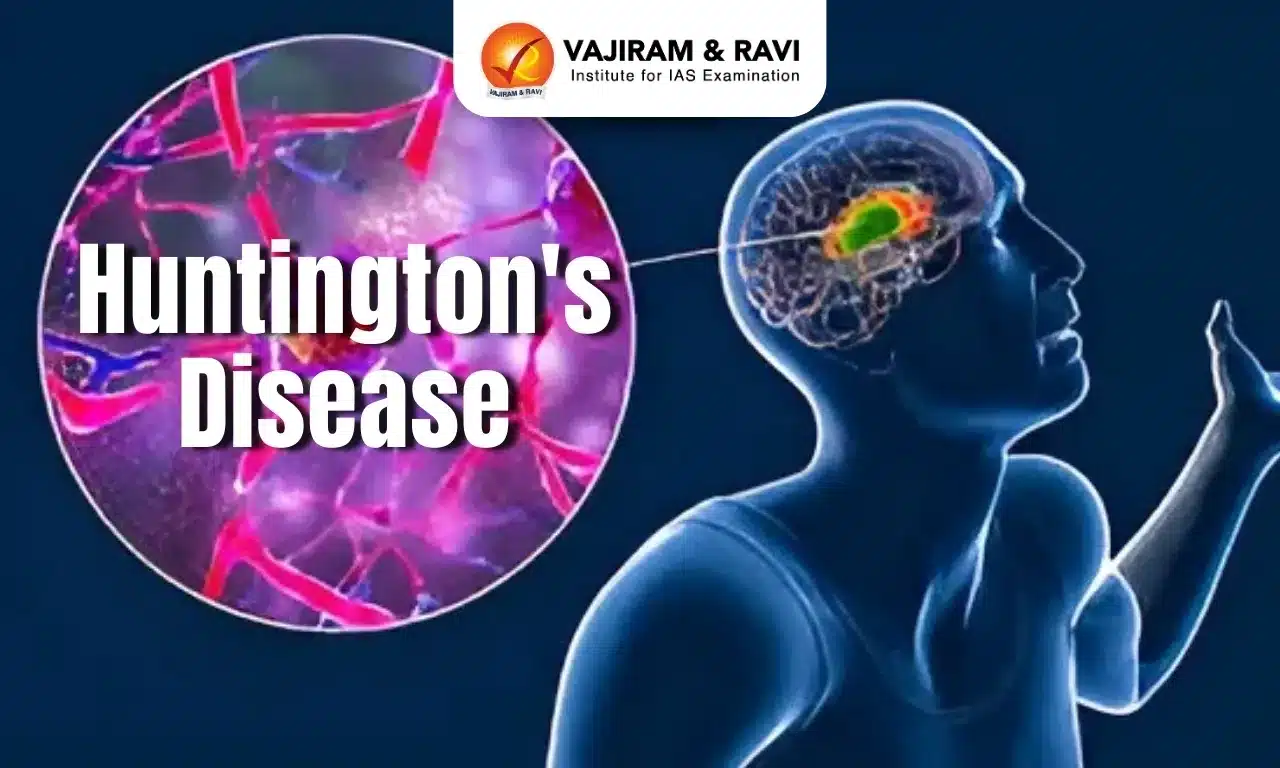
Huntington's Disease Latest News
Huntington's disease (HD) has long been impossible to cure, but new research is finally giving fresh hope.
About Huntington's Disease
- It is a rare hereditary disorder in which brain cells, or neurons, in certain areas of your brain start to break down.
- The destruction of nerve cells happens in the basal ganglia, or the region of your brain that regulates your body’s movements.
- It also affects the brain cortex (surface of your brain) that regulates your thinking, decision-making, and memory.
- As the neurons degenerate, the disease can lead to emotional disturbances, loss of intellectual abilities, and uncontrolled movements.
- What causes HD?
- A genetic mutation of the HTT gene causes HD. If one of your parents has HD, you have a 50% chance of also developing it.
- The HTT gene makes a protein called huntingtin. This protein helps your nerve cells (neurons) function.
- If you have HD, your DNA doesn’t have all the information needed to make the huntingtin protein.
- As a result, these proteins grow in an abnormal shape and destroy (instead of help) your neurons.
- Your neurons die because of this genetic mutation.
- How common is HD?
- HD affects an estimated 3 to 7 out of every 100,000 people, most often people of European ancestry (biological family comes from European descent).
- There are two main types of HD:
- Adult-onset: This is the most common type. Symptoms usually start after age 30.
- Early-onset (juvenile Huntington’s disease): This rare type affects children and teenagers. Symptoms appear before age 20.
- Symptoms:
- Common symptoms include uncontrollable dance-like movements (chorea) and abnormal body postures, as well as problems with behavior, emotion, thinking, and personality.
- Other symptoms may include tremor (unintentional back-and-forth movement in the person’s muscles) and unusual eye movements. The eye movements can happen early in the disease.
- These symptoms get worse over time.
- As HD progresses, you will need constant assistance and supervision because of the debilitating nature of the disease.
- People usually die from the disease within 15 to 20 years of developing symptoms.
- Treatment: There is no treatment that can stop or reverse HD, but health care providers can offer medications to help with certain symptoms.
Source: SA
Huntington's Disease FAQs
Q1: What is Huntington’s disease (HD)?
Ans: It is a rare hereditary disorder in which certain brain cells gradually break down.
Q2: Which part of the brain is primarily affected in Huntington’s disease?
Ans: The basal ganglia, which regulate body movements, are primarily affected.
Q3: What are the major effects of neuron degeneration in Huntington’s disease?
Ans: Neuron degeneration leads to emotional disturbances, loss of intellectual abilities, and uncontrolled movements.
Q4: What causes Huntington’s disease?
Ans: Huntington’s disease is caused by a genetic mutation in the HTT gene.
Q5: Is there a cure or Huntington’s disease?
Ans: No, there is currently no treatment that can stop or reverse Huntington’s disease, though medications can help manage symptoms.
