
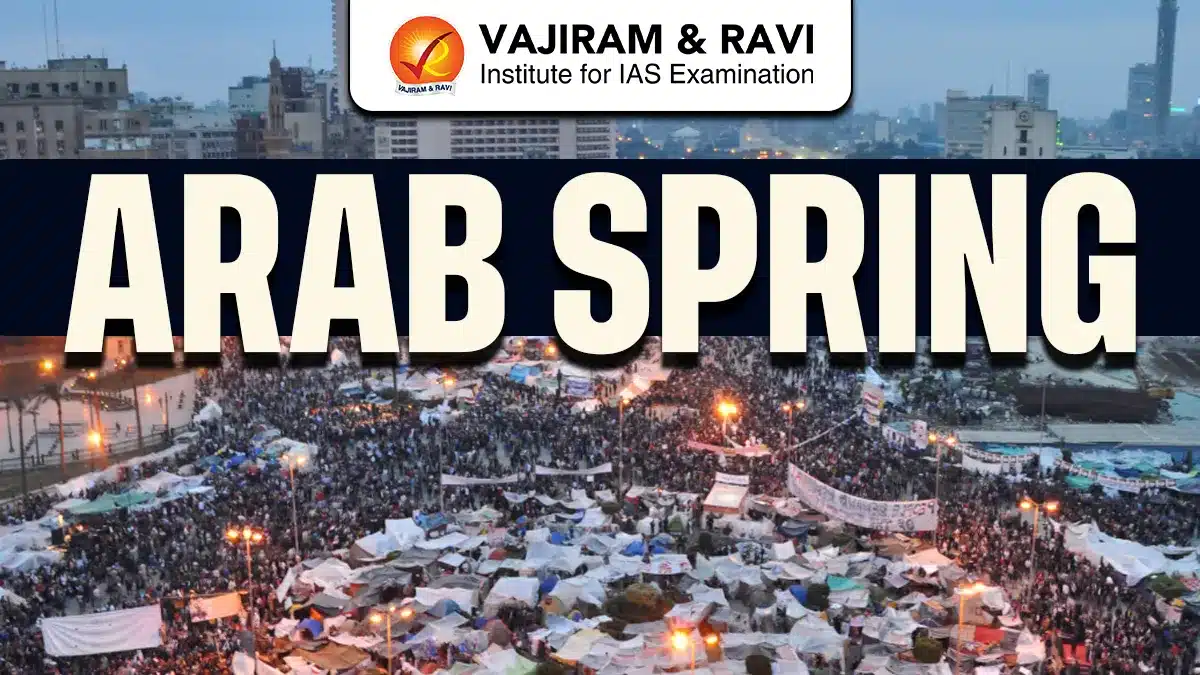
The Arab Spring was a series of anti-government protests and uprisings across the Arab world in the early 2010s, aimed at achieving democracy and social justice. It began in Tunisia when street vendor Mohamed Bouazizi set himself on fire, inspiring mass protests in other countries. Major uprisings occurred in Egypt, Libya, Syria, Yemen, Bahrain, and Morocco, leading to regime changes, civil wars, and political instability. The aftermath, known as the Arab Winter, brought prolonged conflicts, humanitarian crises, and regional instability that continue to affect the Middle East and North Africa.
Arab Spring Origin
The Arab Spring began in December 2010 with the self-immolation of Tunisian street vendor Mohamed Bouazizi, who protested the harassment of authorities. This act ignited the Jasmine Revolution in Tunisia, inspiring mass protests across the Arab world. Citizens demanded political freedom, social justice, and an end to authoritarian rule.
- Trigger Event: Mohamed Bouazizi set himself on fire in protest against police harassment and denial of permits.
- Immediate Outcome: Sparked the Jasmine Revolution in Tunisia; mass protests in the capital, Tunis.
- Political Impact: President Zine El Abidine Ben Ali fled Tunisia after ruling for 20 years.
- Regional Influence: Inspired uprisings in Egypt, Libya, Syria, Yemen, Bahrain, and Morocco.
- Main Demands: Greater democracy, political participation, social justice, and human rights reforms.
- Significance: Highlighted the role of individual acts of defiance in mobilizing mass movements.
Major Events and Uprisings of Arab Spring
The Arab Spring saw widespread protests, uprisings, and armed conflicts across the Middle East and North Africa, starting from Tunisia and spreading to Egypt, Libya, Syria, Yemen, and other nations. While some countries achieved short-term political changes, others descended into civil wars and prolonged instability. The movements were marked by mass mobilization, regime changes, and regional unrest.
- Tunisia: Jasmine Revolution led to President Zine El Abidine Ben Ali fleeing the country; paved the way for democratic reforms.
- Egypt: Protests in Tahrir Square ousted President Hosni Mubarak in 2011; early democratic gains were reversed after the 2013 military coup led by Abdel Fattah el-Sisi.
- Libya: Colonel Muammar Qaddafi overthrown during a civil war in 2011; executed by opposition forces; ongoing factional conflicts and humanitarian crises followed.
- Syria: Protests escalated into a civil war; millions displaced; rise of ISIS in northeastern Syria; Bashar al-Assad remains in power.
- Yemen: Protests triggered civil war, leading to destruction of infrastructure and ongoing tribal and political conflicts.
- Bahrain & Morocco: Bahrain faced violent crackdowns; Morocco introduced limited constitutional reforms.
- Impact on Civilians: Millions of refugees fled to neighboring countries and Europe; widespread violence and disruption of daily life.
- Regional Significance: Showed the power of grassroots activism, but also the fragility of political transitions in authoritarian contexts.
Aftermath of the Arab Spring
The aftermath of the Arab Spring, often called the “Arab Winter,” brought widespread instability, violence, and political uncertainty across the Middle East and North Africa. While some countries like Tunisia experienced democratic reforms, others like Egypt, Libya, Syria, and Yemen faced civil wars, authoritarian resurgence, and humanitarian crises.
- Tunisia achieved democratic elections and political reforms, considered a relative success.
- Egypt saw early democratic gains reversed after the 2013 military coup; Abdel Fattah el-Sisi returned the country to authoritarian rule.
- Libya descended into civil war between rival factions, leaving civilians vulnerable to violence and shortages.
- Syria’s civil war continues; Bashar al-Assad remains in power; ISIS rise and fall caused further instability.
- Yemen’s protests escalated into prolonged civil war, destroying infrastructure and creating a humanitarian crisis.
- Regional impact included rising sectarianism and proxy wars, notably between Iran and Saudi Arabia.
- Global consequences involved refugee flows to Europe and disruptions in trade and security.
- The Arab Spring highlighted the difficulty of democratic transitions in authoritarian regimes.
Arab Spring FAQs
Q1: What caused the Arab Spring?
Ans: The Arab Spring was triggered by political, social, and economic grievances, including high unemployment, corruption, lack of political freedom, and rising population pressures.
Q2: Which countries experienced uprisings due to the Arab Spring?
Ans: Major countries affected included Tunisia, Egypt, Libya, Syria, Yemen, Bahrain, and Morocco.
Q3: What was the trigger event of the Arab Spring?
Ans: The self-immolation of Tunisian street vendor Mohamed Bouazizi in December 2010 sparked mass protests in Tunisia, inspiring uprisings across the Arab world.
Q4: What was the outcome of the Arab Spring in Tunisia?
Ans: Tunisia saw the removal of President Zine El Abidine Ben Ali and successful democratic elections, making it one of the few relative successes of the Arab Spring.
Q5: What were the effects of the Arab Spring in Egypt?
Ans: Egypt’s protests led to the ouster of President Hosni Mubarak in 2011. However, democratic gains were reversed after the 2013 military coup, bringing Abdel Fattah el-Sisi to power.
