
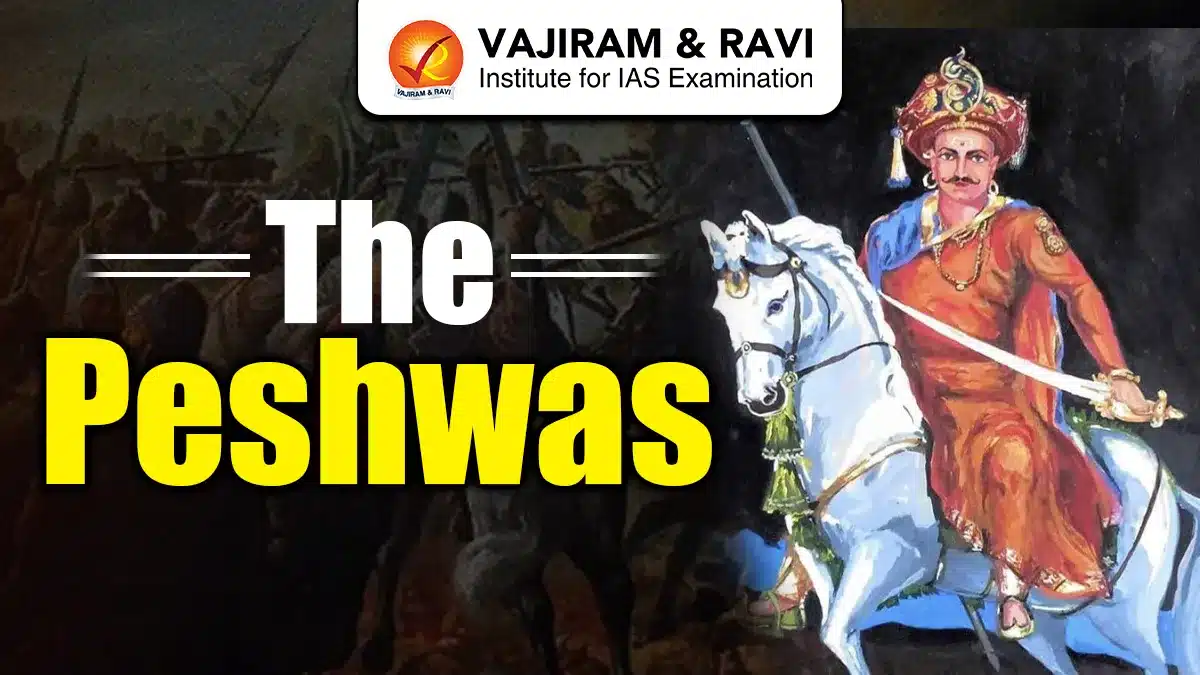
The Peshwas were the prime ministers of the Maratha Empire and ranked second only to the Chhatrapati in authority and prestige during 1674 to 1818. Over time, especially after Shahu’s death, the Peshwas emerged as the real power holders, while the Chhatrapati became largely nominal. They handled administration, revenue, military command, diplomacy and internal stability, transforming the Maratha state into a vast confederacy ruling most of the Indian subcontinent during the eighteenth century.
List of the Peshwas
The Peshwas played a decisive role in expanding, consolidating and later struggling to maintain the Maratha Empire. These positions were appointed by Chhatrapati until 1713, when Shahu Ji was succeeded by his son Baji Rao I. It became hereditary under Bhat family. The list of major Peshwa in chronological order has been given below:
1. Moropant Trimbak Pingle (1674-1683)
- He was appointed by Shivaji in 1674 as the first Peshwa and head of the Ashta Pradhan; he managed administration, revenue and state correspondence.
- He helped organize Shivaji’s civil administration, fort management, revenue assessment and coordination between military and civil officials.
- His tenure laid the institutional foundation of the Peshwa office, which later evolved into the most powerful position in the Maratha Empire.
2. Nilopant Moreshvar Pingle (1683-1689)
- Son of Moropant Pingle, he served as Peshwa under Sambhaji after his father’s death in 1683.
- His tenure coincided with Mughal invasions under Aurangzeb and internal instability within the Maratha state.
- Continued administrative continuity during a difficult phase but lacked the authority later enjoyed by hereditary Peshwas.
3. Ramchandra Pant Amatya (1689-1708)
- Appointed Peshwa by Rajaram I in 1689, he acted as regent when Rajaram fled to Jinji.
- Personally recaptured several forts from the Mughals between 1690 and 1694 using guerrilla warfare techniques.
- Managed finances, handled rebellions and ensured economic stability during severe famine and Mughal pressure.
- Played a crucial role in preserving the Maratha state during its most vulnerable period.
4. Balaji Vishwanath Bhat (1713-1720)
- Appointed by Chhatrapati Shahu in 1713 after the Maratha civil war. He was the first hereditary Peshwa.
- Secured Mughal recognition of “Shahu” as king and obtained rights to collect Chauth and Sardeshmukhi in six Deccan provinces.
- Strengthened revenue system and restored jagirs, making the Peshwa the most powerful office in the empire.
- Established hereditary succession by ensuring his son Baji Rao I succeeded him as Peshwa, making Shahu as centre of the Peshwa Family Tree.
5. Baji Rao I (1720-1740)
- Appointed at age twenty after his father, he is regarded as a military genius who never lost a single battle.
- He fought over 40 battles, including decisive victories at Palkhed (1728) and Bhopal (1737), and is considered as the greatest Peshwa.
- He expanded the Maratha empire, his influence was seen from Cuttack in the east to Attock in the northwest.
- Initiated Maratha confederacy, empowering Scindias, Holkars, Gaekwads and Bhonsles as regional administrators.
- Shifted the administrative capital from Satara to Pune in 1728, making it the Peshwa power center.
6. Balaji Baji Rao (1740-1761)
- Balaji Baji Rao, also called Nana Saheb, succeeded Baji Rao I and ruled during the peak of Maratha territorial expansion.
- After Shahu’s death in 1749, he imprisoned Ramraja, making the Peshwa the supreme authority by the Sangola Agreement of 1750.
- Secured Mughal agreement in 1752 granting Marathas revenue rights over Agra and Ajmer.
- He won the Battle of Udgir (1760) against the Nizam but faced catastrophic defeat at the Third Battle of Panipat (1761).
- Deeply affected by Panipat losses, he died in June 1761, marking a major turning point.
7. Madhav Rao I (1761-1772)
- Became Peshwa at a young age under the regency of Raghunath Rao after the Panipat disaster.
- Defeated Nizam of Hyderabad in 1763 and forced Haider Ali of Mysore into unfavorable treaties.
- Reasserted Maratha authority over Rajputs, Jats and Rohillas and restored Shah Alam II to Delhi in 1771.
- Regarded as the most capable administrator after Baji Rao I who restored the Maratha Power.
- Died prematurely in 1772, ending a highly effective reign.
8. Narayan Rao (1772-1773)
- Succeeded Madhav Rao I but ruled for barely a year.
- Faced severe factionalism between Raghunath Rao and Nana Fadnavis.
- Murdered at age eighteen due to conspiracy involving Raghunath Rao and Anandibai.
- His death destabilized the Peshwa administration and accelerated decline.
9. Madhav Rao II (1774-1795)
- Proclaimed Peshwa posthumously at birth, with Nana Fadnavis acting as chief administrator.
- Real power lay with ministers and Maratha chiefs, weakening central authority.
- Period marked by increasing British interference and internal Maratha rivalries.
- His long but weak reign ended in 1795.
10. Baji Rao II (1796-1818)
- Son of Raghunath Rao, became Peshwa amid intense British influence.
- Signed the Subsidiary Alliance in 1802, severely compromising Maratha sovereignty.
- Defeated by British East India Company in the Battle of Khadki during the Third Anglo Maratha War.
- Deposed in 1818, his territories annexed and he was pensioned off by the British.
- He was the last Peshwa and his defeat marked the end of the Peshwa institution and Maratha political independence.
Economy under the Peshwas
The features of economy under Peshwa has been highlighted below:
- Revenue System: The Peshwas relied on Chauth and Sardeshmukhi, collecting assessed land revenue from Mughal and regional territories, forming the backbone of Maratha finances.
- Agricultural Stability: Emphasis was placed on protecting cultivators, restoring war damaged villages and encouraging cultivation, especially during Balaji Baji Rao’s relatively peaceful Deccan phase between 1741 and 1745.
- Jagir and Cash Assignments: Revenue was distributed through jagirs to soldiers and officials, reducing immediate cash burden but gradually weakening central control over finances.
- Urban Growth: Pune emerged as a major administrative and economic center, witnessing growth in markets, banking and artisan activity due to sustained Peshwa patronage.
- Trade and Taxation: The Peshwas encouraged inland trade and maintained pragmatic relations with European traders to secure customs revenue and supplies for the army.
Administration under the Peshwas
The administrative features under Peshwa has been listed below:
- Hereditary Executive Authority: Under the Bhat family, the Peshwa became the supreme executive, controlling appointments, revenue, diplomacy and military command across the confederacy.
- Council and Officials: Administration relied on experienced ministers, diplomats and accountants, ensuring continuity even during weak or minor Chhatrapatis.
- Confederate Governance: Maratha chiefs like Scindias, Holkars, Gaekwads and Bhonsles governed their regions autonomously while acknowledging Peshwa supremacy.
- Judicial Oversight: Village level disputes were settled locally, while major cases and political matters were handled by Peshwa-appointed officials in Pune.
- Advisors: Influential figures like Nana Fadnavis shaped policy during later years, often balancing internal rivalries and external threats.
Military under the Peshwas
The military strength of the Peshwas rested on mobility, cavalry dominance and adaptive strategies suited to Indian terrain and politics.
- Cavalry Warfare: The Maratha army emphasized fast moving cavalry, enabling deep raids, long pursuits and disruption of enemy supply lines.
- Guerrilla Tactics: Following Shivaji’s legacy, Peshwas like Baji Rao I perfected hit-and-run warfare, ambushes and strategic retreats.
- Command Structure: Senior generals such as Malhar Rao Holkar, Scindia and Gaikwad commanded independent forces under overall Peshwa direction.
- Logistics and Speed: Armies carried minimal baggage, allowing rapid movement across hundreds of kilometers, as seen in northern expeditions up to Attock.
- Limitations: Dependence on cavalry and lack of strong artillery and infantry coordination proved costly against Afghan and European style armies.
Society under the Peshwas
Peshwa rule influenced social structures while remaining largely pragmatic due to the demands of governance and warfare.
- Caste Composition: Early Peshwas belonged to the Marathi Deshastha Brahmin community, yet administration and armies included diverse castes and groups.
- Social Pragmatism: Military needs reduced rigid caste barriers, as cooperation across communities was essential for taxation and warfare.
- Limited Caste Intervention: Direct interference in caste matters was rare, except under Narayan Rao, who altered the disputed social status of Prabhus.
- Lifestyle of Peshwas: Early Peshwas lived modestly, with legends describing Baji Rao I sharing food and hardships with his soldiers.
- Urban Society: Pune developed as a cultural and political hub, attracting scholars, artisans, administrators and merchants.
Battles fought by the Peshwas
Military campaigns under the Peshwas reshaped Indian politics and expanded Maratha influence across regions. Major Battles fought under Peshwa were:
- Battle of Palkhed (1728): Baji Rao I decisively defeated the Nizam of Hyderabad using superior mobility and strategy, establishing Maratha dominance in the Deccan.
- Battle of Bhopal (1737): Maratha forces forced the Mughal emperor to concede revenue rights, strengthening Maratha claims in northern India.
- Battle of Dabhoi (1731): Baji Rao crushed internal rebellion led by Trimbak Rao Dabhade, reinforcing Peshwa authority over Maratha chiefs.
- Battle of Udgir (1760): Peshwa forces defeated the Nizam during succession disputes, capturing key Deccan forts and territories.
- Third Battle of Panipat (1761): A catastrophic defeat against Ahmad Shah Abdali resulted in massive casualties and temporarily shattered Maratha power in the north.
The Peshwas’ Relations with Contemporary Rulers
The Peshwas maintained complex relations with Indian rulers and European powers to safeguard Maratha interests.
- Mughal Empire: Agreements with Mughal emperors granted Marathas Chauth and Sardeshmukhi in return for military protection.
- Nizam of Hyderabad: Relations alternated between alliance and conflict, with repeated wars over Deccan supremacy.
- Regional Powers: The Peshwas subdued Rajputs, Jats, Rohillas and Nawabs to assert Maratha dominance in northern India.
- British East India Company: Early cooperation for trade and naval matters later turned into conflict, culminating in Anglo Maratha wars.
- French Influence: Limited engagement with French trained troops occurred, but Marathas failed to fully modernize their forces like European armies.
Decline of the Peshwas
The decline of the Peshwas resulted from internal discord, military setbacks and rising European colonial power.
- The murder of Narayan Rao by Raghunath Rao and Anandibai severely weakened moral authority and unity.
- Autonomous Maratha chiefs increasingly pursued independent interests, reducing centralized control from Pune.
- Failure to modernize infantry and artillery left Marathas vulnerable against Afghan and British forces.
- The Peshwaship was abolished in 1818 by the British East India Company after the Third Anglo Maratha War (1817-1818).
- Baji Rao II was pensioned off, marking the formal end of Peshwa rule and Maratha sovereignty under colonial domination.
The Peshwas FAQs
Q1: Who were the Peshwas in the Maratha Empire?
Ans: The Peshwas were the prime ministers of the Maratha Empire, second in rank to the Chhatrapati and later became the real executive rulers.
Q2: When did the office of Peshwa become hereditary?
Ans: The Peshwa position became hereditary in 1720 when Chhatrapati Shahu appointed Baji Rao I, son of Balaji Vishwanath, as Peshwa.
Q3: Which Peshwa is regarded as the greatest military commander?
Ans: Baji Rao I is considered the greatest Peshwa due to his undefeated military career and expansion of Maratha power across India.
Q4: What was the Third Battle of Panipat’s impact on the Peshwas?
Ans: The third Battle of Panipat in 1761 caused massive Maratha losses and marked the beginning of the political decline of the Peshwas.
Q5: Who was the last Peshwa and how did Peshwa rule end?
Ans: Baji Rao II was the last Peshwa and his defeat by the British in 1818 ended Peshwa rule and Maratha sovereignty.
