Gandak River Latest News
The Gandak River has emerged as the second major river after the Chambal with the highest number of gharials, also known as fish-eating crocodiles.
About Gandak River
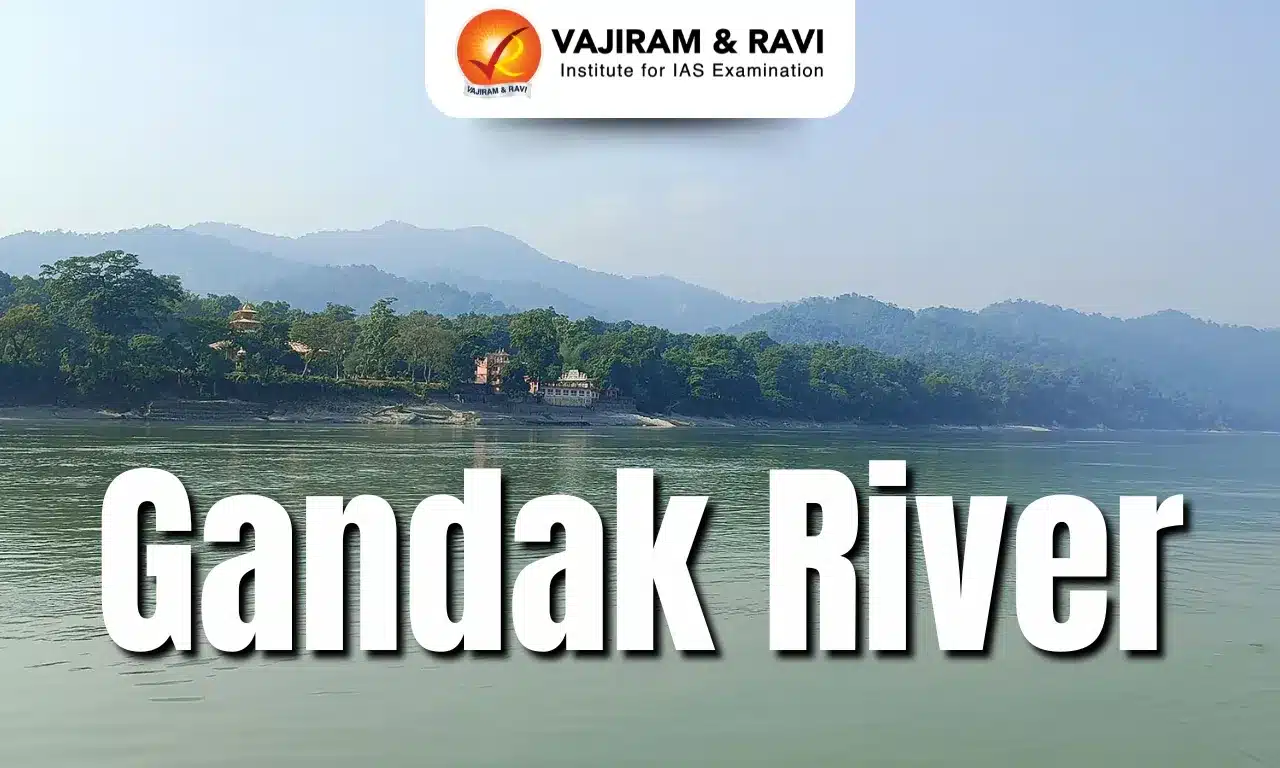
- The Gandak River, also known as the Narayani and Gandaki, is one of the major rivers in Nepal and a left-bank tributary of the Ganges in India.
- It is mentioned in the ancient Sanskrit epic Mahabharata.
- Course:
- It originates at an altitude of 7620 m above msl to the north of Dhaulagiri Mountain in Tibet near the Nepal border.
- After flowing through Tibet, it crosses Nepal, where it is also known as Narayani, to enter the Indian Territory.
- The river enters India from Valmikinagar in the West Champaran district of Bihar. The entry point of the river is at the Indo–Nepal border and is known as Triveni.
- In India, it flows southeast, across the upper Gangetic plain in eastern Uttar Pradesh and northwestern Bihar.
- Gandak joins Ganga near Patna in Vaishali district of Bihar.
- The total length of the river is 700 km. In India, it covers a course of more than 300 km.
- It is bounded on the north by the Himalayas, south by the River Ganga, east by the Burhi Gandak Basin and on the west by the Ghagra Basin.
- There are about 1,710 glaciers and over 300 lakes in the upper catchment of Gandaki.
- Due to the steep slope and loose soil in the upper catchment, Gandak carries a lot of silt and other deposits to the Indian side, resulting in a continuous shifting course of the river.
- While flowing through the Nepal Himalayas, it forms the Kali Gandaki gorge, one of the deepest river gorges in the world.
- Two important protected areas, Chitwan National Park in Nepal and the adjacent Valmiki Tiger reserve in India, have been established in the basin.
- Major Tributaries: Daraudi, Seti, Madi, Marsyandi, and Budhi Gandaki.
Key Facts about Gharial
- It is a freshwater crocodile.
- Scientific Name: Gavialis gangeticus
- The name ‘gharial’ comes from the Hindi word ghara, meaning pot or vessel, referring to the bulbous snout tip of adult males, which resembles an inverted pot.
- Distribution:
- Historically, the gharial's range spanned rivers of Bangladesh, Bhutan, India, Myanmar, Nepal and Pakistan.
- Today, only fragmented populations remain in Nepal and northern India.
- The Gharial reserves of India are located in three States: Uttar Pradesh, Madhya Pradesh, and Rajasthan.
- In India, the National Chambal Sanctuary holds about 90% of the surviving gharials.
- Features:
- It is one of the largest crocodilian species, with males reaching 16 to 20 feet (5 to 6 meters) in length.
- Females typically grow to lengths of 11.5 to 15 feet (3.5 to 4.5 meters).
- They have thick skin covered with smooth epidermal scales that do not overlap.
- The snout of the gharial is uniquely the thinnest and most elongated among all the crocodilians.
- In addition, the adult males sport a large bulb at the tip of their snout, called the ‘ghara’.
- It is also the most aquatic of all crocodilians, for it never moves far from the water. Individuals typically only leave the water to bask and nest on sandbanks.
- Reproduction: They mate during November–January and lay eggs March–May.
- Conservation Status:
- IUCN Red List: Critically Endangered
Source: TOI
Gandak River FAQs
Q1: What is the Gandak River also known as?
Ans: The Gandak River is also known as the Narayani and Gandaki.
Q2: Which major river system does the Gandak belong to in India?
Ans: It is a left-bank tributary of the Ganga River.
Q3: Where does the Gandak River originate?
Ans: It originates north of the Dhaulagiri Mountain in Tibet at an altitude of about 7,620 metres above mean sea level.
Q4: Which Indian states does the Gandak River flow through?
Ans: It flows through eastern Uttar Pradesh and Bihar.
Q5: Which famous gorge is formed by the Gandak River in the Himalayas?
Ans: It forms the Kali Gandaki Gorge, one of the deepest river gorges in the world.

