
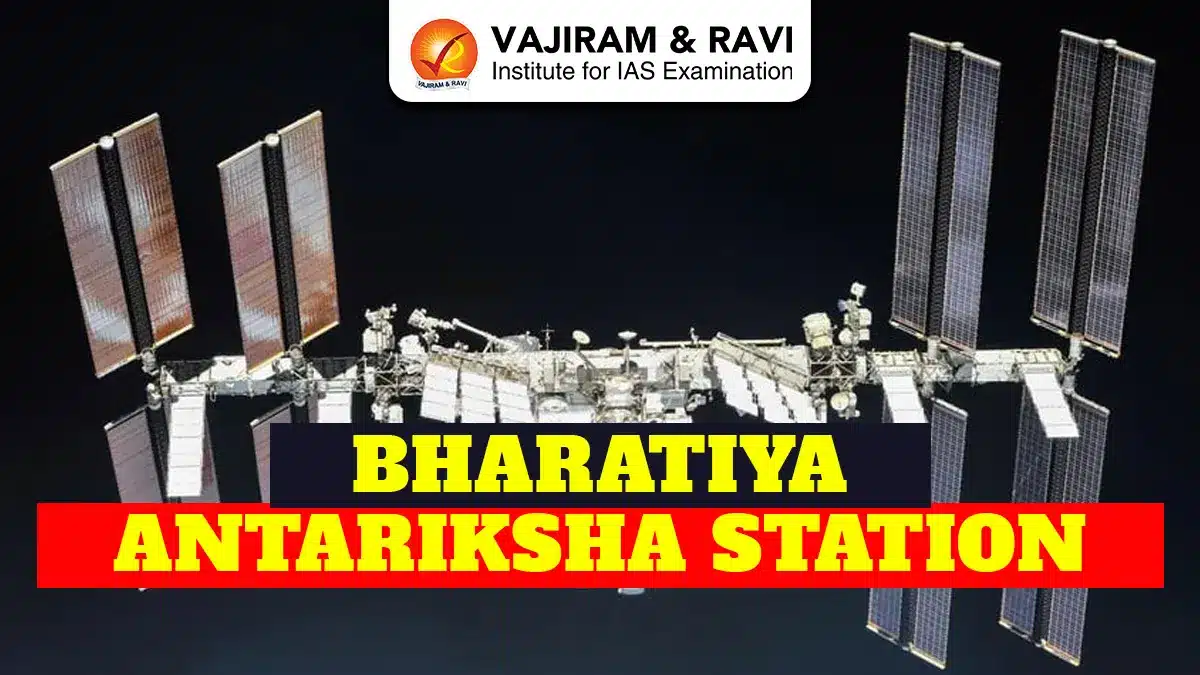
India’s space journey has steadily evolved from satellite launches to deep space exploration missions such as Chandrayaan and Gaganyaan under the leadership of the Indian Space Research Organisation (ISRO). These programmes laid the technological and human capability foundation for long duration missions in Low Earth Orbit. India is now moving towards establishing its own indigenous Space Station named the Bharatiya Antariksha Station (BAS). This Station represents the next logical step in India’s human spaceflight roadmap, enabling sustained astronaut presence, advanced microgravity research, and preparation for future missions to the Moon and beyond.
Bharatiya Antariksha Station
The Bharatiya Antariksh Station (BAS) is India’s planned modular Space Station designed for long term scientific research in Low Earth Orbit at an altitude of 400-450 kilometres. It will allow Indian astronauts to stay in space for extended durations of three to six months. It is planned on lines similar to the International Space Station. BAS will consist of five modules launched in phases. The first module, BAS-01, is targeted for launch in 2028, with the complete station expected to become fully operational by 2035 under ISRO’s long term space vision.
Bharatiya Antariksh Station Background
The idea of Bharatiya Antariksh Station emerged as a natural extension of India’s human spaceflight ambitions under Gaganyaan and long term space exploration goals.
- Gaganyaan, approved in December 2018, aimed to develop technologies for safe human spaceflight to Low Earth Orbit, forming the technological base required for a future space station.
- Short term orbital missions were insufficient to study long term effects of microgravity on humans, creating the need for a permanent orbital laboratory.
- India’s space roadmap envisions an operational space station by 2035 and a crewed lunar mission by 2040, positioning BAS as a critical intermediate milestone under Amrit Kaal Vision 2047.
- On 18 September 2024, the Union Cabinet approved expansion of Gaganyaan to include development of BAS-01 and precursor missions.
- Establishing BAS enhances India’s autonomy in human spaceflight, scientific research, and strategic space capabilities amid growing global space competition.
Bharatiya Antariksh Station Features
The Bharatiya Antariksh Station is designed as a technologically advanced, modular, and internationally compatible orbital research facility.
- Modular Configuration: BAS will consist of five interconnected modules, allowing phased construction, easier upgrades, and operational flexibility over its planned lifespan.
- Orbital Characteristics: The station will orbit Earth at approximately 400-450 km, ensuring stable microgravity conditions suitable for scientific experiments.
- Funding: Revised Gaganyaan funding stands at ₹20,193 crore, including an additional ₹11,170 crore approved specifically for BAS development and missions.
- Mission Planning: Eight human spaceflight-related missions are planned under the revised programme, concluding with BAS-01 launch by December 2028.
- Interoperability Standards: BAS-01 subsystems are being designed following international standards to enable docking and collaboration with global space agencies.
Bharatiya Antariksh Station Modules
The Bharatiya Antariksh Station will be constructed using five specialised modules launched using India’s heavy-lift launch vehicles.
- BAS-01 Base Module: Target to be launched in 2028, measuring 3.8 m in diameter and 8 m in length, weighing around 9-10 tonnes, it houses crew quarters, life support, docking, and berthing systems.
- BAS-02 Core Module: Designed for docking and station control, this module will support structural stability and internal systems integration.
- BAS-03 Science Research Module: Dedicated to microgravity experiments in biotechnology, materials science, and human physiology.
- BAS-04 Laboratory Module: Enables extended experimental setups, long-term observations, and technology demonstrations in space conditions.
- BAS-05 Common Berthing Module: Facilitates cargo docking, crew transfers, and expansion capabilities, supporting station logistics and maintenance.
Bharatiya Antariksh Station Development
The development of Bharatiya Antariksha Station follows a phased, technology-driven roadmap integrated with Gaganyaan missions and indigenous system development.
- Timeline Progression: First module launch is targeted for 2028, while complete five module operational capability is planned by 2035.
- Technology Demonstration Missions: Four dedicated missions between 2026 and 2028 will validate life support, docking, robotics, and long-duration habitation technologies.
- Launch Vehicles: BAS modules will be launched using LVM3, LVM3-SC and future Next Generation Launch Vehicles to handle heavy payloads.
- Robotic Systems: A robotic arm tested on POEM-4 in January 2025 will assist in module assembly, maintenance, and external operations.
- Industry Participation: ISRO has invited commercial players since January 2026 for module construction, increasing private-sector involvement.
Bharatiya Antariksh Station Significance
The Bharatiya Antariksha Station holds transformative significance for India’s scientific, technological, economic, and strategic ambitions.
- Microgravity Research Hub: BAS will enable advanced research on muscle atrophy, bone density loss, fluid behaviour, and materials processing in microgravity.
- Human Spaceflight Capability: Long-duration missions will help develop medical, psychological, and life-support solutions essential for future lunar and deep-space missions.
- Economic Growth: India aims to raise its global space economy share from 2% to 10%, with BAS driving high-tech manufacturing and innovation.
- Technological Spin-offs: Space-developed technologies will benefit sectors like healthcare, environmental monitoring, construction, and advanced materials.
- STEM Inspiration: BAS offers career opportunities for youth in space science, engineering, and research, strengthening India’s knowledge economy.
Bharatiya Antariksh Station Challenges
Despite its promise, the Bharatiya Antariksh Station faces several technical, financial, and strategic challenges.
- Complex Life Support Systems: Developing reliable systems for oxygen, waste recycling, radiation shielding, and thermal control is technologically demanding.
- Astronaut Health Risks: Microgravity, radiation exposure, psychological isolation, and altered brain fluid dynamics pose serious health challenges.
- Limited Funding: India’s Research and Development budget stands at around 0.7% of GDP, which may constrain advanced technology development pace.
- Space Debris Threat: Increasing orbital debris heightens collision risks, requiring advanced tracking and avoidance systems.
- Geopolitical Sensitivities: Balancing strategic autonomy with international collaboration remains complex in a competitive global space environment.
Way Forward
- International Collaboration: Cooperation with experienced agencies like ESA, NASA, and Roscosmos can reduce costs and technological risks.
- Enhanced Funding Models: Greater public-private partnerships and international collaboration can supplement national funding constraints.
- Capacity Building: ISRO must upgrade infrastructure for life support, radiation protection, and orbital maintenance technologies.
- Sustainability Planning: Regular resupply missions, modular upgrades, and maintenance strategies are essential for station longevity.
- Regulatory Compliance: Adherence to international space law and sustainable space governance norms is critical for long-term operations.
International Space Station
The International Space Station is the world’s largest operational Space Laboratory and serves as a benchmark for global cooperation in space.
- ISS is jointly operated by NASA, Roscosmos, ESA, JAXA, and the Canadian Space Agency, involving 15 countries.
- Assembled in 1998 and operational since 2000, it has hosted continuous human presence for over two decades.
- More than 3,000 experiments from over 108 countries have been conducted aboard the ISS.
- ISS orbits Earth at around 400 km, similar to the planned orbit of BAS, enabling comparable research conditions.
- ISS experience provides valuable lessons in long-duration missions, international coordination, and station sustainability.
Space Stations
A Space Station is a habitable artificial satellite designed for long duration human stay, research and experiments in Earth’s orbit. The list of other Space Stations that have been managed by the Countries across world is given below:
- Salyut 1, Soviet Union (Inoperative): Launched in April 1971, it was the world’s first space station and marked the beginning of long-duration human space habitation experiments.
- Skylab, United States (Inoperative): Launched by NASA in 1973, it was America’s first space station and conducted extensive solar and biomedical research before deorbiting in 1979.
- Salyut Series, USSR (Inoperative): Between 1971 and 1986, several Salyut stations were launched to test military and civilian space station technologies.
- Mir Space Station, Russia (Inoperative): Operational from 1986 to 2001, Mir was the first modular space station and supported long-duration missions exceeding one year.
- International Space Station (Operational): Operational since 2000, jointly run by NASA, Roscosmos, ESA, JAXA, and CSA, and the largest habitable structure in Low Earth Orbit.
- Tiangong Space Station, China (Operational): Fully operational since late 2022, China’s modular space station supports three-member crews and advanced microgravity research.
- Bharatiya Antariksh Station, India (Upcoming): India’s planned modular space station with five modules, first module launch targeted for 2028 and full operation by 2035.
- Gateway Space Station (Upcoming): A NASA-led international project under the Artemis programme, planned to orbit the Moon and support deep space and lunar missions.
- Axiom Space Station (Upcoming): The world’s first planned commercial space station, to be built in Low Earth Orbit and eventually replace ISS modules.
- Russian Orbital Service Station (ROSS) (Upcoming): Russia’s proposed next-generation space station intended to replace its role in the ISS after retirement.
Bharatiya Antariksha Station FAQs
Q1: What is the Bharatiya Antariksh Station (BAS)?
Ans: Bharatiya Antariksh Station is India’s planned modular space station for long-duration human spaceflight and microgravity scientific research in Low Earth Orbit.
Q2: When will the first module of Bharatiya Antariksha Station be launched?
Ans: The first module, BAS-01 (Base Module), is approved to be launched by 2028 as part of the revised Gaganyaan Programme.
Q3: What is the total budget allocated for Bharatiya Antariksh Station?
Ans: The revised Gaganyaan Programme, including BAS development, has a total approved budget of ₹20,193 crore.
Q4: What will be the location for the Bharatiya Antariksha Station?
Ans: Bharatiya Antariksh Station will orbit the Earth in Low Earth Orbit at an altitude of approximately 400 to 450 kilometres.
Q5: Which launch vehicle will be used to launch Bharatiya Antariksha Station Modules?
Ans: BAS modules will be launched using India’s heavy-lift launch vehicles, primarily LVM3 and future next-generation launch vehicles.
