
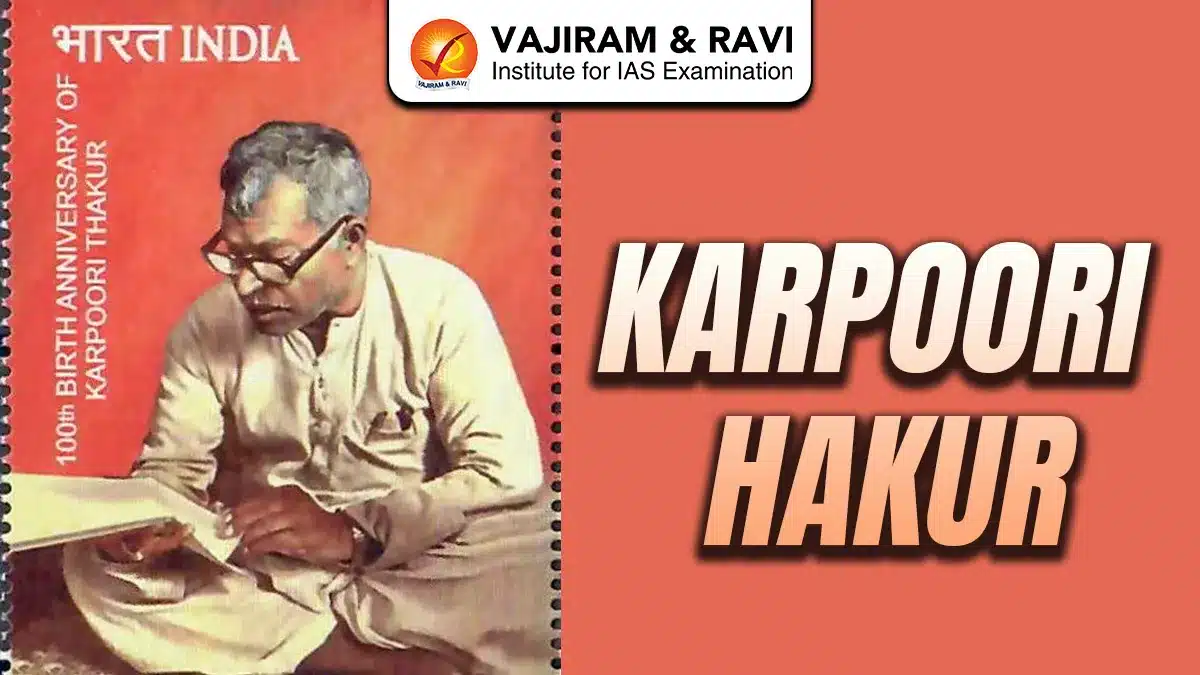
Karpoori Thakur was a freedom fighter, a visionary statesman and a champion of the cause of farmers, women and disadvantaged sections of society. Popularly known as “Jan Nayak”, he dedicated his entire public life to the empowerment of the poor, backward, and marginalized sections of society.
Karpoori Thakur Early Life
Karpoori Thakur was born on 24 January 1924 at Pitaunjhia (now Karpoori Gram) in the Samastipur (earlier Darbhanga) district of Bihar. He belonged to the Nai community, which was socially, educationally, and politically disadvantaged.
Despite being born in a poor and marginalised community he was among the few students to pass the Class 10 Board Examination. He later enrolled in CM College, completed his intermediate education, and continued his studies for graduation.
Karpoori Thakur Role in Freedom Struggle
Karpoori Thakur was influenced by leaders like Mahatma Gandhi and Satyanarayan Sinha. He actively participated in the Quit India Movement and spent 26 months in prison.
Even after his release in 1945, he continued his non-violent struggle against British rule and worked persistently for the cause of landless farmers. He formed the Navyuvak Sangh at the age of 14 and took part in the farmers' movement led by Swami Sahajanand Saraswati.
Karpoori Thakur Political Career
Karpoori Thakur was first non-Congress socialist Chief Minister of Bihar. He served as the Chief Minister of Bihar twice, from 1970-71 and 1977-79.
He won the first election of Independent India in 1952 as a Socialist Party nominee and remained an MLA till his death in 1988, except when he became an MP in 1977 and when he lost an Assembly election in 1984.
He became the Deputy Chief Minister of Bihar in 1967 holding the Education and Finance Ministries.
He resigned as a Member of the Legislative Assembly in 1974 to participate in the mass movement popularly known as the JP movement led by Jayprakash Narayan.
Karpoori Thakur Legacy
Karpoori Thakur is remembered for his commitment to the idea of social justice. As the Chief Minister of Bihar, karpoori Thakur implemented several people-centric reforms such as:
- He implemented the recommendations of the Mungeri Lal Commission, with 12 per cent reservation for the Extremely Backward Classes, 8 per cent for the Backward Classes, 3 per cent for women from all classes, and 3 per cent for economically weaker sections. For the first time in independent India, he introduced affirmative action for women and economically weaker sections of the general category.
- He made primary education free to help the poor and removed the mandatory requirement of passing English to pass the 10" Examination to make education inclusive and more relevant.
- He made Hindi as the language of the government and recognized Urdu, a language of a large segment of the population, as the second official language.
- He implemented the Antyodaya Yojana for the first time to provide free food grains through the public distribution system.
- He instituted an old age pension and banned alcohol.
- He exempted land rent on land holdings up to 7 acres and abolished surcharges on land
- With an aim to promote transparency, he overhauled the appointment process of engineers and doctors, distributing their appointment letters in public.
Karpoori Thakur was a true Jan Nayak who devoted his life to the welfare of people. He was respected personally for his clean image and people-centric governance. In recognition of his lifelong contribution to inclusive politics, ethical leadership, and social equality, he was posthumously awarded the Bharat Ratna in 2024.
Karpoori Thakur FAQs
Q1: Who was Karpoori Thakur?
Ans: Karpoori Thakur was a freedom fighter, socialist leader, and Chief Minister of Bihar, popularly known as “Jan Nayak” for his work for the poor and marginalized.
Q2: When and where was he born?
Ans: He was born on 24 January 1924 at Pitaunjhia (now Karpoori Gram), Samastipur, Bihar.
Q3: What was his role in the freedom struggle?
Ans: He actively participated in the Quit India Movement, spent 26 months in prison, and worked for landless farmers from an early age.
Q4: What were his major contributions as Chief Minister?
Ans: He implemented social justice reforms like reservation for backward classes and women, free primary education, Antyodaya Yojana, land rent exemptions, and transparent recruitment processes.
Q5: Why is he called Jan Nayak?
Ans: He earned the title Jan Nayak for his mass leadership, dedication to the marginalized, and ethical, people-centric governance.
