
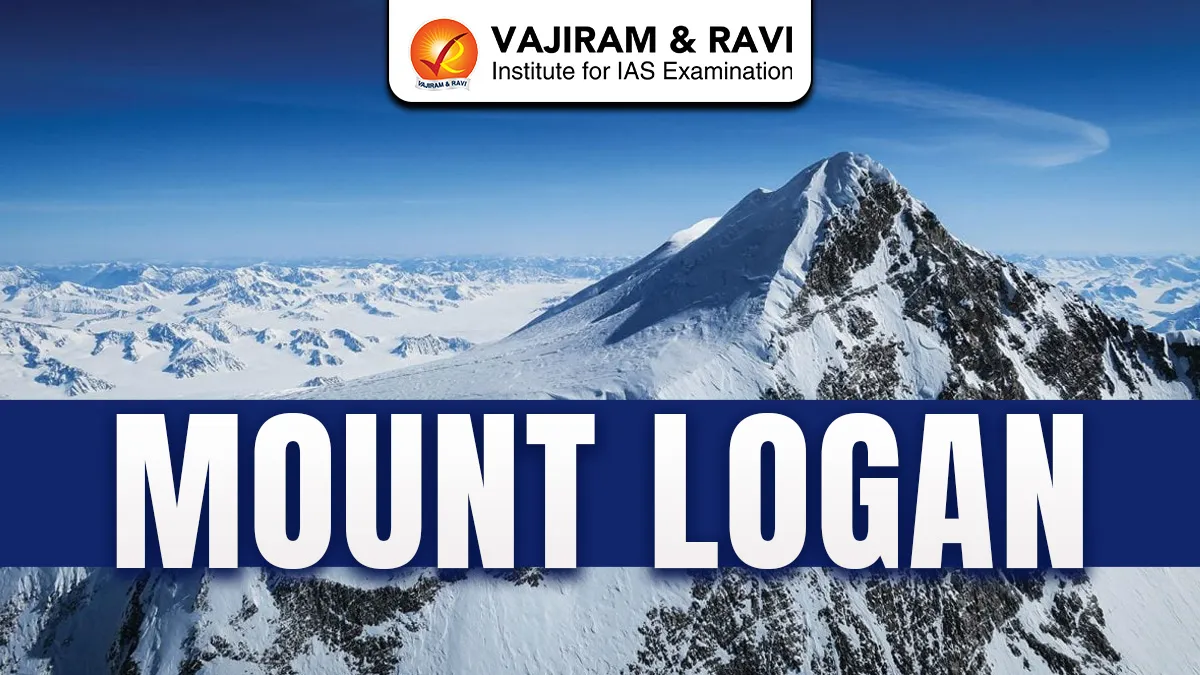
Mount Logan is the Highest Mountain Peak in Canada and the Second Highest Peak in North America, after Denali (formerly known as Mount McKinley) in Alaska. It dominates the Saint Elias Mountains of southwestern Yukon. The mountain lies within Kluane National Park and Reserve which is a vast protected wilderness close to the Yukon-Alaska border. It was named after Sir William Edmond Logan who was the founder of the Geological Survey of Canada. Mount Logan is globally significant for its immense size, extreme climate and scientific value in geology, glaciology and high altitude research.
Mount Logan
Mount Logan is one of the most massive non volcanic mountains on Earth. It forms a vast massif containing eleven peaks above 5,000 metres and ranks as the sixth most topographically prominent mountain worldwide. Due to ongoing tectonic uplift, the mountain continues to rise at about 0.35 millimetres annually. Mount Logan feeds major glaciers, including the Hubbard and Logan glaciers which makes it central to the Saint Elias Icefields.
Read about: Highest Peak in India
Mount Logan Features
Mount Logan is characterised by extreme elevation, harsh climate, massive glaciation, geological importance and a long history of exploration and scientific study as highlighted below:
- Location: Mount Logan is located in southwestern Yukon within Kluane National Park and Reserve, less than 40 kilometres north of the Yukon-Alaska border, forming a central feature of the rugged Saint Elias Mountains and vast icefields.
- Height: Its precise height was confirmed in 1992 using GPS by a Geological Survey of Canada expedition to be 5,959 metres tall.
- Elevation: Active tectonic forces continue to raise its elevation at approximately 0.35 millimetres per year.
- Massif: The Mount Logan massif includes eleven peaks exceeding 5,000 metres and spread across a massive plateau nearly 19 kilometres long.
- Peaks: Major Peaks include Philippe Peak, Logan East Peak and Prospector Peak, etc.
- Base: Mount Logan has the largest base circumference of any non volcanic mountain on Earth.
- Prominence: It has a topographic prominence of about 5,250 metres, ranking sixth globally in prominence.
- Climatic Conditions: Temperatures on the 5,000 metre plateau average around -27°C annually. The temperature usually drops to -45°C in winter and summer temperatures rarely exceed freezing levels.
- Ice Cap and Glaciation: Extremely low temperatures cause minimal snowmelt, resulting in an ice cap up to 300 metres thick that feeds major glaciers like the Hubbard and Logan Glaciers.
- Geological Composition: The mountain is largely composed of granodiorite, an intrusive igneous rock, indicating deep crustal geological processes linked to the tectonic collision along the Pacific margin.
- Discovery: American geologist Israel C. Russell first reported Mount Logan in 1890 and named it after Sir William Edmond Logan, a pioneer of Canadian geological science.
- First Ascent: The first successful ascent occurred on June 23, 1925, led by Albert H. MacCarthy with an international team, after a 65 day expedition involving extreme cold and severe frostbite.
- Scientific Research: High altitude medical, meteorological and glaciological research has been conducted on Mount Logan, including long term physiology studies supported by Canadian and American scientific institutions.
- Climbing Regulations: Due to high rescue costs, Parks Canada banned solo and winter climbs in 2020 and made rescue insurance mandatory, following multiple expensive rescue missions.
Mount Logan FAQs
Q1: Where is Mount Logan located?
Ans: Mount Logan is located in southwestern Yukon, Canada, within Kluane National Park and Reserve, near the Yukon-Alaska border.
Q2: What is the height of Mount Logan?
Ans: Mount Logan has an officially measured height of 5,959 metres, confirmed using GPS technology in 1992.
Q3: Mount Logan was named after whom?
Ans: The mountain was named after Sir William Edmond Logan, founder of the Geological Survey of Canada.
Q4: How many major Peaks are part of the Mount Logan Massif?
Ans: The Mount Logan massif includes 11 major peaks above 5,000 metres which forms one of the largest mountain complexes in North America.
Q5: Which glaciers originate from Mount Logan?
Ans: Mount Logan is the source of major glaciers such as the Hubbard Glacier and the Logan Glacier which are part of the Saint Elias Icefields.
