
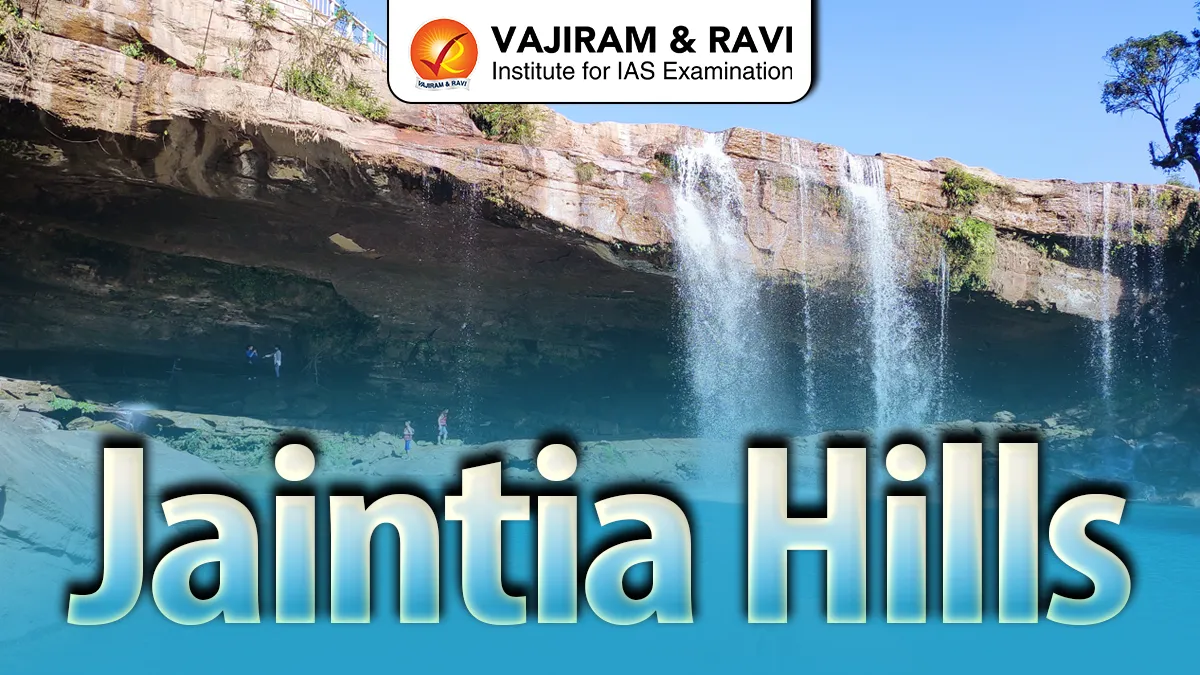
The Jaintia Hills are a beautiful, mountainous region in eastern Meghalaya, known for being one of the wettest places on Earth.
Jaintia Hills Location
- The Jaintia Hills are located in the eastern part of Meghalaya, forming one of the three hill ranges of the state - Garo, Khasi, and Jaintia Hills.
- They lie east of the Khasi Hills and extend up to the India - Bangladesh international border.
- The Jaintia Hills are an integral part of the Meghalaya Plateau, which is an extension of the Peninsular Plateau.
Jaintia Hills Physiography and Relief
- The Jaintia Hills exhibit a plateau-like structure with dissected hills and valleys.
- Average elevation ranges from 600 metres to about 1,500 metres.
- The relief is highly uneven due to intense rainfall and river erosion.
- The southern edge shows steep escarpments that descend sharply towards the Bangladesh plains.
Jaintia Hills Geology
- The hills are composed mainly of ancient crystalline rocks such as gneiss and schist, overlain by thick sedimentary limestone deposits.
- Rich mineral resources include Limestone (cement industry), Coal Sandstone and clay.
- Jaintia Hills are famous for karst landscapes, formed by the dissolution of limestone. This process has created many caves, sinkholes, and underground rivers in the region. Inside the caves, there are natural formations called stalactites and stalagmites, which are formed by mineral deposits.
- The region hosts some of the longest and deepest caves in India, such as Krem Liat Prah, Krem Umthloo
Jaintia Hills Drainage
- Since Jaintia Hills have a hilly and steep terrain rivers are generally short, swift-flowing, and rain-fed.
- Most rivers flow southwards into Bangladesh, becoming part of the Surma - Meghna river system.
- The Kopili River is the largest stream in the region, known for its rocky terrain and numerous waterfalls.
- Other major rivers include the Myntdu River and the Lukha River which is known for its seasonal blue and acidic water
Jaintia Hills Climate
- The climate of the Jaintia Hills is directly controlled by the southwest monsoon originating from the Bay of Bengal and the Arabian Sea.
- The climate shows a variation from the warm, humid tropical plains in the eastern and southern part and temperate climate is experienced in the western part.
- They receive very heavy rainfall, particularly during the south-west monsoon. Proximity to Cherrapunji and Mawsynram places the region among the wettest areas of India.
- High rainfall in the region leads to waterfalls and deep gorges. Krang Suri Waterfall is one of the most famous and beautiful waterfalls in the Jaintia Hills of Meghalaya
Jaintia Hills Soils
- Soils are mainly red, lateritic and acidic in nature.
- Heavy rainfall results in leaching and soil erosion.
- Valley areas have relatively more fertile alluvial patches suitable for agriculture.
Jaintia Hills Ecology
The region is part of the Indo-Burma biodiversity hotspot, making it ecologically important.
- The region supports tropical evergreen and semi-evergreen forests. Forests are rich in Bamboo, Orchids, Medicinal plants. In the higher and cooler parts, pine forests are also found.
- Jaintia Hills host diverse wildlife such as elephants, leopards, hoolock gibbons, hornbill
- The region is often in news due to Rat-hole mining. Rat-hole mining is a method of extracting coal from narrow, horizontal seams, prevalent in Meghalaya. The term “rat hole” refers to the narrow pits dug into the ground, typically just large enough for one person to descend and extract coal.
Jaintia Hills FAQs
Q1: Where are the Jaintia Hills located?
Ans: They are in eastern Meghalaya, east of the Khasi Hills, and extend up to the India–Bangladesh border. They form part of the Meghalaya Plateau.
Q2: Why are the Jaintia Hills geologically important?
Ans: They contain limestone-rich formations that create karst landscapes with caves, sinkholes, underground rivers, stalactites, and stalagmites.
Q3: Jaintia Hills are part of which global biodiversity hotspot?
Ans: Jaintia hills are part of the Indo-Burma biodiversity hotspot.
Q4: What type of climate is found in the Jaintia Hills?
Ans: The region receives very heavy monsoon rainfall and is among the wettest areas of India, leading to dense forests, waterfalls, and deep gorges.
Q5: Why are the Jaintia Hills often in the news?
Ans: They are known for rat-hole coal mining, a controversial method of extracting coal from narrow tunnels, raising environmental and safety concerns.

