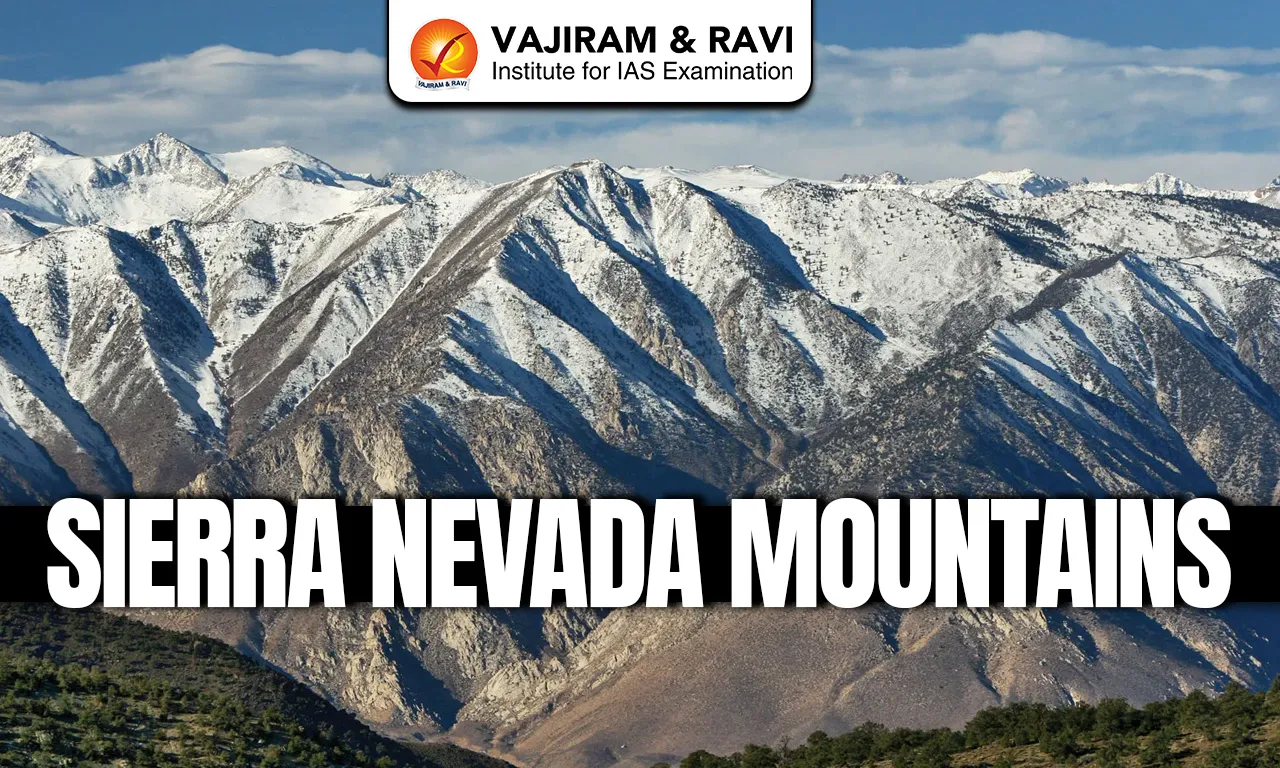
The Sierra Nevada Mountains are a major mountain range in Western North America, mainly located in California. They run from North to South and include some of the highest peaks in the United States, such as Mount Whitney. The range is known for its steep slopes, deep valleys and glaciers and they play a crucial role in climate, rivers and water supply of the region.
Sierra Nevada Mountains
- Sierra Nevada lies between the Central Valley in the west and the Basin and Range Province in the east, extending from the Mojave Desert to the Cascade Range.
- The range is famous for its high peaks, scenic landscapes and giant sequoia trees, the largest trees in the world.
- It is an important source of water, hydroelectric power and was a key region during the California Gold Rush, though human activities like mining and tourism have changed its natural landscape.
Sierra Nevada Mountains Physical Features
Physiography
- The Sierra Nevada is an asymmetrical mountain range, with its highest peaks and steep slopes on the eastern side.
- Most peaks are 11,000-14,000 feet high; Mount Whitney (14,494 feet) is the highest peak in the contiguous United States.
- The northern part of the range is lower, with heights mostly between 7,000 and 9,000 feet.
- Geologically, the range is mainly made of granite, along with some metamorphic rocks and volcanic rocks, especially in the northern section where it connects with the Cascade Range.
Geology
- The Sierra Nevada is an uplifted and tilted block of the Earth’s crust, formed due to faulting.
- A major fault lies on the eastern side, along which the land was pushed upward and tilted westward, making the range asymmetrical.
- The eastern slope is steep, with deep canyons formed by erosion from wind, rain, ice and frost.
- The western slope is gentle, where rivers deposit sediments and form large alluvial fans extending into California’s Central Valley.
- Although uplift began millions of years ago, major uplift occurred in the last 2 million years, giving the range its great height today.
Drainage and Glaciation
- The western slope of the Sierra Nevada is gentle and has long rivers like the Yuba, American, Merced and Kern, which mostly flow into the Sacramento-San Joaquin river system and finally reach the Pacific Ocean.
- Most rivers rise in deep valleys carved by glaciers in hard granite rocks.
- During the Pleistocene period, large glaciers covered the mountain valleys several times and shaped the landscape.
- These glaciers formed U-shaped valleys, cirques, moraines and many glacial lakes, especially on the western side.
- Famous features like Yosemite Valley and Lake Tahoe are results of glacial erosion; Lake Tahoe is one of the largest and deepest alpine lakes in the world.
Climate
- The Sierra Nevada has a mild mountain climate as it lies in the mid-latitudes and is close to the Pacific Ocean, which lowers the extreme temperatures.
- The range runs northwest to southeast, so moist winds from the Pacific give heavy rainfall and snowfall on the western slopes, while the eastern slopes remain dry due to the rain-shadow effect.
- Most rainfall occurs from November to April and snowfall increases with height, with deep snow cover on higher northern peaks.
- In summer, a high-pressure system over the Pacific brings dry weather; when it remains strong for many years, the region may face long droughts.
Flora and Fauna
- The Sierra Nevada shows distinct vegetation zones based on altitude, from foothill forests to alpine plants above the tree line.
- Lower and upper slopes have deciduous trees, pines, fir, cedar, and giant sequoias, while subalpine areas support hardy conifers.
- The eastern slopes are dry, with desert-type vegetation like sagebrush and juniper; chaparral grows on both sides except alpine zones.
- Wildlife includes black bear, mule deer, mountain lion, and smaller mammals like bobcat, beaver, pika, and marmot, varying with height.
Sierra Nevada Mountains FAQs
Q1: Where are the Sierra Nevada Mountains located?
Ans: They are located in western North America, mainly along the eastern side of California, between the Central Valley and the Basin and Range Province.
Q2: What is the highest peak of the Sierra Nevada Mountains?
Ans: Mount Whitney (14,494 feet) is the highest peak of the Sierra Nevada and the highest in the contiguous United States.
Q3: Why are the Sierra Nevada Mountains called asymmetrical?
Ans: As they have steep slopes and high peaks on the eastern side and gentle slopes on the western side.
Q4: What type of rocks mainly form the Sierra Nevada Mountains?
Ans: The range is mainly made of granite, along with some metamorphic and volcanic rocks, especially in the northern part.
Q5: Which major rivers drain the Sierra Nevada region?
Ans: Rivers like the Yuba, American, Merced, and Kern drain the region, mostly flowing into the Sacramento–San Joaquin river system.