Wet Dress Rehearsal

Wet Dress Rehearsal

Wet Dress Rehearsal Latest News

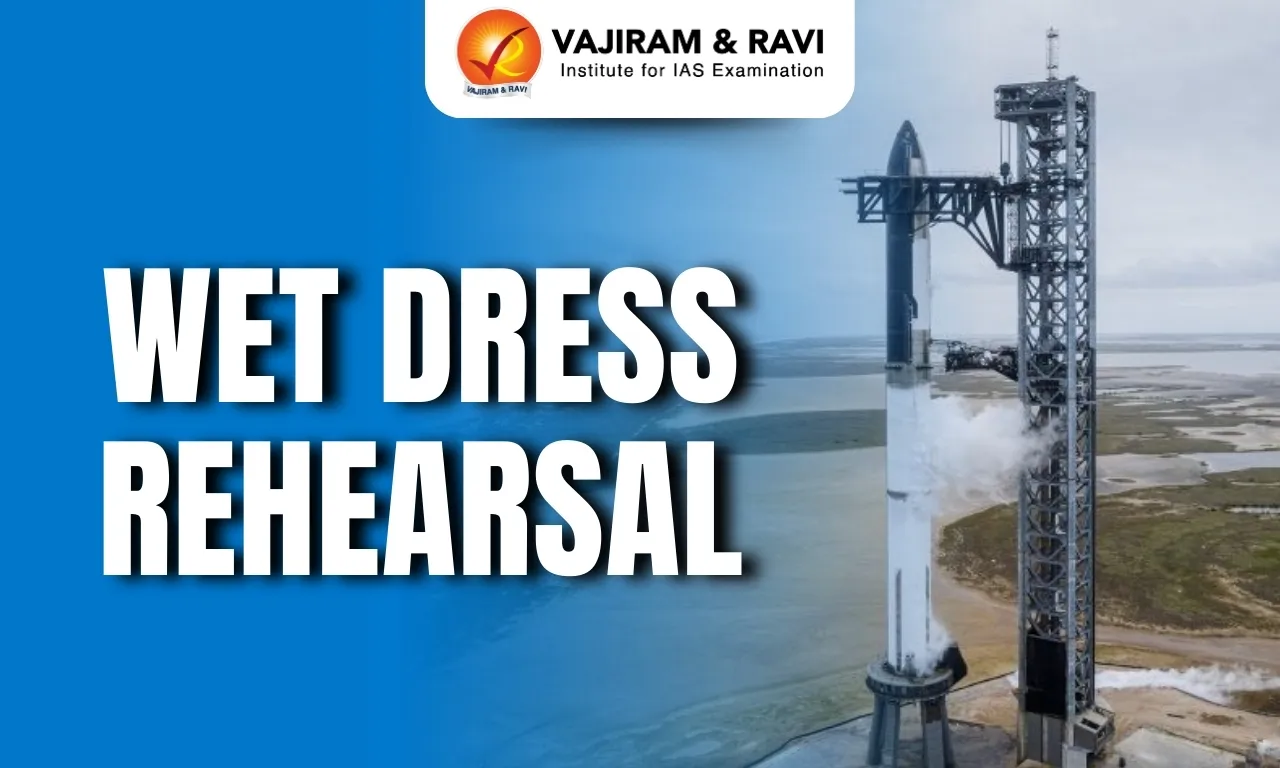
Recently, NASA found a hydrogen leak during a wet dress rehearsal of its Artemis II mission.

About Wet Dress Rehearsal

  • It is the final practice run for a high-stakes rocket launch. 
  • The “wet” in the name refers to the loading of cryogenic fuel (typically liquid oxygen and liquid hydrogen for large rockets) into the rocket’s massive tanks.
  • It is a rigorous demonstration of ground team preparedness. 
  • The team will cool the fuel feed lines, load the tanks, pressurise them, monitor leak detectors, and execute the countdown into its final stages. 
  • These rehearsals also keep the tanks full as the propellant warms and boils off, then executes a stop just before ignition, followed by draining and returning the vehicle to a stable configuration. 
  • This puts the entire craft through each step of a simulated launch, exposing it to the super-chilled fuels to ensure that everything will function properly on launch day. 
  • Wet rehearsals are important because only they can reveal events that happen in cryogenic conditions, e.g., leaks in seals or in the connections between the rocket and ground equipment.

What is a Dry Dress Rehearsal?

  • It practices the countdown and important operations without loading cryogenic propellants into the rocket. 
  • Instead, the team will power up vehicle and ground systems, verify its communications equipment, simulate critical events, and validate decision-making and handoffs between launch control, engineering, range safety, and, if applicable, crew operations. 
  • Many of the testing steps use simulated sensor inputs. 
  • These rehearsals are useful to reveal logical problems in the flow of events without risking fuel leaks.

Key Facts about Artemis II Mission

  • It is the second scheduled flight of NASA's Artemis program and the first crewed Artemis mission. 
  • It will be the first mission to carry humans to the moon’s vicinity since 1972.
  • It is the first to fly astronauts aboard the Space Launch System (SLS) rocket and Orion spacecraft. 
  • While Artemis 1 successfully flew Orion around the moon without astronauts in 2022, Artemis 2 will be the first time humans travel aboard the spacecraft and venture beyond Low Earth Orbit in more than 50 years.
  • Four astronauts will take a 10-day flight around the moon and back to Earth, testing systems ahead of the Artemis 3 mission, which aims to deliver astronauts to the lunar surface by 2028.
  • The mission will include three NASA astronauts and one astronaut from the Canadian Space Agency (CSA).
  • The astronauts and mission controllers will collect data on Orion and the crew’s performance to assess how ready the Artemis program is to send people to the moon’s surface.
  • Orion will undergo high-speed reentry through Earth’s atmosphere before safely splashing down in the Pacific Ocean off the coast of San Diego.

Source: TH

Wet Dress Rehearsal FAQs

Q1: What is a Wet Dress Rehearsal in the context of a rocket launch?

Ans: It is the final practice run before launch, involving full fueling of the rocket.

Q2: Why is it called a “wet” dress rehearsal?

Ans: Because it involves loading cryogenic propellants like liquid oxygen and liquid hydrogen into the rocket.

Q3: What key procedures are carried out during a Wet Dress Rehearsal?

Ans: Cooling fuel lines, loading tanks, pressurising them, checking for leaks, and running the countdown close to ignition.

Q4: Does a Wet Dress Rehearsal include actual engine ignition?

Ans: No, it stops just before ignition.

Q5: Why are Wet Dress Rehearsals critical for rocket launches?

Ans: They expose the rocket to super-chilled cryogenic fuels, helping detect leaks or system failures under real conditions.
Wajid Ali Shah

Wajid Ali Shah

Wajid Ali Shah Latest News

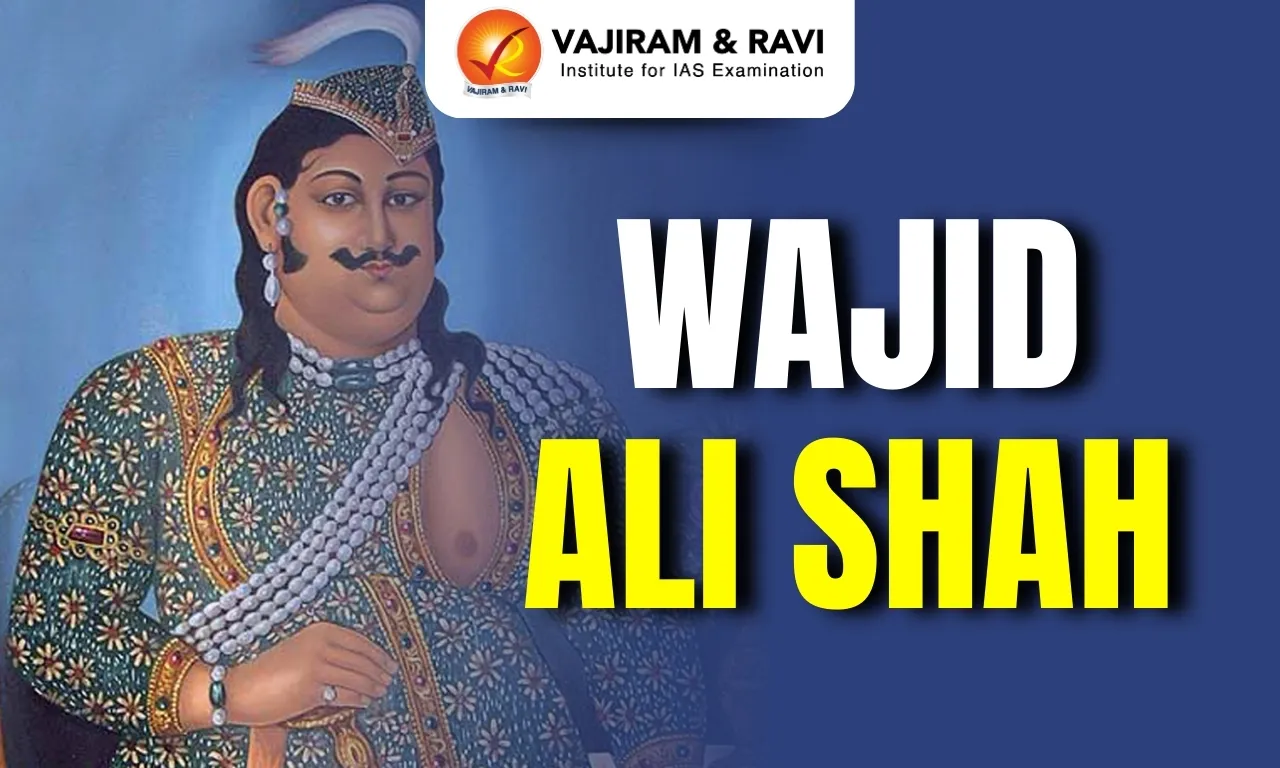
Nawab Wajid Ali Shah was not exiled to Calcutta but he came to the city because he wanted to take a ship to London to submit a petition but that departure was restricted and he stayed on, according to a biography by his great-grandson, recently translated from Urdu to English.

About Wajid Ali Shah

  • Nawab Wajid Ali Shah (1822-1887) belonged to the princely kingdom of Awadh (Oudh) in Uttar Pradesh.
  • He succeeded his father, Nawab Amjad Ali Shah, to become the province’s tenth and last nawab. He ascended the throne in 1847.
  • He was regarded as being a kind, generous, and compassionate ruler, as well as a good administrator, who took keen interest in the affairs of the state.
  • He went on to rule for nine years till his kingdom was annexed by the British in 1856, citing “misgovernance.”.
  • His deposition and the annexation of Awadh became one of the major causes of the Revolt of 1857.
  • He lived out the rest of his life at Garden Reach in Metiabruz, then a suburb of Kolkata.
  • His time spent as Nawab is perfused with generosity and admiration for artistic valor.
  • He was a man of many talents, a poet, playwright, dancer, and profound patron of arts. 
  • His works included numerous poems, prose, ragas, playwrights, and ghazals under his pen name of ‘Qaisar’.
  • The Ishqnamah (Book of Love) is a youthful autobiography written in Urdu verse by Wajid Ali Shah.
  • He is also credited for contributing to the revival of the Indian dance form Kathak
  • He is renowned for his secular approach and his interest in Hindu culture.
  • He was also greatly interested in architecture. He started building the Qaiser bagh palace complex as soon as he came to the throne. This vast complex was built between 1848 and 1850.
  • Besides the Nawab’s immense contributions to India, one of his wives, Begum Hazrat Mahal, was known to be a great Indian freedom fighter who played a major role during India’s First War of Independence (1857-58) against the British.

Source: TH

Wajid Ali Shah FAQs

Q1: Who was Wajid Ali Shah?

Ans: Wajid Ali Shah was the tenth and last Nawab of Awadh (Oudh).

Q2: When did Wajid Ali Shah ascend the throne of Awadh?

Ans: He ascended the throne in 1847.

Q3: How long did Wajid Ali Shah rule Awadh?

Ans: He went on to rule for nine years till his kingdom was annexed by the British in 1856, citing “misgovernance.”.

Q4: How is Wajid Ali Shah remembered in cultural history?

Ans: He is remembered as a poet, playwright, dancer, patron of arts, and a ruler with a secular outlook.

Q5: What palace complex did Wajid Ali Shah construct?

Ans: He built the Qaiserbagh Palace Complex between 1848 and 1850.

PM-SURAJ Portal

PM-SURAJ Portal

PM-SURAJ Portal Latest News

The PM-SURAJ portal disbursed Rs 1,389.61 crore in loans to 1.39 lakh entrepreneurs in the 2024-25 fiscal year, surpassing its target.

About PM-SURAJ Portal

  • Pradhan Mantri Samajik Utthan evam Rozgar Adharit Jankalyan (PM-SURAJ) portal was launched by the Ministry of Social Justice and Empowerment in 2024.
  • Objective: To provide credit support to entrepreneurs from disadvantaged sections of society virtually.
  • It is a centralised platform where individuals from underprivileged backgrounds can apply for and track the progress of all available loans and credit schemes. 
  • Only those intending to establish a new business can apply on this portal, as this platform provides loans exclusively for business startups.
  • Business loans up to Rs 15 lakh are available at low interest rateS through this portal, which are transferred directly to your bank account through banks, NBFC-MFIs, and other financial institutions.
  • It is run by government bodies like the National Scheduled Castes Finance and Development Corporation (NSFDC), the National Safai Karamcharis Finance & Development Corporation (NSKFDC), and the National Backward Classes Finance and Development Corporation (NBCFDC).
  • It is designed to uplift the most marginalized segments of society, such as the backward classes, scheduled castes, tribes, and other disadvantaged sections, and extend credit assistance to one lakh entrepreneurs from disadvantaged communities.

Source: DEVD

PM-SURAJ Portal FAQs

Q1: Which Ministry launched the PM-SURAJ Portal?

Ans: It was launched by the Ministry of Social Justice and Empowerment.

Q2: What is the main objective of the PM-SURAJ Portal?

Ans: Its objective is to provide credit support to entrepreneurs from disadvantaged sections of society.

Q3: Who can apply through the PM-SURAJ Portal?

Ans: Individuals from underprivileged and marginalized communities intending to start a new business can apply.

Q4: How are loans disbursed under the PM-SURAJ Portal?

Ans: Loans are transferred directly to the applicant’s bank account through banks, NBFC-MFIs, and other financial institutions.

National Large Solar Telescope

National Large Solar Telescope

National Large Solar Telescope Latest News

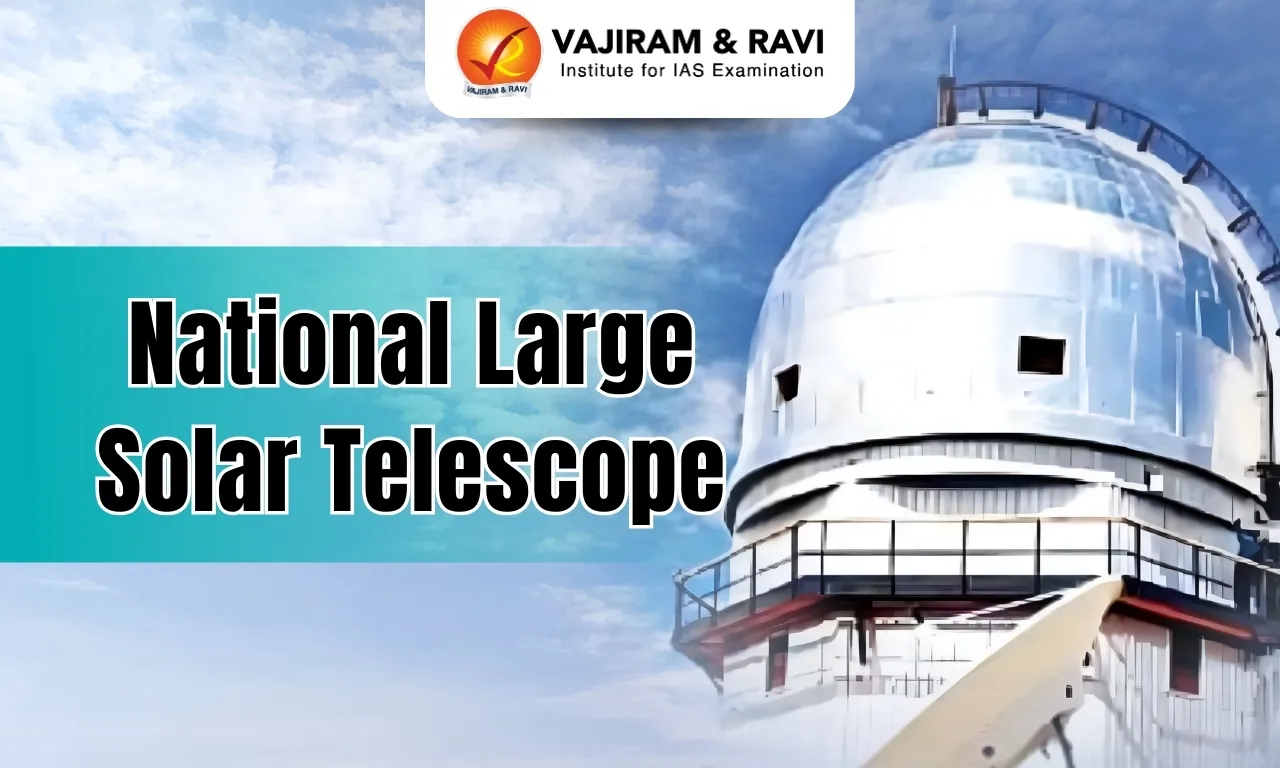
In this year’s Union Budget, the government sanctioned the establishment of two new telescopes namely National Large Solar Telescope and National Large Optical-Near Infrared Telescope to study the sun and the origins of the universe.

About National Large Solar Telescope

  • It is a 2-metre aperture solar telescope, coming up in the Merak region near the Pangong Tso Lake.
  • Purpose: It is meant to study the sun
  • It will operate in the visible and near-infrared wavelengths of the electromagnetic spectrum.
  • It will help solar physicists to study the fundamental solar dynamics and magnetism, energetic solar events, and map various space-weather processes having a direct bearing on the Earth and national space assets, like satellites and space launches.
  • NLST will serve as India’s third ground-based solar observatory.
    • Currently, the Kodaikanal Solar Observatory (in Tamil Nadu, established 1899) and the Udaipur Solar Observatory (in Rajasthan, established 1975) are operational.

Key Facts about National Large Optical-Near Infrared Telescope

  • It is a 13.7-metre aperture segmented-mirror telescope which will be built in Hanle.
    • In a segmented-mirror telescope, a larger primary mirror comprises highly complex, smaller hexagonal mirror segments.
  • It will have 90 smaller segmented mirrors arranged in a fashion that they all collect light but act as one, large mirror.
  • It will be one of the world’s largest telescopes operating in the electromagnetic spectrum’s optical-infrared wavelengths.
  • Objective: Frontier research on exoplanets, stellar and galactic evolution, and supernovae will be possible, besides looking for clues to trace the origins of the universe. 

Source: IE

National Large Solar Telescope FAQs

Q1: What is the primary objective of the NLST?

Ans: To investigate solar magnetic fields and dynamics

Q2: Which organization is leading the NLST project?

Ans: Indian Institute of Astrophysics

Public Financial Management System

Public Financial Management System

Public Financial Management System Latest News

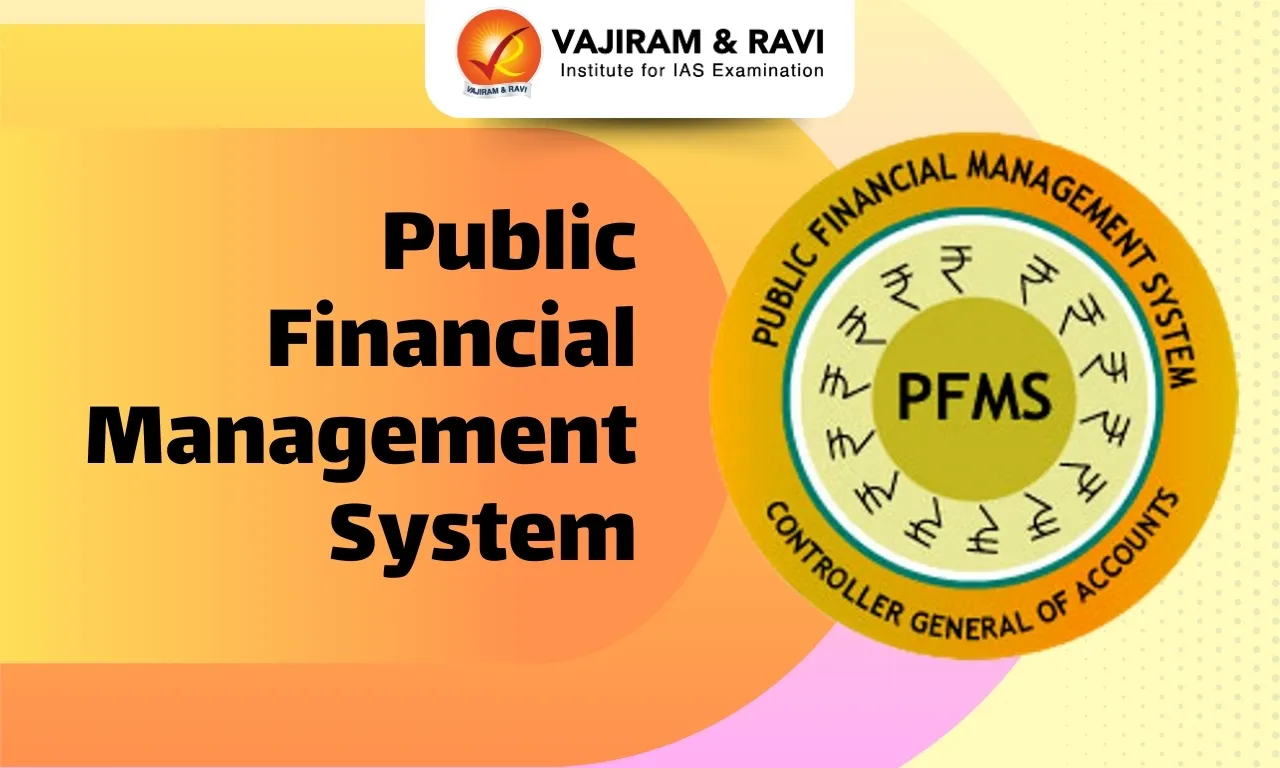
Recently, the Minister of State for finance informed the Rajya Sabha about the Public Financial Management System (PFMS).

About Public Financial Management System

  • It is a web-based online transaction system for fund management and e-payment to implementing agencies and other beneficiaries.
  • It is a Centralized Transaction System & Platform, providing end to end financial management services to all stakeholders.
  • It is developed and implemented by the Controller General of Accounts (CGA), Department of Expenditure, Ministry of Finance, Government of India.
  • It was started during 2009.
  • Function: To facilitate a sound Public Financial Management System for Government of India by establishing an efficient fund flow system as well as a payment cum accounting network.

Key Features of Public Financial Management System

  • It tracks funds released under all Plan schemes of Government of India, and real time reporting of expenditure at all levels of Programme implementation.
  • The government has mandated PFMS as a single platform for payment, accounting & reconciliation of government transactions and DBT.
  • Cash management modules: It has been introduced on PFMS for better fund management like Single Nodal Agency (SNA), Treasury Single Account (TSA), Central Nodal Agency (CNA) and Single Nodal Agency Samyochit Pranali Ekikrit Shighra Hastantaran (SNA SPARSH).
  • Grievance Redressal System: PFMS has introduced the Customer Relationship Management (CRM) system, to strengthen the grievance redressal mechanism for PFMS users/ beneficiaries.

Source: PIB

Public Financial Management System FAQs

Q1: Which ministry developed PFMS?

Ans: Ministry of Finance

Q2: What is a key feature of PFMS?

Ans: It is a single platform for payment and accounting and real-time tracking of funds.

Lymphatic Filariasis

Lymphatic Filariasis

Lymphatic Filariasis Latest News

Recently, the Union Health Minister launched the Annual Nationwide Mass Drug Administration (MDA) Campaign for the Elimination of Lymphatic Filariasis.

About Lymphatic Filariasis

  • It is commonly known as elephantiasis (Haatipaon) which is a neglected tropical disease.
  • It is a vector-borne disease transmitted by the female Culex mosquito.
  • Cause: It is caused by infection with parasites classified as nematodes (roundworms) of the family Filariodidea. There are 3 types of these thread-like filarial worms:
    • Wuchereria bancrofti, which is responsible for 90% of the cases
    • Brugia malayi, which causes most of the remainder of the cases
    • Brugia timori, which also causes the disease
  • Transmission Cycle: Adult worms nest in the lymphatic vessels and disrupt the normal function of the lymphatic system where they produce millions of microfilariae (immature larvae) that circulate in the blood.
    • Infection occurs when filarial parasites are transmitted to humans through mosquitoes.
  • Symptoms: The majority of infections are asymptomatic but in chronic conditions it leads to lymphoedema (tissue swelling) or elephantiasis (skin/tissue thickening) of limbs and hydrocele (scrotal swelling). 
  • Treatment
    • Elimination of lymphatic filariasis is possible by stopping the spread of the infection through preventive chemotherapy.
    • The WHO-recommended preventive chemotherapy strategy for lymphatic filariasis elimination is mass drug administration (MDA).
    • MDA involves administering an annual dose of medicines to the entire at-risk population.

Source: PIB

Lymphatic Filariasis FAQs

Q1: What is Lymphatic Filariasis commonly known as?

Ans: Elephantiasis

Q2: How is Lymphatic Filariasis transmitted?

Ans: Mosquito bite

Gilbert Hill

Gilbert Hill

Gilbert Hill Latest News

After Anand Mahindra highlighted Gilbert Hill in a recent post, curiosity around the Mumbai landmark has surged.

About Gilbert Hill

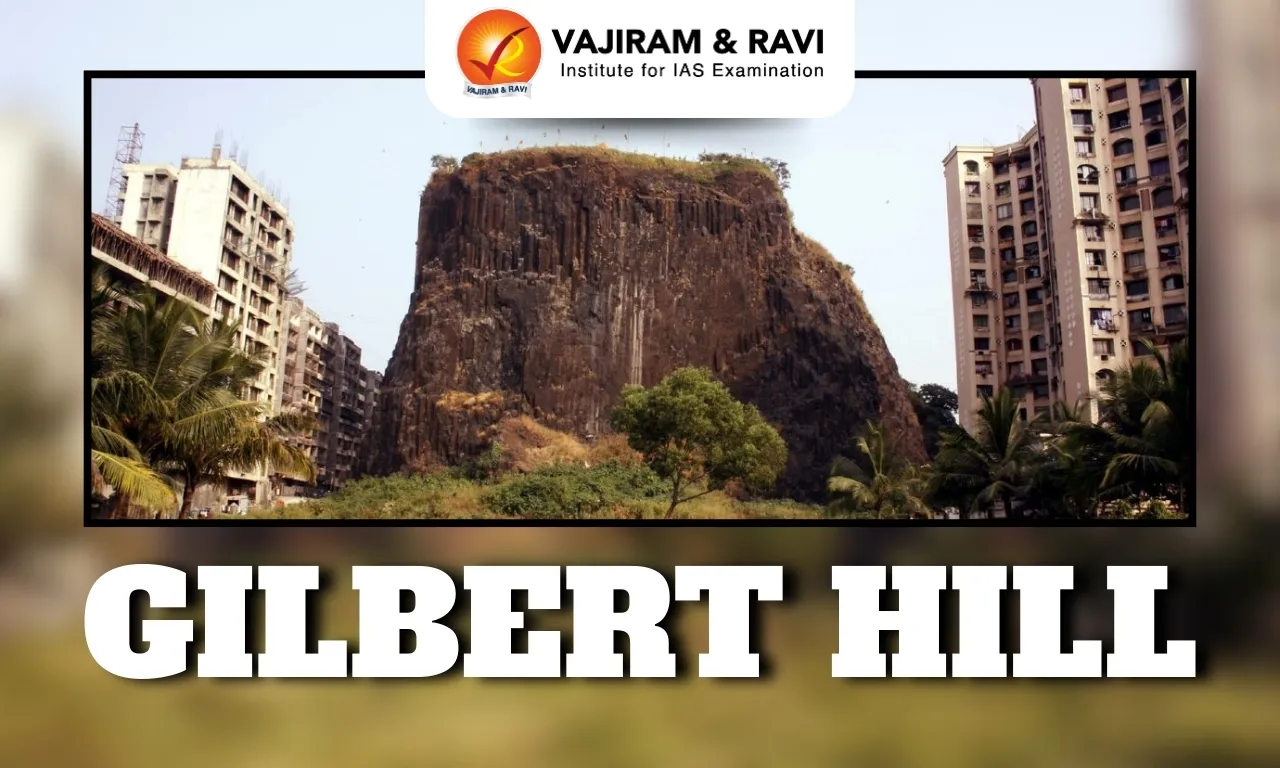
  • It is a 200-foot (61 meters) monolith column of black basalt rock located in Andheri, Mumbai Suburban, Maharashtra. 
  • The hill has a sheer vertical face and is one of the oldest basalt rock formations in the world.
  • It was shaped millions of years ago, during the Mesozoic era, about 66 million years ago, when molten lava emerged from the Earth's crevices.
  • It belongs to the same geological period that marked the end of the dinosaur age. 
  • Formed during massive volcanic eruptions that created the Deccan Traps, the structure is a rare example of a volcanic column. 
  • According to geological records, only three such columnar basalt formations exist in the world. The other two are 
    • Devil’s Tower (USA)
    • Giant’s Causeway (Northern Ireland)
  • It was declared a National Park in 1952, while the BrihanMumbai Municipal Corporation categorised it as a Grade II heritage structure in 2007.
  • Arguably the oldest heritage site in the country in its original form, Gilbert Hill has a few temples and a small garden atop. These are accessed by a steep staircase carved into the rock.

Source: NDTV

Gilbert Hill FAQs

Q1: Where is Gilbert Hill located?

Ans: Gilbert Hill is located in Andheri, Mumbai, Maharashtra.

Q2: What type of geological formation is Gilbert Hill?

Ans: It is a 200-foot (61 m) monolithic column of black basalt rock.

Q3: During which geological era was Gilbert Hill formed?

Ans: It was formed during the Mesozoic era, around 66 million years ago.

Q4: Why is Gilbert Hill considered geologically significant?

Ans: It is a rare example of columnar basalt formation and one of the oldest basalt rock formations in the world.

Hollongapar Gibbon Wildlife Sanctuary

Hollongapar Gibbon Wildlife Sanctuary

Hollongapar Gibbon Wildlife Sanctuary Latest News

Recently, a male gibbon was found electrocuted to death at Hollongapar Gibbon Wildlife Sanctuary (HGWS) in Jorhat.

About Hollongapar Gibbon Wildlife Sanctuary

  • Location: It is located in the Jorhat district of Assam, India.
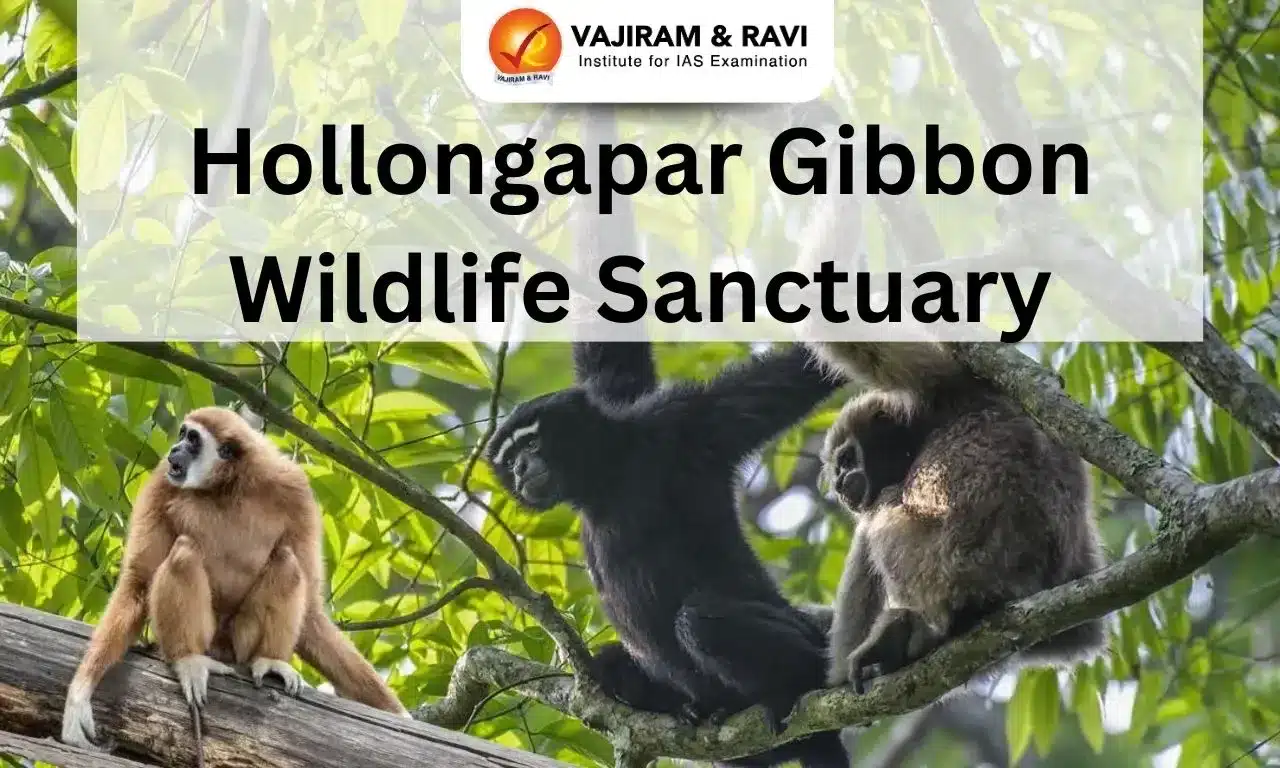
  • It is the only sanctuary in India named after a gibbon due to its distinction for containing the densest gibbon populations in Assam.
  • Terrain: It is situated at an altitude between 100 and 120 m (330 and 390 ft), the topography gently slopes downward from southeast to northwest.
  • River: The Bhogdoi River creates a waterlogged region dominated by semi-hydrophytic plants along the border of the sanctuary.
  • Flora:
    • The upper canopy of the forest is dominated by the Hollong tree, while the Nahar dominates the middle canopy.
    • The lower canopy consists of evergreen shrubs and herbs.
  • Fauna: It contains India’s only gibbons–the hoolock gibbons, and Northeastern India’s only nocturnal primate–the Bengal slow loris, Indian elephants, tigers, leopards, jungle cats, wild boar, three types of civet, four types of squirrels, stump-tailed macaque, northern pig-tailed macaque, etc.

Source: DTE

Hollongapar Gibbon Wildlife Sanctuary FAQs

Q1: Where is Hollongapar Gibbon Wildlife Sanctuary located?

Ans: Jorhat district of Assam

Q2: What is Hollongapar Gibbon Wildlife Sanctuary famous for?

Ans: Gibbon Conservation

Network Readiness Index

Network Readiness Index

Network Readiness Index Latest News

India has improved its position by four slots and is now placed at 45th rank as per the Network Readiness Index 2025 (NRI 2025) report. 

About Network Readiness Index

  • It maps how economies leverage information and communication technologies to support growth, innovation and social development.
  • Methodology used: It maps the network-based readiness landscape of 127 economies based on their performance in four pillars: Technology, People, Governance and Impact, covering a total of 53 indicators.
  • The report has been prepared by the Portulans Institute, an independent, non-profit research and educational institute based in Washington DC.

Key Highlights of Network Readiness Index Report 2025

  • India improved its score from 53.63 out of 100 in 2024 to 54.43 out of 100 in 2025.
  • India secured 1st rank in “Annual investment in telecommunication services”, “AI scientific publications”, “ICT services exports” and “E-commerce legislation”.
  • 2nd rank in “FTTH/Building Internet subscriptions”, “Mobile broadband internet traffic within the country” and “International Internet bandwidth”, and 3rd rank in “Domestic market scale” and “Income Inequality”.
  • India is ranked 2nd in the group of lower-middle-income countries.

Source: PIB

Network Readiness Index FAQs

Q1: What is the rank of India in Readiness Index 2025?

Ans: 45th Position

Q2: What is the primary focus of the NRI?

Ans: Assessing digital development

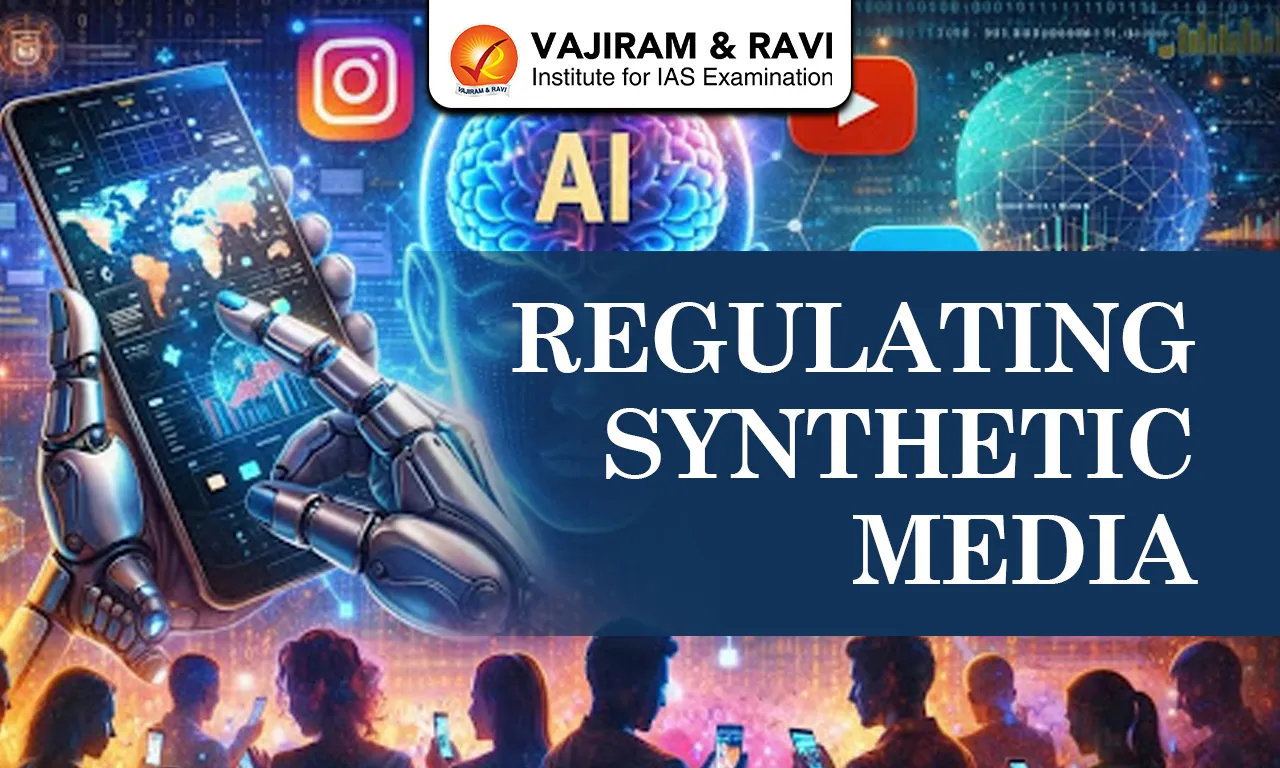
Regulating Synthetic Media – India Tightens IT Rules on AI-Generated Content

Regulating Synthetic Media

Regulating Synthetic Media Latest News

  • The Union Government has notified amendments to the Information Technology (Intermediary Guidelines and Digital Media Ethics Code) Rules, 2021.
  • It will strengthen regulation of AI-generated (synthetic) content and drastically reduce takedown timelines for unlawful material.
  • The amendments (effective February 20, 2026) aim to curb the spread of non-consensual deepfakes, intimate imagery, and unlawful content, while reinforcing platform accountability under the IT Act, 2000.

Key Amendments at a Glance

  • Sharp reduction in removal timelines:
    • For example
      • For Court/Government-declared illegal content takedown timeline reduced to 3 hours (from earlier 24–36 hours.
      • Similarly, for non-consensual intimate imagery/deepfakes it is 2 hours (earlier 24 hours), and for other unlawful content from 36 hours to 3 hours.
    • Rationale: Earlier timelines were seen as ineffective in preventing virality. The government argues tech companies possess sufficient technical capacity for faster removal.
    • Concerns: Determining “illegality” within 2–3 hours is operationally difficult. Risk of over-censorship and precautionary takedowns. Increased compliance burden for intermediaries.
  • Mandatory Labelling of AI-generated content:
    • Legal definition of “Synthetically Generated Information (SGI)”: Audio, visual or audio-visual content artificially created, generated, modified, or altered using a computer resource in a way that makes it appear real or indistinguishable from authentic events or persons.
  • Important features:
    • AI-generated imagery must be labelled “prominently.”
    • The earlier proposal requiring 10% of image space to carry the label has been diluted.
    • Platforms must seek user disclosure for AI-generated content, proactively label content if disclosure is absent, and remove non-consensual deepfakes.
  • Exclusions: Routine editing and quality-enhancing tools (e.g., smartphone touch-ups) are excluded — narrowing the scope from the draft October 2025 version.

Safe Harbour and Intermediary Liability

  • What is Safe Harbour? Under Section 79 of the IT Act, 2000, intermediaries are protected from liability for user-generated content, provided they exercise “due diligence.”
  • Amendment impact:
    • If an intermediary knowingly permits, promotes, or fails to act against unlawful synthetic content, it may be deemed to have failed due diligence.
    • This may result in loss of safe harbour protection, significantly increasing regulatory pressure on platforms.

Administrative Changes

  • The amendment partially rolls back an earlier rule that limited States to appointing only one officer for issuing takedown orders.
  • Now, States can designate multiple authorised officers, addressing administrative needs of populous States.

Trigger Events - The Global Deepfake Crisis

  • The urgency follows global controversies, including AI platforms generating non-consensual intimate images of women. 
  • Such incidents raise privacy concerns, gender dignity issues, pose threats to democratic discourse, and misrepresents real-world events.
  • This places the reform within a broader international debate on AI governance and platform accountability.

Governance and Constitutional Dimensions

  • Article 19(1)(a) – Freedom of Speech: Overbroad or rushed takedowns may chill legitimate expression. Short timelines increase risk of defensive over-removal.
  • Article 21 – Right to Privacy and Dignity: Faster removal of non-consensual deepfakes strengthens protection of individual dignity.
  • Federal implications: Allowing multiple State officers enhances decentralised enforcement.

Key Challenges

  • Determining illegality within 2–3 hours: Legal ambiguity, law enforcement communications may lack clarity.
  • Risk of over-censorship: Platforms may make mistakes on the side of removal - could undermine free speech and digital innovation.
  • Compliance burden on Big Tech: Real-time moderation requires high-end AI tools and human review. Smaller platforms may struggle disproportionately.
  • Verification mechanisms: Ensuring authenticity of user declarations. Deploying “reasonable technical measures” without privacy violations.

Way Forward

  • Clearer illegality standards: Develop structured guidance for platforms, and standardised digital takedown protocols.
  • Independent oversight mechanism: Appellate or review authority to check arbitrary takedowns.
  • Strengthening AI detection tools: Promote indigenous AI detection systems under India’s AI mission.
  • Harmonisation with Digital Personal Data Protection Act: Ensure consistency in privacy and consent standards.
  • Capacity building for States: Training authorised officers in cyber law and AI governance.

Conclusion

  • India’s amended IT Rules reflect a decisive shift toward proactive regulation of AI-driven misinformation and digital harm. 
  • By these amendments, the government seeks to protect privacy, dignity, and public order in an era of rapidly advancing generative AI.
  • However, the reform also raises critical concerns. So, the long-term success of this framework will depend on calibrated enforcement, technological readiness, and institutional safeguards against overreach.

Source: TH | IE

Regulating Synthetic Media FAQs

Q1: What is the significance of the recent amendments to the IT Rules, 2021?

Ans: It strengthens digital governance by mandating prominent labelling of synthetic content and imposing strict takedown timelines.

Q2: How do the amended IT Rules impact the doctrine of ‘safe harbour’ for intermediaries?

Ans: The rules tighten due diligence obligations, making intermediaries vulnerable to loss of safe harbour.

Q3: What are the constitutional tensions arising from compressed takedown timelines under the amended IT Rules?

Ans: While faster takedowns protect dignity under Article 21, they risk over-censorship and chilling effects on free speech [Article 19(1)(a)].

Q4: What are the administrative and federal implications of the amendments?

Ans: The move enhances enforcement capacity in States while deepening decentralised digital regulation within India’s federal framework.

Q5: What are the challenges in operationalising the new definition of SGI under the IT Rules?

Ans: Ambiguity in determining illegality and verifying AI-generated disclosures within tight timelines creates compliance burdens.

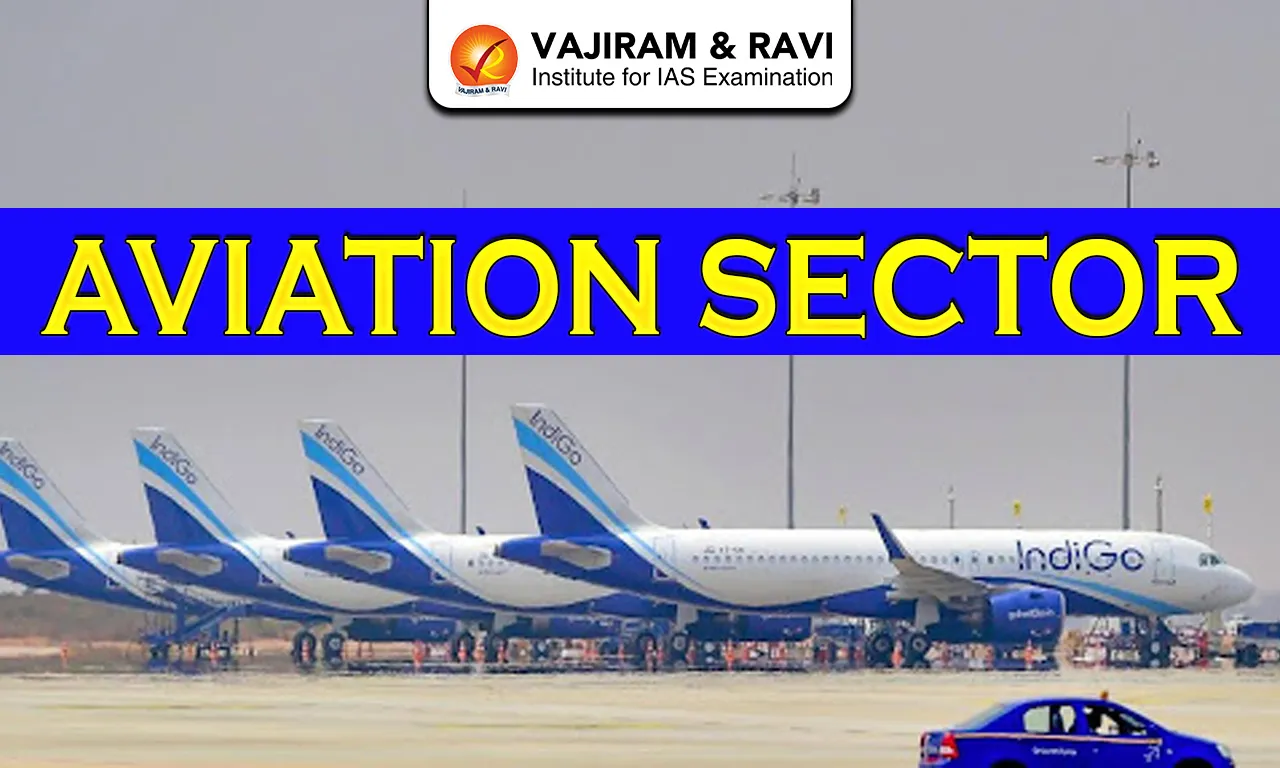
India’s Aviation Sector at a Crossroads – Explained

Aviation Sector

Aviation Sector Latest News

  • India’s aviation sector is under scrutiny following repeated operational disruptions, safety incidents, and declining service reliability among major airlines.

Overview of India’s Aviation Sector

  • India has emerged as the world’s third-largest domestic aviation market, operating over 840 aircraft and carrying more than 350 million passengers annually
  • Rapid growth in air travel demand has been driven by rising incomes, regional connectivity initiatives, and fleet expansion by private carriers. 
  • However, this expansion has increasingly exposed structural weaknesses related to manpower, regulation, and market concentration.
  • While the sector contributes significantly to economic integration and mobility, its current growth trajectory appears overstretched, raising concerns about sustainability, safety, and passenger welfare.

Operational Disruptions and Safety Concerns

  • The past year witnessed multiple operational failures, including mass flight cancellations, prolonged delays, and safety-related incidents. 
  • A major disruption in December involving IndiGo acted as a failed “stress test” for the system, revealing vulnerabilities that go beyond a single airline.
  • These incidents were not isolated but indicative of system-wide constraints, with airlines operating close to their maximum capacity. 
  • The rising frequency of safety notices issued by the aviation regulator points to deeper compliance and oversight challenges.

Pilot Shortage and Flight Duty Time Constraints

  • One of the most critical structural challenges is the acute shortage of trained pilots. India’s aviation expansion has outpaced its training capacity. 
  • New Flight Duty Time Limitation (FDTL) norms, which mandate longer rest periods and reduced night operations, have made existing airline schedules difficult to sustain.
  • Major airlines operate with a pilot-to-aircraft ratio significantly below global benchmarks, increasing fatigue risks and operational fragility. 
  • While India may require 25,000-30,000 pilots over the next decade, licensing and training bottlenecks have constrained supply, forcing airlines to rely on costly and limited foreign pilots as stopgap measures.

Regulatory Capacity and Oversight Gaps

  • Regulatory stress has compounded operational issues. 
  • The aviation regulator faces significant staff shortages, with a large proportion of technical positions vacant despite rapid sectoral growth. 
  • In practice, disruptions have often been managed through ad hoc exemptions rather than strict enforcement of safety norms.
  • This approach reflects a shift toward crisis management instead of preventive regulation, weakening long-term institutional capacity and undermining confidence in oversight mechanisms.

Market Concentration and the Aviation Duopoly

  • India’s domestic aviation market is highly concentrated, with two airline groups controlling nearly 90% of passenger traffic
  • This level of concentration transforms dominant carriers into systemically important entities whose failures directly impact national connectivity.
  • On a majority of domestic routes, only one airline operates. Consequently, disruptions do not result in passenger redistribution but in the complete loss of connectivity, particularly affecting smaller cities and time-sensitive travel.

Entry of New Regional Airlines

  • To address concentration and improve connectivity, the government has approved new regional airlines aimed at serving underserved routes. 
  • These entrants align with the objectives of the UDAN scheme, which has expanded regional air access across multiple States.
  • However, past failures of regional airlines highlight persistent challenges such as high fuel costs, weak demand, infrastructure gaps, and intense price competition. 
  • Without sustained policy support, such as assured subsidies, better airport infrastructure, and relief from fuel price volatility, new entrants risk inheriting the same fragilities.

Structural Challenges and Fuel Price Volatility

  • Aviation Turbine Fuel (ATF) remains one of the biggest cost drivers for Indian airlines. 
  • Prices are linked to global oil markets and currency fluctuations, exposing carriers to external shocks. 
  • Combined with thin profit margins, this volatility has historically contributed to airline failures.
  • Globally, airlines maintain spare crew and capacity buffers to absorb shocks. Indian carriers, by contrast, operate at near-total utilisation, allowing minor disruptions to cascade across networks.

Source: TH

Aviation Sector FAQs

Q1: Why is India’s aviation sector facing repeated disruptions?

Ans: Operational overstretch, pilot shortages, and regulatory constraints have exposed systemic weaknesses.

Q2: What role do Flight Duty Time norms play in recent disruptions?

Ans: Stricter FDTL norms reduced scheduling flexibility amid insufficient pilot availability.

Q3: Why is market concentration a concern in Indian aviation?

Ans: High concentration means failures of dominant airlines directly disrupt national connectivity.

Q4: Can new regional airlines solve India’s aviation challenges?

Ans: They can help, but only with sustained policy support and cost mitigation measures.

Q5: What is the long-term risk if reforms are delayed?

Ans: Aviation growth may turn into recurring operational and safety crises affecting passengers.

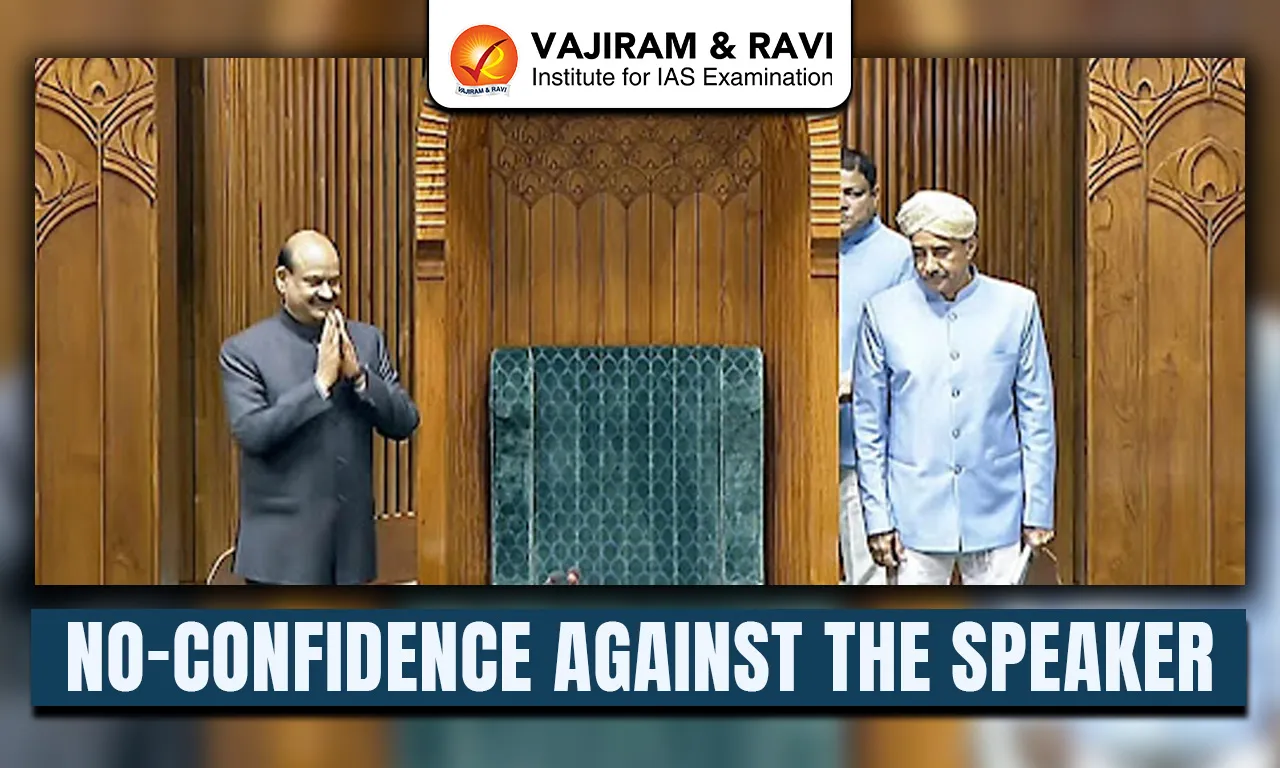
No-Confidence Against the Speaker: Constitutional Process and Implications Explained

No-Confidence Against the Speaker

No-Confidence Against the Speaker Latest News

  • The Opposition has moved a no-confidence motion against Om Birla, the Lok Sabha Speaker. Parliamentary sources said the motion will now be examined and processed as per established rules.
  • The move follows criticism from the Congress and other parties, who accused the Speaker of not permitting the Leader of Opposition to quote from or discuss former Army Chief M M Naravane’s unpublished memoir. 
  • The Opposition also objected to the Speaker’s claim that PM Modi could have been attacked inside the House, calling it unwarranted and contentious.

Removal of the Lok Sabha Speaker: What the Constitution Allows

  • The Lok Sabha Speaker (or Deputy Speaker) can be removed from office, but only through a strict constitutional process. 
  • Under Article 94(c) of the Constitution, removal is possible by a resolution passed by a majority of all the then members of the Lok Sabha
  • The provision applies only to the Lok Sabha, not the Rajya Sabha, and the procedural requirements are stringent, reflecting the high threshold set for removing the presiding officer of the House.

When Does the Lok Sabha Speaker or Deputy Speaker Vacate Office

  • Article 94 of the Constitution lays down the conditions under which the Speaker or Deputy Speaker of the Lok Sabha vacates office:
    • Cessation of membership (Article 94(a)): They automatically vacate office if they cease to be a member of the Lok Sabha.
    • Resignation (Article 94(b)): They may resign at any time by submitting a written resignation.
    • Removal by resolution (Article 94(c)): They can be removed through a Lok Sabha resolution passed by a majority of all the then members of the House.
  • These provisions ensure both stability and accountability of the presiding officers.

Procedure to Remove the Lok Sabha Speaker or Deputy Speaker

  • A member seeking removal must submit a written notice to the Secretary-General of the Lok Sabha. 
  • The notice may be jointly signed by two or more members, but the resolution cannot be moved unless at least 14 days’ notice is given.
  • After receipt, a motion for leave to move the resolution is listed in the List of Business in the members’ names. 
  • The date fixed must be any day after the 14-day notice period, following which the House may consider the motion as per rules.

Past Precedents of No-Confidence Motions Against Lok Sabha Speakers

  • No-confidence motions have been moved against the Lok Sabha Speaker on three occasions—in 1954, 1966, and 1987. 
  • For such a motion to proceed, it must be supported by at least two Members of Parliament, and 50 members must stand in support, fulfilling the House’s quorum. 
  • The procedure is governed by Rules 200–203 of the Rules of Procedure and Conduct of Business in Lok Sabha.
  • Historically:
    • 1954: G V Mavalankar, the first Speaker, faced a motion
    • 1966: Motion against Hukam Singh
    • 1987: Motion against Balram Jakhar
  • In all three cases, the motions failed, and none of the Speakers were removed from office.

Guidelines Governing a No-Confidence Motion Against the Speaker

  • Under Rule 200A of the Rules of Procedure and Conduct of Business in Lok Sabha, a no-confidence motion against the Speaker must meet strict content and conduct requirements. 
  • The resolution must be specific in its charges, clearly and precisely worded, and free of arguments, inferences, ironic expressions, imputations, or defamatory statements. 
  • Additionally, once the motion is admitted for discussion, the Member(s) who submitted it are not permitted to make a speech, underscoring the procedural rigor governing such motions.

What Follows If a No-Confidence Motion Is Admitted

  • If a no-confidence motion is admitted, members supporting it must rise in their places.
  • If at least 50 members stand, the presiding officer declares that leave is granted and schedules the motion for a day within 10 days.
    • If fewer than 50 members rise in support, the presiding officer declares that the member “has not the leave of the House”, and the motion does not proceed further. 
    • Additionally, any resolution for the removal of the Speaker or Deputy Speaker submitted without the required notice is not taken up, ending the process at the preliminary stage.
  • On the appointed day, the resolution is listed in the business of the House and taken up for discussion. 
  • The mover(s) may be allowed to speak for up to 15 minutes, subject to the presiding officer’s permission. The debate must be strictly confined to the charges stated in the resolution.

Speaker’s Role During Consideration of Removal Motion

  • While a removal motion is under discussion, the Speaker continues in office and, as a Member of the Lok Sabha, retains the right to participate and speak in the proceedings. 
  • The Speaker is entitled to vote in the first instance on the resolution or related matters, but cannot exercise a casting vote in the event of a tie.

Source: TH | NDTV

No-Confidence Against the Speaker FAQs

Q1: What triggered the No-Confidence Against the Speaker?

Ans: No-Confidence Against the Speaker was moved by the Opposition alleging procedural bias and controversial remarks during Lok Sabha proceedings involving sensitive political debates.

Q2: What constitutional provision governs No-Confidence Against the Speaker?

Ans: No-Confidence Against the Speaker is governed by Article 94(c), which allows removal through a resolution passed by a majority of all the then members of Lok Sabha.

Q3: What procedural requirements apply to No-Confidence Against the Speaker?

Ans: No-Confidence Against the Speaker requires written notice, fourteen days’ advance intimation, and support of at least 50 members before the resolution is admitted.

Q4: Has No-Confidence Against the Speaker occurred earlier?

Ans: No-Confidence Against the Speaker has been attempted thrice—in 1954, 1966, and 1987—but none resulted in removal of the Lok Sabha Speaker.

Q5: What happens if No-Confidence Against the Speaker is admitted?

Ans: If No-Confidence Against the Speaker gains required support, the House debates strictly on stated charges, and the Speaker may participate and vote initially but lacks casting vote authority.

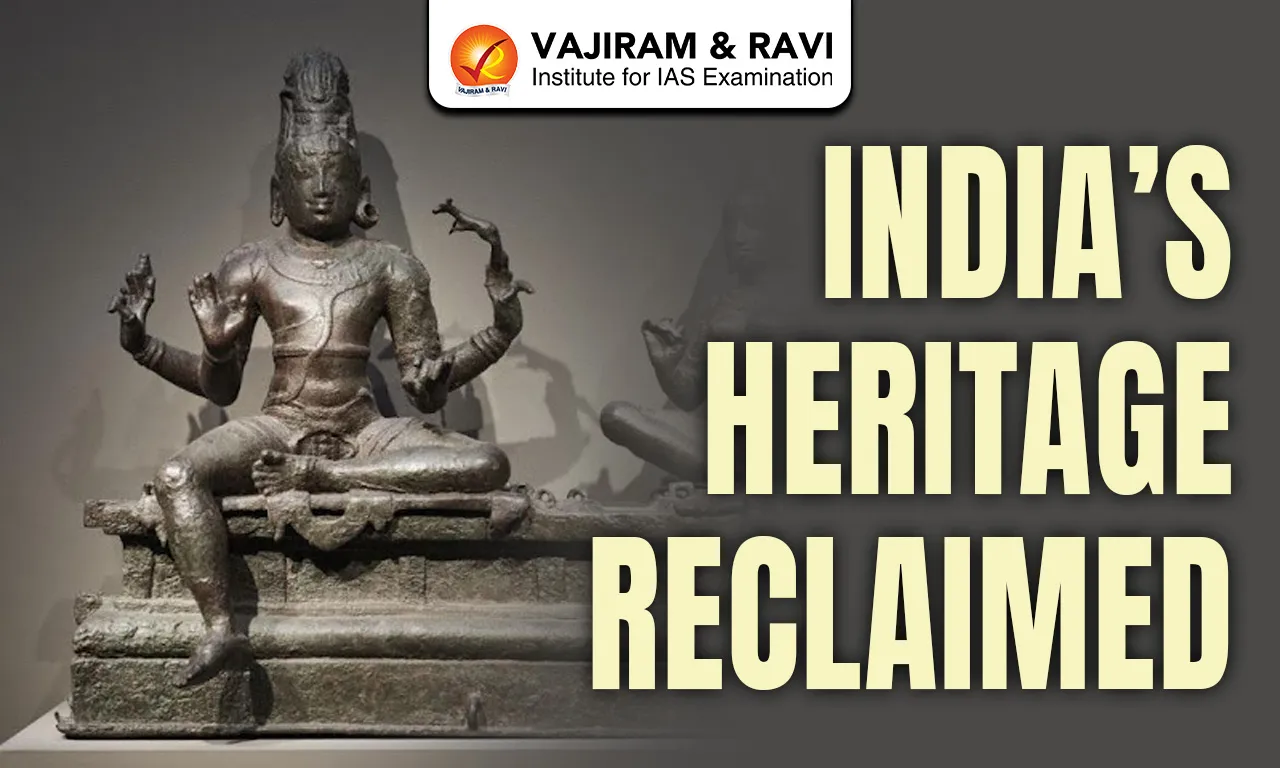
India’s Heritage Reclaimed: Smithsonian Returns Three Bronzes to India

India’s Heritage Reclaimed

India’s Heritage Reclaimed Latest News

  • Earlier this month, the Smithsonian’s National Museum of Asian Art (NMAA) announced it will return three historic bronze sculptures to the Government of India, acknowledging they were illegally removed from temple settings.
  • The artefacts include: Shiva Nataraja (Chola period, ca. 990); Somaskanda (Chola period, 12th century); Saint Sundarar with Paravai (Vijayanagar period, 16th century).
  • The decision aligns with a global push for restitution of looted or illicitly trafficked cultural property to Asian countries such as Cambodia, Indonesia, Sri Lanka, and Thailand. 
  • As part of this broader effort, the United States returned 297 Indian antiquities in 2024 alone.
  • Of the three bronzes, two will be physically repatriated to India, while the Shiva Nataraja will remain at the Smithsonian on a long-term loan. 
  • The return follows detailed provenance research that traced their unlawful removal, underscoring growing institutional accountability in global museum practices.

The Three Bronzes: Sacred Origins and Iconography

  • All three sculptures were sacred processional bronzes, traditionally carried during temple rituals, reflecting the refined bronze-casting traditions of South India. 
  • These were not decorative objects but living icons central to worship and ceremonial life.

Shiva Nataraja: Lord of the Dance 

  • The Shiva Nataraja bronze originated from the Sri Bhava Aushadesvara Temple in Tamil Nadu’s undivided Thanjavur district. 
  • It portrays Shiva as “Lord of the Dance”, performing the ananda tandava (dance of bliss), symbolising cosmic creation, preservation, and destruction.

Somaskanda: The Divine Family

  • The Somaskanda bronze traces its provenance to the Visvanatha Temple in Mannargudi, Tamil Nadu.
  • It depicts:
    • Shiva seated with Parvati (Uma)
    • Their son Skanda, who may sit between or dance around them
  • Notably, the NMAA sculpture is missing Skanda. 
  • According to experts, Skanda was often cast separately and was typically the first figure to be lost or separated. 
    • Archival photographs show Skanda was already missing by 1959.
  • Crucially, provenance research revealed that buried or damaged bronzes could later be reinstalled in temples, challenging earlier scholarly assumptions that burial meant permanent removal from ritual use.

Saint Sundarar with Paravai: Devotion in Bronze

  • The third sculpture depicts Saint Sundarar and his wife Paravai, originally from a Shiva temple in Veerasolapuram village, Tamil Nadu.
  • The couple were influential Shaivite saints, credited with spreading Shiva worship in eighth-century southern India, and are deeply revered in Tamil religious tradition.

Living Icons, Not Museum Objects

  • According to the NMAA, such images were:
    • Housed in dedicated shrines for most of the year
    • Once annually subjected to elaborate ritual bathing (abhisheka) using water, milk, yogurt, honey, sandalwood paste, and sacred ash
    • Then dressed in ceremonial robes

How the Three Bronzes Entered the Smithsonian’s Collection

  • The three bronzes had been part of the Smithsonian’s National Museum of Asian Art (NMAA) collections for decades. 
  • They came under scrutiny during a systematic provenance review, which revealed gaps and inconsistencies in their documentation, according to the museum’s provenance team.
  • The bronzes were acquired during a period when museum collecting standards were less stringent. 
  • Today, NMAA requires documentary proof of legal export, assessed against the UNESCO 1970 Convention, alongside export permits, seller consent, and a complete ownership trail, factoring in colonial and geopolitical contexts.
  • A 2023 collaboration with the French Institute of Pondicherry photo archives confirmed that the bronzes were photographed in situ in Tamil Nadu temples between 1956 and 1959. 
  • The Archaeological Survey of India subsequently reviewed the findings and confirmed the sculptures were removed in violation of Indian law.
  • While the exact circumstances of removal remain unclear, the museum established that the bronzes appeared in US markets or collections after the 1950s and passed through dealers linked to illicit antiquities. 
  • There is no evidence of lawful export from India.

Why the Smithsonian Is Returning the Bronzes

  • The Smithsonian’s National Museum of Asian Art (NMAA) stated that the decision reflects its commitment to responsible stewardship of cultural heritage and greater transparency.
  • NMAA began its restitution efforts in 2002, making it one of the earlier US museums to address issues of illicitly acquired cultural property
  • The institution acknowledges that many artefacts were transferred over the past two centuries without the consent of local communities.

What Restitution Means for India

  • Restoring Legal and Cultural Ownership - Restitution ensures that India regains legal title over artefacts that rightfully belong to it. While ownership returns to the Government of India, objects may remain on long-term loan, allowing them to be displayed internationally while acknowledging their true origin.
  • Ethics and International Goodwill - The provenance research and return process reflect ethical museum practice and foster diplomatic goodwill. Restitution signals recognition of historical wrongs and builds trust between source nations and global institutions.
  • Opportunities for Cultural Collaboration - Repatriation can open doors to long-term cultural partnerships. 
    • For example, after returning three sculptures to Cambodia—one remaining on loan—the museum collaborated on a five-year exhibition project in 2023. 
    • Such arrangements allow source countries to showcase their heritage globally through structured cooperation.
  • Expanding Global Cultural Presence
    • For India, restitution does not necessarily mean withdrawal from global spaces. Instead, it can:
      • Strengthen India’s cultural diplomacy
      • Promote curated international exhibitions
      • Ensure wider global engagement with Indian heritage

Source: IE | SI

India’s Heritage Reclaimed FAQs

Q1: Why is India’s Heritage Reclaimed in the news?

Ans: India’s Heritage Reclaimed is in the news after the Smithsonian’s National Museum of Asian Art decided to return three sacred South Indian bronzes removed illegally from temples.

Q2: Which artefacts are part of India’s Heritage Reclaimed?

Ans: India’s Heritage Reclaimed includes Shiva Nataraja, Somaskanda, and Saint Sundarar with Paravai—Chola and Vijayanagar period bronzes originally worshipped in Tamil Nadu temples.

Q3: How did provenance research support India’s Heritage Reclaimed?

Ans: India’s Heritage Reclaimed followed archival evidence, temple photographs, and verification by the Archaeological Survey of India confirming unlawful removal and lack of legal export documentation.

Q4: Why is India’s Heritage Reclaimed significant globally?

Ans: India’s Heritage Reclaimed reflects a wider global restitution movement where museums reassess colonial-era acquisitions and return looted cultural property to rightful nations.

Q5: What does India’s Heritage Reclaimed mean for cultural diplomacy?

Ans: India’s Heritage Reclaimed strengthens cultural sovereignty while enabling long-term loans and collaborative exhibitions, enhancing India’s global cultural presence and ethical museum partnerships.

Almatti Dam

Almatti Dam

Almatti Dam Latest News

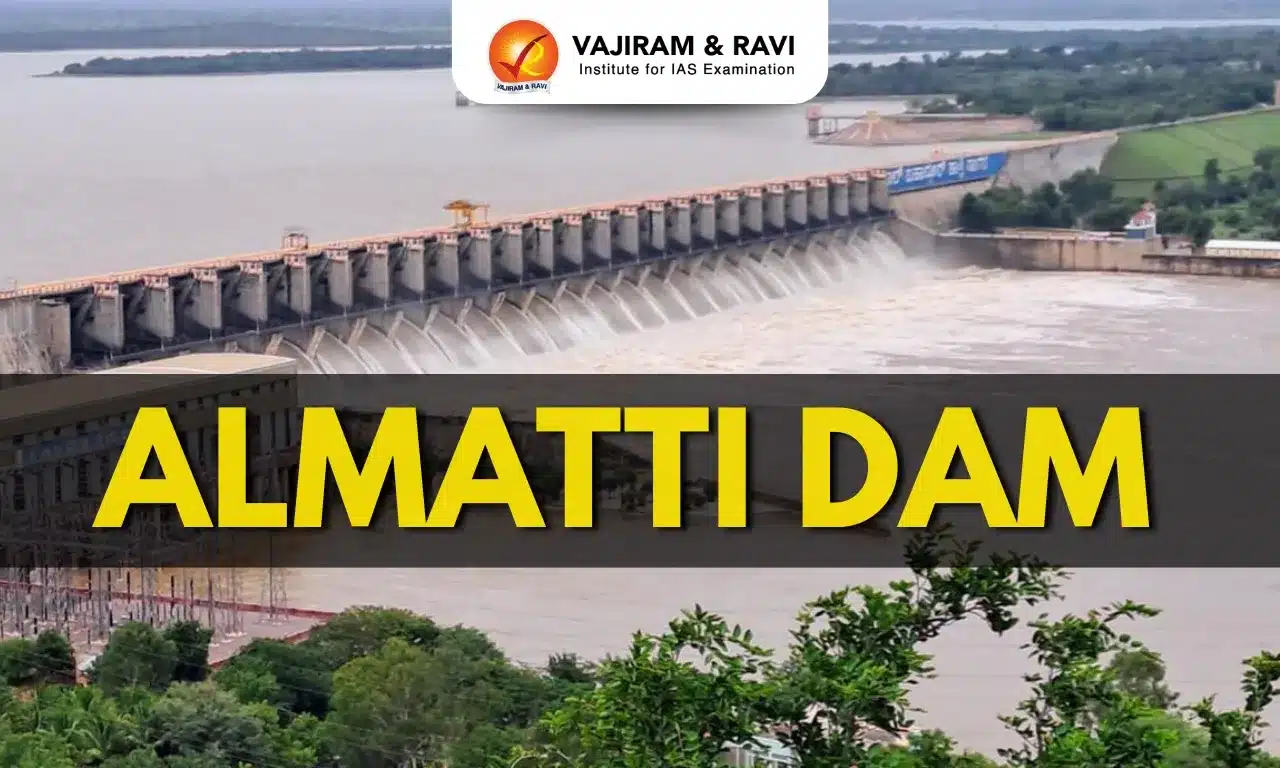
The Andhra Pradesh chief minister recently objected to Karnataka's move to increase the height of the Almatti Dam on the Upper Krishna.

About Almatti Dam

  • Almatti Dam, situated on the Krishna River in Karnataka, is a multipurpose dam primarily used for irrigation, hydroelectric power generation, and flood control.
  • It stands at a height of 52.5 meters and extends 3.5 kilometers in length.
  • The dam was completed in July 2005.
  • The annual electric output of the dam is 713,000,000 kilowatts (KW). 
  • The dam holds a gross water storage capacity of 123.08 TMC at 519 meters MSL.
  • It is the main reservoir of the Upper Krishna Irrigation Project; the 290 MW power station is located on the right side of the Almatti Dam. 
    • The facility uses vertical Kaplan turbines: five 55 MW generators and one 15 MW generator. 
    • After generating power, water is released into the Narayanpur reservoir to meet the irrigation requirements downstream.
  • Seven terrace gardens have been developed as a picnic spot in the dam area.
    • On one side of the dam, a garden named "Rock Hill" has an artificial forest with ceramic wild animals and birds and many idols representing village life in India.

Source: DH

Almatti Dam FAQs

Q1: On which river is the Almatti Dam constructed?

Ans: The Almatti Dam is constructed on the Krishna River.

Q2: In which state is the Almatti Dam located?

Ans: It is located in Karnataka.

Q3: When was the Almatti Dam completed?

Ans: It was completed in July 2005.

Q4: Which major irrigation project is associated with the Almatti Dam?

Ans: It is the main reservoir of the Upper Krishna Irrigation Project.

Enquire Now