
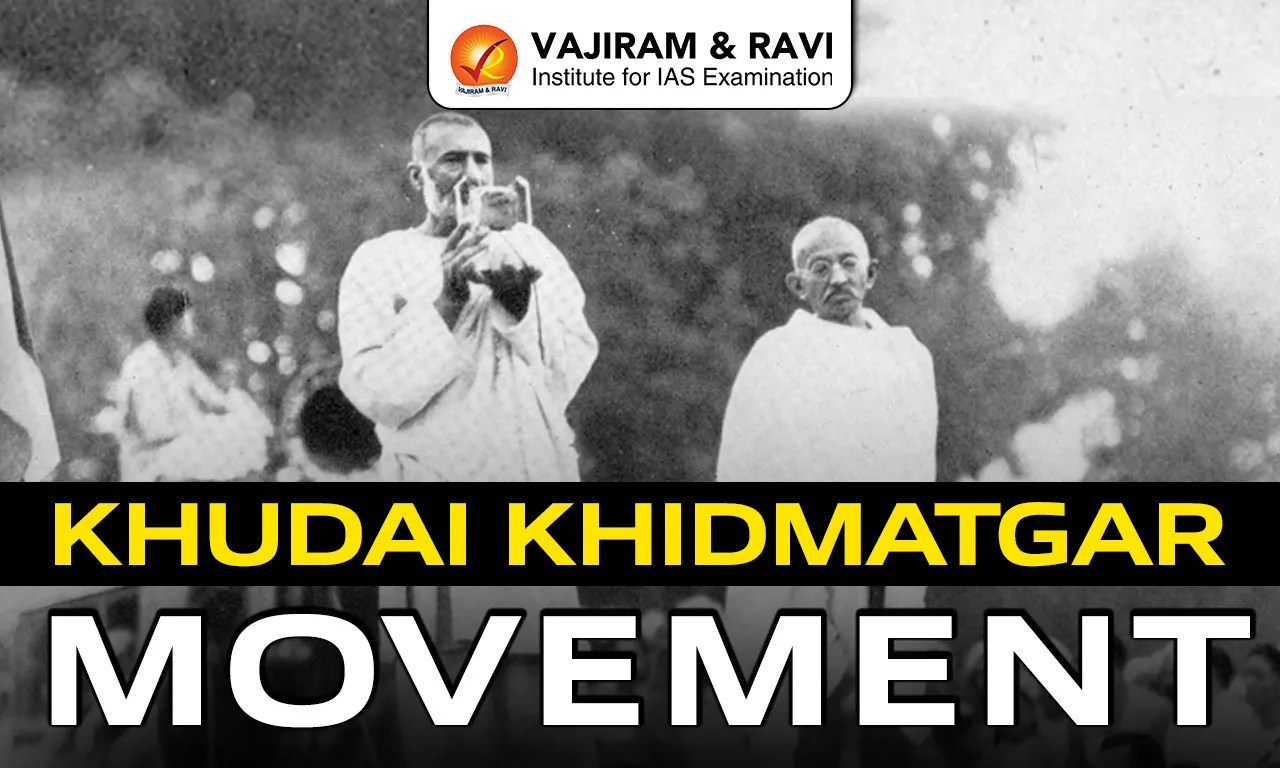
Khudai Khidmatgar, meaning “Servants of God,” was a mainly Pashtun movement that used nonviolent methods to oppose British rule in colonial India. It was based in the North-West Frontier Province, which is now part of Khyber Pakhtunkhwa, Pakistan.
Also called the Red Shirts or Surkh Posh, it started as a social reform group called Anjuman-e-Islah-e Afghania, focused on education and ending traditional blood feuds among Pashtuns.
Khudai Khidmatgar Movement Political Role
The Khudai Khidmatgar Movement was led by Abdul Ghaffar Khan, popularly known as Bacha Khan, Badshah Khan, or the Frontier Gandhi. Initially, it focused on social reforms, but as the British targeted its members, it became more political. By 1929, many leaders were exiled, and numerous members arrested.
The movement tried to get support from the All-India Muslim League and the Indian National Congress. After being rejected by the Muslim League, the Khudai Khidmatgars formally joined the Congress and played an important role in India’s fight for independence.
Khudai Khidmatgar Movement Achievements and Elections
Due to public pressure, the British released Bacha Khan and eased restrictions on the movement.
- Under the Government of India Act 1935, men were allowed to vote in the NWFP.
- In the 1937 elections, the Khudai Khidmatgars, allied with the Congress, won. Bacha Khan’s brother, Khan Abdul Jabbar Khan (Dr. Khan Sahib), became Chief Minister.
- They also won the 1946 elections, with Dr. Khan Sahib re-elected.
The Khudai Khidmatgars opposed the partition of India, siding with Congress and the All India Azad Muslim Conference. When Congress accepted partition without consulting them, Bacha Khan said, “You have thrown us to the wolves.”
Khudai Khidmatgar Movement Post-Partition Struggles
After India and Pakistan were partitioned, the Khudai Khidmatgars faced severe backlash in Pakistan:
- Their government was dismissed, and the movement banned.
- Many members were killed in the Babrra massacre on 12 August 1948.
In 2011, the movement was revived in Delhi by Faisal Khan, focusing on communal harmony and disaster relief, with around 5,000 members.
Abdul Ghaffar Khan (Bacha Khan)
- Born in 1890, Bacha Khan was a follower of Mahatma Gandhi and a leader of the Pashtuns.
- He joined politics in 1919, protesting the Rowlatt Acts that allowed imprisonment without trial.
- In 1920, he joined the Khilafat Movement, and in 1921, became president of a district Khilafat committee.
- In 1929, he founded the Red Shirt movement (Khudai Khidmatgar).
- In 1987, he became the first non-Indian awarded the Bharat Ratna, India’s highest civilian honor.
Other notable non-Indians who received the Bharat Ratna include Nelson Mandela (1990), and Mother Teresa (1980), who was the first naturalized citizen to receive it.
Khudai Khidmatgar Movement FAQs
Q1: What was the Khudai Khidmatgar Movement?
Ans: The Khudai Khidmatgar, meaning “Servants of God,” was a nonviolent Pashtun movement that opposed British rule in India.
Q2: Who founded the Khudai Khidmatgar?
Ans: It was founded by Abdul Ghaffar Khan, also known as Bacha Khan or the Frontier Gandhi, in 1929.
Q3: Why were they called the Red Shirts?
Ans: Members wore red uniforms, so they were popularly called Red Shirts or Surkh Posh.
Q4: Which political party did Khudai Khidmatgar join?
Ans: After being rejected by the All-India Muslim League, the Khudai Khidmatgars joined the Indian National Congress and actively participated in the independence movement.
Q5: How did the Khudai Khidmatgar react to India’s partition?
Ans: They opposed partition and boycotted the 1947 NWFP referendum, as it did not include options for independence or joining Afghanistan.

