
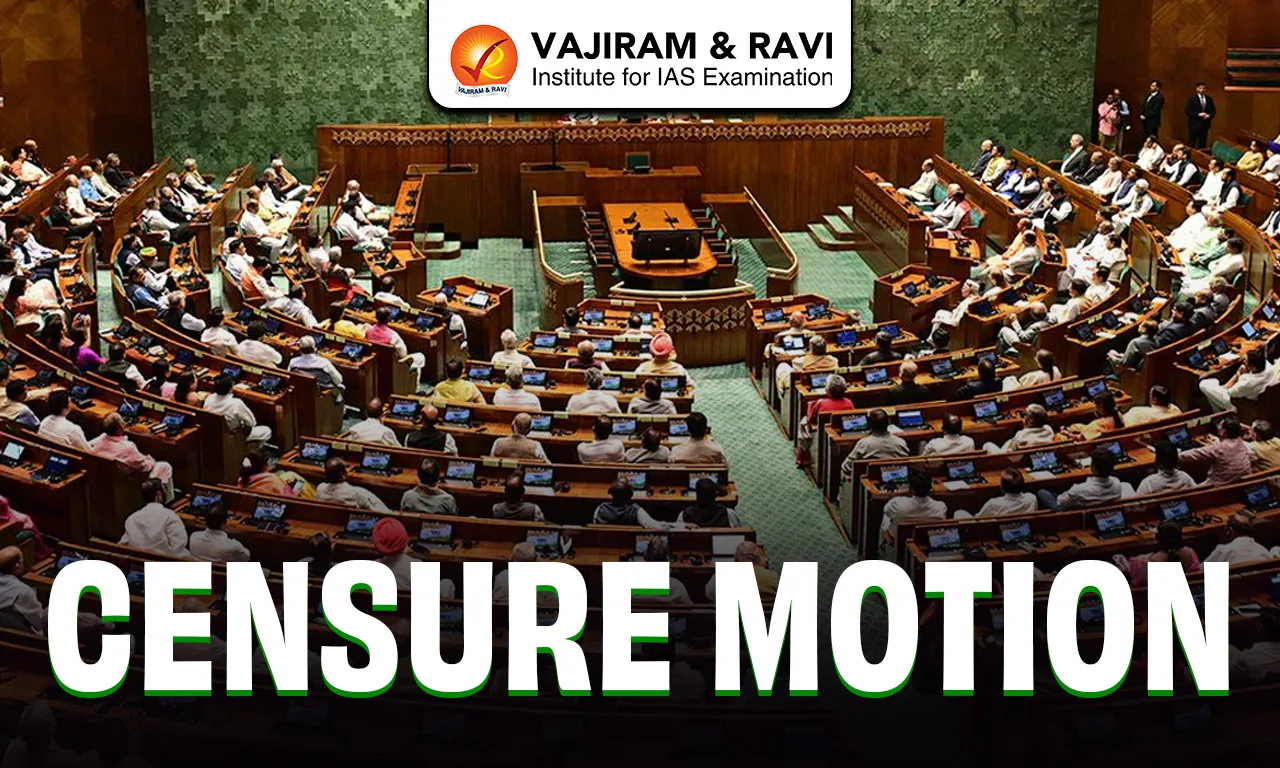
A Censure Motion is an important parliamentary device used in the Indian political system to express strong disapproval of the government’s policies or actions. It is a formal way for Members of Parliament (MPs) to criticize the Council of Ministers for specific decisions or failures.
In India, the concept of a Censure Motion is rooted in the parliamentary form of government established by the Constitution of India. It ensures accountability of the executive (government) to the legislature (Parliament). Although it is not specifically mentioned in the Constitution, it is part of parliamentary conventions and procedures followed in the Lok Sabha.
What is Censure Motion?
A Censure Motion is a formal proposal moved by members of the opposition in the Lok Sabha to criticize the government for a specific policy, action, or failure. It is different from a general criticism because:
- It clearly mentions the reasons for disapproval.
- It focuses on a specific issue or policy.
- It is debated and voted upon in the House.
If the motion is passed by a majority of members present and voting, it shows that the government has lost the support of the House on that particular issue. However, unlike a No Confidence Motion, the government is not required to resign after the passing of a Censure Motion.
Also Read: Substantive Motion
Censure Motion Features
Here are the main features of a Censure Motion explained below.
- Moved in Lok Sabha Only: A Censure Motion can be introduced only in the Lok Sabha and not in the Rajya Sabha.
- Specific Reasons Required: The motion must clearly state the specific charges or policies for which the government is being criticized.
- Can Target Entire Government or a Minister: It may be moved against: The entire Council of Ministers, or A particular minister for his/her actions.
- Requires Speaker’s Permission: The motion can only be admitted after approval by the Speaker of the Lok Sabha.
- Debate and Voting: Once admitted, the motion is debated in the House and then put to vote.
- Simple Majority Required: It is passed if it receives a simple majority of members present and voting.
- No Compulsory Resignation: Even if passed, the government is not legally bound to resign. However, it faces political pressure.
Also Read: Cut Motions
Censure Motion Significance
The Censure Motion plays a vital role in strengthening democracy and ensuring government accountability. Its importance can be understood through the following points:
- Ensures Accountability: It makes the government answerable for its decisions and actions.
- Strengthens Opposition Role: It gives the opposition a powerful tool to question and criticize the government.
- Encourages Healthy Debate: It allows detailed discussion on important national issues.
- Promotes Transparency: The government must publicly defend its policies and clarify doubts.
- Political Pressure Tool: Even if the government does not resign, passing of the motion damages its public image and moral authority.
Difference Between Censure Motion and No Confidence Motion
A Censure Motion is a parliamentary procedure used in the Lok Sabha to express strong disapproval of the government’s specific policies or actions. The Difference Between Censure Motion and No Confidence Motion has been provided below.
| Difference Between Censure Motion and No Confidence Motion | ||
|
Basis |
Censure Motion |
No Confidence Motion |
|
Purpose |
To criticize specific policy or action |
To test overall majority of the government |
|
Reasons Required |
Specific reasons must be mentioned |
No reasons required |
|
Target |
Specific minister or entire government |
Entire Council of Ministers |
|
Resignation |
Not compulsory if passed |
Government must resign if passed |
|
Constitutional Basis |
Not directly mentioned |
Based on Article 75(3) – Collective Responsibility |
|
Impact |
Political criticism and pressure |
Direct threat to survival of government |
Censure Motion FAQs
Q1: What is a Censure Motion in simple words?
Ans: A Censure Motion is a proposal in the Lok Sabha to criticize the government for a specific policy or action.
Q2: Is Censure Motion mentioned in the Constitution?
Ans: No, it is not directly mentioned in the Constitution but is part of parliamentary procedures.
Q3: Who can move a Censure Motion?
Ans: Any member of the Lok Sabha can move it with the permission of the Speaker.
Q4: Does the government have to resign if it is passed?
Ans: No, resignation is not compulsory, but it creates strong political pressure.
Q5: Can it be moved in Rajya Sabha?
Ans: No, it can be moved only in the Lok Sabha.

