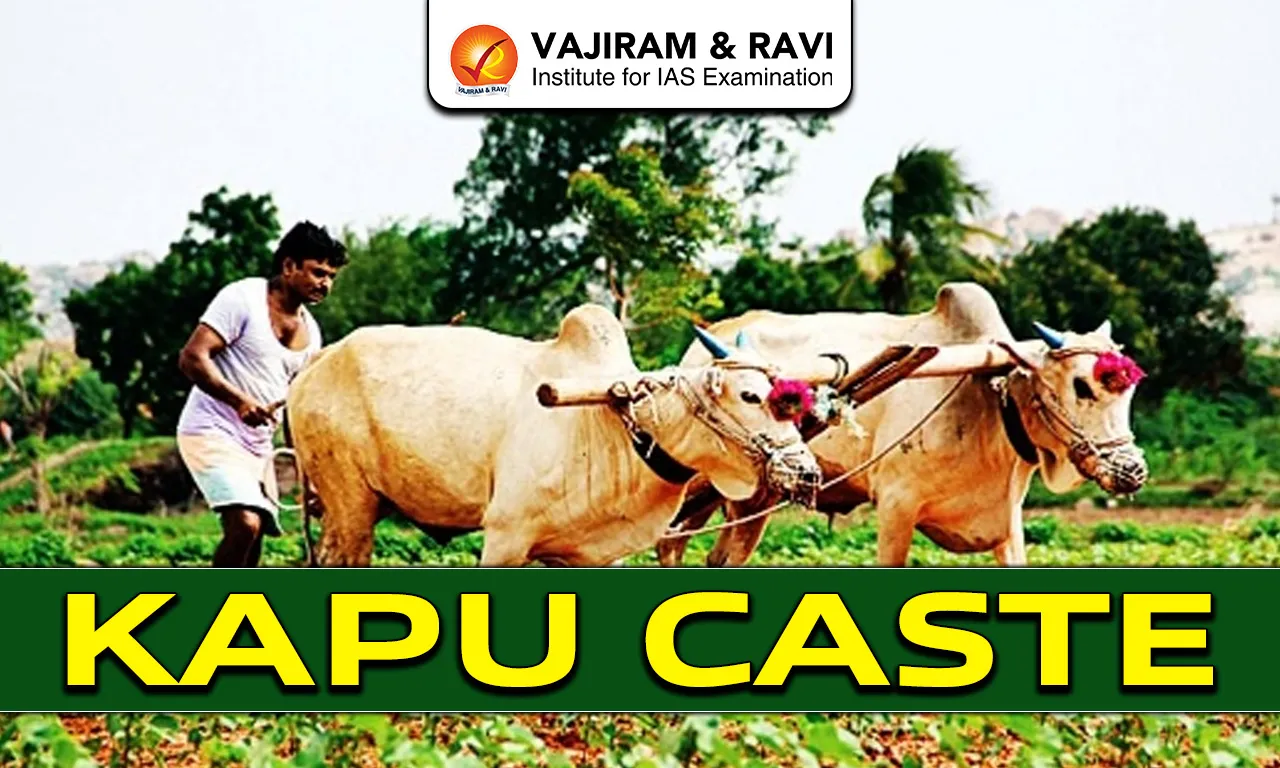
The Kapu Caste is a major agrarian community concentrated in Andhra Pradesh and Telangana, forming nearly 20-26% of the population in the Telugu speaking region. Traditionally cultivators and landholders, they historically settled along the fertile Godavari basin after migrating from the Gangetic plains, possibly from Kampilya near Ayodhya. Over time, they emerged as a politically influential middle caste. Despite numerical strength, the community has consistently demanded backward status, arising major debates around social justice, constitutional amendments and reservation policies in recent times.
Kapu Caste Features
The Kapus are a historically agrarian, regionally dominant Telugu speaking community with strong demographic and political presence.
- Agrarian Identity: The term “Kapu” in Telugu means cultivator or protector, reflecting their primary occupation as land owning farmers. They traditionally cultivated paddy and cash crops in the Godavari delta, benefiting from irrigation networks and fertile alluvial soil.
- Demographic Strength: Estimates indicate the community constitutes between 20% to 26% of the population in Andhra Pradesh, making it one of the largest caste groups.
- Regional Spread: Heavy concentration exists in East and West Godavari districts, Krishna, Guntur and parts of Telangana.
- Social Classification: In India’s official framework, castes are categorized as General, Scheduled Castes, Scheduled Tribes and Other Backward Classes. The Mandal Commission in 1980 estimated OBCs at 52% of the population, later assessed at 41% by NSSO in 2006.
- Subgroup Diversity: The broader Kapu identity includes subgroups such as Telaga, Balija, Munnuru Kapu, Ontari and Turpu Kapu. While culturally similar, these groups vary by region and historical occupational specialization.
- Political Assertion: From the 1990s onward, Kapu leaders mobilized large gatherings demanding equitable representation. The first major organized protest for backward status inclusion occurred in 1993, marking a turning point in collective political identity.
Also Read: Caste System in India
Kapu Caste Reservation Demand
The Kapu Caste seeks inclusion in Backward Classes and benefits under the 10% EWS quota framework.
- Demand for Backward Status: Kapus argue they were recognized as backward before independence and seek reinstatement in the Backward Classes list. A government order issued in 1993 proposed inclusion, but it was not implemented after a change in political leadership.
- Agitations and Movements: Protests intensified over decades, with a major wave in 2016 that led to statewide disturbances. A commission was constituted to examine the demand, reflecting administrative engagement but prolonged decision making processes.
- 10% Reservation Announcement: The Andhra Pradesh government announced 10% reservation for Kapus and other Economically Weaker Sections in initial state government appointments, aligning with the Constitution 103rd Amendment Act, 2019.
- Constitutional Basis: The 103rd Amendment inserted Articles 15(6) and 16(6), enabling up to 10% reservation for EWS in education and public employment. This quota operates over and above the earlier 50% ceiling principle debated in constitutional jurisprudence.
- EWS Eligibility Criteria: Beneficiaries must not belong to SC, ST, or SEBC categories and must have annual family income below Rs 8 lakh. Income includes salary, agriculture, business and professional earnings from the preceding financial year.
- Constitutional Safeguards: Articles 14, 15(4), 16(4) and 46 collectively empower the state to promote social and educational advancement of weaker sections. The National Commission for Backward Classes under Article 338B monitors backward class welfare.
Kapu Caste FAQs
Q1: What is the primary occupation of the Kapu Caste?
Ans: The Kapus are traditionally an agrarian community engaged mainly in cultivation and landholding, especially in the Godavari and coastal Andhra regions.
Q2: What percentage of the population do Kapu Caste form in Andhra Pradesh?
Ans: The Kapu community is estimated to constitute around 20% to 26% of the population in Andhra Pradesh, making it a numerically significant group.
Q3: What reservation has been announced for the Kapu Community?
Ans: The Andhra Pradesh government announced 10 percent reservation for Kapus and other Economically Weaker Sections in initial state government appointments under the Constitution (103rd Amendment) Act, 2019.
Q4: What is the income limit for EWS reservation eligibility?
Ans: To qualify under the EWS category, the gross annual family income must be below Rs 8 lakh, including income from salary, agriculture, business, or profession.
Q5: When did the major Kapu Caste protest for Backward Class inclusion begin?
Ans: The first major organized protest demanding inclusion in the Backward Classes category was held in 1993, followed by continued agitations in later years.

