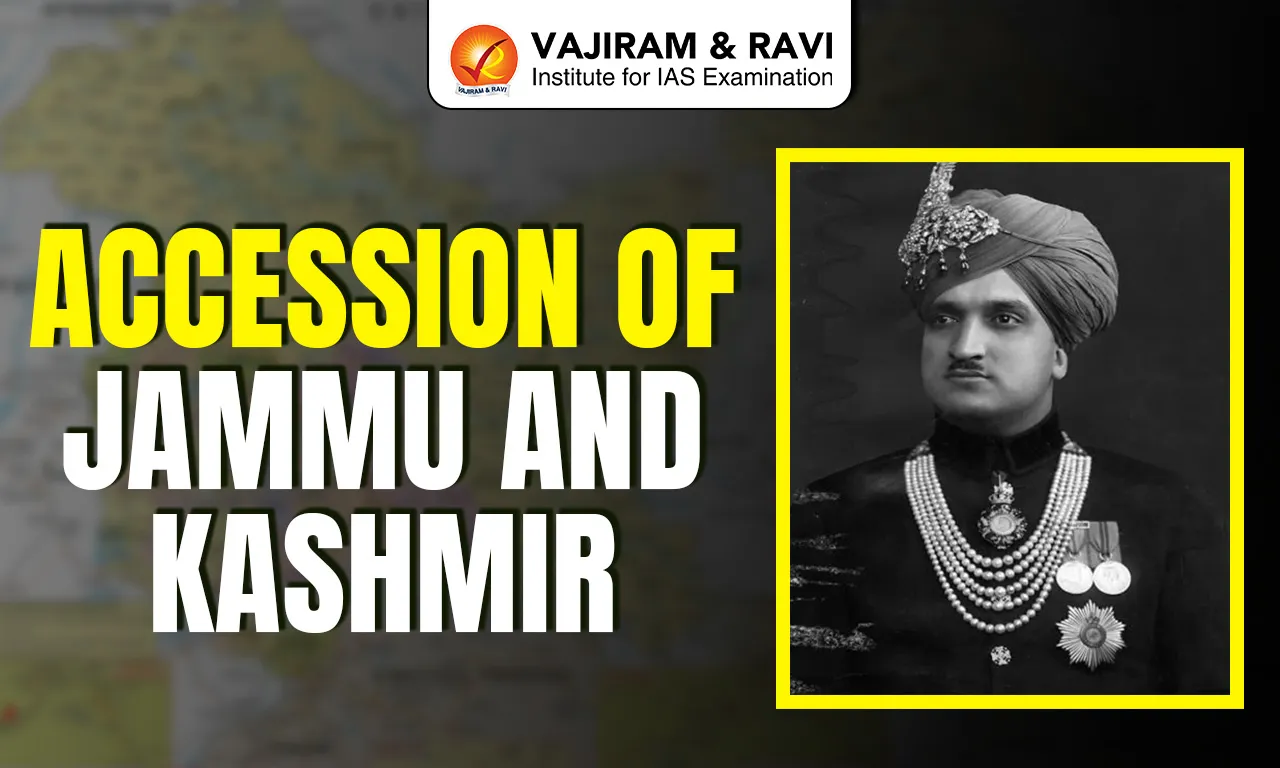
After the Indian Independence Act, 1947, British India was divided into India and Pakistan. Around 580 princely states were given three choices: Join India, Join Pakistan, Remain independent. According to Section 6(a) of the Act, before joining India or Pakistan, these states had to sign an Instrument of Accession, in which they would specify the terms on which they were becoming part of the new dominions. This legal provision formed the basis of the Accession of Jammu and Kashmir.
Accession of Jammu and Kashmir Background
The accession of Jammu and Kashmir took place on 26th October 1947. The ruler of Jammu & Kashmir, Maharaja Hari Singh, first wanted to remain independent. He signed standstill agreements with India and Pakistan to maintain the status quo. However, in October 1947, tribesmen and soldiers from Pakistan invaded Kashmir. Facing this threat, the Maharaja asked India for military help. India agreed, but only after Kashmir formally joined India. So, the Maharaja signed the Instrument of Accession on 26 October 1947. It was accepted by Governor-General Lord Mountbatten on 27 October 1947.
Instrument of Accession Key Provisions
The key provisions that shaped the Accession of Jammu and Kashmir were as follows:
- Limited powers to India: The Indian government could make laws for Jammu & Kashmir only on three subjects - Defence, External Affairs and Communications.
- No automatic change in terms (Clause 5): The conditions of accession could not be changed by Indian laws unless the Maharaja agreed.
- No compulsion to accept India’s future Constitution (Clause 7): The Maharaja was not bound to accept any future Constitution of India automatically.
- Protection of land rights (Clause 6): The Indian Parliament could not pass laws to take land in Jammu & Kashmir without permission.
After the Accession of Jammu and Kashmir in 1947,its relationship with India was given a special constitutional arrangement through Article 370. This provision defined how the Indian Constitution would apply to the state.
Article 370 Special Status for Jammu & Kashmir
Article 370 was included in the Constitution of India as a temporary provision. It granted special autonomy to Jammu & Kashmir after the Accession of Jammu and Kashmir.
Key features of Article 370 were as follows:
- The Indian Parliament could make laws for the state only on Defence, External Affairs, Communications (and later, other subjects only with the state’s consent)
- Jammu & Kashmir had its own Constitution (adopted in 1957).
- The state had its own flag along with the Indian national flag.
- Central laws were applied to the state only through Presidential Orders with the state government’s approval.
In practice, over the years, many provisions of the Indian Constitution were gradually extended to the state.
In 1954, another provision called Article 35A was added to the Constitution through a Presidential Order issued under Article 370.
Article 35A: Special Rights for Permanent Residents
Article 35A was added to the Constitution in 1954 through a Presidential Order issued under Article 370. It gave special legal status for residents of Jammu & Kashmir after the Accession of Jammu and Kashmir.
Key features of Article 35A:
- It empowered the Jammu & Kashmir legislature to define “permanent residents” of the state.
- Based on this definition, the state government could give special rights and privileges only to these permanent residents. These rights included the right to own land and property, eligibility for government jobs, access to state scholarships, and other welfare benefits provided by the state government.
- People from other parts of India were not allowed to buy land or get state government jobs in Jammu and Kashmir unless they were recognized as permanent residents.
In August 2019, the Government of India made major constitutional changes regarding Jammu and Kashmir. Through a Presidential Order and a resolution passed by Parliament, Article 370 was made inoperative. Since Article 35A existed only because of Article 370, it was automatically removed after these changes.
At the same time, the state was reorganized under the Jammu and Kashmir Reorganisation Act, 2019 into two Union Territories:
- Jammu & Kashmir (with a legislature)
- Ladakh (without a legislature)
Later, in December 2023, the Supreme Court of India upheld this decision and confirmed that the removal of Article 370 was constitutionally valid.
Accession of Jammu and Kashmir FAQs
Q1: What was the Instrument of Accession?
Ans: The Instrument of Accession was a legal document that princely states had to sign to join either India or Pakistan after independence in 1947. By signing it, the ruler agreed to give certain powers to the new dominion. The Accession of Jammu and Kashmir took place when this document was signed on 26 October 1947.
Q2: Why did Jammu & Kashmir sign the Instrument of Accession?
Ans: Maharaja Hari Singh initially wanted to remain independent. However, when tribesmen and soldiers from Pakistan invaded Kashmir in October 1947, he asked India for military help. India agreed only after the Accession of Jammu and Kashmir, so he signed the Instrument.
Q3: On what subjects did India get powers after the accession?
Ans: India received powers only on three subjects: Defence, External Affairs, and Communications. Other matters remained under the control of the Jammu & Kashmir government after the Accession of Jammu and Kashmir.
Q4: What was the purpose of Article 370?
Ans: Article 370 gave special constitutional status to Jammu & Kashmir. It allowed the state to have its own Constitution, flag, and internal autonomy, while India controlled defence, foreign affairs, and communications.
Q5: What rights were given under Article 35A?
Ans: Article 35A allowed the Jammu & Kashmir legislature to define permanent residents and give them special rights, such as owning land, getting government jobs, and receiving state welfare benefits.

