National Honour Act 1971, Background, Objectives, Key Provisions

national honour act 1971

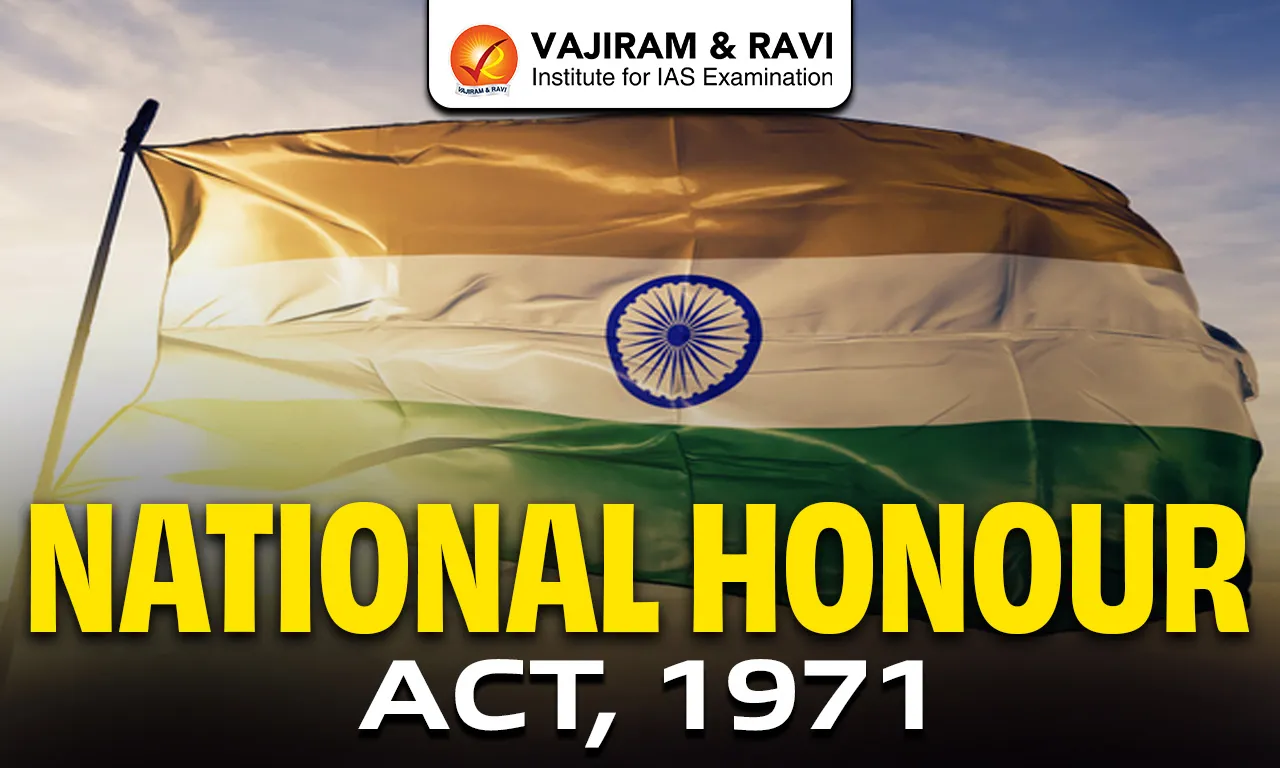
The National Honour Act 1971, officially known as the Prevention of Insults to National Honour Act, 1971, is a significant Indian law enacted to protect the dignity and respect of the nation’s symbols. It ensures that the Indian National Flag, the Constitution of India, and the National Anthem are treated with honor and are not subjected to insult or disrespect.

National Honour Act 1971 Background

  • After independence in 1947, India adopted national symbols such as the National Flag, National Anthem, and Constitution as representations of sovereignty, unity, and democratic values.
  • There was no specific penal law initially to punish acts like burning, defacing, or insulting the National Flag and the Constitution.
  • Growing public sentiment and the need to legally safeguard national symbols led to parliamentary discussions in the late 1960s and early 1970s.
  • The Constitution under Article 51A(a) (Fundamental Duties, added later by the 42nd Amendment in 1976) emphasized the duty of citizens to respect the Constitution, National Flag, and National Anthem.
  • To provide a clear legal framework, the Indian Parliament enacted the Prevention of Insults to National Honour Act in 1971.
  • The Act came into force in December 1971, ensuring criminal penalties for intentional insult to national symbols.
  • The legislation aimed to balance national dignity with fundamental rights like freedom of speech and expression under Article 19.

National Honour Act 1971 Objectives

The main objectives of the National Honour Act 1971 are:

  • To prevent insults to the Indian National Flag.
  • To protect the dignity of the Constitution of India.
  • To ensure proper respect toward the National Anthem.
  • To promote patriotism and constitutional values.
  • To legally penalize acts that dishonor national symbols.

Prevention of Insults to National Honour Act, 1971 Key Provisions

The Prevention of Insults to National Honour Act 1971 is a penal law enacted to safeguard the dignity of India’s national symbols. It prescribes punishment for intentional acts of insult toward the National Flag, the Constitution of India, and the National Anthem.

  • Section 2 - Insult to the Indian National Flag and Constitution: It prohibits burning, mutilating, defacing, defiling, disfiguring, destroying, trampling upon, or otherwise showing disrespect to the Indian National Flag or the Constitution of India in public view.
  • Definition of “Disrespect”: Disrespect includes using the flag as clothing below the waist, using it as drapery (except permitted state funerals), printing it on disposable items, or deliberately allowing it to touch the ground.
  • Public View Requirement: The offence must generally occur in public view, meaning in a place accessible to or visible by the public.
  • Section 3 - Prevention of Singing of National Anthem: It penalizes any person who intentionally prevents the singing of the National Anthem or causes disturbance during its performance.
  • Intentional Act Requirement: The offence must be intentional; accidental or unintentional acts do not usually attract punishment under the Act.
  • Punishment Provision: The punishment may extend to imprisonment for up to three years, or fine, or both.
  • Scope of Application: The Act applies across India and covers acts committed in public places or during public ceremonies.
  • 2003 Amendment: The amendment clarified certain forms of disrespect toward the National Flag and strengthened enforcement provisions in line with the Flag Code of India.

Important Supreme Court Judgments Related to the Act

The Supreme Court has played a crucial role in interpreting the Act to ensure that respect for national symbols does not violate Fundamental Rights. Its judgments have balanced constitutional patriotism with freedom of speech and religion.

  • Bijoe Emmanuel v. State of Kerala (1986): The Supreme Court of India held that students who stood respectfully but did not sing the National Anthem due to religious beliefs did not commit an offence under the Act.
  • Shyam Narayan Chouksey v. Union of India (2016–2018): The Court clarified that playing the National Anthem in cinema halls is not mandatory and that patriotism cannot be forced by law.
  • Union of India v. Naveen Jindal (2004): The Court recognized the right to fly the National Flag as a part of freedom of expression under Article 19(1)(a), subject to reasonable restrictions under law.

National Honour Act 1971 and Fundamental Duties

The Prevention of Insults to National Honour Act 1971 is closely linked with the Fundamental Duties under Article 51A(a) of the Indian Constitution. Article 51A(a), added by the 42nd Constitutional Amendment Act, 1976, makes it the duty of every citizen to respect the Constitution, the National Flag, and the National Anthem. While Fundamental Duties are non-justiciable, this Act provides legal enforcement by prescribing punishment for intentional insult to national symbols.

National Honour Act 1971 FAQs

Q1: What is the official name of the National Honour Act 1971?

Ans: The official name is the Prevention of Insults to National Honour Act, 1971.

Q2: What is the punishment under the Act?

Ans: The punishment may extend to three years of imprisonment, fine, or both.

Q3: Does refusing to sing the National Anthem amount to an offence?

Ans: No, if a person stands respectfully without causing disturbance, it is not considered an offence as per Supreme Court judgment.

Q4: Which national symbols are protected under the Act?

Ans: The Indian National Flag, the Constitution of India, and the National Anthem are protected under the Act.

Q5: Is the Act related to Fundamental Duties?

Ans: Yes, it supports Article 51A(a) of the Indian Constitution.
Accession of Jammu and Kashmir, Background, Instrument of Accession

Accession of Jammu and Kashmir

After the Indian Independence Act, 1947, British India was divided into India and Pakistan. Around 580 princely states were given three choices: Join India, Join Pakistan, Remain independent. According to Section 6(a) of the Act, before joining India or Pakistan, these states had to sign an Instrument of Accession, in which they would specify the terms on which they were becoming part of the new dominions. This legal provision formed the basis of the Accession of Jammu and Kashmir.

Accession of Jammu and Kashmir Background 

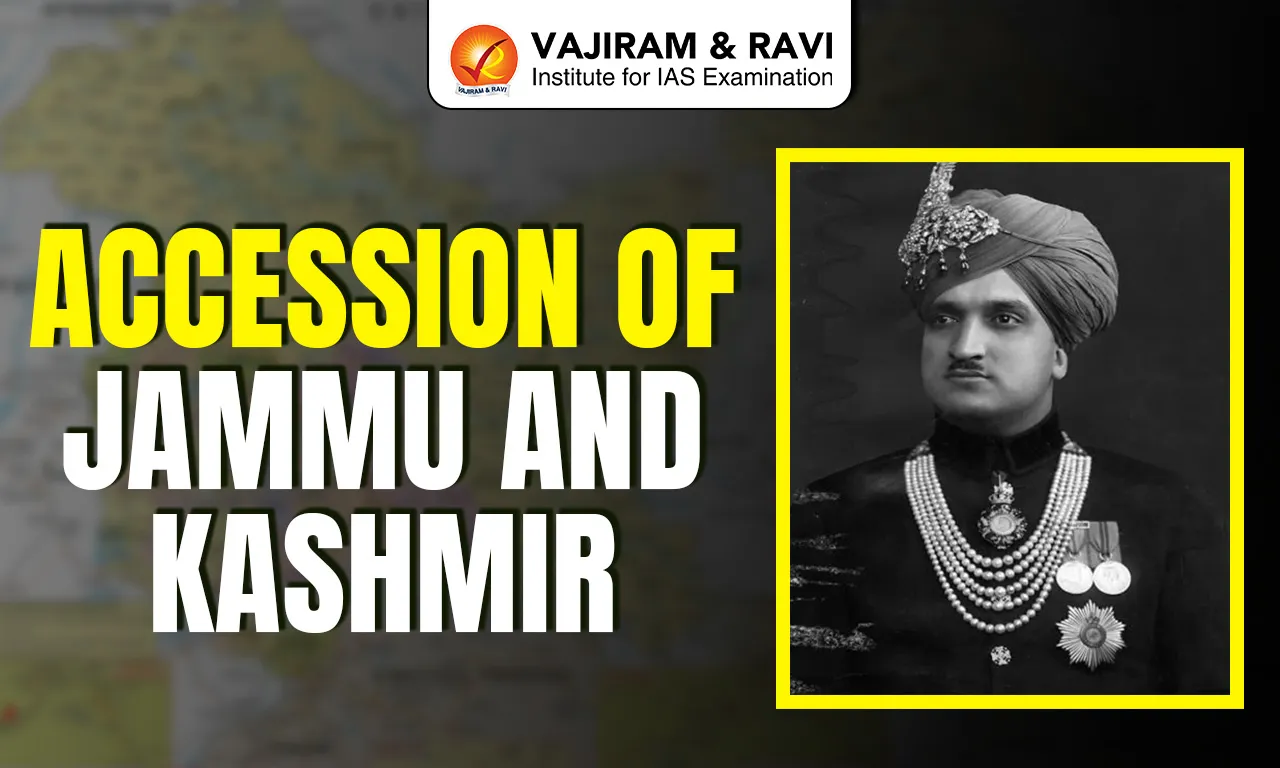
The accession of Jammu and Kashmir took place on 26th October 1947. The ruler of Jammu & Kashmir, Maharaja Hari Singh, first wanted to remain independent. He signed standstill agreements with India and Pakistan to maintain the status quo. However, in October 1947, tribesmen and soldiers from Pakistan invaded Kashmir. Facing this threat, the Maharaja asked India for military help. India agreed, but only after Kashmir formally joined India. So, the Maharaja signed the Instrument of Accession on 26 October 1947. It was accepted by Governor-General Lord Mountbatten on 27 October 1947.

Instrument of Accession Key Provisions

The key provisions that shaped the Accession of Jammu and Kashmir were as follows:

  • Limited powers to India: The Indian government could make laws for Jammu & Kashmir only on three subjects - Defence, External Affairs and Communications.
  • No automatic change in terms (Clause 5): The conditions of accession could not be changed by Indian laws unless the Maharaja agreed.
  • No compulsion to accept India’s future Constitution (Clause 7): The Maharaja was not bound to accept any future Constitution of India automatically.
  • Protection of land rights (Clause 6): The Indian Parliament could not pass laws to take land in Jammu & Kashmir without permission.

After the Accession of Jammu and Kashmir in 1947,its relationship with India was given a special constitutional arrangement through Article 370. This provision defined how the Indian Constitution would apply to the state.

Article 370 Special Status for Jammu & Kashmir

Article 370 was included in the Constitution of India as a temporary provision. It granted special autonomy to Jammu & Kashmir after the Accession of Jammu and Kashmir.

Key features of Article 370 were as follows: 

  • The Indian Parliament could make laws for the state only on Defence, External Affairs, Communications (and later, other subjects only with the state’s consent)
  • Jammu & Kashmir had its own Constitution (adopted in 1957).
  • The state had its own flag along with the Indian national flag.
  • Central laws were applied to the state only through Presidential Orders with the state government’s approval.

In practice, over the years, many provisions of the Indian Constitution were gradually extended to the state.

In 1954, another provision called Article 35A was added to the Constitution through a Presidential Order issued under Article 370

Article 35A: Special Rights for Permanent Residents

Article 35A was added to the Constitution in 1954 through a Presidential Order issued under Article 370. It gave special legal status for residents of Jammu & Kashmir after the Accession of Jammu and Kashmir.

Key features of Article 35A:

  • It empowered the Jammu & Kashmir legislature to define “permanent residents” of the state.
  • Based on this definition, the state government could give special rights and privileges only to these permanent residents. These rights included the right to own land and property, eligibility for government jobs, access to state scholarships, and other welfare benefits provided by the state government. 
  • People from other parts of India were not allowed to buy land or get state government jobs in Jammu and Kashmir unless they were recognized as permanent residents.

In August 2019, the Government of India made major constitutional changes regarding Jammu and Kashmir. Through a Presidential Order and a resolution passed by Parliament, Article 370 was made inoperative. Since Article 35A existed only because of Article 370, it was automatically removed after these changes.

At the same time, the state was reorganized under the Jammu and Kashmir Reorganisation Act, 2019 into two Union Territories:

  • Jammu & Kashmir (with a legislature)
  • Ladakh (without a legislature)

Later, in December 2023, the Supreme Court of India upheld this decision and confirmed that the removal of Article 370 was constitutionally valid.

Accession of Jammu and Kashmir FAQs

Q1: What was the Instrument of Accession?

Ans: The Instrument of Accession was a legal document that princely states had to sign to join either India or Pakistan after independence in 1947. By signing it, the ruler agreed to give certain powers to the new dominion. The Accession of Jammu and Kashmir took place when this document was signed on 26 October 1947.

Q2: Why did Jammu & Kashmir sign the Instrument of Accession?

Ans: Maharaja Hari Singh initially wanted to remain independent. However, when tribesmen and soldiers from Pakistan invaded Kashmir in October 1947, he asked India for military help. India agreed only after the Accession of Jammu and Kashmir, so he signed the Instrument.

Q3: On what subjects did India get powers after the accession?

Ans: India received powers only on three subjects: Defence, External Affairs, and Communications. Other matters remained under the control of the Jammu & Kashmir government after the Accession of Jammu and Kashmir.

Q4: What was the purpose of Article 370?

Ans: Article 370 gave special constitutional status to Jammu & Kashmir. It allowed the state to have its own Constitution, flag, and internal autonomy, while India controlled defence, foreign affairs, and communications.

Q5: What rights were given under Article 35A?

Ans: Article 35A allowed the Jammu & Kashmir legislature to define permanent residents and give them special rights, such as owning land, getting government jobs, and receiving state welfare benefits.

Enquire Now

