
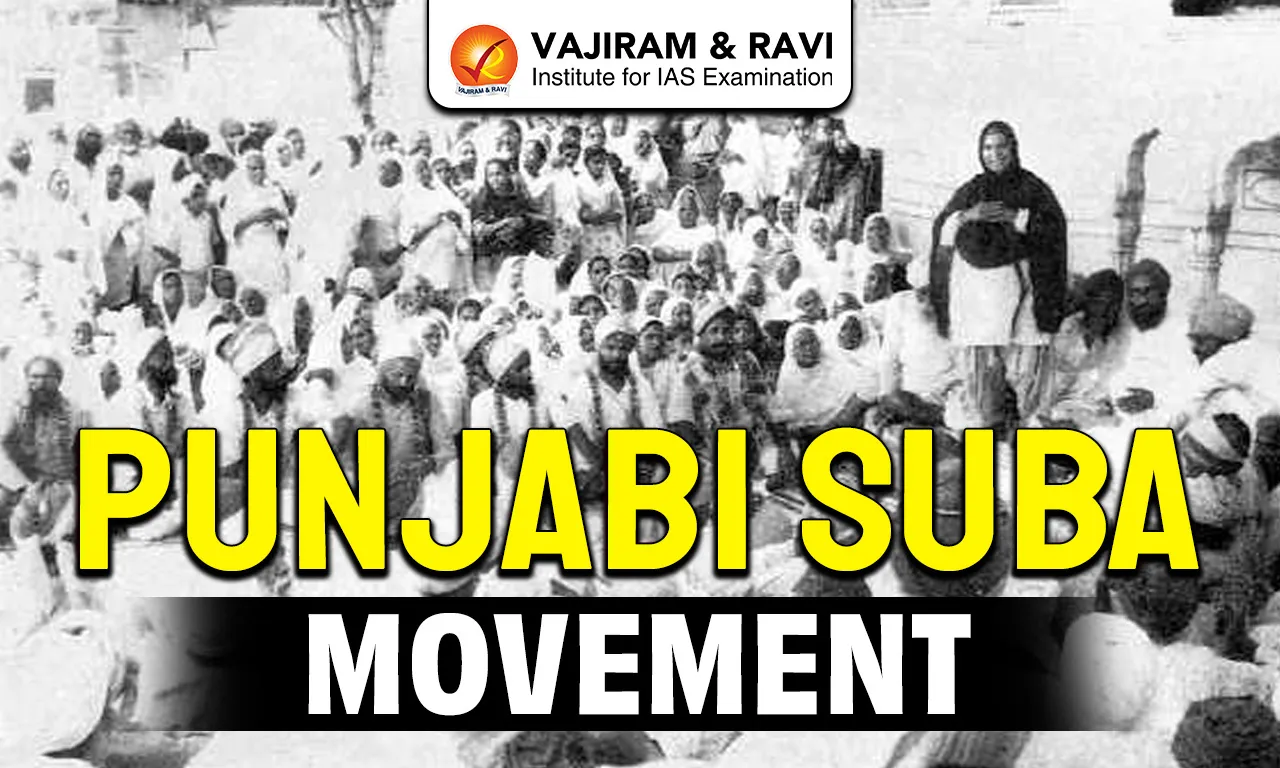
The Punjabi Suba Movement was a political movement in independent India that demanded the creation of a separate Punjabi-speaking state. It was mainly led by the Shiromani Akali Dal and supported largely by sections of the Sikh community. The movement emerged in the 1950s as part of the broader demand for reorganization of states on a linguistic basis. After years of protests and negotiations, the demand was accepted in 1966, leading to the reorganization of Punjab and the creation of Haryana and a new Punjab.
Punjabi Suba Movement Background
- After Independence, India faced several demands for creation of states on a linguistic basis. In Punjab, the demand for a separate Punjabi-speaking state, known as Punjabi Suba, became the main political objective of the Sikh leadership, especially the Shiromani Akali Dal.
- The Sikhs believed that their language (Punjabi) and cultural identity would be better protected in a separate state. Elections to the Shiromani Gurdwara Parbandhak Committee (SGPC) in 1954 showed strong Sikh support for this demand.
Punjabi Suba Movement Demands
- Creation of a Punjabi-speaking state.
- The state should include only Punjabi-speaking areas.
- Its boundaries should not be changed artificially for political reasons.
- The new state would function within the framework of the Indian Constitution.
Role of the States Reorganisation Commission (1953)
- The States Reorganisation Commission (SRC), appointed in 1953, examined various demands for new states. It rejected the demand for Punjabi Suba.
- Instead of recommending the creation of a separate Punjabi-speaking state, the Commission proposed expanding the existing Punjab by merging the Patiala and East Punjab States Union (PEPSU) and Himachal Pradesh with it.
- Sikh leaders felt that this recommendation ignored their genuine concerns. They believed that the decision aimed to keep Sikhs politically in a minority. This rejection increased dissatisfaction and strengthened the movement.
Agitations and Police Action (1955)
- The Punjabi Suba Movement turned into mass protests in 1955. During the Baisakhi festival in Amritsar, the Punjab government banned slogans supporting Punjabi Suba. Thousands of Sikhs courted arrest in protest.
- On 4 July 1955, police entered the Golden Temple and used tear gas to disperse protesters. This incident deeply hurt Sikh religious sentiments and increased tensions between the government and the Sikh community. Although the ban was later withdrawn.
- To solve the issue, a “Regional Formula” was introduced. It divided Punjab into Punjabi-speaking and Hindi-speaking regions for administrative purposes. However, it was not effectively implemented and failed to satisfy both sides.
- Over time, language differences started taking a communal shape. The demand for Punjabi Suba continued through peaceful protests and political negotiations.
- Leaders like Master Tara Singh and Sant Fateh Singh used hunger strikes and mass agitations to press the demand. Thousands of supporters courted arrest. The issue remained politically sensitive and emotionally charged.
Creation and Reorganisation of Punjab (1966)
- After the 1965 India-Pakistan War, the central government reconsidered the long-pending demand for a Punjabi-speaking state. A Parliamentary Committee examined the issue and recommended the creation of Punjabi Suba. Accepting this recommendation, the government passed the Punjab Reorganisation Act, 1966.
- The Act came into effect on 1 November 1966, and Punjab was reorganised mainly on a linguistic basis. As a result:
- Punjab was reconstituted as a Punjabi-speaking state.
- Haryana was created as a separate Hindi-speaking state and became the 17th state of India.
- Some hill areas of the old Punjab were transferred to Himachal Pradesh (which was then a Union Territory and became a full state in 1971)..
- Chandigarh was made a Union Territory and declared the joint capital of both Punjab and Haryana.
- Thus, the long-standing Punjabi Suba Movement demand was fulfilled through constitutional means under Article 3 of the Indian Constitution. The reorganisation of 1966 became an important example of linguistic state formation in post-Independence India.
Constitutional Provisions for Creation of States (Article 3)
- The Indian Constitution gives Parliament the power to:
- Create a new state.
- Change the name or boundaries of a state.
- Merge or divide states.
- Procedure under Article 3:
- The President refers the proposal to the concerned State Legislature for its opinion.
- The State Legislature gives its views within a specified time.
- Parliament can then pass the Reorganisation Bill.
- The final power lies with Parliament (state consent is not mandatory, only its opinion is required).
Punjabi Suba Movement FAQs
Q1: What was the Punjabi Suba Movement?
Ans: The Punjabi Suba Movement was a political movement led mainly by the Shiromani Akali Dal demanding the creation of a separate Punjabi-speaking state after Independence.
Q2: Why was the Punjabi Suba demand raised?
Ans: The demand was raised to protect Punjabi language and Sikh cultural identity and to reorganise Punjab on a linguistic basis, similar to other states in India.
Q3: What was the role of the States Reorganisation Commission (1953)?
Ans: The States Reorganisation Commission examined the demand but rejected the creation of Punjabi Suba and instead suggested a larger Punjab.
Q4: What happened during the 1955 agitation?
Ans: The Punjab government banned pro-Punjabi Suba slogans. Protests followed, thousands were arrested, and police entered the Golden Temple on 4 July 1955, which deeply hurt Sikh sentiments.
Q5: Who were the main leaders of the movement?
Ans: Important leaders included Master Tara Singh and Sant Fateh Singh, who used protests and hunger strikes to press the demand.

