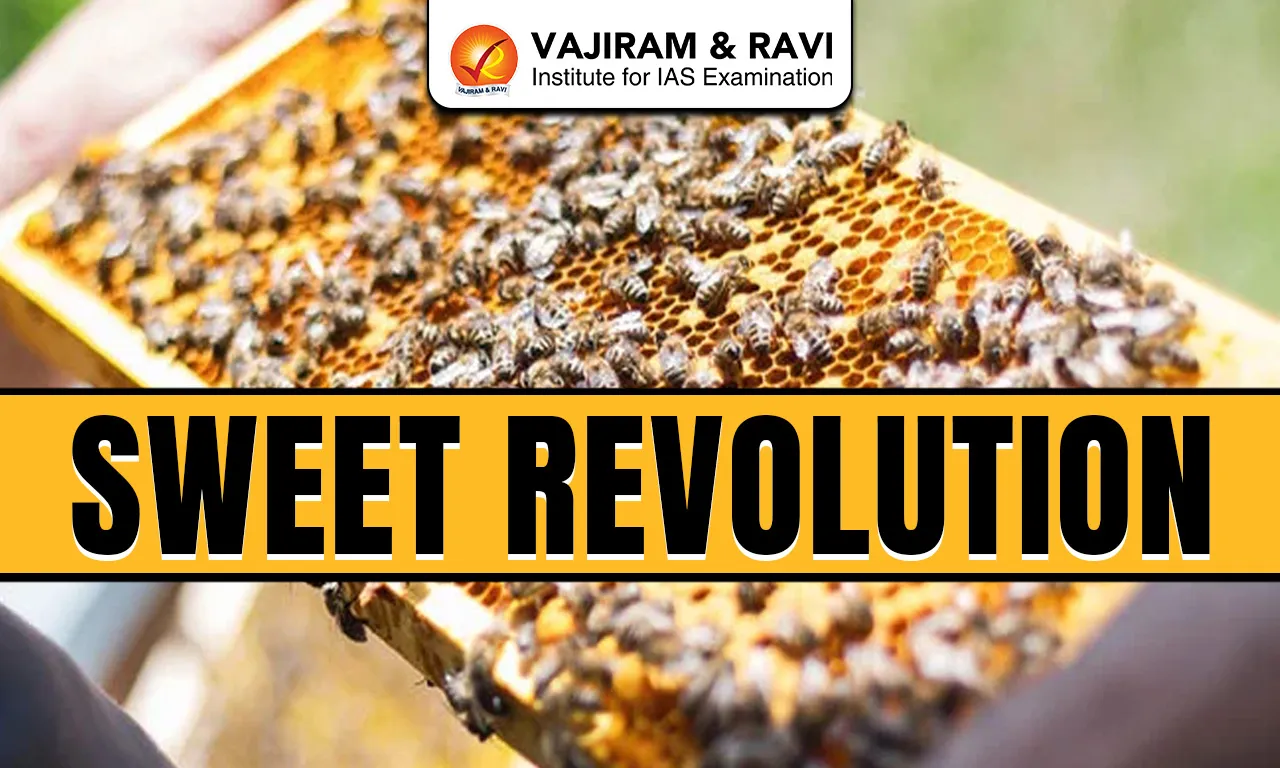
Sweet Revolution, also called “Mithi Kranti”, focuses on expanding scientific beekeeping to increase honey production and farmers’ income. It was announced in 2016 and gained momentum through the Honey Mission launched by the Khadi and Village Industries Commission under the Khadi and Village Industries Commission Act 1956. India is among the world’s top five honey producers. The honey output has grown by 242% while exports increased by 265% compared to 2005-06 levels. The sector supports crop pollination, improves agricultural productivity and strengthens rural livelihoods through low investment apiculture practices.
Sweet Revolution in India
Sweet Revolution promotes scientific apiculture to boost rural income and honey quality across states.
- National Beekeeping and Honey Mission: Launched in 2020 with ₹500 crore allocation under Atma Nirbhar Bharat, it supports structured beekeeping development nationwide.
- Madhukranti Portal: The portal has been created to collect the data and regulations of Bee Keeping and Apiculture.
- Honey Mission: Initiated by KVIC in 2017-18 to modernize beekeeping and expand honey and wax production capacity.
- Training Outreach: Around 30 lakh farmers trained through four modules designed by the National Bee Board for skill based apiculture practices.
- Employment Creation: Generated over 10,000 new jobs and about 25,000 additional man days through bee box fabrication and honey extraction activities.
- Jharkhand Focus: Selected due to 30% forest cover and suitable climate, aiming to transform it into a leading honey producing region.
- Market Expansion: India exported 61,333.88 tonnes of honey worth ₹732.19 crore, showing strong international demand growth.
- Consumption Gap: Domestic per capita consumption is 50 grams annually, compared to 2 kg in Germany and 700 grams in Japan.
Also Read: Brown Revolution 2.0
Sweet Revolution Features
The Sweet Revolution initiative integrates training, technology, processing and market linkages to strengthen apiculture value chains.
- Mobile Honey Processing Van: First launched in Uttar Pradesh by KVIC to process honey at farmers’ doorsteps, reducing transport expenses.
- Cost Reduction: Eliminates expensive travel to distant plants, preventing distress sale of raw honey at low farm gate prices.
- Adulteration Control: On site processing ensures purity and prevents mixing or contamination during transit stages.
- Scientific Training: Covers colony examination, disease management, seasonal hive maintenance and pest identification techniques.
- Equipment Support: Provides honey extractors, wax purification tools and modern apicultural devices to enhance productivity.
- Value Addition: Encourages production of royal jelly, beeswax, pollen and propolis used in pharmaceuticals and cosmetics sectors.
- Crop Productivity Boost: Pollination services increase yields of fruits, vegetables, cereals and pulses by nearly 15%.
Also Read: Industrial Revolution 4.0
Sweet Revolution Impact
Sweet Revolution strengthens agriculture, exports and rural employment through sustainable beekeeping expansion.
- Income Addition: Enables farmers cultivating fruits and pulses to earn parallel income without large land requirements.
- Export: Nearly 60% of output exported to the US, Canada, West Asia and Africa, strengthening foreign exchange earnings.
- Market Growth: Global honey market valued at $500 million, expected to reach $1,130 million by 2025 with 10.7% CAGR.
- Rural Enterprise: Beekeeping requires limited capital yet generates steady returns, supporting women and unemployed youth.
- Allied Industries: Supports food processing, beauty products and health sectors through consistent supply of bee based inputs.
- Quality Focus: Rising demand for pure honey after adulteration concerns increases importance of testing and certification.
Sweet Revolution FAQs
Q1: What is the Sweet Revolution in India?
Ans: Sweet Revolution, also known as Mithi Kranti, is a government initiative to promote scientific beekeeping and increase quality honey production and farmers’ income.
Q2: When was the Honey Mission launched?
Ans: The Honey Mission was launched by the Khadi and Village Industries Commission in 2017-18 to modernize apiculture practices.
Q3: What is the National Beekeeping and Honey Mission?
Ans: Launched in 2020 with ₹500 crore allocation, it aims to expand scientific beekeeping, improve productivity and strengthen honey value chains.
Q4: How does beekeeping help agriculture?
Ans: Beekeeping improves pollination, which can increase crop productivity of fruits, vegetables, cereals and pulses by around 15%.
Q5: What is the role of the Mobile Honey Processing Van?
Ans: It processes honey at farmers’ doorsteps, reduces transportation costs, prevents adulteration and ensures better returns for beekeepers.

