Actinarctus odissi

Actinarctus odissi

Actinarctus odissi Latest News

Scientists recently discovered a new species of tardigrade, fondly known as the marine water bear, named Actinarctus odissi, off the northeast coast of India.

About Actinarctus odissi

  • It is a new species of tardigrade.
  • The microscopic creature was discovered in the shallow marine waters of the Bay of Bengal, near the coastal region of Markandi in Odisha
  • The name ‘’odissi’’ was chosen to honour the famous traditional classical dance form originating from Odisha
  • This marks the first time in 43 years that a new member of its elusive genus has been found.   
  • Features:
    • It boasts a dome-shaped body surrounded by transparent, wing-like flaps called alae, which are supported by translucent pillars. 
    • While other species in this genus feature long wings and elaborate internal supports, this new water bear has noticeably shorter lateral wings. 
    • Its back legs possess simple, un-split sensory organs that are much shorter than those of its cousins. 
    • It also features blunt-tipped sensory appendages, rather than sharp ones, and its back is uniquely heavily sculptured with tiny, trombone-shaped pillars. 

What are Tardigrades?

  • Tardigrades, also called ‘’water bears’’ or ‘’moss-piglets’’, are tiny microscopic animals.   
  • Scientists have identified about 1,300 tardigrade species. 
  • Tardigrades can be found in almost every habitat on Earth. 
  • Most species live in freshwater or semiaquatic terrestrial environments. 
  • Marine tardigrades account for 17% of all known tardigrade species.
  • They are short (0.05 mm - 1.2 mm in body length), plump, bilaterally symmetrical, segmented organisms. 
  • They have four pairs of legs, each of which ends in four to eight claws.  
  • They feed on the fluids of plant cells, animal cells, and bacteria.  
  • They are famous for their extraordinary ability to survive extreme environmental conditions. 
  • They can survive punishing heat, freezing cold, ultraviolet radiation, and even outer space. 
  • Under unfavourable conditions, they go into a state of suspended animation called the “tun” state—in which the body dries out and appears as a lifeless ball (or tun). 
    • In this state their metabolism may decline to as little as 0.01 percent of its normal rate. 
    • Tardigrades can survive as tuns for years, or even decades, to wait out dry conditions. 

Source: RM

Actinarctus odissi FAQs

Q1: What is Actinarctus odissi?

Ans: Actinarctus odissi is a newly discovered species of tardigrade.

Q2: Where was Actinarctus odissi discovered?

Ans: It was discovered in the shallow marine waters of the Bay of Bengal near Markandi in Odisha.

Q3: What is the body shape of Actinarctus odissi?

Ans: It has a dome-shaped body.

Q4: What are tardigrades commonly called?

Ans: Tardigrades are commonly called “water bears” or “moss-piglets.”

Anal Naga Tribe

Anal Naga Tribe

Anal Naga Tribe Latest News

For generations, the Anal Naga tribe in Manipur has followed Uju and Rangkang, community-led forest systems that protect trees, water sources and village life.

About Anal Naga Tribe

  • They are an indigenous Tibeto-Burman ethnic group found in Manipur, India, and in Myanmar.
  • They are one of the first settlers of 19 Naga tribes in Manipur. 
  • They are confined mostly in Chandel District, Manipur. 
  • They are recognized as a Scheduled Tribe in India.
  • The population of Anal, according to the 2011 census, is 24,301.
  • They speak the Anāl language, a Northern Kukish dialect of the Sino-Tibetan family.
  • Religion:
    • The ancient religion of Anal is ‘animist’. 
    • At present, the overwhelming majority of the population are Christians.  
  • Livelihood:
    • They make their living by farming and animal husbandry.  
    • For generations, the Anal Naga tribe has protected forests through Uju and Rangkang-community-led systems.

What is Uju? 

  • It refers to community-managed reserved forests located near Anal villages. 
  • These are protected collectively, usually under the supervision of village authorities and elders, who regulate how resources can be used. 
  • Decisions are made collectively during annual assemblies attended by residents. 
  • Discussions range from land disputes and road repairs to forest regulations and jhum cultivation cycles. 
  • Commercial logging is prohibited. 
  • Trees cannot be cut without permission.
  • Forest products such as mushrooms, herbs, wild vegetables, flowers, fruits, berries, and medicinal plants may be gathered carefully for household use, but extraction for profit is restricted.

What is Rangkang?

  • It refers to untouched forest areas located deeper within jhum cultivation landscapes.
  • Unlike Uju, which is actively managed, Rangkang forests are left largely undisturbed. 
  • Over generations, communities have intentionally avoided cultivating these regions, allowing dense ecosystems to regenerate naturally.

Source: BI

Anal Naga Tribe FAQs

Q1: Who are the Anal Naga Tribe?

Ans: Anal Naga Tribe are an indigenous Tibeto-Burman ethnic group found in Manipur, India, and Myanmar.

Q2: In which Indian state is the Anal Naga Tribe mainly found?

Ans: The Anal Naga Tribe is mainly found in Manipur.

Q3: Which language is spoken by the Anal Naga Tribe?

Ans: They speak the Anāl language, a Northern Kukish dialect of the Sino-Tibetan family.

Q4: Which religion is followed by the majority of the Anal Naga Tribe today?

Ans: The majority of the Anal Naga Tribe today are Christians.

Q5: What are the main livelihoods of the Anal Naga Tribe?

Ans: Their main livelihoods are farming and animal husbandry.

India’s Cold Water Fisheries

India’s Cold Water Fisheries

India’s Cold Water Fisheries Latest News

India’s cold water fisheries sector is emerging as an important component of the Blue Economy by generating livelihoods, improving nutrition, promoting eco-tourism, and supporting sustainable mountain development.

About India’s Cold Water Fisheries

  • Cold-water fisheries are practiced in high-altitude snow-fed rivers, streams, lakes, and reservoirs with temperatures ranging between 5°C and 25°C, dissolved oxygen above 6 mg/L, and pH levels between 6.5 and 8.0. 
  • They flourish across Jammu & Kashmir, Ladakh, Himachal Pradesh, Uttarakhand, Arunachal Pradesh, Sikkim, Meghalaya, and Nagaland, along with hill districts of West Bengal, Kerala, Karnataka, and Tamil Nadu. 
  • Together, these ecosystems cover more than 5.33 lakh sq. km. of mountainous terrain. 
  • India has identified over 278 cold-water fish species. 
  • Species such as rainbow trout, golden mahseer, and snow trout are cultivated using specialized infrastructure, including hatcheries, raceways, RAS, biofloc systems, and cold chain facilities. 
  • Trout farming is generally practiced above 1,500 metres altitude, while mahseer culture is suitable at relatively lower elevations. 
  • Current Status and Production:
    • India’s total fish production reached approximately 197.75 lakh tonnes during 2024–25, with cold-water fisheries contributing nearly 3 percent of inland fish production. 
    • National cold-water fish production currently stands at around 7,000 metric tonnes. 
    • Trout production alone has increased nearly 1.8 times over the last decade to about 6,000 metric tonnes in 2024–25. 
    • Jammu & Kashmir has emerged as India’s leading trout-producing region, followed by Himachal Pradesh and Uttarakhand.
  • Policy Initiatives: 
    • Under the Pradhan Mantri Matsya Sampada Yojana (PMMSY) during 2020–26, projects worth over ₹5,638.76 crore sanctioned specifically for cold-water states.
    • The Fisheries and Aquaculture Infrastructure Development Fund (FIDF) approved projects worth ₹7,761.78 crore during 2018–26 for hatcheries, training centres, and fisheries infrastructure. 
    • The Blue Revolution Scheme (2015–20) laid the foundation for scientific trout farming through support for raceways, hatcheries, and reservoir stocking. 
    • Under Pradhan Mantri Matsya Kisan Samridhi Sah-Yojana (PM-MKSSY), with an outlay of ₹6,000 crore, support is being provided for aquaculture insurance, performance grants to fisheries startups/microenterprises, and value chain efficiency.
    • The Government has also issued Model Guidelines for Cold Water Fisheries Development, 2026, covering site selection, hatchery standards, disease management, biosecurity, branding, certification, e-trading, and skill development. 
    • India is also strengthening international collaborations with Norway and Iceland for knowledge exchange.

Source: NOA

India’s Cold Water Fisheries FAQs

Q1: What are cold-water fisheries?

Ans: Cold-water fisheries are fisheries practiced in high-altitude snow-fed rivers, streams, lakes, and reservoirs.

Q2: What is the ideal temperature range for cold-water fisheries?

Ans: The ideal temperature range is between 5°C and 25°C.

Q3: What is the suitable pH range for cold-water fisheries?

Ans: The suitable pH range is between 6.5 and 8.0.

Q4: In which regions of India are cold-water fisheries mainly practiced?

Ans: They are mainly practiced in Jammu and Kashmir, Ladakh, Himachal Pradesh, Uttarakhand, Arunachal Pradesh, Sikkim, Meghalaya, and Nagaland.

Q5: What percentage of inland fish production comes from cold-water fisheries?

Ans: Cold-water fisheries contribute nearly 3 percent of inland fish production.

Himalayan Tricarinate Hill Turtle

Himalayan Tricarinate Hill Turtle

Himalayan Tricarinate Hill Turtle Latest News

Forest officials recently found the rare Himalayan Tricarinate Hill Turtle in the Udanti Sitanadi Tiger Reserve forests of Chhattisgarh, marking an unusual sighting of the Himalayan species in central India.

About Himalayan Tricarinate Hill Turtle

  • It is a small, terrestrial turtle species belonging to the family Geoemydidae.
  • It derives its name from the three distinct keels on its shell, which provide it with a striking appearance.  
  • Scientific Name: Melanochelys tricarinata 

Himalayan Tricarinate Hill Turtle Habitat and Distribution

  • It is found along the narrow sub-Himalayan belt, stretching across northeastern India, southern Nepal, southern Bhutan, and northern Bangladesh. 
  • The species primarily inhabits temperate forests, as well as grasslands and foothills of the Himalayas.  

Himalayan Tricarinate Hill Turtle Features

  • It is characterised by a highly domed carapace with three longitudinal keels.
  • It has a small olive-to-dark coloured head with a narrow snout.
  • It has scaly limbs adapted for terrestrial movement.

Himalayan Tricarinate Hill Turtle Conservation Status

It is classified as 'Endangered' under the IUCN Red List.

Source: TOI

Himalayan Tricarinate Hill Turtle FAQs

Q1: What is the Himalayan Tricarinate Hill Turtle?

Ans: It is a small terrestrial turtle species belonging to the family Geoemydidae.

Q2: Why is it called the “Tricarinate” Hill Turtle?

Ans: It is called “Tricarinate” because of the three distinct keels on its shell.

Q3: In which geographical belt is the Himalayan Tricarinate Hill Turtle found?

Ans: It is found along the narrow sub-Himalayan belt, stretching across northeastern India, southern Nepal, southern Bhutan, and northern Bangladesh.

Q4: What is the IUCN Red List status of the Himalayan Tricarinate Hill Turtle?

Ans: Its IUCN Red List status is Endangered.

Hutti Gold Mines Company Limited (HGML)

Hutti Gold Mines Company Limited

Hutti Gold Mines Company Limited Latest News

Hutti Gold Mines, the only functional gold mine in the country, earned a whopping ₹633.34 crores more in 2025-26, thanks to the skyrocketing price of gold in the world market.

About Hutti Gold Mines Company Limited

  • It is a Government of Karnataka undertaking established in 1947
  • It has the unique distinction of being the only producer of primary gold in the country. 
  • HGML has been active in the exploration, development, and exploitation of gold deposits occurring in Karnataka
  • The company's corporate office is situated in Bangalore.
  • It currently processes the ore from the Hutti Gold mine and two satellite mines, the Uti opencast mine and the Heera-Buddinni exploratory underground mine. 
  • The Hutti mine is probably one of the most ancient metal mines in the world, dating to the Pre-Ashokan period.  
  • Production:
    • The company produced 1,691.57 kg of gold during 2025-26.
    • Hutti’s gold production meets less than 1% of India’s annual demand for gold that is estimated to be over 700 tonnes. 
    • The company also produced 145.76 kg of silver as a byproduct of the gold ore beneficiation process.

Source: TH

Hutti Gold Mines Company Limited FAQs

Q1: What is Hutti Gold Mines Company Limited (HGML)?

Ans: It is a Government of Karnataka undertaking engaged in gold mining activities.

Q2: In which year was Hutti Gold Mines Company Limited (HGML) established?

Ans: HGML was established in 1947.

Q3: What unique distinction does Hutti Gold Mines Company Limited (HGML) hold in India?

Ans: HGML is the only producer of primary gold in India.

Q4: Which main mine supplies ore to HGML?

Ans: The Hutti Gold Mine supplies ore to HGML.

Q5: How much gold did Hutti Gold Mines Company Limited (HGML) produce during 2025–26?

Ans: HGML produced 1,691.57 kg of gold during 2025–26.

Red-Necked Phalarope

Red-Necked Phalarope

Red-Necked Phalarope Latest News

Chandu Budhera wetland recently emerged as a migratory stopover for the rare red-necked phalarope.

About Red-Necked Phalarope

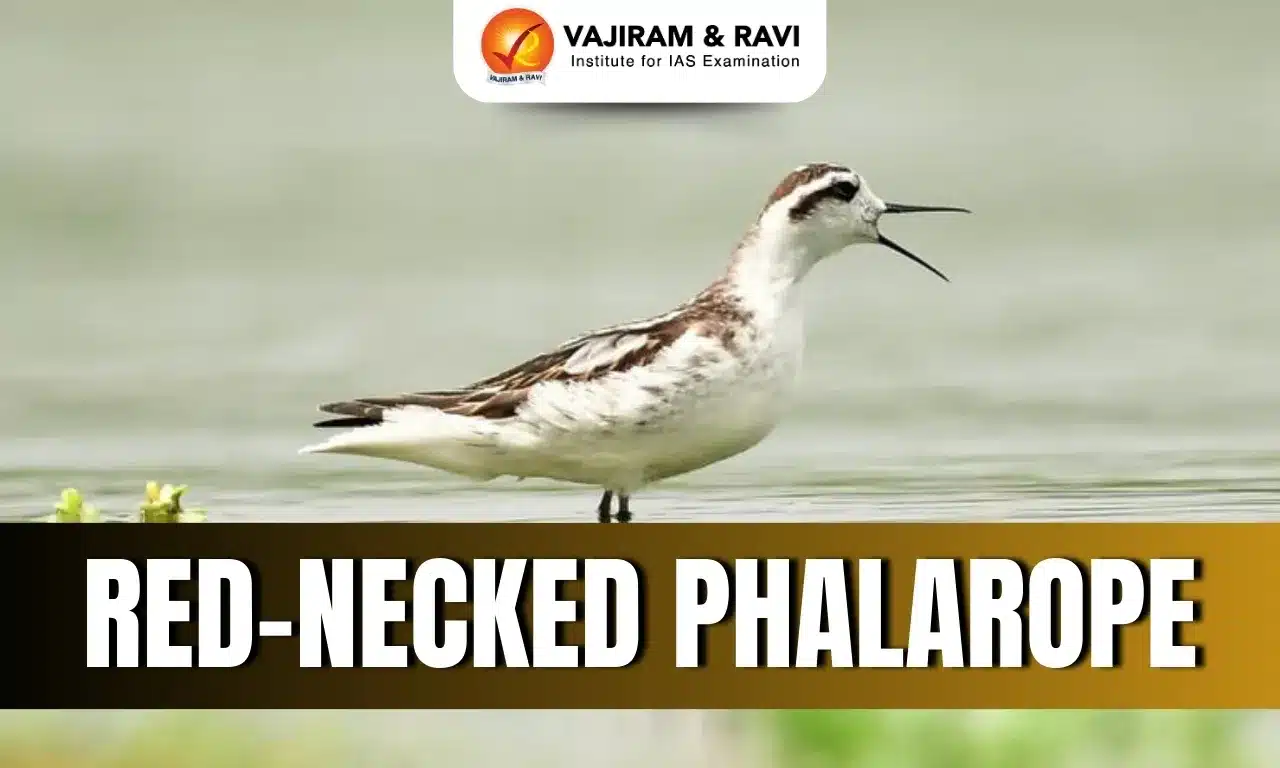
  • It is a small shorebird known for spinning frantically on water to stir up small invertebrates.
  • Scientific Name: Phalaropus lobatus 

Red-Necked Phalarope Habitat and Distribution

  • This species has a circumpolar distribution. 
  • A long-distance migrant, it breeds in Arctic bogs and winters at sea in the tropics, often travelling overland. 
  • Russian breeders winter in the southwest Pacific, North American birds off Peru, and European birds mainly in the Arabian Sea. 

Red-Necked Phalarope Features

  • It has a small head, short legs, and a thin needle-like bill. 
  • Both sexes have a dark head with a white spot above the eye, white throat, and a dark back with bold, buff-coloured streaking. 
  • The bright, chestnut-red stripe down the sides of the neck is distinctive. 
  • Like all phalaropes, red-necked phalaropes show reversed sexual dimorphism.
  • Females are the more brightly colorful and typically larger sex. 
  • Males are responsible for incubating eggs and feeding young. 

Red-Necked Phalarope Conservation Status

It is classified as 'Least Concern' under the IUCN Red List

Source: HT

Red-Necked Phalarope FAQs

Q1: What is Red-Necked Phalarope?

Ans: It is a small shorebird.

Q2: What unique feeding behaviour is shown by the Red-Necked Phalarope?

Ans: It spins frantically on water to stir up small invertebrates.

Q3: Where does the Red-Necked Phalarope breed?

Ans: It breeds in Arctic bogs.

Q4: Where does the Red-Necked Phalarope spend the winter?

Ans: It winters at sea in tropical regions.

Q5: What is the IUCN conservation status of the Red-Necked Phalarope?

Ans: Its IUCN Red List status is Least Concern.

Indian Cybercrime Coordination Centre (I4C)

Indian Cybercrime Coordination Centre (I4C)

Indian Cybercrime Coordination Centre (I4C) Latest News

The Indian Cybercrime Coordination Centre (I4C) recently identified a sophisticated phishing campaign targeting Apple iPhone users whose devices have been lost or stolen, according to an advisory issued by the agency.

About Indian Cybercrime Coordination Centre (I4C)

  • I4C has been established under the Ministry of Home Affairs (MHA) to act as a nodal point at the National level in the fight against cybercrime. 
  • It is designed to provide a framework and ecosystem for law enforcement agencies (LEAs) to deal with cybercrime in a coordinated and comprehensive manner.
  • I4C brings together academia, industry, public, and government in the prevention, detection, investigation, and prosecution of cybercrimes.
  • Headquarters: New Delhi.

Indian Cybercrime Coordination Centre (I4C) Objectives

  • To act as a nodal point to curb Cybercrime in the country.
  • To strengthen the fight against Cybercrime committed against women and children.
  • Facilitate easy filing of cybercrime-related complaints and identifying cybercrime trends and patterns.
  • To act as an early warning system for LEAs for proactive cybercrime prevention and detection.
  • Awareness creation among the public about preventing cybercrime.
  • Assist states/UTs in the capacity building of Police Officers, Public Prosecutors and Judicial Officers in the area of cyber forensics, investigation, cyber hygiene, cyber-criminology, etc.
  • Identify the research problems and needs of LEAs and take up R&D activities in developing new technologies and forensic tools in collaboration with academia/research institutes within India and abroad.
  • Suggest amendments, if required, in cyber laws to keep pace with fast-changing technologies and international cooperation.
  • To coordinate all activities related to the implementation of Mutual Legal Assistance Treaties (MLAT) with other countries related to cybercrimes in consultation with the concerned nodal authority in MHA.

Indian Cybercrime Coordination Centre (I4C) Components

  • National Cybercrime Threat Analytics Unit (TAU)
  • National Cybercrime Reporting Portal (NCRP)
  • National Cybercrime Training Centre (NCTC)
  • National Cybercrime Research and Innovation Centre
  • Platform for Joint Cyber Crime Coordination Team
  • Cybercrime Ecosystem Management Unit
  • National Cybercrime Forensic Laboratory (Investigation) Ecosystem

Indian Cybercrime Coordination Centre (I4C) Initiatives

  • Citizen Financial Cyber Fraud Reporting and Management System: For immediate reporting of financial cyber frauds and preventing the siphoning of funds by cyber criminals on a near-real-time basis.
  • National Toll-Free Helpline number ‘1930’ has been operationalized to provide citizen assistance in lodging online cyber complaints.
  • The social media handle “CyberDost”, which provides cyber safety tips at regular intervals.
  • I4C has envisaged the Cyber Crime Volunteers Program to bring together citizens with a passion to serve the nation on a single platform and contribute to the fight against cybercrime in the country.
  • Pratibimb geospatial crime mapping platform maps locations of criminals and crime infrastructure on a map to give visibility to jurisdictional officers.    

What is Phishing?

  • It is a type of cyberattack that uses deceptive messages from seemingly reputable sources to trick victims into revealing sensitive information like login credentials, passwords, or financial data for malicious use.
  • Attackers utilize various sophisticated methods, including domain spoofing, fake websites, and generative AI, to execute a phishing attack via email, SMS, phone calls, or social media.
  • The most common examples of phishing are used to support other malicious actions, such as account takeovers, ransomware attacks, or business email compromise.

Source: TH

Indian Cybercrime Coordination Centre (I4C) FAQs

Q1: What is the Indian Cybercrime Coordination Centre (I4C)?

Ans: It is a national-level nodal agency established to fight cybercrime in India.

Q2: Under which ministry was Indian Cybercrime Coordination Centre (I4C) established?

Ans: I4C was established under the Ministry of Home Affairs.

Q3: Where is the headquarters of Indian Cybercrime Coordination Centre (I4C) located?

Ans: The headquarters of I4C is located in New Delhi.

Q4: Which toll-free helpline number is used for cybercrime complaints in India?

Ans: The toll-free helpline number is 1930.

Q5: What is “CyberDost”?

Ans: CyberDost is a social media initiative that shares cyber safety tips regularly.

Nereid

Nereid

Nereid Latest News

New observations from the James Webb Space Telescope suggest that Nereid may not have originated from the Kuiper Belt, as its crystalline water ice and unique spectral signature differ from known Kuiper Belt objects.

About Nereid

  • It is the third-largest moon of Neptune. 
  • It was discovered on May 1, 1949, by  Dutch astronomer Gerard Kuiper, who named the moon after the sea nymphs in Greek mythology. 
  • Nereid is about 170 kilometers across.
  • It is unique because it has one of the most eccentric orbits of any moon in our solar system. 
  • It is so far from Neptune that it requires 360 Earth days to make one orbit. 
  • Like so many other moons in the outer solar system, Nereid was long suspected of migrating to Neptune's neighborhood from the Kuiper Belt
  • But using the Webb telescope, scientists determined that Nereid’s composition was inconsistent with Kuiper Belt objects — it had too much ice. 
  • That suggests it was part of Neptune's system all along. 

What is the Kuiper Belt?

  • It is a large, doughnut-shaped cold region of icy bodies located in the outer reaches of our solar system beyond the orbit of Neptune.  
  • It's sometimes called the "third zone" of the solar system. 
  • It is similar to the main asteroid belt, found between Mars and Jupiter, in that its objects are composed of material leftover from the formation of the solar system around 4.6 billion years ago. 
  • However, it is far larger than the main asteroid belt, up to 20 times as wide and 20 to 100 times its mass.
  • Like the asteroid belt, it has also been shaped by a giant planet, although it's more of a thick disk (like a donut) than a thin belt.
  • The icy bodies in the Kuiper Belt are called "Kuiper Belt Objects", or KBOs for short. Pluto is the best-known KBO.
  • In addition to rock and water ice, objects in the Kuiper Belt also contain a variety of other frozen compounds like ammonia and methane.  

Source: TH

Nereid FAQs

Q1: What is Nereid?

Ans: Nereid is the third-largest moon of Neptune.

Q2: Who discovered Nereid?

Ans: It was discovered on May 1, 1949, by Dutch astronomer Gerard Kuiper.

Q3: Why is Nereid considered unique among moons in the Solar System?

Ans: It has one of the most eccentric orbits of any moon in the Solar System.

Q4: How long does Nereid take to complete one orbit around Neptune?

Ans: Nereid takes about 360 Earth days to complete one orbit.

Q5: Why is Nereid’s composition inconsistent with Kuiper Belt objects?

Ans: Its composition contains more ice than typical Kuiper Belt objects.

Stroke

Stroke

Stroke Latest News

The World Health Assembly (WHA) recently passed the first-ever resolution on strokes, urging member states to recognise the medical condition as a public health priority.

About Stroke

  • It is a medical emergency that occurs when blood flow to the brain is interrupted, either due to a blockage or bleeding. 
  • This lack of blood flow can lead to brain cell death and serious complications. 
  • A stroke can cause lasting brain damage, long-term disability, or even death. 
  • The types of strokes are:
    • Ischaemic stroke: A blood clot blocks a blood vessel in your brain, leading to loss of blood flow.
    • Haemorrhagic stroke: Intracerebral haemorrhage (ICH) by rupture of a blood vessel in the brain leading to bleeding.
    • Transient ischaemic attack (TIA): A short period of symptoms similar to those of a stroke, caused by a brief blockage of blood flow to the brain. A TIA usually lasts only a few minutes and doesn't cause long-term damage.
  • Most of the stroke burden is attributable to 10 modifiable risk factors, including high blood pressure, air pollution, smoking, high LDL cholesterol, diet high in sodium, high fasting blood glucose, kidney dysfunction, excess body weight, physical inactivity, and harmful use of alcohol
  • Non‑modifiable risk factors are:
    • Age
    • A prior stroke
    • Pre-existing cardiac conditions (e.g., atrial fibrillation and heart failure) and chronic kidney disease.
  • The symptoms of a stroke often happen quickly. They include:
    • Sudden numbness or weakness of the face, arm, or leg (especially on one side of the body).
    • Sudden confusion, trouble speaking, or understanding speech.
    • Sudden trouble seeing in one or both eyes.
    • Sudden difficulty walking, dizziness, loss of balance, or coordination.
    • Sudden severe headache with no known cause.
  • Treatment:
    • Treatments for stroke include medicines, surgery, and rehabilitation. 
    • Prevention of another stroke is also important, since having a stroke increases the risk of getting another one. 
    • Prevention may include heart-healthy lifestyle changes and medicines. 

Source: TH

Stroke FAQs

Q1: What is a stroke?

Ans: Stroke is a medical emergency that occurs when blood flow to the brain is interrupted.

Q2: What are the two main causes of a stroke?

Ans: A stroke can occur due to a blockage or bleeding in the brain.

Q3: Why is interrupted blood flow dangerous during a stroke?

Ans: Interrupted blood flow can lead to brain cell death and serious complications.

Q4: What is an ischaemic stroke?

Ans: An ischaemic stroke occurs when a blood clot blocks a blood vessel in the brain.

Q5: What is a haemorrhagic stroke?

Ans: A haemorrhagic stroke occurs when a blood vessel in the brain ruptures and causes bleeding.

Jharia Coalfield

Key Facts about Jharia coalfield

Jharia Coalfield Latest News

A new study has found that the long-burning underground fires in the Jharia Coalfield may be burning hotter and emitting more greenhouse gases than previously estimated.

About Jharia Coalfield

  • It is located in the Dhanbad district of Jharkhand.
  • It lies in the Damodar River valley and covers about 280 sq.km.
  • It is known for its vast deposits of high-quality coking coal and holds the largest coal reserves in the country, having estimated reserves of 19.4 billion tonnes.
  • Coal mining began in Jharia in 1894, and there are now more than 20 underground mines and several large open-cast coal mines there.  
  • Underground fires were first noted in Jharia in 1916, and they have continued to spread, destroying properties and killing miners.  

What is Coking Coal?

  • Coking coal (or metallurgical coal) is a naturally occurring sedimentary rock found within the earth’s crust.
  • It typically contains more carbon, less ash, and less moisture than thermal coal, which is used for electricity generation.
  • It is a bituminous coal with a suitable quality that allows the production of metallurgical coke, or simply named coke. 
  • Coke is the main product of the high-temperature carbonisation of coking coal. 
  • It is an essential input material in steelmaking, as it is used to produce pig iron in blast furnaces, acting as the reducing agent of iron ore and as the support of the furnace charge.  
  • Major Producers: 
    • The largest producers of coking coal were China, Australia, Russia, USA, and Canada.
    • India has an estimated 37.37 billion tonnes of coking coal resources, largely located in Jharkhand, with additional reserves in Madhya Pradesh, West Bengal, and Chhattisgarh.

Source: TH


Jharia Coalfield FAQs

Q1: Where is the Jharia Coalfield located?

Ans: Jharia Coalfield is located in the Dhanbad district of Jharkhand.

Q2: In which river valley is the Jharia Coalfield situated?

Ans: It is situated in the Damodar River valley.

Q3: What type of coal is Jharia Coalfield famous for?

Ans: It is famous for high-quality coking coal.

Q4: Which coalfield holds the largest coal reserves in India?

Ans: The Jharia Coalfield holds the largest coal reserves in India.

Q5: When did coal mining begin in Jharia?

Ans: Coal mining began in Jharia in 1894.

BCCI and RTI – Why the CIC Refused to Treat the Cricket Board as a Public Authority

BCCI and RTI

BCCI and RTI Latest News

  • The Central Information Commission (CIC) ruled that the Board of Control for Cricket in India (BCCI) is not a “public authority” under the Right to Information (RTI) Act, 2005, and therefore cannot be compelled to disclose information under the Act. 
  • The decision revisits a long-standing debate over transparency, accountability, and the legal status of sports bodies performing public functions.

Legal Framework Behind the Dispute

  • RTI Act and definition of “public authority”: Section 2(h) of the RTI Act defines a public authority as a body -
    • Established by the Constitution, parliamentary or state laws, or government notification;
    • Owned, controlled, or substantially financed by the government;
    • Including NGOs substantially funded through public money.
  • The BCCI argued that it is -
    • A private autonomous body;
    • Registered under the Tamil Nadu Societies Registration Act, 1975;
    • Neither created by statute nor substantially financed by the government.
  • Article 12 and the concept of “State”:
    • It includes governments and authorities under governmental control. 
    • Courts have expanded this interpretation in some cases involving bodies performing public functions.
    • However, the BCCI maintained that despite regulating cricket in India, it is not “State” because there is no deep and pervasive governmental control over its affairs.

Earlier Recommendations for Bringing BCCI Under RTI

  • Justice Lodha committee recommendations:
    • The committee criticised the BCCI’s opaque functioning as a “closed-door and backroom affair”. 
    • It recommended bringing the BCCI within the RTI framework to enhance transparency and accountability.
  • Law Commission’s 275th Report (2018):
    • It also recommended that sports bodies performing public functions should come under RTI because they exercise “state-like powers”; BCCI virtually functions as a National Sports Federation.
    • Despite these recommendations, Parliament did not enact any law to include the BCCI under RTI.

Earlier CIC Position and Judicial Developments

  • 2018 CIC order: The BCCI qualified as a public authority and directed it to appoint Public Information Officers (PIOs); create an RTI compliance mechanism.
  • Madras High Court (HC) intervention: The BCCI challenged the order before the Madras HC, which remanded the matter back to the CIC for reconsideration in light of SC rulings. The recent SC order emerged from this reconsideration.

What the Latest CIC Order Held

  • Registration under a statute does not make an entity public:
    • The CIC clarified that the BCCI is merely registered under a statute; it was not created by legislation or government notification.
    • The Commission distinguished between the bodies created by law (e.g., SBI); and private entities later registered under a legal framework.
    • Thus, registration only grants legal recognition, not statutory status.
  • No “substantial and pervasive” government control: 
    • Relying on the SC judgment in Thalappalam Service Cooperative Bank Ltd case (2013), the CIC held that RTI applies only when government control is deep, substantial, and pervasive across administration, finance, and policy.
    • The Commission observed that the BCCI office-bearers are internally elected; no government nominees sit on its committees; government approval is unnecessary for its decisions.
    • Hence, ordinary regulatory supervision was held insufficient to convert it into a public authority.
  • No substantial government financing:
    • The CIC interpreted “substantial financing” under Section 2(h)(d) as funding essential for an entity’s survival.
    • It rejected claims that tax exemptions, police deployment, and use of public stadiums amount to substantial government financing.
    • The Commission emphasised that the BCCI generates massive independent revenues through media rights, sponsorships, broadcasting deals, and ticket sales.

SC Judgments Shaping the Issue

  • Zee Telefilms Ltd. v. Union of India (2005):
    • The BCCI is not “State” under Article 12 because there is no government shareholding; no substantial financial assistance exists; government control is not deep or pervasive.
    • The CIC heavily relied on this reasoning.
  • BCCI v. Cricket Association of Bihar (2016): 
    • Following IPL spot-fixing controversies, the SC imposed major governance reforms through the Lodha Committee recommendations, including:
      • One-state-one-vote principle,
      • Tenure limits,
      • Conflict-of-interest norms.
    • The Court also clarified that even if BCCI is not “State” under Article 12, it can still be subject to judicial review under Article 226 because it performs public functions.
    • Thus, a body may remain outside RTI yet still be answerable before HCs for arbitrary or unfair actions.

National Sports Governance Act, 2025

  • Section 14(2) of the Act provides that sports bodies will be treated as public authorities only regarding the utilisation of government grants or financial assistance.
  • Since the BCCI receives no such grants, the law effectively keeps it outside the RTI regime.

Implications of the CIC Decision

  • Transparency concerns: Excluding the BCCI from RTI limits public access to information relating to the team selection processes, governance decisions, etc.
  • Accountability gap: The decision highlights a legal paradox - the BCCI performs significant public functions and regulates cricket nationally, yet it remains outside direct transparency obligations under RTI.
  • Distinction between public function and public authority: 
    • Performing public functions does not automatically make an entity a “public authority” under RTI;
    • Government ownership, financing, or pervasive control remains the determining test.

Source: TH | IE

BCCI and RTI FAQs

Q1: Why did the CIC refuse to classify the BCCI as a “public authority”?

Ans: Because the BCCI lacks statutory creation, substantial government financing, required under Section 2(h) of the RTI Act.

Q2: What was the significance of the SC judgment in Zee Telefilms Ltd. case (2005)?

Ans: The SC ruled that the BCCI is not “State” under Article 12 due to the absence of deep and pervasive governmental control.

Q3: What are the key recommendations of the Justice Lodha Committee?

Ans: It recommended bringing the BCCI under the RTI framework to enhance transparency and accountability.

Q4: How does the National Sports Governance Act, 2025 limit RTI applicability?

Ans: It treats sports bodies as public authorities only concerning the utilisation of government grants or financial assistance.

Q5: What constitutional remedy remains available against the BCCI despite its exclusion from RTI?

Ans: The BCCI remains subject to judicial review under Article 226 for arbitrary actions while performing public functions.

SC Verdict and Railways’ Finances: Why Financial Stress May Rise

Railways’ Finances

Railways’ Finances Latest News

  • A recent Supreme Court order cancelling Indian Railways' "Deemed Licensee" status — which had allowed it to procure electricity without paying surcharges — combined with a decline in freight loading and earnings in April, has triggered serious financial alarm within the Railway Board.

Background — How Electricity Procurement Works

  • Under the Electricity Act, 2003, consumers can procure electricity in two ways:
    • From the Distribution Licensee in their area of supply (the regular electricity company).
    • From alternative sources through Open Access — directly from power generators or the grid.
  • When a consumer uses Open Access, two surcharges apply:
    • Cross-Subsidy Surcharge — levied to compensate distribution companies for the revenue they lose when large consumers bypass them.
    • Additional Surcharge — levied to offset the cost of maintaining the distribution network.
  • These surcharges exist because distribution companies provide subsidised electricity to certain categories like agricultural users and low-income households — and the revenue shortfall from large consumers leaving must be compensated.

Railways' Special Status

  • Indian Railways had been classified as a "Deemed Licensee" — a type of distribution company that supplies electricity rather than consuming it for its own use. 
  • Under this classification, Railways was procuring electricity through Open Access without paying Cross-Subsidy Surcharge and Additional Surcharge — resulting in significant cost savings.

What the Supreme Court Did

  • The Supreme Court's May 8 order cancelled this Deemed Licensee status, meaning Railways must now pay these surcharges like any other large consumer. 
  • The Railway Board estimates this will increase traction energy costs by more than 30%.

Why This is a Big Deal — Railways and Electricity

  • Indian Railways is the largest single user of electrical energy in India. 
  • The total amount spent on traction electricity (electricity used to run trains) in 2024-25 was ₹32,378 crore — one of the biggest components of Ordinary Working Expenses (OWE). 
  • A 30%+ increase in this cost alone would translate to an additional burden of approximately ₹9,700 crore or more — a significant blow to an already strained budget.

The Broader Financial Stress — Multiple Pressures Simultaneously

  • The Supreme Court order arrives at a particularly vulnerable moment for Railways. 
  • The Railway Board's letter to general managers of all zonal railways highlighted several concurrent financial pressures:
    • Rising Expenditure
      • Ordinary Working Expenses (OWE) increased by 11.6%.
      • Pension expenditure increased by 9.1%.
    • Declining Freight Performance
      • Freight loading declined by 1%.
      • Freight earnings declined more sharply by 5% — worse than even the corresponding figures for April 2024.
    • This is a "double whammy" — costs rising sharply while the primary revenue source is simultaneously declining.

The Operating Ratio Challenge

  • Operating Ratio measures how much Railways spends to earn every ₹100. 
  • It should ideally be as low as possible — a lower operating ratio means greater financial efficiency and more surplus available for investment.
  • Indian Railways' operating ratio has remained above 98% for years — meaning it spends over ₹98 to earn every ₹100
  • This leaves a razor-thin margin for capital investment, debt repayment, and network expansion. 
  • The combination of rising energy costs and falling freight revenue risks pushing the operating ratio even higher — potentially above 100%, meaning Railways would spend more than it earns.

Revenue Structure of Indian Railways

  • Passenger services in Indian Railways are heavily subsidised — fares are kept below cost for social and political reasons. 
  • This means freight revenue is the lifeline of Railways' finances, contributing over 65% of total revenue.
  • The net earnings trend is deeply concerning — declining from ₹2,660 crore to a revised ₹1,957 crore in 2025-26, leaving virtually no financial cushion for the system.
  • Indian Railways is simultaneously facing:
    • Revenue Side — Freight earnings declining, passenger revenue subdued due to subsidised fares, freight loading falling.
    • Expenditure Side — OWE rising 11.6%, pension costs rising 9.1%, and traction energy costs set to rise 30%+ due to Supreme Court order.
    • Structural Challenge — Operating ratio chronically above 98%, leaving no room for absorbing additional shocks.
  • Together, these pressures constitute a financial perfect storm for Indian Railways.

Way Forward — What Needs to Change

  • For Railways to restore financial health, several structural interventions are needed — 
    • rationalising passenger fare subsidies to reduce cross-subsidisation from freight, 
    • diversifying revenue sources beyond freight and passenger (real estate, advertising, logistics parks), 
    • improving energy efficiency through faster electrification and renewable energy adoption to reduce dependence on grid electricity, 
    • increasing freight competitiveness to win back traffic lost to road transport, and 
    • exploring legal remedies or legislative changes to restore or replace the financial benefits lost from the Deemed Licensee status cancellation.

Source: IE

Railways’ Finances FAQs

Q1: How could the Supreme Court verdict affect Railways’ Finances?

Ans: The verdict may significantly burden Railways’ Finances by increasing compensation liabilities, operational expenditure, and long-term fiscal commitments for Indian Railways.

Q2: Why are Railways’ Finances already under pressure?

Ans: Railways’ Finances are strained by rising infrastructure spending, passenger subsidies, operational inefficiencies, and growing maintenance and employee-related financial obligations.

Q3: What does the Supreme Court ruling mean for Railways’ Finances in the long run?

Ans: The ruling could worsen Railways’ Finances by creating recurring expenditure burdens, limiting fiscal flexibility, and affecting future investment priorities.

Q4: Can the SC verdict impact railway services through Railways’ Finances?

Ans: Pressure on Railways’ Finances may indirectly affect service upgrades, infrastructure modernisation, and resource allocation if financial stress deepens significantly.

Q5: Why is Railways’ Finances an important public policy issue?

Ans: Railways’ Finances matter because Indian Railways is a critical public transport backbone, and financial instability could affect connectivity, affordability, and national infrastructure development.

New Green Card Rule Emerges as New India–US Friction Point

Green Card

Green Card Latest News

  • The Trump administration's US Citizenship and Immigration Services (USCIS) announced a sweeping reversal of a 50-year-old immigration practice — requiring all foreign nationals temporarily in the US to return to their home countries to apply for a Green Card (Permanent Resident Card). 
  • The move could potentially impact thousands of Indians currently in the US at various stages of the Green Card process and has emerged as a new point of contention between New Delhi and Washington DC.

About Green Card

  • A Green Card (officially called a Permanent Resident Card) allows a foreign national to live and work permanently in the United States. 
  • It is the critical stepping stone between temporary visa status and full US citizenship. 
  • There are approximately 1.5 million Indian Green Card holders in the US already, making India the second-largest country of origin for new permanent residents.

What Was the Earlier Rule

  • For over 50 years, the US allowed foreign workers to change from non-immigrant to immigrant status by applying for "Adjustment of Status" from within the US — without having to leave the country. 
  • This meant that students, H-1B workers, and others legally present in the US could complete the entire permanent residence process without ever leaving. 
  • This applied to those married to US citizens, student visa holders, work visa holders, refugees, and asylum-seekers.

What Has Changed — The New Rule

  • From now on, an alien who is in the US temporarily and wants a Green Card must return to their home country to apply, except in extraordinary circumstances. 
  • The USCIS described the change as a return to "the original intent of the law" and closing a "loophole." 
  • The agency will now grant Green Cards to people inside the country only in "extraordinary circumstances". 
  • Experts say the revised rule will apply only to new applications — existing applicants may not be immediately affected.

The US Government's Stated Rationale

  • USCIS offered two primary justifications for the change. 
  • First, reducing illegal overstays — "When aliens apply from their home country, it reduces the need to find and remove those who decide to slip into the shadows and remain in the US illegally after being denied residency." 
  • Second, freeing up USCIS resources. It allow USCIS to focus on other priorities including visas for victims of violent crime, human trafficking, and naturalization applications.

Why is This Significant for Indians

  • India has an outsized stake in this policy change. Key data points illustrate the scale of exposure:
    • Approximately 1.5 million Indian Green Card holders already in the US.
    • An additional 1.2 million highly skilled Indian nationals and their dependents are estimated to be stuck in the employment-based Green Card backlog — already waiting years or decades due to country-specific caps.
    • Tens of thousands of new Green Cards are issued to Indian nationals every year.
    • The categories most affected — H-1B temporary workers, students, and tourist visa holders — are disproportionately Indian.
  • The new rule will now require these individuals to leave the US, return to India, and file their Green Card applications at a US consulate — a logistically complex, financially burdensome, and professionally disruptive process.

Key Concerns

  • Subjectivity and Discretion
    • Under the old system, if applicants followed rules, paid taxes, and had their paperwork in order, a Green Card was virtually guaranteed. 
    • The new rule gives the Department of State discretionary powers to approve or reject applications — making the process more subjective and uncertain. 
  • Logistical Nightmare
    • Requiring applicants to physically return to their home countries creates enormous logistical challenges — particularly for those who have lived in the US for years, have US-born children, own property, and are deeply embedded in American professional and social life.
  • Structural Contradiction
    • Critics have noted a fundamental structural contradiction — the US does not process immigrant visa applications in many countries. 
    • This means many applicants would be separated from their families indefinitely while getting no closer to securing a Green Card — effectively creating an immigration limbo.

Conclusion

  • The policy has significant bilateral implications for India-US relations. India's large skilled diaspora in the US — particularly in technology, medicine, research, and engineering — has been a major source of remittances, technology transfer, and soft power for India. 
  • Disruption of their immigration pathways could trigger return migration of skilled Indians — with both brain gain implications for India and talent drain implications for the US. 
  • It could also become a diplomatic friction point between New Delhi and Washington, at a time when the two countries are deepening their strategic and technology partnership.


Source: IE

Green Card FAQs

Q1: What is the Green Card Return-Home Rule and why is it controversial?

Ans: The Green Card Return-Home Rule requires certain applicants to return to their home country before pursuing permanent residency, creating uncertainty for skilled Indian professionals.

Q2: Why has the Green Card Return-Home Rule become an India–US friction point?

Ans: The Green Card Return-Home Rule affects thousands of Indian applicants, raising concerns about talent mobility, immigration fairness, and bilateral people-to-people relations between India and the US.

Q3: How does the Green Card Return-Home Rule impact Indian professionals?

Ans: The Green Card Return-Home Rule may disrupt career continuity, delay residency prospects, and create financial and personal uncertainty for Indian skilled workers in the US.

Q4: What are the broader diplomatic implications of the Green Card Return-Home Rule?

Ans: The Green Card Return-Home Rule could add strain to India–US relations by complicating migration pathways for one of the largest professional immigrant communities.

Q5: Can the Green Card Return-Home Rule reshape immigration debates?

Ans: The Green Card Return-Home Rule may intensify global debates over skilled migration, visa fairness, labour mobility, and the treatment of long-term foreign professionals.

UAPA Bail and Supreme Court’s Evolving Jurisprudence on Personal Liberty

UAPA Bail

UAPA Bail Latest News

  • The Supreme Court has referred to a larger Bench the issue of whether prolonged incarceration and delayed trial can override strict bail conditions under the Unlawful Activities (Prevention) Act (UAPA).

Understanding UAPA and Bail Provisions

  • The Unlawful Activities (Prevention) Act, 1967 (UAPA) is India’s primary anti-terror law. Initially enacted to deal with unlawful organisations.
  • The Act has gradually expanded to include provisions related to terrorism, terrorist financing, and designation of individuals as terrorists.
  • UAPA grants wide powers to investigative agencies, especially in cases involving threats to national security. 
  • However, one of the most debated aspects of the law concerns bail provisions, which are significantly stricter than ordinary criminal law.
  • Under normal criminal jurisprudence, courts generally follow the principle of “bail, not jail”, based on the presumption that an accused person remains innocent until proven guilty. UAPA, however, modifies this principle through Section 43D(5).

Bail Difficulty Under UAPA

  • Section 43D(5) of UAPA creates a stringent framework for granting bail. It provides that courts shall deny bail if, after examining the chargesheet or case diary, there are “reasonable grounds” to believe that accusations are prima facie true.
  • This provision effectively shifts the balance in favour of prolonged detention.
  • The Supreme Court’s ruling in National Investigation Agency (NIA) vs Zahoor Ahmad Shah Watali (2019) strengthened this restrictive approach. 
  • The Court held that judges need not undertake an elaborate analysis of evidence at the bail stage. Instead, courts only need to examine the broad probabilities of the accusations.
  • As a result, securing bail under UAPA became significantly harder because courts often defer to the prosecution’s initial allegations. Critics argue that this transforms pre-trial detention into a form of punishment.

The K.A. Najeeb Judgment and Constitutional Safeguards

  • A major shift came through the Supreme Court’s decision in Union of India vs K.A. Najeeb (2021).
  • The Court recognised that rigid application of Section 43D(5) could violate Article 21 of the Constitution, which guarantees the right to life and personal liberty.
  • In this case, the Supreme Court held that constitutional courts have the power to grant bail when an accused has spent a substantial period in jail and the trial is unlikely to conclude within a reasonable time.
  • The judgment clarified that prolonged incarceration without trial cannot continue indefinitely, irrespective of the seriousness of charges. 
  • It stressed that courts cannot become mute spectators if legal delays effectively punish an undertrial person before conviction.
  • Thus, the Najeeb judgment softened the rigour of Section 43D(5) by allowing constitutional principles to override statutory restrictions in exceptional circumstances.

Recent Supreme Court Debate on UAPA Bail

  • The present controversy arose after the Supreme Court granted interim bail to two accused in the 2020 Delhi riots case and referred a larger legal question regarding UAPA bail.
  • The debate intensified because of apparent differences between two recent Supreme Court rulings:
    • Syed Iftikhar Andrabi vs National Investigation Agency (2026). 
    • Gulfisha Fatima vs State (Government of NCT Delhi) (2026). 
  • In the Andrabi case, Justices B.V. Nagarathna and Ujjal Bhuyan raised concerns that smaller Benches may be weakening the principle established in K.A. Najeeb
    • Justice Bhuyan emphasised that courts must not ignore prolonged incarceration merely because offences are serious.
    • The Bench observed that undertrials should not suffer because the State fails to complete trials within a reasonable time. It also noted that seriousness of charges alone cannot justify indefinite detention.
    • Justice Bhuyan further highlighted that UAPA conviction rates remain low, reportedly between 2% and 6% nationally, raising concerns over prolonged imprisonment without conviction.
  • However, another Bench in the Gulfisha Fatima case denied bail to accused persons such as Umar Khalid and Sharjeel Imam, holding that an accused-specific assessment of evidence justified continued detention. 
    • The Bench maintained that the K.A. Najeeb ruling did not create an automatic right to bail merely because of delay.
    • Because of these differing interpretations, the Supreme Court has now referred the matter to a larger Bench for authoritative clarification.

Balancing Security and Liberty

  • The ongoing debate reflects a larger constitutional tension between:
    • National security and anti-terror enforcement, and 
    • Protection of personal liberty under Article 21. 
  • Supporters of strict bail norms argue that terrorism-related offences require exceptional caution. 
  • Critics, however, contend that prolonged incarceration without trial undermines constitutional rights and effectively punishes individuals before guilt is established.
  • The Supreme Court’s upcoming clarification may significantly shape India’s future UAPA bail jurisprudence.

Source: TH

UAPA Bail FAQs

Q1: What is Section 43D(5) of UAPA?

Ans: It restricts bail if accusations appear prima facie true based on case records.

Q2: Why is bail difficult under UAPA?

Ans: Courts follow strict statutory conditions and rely on broad probabilities of accusations.

Q3: What did the K.A. Najeeb judgment hold?

Ans: It allowed constitutional courts to grant bail in cases of prolonged incarceration and delayed trials.

Q4: Which constitutional right is central to UAPA bail cases?

Ans: Article 21, which guarantees life and personal liberty.

Q5: Why has the Supreme Court referred the matter to a larger Bench?

Ans: To resolve differing interpretations of bail principles under UAPA.

Enquire Now