SIPRI Yearbook 2026, India’s Nuclear Modernisation and Defence Trends

SIPRI Yearbook 2026

The Stockholm International Peace Research Institute (SIPRI) released its Yearbook 2026 (June 2026), highlighting major global and regional security trends. For India, the report is significant due to findings on nuclear warhead increase, defence expenditure, arms imports, and India–Pakistan conflict (Operation Sindoor 2025).

About India’s Nuclear Arsenal

India’s nuclear stockpile is estimated to have increased to around 190 warheads by early 2026, indicating a modest but steady expansion.

  • The focus of India’s nuclear modernisation is shifting towards longer-range missiles, particularly aimed at strengthening deterrence against China, while maintaining strategic balance with Pakistan.
  • India continues to develop and improve diverse nuclear delivery systems, including land-based, air-based, and sea-based platforms to ensure a credible second-strike capability.
  • The overall approach reflects India’s continued policy of credible minimum deterrence, adapted to changing regional threats.

India is not a signatory to the Nuclear Non-Proliferation Treaty (NPT), which it views as discriminatory. Instead, India has built its nuclear doctrine around three pillars:

  1. No First Use (NFU): India will not use nuclear weapons first in any conflict.
  2. Credible Minimum Deterrence: India maintains only as many weapons as necessary to deter adversaries.
  3. Massive Retaliation: Any nuclear attack on India will invite a devastating response.

However, some strategic analysts argue that India’s quiet shift towards longer-range, more survivable systems (including the development of submarine-launched ballistic missiles) suggests an evolving doctrine, even if official policy remains unchanged.

India–Pakistan Conflict: Operation Sindoor (2025)

SIPRI describes the May 2025 India–Pakistan confrontation (Operation Sindoor) as an “unusually severe military crisis” between two nuclear-armed states.

  • During the conflict, India reportedly struck Pakistani air and missile bases, some of which may have had nuclear-related roles.
  • Despite escalation, both sides reportedly took steps to prevent full-scale war, showing that nuclear deterrence continued to act as a stabilising factor.

The crisis highlights the fragile nature of peace in South Asia and the risk of escalation between nuclear neighbours.

New Dimension of Warfare: Cyber Operations

The 2025 conflict marked the first known integration of cyber operations into active military conflict between India and Pakistan.

  • This reflects the growing use of hybrid warfare, where cyber tools are combined with conventional military actions.
  • It shows how modern conflicts are no longer limited to traditional battlefields but extend into digital and technological domains.

India’s Defence Expenditure

  • India’s military expenditure is estimated at $92.1 billion in 2025, an increase of 8.9% over the previous year.
  • India remains the fifth-largest military spender in the world, after the United States, China, Russia, and Germany.

Rising expenditure reflects continued focus on modernisation, procurement of advanced weapons, and strengthening defence capabilities.

India in Global Arms Imports

  • India is the second-largest importer of major arms globally during 2021-25.
    • It accounts for 8.2% of global arms imports, highlighting continued dependence on foreign defence technology.
  • Major importers globally include Ukraine, India, Saudi Arabia, Qatar, and Pakistan.

Global Nuclear Context

  • The nine nuclear-armed countries collectively hold about 12,187 nuclear warheads as of early 2026.
  • Around 9,745 warheads are in military stockpiles, ready for potential use.
  • While global stockpiles are slowly declining due to dismantlement by the US and Russia, the pace of reduction is slowing due to ongoing modernisation by all nuclear states.

About SIPRI (Stockholm International Peace Research Institute)

  • SIPRI is an independent international research institute based in Stockholm, Sweden, established in 1966.
  • It conducts research on global security, armaments, arms control, disarmament, and conflict trends, with a focus on evidence-based policy analysis.
  • SIPRI is widely regarded as one of the most credible global sources of data on military expenditure, nuclear arsenals, arms transfers, and global security trends.
  • It publishes an annual SIPRI Yearbook, which provides a comprehensive assessment of global armaments, disarmament efforts, and international security developments.
  • The institute also maintains key global databases on military spending, arms trade, and nuclear forces, which are frequently used by governments, researchers, and international organisations.
  • SIPRI plays an important role in informing global disarmament debates and supporting transparency in international security affairs.

SIPRI Yearbook 2026 FAQs

Q1: What is SIPRI and what does it do?

Ans: SIPRI (Stockholm International Peace Research Institute) is an independent research institute based in Stockholm, Sweden. It studies global security, arms control, disarmament, military expenditure, and publishes an annual Yearbook used as a key reference for defence and strategic analysis.

Q2: What are the key nuclear-related findings for India in SIPRI Yearbook 2026?

Ans: According to SIPRI, India’s nuclear stockpile has increased to around 190 warheads by early 2026. The report also highlights that India is focusing on developing longer-range missile systems, particularly to strengthen deterrence against China while maintaining strategic balance with Pakistan.

Q3: What is India’s position in global defence expenditure and arms imports?

Ans: India is the world’s fifth-largest military spender with an estimated defence expenditure of $92.1 billion in 2025. It is also the second-largest importer of major arms globally, accounting for 8.2% of global imports during 2021–25, reflecting continued dependence on foreign defence technology despite growing domestic production efforts.

Q4: What is the global nuclear stockpile as per SIPRI 2026?

Ans: The world has about 12,187 nuclear warheads, of which around 9,745 are in military stockpiles ready for use.

Q5: Which countries have the largest nuclear arsenals?

Ans: Russia and the United States have the largest arsenals, followed by China, France, and the United Kingdom.
NCAER Report Highlights ‘Hidden Digital Divide’ in India

NCAER Report Highlights ‘Hidden Digital Divide’ in India

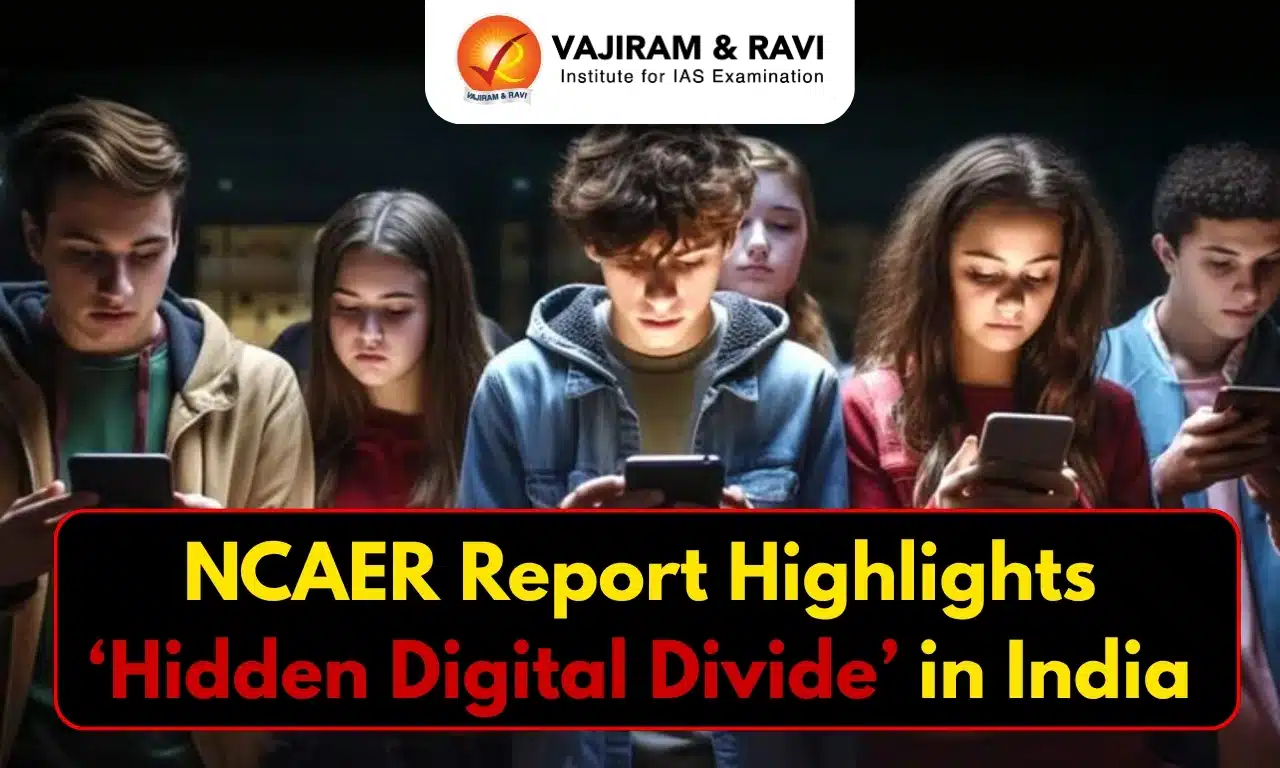
A report titled “The Evolving Landscape of Digital Inclusion in India” released by the National Council of Applied Economic Research (NCAER), in collaboration with The Quantum Hub and Women in Digital Economy Network highlighted that India’s digital transformation has entered a new phase where the primary challenge is no longer basic connectivity but the quality, depth, and equality of digital usage. It describes this emerging situation as a “hidden digital divide”, where access to technology exists but meaningful participation remains uneven.

Meaning of Hidden Digital Divide

The “hidden digital divide” refers to a new phase of digital inequality highlighted in the NCAER report where access to digital devices and internet connectivity exists, but meaningful, independent, and productive use of digital technologies remains highly uneven across individuals and households.

  • It shifts the understanding of digital inequality from a simple question of connectivity (who has internet access) to a deeper concern of usage quality (who can effectively use digital tools for education, governance, employment, and services).
  • India has achieved high levels of mobile penetration, but digital usage is largely concentrated in entertainment, social media, and passive consumption rather than empowerment-oriented activities like online education, financial services, or e-governance.
  • It is characterised by assisted digital usage, where a significant proportion of households require help from outsiders to complete basic digital tasks, indicating lack of autonomous digital capability.
  • It also reflects structural inequalities based on income, education, gender, and geography, where disadvantaged groups remain digitally connected but not digitally empowered.
  • In the Indian context, the report shows that despite widespread access, only a small proportion of users engage with online education (16.1%) and government services (11.4%), reinforcing the existence of a usage-level divide beyond connectivity.

Thus, the hidden digital divide represents the gap between digital access and meaningful digital participation, where technology reaches households but does not necessarily translate into inclusion, opportunity, or empowerment.

Key Highlights of the NCAER Report

Based on the India Human Development Survey data, covering 47,000 households and 2.1 lakh individuals, the study suggests mobile-led inclusion had widened access but not necessarily empowerment.

  • High mobile penetration but limited meaningful digital inclusion: While 95.1% of households own a mobile device and 74.8% have access to a smartphone or internet-enabled phone, only 39.7% of individuals aged 15 and above use the internet, showing that ownership does not automatically translate into usage.
  • Very low use of internet for education and government services: Only 16.1% of connected households use the internet for online education and just 11.4% access government services online, indicating limited integration of digital tools into essential public and learning systems.
  • Internet usage is largely entertainment-driven: Around 66% use the internet to watch movies, television or news content, and 53.8% use social media, compared to much lower usage for productive purposes such as education and governance services.
  • Limited access to computers and tablets despite mobile expansion: Only 8% of households own a computer/laptop and 2.3% own a tablet, showing continued dependence on mobile phones as the primary digital device.
  • Sharp inequality in computer ownership across income groups: Computer ownership falls to 1.2% among the poorest households compared to 23.1% among the richest, reflecting strong socio-economic disparities in digital access.
  • Persistent connectivity gaps in households: Around 27.5% of households remain offline, including 32.2% in rural India and 52.1% among the poorest consumption group, showing uneven spread of internet access.
  • Emergence of a “hidden divide” in usage: One in five households requires help from someone outside to use digital services, rising to one in three among households with no formal education, indicating dependence and lack of independent digital capability.
  • Gender gap in internet usage remains significant: Internet use among working-age adults stands at 57.6% for men and 35.6% for women, showing clear gender-based inequality in digital access and usage.
  • Low internet usage among adolescents: Only 37.8% of children aged 13-16 actively use the internet, reflecting limited early exposure to digital tools.

Policy Priorities Suggested in the Report

  • Expansion of affordable broadband connectivity and public Wi-Fi infrastructure to improve access in underserved regions.
  • Improvement in availability of computers, laptops, and shared digital devices, particularly in rural and low-income households.
  • Strengthening digital literacy programmes to enhance skills and independent usage of digital platforms.
  • Targeted interventions for women, rural populations, economically weaker sections, and disadvantaged communities.

NCAER Report Highlights ‘Hidden Digital Divide’ in India FAQs

Q1: What is the “hidden digital divide” highlighted in the NCAER report?

Ans: The hidden digital divide refers to a situation where people have access to digital devices and internet connectivity, but are unable to use them independently and effectively for meaningful purposes such as education, governance, employment, and financial services.

Q2: What does the report say about mobile and internet penetration in India?

Ans: The report notes that 95.1% of households own a mobile device and 74.8% have access to a smartphone or internet-enabled phone, but only 39.7% of individuals aged 15 and above actually use the internet.

Q3: How is the internet mainly being used in India according to the report?

Ans: Internet usage is largely driven by entertainment and social media, with 66% using it for watching movies, television or news content and 53.8% using social media, while only 16.1% use it for online education and 11.4% for government services.

Q4: What major inequalities are highlighted in digital access and usage?

Ans: The report highlights significant inequalities, including only 8% of households owning a computer, 27.5% households remaining offline, a gender gap in internet use (57.6% men vs 35.6% women), and higher dependence on others for digital tasks in less educated households.

Q5: What policy measures does the report suggest to reduce the digital divide?

Ans: The report suggests expanding affordable broadband and public Wi-Fi, improving access to computers and shared devices, strengthening digital literacy and skills, and targeting women, rural households, poorer families, and disadvantaged communities.

Social Ethics, Meaning, Key Aspects, Significance, Challenges

Social Ethics

Social Ethics refers to the basic principles and values that guide how people behave and interact in society. It is about understanding what is right and wrong in our actions towards others. These ethics help maintain harmony, respect, and cooperation among individuals. In general, Social Ethics play an important role in creating a balanced and well-functioning society

About Social Ethics

  • Social Ethics is a branch of ethics that focuses on the moral aspects of society as a whole, rather than just individual behavior. It studies how groups, communities, and institutions make decisions and act in different situations.
  • It mainly deals with collective actions and shared responsibilities, meaning it looks at choices that affect a large number of people, not just personal or private matters.
  • Social Ethics is concerned with values that are created and followed by society, such as justice, fairness, equality, and respect. These values are shaped over time through the experiences of different cultures and communities.
  • In simple terms, it helps us understand what is right and wrong in social life, especially in the way people interact with each other and how systems like government, law, and institutions function.
  • It focuses on the ethical side of social structures, including policies, rules, and everyday practices that influence people’s lives.
  • Social Ethics is also a part of applied ethics, which means it does not remain theoretical. Instead, it uses moral principles to analyze real-life social problems and find practical solutions.
  • Overall, Social Ethics plays an important role in guiding society towards being more just, balanced, and responsible, by improving both collective decision-making and social behavior.

Also Read : Spiritual Values

Key Aspects of Social Ethics

  • Human Dignity: Every person deserves respect and value just for being human, no matter their background, gender, or status. Social Ethics teaches us to treat others with kindness, fairness, and understanding in all situations.
  • Justice and Fairness: Society should provide equal opportunities and fair treatment to everyone. This means reducing inequalities, avoiding discrimination, and ensuring that resources and rights are shared in a balanced way.
  • Respect for Freedom (Autonomy): Individuals should have the freedom to make their own choices and express their views. Social Ethics supports privacy, consent, and freedom of thought, as long as it does not harm others.
  • Doing Good (Beneficence): People should try to help others and contribute positively to society. It encourages actions that improve the well-being and happiness of others, rather than causing harm.
  • Social Responsibility: We are all connected, so everyone has a duty to care about society and work for its betterment. This includes participating in social causes, helping communities, and supporting sustainable development.
  • Honesty and Integrity: Being truthful, transparent, and morally upright is an important part of Social Ethics. It builds trust in relationships, whether personal or professional.
  • Equality and Non-Discrimination: Everyone should be treated equally without bias based on caste, religion, gender, or economic status. This promotes a more inclusive and peaceful society.
  • Cooperation and Mutual Respect: Social life depends on working together and respecting differences. Cooperation helps in solving problems and maintaining harmony.
  • Accountability: Individuals and institutions should be responsible for their actions. Accepting mistakes and correcting them is an important ethical practice.
  • Empathy and Sensitivity: Understanding others’ feelings and situations helps in building strong relationships and a caring society.

Also Read : Human Values

Significance of Social Ethics

  • Promotes Harmony in Society: Social Ethics helps people develop understanding, empathy, and mutual respect, which reduces conflicts and supports peaceful and harmonious living among different groups.
  • Protects Human Rights and Dignity: It ensures that every individual is treated with respect and fairness, and helps prevent issues like discrimination, exploitation, and injustice in society.
  • Builds Trust and Cooperation: When people follow ethical values like honesty and fairness, it creates trust between individuals, institutions, and communities, leading to better teamwork and cooperation.
  • Guides Right Decision-Making: Social Ethics provides a moral framework that helps individuals and groups make responsible and fair decisions, especially in complex social situations.
  • Supports Social Progress and Development: By encouraging ethical behavior and addressing social issues, it contributes to the overall growth and improvement of society, making it more inclusive and forward-moving.
  • Encourages Equality and Inclusion: Social Ethics promotes equal opportunities for all, helping to reduce social inequalities and build a more inclusive society.
  • Strengthens Social Responsibility: It reminds individuals and organizations of their duty to contribute positively to society and care about the well-being of others.
  • Reduces Social Conflicts: Ethical values help in resolving disagreements peacefully and prevent violence, injustice, and social unrest.
  • Improves Quality of Life: A society guided by ethics becomes more safe, fair, and supportive, improving the overall life experience of its people.
  • Promotes Sustainable Living: Social Ethics encourages thinking beyond self-interest and working towards the long-term welfare of society and the environment.

Challenges of Social Ethics

  • Cultural Differences and Diversity: Different societies and cultures have different ideas of what is right and wrong, which can create confusion and conflicts while applying common ethical standards.
  • Growing Materialism and Self-Interest: Increasing focus on money, success, and personal gain often leads people to ignore ethical values like honesty, fairness, and empathy.
  • Inequality and Social Injustice: Issues like poverty, discrimination, and unequal opportunities make it difficult to maintain fairness and justice in society.
  • Corruption and Lack of Accountability: Corruption in institutions and misuse of power weaken ethical systems and reduce trust in governance and social structures.
  • Rapid Technological Changes: Advancements in technology bring new ethical issues related to privacy, data misuse, artificial intelligence, and digital behavior, which are not always easy to regulate.
  • Weak Implementation of Laws and Policies: Even when ethical rules exist, they are not always properly followed or enforced, leading to a gap between theory and practice.
  • Conflict Between Individual Freedom and Social Good: Sometimes personal choices may clash with the welfare of society, making it difficult to balance freedom with responsibility.

Measures to Strengthen Social Ethics

  • Promoting Ethical Education: Values like honesty, empathy, respect, and responsibility should be taught from an early age in schools and homes. Ethical awareness helps individuals make better and more responsible decisions in life.
  • Strengthening Laws and Their Implementation: Governments should ensure strict enforcement of laws related to justice, equality, and human rights so that ethical behavior is encouraged and wrongdoing is discouraged.
  • Encouraging Role Models and Leadership: Leaders in politics, society, and organizations should act as ethical role models, as their behavior influences others and sets standards for society.
  • Promoting Transparency and Accountability: Institutions must work with openness and honesty, and individuals should be held accountable for their actions to build trust in society.
  • Reducing Social and Economic Inequality: Providing equal opportunities, education, and resources helps reduce injustice and creates a more fair and balanced society.
  • Creating Awareness Through Media and Society: Media, social platforms, and community programs should spread awareness about ethical values and responsible behavior.

Social Ethics FAQs

Q1: What is Social Ethics?

Ans: Social Ethics refers to the principles and values that guide how people behave in society. It helps individuals understand right and wrong actions and promotes harmony, fairness, and respect in social life.

Q2: Why are Social Ethics important in society?

Ans: Social Ethics are important because they help maintain peace, justice, and cooperation. They also protect human rights, reduce conflicts, and support the overall development of a balanced society.

Q3: What are the key aspects of Social Ethics?

Ans: Key aspects include human dignity, justice, equality, freedom, honesty, responsibility, and empathy. These values guide individuals and institutions to act in a fair and ethical manner.

Q4: What are the main challenges of Social Ethics?

Ans: Major challenges include inequality, corruption, materialism, cultural differences, and weak law enforcement. Rapid technological changes also create new ethical issues in modern society.

Q5: How does Social Ethics promote social harmony?

Ans: Social Ethics promotes harmony by encouraging respect, understanding, and cooperation among people. It helps reduce conflicts and supports peaceful coexistence in diverse societies.

Zoological Survey of India (ZSI), Headquarter, Established

Zoological Survey of India

The Zoological Survey of India (ZSI) is India’s premier zoological research and animal taxonomy institution. It was established in 1916 and is headquartered in Kolkata. It conducts surveys, exploration, documentation and scientific research on the country’s faunal diversity. It is recognized as the repository of the National Zoological Collection under the National Biodiversity Act 2002. ZSI plays a central role in discovering, classifying, conserving and monitoring India's rich animal wealth spread across ecosystems, protected areas and biodiversity hotspots.

Zoological Survey of India Objectives

The Zoological Survey of India works to document, conserve and scientifically study India's diverse animal resources across ecosystems.

  • Exploration and Faunal Surveys: Conducts systematic exploration, survey, inventory and monitoring of animal diversity across states, ecosystems, forests, wetlands, marine regions and protected areas to improve knowledge of India's fauna.
  • Taxonomic Research: Identifies, names, describes and classifies vertebrate and invertebrate species through taxonomic and systematic studies, strengthening scientific understanding of Indian animal biodiversity.
  • National Zoological Collection: Maintains and develops the National Zoological Collection, which serves as a reference repository for scientific research, species identification and biodiversity documentation.
  • Threatened Species Assessment: Periodically reviews the conservation status of threatened, endemic and rare species and provides scientific inputs for wildlife protection and management measures.
  • Biodiversity Database Development: Creates and maintains the “Fauna of India Database” and undertakes digitization of zoological collections to improve accessibility and long term preservation of biological records.
  • Advanced Research and Capacity Building: Promotes genomic studies, DNA barcoding, wildlife forensics, animal taxonomy training, conservation education and capacity building programmes for researchers and institutions.

Zoological Survey of India History

The Zoological Survey of India evolved from a museum based zoological unit into India's leading institution for faunal research.

  • Origin: The foundation of Zoological Survey of India lies in the establishment of the Zoological Section of the Indian Museum at Calcutta in 1875, which began systematic collection and study of animal specimens.
  • Establishment: Zoological Survey of India was officially established on 1 July 1916 to promote surveys, exploration and zoological research across the then British Indian Empire and expand scientific knowledge of animal life.
  • Infrastructure: Through continuous expansion of staff, regional centres and research programmes, ZSI strengthened its capability to study India's vast and diverse fauna.
  • Role in Mega Diverse India: India is among the world's 17 mega diverse countries and contains four biodiversity hotspots: Western Ghats/Sri Lanka, Indo-Burma, Himalayas and Sundaland, making ZSI's role especially significant.
  • Biodiversity Documentation: Of the approximately 1.7 million described species worldwide, India has recorded 1,00,693 animal species, while many more remain undiscovered, particularly among lower invertebrates.
  • Responsibilities: Following the Convention on Biological Diversity, ZSI expanded its work in species identification, conservation planning, biodiversity assessment, scientific collaboration and sustainable use of biological resources.

Zoological Survey of India Functions

Zoological Survey of India performs scientific, conservation and advisory functions to support biodiversity research and wildlife management in India.

  • Species Survey and Documentation: Conducts nationwide surveys to document species diversity, distribution, abundance and ecological characteristics across terrestrial, freshwater and marine ecosystems.
  • Conservation Support: Provides scientific information for in situ conservation, helping protect species and habitats both within and outside protected areas through evidence based management recommendations.
  • Environmental Impact Assessment: Undertakes Environmental Impact Assessment studies with special emphasis on ecology, wildlife and biodiversity conservation for development planning.
  • Sustainable Biodiversity Use: Monitors commercially important species, advises on permissible utilization limits and provides early warnings regarding declining wildlife populations to ensure sustainable use.
  • GIS and Climate Research: Uses GIS, remote sensing and other modern tools for biodiversity mapping, threatened species studies and monitoring climate change impacts on faunal diversity.
  • Advisory and Collaborative Services: Supports CITES implementation, wildlife forensic identification, EIACP activities and collaborative biodiversity research with national and international organizations.

Zoological Survey of India Publications

Zoological Survey of India publishes authoritative scientific literature that serves as an important reference for biodiversity research and conservation.

  • Fauna of India Series: The flagship publication documents taxonomy, distribution and biological information of Indian animal groups and remains a major scientific reference source.
  • Fauna of States and Conservation Areas: These publications provide region specific faunal inventories and biodiversity records for states, national parks, wildlife sanctuaries and conservation landscapes.
  • Red Data Book on Indian Animals: First published in 1983 and updated periodically, it records threatened and endangered animal species along with their distribution, habitat and conservation status.
  • Animal Discoveries Reports: Annual reports such as Animal Discoveries 2023 document newly discovered species and new records reported from different regions of India.
  • Faunal Survey A Methodology: Provides scientific methods and guidelines for conducting faunal surveys, biodiversity assessments and zoological field investigations.

Zoological Survey of India Recent Developments

Recent discoveries and scientific achievements highlight Zoological Survey of India's growing contribution to biodiversity documentation and conservation science.

  • New Lichen Moths Discovery 2026: Zoological Survey of India scientists discovered two new lichen moth species, Caulocerahollowayi and Asura buxa, from Sikkim and West Bengal, along with seven new species records from the Indian Himalaya. Published in Zootaxa in March 2026, these moths are important indicators of air pollution because their caterpillars depend on lichens for survival.
  • Animal Discoveries 2023 Report: Indian scientists reported 641 discoveries, including 442 new species, 199 new records and 19 new genera, raising India's recorded faunal diversity to 104,561 species.
  • Species Discoveries (2020): ZSI researchers identified Amolops siju frog from Meghalaya's Siju Cave, Exostoma dhritiae catfish from Arunachal Pradesh and two new marine moray eel species from Indian waters.
  • Conservation and Forensic Innovations (July 2020): ZSI developed the Pangolin Indexing System using DNA markers to track illegal pangolin trade and assist wildlife law enforcement agencies.

Zoological Survey of India FAQs

Q1: When was the Zoological Survey of India established?

Ans: The Zoological Survey of India (ZSI) was established on 1 July 1916.

Q2: Where is the headquarters of the Zoological Survey of India located?

Ans: The headquarters of Zoological Survey of India is located in Kolkata, West Bengal.

Q3: What is the main objective of the Zoological Survey of India?

Ans: Its main objective is to survey, document, classify and conserve India's faunal diversity.

Q4: What is the National Zoological Collection?

Ans: It is India's official repository of animal specimens maintained and developed by Zoological Survey of India for research and identification purposes.

Q5: Which ministry administers the Zoological Survey of India?

Ans: Zoological Survey of India functions under the Ministry of Environment, Forest and Climate Change, Government of India.

UPSC Daily Quiz 10 June 2026

UPSC Daily Quiz

[WpProQuiz 182]

UPSC Daily Quiz FAQs

Q1: What is the Daily UPSC Quiz?

Ans: The Daily UPSC Quiz is a set of practice questions based on current affairs, static subjects, and PYQs that help aspirants enhance retention and test conceptual clarity regularly.

Q2: How is the Daily Quiz useful for UPSC preparation?

Ans: Daily quizzes support learning, help in revision, improve time management, and boost accuracy for both UPSC Prelims and Mains through consistent practice.

Q3: Are the quiz questions based on the UPSC syllabus?

Ans: Yes, all questions are aligned with the UPSC Syllabus 2025, covering key areas like Polity, Economy, Environment, History, Geography, and Current Affairs.

Q4: Are solutions and explanations provided with the quiz?

Ans: Yes, each quiz includes detailed explanations and source references to enhance conceptual understanding and enable self-assessment.

Q5: Is the Daily UPSC Quiz suitable for both Prelims and Mains?

Ans: Primarily focused on Prelims (MCQ format), but it also indirectly helps in Mains by strengthening subject knowledge and factual clarity.

Constitutional Values, Meaning, Source, Application in Public Administration

Constitutional Values

The Constitution of India is not only a legal document but also a moral guide for governance and public life. It reflects the values that India wants its institutions, leaders, civil servants, and citizens to follow. Dr. B.R. Ambedkar believed that democracy can survive only when constitutional values become part of everyday behaviour and decision-making.

For a civil servant, constitutional values act as an ethical compass. They help in choosing what is right over what is convenient, public interest over personal interest, and justice over pressure or prejudice.

Constitutional values such as justice, liberty, equality, fraternity, secularism, rule of law, democracy, etc provide the foundation of ethical governance and good administration.

Constitutional Values Sources and Foundations

Constitutional values emerge from multiple constitutional sources:

Constitutional Values Meaning and Application in Public Administration 

Constitutional Value of Justice

Justice is the constitutional commitment to ensuring fairness, dignity, and equal opportunities for all citizens. It seeks to establish a social order where no individual suffers discrimination, exploitation, or exclusion due to social or economic disadvantages.

  • Purpose : The purpose of justice is to reduce inequalities, protect the rights of vulnerable groups, promote inclusive development, and ensure that every citizen can participate meaningfully in society and governance.
  • Ethical Significance : Justice represents the ethical values of fairness, equity, compassion, inclusiveness, and responsibility towards the vulnerable. It reminds public institutions that governance should not merely follow rules but also promote human dignity and social welfare. Justice strengthens public trust by ensuring that decisions are guided by fairness rather than privilege, prejudice, or power.

Application of Justice in Public Administration : 

  • Ensuring impartial and non-discriminatory delivery of public services and welfare schemes.
  • Prioritising the needs of vulnerable and marginalised groups in policy implementation.
  • Providing fair rehabilitation and compensation to people affected by development projects.
  • Ensuring accessible grievance redressal and timely justice to citizens.
  • Allocating public resources equitably to reduce regional and social disparities.
  • Exercising administrative discretion with fairness, empathy, and objectivity.
  • Protecting citizens’ rights and dignity while enforcing laws and regulations.

Example: The Aspirational Districts Programme promotes constitutional justice by focusing administrative efforts and resources on India’s most underdeveloped districts to ensure inclusive and equitable development.

Constitutional Value of Liberty

Liberty refers to the freedom of individuals to think, express, believe, act, and pursue their aspirations without arbitrary interference. The Constitution guarantees liberty of thought, expression, belief, faith, and worship, recognising that every individual possesses inherent dignity and autonomy.

  • Purpose : The purpose of liberty is to enable individuals to develop their personality, exercise informed choices, express their views freely, and live with dignity. It seeks to protect citizens from arbitrary state action while fostering creativity, participation, and personal growth.
  • Ethical Significance : Liberty embodies the ethical values of autonomy, dignity, tolerance, respect for individual choice, and human freedom. It recognises that individuals are moral agents capable of making decisions about their own lives. Liberty also encourages open dialogue, critical thinking, and responsible citizenship, which are essential for a healthy democracy.

Application in Public Administration : 

  • Respecting citizens’ rights to freedom of expression, belief, and peaceful dissent.
  • Ensuring that administrative actions follow due process and do not arbitrarily restrict individual freedoms.
  • Protecting privacy and personal dignity while delivering public services.
  • Balancing public order and security concerns with constitutional freedoms.
  • Creating an environment where citizens can participate freely in governance and decision-making.
  • Safeguarding whistleblowers, journalists, and individuals who raise legitimate concerns in the public interest.
  • Avoiding misuse of authority that may lead to arbitrary detention, harassment, or suppression of lawful activities.
  • Ensuring that restrictions on freedoms are reasonable, lawful, and proportionate.

Example : The recognition of the Right to Privacy as a Fundamental Right by the Supreme Court in the K.S. Puttaswamy (2017) judgment reinforced the constitutional value of liberty by protecting individual autonomy and dignity in the digital age.

Constitutional Value of Equality

Equality refers to the constitutional commitment that every individual is entitled to equal respect, equal protection of law, and equal opportunities irrespective of caste, religion, gender, language, region, or economic status. It seeks to create a society where opportunities are determined by merit and capability rather than birth or privilege.

  • Purpose : The purpose of equality is to eliminate discrimination, reduce social and economic inequalities, promote equal opportunities, and ensure that every citizen can participate fully in social, economic, and political life. It also seeks to empower historically disadvantaged groups through affirmative measures.
  • Ethical Significance : Equality embodies the ethical values of fairness, impartiality, inclusiveness, respect for human dignity, and social justice. It recognises that every individual possesses equal moral worth and deserves to be treated with respect and fairness. Equality strengthens social cohesion by reducing exclusion and fostering a sense of belonging.

Application in Public Administration : 

  • Ensuring non-discriminatory delivery of public services irrespective of caste, religion, gender, language, or socio-economic background.
  • Providing equal access to education, healthcare, welfare schemes, and public opportunities.
  • Implementing affirmative action policies to support historically disadvantaged communities.
  • Making recruitment, promotions, and administrative decisions based on merit, fairness, and prescribed criteria.
  • Preventing bias, favouritism, and prejudice in decision-making and service delivery.
  • Ensuring equal protection of law and due process for all citizens.
  • Addressing regional and social disparities through inclusive and targeted development initiatives.
  • Creating accessible and inclusive public institutions for women, persons with disabilities, and other vulnerable groups.

Example : The Nari Shakti Vandan Adhiniyam (Women’s Reservation Act) advances the constitutional value of equality by enhancing women’s representation in legislative bodies and promoting their participation in decision-making processes.

Constitutional Value of Fraternity

Fraternity refers to the spirit of brotherhood, mutual respect, and solidarity among citizens. It promotes a sense of common belonging that transcends differences of caste, religion, language, region, gender, and social status. The Constitution views fraternity as essential for assuring the dignity of the individual and the unity and integrity of the nation.

  • Purpose : The purpose of fraternity is to foster social harmony, strengthen national integration, reduce divisions and prejudices, and create a society where every individual feels respected, valued, and included. It seeks to build emotional unity among citizens in a diverse society like India.
  • Ethical Significance : Fraternity embodies the ethical values of empathy, compassion, tolerance, mutual respect, inclusiveness, and human dignity. It encourages individuals to look beyond narrow identities and recognise the equal worth of every human being. Fraternity humanises governance by reminding public officials that citizens are not merely beneficiaries or statistics but individuals deserving dignity and respect.

Application in Public Administration : 

  • Treating every citizen with dignity, courtesy, and respect during public service delivery.
  • Promoting inclusive policies that ensure no community or group feels excluded from development.
  • Encouraging community participation and collaborative problem-solving in governance.
  • Maintaining social harmony and preventing discrimination based on caste, religion, language, or region.
  • Adopting a citizen-centric and compassionate approach while dealing with vulnerable sections of society.
  • Ensuring relief, rehabilitation, and welfare measures are implemented fairly and sensitively during crises and disasters.
  • Building trust between government institutions and citizens through responsive and humane administration.
  • Promoting national integration while respecting cultural and social diversity.

Fraternity transforms governance from a system of authority into a system of care, where citizens are treated not merely as subjects of administration but as fellow members of a shared constitutional community.

Example : Mission Sankalp in Tripura, which rescued children from child marriages through coordinated efforts of schools, communities, and district administration, reflected the value of fraternity by protecting vulnerable children and ensuring their dignity, safety, and future opportunities.

Constitutional Value of Secularism

Secularism refers to the constitutional principle that the State treats all religions equally and does not favour or discriminate against any faith. It ensures freedom of religion while maintaining the neutrality of public institutions. In the Indian context, secularism means equal respect for all religions (Sarva Dharma Sambhava) rather than strict separation of religion and State.

  • Purpose : The purpose of secularism is to protect religious freedom, promote peaceful coexistence among diverse communities, prevent religious discrimination, and strengthen national unity in a pluralistic society.
  • Ethical Significance : Secularism embodies the ethical values of tolerance, impartiality, inclusiveness, respect for diversity, and social harmony. It recognises that every individual has the freedom to follow their beliefs while ensuring that public institutions remain fair and unbiased. Secularism strengthens mutual trust and fosters a culture of peaceful coexistence in a diverse society.

Application in Public Administration : 

Secularism in public administration means that a civil servant’s actions must be guided by constitutional principles and public interest, not by personal religious beliefs or community affiliations.

  • Ensuring equal treatment of citizens irrespective of their religion or faith.
  • Delivering public services, welfare benefits, and government schemes without religious bias or discrimination.
  • Maintaining neutrality and fairness while handling communal tensions and law-and-order situations.
  • Protecting the religious freedoms and rights of all communities in accordance with constitutional provisions.
  • Preventing the misuse of public office or state resources for promoting any particular religion.
  • Encouraging interfaith dialogue, social harmony, and community participation in governance.
  • Ensuring fair and impartial law enforcement during religious conflicts and sensitive situations.
  • Promoting an inclusive administrative culture that respects India’s religious and cultural diversity.

Example : The administration’s role in ensuring peaceful conduct of major religious festivals such as Kumbh Mela, Eid, Christmas, and Gurpurab through equal security arrangements, public services, and coordination reflects the constitutional value of secularism in practice.

Constitutional Value of Democracy

Democracy is the constitutional principle that ultimate authority rests with the people and that governance must be carried out with their consent, participation, and accountability. It is not limited to periodic elections but encompasses a broader culture of freedom, participation, transparency, and respect for citizens’ rights.

  • Purpose : The purpose of democracy is to empower citizens, ensure accountable governance, protect individual rights, encourage public participation in decision-making, and promote inclusive development through responsive institutions.
  • Ethical Significance : Democracy embodies the ethical values of participation, accountability, transparency, responsiveness, respect for human dignity, and public trust. It recognises citizens as active stakeholders in governance rather than passive recipients of government benefits. Democracy promotes ethical governance by making public authorities answerable to the people they serve.

Application in Public Administration : 

Democracy in administration means recognising that public power is a trust delegated by citizens and must therefore be exercised with accountability, transparency, and respect for people’s voices.

  • Encouraging citizen participation in policy formulation, implementation, and monitoring of public programmes.
  • Ensuring transparency in decision-making and public access to information.
  • Remaining accountable and responsive to citizen grievances and public concerns.
  • Strengthening local self-governance through Panchayati Raj Institutions and Urban Local Bodies.
  • Conducting public consultations and stakeholder engagement before major policy decisions.
  • Promoting social audits, public hearings, and community-based monitoring mechanisms.
  • Respecting citizens’ rights to information, expression, and peaceful participation in democratic processes.
  • Delivering public services in a citizen-centric manner that builds trust and confidence in institutions.

Example : The Right to Information (RTI) Act, 2005 strengthens democratic governance by empowering citizens to seek information from public authorities, thereby enhancing transparency, accountability, and public participation.

Constitutional Value of Rule of Law

Rule of Law means that all individuals and institutions, including the government, are subject to the law and must act within its limits. It ensures that power is exercised according to established legal procedures rather than arbitrary will, personal discretion, or political influence.

  • Purpose : The purpose of the Rule of Law is to prevent arbitrary exercise of power, protect citizens’ rights and liberties, ensure equality before law, and promote fairness, predictability, and accountability in governance.
  • Ethical Significance : Rule of Law embodies the ethical values of integrity, accountability, fairness, objectivity, and respect for justice. It ensures that public power is exercised responsibly and that no individual is above the law. By replacing arbitrariness with due process, it strengthens public trust in institutions and upholds human dignity.

Application in Public Administration : 

Rule of Law means that public officials are governed by law, not by personal preferences, political pressure, or administrative convenience.

  • Ensuring that all administrative actions are taken strictly within the framework of law and constitutional provisions.
  • Following due process and principles of natural justice while making decisions that affect citizens’ rights and interests.
  • Resisting unlawful orders, political pressure, and arbitrary exercise of authority.
  • Applying laws and regulations uniformly without favouritism, discrimination, or bias.
  • Protecting citizens from abuse of power through transparent and accountable decision-making.
  • Ensuring fair investigation, enforcement, and grievance redressal mechanisms.
  • Respecting judicial decisions and implementing court orders in letter and spirit.
  • Maintaining proper records, transparency, and procedural fairness in administrative functioning.

Example : The Supreme Court’s 2024 judgment against arbitrary bulldozer demolitions reaffirmed that punitive action cannot be taken without due process, notice, and an opportunity to be heard, thereby upholding the constitutional value of Rule of Law.

2nd ARC Recommendations on Constitutional Values

The 2nd ARC viewed constitutional values not merely as constitutional ideals but as the ethical foundation of governance, capable of transforming administration from rule-based functioning to value-based public service.

The Second Administrative Reforms Commission’s 4th Report on Ethics in Governance made several critical recommendations:

  • Public servants should internalise constitutional values such as justice, equality, liberty, integrity, and human dignity as personal ethical commitments rather than viewing them merely as legal obligations.
  • Civil service training institutions, including LBSNAA and State Administrative Training Institutes, should integrate constitutional philosophy, ethical reasoning, and public service values into administrative training.
  • Codes of Ethics and Codes of Conduct for public servants should be firmly anchored in constitutional values and Fundamental Rights to ensure citizen-centric governance.
  • Officers who uphold constitutional principles and act with integrity against unethical political or administrative pressures should receive adequate institutional support and protection.
  • Administrative decision-making should be guided by constitutional morality, ensuring that public interest, rule of law, and human dignity prevail over partisan considerations.
  • Citizens should be empowered as rights-bearing stakeholders rather than passive beneficiaries, while public institutions should adopt a service-oriented and accountability-driven approach.
  • Public administration should promote transparency, accountability, and responsiveness to strengthen citizens’ trust in democratic institutions.
  • Ethical leadership should be encouraged at all levels of governance so that constitutional values are reflected not only in laws and policies but also in administrative behaviour and organisational culture.

Ethical Significance of Constitutional Values in Administration

Constitutional values provide the ethical foundation of public administration by guiding civil servants to exercise authority in a manner that is fair, accountable, citizen-centric, and consistent with the ideals of the Constitution.

  • Promote integrity in public service by ensuring that decisions are guided by constitutional principles and public interest rather than personal gain, political pressure, or sectional interests.
  • Strengthen impartiality and objectivity by requiring public officials to treat all citizens fairly, without discrimination based on caste, religion, gender, language, region, or socio-economic status.
  • Enhance accountability and transparency by reminding public servants that public power is a trust that must be exercised responsibly and openly.
  • Protect human dignity by ensuring that citizens are treated with respect, compassion, and sensitivity while delivering public services.
  • Promote social justice and inclusiveness by encouraging special attention towards vulnerable, marginalised, and disadvantaged sections of society.
  • Guide ethical decision-making during dilemmas by providing a moral framework for balancing competing interests, rights, and administrative priorities.
  • Strengthen public trust in institutions by ensuring that governance is perceived as fair, lawful, responsive, and citizen-centric.
  • Encourage moral courage and constitutional morality by empowering officials to uphold constitutional principles even in the face of political, social, or institutional pressure.
  • Promote democratic governance by fostering citizen participation, responsiveness, and respect for individual rights and freedoms.
  • Ensure adherence to the rule of law by preventing arbitrary exercise of power and reinforcing due process, fairness, and justice.
  • Foster social harmony and national integration by promoting tolerance, fraternity, secularism, and respect for diversity in a pluralistic society.
  • Transform administration into public service by shifting the focus from mere rule enforcement to the pursuit of public welfare, human development, and constitutional goals.

Challenges in Realising Constitutional Values

Despite their importance, constitutional values continue to face significant challenges.

  • Political interference often places administrators in situations where constitutional obligations conflict with immediate political expectations.
  • Social prejudices related to caste, religion, gender, and class may unconsciously influence administrative decision-making.
  • Corruption undermines justice, equality, accountability, and public trust.
  • Excessive bureaucratic formalism sometimes prioritises procedure over empathy and human dignity.
  • Growing social polarisation can weaken fraternity and constitutional morality.
  • Limited constitutional awareness among citizens often reduces the effectiveness of accountability mechanisms.

Means of Inculcating Constitutional Values

Addressing these challenges requires more than legal safeguards and institutional reforms. Constitutional values must be consciously nurtured through education, ethical leadership, citizen engagement, and value-based governance so that they become an integral part of both administrative culture and public life.

  • Value-based education should promote constitutional ideals such as justice, equality, liberty, fraternity, secularism, and respect for diversity from an early age.
  • Constitutional literacy campaigns should increase public awareness about constitutional rights, duties, and democratic values.
  • Ethics and constitutional training for civil servants should integrate constitutional philosophy with practical governance and decision-making.
  • Leading by example through ethical conduct of political leaders, judges, civil servants, and public institutions can inspire citizens to uphold constitutional values.
  • Citizen-centric governance can help people experience constitutional values through fair, transparent, and inclusive public service delivery.
  • Promotion of democratic participation through Gram Sabhas, social audits, public consultations, and local self-governance strengthens constitutional culture.
  • Strengthening institutions such as the judiciary, Election Commission, CAG, Human Rights Commissions, and vigilance bodies helps safeguard constitutional principles.
  • Effective implementation of Fundamental Duties can encourage citizens to promote harmony, scientific temper, and respect for constitutional ideals.
  • Media and digital platforms can be used to spread awareness about constitutional values, rights, responsibilities, and ethical citizenship.
  • Community engagement and social interaction among diverse groups can foster tolerance, fraternity, and respect for diversity.
  • Recognition and protection of ethical conduct can encourage public officials who demonstrate integrity, constitutional morality, and moral courage.
  • Incorporating constitutional values into organisational culture through codes of ethics, service rules, and performance evaluation can institutionalise value-based governance.

Constitutional Values FAQs

Q1: What are constitutional values?

Ans: Constitutional values are the core ethical principles embedded in the Indian Constitution such as justice, liberty, equality, fraternity, secularism, democracy, and rule of law that guide governance, public administration, and citizen behaviour.

Q2: What is the difference between legal values and constitutional values?

Ans: Legal values focus on compliance with laws and procedures, whereas constitutional values go beyond legality and emphasise fairness, justice, human dignity, and ethical governance; thus, something may be legal but still not align with constitutional morality.

Q3: Why are constitutional values important for civil servants?

Ans: They act as an ethical compass for civil servants by guiding fair, impartial, and accountable decision-making, ensuring that public power is exercised in the interest of justice, human dignity, and citizen welfare rather than personal or political interests.

Q4: How do constitutional values improve governance?

Ans: They improve governance by promoting transparency, accountability, inclusiveness, and rule-based administration, which strengthens public trust, ensures equitable service delivery, and supports citizen-centric decision-making.

Q5: How can constitutional values be inculcated in society?

Ans: They can be inculcated through value-based education, constitutional literacy, ethical leadership, citizen participation, strong institutions, and consistent practice of constitutional principles in everyday governance and public behaviour.

Spiritual Values, Meaning, Core Values, Principles, Significance

Spiritual Values

Spiritual Values are the basic inner beliefs and ideas that influence how a person thinks, feels, and lives their life. They are related to understanding oneself and looking beyond only material aspects of life. These values encourage a sense of balance, purpose, and awareness. In general, they help individuals live in a more thoughtful and meaningful way

About Spiritual Values

  • Spiritual Values are the inner beliefs and qualities that guide a person towards a meaningful and peaceful life.
  • They are connected with our inner self and our relationship with something higher or greater, such as nature, the universe, or a higher power.
  • These values go beyond material success and focus on inner happiness, purpose, and self-realisation.
  • They help a person understand life deeply and develop a sense of unity with others and the world.
  • Core Spiritual Values
    • Compassion: Feeling deep concern for others’ suffering and taking action to help them with kindness.
    • Purity: Maintaining clean thoughts, positive intentions, and sincerity in actions.
    • Detachment: Staying emotionally balanced and not getting too attached to success, failure, or material things.
    • Peace: Keeping a state of inner calm and stability, even in difficult or stressful situations.
    • Truth: Being honest and genuine in thoughts, words, and actions.
    • Goodness: Choosing what is right, moral, and beneficial for oneself and others.
    • Beauty: Appreciating harmony, goodness, and positivity in life and surroundings.
  • Key Principles of Spiritual Living
    • Love & Kindness: Treating everyone with care, respect, and empathy without expecting rewards.
    • Integrity & Honesty: Following strong moral principles and doing the right thing even when no one is watching.
    • Gratitude: Being thankful for life, people, and opportunities instead of constantly focusing on what is lacking.
    • Inner Peace & Patience: Staying calm, composed, and patient during challenges or delays.
    • Humility: Being simple, grounded, and respectful, without ego or pride.
    • Self-awareness: Understanding your own thoughts, emotions, strengths, and weaknesses.
    • Forgiveness: Letting go of anger and resentment to maintain mental peace.
    • Contentment: Feeling satisfied with what you have while still striving for growth in a balanced way.
  • Importance of Spiritual Values
    • They help in achieving self-realisation and personal growth.
    • They improve relationships by promoting empathy and understanding.
    • They bring mental peace, emotional stability, and clarity of mind.
    • They guide individuals towards a purposeful and meaningful life beyond material achievements.

Also Read : Human Values

Spiritual Values FAQs

Q1: What are Spiritual Values?

Ans: Spiritual Values are inner beliefs and principles that guide a person towards a meaningful, peaceful, and balanced life, focusing on qualities like compassion, honesty, and self-awareness.

Q2: Why are Spiritual Values important in life?

Ans: Spiritual Values help in achieving inner peace, emotional stability, and personal growth, while also improving relationships and giving life a deeper purpose.

Q3: What are the core Spiritual Values?

Ans: Core Spiritual Values include compassion, purity, detachment, peace, truth, goodness, and appreciation of beauty, which guide ethical and positive living.

Q4: How do Spiritual Values differ from material values?

Ans: Spiritual Values focus on inner happiness, self-realisation, and purpose, while material values emphasize wealth, success, and external achievements.

Q5: How can one develop Spiritual Values in daily life?

Ans: Spiritual Values can be developed through self-awareness, practicing kindness, gratitude, honesty, patience, and maintaining inner calm in everyday situations.

Indian Wild Ass, Features, Ghudkhar Wildlife Sanctuary

Indian Wild Ass

Indian Wild Ass are popularly known as the Khur or Ghudkhar in Gujarat. It is a unique subspecies of the Asiatic Wild Ass and the last surviving wild equid of India. Once distributed across northwestern India, present day Pakistan and parts of Central Asia, it is now largely confined to the Little Rann of Kutch in Gujarat. This hardy animal survives in harsh desert and grassland ecosystems and plays an important ecological role through seed dispersal and habitat maintenance. Continuous conservation efforts have helped its population recover significantly over recent decades.

Indian Wild Ass Features

The Indian Wild Ass is specially adapted to survive in arid landscapes and extreme climatic conditions.

  • Identity: The Indian Wild Ass (Equus hemionus khur) is a subspecies of the Asiatic Wild Ass or Onager. It belongs to the family Equidae and is an odd toed ungulate closely related to horses and zebras.
  • Local Names: In Gujarat, the species is widely known as khur, ghudkhar, or ghorkhad. These names are commonly used by local communities living around the Little Rann of Kutch.
  • Physical Appearance: It has a sandy coloured coat ranging from reddish grey fawn to pale chestnut. Distinctive white patches occur on the shoulder and rump, while a dark stripe bordered by white runs along the back.
  • Body Structure: The animal possesses an erect dark mane extending from the head along the neck. Its strong limbs and muscular body help it move efficiently across salt marshes, grasslands and desert terrain.
  • Habitat: The species survives in harsh desert and grassland ecosystems where temperatures are extreme and water availability is limited. Its adaptability allows it to thrive in the challenging environment of the Rann.
  • Distribution Range: Historically, the khur inhabited northwestern India, Pakistan and parts of Central Asia. Today, its main natural range is restricted to the Little Rann of Kutch, with some populations extending into nearby districts.
  • Feeding Behaviour: It is a generalist herbivore that feeds mainly on grasses growing on desert islands called bets. During dry periods, it consumes Prosopis leaves, pods and other available vegetation.
  • Social Behaviour: Indian Wild Asses are generally shy animals occurring at low densities. They often move in herds led by stallions and migrate between grassy patches in search of food and water.
  • Speed: The species is known for remarkable speed and stamina, capable of running at around 70 km per hour, helping it escape predators and travel long distances.
  • Ecological Importance: By dispersing seeds through grazing activities, the species supports vegetation growth. It also creates pathways in dense grasslands, improving habitat accessibility for several other wildlife species.

What are the Threats to Indian Wild Ass?

Human activities and environmental pressures continue to affect the long term survival of the Indian Wild Ass.

  • Expansion of Human Activities: Increasing salt farming, agricultural expansion and settlement growth around the Little Rann of Kutch are reducing habitat quality and disturbing wildlife movement patterns.
  • Excessive Livestock Grazing: Uncontrolled grazing by domestic cattle and Maldhari livestock creates competition for food resources and puts additional pressure on the fragile desert ecosystem.
  • Illegal Salt Panning: Large scale unauthorized salt extraction activities inside and around the sanctuary alter habitat conditions and disturb breeding and feeding areas used by wild asses.
  • Habitat Degradation by Invasive Plants: The spread of invasive shrubs changes natural grassland composition, reducing the availability of preferred forage and affecting the nutritional requirements of the species.
  • Soil Salinity Increase: Irrigation canals reaching the southern edge of the Little Rann can increase soil salinity, affecting vegetation growth and reducing the productivity of grazing habitats.
  • Disease Outbreaks: During the late 1950s, the fly borne disease Surra severely impacted populations. By 1961, the number of Indian Wild Asses had fallen drastically to around 870 individuals.

Also Read: Species in News 2026

Indian Wild Ass Conservation

Conservation measures have played a major role in the recovery of this species from near extinction.

  • Conservation Status: The Indian Wild Ass is listed as Near Threatened by the IUCN, included in Appendix II of CITES and receives the highest legal protection under Schedule I of the Wildlife Protection Act 1972.
  • Flagship Species: The Indian Wild Ass serves as a flagship species of the Little Rann of Kutch, helping conserve the broader biodiversity and ecological integrity of the region.
  • Conservation Measures:
    • Forest authorities have created additional water holes in drought prone areas to ensure a reliable water supply during harsh summer months.
    • Expansion of fodder plots and habitat improvement initiatives has increased food availability and supported population growth within protected landscapes.
    • Modern conservation surveys increasingly use drones, camera traps and scientific population estimation methods to improve monitoring and management effectiveness.
    • The Thar Desert of Rajasthan has been identified by the Gujarat government and the Gujarat Ecological Education and Research Foundation (GEER) as a potential reintroduction site.

Indian Wild Ass Population

Recent surveys indicate a strong recovery trend in the Indian Wild Ass species over the last several decades.

  • Following disease outbreaks and habitat pressures, the population declined to around 870 individuals in 1961, making conservation intervention critically important.
  • Population estimates increased from 4,038 in 2009 to 4,451 in 2014 and the 2020 census recorded 6,082 Indian Wild Asses, representing an increase of about 34% compared with the 2014 estimate.
  • According to the 10th Wild Ass Population Estimation (2024), the population reached 7,672 individuals, showing a 26.14% rise from the 2020 count.
  • The highest numbers were recorded in Surendranagar (2,705), followed by Kutch (1,993), Patan (1,615), Banaskantha (710), Morbi (642) and Ahmedabad (7).
  • Forest area estimates reported 2,569 females, 1,114 males, 584 young individuals and 2,206 unclassified wild asses, indicating a healthy breeding population.

Indian Wild Ass Sanctuary

The Indian Wild Ass Sanctuary (Ghudkhar Wildlife Sanctuary) forms the core refuge of this species and remains vital for its survival.

  • Location: The sanctuary is situated in the Little Rann of Kutch, Gujarat, covering approximately 4,954 square kilometres of protected landscape.
  • Establishment: It was established in 1972 under the Wildlife Protection Act 1972, specifically to safeguard the remaining population of Indian Wild Asses.
  • Ecosystem: The Little Rann of Kutch displays dual ecological characteristics of a wetland and desert, creating a rare habitat mosaic supporting diverse wildlife.
  • Significance: It represents the world's last major natural refuge of the Indian Wild Ass, making it one of the most important conservation landscapes for wild equids.

Indian Wild Ass FAQs

Q1: What is the Indian Wild Ass?

Ans: The Indian Wild Ass (Equus hemionus khur) is a subspecies of the Asiatic Wild Ass found mainly in Gujarat's Little Rann of Kutch.

Q2: What is the conservation status of the Indian Wild Ass?

Ans: The species is listed as Near Threatened by the IUCN, included in CITES Appendix II and protected under Schedule I of the Wildlife Protection Act, 1972.

Q3: Where is the Indian Wild Ass found in India?

Ans: It is primarily found in the Little Rann of Kutch and surrounding areas of Gujarat, which contain the world's last major population of this species.

Q4: What does the Indian Wild Ass eat?

Ans: It mainly feeds on grasses but also consumes Prosopis leaves, pods and other vegetation during dry seasons when grass availability declines.

Q5: What was the Indian Wild Ass population in 2024?

Ans: According to the 10th Wild Ass Population Estimation (2024), the population reached 7,672 individuals, showing a 26.14% increase from 2020.

Mission Indradhanush Yojana, Launched Date, Objective, Challenges

Mission Indradhanush Yojana

Mission Indradhanush Yojana was launched on December 25, 2014, by Union Health Minister JP Nadda, which is a flagship immunization initiative of the Government of India. It aims to increase the immunization coverage for children under two years and pregnant women. The Mission is also known as “Mission Rainbow,” focuses on reducing child mortality due to vaccine-preventable diseases. With targeted strategies, periodic campaigns, and intensive monitoring, it has evolved into multiple phases like Intensified Mission Indradhanush (IMI) and its subsequent versions. It plays a crucial role in enhancing public health infrastructure across the country.

Mission Indradhanush Yojana Objectives

The Mission Indradhanush Yojana Objectives is to achieve full immunization coverage for all children and pregnant women in India. It strives to close the immunization gaps in underserved, remote, and marginalized communities. The mission seeks to reduce child mortality and morbidity by protecting against life-threatening diseases. By ensuring last-mile delivery of essential vaccines, it supports the government’s goal of achieving Universal Immunization. It also encourages inter-departmental coordination to ensure better health outcomes.

Mission Indradhanush Yojana Diseases Covered

The inclusion of Mission Indradhanush Yojana Diseases Covered aligns with WHO-recommended immunization schedules which is discussed below:

  1. Diphtheria: A serious bacterial infection that primarily impacts the respiratory system. If left untreated, it can result in complications such as breathing difficulties, heart damage, and even death.
  2. Pertussis (Whooping Cough): A highly contagious respiratory illness characterized by severe, repetitive coughing fits. It poses significant risks to infants and young children due to its potential complications.
  3. Tetanus: Triggered by a bacterial toxin, tetanus causes intense muscle stiffness and spasms. Without timely medical intervention, it can be fatal.
  4. Tuberculosis (TB): A bacterial infection that most commonly affects the lungs, though it can spread to other organs. TB remains a major public health concern due to its contagious nature.
  5. Polio: A viral disease that can invade the nervous system and lead to paralysis. In its most severe form, polio can be life-threatening.
  6. Hepatitis B: This viral infection targets the liver and can result in chronic conditions, including liver cirrhosis and hepatocellular carcinoma (liver cancer).
  7. Meningitis and Pneumonia caused by Haemophilus influenzae: These bacterial infections can cause inflammation of the brain and lung tissues, respectively. Both conditions are potentially life-threatening and require immediate medical attention.

List of Mission Indradhanush Yojana Covered State/Districts

The program covered 201 high-focus districts in its initial phase and later expanded to more regions. States like Bihar, Uttar Pradesh, Madhya Pradesh, and Rajasthan saw extensive implementation due to their low immunization coverage. Each state included specific districts based on immunization gaps identified by surveys. The table below includes the List of Mission Indradhanush Yojana Covered State:

State/UT

Districts Covered

Andhra Pradesh

East Godavari, Guntur, Krishna, Kurnool, Visakhapatnam

Arunachal Pradesh

Changlong, East Kameng, East Siang, Lohit, Upper Siang

Assam

Bongaigaon, Darrang, Dhubri, Goalpara, Hailakandi, Karimganj, Kokrajhar, Nagaon

Bihar

Araria, Begusarai, Champaran East, Champaran West, Darbhanga, Gaya, Jamui, Katihar, Kishanganj, Muzaffarpur, Patna, Saharsa, Samastipur, Sitamarhi

Chhattisgarh

Balodabazar Bhatapara, Bijapur, Bilaspur, Dantewada, Jashpur, Korba, Raipur, Sarguja

Delhi

North-East, North-West

Gujarat

Ahmedabad, Ahmedabad Corpn., Banaskantha, Dahod, Dangs, Kutch, Panchmahal, Sabarkantha, Valsad

Haryana

Faridabad, Gurgaon, Mewat, Palwal, Panipat

Jammu & Kashmir

Doda, Kishtwar, Poonch, Rajouri, Ramban

Jharkhand

Deoghar, Dhanbad, Giridih, Godda, Pakur, Sahibganj

Karnataka

Bangalore (Urban), Bellary, Gulbarga, Koppal, Raichur, Yadgir

Kerala

Kasaragod, Malappuram

Madhya Pradesh

Alirajpur, Anuppur, Chhatarpur, Damoh, Jhabua, Mandla, Panna, Raisen, Rewa, Sagar, Satna, Shadol, Tikamgarh, Umariya, Vidisha

Maharashtra

Beed, Dhule, Hingoli, Jalgaon, Nanded, Nasik, Thane

Manipur

Churachandpur, Senapati, Tamenglong, Ukhrul

Meghalaya

East Khasi Hills, West Garo Hills, West Khasi Hills

Mizoram

Lawngtlai, Lunglei, Mamit, Saiha

Nagaland

Dimapur, Kiphire, Kohima, Mon, Tuensang, Wokha

Odisha

Boudh, Gajapati, Ganjam, Kandhamal, Khurda, Koraput, Malkangiri, Nabarangpur, Nuapada, Rayagada

Pondicherry

Yanam

Punjab

Gurdaspur, Ludhiana, Muktsar

Rajasthan

Alwar, Barmer, Bundi, Dhaulpur, Jaipur, Jodhpur, Karauli, Sawai Madhopur, Tonk

Tamil Nadu

Coimbatore, Kancheepuram, Madurai, Thiruvallur, Tiruchirappalli, Tirunelveli, Vellore, Virudhunagar

Telangana

Adilabad, Mahbubnagar

Intensified Mission Indradhanush (IMI)

  1. Launched on October 8, 2017, Intensified Mission Indradhanush (IMI) aimed to reach every child under two and pregnant women left out of routine immunization. 
  2. It focused on 173 districts and urban areas with low vaccination coverage. 
  3. The goal was to achieve over 90% full immunization by December 2018. It involved four intensified rounds of immunization, each conducted for seven days. 
  4. Ministries other than Health, like WCD and Urban Development, participated actively to ensure inter-sectoral coordination.

Intensified Mission Indradhanush 3.0

  1. Intensified Mission Indradhanush 3.0 was introduced in February 2021 to address disruptions caused by the COVID-19 pandemic. 
  2. It was conducted in two rounds across 250 districts. 
  3. The campaign focused on vaccinating children and pregnant women who missed doses during lockdowns. 
  4. It emphasized rigorous micro-planning and community engagement to restore immunization levels. Special attention was given to urban slums, tribal areas, and hard-to-reach pockets. 
  5. It helped regain momentum in public health services affected by the pandemic.

Intensified Mission Indradhanush 4.0

  1. Intensified Mission Indradhanush 4.0 was launched in February 2022 with the aim to cover 416 districts across 33 states and UTs. This phase conducted three rounds of immunisation from February to May 2022. 
  2. It focused on those who had missed their regular doses in earlier campaigns or during the pandemic. 
  3. The campaign used a revised strategy with greater focus on urban and peri-urban areas. 
  4. Technological platforms and real-time data tracking enhanced accountability and effectiveness.

Intensified Mission Indradhanush 5.0

  1. Intensified Mission Indradhanush 5.0 was carried out from August to October 2023 and introduced a major upgrade in monitoring through the U-WIN digital platform. 
  2. It extended the vaccination age group from 0–2 years to children up to 5 years. 
  3. The campaign focused particularly on improving Measles-Rubella vaccination. The use of a digital platform allowed better beneficiary tracking, improved data quality, and ensured no child was left behind. 
  4. IMI 5.0 showed a more data-driven and digital future for India’s immunization system.

Vaccination Strategy

Mission Indradhanush Yojana follows a structured, multi-layered strategy to reach all eligible beneficiaries. It integrates routine immunization with special catch-up rounds for those who missed vaccines. The program uses micro-planning at the block level to identify target groups and ensure door-to-door outreach. Health workers, ASHAs, and ANMs play a vital role in mobilization and administration. Regular monitoring through district and state-level task forces ensures transparency. Effective cold chain and logistics systems are also integral to its success.

Mission Indradhanush Yojana Challenges

Despite notable progress of Mission Indradhanush Yojana continues to encounter several operational challenges:

  1. Geographical Accessibility: Reaching remote or underserved regions remains a significant obstacle in vaccine delivery. To mitigate this, mobile health units and targeted outreach initiatives have been deployed.
  2. Public Awareness and Education: Limited awareness and persistent misconceptions about immunization hinder vaccine coverage. Addressing these gaps through sustained educational efforts is essential.
  3. Supply Chain Efficiency: Ensuring an uninterrupted and timely supply of vaccines necessitates robust logistics and inventory management systems to avoid stockouts and delays.

Mission Indradhanush Yojana Solutions

To tackle these issues, the Mission Indradhanush Yojana incorporates a range of strategic measures:

  1. Expanded Outreach Campaigns: Educational drives and information dissemination efforts are undertaken to raise public awareness and emphasize the importance of timely vaccination.
  2. Enhanced Logistics Framework: Strengthening the infrastructure for storage, transport, and distribution ensures the availability of vaccines across all targeted regions.
  3. Community-Based Mobilization: Active participation of community leaders and local healthcare personnel is encouraged to build trust, resolve doubts, and improve acceptance of immunization programs.

Mission Indradhanush 2.0

Mission Indradhanush 2.0 was launched in December 2019 and continued till March 2020. It was designed to build upon the previous gains and address missed targets. The program focused on 272 districts across 27 states and UTs. It used an evidence-based approach to identify areas with low vaccine coverage. Community mobilization, improved logistics, and digital tools were key pillars. This phase was especially important in re-energizing frontline health workers and public health awareness campaigns.

Mission Indradhanush Yojana Achievements

  1. Mission Indradhanush Yojana significantly increased India’s immunization coverage, with many districts crossing the 90% mark in full immunization. 
  2. It helped reduce incidence rates of vaccine-preventable diseases like polio and measles. The campaign also improved community-level awareness regarding maternal and child healthcare. 
  3. It strengthened India’s health infrastructure and built inter-sectoral coordination models that were later used during COVID-19 vaccination drives. 
  4. Global agencies like WHO and UNICEF have recognized India’s commitment and success through this initiative.

Mission Indradhanush Yojana FAQs

Q1: What is the Mission Indradhanush Yojana?

Ans: It is a government immunization program launched in 2014 to improve vaccine coverage for children under 2 years and pregnant women.

Q2: How many diseases are covered under this scheme?

Ans: Initially seven; now expanded to include vaccines for up to 12 diseases depending on the region and availability.

Q3: What is Intensified Mission Indradhanush (IMI)?

Ans: IMI is a focused immunization campaign under the mission to reach left-out and resistant populations.

Q4: Is Mission Indradhanush still active?

Ans: Yes, its latest version IMI 5.0 was launched in 2023 and continues with targeted coverage strategies.

Q5: Who monitors the campaign?

Ans: Monitoring is done at district, state, and national levels with oversight mechanisms like PRAGATI and digital platforms like U-WIN.

Human Values, Meaning, Types, Sources, Role in Life and Society

Human Values

Human Values are the basic principles and beliefs that guide our behavior and help us understand what is right and wrong in life. They shape the way we think, act, and interact with others in society. Values like honesty, respect, kindness, and responsibility help in building good relationships and creating a peaceful and balanced life. In a general sense, human values are important because they help individuals become better people and contribute positively to society

Meaning and Concept of Human Values

  • Human Values play a major role in shaping our personality and character, as the values we follow influence the kind of person we become and how we deal with different situations.
  • Human values act like an inner guide or moral compass, helping us make the right decisions, especially in difficult or confusing situations where choices are not easy.
  • Values such as honesty, kindness, respect, and responsibility help us build strong relationships and live peacefully with others in society.
  • These values are essential for giving purpose and direction to life; without them, life can become confused, directionless, and lacking meaning.
  • Human values are not only important for individuals but also for society, as they promote harmony, cooperation, mutual respect, and social well-being.
  • They are considered universal in nature, meaning people across different cultures and backgrounds share similar core values, which helps in maintaining unity and understanding.
  • It is important for both individuals and institutions to promote and practice these values, so that society remains ethical, balanced, and progressive.

Also Read : Technology Ethics 

Types of Human Values

Human values can be classified in different ways based on their role, purpose, and importance in life, which helps us clearly understand how they influence our behavior and decisions at both personal and social levels. 

  • Terminal and Instrumental Values
    • Terminal values are the final goals or life objectives that a person wants to achieve, such as happiness, freedom, self-respect, inner peace, and a secure life. These values represent the end results of our efforts and often become a permanent part of our personality, making them difficult to change over time.
    • Instrumental values, on the other hand, are the means or ways of behaving that help us achieve these goals. Qualities like hard work, honesty, courage, patience, and discipline act as tools that guide our actions and help us move towards our desired goals.
    • In simple terms, terminal values tell us what we want in life, while instrumental values show us how to achieve it.
  • Intrinsic and Extrinsic Values
    • Intrinsic values are those that are valuable in themselves, meaning they are important regardless of any external benefit. Values like truth, happiness, peace, honesty, and love are considered good because they have their own worth and give meaning to life.
    • Extrinsic values are those that are valued because they help us achieve something else. For example, money, status, or fame are not ends in themselves but are useful in achieving goals like security, comfort, or success.
    • Thus, intrinsic values are ends, while extrinsic values are means that support those ends.
  • Individual and Institutional Values
    • Individual values are the personal beliefs and principles that guide a person’s own behavior, choices, and priorities, such as self-respect, ambition, or personal growth. These values differ from person to person depending on their experiences and background.
    • Institutional values are promoted by organizations and social systems like family, government, religion, or education. For example, liberty in a democratic system or loyalty in marriage are values encouraged by institutions to maintain order and stability.
    • Both types of values are important as they help balance personal development with social responsibility.
  • Personal and Social Values
    • Personal values focus on the well-being and development of an individual, including values like freedom, self-respect, comfort, and personal success. They help individuals grow and achieve their goals.
    • Social values focus on the well-being of society as a whole, including values like equality, justice, cooperation, and peace. These values ensure harmony and collective progress.
    • A balanced life requires maintaining both individual happiness and social responsibility.
  • Moral, Immoral, and Amoral Values
    • Moral values guide people towards right and ethical behavior, such as honesty, fairness, and kindness, which help build a just and responsible society.
    • Immoral values lead to wrong or harmful actions, such as greed, dishonesty, or corruption, which negatively affect both individuals and society.
    • Amoral values are those that are not related to morality, such as preferences for beauty, fitness, or style, and do not involve right or wrong judgments.
  • Other Important Types of Human Values
    • Personal values like honesty, discipline, and courage help in building strong character and self-control.
    • Social values like empathy, tolerance, and cooperation help individuals live peacefully and work together in society.
    • Moral and ethical values like integrity and non-violence help in making the right decisions and maintaining ethical standards.
    • Spiritual values like compassion, inner peace, and detachment help individuals find deeper meaning and emotional balance in life.

Also Read : Professional Ethics

Sources of Human Values

Sources of human values refer to the various foundations from which individuals learn and develop moral principles. These sources, discussed below, shape our attitudes, behavior, and understanding of right and wrong in society. 

  • Family as the primary source: Family is the first and most important place where values are learned. From childhood, parents shape a child’s thinking through their behavior, upbringing, and guidance. Values like honesty, respect, discipline, and responsibility are developed at this stage and often stay for life.
  • Society and social environment: After family, society plays a major role in shaping values. Schools, peer groups, and community interactions teach discipline, cooperation, equality, and social responsibility. A child learns how to behave in public and adjust to social norms.
  • Education system: Schools and teachers not only provide knowledge but also help build character. Through rules, activities, and interactions, children learn values like punctuality, teamwork, respect for others, and a sense of duty.
  • Culture and traditions: Cultural practices, customs, and beliefs influence how people think and behave. These values are passed from generation to generation and provide a sense of identity, discipline, and belonging in society.
  • Religion and spirituality: Religion teaches moral principles and helps individuals understand the difference between right and wrong. It encourages values like compassion, honesty, forgiveness, and self-control in daily life.
  • Personal factors and personality: Individual qualities like intelligence, education, and awareness also shape values. People with higher understanding and exposure tend to develop a more refined and balanced value system.
  • Life experiences: Real-life situations, challenges, and experiences strongly influence values. Lessons learned from success, failure, or hardships often stay longer and shape a person’s outlook and decisions.
  • Organizational and professional environment: At the workplace, individuals adapt to values like discipline, responsibility, teamwork, and accountability. Professional roles often shape behavior and decision-making patterns.
  • Role demands and responsibilities: Every individual plays multiple roles in life (student, employee, citizen, etc.). These roles influence behavior, and sometimes conflicts between roles help individuals refine and strengthen their values.
  • Constitution and legal framework: The values enshrined in laws and the Constitution, such as justice, liberty, equality, and fraternity, guide citizens’ behavior and promote fairness and harmony in society.

Also Read : Media Ethics

Significance of Human Values in Individual Life

The significance of human values in individual life can be understood through the following aspects, which highlight how they guide behavior, decisions, and personal development. 

  • Foundation of character and inner strength: Human values shape personality and guide actions, helping individuals achieve inner peace, clarity, and personal growth.
  • Support in decision-making: Values act as a moral compass, guiding individuals to make right and balanced choices in daily life.
  • Build strong relationships: Qualities like honesty, empathy, and respect foster trust and strengthen personal and professional relationships.
  • Promote resilience and emotional stability: Values such as patience and humility help individuals handle challenges positively and stay emotionally balanced.
  • Enhance professional and social life: Strong values build credibility, improve reputation, and contribute to a trustworthy and ethical environment.

Human Values in Public Administration

Human values in public administration are the ethical principles guiding the behavior of public officials. They ensure fairness, accountability, and trust in governance, as discussed below.

  • Guide discretionary power: Since laws cannot cover every situation, administrators often have to use their judgment. Values like fairness, objectivity, and justice act as an inner compass, helping them make unbiased decisions and preventing misuse of power or favoritism.
  • Help resolve ethical dilemmas: Officers frequently face situations where two good options conflict, such as efficiency vs accountability. Values help them prioritize what is more important in a given situation while maintaining transparency and public trust.
  • Shape organizational culture: The values followed by leaders influence the behavior of the entire administration. When senior officials show humility, respect, and accessibility, it encourages staff to act responsibly and treat citizens with dignity, creating a positive work culture.
  • Promote human-centric governance: Values like empathy and compassion ensure that decisions are not just technically correct but also sensitive to people’s needs, especially the poor and vulnerable sections.
  • Focus on welfare of the weakest (Antyodaya): A strong value system pushes administrators to prioritize marginalized groups. Decisions are made not just on efficiency but also on social justice and inclusiveness.
  • Ensure accountability and integrity: Values discourage corruption, bias, and misuse of public resources. They help build honesty and responsibility in administration, which strengthens public trust.
  • Improve quality of public service: Ethical values make governance more transparent, responsive, and citizen-oriented, leading to better delivery of services and increased satisfaction among people.
  • Balance efficiency with fairness: Values help maintain a balance between quick decision-making and justice, ensuring that urgency does not compromise fairness or due process.

Also Read : Business Ethics

Human Values and Professional Life

Human values in professional life guide ethical conduct, responsibility, and integrity at the workplace. They promote trust, teamwork, and accountability, ensuring long-term success and credibility, as discussed below. 

  • Human values connect our thoughts and actions: They are the basic beliefs like honesty, integrity, compassion, and humility that guide how we behave in everyday life. They help us choose what is right, even in difficult situations.
  • Act as an inner moral guide: In professional life, rules and codes may exist, but values act as an internal compass. They help us take ethical decisions, especially when rules are unclear or situations are complex.
  • Build trust and credibility: When a person consistently follows values like honesty and responsibility, it creates trust among colleagues, clients, and society. Over time, this builds a strong and reliable reputation.
  • Core Human Values at Work
    • Integrity and truthfulness: Doing the right thing with honesty and fairness, even when no one is watching. It means avoiding shortcuts and staying committed to duties and responsibilities.
    • Empathy and compassion: Understanding others’ feelings and showing kindness. This improves teamwork, reduces conflicts, and helps in handling criticism in a positive way.
    • Humility and respect: Being open to learning and valuing everyone’s contribution, regardless of position. It creates a healthy and inclusive work environment.
    • Self-discipline and emotional balance: Staying calm and focused, especially in stressful situations. It helps in making better decisions without anger or frustration.
  • Link Between Human Values and Professional Ethics
    • Foundation of professional ethics: While workplace rules tell us what to do, human values guide us on how to do it in the right way. They fill the gaps where rules cannot reach.
    • Encourage collaboration and teamwork: Respect for different opinions and backgrounds promotes inclusiveness and better cooperation in organizations.
    • Ensure fairness in decision-making: Values help avoid bias and ensure that decisions are just, transparent, and beneficial for all stakeholders.
    • Support long-term success: True success is not just about achievements but also about maintaining ethics, relationships, and social responsibility.
    • Promote accountability and responsibility: Value-based individuals take ownership of their actions and are willing to accept mistakes and improve.

Role of Family and Society in Inculcating Values

Family and society play a crucial role in shaping human values by instilling morals, traditions, and social norms. They nurture ethical behavior, responsibility, and empathy, as discussed below.

  • Family as the first source of values: A child’s earliest learning happens at home, where parents teach basic values like honesty, respect, and responsibility through both words and actions, shaping the child’s character from the beginning.
  • Learning through observation: Children naturally imitate what they see around them. When they observe elders behaving with kindness, discipline, and respect, they slowly adopt these values in their own behavior.
  • Emotional and moral development: A supportive and loving family environment helps children develop empathy, patience, and tolerance, which are essential for building strong moral character.
  • Role of elders and traditions: Elders act as role models and pass on cultural values, customs, and traditions, which help children understand discipline, respect, and a sense of belonging.
  • Society as a wider learning space: Schools, peer groups, and community interactions expose children to diversity and teach values like cooperation, equality, and social responsibility beyond the family.
  • Formation of right and wrong understanding: Continuous guidance from family and society helps children develop a clear sense of what is right and wrong, enabling them to make ethical choices in life.
  • Building strong and responsible individuals: A strong value system gives children confidence to resist negative influences and grow into responsible, ethical citizens who contribute positively to society.

Challenges to Human Values in Modern Society

Modern society faces several challenges that weaken human values due to rapid social and technological changes. The following points highlight key issues affecting ethics, empathy, and moral conduct, as discussed below. 

  • Materialism and Consumerism: Success is increasingly judged by wealth and status, which reduces the importance of values like honesty, simplicity, and contentment in everyday life.
  • Technological Overdependence: Excessive use of phones and social media limits real human interaction, weakening emotional bonds, empathy, and social understanding.
  • Self-Centered Attitude: People are becoming more focused on personal goals and rights, often ignoring responsibilities towards society and the needs of others.
  • Decline of Family and Cultural Values: Busy lifestyles and migration reduce family bonding, weakening the transfer of moral values and traditions to younger generations.
  • Unethical Practices in Work and Public Life: Intense competition encourages shortcuts like corruption and dishonesty, lowering the importance of integrity and fairness.
  • Rising Economic Inequality: The growing gap between rich and poor creates dissatisfaction and weakens trust in justice, equality, and social harmony.
  • Weak Community Bonds: Reduced social interaction and busy lives have weakened the sense of belonging, cooperation, and mutual support in society.

Human Values Learned from Inspirational Personalities

Human values learned from inspirational personalities reflect the principles of integrity, courage, and compassion demonstrated through their lives. These values guide individuals towards ethical living and responsible conduct, as discussed below. 

  • Mahatma Gandhi
    • Emphasized Truth (Satya) and Non-violence (Ahimsa) as guiding principles.
    • Showed that peaceful methods can bring major social and political change.
    • Lived a life of simplicity and integrity, proving values matter more than power.
    • Key lesson: Change begins with oneself.
  • Nelson Mandela
    • Example of Resilience and Forgiveness.
    • Chose reconciliation over revenge after long imprisonment.
    • Promoted unity and peace in a divided society.
    • Key lesson: Forgiveness is a powerful tool for healing.
  • Abraham Lincoln
    • Upheld Justice, Equality, and Democracy.
    • Played a key role in the abolition of slavery.
    • Demonstrated strong leadership during crisis.
    • Key lesson: Stand firm for what is right despite challenges.
  • Swami Vivekananda
    • Promoted Self-confidence and Service to humanity.
    • Key lesson: Believe in yourself and work for others.
  • Dalai Lama
    • Emphasizes Peace, Compassion, and Inner Happiness.
    • Key lesson: Kindness is essential for a better world.
  • A. P. J. Abdul Kalam
    • Inspired youth with values of Hard Work, Discipline, and Dreams.
    • Key lesson: Dream big and achieve through dedication.
  • Martin Luther King Jr.
    • Advocated Equality, Justice, and Non-violence.
    • Promoted the idea of unity in diversity.
    • Key lesson: Fight injustice with dignity and peaceful means.
  • Albert Einstein
    • Represented Curiosity and Scientific Temper.
    • Encouraged questioning, learning, and critical thinking.
    • Key lesson: Knowledge and curiosity drive progress.

Human Values FAQs

Q1: What are human values and why are they important?

Ans: Human values are basic principles like honesty, respect, and kindness that guide behavior. They are important because they shape personality, improve relationships, and ensure a balanced and ethical life.

Q2: What is the difference between terminal and instrumental values?

Ans: Terminal values are life goals like happiness and freedom, while instrumental values are the means (like honesty and hard work) used to achieve those goals.

Q3: How do human values influence decision-making?

Ans: Human values act as a moral compass, helping individuals choose what is right, especially in difficult or confusing situations.

Q4: What role do human values play in professional life?

Ans: In professional life, values like integrity, responsibility, and empathy help build trust, ensure ethical decisions, and promote long-term success.

Q5: What are the main sources of human values?

Ans: Human values are mainly learned from family, society, education, culture, religion, and life experiences, which shape a person’s behavior and thinking.

Pseudocapritermes novus

Pseudocapritermes novus

Pseudocapritermes novus Latest News

Researchers recently discovered a new species of soil-dwelling termite named Pseudocapritermes novus within the lush forests of West Bengal.

About Pseudocapritermes novus

  • It is a new species of soil-dwelling termite.
  • It was discovered during an exploration of the Chapramari Wildlife Sanctuary, West Bengal.
  • It is different from the usual termites that are destructive in nature.
  • These soil-feeding termites play a crucial role in enriching the earth by feeding on soil and humus, making them vital indicators of an ecosystem's soil health and fertility. 
  • This discovery brings the total number of Pseudocapritermes species found in India to five. 

Pseudocapritermes novus Features

  • The new termite stands out from its closest relatives in the unique shapes of its mouthparts and body armour. 
  • Like others in its group, this insect belongs to a special club of termites known for their asymmetrical, snapping jaws, which they use to defend themselves or raise an alarm by producing a loud clicking sound. 
  • However, compared to its closest known cousin, P. bhutanensis, the newly discovered species boasts a strongly bent left jaw with a slightly incurved tip, a more rounded swollen section below its beak, and a longer, wider postmentum (the lower part of its mouth).  
  • It also features strong, prominent spurs on its front legs. 
  • Compared with another close relative, P. tikadari, the new insect has a noticeably wider head.

Source: RM

Pseudocapritermes novus FAQs

Q1: What is Pseudocapritermes novus?

Ans: It is a newly discovered species of soil-dwelling termite.

Q2: Where was Pseudocapritermes novus discovered?

Ans: It was discovered in the Chapramari Wildlife Sanctuary, West Bengal.

Q3: What type of termite is Pseudocapritermes novus?

Ans: A soil-feeding, soil-dwelling termite.

Q4: How does Pseudocapritermes novus differ from many commonly known termites?

Ans: It is not destructive and instead contributes to soil enrichment.

Q5: To which special group of termites does Pseudocapritermes novus belong?

Ans: A group of termites known for their asymmetrical snapping jaws.

Caustic Soda

Caustic Soda

Caustic Soda Latest News

The Environment (Protection) Second Amendment Rules, 2025 require caustic soda plants using membrane cell technology to pass a fish-survival test for wastewater toxicity. 

About Caustic Soda

  • Caustic soda, also known as sodium hydroxide, is one of India’s most widely used industrial chemicals.
  • Other names: Lye, soda lye, and sodium hydrate.
  • It is produced by the electrolysis of aqueous solutions of sodium chloride (brine) or by reacting naturally occurring sodium carbonate with calcium hydroxide.

Properties of Caustic Soda

  • This compound is an alkali – a type of base that can neutralize acids and is soluble in water.
  • At room temperature, sodium hydroxide is a white crystalline odorless solid that absorbs moisture from the air
  • When dissolved in water or neutralized with acid it liberates substantial heat.
  • Its solution appears as a colorless liquid and more dense than water.
  • Its contact may severely irritate skin, eyes, and mucous membranes.
  • It is corrosive to metals and tissue.

Applications of Caustic Soda

  • It is used in industries such as soap, detergents, paper, textiles, aluminium, petrochemicals and water purification.
  • It is also used in processing cotton fabric, laundering and bleaching, metal cleaning and processing, oxide coating, electroplating, and electrolytic extracting.

Source: DTE

Caustic Soda FAQs

Q1: Caustic Soda is produced mainly by which process?

Ans: Electrolysis of brine

Q2: What is the nature of Caustic Soda solution?

Ans: Highly corrosive to skin and metals

Tezpur Litchi

Tezpur Litchi

Tezpur Litchi Latest News

Recently, the Agricultural and Processed Food Products Export Development Authority (APEDA) facilitated the first export consignment of GI-tagged Tezpur Litchi from Assam to Dubai.

About Tezpur Litchi

  • It is one of Assam's most celebrated horticultural products.
  • It is renowned for its exceptional sweetness, bright-red appearance, distinctive aroma and superior eating quality.
  • The region cultivates several notable varieties, including Bombaya, Bilati, Elaichi, Piyaji and Sahi.
  • It received the geographical indication (GI) tag in 2013.

Key Facts about Litchi

  • It is a tropical fruit belonging to the Sapindaceae family.

Required Climatic Conditions for Litchi

  • Climate: It is a sub-tropical fruit and thrives best under moist sub-tropical climate.
  • It usually prefers low elevation and can be grown up to an altitude of 800 m.
  • Soil: Deep, well drained loamy soil, rich in organic matter and having pH in the range of 5.0 to 7.0 is ideal for the crop.
  • Temperature: The temperature should not go beyond 40.5 0C in summer and below freezing point in winter.
  • Rain: Prolonged rain may be harmful especially at the time of flowering, when it interferes with pollination.
  • The young trees require protection against frost and hot winds for several years till they are firmly established.
  • It is sensitive to frost during winter and dry heat in summer.
  • Distribution of Litchis Cultivation
    • India is the second largest producer of litchi in the World after China. Other major producing countries are Thailand, Australia, South Africa, Madagascar and Florida in the US.
    • It is widely cultivated in India, especially in Bihar, West Bengal, Uttar Pradesh, Jharkhand, and Assam.

Source: PIB

Tezpur Litchi FAQs

Q1: What is special about Tezpur Litchi compared to other litchis?

Ans: It is known for high pulp content and small seed.

Q2: Tezpur Litchi is associated with which state?

Ans: Assam

National Sport of India, is Hockey the National Sport of India?

National Sport of India

The concept of a national sport holds cultural and emotional value for any country. There is a widespread belief that hockey is the National Sport of India due to its glorious history. However, the Government of India has clarified that no sport has been officially designated as the National Game. Despite this, hockey remains deeply rooted in India’s sporting history. This article discusses how national symbols are interpreted beyond legal declarations.

National Sport of India

India does not have an officially recognized National Sport of India. While hockey is commonly believed to hold this status, the Ministry of Youth Affairs and Sports has denied this in response to an RTI filed in 2020. The assumption began from India’s exceptional past performances in hockey, especially during the Olympic games. Cricket, kabaddi, and other sports are also popular but have no official status assigned to them. This reflects India's diverse sporting culture and the government's inclusive approach to promoting multiple disciplines.

Hockey as Indian Legacy

From 1928 to 1980, India won 8 gold medals, with a record six consecutive wins from 1928 to 1956. Globally recognised players like Dhyan Chand, Balbir Singh Sr., and Dhanraj Pillai contributed to this golden era. Hockey was not just a sport but a symbol of national pride during the pre- and post-independence era. This legacy, more than anything else, explains why hockey is often viewed as the National Sport of India.

Common Misconceptions Hockey as National Sport of India

A common misconception is that hockey is the National Sport of India. This belief is not legally or constitutionally supported. No official government notification has declared hockey or any sport as National Sport of India. Similarly, cricket, though the Most Popular Sport in India, has never held official status. Kabaddi, despite India’s dominance at international events, is also not recognized officially.

National Game of India

Hockey was regarded as the de facto National Game of India due to India’s strong international presence. The Indian Hockey Federation was formed in 1925, and the country’s first international tour against New Zealand marked the beginning of a winning streak. However, the Indian government promotes all sports equally, aiming to create a multi-disciplinary sporting environment. This balanced approach encourages equal opportunity for growth in every sport rather than prioritizing one.

No National Game in India-Why?

In 2020, a teacher filed an RTI asking when hockey was declared National Sport of India. The Ministry of Youth Affairs responded that India does not have any officially designated National Game of India. The reason lies in the government's inclusive sports policy that seeks to promote all disciplines instead of favoring one. Recognizing only one sport could undermine others that are also flourishing, such as wrestling, badminton, and athletics. Thus, India celebrates sporting diversity rather than limiting itself to one symbol.

Calls for Official Recognition

India's historic performance at the Tokyo Olympics 2020, where the men’s hockey team won a bronze medal, revived public calls to officially declare hockey as the National Sport of India. A PIL was filed seeking government intervention, but the Supreme Court dismissed the petition, stating the matter lies within the government's purview. While emotional sentiments support hockey’s recognition, official status remains unprovided. The debate highlights the interplay between public opinion, legal frameworks, and cultural pride.

National Sports Day of India

National Sports Day of India is celebrated on August 29th every year, marking the birth anniversary of Major Dhyan Chand, India's legendary hockey player. The day was first observed in 2012 and focuses on promoting physical fitness and sporting spirit. Various events are organized across the country, including awards like the Rajiv Gandhi Khel Ratna (now Major Dhyan Chand Khel Ratna). It reflects India’s commitment to honoring its sports heritage and encouraging youth participation in athletics.

Father of Indian Hockey

Major Dhyan Chand, a three-time Olympic gold medalist, is revered as the Father of Indian Hockey. His dominance in international matches, especially at the 1928, 1932, and 1936 Olympics, remains unmatched in hockey history. His exceptional dribbling skills and goal-scoring abilities earned him global admiration. Dhyan Chand’s contributions turned hockey into a symbol of Indian excellence and earned the sport a special place in the country’s heart. His legacy continues to inspire generations of Indian athletes.

Hockey Team of India Achievements

The Hockey Team of India is one of the most successful in Olympic history. Between 1928 and 1980, India won eight gold, one silver, and three bronze medals. The golden period saw six consecutive gold medals, an achievement unparalleled in world hockey. After a long medal drought, the team returned to the Olympic podium with a bronze medal at Tokyo 2020 and again at Paris 2024.

Hockey Team of India Achievements

Venue/Olympics Name

Year

Achievements

Amsterdam Olympics

1928

Gold Medal

Los Angeles Olympics

1932

Gold Medal

Berlin Olympics

1936

Gold Medal

London Olympics

1948

Gold Medal

Helsinki Olympics

1952

Gold Medal

Melbourne Olympics

1956

Gold Medal

Rome Olympics

1960

Silver Medal

Tokyo Olympics

1964

Gold Medal

Mexico City Olympics

1968

Bronze Medal

Munich Olympics

1972

Bronze Medal

Montreal Olympics

1976

7th Position

Moscow Olympics

1980

Gold Medal

Los Angeles Olympics

1984

5th Position

Seoul Olympics

1988

5th Position

Barcelona Olympics

1992

6th Position

Atlanta Olympics

1996

8th Position

Sydney Olympics

2000

7th Position

Athens Olympics

2004

7th Position

Beijing Olympics

2008

Did Not Qualify

London Olympics

2012

12th Position

Rio Olympics

2016

8th position

Tokyo Olympics

2021

Bronze Medal

Paris Olympics

2024

Bronze Medal

National Game of India Important Facts

  • No official National Game of India has been declared by the Government of India.
  • Hockey is widely regarded as the National Sport of India due to historical dominance.
  • India won 8 Olympic gold medals in hockey, most between 1928 and 1980.
  • The Bengal Hockey Association was India’s first governing body for hockey.
  • The Khelo India scheme promotes grassroots sports development across the country.
  • Other popular sports in India include cricket, kabaddi, badminton, and wrestling.
  • The Ministry of Youth Affairs and Sports encourages multi-sport development, not just hockey.
  • Dhyan Chand’s birth anniversary is celebrated as National Sports Day.

National Sport of India FAQs

Q1: Is hockey the national sport of India?

Ans: No, hockey is not officially recognized as the national sport of India.

Q2: Why is hockey considered India’s national game?

Ans: Due to India’s Olympic achievements and legendary players like Dhyan Chand, hockey is widely regarded as the de facto national sport.

Q3: Has the Indian government declared any national game?

Ans: No, the government has clarified that no sport holds the status of a national game.

Q4: What is National Sports Day in India?

Ans: It is celebrated on August 29, the birth anniversary of Major Dhyan Chand, to promote sports and fitness.

Q5: Who is called the Father of Indian Hockey?

Ans: Major Dhyan Chand is honored as the Father of Indian Hockey due to his remarkable achievements.

Gharials

Gharials

Gharials Latest News

Recently, 31 gharial hatchlings have been released in the Bagaha area along the Gandak River in Bihar.

About Gharials

  • It is a freshwater crocodile belonging to the Crocodylia Order and Crocodylidae Family.
  • The name ‘gharial’ comes from the Hindi word ghara, meaning pot or vessel, referring to the bulbous snout tip of adult males, which resembles an inverted pot.
  • Habitat Preference: Gharials inhabit deep, clear, freshwater rivers with sandy banks, primarily within Himalayan river systems.
  • Distribution: It is mainly found in the rivers of Bangladesh, Bhutan, India, Myanmar, Nepal, and Pakistan.
  • Their major population occurs in three tributaries of the Ganga River: the Chambal (Hosts the largest wild population) and Girwa Rivers in India and the Rapti-Naryani River in Nepal.
  • The Gharial reserves of India are located in three States: Uttar Pradesh, Madhya Pradesh, and Rajasthan.
  • Diet: Predominantly piscivorous, gharials play a key role in regulating fish diversity and maintaining riverine ecological balance.

Features of Gharials

  • It is one of the largest crocodilians.
  • They have thick skin covered with smooth epidermal scales that do not overlap.
  • The snout of the gharial is uniquely the thinnest and most elongated among all the crocodilians.
  • In addition, the adult males sport a large bulb at the tip of their snout, called the ‘ghara’.
  • It is also the most aquatic of all crocodilians, for it never moves far from the water. Individuals typically only leave the water to bask and nest on sandbanks.
  • Reproduction: They mate during November–January and lay eggs March–May.

Conservation Status of  Gharials

  • IUCN Red List: Critically endangered
  • CITES: Appendix I
  • Wildlife Protection Act 1972: Schedule I.

Source: IT

Gharials FAQs

Q1: Gharial is listed under which Schedule of Wildlife Protection Act, 1972?

Ans: Schedule I

Q2: Gharials are found mainly in which river system of India?

Ans: Chambal, Girwa, Son, Gandak tributaries of Ganga

Zojila Tunnel

Zojila Tunnel

Zojila Tunnel Latest News

The Zojila Tunnel recently achieved its final breakthrough with the blast of the last five metres, marking a historic milestone in India’s infrastructure story.

About Zojila Tunnel

  • It is a major under-construction road tunnel that will connect Sonamarg in Jammu & Kashmir to Drass in Ladakh. 
  • It is situated under the Zoji La pass on the Srinagar-Leh Highway (NH-1). 
  • Upon completion, the tunnel will join the Ganderbal district of Jammu & Kashmir and the Kargil district of Ladakh, providing all-weather connectivity between the Kashmir Valley and Ladakh. 
  • It is being constructed on the complex, rocky terrain at an elevation of 11,578 feet above sea level.  
  • The horseshoe-shaped, single-tube tunnel will be 9.5 metres wide, 7.57 metres high and 13 kilometres long.
  • It is the world’s longest single‑tube bi‑directional road tunnel at the highest altitude.   
  • Once completed, it will reduce travel time across the Zojila stretch from around 90 minutes to just 15 minutes.
  • It is being constructed using the New Austrian Tunnelling Method (NATM), a method particularly suited to fragile Himalayan geology and variable rock conditions.

Source: DC

Zojila Tunnel FAQs

Q1: What is the Zojila Tunnel?

Ans: It is a major under-construction road tunnel connecting Sonamarg in Jammu & Kashmir to Dras in Ladakh.

Q2: Under which mountain pass is the Zojila Tunnel being constructed?

Ans: The tunnel is being constructed under the Zoji La Pass.

Q3: On which national highway is the Zojila Tunnel located?

Ans: It is located on the Srinagar–Leh Highway (NH-1).

Q4: What type of tunnel is the Zojila Tunnel?

Ans: It is a single-tube bi-directional road tunnel.

Q5: What global distinction will the Zojila Tunnel hold upon completion?

Ans: It will be the world's longest single-tube bi-directional road tunnel at the highest altitude.

Eechathalakenda incognita

Eechathalakenda incognita

Eechathalakenda incognita Latest News

A team of scientists recently discovered a new fish species named Eechathalakenda incognita from Western Ghats of Kerala.

About Eechathalakenda incognita

  • It is a new species of fish belonging to the cyprinid subfamily Torinae. 
  • It was discovered from various streams inside the Periyar Tiger Reserve, Kerala.
  • The genus Eechathalakenda was originally established in 1999 for a solitary, enigmatic fish species first described in 1941 from the Pamba River in Kerala. 
  • This newly described species had been confused with Eechathalakenda ophicephala for the last 70 years.  
    • However, it is visually and genetically distinct from Eechathalakenda ophicephala.
    • While E. ophicephala sports rhomboid-shaped scales, the new species features circular scales near its upper body, alongside a unique dark lateral stripe, a different count of fin rays, and a substantial 4.9%-5.3% genetic variation.   
    • Their geographic distributions are exceptionally narrow; E. ophicephala is strictly confined to Pamba river headwaters over 1,000 metres above sea level, while E. incognita is isolated to specific fast-flowing, rocky streams inside the Periyar Tiger Reserve
  • E. incognita is the ninth point-endemic fish species (restricted to a single location in the world) to be identified within the Periyar Tiger Reserve. 

Source: TH

Eechathalakenda incognita FAQs

Q1: What is Eechathalakenda incognita?

Ans: It is a newly discovered species of fish belonging to the cyprinid subfamily Torinae.

Q2: Where was Eechathalakenda incognita discovered?

Ans: It was discovered in various streams within the Periyar Tiger Reserve in Kerala.

Q3: How does Eechathalakenda incognita differ from Eechathalakenda ophicephala in scale shape?

Ans: E. incognita has circular scales near its upper body, whereas E. ophicephala has rhomboid-shaped scales.

Q4: What is meant by a point-endemic species?

Ans: A point-endemic species is one that is restricted to a single location in the world.

Q5: Why is Eechathalakenda incognita considered a point-endemic species?

Ans: Because it is known only from specific streams within the Periyar Tiger Reserve.

Important Days in February 2026, National and International Days List

Important Days in February 2026

February is an important month that focuses on health, science, language, social justice and cultural awareness. The Important Days in February 2026 include many national and international observances that highlight critical global and Indian issues, even though it is the shortest month of the year. In India, February is also the last month of winter and is marked by festivals, cultural events and historical commemorations that make it significant.

Important Days in February 2026

Important Days in February 2026 include several national, international, cultural and awareness days. These days are observed to educate people about health issues, scientific achievements, social equality, environmental protection and historical personalities. Major Festivals that fall in the month of February include: Mahashivaratri, Ramadan and other regional festive events.

List of Important Days in February 2026

The list of Important Days in February 2026 has been tabulated below:

Important Days in February 2026
Date Event Significance

1 February

Union Budget (India)

Since 2017, the Government of India releases Union Budget on this day each year

1 February

Indian Coast Guard Day

Marks the foundation day (Feb 1, 1977) of the Indian Coast Guard and its role in maritime security.

1 February

Guru Ravidas Jayanti

Celebrates the birth of saint and social reformer Guru Ravidas.

1-7 February

International Development Week

Highlights global development efforts and career opportunities in development sectors.

2 February

World Wetlands Day

Raises awareness about the importance of wetlands and environmental conservation.

2 February

Rheumatoid Arthritis Awareness Day

Spreads awareness about Rheumatoid Arthritis and its impact on health.

4 February

World Cancer Day

Promotes awareness, prevention and control of cancer worldwide.

4 February

Independence Day of Sri Lanka

Celebrates Sri Lanka’s independence from British rule in 1948.

6 February

International Day of Zero Tolerance for Female Genital Mutilation

Educates about the harmful effects of female genital mutilation.

9 February

Baba Amte’s Death Anniversary

Remembers the social reformer known for work with leprosy patients.

9 February (Second Monday of the Month)

International Epilepsy Day

Raises awareness about epilepsy and the need for better treatment, observed on second Monday of February

10 February

National Deworming Day

Government initiative to protect children from parasitic worm infections, celebrated biannually on Feb 10 and Aug 10.

10 February

World Pulses Day

Highlights the nutritional and environmental benefits of pulses.

10 February

Safer Internet Day

Encourages safer and responsible use of the internet, especially for children. Observed on Second Tuesday of the Month

11 February

World Day of the Sick

Observed to pray and care for people suffering from illness.

11 February

International Day of Women and Girls in Science

Promotes gender equality in science and technology fields.

12 February

Darwin Day

Commemorates the birth of Charles Darwin and his contribution to science.

12 February

Abraham Lincoln’s Birthday

Honors the former US President known for ending slavery.

12 February

National Productivity Day

Promotes productivity awareness in India.

13 February

World Radio Day

Highlights the importance of radio as a mass communication medium.

13 February

Sarojini Naidu Birth Anniversary

Celebrates the birth of the Nightingale of India and freedom fighter.

14 February

Black Day

Commemorates the sacrifice of Indian Soldiers in the Pulwama Attack of 2019

14 February

World Congenital Heart Defect Awareness Day

Raises awareness about congenital heart defects.

15 February

Mahashivratri

Major Hindu festival dedicated to Lord Shiva.

18-27 February

Taj Mahotsav

Cultural festival showcasing India’s heritage at Agra.

17 February

Ramadan Begins

Marks the beginning of the holy fasting month for Muslims.

19 February

World Anthropology Day

Promotes awareness about anthropology and human societies. Observed on Third Thursday of the Month

20 February

Arunachal Pradesh Foundation Day

Celebrates the formation of Arunachal Pradesh.

20 February

Mizoram Foundation Day

Marks Mizoram becoming a full fledged Indian state.

20 February

World Day of Social Justice

Promotes equality, employment and social inclusion.

21 February

International Mother Language Day

Encourages linguistic diversity and multilingual education.

22 February

World Thinking Day

Observed by Girl Guides and Girl Scouts worldwide. This year marks the 100th Anniversary of the day.

23 February

World Peace and Understanding Day

Promotes peace and international understanding.

24 February

Central Excise Day

Encourages efficient functioning of the excise department in India.

26 February

Veer Savarkar’s Death Anniversary

This day remembers freedom fighter Vinayak Damodar Savarkar.

27 February

World NGO Day

Recognizes the contribution of non-governmental organizations.

28 February

National Science Day (India)

Marks the discovery of the Raman Effect by C.V. Raman.

28 February

Rare Disease Day

Raises awareness about rare diseases and affected individuals. Observed on the last day of February.

Major Important Days in February 2026 Explained

The significance and background of the days celebrated in the month of February has been detailed below:

February 1: Union Budget and Indian Coast Guard Day

February 1 is important in India as the Union Budget is presented on this day. It outlines government policies, expenditure and development plans. The same day is also celebrated as Indian Coast Guard Day, honoring the force that protects India’s maritime boundaries.

February 4: World Cancer Day

World Cancer Day is observed to spread awareness about cancer prevention, early detection and treatment. It encourages global efforts to reduce cancer related deaths.

February 6: Zero Tolerance for Female Genital Mutilation

This international observance highlights the harmful effects of female genital mutilation and promotes human rights and women’s health.

February 10: National Deworming Day and World Pulses Day

National Deworming Day focuses on improving child health in India, while World Pulses Day promotes pulses as a sustainable and nutritious food source.

February 11: Women and Girls in Science

This day recognizes the achievements of women in science and encourages equal participation in scientific research and education.

February 12: Darwin Day

Darwin Day celebrates the birth of Charles Darwin and his contribution to evolutionary science through the theory of natural selection.

February 13: Sarojini Naidu Birth Anniversary

Sarojini Naidu was a freedom fighter, poet and the first woman Governor of an Indian state. Her birth anniversary honors her contribution to India’s freedom struggle.

February 15: Mahashivratri

Mahashivratri is a major Hindu festival dedicated to Lord Shiva. Devotees observe fasting and night long prayers.

February 20: State Foundation Days and Social Justice

Arunachal Pradesh and Mizoram celebrate their foundation days on February 20. The same day is also observed as World Day of Social Justice, promoting equality and inclusion.

February 28: National Science Day

National Science Day commemorates the discovery of the Raman Effect by C.V. Raman in 1928 and promotes scientific thinking among students and citizens.

Important Days in February 2026 FAQs

Q1: Why is February important for awareness campaigns?

Ans: February includes many health, science and social justice observances that focus on public awareness.

Q2: Which is the most important national day in February in India?

Ans: National Science Day on February 28 is one of the most important national observances.

Q3: Why is February 21 celebrated as International Mother Language Day?

Ans: It promotes linguistic diversity and the protection of mother languages worldwide.

Q4: What is the significance of World Cancer Day?

Ans: World Cancer Day spreads awareness about cancer prevention and treatment.

Q5: Which cultural festival is celebrated in February in Agra?

Ans: Taj Mahotsav is celebrated in February to showcase India’s cultural heritage.

FCNR(B) Deposits – Can Special Incentives Revive NRI Dollar Inflows?

FCNR(B) Deposits

FCNR(B) Deposits Latest News

  • To strengthen foreign currency inflows and improve external sector liquidity, the RBI has introduced a special dispensation allowing banks to mobilise fresh FCNR(B) deposits with maturities of 3–5 years until September 2026. 
  • Additionally, banks can swap these deposits with the RBI at concessional terms, effectively eliminating the cost of hedging foreign exchange risk.
  • Experts estimate that the move could potentially attract $50–70 billion in foreign capital, although its success will depend largely on the interest rates offered by banks.

What are FCNR(B) Deposits?

  • Foreign Currency Non-Resident (Bank) [FCNR(B)] deposits are fixed-term deposits maintained by:
    • Non-Resident Indians (NRIs)
    • Overseas Citizens of India (OCIs)
    • Persons of Indian Origin (PIOs)
  • Key features:
    • Deposits are held in foreign currencies such as the US Dollar (USD), Pound Sterling (GBP), Euro (EUR), Japanese Yen (JPY), Australian Dollar (AUD), and Canadian Dollar (CAD).
    • Such deposits protect depositors from exchange-rate fluctuations.
    • Interest earned is exempt from income tax in India for eligible non-residents.
    • Interest rates are linked to international benchmark rates.

Reasons Behind Introducing New Facility

  • Sharp decline in FCNR(B) inflows:
    • FCNR(B) inflows fell by 86% in FY26, and fresh inflows dropped to $946 million from $7.1 billion in FY25.
    • Outstanding FCNR(B) deposits stood at $33.8 billion at the end of March FY26.
    • The decline reflects - expiry of earlier regulatory incentives, lower returns compared to overseas deposit options, and strong competition from US dollar deposits abroad.
  • RBI’s objective:
    • To boost foreign currency inflows.
    • Strengthen forex reserves and external sector resilience.
    • Provide banks with a cheaper source of overseas funding.
    • Enhance liquidity without significantly increasing borrowing costs.

Reasons for FCNR(B) Deposits Currently Being Less Attractive

  • Lower interest rates offered by Indian banks:
    • For example, SBI offers 3.35% [3–4 years FCNR(B) rate], HDFC bank offers 3.65%, and ICICI bank offers 3.0%.
    • In contrast, SBI offers about 6.3% on comparable domestic fixed deposits. HDFC and ICICI offer around 6.5% on rupee deposits.
  • Competition from overseas markets:
    • US dollar deposits abroad provide higher returns. 
    • For example, Merrick bank offers ~4.2% annualised percentage yield (APY), Morgan Stanley offers ~4.3% APY, and SBI's US Certificate of Deposit (CD) offers ~3.85%.
    • Therefore, unless Indian banks raise FCNR(B) rates by around 100 basis points (1%), NRIs may have little incentive to transfer funds to India.

Working of RBI’s New Swap Facility

  • Concessional hedging support: The RBI has allowed banks to swap FCNR(B) deposits with the central bank at concessional terms.
  • Mechanism:
    • Banks sell US dollars to the RBI and simultaneously agree to buy them back at maturity.
    • Swap transactions will occur at the same exchange rate in both legs.
    • The swap is undertaken at par, removing exchange-rate risk.
  • Operational conditions:
    • Facility available for deposits mobilised up to September 30, 2026.
    • The swap window remains open until October 16, 2026.
    • Banks may access the facility once every week.
    • Minimum transaction size: $1 million.
    • Settlement is based on the FBIL Reference Rate.
  • Significance: The arrangement transfers most of the hedging burden from banks to the RBI, reducing costs and enabling banks to offer more competitive FCNR(B) rates without hurting profitability.

Additional Regulatory Relaxations

  • To encourage mobilisation of foreign currency deposits, RBI has also exempted these deposits from:
    • Cash Reserve Ratio (CRR): Portion of deposits banks must maintain with RBI as cash reserves.
    • Statutory Liquidity Ratio (SLR): Portion of deposits maintained in liquid assets such as cash, gold, or government securities.
  • These exemptions improve banks’ deployable resources and lower the cost of raising FCNR(B) funds.

Trends in NRI Deposits During FY26

  • Overall NRI deposit flows: Total NRI deposit inflows declined to $14.41 billion from $16.16 billion in FY25.
  • NRI deposits comprise: FCNR(B) deposits, Non-Resident External (NRE) accounts, and Non-Resident Ordinary (NRO) accounts.
  • Shift towards rupee deposits:
    • Despite the fall in FCNR(B) inflows, NRIs increasingly preferred rupee-denominated deposits.
    • NRE deposits: Outstanding balances increased by $7.94 billion. Total outstanding reached $98.56 billion.
    • NRO deposits: Increased by $5.53 billion. Outstanding balances reached $33.33 billion.
    • Consequently, total outstanding NRI deposits rose marginally from $164.68 billion to $165.65 billion.

Conclusion

  • The RBI’s FCNR(B) deposit scheme represents a targeted external-sector intervention aimed at attracting foreign currency resources and strengthening financial stability. 
  • The success of the initiative will ultimately depend on whether lenders can offer sufficiently attractive returns to compete with global dollar deposit markets and revive NRI participation.

Source: IE

FCNR(B) Deposits FAQs

Q1: What is the primary objective of the RBI's special FCNR(B) deposit dispensation?

Ans: To attract foreign currency inflows, strengthen external sector stability, and augment banks' overseas funding sources.

Q2: How does the RBI's FCNR(B) swap facility reduce the cost of mobilising foreign currency deposits for banks?

Ans: By undertaking swaps at concessional terms and absorbing most of the foreign exchange hedging cost.

Q3: Why have FCNR(B) deposit inflows declined sharply despite regulatory support from the RBI?

Ans: Due to lower interest rates offered by Indian banks compared to higher returns available on US dollar deposits abroad.

Q4: What trend in NRI deposit preferences was observed in FY26?

Ans: NRIs increasingly preferred rupee-denominated NRE and NRO deposits over FCNR(B) deposits.

Q5: How do CRR and SLR exemptions on FCNR(B) deposits benefit Indian banks?

Ans: They reduce regulatory costs and increase deployable funds available for lending and investment.

West Asia Crisis: Port Congestion and Opportunistic Pricing Hit Indian Exporters

Port Congestion and Opportunistic Pricing

Port Congestion and Opportunistic Pricing Latest News

  • The ongoing US-Iran conflict and near-closure of the Strait of Hormuz has created severe logistical disruption for Indian trade. 
  • India's top export promotion body, the Federation of Indian Export Organisations (FIEO), has written to the ministries of Ports & Shipping and Commerce & Industry flagging two serious problems
    • opportunistic pricing by foreign shipping lines and non-transparent detention and 
    • demurrage charges by port authorities. 
  • The crisis has hit India's western ports — JNPT, Kandla, and Mundra — particularly hard.

Understanding the Key Terms

  • Detention charges – These are fees levied on exporters or importers when a shipping container is kept beyond the allowed free time outside the port — for example, at a factory or warehouse — before being returned to the shipping line.
  • Demurrage charges – These are fees for keeping a container inside the port terminal beyond the permitted free period.
  • War Risk Surcharge (WRS) is an additional freight charge levied by shipping lines when vessels pass through conflict zones — reflecting the higher insurance and operational risk.
  • When these charges are applied non-transparently, inconsistently, or retroactively, they become a serious burden on exporters — especially during a crisis when they are already dealing with rising freight rates and port delays.

How the West Asia Crisis Triggered the Problem

  • The chain of events is straightforward. The near-closure of the Strait of Hormuz — through which a large share of India's trade with West Asia passes — disrupted shipping routes in March and April 2026. 
  • West Asia-bound containers that could not be delivered were diverted and temporarily stored at Indian western ports, primarily JNPT (Jawaharlal Nehru Port Trust).
  • When the Iran-US ceasefire was announced in April 2026, these stranded shipments began flowing back into the system simultaneously. 
  • The sudden influx overwhelmed port capacity. JNPT, Kandla, and Mundra — which together form India's biggest container gateway — became severely congested. 
  • Container evacuation slowed, backlogs piled up, and costs began rising sharply.
  • As of June 6, 2026, Mundra Port congestion continues to persist, with the Central Warehousing Corporation (CWC) warning traders of delays in container evacuation, rail transit, and onward dispatch. 
  • CWC also noted that container loading is being done based on operational accessibility rather than the standard First-In-First-Out (FIFO) basis — adding unpredictability for exporters.

The Problem of Opportunistic Pricing

  • The Directorate General of Shipping (DGS) had issued an advisory, asking all stakeholders to "refrain from predatory, non-transparent and opportunistic pricing practices, including levy of exorbitant charges." 
  • However, FIEO's letter to the government stated bluntly that this advisory is not being followed on the ground.
  • Exporters continue to report:
    • Unilateral and non-transparent imposition of detention and demurrage charges.
    • War Risk Surcharge being applied inconsistently — with different shipping lines using different cut-off dates
    • WRS being levied even on cargo already discharged before the conflict began
    • Charges for basic port services like lift-on/lift-off having gone up several times

The Transparency Problem

  • A particularly damaging issue is the format of invoices from foreign shipping lines. 
  • Many lines are merging WRS within the overall ocean freight rather than showing it as a separate line item. 
  • This prevents exporters from claiming relief under the government's RELIEF support framework being implemented by ECGC (Export Credit Guarantee Corporation of India).
  • FIEO has requested a uniform and transparent cut-off date for WRS applicability across all shipping lines, and standardised invoice formats that show WRS separately.

The Labour Shortage Problem

  • Adding to port congestion is an acute shortage of trailer drivers at JNPT. This has seriously impeded the movement of import containers from terminals to Container Freight Stations (CFS).
  • The Shipping Ministry confirmed there has been no strike, but acknowledged the driver shortage has caused delays. 

What Exporters and Industry Are Demanding

  • The industry's demands are clear and practical. As per them, during a crisis, relief measures should be announced — not additional charges. 
  • Also, more storage space is needed so that cargo can be unloaded and moved without accumulating detention charges due to port-side delays that are beyond exporters' control.
  • A single point of contact comprising the Road, Shipping, Commerce, and Customs ministries is needed to coordinate crisis response. 
  • They called for making the entire port clearance system paperless to eliminate delays that compound during a crisis. 

The Bigger Picture

  • This crisis exposes a structural vulnerability in India's export logistics — one that geopolitical disruptions can quickly turn into a financial crisis for exporters. 
  • India's western ports are critically dependent on Gulf shipping routes. When those routes are disrupted, the entire export supply chain seizes up.
  • There are no domestic shipping lines of sufficient scale to provide an alternative. Foreign shipping lines — which dominate India's container trade — have little regulatory accountability during a crisis. 
  • The DGS advisory has no enforcement mechanism. 
  • The result is that Indian exporters — already facing high freight rates — also bear the cost of port congestion, arbitrary surcharges, and a system that has no single crisis management authority.

Source: IE

Port Congestion and Opportunistic Pricing FAQs

Q1: What is the significance of West Asia Crisis: Port Congestion and Opportunistic Pricing Hit Indian Exporters?

Ans: West Asia Crisis: Port Congestion and Opportunistic Pricing Hit Indian Exporters highlights how geopolitical tensions have disrupted shipping and increased export costs.

Q2: How did the West Asia crisis affect Indian ports?

Ans: West Asia Crisis: Port Congestion and Opportunistic Pricing Hit Indian Exporters led to severe congestion at JNPT, Mundra, and Kandla due to disrupted shipping routes

Q3: What is meant by opportunistic pricing in this context?

Ans: In West Asia Crisis: Port Congestion and Opportunistic Pricing Hit Indian Exporters, opportunistic pricing refers to arbitrary surcharges, detention fees, and non-transparent freight charges.

Q4: Why are exporters concerned about War Risk Surcharge (WRS)?

Ans: West Asia Crisis: Port Congestion and Opportunistic Pricing Hit Indian Exporters has seen inconsistent application of WRS, increasing costs and reducing transparency for traders.

Q5: What reforms are exporters demanding?

Ans: West Asia Crisis: Port Congestion and Opportunistic Pricing Hit Indian Exporters has prompted demands for transparent pricing, paperless clearances, additional storage, and coordinated crisis management.

EC Rules on Unusual Election Symbols: Can a Cockroach Become a Poll Symbol?

EC Rules on Unusual Election Symbols

EC Rules on Unusual Election Symbols Latest News

  • Following Chief Justice Surya Kant's controversial remark comparing some unemployed youth to "cockroaches", protesters and the satirical Cockroach Janta Party (CJP) have adopted the insect as a symbol of dissent. 
  • While CJP is currently a youth pressure group and not a registered political party, its founder has not ruled out seeking registration in the future. 
  • However, even if the group registers as a political party, the Election Commission is unlikely to allot the cockroach as an election symbol, as symbols must comply with specific EC guidelines regarding acceptability and public perception.

Election Symbols in India: What the Rules Say

  • Allocation of Election Symbols - The Election Commission (EC) allocates election symbols under the Election Symbols (Reservation and Allotment) Order, 1968. These symbols help voters identify parties and candidates on the ballot.
  • Reserved Symbols for Recognised Parties - Recognised national and state parties are allotted their exclusive reserved symbols. For example, the BJP uses the lotus, while the Congress uses the hand symbol.
  • Free Symbols for Others - Unrecognised political parties and independent candidates are allotted symbols from the EC's list of "free symbols". These are not permanently reserved for any party.
  • No Guaranteed Choice - Candidates and unrecognised parties may request a preferred symbol from the free-symbol list, but the Election Commission is not obligated to grant their choice.

What Symbols Are Allowed by the Election Commission

  • The Election Commission's list of free symbols includes a wide range of simple and easily identifiable images drawn from everyday life. 
  • These cover categories such as fruits, vegetables, household appliances, farm tools, sports equipment, and food items.
  • Diverse Range of Free Symbols - The latest EC list, released in May 2025, contains 184 free symbols, including items such as air-conditioners, balloons, door bells, dustbins, frying pans, jackfruits, and grapes.
  • Everyday Objects and Food Items - The list also features common household objects like immersion rods, latches, mixers, toothbrushes, and TV remotes, along with various fruits, vegetables, cakes, and toffees to ensure easy voter recognition.

Can a New Political Party Choose Any Election Symbol

  • Free Symbols Are the Usual Option - In most cases, new or unrecognised political parties must choose from the Election Commission's approved list of free symbols, which contains over 100 options.
  • How Symbol Allotment Works - Parties can indicate their preferred symbols, but the final decision rests with the Election Commission.
  • If Multiple Parties Want the Same Symbol - When more than one party seeks the same symbol, allotment may be decided on a first-come-first-served basis or through a draw of lots.
  • EC Has the Final Say - Even if a party requests a particular symbol, the Election Commission can allot a different free symbol if the preferred one is unavailable.

Why a Cockroach Is Unlikely to Become an Election Symbol

  • EC's Ban on Animal Symbols - The Election Commission largely stopped allotting animals as election symbols in the 1990s following concerns raised by animal welfare activists about the misuse and mistreatment of animals during election campaigns.
  • Background to the Decision - The move was influenced by incidents such as the 1989 Tamil Nadu Assembly election, when roosters used as a party symbol were reportedly subjected to cruelty during campaign activities.
  • Existing Exceptions - Some parties that received animal symbols before the ban continue to retain them. The most prominent example is the Bahujan Samaj Party (BSP), which still uses the elephant as its reserved symbol.
  • Cockroach Symbol Unlikely - Given the Election Commission's long-standing policy against allotting animal symbols, a cockroach is unlikely to be approved as an election symbol for any new political party or candidate.

Source: IE | IT

EC Rules on Unusual Election Symbols FAQs

Q1: What are the EC Rules on Unusual Election Symbols?

Ans: EC Rules on Unusual Election Symbols govern how political parties and independent candidates are allotted election symbols under the Election Symbols Order, 1968.

Q2: Can a new political party choose any symbol it wants?

Ans: Under EC Rules on Unusual Election Symbols, new parties generally select from the Election Commission's approved list of free symbols, subject to availability.

Q3: Why are animal symbols rarely allotted today?

Ans: EC Rules on Unusual Election Symbols largely prohibit new animal symbols due to concerns about animal welfare and misuse during election campaigns.

Q4: How are free symbols allotted when multiple parties seek the same symbol?

Ans: According to EC Rules on Unusual Election Symbols, allotment may be decided through first-come-first-served principles or a draw of lots.

Q5: Why is a cockroach unlikely to become an election symbol?

Ans: EC Rules on Unusual Election Symbols and the Commission's long-standing policy against new animal symbols make approval of a cockroach symbol highly unlikely.

Fertiliser Subsidy Burden Set to Double Amid Global Supply Crunch

Fertiliser Subsidy

Fertiliser Subsidy Latest News

  • India's fertiliser subsidy burden is likely to double to nearly Rs. 3.4 lakh crore in 2026-27 due to surging global prices caused by the West Asia conflict and the closure of the Strait of Hormuz.

About Fertilisers and India's Dependence

  • Fertilisers are essential agricultural inputs that supply nutrients, primarily nitrogen (N), phosphorus (P), and potassium (K), to crops, supporting higher yields and food security. India's agriculture is heavily dependent on fertilisers, particularly:
    • Urea: The most widely used nitrogen-based fertiliser, primarily used for crops like rice, wheat, and sugarcane.
    • Di-Ammonium Phosphate (DAP): A phosphate-based fertiliser.
    • Muriate of Potash (MOP): A potassium-based fertiliser.
    • Nitrogen-Phosphorus-Potassium (NPK) Complex Fertilisers: Multi-nutrient fertilisers.
  • India is one of the largest importers of fertilisers in the world. Major exporters include China, Russia, Morocco and Gulf nations (Oman, Qatar, Saudi Arabia, UAE, Bahrain)
  • Before the West Asia war, the Gulf nations accounted for around 40% of India's urea imports. 

Fertiliser Subsidy Regime in India

  • The Indian government heavily subsidises fertilisers to make them affordable for farmers and maintain food security. The subsidy system operates under two main frameworks:
  • Urea Subsidy
    • Urea is sold at a fixed Maximum Retail Price (MRP) of around Rs. 268 per 45-kg bag.
    • The difference between the production/import cost and the MRP is borne by the government as a subsidy.
  • Nutrient-Based Subsidy (NBS) Scheme
    • Launched in April 2010 for non-urea fertilisers (DAP, MOP, complex fertilisers).
    • The government provides a fixed subsidy per kg of nutrient content (N, P, K, and Sulphur).
    • Manufacturers can fix the MRP based on market conditions.
  • Direct Benefit Transfer (DBT)
    • Since 2018, fertiliser subsidy has been routed through the DBT mechanism.
    • Sales are recorded through PoS (Point of Sale) machines at retail outlets.
    • Subsidy is released to companies based on actual sales to farmers.

News Summary

  • According to top government sources, India's fertiliser subsidy burden is likely to reach Rs. 3.4 lakh crore in 2026-27, an almost 100% increase compared to the Budget estimate of Rs. 1.7 lakh crore.
  • The cost of a fertiliser sack has surged from around Rs. 2,900 post-COVID to around Rs. 4,500 now, while the government continues to sell it at a subsidised price of around Rs. 300 per sack.

Causes of the Surge

  • Global Supply Crunch
    • The West Asia conflict and the closure of the Strait of Hormuz, a critical waterway, have caused massive disruptions:
    • India's latest urea purchases were at a cost-plus-freight price of $935-$959 per tonne.
    • This is more than double the year-ago figure of $410-$420 per tonne.
    • Global suppliers, including China, are holding on to their stock due to the Iran war.
  • China's Export Ban
    • In mid-March 2026, China banned the export of fertilisers to secure domestic supplies, removing a critical source of supply for India.

Shift to Russia and Alternative Sources

  • Given the supply crunch, the government is exploring alternative sources:
    • India's urea imports from Russia rose to 13.99 LMT from 9.23 LMT.
    • Imports from China surged to 21.24 LMT in the first 11 months of 2025-26 from just 0.99 LMT in all of 2024-25 (before the ban).
    • The government is now planning to tap Russia to meet more of its import requirements.

Fiscal Implications

  • Subsidy Spending Trends
    • 2024-25: Rs. 1.73 lakh crore on fertiliser subsidy.
    • 2025-26 (Revised Estimate): Raised to Rs. 1.86 lakh crore from initial Rs. 1.68 lakh crore.
    • 2025-26 (Actual): Rs. 2.11 lakh crore, Rs. 24,920 crore more than the revised estimate, 22% higher than 2024-25.
    • 2026-27 (Budget Estimate): Rs. 1.71 lakh crore, likely to balloon to Rs. 3.4 lakh crore.
  • April 2026 Expenditure
    • The Controller General of Accounts data shows the Centre spent Rs. 22,033 crore as subsidy in April 2026 for urea and nutrient-based fertilisers, roughly 13% of the full-year estimate in just one month.
  • Pressure on Fiscal Deficit
    • The fiscal pressure from the fertiliser subsidy is compounded by:
    • Rs. 1.23 lakh crore lost in revenue foregone due to the Rs. 10 per litre excise duty cut on fuel.
    • Under-recoveries of public sector oil marketing companies (OMCs), earlier Rs. 1,000 crore a day, now around Rs. 650 crore.
    • April 2026 fiscal deficit surged to a 26-month high of Rs. 3.62 lakh crore, accounting for 21.4% of the entire 2026-27 target.
  • The "3 Fs" Challenge
    • Finance Minister Nirmala Sitharaman highlighted the "3 Fs" that require focus amid rupee pressure:
      • Fertiliser: heavily imported, surging prices.
      • Fuel: crude oil dependence, elevated global prices.
      • Foreign exchange to buy gold: a significant import bill.
    • All three items must be paid for in foreign currency, putting pressure on the rupee.

Concerns Over Diversion

  • Current Stock Position
    • Despite the price pressures, the government has stated that the overall stock position is "comfortable" for the kharif season:
    • Kharif fertiliser requirement (2026): 383.9 LMT
    • Current stocks: 197.56 LMT (51% of requirement)
    • Usual stock level: About 33%, so current stocks are significantly higher
    • Farmer purchases so far: 86.65 LMT (just under 23% of total requirement)
  • Government Response
    • The government has instructed states to:
    • Provide fertiliser based on the actual requirement plus a reasonable buffer.
    • Strengthen monitoring at retail outlets.
    • Use PoS data to track unusual purchase patterns.

Significance and Implications

  • For Farmers
    • Continued subsidised access to fertilisers despite the global price surge.
    • Risk of supply disruptions if imports are not secured.
    • Need for soil health awareness and balanced fertiliser use.
  • For Government Finances
    • Massive fiscal burden affecting other priorities.
    • Pressure on fiscal deficit targets.
    • Trade-offs with other welfare and capital expenditure.
  • For India's External Sector
    • A higher import bill puts pressure on the current account deficit.
    • Foreign exchange outflows are affecting the rupee.
    • Need to diversify import sources.
  • For Agricultural Policy
    • Long-term concerns about fertiliser subsidy sustainability.
    • Need for promoting organic and natural farming.
    • Importance of soil health management.
    • Push for nano fertilisers and precision agriculture.

Source: IE | TH

Fertiliser Subsidy FAQs

Q1: What is the projected fertiliser subsidy burden for 2026-27?

Ans: The fertiliser subsidy burden is projected to nearly double to ₹3.4 lakh crore, compared to the Budget estimate of ₹1.7 lakh crore.

Q2: What is causing the surge in fertiliser prices?

Ans: The West Asia conflict, closure of the Strait of Hormuz, and China's ban on fertiliser exports have caused global supply disruptions and price surges.

Q3: What are the "3 Fs" mentioned by the Finance Minister?

Ans: The 3 Fs are Fertiliser, Fuel, and Foreign exchange to buy gold, all heavily import-dependent and paid for in foreign currency.

Q4: What is the current price of imported urea?

Ans: India's latest urea purchases were at $935-$959 per tonne, more than double the year-ago figure of $410-$420 per tonne.

Q5: Which countries are India's major fertiliser suppliers?

Ans: Major suppliers include China, Russia, Morocco, and Gulf nations like Oman, Qatar, Saudi Arabia, UAE, and Bahrain.

Sagittarius A*

Sagittarius A*

Sagittarius A* Latest News

Recently, after 50 years of relentless research, astronomers have finally found evidence of wind blowing from Sagittarius A*.

About Sagittarius A*

  • It is a supermassive black hole at the Milky Way’s Center. 
  • It was discovered in the 1970s.
  • It is mostly dormant and only occasionally absorbs gas or dust, but nonetheless has an estimated mass 4.3 million times that of the sun.
  • It is located in the constellation Sagittarius.
  • It has a diameter of around 14.6 million miles (23.5 million kilometers).
  • It is a strong source of radio waves. Most of the radio radiation is from a synchrotron mechanism, indicating the presence of free electrons and magnetic fields.
  • The event horizon of the black hole has a radius of 12 million km (7 million miles).

What is a Black hole?

  • A black hole is a region in space where gravity pulls so much that even light cannot get out.
  • The gravity is so strong because matter has been squeezed into a tiny space. This can happen when a star is dying.
  • Because no light can get out, it is difficult to detect a black hole.
  • The largest black holes are called “supermassive.” These black holes have masses that are more than 1 million suns together.
  • Albert Einstein first predicted the existence of black holes in 1916, with his general theory of relativity.

Source: TH

Sagittarius A* FAQs

Q1: Which constellation contains Sagittarius A_?

Ans: Sagittarius constellation

Q2: Which type of telescope array imaged Sagittarius A_?

Ans: The Event Horizon Telescope

American Foulbrood (AFB)

American Foulbrood (AFB)

American Foulbrood (AFB) Latest News

Beekeepers have been warned to increase the biosecurity of their hives after an outbreak of American Foulbrood disease (AFB) was recently confirmed in Scotland. 

About American Foulbrood 

  • It is a fatal infectious disease of honey bee larvae  caused by a spore-forming bacterium called Paenibacillus larvae. 
  • While it only attacks larvae, AFB weakens the colony and can quickly lead to its death in only three weeks. 
  • Cause: 
    • Paenibacillus larvae produce spores when subjected to stress such as lack of nutrients. 
    • It's these spores that actually cause and are the source of the disease.  
    • Spores enter the larva through feeding of contaminated food. 
    • The bacteria kill the bee larva by completely consuming the body tissues. 
    • The spores are highly resistant to extremes of temperature, chemical attack, and other adverse conditions and can remain viable for over 50 years  
    • Once hardship has passed, for example, when nutrients become available again, the bacterium will germinate and reproduce. 
    • The cycle will repeat if hardship occurs again. This means that it is difficult to eliminate the spores from colonies. 
  • Transmission
    • Although AFB is not highly contagious, bacterial spores can easily be spread between hives and apiaries through beekeeping practices such as the exchange of equipment and movement of infected combs.  
    • Though adult bees are not affected by AFB, they can spread spores within and between infected and clean hives through robbing and drifting. 
  • Treatment: The disease is not able to be cured, meaning that destruction of infected colonies and hives or irradiation of infected material is the only way to manage AFB.

Source: HS

American Foulbrood FAQs

Q1: What is American Foulbrood (AFB)?

Ans: American Foulbrood is a fatal infectious disease of honey bee larvae.

Q2: Which organism causes American Foulbrood?

Ans: A spore-forming bacterium called Paenibacillus larvae.

Q3: Does American Foulbrood affect adult honey bees directly?

Ans: No, it primarily affects bee larvae.

Q4: How can American Foulbrood spores spread between hives and apiaries?

Ans: Through beekeeping practices such as exchanging equipment and moving infected combs.

Q5: What is the primary management method for American Foulbrood?

Ans: Destruction of infected colonies and hives.

National SC-ST Hub Scheme

National SC-ST Hub scheme

National SC-ST Hub Scheme Latest News

The Ministry of Micro, Small & Medium Enterprises is promoting inclusive entrepreneurship through the National SC-ST Hub Scheme. 

About National SC-ST Hub Scheme

  • It was launched in October 2016.
  • It is one of the flagship schemes of the Ministry of Micro, Small & Medium Enterprises.
  • It is aimed at capacity enhancement of Schedule Caste - Schedule Tribe entrepreneurs and promoting "entrepreneurship culture" amongst the SC-ST population.
  • Implementation: It is implemented by the National Small Industries Corporation Ltd. (NSIC).
  • The NSSH scheme supports purchase of plant & machinery/equipment; capacity building & training, market linkage, facilitation for participation in exhibitions, credit, Udyam registration and GeM onboarding.

Functions of the scheme

  • To encourage SC/ST owned units to be part of 4% of total procurement being made by Central/State Governments, CPSEs and other government agencies
  • To prepare strategy for intervention through industry associations to sensitize, encourage and enable the SC/ST owned units for participation in Public Procurement Process
  • Facilitating SC/ST Entrepreneurs to be part of vendor development programs and mentoring support by specific CPSE matching the products/services of such entrepreneurs
  • Capacity building of existing and prospective SC/ST entrepreneurs through skill development programs
  • Sharing of SC/ST MSEs data with CPSEs to enhance the procurement from SC/ST
  • Undertaking outreach activities for the promotion of the scheme among SC/ST population
  • Significance: These initiatives are fostering inclusive economic growth, promoting self-reliance and strengthening the MSME ecosystem by creating greater opportunities across India. 

Source: PIB

National SC-ST Hub Scheme FAQs

Q1: Which organization is the implementing agency for National SC-ST Hub?

Ans: National Small Industries Corporation Ltd

Q2: Which ministry implements the National SC-ST Hub Scheme?

Ans: Ministry of Micro, Small & Medium Enterprises

Dark Pattern

Dark Pattern

Dark Patterns Latest News

Indian consumers are losing an estimated ₹25,000 crore to ₹28,000 crore annually due to deceptive interface designs, commonly known as dark patterns, across online marketplaces, according to a recent report.

About Dark Patterns

  • Dark patterns, also known as deceptive patterns, are deliberate design tactics that trick online users into making choices that aren’t always in their best interest.  
  • They are designed to mislead users to do something they originally did not intend or want to do.
  • The term was coined by Harry Brignull in 2010.
  • At their core, dark patterns exploit cognitive biases. They leverage the way our brains process information to nudge us toward specific decisions, often against our best interests. 
  • Dark patterns take many forms, and different sources may categorize them in various ways. 
  • Each is designed to manipulate users into making choices that benefit the company rather than the user. 
  • These deceptive design tactics can pop up across websites, forms, emails, and apps.  
  • The Central Consumer Protection Authority notified the Guidelines for Prevention and Regulation of Dark Patterns in 2023 and specified 13 dark patterns, namely
    • False urgency, Basket Sneaking, Confirm shaming, forced action, Subscription trap, Interface Interference, Bait and switch, Drip Pricing, Disguised Advertisements and Nagging, Trick Wording, Saas Billing and Rogue Malwares.
  • For example, drip pricing is when extra costs appear after the user has started the purchase process.
  • False urgency: Dark patterns sometimes invent deadlines or stock shortages, sometimes known as scarcity cues, to exploit a fear of missing out, pressuring users into quick decisions without taking the time to think through the purchase.   
  • Basket Sneaking: This is when extra products or services are added to a user’s shopping cart without their explicit consent.  
  • Subscription Trap: This dark pattern is the common case of making it substantially harder to cancel a subscription than it was to start the subscription in the first place. 

Source: TH

Dark Patterns FAQs

Q1: What are dark patterns?

Ans: Dark patterns are deceptive design tactics that trick online users into making choices that may not be in their best interest.

Q2: What is the primary purpose of dark patterns?

Ans: To mislead users into doing something they did not originally intend or want to do.

Q3: How do dark patterns manipulate users?

Ans: By leveraging the way people process information to nudge them toward specific decisions.

Q4: What is drip pricing?

Ans: A dark pattern where additional costs are revealed only after the user has begun the purchase process.

Q5: What is false urgency?

Ans: A dark pattern that creates fake deadlines or stock shortages to pressure users into making quick decisions.

Daily Editorial Analysis 10 June 2026

Daily-Editorial-Analysis

India’s Road Through Myanmar is One of Engagement

Context

  • Myanmar's President U Min Aung Hlaing visited India from May 30 to June 3, 2026 — his first visit in his capacity as President.
  • Before arriving in New Delhi for talks, he stopped at the Mahabodhi Temple in Bodh Gaya — a deliberate civilisational signal.
  • This article argues that India's decision to engage the Myanmar military government — despite its controversial 2021 coup — is driven by geography, strategic necessity, and the inescapable reality of China.

Why India Chose Engagement Over Isolation

  • The world's democracies largely turned their backs on Myanmar after the February 2021 coup that ousted Aung San Suu Kyi's elected government. Western nations imposed sanctions and sought to isolate the military junta.
  • India chose a different path. Foreign Secretary Vikram Misri stated plainly that India's policy is "not intended to be a commentary on the internal political arrangements" in Myanmar.
  • This was realpolitik dressed as pragmatism — and there are three compelling reasons behind it.
    • Geography first. Myanmar shares a 1,643 km border with four of India's northeastern states — Arunachal Pradesh, Nagaland, Manipur, and Mizoram. An unstable or hostile Myanmar is a direct security threat to India's most sensitive and fragile border region.
    • Act East and Neighbourhood First. Myanmar is India's only land bridge to Southeast Asia. Without a stable, cooperative Myanmar, India's ambitions to integrate its northeast with the ASEAN economies remain geographically stranded.
    • The China factor. Since the coup, Beijing has aggressively stepped into the vacuum left by Western withdrawal — providing infrastructure financing, arms supplies, and diplomatic cover to Naypyidaw. For India to disengage entirely would be to hand China a free pass in its own backyard.

The Infrastructure Stakes: Two Corridors, Two Delays

  • Two connectivity projects dominated the Modi-Hlaing agenda, and both tell a story of ambition delayed by conflict.
  • The Kaladan Multi-Modal Transit Transport Project

    • This project connects Kolkata to Sittwe (Rakhine State) by sea, then follows the Kaladan River inland to Paletwa, before linking by road to Zorinpui in Mizoram.
    • The sea and river components are operational — the first cargo shipment reached Sittwe in May 2023.
    • But the critical 109 km Paletwa-Zorinpui road through mountainous, flood-prone Chin State remains incomplete. Full operationalisation is now targeted for 2027.
  • India-Myanmar-Thailand Trilateral Highway

    • This carries an even grander vision: linking Moreh in Manipur to Mae Sot in Thailand through roughly 1,360 km of Myanmar, with planned extensions to Cambodia, Lao PDR, and Vietnam.
    • Once complete, it could transform India's landlocked northeast into a true gateway to Southeast Asia. It was supposed to be finished by 2019. It still is not.
    • The reason for both delays is the same: Myanmar's internal armed conflict. Armed groups control large stretches of territory along both corridors, making construction dangerous and unpredictable.

Beyond Infrastructure: Trade, Security, and People

  • The summit covered significant ground beyond connectivity.
  • Trade stood at $1.95 billion in 2025-26. Both sides agreed to increase it through a rupee-kyat settlement mechanism — reducing dependence on dollar transactions. Discussions also covered critical minerals and rare-earth cooperation — an area of growing strategic importance for India.
  • Security was equally significant. President Hlaing reiterated Myanmar's assurance that its territory would not be used against India's interests — a crucial pledge given the long presence of Indian insurgent groups and cybercrime networks in Myanmar's border regions.
  • Cybercrime and trafficking have emerged as a new bilateral concern. More than 2,400 Indian nationals have been rescued from scam centres in Myanmar through bilateral cooperation over the past 18 months — though many remain trapped.
  • Education received attention too. India announced an increase in Mekong-Ganga ICCR scholarships for Myanmar students from 36 to 100 annually from 2026 — a soft power investment in the bilateral relationship.

The Larger Reckoning

  • By receiving Hlaing as Myanmar's President, India has signalled a measured acceptance of political reality — not an endorsement of the military government, but a recognition that meaningful engagement requires working with whoever holds power.
  • For Myanmar, the choice of India for Hlaing's first major bilateral visit abroad as head of state is itself telling.
  • It signals a deliberate effort to cultivate a relationship that can provide diplomatic and economic counterweight to overwhelming dependence on China.
  • For India, the calculus is rooted in geography, security, and the historical lesson that disengagement rarely produces better outcomes than engagement.
  • Pragmatic engagement, however uncomfortable, may increasingly define how the region deals with Myanmar.

Conclusion

  • India's Myanmar policy is not about comfort — it is about calculus. In a neighbourhood where China fills every vacuum, New Delhi's choice to engage is less an endorsement of the junta and more a refusal to be strategically outmanoeuvred on its own border.

India’s Road Through Myanmar is One of Engagement FAQs

Q1. Why has India chosen engagement over isolation in dealing with Myanmar?

Ans. India prioritises border security, regional connectivity, and strategic competition with China, making engagement with Myanmar more practical than diplomatic isolation.

Q2. Why is Myanmar important for India's Act East Policy?

Ans. Myanmar serves as India's only land bridge to Southeast Asia, making it essential for connectivity, trade integration, and economic engagement with ASEAN countries.

Q3. What are the major connectivity projects between India and Myanmar?

Ans. The Kaladan Multi-Modal Transit Transport Project and the India-Myanmar-Thailand Trilateral Highway are key initiatives aimed at improving regional connectivity and trade.

Q4. How has internal conflict in Myanmar affected India's projects?

Ans. Armed conflicts and territorial control by insurgent groups have delayed infrastructure construction, increasing costs and slowing project implementation timelines.

Q5. How does China influence India's Myanmar policy?

Ans. China's growing economic, diplomatic, and strategic presence in Myanmar encourages India to maintain engagement and prevent Beijing from dominating the region.

Source: TH

Daily Editorial Analysis 2026 FAQs

Q1: What is editorial analysis?

Ans: Editorial analysis is the critical examination and interpretation of newspaper editorials to extract key insights, arguments, and perspectives relevant to UPSC preparation.

Q2: What is an editorial analyst?

Ans: An editorial analyst is someone who studies and breaks down editorials to highlight their relevance, structure, and usefulness for competitive exams like the UPSC.

Q3: What is an editorial for UPSC?

Ans: For UPSC, an editorial refers to opinion-based articles in reputed newspapers that provide analysis on current affairs, governance, policy, and socio-economic issues.

Q4: What are the sources of UPSC Editorial Analysis?

Ans: Key sources include editorials from The Hindu and Indian Express.

Q5: Can Editorial Analysis help in Mains Answer Writing?

Ans: Yes, editorial analysis enhances content quality, analytical depth, and structure in Mains answer writing.

Enquire Now