Tetrastichus narayandebnathi

Tetrastichus narayandebnathi

Tetrastichus narayandebnathi Latest News

A new wasp ('bolta') species named Tetrastichus narayandebnathi was recently discovered in Rajarhat.

About Tetrastichus narayandebnathi

  • It is a new species of parasitoid wasp.
  • It was discovered in the Rajarhat region of West Bengal.
  • It has been named after award-winning cartoonist and creator of 'Batul' and 'Nonte-Phonte', Narayan Debnath. 
  • It has been recorded as a gregarious primary parasitoid of a tortoise beetle pupa. 
    • A parasitoid is an organism that spends a significant portion of its life cycle attached to or inside a single host organism, which it ultimately consumes and kills.
  • Not only the third account of the genus Tetrastichus Haliday, 1844, as a parasitoid of Cassidinae (a subfamily of leaf beetles), but it's also the second report from India among 86 valid Indian species.

News: TOI

Tetrastichus narayandebnathi FAQs

Q1: What is Tetrastichus narayandebnathi?

Ans: It is a new species of parasitoid wasp.

Q2: Where was Tetrastichus narayandebnathi discovered?

Ans: It was discovered in the Rajarhat region of West Bengal.

Q3: What type of parasitoid is Tetrastichus narayandebnathi?

Ans: It is a gregarious primary parasitoid.

Q4: Why was the species named Tetrastichus narayandebnathi?

Ans: It was named to honour the renowned Bengali cartoonist Narayan Debnath for his contributions to literature and comics.


New GI-Tagged Tribal Crops of Madhya Pradesh

New GI-Tagged Tribal Crops of Madhya Pradesh

New GI-Tagged Tribal Crops of Madhya Pradesh Latest News

In a significant milestone for biodiversity conservation and traditional agriculture, four unique traditional crops of Madhya Pradesh have been recently granted the prestigious Geographical Indication (GI) Tag. 

About New GI-Tagged Tribal Crops of Madhya Pradesh

  • The four crops recognised are Sitahi Kutki (Sitahi Minor Millet), Nagdaman Kutki (Nagdaman Minor Millet), Baigani Arhar (Baigani Pigeon Pea) and Chhatriya Dhan (Chhatriya Paddy).  
  • These crops have been traditionally preserved for generations, particularly by the Baiga tribe from the Dindori region of Madhya Pradesh. 
  • Sitahi and Nagdaman Kutki:
    • They are highly nutritious minor millets, rich in dietary fiber, minerals and antioxidants, making them health-promoting.
    • These two specific varieties are inherently climate-resilient.
  • Baigani Arhar:
    • Deeply integrated with the heritage of the Baiga tribe, this local variety of pigeon pea (toor dal) is completely cultivated using organic, age-old tribal practices.
    • It stands out for having a notably higher natural protein content and a distinct sweet flavor compared to commercial varieties.
    • It has a shorter maturation cycle (5–6 months) and requires significantly less cooking time, retaining its high concentration of dietary fibre, iron, calcium, and B-complex vitamins.
  • Chhatriya Dhan:
    • Cultivated across the fertile wetlands of Jabalpur and Katni, this traditional rice variety is historically revered for its hardiness and culinary excellence.
    • It is famous for its distinct aroma, taste, and local adaptability. 
    • Unlike heavily processed white rice, Chhatriya Dhan retains its vital bran layer, providing a rich source of vitamin B1 (thiamine), essential minerals, and healthy fats.
    • It offers clean, easily digestible energy with a balanced amino acid profile, making it a wholesome staple.

News: HIT

New GI-Tagged Tribal Crops of Madhya Pradesh FAQs

Q1: What are the four newly GI-tagged tribal crops of Madhya Pradesh?

Ans: Sitahi Kutki, Nagdaman Kutki, Baigani Arhar, and Chhatriya Dhan.

Q2: What type of crops are Sitahi Kutki and Nagdaman Kutki?

Ans: They are minor millets.

Q3: Why are Sitahi Kutki and Nagdaman Kutki considered health-promoting crops?

Ans: They are rich in dietary fiber, minerals, and antioxidants.

Q4: Baigani Arhar is a local variety of which crop?

Ans: Pigeon pea (toor dal).

Q5: Which tribal community is closely associated with Baigani Arhar?

Ans: The Baiga tribe.

FP-5 Flamingo Missile

Flamingo Missile

FP-5 Flamingo Missile Latest News

Ukraine recently claimed that its domestically developed FP-5 Flamingo long-range missiles struck a key Russian defence manufacturing facility in the Volgograd region.

About FP-5 Flamingo Missile

  • It is a long-range, ground-launched cruise missile developed by Ukrainian defense company Fire Point.
  • It entered service in 2025. 

FP-5 Flamingo Missile Features

  • It has a reported 6-meter wingspan, and an estimated length of 12-14 meters excluding the pitot tube.  
  • It is designed to deliver a specified combat payload of up to 1150 kg to strike ground targets with fixed topographic coordinates at a range of up to 3000 km, both day and night. 
  • It is designed for low-altitude flight to avoid detection. 
  • It reaches a maximum speed of up to 950 km/h, with a cruising speed of 650 to 700 km/h. 
  • The missile is capable of hitting a target even under conditions of active electronic interference. 
  • It stands out for its ease of use and low cost. 
  • It does not require expensive launch platforms—its launchers are reusable, making deployment more economical. 

News: TOI

FP-5 Flamingo Missile FAQs

Q1: What is the FP-5 Flamingo?

Ans: It is a long-range, ground-launched cruise missile.

Q2: Which country developed the FP-5 Flamingo missile?

Ans: Ukraine.

Q3: Which company developed the FP-5 Flamingo missile?

Ans: The Ukrainian defense company Fire Point.

Q4: What is the maximum combat payload that the FP-5 Flamingo can carry?

Ans: It can carry a combat payload of up to 1,150 kg.

Q5: What is the maximum range of the FP-5 Flamingo missile?

Ans: It has a range of up to 3,000 km.

Bharat Taxi

Bharat Taxi

Bharat Taxi Latest News

The Union Home Minister officially launched the cooperative-model ride-hailing platform, Bharat Taxi, in Gujarat, recently.

About Bharat Taxi

  • Bharat Taxi is India’s first cooperative-led, driver-owned, ride-hailing platform registered under the Multi-State Cooperative Societies Act, 2002.
  • It is a government-supported initiative developed under the Union Ministry of Cooperation and the National e-Governance Division (NeGD).
  • It differs from private ride-hailing platforms by treating drivers as “Sarathis” and making them shareholders in the cooperative instead of merely service providers. 
  • Developed by Sahkar Taxi Cooperative Limited, Bharat Taxi is backed by eight major cooperative institutions -- NCDC, GCMMF (Amul), NDDB, NAFED, IFFCO, KRIBHCO, NABARD, and NCEL.

Bharat Taxi Features

  • Driver-Owned Fleet: Drivers can purchase shares and become cooperative members, giving them transparency and decision-making power.
  • Zero Commission: Unlike private cab aggregators that take a large cut, Bharat Taxi transfers the full fare to the driver. 
  • Transparent, No-Surge Pricing: Fares will remain predictable, with no surge charges.
  • Platform Integration & Technical Architecture: Integration of the Bharat Taxi platform with national digital platforms such as DigiLocker, UMANG, and API Setu.
  • Security, Compliance & Infrastructure: Ensuring adherence to Government of India’s data protection norms and cybersecurity standards and advising on robust technical infrastructure.
  • Bharat Taxi would provide support to Sarathis through loans, insurance, and business expansion opportunities.

News: NDTV

Bharat Taxi FAQs

Q1: What is Bharat Taxi?

Ans: Bharat Taxi is India’s first cooperative-led, driver-owned ride-hailing platform.

Q2: Under which Act is Bharat Taxi registered?

Ans: It is registered under the Multi-State Cooperative Societies Act, 2002.

Q3: What ownership model does Bharat Taxi follow?

Ans: A cooperative, driver-owned model.

Q4: How can drivers become members of Bharat Taxi?

Ans: By purchasing shares and becoming cooperative members.

Dal Lake

Dal Lake

Dal Lake Latest News

Labourers from the Jammu and Kashmir Lakes and Waterways Development Authority (LAWDA) recently removed weeds from the waters of Dal Lake in Srinagar, Jammu and Kashmir.

About Dal Lake

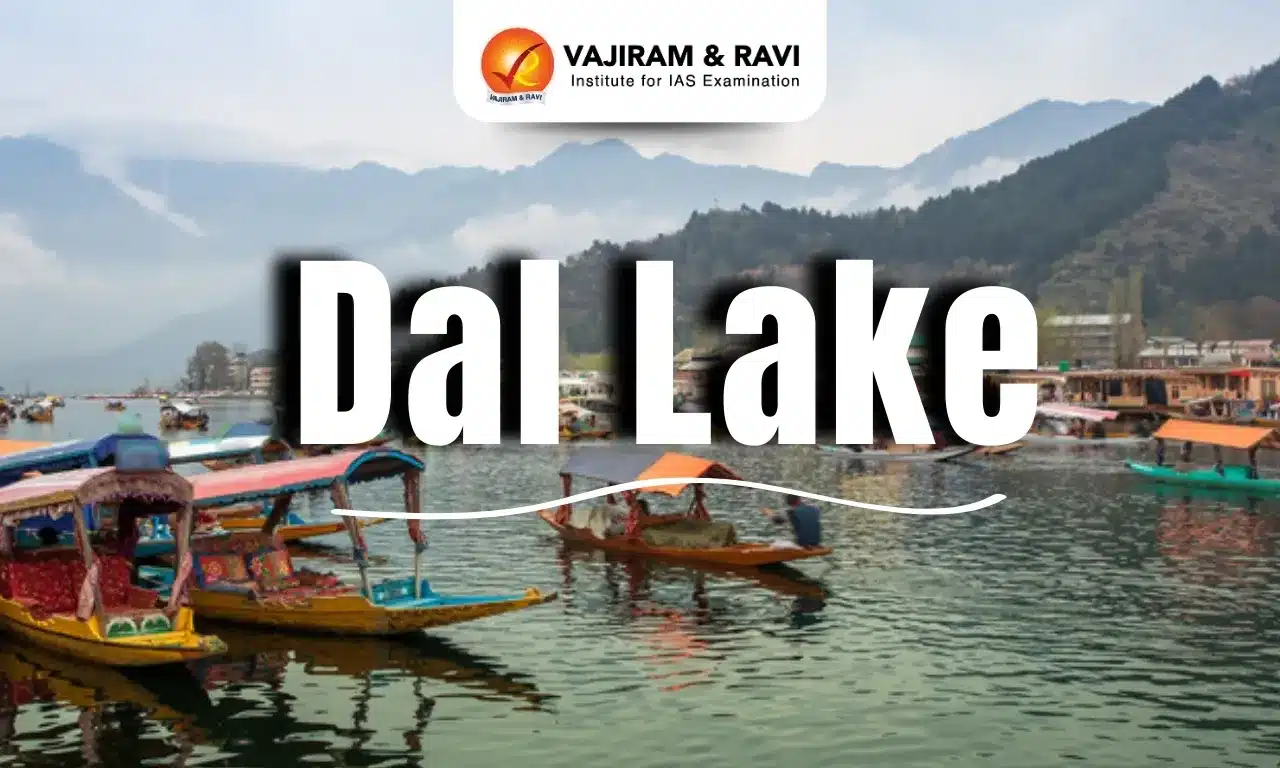
  • It is an urban freshwater lake located in Srinagar, Jammu and Kashmir.
  • It is surrounded by the Pir Panjal mountains.
  • It is integral to tourism and recreation in Kashmir and is named the “Jewel in the crown of Kashmir” or “Srinagar’s Jewel”.
  • It covers an area of about 18 sq.km. It is the second-largest lake in Jammu and Kashmir after the Wular Lake.  
  • It is one of the world’s largest natural lakes and also known as the Lake of Flowers.
  • The lake gets its water mainly from the Telbal stream. This stream flows from the Jhelum River. 
  • During the winter season, the temperature sometimes reaches −11°C (12°F), freezing the lake.
  • The wetland is divided by causeways into four basins: Gagribal, Lokut Dal, Bod Dal, and Nagin (although Nagin is also considered an independent lake).
  • Lokut-dal and Bod-dal each have an island in the centre, known as Rup Lank (or Char Chinari) and Sona Lank, respectively.
  • The floating gardens, locally known as “Rad,” are a spectacular highlight of the lake.
    • These are patches of land that float on the water. 
    • Farmers grow vegetables and flowers on them.
    • It blossoms with lotus flowers during July and August.  
  • It is also popular for the floating market, where vendors have their own Shikaras/wooden boats and approach tourists.
  • The shoreline of the lake, about 15.5 km, is encompassed by a boulevard lined with Mughal-era gardens, parks, houseboats, and hotels. 

News: REUT

Dal Lake FAQs

Q1: Where is Dal Lake located?

Ans: Dal Lake is located in Srinagar, Jammu and Kashmir.

Q2: What type of lake is Dal Lake?

Ans: It is an urban freshwater lake.

Q3: Which mountain range surrounds Dal Lake?

Ans: The Pir Panjal Mountains surround Dal Lake.

Q4: What is Dal Lake popularly known as?

Ans: It is known as the “Jewel in the crown of Kashmir” or “Srinagar’s Jewel.”

Q5: What are the floating gardens of Dal Lake locally known as?

Ans: They are locally known as “Rad.”

e-Sushrut@Clinic

https://vajiramandravi.com/upsc-exam/swadeshi-movement/

e-Sushrut@Clinic Latest News

Aimed at helping small outpatient clinics that face challenges with manual processes and lack of affordable digital solutions, the Union Health Ministry is all set to launch the e-Sushrut@Clinic.

About e-Sushrut@Clinic

  • It provides a lightweight, cloud-based Hospital Management Information System (HMIS) for outpatient clinics.
  • This government-backed HMIS is designed specifically for small and medium healthcare providers, including general practitioners, specialists, clinic administrators, pharmacists, and lab technicians.
  • It can also be used by allied health workers and staff for administrative tasks. 
  • The platform includes modules for outpatient management, pharmacy, and nursing, and is designed to digitise patient records, prescriptions, and billing. 
  • It marks a pivotal step in expanding the Ayushman Bharat Digital Mission (ABDM) ecosystem.
  • The application developed by C-DAC is a lighter version of their flagship e-Sushrut HMIS software. 
    • The eSushrut HMIS software is currently in use at 17 AIIMS and more than 4000 health facilities all over the country. 

e-Sushrut@Clinic Features

  • Any healthcare provider can onboard it from his/her laptop/mobile on a webpage through their Health Facility Registry (HFR) and Health Professionals Registry (HPR).
  • If the healthcare provider is not registered on HFR/HPR, they would be able to register on eSushrut@Clinic itself.  
  • The platform enables small clinics, sub-centres, and medium-sized hospitals to digitize patient records, prescriptions, and billing with minimal technical overhead.
  • The system supports both online and offline functionalities for seamless clinic operations. 
  • It delivers essential functionalities at a low per-user cost.
  • The system also integrates several services from the ABDM, including the AIIMS Clinical Decision Support Systems (CDSS) for hypertension and diabetes, which are provided free of charge for all ABDM-integrated software. 
    • This CDSS helps improve patient care by supporting doctors in making better diagnoses and treatment.

News: TH

e-Sushrut@Clinic FAQs

Q1: What is e-Sushrut@Clinic?

Ans: It is a lightweight, cloud-based Hospital Management Information System (HMIS) for outpatient clinics.

Q2: For whom is e-Sushrut@Clinic specifically designed?

Ans: It is designed for small and medium healthcare providers.

Q3: Which modules are included in the e-Sushrut@Clinic platform?

Ans: Outpatient management, pharmacy, and nursing modules.

Q4: What is the main objective of e-Sushrut@Clinic?

Ans: To digitise patient records, prescriptions, and billing.

Q5: Which organization developed e-Sushrut@Clinic?

Ans: The Centre for Development of Advanced Computing (C-DAC).

Arabithittu Wildlife Sanctuary

Arabithittu Wildlife Sanctuary

Arabithittu Wildlife Sanctuary Latest News

A four-year-old leopard was killed on the spot after being hit by an unidentified vehicle near Arabithittu Wildlife Sanctuary recently.

About Arabithittu Wildlife Sanctuary

  • It is situated in the Mysore District of Karnataka
  • It was a game reserve till 1985, when it was declared a wildlife sanctuary. 
  • It is spread over 13.5 sq.km. and includes the Arabithittu State Forest.  
  • Entry to the forest is highly restricted due to the Defense Research Development Organization (DRDO) installations nearby. 
  • Flora: It has tropical dry deciduous forest and scrubland, surrounded by cultivation and grazing land.  
  • There is also a large area of eucalyptus and sandalwood plantations located within the sanctuary. 
  • Other tree species include Ailanthus triphysa, Artocarpus heterophyllus, Anogeissus latifolia, Butea sp., 
  • Fauna: 
    • Leopard, fox, spotted deer, wild pig, porcupine, hare, and common mongoose are the fauna spotted here. 
    • The sanctuary also boasts more than 250 species of birds.

News: TOI

Arabithittu Wildlife Sanctuary FAQs

Q1: Where is the Arabithittu Wildlife Sanctuary located?

Ans: It is located in the Mysore District of Karnataka.

Q2: Which state forest is included within the Arabithittu Wildlife Sanctuary?

Ans: The Arabithittu State Forest is included within the sanctuary.

Q3: What type of forests are found in the Arabithittu Wildlife Sanctuary?

Ans: Tropical dry deciduous forests and scrublands are found in the sanctuary.

Q4: Which plantation species are extensively found within the Arabithittu Wildlife Sanctuary?

Ans: Eucalyptus and sandalwood plantations are extensively found within the sanctuary.

ICGS Akshay

ICGS Akshay

ICGS Akshay Latest News

Recently, Indian Coast Guard Ship (ICGS) Akshay, a new-generation Fast Patrol Vessel (FPV), was commissioned into the Bharatiya Tatrakshak Fleet at Goa.

About ICGS Akshay

  • It is a new-generation Fast Patrol Vessel (FPV).
  • It is named Akshay, meaning Indestructible.
  • It is the fourth vessel in the adamya class series of eight fast patrol vessels.
  • Functions: It is equipped to undertake a wide range of Coast Guard operations including;
    • Maritime law enforcement, coastal security, search and rescue, marine environmental protection and assistance to mariners in distress, thereby enhancing the operational capability of Bharatiya Tatrakshak.
  • It is designed and constructed by Goa Shipyard.
  • Features of ICGS Akshay
    • Armaments: It is armed with a 30mm CRN-91 gun and two 12.7mm stabilised remote-controlled guns with fire-control systems.
    • It is equipped with advanced Controllable Pitch Propeller (CPP) propulsion systems paired with two 3,000 kW diesel engines.
    • The vessels measure 52 metres in length with a displacement of 320 tonnes.
    • Significance: It carries over 65 percent indigenous content.

Source: PIB

ICGS Akshay FAQs

Q1: Who built ICGS Akshay & with what indigenous content?

Ans: Goa Shipyard Limited with 60% indigenous content

Q2: What series does ICGS Akshay belong to?

Ans: Adamya-class

Amrabad Tiger Reserve

Amrabad Tiger Reserve

Amrabad Tiger Reserve Latest News

The All-India Tiger Estimation- (AITE) 2026 has recorded a strong tiger presence in Amrabad Tiger Reserve (ATR). 

About Amrabad Tiger Reserve

  • Location: It is located in the Nallamala hills of the Eastern Ghats in Telangana state.
  • It was originally part of the larger Nagarjunasagar-Srisailam Tiger Reserve before the bifurcation of Andhra Pradesh and Telangana in 2014.
  • Terrain: The reserve is renowned for its rugged terrain, deep valleys, and dense forests.
  • Rivers: The Krishna River and its perennial streams originating within the reserve contribute to the water supply of major reservoirs such as the Srishailam Dam and Nagarjunsagar Dam.
  • Tribal Community: The Chenchu tribe is one of the major tribal communities that live in the ATR.
  • Flora 
    • Amrabad is characterized by dry deciduous forests, primarily made up of sal, teak, bamboo, and acacia trees. 
    • The forest is rich in medicinal plants and shrubs, which have long been used by local tribes for traditional remedies.
  • Fauna
    • It is home to leopards and wild cats, along with herbivores like sambar deer, chital (spotted deer), nilgai (blue bull), wild boar, and the Indian bison (gaur). 
    • Over 303 bird species have been identified in this region. Some important groups include Eagles, Pigeons, Doves, Cuckoos, Woodpeckers, Drongos, etc.

Source: TOI

Amrabad Tiger Reserve FAQs

Q1: Where is Amrabad Tiger Reserve located?

Ans: Telangana

Q2: Which river flows through Amrabad TR?

Ans: Krishna River

Colombia

Colombia

Colombia Latest News

Recently, the Prime Minister of India congratulated Abelardo de la Espriella on his victory in the Colombian presidential elections. 

About Colombia

  • Location: It is a country located in the northwestern part of South America. 
  • It is known as the “Gateway of South America”, strategically located in the northwest, connecting South America with Central and North America.
  • Bordering Countries: It is bordered by Panama to the northwest; by Ecuador and Peru to the south; by Venezuela to the east, and by Brazil to the southeast.
  • Maritime Borders: It is also bounded by the Caribbean Sea in the north and by the Pacific Ocean in the west. 
  • It is a member of the Organisation for Economic Co-operation and Development (OECD) from 2020.
  • Capital City: Bogotá.

Geographical Features of Colombia

  • Climate: The climate is tropical along the coasts and eastern plains, and cooler in the highlands.
  • Highest Peak: Its highest point is Pico Cristobal Colon.
  • Major Rivers: Major rivers include the Magdalena, Amazon, and Orinoco.
  • Natural Resources: It is rich in natural resources like petroleum, natural gas, coal, and gold.

Source: DD News

Colombia FAQs

Q1: Which countries border Colombia?

Ans: Venezuela, Brazil, Peru, Ecuador, Panama

Q2: What is Colombia’s highest point?

Ans: Pico Cristóbal Colón

Foreign Contribution (Regulation) Amendment Rules 2026 – Stricter Oversight of Foreign-Funded NGOs

Foreign Contribution (Regulation) Amendment Rules 2026

Foreign Contribution (Regulation) Amendment Rules 2026 Latest News

  • The Union Ministry of Home Affairs (MHA) has notified the Foreign Contribution (Regulation) Amendment Rules 2026, marking the 10th amendment to the Foreign Contribution (Regulation) Rules, 2011 under the FCRA 2010. 
  • The amendments tighten regulatory oversight over foreign-funded NGOs by prescribing detailed activity classifications, expanding disclosure requirements, and introducing stricter penalties for violations.

FCRA - Regulatory Framework

  • Objective:
    • The Foreign Contribution (Regulation) Act (FCRA) regulates the acceptance and utilisation of foreign contributions.
    • It ensures that such funds do not adversely affect India's sovereignty, internal security, public interest, or democratic institutions.
  • Evolution:
    • 1976: Original FCRA enacted.
    • 2010: Replaced by the current FCRA, effective from May 1, 2011. Subsequent amendments in 2016, 2018, 2020, and now 2026.
  • Validity: FCRA registration remains valid for five years, requiring periodic renewal.
  • Current status: Over 18,000 NGO registrations have been cancelled since 2015. As of June 22, 2026, 14,456 NGOs hold active FCRA registration.

Major Amendments under the FCRA Rules 2026

  • Detailed disclosure of activities:
    • Registered NGOs must now:
      • Specify the exact nature of activities from a government-prescribed list.
      • Declare the States/Union Territories where foreign funds will be utilised.
      • Existing NGOs must update these details within one year.
    • Implication: Replaces the earlier broad permissions with purpose-specific approvals, enabling closer monitoring.
  • Expanded definition of 'Key Functionary':
    • The Rules widen the scope of persons responsible for compliance to include Trustees, Partners, Karta of a Hindu Undivided Family (HUF), governing body members, and any individual exercising managerial or controlling authority.
    • This increases accountability beyond office-bearers and directors.
  • Enhanced transparency requirements:
    • NGOs must mandatorily disclose official websites, social media accounts, and publications issued during the year (books, magazines, newspaper articles, etc.).
    • The objective is to improve transparency and facilitate regulatory oversight.
  • Higher registration costs:
    • Registration fees are now charged separately for each approved purpose, and for every State or Union Territory where the NGO operates.
    • This increases compliance costs, particularly for organisations working across multiple sectors or regions.

Purpose-wise Classification of Foreign Contributions

  • Foreign contributions may be received under five broad categories.
  • These are -
    • Social (30 specified activities), Economic (19 categories)
    • Educational: 22 activities; while awareness programmes on constitutional rights, fundamental duties and civic responsibilities must be strictly non-political.
    • Cultural: 18 categories, including promotion of contemporary arts inspired by Indian traditions. Activities must exclude political or ideological content.
    • Religious: 16 permitted activities, including -
      • Religious education,
      • Moral instruction,
      • Satsangs and meditation retreats,
      • Burial and cremation ground maintenance, and
      • Proselytisation is expressly excluded.

Penalties for Violations

  • The MHA has separately notified penalties for several violations, including -
    • Excess administrative expenditure
    • Speculative investment of foreign funds
    • Misuse or unauthorised utilisation of contributions
    • Receipt or utilisation without approval
    • Use of funds for unapproved purposes or outside approved States/UTs
  • Penalty structure:
    • Misutilisation of funds: 30% of the misused amount or ₹1 lakh, whichever is higher.
    • Unapproved purposes: Use of funds for unapproved purposes or geographical areas, will attract 30% of the amount involved or ₹1 lakh penalty, whichever is higher.
    • Excess administrative expenditure: and speculative investments also attract percentage-based penalties, subject to a minimum fine of ₹1 lakh.

Concerns Raised by the Opposition and Civil Society Organisations

  • The amendments may restrict the operational flexibility of NGOs.
  • Limit their ability to respond swiftly to emergencies and humanitarian crises.
  • Increase compliance burdens through rigid activity classifications and geographical restrictions.
  • Shift the focus from regulating foreign contributions to regulating voluntary organisations themselves.
  • Raise concerns regarding freedom of association (Article 19(1)(c)) and constitutional protections available to civil society organisations.

Conclusion

  • The FCRA Amendment Rules 2026 represent a significant tightening of India's regulatory framework governing foreign-funded NGOs. 
  • While the government views the amendments as necessary, critics contend that they may constrain their operational effectiveness.
  • This highlights the continuing challenge of balancing national security concerns with democratic freedoms and civic participation.

Source: TH

Foreign Contribution (Regulation) Amendment Rules 2026 FAQs

Q1: What is the objective of the FCRA Amendment Rules 2026?

Ans: It seeks to strengthen the regulatory framework governing foreign-funded NGOs in India.

Q2: What is the significance of balancing national security concerns with the autonomy of civil society organisations?

Ans: Effective regulation should prevent misuse of foreign funds while preserving the constitutional space for voluntary organisations.

Q3: What are the implications of the expanded definition of 'key functionary'?

Ans: It enhances institutional accountability by extending legal responsibility beyond office-bearers to trustees, partners, etc.

Q4: Why has the Government introduced purpose-wise and geographical restrictions?

Ans: To improve traceability of foreign funds, prevent diversion or misuse, and enable more effective regulatory oversight of NGO activities.

Q5: What are the concerns raised by civil society regarding the FCRA Amendment Rules 2026?

Ans: Rigid activity classifications, geographical limitations, and increased compliance requirements may reduce NGOs' operational flexibility.

UNHRC Gaza Report: Genocidal Intent and Its Legal Implications Explained

UNHRC Gaza Report

UNHRC Gaza Report Latest News

  • Recently, a United Nations Human Rights Council (UNHRC) commission of inquiry released a report concluding that Israel deliberately targeted Palestinian children in Gaza, and that this pattern of acts established genocidal intent to destroy the Palestinian group. 
  • Released by the UN Independent International Commission of Inquiry, the report has significant implications for ongoing international legal cases against Israel.

About the Commission

  • The report comes from the UN Independent International Commission of Inquiry on the Occupied Palestinian Territory (including East Jerusalem) and Israel.
  • It was set up in May 2021 through a UNHRC resolution as an independent body to monitor conditions in the occupied Palestinian territory, and is mandated to submit annual reports.
  • It is currently chaired by Justice S. Muralidhar of India, who retired in 2023 as Chief Justice of the Odisha High Court. 
    • The other members are Florence Mumba (Zambia) and Chris Sidoti (Australia).
  • This is not the first such finding: in September 2025, the commission — then chaired by Navi Pillay (South Africa), with Miloon Kothari (India) and Chris Sidoti — had reached similar conclusions on genocidal intent.

What the Report Found

  • The central argument is that children were not incidental victims but were directly targeted
  • The commission described children as central to the survival and continuity of the Palestinian group, making their targeting a key element in establishing intent.
  • Key findings include:
    • Targeted killings: Medical practitioners interviewed reported a consistent pattern of children with single gunshot wounds from quadcopters or snipers. 
    • Ceasefire did not end violence: The October 2025 ceasefire between Israel and Hamas did not stop the killings. Deaths increased near the "yellow line" — an Israel-declared security buffer cutting north-to-south through Gaza, established under the US-mediated October 2025 peace plan, marking the boundary to which Israeli forces withdrew while retaining control over a large part of the Strip.
    • Torture and abuse in detention: The report documented torture of children during arrests and detention, including sexual violence.
    • Attacks on protective infrastructure: It alleged Israeli forces targeted schools and orphanages, forced the closure of paediatric hospitals, and destroyed infrastructure essential for children's survival.

Genocide Under International Law

  • The UN Genocide Convention (Article II) defines genocide as acts committed with intent to destroy, in whole or in part, a national, ethnical, racial or religious group. 
  • The five listed acts are:
    • Killing members of the group
    • Causing serious bodily or mental harm to members of the group
    • Deliberately inflicting conditions of life calculated to bring about physical destruction
    • Imposing measures intended to prevent births within the group
    • Forcibly transferring children of the group to another group
  • The same definition appears in Article 6 of the Rome Statute of the International Criminal Court (ICC) and in other international jurisdictions.
  • The crucial point: proving genocide requires establishing intent (the mental element), which is held to a very high evidentiary standard. 
  • As legal experts noted, ethnic cleansing, indiscriminate killing or war crimes alone are not enough to prove genocide.

Why a UN Report Matters Legally

  • A UN commission cannot impose penalties, but its findings can serve as documentary evidence before international courts. 
  • Experts cited by the report explained how:
    • As corroborating evidence: UN fact-finding missions and similar reports have historically formed part of the evidentiary record in major genocide proceedings — examples cited include the Bosnia v. Serbia case at the ICJ and the ICC's prosecution of Sudan's Omar al-Bashir over Darfur.

Two parallel cases against Israel

  • ICJ: In South Africa's case against Israel, the court has held that Palestinians in Gaza have plausible rights under the Genocide Convention requiring protection.
  • ICC: The case against PM Benjamin Netanyahu is seen by some experts as having more potential, as evidence emerges on the chain of command behind alleged acts.
  • However, experts cautioned that proving genocidal intent is hard because, unlike the Rohingya in Myanmar (where a clear ethnicity was targeted), Palestinians do not fit as squarely into such identity definitions. 
  • There is also concern about "judicial bullying" by powerful states obstructing evidence collection.

Conclusion

  • The report marks a significant step in documenting allegations of genocide in Gaza, but it sits at the gap between documentation and enforcement
  • While its findings strengthen the evidentiary foundation for cases at the ICJ and ICC, the high legal threshold for proving genocidal intent — and the absence of enforcement obligations on powerful non-ICC states like India and the US — means its practical legal impact remains uncertain. 

Source: IE | BBC

UNHRC Gaza Report FAQs

Q1: What is the significance of the UNHRC Gaza Report?

Ans: The UNHRC Gaza Report documents alleged violations in Gaza and may serve as evidentiary material in ongoing proceedings before international judicial bodies.

Q2: How does the UNHRC Gaza Report relate to the Genocide Convention?

Ans: The UNHRC Gaza Report examines whether reported acts satisfy the legal elements of genocide, particularly the requirement of proving genocidal intent under international law.

Q3: Why is proving intent central to the UNHRC Gaza Report?

Ans: The UNHRC Gaza Report highlights that establishing specific intent to destroy a protected group is the most demanding legal requirement in genocide cases.

Q4: What legal value does the UNHRC Gaza Report have?

Ans: The UNHRC Gaza Report cannot impose penalties directly but may be used as supporting evidence before international courts such as the ICJ and ICC.

Q5: What broader legal debate has the UNHRC Gaza Report generated?

Ans: The UNHRC Gaza Report has intensified debate on international humanitarian law, accountability, evidentiary standards and the enforcement of international criminal justice.

Proving Indian Citizenship: Documents, Legal Gaps and Citizenship Disputes Explained

Proving Indian Citizenship

Proving Indian Citizenship Latest News

  • Ministry of External Affairs (MEA) recently clarified that the Indian passport is not a "document of citizenship." 
  • The remark came in response to whether a passport can be used to challenge exclusion from voter lists during the Special Intensive Revision (SIR) of electoral rolls currently underway in 16 States. 
  • The clarification has revived a long-standing question: India prescribes no single, universal document to prove citizenship.

The Core Puzzle: No Universal Citizenship Document

  • The central fact is simple but counter-intuitive — India does not have one document that conclusively proves citizenship for all. 
  • An attempt to create such a record through the National Register of Citizens (NRC) became politically contentious, amid fears that a nationwide verification drive could exclude genuine citizens over missing or inconsistent paperwork. 
  • This forces citizens to rely on different combinations of evidence depending on the dispute.

Why the Passport Is Not Conclusive Proof

  • This is not a new rule. The government's Passport Manual places a passport in the same category as any other evidence of citizenship status — it is strong evidence that the holder is an Indian citizen, but not conclusive proof in law.
  • The MEA official explained that a passport is a travel document, not a citizenship document. While it attests to nationality abroad, that is distinct from being conclusive proof.
  • The key distinction is between evidence of citizenship and conclusive proof of citizenship. Citizenship is determined under the Citizenship Act, 1955, while passports are issued under the Passports Act, 1967.
  • Maneka Gandhi v. Union of India (1978): Issuance of a passport is based on the holder being an Indian national, entitling them to the protection of the Indian Republic and assistance of its missions abroad.
  • Passports Act provisions: Under Section 6(2)(a), a passport can be refused if the applicant is not a citizen. But under Section 20, the government may issue a passport or travel document to a non-citizen in public interest — which is precisely why the passport cannot be treated as definitive proof.
  • If citizenship is disputed, courts examine the passport alongside other relevant evidence.

Can Aadhaar Prove Citizenship

  • No. From the start, the UIDAI has stressed that Aadhaar is proof of identity and address only — not citizenship. 
  • In fact, non-Indian citizens legally resident in India are also eligible for Aadhaar and often need it for basic services like banking and cooking gas.
  • Supreme Court (May 2026): While upholding the constitutional validity of the SIR, the Court held that Aadhaar does not constitute proof of citizenship and cannot be relied on for that purpose. It may, however, be used for the limited purpose of establishing identity.

Does a Voter ID / Electoral Roll Prove Citizenship

  • Only Indian citizens can vote — but presence on the electoral roll or holding an EPIC (Electoral Photo Identity Card) does not determine or conclusively prove citizenship.
  • Lal Babu Hussein v. Electoral Registration Officer (1995): Electors on the roll are entitled to a presumption of citizenship, which cannot be displaced except through the legally prescribed procedure.
  • 2026 SIR judgment: The Court emphasised that the Election Commission's role is confined to determining electoral eligibility — it cannot adjudicate citizenship. Importantly, a person's citizenship does not cease merely because they become ineligible for the electoral roll under the SIR.
  • A practical contradiction emerged here: the passport was one of 11 'indicative' documents the EC listed as proof of citizenship. 
  • In Uttar Pradesh, some purged voters used passports to get back on the rolls — yet in West Bengal, some passport-holders were still deleted from draft lists. 
  • This inconsistency underlines how no single document settles the matter.

What Actually Proves Citizenship?

  • The answer depends on how a person became a citizen. Under the Citizenship Act, 1955, citizenship can be acquired by birth, descent, registration, naturalisation, or incorporation of territory.
  • Citizenship certificates are issued to those who acquire citizenship by registration or naturalisation, and act as conclusive proof.
  • But most Indians are citizens by birth or descent and have no such certificate. They rely on documents proving date of birth, place of birth, or parentage, depending on the dispute.
  • The Home Ministry itself, replying in the Lok Sabha on August 2025, did not specify a fixed list of valid documents, stating only that citizenship is governed by the Citizenship Act, 1955.

The Birth-Date Complication

  • Citizenship by birth has changed over time, making documentary proof progressively harder:
    • Jan 26, 1950 – Jul 1, 1987 - Citizen by birth, irrespective of parents' nationality.
    • Jul 1, 1987 – Dec 3, 2004 - Must also prove at least one parent was an Indian citizen.
    • On or after Dec 3, 2004 - One parent must be an Indian citizen and the other must not be an illegal migrant.
  • For the earliest group, since mandatory birth certificates were not issued then, many rely on a combination of educational certificates, Aadhaar and other records. 
  • For the later groups, proving one's own birth is no longer enough — parentage must also be documented, complicating matters significantly.

Conclusion

  • The episode reveals a structural gap in India's governance: citizenship is a clearly defined legal status under the Citizenship Act, yet no document conclusively establishes it for the majority of Indians who are citizens by birth or descent. 
  • Passports, Aadhaar and voter IDs each prove something narrower — nationality for travel, identity, or electoral eligibility — but none settles citizenship on its own. 
  • As exercises like the SIR test these boundaries, the case for robust universal birth and civil registration becomes not just an administrative reform but a safeguard for citizens' rights.

Source: TH 

Proving Indian Citizenship FAQs

Q1: Why is Proving Indian Citizenship a complex legal issue in India?

Ans: Proving Indian Citizenship is complex because India has no single universal citizenship document, requiring different forms of evidence depending on the legal dispute.

Q2: Can a passport be used for Proving Indian Citizenship?

Ans: A passport is strong evidence for Proving Indian Citizenship but is not conclusive proof, as it is issued under the Passports Act rather than the Citizenship Act.

Q3: Does Aadhaar help in Proving Indian Citizenship?

Ans: Aadhaar cannot be used for Proving Indian Citizenship because it establishes identity and residence, not citizenship, and is also issued to eligible non-citizen residents.

Q4: How do citizens by birth approach Proving Indian Citizenship?

Ans: For Proving Indian Citizenship, citizens by birth generally rely on birth records, educational certificates and documents establishing parentage under the Citizenship Act.

Q5: Why is universal birth registration important for Proving Indian Citizenship?

Ans: Universal birth registration would simplify Proving Indian Citizenship by providing reliable documentary evidence, reducing disputes and strengthening citizens' legal rights.

EU Carbon Border Adjustment Mechanism – Explained

Carbon Border Adjustment

Carbon Border Adjustment Latest News

  • The Government of India is reportedly preparing a scheme to bear 90% of the compliance cost incurred by MSMEs exporting to the European Union under the Carbon Border Adjustment Mechanism (CBAM).

Carbon Border Adjustment Mechanism (CBAM)

  • The Carbon Border Adjustment Mechanism is a carbon pricing mechanism introduced by the European Union (EU) to prevent carbon leakage, the relocation of carbon-intensive industries to countries with less stringent climate regulations.
  • Under CBAM, importers of certain goods into the EU must purchase CBAM certificates corresponding to the embedded carbon emissions generated during the production of those goods. 
  • The mechanism aims to ensure that imported products face a carbon cost similar to that imposed on producers within the EU under the EU Emissions Trading System (EU ETS).
  • The transitional phase of CBAM began in October 2023, focusing on emissions reporting, while the financial obligations came into effect from January 1, 2026.
  • CBAM currently applies to carbon-intensive products such as:
    • Iron and steel, Aluminium, Cement, Fertilisers, Electricity and Hydrogen
  • The scope is expected to expand gradually to include additional sectors.

How CBAM Works

  • Exporters selling covered products to the EU must report the embedded emissions generated during production.
  • These emissions include:
    • Direct emissions from manufacturing processes
    • Indirect emissions from electricity consumption (for specified sectors such as cement and fertilisers)
  • EU importers are required to purchase CBAM certificates based on these verified emissions. 
  • If exporters fail to provide actual emissions data, the European Commission applies default emission values, which are subject to progressively increasing mark-ups:
    • 10% in 2026 
    • 20% in 2027 
    • 30% from 2028 onwards 
  • These higher default values significantly increase compliance costs and reduce the competitiveness of exporters unable to accurately measure and report emissions.

Challenges for Indian MSMEs

  • Although CBAM is often viewed as a carbon tax, experts note that the largest burden for MSMEs is compliance rather than taxation.
  • To comply with the regulation, exporters must establish systems for:
    • Carbon accounting
    • Emissions measurement and monitoring
    • Third-party verification
    • Digital reporting
    • Data management and documentation
  • According to industry estimates, each MSME may incur compliance costs of Rs. 15-20 lakh merely to meet CBAM reporting requirements.
  • Unlike large corporations, MSMEs often lack:
    • Technical expertise
    • Financial resources
    • Dedicated sustainability teams
    • Digital infrastructure for emissions reporting
  • Since many of these expenses are fixed costs, they do not decrease with lower production or export volumes, placing smaller exporters at a competitive disadvantage.

Government's Proposed Support Scheme

  • Recognising the disproportionate burden on small exporters, the Central Government is working on a scheme to reimburse 90% of CBAM compliance costs for eligible MSMEs. The proposed support is intended to help exporters:
    • Develop carbon accounting systems
    • Obtain third-party verification
    • Build reporting infrastructure 
    • Continue accessing European markets
  • The initiative follows unsuccessful attempts by India to secure special concessions for small industries during negotiations with developed countries.

Impact on Indian Exports

  • India is the world's second-largest producer of crude steel and primary aluminium, making CBAM particularly significant for the country's manufacturing sector.
  • According to a recent Indian Council for Research on International Economic Relations (ICRIER) working paper:
    • Iron and steel exports to the EU could decline by nearly 24%, making it the most affected sector. 
    • India's overall global exports of iron and steel may decline by 5.7%. 
    • Fertilisers, aluminium, and fabricated metal products are also expected to face substantial impacts. 
  • The report further notes that while CBAM is likely to adversely affect India's exports to the EU, its impact on global carbon emissions is expected to be limited, as emission reductions will depend on the technologies and production processes adopted by exporting countries.

Implications for India

  • CBAM presents both challenges and opportunities for India's manufacturing sector.
  • Economic Challenges
    • Increased compliance costs for exporters
    • Reduced competitiveness of MSMEs in European markets
    • Pressure on labour-intensive export sectors
    • Additional burden due to the UK's proposed CBAM from 2027
  • Strategic Opportunities
    • Adopt cleaner production technologies
    • Improve energy efficiency
    • Strengthen carbon accounting systems
    • Enhance global competitiveness through sustainable manufacturing
  • The mechanism may also accelerate India's transition towards low-carbon industrial production, particularly as global markets increasingly prioritise environmental standards.

Way Forward

  • To minimise the impact of CBAM, India should adopt a comprehensive strategy by:
    • Providing financial assistance for MSME compliance
    • Expanding technical support for carbon accounting and emissions reporting
    • Strengthening domestic carbon measurement and verification infrastructure
    • Encouraging the adoption of cleaner production technologies through targeted incentives
    • Continuing bilateral negotiations with the EU to address concerns of developing countries while ensuring market access for Indian exporters
  • Such measures would help Indian industries remain competitive while aligning with global climate commitments.

Source: IE

Carbon Border Adjustment FAQs

Q1: What is the Carbon Border Adjustment Mechanism (CBAM)?

Ans: CBAM is the European Union's carbon pricing mechanism that imposes a carbon cost on imports of carbon-intensive goods based on their embedded emissions.

Q2: Which sectors are currently covered under CBAM?

Ans: Iron and steel, aluminium, cement, fertilisers, electricity, and hydrogen.

Q3: Why are Indian MSMEs particularly affected by CBAM?

Ans: They face high fixed compliance costs for carbon accounting, verification, and reporting, despite having limited financial and technical resources.

Q4: What financial support is the Government of India considering for MSMEs?

Ans: The government is considering a scheme to bear 90% of the compliance cost incurred by MSMEs under CBAM.

Q5: According to the ICRIER study, which Indian sector is likely to be the most affected by CBAM?

Ans: The iron and steel sector, with exports to the EU projected to decline by around 24%.

Enquire Now