Shadow Puppetry, Meaning, Types, Indian Regional Forms

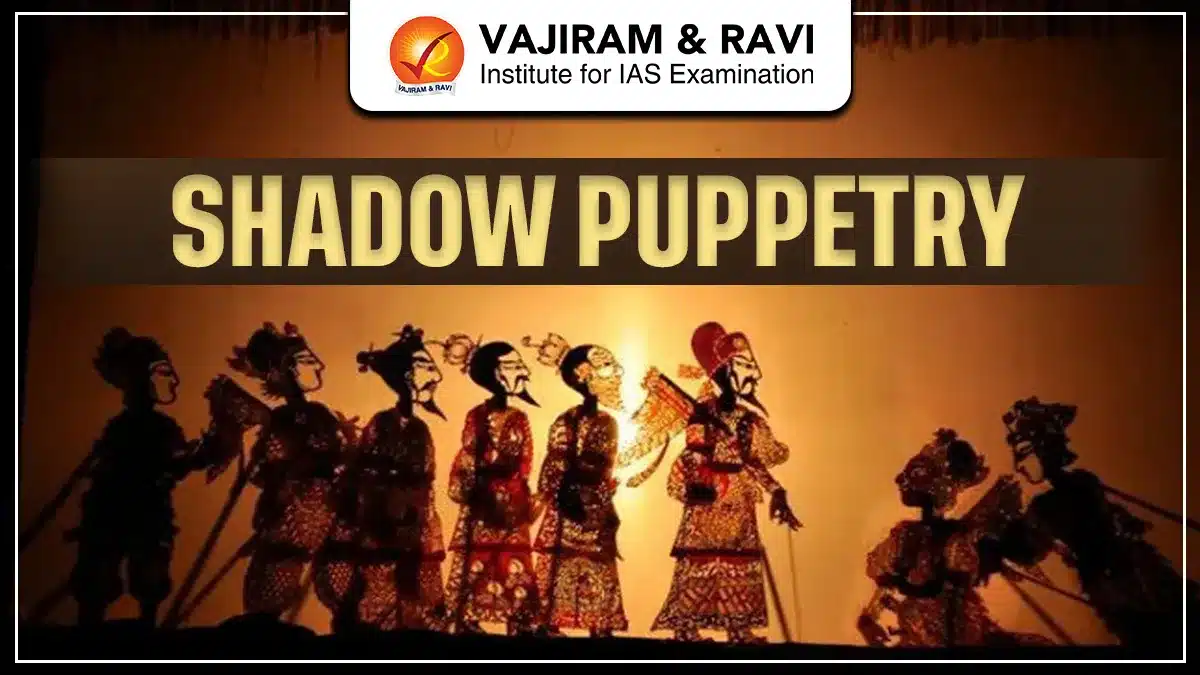
Shadow Puppetry

Shadow Puppetry, also called Shadow Play, is an ancient narrative art that uses flat, cut-out puppets made from leather or paper, held against a screen illuminated from behind. The movement of puppets and manipulation of light creates lifelike visual illusions such as walking, fighting, dancing or emotional gestures. Historical evidence suggests its development during the first millennium BCE, with strong roots in India and China. Shadow Puppetry later influenced projected visual arts, including slide projection and early cinema, due to its core principle of light-image-screen interaction.

Shadow Puppetry in India

Shadow Puppetry in India represents one of the richest and most continuous living traditions of this art form, deeply rooted in ritual, mythology and folk education. Evidence of puppetry appears in Harappa and Mohenjo-daro excavations, while literary references exist in the Mahabharata, Silappadikaaram and Natyashastra, where the term “Sutradhar” means the holder of strings. Indian shadow plays traditionally narrate Ramayana, Mahabharata and Puranic legends, performed during temple festivals. States like Andhra Pradesh, Karnataka, Kerala, Odisha, Maharashtra and Tamil Nadu preserve distinct regional styles using leather puppets and oil-lamp illumination.

Shadow Puppetry Types

Shadow Puppetry in India includes several region specific traditions, each distinguished by puppet size, articulation, material, performance style, music and ritual importance.

  1. Tholu Bommalata, Andhra Pradesh: Large translucent leather puppets, often four to five feet tall, with movable joints, painted on both sides, narrating Ramayana and Mahabharata with strong classical music influence.
  2. Togalu Gombeyatta, Karnataka: Small leather puppets whose size varies by social status, with kings and gods depicted larger, accompanied by folk music and flexible narrative improvisation.
  3. Ravanachhaya, Odisha: Opaque, single piece deer skin puppets without joints, producing bold shadows, focusing on dramatic Ramayana episodes with strong visual symbolism.
  4. Tholpavakoothu, Kerala: Ritual temple based shadow theatre performed in Koothumaadams, using around 160 puppets to narrate Kamba Ramayanam over performances lasting up to 41 nights.
  5. Charma Bahuli Natya, Maharashtra: Leather puppetry preserved by folk communities, presenting epic narratives with strong oral traditions and Marathi linguistic influence across regions.

Shadow Puppetry across World

Shadow Puppetry spread across Asia, the Middle East and Europe through trade, migration and cultural exchange, adapting local aesthetics while retaining its core visual principle.

  • China: Known as Piyingxi, recognized by UNESCO in 2011, featuring colored leather puppets and regional styles like Luanzhou and Sichuan, flourishing since the Song dynasty.
  • Indonesia: Famous for Wayang Kulit, designated a UNESCO Masterpiece in 2003, integrating leather puppets, gamelan music and a single master puppeteer called Dalang.
  • Malaysia: Practiced as Wayang Kulit Melayu, Gedek, Jawa and Siam, combining Javanese and Thai influences with moral storytelling and leather puppets.
  • Thailand: Includes Nang Yai with large figures and Nang Talung with smaller movable puppets, often performed during rituals and temple fairs with music and chants.
  • Turkey: Known as Karagöz and Hacivat, a satirical Ottoman era shadow comedy tradition featuring social commentary, performed widely in coffee houses and royal courts.
  • Cambodia: Practiced as Sbek Thom and Sbek Touch, using large cowhide puppets to depict Ramayana scenes during sacred ceremonies with pinpeat orchestra support.
  • Europe: Introduced in the 17th century, popularized as Ombres Chinoises in France, influencing theatre, philosophy and later cinematic visual storytelling traditions.
  • Modern World: Shadow Puppetry influenced silhouette animation, early cinema and contemporary visual arts, with examples in films, theatre productions and digital media worldwide.

Shadow Puppetry FAQs

Q1: What is Shadow Puppetry?

Ans: Shadow puppetry is a storytelling art where flat puppets create moving shadows on a screen using a light source.

Q2: Which materials are used to make Shadow Puppets?

Ans: Shadow puppets are mainly made from leather, parchment, or paper, often processed to allow light to pass through.

Q3: Where did Shadow Puppetry originate?

Ans: Shadow puppetry originated in Asia, with strong early evidence from India and China during the first millennium BCE.

Q4: Which Indian epics are commonly performed in Shadow Puppetry?

Ans: The Ramayana, Mahabharata and Puranic legends are the most commonly performed narratives in Indian shadow puppetry.

Q5: Why is Shadow Puppetry historically important?

Ans: Shadow puppetry influenced early visual storytelling techniques and is considered a precursor to projected theatre and cinema.

UPSC Daily Quiz 15 January 2026

UPSC Daily Quiz

[WpProQuiz 68]

UPSC Daily Quiz FAQs

Q1: What is the Daily UPSC Quiz?

Ans: The Daily UPSC Quiz is a set of practice questions based on current affairs, static subjects, and PYQs that help aspirants enhance retention and test conceptual clarity regularly.

Q2: How is the Daily Quiz useful for UPSC preparation?

Ans: Daily quizzes support learning, help in revision, improve time management, and boost accuracy for both UPSC Prelims and Mains through consistent practice.

Q3: Are the quiz questions based on the UPSC syllabus?

Ans: Yes, all questions are aligned with the UPSC Syllabus 2025, covering key areas like Polity, Economy, Environment, History, Geography, and Current Affairs.

Q4: Are solutions and explanations provided with the quiz?

Ans: Yes, each quiz includes detailed explanations and source references to enhance conceptual understanding and enable self-assessment.

Q5: Is the Daily UPSC Quiz suitable for both Prelims and Mains?

Ans: Primarily focused on Prelims (MCQ format), but it also indirectly helps in Mains by strengthening subject knowledge and factual clarity.

Pradhan Mantri Suraksha Bima Yojana, Objectives, Eligibility

Pradhan Mantri Suraksha Bima Yojana

The Pradhan Mantri Suraksha Bima Yojana, launched on May 9th 2015, is a flagship social security initiative of the Government of India aimed at protecting citizens from financial distress caused by accidental death or disability. It was designed to provide affordable accident insurance to people who were previously outside any formal insurance coverage. It focuses especially on poor, rural and unorganised sector workers with a very low annual premium, ensuring basic financial safety and dignity for families during sudden life tragedies.

Pradhan Mantri Suraksha Bima Yojana

Pradhan Mantri Suraksha Bima Yojana is a one year personal accident insurance scheme, renewable every year, offering financial protection against accidental death and disability. The scheme is administered through Public Sector General Insurance Companies and other approved insurers in partnership with banks and post offices. Coverage is linked directly to a savings bank or post office account with auto-debit consent. In May 2026, it will mark the 11th anniversary of this scheme.

Pradhan Mantri Suraksha Bima Yojana Objectives

The Pradhan Mantri Suraksha Bima Yojana aims to extend accident insurance to vulnerable populations at an extremely affordable cost, reducing financial shock during emergencies.

  • It covers individuals without formal insurance, especially unorganised workers, daily wage earners and rural households facing high accident related financial risks.
  • The scheme ensures that even low income earners can afford accident insurance without regular financial burden.
  • PMSBY builds on Jan Dhan Yojana bank accounts, using the banking system as a platform to provide universal access to basic insurance.
  • It provides immediate financial support to families after accidental death or disability, preventing debt traps and loss of livelihood.
  • It aims to reach both rural and urban populations equally through banks, regional rural banks, cooperative banks and post offices.

Pradhan Mantri Suraksha Bima Yojana Eligibility Criteria

Eligibility conditions are kept simple to ensure maximum participation across diverse social and economic groups.

  • Age Requirement: Any individual between 18 and 70 years of age is eligible to enroll, ensuring coverage for the working age population.
  • Account Requirement: The applicant must have an active savings bank account or post office account.
  • Auto-Debit Consent: Enrolment requires explicit consent for automatic deduction of the annual premium from the linked account.
  • Single Account Enrollment: Individuals holding multiple accounts can enroll only through one account.
  • Renewable Participation: Eligible individuals must renew the scheme every year, though rejoining is allowed if coverage lapses earlier.

Pradhan Mantri Suraksha Bima Yojana Coverage

The Pradhan Mantri Suraksha Bima Yojana provides clearly defined financial compensation for death and disability caused strictly by accidents.

  • Accidental Death Cover: In case of death due to an accident, the nominee receives a lump sum insurance amount of ₹2 lakh.
  • Total Permanent Disability: Coverage of ₹2 lakh is provided for irreversible loss of both eyes, both hands, both feet, or loss of one eye with one hand or foot.
  • Partial Permanent Disability: An insurance benefit of ₹1 lakh is paid for loss of one eye, one hand, or one foot due to an accident.
  • Natural Calamity Inclusion: Accidents arising from natural calamities such as floods, earthquakes, or storms are also covered under PMSBY.
  • Defined Coverage Period: Insurance protection remains valid for one year, from 1 June to 31 May, after successful premium deduction.
  • Annual Premium: The premium is fixed at ₹20 per member per year, deducted automatically in one installment.
  • No Hidden Charges: There are no additional administrative or service charges payable by the subscriber under the scheme.
  • Termination Conditions: Coverage ends at age 70, account closure, insufficient balance, or failure of premium auto-debit.

Pradhan Mantri Suraksha Bima Yojana Achievements

Over ten years, Pradhan Mantri Suraksha Bima Yojana has achieved massive scale and measurable social impact across India.

  1. Total Enrolments: As of April 2025, cumulative enrolments under PMSBY have crossed 51 crore, reflecting nationwide acceptance.
  2. Women Participation: Around 23.87 crore women have enrolled, highlighting the scheme’s role in improving financial security for women.
  3. Rural Outreach: Nearly 72 percent of beneficiaries come from rural areas, proving deep penetration among vulnerable populations.
  4. Claims Settlement: More than 1.57 lakh claims have been settled, with insurance payouts exceeding ₹3,121 crore by April 2025.
  5. Inclusive Growth Impact: PMSBY has supported families like that of Jyoti Nihal from Madhya Pradesh, transforming small annual savings into life restoring financial support.

Pradhan Mantri Suraksha Bima Yojana FAQs

Q1: What is Pradhan Mantri Suraksha Bima Yojana?

Ans: PMSBY is a government backed one year accident insurance scheme providing death and disability cover for accidents at a very low annual premium.

Q2: Who can enroll under Pradhan Mantri Suraksha Bima Yojana?

Ans: Any individual aged 18 to 70 years having a savings bank or post office account with auto-debit consent can enroll.

Q3: What is the annual premium of Pradhan Mantri Suraksha Bima Yojana?

Ans: The premium is ₹20 per year per member, automatically deducted from the linked bank or post office account.

Q4: How much insurance coverage is provided under Pradhan Mantri Suraksha Bima Yojana?

Ans: The scheme offers ₹2 lakh for accidental death or total permanent disability and ₹1 lakh for partial permanent disability.

Q5: Is Pradhan Mantri Suraksha Bima Yojana coverage renewable every year?

Ans: Yes, PMSBY is a one year scheme and can be renewed annually through auto-debit from the subscriber’s account.

Peninsular Drainage System, Evolution, Features, Rivers

Peninsular Drainage System

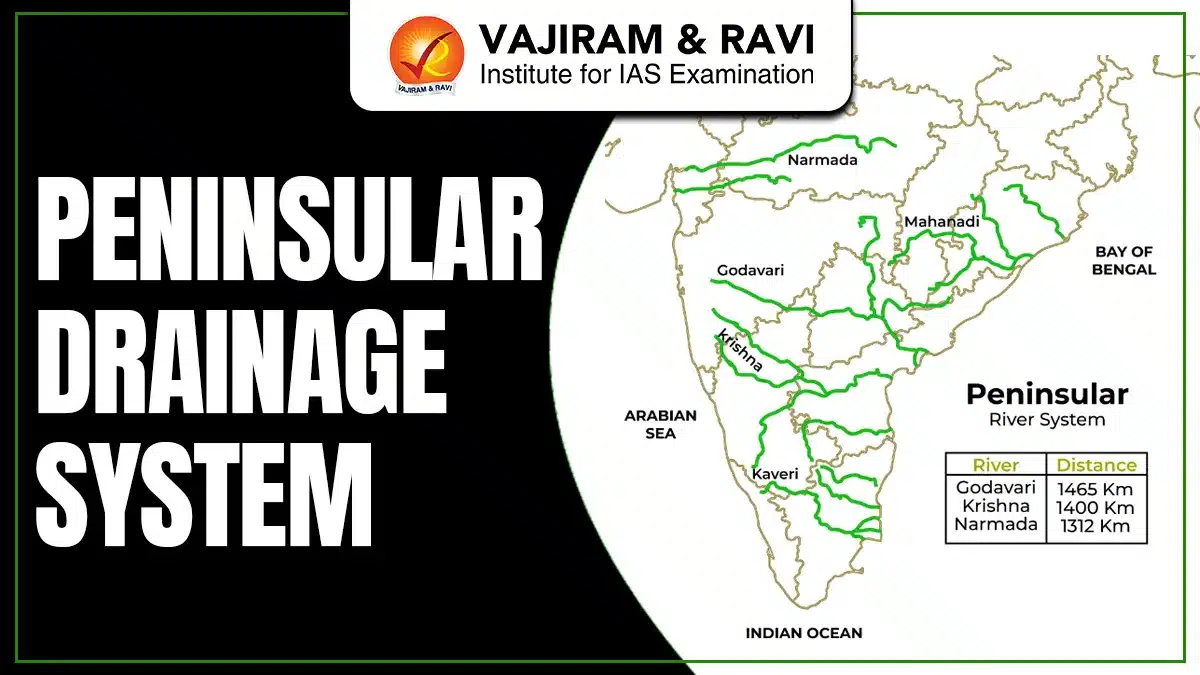
The Peninsular Drainage System is one of India’s oldest river systems, covering the southern and central plateau regions. It developed on the ancient Gondwana landmass and flows over hard, crystalline rocks. Most rivers are seasonal and rain-fed, with fixed courses and broad valleys. Key rivers include Godavari, Krishna, Cauvery, Mahanadi, Narmada, and Tapi, supporting irrigation, hydropower, and regional development.

Peninsular Drainage System

The Peninsular Drainage System is one of India’s oldest river systems, flowing across the stable Peninsular Plateau. Most rivers are rain-fed and seasonal, with well-defined and fixed courses. They have broad valleys, waterfalls, and rapids due to the hard rocky terrain. These rivers are crucial for irrigation, hydropower, and supporting regional economies.

Peninsular Drainage System Geological Evolution

The geological evolution of the Peninsular Drainage System is linked to the ancient Gondwana landmass, making it one of the oldest river systems in the world. Most peninsular rivers were formed much before the uplift of the Himalayas. Later tectonic movements, faulting, and tilting of the Peninsular Plateau modified their present courses.

  • The Peninsular Plateau is composed of hard igneous and metamorphic rocks, which resisted extensive erosion.
  • Rivers developed during the Pre-Cambrian period, long before the formation of young fold mountains.
  • The tilting of the Peninsular block towards the east caused many rivers to flow eastward into the Bay of Bengal.
  • Faulting and rifting led to the formation of rift valleys, through which the Narmada and Tapi rivers flow.
  • Some rivers originally flowed westward but were later captured or diverted due to tectonic disturbances.
  • Rivers are in a mature stage, showing limited vertical erosion and broad valleys.
  • Long geological stability resulted in fixed river courses with minimal shifting over time.

Peninsular Drainage System Features

The Peninsular Drainage System has evolved over a long geological period, giving it stable and well-defined characteristics. The major features of the Peninsular Drainage System is given below.

  • Most rivers are seasonal and receive water primarily from the southwest monsoon.
  • Rivers have shorter lengths and smaller basins compared to Himalayan rivers.
  • Flow over hard igneous and metamorphic rocks, resulting in shallow valleys.
  • River courses are fixed and stable, with little lateral shifting.
  • East-flowing rivers form extensive deltas, while west-flowing rivers form estuaries.
  • Presence of waterfalls, rapids, and gorges due to uneven plateau surface.
  • Limited vertical erosion as rivers are in a mature stage of development.
  • Discharge varies greatly between monsoon and dry seasons.

East Flowing Rivers of the Peninsular Plateau

Most rivers of the Peninsular Plateau flow eastward and drain into the Bay of Bengal. These rivers generally have longer courses and wider drainage basins compared to west-flowing rivers. They carry large amounts of alluvium and form fertile delta regions along the eastern coast.

Mahanadi River

  • The Mahanadi River originates from the Sihawa Range in Chhattisgarh and flows eastward to drain into the Bay of Bengal.
  • It is known for forming a large and fertile delta in Odisha, supporting extensive rice cultivation.
  • Major projects like the Hirakud Dam make it vital for irrigation, flood control, and hydroelectric power.

Godavari River

  • The Godavari River, originating from Trimbakeshwar in the Western Ghats, is the longest river of the Peninsular Plateau.
  • It drains a vast basin across multiple states, earning it the title “Dakshin Ganga”.
  • The river forms an extensive delta in Andhra Pradesh and plays a key role in agriculture and drinking water supply.

Krishna River

  • The Krishna River rises near Mahabaleshwar in Maharashtra and flows east into the Bay of Bengal.
  • It supports major irrigation systems through projects like the Nagarjuna Sagar and Srisailam dams.
  • The Krishna basin is crucial for agriculture and hydropower in Maharashtra, Karnataka, Telangana, and Andhra Pradesh.

Cauvery River

  • The Cauvery River originates from the Brahmagiri Hills in the Western Ghats, Karnataka.
  • It is the primary source of irrigation in Tamil Nadu and forms one of the most fertile deltas in India.
  • The river holds immense cultural and economic importance, supporting agriculture, cities, and hydroelectric projects.

West Flowing Rivers of the Peninsular Plateau

West-flowing rivers of the Peninsular Plateau originate mainly from the Western Ghats and drain into the Arabian Sea. These rivers are comparatively short due to the steep western slope of the plateau. They generally form estuaries instead of deltas and have fast-flowing currents.

Narmada River

  • The Narmada River flows through a rift valley between the Vindhya and Satpura ranges.
  • One of the longest west-flowing rivers, draining into the Arabian Sea.
  • Important for irrigation, hydropower, and projects like the Sardar Sarovar Dam.

Tapi (Tapti) River

  • Tapi (Tapti) River originates from the Satpura Range and flows parallel to the Narmada.
  • Drains into the Arabian Sea near Surat, Gujarat.
  • Supports agriculture and industrial activities in central and western India.

Periyar River

  • Periyar River is the longest river of Kerala, originating in the Western Ghats.
  • Plays a vital role in water supply and hydropower generation.
  • Supports irrigation and urban water needs in Kerala.

Sharavathi River

  • Sharavathi River originates in the Thirthahalli taluk of the Shimoga district (Shivamogga) in Karnataka in the Western Ghats and flows into the Arabian Sea.
  • Known for the Jog Falls, one of the highest waterfalls in India.
    Major source of hydroelectric power in Karnataka.

Himalayan vs Peninsular Drainage System

The Himalayan and Peninsular drainage systems differ greatly in origin, nature, and river behavior. Himalayan rivers are young, perennial, and highly erosive due to active tectonics. In contrast, Peninsular rivers are older, seasonal, and flow through stable landforms with fixed courses.

Himalayan vs Peninsular Drainage System
Basis Himalayan Drainage System Peninsular Drainage System

Geological Origin

Formed after Himalayan uplift during the Tertiary period on young fold mountains

Developed on ancient Gondwana landmass of the Peninsular Plateau

Age of Rivers

Geologically young and actively evolving

Very old rivers with mature stages

Nature of Flow

Perennial due to glacier, snowmelt, and monsoon rainfall

Mostly seasonal and dependent on monsoon rainfall

Course & Stability

Long, meandering courses with frequent shifting

Shorter, straighter, and fixed courses

Erosion & Valleys

Strong vertical and lateral erosion forming deep gorges and wide floodplains

Limited erosion forming broad, shallow valleys

Sediment & Landforms

High sediment load leading to extensive floodplains and large deltas

Lower sediment load; deltas in east and estuaries in west

Economic Role

Supports navigation, intensive agriculture, and dense population

Supports irrigation, hydropower, and regional water supply

Examples

Ganga, Yamuna, Brahmaputra, Indus

Godavari, Krishna, Cauvery, Narmada

Impact of Monsoon on Peninsular Drainage

The Peninsular Drainage System is predominantly rain-fed, with nearly 85–90% of annual river discharge occurring during the southwest monsoon (June–September). Variations in monsoon intensity directly affect river flow, agriculture, and water security in Peninsular India.

  • Seasonal Discharge Concentration: Around 80–90% of annual runoff in rivers like Godavari, Krishna, and Cauvery occurs during the monsoon months, leading to sharp seasonal contrasts in flow.
  • Flood Frequency: Intense monsoon rainfall has caused repeated floods in east-flowing river basins, such as the Godavari floods (2006, 2019) and Krishna basin floods (2009, 2020), affecting millions.
  • Drought Vulnerability: Nearly 50% of Peninsular India is classified as drought-prone due to monsoon variability, with weak monsoon years severely reducing river flow and reservoir levels.
  • Sediment Transport & Delta Growth: Heavy monsoon runoff enables rivers like the Mahanadi and Godavari to transport large sediment loads, contributing to the formation of some of India’s most fertile delta regions.
  • Reservoir Dependence: Major reservoirs such as Nagarjuna Sagar, Srisailam, and Mettur depend almost entirely on monsoon inflow, with low rainfall years reducing irrigation and hydropower output.
  • Agricultural Dependence: Over 60% of irrigated agriculture in peninsular states relies on monsoon-fed rivers and reservoirs, making crop yields highly rainfall-dependent.
  • Inter-State Water Disputes: Uneven monsoon rainfall intensifies disputes in basins like Cauvery, Krishna, and Godavari, especially during deficit rainfall years.

Importance of Peninsular Drainage System for Indian Economy

  • Irrigation Support: Rivers like Godavari, Krishna, Cauvery, and Mahanadi irrigate millions of hectares, supporting crops such as rice, sugarcane, cotton, and pulses. Over 60% of agriculture in peninsular states depends on these rivers.
  • Hydropower Generation: Major rivers provide sites for dams and hydropower projects, including Hirakud (Mahanadi), Srisailam (Krishna), Nagarjuna Sagar (Krishna), and Sharavathi (Jog Falls), contributing significantly to renewable energy production.
  • Industrial Water Supply: Peninsular rivers supply water to industrial hubs in Maharashtra, Karnataka, Telangana, and Tamil Nadu, supporting manufacturing, textiles, and chemical industries.
  • Fisheries and Livelihoods: Rivers support inland fisheries, providing livelihoods to millions in delta and coastal regions. The Godavari and Krishna deltas are especially rich in aquaculture.
  • Urban and Domestic Water Supply: Major cities like Hyderabad, Bengaluru, Vijayawada, and Chennai depend on peninsular rivers and reservoirs for drinking water and urban needs.
  • Navigation and Trade: Although limited compared to Himalayan rivers, some rivers like the Godavari support inland navigation and local trade.

Peninsular Drainage System FAQs

Q1: Why are peninsular rivers called old rivers?

Ans: They originated millions of years ago on the Gondwana landmass and have stable courses.

Q2: Which is the longest peninsular river?

Ans: The Godavari is the longest river of the Peninsular Drainage System.

Q3: Why do west-flowing rivers not form deltas?

Ans: Steep slopes and strong tidal currents prevent sediment deposition.

Q4: Which rivers flow through rift valleys?

Ans: The Narmada and Tapi rivers flow through rift valleys.

Q5: How do Peninsular rivers differ from Himalayan rivers?

Ans: Peninsular rivers are older, seasonal, and stable, while Himalayan rivers are younger, perennial, and highly erosive.

Pax Silica, Objective, Inaugural Summit, Core Commitments

Pax Silica

Why Pax Silica is in News?

The United States’ new Ambassador to India, Sergio Gor, announced that India will be invited to join Pax Silica.

What is Pax Silica?

Pax Silica is a US-led international coalition designed to build a secure, resilient, and innovation-driven silicon and AI supply chain ecosystem. It focuses on collaboration among trusted global partners to safeguard critical materials and ensure the development and deployment of advanced technologies.

Features of Pax Silica

The features of Pax Silica have been discussed below:

  • Objective: Reduce reliance on a single country for critical minerals and AI technology, while protecting sensitive materials and promoting innovation.
  • Inaugural Summit: Held in Washington, D.C., December 2025.
  • Critical Minerals: China dominates over 60% of lithium, cobalt, and rare earth production, which are crucial for semiconductors and AI hardware. Pax Silica aims to diversify supply chains globally.
  • Participating Nations: Japan, Republic of Korea, Singapore, Netherlands, United Kingdom, Israel, United Arab Emirates, and Australia.
  • Core Commitments: Joint projects covering semiconductor design, fabrication, packaging, compute infrastructure, energy grids, and protection of sensitive technologies.

Impact on Global Trade and Economy

Pax Silica has significant implications for global trade and the economy:

  • Diversification of Supply Chains: Reduces dependency on China for critical minerals, minimizing supply disruptions.
  • Boost to Innovation: Collaboration allows member countries to develop AI and semiconductor technologies at scale.
  • Economic Security: Joint projects ensure that sensitive technologies remain protected from countries of concern.
  • Job Creation: Strengthening AI and semiconductor industries could generate employment in high-tech sectors globally.
  • Trade Partnerships: Encourages deeper trade ties among coalition members, including technology sharing and joint investments.

India’s Initiatives to Strengthen the Silicon and AI Supply Chain

India has launched several initiatives to develop its semiconductor and AI capabilities and enhance critical mineral self-reliance: The key initiatives includes:

 1. India Semiconductor Mission (ISM, 2021)

  • Objective: The mission aims to build a robust indigenous semiconductor ecosystem in India, reducing dependence on imports and strengthening national security in technology-critical sectors.
  • Investment: The Government of India has committed USD 10 billion to support semiconductor manufacturing, research, and development projects across the country.
  • Approved Projects: Currently, 10 major projects have been approved, covering:
    • Fabrication Units (Fabs): Manufacturing chips domestically to reduce reliance on foreign suppliers.
    • Packaging and Testing: Ensuring high-quality standards and global competitiveness.
    • Chip Design: Supporting startups and established companies in advanced semiconductor design.
  • Impact: Once implemented, ISM is expected to create over 50,000 direct and indirect jobs, boost high-tech manufacturing, and make India a significant player in the global semiconductor supply chain.

2. IndiaAI Mission (2024)

  • Focus: The mission emphasizes the development of indigenous Large Language Models (LLMs), AI algorithms, and foundational AI infrastructure. This supports India’s goal of becoming a global AI innovation hub.

  • Infrastructure Expansion:
    • GPU capacity has been expanded to 34,333 GPUs, almost doubling previous capacity.
    • This allows faster AI model training and reduces reliance on foreign cloud platforms.
  • Shared Compute Platform:
    • Provides cloud-based resources for AI research, model training, and inference.
    • Tailored to Indian data and context, enabling AI solutions suitable for local languages, governance, healthcare, and industry needs.
  • Expected Outcome: Encourages the growth of AI startups, supports research in generative AI, and strengthens India’s digital sovereignty.

3. National Critical Mineral Mission (NCMM)

  • Objective: To achieve self-reliance in critical minerals essential for high-tech manufacturing, clean energy, and defense applications.
  • Scope: The mission covers the entire mineral lifecycle, including:
    • Exploration: Identifying domestic sources of lithium, cobalt, rare earths, and other strategic minerals.
    • Mining and Processing: Developing modern mining and refining capabilities in India.
    • Recycling and Circular Economy: Promoting sustainable use of minerals through recycling and recovery.
  • Key Initiatives:
    • Establish mineral parks to support industrial clustering and infrastructure development.
    • Promote mineral recycling and reuse to reduce imports and environmental impact.
    • Support research and innovation, including setting up Centres of Excellence for advanced mineral technologies.
  • Impact: Enhances India’s strategic autonomy, supports high-tech manufacturing, and aligns with global initiatives like Pax Silica and MSP.

4. Minerals Security Partnership (MSP)

  • Objective: The MSP is a US-led initiative that aims to strengthen global critical mineral supply chains while supporting India’s domestic strategy.
  • Key Benefits to India:
    • Encourages overseas mineral asset acquisition to secure long-term supply.
    • Strengthens international trade ties, facilitating partnerships with leading mining and technology firms.
    • Complements NCMM objectives, ensuring India can both produce and process strategic minerals efficiently.
  • Strategic Importance: Participation in MSP helps India reduce supply chain risks, access advanced technologies, and position itself as a trusted partner in global high-tech ecosystems.

Pax Silica FAQs

Q1: What is Pax Silica?

Ans: Pax Silica is a US-led coalition to secure and strengthen the global silicon and AI supply chain.

Q2: Why was Pax Silica formed?

Ans: It was formed to reduce dependency on a single country for critical minerals and AI technologies.

Q3: Which countries are part of Pax Silica?

Ans: Japan, South Korea, Singapore, Netherlands, UK, Israel, UAE, and Australia are members.

Q4: What is India’s role in Pax Silica?

Ans: India is expected to join the coalition to strengthen its AI, semiconductor, and critical minerals capabilities.

Q5: How does Pax Silica impact the global economy?

Ans: It diversifies supply chains, promotes innovation, and boosts economic and technological security.

Export Preparedness Index 2024

Export Preparedness Index 2024

Export Preparedness Index 2024 Latest News

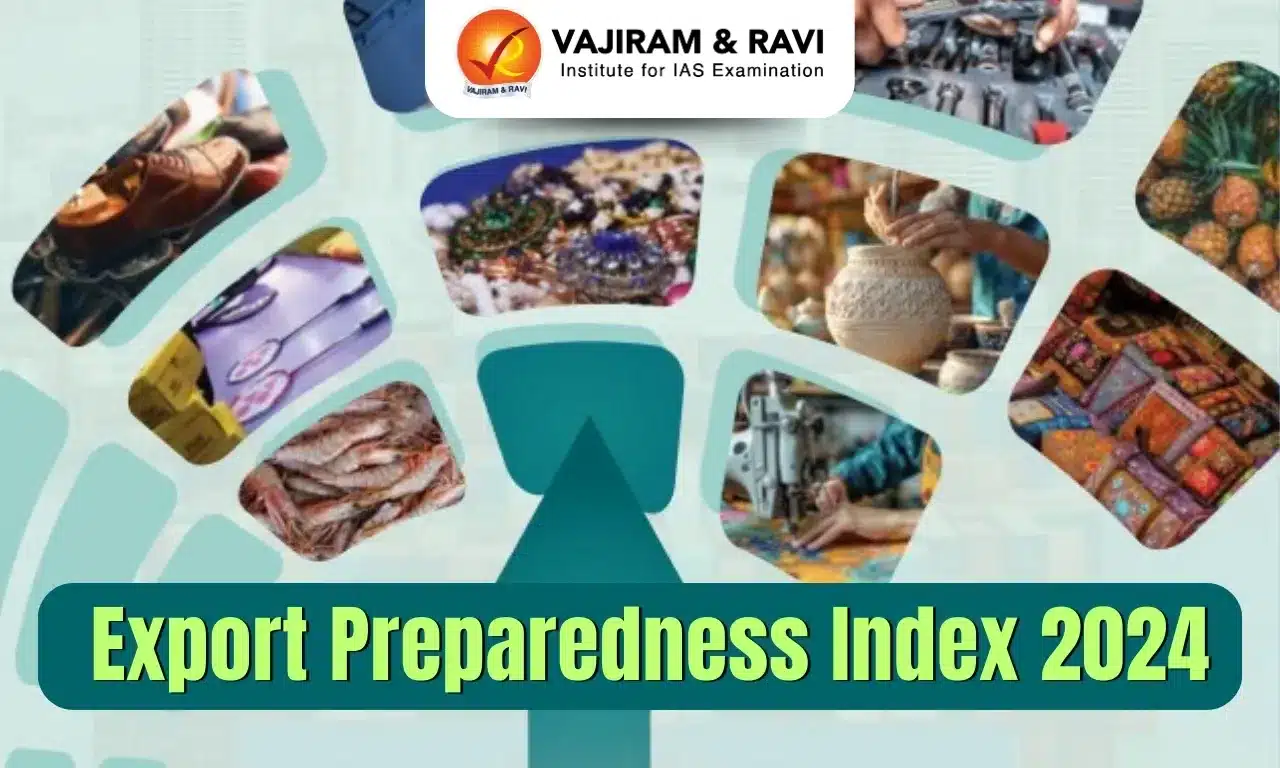
Recently, NITI Aayog released the Export Preparedness Index (EPI) 2024.

About Export Preparedness Index 2024

  • It is a comprehensive assessment of export readiness across India’s States and Union Territories (UTs).
  • It recognises the diversity of subnational economic structures and their critical role in advancing India’s global trade ambitions.
  • The first edition of the EPI was published in August 2020 and this is the 4th edition.
  • Framework and Coverage: It is structured around four pillars, further disaggregated into 13 sub-pillars and 70 indicators. Four Pillars are:
    • Export Infrastructure (20% Weightage)
    • Business Ecosystem (40% Weightage)
    • Policy and Governance (20% Weightage)
    • Export Performance (20% Weightage)
  • Classification of States and Union Territories: States and UTs have been categorised into Large States & Small States, North East States and Union Territories.
  • Within each category, they are further classified as
    • Leaders: States/UTs demonstrating relatively high export preparedness
    • Challengers: States/UTs with moderate preparedness and scope for improvement
    • Aspirers: States/UTs at early stages of export ecosystem development
  • Under EPI 2024, the following States and UTs have emerged as leading performers in their respective categories:
    • Leading Performers – Export Preparedness Index (EPI) 2024
      • Large States: Maharashtra, Tamil Nadu, Gujarat,Uttar Pradesh, Andhra Pradesh
      • Small States, North Eastern States & Union Territories: Uttarakhand, Jammu and Kashmir, Nagaland, Dadra and Nagar Haveli & Daman and Diu, Goa

Source: PIB

Export Preparedness Index 2024 FAQs

Q1: Which state topped the Export Preparedness Index 2024 in the large states category?

Ans: Maharashtra

Q2: How many pillars is the Export Preparedness Index 2024 structured around?

Ans: 4

यूपीएससी पाठ्यक्रम 2026, आईएएस प्रारंभिक और मुख्य परीक्षा पाठ्यक्रम पीडीएफ

यूपीएससी पाठ्यक्रम 2026 upsc syllabus in hindi

यूपीएससी का पाठ्यक्रम उम्मीदवारों के ज्ञान, योग्यता और विश्लेषणात्मक क्षमताओं का आकलन करने के लिए डिज़ाइन किया गया है, और इसमें दो चरण शामिल हैं: प्रारंभिक परीक्षा (प्रीलिम्स) और मुख्य परीक्षा (मेन्स), जिसके बाद साक्षात्कार/व्यक्तित्व परीक्षण होता है। प्रारंभिक परीक्षा के लिए यूपीएससी के पाठ्यक्रम में दो अनिवार्य प्रश्नपत्र शामिल हैं: सामान्य अध्ययन प्रश्नपत्र-I और सामान्य अध्ययन प्रश्नपत्र-II (जिसे सीसैट या सिविल सेवा योग्यता परीक्षा भी कहा जाता है)। ये प्रश्नपत्र इतिहास, भूगोल, अर्थशास्त्र, राजनीति, पर्यावरण, विज्ञान और समसामयिक मामलों सहित कई विषयों को कवर करते हैं।

यूपीएससी मुख्य परीक्षा का पाठ्यक्रम अधिक विशिष्ट है और इसमें नौ पेपर होते हैं, जिनमें एक निबंध पेपर, चार सामान्य अध्ययन पेपर, दो वैकल्पिक विषय पेपर और दो भाषा पेपर (दोनों ही योग्यता प्रकृति के) शामिल हैं।

यूपीएससी पाठ्यक्रम 2026 पीडीएफ

यूपीएससी पाठ्यक्रम पीडीएफ उम्मीदवारों के लिए एक रोडमैप का काम करता है, जिससे उन्हें परीक्षा के प्रत्येक चरण, जिसमें प्रारंभिक परीक्षा, मुख्य परीक्षा और व्यक्तित्व परीक्षण (साक्षात्कार) शामिल हैं, में क्या अपेक्षित है, इसकी स्पष्ट समझ मिलती है। उम्मीदवार प्रारंभिक और मुख्य परीक्षा के लिए यूपीएससी पाठ्यक्रम पीडीएफ निम्नलिखित लिंक से डाउनलोड कर सकते हैं:

यूपीएससी प्रारंभिक परीक्षा पाठ्यक्रम 2026

परीक्षा का पहला चरण, यानी सिविल सेवा प्रारंभिक परीक्षा, केवल एक स्क्रीनिंग परीक्षा है और मुख्य परीक्षा के लिए उम्मीदवारों का चयन करने के लिए आयोजित की जाती है। अंतिम मेरिट तैयार करते समय प्रारंभिक परीक्षा में प्राप्त अंकों को ध्यान में नहीं रखा जाता है।

प्रारंभिक परीक्षा में वस्तुनिष्ठ प्रकार के दो प्रश्नपत्र होते हैं जिनके अधिकतम अंक 400 होते हैं।

विवरण जानकारी

प्रश्नपत्रों की संख्या

2 अनिवार्य पेपर

प्रश्नों के प्रकार

वस्तुनिष्ठ (MCQ) प्रकार

कुल अधिकतम अंक

400 (प्रत्येक पेपर 200)

परीक्षा की अवधि

2 घंटे (दृष्टिहीन अभ्यर्थियों और लोकोमोटर विकलांगता व सेरेब्रल पाल्सी [न्यूनतम 40% विकलांगता] वाले अभ्यर्थियों के लिए 20 मिनट प्रति घंटा अतिरिक्त समय)

नकारात्मक अंकन

किसी प्रश्न के लिए निर्धारित अंकों का 1/3 भाग

परीक्षा का माध्यम

द्विभाषी (हिंदी और अंग्रेजी)

यूपीएससी सामान्य अध्ययन पेपर I का पाठ्यक्रम

इसमें निम्नलिखित विषयों को कवर करने वाले 100 प्रश्न हैं, जिनके अधिकतम अंक 200 हैं तथा इन्हें 2 घंटे में हल करना है।

  • राष्ट्रीय एवं अंतर्राष्ट्रीय महत्व की समसामयिक घटनाएँ।
  • भारत का इतिहास एवं भारतीय राष्ट्रीय आंदोलन।
  • भारतीय एवं विश्व भूगोल - भारत एवं विश्व का भौतिक, सामाजिक, आर्थिक भूगोल।
  • भारतीय राजनीति एवं शासन-संविधान, राजनीतिक व्यवस्था, पंचायती राज, सार्वजनिक नीति, अधिकार संबंधी मुद्दे, आदि।
  • आर्थिक एवं सामाजिक विकास - सतत विकास, गरीबी, समावेशन, जनसांख्यिकी, सामाजिक क्षेत्र की पहल, आदि।
  • पर्यावरण पारिस्थितिकी, जैव-विविधता और जलवायु परिवर्तन पर सामान्य मुद्दे - जिनके लिए विषय विशेषज्ञता की आवश्यकता नहीं है।
  • सामान्य विज्ञान।

यूपीएससी सामान्य अध्ययन पेपर-II का पाठ्यक्रम

इसमें निम्नलिखित विषयों से 80 प्रश्न होंगे जिनके लिए अधिकतम 200 अंक निर्धारित होंगे तथा इन्हें 2 घंटे में हल करना होगा।

  • समझ।(Comprehension)
  • संचार कौशल सहित पारस्परिक कौशल।
  • तार्किक तर्क एवं विश्लेषणात्मक क्षमता।
  • निर्णय लेना एवं समस्या समाधान करना।
  • सामान्य मानसिक क्षमता.
  • बुनियादी संख्यात्मकता (संख्याएँ और उनके संबंध, परिमाण के क्रम, आदि) (कक्षा X स्तर), डेटा व्याख्या (चार्ट, ग्राफ़, तालिकाएँ, डेटा पर्याप्तता, आदि - कक्षा X स्तर)

CSAT एक अर्हक परीक्षा है जिसके लिए न्यूनतम अर्हक अंक 33% निर्धारित हैं। मूल्यांकन के उद्देश्य से, किसी उम्मीदवार के लिए IAS प्रारंभिक परीक्षा के दोनों प्रश्नपत्रों में उपस्थित होना अनिवार्य है।

यूपीएससी मुख्य परीक्षा पाठ्यक्रम 2026

सिविल सेवा मुख्य परीक्षा में लिखित परीक्षा और साक्षात्कार (व्यक्तित्व परीक्षण) शामिल हैं। सिविल सेवा मुख्य परीक्षा में निम्नलिखित प्रश्नपत्र शामिल हैं, जिन्हें दो श्रेणियों में विभाजित किया गया है - अर्हक प्रश्नपत्र और योग्यता के लिए गिने जाने वाले प्रश्नपत्र।

योग्यता पत्र

विषय

निशान

पेपर-ए

संविधान की आठवीं अनुसूची में शामिल भाषाओं में से उम्मीदवार द्वारा चुनी जाने वाली एक भारतीय भाषा

300

पेपर-बी

अंग्रेजी

300

पेपर-I

निबंध

250

पेपर-II

सामान्य अध्ययन-I (भारतीय विरासत एवं संस्कृति, विश्व का इतिहास एवं भूगोल तथा समाज)

250

पेपर-III

सामान्य अध्ययन-II (शासन व्यवस्था, संविधान, राजनीति, सामाजिक न्याय एवं अंतर्राष्ट्रीय संबंध)

250

पेपर-IV

सामान्य अध्ययन-III (प्रौद्योगिकी, आर्थिक विकास, जैव-विविधता, पर्यावरण, सुरक्षा तथा आपदा प्रबंधन)

250

पेपर-V

सामान्य अध्ययन-IV (नैतिकता, सच्चाई और योग्यता)

250

पेपर-VI

वैकल्पिक विषय – पेपर 1

250

पेपर-VII

वैकल्पिक विषय – पेपर 2

250

उप-योग (लिखित परीक्षा)


1750

व्यक्तिगत परीक्षण


275

कुल योग


2025

महत्वपूर्ण बिंदु:

  • भारतीय भाषाओं और अंग्रेजी (पेपर ए और पेपर बी) के पेपर क्वालीफाइंग प्रकृति के होंगे और इन पेपरों में प्राप्त अंकों को रैंकिंग के लिए नहीं गिना जाएगा।
  • भारतीय भाषाओं और अंग्रेजी (पेपर ए और पेपर बी) के पेपर मैट्रिकुलेशन या समकक्ष स्तर के होंगे।
  • केवल ऐसे अभ्यर्थियों के निबंध, सामान्य अध्ययन और वैकल्पिक विषय के प्रश्नपत्रों पर विचार किया जाएगा, जो इन अर्हक प्रश्नोंपत्रों में न्यूनतम अर्हक मानक के रूप में 'भारतीय भाषा' में 25% अंक और 'अंग्रेजी' में 25% अंक प्राप्त करेंगे।
  • अभ्यर्थियों द्वारा केवल पेपर I-VII में प्राप्त अंक ही मेरिट रैंकिंग के लिए गिने जाएंगे।
  • मुख्य परीक्षा के प्रश्नपत्र पारंपरिक (निबंध) प्रकार के होंगे तथा प्रत्येक प्रश्नपत्र 3 घंटे की अवधि का होगा।
  • अभ्यर्थियों को अर्हक भाषा के प्रश्नपत्रों, प्रश्नपत्र-ए और प्रश्नपत्र-बी को छोड़कर, सभी प्रश्नपत्रों के उत्तर भारत के संविधान की आठवीं अनुसूची में शामिल किसी भी भाषा में या अंग्रेजी में देने का विकल्प होगा।
  • प्रश्न पत्र (भाषा साहित्य के प्रश्नपत्रों को छोड़कर) केवल हिंदी और अंग्रेजी में तैयार किए जाएंगे।
  • दृष्टिबाधित अभ्यर्थियों तथा लोकोमोटर विकलांगता और मस्तिष्क पक्षाघात से ग्रस्त अभ्यर्थियों, जिनमें प्रमुख (लेखन) अंग इस सीमा तक प्रभावित होता है कि उनके कार्य निष्पादन में कमी आ जाती है (न्यूनतम 40% हानि), को सिविल सेवा (प्रारंभिक) तथा सिविल सेवा (मुख्य) परीक्षा दोनों में बीस मिनट प्रति घंटा का प्रतिपूरक समय दिया जाएगा।

यूपीएससी पाठ्यक्रम 2026 अर्हक पत्रों के लिए (भारतीय भाषाएं और अंग्रेजी)

प्रश्नों का स्वरूप मोटे तौर पर इस प्रकार होगा:

अंग्रेजी भाषा:

  • दिए गए अनुच्छेदों की समझ।
  • सटीक लेखन.
  • उपयोग और शब्दावली.
  • लघु निबंध.

भारतीय भाषाएँ:

  • दिए गए अनुच्छेदों की समझ।
  • सटीक लेखन.
  • उपयोग और शब्दावली.
  • लघु निबंध.
  • अंग्रेजी से भारतीय भाषा में तथा इसके विपरीत अनुवाद।

यूपीएससी निबंध पाठ्यक्रम 2026

अभ्यर्थियों को कई विषयों पर निबंध लिखने की आवश्यकता हो सकती है।

उनसे अपेक्षा की जाएगी कि वे निबंध के विषय पर बारीकी से नज़र रखें, अपने विचारों को व्यवस्थित ढंग से प्रस्तुत करें और संक्षिप्त लेखन करें। प्रभावी और सटीक अभिव्यक्ति के लिए अंक दिए जाएँगे।

यूपीएससी जीएस 1 पाठ्यक्रम 2026

भारतीय विरासत और संस्कृति, विश्व का इतिहास और भूगोल तथा समाज।

  • भारतीय संस्कृति में प्राचीन काल से लेकर आधुनिक काल तक के कला रूपों, साहित्य और वास्तुकला के प्रमुख पहलुओं को शामिल किया जाएगा।
  • अठारहवीं शताब्दी के मध्य से लेकर वर्तमान तक का आधुनिक भारतीय इतिहास- महत्वपूर्ण घटनाएँ, व्यक्तित्व, मुद्दे।
  • स्वतंत्रता संग्राम - इसके विभिन्न चरण और देश के विभिन्न भागों से इसमें महत्वपूर्ण योगदानकर्ता/योगदान।
  • स्वतंत्रता के बाद देश के भीतर एकीकरण और पुनर्गठन।
  • विश्व के इतिहास में 18वीं शताब्दी की घटनाएं शामिल होंगी, जैसे औद्योगिक क्रांति, विश्व युद्ध, राष्ट्रीय सीमाओं का पुनः सीमांकन, उपनिवेशीकरण, उपनिवेशवाद-विमुक्ति, राजनीतिक दर्शन जैसे साम्यवाद, पूंजीवाद, समाजवाद आदि - उनके स्वरूप और समाज पर प्रभाव।
  • भारतीय समाज की मुख्य विशेषताएँ , भारत की विविधता
  • महिलाओं की भूमिका और महिला संगठन, जनसंख्या और संबंधित मुद्दे, गरीबी और विकास संबंधी मुद्दे, शहरीकरण, उनकी समस्याएं और उनके समाधान।
  • भारतीय समाज पर वैश्वीकरण के प्रभाव।
  • सामाजिक सशक्तिकरण, सांप्रदायिकता , क्षेत्रवाद और धर्मनिरपेक्षता
  • विश्व के भौतिक भूगोल की प्रमुख विशेषताएँ।
  • विश्व भर में प्रमुख प्राकृतिक संसाधनों का वितरण (दक्षिण एशिया और भारतीय उपमहाद्वीप सहित); विश्व के विभिन्न भागों (भारत सहित) में प्राथमिक, द्वितीयक और तृतीयक क्षेत्र के उद्योगों की अवस्थिति के लिए उत्तरदायी कारक।
  • महत्वपूर्ण भूभौतिकीय घटनाएं जैसे भूकंप, सुनामी, ज्वालामुखीय गतिविधि, चक्रवात आदि, भौगोलिक विशेषताएं और उनके स्थान-महत्वपूर्ण भौगोलिक विशेषताओं (जल निकायों और बर्फ-टोपियों सहित) और वनस्पतियों और जीवों में परिवर्तन और ऐसे परिवर्तनों के प्रभाव।

यूपीएससी जीएस 2 पाठ्यक्रम 2026

शासन, संविधान, राजनीति, सामाजिक न्याय और अंतर्राष्ट्रीय संबंध।

  • भारतीय संविधान-ऐतिहासिक आधार, विकास, विशेषताएँ, संशोधन, महत्वपूर्ण प्रावधान और मूल संरचना
  • संघ और राज्यों के कार्य और जिम्मेदारियां, संघीय ढांचे से संबंधित मुद्दे और चुनौतियां, स्थानीय स्तर तक शक्तियों और वित्त का हस्तांतरण और उसमें चुनौतियां।
  • विभिन्न अंगों, विवाद निवारण तंत्रों और संस्थाओं के बीच शक्तियों का पृथक्करण
  • भारतीय संवैधानिक योजना की अन्य देशों के साथ तुलना।
  • संसद और राज्य विधानमंडल-संरचना, कार्यप्रणाली, कार्य संचालन, शक्तियां एवं विशेषाधिकार तथा इनसे उत्पन्न होने वाले मुद्दे।
  • कार्यपालिका और न्यायपालिका की संरचना, संगठन और कार्यप्रणाली - सरकार के मंत्रालय और विभाग; दबाव समूह और औपचारिक/अनौपचारिक संघ और राजनीति में उनकी भूमिका।
  • जनप्रतिनिधित्व अधिनियम की मुख्य विशेषताएं .
  • विभिन्न संवैधानिक पदों पर नियुक्ति, विभिन्न संवैधानिक निकायों की शक्तियां, कार्य और जिम्मेदारियां।
  • वैधानिक, विनियामक और विभिन्न अर्ध-न्यायिक निकाय।
  • विभिन्न क्षेत्रों में विकास के लिए सरकारी नीतियां और हस्तक्षेप तथा उनके डिजाइन और कार्यान्वयन से उत्पन्न मुद्दे।
  • विकास प्रक्रियाएं और विकास उद्योग - गैर सरकारी संगठनों, स्वयं सहायता समूहों, विभिन्न समूहों और संघों, दाताओं, धर्मार्थ संस्थाओं, संस्थागत और अन्य हितधारकों की भूमिका।
  • केन्द्र और राज्यों द्वारा जनसंख्या के कमजोर वर्गों के लिए कल्याणकारी योजनाएं और इन योजनाओं का निष्पादन; इन कमजोर वर्गों के संरक्षण और बेहतरी के लिए गठित तंत्र, कानून, संस्थाएं और निकाय।
  • स्वास्थ्य, शिक्षा, मानव संसाधन से संबंधित सामाजिक क्षेत्र/सेवाओं के विकास और प्रबंधन से संबंधित मुद्दे।
  • गरीबी और भुखमरी से संबंधित मुद्दे।
  • शासन, पारदर्शिता और जवाबदेही के महत्वपूर्ण पहलू, ई-गवर्नेंस- अनुप्रयोग, मॉडल, सफलताएं, सीमाएं और संभावनाएं; नागरिक चार्टर, पारदर्शिता और जवाबदेही तथा संस्थागत और अन्य उपाय।
  • लोकतंत्र में सिविल सेवाओं की भूमिका.
  • भारत और उसके पड़ोसी संबंध।
  • द्विपक्षीय, क्षेत्रीय और वैश्विक समूह तथा भारत से संबंधित और/या भारत के हितों को प्रभावित करने वाले समझौते।
  • विकसित और विकासशील देशों की नीतियों और राजनीति का भारत के हितों, भारतीय प्रवासियों पर प्रभाव।
  • महत्वपूर्ण अंतर्राष्ट्रीय संस्थाएं, एजेंसियां ​​और मंच - उनकी संरचना, अधिदेश।

यूपीएससी जीएस 3 पाठ्यक्रम 2026

प्रौद्योगिकी, आर्थिक विकास, जैव विविधता, पर्यावरण, सुरक्षा और आपदा प्रबंधन

  • भारतीय अर्थव्यवस्था तथा नियोजन, संसाधनों का जुटाव, वृद्धि, विकास और रोजगार से संबंधित मुद्दे।
  • समावेशी विकास और इससे उत्पन्न मुद्दे।
  • सरकारी बजट.
  • देश के विभिन्न भागों में प्रमुख फसलें-फसल पैटर्न, - विभिन्न प्रकार की सिंचाई और सिंचाई प्रणालियाँ, कृषि उपज का भंडारण, परिवहन और विपणन तथा मुद्दे और संबंधित बाधाएँ; किसानों की सहायता में ई-प्रौद्योगिकी।
  • प्रत्यक्ष एवं अप्रत्यक्ष कृषि सब्सिडी और न्यूनतम समर्थन मूल्य से संबंधित मुद्दे; सार्वजनिक वितरण प्रणाली-उद्देश्य, कार्यप्रणाली, सीमाएं, सुधार; बफर स्टॉक और खाद्य सुरक्षा के मुद्दे; प्रौद्योगिकी मिशन; पशुपालन का अर्थशास्त्र।
  • भारत में खाद्य प्रसंस्करण एवं संबंधित उद्योग- कार्यक्षेत्र एवं महत्व, स्थान, अपस्ट्रीम एवं डाउनस्ट्रीम आवश्यकताएं, आपूर्ति श्रृंखला प्रबंधन।
  • भारत में भूमि सुधार.
  • अर्थव्यवस्था पर उदारीकरण के प्रभाव, औद्योगिक नीति में परिवर्तन और औद्योगिक विकास पर उनके प्रभाव।
  • बुनियादी ढांचा: ऊर्जा, बंदरगाह, सड़कें, हवाई अड्डे, रेलवे आदि।
  • निवेश मॉडल.
  • विज्ञान एवं प्रौद्योगिकी- विकास और उनके अनुप्रयोग तथा दैनिक जीवन पर प्रभाव।
  • विज्ञान एवं प्रौद्योगिकी में भारतीयों की उपलब्धियां ; प्रौद्योगिकी का स्वदेशीकरण और नई प्रौद्योगिकी का विकास।
  • आईटी, अंतरिक्ष, कंप्यूटर, रोबोटिक्स , नैनो-टेक्नोलॉजी , जैव-टेक्नोलॉजी और बौद्धिक संपदा अधिकारों से संबंधित मुद्दों के क्षेत्र में जागरूकता ।
  • संरक्षण, पर्यावरण प्रदूषण और क्षरण, पर्यावरणीय प्रभाव मूल्यांकन।
  • आपदा एवं आपदा प्रबंधन।
  • विकास और उग्रवाद के प्रसार के बीच संबंध।
  • आंतरिक सुरक्षा के लिए चुनौतियां पैदा करने में बाहरी राज्य और गैर-राज्य अभिनेताओं की भूमिका।
  • संचार नेटवर्क के माध्यम से आंतरिक सुरक्षा के लिए चुनौतियां, आंतरिक सुरक्षा चुनौतियों में मीडिया और सामाजिक नेटवर्किंग साइटों की भूमिका, साइबर सुरक्षा की मूल बातें; धन शोधन और इसकी रोकथाम।
  • सीमावर्ती क्षेत्रों में सुरक्षा चुनौतियां और उनका प्रबंधन - संगठित अपराध का आतंकवाद से संबंध।
  • विभिन्न सुरक्षा बल एवं एजेंसियां ​​तथा उनका अधिदेश।

जीएस पेपर 4 पाठ्यक्रम 2026

नैतिकता, अखंडता और योग्यता

इस प्रश्नपत्र में सार्वजनिक जीवन में ईमानदारी, सत्यनिष्ठा से संबंधित मुद्दों के प्रति अभ्यर्थियों के दृष्टिकोण और दृष्टिकोण तथा समाज के साथ व्यवहार करते समय उनके सामने आने वाले विभिन्न मुद्दों और संघर्षों के प्रति उनकी समस्या समाधान की दृष्टि का परीक्षण करने के लिए प्रश्न शामिल होंगे।

इन पहलुओं को निर्धारित करने के लिए प्रश्नों में केस स्टडी दृष्टिकोण का उपयोग किया जा सकता है।

निम्नलिखित व्यापक क्षेत्रों को कवर किया जाएगा:

  • नैतिकता और मानवीय अंतरसंबंध: मानवीय कार्यों में नैतिकता का सार, निर्धारक और परिणाम; नैतिकता के आयाम; निजी और सार्वजनिक संबंधों में नैतिकता। मानवीय मूल्य - महान नेताओं, सुधारकों और प्रशासकों के जीवन और शिक्षाओं से शिक्षा; मूल्यों के विकास में परिवार, समाज और शैक्षणिक संस्थाओं की भूमिका।
  •  दृष्टिकोण: विषय-वस्तु, संरचना, कार्य; विचार और व्यवहार पर इसका प्रभाव और संबंध; नैतिक और राजनीतिक दृष्टिकोण; सामाजिक प्रभाव और अनुनय।
  • सिविल सेवा के लिए योग्यता और आधारभूत मूल्य, ईमानदारी, निष्पक्षता और गैर-पक्षपात, वस्तुनिष्ठता, सार्वजनिक सेवा के प्रति समर्पण, कमजोर वर्गों के प्रति सहानुभूति, सहिष्णुता और करुणा।
  • भावनात्मक बुद्धिमत्ता-अवधारणाएं, तथा प्रशासन और शासन में उनकी उपयोगिताएं और अनुप्रयोग।
  • भारत और विश्व के नैतिक विचारकों और दार्शनिकों का योगदान।
  • लोक प्रशासन में सार्वजनिक/सिविल सेवा मूल्य और नैतिकता: स्थिति और समस्याएं; सरकारी और निजी संस्थानों में नैतिक चिंताएं और दुविधाएं; नैतिक मार्गदर्शन के स्रोत के रूप में कानून, नियम, विनियम और विवेक; जवाबदेही और नैतिक शासन; शासन में नैतिक और नैतिक मूल्यों को मजबूत करना; अंतर्राष्ट्रीय संबंधों और वित्त पोषण में नैतिक मुद्दे; कॉर्पोरेट प्रशासन।
  • शासन में ईमानदारी: सार्वजनिक सेवा की अवधारणा; शासन और ईमानदारी का दार्शनिक आधार; सरकार में सूचना साझाकरण और पारदर्शिता, सूचना का अधिकार, आचार संहिता, आचरण संहिता, नागरिक चार्टर, कार्य संस्कृति, सेवा वितरण की गुणवत्ता, सार्वजनिक धन का उपयोग, भ्रष्टाचार की चुनौतियां।
  • उपरोक्त मुद्दों पर केस स्टडीज़।

यूपीएससी वैकल्पिक पाठ्यक्रम 2026

वैकल्पिक विषय के पेपर I और II, प्रत्येक 250 अंकों के हैं और कुल मिलाकर 500 अंक हैं। यूपीएससी ने चुनने के लिए 48 वैकल्पिक विषयों की सूची उपलब्ध कराई है। इन पेपरों में प्राप्त अंक अंतिम यूपीएससी सिविल सेवा परीक्षा परिणाम में रैंक निर्धारित करने में महत्वपूर्ण रूप से सहायक हो सकते हैं।

यूपीएससी वैकल्पिक पाठ्यक्रम 2026

UPSC Agriculture Syllabus

UPSC Animal Husbandry and Veterinary Science Syllabus

UPSC Anthropology Syllabus

UPSC History Syllabus

UPSC Botany Syllabus

UPSC Law Optional Syllabus

UPSC Chemistry Syllabus

UPSC Management Syllabus

UPSC Civil Engineering Syllabus

UPSC Maths Optional Syllabus

UPSC Commerce and Accountancy Syllabus

UPSC Mechanical Engineering Syllabus

UPSC Economics Syllabus

UPSC Medical Science Syllabus

UPSC Electrical Engineering Syllabus

UPSC Philosophy Syllabus

UPSC Geography Syllabus

UPSC Physics Optional Syllabus

UPSC Geology Syllabus

UPSC PSIR Optional Syllabus

UPSC Psychology Syllabus

UPSC Public Administration Optional Syllabus

UPSC Sociology Optional Syllabus

UPSC Statistics Syllabus

UPSC Zoology Syllabus

यूपीएससी वैकल्पिक साहित्य पाठ्यक्रम 2026

यूपीएससी के वैकल्पिक पाठ्यक्रम में 22 वैकल्पिक साहित्य विषय शामिल हैं। इन विषयों में असमिया, संस्कृत, तमिल आदि भारतीय भाषाएँ शामिल हैं। ये वैकल्पिक विषय भाषा के ज्ञान का परीक्षण करते हैं, जिसमें प्रसिद्ध लेखकों के साथ-साथ महत्वपूर्ण साहित्यिक ग्रंथ, गद्य और पद्य शामिल हैं।  यूपीएससी साहित्य पाठ्यक्रम में निम्नलिखित विषय शामिल हैं

यूपीएससी वैकल्पिक साहित्य पाठ्यक्रम 2026
UPSC Assamese Optional Syllabus UPSC Bengali Literature Syllabus
UPSC Gujarati Literature Optional Syllabus UPSC Hindi Literature Optional Syllabus
UPSC Maithili Literature Syllabus UPSC Malayalam Literature Syllabus
UPSC Manipuri Literature Optional Syllabus UPSC Odia Literature Syllabus
UPSC Punjabi Literature Syllabus UPSC Telugu Literature Syllabus
UPSC English Literature Syllabus UPSC Urdu Literature Syllabus
UPSC Dogri Literature Syllabus UPSC Kannada Literature Syllabus
UPSC Kashmiri Literature Syllabus UPSC Konkani Literature Syllabus
UPSC Marathi Literature Syllabus UPSC Nepali Literature Syllabus
UPSC Sanskrit Literature Syllabus UPSC Santhali Literature Syllabus
UPSC Sindhi Literature Syllabus UPSC Tamil Literature Syllabus
Other Related Posts of UPSC 2026

UPSC Syllabus 2026

UPSC Exam Pattern

UPSC Age Limit

IAS Salary

UPSC Exam Date 2026

UPSC Optional Subjects List

UPSC Calendar

UPSC Mains 2026

UPSC Prelims 2026

UPSC Interview

UPSC Result

UPSC Cut Off

UPSC CSAT Syllabus

UPSC Books

UPSC Admit Card

UPSC Previous Year Papers

UPSC Answer Key

IAS vs IPS

यूपीएससी पाठ्यक्रम 2026 FAQs

Q1: यूपीएससी परीक्षा 2026 का पाठ्यक्रम क्या है?

Ans: यूपीएससी पाठ्यक्रम 2026 में प्रारंभिक परीक्षा (सामान्य अध्ययन, सीएसएटी) और मुख्य परीक्षा (निबंध, जीएस I-IV, वैकल्पिक विषय और भाषा के पेपर सहित नौ पेपर) शामिल हैं।

Q2: क्या 2026 में यूपीएससी का पैटर्न बदल जाएगा?

Ans: यूपीएससी 2026 परीक्षा पैटर्न में किसी बड़े बदलाव की कोई आधिकारिक जानकारी नहीं है; यह पिछले वर्षों की तरह ही रहने की उम्मीद है।

Q3: यूपीएससी 2026 का पेपर पैटर्न क्या है?

Ans: यूपीएससी परीक्षा पैटर्न 2026 में प्रारंभिक परीक्षा (वस्तुनिष्ठ), मुख्य परीक्षा (वर्णनात्मक) और साक्षात्कार शामिल हैं। मुख्य परीक्षा में सामान्य अध्ययन, निबंध और एक वैकल्पिक विषय सहित नौ पेपर होते हैं।

Q4: आईएएस के लिए कौन सा विषय सर्वोत्तम है?

Ans: सर्वोत्तम वैकल्पिक विषय व्यक्तिगत रुचि के अनुसार भिन्न होता है, लेकिन लोकप्रिय विकल्पों में लोक प्रशासन, भूगोल, इतिहास, समाजशास्त्र और राजनीति विज्ञान शामिल हैं।

Q5: यूपीएससी के लिए कितने प्रयास मिलते है?

Ans: यूपीएससी सिविल सेवा परीक्षा के लिए, उम्मीदवारों को निर्धारित आयु सीमा के भीतर सामान्य के लिए 6 प्रयास, ओबीसी के लिए 9 और एससी/एसटी के लिए असीमित प्रयास मिलते हैं।

Huntington’s Disease (HD)

Huntington’s Disease

Huntington's Disease Latest News

Huntington's disease (HD) has long been impossible to cure, but new research is finally giving fresh hope.

About Huntington's Disease

  • It is a rare hereditary disorder in which brain cells, or neurons, in certain areas of your brain start to break down. 
    • The destruction of nerve cells happens in the basal ganglia, or the region of your brain that regulates your body’s movements.
    • It also affects the brain cortex (surface of your brain) that regulates your thinking, decision-making, and memory.
  • As the neurons degenerate, the disease can lead to emotional disturbances, loss of intellectual abilities, and uncontrolled movements.
  • What causes HD?
    • A genetic mutation of the HTT gene causes HD. If one of your parents has HD, you have a 50% chance of also developing it.
    • The HTT gene makes a protein called huntingtin. This protein helps your nerve cells (neurons) function.
    • If you have HD, your DNA doesn’t have all the information needed to make the huntingtin protein.
    • As a result, these proteins grow in an abnormal shape and destroy (instead of help) your neurons.
    • Your neurons die because of this genetic mutation.
  • How common is HD?
    • HD affects an estimated 3 to 7 out of every 100,000 people, most often people of European ancestry (biological family comes from European descent).
    • There are two main types of HD:
    • Adult-onset: This is the most common type. Symptoms usually start after age 30.
    • Early-onset (juvenile Huntington’s disease): This rare type affects children and teenagers. Symptoms appear before age 20.
  • Symptoms:
    • Common symptoms include uncontrollable dance-like movements (chorea) and abnormal body postures, as well as problems with behavior, emotion, thinking, and personality.
    • Other symptoms may include tremor (unintentional back-and-forth movement in the person’s muscles) and unusual eye movements. The eye movements can happen early in the disease.
    • These symptoms get worse over time.
    • As HD progresses, you will need constant assistance and supervision because of the debilitating nature of the disease.
    • People usually die from the disease within 15 to 20 years of developing symptoms.
  • Treatment: There is no treatment that can stop or reverse HD, but health care providers can offer medications to help with certain symptoms.

Source: SA

Huntington's Disease FAQs

Q1: What is Huntington’s disease (HD)?

Ans: It is a rare hereditary disorder in which certain brain cells gradually break down.

Q2: Which part of the brain is primarily affected in Huntington’s disease?

Ans: The basal ganglia, which regulate body movements, are primarily affected.

Q3: What are the major effects of neuron degeneration in Huntington’s disease?

Ans: Neuron degeneration leads to emotional disturbances, loss of intellectual abilities, and uncontrolled movements.

Q4: What causes Huntington’s disease?

Ans: Huntington’s disease is caused by a genetic mutation in the HTT gene.

Q5: Is there a cure or Huntington’s disease?

Ans: No, there is currently no treatment that can stop or reverse Huntington’s disease, though medications can help manage symptoms.

Daily Editorial Analysis 15 January 2026

Daily Editorial Analysis

The Continued Custody in Delhi Riots Cases is an Injustice

Context

  • The Supreme Court of India’s January 5, 2026 order in the Delhi Riots larger conspiracy case, which granted bail to five accused but denied it to Umar Khalid and Sharjeel Imam, has renewed debate on the interaction between criminal procedure, personal liberty, and state power.
  • The controversy arises from the prolonged detention of seven students and activists arrested during the 2020 protests against the Citizenship (Amendment) Act (CAA) under provisions of the Unlawful Activities (Prevention) Act (UAPA), despite the absence of a completed trial.

Right to Speedy Trial and Reason Behind Delayed Trial

  • Right to Speedy Trial

    • More than five years have elapsed since the arrests, with the trial still pending commencement.
    • Indian constitutional jurisprudence locates the right to speedy trial within Article 21, making procedural delay a direct infringement of liberty.
    • When pre-trial incarceration approaches half a decade, detention becomes indistinguishable from punishment and undermines the presumption of innocence.
    • The Supreme Court has previously stated that if the state cannot ensure trial within a reasonable period, its opposition to bail lacks legitimacy.
    • In this case, the Court concluded that delay justified bail for five accused but not for Khalid and Imam.
    • This distinction rested on the assertion that the latter two allegedly conceptualised the disturbances, placing them on a different footing.
    • Yet such differentiation relies on unproven allegations and grants excessive weight to prosecutorial assertion.
    • Liberty cannot be contingent upon the gravity of accusation alone, for this would empower the state to curtail freedom simply by escalating charges.
  • Reason Behind the Delay

    • The Court also observed that delay was partly attributable to the accused, but the pace of proceedings remains fundamentally under judicial control.
    • Judges can refuse adjournments and streamline hearings. The presence of hundreds of witnesses suggests the trial is unlikely to conclude swiftly, creating the risk of prolonged incarceration without adjudication.
    • The Court’s suggestion that bail may be reconsidered after another year implies that five-and-a-half years have not yet crossed a constitutional threshold, raising the spectre of detention spanning a decade or more without verdict.

Terrorism, the UAPA, and Expansive Interpretation

  • The order also raises structural concerns regarding the interpretation of Section 15 of the UAPA, which defines terrorism.
  • Alongside explicit elements involving weapons or violence, the statute includes the residual phrase by any other means.
  • Criminal law traditionally requires narrow construction of ambiguous provisions to safeguard individuals against state overreach.
  • Instead, the Court adopted a broad reading that could encompass non-violent protest actions such as chakka jams, vastly expanding the statute’s scope.
  • Such interpretation vests wide discretion in the executive, enabling it to classify forms of civil disobedience under anti-terror law rather than under ordinary criminal provisions.
  • The broader the definition, the greater the risk of suppressing dissent and discouraging democratic mobilisation.
  • Moreover, the interpretation directly affects bail due to Section 43D (5), which bars bail if a prima facie case exists based solely on prosecution material.
  • A wider definition of terrorism makes it easier to satisfy the prima facie threshold, thereby entrenching pre-trial detention and shifting power from judiciary to prosecution.
  • Across legal systems, stringent statutes demand cautious judicial construction. Departing from this principle accelerates the collapse of procedural safeguards and normalises preventive detention over judicial adjudication.

Deference, Evidence, and the Language of Conspiracy

  • The factual assessment within the order reflects a deferential approach toward prosecutorial narratives.
  • The available evidence indicates organisational efforts surrounding anti-CAA protests, including coordination of demonstrations and chakka jams.
  • These activities fall within the constitutional right to protest, even when disruptive. In the absence of direct evidence linking the accused to violence, the prosecution invoked a theory of conspiracy, alleging managerial responsibility for the riots.
  • Conspiracy theories often operate as substitutes for evidentiary gaps. Throughout history, from political trials in colonial contexts to episodes like the Dreyfus Affair, conspiracy has served as a legal framework for incarcerating individuals without concrete proof.
  • When liberty is at stake and trial delays are acute, judicial scrutiny should intensify rather than retreat.
  • Accepting speculative inferences without robust evidence risks turning accusation into pretext and detention into indefinite punishment.

Conclusion

  • The continued imprisonment of Khalid and Imam exemplifies the dangers posed by expansive statutory interpretation, prosecutorial discretion, and judicial deference.
  • When protest merges with terrorism and delay merges with punishment, constitutional commitments to liberty, dissent, and due process erode.
  • Correcting this imbalance is a matter of democratic principle and requires judicial willingness to prioritise liberty over speculative narratives of national security.

The Continued Custody in Delhi Riots Cases is an Injustice FAQs

Q1. What central issue does the Supreme Court’s January 2026 order highlight?
Ans. The order highlights the tension between prolonged pre-trial detention and the constitutional right to personal liberty.

Q2. Why was the denial of bail to Umar Khalid and Sharjeel Imam considered controversial?
Ans. It was considered controversial because the denial relied on unproven allegations and ignored the excessive delay in commencing the trial.

Q3. How did the Court interpret Section 15 of the UAPA?
Ans. The Court adopted a broad interpretation that could include non-violent protest actions such as chakka jams within the definition of terrorism.

Q4. What impact does Section 43D(5) of the UAPA have on bail decisions?
Ans. Section 43D(5) makes bail difficult by allowing denial when a prima facie case exists based solely on prosecution material.

Q5. What does the analysis suggest about judicial scrutiny in cases involving conspiracy allegations?
Ans. It suggests that judicial scrutiny should deepen rather than weaken, especially when liberty is at stake and direct evidence is lacking.

Source: The Hindu


An Exploration of India’s Minerals Diplomacy

Context

  • India’s clean energy transition is increasingly dependent on imported critical minerals and rare earths, making external supply chains vital, especially as China tightens export controls.
  • Like other countries, India is seeking to diversify mineral trade partnerships, encourage responsible production, and build standards-based markets.
  • To address both immediate needs and long-term resilience, India has adopted a two-pronged approach—securing overseas access while strengthening domestic capabilities.
  • Over the past five years, New Delhi has pursued numerous bilateral and multilateral partnerships alongside domestic policy reforms, raising questions about their effectiveness and the need for recalibration.

Uneven Progress Across Critical Mineral Partnerships

  • India’s critical mineral partnerships have delivered mixed outcomes, with some countries emerging as more reliable and strategically aligned than others.
  • Australia: A Reliable Anchor Partner

    • Australia stands out due to political stability, large mineral reserves, and strategic clarity.
    • Cooperation has progressed through long-term supply talks, joint research, and investments.
    • Under the 2022 India–Australia Critical Minerals Investment Partnership, five lithium and cobalt projects were identified for potential investment.
  • Japan: A Model for Long-Term Resilience

    • Japan offers a template for resilience built on diversification, stockpiling, recycling, and sustained R&D—lessons drawn after China restricted rare earth exports a decade ago.
    • Beyond ties with Indian Rare Earths Limited, cooperation now includes joint extraction, processing, and stockpiling, bilaterally and in third countries.
  • Africa: Opportunity with a Long-Term Lens

    • African nations present strong opportunities, combining mineral abundance with growing expectations of local value addition.
    • India’s agreements with Namibia (lithium, rare earths, uranium) and asset talks in Zambia (copper, cobalt) signal intent.
    • Success will depend on a long-term industrial approach to compete with more coordinated players.
  • United States: Strategic Potential, Policy Volatility

    • Despite “friend-shoring” rhetoric, cooperation with the United States has struggled to move beyond dialogue.
    • Tariffs, shifting trade rules, and Inflation Reduction Act incentives add uncertainty.
    • Initiatives like TRUST and the Strategic Minerals Recovery Initiative offer frameworks, but policy volatility limits reliability.
  • European Union: Standards-Driven Synergy

    • The European Union demonstrates how regulation and industrial strategy can align through the Critical Raw Materials Act and the European Battery Alliance.
    • Progress for India requires alignment with EU transparency, lifecycle, and environmental standards.
  • West Asia: Midstream Potential, Limited Depth

    • United Arab Emirates and Saudi Arabia are investing in battery materials, refining, and green hydrogen, acquiring mining stakes globally.
    • The region could serve India as a midstream processing hub, though institutional frameworks remain thin.
  • Russia: A Hedge, Not a Foundation

    • Russia holds substantial reserves and has longstanding scientific ties with India.
    • However, sanctions, financing constraints, and logistical risks limit reliability—making Russia a supplementary hedge rather than a core pillar.

Latin America: Emerging Opportunities and Intense Competition

  • Latin America is emerging as a new frontier for India’s critical minerals strategy, with growing engagement in Argentina, Chile, Peru, and Brazil.
  • These countries are increasingly central to global copper, nickel, and rare-earth supply chains.
  • Indian public and private firms have begun investing in the region, including a ₹200 crore exploration and development agreement signed by Khanij Bidesh India Limited with Argentina.
  • However, competition is intense and engagement remains nascent, underscoring the need for value-chain partnerships and local processing beyond extraction.

Canada: Potential Partner Amid Diplomatic Reset

  • With diplomatic ties restored, Canada re-emerges as a promising minerals partner for India.
  • Canada’s reserves of nickel, cobalt, copper, and rare earths, alongside a recently signed trilateral agreement with Australia and India, position it well for cooperation.
  • Sustained progress, however, will depend on political stability and consistent bilateral engagement.

From Ore Access to Value-Chain Resilience

  • Across regions, a clear lesson emerges: securing mineral ore alone is insufficient. The real vulnerability lies in processing.
  • Without domestic refining and midstream capacity, India remains exposed to supply-chain disruptions.
  • Building Integrated, End-to-End Partnerships

    • India needs integrated partnerships across the value chain:
      • Upstream ore extraction: Africa, Australia, Canada, Latin America
      • Midstream processing of the mineral ores: West Asia (the Gulf) and Japan
      • Downstream technologies creation: European Union and United States (batteries, recycling)
      • Diversification hedge: Russia
    • Technology, innovation, and on-ground project execution matter more than announcements.
  • Strategic Focus Before Expansion

    • While cooperation with additional partners like South Korea and Indonesia is valuable, India must first sharpen a coherent strategy for existing partnerships to ensure results.
  • Strengthening the Domestic Foundation

    • None of these efforts will succeed without a robust domestic framework for responsible mining.
    • Environmental, Social and Governance (ESG) standards, transparency, and regulatory certainty are increasingly decisive in international partnerships.

The Way Forward

  • India has built an extensive network of critical mineral partnerships. The next step is to deepen what works, recalibrate what doesn’t, and anchor the strategy in processing capacity, technology leadership, and long-term certainty.

An Exploration of India’s Minerals Diplomacy FAQs

Q1. Why are critical minerals central to India’s clean energy transition?

Ans. Critical minerals and rare earths are essential for batteries, renewables, and electronics, making secure and diversified supply chains vital for India’s clean energy goals.

Q2. Why has Australia emerged as a key minerals partner for India?

Ans. Australia offers political stability, large reserves, and strategic clarity, with cooperation advancing through investments, joint research, and identified lithium and cobalt projects.

Q3. What lessons does Japan offer in critical mineral resilience?

Ans. Japan demonstrates long-term resilience through diversification, stockpiling, recycling, and sustained R&D, especially after facing Chinese export restrictions on rare earths.

Q4. Why is processing a major vulnerability in India’s minerals strategy?

Ans. Without domestic refining and midstream processing capacity, India remains exposed to supply disruptions even if it secures upstream mineral extraction abroad.

Q5. What is the key priority for India’s minerals diplomacy going forward?

Ans. India must deepen effective partnerships, strengthen domestic ESG frameworks, and focus on integrated value-chain development covering extraction, processing, and downstream technologies.

Source: TH


Kashi–Tamil Sangamam - Celebrating India’s Living Civilisational Unity

Context

  • The Kashi–Tamil Sangamam, a flagship cultural initiative under the spirit of “Ek Bharat, Shreshtha Bharat”, highlights India’s civilisational continuity, cultural unity and people-to-people bonds.
  • The Somnath Swabhiman Parv (1026–2026), marking 1,000 years since the first attack on Somnath, puts the Sangamam within India’s broader historical and cultural consciousness.

Background - Idea of Sangamam

  • Sangam in Indian ethos symbolises confluence, integration and unity amid diversity.
  • The Kashi–Tamil Sangamam represents the living unity of India’s traditions while respecting regional uniqueness.
  • Kashi (Varanasi), a civilisational and spiritual anchor for millennia, where people from all over have come in search of knowledge, meaning and Moksha, is a natural venue for such cultural integration.

Civilisational Linkages Between Kashi and Tamil Nadu

  • Spiritual and cultural bonds - Kashi–Rameswaram axis

    • Baba Vishwanath (Kashi) and Rameswaram (Tamil Nadu) are key spiritual centres. Tenkasi in Tamil Nadu is known as Dakshin Kashi.
    • Saint Kumaraguruparar Swamigal strengthened spiritual and institutional ties between Kashi and Tamil Nadu.
  • Intellectual and nationalist connections

    • Mahakavi Subramania Bharati found in Kashi a space for intellectual growth, spiritual awakening, and deepening nationalism and vision of a united India.

Evolution of the Kashi–Tamil Sangamam

  • First edition (2022): Participation of scholars, artisans, students, farmers, writers and professionals, who travelled to Kashi, Prayagraj and Ayodhya.
  • Second edition (2023): Greater use of technology to overcome language barriers. The aim was to introduce innovative formats and deeper engagement, so that the Sangamam continued to evolve while remaining rooted in its core spirit.
  • Third edition: The focus was on Indian Knowledge Systems (IKS), expanding academic discussions, exhibitions and cultural interactions.
  • Fourth edition (2025):
    • Theme: Tamil Karkalam (Learn Tamil)
    • Teachers from Tamil Nadu taught Tamil to students in Kashi, emphasising linguistic integration and cultural learning.

Key Highlights of the Fourth Edition

  • Translation: Of Tholkappiyam (ancient Tamil literary classic) into 4 Indian languages, and 6 foreign languages.
  • Sage Agastya Vehicle Expedition (SAVE): From Tenkasi to Kashi, it included activities like eye camps, health awareness, digital literacy camps. Tribute to King Adi Veera Parakrama Pandiyan, symbol of cultural oneness
  • Other highlights: Academic sessions at Banaras Hindu University (BHU), cultural exhibitions at Namo Ghat, and high participation of Yuva Shakti (youth).

Role of Institutions and Governance

  • Indian Railways operated special trains for participants.
  • Warm hospitality by people of Kashi and Uttar Pradesh.
  • Strong administrative coordination ensuring a seamless experience.
  • Valedictory function held at Rameswaram, attended by the Vice President of India, highlighting spiritual unity and national integration.

Challenges and Way Ahead

  • Sustaining long-term engagement: Linking cultural exchanges with education, tourism and local economies.
  • Ensuring deeper grassroots participation: Institutionalising Sangamam-type platforms across regions.
  • Avoiding symbolic tokenism: Greater academic, youth and digital integration.
  • Bridging linguistic and regional gaps: Using technology for inclusive participation. Expanding translations and documentation of classical texts.

Conclusion

  • The Kashi–Tamil Sangamam exemplifies India’s living civilisational unity, where diversity is not erased but harmonised.
  • By fostering cultural understanding, academic exchange and youth participation, it strengthens the foundations of national integration.
  • Alongside India’s shared festivals like Pongal, Sankranti, Magh Bihu and Uttarayan, such initiatives reinforce harmony, collective heritage and the timeless idea of One India, Many Traditions.

Kashi–Tamil Sangamam FAQs

Q1. How does the Kashi–Tamil Sangamam contribute to the idea of “Ek Bharat, Shreshtha Bharat”?

Ans. It promotes cultural integration, linguistic understanding and people-to-people exchanges, reinforcing India’s unity amid diversity.

Q2. What is the civilisational significance of Kashi in fostering pan-Indian cultural linkages?

Ans. Kashi has historically functioned as a spiritual and intellectual hub connecting diverse regions.

Q3. What is the role of cultural initiatives like Kashi–Tamil Sangamam in strengthening national integration?

Ans. Such initiatives deepen cultural understanding, youth participation and shared civilisational consciousness across regions.

Q4. Why is the translation of classical texts like Tholkappiyam important from a cultural integration perspective?

Ans. It democratises access to ancient knowledge and promotes inter-regional and global appreciation of India’s linguistic heritage.

Q5. What is the significance of youth participation in cultural programmes such as the Kashi–Tamil Sangamam?

Ans. Youth engagement ensures continuity of cultural values and strengthens long-term national unity through informed participation.

Source: IE

Daily Editorial Analysis 15 January 2026 FAQs

Q1: What is editorial analysis?

Ans: Editorial analysis is the critical examination and interpretation of newspaper editorials to extract key insights, arguments, and perspectives relevant to UPSC preparation.

Q2: What is an editorial analyst?

Ans: An editorial analyst is someone who studies and breaks down editorials to highlight their relevance, structure, and usefulness for competitive exams like the UPSC.

Q3: What is an editorial for UPSC?

Ans: For UPSC, an editorial refers to opinion-based articles in reputed newspapers that provide analysis on current affairs, governance, policy, and socio-economic issues.

Q4: What are the sources of UPSC Editorial Analysis?

Ans: Key sources include editorials from The Hindu and Indian Express.

Q5: Can Editorial Analysis help in Mains Answer Writing?

Ans: Yes, editorial analysis enhances content quality, analytical depth, and structure in Mains answer writing.

Section 17A Verdict: Corruption Control vs Officer Protection

Section 17a Latest

Section 17a Latest News

  • A two-judge bench of the Supreme Court of India delivered a split verdict on the constitutionality of Section 17A of the Prevention of Corruption Act, 1988
    • Given the divergent views, the case has been referred to the Chief Justice of India to constitute a larger bench for final adjudication.
  • Inserted in 2018, the provision requires prior government approval before police can initiate enquiries or investigations against public servants for decisions taken in official duties.
  • The judgment underscores a long-standing tension in administrative law — striking a balance between empowering agencies to act decisively against corruption and protecting honest civil servants from undue harassment.

Addressing Policy Paralysis in Governance

  • Section 17A was introduced to prevent “policy paralysis” by protecting civil servants from investigative harassment over bona fide decisions. 
  • The concern was that fear of probes could deter officials from taking bold, necessary policy decisions.

Protecting the ‘Steel Frame’ of India

  • Justice K V Viswanathan underscored the need for such protection, invoking Sardar Vallabhbhai Patel’s description of civil servants as the “Steel Frame of India.” 
  • He warned that without safeguards, honest officers would adopt a risk-averse “play-it-safe” approach, ultimately harming national interests.

The Constitutional Flaw in Section 17A

  • Justice Viswanathan acknowledged a key defect in the provision: the authority to grant or deny approval for investigations rests with the government itself, undermining the independence essential for corruption inquiries.
  • To preserve the provision’s constitutionality, Justice Viswanathan adopted a “constructive approach.” 
  • He upheld the requirement of prior approval but ruled that decision-making must not be confined to the government alone
  • Instead, complaints must be independently screened by the Lokpal at the Centre and Lokayuktas in the States.

How the Proposed Mechanism Works

  • Under this framework, when police seek approval to investigate, the government must forward the request to the Lokpal. 
  • The Lokpal’s Inquiry Wing conducts a preliminary assessment, and if a prima facie case is found, the government is obliged to grant approval.
  • This ensures independent scrutiny of corruption allegations while retaining necessary protection for honest public servants, thereby balancing administrative efficiency with accountability.

Section 17A as a Shield for the Corrupt

  • Justice B V Nagarathna held that Section 17A is contrary to the very objective of the Prevention of Corruption Act, 1988. 
  • She argued that by blocking enquiries at the threshold, the provision effectively protects corrupt officials rather than safeguarding honest ones.

Conflict of Interest in Government Approval

  • She rejected the assumption that the government can act as an impartial authority in granting approval for investigations. 
  • She highlighted the risks of policy bias and conflict of interest, especially where allegations involve senior officials or ministers, making impartial decision-making by subordinate officers unrealistic.

Violation of the Right to Equality

  • She found Section 17A violative of Article 14, as it grants protection only to officials involved in “recommendations or decisions.” 
  • This, she said, unfairly discriminates against lower-level officials who perform clerical functions or record file notings and are denied similar safeguards.

Rejection of Judicial Reconstruction

  • Justice Nagarathna strongly disagreed with Justice Viswanathan’s effort to save the provision by routing approvals through the Lokpal. 
  • She termed this “judicial legislation,” asserting that courts cannot rewrite statutes by replacing “Government” with “Lokpal.”

‘Cart Before the Horse’ Argument

  • She dismissed the government’s claim that Section 17A acts as a gatekeeper against frivolous complaints. 
  • Without a preliminary police enquiry, she argued, it is impossible to assess whether allegations are genuine or baseless.

A Tool of Control Over Officials

  • Justice Nagarathna warned that Section 17A enables the government to wield a “Damocles’ sword” over public servants, pressuring them to conform to political interests under the threat of investigation approvals being selectively granted.

Divergent Readings of Supreme Court Precedents

  • A key disagreement in the split verdict centred on how to interpret two landmark rulings of the Supreme Court of India: Vineet Narain v. Union of India and Subramanian Swamy v. CBI
  • Both judgments had struck down prior approval requirements that restricted corruption investigations.

Justice Nagarathna: Section 17A as a Revival of Invalid Law

  • Justice B V Nagarathna viewed Section 17A as “old wine in a new bottle,” arguing that it resurrects protections earlier invalidated. 
  • She relied on Subramanian Swamy Case, where the Court held that any fetter on even a preliminary enquiry undermines the investigation process. 
  • In her view, Section 17A creates the same barrier—now extended to all public servants—and therefore suffers from the same constitutional infirmity.

Justice Viswanathan: Distinguishing the Earlier Rulings

  • Justice K V Viswanathan took a different approach, distinguishing Section 17A from the provisions struck down earlier. 
  • He noted that Subramanian Swamy invalidated Section 6A of the DSPE Act mainly because it discriminated between officers based on rank, violating equality under the Constitution
  • Since Section 17A applies uniformly to all public servants, he argued that this defect does not arise.
  • Justice Viswanathan further reasoned that the core principle of Vineet Narain and Subramanian Swamy was preventing executive control over investigations
  • By routing prior approval through an independent body like the Lokpal, he argued, Section 17A addresses this concern and meets constitutional requirements.

The Crux of the Disagreement

  • Thus, while Justice Nagarathna saw Section 17A as fundamentally incompatible with binding precedent, Justice Viswanathan believed that institutional redesign—through independent screening—was sufficient to reconcile the provision with earlier Supreme Court rulings.

Source: IE | BW | ToI

Section 17a FAQs

Q1: What is Section 17A of the Prevention of Corruption Act?

Ans: Section 17A requires prior government approval before investigating public servants for decisions taken in official duties, aiming to prevent harassment over bona fide actions.

Q2: Why did Section 17A reach the Supreme Court?

Ans: Section 17A was challenged for allegedly shielding corruption by allowing the government to block investigations, prompting constitutional scrutiny by the Supreme Court.

Q3: What was Justice Viswanathan’s view on Section 17A?

Ans: Justice Viswanathan upheld Section 17A by reading it down, arguing it prevents policy paralysis and protects honest officers if independent screening by the Lokpal is ensured.

Q4: Why did Justice Nagarathna strike down Section 17A?

Ans: Justice Nagarathna held Section 17A unconstitutional, stating it blocks preliminary enquiries, violates equality under Article 14, and creates conflicts of interest in corruption probes.

Q5: Why is the Section 17A verdict significant?

Ans: The Section 17A verdict highlights a core administrative law tension between empowering anti-corruption agencies and protecting civil servants from political pressure and investigative misuse.

Marine and Space Biotechnology: India’s Next Strategic Frontier

Marine and Space Biotechnology

Marine and Space Biotechnology Latest News

  • Futuristic space and marine biotechnology explores extreme environments such as deep oceans and outer space to generate new biological knowledge, materials, and manufacturing processes. 
  • Marine biotechnology studies microorganisms, algae, and other marine life to develop bioactive compounds, enzymes, biomaterials, food ingredients, and biostimulants adapted to harsh conditions. 
  • Space biotechnology focuses on understanding how microbes, plants, and human biological systems respond to microgravity and radiation, expanding possibilities for innovation in science and industry.

Why Marine and Space Biotechnology Matters for India

  • India’s extensive coastline of over 11,000 km and a vast Exclusive Economic Zone of more than two million sq km provide access to rich marine biodiversity, yet its global share in marine outputs remains low, revealing large untapped potential. 
  • Investing in marine biomanufacturing can create new sources of food, energy, chemicals, and biomaterials while easing pressure on land, freshwater, and agriculture. 
  • At the same time, space biotechnology is vital for India’s long-term space ambitions, supporting safe food production, human health management, and biological manufacturing in extreme environments. 
  • Together, these fields can position India as a global leader in future-ready biomanufacturing.

India’s Current Position in Marine and Space Biotechnology

  • India’s marine biomass production, including seaweed, remains modest at around 70,000 tonnes annually, forcing continued imports of seaweed-derived products like agar, carrageenan, and alginates for food, pharmaceuticals, cosmetics, and medical use. 
  • Policy initiatives under the Blue Economy agenda, the Deep Ocean Mission, and BioE3 aim to build integrated marine biomanufacturing linking cultivation, extraction, and downstream applications. 
  • A limited set of private players such as Sea6 Energy and ClimateCrew, alongside research bodies like ICAR–Central Marine Fisheries Research Institute, are exploring scale-up pathways. 
  • In space biotechnology, Indian Space Research Organisation is advancing microgravity biology research on microbes, algae, and life-support systems, though private-sector participation remains limited due to the sector’s nascent stage.

Global Advances in Marine and Space Biotechnology

  • The European Union is investing heavily in marine bioprospecting, algae-based biomaterials, and bioactive compounds, supported by shared research infrastructure such as the European Marine Biological Resource Centre
  • China has rapidly scaled seaweed aquaculture and marine bioprocessing to strengthen its bioeconomy. 
  • In space biotechnology, the United States leads through NASA and the International Space Station, where experiments on microbes, protein crystallisation, stem cells, and life-support systems advance drug discovery, regenerative medicine, and long-duration human space missions.

The Way Forward for Marine and Space Biotechnology

  • Marine and space biotechnology remain largely untapped frontiers where early movers can secure long-term strategic and technological advantages. 
  • The main risk is slow, fragmented research and development. 
  • A dedicated roadmap with clear timelines and outcomes is essential to focus resources, coordinate efforts, and accelerate progress.

Source: TH

Marine and space biotechnology FAQs

Q1: What is marine and space biotechnology?

Ans: Marine and space biotechnology uses deep oceans and outer space to develop new biological knowledge, biomaterials, enzymes, and manufacturing processes under extreme environmental conditions.

Q2: Why is marine and space biotechnology important for India?

Ans: Marine and space biotechnology helps India utilise marine biodiversity, reduce pressure on land resources, and support long-term space missions through sustainable food and life-support systems.

Q3: Where does India stand in marine and space biotechnology today?

Ans: India’s marine and space biotechnology sector is emerging, with modest seaweed output and ISRO-led microgravity research, but limited private-sector participation and industrial-scale biomanufacturing.

Q4: How are other countries advancing marine and space biotechnology?

Ans: The EU funds marine bioprospecting, China scales seaweed bioprocessing, and the US leads space biotechnology through ISS research on microbes, stem cells, and life-support systems.

Q5: What is the way forward for marine and space biotechnology in India?

Ans: India needs a clear roadmap for marine and space biotechnology with defined timelines, coordinated R&D, and integrated policies to gain early-mover strategic and technological advantages.

Henley Passport Index

Henley Passport Index

Henley Passport Index Latest News

The 2026 Henley Passport Index has shown significant shifts in global travel mobility, with Asia continuing to dominate the top ranks.

About Henley Passport Index

  • It is a popular ranking of global passports that measures passport strength by the number of destinations that holders can visit without a prior visa.
  • The index ranks countries based on statistics provided by the International Air Transport Association (IATA).
  • It started in 2006 as the Henley & Partners Visa Restrictions Index (HVRI).
  • The index includes 199 different passports and 227 different travel destinations.
  • Significance: The stronger the passport, the more countries its holders can enter without a prior visa — a privilege that reflects diplomatic ties, economic influence, and international trust.

Key Highlights of Henley Passport Index 2026

  • India’s passport also saw improvement, climbing five spots to 80th position
  • The top three passports in the world come from Asia. Singapore ranks first, while Japan and South Korea are tied for second place.
  • Afghanistan is at the bottom of the list, ranked 101st, with visa-free access to 24 destinations.

Source: ET

Henley Passport Index FAQs

Q1: What is India's rank in the Henley Passport Index 2026?

Ans: 80th

Q2: What is the Henley Passport Index?

Ans: A ranking of passports by visa-free access

Human Capital Index (HCI), Objectives, Indicators, India’s Performance

Human Capital Index

The Human Capital Index (HCI) is a global index developed by the World Bank to measure the level of human capital across countries. First released in 2018 as part of the Human Capital Project, the index assesses how effectively nations invest in the health, education, and overall development of their population.

Human Capital Index

The Human Capital Index provides a new way of understanding human capital by quantifying the impact of health and education on the productivity of the future workforce. It enables countries to estimate the income they may lose due to inadequate investment in human capital.

The index is measured on a scale of 0 to 1, where:

  • 1 represents complete health and education potential
  • 0 represents the absence of human capital development

Human Capital Index Objectives

The primary objectives of the Human Capital Index are focused on improving national productivity and sustainable development through better human outcomes.

  • To measure how health and education shape the future workforce of a country
  • To highlight learning gaps, health risks, and skill deficiencies in children
  • To encourage governments to invest more in people-centric development policies
  • To provide a comparative framework for assessing human capital across countries
  • To support evidence-based policymaking aimed at inclusive economic growth

Indicators Used in Human Capital Index

The Human Capital Index is calculated using three major components, which together reflect the quality and quantity of human capital formation.

1. Survival

This indicator measures whether children survive early childhood.

  • Under-5 mortality rate
  • Probability of survival from birth to age 5

2. Education

This component evaluates both the quantity and quality of education.

  • Expected years of schooling
  • Learning-adjusted years of schooling (LAYS), which factor in actual learning outcomes

3. Health

Health indicators reflect a child’s ability to be productive as an adult.

  • Adult survival rate (ages 15–60)
  • Rate of childhood stunting, indicating chronic malnutrition

India’s Performance in Human Capital Index 2020

In the Human Capital Index (HCI) 2020 released by the World Bank, India ranked 116th out of 174 countries. India’s HCI score improved to 0.49 in 2020, up from 0.44 in 2018, indicating gradual progress in health and education outcomes. This score implies that a child born in India is expected to achieve 49% of their full human capital potential by the age of 18, compared to a scenario of complete education and optimal health.

The report serves as a pre-COVID baseline and highlights persistent challenges related to learning quality, child nutrition, and healthcare access, which continue to limit India’s overall human capital development.

Government Initiatives to Improve Human Capital in India

The Government of India has launched multiple initiatives aimed at strengthening education, healthcare, nutrition, and skill development, directly impacting human capital growth.

  • National Education Policy (NEP) 2020 – Focuses on foundational literacy, skill-based learning, and higher education reforms
  • Ayushman Bharat – Expands healthcare access through Health and Wellness Centres and insurance coverage
  • Poshan Abhiyaan – Targets child malnutrition, stunting, and maternal health
  • Samagra Shiksha Abhiyan – Integrates school education from pre-primary to secondary level
  • Skill India Mission – Enhances employability through vocational training and digital skills

Human Capital Index FAQs

Q1: What is the Human Capital Index?

Ans: The Human Capital Index is a World Bank tool that measures how health and education outcomes affect the productivity of future workers.

Q2: Who publishes the Human Capital Index?

Ans: The World Bank publishes the Human Capital Index as part of its Human Capital Project.

Q3: When was the Human Capital Index first published?

Ans: The first Human Capital Index was published in 2018.

Q4: On what scale is the Human Capital Index measured?

Ans: The HCI is measured on a scale of 0 to 1, where 1 represents full health and complete education potential.

Q5: What does an HCI score indicate?

Ans: An HCI score shows the proportion of productivity a child born today can expect to achieve by adulthood compared to their full potential.

Miyawaki Method

Miyawaki Method

Miyawaki Method Latest News

The Miyawaki method can be used in cities where green space has thinned out over decades.

About Miyawaki Method

  • This method of afforestation was developed by renowned Japanese botanist Akira Miyawaki in the 1970s.
  • It is a revolutionary method for creating dense forests in limited spaces.
  • It is often referred to as the ‘pot plantation method’, it involves planting trees and shrubs close to one another to accelerate their growth.  
  • The competition for sunlight encourages trees to grow more vertically and less laterally.
  • It emphasises planting only plant species native to the local area. This fosters a more resilient and naturally balanced ecosystem.
  • Plants grow 10 times faster with this technique, making it a practical solution for urban areas.
  • They are much denser and house much more biodiversity — just like ancient, primordial forests. 
  • For the first two to three years, the forest requires regular watering, weeding, and monitoring. 
  • After this period, the forest becomes self-sustaining and requires minimal intervention
  • Advantages:
    • It improves soil quality, enhances biodiversity, and accelerates forest development.
    • Trees planted using the Miyawaki technique absorb more carbon, grow faster, and support richer biodiversity compared to traditional forests.
    • In urban settings, this technique has transformed polluted, barren lands into green ecosystems.
    • It has successfully managed industrial waste, reduced dust and foul odours, and curbed air and water pollution.
    • Additionally, it prevents soil erosion and promotes ecological balance, making it an effective tool for environmental restoration.

Source: TOI

Miyawaki Method FAQs

Q1: Who developed the Miyawaki Method of afforestation?

Ans: The Miyawaki Method was developed by Japanese botanist Akira Miyawaki in the 1970s.

Q2: What is the primary objective of the Miyawaki Method?

Ans: The primary objective is to create dense forests in limited spaces.

Q3: How does close planting affect tree growth in the Miyawaki Method?

Ans: Competition for sunlight encourages trees to grow vertically rather than laterally.

Q4: Why is the Miyawaki Method suitable for urban areas?

Ans: It requires limited space and enables rapid forest growth.

NPS Vatsalya Scheme

NPS Vatsalya Scheme

NPS Vatsalya Scheme Latest News

Recently, the Pension Fund Regulatory and Development Authority (PFRDA) has issued the NPS Vatsalya Scheme Guidelines 2025.

About NPS Vatsalya Scheme

  • It is a contributory savings and long term financial security scheme designed exclusively for minors.

Key Features of NPS Vatsalya Scheme

  • Eligibility: It is open to all Indian citizens, including NRI/OCI, below 18 years of age.
  • Account Operation: Account opened in the name of the minor and operated by the guardian
  • Contribution: Minimum initial and annual contribution ₹250 and no maximum limit on contribution
    • The contribution can also be gifted by relatives and friends. 
  • Pension Fund Selection: Guardian can choose any one Pension Fund registered with PFRDA 
  • Partial Withdrawal Provisions: It is allowed after completion of three years from account opening
    • Up to 25% of own contributions (excluding returns) is permitted for education, medical treatment and specified disabilities
    • It is allowed twice before 18 years and twice between 18-21 years, subject to conditions. 

Source: PIB

NPS Vatsalya Scheme FAQs

Q1: Who is eligible to open an NPS Vatsalya account?

Ans: Minor Indian citizens below 18 years

Q2: What happens to the NPS Vatsalya account when the child turns 18?

Ans: It is converted to a regular NPS account

Gharials

Gharials

Gharial Latest News

Despite significant existential threats, a comprehensive survey across the Ganga River basin recently revealed a population of 3,037 gharials (Gavialis gangeticus), the critically endangered fish-eating crocodile, inhabiting 13 of the surveyed rivers.

About Gharial

  • It is a freshwater crocodile belonging to the Crocodylia Order and Crocodylidae Family.
  • Scientific Name: Gavialis gangeticus
  • The name ‘gharial’ comes from the Hindi word ghara, meaning pot or vessel, referring to the bulbous snout tip of adult males, which resembles an inverted pot.

Gharial Distribution 

  • Its range spanned the rivers of Bangladesh, Bhutan, India, Myanmar, Nepal, and Pakistan.
  • Their major population occurs in three tributaries of the Ganga River: the Chambal and Girwa Rivers in India and the Rapti-Naryani River in Nepal.
  • The Gharial reserves of India are located in three States: Uttar Pradesh, Madhya Pradesh, and Rajasthan.

Gharial Features

  • It is one of the largest crocodilian species, with males reaching 16 to 20 feet (5 to 6 meters) in length. Females typically grow to lengths of 11.5 to 15 feet (3.5 to 4.5 meters).
  • They have thick skin covered with smooth epidermal scales that do not overlap. 
  • The snout of the gharial is uniquely the thinnest and most elongated among all the crocodilians.
  • In addition, the adult males sport a large bulb at the tip of their snout, called the ‘ghara’. 
  • It is also the most aquatic of all crocodilians, for it never moves far from the water.  Individuals typically only leave the water to bask and nest on sandbanks.
  • Reproduction: They mate during November–January and lay eggs March–May.

Gharial Conservation Status

It is classified as 'Critically endangered' under the IUCN Red List.

Source: NIE

Gharial FAQs

Q1: What is Gharial?

Ans: It is a freshwater crocodile belonging to the Crocodylia Order and Crocodylidae Family.

Q2: Which physical feature gives the gharial its name?

Ans: The bulbous structure called the ‘ghara’ at the tip of the snout of adult males gives the gharial its name.

Q3: What was the historical distribution range of the gharial?

Ans: Historically, gharials were found in rivers of Bangladesh, Bhutan, India, Myanmar, Nepal, and Pakistan.

Q4: Where does the major population of gharials occur today?

Ans: The major population occurs in the Chambal and Girwa Rivers in India and the Rapti–Naryani River in Nepal.

Q5: What is the conservation status of the gharial according to the IUCN Red List?

Ans: The gharial is listed as Critically Endangered on the IUCN Red List.

Asola Bhatti Wildlife Sanctuary

Asola Bhatti Wildlife Sanctuary

Asola-Bhatti Wildlife Sanctuary Latest News

The Delhi government recently said that over 6,500 monkeys rescued by civic bodies from residential and commercial areas across the city have been shifted to Asola-Bhatti Wildlife Sanctuary in the last five years.

About Asola-Bhatti Wildlife Sanctuary

  • Asola-Bhatti Wildlife Sanctuary, covering 32.71 sq.km. of area on the Southern Delhi Ridge of the Aravalli hill range on the Delhi-Haryana border, lies in Southern Delhi as well as the northern parts of Faridabad and Gurugram districts of Haryana state.
  • It is part of the Northern Aravalli Leopard Wildlife Corridor. 
  • In Delhi, Sanctuary passes through historical sites such as Chattarpur Temple, Tughlakabad, Surajkund, Anangpur Dam, and Adilabad Ruins.
  • Flora
    • The semi-arid forest vegetation of the Aravali region provides homes to certain plant species. 
    • It includes dhak (flame of the forest), babool (Acacia), khejri, and various shrubs and grasses that are well-adapted to dry conditions.
  • Fauna
    • It is home to a wide variety of animals, including the Indian leopard, jackal, Indian blue bull, sambar deer, wild boar, and mongoose. 
    • It is also a birdwatcher’s paradise, with over 200 species of birds spotted here, including the Indian peafowl, crested serpent-eagle, and Indian roller.
    • Reptiles such as the monitor lizard, Indian cobra, and Russell’s viper can also be found here.

Source: WEEK

Asola-Bhatti Wildlife Sanctuary FAQs

Q1: Where is the Asola-Bhatti Wildlife Sanctuary located?

Ans: It is located on the Southern Delhi Ridge of the Aravalli hill range along the Delhi–Haryana border.

Q2: What is the total area of the Asola-Bhatti Wildlife Sanctuary?

Ans: The sanctuary covers an area of 32.71 square kilometres.

Q3: Which major hill range is the Asola-Bhatti Wildlife Sanctuary a part of?

Ans: It is part of the Aravalli hill range

Q4: Which plant species are commonly found in the sanctuary?

Ans: Common plant species include dhak (flame of the forest), babool (Acacia), khejri, and various shrubs and grasses.

Molecular Cloud

Molecular Cloud

Molecular Cloud Latest News

Recently, astronomers studied the L328 molecular cloud, located around 700 light years away, to map the magnetic fields at multiple scales.

About Molecular Cloud

  • It is an interstellar cloud of gas and dust in which molecules can form, the most common of which is hydrogen (H2).

Properties of Molecular Cloud

  • These are characterized by their low temperatures (below 40 K, colder than liquid nitrogen) and relatively high densities (103–104 particles per cubic cm).
  • Size: The size of these clouds can be from a few light years up to 600 light years. Their total mass can reach several million solar masses.
  • Molecular clouds with dimensions of more than about 15 light years are also called giant molecular clouds.
  • The complex interplay between three key forces, namely gravity, magnetic fields, and turbulence, determines how these clouds collapse to form stars.
  • The central regions of these clouds are completely hidden from view by dust
  • They are the raw material of stars and planets. These clouds do not last for a very long time.
  • After the new stars are born, their solar winds blow away the remaining gas and dust. 

Significance of Molecular Cloud

  • Molecular clouds are so important because they are the raw material of stars and planets. 
  • It is thought to be the birthplace of stars and planetary systems through processes of contraction, condensation, and accretion.

Source: PIB

Molecular Cloud FAQs

Q1: What is the primary component of molecular clouds?

Ans: Molecular hydrogen

Q2: What is a molecular cloud?

Ans: A region of space with cold, dense molecular gas and dust

Indian Army Day 2026, Historical Background, Significance

Indian Army Day 2026

Indian Army Day 2026 is observed on 15 January 2026 across the country to honour the courage, discipline, and dedication of the Indian Army. This day is a reminder of the sacrifices made by millions of soldiers who safeguard India’s borders and sovereignty. It marks a historic moment when the Indian Army came under full Indian leadership after independence.

The celebration strengthens the bond between the armed forces and the citizens of India. Army Day also highlights the professionalism, readiness, and strength of one of the world’s largest military forces.

Indian Army Day 2026

Indian Army Day 2026 is celebrated with grand military parades, ceremonial events, and tributes to fallen soldiers. The President of India, Defence Minister, and senior military officials take part in these events. The day provides an opportunity for citizens to learn about the Army’s role in disaster relief, peacekeeping, and border security. Schools, colleges, and defence institutions also organize awareness programs.

Indian Army Day Historical Background

Indian Army Day 2026 marks an important moment in India’s military history when the leadership of the Indian Army came fully into Indian hands. On 15 January 1949, India appointed its first Indian Commander-in-Chief, ending British control over the Army. Since then, this day is celebrated every year to honour this historic change.

  • Indian Army Day is celebrated on 15 January every year.
  • On this day in 1949, Field Marshal K. M. Cariappa became the first Indian Army Chief.
  • He took over command from General Sir F. R. R. Bucher, the last British officer in charge.
  • This marked the complete independence of India’s military leadership.
  • The day represents national pride, self-rule, and sovereignty in defence matters.
  • It is celebrated to remember the journey of the Indian Army after independence.

Indian Army Day 2026 Theme

The Indian Army Day 2026 theme, “Year of Networking and Data Centricity,” emphasizes the digital transformation of the Indian Army with a strong focus on AI-enabled warfare, cyber resilience, and integrated battle management systems. This approach aligns with initiatives such as the Army Modernisation Plan, which leverages data analytics and real-time information sharing to enhance decision-making amid evolving threats from drones, cyber warfare, and hypersonic weapons.

Other Defence Days

All the important defence days celebrated have been tabulated below.

Day

Date

Significance

Army Day

15 January

Cariappa's command takeover (1949)

Navy Day

4 December

Operation Trident (1971 Liberation War)

Air Force Day

8 October

IAF formation (1932); 1st squadron raising

Who was Field Marshal KM Cariappa?

Field Marshal KM Cariappa was the first Indian Commander-in-Chief of the Indian Army and led Indian forces on the Western Front during the 1947 Indo-Pakistan War.

  • He was one of only two Indian Army officers to receive the highest military rank of Field Marshal, the other being Sam Manekshaw.
  • He took charge as the first Commander-in-Chief of independent India’s Army on 15 January 1949, which is now celebrated as Indian Army Day.
  • He replaced General Sir F. R. R. Bucher, who was the last British Commander-in-Chief of the Indian Army.
  • In 1947, he became the first Indian officer to be selected for advanced military training at the Imperial Defence College in the United Kingdom.
  • He was honoured with the Order of the Chief Commander of the Legion of Merit by US President Harry S. Truman for his outstanding service.
  • In 1983, the Government of India officially awarded him the rank of Field Marshal for his lifelong contribution to the nation.

Indian Army Day 2026 Significance

Indian Army Day 2026 is celebrated to honour the brave soldiers who protect India’s borders and keep the nation safe. It reminds every citizen of the sacrifices made by the Army for our freedom and security. This day also helps people understand the important role of the Indian Army in building a strong and peaceful country.

  • It pays respect to soldiers who risk their lives for the nation.
  • It reminds us of the courage and hard work of the Indian Army.
  • It encourages young people to serve the country.
  • It builds feelings of patriotism and national pride.
  • It shows how the Army helps not only in wars but also during disasters and emergencies.

Indian Army Day 2026 FAQs

Q1: When is Indian Army Day 2026 celebrated?

Ans: Indian Army Day 2026 will be celebrated on 15 January 2026 across India.

Q2: Why is Indian Army Day observed?

Ans: It is observed to honour the bravery, sacrifice, and service of Indian Army soldiers and to mark the day when India got its first Indian Army Chief.

Q3: Who was the first Indian Army Chief?

Ans: Field Marshal K. M. Cariappa was the first Indian Commander-in-Chief of the Indian Army.

Q4: What is the main highlight of Indian Army Day?

Ans: The main highlight is the Army Day Parade, where soldiers display their discipline, weapons, and military strength.

Q5: How does Indian Army Day inspire people?

Ans: It inspires citizens, especially the youth, to respect the armed forces and encourages them to serve the nation with dedication and pride.

Election Commission of India (ECI), Structure, Framework, Composition

Election Commission of India

The Election Commission of India (ECI) is an autonomous constitutional authority responsible for administering elections to the Parliament, state legislatures, and the offices of the President and Vice-President of India. Established on 25 January 1950, the Commission ensures that elections are conducted freely, fairly, and transparently across the country. Its work upholds the democratic principle of universal adult suffrage guaranteed by the Constitution under Article 326. The ECI’s independence and credibility are vital to maintaining India’s democratic integrity.

Election Commission of India

The Election Commission of India derives its powers and responsibilities from Article 324 of the Indian Constitution. It is a constitutional body, independent of government influence, tasked with supervising the entire electoral process. Initially a single-member body, it became a multi-member Commission in 1993, consisting of the Chief Election Commissioner (CEC) and two Election Commissioners. The ECI manages over 97 crore registered voters (as per 2024 data) and conducts elections in more than 10 lakh polling stations nationwide.

Election Commission of India Structure

The Election Commission of India (ECI) is a constitutional body established under Article 324 of the Indian Constitution. It is a multi-member commission responsible for supervising elections to Parliament, State Legislatures, and the offices of the President and Vice-President. Originally, it had only one Chief Election Commissioner (CEC), but since October 1993, it became a three-member body. The Commission operates as a collegiate body, ensuring collective decision-making. It has a permanent secretariat at Nirvachan Sadan, New Delhi, and functions independently of government control. Its structure ensures autonomy, impartiality, and accountability in the electoral process as mandated by the Constitution.

Election Commission of India Composition

The ECI comprises the Chief Election Commissioner (CEC) and two Election Commissioners (ECs), as provided under Article 324(2) of the Constitution. The President of India determines the number of Commissioners from time to time. All three members enjoy equal powers, salaries, and status, and decisions are taken collectively through majority vote. The Chief Election Commissioner acts as the head of the institution, ensuring smooth coordination. The administrative staff is drawn from central and state government services. This composition aims to maintain checks and balances within the Commission, upholding transparency and non-partisanship in the conduct of elections.

As of 2025 the members of Election Commission of India are:

  • Chief Election Commissioner (CEC): Shri Gyanesh Kumar
  • Election Commissioners: Dr. Sukhbir Singh Sandhu and Dr. Vivek Joshi

Chief Election Commissioner (CEC)

The Chief Election Commissioner is the head of the Election Commission of India and ensures the independence and integrity of the electoral process.

  • The CEC is appointed by the President of India under Article 324(2) of the Constitution.
  • The CEC’s role is crucial in enforcing the Model Code of Conduct (MCC), supervising voter rolls, and ensuring impartial conduct of elections.
  • The Supreme Court in T.N. Seshan vs Union of India (1995) upheld that all Election Commissioners are equal in power and status, ensuring collective functioning.
  • The CEC is considered the guardian of India’s electoral democracy, accountable only to Parliament and the Constitution.

Election Commissioners Appointment

The Chief Election Commissioner and other Election Commissioners are appointed by the President of India under Article 324(2). Though the Constitution does not specify a detailed procedure, the appointment is made on the advice of the Council of Ministers. However, several legal experts and the Supreme Court (in March 2023) have recommended a collegium system involving the Prime Minister, Leader of Opposition, and Chief Justice of India to ensure transparency until Parliament enacts law. Their appointment order is issued by the President, and their terms, conditions, and service benefits are defined under the Election Commission (Conditions of Service) Rules, 1992.

Election Commissioners Tenure

Under the Election Commission (Conditions of Service of Election Commissioners and Transaction of Business) Act, 1991, each Election Commissioner, including the CEC, holds office for six years or until attaining the age of 65 years, whichever is earlier. This fixed tenure provides functional independence and stability. Their salaries and allowances are equivalent to those of Judges of the Supreme Court, ensuring parity with other high constitutional offices. Article 324(5) protects their tenure by stating that their service cannot be varied to their disadvantage after appointment. Such constitutional safeguards ensure autonomy and prevent arbitrary interference by the executive branch.

Election Commissioners Resignation and Removal

Election Commissioners may resign from office by submitting a written resignation to the President of India. However, the Chief Election Commissioner (CEC) enjoys stronger constitutional protection. Under Article 324(5), the CEC can be removed only in the same manner and on the same grounds as a Judge of the Supreme Court, that is, by a special majority of both Houses of Parliament on proven misbehavior or incapacity. Other Election Commissioners can be removed only on the recommendation of the CEC. This system ensures the Commission’s independence, preventing misuse of executive power and preserving the institution’s credibility and neutrality in elections.

Election Commission of India Powers

The Commission enjoys wide-ranging powers to ensure the integrity, neutrality, and transparency of the electoral process across India.Key Powers:

  • Administrative Powers: Control over election schedules, polling arrangements, and the deployment of polling staff.
  • Advisory Powers: Advises the President and Governors on matters related to disqualification of members.
  • Quasi-Judicial Powers: Decides disputes regarding political party recognition and symbols under the Election Symbols (Reservation and Allotment) Order, 1968.
  • Regulatory Powers: Enforces the Model Code of Conduct (MCC) and monitors election expenditure.
  • Disciplinary Powers: Can direct transfers or suspension of officials for election-related misconduct.

Election Commission of India Functions

The ECI performs multiple functions to ensure free, fair, and periodic elections in accordance with democratic principles. Major Functions:

  • Conduct of Elections: Supervises, directs, and controls elections to Parliament, State Legislatures, and high offices.
  • Delimitation: The Election Commission of India (ECI) does not directly have delimitation powers; instead, it oversees the process, which is conducted by a separate, temporary Delimitation Commission established by the Central Government.
  • Electoral Rolls: Prepares, revises, and updates voter lists through continuous revision and SIR (Special Intensive Revision).
  • Registration of Political Parties: Recognizes parties and allots election symbols.
  • Voter Education: Promotes awareness under the Systematic Voters’ Education and Electoral Participation (SVEEP) program.
  • Monitoring Expenditure: Ensures transparency through election expenditure audits and monitoring teams.

Election Commission of India Constitutional Provisions

The Election Commission of India is established under Article 324 of the Constitution to ensure free and fair elections in India. Key Constitutional Provisions:

  • Article 324(1): Grants the ECI the power to conduct elections to Parliament, State Legislatures, and the offices of President and Vice-President.
  • Article 324(2): Empowers the President to appoint the Chief Election Commissioner and other Election Commissioners.
  • Article 324(5): Provides protection to the tenure and service conditions of the CEC, ensuring independence.
  • These provisions ensure the ECI acts as an autonomous constitutional authority, not subordinate to any executive or legislature.

Election Commission of India Legal Safeguards

The legal framework guarantees the Commission’s independence and shields it from executive or political influence during elections. Major Legal Provisions:

  • Article 324(5): Protects the CEC’s tenure and prevents arbitrary removal.
  • Election Commission (Conditions of Service of Election Commissioners and Transaction of Business) Act, 1991: Defines tenure, salaries, and conditions of service.
  • Representation of the People Acts (1950 & 1951): Provide detailed election procedures, voter eligibility, and dispute resolution.
  • Indian Penal Code & Conduct of Election Rules, 1961: Penalize malpractices like bribery, booth capturing, and false nominations.
  • These legal safeguards collectively ensure institutional autonomy and operational transparency.

Election Commission of India Government Policies

To strengthen electoral integrity, several policy measures and reforms have been introduced by the government in consultation with the ECI. Key Policies and Their Impact:

  • Electoral Bond Scheme (2018): Introduced to improve transparency in political funding, though under judicial scrutiny.
  • One Nation, One Election (Proposal): Aims to synchronize national and state elections, reducing expenditure and administrative burden.
  • Voter ID-Aadhaar Linking Drive (Proposal): Ensures cleaner voter rolls by removing duplicate entries.
  • Remote Voting Prototype (Proposal): Designed to allow migrant workers to vote from other locations.
  • Awareness Campaigns (SVEEP): Promotes voter education and participation, increasing turnout rates to over 67% in 2019 Lok Sabha polls.

Election Commission of India Independence

The independence of the Election Commission is fundamental to Indian democracy. The Constitution grants it autonomy, but its accountability mechanisms ensure transparency.

Accountability Measures:

  • Judicial review of Commission decisions.
  • Parliamentary oversight through questions and debates.
  • Media transparency and publication of detailed election reports.

Measures Ensuring Independence:

  • Fixed Tenure: CEC and ECs hold office for six years or till the age of 65.
  • Security of Tenure: CEC can be removed only by parliamentary impeachment similar to a Supreme Court judge.
  • Equal Status: All commissioners enjoy equal decision-making power.
  • Financial Autonomy: ECI’s budget is charged on the Consolidated Fund of India, ensuring executive non-interference.
  • Neutrality in Appointments: Recent Supreme Court directives advocate a collegium-based selection process for transparency.

Election Commission of India Case Laws

Several judicial decisions have strengthened the constitutional position and functioning of the ECI:

  1. S. Subramaniam Balaji v. State of Tamil Nadu (2013): Directed the ECI to enforce the Model Code of Conduct more stringently.
  2. Union of India v. Association for Democratic Reforms (2002): Mandated disclosure of candidates’ criminal, educational, and financial backgrounds.
  3. PUCL v. Union of India (2003): Recognized the Right to Vote as part of the freedom of expression under Article 19(1)(a).
  4. A.C. Jose v. Sivan Pillai (1984): Affirmed that the ECI has plenary powers under Article 324 to ensure free elections.
  5. ADR vs. Election Commission (2024): The Supreme Court emphasized transparency in voter list revisions under SIR, ensuring uniform procedures across states.

Election Commission of India Challenges

Despite its achievements, the ECI faces several operational and institutional challenges:

  1. Political Pressure and Allegations of Bias: Increasing accusations of partisanship affect its credibility.
  2. Voter Exclusion: Issues in electoral roll verification, especially during Special Intensive Revisions (SIR), lead to disenfranchisement.
  3. Election Expenditure: Unchecked campaign spending and unaccounted political donations undermine transparency.
  4. Fake News and Electoral Manipulation: Social media misinformation impacts voter behavior.
  5. Digital Divide: Limited accessibility of digital services in rural areas hinders full participation.

Way Forward:

  • Establish a collegium system for appointment of Election Commissioners.
  • Provide statutory backing for the Model Code of Conduct.
  • Expand voter education programs in marginalized communities.
  • Enhance cyber resilience through AI-based monitoring.
  • Strengthen coordination with social media platforms to curb misinformation.

Election Commission of India Technology Integration

The ECI has significantly integrated technology into election management, ensuring faster, more secure, and transparent processes. Key Digital Initiatives:

  • EVMs and VVPATs: Ensure tamper-proof voting and verifiable paper trails.
  • cVIGIL App: Allows citizens to report Model Code violations in real time.
  • ERONet and NVSP Portal: Facilitate online voter registration and roll management.
  • Suvidha and Samadhan Portals: Streamline candidate permissions and grievance redressal.
  • Garuda App: Enables Booth Level Officers (BLOs) to conduct door-to-door verification digitally.

Election Commission of India Significance

The Election Commission acts as the foundation of India’s democracy, ensuring the people’s mandate is exercised freely, fairly, and periodically.

  • Democratic Legitimacy: Upholds citizens’ right to vote under Article 326, maintaining public confidence in electoral outcomes.
  • Institutional Stability: Ensures smooth transitions of power without conflict, protecting the essence of parliamentary democracy.
  • Inclusivity: Implements initiatives like SVEEP and Accessible Elections Project to include marginalized groups, PwDs, and senior citizens.
  • Technological Reforms: Adoption of EVMs, VVPAT, and digital voter roll systems enhances transparency and reduces human error.
  • Global Recognition: India’s ECI is often cited as a model for electoral management by international organizations like the UNDP and International IDEA.

Election Commission of India UPSC

The Election Commission of India (ECI) has announced Phase 2 of its nationwide “Special Intensive Revision” (SIR) of electoral rolls, covering 12 states and Union Territories from November 4, 2025.

  • The exercise will affect around 51 crore electors, aiming for a final roll publication on February 7, 2026.
  • States involved include major poll-bound regions such as Tamil Nadu, Kerala, West Bengal and Puducherry. 
  • The ECI clarified that Aadhaar card and 13 other documents may be used for identity proof, though concerns over potential disenfranchisement have been raised by opposition parties. 
  • The revision follows the earlier SIR pilot in Bihar, where the ECI reported zero appeals or complaints relating to deletions. 
  • Some states have questioned the timeline and scope of the exercise, arguing that it should not proceed in a short span of 2-3 months given migration and administrative challenges.

Election Commission of India FAQs

Q1: What is the Election Commission of India?

Ans: It is a constitutional body established under Article 324 to supervise elections in India.

Q2: Who appoints the Chief Election Commissioner?

Ans: The President of India appoints the Chief Election Commissioner and other Election Commissioners.

Q3: What is the tenure of Election Commissioners?

Ans: They hold office for six years or until the age of 65, whichever is earlier.

Q4: What are the major powers of the Election Commission of India?

Ans: The ECI conducts elections, enforces the Model Code, and regulates political parties and expenditure.

Q5: How does the Election Commission of India ensure free and fair elections?

Ans: Through technology use, strict monitoring, legal powers, and transparent processes under constitutional safeguards.

Havana Syndrome

Havana Syndrome

Havana Syndrome Latest News

Recently, a covertly acquired device by the Pentagon that emits pulsed radio waves is under US testing, reopening questions around Havana Syndrome.

About Havana Syndrome

  • It refers to a set of mental health symptoms that are said to be experienced by United States intelligence and embassy officials in various countries.
  • It does not mean a unique medical condition, but rather a set of symptoms that are usually experienced together whose origins may be difficult to confirm.
  • Symptoms: Such as hearing certain sounds without any outside noise, nausea, vertigo and headaches, memory loss and balance issues.

Origin of Havana Syndrome

  • It first emerged in late 2016 when US diplomats stationed in Havana, Cuba.
  • This was about a year after the US opened its embassy in the capital city of Havana after ties between the two countries were normalised in 2015.
  • Some US intelligence officials and members of the staff at the embassy began experiencing sudden bursts of pressure in their brains followed by persistent headaches, feelings of disorientation and insomnia.
  • In India, the first such case was reported in 2021, when a US intelligence officer travelling to New Delhi with CIA director William Burns reported symptoms of Havana Syndrome.
  • No one is entirely sure about the causes of this syndrome.

Source: BS

Havana Syndrome FAQs

Q1: Where was Havana Syndrome first reported?

Ans: Havana, Cuba

Q2: What are some common symptoms of Havana Syndrome?

Ans: Dizziness, nausea, and hearing loss

Enquire Now