World Children’s Day 2026, Date, Theme, History, Significance, Child Rights

World Children's Day 2026

When is World Children’s Day 2026?

World Children’s Day 2026 will be observed on 20 November 2026 (Friday). It is a global day of action for children, led by the United Nations Children's Fund (UNICEF), to promote awareness of children's rights and welfare.

The date marks two important milestones in the history of child rights:

  • 20 November 1959: The United Nations General Assembly (UNGA) adopted the Declaration of the Rights of the Child.
  • 20 November 1989: The UNGA adopted the Convention on the Rights of the Child (UNCRC). 

World Children’s Day 2026 Theme 

The theme for World Children’s Day 2026 is “My day. My rights. My future.”

The campaign aims to:

  • Give children a platform to express their views about their lives, rights and future.
  • Encourage world leaders to listen to children's concerns and priorities.
  • Promote action to protect children's rights and create a better future for every child.

UNICEF also encourages activities such as children's takeovers in media, politics, business, sports and entertainment. Landmarks and buildings are illuminated in blue as part of the global campaign to show support for children's rights. 

World Children’s Day History 

The observance of World Children’s Day has its roots in a series of international efforts to recognise children's rights and ensure their protection.

  • 1924: The League of Nations adopted the Geneva Declaration of the Rights of the Child, an early international effort to recognise children's special protection needs.
  • 1954: The UNGA adopted Resolution 836 (IX), recommending that all countries establish a Universal Children's Day to promote fraternity and understanding among children and activities for their welfare.
  • 1959: The UNGA adopted the Declaration of the Rights of the Child, setting out principles for the protection and development of children.
  • 1989: The UNGA adopted the UN Convention on the Rights of the Child on 20 November.
  • 1990: The Convention entered into force on 2 September.

The observance of World Children's Day on 20 November therefore connects the global campaign with the development of international standards for child protection. 

What is the United Nations Convention on the Rights of the Child (UNCRC)?

The UNCRC, adopted by the UNGA on 20 November 1989, is an international human rights treaty that recognises the civil, political, economic, social and cultural rights of children.

It defines a child as every human being below the age of 18 years, unless the age of majority is attained earlier under the law applicable to the child.

Key features of the Convention: 

  • It consists of 54 articles covering different aspects of children's rights and welfare.
  • It recognises children as individuals with their own rights, rather than merely as dependents of adults.
  • It requires governments to take appropriate legislative, administrative and other measures to protect and fulfil children's rights.

It is based on four guiding principles:

  • Non-discrimination: All children must enjoy their rights without discrimination.
  • Best interests of the child: The best interests of the child must be a primary consideration in decisions affecting them.
  • Right to life, survival and development: Every child must have opportunities for healthy physical, mental and social development.
  • Respect for the views of the child: Children have the right to express their views in matters affecting them, with due consideration given to their age and maturity.

Major Laws for Child Protection in India

India has enacted several laws to protect children from exploitation, abuse, neglect and denial of basic rights.

  • Right of Children to Free and Compulsory Education Act, 2009: Provides free and compulsory elementary education to children between 6 and 14 years of age.
  • Protection of Children from Sexual Offences (POCSO) Act, 2012: Protects children from sexual assault, sexual harassment and pornography. It also provides for child-friendly procedures for reporting and trial.
  • Juvenile Justice (Care and Protection of Children) Act, 2015: Provides for the care, protection, rehabilitation and social reintegration of children in need of care and protection, as well as children in conflict with law.
  • Prohibition of Child Marriage Act, 2006: Seeks to prevent child marriages and provides legal remedies and penalties.
  • Child and Adolescent Labour (Prohibition and Regulation) Act, 1986, as amended in 2016: Prohibits the employment of children below 14 years in occupations and processes, subject to specified exceptions, and prohibits adolescents aged 14-18 years from working in hazardous occupations and processes.

The National Commission for Protection of Child Rights (NCPCR) monitors the implementation of key child-protection laws, including the POCSO Act, Juvenile Justice Act and Right to Education Act. 

Government Initiatives for Child Welfare

The Government of India has introduced several schemes to address children's nutrition, education, development and protection.

  • Mission Vatsalya: Strengthens child protection services and provides support for children in difficult circumstances through institutional and non-institutional care, rehabilitation and other support mechanisms. The Child Helpline is also provided under the Mission.
  • Mission Saksham Anganwadi and POSHAN 2.0: Focuses on improving the nutritional status of children below six years of age and strengthening early childhood care and education through Anganwadi services.
  • Pradhan Mantri Poshan Shakti Nirman (PM POSHAN): Provides hot cooked meals to children in Balvatika and Classes I-VIII in government and government-aided schools, with the aim of improving nutrition and encouraging school attendance.
  • Samagra Shiksha: Supports school education from pre-school to Class XII, with a focus on improving access, equity and the quality of education.

Challenges to Child Rights

Despite legal safeguards and welfare programmes, several challenges continue to affect children's development and well-being.

  • Malnutrition: Undernutrition, stunting, wasting and anaemia affect children's health and development.
  • Child labour: Poverty and lack of access to quality education force some children into work, exposing them to exploitation.
  • Child marriage: Early marriage affects children's education, health and overall development, particularly among girls.
  • Child abuse and trafficking: Children remain vulnerable to sexual abuse, exploitation, trafficking and violence.
  • Educational inequality: Poverty, social barriers and inadequate school infrastructure affect access to quality education.
  • Digital risks: Online abuse, cyberbullying, exploitation and exposure to harmful content create new challenges for child safety.

Way Forward

  • Strengthen implementation: Ensure effective enforcement of child-protection laws and timely action against violations.
  • Improve nutrition and healthcare: Strengthen Anganwadi services, school nutrition programmes and access to essential healthcare.
  • Ensure quality education: Address school dropouts, improve learning outcomes and make education accessible to disadvantaged children.
  • Prevent exploitation: Strengthen mechanisms to identify and rehabilitate children affected by child labour, trafficking and abuse.
  • Improve digital safety: Promote digital literacy and strengthen safeguards against online exploitation and cyberbullying.
  • Encourage child participation: Involve children in decisions affecting their education, safety and well-being, in accordance with their age and maturity.

World Children’s Day 2026 FAQs

Q1: What is World Children’s Day?

Ans: World Children’s Day is a global observance led by UNICEF to promote children's rights, welfare and well-being.

Q2: When is World Children’s Day celebrated?

Ans: World Children’s Day is observed every year on 20 November.

Q3: What is the theme of World Children’s Day 2026?

Ans: The theme of World Children’s Day 2026 is “My day. My rights. My future.”

Q4: Why is World Children’s Day celebrated on 20 November?

Ans: The date marks the adoption of the Declaration of the Rights of the Child in 1959 and the Convention on the Rights of the Child in 1989 by the United Nations General Assembly.

Q5: What is the United Nations Convention on the Rights of the Child (UNCRC)?

Ans: The UNCRC is an international treaty adopted in 1989 that recognises the civil, political, economic, social and cultural rights of children.


International Day for Biosphere Reserves 2026, Date and Significance

International Day for Biosphere Reserves 2026

When is the International Day for Biosphere Reserves 2026?

The International Day for Biosphere Reserves is observed every year on 3 November.

  • UNESCO proclaimed the International Day for Biosphere Reserves in November 2021.
  • It was first celebrated globally on 3 November 2022, marking the conclusion of the 50th anniversary of UNESCO’s Man and the Biosphere (MAB) Programme.

The day recognises the contribution of biosphere reserves to biodiversity conservation, sustainable development and the harmonious relationship between people and nature.

What are Biosphere Reserves?

Biosphere reserves are areas of terrestrial, marine and coastal ecosystems recognised for conserving biological and cultural diversity while promoting sustainable development.

They are described as “learning places for sustainable development” because they provide opportunities to test and demonstrate approaches that balance environmental conservation with human activities.

Their key features include:

  • Biodiversity conservation: Protecting ecosystems, species and genetic diversity.
  • Sustainable development: Promoting economic activities that do not undermine ecological balance.
  • Community participation: Involving local and Indigenous communities in the management of natural resources.
  • Research and education: Supporting scientific studies, environmental monitoring and awareness.

Biosphere reserves are nominated by national governments and remain under the sovereignty of the countries in which they are located. UNESCO recognition provides an international framework for cooperation and conservation; it does not transfer ownership or administrative control to UNESCO.

Functions and Zonation of Biosphere Reserves

Biosphere reserves perform three interconnected functions under UNESCO’s MAB framework.

  1. Conservation Function
  • Protects genetic resources, species, ecosystems and landscapes.
  • Conserves biodiversity and supports the maintenance of ecological processes.
  1. Development Function
  • Promotes sustainable economic and human development.
  • Encourages activities such as responsible tourism, sustainable agriculture and the use of local resources without damaging ecosystems.
  • Supports the livelihoods and well-being of local communities.
  1. Logistic Support Function
  • Facilitates research, environmental monitoring and education.
  • Promotes training and capacity-building.
  • Supports the exchange of scientific knowledge and sustainable management practices.

To perform these functions, biosphere reserves are organised into three interconnected zones:

Zone

Major features

Core Zone

Legally protected area dedicated to long-term conservation of ecosystems, species and genetic diversity.

Buffer Zone

Surrounds or adjoins the core area. Supports activities compatible with conservation, including research, education, monitoring and regulated tourism.

Transition Zone

Outer area where communities live and undertake sustainable economic and human activities.

This zonation allows biosphere reserves to combine strict conservation with activities that support local livelihoods and sustainable resource use.

UNESCO’s Man and the Biosphere (MAB) Programme

The Man and the Biosphere (MAB) Programme is an intergovernmental scientific programme launched by UNESCO in 1971.

It aims to improve the relationship between people and their environment by combining natural and social sciences. The programme promotes scientific research, capacity-building and sustainable management of natural resources.

Its major objectives include:

  • Conserving biodiversity and maintaining healthy ecosystems.
  • Promoting sustainable economic and human development.
  • Supporting research, monitoring and environmental education.
  • Encouraging cooperation between governments, scientists, local communities and other stakeholders.

Under this programme, UNESCO recognises biosphere reserves as sites where innovative approaches to conservation and sustainable development can be developed, tested and shared.

Biosphere Reserves in India Recognised by UNESCO

India has 13 biosphere reserves included in UNESCO’s World Network of Biosphere Reserves (WNBR), out of a total of 18 notified biosphere reserves nationwide. The latest addition was the Cold Desert Biosphere Reserve in Himachal Pradesh, recognised in September 2025. 

The 13 UNESCO-Recognised Biosphere Reserves in India are: 

  1. Nilgiri (Tamil Nadu, Kerala and Karnataka) - Recognised in 2000.
  2. Gulf of Mannar (Tamil Nadu) - Recognised in 2001.
  3. Sunderban (West Bengal) - Recognised in 2001.
  4. Nanda Devi (Uttarakhand) - Recognised in 2004.
  5. Nokrek (Meghalaya) - Recognised in 2009.
  6. Pachmarhi (Madhya Pradesh) - Recognised in 2009.
  7. Similipal (Odisha) - Recognised in 2009.
  8. Achanakmar-Amarkantak (Madhya Pradesh and Chhattisgarh) - Recognised in 2012.
  9. Great Nicobar (Andaman and Nicobar Islands) - Recognised in 2013.
  10. Agasthyamala (Kerala and Tamil Nadu) - Recognised in 2016.
  11. Khangchendzonga (Sikkim) - Recognised in 2018.
  12. Panna (Madhya Pradesh) - Recognised in 2020.
  13. Cold Desert (Himachal Pradesh) - Recognised in 2025. 

World Network of Biosphere Reserves (WNBR)

The World Network of Biosphere Reserves (WNBR) is a global network of sites designated under UNESCO’s MAB Programme.

It facilitates international cooperation and the exchange of knowledge, research and best practices among biosphere reserves.

  • As of 2026, the network comprised 797 biosphere reserves across 145 countries.
  • These reserves cover approximately 7.5 million square kilometres, representing more than 5% of the Earth's terrestrial surface.
  • Around 90% of the sites overlap with Key Biodiversity Areas (KBAs), highlighting their importance for global biodiversity conservation.

The network also supports regional and thematic cooperation to address shared challenges such as climate change, ecosystem degradation, biodiversity loss and sustainable livelihoods.

Significance of Biosphere Reserves

Biosphere reserves are important because they connect biodiversity conservation with the needs of local communities and sustainable development.

  • Conservation of biodiversity: They protect diverse ecosystems, endangered species and genetic resources.
  • Climate change mitigation and adaptation: Forests, wetlands, mangroves and other ecosystems within these reserves support carbon storage, regulate water cycles and strengthen resilience to climate-related risks.
  • Sustainable livelihoods: They promote nature-based livelihoods and responsible use of natural resources, reducing pressure on ecosystems.
  • Scientific research: They provide sites for long-term ecological monitoring and research on interactions between human activities and natural systems.
  • Protection of cultural diversity: They help preserve traditional knowledge, cultural practices and the relationship of Indigenous and local communities with their environment.
  • Global environmental cooperation: Through the WNBR, they facilitate the exchange of knowledge and coordinated responses to environmental challenges.

Biosphere reserves also contribute to the objectives of the Kunming-Montreal Global Biodiversity Framework and the United Nations Sustainable Development Goals (SDGs) by linking ecosystem protection with inclusive and sustainable development.

International Day for Biosphere Reserves 2026 FAQs

Q1: When is the International Day for Biosphere Reserves observed?

Ans: International Day for Biosphere Reserves 2026 is observed annually on 3 November. The first celebration took place in 2022.

Q2: Which UNESCO programme recognises biosphere reserves?

Ans: UNESCO’s Man and the Biosphere (MAB) Programme, launched in 1971.

Q3: What are the three main functions of biosphere reserves?

Ans: Conservation, sustainable development and logistic support are the three main functions of biosphere reserves.

Q4: What are the three zones of a biosphere reserve?

Ans: Core zone, buffer zone and transition zone are the three zones of a biosphere reserve.

Q5: How many biosphere reserves are part of the World Network of Biosphere Reserves?

Ans: As of 2026, the network comprised 797 biosphere reserves across 145 countries.

Acharya J. B. Kripalani Jayanti 2026,  Biography, Role in Freedom Struggle

Acharya J. B. Kripalani Jayanti 2026

Acharya J. B. Kripalani Jayanti 2026 honours the legacy of a prominent freedom fighter, Gandhian leader, educationist and parliamentarian who played a significant role in India's struggle for independence and the making of its Constitution. 

His contributions to the freedom struggle, constitutional development and parliamentary democracy make him an important figure in modern Indian history.

When is Acharya J. B. Kripalani Jayanti Celebrated?

Acharya J. B. Kripalani Jayanti is observed every year on 11 November, marking his birth anniversary.

  • He was born on 11 November 1888 in Hyderabad, Sindh (now in Pakistan).
  • In 2026, his 138th birth anniversary will be observed.

Who Was Acharya J. B. Kripalani?

Acharya J. B. Kripalani was a prominent Gandhian leader, freedom fighter, educationist and parliamentarian who made significant contributions to India's freedom struggle and public life.

  • His full name was Jivatram Bhagwandas Kripalani.
  • He was popularly known as Acharya Kripalani because of his long association with education and teaching.
  • He came into contact with Mahatma Gandhi during the Champaran Satyagraha (1917) and became one of his close associates.
  • He participated in major national movements, including the Non-Cooperation Movement, Civil Disobedience Movement and Quit India Movement.
  • He served as President of the Indian National Congress during 1946-47.
  • He was a member of the Constituent Assembly and chaired its Sub-Committee on Fundamental Rights.

After Independence, he remained active in Parliament and public life, advocating democratic values, parliamentary accountability and social justice.

Acharya J. B. Kripalani Early Life and Education 

Acharya Kripalani pursued higher education at institutions including Wilson College in Bombay and Fergusson College in Pune.

His early professional career was in teaching.

  • He began teaching at Greer Bhumihar Brahman College, Muzaffarpur, in 1912.
  • He also taught at Banaras Hindu University.
  • He served as Vice-Principal of Kashi Vidyapith.
  • He became Principal of Gujarat Vidyapith, Ahmedabad, from 1922 to 1927.

His association with Gujarat Vidyapith and the field of education earned him the popular title 'Acharya'. 

Role of Acharya J. B. Kripalani in the Indian Freedom Struggle

Acharya Kripalani was closely associated with Mahatma Gandhi and participated in several important movements of India's national struggle.

1. Champaran Satyagraha (1917)

Kripalani came into contact with Gandhi during the Champaran Satyagraha in Bihar in 1917. He was teaching at Muzaffarpur when Gandhi arrived to lead the movement against the exploitation of indigo cultivators by European planters.

He received Gandhi at Muzaffarpur railway station and subsequently became associated with his political and constructive activities. 

2. Non-Cooperation and Civil Disobedience Movements

Kripalani supported Gandhi's methods of non-violent resistance and participated in the national movement.

He was associated with the Civil Disobedience Movement and the Dandi March of 1930, which challenged the British salt laws. He also worked to promote khadi, village industries and other constructive activities inspired by Gandhi. 

3. Quit India Movement (1942)

Kripalani played an important role in the Quit India Movement launched by the Indian National Congress in August 1942.

As a senior Congress leader, he was associated with the organisation of the movement and the demand for an immediate end to British rule in India. He continued his association with Gandhi's activities during the final phase of the freedom struggle. 

4. President of the Indian National Congress (1946-1947)

Kripalani served as the President of the Indian National Congress from 1946 to 1947. He was at the helm of the organisation during the negotiations over the transfer of power and India's Independence.

He resigned from the post in November 1947 following differences with the Congress leadership over the functioning of the party and the relationship between its organisation and the government. 

Political Career and Role in Parliamentary Democracy

After Independence, Kripalani continued to participate in electoral politics and parliamentary affairs.

  • Kisan Mazdoor Praja Party: He left the Indian National Congress and formed the Kisan Mazdoor Praja Party in 1951. It later merged with the Socialist Party to form the Praja Socialist Party.
  • Member of Parliament: He served in the Provisional Parliament and was elected to the Lok Sabha in four separate terms.
  • First No-Confidence Motion: In 1963, he moved the first no-confidence motion against the government led by Prime Minister Jawaharlal Nehru.
  • Parliamentary accountability: He was a vocal advocate of democratic values, government accountability and the role of the opposition in Parliament.

His decision to move the first no-confidence motion marked an important moment in the development of parliamentary opposition in India. 

Acharya Kripalani's Ideology and Contributions

Kripalani's political thought was strongly influenced by Gandhian principles. His public life reflected a commitment to non-violence, social justice, democratic values and the welfare of ordinary people.

His major contributions included:

  • Gandhian philosophy: He supported non-violence, truth and peaceful methods of political struggle.
  • Khadi and village industries: He promoted khadi, rural industries and self-reliance.
  • Social reform: He supported efforts towards the removal of untouchability and social inequalities.
  • Education: Through his association with educational institutions such as Gujarat Vidyapith, he contributed to national education.
  • Democratic values: He emphasised parliamentary democracy, political accountability and the importance of an independent opposition.. 

Important Books Written by Acharya J. B. Kripalani

Kripalani also contributed to political and social thought through his writings. Some of his notable works include:

  • Gandhi: His Life and Thought
  • The Gandhian Way
  • The Non-Violent Revolution
  • My Times: An Autobiography

These writings reflect his understanding of Gandhian philosophy, non-violence and India's political development. 

Acharya J. B. Kripalani Jayanti 2026 FAQs

Q1: When is Acharya J. B. Kripalani Jayanti 2026 celebrated?

Ans: Acharya J. B. Kripalani Jayanti 2026 is observed every year on 11 November to mark his birth anniversary.

Q2: What was the full name of Acharya Kripalani?

Ans: His full name was Jivatram Bhagwandas Kripalani.

Q3: What was Acharya Kripalani's role in the Constituent Assembly?

Ans: He was the Chairman of the Sub-Committee on Fundamental Rights, which examined proposals relating to fundamental rights and principles of social policy.

Q4: When did Acharya Kripalani become Congress President?

Ans: He became President of the Indian National Congress in 1946 and held the position until 1947.

Q5: What was Acharya Kripalani's contribution to parliamentary democracy?

Ans: He moved the first no-confidence motion against the government of Prime Minister Jawaharlal Nehru in 1963, highlighting the role of parliamentary opposition and government accountability.

Western Sahara: UN Peacekeeping Mission to End After 35 Years

Western Sahara

Western Sahara Latest News

Recently, the UN chief said that the 35-year-old UN peacekeeping mission in the Western Sahara region (MINURSO) will come to an end after the Security Council failed to renew its mandate.

About Western Sahara

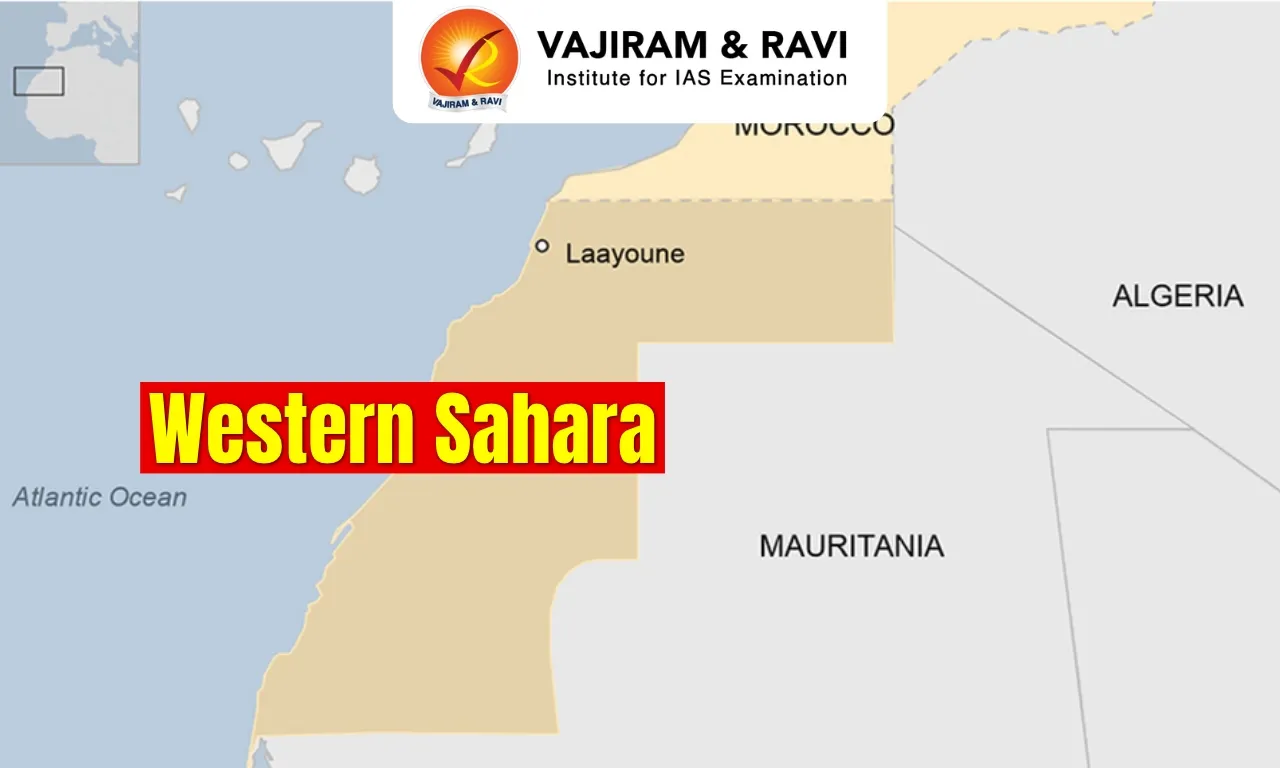
  • Western Sahara is a vast, sparsely-populated desert region in Northwest Africa.
  • It is part of the Maghreb region of North and West Africa.
  • Bordering Countries: It shares its land borders with Morocco and Algeria to the north and northeast respectively, and Mauritania to the east and south.
  • Water Body: It also has a long coast with the Atlantic Ocean in the West and Northwest.
  • It is a region rich in phosphates and other minerals and has a lucrative fishing industry on its Atlantic coast.

United Nations Mission for the Referendum in Western Sahara (MINURSO)

  • It was established in 1991 to support the settlement proposals and ceasefire reached by Morocco and Frente Polisario. 
  • Since the establishment of the Mission, MINURSO headquarters has been located in Laayoune, the main city in Western Sahara. 
  • Focus: It contributes to peace and stability in Western Sahara by monitoring, investigating and reporting on the ongoing situation, and working with the parties to reduce tensions as they arise.

Source: Reuters

Western Sahara FAQs

Q1: Western Sahara shares border with which countries?

Ans: It shares its land borders with Morocco and Algeria to the north and northeast respectively, and Mauritania to the east and south.

Q2: Which mineral is abundantly found in Western Sahara?

Ans: It is a region rich in phosphates.

Project 18A: India Moves Ahead with ₹80,000 Crore Next-Generation Stealth Destroyers

Project 18A

Project 18A Latest News

The Defence Acquisition Council (DAC), chaired by Defence, has recently accorded in-principle approval to the futuristic warships under Project 18A.

About Project 18A

  • It is the Indian Navy’s Next-Generation Destroyer (NGD) programme.
  • The proposed programme, estimated to cost around ₹80,000 crore, aims to develop a new generation of stealth-guided missile destroyers.
  • Conceived as a successor to the Visakhapatnam-class (P-15B) destroyers, the P-18 class destroyers are engineered to counter emerging threats — from anti-ship ballistic missiles to submarine warfare. 
  • It is overseen by the Indian Navy’s Warship Design Bureau (WDB) in collaboration with Mazagon Dock Shipbuilders Limited (MDL) and Garden Reach Shipbuilders & Engineers (GRSE). 

Project 18A Features

  • With an estimated displacement exceeding 13,000 tonnes, the P-18 will rank among the largest destroyers ever operated by the Indian Navy,  significantly larger than the Visakhapatnam-class destroyers (7,400 tonnes).
    • Under international classification, warships above 10,000 tonnes fall into the cruiser category — a segment that India currently does not possess.
    • Project 18 will mark India’s entry into this class of warships.
  • The warships are expected to have nearly 75% indigenous content.  
  • It features Integrated Electric Propulsion (IEP). 
  • Cruising Range: 4,500 nautical miles at 18 knots; endurance 45+ days. 
  • One of the most notable features of the design is the planned incorporation of up to 144 vertical launch system (VLS) cells capable of firing a diverse range of missile systems, including  
    • the long-range BrahMos-NG (Next Generation) supersonic cruise missiles for anti-ship and land-attack roles, 
    • the Barak-8 ER (Extended Range) surface-to-air missiles with intercept capabilities beyond 150 km;
    • and the upcoming LR-LACM (Long Range Land Attack Cruise Missile).  
  • For terminal defence, the ships will deploy four 30-mm rapid-fire CIWS and at least one high-energy laser-based directed-energy weapon for defeating UAV swarms and supersonic sea-skimming missiles.  
  • Anti-submarine warfare (ASW) capabilities include twin triple-torpedo launchers (Varunastra heavy torpedoes), rocket-assisted ASW mortars, and advanced towed-array sonar systems.  
  • Additionally, a 127-mm/62 caliber main gun (likely the Oto Melara or indigenous upgrade) provides naval gunfire support. 
  • The ships will be able to carry unmanned underwater vehicles and kamikaze drones, used for surveillance, detecting mines, and attacking submarines.
  • It is also expected to feature an advanced sensor and radar architecture centred on long-range multi-domain tracking systems capable of detecting and tracking targets at distances of up to 500 kilometres. 
  • The stealth enhancements include an enclosed X-shaped mast, radar-absorbent materials, optimized hull form, and infrared signature suppression (IRSS) for exhaust systems. 

News: TH

Project 18A FAQs

Q1: What is Project 18A?

Ans: It is the Indian Navy's Next-Generation Destroyer (NGD) programme aimed at developing advanced stealth-guided missile destroyers

Q2: Which organisation oversees the design of Project 18A destroyers?

Ans: The Indian Navy's Warship Design Bureau (WDB).

Q3: What is the estimated displacement of Project 18A destroyers?

Ans: More than 13,000 tonnes.

Q4: Which propulsion technology is expected to be incorporated into Project 18A destroyers?

Ans: Integrated Electric Propulsion (IEP).

Q5: What is the expected cruising range of Project 18A destroyers?

Ans: Approximately 4,500 nautical miles at 18 knots.

National Programme for Dairy Development: New Milk Testing Lab to Open in Sikkim

National Programme for Dairy Development

National Programme for Dairy Development Latest News

The Union Minister of Fisheries, Animal Husbandry and Dairying is set to inaugurate a microbiology laboratory for the Sikkim Milk Union under the National Programme for Dairy Development (NPDD). 

About National Programme for Dairy Development

  • It is a Central Sector Scheme implemented by the Department of Animal Husbandry and Dairying (DAHD), Government of India.
  • It was launched in 2014 and has been restructured/ realigned in July 2021 for implementation from 2021-22 to 2025-26 to strengthen dairy infrastructure and dairy cooperative systems.
  • It aims to enhance quality of milk and milk products and increase share of organized procurement, processing, value addition and marketing. 
  • Nodal Ministry: Ministry of Fisheries, Animal Husbandry & Dairying
  • Components of National Programme for Dairy Development
    • Component A: It focuses on strengthening of infrastructure for quality milk testing equipment as well as primary chilling facilities for State Cooperative Dairy Federations/ District Cooperative Milk Producers’ Union/SHGs/Milk Producer Companies/Farmer Producer Organizations.
    • Component ‘B’: It aims to increase sales of milk and dairy products by increasing farmer’s access to organized markets, upgrading dairy processing facilities and marketing infrastructure and enhancing the capacity of producer owned institutions.

Source: PIB

National Programme for Dairy Development FAQs

Q1: Which is the nodal ministry for National Programme for Dairy Development?

Ans: Ministry of Fisheries, Animal Husbandry & Dairying

Q2: What is the aim of the National Programme for Dairy Development?

Ans: It aims to enhance quality of milk and milk products and increase share of organized procurement, processing, value addition and marketing. 

Exostoma nasibarbatum: Scientists Discover New Catfish Species in Manipur

Exostoma nasibarbatum

Exostoma nasibarbatum Latest News

A new species of rare glyptosternine catfish, named Exostoma nasibarbatum, has been recently identified in Manipur.

About Exostoma nasibarbatum

  • It is a new species of catfish. 
  • It was discovered in Manipur, during a survey of the Bupal stream, a tributary of the Dujang River in the Chindwin river system along the Myanmar border. 
  • It inhabits fast-flowing, turbulent streams characterised by boulders and rocky substrates. 
  • The species has several morphological adaptations that enable it to survive in fast-flowing waters. 
    • These include a strongly flattened head and body, enlarged paired fins with adhesive striae, and flattened maxillary barbels that aid attachment to rocky substrates. 
  • The species has been named nasibarbatum in reference to its prominent nasal barbel, which extends beyond the posterior margin of the orbit. 
    • The name combines the Latin words nasus, meaning nose, and barba, meaning beard, referring to the elongated, tactile sensory organ located near the nostril. 
  • It belongs to the genus Exostoma.
    • Exostoma is a genus of sisorid catfishes native to Asia. 
    • Sisorid catfishes are freshwater catfishes belonging to the family Sisoridae, under the order Siluriformes. 
    • 23 valid species are currently recognised within the genus, distributed across major river systems in Southeast Asia and the Indian subcontinent. 
    • Of these, seven are considered valid species in the Chindwin-Irrawaddy drainage. 

News: AT

Exostoma nasibarbatum FAQs

Q1: What is Exostoma nasibarbatum?

Ans: It is a newly discovered species of catfish.

Q2: In which Indian state was Exostoma nasibarbatum discovered?

Ans: Manipur.

Q3: What type of habitat does Exostoma nasibarbatum inhabit?

Ans: Fast-flowing, turbulent streams characterised by boulders and rocky substrates.

Q4: Which morphological adaptations help Exostoma nasibarbatum survive in fast-flowing waters?

Ans: A strongly flattened head and body, enlarged paired fins with adhesive striae, and flattened maxillary barbels.

Shey Phoksundo Lake: 6 Indian Tourists Reported Missing After Heavy Snowfall in Nepal

Shey Phoksundo Lake

Shey Phoksundo Lake Latest News

Six Indian tourists have gone missing during a trek to Nepal's Shey-Phoksundo Lake recently, following heavy snowfall in the region.

About Shey Phoksundo Lake

  • It is an alpine freshwater oligotrophic lake located in the Dolpa district of Nepal.
  • It sits at an altitude of 3,611 meters (11,849 feet) and covers an area of about 4.94 sq.km.     
  • The lake is believed to have been formed some 30,000–40,000 years ago. 
  • It is a landslide-dammed lake, formed when a massive mountain collapse blocked a river valley, resulting in the accumulation of water. 
  • It is one of the deepest lakes of Nepal. The maximum depth of the lake is 145 meters, making it one of the deepest high-altitude lakes on the entire globe.   
  • It has a distinctive Y-shaped appearance.
  • The lake's outlet forms Suligad Waterfall, also known as Phoksundo Waterfall, approximately 167 metres high, regarded as the highest waterfall in Nepal. 
  • Its clear, mineral-rich water glimmers in bright blue and turquoise, changing shades with the weather and time of day.  
  • It was designated a Ramsar site in 2007 and falls within Shey Phoksumdo National Park. 
  • The Dolpo people have lived around Shey Phoksundo Lake for generations and continue to practice the ancient Bon religion.
    • Bon is one of the oldest spiritual traditions of Tibet, predating Buddhism for thousands of years.  
  • Ringmo village, with as many as 20 stupas and a Bon Gompa (temple) also named Ringmo, is located on the southern end of the lake.
  • Both Bon and Tibetan Buddhism are practised in the region. 

News: FP

Shey Phoksundo Lake FAQs

Q1: Where is Shey Phoksundo Lake located?

Ans: In the Dolpa district of Nepal.

Q2: What type of lake is Shey Phoksundo Lake?

Ans: An alpine freshwater oligotrophic lake.

Q3: How was Shey Phoksundo Lake formed?

Ans: It is a landslide-dammed lake formed when a massive mountain collapse blocked a river valley, leading to the accumulation of water.

Q4: Which waterfall is formed by the outlet of Shey Phoksundo Lake?

Ans: Suligad Waterfall, also known as Phoksundo Waterfall.

Q5: Which indigenous community has traditionally lived around Shey Phoksundo Lake?

Ans: The Dolpo people have lived around Shey Phoksundo Lake for generations.

Liberalised Remittance Scheme: Indians’ Overseas Spending Falls to Two-Year Low

Liberalised Remittance Scheme

Liberalised Remittance Scheme Latest News

Outward remittances from India under the Reserve Bank of India’s (RBI) Liberalised Remittance Scheme (LRS) have crossed $20 billion during the first eight months of 2026.

About Liberalised Remittance Scheme

  • It is part of the Foreign Exchange Management Act (FEMA) 1999, which lays down the guidelines for outward remittance from India. 
  • It was introduced on February 4, 2004.
  • Remittance Limit: Under LRS, all resident individuals, including minors, are allowed to freely remit up to USD $250,000 per financial year (April–March). 
  • This can be for any permissible current or capital account transaction, or a combination of both.
  • Eligibility: Only individual Indian residents, including minors, are permitted to remit funds under LRS.
  • Frequency of Remittances: There is no restriction on the frequency or number of transactions during a financial year. 
  • Types of transactions permitted
    • Opening of a foreign currency account abroad with a bank;
    • Acquisition of immovable property abroad, overseas direct investment (ODI), and overseas portfolio investment (OPI);
    • Extending loans, including loans in Indian Rupees to non-resident Indians (NRIs) who are relatives as defined in the Companies Act, 2013;
    • Private visits abroad (excluding Nepal and Bhutan); 
    • Maintenance of relatives abroad;Medical treatment abroad; Pursuing studies abroad;
    • Any other current account transaction that does not fall under the definition of current account (FEMA 199);
  • Types of transactions not permitted
    • Remittance for purposes specifically prohibited, such as buying lottery tickets or restricted items.
    • Remittance for buying Foreign Currency Convertible Bonds (FCCBs) issued by Indian companies in the overseas secondary market.
    • Sending money for trading in foreign exchange abroad.
    • Sending money to individuals and entities identified as posing a significant risk of terrorism.
    • Sending money to countries identified as “non-cooperative countries and territories” by the Financial Action Task Force (FATF).

Source: IE

Liberalised Remittance Scheme FAQs

Q1: What is Liberalised Remittance Scheme ?

Ans: It is part of the Foreign Exchange Management Act (FEMA) 1999, which lays down the guidelines for outward remittance from India. 

Q2: Who are eligible for Liberalised Remittance Scheme ?

Ans: Only individual Indian residents, including minors, are permitted to remit funds under LRS.

Gelephu Mindfulness City: Bhutan’s 2,500 Sq Km Smart City Project Near India

Gelephu Mindfulness City

Gelephu Mindfulness City Latest News

Bhutan’s King recently dedicated one of the 108 Buddhist stupas erected in a nine-hour construction feat to Prime Minister Narendra Modi as a mark of appreciation for India’s support for the country’s Gelephu Mindfulness City (GMC) project.

About Gelephu Mindfulness City 

  • It is a transformative project to create a new city in the foothills of the Himalayas in Bhutan. 
  • This visionary city aspires to redefine urban development by placing mindfulness, well-being, sustainability, and cultural integrity at its core.  
  • The GMC project has been envisioned by the King of Bhutan, Jigme Khesar Namgyel Wangchuck.
  • Located in Bhutan’s southern plains bordering the State of Assam in India and spanning over 4,046 sq.km., or 10% of Bhutan, GMC was established by Royal Charter in February 2024 as a highly autonomous Special Administrative Region (SAR). 
  • Through this Royal mandate, GMC is accorded full executive and legislative powers, with an independent judiciary, to govern the SAR separate from the Royal Government of Bhutan.  
  • Under the direct guidance of the King, GMC will be run by global and local talents to build an advanced economy by adopting and adapting the best governing policies and business practices from around the world. 

Gelephu Mindfulness City Features

  • The masterplan for "Gelephu Mindfulness City" shows a low- to-mid-rise metropolis built around a series of inhabitable bridges. 
  • Each of the bridges was designed to be combined with cultural, educational, recreational and infrastructure functions. 
  • Each bridge will "house" key features of the city: a new international airport, a university, a health-care facility for Eastern and Western medicine, a hydroponic greenhouse, a cultural center, a spiritual center, a market for local goods and a hydroelectric dam, according to the plan. 
  • The planned city will have eleven "ribbonlike neighborhoods" that incorporate the area's 35 rivers and streams. 
  • Neighborhoods will be designed like mandalas, with repeated patterns organized around a central public space.
  • To protect against flooding, paddy fields will be built along the rivers, “forming urban terraces that cascade down from the hills to the valley,”. These will further function as biodiversity corridors for local flora and fauna.
  • The GMC will have two protected areas – a national park and a wildlife sanctuary.

News: TH

Gelephu Mindfulness City FAQs

Q1: What is Gelephu Mindfulness City (GMC)?

Ans: It is a major urban development project in Bhutan aimed at creating a sustainable, well-being-oriented city integrating mindfulness, modern economic development and cultural values.

Q2: Where is Gelephu Mindfulness City located?

Ans: In the southern foothills of the Himalayas in Bhutan.

Q3: Gelephu Mindfulness City is located along the border of Bhutan with which Indian state?

Ans: Assam.

Q4: What is the administrative status of Gelephu Mindfulness City?

Ans: A highly autonomous Special Administrative Region (SAR) of Bhutan.

Q5: What is the distinctive architectural feature of the Gelephu Mindfulness City?

Ans: A low- to mid-rise metropolis organised around a series of inhabitable bridges.

Psoriasis: Why the Immune System Causes Scaly Skin Patches and Inflammation

Psoriasis

Psoriasis Latest News

Patients with psoriasis have an increased risk for cataracts and cataract surgery, with the risks for these outcomes varying by treatment modality, according to a recent study.

About Psoriasis

  • It is a chronic autoimmune condition that causes the rapid buildup of skin cells.
  • This buildup of cells causes scaling on your skin’s surface.
  • It causes a rash with itchy, scaly patches, most commonly on the knees, elbows, trunk, and scalp.
  • It can be painful, interfere with sleep, and make it hard to concentrate. 
  • Causes:
    • The cause of psoriasis is not fully understood. It is believed to be caused by genetics, the immune system, and the environment.
    • Psoriasis occurs because the overactive immune system speeds up skin cell growth. 
    • Normal skin cells completely grow and shed (fall off) in a month. 
    • With psoriasis, skin cells do this in only three or four days. Instead of shedding, the skin cells pile up on the surface of the skin.
  • Common triggers for psoriasis flare-ups include:
    • Emotional stress.
    • An infection (streptococcal infection).
    • A skin injury like cuts, scrapes, or surgery.
    • Certain medications, such as lithium and beta-blockers.
    • Changes in body temperature due to the weather.
  • Is psoriasis hereditary? 
    • Yes, there is a strong family link to psoriasis.
    • If you have a family member affected by psoriasis, you are more likely to be affected by it too, due to shared genes. 
    • The way psoriasis is inherited is complex and not completely understood.
  • Is psoriasis contagious?  Psoriasis is not contagious.
  • Symptoms: 
    • The condition tends to go through cycles, flaring for a few weeks or months, then subsiding for a while.
    • Symptoms of psoriasis vary from person to person, but some common ones are:
      • Patches of thick, red skin with silvery-white scales that itch or burn.
      • Dry, cracked skin that itches or bleeds.
      • Thick, ridged, pitted nails.
      • Poor sleep quality.
    • Some patients have a related condition called psoriatic arthritis, which can be characterized by stiff, swollen, or painful joints; neck or back pain; or Achilles heel pain.
  • Treatment:
    • It has no cure. Treatments aim to
      • reduce inflammation and scales;
      • slow the growth of skin cells;
      • remove plaques;
    • Common psoriasis treatments include:
      • Steroid creams.
      • Moisturizers for dry skin.
      • Medication to slow skin cell production (anthralin).
      • Medicated lotions or shampoos.
      • Vitamin D3 ointment.
      • Vitamin A or retinoid creams.

News: MED

Psoriasis FAQs

Q1: What is psoriasis?

Ans: Psoriasis is a chronic autoimmune condition that causes the rapid buildup of skin cells.

Q2: Which parts of the body are most commonly affected by psoriasis?

Ans: The knees, elbows, trunk and scalp.

Q3: How does an overactive immune system contribute to psoriasis?

Ans: It speeds up skin cell growth, causing cells to accumulate on the skin's surface.

Q4: Is psoriasis hereditary?

Ans: Yes. There is a strong family link, and genetic factors increase the likelihood of developing the condition.

Q5: Is there a permanent cure for psoriasis?

Ans: No. There is currently no cure, but treatments can help manage its symptoms.

Cyclone Murasu 2026, Tracker, Affected Areas, Warnings, Latest Updates

Cyclone Murasu 2026

Cyclone Murasu 2026 is a severe cyclonic storm that developed over the Bay of Bengal and is moving towards the eastern coast of India, particularly Andhra Pradesh. According to the India Meteorological Department (IMD), the cyclone intensified into a severe cyclonic storm on November 2, 2026, and is expected to make landfall near Ongole during the night of November 2-3. With winds reaching 100-110 kmph, gusting to 120 kmph, the cyclone poses risks of heavy rainfall, coastal flooding, agricultural losses and infrastructure damage across Andhra Pradesh and neighbouring states. 

Cyclone Murasu 2026 Latest Updates

As of November 2, 2026, Cyclone Murasu has intensified into a Severe Cyclonic Storm over the west-central and adjoining southwest Bay of Bengal. The IMD has issued a red cyclone warning for Andhra Pradesh and adjoining northern Tamil Nadu coasts. The storm is expected to cross the south Andhra Pradesh coast between Nellore and Narsapur, close to Ongole, during the night of November 2-3. 

Heavy to extremely heavy rainfall, strong winds and a storm surge of 1-1.5 metres are forecast in vulnerable coastal areas. Andhra Pradesh and Odisha have strengthened disaster preparedness, while heavy rainfall has already affected parts of Chennai.

What is Cyclone Murasu 2026?

Cyclone Murasu 2026 is a tropical cyclone over the Bay of Bengal that developed from a low-pressure weather system and intensified into a severe cyclonic storm. It highlights the vulnerability of India’s eastern coastal regions to post-monsoon cyclones.

  • Origin and development: Cyclone Murasu developed from a depression over the southwest and adjoining west-central Bay of Bengal. It strengthened into a cyclonic storm on November 1 and a severe cyclonic storm during the early hours of November 2, 2026.
  • Cyclone category: The IMD classified Murasu as a Severe Cyclonic Storm, indicating sustained wind speeds within the range of 89-117 kmph.
  • Expected landfall: The cyclone is forecast to cross the south Andhra Pradesh coast between Nellore and Narsapur, close to Ongole, during the night of November 2-3.
  • Wind speed: Maximum sustained winds of 100-110 kmph, gusting to 120 kmph, are expected during landfall.
  • Affected regions: Coastal Andhra Pradesh faces the greatest direct risk, while Tamil Nadu, Odisha, Telangana, Rayalaseema and parts of Chhattisgarh may experience heavy rainfall and strong winds.
  • Cyclone Murasu tracker: In the early morning of November 2, the cyclone was centred approximately 210 km east-southeast of Nellore and 260 km southeast of Ongole.

Also Read:- Cyclone Arnab 2026

Cyclone Murasu 2026 Name Origin

The name Murasu was proposed by India under the tropical cyclone naming system followed in the North Indian Ocean. The word Murasu means “war drum”, referring to a traditional drum associated with Tamil culture.

  • Naming country: India proposed the name Murasu.
  • Meaning: Murasu means war drum.
  • Naming authority: The India Meteorological Department, which functions as the Regional Specialized Meteorological Centre (RSMC), New Delhi, assigns cyclone names from an agreed regional list.
  • Purpose of naming: Naming cyclones helps meteorological agencies, governments and the public identify storms, communicate warnings and avoid confusion when multiple weather systems develop.

Cyclone Murasu 2026 Tracker

The Cyclone Murasu 2026 tracker shows the storm’s movement across the Bay of Bengal, its strengthening into a severe cyclonic storm and its expected landfall along the Andhra Pradesh coast. The following timeline is based on IMD bulletins and forecasts available on November 2, 2026.

[my_image src="https://vajiramias.sgp1.cdn.digitaloceanspaces.com/wp/current-affairs/2026/11/02115017/Capture-32.jpg?v=1793600416" size="full" align="center" width="auto" height="620px" alt="Cyclone Murasu 2026 Tracker" title="Cyclone Murasu 2026 Tracker"]

  • October 31, 2026 - Depression develops: A depression formed over the Bay of Bengal, with IMD forecasts indicating that the system could intensify and move towards the south Andhra Pradesh coast.
  • November 1, 2026 - Cyclonic Storm Murasu forms: The system intensified into a cyclonic storm over the southwest and adjoining west-central Bay of Bengal. By evening, it was moving west-northwestwards at approximately 25 kmph.
  • November 2, 2026 - Severe cyclonic storm: Murasu strengthened into a severe cyclonic storm during the early hours of the day. In the early morning, it was positioned approximately 210 km east-southeast of Nellore, continuing towards Andhra Pradesh.
  • November 2-3, 2026 - Expected landfall: The cyclone is forecast to cross the coast between Nellore and Narsapur, near Ongole, during the night of November 2-3, with winds gusting to 120 kmph.
  • November 3, 2026 - Expected weakening: After crossing the coast, the system is forecast to move inland and gradually weaken into a cyclonic storm and subsequently a deep depression.
  • November 4, 2026 - Further weakening: The IMD forecast indicates that the system may weaken into a depression, although rainfall and flooding risks may continue in affected regions.

Note: Events from the night of November 2 onward are forecasts, not confirmed landfall observations.

Cyclone Murasu 2026 IMD Warnings

The India Meteorological Department (IMD) has issued warnings for Cyclone Murasu, highlighting the risks of extremely heavy rainfall, strong winds, rough seas, storm surges and flooding. Coastal Andhra Pradesh faces the highest risk during landfall, while neighbouring states may also experience severe weather conditions.

  • Heavy rainfall warning: Coastal Andhra Pradesh may receive heavy to very heavy rainfall at several places and extremely heavy rainfall at isolated locations on November 2-3. Heavy rainfall is also forecast in Tamil Nadu, Rayalaseema, Telangana, southern Odisha and Chhattisgarh.
  • Wind warning: Winds along the Andhra Pradesh coast may reach 100-110 kmph, gusting to 120 kmph, during landfall. Northern Tamil Nadu and Puducherry may experience winds of 60-70 kmph, gusting to 80 kmph, during the peak warning period.
  • Sea condition warning: Very high sea conditions are expected over the west-central Bay of Bengal until November 3. Sea waves may reach 9-14 metres in severely affected marine areas, making fishing and shipping operations dangerous.
  • Storm surge warning: A storm surge of approximately 1-1.5 metres above astronomical tide may inundate low-lying coastal areas of southern Andhra Pradesh. Bapatla, Krishna and Prakasam districts face particular risks.
  • Fishermen warning: Fishermen have been advised not to venture into the sea along the Andhra Pradesh coast from November 2 until the afternoon of November 4. Restrictions also apply to affected marine areas off Tamil Nadu, Puducherry and southern Odisha.
  • Flooding warning: Intense rainfall may trigger urban flooding, riverine flooding, waterlogging and coastal inundation. Hilly regions may also experience landslides.
  • Transport and infrastructure warning: Strong winds and flooding may damage roads, railway infrastructure, electricity poles and communication networks. Authorities have been advised to regulate transport and avoid movement through vulnerable areas.
  • Public safety advisory: Residents should remain indoors during severe weather, avoid weak structures and flooded roads, and follow official IMD and district administration warnings.

Cyclone Murasu 2026 Impacts

Cyclone Murasu 2026 poses significant risks to coastal communities, agriculture, infrastructure and essential services. Its expected landfall near Ongole, combined with heavy rainfall and strong winds, could affect several districts of Andhra Pradesh and neighbouring states.

  • Heavy rainfall and flooding: Extremely heavy rainfall is forecast in parts of coastal Andhra Pradesh, particularly Eluru, Krishna, NTR and adjoining districts. Rainfall may cause waterlogging, river overflow and flooding in low-lying settlements.
  • Strong winds and structural damage: Winds gusting to 120 kmph may damage thatched houses, weak buildings, rooftops, hoardings and electricity infrastructure. Uprooted trees and broken branches may create additional hazards.
  • Agricultural losses: Standing paddy crops, plantations, orchards and horticultural crops may suffer serious damage. Banana, papaya, coconut and drumstick trees are particularly vulnerable to strong winds and prolonged rainfall.
  • Electricity supply disruption: Preliminary state estimates indicate that around 15,128 electricity poles across 12 districts could be damaged. Such disruption may affect households, businesses, irrigation systems and communication services.
  • Fishing and coastal livelihoods: Dangerous sea conditions have prompted warnings against fishing operations. Restrictions on boats, ports and marine activities may temporarily affect fishing communities and coastal trade.
  • Transport and infrastructure: Heavy rain and fallen trees may disrupt road and railway movement. Waterlogging and damage to bridges, roads and signalling systems could delay emergency services and transportation.
  • Displacement of vulnerable communities: People living in low-lying coastal settlements, weak houses and flood-prone areas may need evacuation to safer shelters. Storm surges and river flooding increase the risks for vulnerable populations.
  • Pressure on essential services: Cyclone-related damage may increase the demand for drinking water, medical assistance, emergency transport, electricity restoration and communication facilities.

These are primarily forecast or potential impacts as of November 2, 2026, rather than confirmed final damage figures.

Cyclone Murasu 2026 Preparedness

Preparedness for Cyclone Murasu 2026 focuses on early warnings, evacuation, rescue operations, infrastructure protection and maintaining essential services. The governments of Andhra Pradesh, Tamil Nadu and Odisha have announced precautionary measures to reduce the cyclone’s impact.

  • Early warning and monitoring: The IMD is regularly monitoring the cyclone’s movement and intensity. Andhra Pradesh officials have been directed to issue frequent cyclone updates to help communities prepare for changing weather conditions.
  • Evacuation of vulnerable areas: Authorities have instructed district officials to identify people living in low-lying coastal settlements, flood-prone areas and unsafe houses and shift them to safer locations where necessary.
  • Deployment of rescue teams: Andhra Pradesh has deployed six National Disaster Response Force (NDRF) teams and seven State Disaster Response Force (SDRF) teams in vulnerable districts, including Krishna, Bapatla, Guntur, Nellore and Prakasam.
  • Closure of educational institutions: Schools and colleges in Chennai and Tiruvallur have been closed on November 2 as a precaution against heavy rainfall. Educational institutions in parts of Andhra Pradesh have also announced holidays.
  • Power supply management: Electricity departments have been directed to arrange additional workers, equipment and repair materials in advance. Officials must also establish clear timelines for restoring power after cyclone-related damage.
  • Telecommunication preparedness: Telecom operators have been asked to take precautionary measures to minimise mobile network disruptions, particularly in areas likely to experience strong winds and flooding.
  • Relief camps and essential supplies: District administrations are preparing evacuation shelters and reviewing arrangements for food, drinking water, medical assistance and rescue equipment.
  • Protection of agriculture: Authorities have been asked to monitor rainfall, reservoir inflows and flood-prone agricultural areas. Farmers are advised to protect harvested produce and follow local agricultural advisories.
  • Reservoir and flood monitoring: Increased inflows are anticipated in Budameru, Errakalva, Gonelavagu and other water bodies. Monitoring these systems is important for preventing sudden flooding in downstream settlements.
  • Coordination among departments: Police, fire services, revenue officials, disaster response teams, electricity departments and local administrations are coordinating relief and rescue operations.

Why is the Bay of Bengal Prone to Cyclonic Storms?

The Bay of Bengal is one of the major cyclone-prone regions of the North Indian Ocean. Cyclones such as Murasu develop under favourable oceanic and atmospheric conditions, making the eastern coast of India particularly vulnerable to tropical storms.

  • Warm sea surface temperatures: Warm ocean waters provide the heat and moisture necessary for cyclone formation. Sea surface temperatures of approximately 26.5°C or higher can support tropical cyclone development when other conditions are favourable.
  • High atmospheric moisture: Moist air over the Bay of Bengal supports the formation of deep rain-bearing clouds and thunderstorms, helping developing cyclonic systems intensify.
  • Post-monsoon cyclone activity: October to December is an important cyclone season in the North Indian Ocean. During this period, favourable atmospheric conditions can support the formation and strengthening of tropical cyclones.
  • Favourable atmospheric conditions: Low vertical wind shear, sufficient Coriolis force, atmospheric instability and an existing low-pressure disturbance can allow cyclonic circulation to develop and strengthen.
  • Movement towards India’s eastern coast: Large-scale atmospheric circulation influences cyclone tracks. Storms moving westwards or northwestwards across the Bay of Bengal may approach Andhra Pradesh, Odisha, Tamil Nadu and West Bengal.
  • Funnel-shaped northern Bay of Bengal: The narrowing shape and shallow coastal waters of the northern Bay of Bengal can amplify storm surges, increasing the risk of coastal flooding during powerful cyclones.

Cyclone Murasu 2026 FAQs

Q1: What is Cyclone Murasu 2026?

Ans: Cyclone Murasu 2026 is a severe cyclonic storm over the Bay of Bengal, moving towards the eastern coast of India, particularly Andhra Pradesh. It developed from a low-pressure system and intensified on November 2, 2026.

Q2: When will Cyclone Murasu make landfall?

Ans: According to the IMD forecast, Cyclone Murasu is expected to make landfall near Ongole, Andhra Pradesh, during the night of November 2-3, 2026.

Q3: Which country is named Cyclone Murasu, and what does it mean?

Ans: India proposed the name Murasu, which means “war drum” and refers to a traditional drum associated with Tamil culture.

Q4: How strong is Cyclone Murasu?

Ans: The IMD classifies it as a Severe Cyclonic Storm, with winds of 100-110 kmph gusting to 120 kmph expected during landfall.

Q5: Which areas are affected by Cyclone Murasu?

Ans: Coastal Andhra Pradesh faces the greatest risk. Tamil Nadu, Odisha, Telangana, Rayalaseema and parts of Chhattisgarh may also see heavy rainfall and strong winds.

Olive Ridley Turtles Migrate from Tamil Nadu to Sri Lanka Dome in Indian Ocean

Olive Ridley Turtles

Olive Ridley Turtle Latest News

Recently, fishing activities and the movement of mechanised boats have been prohibited in designated coastal stretches of Odisha for seven months as part of measures to protect the endangered Olive Ridley sea turtles.

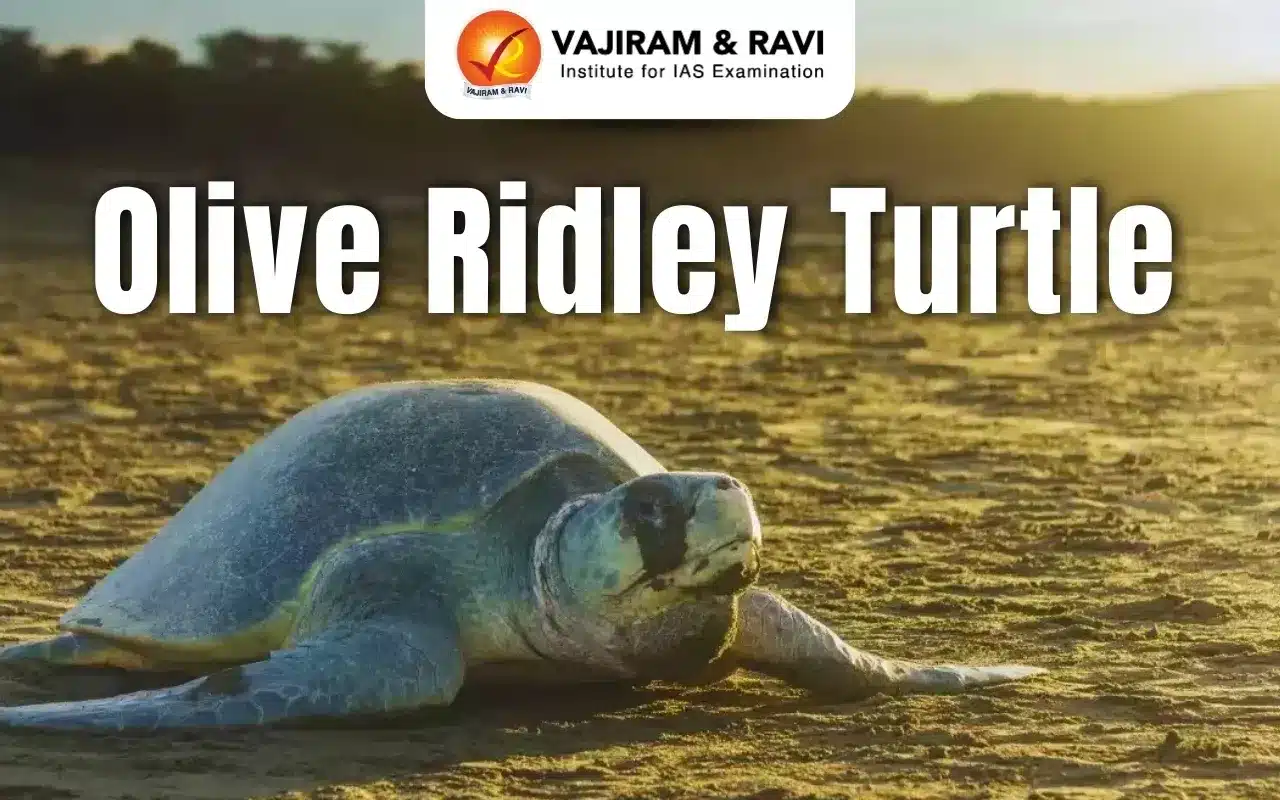
About Olive Ridley Turtle

  • It is the smallest and most abundant of all sea turtles found in the world.
  • It gets its name from the olive green colouration of its carapace (shell). 
  • It is best known for its unique mass nesting, called Arribada, where thousands of females come together on the same beach to lay eggs.

Distribution of Olive Ridley Turtle

  • They are mainly found in the warm waters of the Pacific, Atlantic, and Indian oceans.
  • Odisha’s Gahirmatha Marine Sanctuary is known as the world’s largest rookery (a colony of breeding animals) of sea turtles.

Features of Olive Ridley Turtle

  • They are solitary, preferring the open ocean.
  • Diet: They are omnivorous, meaning they feed on both plants and animals.
  • These turtles spend their entire lives in the ocean, and migrate thousands of kilometers between feeding and mating grounds in the course of a year.

Conservation Status of Olive Ridley Turtle

Source: DTE

Olive Ridley Turtle FAQs

Q1: Where do we find Olive Ridley Turtle?

Ans: They are mainly found in the warm waters of the Pacific, Atlantic, and Indian oceans.

Q2: What are the features of Olive Ridley Turtle?

Ans: They are solitary, preferring the open ocean.

Tawang Monastery Welcomes Sacred Relics of Lord Buddha in Arunachal Pradesh

Tawang Monastery

Tawang Monastery Latest News

Recently, the sacred relics of Lord Buddha were accorded a traditional religious reception at the historic Gaden Namgyal Lhatse (Tawang Monastery).

About Tawang Monastery

  • Location: It is located in the mountains of the eastern Himalayan range in Arunachal Pradesh.
  • It is also known as Gaden Namgyal Lhatse which means "the divine paradise of complete victory".
  • It was founded in the 17th century by Merak Lama Lodre Gyatso.
  • It is a magnificent example of Mahayana Buddhism and is the largest monastery in India.
  • It is an important centre of monastic learning, religious practice and cultural continuity.

Structure of Tawang Monastery

  • The most imposing building of the monastery is the assembly hall known as Dukhang.
  • It is a three-storied building standing on the northern side of the court and houses the template and the Labrang (The establishment of the Abbot.).
  • The inner walls of the Dukhang are painted with murals of various divinities and saints. The altar occupies the entire northern wall of the hall.
  • On the left of the alter is the silver casket wrapped in silk containing the Thangkas of Goddess Sri Devi (Palden Lhamo) the principle deity of the monastery, which was given to Merak Lama by the 5th Dalai Lama.
  • A colossal richly gilded statue of Lord Buddha occupies the middle of the northern side.
  • It is seated on a lotus throne flanked by his two Principal attendants Maudgalyayana and Sariputra, each with a staff and begging bowl in hand. 

Source: PIB

Tawang Monastery FAQs

Q1: Where is Tawang Monastery located?

Ans: Arunachal Pradesh

Q2: When was the Tawang Monastery established?

Ans: It was founded in the 17th century by Merak Lama Lodre Gyatso.

Social Security Boards for Gig Workers: Composition, Functions and Benefits

Social Security Boards

Social Security Boards Latest News

  • The Ministry of Labour and Employment has notified the constitution of two key bodies: the National Social Security Board (NSSB) for unorganised workers (40 members) and a separate NSSB for gig and platform workers (22 members). 
  • Both boards are tasked with designing, monitoring, and recommending welfare schemes to bridge India’s long-standing social security gap for workers outside the formal employment structure.

Background: The Code on Social Security

  • Notified last year (November 2025), alongside three other labour codes, the Code on Social Security merged nine existing social security laws to cover both organised and unorganised sectors.
  • For the first time, the Code legally defined “gig workers” and “platform workers.”
  • It mandated a national registration system and a dedicated social security fund for unorganised and gig workers.

Composition of the Boards

  • National Social Security Board (Unorganised Workers) — 40 members:
    • Chairperson: Union Minister for Labour and Employment
    • Vice-Chairperson: Secretary, Ministry of Labour and Employment
    • Includes employee and employer representatives.
    • Nominated Members:
      • Unorganised sector workers: 7 representatives representing workers in the unorganised sector
      • Employers of unorganised sector: 7 representatives representing employers
      • Eminent persons from civil society: 7 representatives
      • Parliamentary representatives: 2 members representing the Lok Sabha and 1 member representing the Rajya Sabha (3 total)
      • Central Government Ministries and Departments: 10 members representing concerned central ministries and departments
      • State Governments: 5 members representing State Governments
      • Union Territories: 1 member representing the Union territories [1, 2]
  • National Social Security Board (Gig and Platform Workers) — 22 members:
    • Union Labour Minister chairs it; Labour Secretary serves as Vice-Chairperson (same structure as the unorganised workers’ board).
    • Industry representation: Aggregators and quick-commerce operators like Eternal (Zomato’s parent), Zepto, Swiggy, and Urban Company.
    • Worker representation: BMS, the Indian Federation of App-Based Transport Workers (IFAT), and the National Front of Indian Trade Unions (NFITU).

Functions and Powers of the Boards

  • As per the Code, the NSSB must meet at least thrice a year.
  • Core mandate: Recommend that the Central government frame suitable schemes for different categories of unorganised, gig, and platform workers.

Key Responsibilities

  • Monitor social welfare schemes for unorganised workers.
  • Review expenditure from the social security fund and its accounts.
  • Review record-keeping functions related to gig workers’ welfare schemes performed at the state level.
  • Advise the Central government on matters arising from administering the Code.
  • Undertake other functions as assigned by the Central government from time to time.

The Social Security Fund: Who Pays, and for What?

  • The Code envisions a Social Security Fund for gig and platform workers, funded through: 
    • Central and State government contributions.
    • Corporate Social Responsibility (CSR) funds.
    • Fines collected through compounding.
  • Aggregator Contributions: Companies like Amazon, Flipkart, Swiggy, and Zomato must contribute 1-2% of their annual turnover to the fund — with total contribution capped at 5% of the amount payable to workers.
  • Covered benefits the Centre may frame schemes for include: 
    • Life and disability cover.
    • Accident insurance.
    • Health and maternity benefits.
    • Old age protection.
    • Crèche facilities.

Expanded EPFO Coverage: A Major Structural Shift

  • EPFO (Employees’ Provident Fund Organisation) provisions now apply to all establishments with 20+ employees, regardless of industry type.
  • Previously, EPFO applied only to establishments listed in Schedule 1 of the Act — primarily manufacturing sector entities.
  • This restriction has been removed under the Code on Social Security, bringing both organised and unorganised sector workers under the social security umbrella.
  • Schemes will be funded wholly or partly by Central/State governments or CSR contributions.

What Changes for Gig Workers Specifically

  • Gig and platform workers will receive social security cover for the first time in India’s labour history.
  • Mandatory Registration: Platforms must work with the government to register all gig and platform workers.
  • Technology Enabler: Registration will use an Aadhaar-linked Universal Account Number (UAN) — ensuring benefits remain portable across states, crucial given gig workers’ frequent inter-state mobility for work.
  • Scale of Impact: As per NITI Aayog, India’s gig economy is projected to employ 2.35 crore (23.5 million) workers by 2029-30 — making this reform potentially transformative for a rapidly growing workforce segment.

Conclusion

  • The notification of these two Social Security Boards operationalises one of the most significant labour reforms in recent Indian history — extending formal social security protections to a workforce segment that has historically operated entirely outside such safeguards. 
  • By mandating aggregator contributions, enabling portable Aadhaar-linked registration, and expanding EPFO coverage beyond manufacturing-sector limits, the Code addresses a genuine structural gap as India’s gig economy approaches a projected 2.35 crore workers by 2029-30. 
  • However, the real test will lie in implementation — particularly ensuring that board composition remains genuinely representative of worker interests, and that the promised benefits translate into accessible, timely support for a workforce often characterised by precarious, fragmented employment.

Source: IE

Social Security Boards FAQs

Q1: What are the Social Security Boards for Gig Workers?

Ans: Social Security Boards for Gig Workers are statutory bodies tasked with recommending, monitoring and reviewing welfare schemes for gig and platform workers.

Q2: What is the composition of the Social Security Boards for Gig Workers?

Ans: The Social Security Boards for Gig Workers include government officials, worker representatives, employers, industry representatives and other nominated members.

Q3: What are the main functions of the Social Security Boards for Gig Workers?

Ans: Social Security Boards for Gig Workers recommend welfare schemes, monitor implementation, review fund expenditure and advise the Central government on social security matters.

Q4: How will the Social Security Boards for Gig Workers be funded?

Ans: The Social Security Boards for Gig Workers oversee schemes supported by government contributions, CSR funds, compounding fines and mandatory aggregator contributions.

Q5: How will the Social Security Boards for Gig Workers benefit platform workers?

Ans: Social Security Boards for Gig Workers can facilitate life, accident, health, maternity and old-age protection through welfare schemes and Aadhaar-linked portable registration.

Uttarakhand Helicopter Crashes: Causes, Safety Risks and Regulatory Gaps

Uttarakhand Helicopter Crashes

Uttarakhand Helicopter Crashes Latest News

  • A helicopter carrying six people, including the pilot, crashed while returning from Badrinath to Dehradun recently, amid adverse weather conditions — all six confirmed dead. 
  • This latest tragedy has once again spotlighted the safety risks associated with helicopter operations in one of India’s most challenging flying environments, raising urgent questions about India’s helicopter-based pilgrimage tourism.

The Scale of the Problem

  • As per Ministry of Civil Aviation (MoCA) data (shared with Parliament, July 2025): of 12 helicopter accidents nationwide since 2020, 7 occurred in Uttarakhand alone.
  • Fatality statistics are starker: Of 30 total deaths in helicopter crashes during this period, 21 occurred in Uttarakhand.
  • Last summer saw at least 5 incidents within just a couple of months, including multiple fatal crashes — prompting the state administration, UCADA, MoCA, and DGCA to announce safety audits and temporary operational pauses.

Why Uttarakhand’s Terrain Makes Flying So Dangerous

  • Much of the Char Dham route passes through deep valleys surrounded by steep mountains, leaving little room to manoeuvre — especially when weather deteriorates suddenly or technical problems arise.
  • Mountainous terrain disrupts wind patterns, causing sudden turbulence that’s hard to predict.
  • Areas are prone to rapid visibility changes from cloud movement, mist, and unpredictable rain.
  • Helicopters here primarily operate under Visual Flight Rules (VFR) — pilots must fly visually, maintaining visibility and separation from terrain without instrument-based guidance.
  • Key Risk: Controlled Flight Into Terrain (CFIT) — when a pilot-controlled aircraft unintentionally strikes terrain. This was the probable cause in the June 2025 Gaurikund crash, where the helicopter reportedly flew despite poor visibility and extensive clouding.
  • Localised Weather Data Gap: Weather readings at a base like Guptkashi may not reflect actual conditions at Kedarnath or in connecting valleys — a district-level forecast cannot tell a pilot if a specific valley entrance is safe to enter at a given moment.

Regulatory and Air Traffic Management Gaps

  • In narrow mountain valleys with multiple helicopters operating simultaneously, proper air traffic control is critical — but many Uttarakhand helipads lack this infrastructure.
  • Pilots often rely on radio communications and relayed information rather than formal air traffic control.
  • Jurisdictional Divide:
    • DGCA (Directorate General of Civil Aviation) regulates airspace nationally (aviation is a Union List subject).
    • Uttarakhand Civil Aviation Development Authority (UCADA), established 2013, coordinates with helicopter operators at the state level.
  • Parliamentary Standing Committee on Transport, Tourism and Culture (August 2025 report) flagged this starkly: 
    • DGCA’s role is primarily licensing, issuing safety guidelines to UCADA but not exercising direct, continuous supervision over daily operations.
    • This creates jurisdictional ambiguity, with DGCA appearing to have ceded direct oversight of a hazardous aviation activity to a state-level body whose capacity and expertise have been questioned.
    • The Committee called this a symptom of a “larger and more dangerous structural flaw” — a “fractured and ambiguous regulatory command structure” in India’s aviation governance.

Do Commercial Pressures Compromise Safety?

  • Helicopter services have grown alongside religious tourism, offering pilgrims faster, easier access to remote Himalayan shrines.
  • This creates concentrated flight activity during the short pilgrimage season (just a few months annually).
  • High Traffic Volumes Demand: effective coordination, reliable communications, clear departure/arrival procedures, and accurate weather data — gaps in any of these leave pilots managing complexity with inadequate information.
  • During peak demand, helicopters run repeated shuttle trips, and the economics of short-duration operations can incentivise maximising daily trip counts.
  • Expert Concerns: Commercial pressure may encourage flights in poor weather, inadequate technical checks, and continued operations despite warnings.
  • Pilot fatigue is a significant but under-monitored risk — repeated flights in demanding terrain require constant reassessment of conditions, terrain, aircraft performance, and air traffic.
  • A DGCA operations circular governs safety for pilgrimage helicopter flights, placing responsibility on operators -but recurring accidents raise doubts about enforcement effectiveness.

Conclusion

  • Uttarakhand’s helicopter tragedies don’t stem from one single failure. They result from many weaknesses coming together. The terrain is treacherous. 
  • The weather is unpredictable. Local weather forecasting remains inadequate. Air traffic management is fragmented. On top of this, the national regulator’s oversight role stays mostly advisory, not operational.
  • The Parliamentary Standing Committee’s findings point to something deeper. This isn’t just an isolated aviation safety issue. It reflects a broader governance gap. This gap exists between central regulators and state-level implementation bodies.
  • Two things need to change. First, DGCA and UCADA’s roles need clearer separation. Genuine, continuous safety supervision must replace periodic licensing checks. Second, commercial pressures during the pilgrimage season need better balance against safety protocols. 
  • Until both happen, the Himalayan skies above Char Dham will likely remain among India’s most dangerous flying corridors.

Source: IE | TP

Uttarakhand Helicopter Crashes FAQs

Q1: Why are Uttarakhand helicopter crashes a recurring concern?

Ans: Uttarakhand helicopter crashes are a recurring concern because difficult mountain terrain, unpredictable weather, inadequate air traffic management and operational pressures combine to increase flying risks.

Q2: How does Himalayan geography contribute to Uttarakhand helicopter crashes?

Ans: Deep valleys, steep mountains, sudden turbulence and rapidly changing visibility make navigation difficult and leave pilots with limited room to manoeuvre safely.

Q3: What is Controlled Flight Into Terrain in the context of Uttarakhand helicopter crashes?

Ans: Controlled Flight Into Terrain occurs when a functioning aircraft unintentionally strikes terrain, often because poor visibility prevents pilots from recognising nearby obstacles.

Q4: What regulatory gaps contribute to Uttarakhand helicopter crashes?

Ans: Uttarakhand helicopter crashes highlight fragmented oversight, as DGCA primarily issues guidelines while UCADA coordinates state-level operations without continuous direct supervision.

Q5: How can authorities reduce Uttarakhand helicopter crashes during pilgrimage season?

Ans: Authorities can reduce Uttarakhand helicopter crashes through continuous safety supervision, better localised weather data, stronger air traffic control and stricter enforcement of operational protocols.

Binance Hack – Cybersecurity Risks, Cryptocurrency Regulation and Investor Protection

Binance Hack

Binance Hack Latest News

  • Binance, one of the world's largest cryptocurrency exchanges, suffered a cyberattack on October 29, resulting in estimated losses of approximately $6.3 billion and raising concerns about cybersecurity and investor protection in the cryptocurrency sector.

Understanding the Binance Cyberattack

  • Binance is a major global cryptocurrency exchange that facilitates the trading and transfer of digital assets. 
  • The recent cyberattack exposed vulnerabilities in its operational security infrastructure and resulted in the unauthorised withdrawal of cryptocurrency assets.
  • Binance has temporarily paused deposits and withdrawals while conducting security checks. Deposits were subsequently restored.
  • The exchange later estimated the losses at approximately $6.3 billion and initiated efforts to freeze and recover the stolen assets.

How the Hack Took Place

  • According to Binance's initial investigation, the attack may have involved a compromised laptop belonging to a DevOps engineer. 
  • The attacker allegedly used access to a service container to submit unauthorised withdrawal transactions.
  • Binance's co-CEO maintained that the incident was complex and did not involve the misuse of a single engineer's permissions or a simple one-click vulnerability.
  • The company subsequently disclosed additional points of breach. However, it stated that there was no evidence of cryptocurrency wallet private keys being leaked.

Recovery of Stolen Cryptocurrency Assets

  • Following the attack, Binance collaborated with industry partners and blockchain companies to freeze the stolen assets.
  • Approximately $3 billion worth of assets were reported to have been frozen on-chain.
  • Two major stablecoin issuers also participated in the recovery effort:
    • Tether: Its CEO reported that the company had frozen more than 1.567 billion USDT.
    • Circle: Its CEO announced that the company had frozen more than 800 million USDC.
  • Stablecoins are cryptocurrencies designed to maintain a relatively stable value, generally by being pegged to an asset such as the US dollar.
  • Binance also committed to covering the stolen funds through its Secure Asset Fund for Users (SAFU) and corporate treasury. The company stated that approximately $5 billion of the affected assets were already available in the exact token assets involved, while the remaining amount was being acquired through market and over-the-counter (OTC) channels.

Implications for the Cryptocurrency Sector

  • The Binance hack has raised concerns about the security, transparency and regulatory oversight of cryptocurrency exchanges.
  • Cybersecurity and Operational Vulnerabilities
    • The alleged compromise of an employee's laptop highlights the risks associated with internal access privileges, endpoint security and third-party or operational infrastructure.
    • Even when private keys remain secure, vulnerabilities in connected systems can expose exchanges to large-scale financial losses.
  • Market Volatility
    • Major cryptocurrency hacks often trigger investor anxiety and uncertainty. Following the incident, Bitcoin, Ethereum's Ether and Binance-linked BNB experienced noticeable, although not drastic, price declines.
    • Such reactions demonstrate how security incidents involving major exchanges can affect confidence across the wider digital-asset market.
  • Investor Protection and Regulatory Oversight
    • Cryptocurrency markets operate under varying regulatory frameworks across jurisdictions. Investors may have limited legal protections and face difficulties recovering funds when exchanges experience cyberattacks or operational failures.
    • The incident also adds to Binance's existing regulatory challenges. In 2023, the US Treasury announced historic settlements with the exchange over failures to prevent and report suspicious transactions involving terrorist organisations, ransomware attackers, money launderers and other sanctioned or criminal actors.
    • A cyberattack resulting in billions of dollars in losses could further complicate the exchange's regulatory and operational environment.

Key Challenges in Cryptocurrency Security

  • The incident highlights several structural concerns affecting the digital-asset ecosystem:
    • Centralised vulnerabilities: Large exchanges hold and process substantial volumes of digital assets, making them attractive targets for cybercriminals.
    • Insider and access risks: Compromised employee devices and excessive access privileges can create entry points for attackers.
    • Cross-border investigations: Cryptocurrency transactions can move rapidly across international jurisdictions, complicating the tracing and recovery of stolen assets.
    • Regulatory fragmentation: Differences in national laws and enforcement mechanisms create gaps in oversight.
    • Limited investor recourse: Investors may face uncertainty over compensation, liability and dispute resolution following major security incidents.

Way Forward

  • Strengthening cryptocurrency security requires coordinated action by exchanges, regulators, technology providers and law enforcement agencies.
  • Stronger access controls: Exchanges should adopt multi-factor authentication, least-privilege access and continuous monitoring of employee devices and systems.
  • Independent security audits: Regular penetration testing, vulnerability assessments and third-party audits can help identify weaknesses before they are exploited.
  • Transaction monitoring: Exchanges should strengthen real-time detection of unusual withdrawals and suspicious blockchain activity.
  • Regulatory cooperation: Cross-border information-sharing and coordinated investigations are essential for tracing stolen digital assets.
  • Investor safeguards: Exchanges should maintain transparent asset-reserve disclosures, robust recovery mechanisms and clear compensation policies.
  • Incident transparency: Timely disclosure of breaches and detailed technical investigations can help restore investor confidence and improve industry-wide security standards.

Source: TH

Binance Hack FAQs

Q1: What happened in the Binance hack?

Ans: Binance suffered a cyberattack on October 29, resulting in estimated cryptocurrency losses of approximately $6.3 billion. The initial investigation suggested that a compromised employee laptop may have enabled unauthorised withdrawal transactions.

Q2: Who was responsible for the Binance hack?

Ans: The attackers had not been independently confirmed. Blockchain analytics firm Chainalysis attributed the attack with a high degree of confidence to North Korean-linked cybercriminals associated with the TraderTraitor group.

Q3: What is Binance's SAFU fund?

Ans: The Secure Asset Fund for Users (SAFU) is an emergency reserve established by Binance to protect users in certain exceptional circumstances. The exchange committed to using it alongside its corporate treasury to cover the stolen funds.

Q4: What are stablecoins?

Ans: Stablecoins are cryptocurrencies designed to maintain a relatively stable value by being linked to assets such as the US dollar.

Q5: How did Tether and Circle respond to the attack?

Ans: Tether reported freezing more than 1.567 billion USDT, while Circle reported freezing more than 800 million USDC linked to the incident.

Bharat Renewable Energy Summit & Expo 2026, Theme, Latest News

Bharat Renewable Energy Summit 2026

The Bharat Renewable Energy Summit & Expo 2026 is the flagship international platform of the Ministry of New and Renewable Energy (MNRE), Government of India, to promote investment, innovation and global cooperation in renewable energy. The inaugural edition will be held from 2–5 November 2026 at Bharat Mandapam, New Delhi.

Why Is Bharat Renewable Energy Summit & Expo 2026 in the News?

The Bharat Renewable Energy Summit & Expo 2026 is in the news as Prime Minister Narendra Modi will inaugurate the four-day global event at Bharat Mandapam, New Delhi. Held under the theme ‘Invest Innovate Inspire’, it aims to promote clean energy investments, technological innovation and international partnerships.

Bharat Renewable Energy Summit & Expo Theme 2026

The Bharat Renewable Energy Summit & Expo 2026 is being organised under the theme ‘Invest Innovate Inspire’. The four day summit aims to promote clean energy investment, technological innovation, global partnerships and industry collaboration, bringing together policymakers, investors and renewable energy leaders from over 130 countries.

Bharat Renewable Energy Summit & Expo 2026 Key Objectives 

The summit aims to bring governments, investors, industries, researchers and innovators together to address key challenges in the global clean energy transition.

  • Mobilising investment: Connect investors, governments, developers and financial institutions to finance renewable energy projects.
  • Promoting innovation: Showcase advances in solar, wind, green hydrogen, energy storage and artificial intelligence.
  • Strengthening international cooperation: Encourage partnerships among governments, industries, research institutions and international organisations.
  • Advancing policy dialogue: Discuss renewable energy policies, financing, manufacturing and energy security.
  • Building skills: Promote workforce development, capacity building and women's participation in the renewable energy sector.
  • Supporting sustainable development: Highlight the role of renewable energy in economic growth, energy access and climate action.

Bharat Renewable Energy Summit & Expo 2026 Focus Areas 

The Bharat Renewable Energy Summit & Expo 2026 will cover key technologies, financing mechanisms and industrial developments across the renewable energy value chain.

  • Solar and wind energy: Expand renewable power generation and promote hybrid energy systems.
  • Green hydrogen and emerging fuels: Develop cleaner fuels for industries that are difficult to decarbonise.
  • Energy storage and grid integration: Improve electricity storage and the integration of variable renewable energy into the power grid.
  • Clean energy manufacturing: Strengthen domestic manufacturing and resilient supply chains.
  • Investment and green financing: Mobilise public and private investment for renewable energy projects.
  • Digitalisation and artificial intelligence: Use digital technologies and smart systems to improve energy efficiency.
  • Distributed renewable energy: Expand decentralised solutions, including rooftop solar and community-level energy systems.
  • Bioenergy and small hydropower: Promote energy generation from biomass, biogas, waste and flowing water.
  • Skill development and women's participation: Build a skilled workforce and encourage inclusive growth in the renewable energy sector.

India's Renewable Energy Progress

India is expanding renewable energy through policy support, infrastructure development, domestic manufacturing and private investment to strengthen energy security and meet its climate commitments.

As of 30 September 2026, India's installed renewable energy capacity, including large hydropower, stood at approximately 299.25 GW. Total non-fossil fuel capacity, including nuclear power, reached 308.03 GW.

India's key priorities include:

  • Expanding solar and wind power capacity.
  • Achieving 500 GW of non-fossil fuel capacity by 2030.
  • Strengthening transmission infrastructure and grid integration.
  • Expanding energy storage to improve renewable power reliability.
  • Promoting domestic manufacturing of solar modules, batteries and clean energy technologies.
  • Developing green hydrogen for industrial applications and hard-to-abate sectors.
  • Strengthening international cooperation through the International Solar Alliance.

RE-INVEST and Bharat Renewable Energy Summit & Expo 2026

The Bharat Renewable Energy Summit & Expo builds on the legacy of RE-INVEST (Global Renewable Energy Investors Meet and Expo), India's flagship platform for attracting investment and strengthening the renewable energy ecosystem.

The fourth edition of RE-INVEST was held in Gujarat in September 2024. Its key outcomes included:

  • Participation: More than 50,000 delegates and over 250 speakers.
  • Business engagement: 816 business-to-business (B2B) meetings and 110 business-to-government (B2G) meetings.
  • Investment commitments: Approximately ₹32.45 lakh crore in announced renewable energy investment commitments.
  • Capacity commitments: Targets to add 570 GW of installed renewable energy capacity.

These figures represent announced commitments and targets, not necessarily realised investments or installed capacity. Building on this foundation, the Bharat Renewable Energy Summit & Expo expands the focus beyond investment to include policy dialogue, manufacturing, innovation, technology collaboration and skill development.

Bharat Renewable Energy Summit & Expo 2026 Significance 

The Bharat Renewable Energy Summit & Expo can support India's clean energy transition by connecting investment with technological development, industrial growth and international cooperation.

  • Energy security: Renewable energy expansion can reduce dependence on imported fossil fuels.
  • Climate action: Replacing fossil-fuel-based energy with renewable sources can help reduce greenhouse gas emissions.
  • Domestic manufacturing: Investment in solar modules, batteries and other clean energy technologies can strengthen India's industrial base.
  • Employment generation: Renewable energy projects create opportunities in manufacturing, installation, maintenance and research.
  • International cooperation: The summit can strengthen India's role in global clean energy initiatives, including the International Solar Alliance.
  • Green industrial growth: It can support emerging sectors such as green hydrogen, energy storage and clean technology manufacturing.

Challenges in India's Renewable Energy Transition

Despite rapid growth in renewable energy capacity, India faces several challenges that require investment, technological innovation and policy coordination.

  • Intermittency: Solar and wind power generation varies with weather conditions and the time of day.
  • Grid integration: Transmission infrastructure must expand to accommodate renewable electricity.
  • Energy storage: Affordable storage solutions are necessary to improve the reliability of renewable power.
  • Financing constraints: Renewable energy projects require substantial investment and access to affordable finance.
  • Supply-chain dependence: Reliance on imported components and critical minerals can create vulnerabilities.
  • Land and environmental concerns: Projects must account for land requirements, local communities and ecological impacts.

Bharat Renewable Energy Summit 2026 FAQ's

Q1: What is the Bharat Renewable Energy Summit & Expo 2026?

Ans: The Bharat Renewable Energy Summit & Expo 2026 is an international platform organised by the Ministry of New and Renewable Energy to promote investment, innovation and cooperation in renewable energy.

Q2: When and where will the Bharat Renewable Energy Summit & Expo 2026 be held?

Ans: The inaugural Bharat Renewable Energy Summit & Expo 2026 is scheduled for 2–5 November 2026 at Bharat Mandapam, New Delhi.

Q3: What are the key objectives of the Bharat Renewable Energy Summit & Expo 2026?

Ans: Its key objectives include mobilising investment, showcasing clean energy technologies, strengthening international partnerships, promoting green financing and developing skills in the renewable energy sector.

Q4: How is RE-INVEST related to the Bharat Renewable Energy Summit & Expo 2026?

Ans: The Bharat Renewable Energy Summit & Expo builds on RE-INVEST, India's renewable energy investment platform, by extending the focus to policy dialogue, manufacturing, innovation and technology collaboration.

Q5: Why is the Bharat Renewable Energy Summit & Expo 2026 important for India?

Ans: The summit can support India's renewable energy transition by encouraging investment, strengthening domestic manufacturing, promoting green hydrogen and energy storage, and advancing the target of 500 GW of non-fossil fuel capacity by 2030.

National Air Quality Index, AQI, Range, Pollutants, Calculation

National Air Quality Index

Air pollution has emerged as a major public health and environmental challenge, especially in rapidly urbanising regions. Communicating complex air pollution data to the public in a simple and meaningful manner is essential for awareness, prevention, and policy response. To address this need, an index based system was developed that converts multiple pollutant concentrations into a single understandable number, enabling citizens, administrators, and health agencies to assess air quality conditions quickly and make informed decisions.

National Air Quality Index

The National Air Quality Index is a standardized tool introduced in India to present real time air quality information in an easily interpretable form. It was launched nationally in September 2014 and follows the principle of “one number, one colour, one description” to communicate pollution levels and associated health risks. It integrates scientific monitoring with public communication, supporting clean air initiatives and environmental governance across urban and semi urban regions.

Also Read: Air Pollution

Air Quality Index (AQI)

Air Quality Index is a numerical scale that represents overall air pollution levels by converting measured concentrations of multiple air pollutants into a single value.

  • Purpose of AQI: It simplifies large volumes of air quality data into a single index value to improve public understanding and risk communication.
  • Health Based Framework: AQI values are linked with epidemiological evidence to reflect potential short term health impacts of pollutant exposure.
  • Colour and Category System: Each AQI range is associated with a specific colour and descriptor indicating pollution severity and health concern levels.
  • Short Term Exposure Focus: AQI primarily reflects short term exposure risks using 24 hour averages, ensuring relevance for daily public health advisories.
  • Global Practice: Different countries adopt AQI systems aligned with their national air quality standards, though pollutants and breakpoints vary.

National Air Quality Index Pollutants

The National Air Quality Index is based on eight key pollutants with established short term National Ambient Air Quality Standards.

  1. PM 10: Coarse particulate matter below 10 micrometres originates from dust, construction, and natural sources, causing respiratory irritation on prolonged exposure.
  2. PM 2.5: Fine particulate matter below 2.5 micrometres penetrates deep into lungs and bloodstream, significantly increasing cardiovascular and respiratory disease risks.
  3. Nitrogen Dioxide (NO₂): Emitted mainly from vehicle exhaust and power plants, it worsens asthma and contributes to ground level ozone formation.
  4. Sulphur Dioxide (SO₂): Released from coal based power generation and smelting, it irritates airways and contributes to acid deposition.
  5. Carbon Monoxide (CO): A toxic gas from incomplete fuel combustion that reduces oxygen delivery in the bloodstream, affecting vital organs.
  6. Ozone (O₃): A secondary pollutant formed by photochemical reactions, causing chest discomfort and lung inflammation during high exposure periods.
  7. Ammonia (NH₃): Predominantly from agricultural activities, it contributes to secondary particulate formation and respiratory irritation.
  8. Lead (Pb): A neurotoxic heavy metal affecting cognitive development, especially harmful to children, sourced from smelters and battery manufacturing.

Also Read: Environmental Pollution

National Air Quality Index Range

The National Air Quality Index classifies air quality into six health based categories using numerical ranges and pollutant concentration thresholds.

  1. Good (0 to 50): Air quality poses minimal health risk, with pollutant concentrations well within national standards.
  2. Satisfactory (51 to 100): Minor breathing discomfort may occur among unusually sensitive individuals.
  3. Moderate (101 to 200): Increased respiratory discomfort observed in children, elderly, and people with lung or heart conditions.
  4. Poor (201 to 300): Prolonged exposure can cause breathing difficulty and aggravate existing respiratory and cardiovascular diseases.
  5. Very Poor (301 to 400): Extended exposure significantly increases risk of respiratory illness, particularly in vulnerable populations.
  6. Severe (401 to 500): Even healthy individuals experience adverse health impacts, while those with existing diseases face serious complications.

National Air Quality Index Calculation

The National Air Quality Index is computed using pollutant wise sub indices derived from monitored concentrations and predefined health breakpoints.

  • Sub Index Calculation: Each pollutant’s measured concentration is converted into a sub index using a linear interpolation based on health based breakpoint ranges.
  • Worst Pollutant Principle: The highest sub index among all monitored pollutants determines the overall National Air Quality Index value for that location.
  • Data Averaging Period: Most pollutants use 24 hour average concentrations, while carbon monoxide and ozone use 8 hour average values.
  • Minimum Data Requirement: AQI is calculated only when data for at least three pollutants is available, including either PM 2.5 or PM 10 compulsorily.
  • Real Time Dissemination: Continuous monitoring stations generate AQI automatically using running averages without manual intervention.
  • Manual Monitoring Support: An AQI calculator allows manual data entry for locations lacking continuous analysers to generate standardized AQI values.

National Air Quality Index Limitation

Despite its effectiveness, the National Air Quality Index has technical and operational limitations affecting accuracy and continuity.

  • Sensor Dependency: AQI accuracy depends on analyser calibration, sensor reliability, and uninterrupted power supply at monitoring stations.
  • Data Gaps: Power outages, internet failures, and maintenance issues can disrupt continuous data transmission and AQI dissemination.
  • Preliminary Data Use: Real time AQI uses raw analyser data without validation, making it unsuitable for regulatory or legal enforcement.
  • Limited Coverage: Continuous real time monitoring is operational only in selected cities, leaving many regions dependent on manual stations.
  • Pollutant Exclusion: Several harmful air pollutants lack defined AQI sub indices and are therefore excluded from public reporting.

Delhi Air Quality Deteriorates to Very Poor Category (November 2026)

Delhi's air quality deteriorated sharply on November 2, 2026, highlighting the importance of real-time air quality monitoring and public-health advisories.

  • AQI Deterioration: Delhi recorded an AQI of 310 at 8:05 AM on November 2, entering the Very Poor category for the first time in the 2026-27 winter pollution season.
  • Severe Pollution Hotspots: Jahangirpuri recorded an AQI of 420, entering the Severe category, while several other monitoring stations reported readings close to 400.
  • PM2.5 as the Primary Pollutant: PM2.5 was identified as the primary pollutant at 51 of the 58 monitoring stations reporting data, indicating the widespread presence of fine particulate matter.

Calm winds and unfavourable weather conditions restricted the dispersion of pollutants, contributing to deteriorating air quality after rainfall had temporarily improved conditions.

NASA satellite observations detected 1,394 farm fires in Punjab and Haryana between October 1 and November 1, 2026, highlighting the contribution of regional agricultural sources to air pollution.

National Air Quality Index FAQs

Q1: What is the National Air Quality Index?

Ans: It is a tool that converts air pollution data into a single number to show overall air quality and health risk.

Q2: When was the National Air Quality Index launched in India?

Ans: It was launched nationwide in September 2014 by the Ministry of Environment, Forest and Climate Change.

Q3: How many pollutants are included in the National Air Quality Index?

Ans: Eight pollutants are considered, including PM 2.5, PM 10, NO₂, SO₂, CO, O₃, NH₃, and Lead.

Q4: Which pollutant decides the final AQI value?

Ans: The pollutant with the highest sub index value determines the overall National Air Quality Index.

Q5: Is National Air Quality Index data used for legal action?

Ans: No, real time AQI data is indicative and not used for regulatory or legal enforcement purposes.

Daily Editorial Analysis 2 November 2026

Daily-Editorial-Analysis

An Energy Revolution in the Making

Context

  • India’s transition towards renewable energy is transforming its economy, energy security, and environmental sustainability.
  • Solar power is reaching households, farmers, and businesses, reducing electricity expenses and creating employment opportunities.
  • With solar capacity increasing from 2.8 GW in 2014 to approximately 171 GW, India is advancing towards Viksit Bharat by 2047 and its target of 500 GW of non-fossil fuel capacity by 2030.

Achievements in India’s Solar Energy Revolution

  • Expansion of Rooftop Solar

    • The PM Surya Ghar Muft Bijli Yojana has enabled over 65 lakh households to adopt rooftop solar, with more than 21 lakh receiving zero electricity bills.
    • This reduces household expenses and encourages citizens to become energy producers rather than merely consumers, while promoting technical knowledge and entrepreneurship.
  • Falling Solar Power Costs

    • Solar electricity costs have declined from approximately ₹8–₹10 per unit in 2014 to as low as ₹2.15.
    • Technological improvements, economies of scale, and government initiatives such as PM-KUSUM have strengthened affordability and expanded adoption.
  • Progress Towards Renewable Energy Targets

    • India has achieved its earlier target of obtaining 50% of installed electricity capacity from non-fossil sources ahead of schedule.
    • However, installed capacity alone does not guarantee reliable electricity; effective storage, transmission, and grid management remain essential.

The Next Phase: Expanding Solar Energy Infrastructure

  • PM-KUSUM 2.0 and Agricultural Solarisation

    • More than 30 lakh standalone solar pumps have reportedly been installed under PM-KUSUM.
    • Agricultural solarisation reduces dependence on conventional electricity and diesel.
    • Agri-photovoltaics, which combines farming with solar generation, can improve land-use efficiency and diversify farmers’ incomes.
  • Rooftop Solar and Green Transmission Corridors

    • India must expand rooftop installations, strengthen Green Energy Corridors, and digitise electricity networks.
    • Cooperation between the Union government, States, and private companies is necessary to integrate renewable power efficiently.

Four Pillars of India’s Renewable Energy Expansion

  • Capital and Investment

    • Achieving 500 GW of non-fossil capacity requires approximately $220 billion in investment.
    • Private enterprises, institutional investors, and foreign investors must complement public funding.
    • Making rooftop installations and solar pumps bankable assets can attract long-term capital.
  • Domestic Manufacturing

    • Production-linked incentives have strengthened solar module manufacturing, with capacity exceeding 225 GW.
    • India must expand domestic production of solar cells, wafers, and polysilicon to reduce import dependence.
    • The National Green Hydrogen Mission, targeting five million tonnes of annual production by 2030, can further promote industrial decarbonisation.
  • Energy Storage and Grid Modernisation

    • India may require 236 GWh of battery storage by 2031–32. Batteries, pumped-storage hydropower, and smart grids can balance intermittent solar generation.
    • Modern transmission infrastructure is essential for delivering renewable electricity reliably.
  • Human Capital and Green Employment

    • Rooftop solar generates employment for engineers, electricians, installers, and maintenance workers.
    • It can create green jobs for youth, expand rural employment, and increase women's participation.
    • Vocational training, apprenticeships, and recognised qualifications are necessary to develop a skilled workforce.

India's International Leadership in Renewable Energy

  • G20 and BRICS Cooperation

    • India has promoted renewable energy cooperation through the G20 and BRICS.
    • Initiatives supporting solar photovoltaics, smart grids, and storage can encourage technology sharing, investment, and manufacturing partnerships, particularly among developing countries.
  • International Solar Alliance

    • The International Solar Alliance (ISA), launched by India and France in 2015, promotes global solar deployment.
    • Its training programmes, centres of excellence, and Africa Solar Facility support skills development and investment mobilisation, particularly across developing economies.

Bharat Renewable Energy Summit and Global Cooperation

  • The Bharat Renewable Energy Summit and Expo 2026, scheduled for November 2–5, provides a platform for cooperation on solar power, green hydrogen, and energy storage.
  • Solar irrigation, reliable electricity, and reduced fuel-import dependence can strengthen developing countries' energy and food security.
  • This reflects Vasudhaiva Kutumbakam, the principle of the world as one family.

Challenges and the Way Forward

  • India faces challenges involving financing, import dependence, inadequate storage, transmission constraints, and uneven rooftop solar adoption.
  • Financially sustainable distribution companies, predictable policies, and stronger domestic supply chains are essential.
  • Affordable financing, environmental safeguards, and responsible water management must accompany expansion.

Conclusion

  • India's solar transformation is creating economic opportunities while strengthening energy security and reducing electricity costs.
  • Achieving its renewable energy ambitions requires investment, manufacturing, storage, infrastructure, and skilled human resources.
  • By combining domestic innovation with international cooperation, India can advance towards Viksit Bharat by 2047 and contribute to a sustainable global energy future.

An Energy Revolution in the Making FAQs

Q1. What is the target of India’s non-fossil fuel capacity by 2030?
Ans. India aims to achieve 500 GW of non-fossil fuel capacity by 2030.

Q2. What is the PM Surya Ghar Muft Bijli Yojana?
Ans. It is a government scheme that promotes rooftop solar installations in households.

Q3. Why is energy storage important for solar power?
Ans. Energy storage ensures a reliable electricity supply when sunlight is unavailable.

Q4. What is the role of the International Solar Alliance?
Ans. The ISA promotes global solar energy deployment through cooperation, investment, and skill development.

Q5. How can solar energy create employment?
Ans. Solar energy creates jobs in manufacturing, installation, maintenance, and technical services.

Source: The Hindu


Draft National Steel Policy: Vision 2047 - From Protection to Global Competitiveness

Context

  • The Ministry of Steel has released the Draft National Steel Policy: Vision 2047, which aims to make India a globally competitive steel producer and increase steel exports to 45 million tonnes (Mt).
  • However, the policy raises a fundamental question: Does India's steel industry derive its competitiveness from efficiency and productivity or from excessive government protection?
  • Therefore, India must gradually dismantle protectionist measures, improve mining policy and enhance industrial efficiency to achieve genuine global competitiveness by 2047.

India's Steel Industry - Growth and Profitability

  • Impressive production growth:

    • India has emerged as the world's 2nd-largest steel producer, with production reaching 170 Mt.
    • Its share in global steel production has increased from less than 5% in 2000. However, India remains significantly behind China, which produces 961 Mt.
  • High profitability:

    • The average EBITDA-to-sales ratio of the Indian steel industry during 2000–2025 was approximately 15%, around 3–4 percentage points higher than the rest of Indian manufacturing.
    • The profitability of India's three largest steel firms was also 3–4 percentage points higher than that of their major global counterparts during 2015–2024.
    • But, high profitability may reflect protection and policy advantages rather than superior efficiency.

Sources of Protection and Their Economic Costs

  • Cheap domestic iron ore:

    • A 30% export duty on iron ore containing more than 58% iron keeps domestic prices approximately 30–40% below global prices.
    • This effectively transfers value from mineral resources and mining regions to steel manufacturers.
    • Low domestic prices reduce incentives for exploration and mining, leading to economic losses in mineral-rich regions.
  • High import tariffs and non-tariff barriers:

    • A 7.5% import tariff, combined with an 11.5% safeguard duty, results in an effective duty of approximately 18%. Comparable tariffs in ASEAN countries are only 3–4%.
    • Quality Control Orders (QCOs) cover 228 steel products, restricting imports and competition.
    • The Gauba Committee reportedly recommended removing 122 products from the QCO list, but only 59 have been suspended so far.
  • Higher costs for downstream industries:

    • Domestic steel manufacturers sell hot-rolled coils at a 6–7% premium over Japan, despite Japan being a high-cost producer.
    • This increases input costs for -
      • Construction: Steel accounts for approximately 15% of total project costs.
      • Automobiles: Steel and related products constitute roughly 5% of raw material costs.
      • MSMEs: Higher input costs weaken the competitiveness of smaller industries, particularly export-oriented enterprises.
    • Thus, protection for the steel industry imposes an indirect cost on the broader manufacturing ecosystem.

Impact of Removing Protection - Examined Through Two Alternative Scenarios

  • Policy change (Alternative 1): Reduce tariffs, lowering domestic steel prices by 6%.
    • Impact: Profitability of the largest private sector steel firm reduces by 25%, that of the largest public sector firm drops by 50%, and the fastest-growing large private firm drops by 40%.
  • Policy change (Alternative 2): Remove iron ore export duties and purchase ore at global prices.
    • Impact: Profitability of the largest private firm reduces to approx. 7%, that of the fastest-growing private firm drops by 95%, and that of the largest public-sector firm becomes negative.
  • The findings indicate that the industry's profitability is highly dependent on policy support.
  • Genuine competitiveness requires firms to survive through productivity, innovation and cost efficiency rather than protection.

Reforms for Global Competitiveness

  • Calibrated liberalisation to strengthen export competitiveness:

    • Reduce import duties over five years to ASEAN levels.
    • Remove unnecessary QCOs, particularly those identified by the Gauba Committee.
    • Introduce greater competition to encourage productivity, innovation and cost reduction.
    • Lessons from other industries:
      • Pharmaceutical and automobile component tariffs declined from approximately 40% in 2000 to 10–15% in 2023.
      • India's share in global automobile component exports increased from 0.2% in 2003 to 1.5% in 2024.
      • Its pharmaceutical export share increased from 0.7% to 2%.
    • Consider strategic privatisation:
      • The profitability gap between private and public-sector steel firms suggests potential efficiency and governance problems in public-sector enterprises.
      • Market-share trends since 2000 - SAIL (declined from 30% to 10%), JSW Steel (increased from 1% to 12%), and Tata Steel (maintained approx. 11–13%).
      • Privatisation of selected SAIL plants could improve efficiency, corporate governance and fiscal outcomes while retaining strategic oversight.
    • Remove iron ore export duty:
      • Abolish the 30% export duty on high-grade iron ore. Allow domestic miners to realise international prices.
      • Encourage exploration, investment and efficient resource allocation. Expose steelmakers to global input prices, encouraging productivity improvements.
    • Overhaul mining policy:
      • India has explored only around 10% of its obvious geological potential.
      • The existing mining regime discourages exploration because discoveries must be surrendered for future auctions, with discoverers receiving limited incentives.
      • Suggested reforms -
        • Adopt exploration-friendly policies followed by Australia and other mineral-rich countries.
        • Provide adequate incentives and predictable rights to mining explorers.
        • Accelerate new mine development.
        • Increase mining's contribution to GDP and improve resource utilisation.

Conclusion:

  • India's steel industry has achieved remarkable growth since Jamsetji Tata established the foundations of modern steel production in 1912, overcoming colonial scepticism about India's industrial capabilities.
  • The Draft National Steel Policy: Vision 2047 must build upon this legacy by promoting efficiency, technological innovation, competitive input markets and export orientation.
  • A phased transition from protection-led profitability to productivity-led competitiveness is essential for sustainable industrial growth.

Draft National Steel Policy FAQs

Q1. What major challenges India's steel industry faces?

Ans. Excessive tariff and non-tariff protection, coupled with artificially cheap iron ore, etc.

Q2. How do high steel prices affect India's downstream industries?

Ans. It increases production costs in construction, automobiles and MSMEs, undermining their domestic and export competitiveness.

Q3. How can tariff liberalisation enhance India's steel industry competitiveness?

Ans. It can promote competition, innovation, productivity and export growth.

Q4. Why is mining policy reform essential for India's steel industry?

Ans. It can unlock India's geological potential, attract investment and ensure efficient resource allocation.

Q5. How can privatisation improve the performance of India's public-sector steel industry?

Ans. By enhancing operational efficiency, corporate governance and fiscal outcomes.

Source: IE

Daily Editorial Analysis 2026 FAQs

Q1: What is editorial analysis?

Ans: Editorial analysis is the critical examination and interpretation of newspaper editorials to extract key insights, arguments, and perspectives relevant to UPSC preparation.

Q2: What is an editorial analyst?

Ans: An editorial analyst is someone who studies and breaks down editorials to highlight their relevance, structure, and usefulness for competitive exams like the UPSC.

Q3: What is an editorial for UPSC?

Ans: For UPSC, an editorial refers to opinion-based articles in reputed newspapers that provide analysis on current affairs, governance, policy, and socio-economic issues.

Q4: What are the sources of UPSC Editorial Analysis?

Ans: Key sources include editorials from The Hindu and Indian Express.

Q5: Can Editorial Analysis help in Mains Answer Writing?

Ans: Yes, editorial analysis enhances content quality, analytical depth, and structure in Mains answer writing.

Delhi Air Pollution 2026, Causes, GRAP, Winter Action Plan

Delhi Air Pollution 2026

Delhi's air quality deteriorated with the onset of winter in 2026. After the Air Quality Index (AQI) increased from 179 to 244 in late October, it crossed 300 on November 2, indicating a further deterioration in air quality.

The Commission for Air Quality Management (CAQM) invoked Stage I of the Graded Response Action Plan (GRAP) on October 21. The Delhi government also began implementing its Winter Action Plan from November 1 to control pollution during the winter months.

What is Delhi Air Pollution?

Delhi air pollution refers to the presence of harmful gases and particulate matter in the atmosphere of Delhi and the National Capital Region (NCR) at concentrations that pose risks to human health and the environment.

The major pollutants include:

  • Particulate Matter (PM2.5): Fine particles with a diameter of 2.5 micrometres or less. They can penetrate deep into the lungs and enter the bloodstream.
  • Particulate Matter (PM10): Particles with a diameter of 10 micrometres or less, commonly generated by road dust, construction and other activities.
  • Nitrogen Oxides (NOx): Gases released mainly through vehicles and industrial combustion.
  • Sulphur Dioxide (SO₂): A pollutant primarily associated with the burning of fossil fuels.
  • Ground-level Ozone (O₃): A secondary pollutant formed through chemical reactions involving nitrogen oxides and volatile organic compounds in sunlight.

The CAQM coordinates air pollution control measures across Delhi and adjoining NCR areas to address pollution as a regional problem rather than treating it as an issue confined to Delhi's administrative boundaries.

Major Sources of Air Pollution in Delhi

Delhi's air pollution results from multiple sources operating throughout the year. Their relative contribution varies with weather conditions, season and location.

  1. Vehicular Emissions: Cars, buses, trucks and two-wheelers release nitrogen oxides, carbon monoxide, hydrocarbons and particulate matter. Traffic congestion and older vehicles increase emissions.
  2. Road Dust: Dust from unpaved roads, road shoulders, construction material and poorly maintained surfaces becomes airborne due to vehicle movement and wind.
  3. Construction and Demolition Activities: Construction sites, demolition work and the transportation of uncovered building materials release large quantities of dust.
  4. Industrial Emissions: Industries, brick kilns, thermal power plants and other fuel-burning units release particulate matter and harmful gases.
  5. Waste Burning: Open burning of municipal waste, leaves and other materials releases fine particles and toxic substances.
  6. Agricultural Stubble Burning: Seasonal crop-residue burning in neighbouring states can transport smoke and particulate matter towards Delhi, particularly during the post-monsoon period.
  7. Domestic and Commercial Sources: The use of solid fuels, diesel generator sets, restaurants and other commercial activities also contributes to local emissions.

Why Does Delhi's Air Pollution Worsen During Winter?

Winter weather conditions restrict the dispersion of pollutants and allow them to accumulate near the ground.

  • Temperature Inversion: A layer of warm air above cooler surface air prevents vertical movement, trapping pollutants close to the ground.
  • Low Wind Speed: Weak winds reduce the movement and dispersion of pollutants.
  • Shallow Mixing Height: The vertical space available for pollutants to disperse becomes limited during winter.
  • High Humidity and Fog: Moisture can contribute to the formation of secondary particles and reduce visibility.
  • Regional Pollution: Smoke and emissions from neighbouring areas can add to Delhi's existing pollution load.

These conditions intensify the effects of existing emission sources, resulting in prolonged episodes of poor air quality.

Government Measures to Control Delhi Air Pollution: Winter Action Plan 2026-27

The Delhi government has initiated its Winter Action Plan for the period from November 1, 2026, to February 28, 2027. It combines preventive measures, enforcement and inter-agency coordination to reduce emissions during the high-risk winter period.

1. Vehicle Emissions and Fuel Restrictions

  • No PUCC, No Fuel: Vehicles without a valid Pollution Under Control Certificate (PUCC) are being denied fuel at designated petrol pumps.
  • Automated Monitoring: Automatic Number Plate Recognition (ANPR) cameras are being used to identify vehicles violating pollution-related requirements.
  • Vehicle Restrictions: Measures target older and polluting vehicles, including restrictions applicable under existing transport and pollution-control rules.
  • Public Transport: The government is promoting public transport and electric mobility to reduce dependence on private vehicles.

2. Construction and Road Dust Control

  • Construction sites are required to follow dust-control guidelines, including covering materials, installing dust barriers and using water sprinklers.
  • Mechanical road sweeping and water sprinkling are being undertaken to reduce road dust.
  • Authorities are monitoring construction and demolition sites for compliance with pollution-control requirements.
  • The government has undertaken road redevelopment and dust-control work, including a target of improving approximately 3,000 km of roads.

3. Traffic Management and Reduction in Private Vehicle Use

  • Work-from-home arrangements and staggered office timings have been announced to reduce peak-hour traffic.
  • Higher parking charges are being used as a measure to discourage unnecessary private vehicle use.
  • Traffic management measures are intended to reduce congestion and vehicle idling at busy intersections.

4. Public Transport and Electric Mobility

  • Delhi's public transport network is being strengthened to provide alternatives to private vehicles.
  • The bus fleet comprises approximately 6,840 buses, including around 5,088 electric buses.
  • The Delhi Metro network, with 228 stations, provides another major public transport option.
  • Greater use of buses and the Metro is expected to reduce vehicular emissions and congestion.

5. Industrial Pollution and Waste Burning

  • Industrial units are being monitored for compliance with prescribed emission standards.
  • Enforcement action is being taken against polluting units and unauthorised fuel use.
  • The Zero Burning Campaign seeks to prevent the open burning of waste, leaves and other materials.
  • Municipal agencies are responsible for timely waste collection and preventing the accumulation and burning of garbage.

6. Pollution Hotspots and Monitoring

  • Pollution hotspots are being monitored through location-specific action plans.
  • Agencies are undertaking measures such as road cleaning, dust suppression and traffic management in affected areas.
  • Real-time air-quality monitoring and inter-agency coordination are being used to identify pollution sources and improve enforcement.

Graded Response Action Plan (GRAP)

The Graded Response Action Plan is an emergency framework that prescribes progressively stricter pollution-control measures as air quality deteriorates. It is implemented by the CAQM across Delhi-NCR.

GRAP is based on four stages of air quality:

Stage AQI category AQI range
Stage I Poor 201–300
Stage II Very Poor 301–400
Stage III Severe 401–450
Stage IV Severe+ Above 450

Key Features of the Revised GRAP 2026

  • Forecast-based implementation: Authorities can initiate preventive action based on air-quality forecasts instead of waiting for the AQI to reach a particular threshold.
  • Progressive restrictions: Measures become stricter as pollution moves from one stage to the next.
  • Regional coordination: The framework covers Delhi and adjoining NCR areas because air pollution crosses administrative boundaries.
  • Monitoring and enforcement: The CAQM coordinates with state governments and relevant agencies to ensure implementation.

Stage I of GRAP was invoked on October 21, 2026, as air quality deteriorated. The framework provides an emergency response mechanism, while the Winter Action Plan focuses on preventive and sustained pollution-control measures.

Enforcement During the Winter Pollution Season

Enforcement action reported on November 1, 2026, indicates the scale of vehicle-related checks undertaken during the initial phase of the winter response.

  • Around 15,000 vehicles were checked.
  • 1,539 vehicles were turned back for violating applicable pollution-related restrictions.
  • 566 challans were issued for violations related to Pollution Under Control Certificates.
  • Penalties and environmental compensation amounting to approximately ₹68.4 lakh were imposed.

These figures reflect enforcement activity and should be distinguished from the broader preventive measures under the Winter Action Plan.

Challenges in Controlling Delhi Air Pollution

  • Multiple Sources: Pollution originates from transport, construction, industries, waste burning and regional sources, making control difficult.
  • Regional Coordination: Effective action requires cooperation among Delhi and neighbouring states, particularly during the stubble-burning season.
  • Enforcement Gaps: Rules may exist, but inadequate monitoring, limited manpower and non-compliance weaken their implementation.
  • Dependence on Private Vehicles: High dependence on personal transport and traffic congestion continue to contribute to emissions.
  • Weather Dependence: Winter meteorological conditions can cause pollution to accumulate even when some local emission sources are controlled.
  • Short-term Approach: Seasonal restrictions alone cannot address pollution sources that operate throughout the year.

Way Forward

  • Strengthen Public Transport: Expand reliable bus services, Metro connectivity and last-mile transport to reduce private vehicle dependence.
  • Improve Regional Coordination: Delhi-NCR states should coordinate emission inventories, enforcement and crop-residue management.
  • Control Road and Construction Dust: Ensure regular road maintenance, mechanised sweeping and strict compliance at construction sites.
  • Promote Cleaner Energy: Encourage cleaner industrial fuels, electric mobility and alternatives to polluting household fuels.
  • Improve Waste Management: Strengthen waste segregation, collection and scientific processing to prevent open burning.
  • Use Scientific Monitoring: Combine real-time monitoring, source-apportionment studies and pollution forecasts to guide targeted interventions.
  • Ensure Accountability: Clearly assign responsibilities to agencies and regularly publish compliance and implementation reports.

Delhi Air Pollution 2026 FAQs

Q1: What is the main cause of Delhi air pollution?

Ans: Delhi's air pollution has multiple sources, including vehicular emissions, road dust, construction, industries, waste burning and seasonal agricultural stubble burning.

Q2: Why does Delhi experience severe air pollution during winter?

Ans: Temperature inversion, low wind speed and a shallow mixing height restrict the dispersion of pollutants, causing them to accumulate near the ground.

Q3: What is the role of the Commission for Air Quality Management (CAQM)?

Ans: The CAQM coordinates air pollution control measures across Delhi-NCR and oversees the implementation of the Graded Response Action Plan.

Q4: What is the Graded Response Action Plan (GRAP)?

Ans: GRAP is an emergency framework that introduces progressively stricter pollution-control measures across four stages based on the AQI.

Q5: What is the difference between the Winter Action Plan and GRAP?

Ans: The Winter Action Plan consists of preventive and sustained measures to reduce emissions during winter. GRAP is an emergency response framework activated in stages when air quality deteriorates.

Enquire Now