Minamata Convention, History, Area Covered, Features

Minamata Convention

The Minamata Convention on Mercury is a global agreement adopted in 2013 to protect people and the environment from mercury pollution. It is named after Minamata Bay in Japan, where mercury poisoning caused serious health problems, known as Minamata disease.

Minamata Convention

  • The Minamata Convention is an international agreement that aims to reduce mercury pollution over time, especially from human activities that release large amounts of mercury into the environment.
  • It also controls the trade and movement of mercury between countries, so that mercury is not freely sold or transported across borders.
  • The Convention does not cover mercury released naturally, such as from volcanoes; it mainly focuses on human-made pollution.
  • It came into force in August 2017, and the first Conference of the Parties (COP-1) was held in September 2017 in Geneva.
  • Since then, member countries have been working together to limit mercury supply, reduce its use, control emissions, spread public awareness and build systems to manage mercury safely.
  • At present, more than 130 countries are part of the Convention, showing wide global support.
  • The Convention bans new mercury mines, plans to close existing ones, and reduces mercury use in products, industries, and gold mining, especially small-scale gold mining.
  • It also deals with safe storage and disposal of mercury waste, cleaning up mercury-polluted sites, and protecting human health.

Minamata Disease

  • It is a serious neurological condition caused by mercury (methylmercury) poisoning from industrial pollution, affecting the brain and nervous system.
  • It was first identified in 1956 in Minamata, Japan, a fishing town where a chemical factory discharged mercury into the sea.
  • It was caused when people consumed contaminated fish and shellfish, which carried methylmercury, leading to poisoning.
  • The symptoms include numbness in hands and feet, muscle weakness, tremors, loss of vision and hearing.
  • In severe cases it can cause coma, paralysis, insanity, or death. Fetuses exposed in the womb can develop congenital Minamata disease or cerebral palsy.
  • It was the first disease linked directly to industrial water pollution, raising worldwide awareness about environmental and public health hazards.
  • Over decades, thousands were affected; chronic cases increased gradually, with more than 1000 deaths officially recorded among recognized patients.

Minamata Convention History

  • In the 1950s, serious mercury poisoning was first noticed in Minamata, Japan, where people fell ill after eating fish contaminated by industrial waste.
  • This tragedy, later called Minamata Disease, made the world aware of the dangers of mercury.
  • In 2001, the United Nations Environment Programme (UNEP) began studying the harmful effects of mercury on health and the environment.
  • By 2003, countries agreed that strong global action was needed to control mercury pollution.
  • Between 2005 and 2007, UNEP launched global efforts to reduce mercury use and emissions.
  • In 2009, an international committee was formed to draft a legally binding agreement on mercury.
  • After several meetings, the Minamata Convention was adopted in 2013 in Japan.
  • The Convention came into force in 2017, and many countries, including India, joined to protect people and the environment from mercury pollution.

Areas Covered Under Minamata Convention

  • Mercury Supply & Trade 
    • Controls mining, storage, and international trade of mercury.
  • Mercury-Added Product
    • Bans mercury in batteries, lamps, cosmetics, measuring devices and reduces dental amalgam use.
  • Cosmetics
    • Prohibits mercury in cosmetics and tackles illegal production.
  • Industrial Processes
    • Limits mercury use in industries like chlorine, caustic soda and acetaldehyde production.
  • Artisanal & Small-Scale Gold Mining (ASGM) 
    • Reduces and eventually eliminates mercury use in small-scale gold mining.
  • Air Emissions 
    • Controls mercury emissions from coal plants and industries using best available technology.
  • Land & Water Pollution 
    • Regulates mercury release into soil and water and promotes safe industrial practices.
  • Mercury Storage
    • Ensures safe temporary storage to prevent leaks and health hazards.
  • Mercury Waste Management
    •  Promotes environmentally safe disposal and restricts cross-border movement of mercury waste.
  • Contaminated Sites & Biodiversity 
    • Identifies and manages polluted sites and protects ecosystems and biodiversity.

Minamata Convention Features

  • The Convention aims to stop mercury mining completely, so that no new sources of mercury pollution are created.
  • It works to phase out mercury use in everyday products and factories, replacing it with safer alternatives.
  • Strong rules are made to reduce mercury pollution in air, water and soil, especially from industries.
  • A major focus is on small-scale gold mining, where mercury is often misused, by promoting safer methods.
  • It gives guidance for safe storage, disposal and treatment of mercury waste and polluted areas.
  • Protecting human health, especially children and pregnant women, is a key goal of the Convention.
  • Countries that join the Convention, including India, must legally follow these rules.
  • Financial and technical help is provided to developing countries through international funds like Global Environment Facility(GEF).
  • The Conference of Parties (COP) meets regularly to review progress and improve implementation.
  • Overall, the Convention supports sustainable development by balancing environmental protection with global cooperation.

About Mercury

  • Mercury(Hg) is a heavy, shiny, silver-coloured metal, with atomic number 80.
  • It is unique because it remains in liquid form at room temperature.
  • It can conduct heat and electricity, which made it useful in scientific instruments earlier.
  • Mercury can be poisonous even in small quantities to living beings.
  • Mercury is found naturally in the Earth’s crust.
  • The World Health Organization lists it among the most harmful chemicals and is considered highly dangerous to human health and the environment.

Mercury Sources

Natural Sources

  • Volcanic eruptions 
  • Weathering and erosion of rocks and soil and from oceans.

Human-made (Anthropogenic) Sources

  • Artisanal and small-scale gold mining is the biggest source of mercury release.
  • Burning of coal and fossil fuels.
  • Industries like cement production, metal processing and chemical factories emit mercury.
  • Improper disposal of electronic waste.

Why is Mercury Harmful?

  • Mercury is highly toxic, and even very small exposure can seriously harm human health.
  • Mercury occurs naturally, but human activities have increased its spread, allowing it to travel through air and water across countries, polluting soil, water and ecosystems far from the source.
  • In water, mercury changes into methylmercury, which is more poisonous and easily enters the food chain. It builds up in fish and seafood and humans are exposed by eating contaminated food.
  • Mercury mainly damages the brain and nervous system, causing permanent problems like memory loss, learning difficulties and speech issues, especially in children and unborn babies.
  • It also affects other organs such as the kidneys, lungs, skin, eyes and immune system, leading to long-term health problems.
  • Even very small amounts of mercury are unsafe and scientists say there is no completely safe level of exposure.

Minamata Convention FAQs

Q1: What is the Minamata Convention?

Ans: It is a global treaty adopted in 2013 to protect humans and the environment from mercury pollution.

Q2: Why is it called the Minamata Convention?

Ans: It is named after Minamata, Japan, where mercury poisoning caused serious health issues, known as Minamata disease.

Q3: When did the Minamata Convention come into force?

Ans: It came into force in August 2017, when the first Conference of Parties (COP1) was held in September 2017 in Geneva.

Q4: How does the Convention control mercury?

Ans: It regulates mercury’s entire life cycle-mining, trade, use in products and industries, storage and disposal.

Q5: What is Minamata Disease?

Ans: It is a neurological condition caused by mercury poisoning from industrial pollution, affecting the brain, nerves and sometimes causing paralysis, birth defects or even death.

UPSC Daily Quiz 9 February 2026

[WpProQuiz 87]

UPSC Daily Quiz FAQs

Q1: What is the Daily UPSC Quiz?

Ans: The Daily UPSC Quiz is a set of practice questions based on current affairs, static subjects, and PYQs that help aspirants enhance retention and test conceptual clarity regularly.

Q2: How is the Daily Quiz useful for UPSC preparation?

Ans: Daily quizzes support learning, help in revision, improve time management, and boost accuracy for both UPSC Prelims and Mains through consistent practice.

Q3: Are the quiz questions based on the UPSC syllabus?

Ans: Yes, all questions are aligned with the UPSC Syllabus 2025, covering key areas like Polity, Economy, Environment, History, Geography, and Current Affairs.

Q4: Are solutions and explanations provided with the quiz?

Ans: Yes, each quiz includes detailed explanations and source references to enhance conceptual understanding and enable self-assessment.

Q5: Is the Daily UPSC Quiz suitable for both Prelims and Mains?

Ans: Primarily focused on Prelims (MCQ format), but it also indirectly helps in Mains by strengthening subject knowledge and factual clarity.

Difference Between National Party and State Party

Difference Between National Party and State Party

Election Commission of India (ECI) grants recognition to national-level and state-level political parties based on objective criteria. The recognition of national and state parties is done by the Election Commission of India under the Election Symbols (Reservation and Allotment) Order, 1968, which was issued in exercise of its powers under Article 324 of the Constitution and the Representation of the People Act, 1951.  The Difference between National and State Party are discussed in detail in the article.

National Party Criteria

National parties have a pan-India presence and exclusive symbols nationwide, while state parties operate within specific states, focusing on regional issues. 

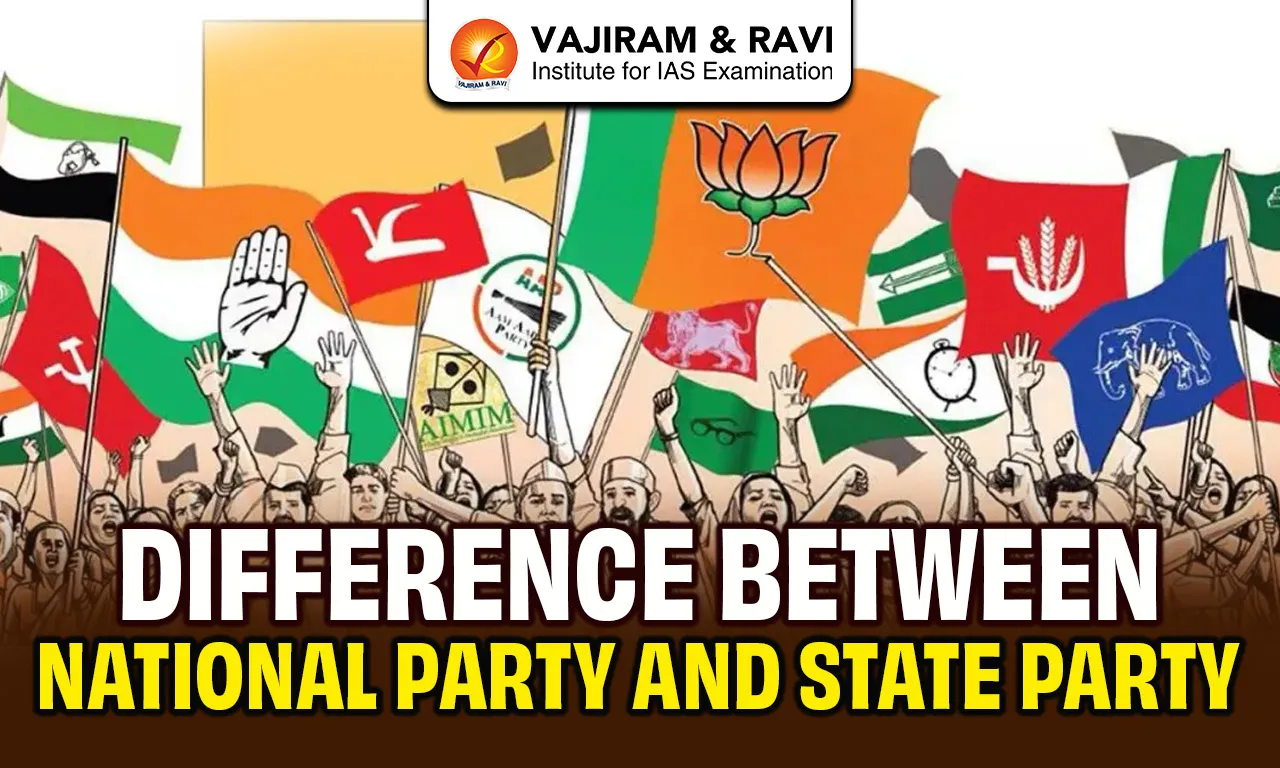
Currently six parties enjoy the status of National Party: Bharatiya Janata Party (BJP), Indian National Congress (INC), Communist Party of India (Marxist) - CPI(M), Bahujan Samaj Party (BSP), Aam Aadmi Party (AAP), National People’s Party (NPP).
A registered party is recognised as a national party only if it fulfills any one of the three conditions listed below:

  • If its candidates polled at least 6% of total valid votes in any four or more states in the last Lok Sabha or Assembly elections and had at least four MPs in the last Lok Sabha polls; or 
  • If it has won at least 2% of the total seats in the Lok Sabha from not less than three states; or 
  • If it is 'recognised' in four or more states. 

State Party Criteria 

A registered party is recognised as a state party only if it fulfils any one of the five conditions listed below: 

  • At least 6% vote-share in the last Assembly election and have at least 2 MLAs; or have 6% vote-share in the last Lok Sabha elections from that state and at least one MP from that state; or
  • At least 3% of the total number of seats or three seats, whichever is more, in the last Assembly elections; or
  • At least one MP for every 25 members or any fraction allotted to the state in the Lok Sabha; or
  • Have at least 8% of the total valid votes in the last Assembly election or Lok Sabha election from the state.

Major examples of State Parties are: All India Trinamool Congress (West Bengal), Dravida Munnetra Kazhagam - DMK (Tamil Nadu), Samajwadi Party - SP (Uttar Pradesh), Rashtriya Janata Dal - RJD (Bihar), Janata Dal (United)  - JD(U) (Bihar), Telugu Desam Party - TDP (Andhra Pradesh) etc 

Difference between National and State Party

Difference between National and State Party is discussed below: 

Difference Between National and State Party
Nation Party State Party

Recognised across India 

Recognised in one particular state 

Must fulfill prescribed criteria in multiple states 

Must fulfill prescribed criteria within a single state 

They have pan-India presence and influence 

They have regional or state specific influence 

Get a permanent reserved symbol valid throughout India 

Gets a reserved symbol symbol only within the concerned state 

Generally has a national ideology and agenda 

Focuses on regional issues, state interests, and local identity

Examples - Indian National Congress (INC), Bhartiya Janta Party (BJP) etc 

Examples - Trinamool Congress in West Bengal, Shiv Sena in Maharashtra etc 

Advantages of Being Recognised as a National or State Party

  • Exclusive Election Symbol:
    • If a party is recognised as a State Party’, it is entitled for exclusive allotment of its reserved symbol to the candidates set up by it in the State in which it is so recognised, and
    • If a party is recognised as a `National Party’ it is entitled for exclusive allotment of its reserved symbol to the candidates set up by it throughout India.
  • Simpler Nomination Process:Recognised `State’ and `National’ parties need only one proposer for filing the nomination.
  • Free Electoral Rolls: Recognised `State’ and `National’ parties are entitled for two sets of electoral rolls free of cost at the time of revision of rolls and their candidates get one copy of electoral roll free of cost during General Elections.
  • Free Airtime: Recognised `State’ and `National’ parties get broadcast/telecast facilities over Akashvani/Doordarshan during general elections.
  • Star Campaigner Facility: Political parties are entitled to nominate “Star Campaigners” during General Elections. 
    • A recognized National or State party can have a maximum of 40 “Star campaigners” 
    • A registered un-recognised party can nominate a maximum of 20 ‘Star Campaigners”. 

The travel expenses of star campaigners are not to be accounted for in the election expense accounts of candidates of their party.

Is Registration Necessary to Contest Elections?

Any Indian citizen who is more than 25 years old and is registered as a voter can contest elections even without forming a party. Similarly, associations can also contest elections without getting registered by the Election Commission. They, however, will not be identified as political parties and hence will not be eligible for availing of benefits under the provisions of the Representation of the People Act, 1951 (RPA).

Benefits of Registration 

There are many benefits of registering a party: 

  • Firstly, the RPA allows political parties to accept contributions voluntarily offered to it by any person or company other than a government company. 
  • Apart from this, candidates of registered parties get preference in allotment of election symbols. Other Candidates are identified as independents and do not get preference in symbol allocation.

Difference Between National Party and State Party FAQs

Q1: Who grants recognition to national and state parties in India?

Ans: The Election Commission of India (ECI) grants recognition based on objective criteria under the Election Symbols (Reservation and Allotment) Order, 1968.

Q2: What is the main difference between a national party and a state party?

Ans: A national party has recognition across multiple states and its symbol is reserved nationwide, while a state party is recognised only within a particular state and its symbol is reserved only in that state.

Q3: How many national parties are there in India as of 2026?

Ans: There are six national parties: BJP, INC, CPI(M), BSP, AAP, and NPP.

Q4: What are the key benefits of being a recognised national or state party?

Ans: They get a reserved election symbol, free electoral rolls, one-proposer nomination, free airtime on Doordarshan and All India Radio, and the ability to nominate up to 40 star campaigners.

Q5: Is party registration necessary to contest elections in India?

Ans: No. Any eligible voter above 25 years of age can contest elections as an independent or as part of an unregistered association, but they will not receive the benefits available to registered or recognised parties.

Municipal Corporation, Constitutional Basis, Functions, Challenges

Municipal Corporation

Municipal Corporation is an urban local government body established for the administration of large cities and metropolitan areas. It is responsible for providing essential civic services and ensuring planned urban development. The first municipal corporation in India was set up by the British in Madras in 1688, followed by Bombay and Calcutta in 1726Across India, municipal corporations are referred to by different names, such as Nagar Nigam, Mahanagar Palika, or other state-specific terms.

Municipal Corporation Constitutional Basis

Municipal Corporations represent the third tier of governance in India. Municipal Corporations derive constitutional status from the 74th Constitutional Amendment Act, 1992. The amendment added Part IX-A to the Constitution, dealing specifically with Urban Local Bodies (ULBs).

Article 243Q provides for the constitution of Municipal Corporations in large urban areas. The Twelfth Schedule lists 18 functional subjects that may be devolved to urban local bodies.

Establishment and Area of Operation

Municipal Corporations are established in the states by the acts of the concerned state legislatures, and in the union territories by the acts of the Parliament of India. There may be one common act for all the municipal corporations in a state or a separate act for each municipal corporation.

Examples include Municipal Corporation of Delhi, Brihanmumbai Municipal Corporation, and Greater Chennai Corporation.

Composition and Structure

A municipal corporation has three authorities, namely, the council, the standing committees and the commissioner.

  • The Council is the deliberative and legislative wing of the corporation. It consists of the Councillors directly elected by the people, as well as a few nominated persons having knowledge or experience of municipal administration.
  • The Council is headed by a Mayor. He is assisted by a Deputy Mayor. He is elected in a majority of the states for a one-year renewable term. He is basically an ornamental figure and a formal head of the corporation. His main function is to preside over the meetings of the Council.
  • The standing committees are created to facilitate the working of the council, which is too large in size. They deal with public works, education, health, taxation, finance and so on. They make decisions in their fields.
  • The municipal commissioner is responsible for the implementation of the decisions taken by the council and its standing committees. Thus, he is the chief executive authority of the corporation. He is appointed by the state government and is generally a member of the IAS.

Functions of Municipal Corporations

The functions of Municipal Corporations are derived from the 74th Constitutional Amendment Act, 1992, which inserted Part IX-A into the Constitution. Article 243W empowers state legislatures to endow Municipal Corporations with powers and responsibilities for urban governance.

The Twelfth Schedule lists 18 functional subjects, which form the core functional domain of Municipal Corporations.However, the actual transfer of functions depends on state legislation, leading to variation in practice. Functions of Municipal corporations are as follows: 

  • Urban Planning and Land-Use Regulation:
    • Municipal Corporations are responsible for urban planning, including preparation of master plans and regulation of land use. They grant building permissions and ensure compliance with zoning regulations and building by-laws.
  • Water Supply and Sewerage Management: 
    • Municipal Corporations are entrusted with the responsibility of providing safe and adequate drinking water to urban residents. 
    • They manage water distribution networks, treatment plants, and storage facilities. 
    • Sewerage systems, including collection, treatment, and disposal of wastewater, also fall under municipal jurisdiction.
  • Public Health and Sanitation: 
    • Municipal Corporations are responsible for Sanitation and cleanliness, control of communicable diseases, Maintenance of municipal hospitals and dispensaries. 
    • They implement national health programmes at the city level in coordination with state authorities.
    • The COVID-19 pandemic highlighted the frontline role of municipal bodies in urban health governance.
  • Solid Waste Management: 
    • Municipal Corporations are responsible for collection, segregation, transportation, processing, and disposal of solid waste.
    • They implement rules under the Solid Waste Management Rules, 2016.
  • Roads, Transport, and Urban Infrastructure: 
    • Municipal Corporations construct and maintain urban roads, footpaths, flyovers, and street lighting.
    • They regulate traffic, parking, and sometimes urban transport services.
  • Disaster Management:
    • Municipal Corporations prepare for and respond to urban disasters such as fires, floods, and building collapses.
    • Disaster preparedness includes early warning systems, evacuation planning, and coordination with state agencies.
  • Implement Government Schemes:
    • For Example, Municipal Corporation implements schemes such as Smart Cities Mission, AMRUT, Swachh Bharat Mission (Urban)
  • Regulation of Trade and Economic Activities:
    • Municipal Corporations regulate markets, street vending, and trade licenses.They ensure compliance with safety, hygiene, and zoning norms.

Financial Powers and Sources of Revenue

Municipal Corporations have the authority to levy and collect local taxes, subject to state laws. Major sources of revenue include Property tax, Profession tax, Advertisement tax, User charges for services. 

They also receive Grants from State Governments, Central Finance Commission and State Finance Commission grants. Despite these sources, many corporations face financial stress and revenue deficits.

Challenges Faced by Municipal Corporations

Despite their importance, Municipal Corporations face several structural challenges:

  • Inadequate devolution of powers, with states retaining control over key functions.
  • Inadequate financial resources
  • Weak political leadership, caused by short mayoral tenures.
  • Administrative capacity constraints, including lack of skilled manpower.
  • Fragmented urban governance, with multiple parastatal agencies operating outside municipal control.
  • Rapid urbanisation has increased pressure on urban infrastructure and basic services.

These challenges often result in inefficient service delivery and citizen dissatisfaction.

Reforms and Way Forward

Strengthening Municipal Corporations is essential for India’s urban transformation. Key reforms include:

  • Ensuring full implementation of the 74th Constitutional Amendment in letter and spirit.
  • Granting greater financial autonomy through predictable revenue sources.
  • Strengthening the office of the Mayor, with longer tenure and executive powers.
  • Improving property tax reforms and GIS-based assessment.
  • Capacity building of municipal staff and elected representatives.
  • Promoting e-governance, citizen participation, and transparency.

Other Forms of Urban Local Government

Apart from Municipal Corporations, there are several other forms of urban local government in India. They are as follows: 

  1. Municipality: Municipalities exist in smaller cities and towns. They are also referred to as municipal councils, municipal committees, or municipal boards, and handle local administration and basic civic amenities.
  2. Notified Area Committee: Notified area committees are formed for rapidly developing towns or towns that lack basic infrastructure. All members of these committees are nominated by the state government.
  3. Town Area Committee: Town area committees are found in small towns and are responsible for essential local services such as street lighting, drainage, roads, and sanitation.
  4. Cantonment Board: Cantonment boards are set up in cantonment areas to manage the civilian population living there. They are created and administered by the central government.
  5. Township: Townships are established near industrial plants or establishments to provide basic facilities to workers and staff living in the colonies. They do not have elected members and function as an extension of the administrative system.
  6. Port Trust: Port trusts are formed in major port areas such as Mumbai, Chennai, and Kolkata. They manage port operations and also provide civic amenities to the people living in the port region.
  7. Special Purpose Agency: Special purpose agencies are created to undertake specific functions or projects assigned to municipal corporations or municipalities.

Conclusion

Municipal Corporations are the backbone of India’s urban governance architecture. As cities become engines of economic growth and social change, empowering Municipal Corporations is no longer optional but essential. A strong, autonomous, and accountable municipal system is crucial for achieving sustainable urbanisation, democratic decentralisation, and inclusive development. For India to manage its urban future effectively, Municipal Corporations must be transformed from weak service providers into robust institutions of self-government.

Municipal Corporation FAQs

Q1: What is a Municipal Corporation?

Ans: A Municipal Corporation is an urban local government body set up for the administration of large cities and metropolitan areas.

Q2: What is the constitutional basis of Municipal Corporations?

Ans: Municipal Corporations derive their constitutional status from the 74th Constitutional Amendment Act, 1992. Article 243Q allows the creation of municipal corporations in large urban areas, while the Twelfth Schedule lists 18 functional subjects that may be entrusted to them.

Q3: Which is the first Municipal Corporation in India?

Ans: The first Municipal Corporation was set up by the British in Madras in 1688, followed by Bombay and Calcutta in 1726.

Q4: How is a Municipal Corporation structured?

Ans: A Municipal Corporation has three main authorities: Council - the deliberative wing consisting of elected councillors and a few nominated members, headed by a Mayor and Deputy Mayor. Standing Committees - handle specialized areas like public works, health, education, and finance. Municipal Commissioner - the executive head, usually an IAS officer, responsible for implementing council decisions.

Q5: What are the main functions of a Municipal Corporation?

Ans: Municipal Corporations are responsible for Urban planning and land-use regulation, Water supply and sewerage management, Public health and sanitation, Solid waste management, Roads, transport, and urban infrastructure.

Mount Manaslu, Location, Height, Range, Features, Biodiversity

Mount Manaslu

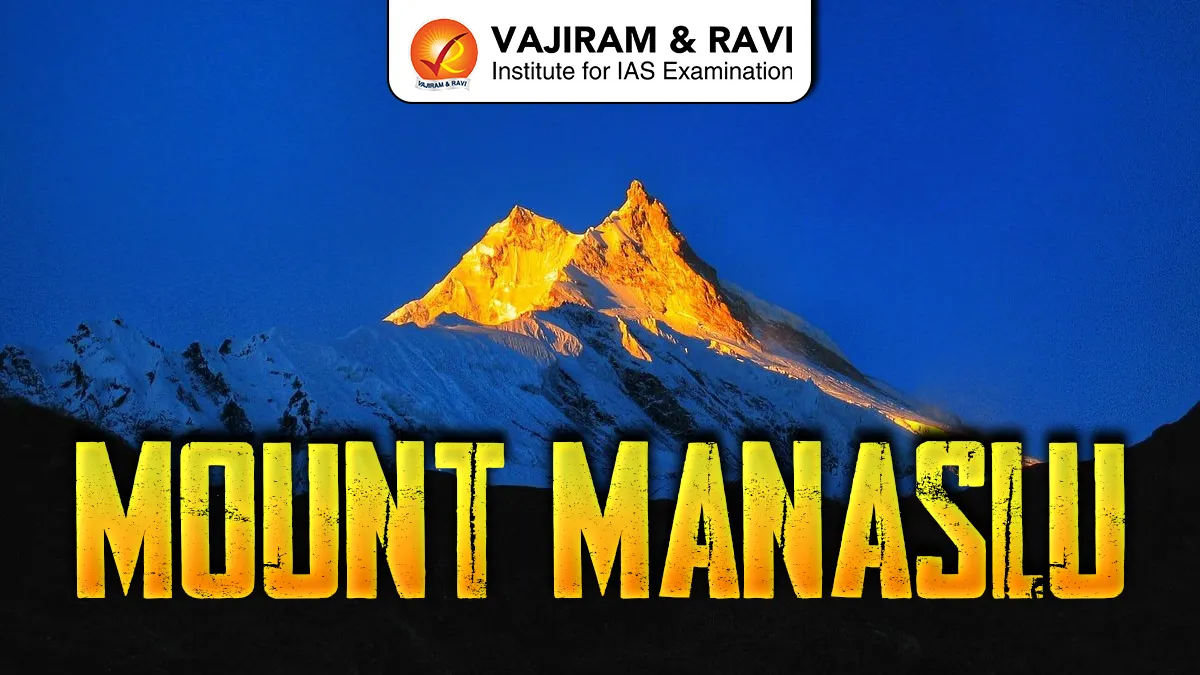
Mount Manaslu is one of the most important high Himalayan peaks of Nepal and holds global geographical, ecological and mountaineering significance. It is the eighth highest mountain in the world and forms a major part of the Mansiri Himal range in west-central Nepal. It is surrounded by glaciers, deep river gorges and remote settlements. Manaslu represents a unique blend of physical geography, biodiversity, human habitation and conservation led development in the central Himalayas.

Mount Manaslu

Mount Manaslu is located in the Gorkha District of Nepal within the northern Himalayan range and stands as the highest peak of the Mansiri Himal massif. Locally, it is known as “Kutang”. The term “Manaslu” is derived from Sanskrit word “manasa” which translates to “Mountain of the Spirit,” reflecting its deep cultural and spiritual symbolism.

Also Read: Ural Mountains

Mount Manaslu Features

Mount Manaslu displays striking physical, climatic and geological features that define its dominance in the central Himalayan landscape. The major features of Manaslu has been highlighted below:

  • Height: Mount Manaslu stands at 8,163 metres or 26,781 feet, making it the eighth highest mountain on Earth after Annapurna and before Dhaulagiri.
  • Geographical Location: The mountain lies in west-central Nepal, around 64 kilometres east of Annapurna and is bordered by the Budhi Gandaki River gorge to the east.
  • Mountain Range: Manaslu forms the highest point of the Mansiri Himal Range, which includes other major peaks like Himalchuli and Ngadi Chuli.
  • Topography: The mountain appears as a steep wall of snow and ice with terraced slopes descending into sparsely inhabited agricultural valleys.
  • Climatic Zones: The region spans six climatic zones, ranging from tropical foothills at 600 metres to arctic conditions above 4,500 metres near the summit.
  • Snow Line: The permanent snow line lies above 5,000 metres, where temperatures remain below freezing throughout the year.
  • Temperature Range: Subtropical areas experience summer temperatures up to 34°C, while the arctic zone remains far below zero degrees Celsius.
  • Precipitation Pattern: Annual rainfall averages around 1,900 millimetres, mainly during the monsoon season from June to September.
  • Surrounding Peaks: Major neighboring peaks include Himalchuli at 7,893 metres and Ngadi Chuli at 7,871 metres.
  • Glacial Pass: The Larkya La pass, at 5,106 metres, forms a glacial saddle north of Manaslu and connects the Manaslu and Annapurna regions.
  • Human Settlements: The nearest settlement to the peak is Samagaun village, located about 1.9 kilometres from the base camp.
  • First Successful Ascent: The peak was first climbed on 9 May 1956 by Toshio Imanishi of Japan and Gyalzen Norbu Sherpa during a Japanese expedition.
  • Trekking Corridor: The Manaslu Circuit trek spans about 177 kilometres and follows an ancient salt trading route along the Budhi Gandaki River.

Also Read: Arakan Yoma Mountain

Mount Manaslu Biodiversity

Mount Manaslu lies within a protected conservation landscape that supports rich biodiversity across multiple ecological zones.

  • Conservation Area: The Manaslu Conservation Area covers 1,663 square kilometres and was formally declared in 1998 under Nepal’s wildlife protection framework.
  • Altitudinal Diversity: The conservation area ranges from 1,400 metres to 8,156 metres, creating diverse habitats from subtropical forests to nival zones.
  • Mammalian Species: At least 33 mammal species are found here, including snow leopard, red panda, Himalayan tahr, musk deer and grey wolf.
  • Avian Diversity: Over 110 bird species inhabit the region, such as golden eagle, Himalayan griffon, blood pheasant and Himalayan snow cock.
  • Plant Wealth: The region supports around 1,500 to 2,000 plant species, including rhododendron forests and Himalayan blue pine.
  • Forest Types: Nineteen distinct forest types exist, classified into low hill, middle mountain and high mountain vegetation zones.
  • Medicinal Flora: Several medicinal and aromatic plant species grow naturally, supporting traditional healthcare and local livelihoods.
  • Community Conservation: Local monasteries have enforced hunting bans, significantly contributing to wildlife protection and ecosystem stability.

Mount Manaslu FAQs

Q1: Where is Mount Manaslu located?

Ans: Mount Manaslu is located in the Gorkha District of west-central Nepal, within the Mansiri Himal range of the Nepalese Himalayas.

Q2: Why is Mount Manaslu called the “Mountain of the Spirit”?

Ans: The name Manaslu comes from the Sanskrit word manasa, meaning intellect or soul, symbolizing spiritual and cultural significance.

Q3: Who was the first person to climb Mount Manaslu?

Ans: Mount Manaslu was first successfully climbed on 9 May 1956 by Toshio Imanishi and Gyalzen Norbu Sherpa.

Q4: What is the height of Mount Manaslu?

Ans: Mount Manaslu has an elevation of 8,163 metres or 26,781 feet, making it the eighth highest mountain in the world.

Q5: Is Mount Manaslu part of a Manaslu Conservation Area?

Ans: Yes, Mount Manaslu lies within the Manaslu Conservation Area, established in 1998 to protect biodiversity and promote sustainable management.

Pearl River, Location, Tributaries, Drainage Pattern, Importance

Pearl River

Pearl River, known in China as Zhu Jiang, is one of the major river systems of East Asia and the third longest river system of China, after the Yangtze and the Yellow River. The name "Pearl River" comes from the pearl-colored shells that lie within the Pearl's riverbed as it flows through the city of Guangzhou.

Pearl River Location and Extent

  • The Pearl River basin is located in southern China.
  • The river system flows mainly through the provinces of Yunnan, Guizhou, Guangxi, and Guangdong.
  • The river finally drains into the South China Sea near Guangzhou, Hong Kong, and Macau.

Pearl River Tributaries and River System

  • The Pearl River is not a single river but a river system formed by the confluence of three major rivers. These three major tributaries are: Xi Jiang (West River) - the longest and most important tributary, Bei Jiang (North River), Dong Jiang (East River). 
  • The Xi Jiang, the main tributary, originates in the Yunnan Plateau.
  • The river system flows generally from west to east, descending from highlands to low-lying coastal plains.
  • After flowing through Guangdong province, the river forms a large delta before entering the South China Sea.

Read about: Tigris River

Pearl River Delta

  • The Pearl River Delta is one of the largest and most economically dynamic deltas in the world.
  • Major cities located in the delta include Guangzhou, Shenzhen, Zhuhai, Hong Kong, and Macau.
  • The delta is characterised by dense population, extensive urbanisation, and advanced industrial activity. It plays a crucial role in China’s export-oriented growth and global trade.

Pearl River Drainage Pattern

  • The Pearl River exhibits a dendritic drainage pattern.
  • Near the delta, the river divides into numerous distributaries, forming a complex estuarine system.

Climate Influence

  • The Pearl River basin lies in a subtropical monsoon climate region.
  • The river receives heavy rainfall during the East Asian summer monsoon.
  • High discharge during monsoon months supports agriculture but also increases flood risk in the delta region.

Pearl River Ecological Significance

  • The Pearl River basin supports wetlands, estuaries, and mangrove ecosystems, especially near its mouth.
  • These ecosystems provide habitats for diverse aquatic and bird species. 
  • For Example, Mai Po Marshes (Hong Kong) - a Ramsar site that supports migratory birds like the Black-faced Spoonbill and Great Egret.

Pearl River Economic Importance

  • The Pearl River is vital for irrigation, inland navigation, hydropower generation, and industrial water supply.
  • The river system supports some of China’s most productive agricultural and industrial regions.
  • Ports in the Pearl River Delta, such as the Port of Guangzhou and the Port of Shenzhen, support international trade and connectivity.

Pearl River FAQs

Q1: The Pearl River drains into which sea?

Ans: Pearl River drains into the South China Sea.

Q2: Which three rivers form the Pearl River system?

Ans: Xi Jiang (West), Bei Jiang (North), Dong Jiang (East) form the Pearl River system.

Q3: Which is the longest and most important tributary of the Pearl River system?

Ans: Xi Jiang (West River) is the longest and most important tributary of the Pearl River system.

Q4: The Pearl River basin lies mainly in which part of China?

Ans: Pearl River basin lies mainly in Southern China.

Q5: Which major cities are located in the Pearl River Delta?

Ans: Guangzhou, Shenzhen, Hong Kong, and Macau.

Karakoram Range, Location, Physiography, Drainage, Ecology

Karakoram Range

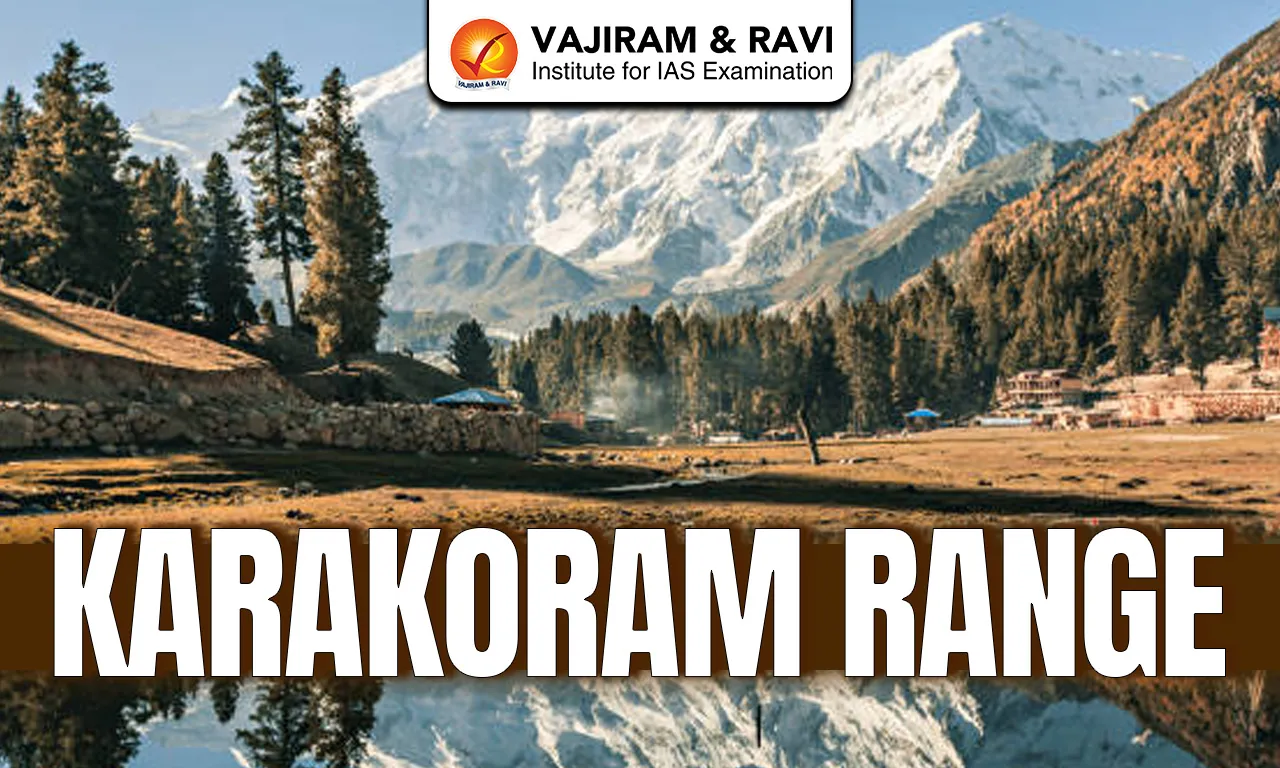
The Karakoram Range, also known as Krishnagiri, is the northernmost Trans-Himalayan range in India. The name Karakoram is derived from a Turkic term meaning “Black Rock” or “Black Mountain.”

The range is geopolitically significant as the borders of India, Pakistan, China, Afghanistan, and Tajikistan converge in this region.

Karakoram Range Location and Extent

  • The Karakoram range is a mountain range in Asia located primarily in the Kashmir region.
  • It lies to the north of the Great Himalayan Range and extends across Ladakh in India, Gilgit-Baltistan in Pakistan, and Xinjiang in China.
  • It is a part of the Trans-Himalayan mountain system. 
  • It is bounded by Pamir Plateau in the northwest, Kunlun Mountains in the north, Himalayan Range in the south.
  • The range runs in a north-west to south-east direction and acts as a natural barrier between the Indian subcontinent and Central Asia.

Karakoram Range Geology

  • The Karakoram range was formed during the Cenozoic era.
  • It is a young fold mountain range. It formed due to the collision of the Indian Plate with the Eurasian Plate.
  • Due to active tectonics, the region is highly prone to earthquakes and landslides.
  • The region is structurally complex and consists mainly of igneous and metamorphic rocks, such as granite and gneiss.
  • Major geological features include the Karakoram Fault and the Indus-Tsangpo Suture Zone, which indicate intense tectonic activity.

Karakoram Range Relief and Physiography

  • The Karakoram Range is known for its extremely rugged and steep terrain.
  • The Karakoram Range contains some of the highest peaks on Earth including K2 (Mount Godwin-Austen), at 8,611 metres, which is the second highest peak in the world.
  • The Karakoram Range is marked by deep, narrow, and glaciated valleys formed by tectonic uplift and intense glacial erosion. Important valleys include the Nubra Valley in Ladakh, Hunza Valley in Gilgit-Baltistan, Shigar Valley, Shimshal Valley. 
  • The Karakoram Range contains several high-altitude passes such as the Karakoram Pass, Khunjerab Pass, and Saser La, which have historically served as trade and strategic routes between South Asia, Central Asia, and China.

Karakoram Range Glaciers

  • The Karakoram Range is one of the most heavily glaciated regions outside the polar areas.
  • Major glaciers include the Siachen Glacier, Baltoro Glacier, Biafo Glacier, and Hispar Glacier.
  • The region exhibits the Karakoram Anomaly, where many glaciers are stable or advancing despite global warming trends. This anomaly is attributed to high-altitude snowfall, lower summer temperatures, and the dominance of western disturbances.

Karakoram Range Drainage

  • The rivers of the Karakoram Range are mainly glacier-fed. 
  • The Karakoram Range acts as a water divide, with rivers on its southern side draining into the Indus basin and those on the northern side draining into the Yarkand - Tarim basin.
  • Rivers such as the Indus, Shyok, Nubra, and Hunza originate from or are fed by Karakoram glaciers.

Karakoram Range Climate 

  • Karakoram Range experiences a cold desert climate with extremely low annual precipitation.
  • The Indian monsoon has very little influence on the region, and most precipitation occurs in the form of winter snowfall due to western disturbances.
  • The region experiences long, severe winters and short, cool summers, along with large diurnal temperature variations.

Karakoram Range Ecology and Biodiversity

  • Due to harsh climatic conditions, vegetation in the Karakoram is sparse and mainly consists of alpine grasses and cold desert shrubs.
  • Despite extreme conditions, the region supports rare wildlife such as the snow leopard, Himalayan ibex, and blue sheep.

Karakoram Range FAQs

Q1: The Karakoram Range belongs to which mountain system?

Ans: It is part of the Trans-Himalayan mountain system, lying north of the Greater Himalayas.

Q2: Which is the highest peak of the Karakoram Range?

Ans: K2 (Mount Godwin-Austen) at 8,611 m, the second-highest peak in the world.

Q3: Siachen Glacier is a part of which mountain range.

Ans: The Siachen Glacier is a part of Karakoram Range.

Q4: The Karakoram Range forms a watershed between which two river basins?

Ans: Between the Indus Basin (south) and the Yarkand–Tarim Basin (north).

Q5: What is the “Karakoram Anomaly”?

Ans: A phenomenon where many Karakoram glaciers are stable or advancing, unlike most Himalayan glaciers which are retreating.

Phad Painting, History, Technique, Names, Types, Features

Phad Painting

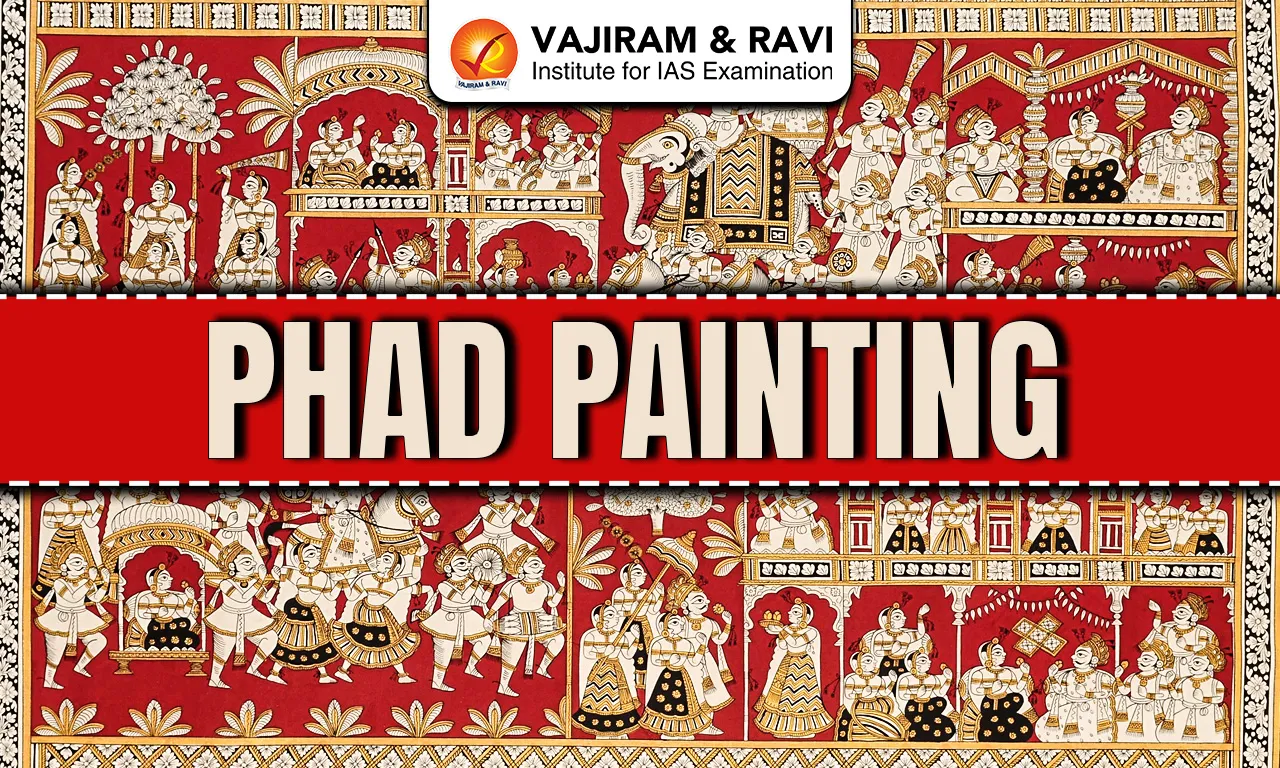
Phad Painting is a traditional religious scroll painting style of Rajasthan, deeply rooted in folk devotion and storytelling. It is practised mainly in the Mewar-Bhilwara region. It is painted on long cotton cloth called Phad and used as a mobile shrine during ritual performances. These scrolls visually narrate heroic legends of local folk deities like Pabuji and Devnarayan, worshipped by pastoral communities. Phad Painting combines art, music, poetry and ritual, making it both a visual and performative tradition. Its sacred nature, fixed iconography and narrative continuity give it a unique place in India’s cultural heritage.

Phad Painting Historical Background

Phad Painting originated around the 14th century in Shahpura, Rajasthan, evolving alongside folk heroic ballads called veergatha.

  • The earliest Phads depicted Pabuji of the Rabari community and Devnarayan of the Gurjar community, treating each painted scroll as a sacred shrine during worship and performances.
  • Priest singers known as Bhopas and Bhopis travelled village to village, using Phads as visual aids while narrating stories overnight through song, dance and ritual narration.
  • For centuries, Phad Painting was practised exclusively by the Joshi Clan, who were authorised to paint these sacred scrolls under strict traditional rules.

Also Read: Santhal Painting

Phad Painting Technique

Phad Painting follows a precise, ritualised process that ensures durability, vibrancy and sacred purity of the scroll.

  • Preparation of Cloth: Coarse cotton or khadi cloth is soaked overnight, dried, coated with a primer of flour and gum and burnished with a stone to achieve a smooth, glossy surface.
  • Use of Natural Pigments: Colours are derived from minerals and vegetable sources, applied using local gum (kheriya gond), which helps maintain colour brightness for decades.
  • Sequential Painting Method: Artists sketch compositions in yellow first, then fill colours systematically, ensuring hierarchical scaling of figures based on social and divine importance.
  • Final Ritual Completion: The painting is symbolically brought to life by drawing the pupil in the central deity’s eye, marking the spiritual completion of the Phad.

Also Read: Kangra Painting

Phad Painting Features

Phad Paintings are instantly recognisable due to their fixed visual grammar, narrative density and symbolic structure.

  • Narrative Composition: Scenes are arranged horizontally around a central deity, depicting multiple episodes simultaneously rather than in linear sequence, allowing continuous storytelling.
  • Distinct Visual Style: Figures are shown frontally with faces in profile, painted in orange tones, while garments use red, yellow, blue and green for contrast and clarity.
  • Defined Borders and Colours: Every Phad has red cloth edges and black-white floral borders, reinforcing its sacred frame and separating the divine narrative from the outside world.
  • Sacred Treatment: Phads are worshipped like temples, ritually purified before performances and traditionally immersed in Pushkar Lake when worn out, preserving their religious sanctity.
  • Project PARI 2024: Under Ministry of Culture’s Project PARI, Phad Painting inspired murals feature in Delhi’s public spaces, created by 150+ artists, showcasing folk art in modern urban settings during the 46th World Heritage Committee meeting.

Phad Painting FAQs

Q1: What is Phad Painting?

Ans: Phad Painting is a traditional religious scroll painting of Rajasthan, painted on long cloth to narrate stories of folk deities like Pabuji and Devnarayan through visual storytelling.

Q2: Which communities are associated with Phad Painting traditions?

Ans: Phad Paintings are linked with the Joshi artist community and are traditionally performed by Bhopas and Bhopis for Rabari and Gurjar communities during ritual storytelling.

Q3: What materials are used in Phad Painting?

Ans: Phad Paintings use hand prepared cotton cloth, natural mineral and vegetable pigments, flour gum primer and local gums, ensuring durability and long lasting colour vibrancy.

Q4: Why are Phad Paintings considered sacred?

Ans: Each Phad is treated as a mobile temple, worshipped during performances, ritually purified and symbolically brought to life by completing the deity’s eyes.

Q5: How is Phad Painting relevant in modern India?

Ans: Phad Painting inspires contemporary public art initiatives like Project PARI (2024), where traditional styles are adapted into murals and installations for wider public engagement.

Dhauladhar Range, Location, Geology, Physiography

Dhauladhar Range

The Dhauladhar Range is a prominent mountain range in the Lesser Himalayas located in the state of Himachal Pradesh. The name Dhauladhar comes from Sanskrit, where “Dhawala” means white and “Dhar” means ridge, referring to its snow-covered peaks.

Dhauladhar Range Location and Extent

  • The Dhauladhar Range lies primarily in the state of Himachal Pradesh, with a small extension into Jammu and Kashmir.
  • It runs in an east-west direction, parallel to the main Himalayan axis.
  • The range rises abruptly from the plains of the Kangra Valley, creating a sharp physiographic contrast.

Read about: Mountain Ranges in India

Dhauladhar Range Geology 

  • The Dhauladhar Range was formed as a result of the ongoing collision between the Indian Plate and the Eurasian Plate.
  • It is composed mainly of sedimentary and metamorphic rocks, such as slate, schist, and limestone.
  • The region lies close to major Himalayan fault systems and is therefore seismically active.

Dhauladhar Range Physiography

  • The Dhauladhar Range is characterised by steep slopes, sharp ridges, and narrow valleys.
  • It rises suddenly from low elevations of about 1,000 metres in the Kangra Valley to peaks exceeding 5,000 metres.
  • This steep gradient makes the range prone to landslides and erosion.
  • The highest peak of the Dhauladhar Range is Hanuman Tibba, with a height of about 5,639 metres.
  • The Indrahar Pass is the most important mountain pass across the Dhauladhar Range. The pass historically connected the Kangra Valley with Chamba and Lahaul regions.
  • Lam Dal lake (glacial lake) is situated in this range. Other notable examples include Kundal Lake, Kareri Lake, Nag Dal Lake, Khajjiar Lake, Chanderkoop Lake (Moon Lake)

Read about: Aravalli Range

Dhauladhar Range Climate

  • The Dhauladhar Range experiences a temperate to alpine climate.
  • The southern slopes receive heavy rainfall from the southwest monsoon, making them among the wettest parts of Himachal Pradesh.
  • The northern slopes lie in the rain-shadow area and are comparatively drier.
  • Winters are cold with substantial snowfall at higher elevations.

Dhauladhar Range Drainage and River Systems

  • The Dhauladhar Range acts as an important water divide in Himachal Pradesh.
  • Rivers originating or influenced by the range include the Beas River and tributaries of the Ravi River.
  • The range forms a natural watershed between the Beas and Ravi river systems.

Ecology and Biodiversity

  • The lower slopes of the Dhauladhar Range support sub-tropical and temperate forests, including sal, pine, oak, and deodar.
  • Higher elevations are characterised by alpine meadows and shrubs.
  • The range supports rich biodiversity, including species such as the Himalayan black bear, goral, and snow leopard in the upper reaches.

Dhauladhar Range Hill Stations

The Dhauladhar Range is associated with several famous hill stations in Himachal Pradesh, mainly located in the Kangra region. Important hill stations are Dharamshala, McLeod Ganj, Palampur, Dalhousie.

Dhauladhar Range FAQs

Q1: Where is the Dhauladhar Range located?

Ans: Mainly in Himachal Pradesh, with a small part in Jammu & Kashmir, running east-west above the Kangra Valley.

Q2: Dhauladhar Range is part of which Himalayas?

Ans: Dhauladhar Range is part of the Middle or Lesser Himalayas.

Q3: What is the highest peak of the Dhauladhar Range?

Ans: Hanuman Tibba (5,639 metres) is the highest peak of the Dhauladhar Range.

Q4: Which hill stations are located in the Dhauladhar Range?

Ans: Dharamshala, McLeod Ganj, Palampur, Dalhousie are some of the famous hill stations located in the Dhauladhar Range.

Q5: What is the climate of the Dhauladhar Range?

Ans: Temperate to alpine, with heavy rainfall on southern slopes and snowy winters at higher elevations.

One Nation One Election Bill, Key Takeaways, Latest Updates

One Nation One Election Bill

The One Nation, One Election Bill has been passed in the Lok Sabha with a ratio of 269 votes in favour and 198 votes against the passing of the bill. The bill proposes to hold simultaneous elections for the Lok Sabha, State Legislative assemblies and local body elections across the whole country. This proposal aims to align the election process leading to cost cutting and better governance by eliminating election related disruptions. This bill was analysed by a high-level committee chaired by President Ram Nath Kovind. While the opposition is still against this bill, a major number of leaders are looking at the benefits and consistently this bill could bring. In this article, we will look at this bill and the benefits and significance of this proposal. 

One Nation One Election Bill Latest Updates

The One Nation One Election Bill has been passed in the Lok Sabha with 269 votes being in favour of the bill and 198 votes against passing the motion. The bill was approved by the Union Cabinet with an aim to align the election processes of states and Union Territories including Jammu and Kashmir, Puducherry and New Delhi. The bill has been proposed to be deliberated through a Joint Parliamentary Committee(JPC). The report issued by the JPC will have to get approval by the Cabinet in order to be discussed in the parliament again. 

One Nation One Election Bill Overview 

Also known as simultaneous elections, one nation one election bill aims to hold all the elections including that of Lok Sabha, State Elections and panchayat that is the local body electrons all at once. In this manner, voters will be able to cast their votes for both the Lok Sabha and State elections all on the same day. 

The initiative will be conducted in two phases. In the first phase the Lok Sabha and State elections will be held together and in the second phase the local body elections that includes panchayats and municipalities elections will be conducted within 100 days of general elections. 

One Nation One Election Bill History 

The years 1951-52, 1962 and 1967 witnessed simultaneous elections dating back the concept of one nation one election to the early years of Indian Independence. This process was only discontinued after the 1967 elections due to the premature dissolution of a few state assemblies and Lok Sabha in 1970. Since then the elections are being conducted separately which is only leading to increased costs. The concept of one nation one election has been revived recently with the aim of aligning India’s electoral process.

One Nation One Election Advantages and Disadvantages

A bill can only be taken forward with analyzing its positives and negatives. Let's have a look at the advantages and disadvantages of One Nation One Election Bill: 

One Nation One Election Bill Advantages

  • Cost Reduction: It could save money by eliminating the need for separate election cycles.
  • Focus on Long-Term Governance: It encourages politicians to prioritize long-term governance over short-term gains.
  • Increased Voter Turnout: Voters are less fatigued, as they only participate once every few years, potentially boosting voter turnout.
  • Level Playing Field: Smaller parties can compete more effectively with larger ones due to reduced overall election expenses.
  • Efficient Use of Security Forces: It allows security forces to be deployed more efficiently for other purposes.

One Nation One Election Bill Disadvantages

  • Synchronization Challenges: Synchronizing elections in a diverse democracy like India can be difficult, particularly if governments lose confidence in their assemblies.
  • Constitutional and Federalism Issues: Its implementation may require constitutional changes and could potentially challenge the federal nature of the Indian political system.
  • Impact on Voter Behavior: Voters may confuse national and state issues in simultaneous elections, blurring the distinctiveness of state-level politics.
  • Impact on Regional Parties: It may favour larger national parties, potentially disadvantaging regional parties.
  • Accountability Concerns: Fixed terms without the threat of election could reduce government accountability and encourage autocratic tendencies.

One Nation One Election Bill Implementation

The implementation of the One Nation, One Election policy is not feasible within the current constitutional framework. To enable this policy, certain essential amendments to the Constitution are necessary, including:

  1. Article 83: Concerning the duration of the Houses of Parliament, amendments are required to fix the tenure and timing for the dissolution of the Lok Sabha.
  2. Article 85: Pertaining to prorogation, dissolution and Session of Parliament, clear guidelines must be established to prevent arbitrary or ambiguous dissolution of sessions.
  3. Article 172: Governing the duration of State Legislatures, amendments are needed to synchronize their tenure with that of the Lok Sabha.
  4. Article 174: Similar to Article 85, this article deals with sessions, prorogation, and dissolution of State Legislatures. Amendments are required to standardize procedures and timelines.

These amendments are critical to harmonize the electoral processes at both the central and state levels, ensuring the successful implementation of the policy.

One Nation One Election Bill Challenges

While the One Nation One Election implementation could significantly bring down the costs of conducting the elections and align the administrative practices, there are a few challenges that cannot be ignored: 

  •  Overshadowing Regional Issues: Holding simultaneous elections for the Lok Sabha and all State Assemblies could lead to national issues dominating the discourse, sidelining important regional and state-specific concerns.
  • Impact on Regional Parties: Simultaneous elections may disproportionately benefit National Political Parties, putting Regional Parties at a disadvantage and potentially diluting their influence.
  • Political Accountability: Frequent elections foster greater accountability among lawmakers by subjecting them to regular public scrutiny. Fixed terms, on the other hand, could provide stability at the cost of reduced performance evaluation, challenging democratic ideals.
  • Federalism Concerns: Amendments to the Constitution regarding the term of State Legislative Assemblies under Article 172 can be enacted without requiring ratification by the states, potentially limiting their role and undermining the federal structure.
  • Logistical Challenges: Implementing the One Nation, One Election policy would demand substantial resources, including a vast number of electronic voting machines and trained personnel to manage the extensive process efficiently.

One Nation One Election Bill FAQs

Q1: What is "One Nation One Election"?

Ans: A policy proposal to conduct elections for the Lok Sabha and all State Assemblies simultaneously to streamline the electoral process.

Q2: Why are simultaneous elections in India considered beneficial?

Ans: They reduce the cost, time, and disruption caused by frequent elections while ensuring administrative efficiency.

Q3: What constitutional amendments are needed for One Nation One Election in India?

Ans: Amendments to Articles 83, 85, 172, and 174 are required to synchronize the terms of the Lok Sabha and State Assemblies.

Q4: Are there any challenges to implementing One Nation One Election in India?

Ans: Yes, challenges include logistical complexity, constitutional hurdles, and potential marginalization of regional issues.

Q5: How have other countries implemented One Nation One Election?

Ans: Countries like South Africa conduct simultaneous elections for national and provincial legislatures to streamline governance.

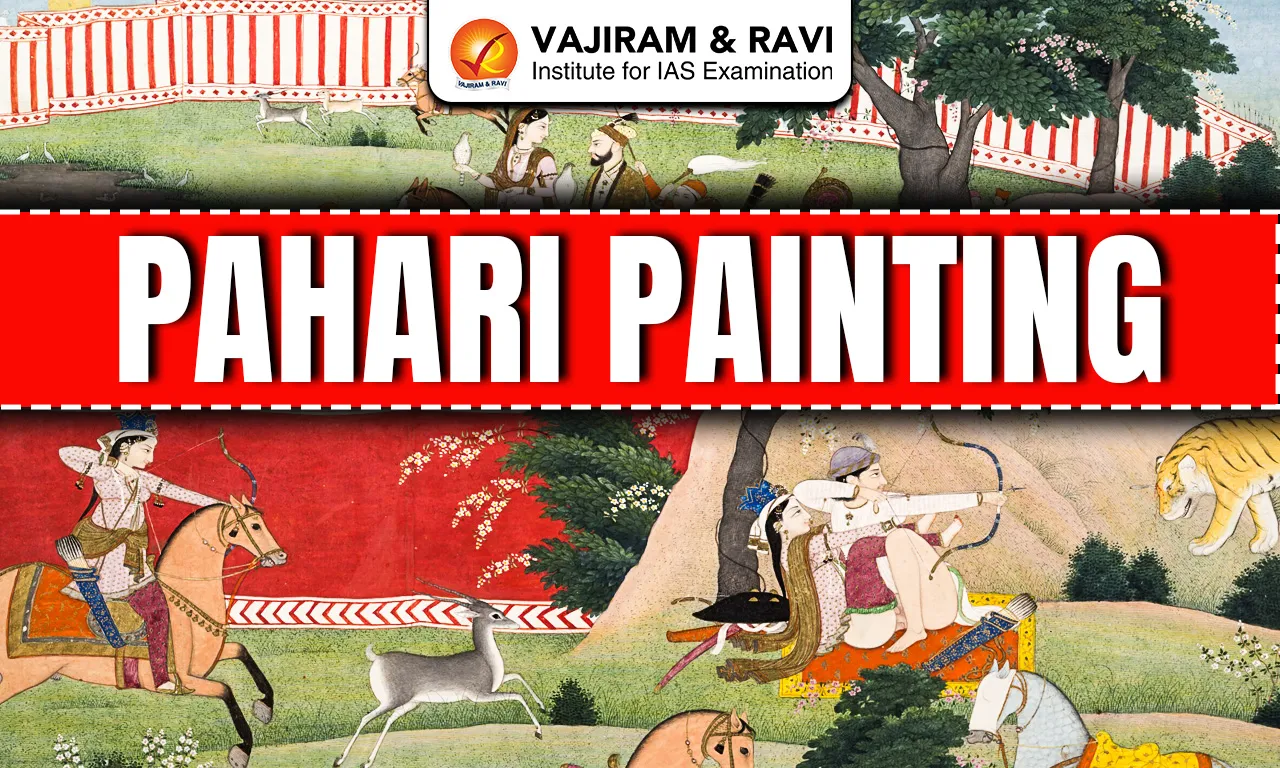
Pahari Painting, Background, Evolution, Features, Styles

Pahari Painting

Paharai Painting is a school of artform that was developed in the hilly regions of Northern India especially the states of Himachal Pradesh adjoining areas. These paintings were mainly patronized by the local rulers and their themes revolved around nature, love and religious stories.

Pahara Painting Background

  • Pahari Painting means painting from the hilly regions of North India.
  • It developed in the sub-Himalayan regions from Jammu to Garhwal between the 17th and 19th centuries (1690–1900).
  • These paintings were mainly done in miniature form and used for books and manuscripts.
  • Pahari Painting grew under the patronage of Rajput hill rulers in states like Basohli, Guler, Kangra, Chamba, Mandi and Garhwal.
  • It was influenced by Mughal and Rajasthani painting, especially after Mughal artists moved to the hills due to decline of Mughal patronage.
  • Over time, Pahari Painting developed its own unique style, different from Mughal art.

Read about: Mughal Paintings

Pahari Painting Evolution

The Pahari School of Painting developed gradually over time, influenced by regional traditions and external artistic styles. It evolved through different phases, beginning with bold early styles and later achieving refinement and lyrical beauty. These stages of development are discussed below.

Early Phase-Basohli Style (1690-mid-18th century)

  • The Basohli style is the earliest form of Pahari painting.
  • It is known for bold lines, strong colours and powerful expressions.
  • Themes included religious stories, especially Krishna legends.

Transitional Phase-Pre-Kangra / Guler Style (1740–1775)

  • This phase acted as a bridge between Basohli and Kangra styles.
  • Colours became softer and figures more natural and refined.
  • Mughal influence became stronger in landscape and perspective.

Mature Phase-Kangra Style (after 1770)

  • The Kangra style represents the peak of Pahari painting.
  • It reached its height under Raja Sansar Chand (1775–1823).
  • Paintings became delicate, lyrical, and full of emotion.
  • Themes focused on Radha-Krishna, inspired by Gita Govinda.

Pahari Painting Features

  • Pahari Paintings mainly show themes from mythology, religion and literature, along with court life and nature.
  • The love of Radha and Krishna is the most important and common subject in Pahari art.
  • Paintings usually have many figures and all figures appear lively and expressive.
  • Each figure is painted with different colours and careful detailing, showing artistic skill.
  • Pahari art introduced new techniques and styles over time, becoming more refined and delicate.
  • Nainsukh, a famous painter of the mid-18th century, played an important role in shaping this style and his family continued the tradition.
  • The paintings are known for fine lines, soft colours and balanced composition.
  • Nature such as hills, rivers, trees, birds and animals is shown beautifully in the background.
  • Pahari Paintings should not be identified only by region, as political boundaries often changed during that period.
  • The style reflects love, devotion, beauty and harmony, making it an important part of Indian art history.

Read about: Miniature Paintings

Different Styles of Pahari Painting

Pahari painting developed in different hill regions under various rulers, which led to the growth of distinct local styles. These styles differ in themes, colours and techniques, and are discussed below.

Basholi Painting

  • Basohli painting is an early style of the Pahari school, which developed in the Basohli region of Jammu and Kashmir between the late 17th and 18th centuries, mainly under the patronage of Raja Kirpal Pal.
  • It is known for its bold lines, strong facial expressions, large eyes and very bright colours like red, yellow, green and brown, which give the paintings a powerful look.
  • A special feature of Basohli paintings is the decorative jewellery made with raised white paint and shiny green beetle wings to show an emerald effect.
  • The main themes include Rasamanjari, Ramayana, Bhagavata Purana, Ragamala, Goddess (Devi) forms and royal court scenes.
  • Artists later carried this style to other hill regions such as Chamba, Kullu, Guler and Kangra and this helped in the development of later Pahari styles like the Kangra school.

Guler Painting

  • The Guler school of Pahari Painting developed in the early 18th century under the patronage of Raja Govardhan Chand of the Kangra royal family.
  • This style marked a shift from the bold Basohli style to a soft, refined and natural look, showing calm expressions and fine details.
  • Guler paintings use light and cool colours and show the influence of Mughal painting, especially in realistic faces and nature scenes.
  • Pandit Seu and his sons Manak and Nainsukh were the main artists; Nainsukh is especially known for realistic portraits of Raja Balwant Singh of Jasrota.
  • Important themes include Bhagavata Purana, portraits and Gita Govinda and this style later developed into the Kangra school of painting.

Kangra Painting

  • The Kangra School of painting developed in the late 18th century under the patronage of Raja Sansar Chand (1775-1823) of the Katoch dynasty. Artists from Guler, including Manaku and his family, came to Kangra and helped this style grow.
  • The main centres of this painting were Tira Sujanpur, Alampur and Nadaun, located along the River Beas, which became important hubs of artistic activity.
  • Kangra paintings are known for their soft, graceful and poetic style, with fine lines, delicate expressions, and bright but soothing colours. The female figures are shown with calm faces and a straight nose in line with the forehead, which is a special feature.
  • The paintings mostly show stories from Krishna’s life, especially Radha-Krishna, along with themes from Bhagavata Purana, Gita Govinda, Ragamala and Nala-Damayanti. Scenes of royal court life were also painted.
  • Fattu, Purkhu and Khushala were important Kangra painters. The art spread to nearby hill regions but started declining after 1805 due to wars and political troubles.

Garhwal Painting

  • The Garhwal School of painting began when artists from other hill regions settled in Srinagar (Garhwal).
  • In the beginning, the style was influenced by Mughal painting, but later it adopted the simple and soft style of Kangra painting.
  • Garhwal paintings are closely related to the Guler-Kangra tradition, especially in their natural and calm landscapes.
  • A special feature of Garhwal paintings is the use of cloudy skies, mist and foggy hills, which give a peaceful and emotional feel.

Chamba Painting

  • Chamba paintings are known for beautiful and graceful female figures with a warm and charming look.
  • These paintings mainly use bright red and blue colours and show good colour mixing.
  • The style shows influence of Mughal art and also elements from Deccan and Gujarat schools.
  • Earlier, Basohli style influenced Chamba painting, but later it moved closer to the Guler-Kangra style.

Mandi Painting

  • Mandi paintings developed under Raja Sidh Sen (1684-1727).
  • This school is famous for Tantric themes and the worship of the Goddess (Devi).
  • The Goddess is shown in fierce and powerful forms, using dark colours like red, black and blue.
  • Human figures, including kings, are often shown with exaggerated features, giving the paintings a bold and dramatic look.

Jammu Painting

  • Jammu paintings are very similar to the Kangra style, especially in their soft and graceful look.
  • This school is famous for the Shangri Ramayana, painted in the late 17th and early 18th centuries.
  • Human figures are shown as tall, slim and well-shaped, with clear facial features.
  • The paintings often show hilly landscapes and nature, using light but bright colours.

Jasrota Painting

  • Jasrota paintings mainly developed in Jammu and Kashmir.
  • They mostly show royal life, such as court scenes, kings’ activities and symbolic events.
  • These paintings are known for their simple and realistic style.

Mankot Painting

  • Mankot paintings are also found in Jammu and Kashmir.
  • Early works look similar to the Basohli style, with bright colours and bold themes.
  • Over time, artists used softer colours and showed more realistic portraits.

Pahari Painting FAQs

Q1: What is Pahari Painting?

Ans: It is a style of miniature painting from the hilly regions of North India developed between the 17th-19th centuries.

Q2: Who patronized Pahari Paintings?

Ans: They were patronised by Rajput hill rulers of Himachal Pradesh and nearby regions.

Q3: What are the main themes of Pahari Painting?

Ans: Mythology, Radha-Krishna, nature, literature and court life.

Q4: What is special about Basohli Painting?

Ans: Bold colours, strong lines and beetle-wing jewellery effect.

Q5: Who were the famous Pahari painters?

Ans: Pandit Seu, Manak, Nainsukh, Fattu and Purkhu.

Kangra Painting, Background, Features, Significance

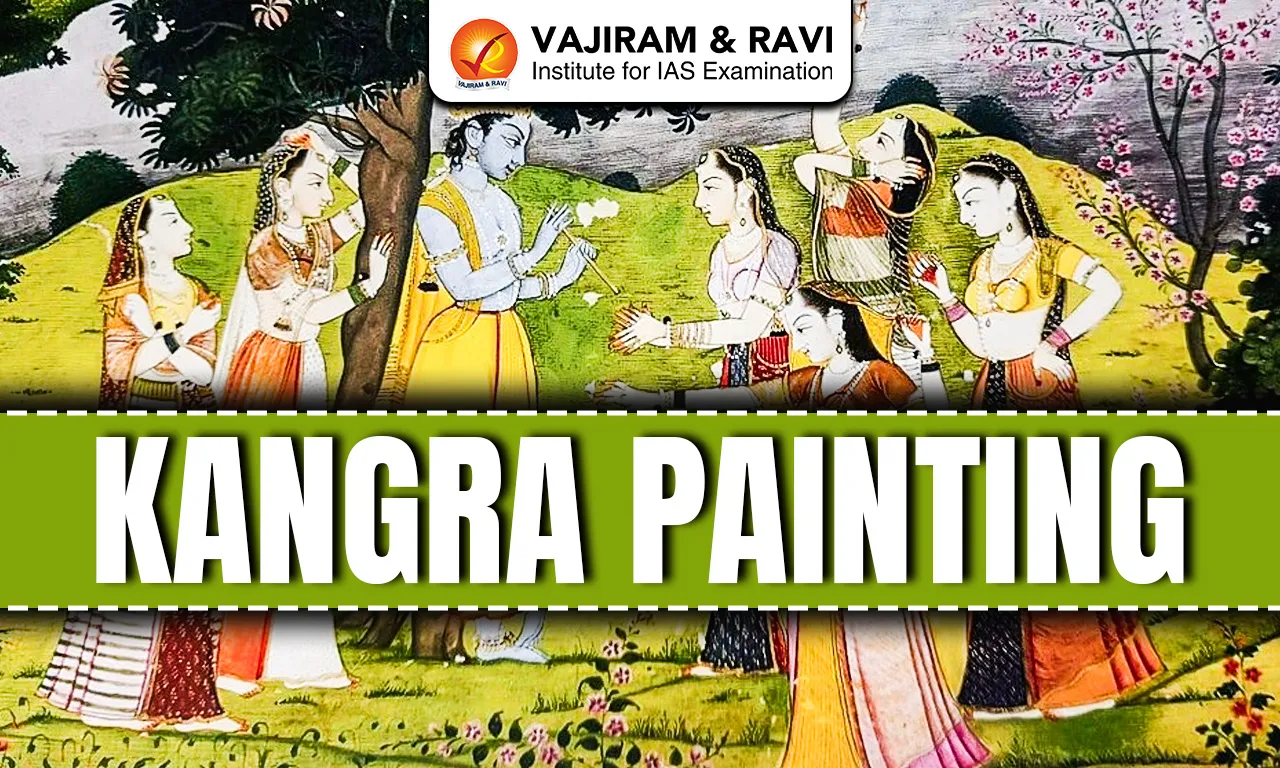
Kangra Painting

Kangra Painting is a famous pictorial type of Pahari art form, which is developed and named after the Kangra region of Himachal Pradesh, a former princely state which patronized the art form. The major themes of these paintings are nature and Krishna’s life.

Kangra Painting Background

  • Kangra Painting developed in the mid-18th century (around 1740–1750 CE) in the hill regions of present-day Himachal Pradesh, after the decline of the Basohli school of painting. It became so influential that the Pahari style later came to be known as Kangra Painting
  • It began at Haripur-Guler under the patronage of Raja Govardhan Chand (1744–1773).
  • After the invasions of Nadir Shah in 1739 and Ahmad Shah Abdali, many painters who were trained in Mughal style of painting moved from the plains to the hills.
  • These artists found support from hill rulers and developed a new painting style influenced by nature.
  • Under Parkash Chand (1773–1790), Kangra Painting continued to grow.
  • The art reached its peak during the rule of Raja Sansar Chand (1775–1823), the greatest patron of Kangra Painting.
  • Famous texts like Gita Govinda, Bhagavata Purana, Bihari’s Sat Sai, the romantic tale of Nala and Damyanti and Keshav Das’Raskapriya and Kavipriya were illustrated during this period.
  • Kangra Paintings are known for fine lines, bright colours and detailed work, which were done using thin squirrel-hair brushes.
  • The artists usually did not mention their names, showcasing selfless dedication to the art.
  • The Kangra Painters used pure red, yellow and blue colours which had maintained their brilliance even after many years.

Read about: Mughal Paintings

Kangra Painting Features

Central Theme

  • The main theme of Kangra Painting is love and emotion.
  • Love between man and woman is shown through figures like Radha–Krishna and Shiva–Parvati.
  • Paintings are lyrical, graceful and full of rhythm and beauty.
  • Themes also include seasons, music (ragas) and romantic devotion (bhakti).

Religious and Literary Influence

  • Many paintings show stories from the Ramayana, Mahabharata and Puranas.
  • Famous literary works like Gita Govinda, Rasikapriya, Sat Sai, Rasmanjari are painted in detail.
  • These paintings reflect religious faith, moral values and cultural awareness.

Depiction of Nature

  • Kangra Paintings are famous for lush green landscapes.
  • Hills, trees, rivers, streams, birds and animals are shown beautifully.
  • Nature is shown as calm, fresh and full of life.

Human Figures and Expression

  • Female figures are shown with grace, softness and beauty.
  • The Nayika is usually Radha, shown with gentle facial features.
  • The Nayak is mostly Krishna, shown with divine charm.
  • Hill rulers were sometimes painted as heroic figures or Nayaks.

Use of Colours and Brushwork

  • Natural colours made from minerals and plants are used.
  • Soft and cool colours create a peaceful and pleasing effect.
  • The brushwork is very fine, delicate and smooth.

Artistic Style

  • Kangra Paintings are realistic and detailed, showing careful observation.
  • Different shades of green are used to show plants and forests.
  • Distant hills are painted in soft pink or light colours.

Themes Over Time

  • Over time, themes expanded to include night scenes, storms, clouds, and lightning.
  • These added depth, mood and emotion to the paintings.

Kangra Painting Decline and Revival

  • Kangra Painting, though culturally important, is facing decline due to urbanisation, modern lifestyle and loss of traditional practices.
  • To protect and preserve this art, Kangra Painting was given the Geographical Indication (GI) tag in 2012, which recognises its heritage value and supports artisans.
  • Today, Kangra Paintings are preserved in museums and collections worldwide, and its global recognition was highlighted in the 2022 G20 Bali Submit, when a Kangra miniature was gifted by the Indian Prime Minister to the US President.

Read about: Miniature Paintings

Kangra Painting Significance

  • Kangra Painting is an important part of India’s cultural and artistic heritage.
  • It reflects Indian values like love, devotion, beauty of nature and spiritual faith.
  • The paintings help us understand the social life, beliefs and traditions of hill regions.
  • Kangra art shows a high level of skill in colour use, fine lines and detailed work.
  • It connects art with literature by illustrating stories from epics and classical poetry.
  • Kangra Painting has influenced later Indian artists and styles.

Its GI tag and global recognition help preserve traditional art and support local artists.

Kangra Painting FAQs

Q1: What is Kangra Painting?

Ans: A Pahari style of miniature painting from Kangra, Himachal Pradesh, mainly showing nature and Krishna’s life.

Q2: When and where did Kangra Painting develop?

Ans: It developed in the mid-18th century (1740–1750 CE) in Himachal Pradesh after the decline of the Basohli school.

Q3: Who were the major patrons of Kangra Painting?

Ans: Raja Govardhan Chand, Raja Parkash Chand and Raja Sansar Chand.

Q4: What are the main themes of Kangra Paintings?

Ans: Love, devotion, Radha–Krishna, nature, seasons, music and religious stories.

Q5: What are the main features of Kangra Painting?

Ans: Fine lines, soft natural colours, detailed landscapes and graceful human figures.

Santhal Painting, Background, Features, Modern Outlook

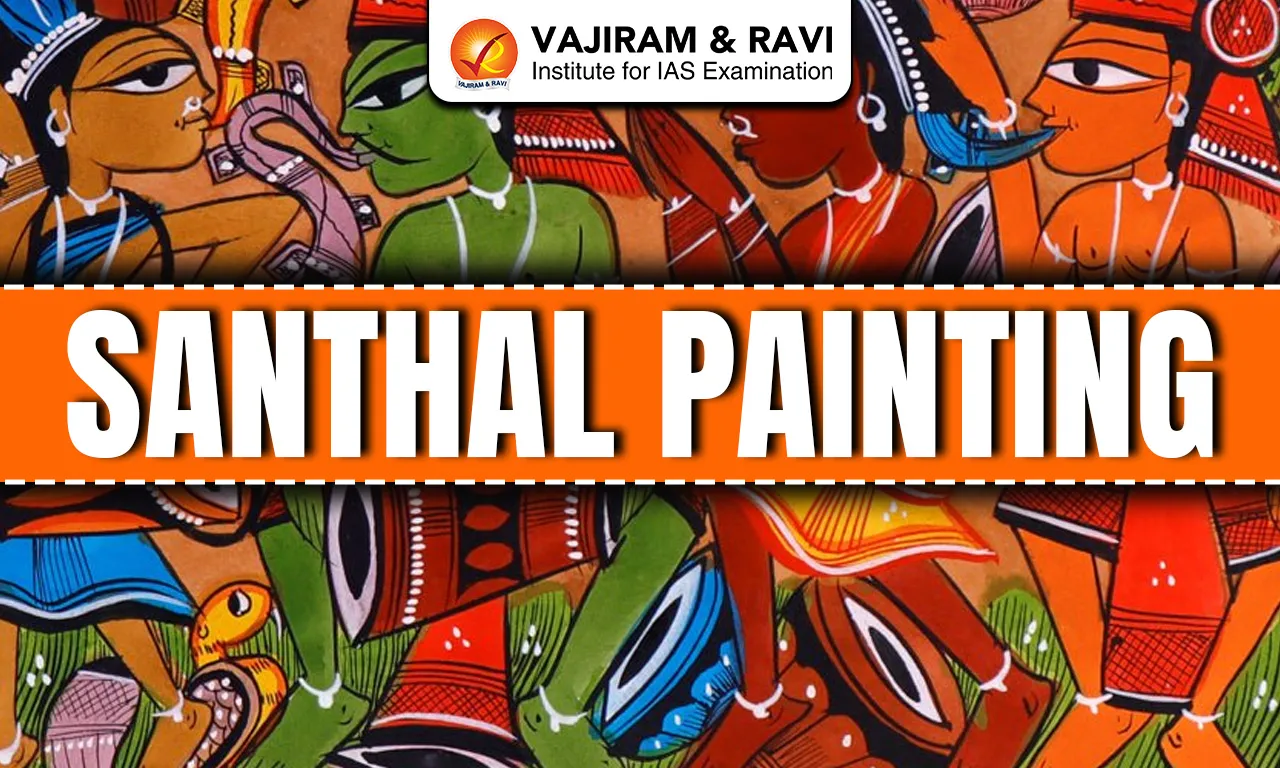
Santhal Painting

Sathal Painting is a traditional tribal artform of Santhal Community, majorly found in Jharkhand, West Bengal, Odisha and Bihar. These paintings use vibrant and bright colours to depict daily life activities, festivals, dance and nature. These paintings symbolize a close connection between the tribal people and nature.

Santhal Painting

  • Santhal Painting is a tribal art form of the Santhal tribe, mainly found in Jharkhand, West Bengal, Bihar, Odisha and Assam.
  • These paintings show simple scenes of daily life such as farming, dancing, hunting, festivals and village activities.
  • Nature, animals, birds and plants are common themes, showing the close bond of the Santhal people with their environment.
  • Bright colours and simple shapes are used to express culture, beliefs, folklore and traditions.
  • Santhal paintings are made during festivals and ceremonies and help preserve the cultural heritage of the tribe.
  • They worship a Stone, a formless representation of the divine.

Read about: Miniature Paintings

Santhal Painting Background

Historical Background

  • Santhal paintings developed among the Santhal tribe who live in forest regions of mainly eastern India.
  • Forests influence their art, as they provide food, livelihood and spiritual meaning.
  • Scenes of farming, fishing, cattle rearing and hunting are commonly shown in the paintings.

Cultural Life and Society

  • Earlier, Santhal paintings were made on the walls of huts during festivals and marriages.
  • Paintings show village life, nature, dancing, singing and social customs.
  • The Santhals were earlier nomadic but later settled and took up agriculture and related activities.

Religious Beliefs

  • Santhals are nature worshippers and believe that divine power exists in trees, stones, animals and birds.
  • These beliefs are clearly reflected through recurring natural motifs in their paintings.

Legends and Scroll Paintings

  • Santhal scroll paintings are based on storytelling and folklore, especially related to death and the soul’s journey.
  • Scroll painters called Jadupatua (meaning “magic painters”) travel to villages to narrate stories through paintings.
  • These scrolls help preserve Santhal beliefs, traditions, and cultural memory.

Santhal Painting Features

Main Characteristics

  • Santhal Paintings are simple, bold and expressive in nature.
  • Natural colours and rhythmic patterns are important features.
  • Figures show strong emotions and active movements.
  • Nature plays a central role, showing the close bond between the Santhal people and their environment.

Central Motifs and Themes

  • Santhal paintings mainly show animals, nature, village life and folk stories.
  • Common scenes include women working in fields, harvesting crops, feeding cattle, children playing, flying kites and people on swings.
  • Stories related to beliefs, life and death are also important themes in these paintings.

Medium Used

  • Traditionally, Santhal paintings were made on cloth known as pata.
  • Natural colours were prepared from forest materials like leaves, flowers, mud, stones and charcoal.
  • Sticks, twigs, and handmade tools were used for drawing and colouring.

Style of Painting

  • The paintings use bright primary colours and simple shapes.
  • Human and animal figures are drawn in a basic and symbolic manner, not in a realistic way.
  • Floral borders and natural elements like leaves, insects and flowers fill the background.
  • The focus is on expression and storytelling rather than accuracy or realism.

Process of Painting

  • First, outlines are drawn using black or brown colour made from charcoal or burnt wood.
  • After that, colours are filled inside the figures.
  • Earlier, paintings were done only on cloth, but today artists also use paper and canvas.

Read about: Mural Paintings

Santhal Painting Modern Outlook

  • In modern times, many Santhal artists use canvas and synthetic colours like acrylic paints.
  • Traditional artists still prefer natural colours and old methods, but their number is slowly decreasing.
  • Changes in living areas and migration have affected the practice of traditional techniques.
  • Rabindranath Tagore played an important role in studying and reviving Santhal paintings.
  • He introduced this art form at Shantiniketan, which helped it gain recognition.
  • Famous artist Jamini Roy was influenced by Santhal art and helped popularise its style in modern Indian art.

Santhal Painting FAQs

Q1: What is Santhal Painting?

Ans: It is a traditional tribal artform of Santhal Community majorly found in the states of Jharkhand, West Bengal, Odisha and Bihar.

Q2: What are the common themes of the Santhal Painting?

Ans: Common themes include village life, festivals, farming, animals, nature, and folklore.

Q3: What materials and colours are traditionally used in Santhal paintings?

Ans: Cloth (pata) and natural colours from plants, mud, and charcoal.

Q4: Who is Jadupatua?

Ans: Santhal scroll painters who narrate stories through paintings.

Q5: Who helped revive and popularise Santhal Painting?

Ans: Rabindranath Tagore and Jamini Roy played a major role to revive and popularize Santhal Painting.

Sarvam AI, Founder, Model, Significance, Challenges, Vision

Sarvam AI

Sarvam AI Latest News

The government has selected Bengaluru-based start-up Sarvam to build the country’s first indigenous artificial intelligence (Sarvam AI) large language model (LLM) amid waves made by China’s low cost model DeepSeek.

Introduction of Sarvam AI

  • In a landmark move to bolster India’s strategic autonomy in artificial intelligence (AI), Bengaluru-based start-up Sarvam AI has been selected to build the country’s first homegrown sovereign large language model (LLM). 
  • The project, undertaken under the government’s ambitious ₹10,370 crore IndiaAI Mission, aims to create a robust AI infrastructure fully developed, deployed, and optimized within India. 
  • This development marks a critical step toward ensuring India’s leadership in the AI domain and promoting domestic innovation through indigenous capabilities.

Sarvam AI Model Initiative Overview

  • The government chose Sarvam after a rigorous selection process involving 67 applicants. The start-up will receive extensive support, including access to 4,000 high-end GPUs for six months to build the model from scratch. 
  • The GPUs will be provided through companies such as Yotta Data Services, Tata Communications, and E2E Networks, which were separately empanelled to create AI data centres in India.
  • The model, to be built entirely using local talent and infrastructure, will have 70 billion parameters, positioning it to compete with some of the best global AI models. 
  • According to Sarvam, the LLM will focus on advanced reasoning, voice-based tasks, and fluency in Indian languages, making it uniquely suited for India's diverse population.

Model Variants Under Development

  • Sarvam AI plans to develop three key variants of its LLM:
    • Sarvam-Large: Designed for advanced reasoning and complex generation tasks.
    • Sarvam-Small: A lightweight model optimized for real-time interactive applications.
    • Sarvam-Edge: A compact model tailored for on-device processing, enabling AI capabilities on mobile and IoT devices.
  • These variants aim to cater to a wide range of applications, from citizen services to enterprise solutions, ensuring adaptability across various use cases.

Strategic Significance of the Project

  • This initiative goes beyond technological advancement; it is a strategic move to establish critical national AI infrastructure
  • The company emphasized that the goal is to create multi-modal, multi-scale foundation models that are not just functional but deeply integrated with Indian languages and societal needs.
  • For citizens, this means AI systems that feel familiar and culturally relevant. 
  • For enterprises, it unlocks the potential to harness AI capabilities without concerns over data sovereignty, as all processes will remain within India's borders.

The IndiaAI Mission and National AI Infrastructure

  • The IndiaAI Mission, approved by the Union Cabinet, is focused on scaling India's AI ecosystem by investing in compute capacity, skilled research talent, datasets, AI applications, and trusted AI practices. 
  • One of its key initiatives is the IndiaAI Compute Capacity program, which aims to deploy over 10,000 GPUs to democratize access to AI resources for startups, researchers, and institutions.
  • To facilitate greater participation, especially by smaller companies, the government has also eased eligibility norms for accessing these resources, offering GPU services at globally competitive subsidized rates.
  • Sarvam’s selection to develop the first sovereign AI model exemplifies the mission’s objective of nurturing homegrown champions capable of competing on the global stage.

Sarvam AI Challenges and Opportunities

  • While the opportunity is historic, building a population-scale LLM is a complex challenge. 
  • It demands seamless integration of vast datasets, engineering innovations to handle diverse languages and dialects, and fine-tuning for cultural and contextual understanding.
  • Additionally, unlike some global LLMs that are open-sourced, Sarvam’s model is expected to be closely managed and fine-tuned specifically for Indian use cases
  • This positions it as a secure and specialized alternative in an era where data privacy and localized solutions are paramount.

Future Prospects

  • Sarvam’s success could unlock a universe of possibilities, from enabling AI-driven citizen services in rural areas to building enterprise-grade AI applications with localized intelligence. 
  • It sets the foundation for India to not merely consume global AI solutions but to become a co-creator and leader in AI innovation.
  • With investments from prominent venture capitalists like Lightspeed Venture Partners and Peak XV Partners, Sarvam is well-resourced to deliver on this ambitious national mission.

Source: IE | TH

Sarvam AI FAQs

Q1: What is Sarvam AI’s project about?

Ans: Sarvam AI has been selected to build India’s first indigenous large language model under the IndiaAI Mission.

Q2: What are the main features of Sarvam’s AI model?

Ans: The model focuses on reasoning, supports voice tasks, and is fluent in multiple Indian languages.

Q3: How is the government supporting Sarvam AI?

Ans: Sarvam will get access to 4,000 GPUs and dedicated infrastructure to develop the model from scratch.

Q4: What is the strategic importance of this project?

Ans: It enhances India’s AI sovereignty, promotes domestic innovation, and ensures secure, localized AI solutions.

Q5: What are the different versions of the Sarvam model?

Ans: Sarvam is developing Sarvam-Large, Sarvam-Small, and Sarvam-Edge for different use cases.

Karve Committee, About, Aim, Recommendations, Key Details

Karve Committee

The Karve Committee was set up by the Planning Commission in 1955 to study the development of village and small-scale industries in India. It aimed to promote rural employment, use local resources and support balanced economic growth.

Karve Committee

  • The Karve Committee, also known as the Village and Small Scale Industries Committee, was set up by the Planning Commission in 1955 under the chairmanship of Prof. D.G. Karve.
  • Its main aim was to promote the growth of village and small-scale industries so that industrial development could also support rural areas and employment generation, especially during the period of the Second Five Year Plan (1956–61).

Karve Committee Recommendations

The Karve Committee strongly recommended the promotion of village and small-scale industries

  • Gave priority to village and small-scale industries for rural development.
  • Recommended labour-intensive industries to create more employment in villages.
  • Suggested use of local raw materials and traditional skills.
  • Supported reservation of certain products for small-scale industries to protect them from big industries.
  • Recommended government support like low-interest loans and tax concessions.
  • Aimed to reduce migration from rural areas to cities.

Promoted balanced and decentralized industrial growth in India.

Karve Committee FAQs

Q1: What is the Karve Committee?

Ans: The Karve Committee was set up in 1955 by the Planning Commission to study and promote village and small-scale industries in India.

Q2: Who chaired the Karve Committee?

Ans: The committee was chaired by Prof. D.G. Karve

Q3: Why was the Karve Committee formed?

Ans: It was formed to promote rural employment, reduce poverty and ensure that industrial development also benefited villages.

Q4: Which Five Year Plan is linked with the Karve Committee?

Ans: Its recommendations were closely linked with the Second Five Year Plan (1956–61).

Q5: What type of industries did the Karve Committee support?

Ans: It supported village and small-scale industries, especially labour-intensive industries.

National Waterways in India, List, Types, Significance

National Waterways in India

National Waterways in India are officially declared rivers, canals, and backwaters developed for inland water transport and navigation. India currently has 111 National Waterways, including major ones like the Ganga (NW-1), Brahmaputra (NW-2), and West Coast Canal (NW-3). These waterways provide a cost-effective and eco-friendly mode of transport, especially for bulk goods and cargo movement. They also help reduce pressure on roads and railways, improve regional connectivity, and support trade, tourism, and economic development in the country.

Important National Waterways in India List

India has several strategically important National Waterways that strengthen inland water transport, reduce logistics costs, and improve regional connectivity. The Important National Waterways in India List is given below.

Important National Waterways in India List

National Waterway

River / Canal

Location / States Covered

Significance

National Waterway 1 (NW-1)

Ganga River

Uttar Pradesh, Bihar, Jharkhand, West Bengal

Longest National Waterway; connects northern India with eastern ports and supports bulk cargo and river tourism.

National Waterway 2 (NW-2)

Brahmaputra River

Assam

Lifeline of Northeast India; crucial for transport of tea, coal, petroleum products, and improving regional connectivity.

National Waterway 3 (NW-3)

West Coast Canal

Kerala

Supports passenger transport and cargo movement; promotes backwater tourism and coastal trade.

National Waterway 4 (NW-4)

Krishna–Godavari River System

Andhra Pradesh, Telangana, Tamil Nadu, Puducherry

Enhances agricultural and industrial transport; improves inland–coastal connectivity in South India.

National Waterway 5 (NW-5)

Brahmani River & Mahanadi Delta

Odisha, West Bengal

Important for coal, fertilizers, and industrial goods from mining and port-linked regions.

National Waterway 6 (NW-6)

Barak River

Assam

Improves connectivity in southern Assam and links remote regions with trade centers.

National Waterway 7 (NW-7)

Godavari River

Andhra Pradesh, Telangana

Supports inland cargo transport and regional economic development.

National Waterway 8 (NW-8)

Alappuzha–Changanassery Canal

Kerala

Important for passenger transport and local trade in Kerala’s backwater region.

National Waterway 10 (NW-10)

Amba River

Maharashtra

Facilitates movement of goods between ports and industrial zones near Mumbai.

National Waterway 16 (NW-16)

Barak–Kushiyara Stretch

Assam

Strengthens inland transport and cross-border connectivity with Bangladesh.

National Waterway 27 (NW-27)

Cumberjua Canal

Goa

Supports iron ore transport and boosts tourism-related water transport.

National Waterway 37 (NW-37)

Gandak River

Bihar, Uttar Pradesh

Supports agricultural trade and rural connectivity in the Ganga basin.

National Waterway 58 (NW-58)

River Mandovi

Goa

Promotes inland water tourism and transport of mining and local goods.

National Waterway 73 (NW-73)

River Narmada

Madhya Pradesh, Gujarat

Facilitates movement of agricultural and industrial goods; supports port connectivity.

National Waterway 97 (NW-97)

Sunderbans Waterways

West Bengal

Vital for eco-tourism, disaster relief, and connectivity in delta and island regions.

National Waterways Act 2016

The National Waterways Act, 2016 was enacted by the Government of India to promote inland water transport and develop waterways as an alternative mode of transportation.

  • It declared 106 new waterways as National Waterways.
  • With this Act, the total number of National Waterways increased from 5 to 111.
  • The Act aims to promote inland water transport (IWT) as a cost-effective and eco-friendly transport system.
  • It provides a legal framework for the development, regulation, and maintenance of waterways.
  • The Act allows the government to develop navigation infrastructure, including terminals and cargo facilities.
  • It supports private sector participation in water transport projects.
  • The implementation and development of waterways under this Act are mainly handled by the Inland Waterways Authority of India (IWAI).
  • The Act helps in improving logistics efficiency and trade connectivity across India.

Inland Waterways Authority of India

The Inland Waterways Authority of India (IWAI) was established in 1986 by the Government of India to regulate and develop inland waterways for shipping and navigation. It plays a key role in strengthening inland water transport by developing infrastructure on National Waterways across the country.

  • IWAI was created in 1986 under the Inland Waterways Authority of India Act.
  • It is responsible for the regulation, development, and maintenance of inland waterways used for navigation.
  • The authority mainly focuses on developing Inland Water Transport (IWT) infrastructure on National Waterways.
  • It undertakes projects such as dredging, construction of terminals, navigation aids, and river traffic management systems.
  • These development and maintenance projects are carried out using grants provided by the Ministry of Shipping.
  • The headquarters of IWAI is located in Noida, Uttar Pradesh.
  • IWAI also has regional offices in various cities and towns across India to oversee local waterway development and operations.

Jalvahak Scheme

The Jalvahak Scheme is a government initiative aimed at promoting cargo transportation through inland waterways in India.

  • The scheme is launched to increase cargo movement through National Waterways.
  • It encourages a modal shift from road and rail transport to inland water transport (IWT).
  • The scheme provides financial incentives and operational support to cargo operators and businesses.
  • It aims to reduce logistics costs for industries by promoting water-based transport.
  • The scheme helps in reducing fuel consumption and carbon emissions, making transport environmentally sustainable.
  • It supports the development of waterway infrastructure, including terminals and cargo handling facilities.
  • The scheme is implemented with support from the Inland Waterways Authority of India (IWAI).
  • It promotes efficient freight movement, especially for bulk goods like coal, cement, fertilizers, and agricultural products.
  • The scheme also helps in generating employment opportunities in transport and logistics sectors.

National Waterways in India Significance

National Waterways in India play a vital role in strengthening the country’s transport system by providing a cost-effective, energy-efficient, and environment-friendly mode of transportation.

  • Cost-Effective Transport: Inland water transport is cheaper than road and rail transport, especially for bulk and heavy goods.
  • Energy Efficient: Waterways consume less fuel per tonne-kilometre, making them an energy-saving mode of transport.
  • Eco-Friendly Mode: Inland water transport produces lower carbon emissions and causes less environmental pollution.
  • Reduced Traffic Congestion: Development of waterways eases pressure on highways and railway networks.
  • Boost to Trade and Industry: National Waterways support domestic trade by enabling smooth movement of raw materials and finished goods.
  • Improved Regional Connectivity: They connect remote and river-based regions with major markets and ports.
  • Support to North-Eastern States: Waterways like the Brahmaputra improve accessibility in areas where road and rail infrastructure is limited.
  • Employment Generation: Development of waterways creates jobs in transport, logistics, tourism, and infrastructure sectors.
  • Tourism Promotion: River cruises, ferries, and water tourism help promote local tourism and cultural exchange.
  • Disaster-Resilient Transport: During floods or natural disasters, waterways can serve as alternative transport and relief routes.

National Waterways in India FAQs

Q1: What are National Waterways in India?

Ans: National Waterways are officially declared inland water routes such as rivers, canals, backwaters, and creeks that are developed for transportation and navigation.

Q2: How many National Waterways are there in India?

Ans: India has 111 National Waterways, declared under the National Waterways Act, 2016.

Q3: Which is the longest National Waterway in India?

Ans: National Waterway 1 (Ganga River) from Prayagraj to Haldia is the longest National Waterway in India.

Q4: Which organization manages National Waterways in India?

Ans: The Inland Waterways Authority of India (IWAI) is responsible for the development, regulation, and maintenance of National Waterways.

Q5: What is the National Waterways Act, 2016?

Ans: It is a law that declared 106 new waterways as National Waterways, increasing the total number from 5 to 111 and promoting inland water transport.

Model Tenancy Act, Need, Key Features, Key Issues, Significance

Model Tenancy Act

The Model Tenancy Act 2021 is a law made by the Government of India to bring fairness and clarity in renting houses and shops. It tries to protect the rights of both landlords (owners) and tenants (people who rent). The Act makes rules about rent, security deposits, maintenance, and how disputes should be solved. The aim is to make renting easier, fairer, and less confusing for everyone.

Model Tenancy Act

  • The Model Tenancy Act, 2021 is a law made to improve the rental housing system in India. Its main purpose is to balance the rights and duties of both landlords and tenants and reduce conflicts between them.
  • The Act proposes the setting up of a Rent Authority to register rental agreements and solve rent-related problems in a fast and fair manner, without going to long court cases. This helps in quick justice and reduces pressure on civil courts.
  • Another important aim of the Act is to promote rental housing and bring it into the formal system. Many houses remain empty due to fear of disputes; this law encourages owners to rent out their properties safely.
  • By increasing the availability of rental houses, the Act helps people from all income groups, especially migrants, students, and urban poor. In the long run, it supports the goal of reducing homelessness and creating a stable and inclusive housing market in the country.

Model Tenancy Act Need

  • Old rent laws were very strict, so many house owners were afraid to rent out their properties.
  • Many houses remained vacant because landlords feared they would not get their property back.
  • Rental agreements were mostly informal, leading to frequent disputes between landlords and tenants.
  • A large number of urban houses were lying empty despite high demand for rental housing.
  • Rapid urbanisation and migration increased the need for a clear, fair, and modern rental law.

Model Tenancy Act Key Features

  • Written Rental Agreement
    • The Model Tenancy Act says that the landlord and tenant must make a written agreement before renting a house or shop. This agreement clearly mentions the rent amount, time period of rent, and other rules, so that there is no confusion later.
  • Security Deposit Rules
    • To protect tenants from paying very high deposits, the Act fixes a limit on security deposits. For houses, the deposit cannot be more than two months’ rent, and for shops or offices, it cannot be more than six months’ rent.
  • Eviction of Tenants
    • A landlord can ask a tenant to leave only in certain cases. These include not paying rent, not paying rent for a long time, using the property without permission, or misusing the property even after a warning. This prevents unfair eviction.
  • Dispute Resolution System
    • The Act sets up a three-level system to solve rent-related problems: Rent Authority, Rent Court, and Rent Tribunal. Normal civil courts cannot interfere in these matters. This helps in quick and simple settlement of disputes.
  • Appointment of Authorities
    • Rent Authorities and Rent Courts are set up at the district level with the approval of the state government. The Rent Tribunal is formed by the state or union territory government after consulting the High Court. This ensures proper supervision and fairness.

Model Tenancy Act Key Issues

  • The Model Tenancy Act tries to improve the rental housing system, but it may not solve all major problems. Issues like lack of affordable houses, limited availability of rental homes, and informal renting may still continue unless more reforms are made.
  • The Act gives very detailed rules about rent agreements, such as who will do repairs and how much security deposit can be taken. Some experts feel that such small details should be decided by the landlord and tenant themselves, instead of being fixed by a central law.
  • To register a rent agreement, the Act asks for an Aadhaar number. This may go against earlier Supreme Court rulings and could raise concerns about people’s privacy.
  • The Act also requires agreement details to be put on an online public portal, which may expose personal information of landlords and tenants.
  • In some cases, the Act does not clearly say how quickly disputes must be solved, such as problems related to rent increase, stopping basic services like water or electricity, or mistakes by property managers. This may cause delays in justice.

Model tenancy Act Significance

  • It ensures quick and simple settlement of disputes between landlords and tenants through a special authority.
  • It modernises and improves the old and outdated rental laws in the country.
  • It builds trust between owners and tenants by clearly defining their rights and duties.
  • It encourages house owners to rent out vacant houses without fear.
  • It promotes private investment in rental housing, helping to reduce the shortage of houses.

Model Tenancy Act FAQs

Q1: What is the Model Tenancy Act, 2021?

Ans: It is a law made to make house and shop renting fair and clear for both landlords and tenants.

Q2: Why was the Model Tenancy Act introduced?

Ans: Old rent laws scared owners from renting houses, so many homes stayed empty despite high demand.

Q3: Who does the Act protect?

Ans: It protects both landlords and tenants by clearly defining their rights and duties.

Q4: Is a written rent agreement compulsory?

Ans: The Act makes it compulsory to have a written rental agreement.

Q5: How much security deposit can be taken?

Ans: Up to 2 months’ rent for houses and 6 months’ rent for shops or offices.

Copernicus Sentinel-2 Mission

Copernicus Sentinel-2 Mission

Copernicus Sentinel-2 Mission Latest News

The European Space Agency (ESA)'s Copernicus Sentinel-2 mission recently released a stunning high-resolution image of the 2026 Winter Olympic venues across northern Italy.

About Copernicus Sentinel-2 Mission

  • It is an Earth observation satellite mission developed by the European Space Agency (ESA).
  • It is part of Copernicus - the European Union’s Earth observation program.
  • It aims at monitoring variability in land surface conditions.
  • It comprises a land monitoring constellation of two polar-orbiting satellites placed in the same sun-synchronous orbit.
  • The twin satellites S-2B and S-2C have a wide swath width (290 km) and a high revisit time. This capability will support monitoring of changes on the Earth's surface.
  • It delivers high-resolution optical multispectral imagery across 13 spectral bands in the visible to shortwave infrared.
  • This data supports a wide range of applications, including precision agriculture, food security, ecosystems monitoring, disaster management (e.g., volcanoes, wildfires, floods, landslides), water quality assessment, and observing anthropogenic methane emissions.

Key Facts about Copernicus Programme

  • It is the Earth observation component of the European Union’s Space programme.
  • This initiative is headed by the European Commission (EC) in partnership with the European Space Agency (ESA).
  • It offers information services that draw from satellite Earth observation and in-situ (non-space) data.
  • The programme consists of a complex set of systems that collect data from multiple sources, including Earth Observation satellites, in-situ sensors like ground stations, and airborne and sea-borne sensors. 
  • Users have free and open access to a great deal of this data, which is also processed to provide a set of services based on reliable and near-real-time information.
  • ESA has developed a new family of satellites, called Sentinels, specifically for the operational needs of Copernicus.

Source: IT

Copernicus Sentinel-2 Mission FAQs

Q1: What is the Copernicus Sentinel-2 Mission?

Ans: It is an Earth observation satellite mission developed by the European Space Agency (ESA).

Q2: What is the primary objective of the Sentinel-2 Mission?

Ans: To monitor variability in land surface conditions.

Q3: What type of satellite constellation does Sentinel-2 use?

Ans: A land monitoring constellation of two polar-orbiting satellites.

Q4: What kind of imagery does Sentinel-2 provide?

Ans: High-resolution optical multispectral imagery.

Giant Phantom Jellyfish

Giant Phantom Jellyfish

 Giant Phantom Jellyfish Latest News

Scientists on a month-long deep-sea expedition off Argentina’s coast documented a rare giant phantom jellyfish recently.

About Giant Phantom Jellyfish

  • It is a rare and mysterious deep-sea jellyfish known for its ghostly, translucent appearance. 
  • It is among the largest jellyfish.
  • Scientific Name: Stygiomedusa gigantea
  • It is in the Ulmaridae family. 
  • It is believed to be widespread throughout the world’s oceans, except in the Arctic Ocean. 
  • Unlike most jellyfish, it lacks tentacles. Instead, they use ribbon-like arms to grab prey, typically plankton or small fish, and pull them into their mouths.
  • This mauve-coloured jellyfish can grow to a colossal size: the bell can be more than one metre (3.3 feet) across, and the animal's four ribbon-like 'oral arms' can reach lengths of more than 10 metres (33 feet).
  • But despite their massive size, the elusive creatures have been spotted only about 120 times since the first specimen was collected in 1899
  • That’s because they prefer to lurk in the “midnight zone,” a part of the ocean ranging from 3,300 to 13,100 feet deep, that is shrouded in complete darkness.
  • Their bodies being made of either spongy tissue or jelly allows the species to withstand the enormous deep ocean pressure of 40,000 kPa (5,800 pounds per square inch).

Source: NDTV

Giant Phantom Jellyfish FAQs

Q1: What is the Giant Phantom Jellyfish?

Ans: It is a rare deep-sea jellyfish known for its ghostly, translucent appearance.

Q2: Why is the Giant Phantom Jellyfish considered one of the largest jellyfish?

Ans: Because its bell can exceed one metre in diameter and its oral arms can grow over 10 metres long.

Q3: Does the Giant Phantom Jellyfish have tentacles like most jellyfish?

Ans: No, it lacks tentacles.

Q4: How does the Giant Phantom Jellyfish capture its prey?

Ans: By using ribbon-like oral arms to grab prey and pull it into its mouth.

Lyriothemis Keralensis

Lyriothemis Keralensis

Lyriothemis Keralensis Latest News

Researchers recently confirmed the discovery of a new species of dragonfly, Lyriothemis keralensis, from the low-lying coastal regions of Kerala.

About Lyriothemis Keralensis

  • It is a new species of dragonfly.
  • It was discovered in the low-lying coastal regions of Kerala.
  • Commonly called the Slender Bombardier, Lyriothemis keralensis was distinguished from its Northeast Indian relative, Lyriothemis acigastra, after extensive research. 
  • It has a slender abdomen, a uniquely shaped tail, and distinct genital structures. 
  • Males display a deep blood-red abdomen with black markings, while the slightly broader females show yellow and black colouration. 
  • The species measures about three centimetres in length.
  • Unlike many dragonflies found in forest areas, the Slender Bombardier prefers human-modified landscapes. 
  • It thrives in irrigation ecosystems such as pineapple and rubber plantations and is commonly seen in shaded canals and seasonal pools within agricultural areas.
  • It is a seasonal resident, emerging during the monsoon and retreating as rainfall declines.

Source: TOI

Lyriothemis keralensis FAQs

Q1: What is Lyriothemis keralensis?

Ans: It is a newly discovered species of dragonfly.

Q2: Where was Lyriothemis keralensis discovered?

Ans: In the low-lying coastal regions of Kerala.

Q3: What is the common name of Lyriothemis keralensis?

Ans: Slender Bombardier.

Q4: What key physical features distinguish Lyriothemis keralensis?

Ans: A slender abdomen, uniquely shaped tail, and distinct genital structures.

Q5: Which type of habitat does the Slender Bombardier prefer?

Ans: Human-modified landscapes rather than forest areas.

Kordofan Region

Kordofan Region

Kordofan Region Latest News

A drone attack by Sudan’s Rapid Support Forces struck a vehicle carrying displaced families near Rahad in North Kordofan, killing at least 24 people, including eight children and two infants.

About Kordofan Region

  • It is a region constituting the central and southern area of Sudan. 
  • It lies between the Darfur region on the west and the valley of the White Nile River on the east.
  • It covers an area of about 390,000 sq.km.
  • The region is divided into three federal states: North Kordofan (capital: El Obeid), South Kordofan (capital: Kadugli), and West Kordofan (capital: Al Fula).
  • The northern part of the region is desert and has sandy soils and little physiographic relief. 
  • There is some acacia scrub, desert grass, and thorny shrub; the landscape becomes increasingly more open and barren toward the north. 
  • The southern section of Kordofan is a level or gently undulating clay plain, with the scattered granitic Nuba Mountains rising in the east to an elevation of about 900 metres. 
  • Traditionally the area is known for the production of gum arabic. Other crops include groundnuts, cotton, and millet.
  • Most of the people in Kordofan are Arabs. Minorities include the Nubian, Beja, Daju, Zaghawa, and Darfunj peoples. 
  • It has been a conflict-prone area, especially since Sudan’s civil wars.
  • It is a strategic region due to:
    • Proximity to South Sudan.
    • Oil fields in West Kordofan.

Source: FPJ

Kordofan Region FAQs

Q1: What is the Kordofan Region?

Ans: It is a region constituting the central and southern area of Sudan.

Q2: Between which two major regions does Kordofan lie?

Ans: Between the Darfur region in the west and the White Nile River valley in the east.

Q3: What are the physical characteristics of northern Kordofan?

Ans: Desert landscape with sandy soils, little relief, and sparse vegetation.

Q4: Which ethnic group forms the majority population of Kordofan?

Ans: Arabs

Q5: Which minority communities live in the Kordofan Region?

Ans: Nubian, Beja, Daju, Zaghawa, and Darfunj peoples.

Paraleocrates Indica

Paraleocrates Indica

Paraleocrates Indica Latest News

Researchers recently discovered a new species of marine worm named Paraleocrates indica hiding in the muddy banks of the Champa Estuary in the Bay of Bengal.

About Paraleocrates Indica

  • It is a new species of marine worm discovered in the muddy banks of the Champa Estuary in the Bay of Bengal.
  • It marks the first time this rare group of creatures has ever been recorded in Indian waters.
  • It is a type of muddy bristle worm in the family Hesionidae, known for its colourful bodies and often symbiotic relationships with other sea life, such as starfish. 
  • This discovery is only the third known species within its specific genus worldwide.
  • To the naked eye, the worm appears reddish and measures between 14 and 35 millimetres in length.
  • The most striking characteristic of Paraleocrates indica is its eyes: its front pair of eyes is a staggering five times larger than the back pair. 
  • It also sports a pair of fang-shaped jaws, one on the top and one on the bottom, and a set of long, sensitive antennae that help it navigate its murky home.
  • It is distinguished from its closest relatives, P. djangkarensis and P. wesenberglundae, in Indonesia and the Gulf of Oman, by its specific bristle count
    • It has significantly fewer bristles (called neurochaetae) per bundle and features unique single-pointed blades on its appendages that lack the protective guards found on other species.

Source: RM

Paraleocrates Indica FAQs

Q1: What is Paraleocrates indica?

Ans: It is a newly discovered species of marine worm.

Q2: Where was Paraleocrates indica discovered?

Ans: In the muddy banks of the Champa Estuary in the Bay of Bengal.

Q3: What type of worm is Paraleocrates indica?

Ans: A muddy bristle worm belonging to the family Hesionidae.

Q4: What are Hesionidae worms generally known for?

Ans: Their colourful bodies and symbiotic relationships with other marine organisms such as starfish.

Q5: What is the most striking physical feature of Paraleocrates indica?

Ans: Its front pair of eyes is five times larger than the back pair.

Ural Mountains, Location, Height, Peaks, Features, Flora & Fauna

Ural Mountains

The Ural Mountains are one of the oldest mountain ranges on Earth, extending about 2,500 kilometres from the Arctic Ocean coast. They form the traditional geographical boundary between Europe and Asia. Since the 18th century, the Urals have played a central role in Russia’s economic development due to vast deposits of metal ores, coal, gold, platinum and semi precious stones, making the region a major metallurgical hub.

Ural Mountains

The Ural Mountains stretch across Eurasia through western Russia and slightly into Kazakhstan, separating European Russia from Siberia. They pass through the Ural geographical region and overlap with the Ural Federal District and Ural economic region. The range continues northward through Vaygach Island and the Novaya Zemlya archipelago into the Arctic Ocean. 

Ural Mountains Features

The Ural Mountains display ancient geological structure, moderate heights, rich mineral resources and strong economic and continental boundary significance.

  • Location: The Ural Mountains are located in western Russia and extend into northwestern Kazakhstan.
  • Geological Age: Formed around 250-300 million years ago during the Uralian orogeny, they are among the world’s oldest preserved mountain ranges without major post orogenic collapse.
  • Height: Average elevations range between 1,000 and 1,300 metres, with Mount Narodnaya reaching 1,894 metres, identified as the highest peak in 1927.
  • Rivers: The Ural Mountains act as an important watershed, giving rise to major rivers such as the Ural, Kama, Pechora, Tobol and Iset, which drain into the Caspian Sea and Arctic Ocean basins.
  • Peaks: The range has rounded and eroded peaks due to great geological age, with Mount Narodnaya (1,894 m), Mount Karpinsky and Mount Telposiz as notable high points.
  • Divisions: The range is divided into Polar, Nether-Polar, Northern, Central and Southern Urals, each showing distinct relief, climate and geological characteristics.
  • Mineral: The Urals contain about 48 economically valuable minerals, including iron ore, copper, nickel, chromite, bauxite, gold, platinum and precious gemstones.
  • Industrial Importance: Since the 18th century, the region has supported Russia’s metallurgy and heavy industries, with major centres like Yekaterinburg, Chelyabinsk and Magnitogorsk.
  • Climatic Influence: The north-south alignment affects climate patterns, with western slopes receiving 150-300 mm more rainfall annually than the eastern slopes.
  • Transport Corridor: Historic routes like Babinov Road and modern railways, including parts of the Trans Siberian Railway, cross the Urals linking Europe and Asia.
  • Economic Regions: The mountains overlap with the Ural economic region, one of Russia’s largest industrial zones due to dense mineral and energy resources.

Also Read: Altai Mountains

Ural Mountains Biodiversity

The flora and fauna of the Ural Mountains ranges from Arctic tundra to forests and steppes, which are shaped by latitude, altitude and continental climatic conditions.

Flora

  • Tundra Vegetation: In Polar Urals, vegetation includes mosses, lichens, dwarf birch, cloudberry and blueberry due to low temperatures and shallow soils.
  • Taiga Forests: Northern Urals are dominated by Siberian spruce, fir, pine, larch and Siberian cedar, forming dense boreal forest ecosystems.
  • Mixed Forests: Southern Urals host mixed forests with conifers and broadleaf species like oak, maple, elm and linden, showing highest plant diversity.
  • Tree Line Variation: Tree line lies at 250-400 metres in Polar Urals, rising to nearly 1,000 metres in Central and Southern Urals.
  • Steppe Grasslands: Southern and south-eastern slopes support meadow and rocky steppes with grasses such as Bromus inermis and mountain clovers.
  • Karst Forest Zones: Western slopes with limestone geology support forests interspersed with caves, sinkholes and underground streams.
  • World Heritage Forests: Virgin Komi Forests in the Northern Urals are recognised as a UNESCO World Heritage Site for pristine boreal ecosystems.

Also Read: Mount Kosciuszko

Fauna

  • Northern Species: Polar Urals host Arctic fox, lemmings, reindeer, snowy owl and ptarmigan adapted to tundra environments.
  • Fur Animals: Northern Urals contain valuable fur species like sable, ermine, marten and Siberian weasel.
  • Steppe Fauna: Southern Urals are home to hares, hamsters, susliks, jerboa and birds of prey like buzzards and kestrels.
  • Bird Diversity: Birdlife includes capercaillie, black grouse, hazel grouse, nutcracker, Siberian jay and migratory waterfowl.
  • Reptiles and Amphibians: Common viper, grass snake and lizards occur mainly in Central and Southern Urals due to milder climate.
  • Aquatic Life: Rivers and lakes support fish such as grayling, salmon, whitefish, nelma and trout, especially in northern basins.
  • Human Impact: Industrialisation reduced wildlife near cities, leading to creation of nature reserves like Ilmen, Pechora-Ilych and Bashkir reserves.
  • Protected Areas: Nine major strict nature reserves conserve forests, wetlands and mountain ecosystems across different Ural sections.
  • Ecological Balance: Despite industrial pressure, large forest cover helps regulate river flow and maintain biodiversity stability.

Ural Mountains FAQs

Q1: In which Continent are the Ural Mountains Located?

Ans: The Ural Mountains extend about 2,500 km from the Arctic Ocean in northern Russia to northwestern Kazakhstan.

Q2: Why are the Ural Mountains important geographically?

Ans: They form the conventional natural boundary between the continents of Europe and Asia.

Q3: What is the highest peak of the Ural Mountains?

Ans: Mount Narodnaya is the highest peak, with an elevation of about 1,894 metres.

Q4: How old are the Ural Mountains?

Ans: The Ural Mountains are around 250-300 million years old, making them one of the world’s oldest mountain ranges.

Q5: What natural resources are found in the Ural Mountains?

Ans: The region is rich in iron ore, copper, nickel, coal, gold, platinum and precious and semi precious gemstones.

Kamal Ranadive (1917-2001), Biography, Contributions, Achievements

Kamal Ranadive

Kamal Jayasing Ranadive was a pioneering Indian biomedical researcher whose work transformed cancer biology in India. She is best known for establishing India’s first Tissue Culture Research Laboratory in the 1960s at the Indian Cancer Research Centre, Mumbai. Her scientific focus on cancer, tumour viruses, hormones and immunology laid a strong experimental foundation for modern oncology research. She also co-founded the Indian Women Scientists’ Association, encouraging women’s participation in science. Her career combined laboratory excellence, public health research and national scientific leadership.

Kamal Ranadive Biography

Kamal Ranadive was born on 8 November 1917 in Pune to Dinkar Dattatreya Samarath and Shantabai Samarath. His father was a biologist at Fergusson College, She completed her BSc with distinction in Botany and Zoology in 1934 and earned an MSc in cytogenetics in 1943 from the Agriculture College, Pune. After marrying mathematician J. T. Ranadive in 1939, she moved to Bombay. She pursued doctoral research at the University of Bombay under pathologist V. R. Khanolkar, receiving her PhD in 1949. She later trained in tissue culture techniques at Johns Hopkins University with George Gey. She passed away on 11 April 2001 at the age of 83.

Kamal Ranadive Contributions

Kamal Ranadive has contributed greatly for the experimental cancer research in India through laboratory development, scientific studies and several initiatives. Major contributions are highlighted below:

  • Tissue Culture and Laboratory Development: She established India’s first tissue culture laboratory at ICRC in the early 1960s, developing indigenous culture media, reagents and experimental biology facilities essential for advanced cancer research.
  • Cancer Biology and Virology Research: Her studies clarified links between hormones, tumour viruses and cancers such as leukaemia, breast cancer and oesophageal cancer using animal models and cellular analysis.
  • Leprosy and Immunological Studies: Her foundational work on leprosy related bacteria contributed to the scientific basis for leprosy vaccine development and strengthened understanding of immune responses.
  • Public Health and Field Research: She led nutrition and health studies among tribal children in Maharashtra, notably the 1989 Akola taluk survey, connecting laboratory science with grassroots health outcomes.

Kamal Ranadive Achievements

For her life saving achievements, Kamal Ranadive has been awarded and honoured several times as highlighted here: 

  • She received the Padma Bhushan for Medicine in 1982. 
  • The Medical Council of India Silver Jubilee Research Award in 1964 with a gold medal and ₹15,000.
  • She served as Acting Director of the Indian Cancer Research Centre from 1966 to 1970 and was named Emeritus Medical Scientist by ICMR.
  • She authored over 200 scientific papers on cancer and leprosy. 
  • Her contributions were globally recognized with a Google Doodle in 2021 marking her 104th birth anniversary.

Kamal Ranadive FAQs

Q1: Who was Kamal Ranadive?

Ans: Kamal Ranadive was an Indian biomedical researcher known for pioneering cancer research and other scientific contributions.

Q2: What was Kamal Ranadive’s main research area?

Ans: Her research focused on cancer biology, tumour viruses, hormones, immunology and leprosy related bacterial studies.

Q3: Where did Kamal Ranadive receive her doctoral training?

Ans: She earned her PhD from the University of Bombay under V. R. Khanolkar, founder of the Indian Cancer Research Centre.

Q4: What awards did Kamal Ranadive receive?

Ans: She received the Padma Bhushan in 1982 and the Medical Council of India Silver Jubilee Research Award in 1964.

Q5: Who established the first Tissue Culture Research Laboratory of India?

Ans: Kamal Ranadive established India’s first Tissue Culture Research Laboratory in the early 1960s at the Indian Cancer Research Centre, Mumbai.

Key Facts about Greece

Key Facts about Greece

Greece Latest News

Greek Defence Minister Nikos and Indian Defence Minister will hold a bilateral meeting at the Manekshaw Centre in New Delhi to enhance defence cooperation.

About Greece

  • Location: It is located on the southern edge of the Balkan Peninsula.
  • Bordering Countries: It is bordered by 4 nations namely, North Macedonia and Bulgaria in the north, Albania in the northwest, and Turkey in the northeast.
  • Bordering Seas: It is also bounded by the Aegean Sea in the east, Ionian Sea in the west and the Mediterranean Sea in the south.
  • Capital:  Athens

Geographical features of Greece

  • Terrain: It is predominantly mountainous, with approximately 80% of its terrain consisting of mountains or hills, making it one of the most mountainous countries in Europe. 
  • Climate: The climate of Greece is typically Mediterranean.
  • Major Mountain:  Pindus mountain range on the mainland contains one of the world's deepest gorges, Vikos Gorge, which plunges 3,600 feet (1,100 meters).
  • Highest Peak: The highest Greek mountain is Mount Olympus, rising to 2,918 meters.
  • Major Rivers: Maritsa, Struma and Vardar etc.
  • Natural Resources:  It mainly consists of petroleum, magnetite, lignite, bauxite, hydropower, and marble.

Source: TH

Greece FAQs

Q1: What is the capital of Greece?

Ans: Athens

Q2: Where is Greece located?

Ans: Southeast Europe

Harijan Sevak Sangh, About, Objectives, Contributions

Harijan Sevak Sangh

Harijan Sevak Sangh, formerly All India Anti Untouchability League, is a non-profit organisation founded by Mahatma Gandhi in 1932 to eradicate untouchability in India, working for Harijan or Dalit People and upliftment of the Depressed Class of India. 

It is headquartered at Kingsway Camp in Delhi, with branches in 26 states across India.

Origin of the word “Harijans”

  • Mahatma Gandhi referred to the Dalit community as “Harijans,” a term that means “Children of God.” 
  • By using this name, Gandhi wanted to remove the social stigma attached to words like “untouchables” or “depressed classes” and highlight the equal dignity of all human beings.
  • His effort was aimed at improving the social status of Dalits and challenging the caste-based discrimination deeply rooted in Indian society.
  • For Gandhi, the term Harijan was not just a new label but part of a larger social reform movement. 
  • He believed that changing the way people thought and spoke about Dalits was essential to ending untouchability and social exclusion.

About Harijan Sevak Sangh

  • It was founded on September 30, 1932, after Gandhiji’s Epic Fast at Yervada Jail, Pune, resulting in the historic Poona Pact with Ambedkar.
  • It helped to make public places accessible to Dalits and did several kinds of social work for them such as the establishment of schools, support of inter-caste marriages, etc.
  • A seminal weekly newspaper, “Harijan” was launched to champion the cause against untouchability, promoting social reform and the upliftment of India's marginalized communities.
  • It served as a crucial platform for Gandhiji's campaigns, covering social, economic, and political issues during India's freedom struggle until the 1940s, continuing even after his death.

Harijan Sevak Sangh Objectives

The objectives of Harijan Sevak Sangh are:

  • Eradication of untouchability through truth and non-violence.
  • Removal of social disabilities and ensuring equal status for Dalits.
  • Securing civil and human rights, including access to schools, temples, wells, and other public places.
  • Improvement of the social conditions of women and children.
  • Promotion of values such as equality, fraternity, cooperation, and social service for an inclusive society.

Harijan Sevak Sangh Contributions

Awareness and Social Reform

  • It launched nationwide campaigns against untouchability and caste discrimination.
  • Mahatma Gandhi led a Harijan campaign (1933–34), travelling across the country to promote Dalit upliftment, social equality, and welfare of marginalised communities.
  • It was focused on changing social attitudes through public meetings, guidance, and direct interaction with Harijan colonies.

Ensuring Civil and Civic Rights

  • Worked to secure equal access for Dalits to public spaces such as temples, wells, roads, crematoriums, river ghats, guest houses, and restaurants.
  • Facilitated access to essential services like doctors, barbers, laundry services, etc., to remove everyday social exclusion.

Promotion of Education

  • It established and managed schools, hostels, and Ashram schools for Dalit children across India.
  • It runs institutions such as Kasturba Balika Vidyalayas and girls’ hostels, with a special focus on Dalit girls and children from marginalised regions.
  • Operates a large network of primary schools, Ashram schools, and hostels with support from the Ministry of Social Justice and Empowerment.

Skill Development and Self-Reliance

  • Set up Industrial Training Institutes (Udyogshalas) and vocational training centres to promote economic self-dependence among Dalits.
  • Established Safai Vidyalaya (Ahmedabad) to train sanitation workers in modern tools, technology, and hygienic practices.
  • Emphasised dignity of labour and skill-based empowerment.

Welfare of Women and Children

  • Operates creche centres across the country with support from the Central Social Welfare Board.
  • Focuses on education, nutrition, and care of women and children from vulnerable sections.

Harijan Sevak Sangh FAQs

Q1: What is Harijan Sevak Sangh?

Ans: Harijan Sevak Sangh is a social service organization established by Mahatma Gandhi in 1932 to work for the welfare, upliftment, and eradication of untouchability against Dalits (then referred to as Harijans).

Q2: Who founded the Harijan Sevak Sangh?

Ans: Harijan Sevak Sangh was founded by Mahatma Gandhi after the Poona Pact in 1932 to promote social equality and support the rights of the depressed classes.

Q3: What was the main objective of Harijan Sevak Sangh?

Ans: The main objective was to eliminate untouchability, promote education among Dalits, provide social and economic upliftment, and ensure equal rights in society.

Q4: Where is the headquarters of Harijan Sevak Sangh located?

Ans: The headquarters of Harijan Sevak Sangh is located in New Delhi, India.

Q5: Why did Mahatma Gandhi start the Harijan Sevak Sangh?

Ans: Mahatma Gandhi started the organization to promote social reforms, remove caste discrimination, and improve the living conditions of marginalized communities.

Social Empowerment, Dimensions, Need, Challenges, Examples

Social Empowerment

Social Empowerment means removing all existing inequalities and disparities created by society. It also involves providing easy access to basic services. Social Empowerment helps individuals and disadvantaged groups participate fully in social, economic, and political life. This is done by eliminating structural inequalities and ensuring dignity, equality, and social justice.

Constitutional Basis of Social Empowerment in India

The Indian Constitution provides a robust framework for Social Empowerment through:

  • The Preamble, which guarantees justice, equality, and fraternity.
  • Fundamental Rights (Articles 14–18), ensuring equality before law and abolition of social discrimination.
  • The Directive Principles of State Policy mandate the State to promote the welfare of weaker sections under Article 46 of the Indian Constitution.
  • Special provisions for Scheduled Castes, Scheduled Tribes, women, minorities, and socially and educationally backward classes are provided under Articles 15(3), 15(4), 15(5), 16(4), 29, 30, 46, and 340 of the Indian Constitution.

Social Empowerment Dimensions

Social Empowerment is a multi-dimensional process. Key dimensions include: 

  • Economic Empowerment: Access to resources, income, employment, and the ability to make financial decisions. Access to jobs, credit, and entrepreneurship opportunities.
  • Political Empowerment: Ability to participate in political processes and decision-making.
    • Example: Voting rights, Representation in local bodies, legislatures, and governance structures.
  • Social Empowerment: Ability to participate in social life without discrimination.
  • Cultural Empowerment: Ability to practice one’s culture, language, and traditions, Protection from cultural assimilation or suppression etc 
  • Educational Empowerment: Access to knowledge, education, and awareness of rights.
  • Health and Nutritional Empowerment: Enhances access to healthcare, nutrition, and sanitation, thereby improving quality of life 

Social Empowerment Need

Social Empowerment is vital for creating an inclusive, just, and democratic society, especially in India, which has significant social diversity and historical inequalities. Social Empowerment is necessary:

  • To address historical injustices and social exclusion
    • Example: Reservation policies for SCs and STs help overcome centuries of caste-based exclusion
  • To ensure equality of opportunity and dignity for all citizens.
    • Example: Abolition of untouchability (Article 17) and the SC/ST (Prevention of Atrocities) Act protect dignity of marginalized communities.
  • To strengthen democratic participation
    • Example: Reservation of seats for women in Panchayati Raj Institutions has increased women’s political participation at the grassroots level.
  • To promote inclusive development
    • Example: Tribal welfare schemes and the Forest Rights Act, 2006 integrate tribal communities into development while protecting their rights.
  • To improve access to education and opportunities
    • Example: Scholarship schemes for minorities and backward classes reduce educational inequality.
  • To empower women socially and economically
    • Example: Beti Bachao Beti Padhao and Self-Help Groups (SHGs) enhance women’s education, awareness, and income.
  • To integrate persons with disabilities into society
    • Example: The Rights of Persons with Disabilities Act, 2016 ensures accessibility, education, and employment.
  • To promote social harmony and national integration: Policies promoting social justice and affirmative action reduce social conflict and foster unity in diversity.

Social Empowerment Challenges

  • Deep-rooted social prejudices and stereotypes: Persistence of caste discrimination and manual scavenging despite constitutional abolition.
  • Poverty and economic deprivation: Poor households are often unable to access quality education and healthcare.
  • Low access to quality education
    • Example: High dropout rates among SC/ST and tribal children. 
  • Gender norms and patriarchy
    • Example: Low female labour force participation due to social restrictions and unpaid care work.
  • Inadequate implementation of welfare schemes
    • Example: Leakages and exclusion errors in scholarship and social security schemes.
  • Lack of awareness about rights and entitlements
    • Example: Beneficiaries not claiming benefits under the Forest Rights Act due to poor awareness.
  • Digital divide and technological exclusion
    • Example: Marginalized groups facing difficulty in accessing online services and e-governance platforms.
  • Weak institutional capacity and governance gaps
    • Example: Shortage of staff and slow justice delivery in cases under the SC/ST (PoA) Act

Way Forward

  • Effective Implementation of Policies and Schemes: Focuses on data-driven monitoring, convergence of schemes, and competitive federalism etc 
  • Strengthen Legal and Institutional Frameworks
    • Example: Effective implementation of SC/ST (Prevention of Atrocities) Act, 1989 and Rights of Persons with Disabilities Act, 2016.
  • Leverage Technology for Empowerment
    • Example: e-SHRAM portal for unorganized sector workers ensures coverage of social security benefits.
  • Encourage Community Participation and Civil Society Involvement
    • Example: Community-led sanitation drives by Sulabh International have empowered women and improved social dignity.
  • Promote Awareness and Social Attitudinal Change: Awareness campaigns on gender equality and anti-discrimination laws promote a culture of inclusion.

Social Empowerment FAQs

Q1: What is social Empowerment?

Ans: Social Empowerment is the process of enabling individuals and marginalized groups to access rights, opportunities, and resources, reduce discrimination, and participate fully in social, economic, and political life.

Q2: Why is social empowerment important?

Ans: It ensures justice, equality, human dignity, and inclusive development, strengthens democracy, and promotes social cohesion.

Q3: What are the main dimensions of social Empowerment?

Ans: Key dimensions include education, economic independence, health access, social inclusion, gender Empowerment, minority/tribal Empowerment, political participation, and disability inclusion.

Q4: What are the major challenges to social empowerment in India?

Ans: Challenges include caste- and gender-based discrimination, poverty, low education access, poor implementation of welfare schemes, social prejudice, digital divide, and weak institutional capacity.

Q5: What are the key government schemes for social empowerment in India?

Ans: Key schemes for social empowerment are Beti Bachao Beti Padhao (BBBP), Pradhan Mantri Jan Dhan Yojana (PMJDY),Samagra Shiksha Abhiyan,Ayushman Bharat PM-JAY,Forest Rights Act, 2006, Rights of Persons with Disabilities Act, 2016, Skill India Mission, National Rural Livelihood Mission (NRLM),Mid-Day Meal scheme etc

Sawalkote Hydroelectric Project

Sawalkote Hydroelectric Project

Sawalkote Hydroelectric Project Latest News

India recently started work on the Sawalkote Hydroelectric Project on the River Chenab in Jammu and Kashmir—the first such new project to get the green light from the government after the abrogation of the Indus Water Treaty.

About Sawalkote Hydroelectric Project

  • It is a 1,856-MW run-of-the-river hydropower project on the Chenab River in the Ramban District of Jammu and Kashmir. 
  • It will be the largest hydroelectric project in the Union Territory and one of the biggest in North India.
  • The project has been in the planning stage since the 1980s and has undergone multiple revisions to address environmental, ecological, and technical concerns.
  • The project will be built by the National Hydroelectric Power Corporation (NHPC).
  • It will comprise nine turbines and an underground power station. 
  • It will feature a Roller Compacted Concrete Gravity Dam at a height of 192.5 metres.
  • It will produce around 8000 million units of electricity every year.
  • The plant will ensure reliable power supply to the region, particularly during the harsh winter months, when electricity demand peaks and shortages are common.
  • It also has the potential to turn J-K into a power-surplus region, creating scope for exporting surplus energy to the national grid.
  • By regulating the flow of the Chenab River, the Sawalkote project could contribute to flood mitigation downstream, while also ensuring better water management for agriculture and domestic use.
  • It is a key part of India’s plan to fully utilise its share of water from the western rivers under the 1960 Indus Waters Treaty (IWT). 
  • It is the first major hydropower project on the Indus rivers to be accorded environmental clearance following India’s suspension of the Indus Waters Treaty (IWT) on April 23, 2025, following the Pahalgam terror attack.

Source: NEWS18

Sawalkote Hydroelectric Project FAQs

Q1: What is the Sawalkote Hydroelectric Project?

Ans: It is a 1,856-MW run-of-the-river hydropower project.

Q2: On which river is the Sawalkote project being built?

Ans: On the Chenab River.

Q3: Where is the Sawalkote Hydroelectric Project located?

Ans: In the Ramban District of Jammu and Kashmir.

Q4: Which organisation is responsible for constructing the Sawalkote project?

Ans: The National Hydroelectric Power Corporation (NHPC).

What is a Virtual Private Network?

Virtual Private Network

Why in News?

Multiple schools in Delhi received bomb threat emails, leading to evacuations and intensive security checks by fire and bomb disposal teams. The incident has raised fresh concerns over student safety and the misuse of hoax threats, with authorities launching an investigation to trace the source of the emails.

About Virtual Private Network

  • A VPN, stands for virtual private network, establishes a digital connection between your computer and a remote server owned by a VPN provider.
  • It creates a point-to-point tunnel that encrypts personal data, masks your IP address, and lets you sidestep website blocks and firewalls on the internet.
  • This ensures online experiences are private, protected, and more secure.
  • It is
    • Virtual because no physical cables are involved in the connection process.
    • Private because through this connection, no one else can see your data or browsing activity.
    • Networked because multiple devices, your computer and the VPN server, work together to maintain an established link.

Advantages of VPN

    • Secure your data: A VPN connection scrambles your data into code and renders it unreadable to anyone without an encryption key. It hides your browsing activity so that no one else can see it.
    • Bypass censorship and surveillance: Some regions may not have access to certain sites or services due to government restrictions, censorship, or surveillance. Location spoofing gives these users the ability to circumvent firewalls, view blocked websites, and move freely online.
    • Prevent ISP and third-party tracking: Internet service providers (ISPs) log and track your browsing history through your device's unique IP address. By routing to a remote VPN server instead of your ISP's servers, a VPN masks your IP address, prevents ISP tracking, and keeps your personal data private.

Source: IE

Virtual Private Network FAQs

Q1: What is a VPN and why is it used?

Ans: A VPN (Virtual Private Network) creates a secure and encrypted connection between your device and a remote server, helping protect your data, hide your IP address, and maintain online privacy.

Q2: How does a VPN protect user privacy?

Ans: A VPN encrypts your internet traffic and masks your real IP address, preventing hackers, ISPs, and third parties from tracking your browsing activity or accessing personal information.

Q3: Can a VPN help access blocked websites?

Ans: Yes, a VPN allows users to bypass censorship and firewalls by routing traffic through servers in different locations, enabling access to restricted or geo-blocked websites and services.

Nanda Devi National Park, Location, Flora, Fauna, Threats

Nanda Devi National Park

Nanda Devi National Park is one of the most beautiful and ecologically rich national parks in India. Located in the Himalayan region of Uttarakhand, this park is famous for its breathtaking mountain landscapes, rare wildlife, and unique biodiversity. It is also part of the UNESCO World Heritage Site known as the Nanda Devi and Valley of Flowers National Parks.

Nanda Devi National Park Location and Geography

Nanda Devi National Park is located in the Chamoli district of Uttarakhand, in northern India. The park lies in the Garhwal Himalayan region and covers an area of approximately 630 square kilometers. It forms the core zone of the larger Nanda Devi Biosphere Reserve, which spreads over more than 2,200 square kilometers.

The park is surrounded by high mountain peaks, glaciers, and deep valleys. The most prominent geographical feature is Nanda Devi Peak, which stands at a height of 7,816 meters. This towering peak is surrounded by several other high mountains, creating a natural protective ring known as the Nanda Devi Sanctuary.

The region has rugged terrain with steep slopes, snow-covered peaks, and glacial rivers such as the Rishi Ganga River, which flows through the sanctuary. Due to its high altitude, the park experiences cold climatic conditions with heavy snowfall during winters.

Also Read: Mrugavani National Park

Nanda Devi National Park Flora and Fauna

Nanda Devi National Park is known for its rich biodiversity. The park supports a wide variety of plant species and wildlife that are specially adapted to high-altitude environments. 

Flora

Some major types of vegetation found in the park include:

  • Coniferous Forests: Trees such as fir, pine, and spruce dominate these forests.
  • Alpine Meadows: These areas are covered with colorful flowers and medicinal plants.
  • Birch and Rhododendron Trees: These trees grow in middle-altitude zones and add beauty to the park.
  • Medicinal Plants: The park contains rare herbs used in traditional medicine.

Fauna

The park is home to many rare and endangered animal species. Due to strict conservation rules, wildlife populations are protected and preserved.

Some important animals found in the park include:

  • Snow Leopard: One of the rarest and most endangered big cats in the world.
  • Himalayan Musk Deer: Known for its valuable musk and shy nature.
  • Himalayan Tahr: A mountain goat species adapted to steep rocky terrains.
  • Bharal (Blue Sheep): A common herbivore found in alpine areas.
  • Himalayan Black Bear: Found in forested regions.

Bird Species

The park is also rich in birdlife. Some popular bird species include:

  • Himalayan Monal (State Bird of Uttarakhand)
  • Snow Partridge
  • Griffon Vulture
  • Golden Eagle

Nanda Devi National Park Threats and Challenges

Nanda Devi National Park faces several environmental and human-related challenges that threaten its fragile Himalayan ecosystem. These threats can disturb wildlife habitats, reduce biodiversity, and damage the natural balance of the region.

  • Climate Change: Rising temperatures have led to rapid melting of glaciers like those around the Rishi Ganga valley, affecting water flow and alpine vegetation.
  • Illegal Poaching: Animals such as the Himalayan musk deer are hunted illegally for musk used in perfumes and medicines.
  • Tourism Pressure: Unregulated trekking in nearby areas has resulted in littering, trail erosion, and disturbance to wildlife.
  • Habitat Loss: Construction of roads and temporary shelters near buffer zones reduces forest cover and wildlife movement corridors.
  • Natural Disasters: Events like landslides and flash floods in the Chamoli region have destroyed forest areas and animal habitats.

Also Read: National Parks in India

Way Forward

  • Promoting Sustainable Tourism: Limiting trekking permits and encouraging eco-friendly travel can reduce environmental damage and protect wildlife habitats.
  • Strengthening Anti-Poaching Measures: Increasing forest patrols and using modern surveillance technologies can help prevent illegal hunting of rare animals.
  • Climate Change Monitoring: Conducting scientific research and glacier monitoring can help understand environmental changes and protect fragile ecosystems.
  • Community Involvement: Providing employment opportunities like eco-tourism and handicrafts can reduce local dependence on forest resources.

Disaster Management Planning: Developing early warning systems and conservation strategies can help reduce damage caused by landslides, floods, and avalanches.

Also Check Other National Park
Kaziranga National Park Dudhwa National Park
Nagarhole National Park Tadoba Andhari National Park
Kanha National Park Manas National Park
Bandipur National Park Sundarbans National Park
Pench National Park Bandhavgarh National Park

Nanda Devi National Park FAQs

Q1: Where is Nanda Devi National Park located?

Ans: Nanda Devi National Park is located in the Chamoli district of Uttarakhand in the Himalayan region of northern India.

Q2: Why is Nanda Devi National Park famous?

Ans: The park is famous for its rich biodiversity, scenic Himalayan landscapes, and the presence of the Nanda Devi Peak, which is the second-highest mountain in India.

Q3: Is Nanda Devi National Park a UNESCO World Heritage Site?

Ans: Yes, it is part of the UNESCO World Heritage Site known as the Nanda Devi and Valley of Flowers National Parks.

Q4: Which animals are found in Nanda Devi National Park?

Ans: The park is home to snow leopard, Himalayan musk deer, Himalayan tahr, blue sheep (bharal), and Himalayan black bear.

Q5: What types of plants grow in Nanda Devi National Park?

Ans: The park has coniferous forests, rhododendron trees, alpine meadows, and several rare medicinal plants.

Indian National Centre for Ocean Information Services (INCOIS)

Indian National Centre for Ocean Information Services (INCOIS)

Indian National Centre for Ocean Information Services (INCOIS) Latest News

Indian National Centre for Ocean Information Services (INCOIS) will be launching three new ocean information services: JellyAIIP, SAMUDRA 2.0 Mobile App, and SIVAS along with a new logo during the foundation day celebrations.

About Indian National Centre for Ocean Information Services (INCOIS)

  • It was established as an autonomous body in 1999 under the Ministry of Earth Sciences (MoES).
  • It is located in Hyderabad, Telangana.
  • Mandate: It is mandated to provide ocean information and advisory services to society, industry, government agencies and the scientific community through sustained ocean observations and constant improvements through systematic and focussed research.
  • It is a permanent member of UNESCO's Intergovernmental Oceanographic Commission (IOC).
  • It established the Indian Tsunami Early Warning Centre (ITEWC) which provides tsunami alerts within 10 minutes, serving India and 28 Indian Ocean countries.
  • Initiatives of INCOIS:
    • It has developed the Search and Rescue Aided Tool (SARAT) to assist the Indian Coast Guard, Navy and Coastal Security Police, in locating individuals or objects lost at sea.
    • INCOIS has also established the SynOPS visualization platform which integrates real-time data to strengthen response coordination during extreme events.

What are JellyAIIP, SAMUDRA 2.0 Mobile App, and SIVAS?

  • JellyAIIP (Jellyfish Aggregation Information Interactive Portal): It is a national web-based platform for reporting and visualising jellyfish aggregation, swarming, and stranding events along the Indian coast, with geospatial mapping, hotspot analysis, and multilingual first-aid guidance.
  • SAMUDRA 2.0 Mobile App: It is an upgraded multilingual advisory platform delivering ocean information and early warnings to fishermen and maritime users.
  • SIVAS: Swell-Surge Inundation Vulnerability Advisory System, is a coastal inundation early warning service designed to provide advance alerts on swell-surge flooding events, currently operational for the Kerala coast, with multilingual forecast bulletins.

Source: TH

Indian National Centre for Ocean Information Services (INCOIS) FAQs

Q1: What is the primary objective of INCOIS?

Ans: To provide ocean information and advisory services

Q2: Where is INCOIS located?

Ans: Hyderabad

Union Budget 2026, Key Highlights, Constitutional Provisions, Stages

Union Budget 2026-27

The Union Budget 2026 is India’s annual financial statement presented by the Central Government that lays down plans for revenue and expenditure for the next financial year from 1 April 2026 to 31 March 2027. It is the most important financial instrument of the government, reflecting priority sectors, economic strategy, taxation policy, social welfare, and fiscal discipline.

The budget determines how India mobilises resources, spends on defence, health, education, infrastructure, and social sectors, and balances growth with fiscal prudence.

What is Union Budget of India?

The Union Budget of India is the annual financial statement of the Government of India, which presents a detailed account of the estimated revenues and expenditures of the Central Government for a particular financial year, running from 1st April to 31st March.

The Union Budget is presented every year by the Union Finance Minister in the Lok Sabha, on 1st February, and it requires approval from Parliament before implementation.

Also Read: New Income Tax Slab 2026-27

Union Budget 2026-27 PDF Download

Union Budget 2026-27 PDF presents the Government of India’s roadmap for sustained economic growth, fiscal discipline, and inclusive development under the vision of Viksit Bharat. It highlights key policy measures across manufacturing, infrastructure, agriculture, services, taxation, and social sectors with a strong focus on reform-led growth.

Download Union Budget 2026-27 Key Highlights PDF

Union Budget 2026 Highlights

Union Budget 2026 has been presented by Finance Minister Nirmala Sitharaman on 1st Februaury, 2026 (Sunday). Aligned with the Viksit Bharat@2047 vision, the budget seeks to balance fiscal discipline with strategic investments that promise strong long-term economic returns. The key highlights of the Union Budget 2026-27 has been discussed below in detail.

Rupee Comes From

Rupee Comes from  

Rupee Goes to 

Rupee Goes to

Receipts

Receipts

Expenditures

Expenditure  

1. Overall Vision and Economic Philosophy

  • The Union Budget 2026–27 is guided by the theme “Action over Ambivalence, Reform over Rhetoric, People over Populism”, aligning with the long-term vision of Viksit Bharat
  • The budget focuses on moderate inflation, sustained high growth (~7%), fiscal discipline, and macroeconomic stability, while balancing ambition with social inclusion.
  • Strong emphasis is placed on reduced import dependence, energy security, domestic manufacturing capacity, and public investment-led growth.

2. Yuva Shakti & Inclusive Growth Focus

  • The budget is Yuva Shakti-driven, targeting employment generation, skill development, and entrepreneurship for youth.
  • Priority is given to poor, underprivileged, and disadvantaged sections, reinforcing the vision of Sabka Saath, Sabka Vikas.
  • The government outlines three Kartavyas:
    • First Kartavya: Accelerate and sustain economic growth
    • Second Kartavya: Fulfil aspirations of our people
    • Third Kartavya: Vision of Sabka Saath, Sabka Vikas

3. Sustaining Momentum of Structural Reforms

  • Over 350 structural reforms have been implemented, including GST simplification, labour code notification, and quality control rationalisation.
  • High Level Committees have been formed.
  • Central Government is working with the State Governments on deregulation and reducing compliance requirements.

4. Manufacturing Push: Strategic & Frontier Sectors

  • Major schemes announced for strengthening high-value and technology-intensive manufacturing, including:

    • Revival of 200 legacy industrial clusters
    • India Semiconductor Mission (ISM) 2.0
    • Electronics Components Manufacturing Scheme
    • Biopharma SHAKTI
    • Dedicated Chemical Parks, Container Manufacturing, and Rare Earth Permanent Magnets initiatives
    • Hi-Tech Tool Rooms in CPSEs
    • Scheme for Container Manufacturing
    • Dedicated initiative for the manufacturing of affordable Sports Goods

5. Tax & Customs Reforms to Boost Manufacturing

  • Five-year income tax exemption for non-residents supplying capital goods to toll manufacturers in bonded zones.
  • Expansion of duty-free import limits for seafood, footwear, leather, and textile exporters.
  • Deferred duty payment facilities for trusted manufacturers and recognition of regular importers with trusted supply chains.
  • One-time concessional duty window for eligible SEZ manufacturing units to sell in Domestic Tariff Area

6. MSME Growth as ‘Champions’

  • Introduction of a ₹10,000 crore SME Growth Fund and ₹2,000 crore top-up to the Self-Reliant India Fund.
  • Mandatory use of TReDS by CPSEs for MSME procurement, with CGTMSE-backed credit guarantee for invoice discounting.
  • Linking GeM with TReDS to ensure faster and cheaper MSME financing.
  • Development of Corporate Mitras in Tier-II and Tier-III towns for affordable compliance support 

7. Services Sector as a Growth Engine

  • Establishment of a High-Powered Education-to-Employment Committee focusing on services.
  • Five Medical Value Tourism Hubs to be developed in partnership with states and the private sector.
  • Expansion of AYUSH infrastructure, allied health institutions, caregiver training, and AVGC creator labs.
  • Strong push to sports, design, healthcare, and the orange economy through institutional strengthening
  • Khelo India Mission - integrated talent development pathweay, systematic coaching development, intergration of science & technology and development of sports infrastructure.

8. Tourism, Education & Culture

  • Development of 15 archaeological sites into experiential destinations and a National Destination Digital Knowledge Grid.
  • Pilot upskilling of 10,000 tourist guides and setting up a National Institute of Hospitality.
  • Establishment of 5 University Townships, girls’ hostels in STEM institutions, and telescope infrastructure facilities
  • India to host the first-ever Global Big Cat Summit.
  • Development of Buddhist Circuits in the North East Region.

9. Financial Sector Reforms

  • Setting up the High Level Committee on Banking for Viksit Bharat to align with India’s next growth phase.
  • Incentive of ₹100 crore for the single issuance of municipal bonds of more than ₹1000 crore and continuation of AMRUT-linked support.
  • Introduction of market-making framework and total return swaps in corporate bonds.
  • Restructuring Power Finance Corporation (PFC) and Rural Electrification Corporation (REC).
  • Review of FEMA (Non-debt Instruments) Rules and restructuring of PFC and REC.
  • Increase in Securities Transaction Tax (STT) on futures and options 

10. Agriculture & Allied Sectors

  • Integrated development of 500 reservoirs and Amrit Sarovars.
  • Targeted programmes for fisheries, horticulture, cashew, cocoa, coconut, sandalwood, and animal husbandry.
  • Launch of Bharat-VISTAAR integrating AgriStack and ICAR practices with AI system.

11. Infrastructure & Public Capital Expenditure

  • Continued sharp rise in public capex, supported through REITs, InVITs, NIIF, and NABFID.
  • New Dedicated Freight Corridors, 20 New National Waterways, and coastal cargo promotion.
  • ₹2 lakh crore support to states under SASCI Scheme.
  • Focus on Tier-II and Tier-III city infrastructure and logistics corridors 

12. Energy Security & Climate Action

  • ₹20,000 crore for the Carbon Capture Utilization and Storage (CCUS) Scheme.
  • BCD exemptions for lithium-ion batteries, solar glass, nuclear projects (extended till 2035), and critical minerals.
  • Excise duty relief on biogas-blended CNG to promote clean energy 

13. People-Centric Development

  • Creation of a Care Ecosystem with training of 1.5 lakh caregivers.
  • Launch of SHE Marts, Divyangjan Kaushal Yojana, and Divyang Sahara Yojana.
  • Expansion of mental health institutions and trauma care centres at district hospitals
  • Supporting Artificial Limbs Manufacturing Corporation of India (ALIMCO) to scale up production of assistive devices, invest in R&D and AI integration.

14. Ease of Doing Business & Trust-Based Governance

  • Automated customs, single digital cargo clearance window, and extended validity of advance rulings.
  • Simplification of TDS/TCS, extended return filing timelines, and decriminalisation of minor tax offences.
  • MAT rationalisation and immunity schemes to encourage voluntary compliance

15. Fiscal Discipline & Deficit Targets

  • Fiscal deficit targeted at 4.3% of GDP in BE 2026–27, continuing the consolidation path.
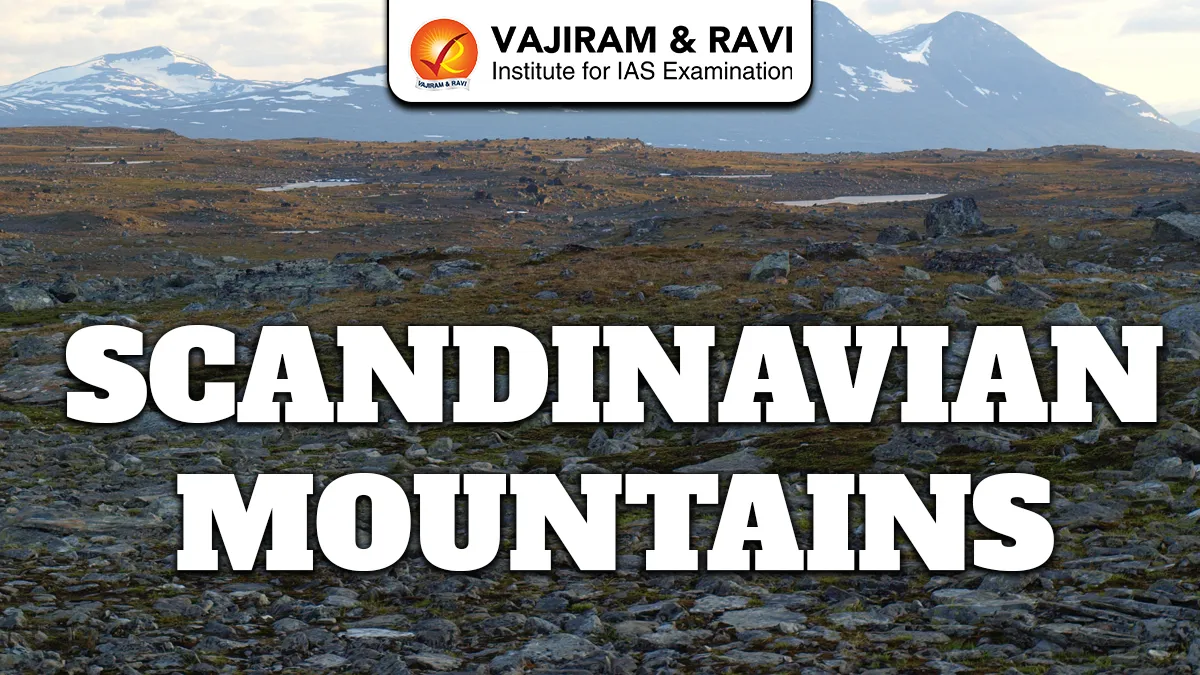
  • Debt-to-GDP ratio projected at 55.6%, with a medium-term target of 50±1% by 2030.
  • 16th Finance Commission Recommendation: ₹1.4 lakh crore Finance Commission grants to states; vertical devolution share retained at 41%.

[youtube url="https://www.youtube.com/live/q15M7tR1obs" width="560" height="315"]

Union Budget History

India’s budgetary tradition began during the colonial era and has grown into a vital instrument guiding the country’s economic and social policies. From the first budget in 1860 to modern times, it reflects India’s evolving fiscal priorities and development goals.

  • Colonial Era Beginnings: The first budget in India was presented on 7th April 1860 by James Wilson, the first Finance Member of the Viceroy’s Council.
  • Purpose in Early Times: Initially, the budget mainly focused on revenue collection and expenditure for administration under British rule.
  • First Post-Independence Budget: After India gained independence, the first budget was presented on 26th November 1947 by R. K. Shanmukham Chetty, setting the foundation for India’s sovereign fiscal policy.
  • Evolution Over Time: The Union Budget transformed from a simple statement of revenue and expenditure to a comprehensive economic policy instrument.
  • Policy and Social Impact: Today, the budget influences economic growth, social welfare, taxation, infrastructure development, and national priorities.
  • Annual Significance: The budget is presented every year, on 1st February, marking the beginning of discussions on economic strategies for the upcoming fiscal year.
  • Modern Innovations: Over decades, the budget has incorporated reforms like digital reporting, gender budgeting, environmental considerations, and sector-specific allocations.
  • Public Engagement: With growing transparency, the budget now engages citizens, experts, and industries through detailed presentations, press releases, and live sessions.

Union Budget Constitutional Provisions

The Union Budget of India is prepared, presented, and implemented strictly according to the constitutional framework laid down in the Indian Constitution. These provisions ensure financial accountability, legislative control, and transparency in the use of public money.

Note: The term ‘budget’ is nowhere mentioned in the Constitution of India.

Union Budget Constitutional Provisions
Article Provision Explanation

Article 112

Annual Financial Statement

Mandates the presentation of the Union Budget showing estimated receipts and expenditures of the Government of India for the financial year.

Article 113

Voting on Demands for Grants

Requires Lok Sabha approval for all expenditure demands of ministries; Rajya Sabha has no voting power.

Article 114

Appropriation Bill

Authorizes withdrawal of money from the Consolidated Fund of India after demands are passed.

Article 110

Finance Bill (Money Bill)

Contains tax proposals; can be introduced only in Lok Sabha and cannot be rejected by Rajya Sabha.

Article 117

Financial Bills

Deals with bills involving expenditure from the Consolidated Fund other than Money Bills.

Article 266

Consolidated Fund of India

All revenues, loans, and repayments go into this fund; money can be withdrawn only with parliamentary approval.

Article 267

Contingency Fund of India

Used to meet unforeseen expenditure, placed at the disposal of the President.

Article 109

Role of Rajya Sabha

Rajya Sabha can only discuss the Budget and must return Money Bills within 14 days.

Article 111

Presidential Assent

Budget becomes law only after President gives assent to Appropriation and Finance Bills.

Article 116

Vote on Account

Allows government to meet expenses temporarily if Budget is not passed in time.

Stages of Budget Session in Indian Parliament

The Budget Session of the Indian Parliament is a special session conducted to discuss, scrutinize, and approve the Union Budget for the upcoming financial year. The stages of Budget Session 2026-27 have been discussed below.

  1. Presentation of the Budget: The Union Budget is presented in the Lok Sabha on 1st February every year by the Finance Minister of India. During the presentation, the Finance Minister delivers the budget speech. After the speech, the budget is formally laid before both Houses of Parliament.
  2. General Discussion: Members of the Lok Sabha discuss the budget as a whole or on any principle involved in it. However, no cut motions can be moved, and the budget is not submitted to a vote at this stage. The Finance Minister has the right to reply at the end of the discussion, clarifying policies and addressing members’ concerns.
  3. Scrutiny by Departmental Committees: Each departmental standing committee conducts an in-depth examination of the Demands for Grants of its respective ministry. This process lasts three to four weeks, during which the House remains in recess. At the end of this period, the committees submit their reports to Parliament, suggesting reductions, modifications, or reallocations if necessary.
  4. Voting on Demands for Grants: The Lok Sabha votes on the individual demands for grants of each ministry. Only Lok Sabha members can vote on these demands. Expenditure charged on the Consolidated Fund of India is excluded and does not require voting.
  5. Passing of Appropriation Bill: No money can be withdrawn from the Consolidated Fund of India except through an Appropriation Bill. This bill authorises the government to withdraw funds and meet its approved expenditures for the financial year.
  6. Passing of Finance Bill: The Finance Bill is introduced to give legal effect to the financial proposals of the government, including taxation and revenue measures, for the upcoming year. It is presented as a Money Bill under Article 110 and requires Lok Sabha approval followed by Presidential assent to become the Finance Act.

Documents Presented in Parliament Along with the Union Budget

When the Union Budget is presented in Parliament, it is accompanied by several mandatory documents that provide detailed information on government finances, allocations, and fiscal policies. These documents ensure transparency, accountability, and detailed scrutiny of government expenditure and revenue.

Budget Documents:

  • Annual Financial Statement (AFS): The primary budget document detailing the estimated receipts and expenditures of the Government of India, prepared under Article 112 of the Constitution.
  • Demands for Grants (DGs): Ministry-wise requests for funds for specific services and schemes, which must be voted upon by the Lok Sabha.
  • Finance Bill: Introduces new taxes or amendments to existing tax laws to implement the government’s revenue proposals.
  • Appropriation Bill: Authorizes the withdrawal of funds from the Consolidated Fund of India to meet expenditure approved through the budget.

FRBM Act Mandated Statements (Fiscal Responsibility and Budget Management)

  • Macro-Economic Framework Statement (MEFS): Evaluates economic growth prospects, fiscal balance, and external sector position for the upcoming year.
  • Fiscal Policy Strategy Statement (FPSS): Outlines the government’s fiscal policies and priorities for the financial year.
  • Medium-Term Fiscal Policy Statement (MTFPS): Presents medium-term fiscal targets and strategies to ensure sustainable public finances over the next 3 years.
Other Related Posts
National Income UPSC Economy Notes 2026
Inflation Monetary Policy in India
Sectors of Indian Economy Balance of Payments
Economic Growth and Development Indirect Tax
Fiscal Policy in India Financial Market
Reserve Bank of India MSME
Poverty and Developmental Issues Green GDP

Union Budget 2026 FAQs

Q1: What is the Union Budget 2026-27?

Ans: The Union Budget 2026-27 is the annual financial statement of the Government of India for the fiscal year 1st April 2026 to 31st March 2027.

Q2: Who presents the Union Budget 2026-27?

Ans: The Finance Minister of India, currently Nirmala Sitharaman, presents the budget in the Lok Sabha.

Q3: When is the Union Budget 2026-27 presented?

Ans: Union Budget 2026-27 has been presented on 1st February 2026.

Q4: Under which Article of the Constitution is the Union Budget presented?

Ans: The budget is presented under Article 112 (Annual Financial Statement) of the Indian Constitution.

Q5: What are Demands for Grants?

Ans: Demands for Grants (DGs) are ministry-wise requests for funds for specific services or schemes. The Lok Sabha votes on them to authorise spending; the Rajya Sabha can only discuss them.

Economic Survey 2025-26 Out, Key Highlights, Features, PDF Download

Economic Survey 2026 Out

The Economic Survey 2026 is one of the most important official documents released by the Government of India every year. It acts as a comprehensive report card of the Indian economy and provides a clear picture of economic performance, challenges, opportunities, and future policy directions. It is released just before the Union Budget, the Economic Survey plays a crucial role in shaping fiscal decisions and long-term economic planning.

What is the Economic Survey?

The Economic Survey is an annual document prepared by the Department of Economic Affairs, Ministry of Finance, under the supervision of the Chief Economic Adviser (CEA) of India. It presents a detailed analysis of the Indian economy’s performance during the previous financial year.

Features of the Economic Survey

  • Economic Survey 2026 provides a comprehensive analysis of India’s economic performance, including growth, inflation, employment, and fiscal trends.
  • It evaluates sector-wise performance such as agriculture, industry, services, and infrastructure.
  • It is released every year before the Union Budget to provide an economic background for policy formulation.
  • The document is data-driven and analytical in nature, based on official statistics and economic indicators.
  • It reviews government policies and reforms while suggesting future economic strategies.
  • The Economic Survey serves as an important reference for policymakers and researchers.

Economic Survey 2026 History

The Economic Survey was first presented in 1950–51 as a part of the Union Budget documents to provide an overview of India’s economic performance. However, in 1964, it was separated from the Budget and began to be presented as an independent document. This change was introduced to ensure a more detailed and objective review of economic developments before the presentation of the Union Budget. The separation allowed policymakers and Parliament to analyze economic trends, challenges, and opportunities in advance, thereby enabling better-informed fiscal decisions. 

In line with this tradition, the Economic Survey 2026 has been released on 29th January 2026, before the Union Budget 2026-27, which will be presented on 1st February 2026.

Economic Survey 2025-26 PDF Download

The Economic Survey 2025-26 PDF is officially released by the Government of India for public access. It provides a detailed review of the country’s economic performance, sector-wise analysis, and policy recommendations. This year, the Economic Survey 2026 has been released on 29th January 2026, ahead of the Union Budget. The PDF can be downloaded from the official government portals for reference by students, researchers, and policymakers.

Download Economic Survey 2025-26 PDF

Economic Survey 2026 Key Highlights

The Economic Survey 2026 highlights India’s continued macroeconomic resilience, with FY26 real GDP growth estimated at 7.4%, low inflation, improved fiscal consolidation, and a strong banking and external sector despite global uncertainties. It underscores structural transformation driven by robust services growth, manufacturing revival, infrastructure expansion, digital and financial inclusion, poverty reduction, and a long-term vision of strategic resilience and strategic indispensability under the Viksit Bharat 2047 framework.

1. Overall State of the Economy

  • India remained the fastest-growing major economy for the fourth consecutive year, despite global headwinds such as geopolitical tensions, trade fragmentation and financial instability.
  • As per First Advance Estimates, real GDP growth for FY26 is projected at 7.4%, while GVA growth is estimated at 7.3%, indicating broad-based economic expansion.
  • Potential growth rate of the Indian economy is assessed at around 7%, with FY27 real GDP growth projected between 6.8–7.2%.

2. Consumption and Investment

  • Private Final Consumption Expenditure (PFCE) grew by 7% in FY26, reaching 61.5% of GDP, the highest level since 2012, reflecting strong domestic demand.
  • Rural consumption improved due to a good agricultural performance, while urban demand was supported by stable employment and tax rationalisation.
  • Gross Fixed Capital Formation (GFCF) rose by 7.8%, remaining steady at 30% of GDP, driven by sustained public capital expenditure and revival of private investment.

3. Fiscal Developments

  • Centre’s revenue receipts increased to 9.2% of GDP in FY25, up from the pre-pandemic average of about 8.5%, reflecting improved tax buoyancy.
  • The direct tax base expanded, with income tax return filers increasing from 6.9 crore in FY22 to 9.2 crore in FY25, indicating better compliance and formalisation.
  • Gross GST collections during April–December 2025 stood at ₹17.4 lakh crore, registering a 6.7% year-on-year growth.
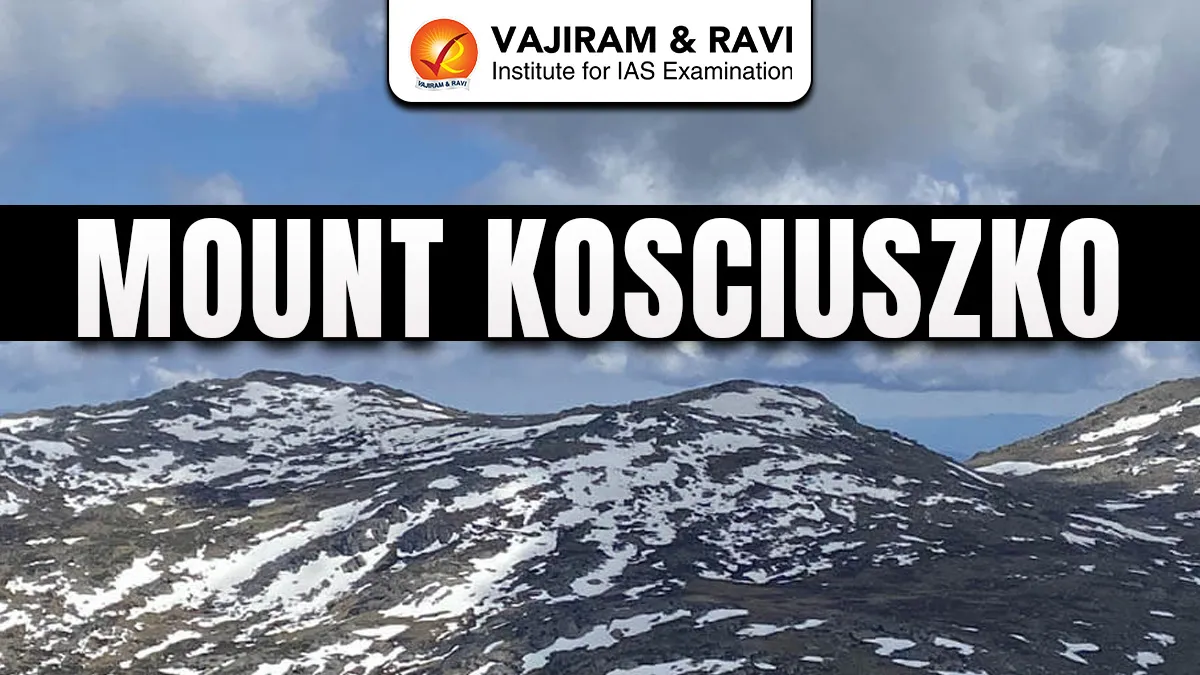
  • Effective capital expenditure of the Centre rose to about 4% of GDP in FY25, reinforcing growth through infrastructure creation.
  • India reduced its general government debt-to-GDP ratio by 7.1 percentage points since 2020, while maintaining high public investment.

4. Monetary Management and Banking Sector

  • The banking system showed strong resilience, with Gross NPAs declining to 2.2% in September 2025, a multi-decadal low.
  • Net NPAs declined further to 0.5%, reflecting improved asset quality and stronger balance sheets.
  • Credit growth of scheduled commercial banks accelerated to 14.5% (YoY) by December 2025, supporting economic activity.

5. Financial Inclusion and Capital Markets

  • Under PM Jan Dhan Yojana, 55.02 crore bank accounts were opened by March 2025, with 36.63 crore accounts in rural and semi-urban areas.
  • The number of unique investors crossed 12 crore in September 2025, with nearly 25% being women, highlighting widening financial participation.
  • Mutual fund penetration expanded beyond metros, with a growing share of investors from non-tier I and II cities.
  • GIFT City is emerging as an international financial hub, helping channel global capital into India.

6. External Sector Performance

  • India’s share in global merchandise exports nearly doubled from 1% in 2005 to 1.8% in 2024, while services export share rose from 2% to 4.3%.
  • Total exports reached a record USD 825.3 billion in FY25, driven mainly by services exports.
  • Services exports touched an all-time high of USD 387.6 billion, growing by 13.6%.
  • India remained the largest recipient of remittances globally, with inflows of USD 135.4 billion in FY25, approximately 3.5% of GDP.
  • Foreign exchange reserves rose to USD 701.4 billion (January 2026), providing import cover of about 11 months and covering 94% of external debt.

7. Inflation Trends

  • India recorded the lowest average CPI inflation (1.7%) for April–December 2025 since the beginning of the CPI series.
  • The sharp decline in inflation was mainly due to moderation in food and fuel prices, strengthening household purchasing power.

8. Agriculture and Allied Sectors

  • Foodgrain production reached 3,577.3 LMT in AY 2024–25, an increase of 254.3 LMT over the previous year.
  • Horticulture, contributing about one-third of agricultural GVA, produced 362.08 MT, surpassing foodgrain outp ut.
  • Livestock and fisheries sectors showed strong long-term growth with fish production increasing by more than 140 per cent during 2014-2024, compared to the increase from 2004-14, reflecting diversification of rural incomes.
  • Under PM-KISAN, more than ₹4.09 lakh crore has been transferred to farmers, strengthening income support.
  • e-NAM enhanced price discovery by integrating farmers, traders and FPOs across States.

9. Services Sector

  • Services accounted for 53.6% of GDP and 56.4% of GVA, the highest ever, reflecting India’s shift towards a service-led economy.
  • India emerged as the 7th largest services exporter globally, driven by IT, business services and digitally delivered services.
  • The services sector attracted over 80% of total FDI inflows during FY23–FY25.

10. Industry and Manufacturing

  • Industry GVA (in real terms) grew by 7% in H1 FY26, despite global slowdown pressures.
  • Manufacturing GVA accelerated to 7.72% in Q1 and 9.13% in Q2 FY26, indicating structural recovery.
  • PLI schemes across 14 sectors attracted over ₹2 lakh crore in investment, generated ₹18.7 lakh crore in output, and created 12.6 lakh jobs.
  • The India Semiconductor Mission advanced domestic manufacturing with ₹1.6 lakh crore investment across 10 projects.

11. Infrastructure and Connectivity

  • Central government capital expenditure increased over four times since FY18, reaching ₹11.21 lakh crore in FY26 (BE).
  • High-speed highway corridors expanded nearly ten-fold to 5,364 km.
  • Railway network expanded with near-total electrification (99.1%).
  • India became the 3rd largest domestic aviation market, with airports increasing from 74 (2014) to 164 (2025).
  • Power sector reforms led to DISCOMs recording a positive PAT of ₹2,701 crore in FY25 for the first time.

12. Social Sector: Education, Health and Employment

  • School enrolment improved with GERs exceeding 90% at primary and upper primary levels.
  • Expansion of premier institutions: 23 IITs, 21 IIMs and 20 AIIMS, including overseas IIT campuses.
  • India achieved faster reduction in maternal and child mortality than global averages since 1990.
  • Employment (15 years & above) stood at 56.2 crore persons in Q2 FY26, with new job creation supported by manufacturing and services.
  • e-Shram portal registered over 31 crore unorganised workers, with women forming 54%.

13. Poverty Reduction and Rural Development

  • Multidimensional Poverty Index (MPI) declined sharply from 55.3% (2005–06) to 11.28% (2022–23) as per NITI Aayog.
  • Social Services Expenditure increased to 7.9% of GDP in FY26 (BE).
  • SVAMITVA scheme improved rural asset ownership through drone-based property mapping.

14. Strategic Vision: From Swadeshi to Strategic Indispensability

  • The Survey advocates “Disciplined Swadeshi” through a three-tier framework focusing on strategic urgency, feasibility and cost-effectiveness.
  • Emphasises reducing input costs, strengthening advanced manufacturing, and integrating India into global value chains.
  • The long-term goal is to make India strategically indispensable in the global economic system.

[youtube url="https://www.youtube.com/watch?v=Wu66P3clSAU" width="560" height="315"]

Why is the Economic Survey 2026 Released Before the Union Budget?

The Economic Survey 2026 is released before the Union Budget to provide a detailed review of India’s economic performance and trends. It helps policymakers and Parliament understand the current economic situation and challenges. The Survey acts as a guide for budget formulation and prioritizing government spending. Releasing it beforehand ensures informed decision-making and transparency in fiscal planning.

Difference Between Union Budget and Economic Survey

The Economic Survey is an analytical document that reviews India’s economic performance and provides policy insights, while the Union Budget is a financial statement outlining government revenue, expenditure, and fiscal priorities. The Survey is presented before the Budget to guide policy decisions. Together, they provide a complete picture of India’s economic strategy and planning

Difference Between Union Budget and Economic Survey
Aspect Economic Survey Union Budget

Nature

Analytical document assessing the economy

Financial and legal statement of government’s revenue and expenditure

Purpose

Review past economic performance and provide policy recommendations

Allocate resources, announce taxes, and set fiscal priorities

Content

GDP trends, inflation, employment, sector-wise performance, and policy suggestions

Tax proposals, government spending, fiscal deficit, and schemes

Timing

Released before the Budget

Released after the Economic Survey

Binding Nature

Non-binding, advisory in nature

Legally binding financial plan for the fiscal year

Prepared by

Chief Economic Adviser and Ministry of Finance

Finance Minister with Ministry of Finance support

Focus

Economic trends, challenges, and future outlook

Financial planning, allocation of resources, and fiscal management

Usefulness

Helps policymakers, researchers, and analysts understand economic conditions

Directly affects citizens, businesses, and government programs

Political Nature

Objective and neutral

Policy-oriented and may include government priorities

Frequency

Annually

Annually

Economic Survey 2026 FAQs

Q1: What is the Economic Survey 2026?

Ans: The Economic Survey 2026 is an annual report that reviews India’s economic performance over the past year, highlights trends and challenges, and offers analytical insights before the Union Budget.

Q2: Who prepares the Economic Survey?

Ans: It is prepared by the Ministry of Finance under the guidance of the Chief Economic Adviser (CEA).

Q3: When is the Economic Survey 2026 released?

Ans: The Economic Survey 2026 has been released on 29th January 2026, ahead of the Union Budget.

Q4: Why is the Economic Survey released before the Union Budget?

Ans: It is released because it provides a detailed economic review and context that helps policymakers and Parliament make informed budgetary decisions.

Q5: What does the Economic Survey include?

Ans: It includes economic data, macroeconomic trends, sector‑wise analysis, policy insights, projections, and recommendations for future growth.
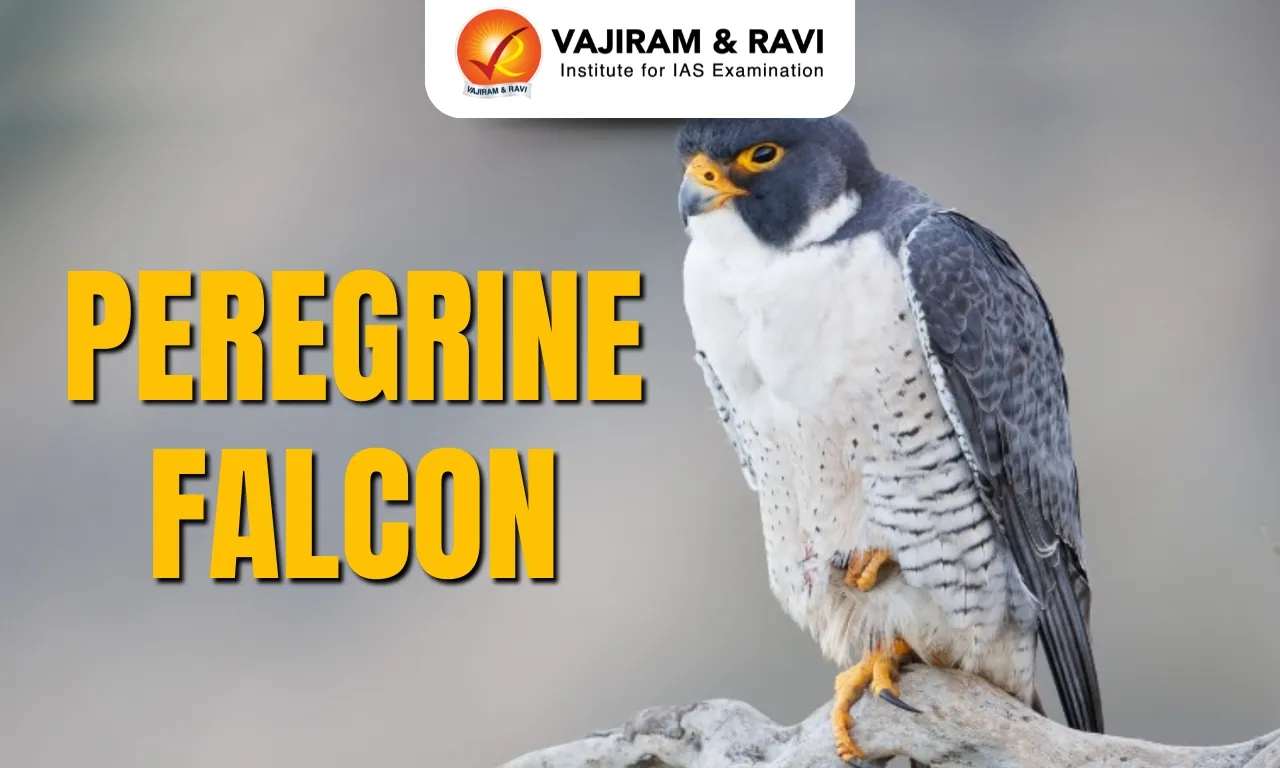
Winter Olympics 2026, Host Country, Motto, India’s Presence

Winter Olympics 2026

The Winter Olympics 2026, officially known as the 25th Winter Olympic Games, is one of the most awaited international sporting events. The Games are popularly called Milano Cortina 2026 and will bring together athletes from across the world to compete in snow and ice sports. The event is organized under the supervision of the International Olympic Committee (IOC) and aims to promote sportsmanship, global unity, and cultural exchange.

Winter Olympics 2026 Host Country

The Winter Olympics 2026 will be hosted by Italy, marking the country’s fourth time hosting the Olympic Games. The event will take place in the northern Italian cities of Milan and Cortina d’Ampezzo, both famous winter sports destinations. The Games aim to showcase Italy’s sports infrastructure, tourism, and cultural heritage on a global platform.

Olympics Logo and Motto

The official logo of the Milano Cortina 2026 Olympics represents modern design, creativity, and unity between the host cities Milan and Cortina d’Ampezzo. It reflects innovation and Italy’s rich artistic culture. The official motto of the Games is “IT’s Your Vibe.” The word “IT” highlights Italy as the host nation and encourages people worldwide to connect with the Olympic spirit and celebrate sports together.

About Winter Olympics 2026

The Winter Olympics 2026 will be hosted in northern Italy. The Games will be jointly hosted by two famous winter sports destinations - Milan and Cortina d’Ampezzo.

Italy has previously hosted the Olympics three times:

  • Winter Olympics 1956 - Cortina d’Ampezzo
  • Summer Olympics 1960 - Rome
  • Winter Olympics 2006 - Turin

The Winter Olympics 2026 Games will be Italy’s fourth Olympic hosting event. Around 2,900 athletes from nearly 90 countries are expected to participate. The Games will include 116 medal events across 16 winter sports disciplines.

A major highlight of the Winter Olympics 2026 Games is the inclusion of a new sport called Ski Mountaineering (Skimo). This sport involves athletes climbing and skiing down mountainous terrains using specialized equipment and techniques.

The official mascot of the Games is Tina, a white stoat symbolizing agility and adaptability in snowy conditions. Another branding element includes “The Flo,” characters inspired by the snowdrop flower, representing hope and resilience.

Olympics History

The Olympic Games have a rich history that dates back thousands of years. They began as a religious and cultural festival in ancient Greece and later evolved into one of the largest international sporting events in the modern world. The journey of the Olympics reflects the development of sports, international cooperation, and global unity.

Ancient Olympic Games

The Ancient Olympic Games started in 776 BCE in Olympia, Greece. These games were organized to honour Zeus, the king of Greek gods. The event was not just a sports competition but also a religious and cultural festival.

Features of Ancient Olympics

  • Held every four years, a period known as an Olympiad.
  • Only free Greek men were allowed to participate.
  • Women were not allowed to compete or watch the Games.
  • Athletes competed without modern equipment and often performed naked, which symbolized strength and equality.
  • Major sports included running, wrestling, boxing, chariot racing, discus throw, javelin throw, and pentathlon.

Decline of Ancient Olympics

The Ancient Olympic Games continued for nearly 12 centuries but were abolished in 393 CE by Roman Emperor Theodosius I. He banned the Games because they were linked to pagan religious practices.

Modern Olympics

  • The Modern Olympic Games were revived by Baron Pierre de Coubertin in the late 19th century.
  • The first Modern Olympics were held in 1896 in Athens, Greece.
  • Around 241 athletes from 14 countries participated in the first modern Games.
  • The Olympics are now organized by the International Olympic Committee (IOC), established in 1894.
  • Women were first allowed to participate in the 1900 Paris Olympics.
  • The Winter Olympic Games were introduced in 1924 in Chamonix, France.
  • The Paralympic Games began in 1960 to promote sports for athletes with disabilities.
  • The Youth Olympic Games started in 2010 to encourage young athletes.
  • The Olympics were cancelled during World War I (1916) and World War II (1940 and 1944).
  • The Games are now divided into Summer Olympics and Winter Olympics, held every four years.
  • The Olympic symbol includes five interlocking rings, representing unity among continents.
  • Modern Olympics promote values such as excellence, friendship, peace, and global unity.

About International Olympics Committee

  • The International Olympic Committee (IOC) is the main governing body of the Olympic Games.
  • It was established in 1894 by Baron Pierre de Coubertin.
  • The headquarters of the IOC is located in Lausanne, Switzerland.
  • The IOC organizes and supervises both Summer and Winter Olympic Games.
  • It selects and approves host cities for the Olympic Games.
  • The IOC promotes Olympic values such as excellence, friendship, and respect.
  • It ensures fair competition and maintains rules and regulations for Olympic sports.
  • The IOC works with National Olympic Committees and international sports federations.
  • It supports athlete development and encourages global participation in sports.
  • The IOC also promotes peace, cultural exchange, and international cooperation through sports.

India’s Presence in Winter Olympics 2026

India’s participation in the Winter Olympics 2026 is expected to be limited but significant, showing the country’s gradual progress in winter sports. Arif Khan, India’s top alpine skier, has qualified in the Slalom event and is likely to represent the country at the Games. Additionally, Abhinav Bindra, India’s first individual Olympic gold medallist, has been selected as a torchbearer, highlighting India’s growing role in the global Olympic movement.

Indian Olympic Association

  • The Indian Olympic Association (IOA) is the official body responsible for India’s participation in the Olympic Games.
  • It was established in 1927 and is recognized by the International Olympic Committee (IOC).
  • The IOA selects and sends Indian athletes to the Olympics, Asian Games, Commonwealth Games, and other international sports events.
  • It works to promote and develop sports across India.
  • The IOA coordinates with national sports federations and training authorities.
  • It supports athlete preparation, training, and participation in global competitions.
  • The IOA also promotes Olympic values such as sportsmanship, unity, and fair play.

Winter Olympics 2026 Significance

  • The Winter Olympics 2026 will promote global unity and international cooperation through sports.
  • It will boost tourism and economic growth in Italy, especially in Milan and Cortina d’Ampezzo.
  • The Games will encourage the development of winter sports and inspire young athletes worldwide.
  • The inclusion of Ski Mountaineering (Skimo) highlights innovation and expansion of Olympic sports.
  • It focuses on sustainable and eco-friendly infrastructure, promoting environmental responsibility.
  • The event will strengthen cultural exchange and showcase Italy’s rich heritage and hospitality.
Other Related Posts
Nobel Prize 2025 Winners List Padma Awards 2026 Winners List
Oscar Award 2025 Indian Olympic Association
Commonwealth Games International Awards List 2025

Winter Olympics 2026 FAQs

Q1: When will the Winter Olympics 2026 be held?

Ans: The Winter Olympics 2026 are scheduled to be held in February 2026.

Q2: Which country is hosting the Winter Olympics 2026?

Ans: Italy is hosting the Winter Olympics 2026.

Q3: Which cities will host the Winter Olympics 2026?

Ans: The Games will be co-hosted by Milan and Cortina d’Ampezzo in northern Italy.

Q4: How many sports will be included in the Winter Olympics 2026?

Ans: The Games will feature 16 winter sports with 116 medal events.

Q5: Which new sport is introduced in the Winter Olympics 2026?

Ans: Ski Mountaineering (Skimo) will make its Olympic debut in 2026.

AI Impact Summit 2026: India Eyes a Larger Role in the Global AI Economy

AI Impact Summit 2026

AI Impact Summit 2026 Latest News

  • India will host the AI Impact Summit 2026 from February 16 to 20, marking the first time this global AI governance forum is being held in the Global South.
  • The summit aims to generate actionable, long-term policy recommendations rather than impose immediate binding regulations. It seeks to align AI governance with inclusive growth, sustainability, and social impact.

Background: Evolution of Global AI Summits

  • The summit builds on a series of international meetings on AI governance.
  • The Bletchley Park AI Safety Summit (2023) focused on identifying catastrophic AI risks.
  • The Seoul Summit (2024) widened the agenda to include innovation and inclusivity.
  • The Paris AI Action Summit (2025) shifted attention to implementation and economic opportunities.
  • Each iteration has gradually expanded the scope beyond safety towards practical and developmental concerns.

India’s Distinct Approach

  • Unlike earlier summits centred on regulation and risk containment, India is steering the discussion towards “People, Planet, and Progress.” 
  • The focus is on developing AI solutions that address real-world challenges, especially in developing countries. 
  • This reflects India’s dual role as an emerging AI power and a representative voice of the Global South.
  • Through this summit, India is positioning itself to secure a larger role in shaping global AI governance and capturing greater economic and developmental benefits from the technology.

India AI Impact Summit 2026: What to Expect

  • Scale and Significance - The AI Impact Summit 2026 has been described by Union IT Minister Ashwini Vaishnaw as the largest such global gathering so far, with strong international interest and participation.
  • High-Level Global Participation - The summit is expected to host representatives from over 100 countries, including 15–20 heads of government, more than 50 ministers, and over 40 CEOs of leading global and Indian companies. 
    • Prime Minister Narendra Modi will inaugurate the event, host a dinner, and address a CEO roundtable.
  • Diverse Stakeholders - Participants will include governments, industry leaders, researchers, civil society organisations, and international institutions, highlighting the summit’s multi-stakeholder approach to AI governance and development.
  • Key Themes and Deliberations - The summit will feature working groups and discussions on major issues such as AI’s impact on jobs, trust and safety frameworks for AI systems, and the application of AI across key industries.
  • India’s AI Push and Model Launches - As part of the Rs 10,370 crore IndiaAI Mission, the government will launch several indigenous AI language models during the summit, including foundational and small language models.
  • Startup and Innovation Showcase - The event will showcase over 500 AI startups and host around 500 sessions alongside the main programme, making it one of the most comprehensive global forums focused on artificial intelligence.

Opening Up to China at the AI Impact Summit

  • Chinese Participation at the Summit - China is expected to send a delegation to the AI Impact Summit, following a formal invitation extended by India last year as both countries seek to strengthen domestic AI capabilities.
  • Summit Format and Invitations - The AI Summit is not a formal multilateral grouping. Participation is determined by the host country, giving India the discretion to invite China despite geopolitical sensitivities.
  • Precedents from Earlier Summits - When the UK hosted the first AI Safety Summit, it faced opposition from allies and domestic lawmakers over inviting China, but proceeded nonetheless. China also participated in the subsequent summits in Seoul and Paris.
  • Signal of Easing India–China Ties - India’s invitation to China reflects a gradual thaw in bilateral relations. Earlier this year, direct flights between the two countries resumed after a gap of more than five years.
  • Trade and Supply Chain Developments - China has also begun clearing applications from firms supplying rare earth components to Indian automobile manufacturers, easing earlier restrictions imposed amid global trade tensions.

Hardware and Energy: India’s Key AI Constraints

  • Dependence on Imported Computing Hardware - A major disadvantage for India in the AI race is the lack of domestically produced advanced hardware. Access to high-end GPUs, which power AI systems, depends largely on imports, limiting self-reliance.
  • Hopes from India–US Tech Trade - The proposed interim India–US trade deal offers some relief. It is expected to significantly expand trade in technology products, including GPUs and data centre equipment, and deepen joint technology cooperation.
  • Policy Push for Data Centres - India has announced a tax holiday until 2047 for foreign companies setting up data centres. This aims to attract global players and build domestic AI infrastructure, even as reliance on imported hardware continues.
  • Budget Signals and AI Mission - In the Union Budget 2026–27, the allocation for subsidising compute under the IndiaAI Mission was halved. This came alongside strong growth in electronics manufacturing and iPhone exports, indicating shifting priorities.
  • Energy Needs and Nuclear Power - Powering AI data centres is emerging as a critical challenge. The government is exploring nuclear energy as a long-term solution.

Source: IE

AI Impact Summit 2026 FAQs

Q1: Why is the AI Impact Summit 2026 significant for India?

Ans: The AI Impact Summit 2026 is significant because it is the first global AI governance summit in the Global South, positioning India as a leader in shaping inclusive AI norms.

Q2: How does the AI Impact Summit 2026 differ from earlier AI summits?

Ans: Unlike safety-focused meetings, the AI Impact Summit 2026 emphasises people-centric AI, development outcomes, jobs, sustainability, and practical governance aligned with emerging economies’ needs.

Q3: What outcomes does India seek from the AI Impact Summit 2026?

Ans: Through the AI Impact Summit 2026, India aims to influence global AI governance, attract investment, showcase startups, launch indigenous AI models, and gain economic benefits.

Q4: What challenges will be highlighted at the AI Impact Summit 2026?

Ans: The AI Impact Summit 2026 will address hardware dependence, GPU shortages, energy constraints, workforce disruption, and the need for trust and safety frameworks for AI systems.

Q5: Why is China’s participation important at the AI Impact Summit 2026?

Ans: China’s presence at the AI Impact Summit 2026 signals easing tensions, inclusivity in AI governance, and India’s intent to host balanced, geopolitically sensitive global technology dialogue.

Make in India, Objectives, Features, Government Initiatives

Make in India

The Make in India initiative was launched in September 2014 with the aim of transforming India into a global manufacturing hub and boosting economic growth through industrial development. The programme focuses on encouraging domestic production, attracting foreign investment, generating employment, and strengthening India’s position in global supply chains.

Make in India Objectives

The Make in India initiative was launched with several important goals to strengthen India’s manufacturing sector and improve economic growth. The key objectives of Make in India are:

  • Boost Manufacturing Growth & GDP: Increase the share of manufacturing in India’s GDP and improve its yearly growth rate.
  • Employment Generation: Create nearly 100 million new manufacturing jobs to utilise India’s large and young workforce.
  • Attract Investment: Encourage domestic and foreign investments by developing a business-friendly and investor-supportive environment.
  • Enhance Global Competitiveness: Strengthen Indian manufacturing to compete in international markets and integrate with global supply chains.
  • Promote Innovation & Skill Development: Support research, technological advancement, and workforce skill training to meet Industry 4.0 requirements.
  • Improve Ease of Doing Business: Simplify regulations, reduce compliance burden, and make business operations smoother.
  • Infrastructure Development: Build modern industrial corridors, logistics networks, and transportation infrastructure to support manufacturing growth.
  • Inclusive and Sustainable Growth: Promote balanced regional development and encourage environmentally sustainable industrial practices.
  • Focus on Priority Sectors: Promote growth across 27 key manufacturing sectors, including automobiles, electronics, renewable energy, textiles, and food processing.

Pillars of Make in India

The Make in India programme is based on four major pillars that guide policy implementation and industrial growth.

  1. New Processes

This pillar focuses on improving the business environment by simplifying industrial licensing, reducing regulations, and improving ease of doing business. India improved its global ranking from 142nd in 2014 to 63rd in 2020 due to reforms in business policies.

  1. New Infrastructure

The government focuses on developing industrial corridors, logistics networks, and smart cities to support manufacturing growth. Better infrastructure helps industries reduce costs and improve efficiency.

  1. New Sectors

Foreign investment norms were relaxed in sectors like defence production, railways, insurance, medical devices, and construction. This helped attract global companies and boost domestic production.

  1. New Mindset

The government shifted from being a regulator to a facilitator by working with industries, startups, and private investors to promote industrial development.

Make in India Features

The Make in India initiative has several unique features that make it a major economic reform programme.

  • Focus on Multiple Manufacturing Sectors: The initiative promotes industrial development across important sectors such as automobiles, electronics, defence, textiles, pharmaceuticals, renewable energy, and food processing.
  • Liberal Foreign Direct Investment (FDI) Policies: The government has relaxed FDI rules in many sectors, allowing foreign companies to invest easily in India and bring advanced technology and capital.
  • Improved Ease of Doing Business: Several reforms have been introduced to simplify licensing procedures, reduce paperwork, and make it easier to start and operate industries in India.
  • Promotion of Innovation and Technology: The programme encourages research, technological development, and adoption of modern manufacturing methods such as automation and digital production systems.
  • Infrastructure Development: The initiative focuses on building industrial corridors, smart cities, modern transport systems, and logistics networks to support industrial growth and reduce production costs.
  • Support for Startups and MSMEs: Special policies and schemes are provided to support startups and small industries, helping them grow and contribute to manufacturing and employment generation.
  • Strengthening Intellectual Property Rights (IPR): The government has improved IPR protection systems to encourage innovation and protect new ideas and technologies developed by industries.

Make in India 2.0 Sectoral Expansion

Make in India 2.0 represents the next phase of the Make in India initiative, where the government has shifted its focus from general manufacturing promotion to targeted and high-value industrial growth

The programme now covers 27 key sectors, promoting advanced manufacturing, technology-driven industries, and service sector expansion. It is strongly supported by Production Linked Incentive (PLI) schemes, which aim to increase domestic production, improve export performance, encourage local value addition, and generate large-scale employment opportunities.

  • Electronics Manufacturing (ESDM): Focus on producing semiconductors, PCBs, and electronic components to reduce import dependence.
  • Strategic and Frontier Sectors: Union Budget 2026-27 prioritised sectors like biotechnology under the Biopharma SHAKTI Programme (₹10,000 crore) and increased allocation of ₹40,000 crore for electronic components.
  • Advanced Manufacturing: Expansion in defence, aerospace, capital goods, and automobile components supported by 14 PLI schemes.
  • Infrastructure and Logistics: Development of manufacturing hubs, plug-and-play industrial parks, and specialised Chemical Parks.
  • Sustainability and Technology: Promotion of green manufacturing, renewable energy, AI, space, and drone technology.
  • Textile Industry: Launch of Tex-Eco initiative and Mega Textile Parks to boost sustainable textile production and exports.

Government Initiatives Supporting Make in India

The Government of India has introduced several major schemes and policy reforms to strengthen the Make in India initiative and promote domestic manufacturing. These initiatives focus on increasing industrial production, attracting investments, improving infrastructure, and supporting innovation and skill development.

Production Linked Incentive (PLI) Scheme

The PLI scheme is one of the most important flagship programmes supporting Make in India. It provides financial incentives to companies for manufacturing products within India. The scheme covers 14 major sectors, including electronics, automobiles, pharmaceuticals, telecom, and renewable energy. It aims to increase domestic production, boost exports, and generate large-scale employment.

National Single Window System (NSWS)

The NSWS was launched to improve ease of doing business by providing investors with a single digital platform for approvals and clearances. It offers information related to land availability, licensing, and regulatory approvals, making business setup faster and more transparent.

Infrastructure Development

  • Industrial Corridors: The government is developing 11 Industrial Corridor Projects to build world-class manufacturing infrastructure and industrial hubs that support large-scale production and exports.
  • PM GatiShakti National Master Plan: PM GatiShakti focuses on improving multimodal connectivity by integrating transport systems such as roads, railways, ports, airports, and logistics networks. This helps reduce logistics costs and improves supply chain efficiency.

Foreign Direct Investment (FDI) Reforms

The government has liberalised FDI policies in several sectors to attract global investors. For example, FDI up to 74% is allowed in defence manufacturing under the automatic route. Similar reforms have been introduced in railway infrastructure, medical devices, and other sectors.

Ease of Doing Business Measures

Various reforms have been implemented to simplify regulatory processes and reduce compliance burden. These include digitisation of approvals, simplified taxation systems, and improvements in property registration processes.

Supportive Flagship Programmes

  • Startup India: This initiative supports innovative startups through funding schemes such as the ₹10,000 crore Fund of Funds, mentorship programmes, and simplified regulations. It encourages entrepreneurship and job creation.
  • Skill India Mission: Skill India focuses on developing a trained workforce by providing vocational training and industry-based skill programmes to meet manufacturing sector requirements.
  • Digital India Programme: Digital India promotes technology adoption across industries by improving digital infrastructure, encouraging e-governance, and supporting digital business operations.

Sector-Specific Policies

  • FAME Scheme: The Faster Adoption and Manufacturing of Hybrid and Electric Vehicles (FAME) scheme promotes electric vehicle manufacturing and supports India’s clean energy goals.
  • Phased Manufacturing Programme (PMP): PMP encourages domestic production of electronic components by gradually reducing import dependence and promoting local manufacturing.

Major Achievements under Make in India

  • Growth in Defence Manufacturing: India has made major progress in indigenous defence production. The successful development of INS Vikrant, India’s first domestically built aircraft carrier, highlights self-reliance in defence. Defence production reached nearly ₹1.27 lakh crore in 2023–24, with exports to over 90 countries.
  • Rapid Expansion of Electronics and Mobile Manufacturing: India has become the second-largest mobile phone manufacturer in the world. The electronics sector grew to approximately USD 155 billion, with mobile phone manufacturing contributing a major share.
  • Global Leadership in Vaccine Production: India emerged as a leading vaccine producer during the COVID-19 pandemic, supplying nearly 60% of global vaccine demand, strengthening India’s global healthcare reputation.
  • Introduction of Vande Bharat Trains: The development of Vande Bharat Express, India’s first indigenous semi-high-speed train, reflects technological advancement and strong domestic manufacturing capabilities.
  • Increase in Merchandise Exports: India’s merchandise exports reached approximately USD 437 billion in FY 2023–24, showing strong growth in manufacturing and industrial exports.
  • Growth in Renewable Energy Manufacturing: India has expanded solar panel and renewable energy equipment manufacturing, supporting clean energy goals and reducing dependency on imports.
  • Employment Generation in Textile Industry: The textile sector has generated around 14.5 crore jobs, making it one of the largest employment-generating sectors in India.
  • Rise of India’s Startup Ecosystem: India has developed the third-largest startup ecosystem globally, with more than 1.48 lakh recognised startups, generating over 15.5 lakh direct jobs.
  • Growth in Toy Manufacturing: India produces nearly 400 million toys annually, strengthening domestic production and export potential in the toy sector.
  • Global Recognition of Indian Products: Products such as Kashmir willow cricket bats, Amul dairy products, and Made-in-India footwear have gained strong international demand and recognition.

Make in India Challenges

  • Low Manufacturing Contribution to GDP: The manufacturing sector currently contributes around 16-17% of India’s GDP, which is still far from the target of 25%. This shows the need for stronger policy implementation and industrial growth.
  • Skill Gap in Workforce: A large portion of India’s workforce lacks industry-relevant skills. Reports suggest that nearly 60% of workers require skill training, which affects productivity and manufacturing efficiency.
  • Infrastructure and Logistics Issues: Although improvements have been made, India still faces challenges related to transportation, power supply, and logistics costs. High logistics expenses reduce global competitiveness of Indian products.
  • Supply Chain Vulnerabilities: Global disruptions such as the COVID-19 pandemic exposed weaknesses in supply chains. India still depends heavily on imports for raw materials and electronic components.
  • Investment Gaps: The government aims to attract large manufacturing investments, but actual investment levels are lower than targets. This slows down industrial expansion and technology adoption.
  • Low Research and Development (R&D) Spending: India’s R&D investment is around 0.7% of GDP, which is much lower than developed economies. Limited innovation restricts technological advancement in manufacturing.
  • Regulatory and Compliance Burden: Complex labour laws, approval procedures, and compliance requirements sometimes discourage investors and increase business costs.
  • Global Competition: Countries such as China, Vietnam, and South Korea have strong manufacturing ecosystems, better infrastructure, and skilled labour, creating tough competition for India.
  • Technology and Automation Challenges: Adoption of advanced manufacturing technologies like automation, artificial intelligence, and robotics is still limited in many Indian industries.
  • Regional Development Imbalance: Industrial growth is concentrated in certain states, while many regions lack manufacturing infrastructure and investment opportunities.

Way Forward

  • Simplifying Regulations and Labour Laws: The government should reduce compliance burden and implement labour law reforms to create a more business-friendly environment. Faster approvals and simplified licensing processes will encourage domestic and foreign investments.
  • Strengthening Infrastructure and Logistics: Expanding industrial corridors, transport networks, and logistics infrastructure can reduce production costs and improve supply chain efficiency. Improved connectivity will help industries operate more smoothly.
  • Expanding Skill Development Programmes: India needs to focus on industry-based training programmes to reduce skill gaps in the workforce. Strengthening vocational education and technical training will improve productivity and employment opportunities.
  • Encouraging Research and Development (R&D): Increasing investment in innovation and research through tax benefits and government funding can promote technological advancement and improve manufacturing quality.
  • Promoting Domestic Supply Chains: Developing strong local supply chains can reduce dependence on imports and improve industrial resilience during global disruptions.
  • Enhancing Foreign Trade and Investment Partnerships: Strengthening international trade relations and attracting foreign investment can help India gain advanced technology and expand export markets.
  • Supporting MSMEs and Startups: Providing financial assistance, technology support, and market access to small industries and startups can strengthen manufacturing growth and employment generation.
  • Promoting Green and Sustainable Manufacturing: Encouraging renewable energy usage, energy-efficient production, and eco-friendly industrial practices can support long-term sustainable development.
  • Adopting Advanced Manufacturing Technologies: Promoting automation, artificial intelligence, robotics, and digital manufacturing systems can increase productivity and global competitiveness.

Effective Monitoring and Policy Evaluation: Establishing strong monitoring systems can help track programme progress, identify challenges, and improve policy implementation.

Make in India FAQs

Q1: When was Make in India launched?

Ans: Make in India was launched in September 2014.

Q2: What is the main goal of Make in India?

Ans: The main goal is to transform India into a global manufacturing hub and increase industrial growth.

Q3: How many sectors are covered under Make in India 2.0?

Ans: Make in India 2.0 covers 27 sectors across manufacturing, infrastructure, and services.

Q4: What is the PLI scheme?

Ans: PLI provides financial incentives to companies to boost domestic manufacturing and exports.

Q5: What is the current manufacturing contribution to India’s GDP?

Ans: Manufacturing contributes around 17% to India’s GDP.

Claude’s Cowork Plugins Trigger a SaaS Market Shock Across Global Tech

Claude’s Cowork Plugins

Claude’s Cowork Plugins Latest News

  • Recently, Anthropic released 11 open-source plugins for Claude Cowork, its AI workplace tool. Unlike regular chatbots, Cowork works like a digital colleague. It can read files, write documents, review contracts, and complete tasks across legal, finance, sales, and marketing with little human input.
  • A few days later, Anthropic launched Claude Opus 4.6. This new model can manage and coordinate multiple AI agents to carry out complex work such as financial research and due diligence.
  • This marked a major leap in autonomous AI capabilities, enabling AI agents to independently handle complex workplace tasks across sectors.
  • Markets reacted sharply. Global software stocks saw heavy losses, with major US SaaS firms and Indian IT companies witnessing steep declines. 
  • The sell-off reflected fears that autonomous AI could replace large teams, threatening traditional, headcount-driven business models—especially in India’s IT outsourcing industry.

About SaaS

  • Software as a Service (SaaS) is a cloud-based software delivery model where applications are hosted by a vendor and accessed by users over the internet, typically via a web browser. 
  • Instead of installing and maintaining software locally, users subscribe to the service, allowing for easier access, automatic updates, and flexible, pay-as-you-go pricing.

‘SaaSpocalypse’: Why AI Is Being Seen as an Existential Threat to SaaS

  • The term “SaaSpocalypse” reflects market fears that advanced AI is not just improving software but replacing it altogether
  • As AI agents perform tasks autonomously, the traditional per-user SaaS pricing model looks vulnerable.
  • This has triggered a sharp selloff in software stocks, with investors questioning whether businesses will still pay for large software licences when AI can deliver the same outcomes with fewer people and tools
  • While analysts warn that markets may be overreacting, the episode highlights a real structural shift in how software value is created and priced.

Real-World AI Disruption Across Professional Services

  • The direction of AI-driven disruption has been visible for years. In March 2023, Bloomberg launched BloombergGPT, a domain-specific financial model trained on an unprecedented volume of proprietary data. 
  • It outperformed general AI models on core financial tasks, proving that specialised AI could decisively augment — and eventually automate — expert work.

From tools to autonomous agents

  • BloombergGPT assisted professionals within a closed system. 
  • The newer shift, seen with Claude Cowork, takes this further by deploying AI as autonomous agents that operate across enterprises, executing workflows with minimal human input. 
  • This transition from “AI-assisted” to “AI-operated” systems has unsettled markets.

Legal services: automation shock

  • Claude’s legal plugins automate contract review, NDA screening, and compliance tracking — tasks that form the backbone of legal services. 
  • The impact was immediate: Thomson Reuters saw its steepest ever single-day stock fall, while LegalZoom, RELX, and Wolters Kluwer suffered sharp declines.

Financial services: AI runs the back office

  • Goldman Sachs’ partnership with Anthropic marks a turning point. 
  • Unlike earlier AI tools that supported analysts, Claude-based agents are being used to automate trade accounting, compliance, and client onboarding
  • This move triggered selloffs in firms like FactSet, S&P Global, and Moody’s.

Healthcare: agentic AI at scale

  • Cognizant’s collaboration with Palantir embeds AI agents into the TriZetto healthcare platform, which processes over half of US medical claims. 
  • These systems now handle routing, claims adjudication, and supply chains, with humans intervening only in exceptions.

Workforce implications

  • Industry leaders are openly acknowledging disruption. Anthropic’s CEO has warned that AI could displace half of entry-level white-collar jobs within five years. 
  • Salesforce’s CEO has said the company will not hire more engineers or lawyers due to AI efficiency gains.

Coding as a leading indicator

  • AI’s impact is already visible in software development. Experts report most of the coding are now done by AI agents, with humans editing the output. 
  • Research suggests AI may author 20% of public GitHub commits by year-end, signalling a broader shift in knowledge work.

India Inc’s AI Pivot: Incremental Moves in a Fast-Moving Disruption

  • Indian IT companies have begun responding to AI-driven disruption, but largely through cautious, incremental investments. 
  • The core challenge is speed. Autonomous AI agents are rapidly automating the very high-volume, repetitive tasks that underpin India’s outsourcing model. 
    • As global clients embed AI directly into operations — from banks deploying agentic workflows to defence agencies consolidating software under single platforms — the traditional argument of slow enterprise adoption is losing credibility.
  • To stay relevant, Indian IT firms must shift from labour-based delivery to AI deployment partnerships. 
  • Their competitive advantage lies in deep domain expertise across sectors like banking, insurance and healthcare. 
  • Combining this knowledge with leading AI platforms  offer a viable path forward in an era where AI is reshaping services at unprecedented speed.

Jobs at Risk, Roles Rewritten: How AI Is Reshaping Indian IT Employment

  • The near-term impact on Indian IT jobs is unsettling. 
  • Firms are cutting headcount, freezing fresher hiring, and automating entry-level roles in testing, maintenance and compliance — the traditional backbone of the outsourcing model. These trends signal genuine disruption, not just cyclical slowdown.
  • At the same time, a new layer of opportunity is emerging. 
  • Autonomous AI systems operating in regulated sectors still require Human-in-the-Loop (HITL) oversight — people to validate decisions, manage exceptions, ensure compliance, and uphold ethical and governance standards. 
  • These roles rely on domain expertise and judgment rather than routine coding.
  • The shift points to three growth avenues: AI deployment partnerships within enterprises, HITL operations centres for regulated industries, and large-scale reskilling to prepare engineers to design, supervise and govern AI systems. 
  • The employment challenge is real — but so is the chance to redefine the nature of tech work in India.

Source: TH | LM

Claude’s Cowork Plugins FAQs

Q1: Why have Claude’s Cowork plugins triggered a SaaS market shock?

Ans: Claude’s Cowork plugins triggered a SaaS market shock because autonomous AI agents can replace multiple software tools and teams, undermining traditional per-user SaaS business models.

Q2: How are Claude’s Cowork plugins different from earlier AI tools?

Ans: Claude’s Cowork plugins go beyond assistance by autonomously executing workflows across legal, finance, and sales functions, marking a shift from AI-assisted to AI-operated systems.

Q3: What sectors are most affected by Claude’s Cowork plugins?

Ans: Claude’s Cowork plugins are disrupting legal services, financial back offices, healthcare administration, and software development, leading to sharp selloffs in SaaS and IT stocks.

Q4: Why are Indian IT companies vulnerable to Claude’s Cowork plugins?

Ans: Claude’s Cowork plugins threaten India’s labour-intensive outsourcing model by automating repetitive, high-volume tasks that traditionally relied on large entry-level IT workforces.

Q5: What opportunities exist despite disruption from Claude’s Cowork plugins?

Ans: Despite disruption, Claude’s Cowork plugins create opportunities in AI deployment partnerships, Human-in-the-Loop oversight, AI governance roles, and large-scale reskilling in India’s IT sector.

India-Malaysia Relations – Expanding Cooperation

India-Malaysia Relations

India-Malaysia Relations Latest News

  • India and Malaysia signed multiple agreements during Prime Minister Narendra Modi’s visit to Kuala Lumpur in February 2026, marking a strategic deepening of bilateral ties.

India-Malaysia Bilateral Relationship

  • Historical and Civilisational Links
    • India and Malaysia share deep civilisational connections dating back over two millennia, shaped by trade, religion, language, and cultural exchanges across the Indian Ocean. 
    • Elements of Indian culture, including Sanskrit influences and Hindu-Buddhist traditions are visible in Malaysia’s historical evolution. 
    • Modern diplomatic relations were established soon after India’s independence, with consistent political engagement since then.
  • Political and Diplomatic Engagement
    • India and Malaysia elevated their relationship to a Comprehensive Strategic Partnership in 2024, reflecting growing political trust. 
    • High-level visits, regular foreign office consultations, and cooperation at multilateral forums such as the United Nations and ASEAN-led platforms form the backbone of diplomatic engagement. 
    • Malaysia has supported India’s demand for permanent membership of a reformed UN Security Council, reinforcing political convergence.
  • Trade and Economic Cooperation
    • Malaysia is India’s 3rd largest trading partner within ASEAN. Between April 2000 and March 2025, Malaysia invested about US$ 1.27 billion in India. 
    • Bilateral trade between the two countries stood at US$ 19.86 billion in 2024-25, comprising Indian exports worth US$ 7.32 billion and imports valued at US$ 12.54 billion
    • Owing to its strategic location along the Strait of Malacca and the South China Sea, Malaysia is a key pillar of India’s Act East Policy and an important partner in India’s maritime connectivity strategy. 
    • India’s major exports include petroleum products, engineering goods, meat and dairy products, and organic chemicals, while India’s major imports from Malaysia consist of vegetable oils, machinery, electrical equipment, and minerals.
  • Defence and Security Cooperation
    • Defence ties have expanded steadily through joint exercises, maritime cooperation, and capacity building. 
    • As maritime neighbours in the Indian Ocean and Indo-Pacific region, both countries share concerns over freedom of navigation, maritime security, and non-traditional threats such as piracy and terrorism. 
    • Intelligence sharing and counter-terrorism cooperation have gained prominence in recent years.
  • Diaspora and People-to-People Ties
    • The Indian diaspora in Malaysia, numbering over 2 million, plays a crucial role in strengthening bilateral ties. 
    • Persons of Indian Origin are active in Malaysia’s politics, business, education, and culture. 
    • Educational exchanges, tourism, and cultural diplomacy further enhance people-to-people relations.
  • Shared Regional and Global Platforms
    • Both countries actively engage through ASEAN, the East Asia Summit, and the Indian Ocean Rim Association (IORA)
    • India recognises ASEAN centrality in the Indo-Pacific, while Malaysia supports India’s Act East Policy, creating strategic alignment at the regional level.

News Summary

  • During Prime Minister Narendra Modi’s visit to Kuala Lumpur, India and Malaysia agreed to significantly broaden cooperation across multiple high-priority sectors. 
  • The two sides signed 11 agreements and MoUs, covering areas such as defence cooperation, semiconductors, digital technologies, health, and energy 
  • A major highlight was the framework agreement on semiconductor collaboration, reflecting both countries’ intent to integrate into global supply chains for advanced manufacturing. 
  • India invited Malaysian investment in electronics, AI, renewable energy, and healthcare, while showcasing domestic reforms aimed at improving ease of doing business.
  • Both leaders strongly reaffirmed a zero-tolerance approach to terrorism, explicitly condemning cross-border terrorism and calling for global cooperation against terror financing, radicalisation, and misuse of emerging technologies. 
  • Prime Minister Modi stressed that there would be “no double standards, no compromise” on terrorism.
  • Defence cooperation is set to expand further, particularly in maritime security, intelligence sharing, and joint capacity-building initiatives. 
  • The two sides also agreed to enhance cooperation in multilateral fora, including the UN and the Financial Action Task Force (FATF).
  • Another notable development was the decision to promote trade settlement in local currencies, the Indian Rupee and Malaysian Ringgit, to reduce transaction costs and dependence on third-country currencies. 
  • Malaysia reiterated its support for India’s permanent membership in a reformed UNSC.
  • India also announced the establishment of a new Indian Consulate General in Malaysia, aimed at improving consular services and strengthening diaspora engagement. 
  • The visit underscored the strategic convergence between the two countries on Indo-Pacific stability, ASEAN centrality, and reform of global governance institutions.

Source: TH | DH

India-Malaysia Relations FAQs

Q1: What is the current status of India-Malaysia relations?

Ans: India and Malaysia share a Comprehensive Strategic Partnership with expanding cooperation in trade, defence, and technology.

Q2: Why is semiconductor cooperation significant between India and Malaysia?

Ans: It helps both countries integrate into global value chains for advanced manufacturing and reduce supply-chain vulnerabilities.

Q3: How does Malaysia support India at global forums?

Ans: Malaysia backs India’s permanent membership in a reformed UN Security Council.

Q4: What role does the Indian diaspora play in Malaysia?

Ans: The Indian diaspora strengthens political, economic, and cultural ties between the two countries.

Q5: Why is local currency trade settlement important?

Ans: It reduces dependence on foreign currencies and lowers transaction costs in bilateral trade.

Sahyadri Tiger Reserve (STR)

Sahyadri Tiger Reserve (STR)

Sahyadri Tiger Reserve (STR) Latest News

In a significant boost to tiger conservation in western Maharashtra, a third tigress was released into the wild at the Sahyadri Tiger Reserve (STR) recently.

About Sahyadri Tiger Reserve (STR)

  • It is located in the Sahyadri Ranges of the Western Ghats in Maharashtra.
  • It is the northernmost tiger habitat in the Western Ghats.
  • It is the first tiger reserve of Western Maharashtra and the fourth tiger reserve of the State.
  • It is spread over two protected areas of Koyana Sanctuary (KWLS) and Chandoli National Park (CNP).
  • The central portion of STR is occupied by the “Shivsagar” reservoir of the Koyana River and the “Vasant Sagar” reservoir of the Warana River.
  • The habitat of Sahyadri is composed of woodlands, grasslands, and plateaus, the latter locally referred to as “Sadaa”, which are lateritic in nature with considerable habitat value. 
  • Vegetation
    • The forest cover here is that of moist evergreen, semi-evergreen, moist, and dry deciduous vegetation.
    • It is the only place where climax and near-climax vegetation are plentiful and prospects of adverse anthropogenic influence in the future are minimal.
  • Flora:
    • Dense tree cover includes species such as teak, bamboo, Indian laurel, and jamun.
    • Medicinal plants like Asparagus racemosus and Aegle marmelos grow abundantly.
    • Unique Western Ghats endemics, including rare orchids and shrubs, flourish in the reserve’s humid microclimates.
  • Fauna:
    • It is home to the endangered species of top carnivores such as Tiger, Wild dog, and Leopard. 
    • The herbivores include Gaur, Sambar, Four Horned Antelope, Mouse Deer, and Giant Squirrel. 
    • The habitat also supports hornbills, and many other endemic birds.

Source: HT

Sahyadri Tiger Reserve (STR) FAQs

Q1: Where is the Sahyadri Tiger Reserve located?

Ans: In the Sahyadri Ranges of the Western Ghats in Maharashtra.

Q2: What is the geographical significance of Sahyadri Tiger Reserve in the Western Ghats?

Ans: It is the northernmost tiger habitat in the Western Ghats.

Q3: Which two protected areas together form the Sahyadri Tiger Reserve?

Ans: Koyana Wildlife Sanctuary and Chandoli National Park.

Q4: Which major reservoirs occupy the central portion of Sahyadri Tiger Reserve?

Ans: Shivsagar reservoir on the Koyana River and Vasant Sagar reservoir on the Warana River.

Q5: What types of forest vegetation are present in Sahyadri Tiger Reserve?

Ans: Moist evergreen, semi-evergreen, moist deciduous, and dry deciduous forests.

Scandinavian Mountains, Location, Peaks Features, Biodiversity

Scandinavian Mountains

The Scandinavian Mountains are also called the Scandes. They form the main mountain system of Northern Europe, stretching across Norway, Sweden and marginally into Finland. The range is geologically young in its present form but rests on very ancient rocks shaped by repeated uplift and intense glaciation. These mountains strongly influence Nordic climate, drainage, biodiversity and human settlement. Their steep western margins create Norway’s famous fjords, while gentler eastern slopes merge into Sweden’s interior landscapes which makes the range a key physical and ecological divide in northern Europe.

Scandinavian Mountains

The Scandinavian Mountains run along the Scandinavian Peninsula, forming a continuous highland spine from southern Norway to the Arctic Circle and beyond. The western flank drops sharply into the Norwegian and North Seas, producing deep fjords, while the eastern side slopes gradually toward Sweden and Finland. The range reaches around 2,000 metres near the Arctic Circle and touches northwestern Finland as low hills. Galdhøpiggen, at 2,469 metres, is the highest peak in mainland Northern Europe.

Also Read: Mount Kosciuszko

Scandinavian Mountains Features

The major features of the Scandinavian Mountains has been listed below:

  • Geographical Extent: The range stretches north-south across the peninsula, forming a natural boundary between Norway and Sweden and influencing continental scale drainage patterns.
  • Western Escarpment and Fjords: Steep western slopes plunge into the sea, where glacially carved valleys flooded by seawater formed fjords like Sognefjord and Hardangerfjord.
  • Eastern Slopes: The eastern side transitions into lower mountains and fore-fells (förfjäll), usually below 1,000 metres, extending across Sweden as a 650 km belt.
  • Highest Peaks: The tallest summits lie mainly between Stavanger and Trondheim, with numerous peaks above 1,300 metres and several exceeding 2,000 metres.
  • Peaks: Galdhøpiggen (2,469 m) in Norway, Kebnekaise Nordtoppen (2,097 m) in Sweden and Halti’s slope (1,324 m) in Finland mark national high points.
  • Surfaces: Southern sections contain large plateaux like Hardangervidda, rising from ancient erosion surfaces uplifted during the Neogene period.
  • Alpine Relief: Only about 13.6% of southern Norway shows true alpine topography, mostly near fjord regions and deep glacial valleys.
  • Glacial Cirques: Cirques occur at both sea level and above 2,000 metres, indicating glacial processes independent of altitude alone.
  • Permafrost Zones: Discontinuous permafrost appears above 1,500-1,700 metres in the west and as low as 1,100 metres in northern Sweden.
  • Glaciers: The glacier equilibrium line ranges from about 1,500 metres in wet western Norway to around 2,100 metres in drier eastern regions.
  • Caledonian Base: The mountains rest on Caledonian nappes formed around 390 million years ago during the closure of the Iapetus Ocean.
  • Passive Margin Uplift: Modern elevation resulted from Cenozoic uplift, not active mountain building, similar to Greenland’s eastern mountains.
  • Drainage Divide Shift: Glacial erosion shifted the watershed between Atlantic and Baltic drainage systems eastward by up to 50 kilometres in places.
  • Karst Landscapes: Limestone areas, especially in northern sections, host caves and sinkholes with origins possibly dating back to the Pleistocene.

Also Read: Appalachian Mountains

Scandinavian Mountains Biodiversity

The biodiversity of the Scandinavian Mountains reflects strong climatic gradients, short growing seasons and adaptations to cold, wind and snow dominated environments. National parks like Jotunheimen, Sarek and Dovrefjell conserve these fragile mountain ecosystems.

Flora

The vegetation is dominated by hardy species adapted to alpine, subalpine and tundra conditions, forming a distinct montane ecosystem across the range.

  • Montane Birch Forests: Mountain birch forms the upper tree line, creating extensive birch forest belts tolerant of cold, wind and snow pressure.
  • Alpine Tundra Vegetation: Above the tree line, mosses, lichens and dwarf shrubs dominate, surviving with shallow roots and slow growth rates.
  • Grasslands and Meadows: Alpine grasslands develop during short summers, providing rich forage due to long daylight and rapid plant growth.
  • Cold Resistant Flowering Plants: Species like northern catchfly and water avens complete life cycles quickly during brief frost free periods.
  • Coniferous Trees at Lower Slopes: Scots pine and Norway spruce occupy lower elevations and sheltered valleys with deeper soils.
  • Lichen Dominance: Reindeer lichens thrive on poor soils and are critical winter forage in snow covered landscapes.
  • Soil and Permafrost Influence: Shallow soils above permafrost limit root depth, shaping low, cushion like plant forms.
  • Glacial Refugia Plants: Some plant species survived glaciations on ice free nunataks and recolonised after deglaciation.

Fauna

Animal life in the Scandinavian Mountains shows strong seasonal strategies to cope with extreme winters and short productive summers.

  • Reindeer Populations: Wild and semi domesticated reindeer migrate seasonally, relying heavily on lichen rich alpine pastures.
  • Large Carnivores: Brown bears and Eurasian lynx inhabit forested and mountainous zones, maintaining top predator roles.
  • Arctic Fox: The Arctic fox survives in high altitude tundra, using thick fur and food caching to endure harsh winters.
  • Red Fox Expansion: Red foxes occupy lower and mid elevations, sometimes competing with Arctic fox populations.
  • Small Mammals: Lemmings and voles show population cycles that strongly influence predator numbers.
  • Bird Diversity: Species such as ptarmigan, ravens, ospreys and willow warblers exploit seasonal insect abundance.
  • Insect Abundance: Summer insect blooms support birds and small mammals, despite extremely short growing seasons.

Scandinavian Mountains FAQs

Q1: Where are the Scandinavian Mountains located?

Ans: They extend along the Scandinavian Peninsula, mainly across Norway and Sweden, with small extensions into northwestern Finland.

Q2: What is the highest peak of the Scandinavian Mountains?

Ans: Galdhøpiggen in southern Norway is the highest peak, rising to 2,469 metres, making it the tallest mountain in mainland Northern Europe.

Q3: Why are Norwegian fjords associated with the Scandinavian Mountains?

Ans: Steep western slopes were deeply carved by glaciers, and later flooded by seawater, forming long and narrow fjords.

Q4: Are the Scandinavian Mountains very old?

Ans: The underlying rocks are ancient, over 390 million years old, but the present mountain height mainly resulted from later uplift and erosion.

Q5: What type of vegetation dominates the Scandinavian Mountains?

Ans: Montane birch forests, alpine tundra plants, mosses, lichens, and cold-resistant grasses dominate due to harsh climatic conditions.

Mount Kosciuszko, Location, Height, Weather, Features, Flora & Fauna

Mount Kosciuszko

Mount Kosciuszko is the highest mountain in Australia. Its height rises to 2,228 metres (7,310 feet) above the sea level. It is located in the Main Range of the Snowy Mountains in New South Wales, near Jindabyne and close to the Victoria border. The mountain forms part of the Australian Alps National Parks and Reserves. It ranks 35th globally in topographic isolation. Its gentle slopes, alpine climate and historical significance make it a unique highland landscape.

Mount Kosciuszko

Mount Kosciuszko was named in 1840 by Polish explorer Paweł Edmund Strzelecki in honour of Tadeusz Kościuszko who was a Polish National hero and American Revolutionary War General. The mountain lies west of Crackenback and is part of the Great Dividing Range. Though the tallest on mainland Australia, it is considered the easiest among the Seven Summits due to its gradual terrain.

Also Read: Altai Mountains

Mount Kosciuszko Features

A brief overview highlighting the mountain’s physical structure, geological origin, climate conditions, access routes and historical mapping significance in Australia’s alpine region.

  • Location: It is situated in the Snowy Mountains within Kosciuszko National Park, New South Wales.
  • Height: Mount Kosciuszko stands at 2,228 metres, making it the highest mainland Australian peak.
  • Geological Formation: The mountain formed through geological uplift and long term erosion, consisting mainly of granite intrusions and older sedimentary rocks, with no evidence of recent volcanic activity.
  • Glacial Influence: Past glacial activity shaped nearby landforms, including Lake Cootapatamba, the highest lake on mainland Australia, created by cirque glaciation below the southern slopes.
  • Weather and Climate: The peak experiences seasonal snow from June to October, supporting alpine conditions and making it suitable for skiing, snowshoeing and cross country skiing.
  • Cultural Significance: The mountain appears in Australian literature, paintings by Eugene von Guerard, music by Midnight Oil and poetry such as Banjo Paterson’s The Man from Snowy River.

Also Read: Pamir Mountains

Mount Kosciuszko Biodiversity

Mount Kosciuszko consists of a large scale of flora and fauna that adapt to the cold temperatures, strong winds and life possibilities at higher elevations. The major flora and fauna found at this mountain are:

Flora

  • Snow Gum Woodlands: Snow gum trees dominate lower alpine zones, adapted to frost and snow, forming Australia’s highest elevation woodland ecosystems.
  • Kosciuszko Buttercup: Ranunculus anemoneus is a rare alpine plant endemic to the region, thriving in short summer periods near the summit.
  • Alpine Grasses: Vickery’s grass (Rytidosperma vickeryae) survives harsh winds and shallow soils, stabilising slopes and preventing erosion.
  • Flowering Species: Billy buttons (Craspedia species) and Nematalolepis ovatifolia add seasonal colour and support alpine pollinators.

Fauna

  • Mountain Pygmy Possum: This endangered marsupial depends on alpine boulder fields and feeds heavily on bogong moths during summer.
  • Corroboree Frog: A critically endangered amphibian found in alpine bogs, highly sensitive to climate change and habitat disturbance.
  • Bogong Moth: These moths migrate annually and aestivate in rock crevices, historically forming a vital food source for Indigenous communities.
  • Eulamprus kosciuskoi: A lizard species named after the mountain and is specially adapted to cold alpine environments.
  • Wild Horses: Feral horse populations causes ecological damage and populations was estimated at under 6,000 in 2024, a reduction from about 17,000 in 2023 after intensive control efforts.

Mount Kosciuszko FAQs

Q1: Where is Mount Kosciuszko located?

Ans: Mount Kosciuszko is located in the Snowy Mountains of New South Wales, within Kosciuszko National Park, near Jindabyne and close to the Victoria border.

Q2: What is the height of Mount Kosciuszko?

Ans: Mount Kosciuszko rises to 2,228 metres or 7,310 feet above sea level, making it the highest mountain on mainland Australia.

Q3: What is Lake Cootapatamba and why is it important?

Ans: Lake Cootapatamba is a glacial cirque lake formed by ice erosion below Mount Kosciuszko’s southern slopes and is the highest lake on mainland Australia..

Q4: Why is Mount Kosciuszko considered the easiest Seven Summit?

Ans: It has gentle slopes and well marked walking tracks, allowing most visitors to reach the summit without technical climbing skills.

Q5: Which rare species are found near Mount Kosciuszko?

Ans: Notable species include the Mountain Pygmy Possum, Corroboree Frog, Kosciuszko buttercup and the alpine lizard Eulamprus kosciuskoi.

Peregrine Falcon

Peregrine Falcon

Peregrine Falcon Latest News

Recently, a wildlife researcher has made a historic sighting of a Siberian peregrine falcon in central Australia, where this subspecies has never been recorded before.

About Peregrine Falcon

  • It is a large cosmopolitan raptor in the family Falconidae.
  • Distribution: It is found on all continents except Antarctica, and on many oceanic islands.
  • Habitat:
    • They prefer open habitats, such as grasslands, tundra, and meadows.
    • They are most common in tundra and coastal areas and rare in sub-tropical and tropical habitats. They nest on cliff faces and crevices.

Characteristics of Peregrine Falcon

  • It is renowned for its speed during its characteristic hunting stoop (high-speed dive), making it the fastest bird in the world, as well as the fastest member of the animal kingdom.
  • They are active during the day. When not breeding they are primarily solitary and establish and defend territories.
  • Ecological role: They are high level predators, peregrine falcons play an important role in regulating populations of their prey, particularly pigeons and doves.
  • Conservation status: IUCN Red List: Least Concern.

Source: Live Science

Peregrine Falcon FAQs

Q1: What is the IUCN conservation status of Peregrine Falcon?

Ans: Least Concern

Q2: Where do we find Peregrine Falcon?

Ans: In all continent except Antarctica.

Daily Editorial Analysis 9 February 2026

Daily-Editorial-Analysis

A Social Media Ban Will Not Save Our Children

Context

  • The suicide of three sisters in Ghaziabad provoked national grief and immediate calls for strict action against digital platforms.
  • Public anger often seeks a clear cause and a decisive response, and social media became the primary target.
  • Yet complex social problems rarely yield to simple remedies. While online environments can intensify psychological distress among adolescents, a blanket prohibition risks replacing thoughtful policy with reaction.
  • The challenge lies in protecting children without undermining their rights, autonomy, and participation in modern life.
  • Effective solutions must therefore balance safety with access, focusing on responsible governance rather than elimination.

Social Media and Adolescent Mental Health

  • Research consistently associates heavy social media use with anxiety, depression, self-harm, and body image dissatisfaction, particularly among teenage girls.
  • Online comparison, cyberbullying, and constant performance pressure can aggravate emotional vulnerability.
  • These findings warrant concern but require careful interpretation. Digital exposure rarely operates as a single cause; instead, it interacts with loneliness, academic stress, or family conflict.
  • Overstating its influence risks ignoring broader psychological and social contexts. The issue is therefore not whether harm exists, but how society should address it without restricting opportunity.

Global Responses and the Rise of Moral Panic

  • International Policy Trends

    • Governments across the world have pursued strict regulation.
    • Australia has barred users under sixteen from major platforms through mandatory age verification, while Spain has proposed similar measures and legal liability for harmful algorithms.
    • These policies promise swift protection and visible accountability.
  • The Concept of Moral Panic

    • Such reactions reflect a moral panic, where a complex problem is attributed to a single identifiable threat.
    • A technological villain offers emotional clarity and political reassurance. However, symbolic crackdowns seldom resolve underlying causes.
    • Emotional satisfaction can overshadow careful analysis, resulting in policies that appear decisive yet produce limited real-world benefit.

Why a Social Media Ban Would Fail in India

  • Technical Ineffectiveness

    • Restrictions are easily bypassed. Adolescents often possess higher digital literacy than regulators and can access platforms through VPNs or alternative applications.
    • Prohibitions may push users into unregulated or encrypted spaces, increasing exposure to grooming, extremism, and exploitation.
    • Mandatory surveillance through identity verification also raises privacy risks.
  • Ignoring the Social Value of Digital Platforms

    • For many teenagers, especially those in marginalised settings, online spaces offer community, belonging, and support.
    • Rural youth, socially isolated adolescents, and LGBTQ individuals rely on digital networks to express identity and seek advice.
    • Removing access may deepen isolation rather than improve well-being.
  • Democratic Deficit in Policymaking

    • Policies affecting young people often exclude their voices. Adolescents are treated as passive subjects instead of participants.
    • A meaningful democracy requires consultation, listening, and recognition of lived experiences.
    • Regulation designed without youth engagement risks misunderstanding both problems and solutions.
  • Reinforcing Gender Inequality

    • A prohibition would likely intensify gender Internet access in India already favours boys over girls.
    • Within conservative households, restrictions would lead families to confiscate devices primarily from daughters, limiting education, skills, and mobility.
    • A protective measure could therefore entrench inequality rather than reduce harm.

A Better Policy Approach

  • Regulating Technology Companies

    • Attention must shift from controlling children to governing corporations. Platform algorithms are designed to maximise engagement and profit.
    • Governments should impose enforceable duty of care obligations, establish competition law, and require accountability for harmful design practices.
    • An independent regulator with technical expertise would be better suited than general administrative authorities.
  • Promoting Research and Youth Participation

    • Comprehensive research is needed to understand how online behaviour varies across class, caste, and region.
    • Long-term studies should inform policy rather than speculation. Young people must participate directly in consultation processes, shaping interventions that affect their daily lives.

The Way Forward

  • Expanding the Debate: Artificial Intelligence and Child Safety

    • Concerns about harm extend beyond social media. Increasing reliance on AI chatbots for advice and emotional support introduces new risks.
    • Excessive dependence may create cognitive weakness in critical thinking and expose minors to inappropriate interactions.
    • Consistent standards are required across all digital technologies, not selective regulation.
  • Toward a Healthy Media Ecology

    • Technology is neither inherently beneficial nor inherently harmful. Its effects depend on structure, incentives, and guidance.
    • A balanced media ecology requires education, supervision, and responsible design.
    • Rather than absolute acceptance or rejection, society must cultivate informed use and ethical innovation.

Conclusion

  • Public grief after the Ghaziabad tragedy generated urgent demands for bans, but prohibition offers only the illusion of control.
  • It would be technically ineffective, socially damaging, democratically weak, and potentially discriminatory.
  • Meaningful protection lies in regulating corporations, strengthening research, and involving young citizens in governance.
  • By prioritising thoughtful regulation over reaction, society can protect mental health while preserving opportunity, ensuring both safety and dignity for the next generation.

A Social Media Ban Will Not Save Our Children FAQs

Q1. What triggered the public debate on social media regulation?
Ans. The suicide of three sisters in Ghaziabad sparked national concern and calls for stricter control of social media platforms.

Q2. Does research show social media directly causes mental illness in teenagers?
Ans. Research shows social media is associated with mental health problems, but it usually intensifies existing vulnerabilities rather than acting as a single cause.

Q3. Why might banning social media be ineffective?
Ans. A ban may fail because adolescents can bypass restrictions using alternative platforms or VPNs and may move to more dangerous unregulated spaces.

Q4. How could a ban affect girls in India differently from boys?
Ans. In many households, girls are more likely to lose device access, which would reduce their educational opportunities and social mobility.

Q5. What solution is suggested instead of banning social media?
Ans. The recommended solution is stronger regulation of technology companies, independent oversight, and policies informed by research and youth participation.

Source: The Hindu


Myanmar’s Military-Scripted Polls, India’s Strategic Bind

Context

  • Five years after the February 2021 coup, Myanmar’s military organised elections between December 2025 and January 2026 to project political normalcy.
  • The military-backed USDP emerged victorious in a tightly managed political environment marked by restricted participation, suppression of opposition, and ongoing armed conflict.
  • Rather than restoring civilian rule, the process sought to institutionalise military authority.
  • The elections hold wider regional importance, particularly for India, which shares borders, security concerns, and economic ambitions tied to Myanmar.

Manufactured Legitimacy and Controlled Participation

  • The electoral exercise functioned primarily as a mechanism to produce legitimacy. Voting occurred in only 265 of 330 townships, excluding large populations.
  • Polling remained concentrated in urban wards, while rural areas under resistance influence were effectively absent from the process.
  • Political competition was systematically eliminated. The Election Commission dissolved major parties including the NLD, the Arakan National Party, and the Shan Nationalities League for Democracy, while senior leaders were imprisoned.
  • At the same time, numerous serving and retired military officers contested under the USDP banner.
  • Turnout figures reinforced the credibility crisis. The regime reported roughly 55% participation, a sharp fall from earlier elections.
  • Under conditions of fear and surveillance, reduced participation signified silent political rejection rather than apathy.
  • The elections thus represented controlled participation rather than democratic choice.

Elections Amid Civil War

  • The polls took place amid widespread conflict. Since 2021, thousands of civilians, activists, and journalists have been killed, tens of thousands arrested, and more than 113,000 structures destroyed, especially in Sagaing and Magway.
  • Repression strengthened armed opposition. The People’s Defence Forces, working alongside long-standing ethnic armed organisations, now control significant territory, including dozens of towns.
  • The state therefore lacks full sovereignty over its territory.
  • Under such conditions, elections cannot stabilise governance. Instead, they deepen political division: participation would validate military rule, while opposition groups view armed struggle as the only viable option.
  • The electoral process therefore risks intensifying violence rather than resolving it.

India’s Diplomatic Balancing Act

  • For India, Myanmar is a strategic neighbour and a gateway central to the Act East Policy.
  • Official statements support democracy and call for free and inclusive elections while avoiding direct recognition of the junta’s authority.
  • High-level engagement continues. Diplomatic contacts, including leadership meetings, demonstrate ongoing engagement while carefully avoiding endorsement.
  • India simultaneously maintains distance by clarifying non-official involvement during the election period.
  • Humanitarian outreach strengthens this calibrated approach. Relief operations and medical assistance following the 2025 earthquake allowed India to maintain a constructive role without conferring political approval.
  • The strategy effectively amounts to engagement without full diplomatic validation.

Security and Economic Implications for India

  • Refugee Flows

    • Violence has driven significant refugees into India, particularly into Mizoram and Manipur.
    • The absence of a national refugee policy places heavy administrative burdens on state governments and exposes governance gaps.
    • Continued instability is likely to sustain these movements.
  • Infrastructure and Connectivity

    • Major connectivity initiatives, the Kaladan Multi-Modal Transit Transport Project and the Trilateral Highway, have experienced repeated delays due to insecurity.
    • Claims of post-election normalisation are unlikely to improve ground conditions, forcing reassessment of timelines and investment risks.
  • Non-Traditional Security Threats

    • State fragility has accelerated trafficking, narcotics trade, and organised crime.
    • A major concern is the growth of cyber-scam centres and cyber slavery networks operating in conflict zones.
    • Thousands of Indians have already been rescued, yet many remain trapped. These emerging threats demand coordinated domestic and regional responses.

The Limits of International Pressure

  • Western governments and ASEAN have declined to recognise the election results. However, external pressure alone cannot resolve Myanmar’s political crisis.
  • The military remains entrenched, while opposition forces remain fragmented.
  • India therefore pursues a dual policy: maintaining communication with the authorities while also sustaining contact with local stakeholders.
  • This approach acknowledges uncertainty regarding Myanmar’s future political order and prioritises stability along the frontier.

Conclusion

  • Myanmar’s 2025–26 elections did not signal democratic restoration but an effort to formalise military rule under institutional cover.
  • Conducted under repression and territorial fragmentation, the process failed to address the underlying political crisis and may prolong instability.
  • For India, the situation presents a lasting dilemma; disengagement risks border instability and economic disruption, while recognition would compromise democratic commitments.
  • New Delhi therefore follows a careful middle path, balancing ideals with national interest.

Myanmar’s Military-Scripted Polls, India’s Strategic Bind FAQs

Q1. What was the main purpose of Myanmar’s 2025–26 elections?
Ans. The elections were organised to project political normalcy and institutionalise military authority rather than restore genuine democratic governance. 

Q2. Why were the elections considered lacking in credibility?
Ans. They lacked credibility because major opposition parties were dissolved, many leaders were imprisoned, and voting was restricted to selected areas.

Q3. How did the elections affect the internal conflict in Myanmar?
Ans. Instead of reducing violence, the elections deepened divisions and are likely to intensify the ongoing armed conflict.

Q4. Why is Myanmar strategically important for India?
Ans. Myanmar is important because it connects India to Southeast Asia, shares a long border with northeastern states, and is central to India’s Act East Policy.

Q5. What approach has India adopted toward the Myanmar regime?
Ans. India has followed a balanced policy by maintaining engagement with the authorities while still supporting democratic principles.

Source: The Hindu


India’s Textile Sector - Reimagining from Volume to Value

Context

  • The Union Budget 2026–27 positioned the textile sector as a strategic driver of economic growth, employment generation, export expansion, and rural livelihood support.
  • The Budget marks a shift from fragmented, scheme-based support to an integrated value-chain approach, covering fibre to fashion.
  • However, the core question remains - Will India merely expand textile production, or will it capture the higher value embedded in design, branding, and global fashion markets?

Key Budget Announcements for the Textile Sector

  • Integrated value-chain approach

    • The Budget outlines five major programmes -
      • National Fibre Scheme: Ensuring sustainable raw material supply, and strengthening upstream fibre production.
      • Textile Expansion and Employment Scheme: Focusing on scaling manufacturing capacity, and employment-intensive growth model.
      • National Handloom and Handicraft Programme (Consolidated): Rationalising multiple schemes, and strengthening artisan ecosystems.
      • Text-ECON Initiative: Enhancing global competitiveness, and supporting modernisation and exports.
      • Samarth 2.0 (Skill Development Upgrade): Focus on workforce modernisation, industry-oriented skilling.
    • Significance: These schemes together signal a shift towards a holistic blueprint, linking fibre production, manufacturing, artisan livelihoods, skills, and exports.
  • Mahatma Gandhi Gram Swaraj Initiative

    • It is designed to strengthen khadi, handloom, and handicraft sectors through improved market access, branding, and training.
    • This reflects a welcome recognition that India’s textile strength lies not only in mechanised mills, but also in its vast cultural and craft ecosystems — systems that sustain millions of rural livelihoods.
    • This will strengthen rural non-farm employment, aligning with Atmanirbhar Bharat and inclusive growth.
  • Mega Textile Parks in “Challenge Mode”

    • Expansion of infrastructure: Similar to PM MITRA Parks, consolidating manufacturing, logistics, value addition, with special focus on technical textiles.
    • Significance: It will reduce logistics costs, encourage economies of scale, attract private investment (reflected in positive equity market response).

Strategic Shift in Textile Policy

  • Earlier approach: Isolated schemes targeting individual bottlenecks, and fragmented policy architecture.
  • Budget 2026 approach:
    • Integrated, value-chain-based policy
    • Treating textiles as a strategic industrial ecosystem
    • Connecting economic, social, and cultural dimensions
    • Reflecting a maturing policy imagination

Key Challenges and Gaps Identified

  • The value creation deficit

    • Though India exports fabric, garments, and embellishments, it remains a low-margin, cost-competitive supplier, weak in brand ownership and creative authorship.
    • Missing elements: Design education, trend intelligence systems, sustainability certification, and brand-oriented export strategy.
    • Without these, India risks being a volume producer, not a value-setter in global fashion.
  • Narrow framing of skills

    • While Samarth 2.0 modernises workforce skills, it focuses mainly on operational training.
    • Missing elements: Creative capabilities, design leadership, managerial competence, systems-level thinking, and digital and sustainability integration.
    • In a global market driven by fast fashion cycles, digital tools, ESG compliance, and consumer consciousness, skill depth matters as much as scale.
  • Artisan vulnerability and pricing power

    • Even with Gram Swaraj support, structural issues (fragmented supply chains, inconsistent quality standards, weak bargaining power, income insecurity) persist.
    • Therefore, assured procurement mechanisms, transparent pricing systems, quality certification frameworks, and direct market access platforms (digital marketplaces) are needed.
    • Otherwise, artisans remain vulnerable despite increased output.
  • External trade pressures

    • Opportunities: Emerging trade agreements (e.g., with the European Union), and expanded global market access.
    • Risks: Competition from Bangladesh, Vietnam; fluctuating tariffs; stringent compliance norms; and sustainability standards.
    • India must combine infrastructure, scale, brand building, and standards compliance.

Way Forward - From “Make More” to “Value Better”

  • Move towards brand ownership: Promote Indian global fashion brands. Incentivise design-led exports. Create fashion innovation hubs.
  • Strengthen creative ecosystem: Invest in top-tier design institutes. Encourage industry-academia collaboration. Support IP protection in fashion.
  • Secure artisan livelihoods structurally: Introduce minimum support mechanisms. Digital platforms for direct selling. GI tagging and certification expansion. Transparent value-chain integration.
  • Focus on sustainability and compliance: Green textiles, circular economy practices, and ESG-based export readiness.
  • Build technical textile leadership: R&D support; high-tech manufacturing clusters; and defence, medical, and industrial textile integration.

Conclusion

  • Union Budget 2026–27 marks a turning point in India’s textile policy. It transitions from fragmented to an integrated approach, recognising textiles as central to India’s economic and social fabric.
  • Yet scale alone is not destiny. So, India’s textile ambition must ultimately be measured not just in export volumes, but in value captured, livelihoods secured, and cultural capital elevated.

India’s Textile Sector FAQs

Q1. How the Budget 2026 marks a structural shift in India’s textile policy?

Ans. It shifts textile policy from fragmented scheme-based support to an integrated value-chain approach.

Q2. Why does India's textile sector continue to remain a low-margin supplier in the global fashion economy?

Ans. This is because of India’s weak design ecosystem, limited brand ownership, and inadequate focus on creative value addition.

Q3. What is the significance of the Mahatma Gandhi Gram Swaraj Initiative in strengthening rural textile livelihoods?

Ans. The initiative recognises khadi, handloom, and handicrafts as pillars of rural non-farm employment.

Q4. Why infrastructure expansion alone cannot ensure global competitiveness in textiles?

Ans. While mega textile parks and scale improve efficiency, long-term competitiveness depends equally on brand building.

Q5. What are the limitations of India’s current skilling approach in the textile sector?

Ans. The absence of emphasis on creative, managerial, and digital capabilities restricts India’s transition to a value-setting textile economy.

Source: IE

Daily Editorial Analysis 9 February 2026 FAQs

Q1: What is editorial analysis?

Ans: Editorial analysis is the critical examination and interpretation of newspaper editorials to extract key insights, arguments, and perspectives relevant to UPSC preparation.

Q2: What is an editorial analyst?

Ans: An editorial analyst is someone who studies and breaks down editorials to highlight their relevance, structure, and usefulness for competitive exams like the UPSC.

Q3: What is an editorial for UPSC?

Ans: For UPSC, an editorial refers to opinion-based articles in reputed newspapers that provide analysis on current affairs, governance, policy, and socio-economic issues.

Q4: What are the sources of UPSC Editorial Analysis?

Ans: Key sources include editorials from The Hindu and Indian Express.

Q5: Can Editorial Analysis help in Mains Answer Writing?

Ans: Yes, editorial analysis enhances content quality, analytical depth, and structure in Mains answer writing.

Thwaites Glacier

Thwaites Glacier

Thwaites Glacier Latest News

Scientists have raised concerns over the Thwaites Glacier, as it is melting at an unprecedented rate because of climate change fueled by human activities. 

About Thwaites Glacier

  • Location: It is a large glacier in West Antarctica, about the size of a large country.
  • Scientists have often called it the “Doomsday Glacier”.
  • It’s a wide and fast-flowing glacier, roughly the size of Florida or Great Britain.
  • It is one of the most vulnerable and important glaciers in the world in terms of future global sea-level rise.
  • It contributes 4% to global annual sea-level rise, and its collapse could destabilise the West Antarctic Ice Sheet, which would cause catastrophic sea-level rise. 

Impact of Melting of Thwaites Glacier

  • It has been becoming thinner, retreating, and contributing to sea-level rise.
  • If it weakens beyond a point, other glaciers may lose ice faster as well, further increasing sea-level rise.
  • Higher sea levels will cause coasts to flood more easily, worsen erosion, increase storm surges, and threaten cities, low-lying islands, and ports.
  • Significance: It is one of the most important places on the earth for those trying to understand how sea levels will rise in future.

Source: NDTV

Thwaites Glacier FAQs

Q1: Where is Thwaites Glacier located?

Ans: West Antarctica

Q2: What is happening to Thwaites Glacier?

Ans: It's melting

Enquire Now