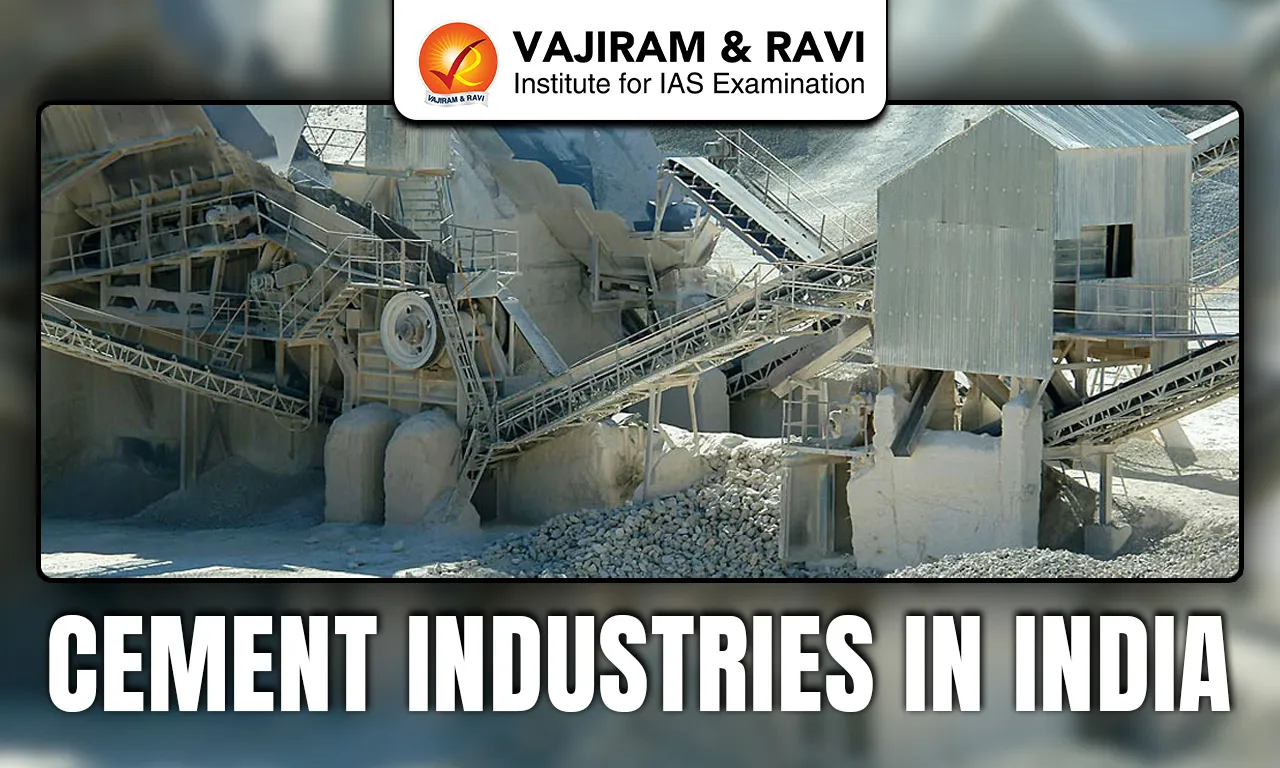
Cement is a basic construction material used in buildings, roads, bridges, dams, and urban infrastructure. India is the world’s second-largest cement producer, accounting for roughly 8% of global cement capacity with an installed capacity of over 700 million tonnes.
Cement production is also an important component of the Index of Eight Core Industries (ICI), where it carries a weight of about 5.37%. Recent data highlights the strong performance of the sector. Cement production registered 13.5% year-on-year growth in December 2025, while cumulative growth from April to December 2025-26 stood at 8.8%, indicating sustained demand driven largely by infrastructure expansion and construction activity.
About Cement Production
Cement is manufactured through a high-temperature chemical and mechanical process using natural minerals. In India, cement production mainly relies on limestone deposits and modern kiln technology.
Limestone contains calcium carbonate, which is heated inside large rotary kilns at temperatures reaching around 1400-1500 degrees Celsius. During this process, calcium carbonate decomposes into calcium oxide and carbon dioxide. The resulting product is called clinker. Clinker is then mixed with gypsum and ground finely to produce cement.
Location of Cement Industries in India
The distribution of cement industries in India is uneven and largely follows mineral resource belts.
- The major cement producing regions include Rajasthan, Madhya Pradesh, Andhra Pradesh, Telangana, Gujarat, Maharashtra, and parts of Tamil Nadu.
- The western and southern parts of India have emerged as dominant production zones.
- The state of Rajasthan is particularly important because of abundant limestone reserves.
- Similarly, Andhra Pradesh and Telangana form one of the largest cement production clusters in the country.
- Another emerging region is eastern India, especially Odisha and West Bengal, where industrial expansion and infrastructure development are driving cement demand.
The location pattern of the cement industry clearly reflects the classical economic geography principle that industries tend to develop where raw materials and market accessibility are balanced.
Factors Determining Location of Cement Industries
Several factors influence the establishment of cement plants.
- Raw Material Availability: Limestone is the most important factor. Since transportation of limestone is costly, industries prefer locations near mining sites.
- Transport Connectivity: Cement is a low-value but high-weight product. Efficient rail and road networks reduce distribution cost. Ports are also important for export-oriented production.
- Energy Supply: The industry requires continuous power supply. Therefore, regions with reliable electricity availability are preferred.
- Market Demand: Rapid urbanisation and infrastructure development create large demand for cement. Growing cities and construction corridors attract new plants.
- Water Availability: Water is required for cooling and processing operations.
- Government Policy and Environmental Regulation: Mining permissions, environmental clearance, and industrial incentives also influence location decisions.
Environmental Impact of Cement Industry
- The cement industry is considered environmentally sensitive because of its carbon footprint. One of the major environmental concerns is carbon dioxide emission during limestone calcination.
- Mining activities also lead to landscape degradation and dust pollution.
The industry is gradually adopting sustainable practices such as using fly ash from thermal power plants and slag from steel industries. Waste heat recovery systems are also becoming popular.
These measures are important because global climate change concerns are pushing industries toward low-carbon production.
Challenges Facing the Cement Industry
Despite its importance, the cement industry faces several problems.
- Transportation cost remains a major challenge because cement is bulky and low in value per unit weight.
- Energy cost is another important factor since production is highly power intensive.
- Environmental regulations increase compliance cost but are necessary for sustainable development.
- Regional imbalance in production and demand sometimes leads to excess capacity in certain areas.
- Price competition among large companies also affects profitability.
Importance of Cement Industry in India’s Development
Cement production is often used as an indicator of economic activity. When infrastructure projects increase, cement consumption also rises.
Government housing schemes and infrastructure corridors have significantly boosted domestic demand. The sector also generates employment opportunities in mining, transportation, and manufacturing.
Cement Industries in India FAQs
Q1: Why is the cement industry important for India’s economy?
Ans: The cement industry is important because it supports infrastructure development such as housing, roads, bridges, and industrial construction. Cement production also acts as an indicator of economic and construction activity.
Q2: Why are cement industries mainly located near limestone reserves?
Ans: Limestone is the primary raw material in cement manufacturing and is bulky and expensive to transport. Therefore, locating plants near mining areas reduces transportation cost and improves efficiency.
Q3: What are the major environmental problems associated with cement production?
Ans: Major environmental impacts include carbon dioxide emissions during limestone calcination, dust pollution, and land degradation due to mining activities.
Q4: Which states are major cement producers in India?
Ans: Major cement-producing states include Rajasthan, Andhra Pradesh, Telangana, Madhya Pradesh, Gujarat, Maharashtra, and Tamil Nadu.
Q5: What is the future of the cement industry in India?
Ans: The future of the cement industry depends on infrastructure investment, urbanisation, adoption of low-carbon technologies, and sustainable production methods.