UPSC Daily Quiz 7 April 2026

UPSC Daily Quiz

[WpProQuiz 131]

UPSC Daily Quiz FAQs

Q1: What is the Daily UPSC Quiz?

Ans: The Daily UPSC Quiz is a set of practice questions based on current affairs, static subjects, and PYQs that help aspirants enhance retention and test conceptual clarity regularly.

Q2: How is the Daily Quiz useful for UPSC preparation?

Ans: Daily quizzes support learning, help in revision, improve time management, and boost accuracy for both UPSC Prelims and Mains through consistent practice.

Q3: Are the quiz questions based on the UPSC syllabus?

Ans: Yes, all questions are aligned with the UPSC Syllabus 2025, covering key areas like Polity, Economy, Environment, History, Geography, and Current Affairs.

Q4: Are solutions and explanations provided with the quiz?

Ans: Yes, each quiz includes detailed explanations and source references to enhance conceptual understanding and enable self-assessment.

Q5: Is the Daily UPSC Quiz suitable for both Prelims and Mains?

Ans: Primarily focused on Prelims (MCQ format), but it also indirectly helps in Mains by strengthening subject knowledge and factual clarity.

Red Corridor, Decline, Government Initiatives, Achievements

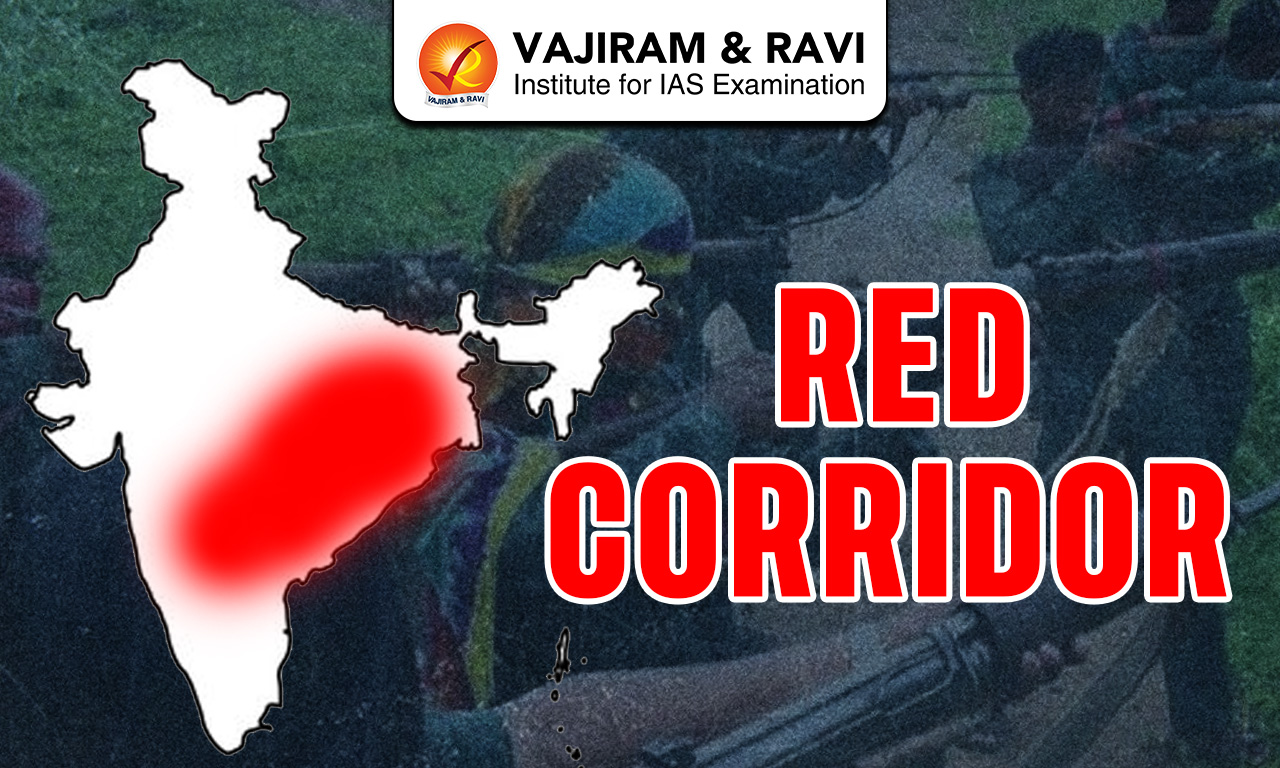
Red Corridor

The Red Corridor refers to the regions in India affected by the Naxalite-Maoist insurgency, representing one of the most significant internal security challenges. It includes areas historically marked by poverty, underdevelopment and weak governance. Over decades, it witnessed violence, parallel authority structures and socio-economic disruption, but recent years have seen a sharp decline due to coordinated security and development strategies.

Red Corridor

The Red Corridor is the geographical zone where Naxalite influence exists, primarily in central, eastern and southern India. As of April 2026, it has significantly contracted and now includes only two districts across Chhattisgarh and Jharkhand, reflecting a major reduction from its earlier vast spread across multiple states and hundreds of districts.

Red Corridor Historical Background

The Red Corridor emerged from the Naxalite-Maoist insurgency that began in 1967 after the Naxalbari uprising. 

  • It developed as a conflict between left wing extremist groups and the Indian state, rooted in agrarian distress and tribal discontent.
  • The insurgency started after the 1967 Naxalbari uprising and split in Communist Party of India (Marxist), leading to a Marxist-Leninist faction promoting armed struggle and rural revolution.
  • Naxalite organisations were declared terrorist organisations under the Unlawful Activities (Prevention) Act 1967, due to their violent activities against security forces and governance structures.
  • The movement emerged due to land inequality, lack of tribal rights over natural resources and absence of development in forested and mineral rich regions.

Red Corridor Districts

The categorisation of affected districts under Red Corridor has evolved to better reflect ground realities and improve targeted intervention strategies by the government.

  • As of 2026, Bijapur in Chhattisgarh and West Singhbhum in Jharkhand are classified as LWE affected districts, representing the highest intensity of remaining Maoist activity.
  • Kanker in Chhattisgarh falls under Districts of Concern category, indicating moderate influence where focused interventions are still required to prevent resurgence of extremist activities.

Red Corridor Government Initiatives

The government adopted a multi dimensional approach combining security, development, infrastructure and rehabilitation to eliminate Left Wing Extremism from the Red Corridor.

  • National Policy and Action Plan 2015: This policy integrates security measures, development interventions and rights based governance to comprehensively address extremism in affected areas.
  • Security Related Expenditure (SRE) Scheme: Under this scheme, ₹1,685 crore released up to 2023-24 reimburses states for security operations, rehabilitation, ex-gratia payments and community policing efforts.
  • Special Central Assistance (SCA): Funds provided to fill critical infrastructure gaps in most affected districts, ensuring development reaches remote and vulnerable populations.
  • Special Infrastructure Scheme (SIS): Funds exceeding ₹371 crore and extended allocations strengthen state police, intelligence branches and fortified police stations to improve operational capacity.
  • Fortified Police Stations: The number increased from 66 before 2014 to over 586, significantly enhancing security presence in remote and insurgency prone areas.
  • Road Connectivity: More than 12,000 km roads constructed, with 17,589 km approved, improving mobility, governance reach and socio-economic integration in previously inaccessible regions.
  • Telecom Connectivity: Over 10,000 mobile towers planned, with thousands operational, ensuring digital connectivity and improved intelligence gathering in remote regions.
  • Financial Inclusion Measures: Establishment of 1,804 bank branches, 1,321 ATMs and 37,850 banking correspondents brought formal banking to previously excluded populations.
  • Skill Development Initiatives: 48 Industrial Training Institutes and 61 Skill Development Centres established, creating employment opportunities and reducing recruitment into extremist groups.
  • NIA Anti Naxal Operations: Dedicated vertical investigated 108 cases and filed charge sheets in 87, weakening organisational networks and financial channels of Maoist groups.

Red Corridor Decline

The Red Corridor has witnessed a sharp decline due to sustained security operations, development initiatives and improved governance mechanisms across affected regions.

  • Reduction in Districts: The number of affected districts declined from nearly 180 in late 2000s to 38 in 2024, 18 in 2025 and only 2 districts by April 2026.
  • Decline in Violence: Violent incidents reduced by 53% from 16,463 (2004-2014) to 7,744 (2014-2024), showing a significant weakening of insurgent capabilities.
  • Casualty Reduction: Security force deaths declined by 73% and civilian deaths by 70%, indicating improved operational success and reduced impact on local populations.

Red Corridor Achievements

Significant achievements highlight the success of coordinated efforts in dismantling the Red Corridor and restoring governance and development.

  • Security Success: In 2025, 317 Naxals were neutralised, over 800 arrested and nearly 2,000 surrendered, indicating high attrition within insurgent ranks.
  • Infrastructure Expansion: Construction of 586 fortified police stations, 361 camps and 68 helipads strengthened security reach in remote and forested areas.
  • Surrender and Rehabilitation: Attractive policies offering ₹2.5-5 lakh incentives and monthly stipends led to large scale surrender and reintegration of cadres into society.
  • Liberation of Strongholds: Areas like Budha Pahad, Parasnath and Abujhmad were freed from decades long Maoist control, marking a major strategic breakthrough.
  • Decline in Police Incidents: Police stations reporting Naxal incidents reduced from 330 in 2013 to 52 by 2025, showing improved law and order conditions.

Red Corridor FAQs

Q1: What is the Red Corridor?

Ans: The Red Corridor refers to regions in India affected by Naxalite-Maoist insurgency, primarily located in central, eastern and southern parts of the country.

Q2: How many districts are affected by the Red Corridor in 2026?

Ans: As of April 2026, the Red Corridor is limited to only two districts across Chhattisgarh and Jharkhand.

Q3: What caused the emergence of the Red Corridor?

Ans: It originated from the 1967 Naxalbari uprising, driven by land inequality, tribal discontent, lack of development and Maoist ideology promoting armed rebellion.

Q4: Which are the most affected districts in 2026?

Ans: Bijapur in Chhattisgarh and West Singhbhum in Jharkhand are classified as LWE affected districts, while Kanker is a district of concern.

Q5: What is the government’s target regarding the Red Corridor?

Ans: The government has successfully eliminated Left Wing Extremism and has declared India Naxal free by March 2026.

Nanda Dynasty, History, Rulers, Administration, Decline

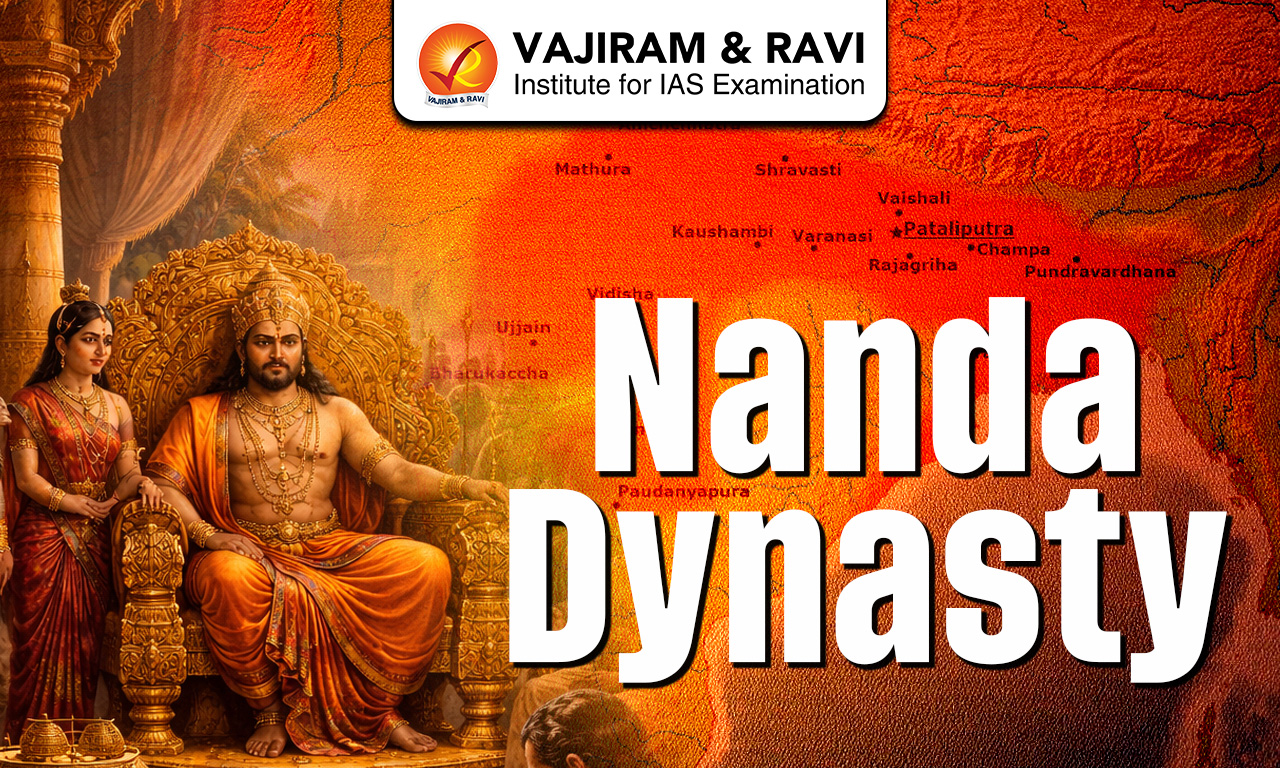
Nanda Dynasty

The Nanda Dynasty was one of the most powerful dynasties of ancient India, ruling the kingdom of Magadha between 343 BCE and 321 BCE. It marked a significant phase in Indian history by establishing a strong centralized empire with immense wealth and military strength. The Nandas expanded upon the foundations laid by earlier dynasties and played a key role in the transition toward the rise of the Mauryan Empire.

Nanda Dynasty Origin

The Nanda Dynasty originated in the powerful kingdom of Magadha during the 4th century BCE and marked a major turning point in ancient Indian political history. It came to power after overthrowing the Shishunaga Dynasty, establishing one of the first large and centralized empires in northern India.

  • Founded around 343–345 BCE in Magadha.
  • Capital city was Pataliputra (modern Patna).
  • Founder Mahapadma Nanda is said to be the son of the last Shishunaga ruler and a Shudra woman.
  • Considered the first non-Kshatriya dynasty to rule a large empire in India.
  • Rise supported by a strong army, efficient taxation system, and centralized administration.
  • Mentioned in Buddhist, Jain texts, and Sanskrit literature like Mudrarakshasa.
  • Played a key role in unifying northern India, paving the way for the Mauryan Empire.

Founder Mahapadma Nanda

Mahapadma Nanda was the founder of the Nanda Dynasty and is regarded as one of the earliest empire builders in ancient India. He established his rule in Magadha during the 4th century BCE after overthrowing the last ruler of the Shishunaga Dynasty.

  • Considered the first powerful ruler who built a large empire in northern India.
  • According to the Puranas, he was the son of King Mahanandin and a Shudra woman, indicating a non-Kshatriya origin.
  • Known by titles like “Ekarat” (sole ruler) and “Sarva-Kshatriyantaka” (destroyer of Kshatriyas).
  • Expanded the empire from Kuru region to the Godavari Valley and up to the Narmada region.
  • Ruled for about 28 years, strengthening the political and administrative structure of Magadha.
  • Ended the dominance of several traditional ruling families and unified large parts of northern India.

Mahapadma Nanda’s rule laid the strong foundation for a centralized empire, which later influenced the rise of the Mauryan Empire.

Last Ruler Dhana Nanda

Dhana Nanda was the last ruler of the Nanda Dynasty, known for his immense wealth and powerful army in Magadha. However, his harsh policies and heavy taxation made him unpopular, leading to the downfall of the dynasty.

  • Known as Agrammes or Xandrames in Greek accounts.
  • Inherited a vast treasury, making him one of the richest rulers of ancient India.
  • Maintained a massive army:
    • 200,000 infantry
    • 20,000 cavalry
    • 3,000 elephants
    • 2,000 chariots
  • Ruled during the time of Alexander the Great.
  • Introduced a system called Nandos Pakraman (a form of measurement).
  • Became unpopular due to heavy taxation and strict governance.
  • Faced opposition from both common people and elites.
  • Overthrown by Chandragupta Maurya, guided by Chanakya, around 321 BCE

Administration under the Nanda Dynasty

The administration of the Nanda Dynasty was highly centralized, with the king exercising absolute authority over the empire. Ruling from Pataliputra, the Nandas developed an efficient system of governance that helped them control a vast territory.

  • Centralized Monarchy: The king was the supreme authority, often referred to as Ekarat (sole ruler).
  • Strong Bureaucracy: Officials were appointed to manage revenue, military, and administration.
  • Efficient Tax System: Heavy taxes were collected from agriculture, trade, and professions.
  • Unified Empire: As per Puranic sources, the empire was governed as a single political unit rather than small kingdoms.
  • Strategic Capital Location: Pataliputra was located near the Ganga and Son rivers, aiding administration and trade.
  • Control over Resources: The state maintained strict control over land, trade routes, forests, and elephants.
  • Law and Order: Strict rules and punishments ensured stability across the empire.
  • Economic Administration: Introduction of currency and systematic revenue collection strengthened governance.

Society and Culture under the Nandas

The society under the Nanda Dynasty saw significant changes, especially with the rise of rulers from a non-Kshatriya background in Magadha. Although the Nandas focused more on administration and expansion, their period influenced social structure and religious developments.

  • Social Structure Change: Rise of non-Kshatriya rulers challenged the traditional varna system.
  • Low Social Origin of Rulers: The Nandas were often criticized in texts for their Shudra background, leading to opposition from elites.
  • Urban Growth: Cities like Pataliputra developed as major political and economic centers.
  • Religious Diversity: Coexistence of multiple religions such as Hinduism, Buddhism, Jainism, and Ajivika sect.
  • Religious Tolerance: No strong evidence of forced conversions or discrimination among religions.
  • Decline of Brahmanical Influence: Reduced royal patronage led to weakening of Vedic Brahmanism.
  • Rise of New Religions: Jainism and Buddhism gained importance in the Magadha region.
  • Limited Cultural Contributions: Compared to later dynasties, fewer developments in art, architecture, and literature.
  • Influence of Ministers: Some officials, like Sthulabhadra, were associated with Jainism, reflecting religious shifts.

Alexandar and Nanda Dynasty

The interaction between Alexander the Great and the Nanda Dynasty is an important episode in ancient Indian history, highlighting the power and reputation of the Nanda rulers, especially Dhana Nanda.

When Alexander invaded north-western India in 326 BCE, the Nanda Empire in Magadha was at its peak under Dhana Nanda. However, Alexander could not advance into the Gangetic plains due to the fear of the massive Nanda army and resistance from his own troops.

  • Time Period: Alexander invaded India around 326 BCE, during the rule of Dhana Nanda.
  • Extent of Invasion: He conquered regions in north-western India but did not reach Magadha.
  • Fear of Nanda Power: Reports of a huge army (lakhs of soldiers, elephants, chariots) discouraged further advance.
  • Army Resistance: Alexander’s soldiers refused to march further east beyond the Beas River due to exhaustion and fear.
  • Strategic Strength of Nandas: Their strong military and vast resources made them a formidable power.
  • Indirect Impact: Although Alexander did not fight the Nandas directly, his invasion weakened north-western regions.
  • Opportunity for Mauryas: This situation later helped Chandragupta Maurya rise to power and overthrow the Nandas.

Decline of the Nanda Dynasty

The decline of the Nanda Dynasty was mainly due to its unpopular rule, heavy taxation, and lack of support from both common people and elites. The rulers, especially Dhana Nanda, were seen as harsh and arrogant, which led to widespread dissatisfaction. Taking advantage of this situation, Chandragupta Maurya, guided by Chanakya, organized a revolt against the Nandas. Around 321 BCE, Dhana Nanda was defeated, marking the end of the dynasty and the rise of the Mauryan Empire.

Nanda Dynasty FAQs

Q1: Who founded the Nanda Dynasty?

Ans: The Nanda Dynasty was founded by Mahapadma Nanda, who established a powerful empire in Magadha during the 4th century BCE.

Q2: Who was the last ruler of the Nanda Dynasty?

Ans: The last ruler was Dhana Nanda, known for his immense wealth and large army.

Q3: What was the capital of the Nanda Dynasty?

Ans: The capital was Pataliputra, which is present-day Patna in Bihar.

Q4: Why was the Nanda Dynasty unpopular?

Ans: The Nandas were unpopular due to heavy taxation, harsh administrative policies, and their non-Kshatriya origin, which led to opposition from both people and elites.

Q5: Who defeated the Nanda Dynasty?

Ans: Chandragupta Maurya, with the help of Chanakya, defeated the Nandas around 321 BCE.

Gahadavala Dynasty 1072-1237, History, Rulers, Capital, Decline

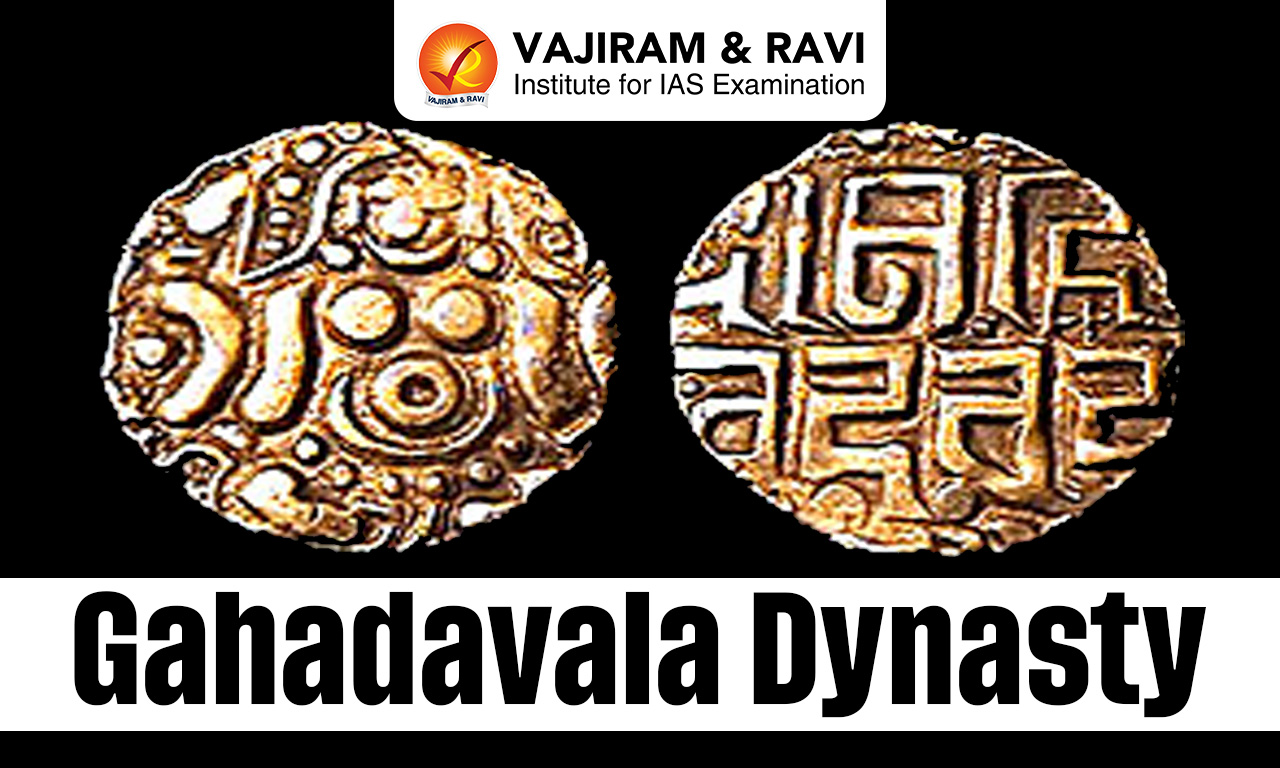
Gahadavala Dynasty

The Gahadavala Dynasty was an important ruling power of northern India between the late 11th century and mid 13th century. It emerged after the decline of major imperial powers and controlled regions like Varanasi, Ayodhya and Kannauj. The dynasty reflected features of early medieval polity such as feudal structure, Brahmanical influence and constant warfare. It played a crucial role in resisting external invasions but eventually declined due to internal weaknesses and foreign attacks.

Gahadavala Dynasty Historical Background

The Gahadavala Dynasty emerged in a politically unstable north India after the decline of Gurjara-Pratiharas and Kalachuris, gradually consolidating power in the Gangetic plains.

  • Origin: The dynasty likely originated in Varanasi and Oudh region of present day Uttar Pradesh. Early records suggest their strong association with Varanasi, where most inscriptions were issued.
  • Rise: Power was consolidated under Yashovigraha, Mahichandra and Chandradeva. Chandradeva (c. 1089-1103) established independence and expanded control over Varanasi, Ayodhya, Kannauj and nearby regions.
  • Territorial expansion: The kingdom expanded across Uttar Pradesh and extended towards Delhi and eastern Bihar, including Patna and Munger, often at the expense of Kalachuris and other regional powers.
  • Political environment: The dynasty operated in a fragmented polity marked by dynastic rivalries, alliances and feudal arrangements, lacking a strong central imperial authority.
  • External threats: Continuous Muslim incursions, especially from the Ghaznavids and later Ghurids, shaped their military and diplomatic strategies, including alliances and tribute payments.

Gahadavala Dynasty Rulers

The Gahadavala Dynasty rulers played a key role in establishing, expanding and defending the kingdom, with some rulers achieving significant political and military success.

  • Yashovigraha: Founder of the dynasty, he laid the foundation of power with strategic alliances and policies. He held titles like Maharaja Dhiraj and Parambhattark, focusing on stabilizing the kingdom.
  • Mahichandra: Son of Yashovigraha, also known as Mahipala or Mahitala, he was comparatively weak and lacked strong administrative capabilities, ruling largely as a subordinate figure.
  • Chandradeva: First independent ruler titled Parmeshwar, he expanded the kingdom by conquering Ayodhya, Varanasi and Kannauj and protected sacred regions like Kashi and Kosala from invasions.
  • Madanpala: Ruled with assistance of a council and faced Ghaznavid attacks. He suppressed invasions and defeated Rampala of the Pala dynasty, though his health limited active governance.
  • Govindachandra: Most powerful ruler who expanded the empire to Bihar and strengthened administration. He repelled Muslim attacks, promoted religion and maintained diplomatic relations with various powers.
  • Vijayachandra: Faced increasing pressure from Muslim invasions and struggled to maintain control. His reign marked the beginning of decline due to weakened military and political authority.
  • Jayachandra (Jaichand): Last major ruler who ruled Uttar Pradesh and Bihar but failed to unite with other Rajput powers. He was defeated and killed in the Battle of Chandawar (1194) by Muhammad of Ghori.
  • Harishchandra: Successor of Jayachandra, ruled briefly with limited power as a vassal. The dynasty survived temporarily but eventually lost control due to continuous external invasions.

Gahadavala Dynasty Administration and Governance

The Gahadavala Dynasty administration reflected a feudal system with strong central authority supported by subordinate chiefs and officials managing different regions.

  • Feudal structure: The kingdom was governed through semi independent feudatory chiefs holding titles like Raja and Maharaja, who maintained local control while acknowledging the king’s authority.
  • Administrative officials: Key officials called Amatyas handled governance duties, including ministers, priests, commanders and treasurers, ensuring smooth functioning of administration.
  • Territorial divisions: The kingdom was divided into units such as visaya (province), pathaka (sub province) and villages, facilitating efficient local administration and revenue collection.
  • Role of royalty: Princes and heirs issued grants independently, while queens’ grants were announced by the king, indicating centralized control over royal decisions and limited autonomy of women.
  • Legal and policy framework: Administrative functions and duties were described in texts like Kṛtya-Kalpataru by Lakshmidhara, reflecting structured governance and legal traditions.

Gahadavala Dynasty Economy

The economy under the Gahadavala Dynasty was primarily agrarian, supported by land grants, taxation and control over important trade and religious centers like Varanasi.

  • Agrarian base: Agriculture formed the backbone of the economy, with fertile Gangetic plains supporting crop production and sustaining population and state revenue.
  • Land grants system: Kings issued land grants to Brahmins and religious institutions, reinforcing Brahmanical ideology while also supporting education and religious activities.
  • Taxation system: Taxes such as Turushka-danda were imposed, possibly to meet military expenses or deal with external threats, showing the financial burden of constant warfare.
  • Trade and urban centers: Cities like Varanasi and Kannauj acted as important commercial hubs, facilitating trade in goods and contributing to economic prosperity.
  • Tribute and diplomacy: Payment of tribute to invading forces like Ghaznavids was sometimes used as a strategy to maintain stability and avoid destruction.

Gahadavala Dynasty Art and Culture

The Gahadavala Dynasty contributed significantly to cultural development through temple building, literary works and patronage of scholars and intellectuals.

  • Temple architecture: The rulers promoted construction and protection of temples in sacred cities like Varanasi and Sarnath, strengthening religious and cultural identity.
  • Literary patronage: Govindachandra encouraged scholarly works, including Kṛtya-Kalpataru by Lakshmidhara, which became an important text on law and administration.
  • Court poets: Vijayachandra patronized poets like Shriharsha, who composed Naishadha Charita, reflecting the literary excellence of the period.
  • Eulogies and inscriptions: Works like Jaichand Prakash by Bhatta Kedar and inscriptions provided valuable historical and cultural information about rulers and society.
  • Cultural synthesis: The dynasty supported both Hindu and Buddhist traditions, promoting intellectual growth and diverse cultural expressions across the kingdom.

Gahadavala Dynasty Society

The society under the Gahadavala Dynasty was deeply influenced by Brahmanical traditions, while also showing tolerance towards other religions like Buddhism.

  • Brahmanical dominance: The rulers depended heavily on Brahmanical ideology, granting land and privileges to Brahmins, which reinforced social hierarchy and religious authority.
  • Hindu religious practices: Kings worshipped Vishnu, Shiva and Surya and were often titled Parama-Maheshvara, indicating strong devotion to Hindu deities.
  • Religious tolerance: Despite Hindu dominance, Buddhism was also supported. Queens like Kumaradevi and Vasantadevi were Buddhists and monasteries were constructed.
  • Social structure: Society followed a hierarchical system based on caste, with Brahmins enjoying high status due to royal patronage and religious importance.
  • Cultural life: Religious rituals, temple activities and scholarly pursuits shaped daily life, making religion a central element of social organization.

Gahadavala Dynasty Decline

The decline of the Gahadavala Dynasty resulted from internal weaknesses, feudal fragmentation and continuous external invasions, especially by the Ghurids.

  • Internal weaknesses: The feudal structure weakened central authority, making the kingdom vulnerable to rebellion and reducing its ability to respond effectively to invasions.
  • Military challenges: Repeated invasions by Ghaznavids and Ghurids strained resources and exposed the limitations of their defensive strategies.
  • Battle of Chandawar (1194): Jayachandra was defeated and killed by Muhammad of Ghor, marking a decisive blow to the dynasty’s power in northern India.
  • Loss of territories: After Jayachandra’s death, key regions like Varanasi and Kannauj were gradually captured and local chiefs shifted allegiance to new rulers.
  • Final phase: The dynasty lingered under Harishchandra and later Adakkamalla, but eventually disappeared by the mid 13th century after retreating to central India. 

Gahadavala Dynasty FAQs

Q1: Who founded the Gahadavala Dynasty?

Ans: Yashovigraha is regarded as the founder of the Gahadavala Dynasty, who laid the foundation of power in the Varanasi region during the late 11th century.

Q2: Which ruler brought the Gahadavala Dynasty to its peak?

Ans: Govindachandra was the most powerful ruler who expanded the empire, strengthened administration and successfully resisted external invasions.

Q3: What were the main regions ruled by the Gahadavala Dynasty?

Ans: The dynasty ruled major parts of present day Uttar Pradesh and Bihar, including Varanasi, Ayodhya, Kannauj and extended towards Patna and Munger.

Q4: Why did the Gahadavala Dynasty decline?

Ans: The decline was due to internal feudal weaknesses and repeated invasions, especially the defeat of Jayachandra by Muhammad of Ghor in 1194.

Q5: What was the religious policy of the Gahadavala Dynasty?

Ans: The rulers followed Hinduism, mainly worshipping Vishnu and Shiva, but also showed tolerance towards Buddhism and supported religious diversity.

Haryanka Dynasty 544-413 BCE, Rulers, Administration, Society

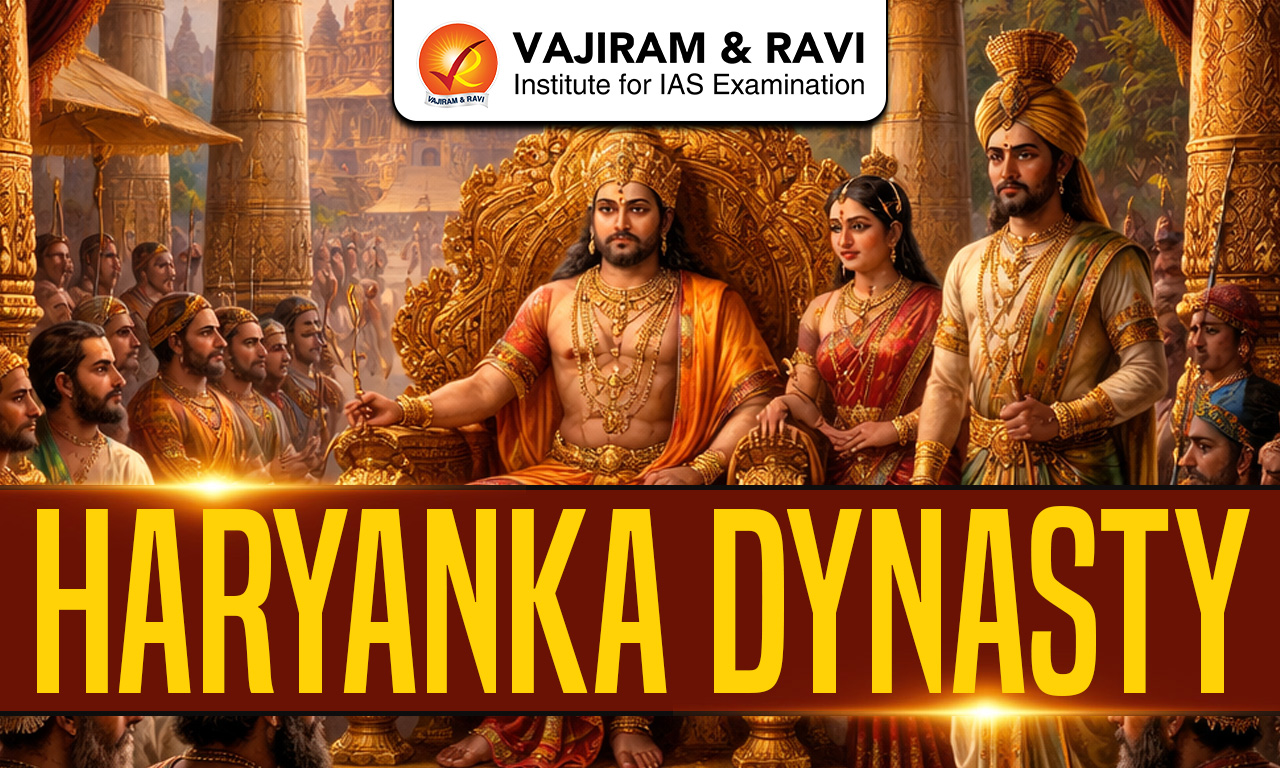
Haryanka Dynasty

The Haryanka Dynasty was one of the earliest ruling dynasties of Magadha. According to the Mahavamsa, It played a crucial role in the political rise of eastern India between 544 BCE and 413 BCE. The dynasty was founded by Bimbisara and eventually it laid the foundation of Magadha’s expansion into a powerful kingdom.

Haryanka Dynasty Historical Background

The Haryanka Dynasty ruled Magadha during a transformative period marked by political consolidation and external interactions. Its emergence coincided with broader developments in northern India.

  • Origin and Chronology: According to Mahavamsa, the dynasty ruled from 544 BCE to 413 BCE, though some historians suggest a later 5th-4th century BCE timeline based on short chronology interpretations.
  • Founder and Early Rule: Bimbisara was appointed as the king at fifteen by his father Bhattiya. He established strong foundations through diplomacy, administration and territorial consolidation in Magadha.
  • Capital and Expansion: The initial capital was Rajagriha, strategically located. Later, Udayin shifted it to Pataliputra near modern Patna, enhancing administrative and military control over the Ganga plains.
  • External Context: This period during Haryanka Dynasty overlapped with the Achaemenid expansion under Darius I around 517-516 BCE, indicating early contacts between Indian and Persian political spheres.

Haryanka Dynasty Rulers

The Haryanka Dynasty rulers significantly expanded Magadha through conquest, alliances and administrative innovations, establishing it as a dominant regional power. The key rulers of this dynasty and their contributions has been discussed below:

Bimbisara (544-492 BCE)

  • He is the founder of the dynasty and ruled for about 52 years. 
  • He expanded Magadha by conquering Anga and forming alliances through marriages with Kosala, Vaishali and Madra.
  • He maintained efficient governance with officials like Sona Kolivisa, Kumbhaghosaka and physician Jīvaka. 
  • He supported both Buddhism and Jainism, associating with Mahavira and Buddha.

Ajatashatru (493-462 BCE)

  • He was the son of Bimbisara. He seized power, possibly by imprisoning or killing his father. 
  • Under him, Magadha reached its greatest territorial extent through aggressive expansion.
  • He fought the Vajjika League led by the Lichhavis and successfully conquered them. 
  • He is also associated with the use of war technologies like catapults.

Udayin (460-444 BCE)

  • He is the successor of Ajatashatru. 
  • He is credited with shifting the capital to Pataliputra, strategically located at the confluence of the Ganga and Son rivers, strengthening Magadha’s position.

Later Rulers

  • Successors included Anuruddha, Munda, Darshaka and Nagadasaka according to Buddhist tradition.
  • However, Puranas mention Nandivardhana and Mahanandin, indicating conflicting succession traditions.

Haryanka Dynasty Administration and Governance

The administrative system of the Haryanka Dynasty reflects early state organization with structured governance and official hierarchies mentioned in ancient texts.

  • Village Administration: Gramakas acted as village headmen who managed local assemblies and ensured smooth functioning of rural administration at the grassroots level.
  • Central Officials: Mahamatras were high ranking officials responsible for executive, judicial and military duties, indicating a centralized administrative system with multiple functional roles.
  • Bureaucratic Structure: The presence of ministers, treasurers and advisors such as Koliya and Kumbhaghosaka shows an organized bureaucracy supporting royal authority and governance efficiency.
  • Capital Administration: The shift to Pataliputra improved control over trade routes and political regions, making governance more effective in expanding territories.

Haryanka Dynasty Society

The period of Haryanka Dynasty rule witnessed significant religious and social developments, especially with the rise of new philosophical traditions in northern India.

  • Religious Diversity: Both Buddhist and Jain texts claim royal patronage. Bimbisara is described as a follower of Mahavira in Jain texts and of Buddha in Buddhist sources.
  • Royal Patronage: Bimbisara supported Buddha’s Sangha by deputing Jīvaka and granting land for monastic establishments, reflecting active state support for religious institutions.
  • Ajatashatru’s Role: Ajatashatru was contemporary with Mahavira and Buddha, continuing patronage of these traditions and contributing to their spread across Magadha.
  • Social Structure: Society included administrators, ministers, physicians and village leaders, indicating a stratified yet organized social system linked closely with governance.

Haryanka Dynasty Decline

The decline of the Haryanka Dynasty was marked by internal instability, succession disputes and eventual overthrow by new political forces.

  • Succession Conflicts: Multiple traditions suggest uncertain succession after Udayin, with rulers like Anuruddha, Munda and Nagadasaka possibly ruling simultaneously or in fragmented regions.
  • Political Instability: Historical interpretations highlight court intrigues and frequent changes of rulers, weakening central authority and creating administrative disorder within Magadha.
  • Assassinations and Intrigues: Jain texts mention Udayin’s assassination by a rival kingdom, while other accounts indicate repeated internal violence among successors.
  • End of Dynasty: According to Mahavamsa, the last ruler Nagadasaka was overthrown by minister Shishunaga, leading to the establishment of the Shaishunaga dynasty around 413 BCE. 

Haryanka Dynasty FAQs

Q1: Who founded the Haryanka Dynasty?

Ans: Bimbisara is regarded as the founder of the Haryanka Dynasty and established strong political foundations in Magadha around 544 BCE.

Q2: What was the capital of the Haryanka Dynasty?

Ans: The initial capital was Rajagriha, which was later shifted to Pataliputra by Udayin for better strategic and administrative control.

Q3: Who was the most powerful ruler of the Haryanka Dynasty?

Ans: Ajatashatru is considered the most powerful ruler as he expanded Magadha significantly and defeated the Vajjika League.

Q4: What type of administration existed in the Haryanka Dynasty?

Ans: The administration included gramakas (village headmen) and mahamatras (high officials) who handled executive, judicial and military functions.

Q5: How did the Haryanka Dynasty come to an end?

Ans: The dynasty ended around 413 BCE when the last ruler Nagadasaka was overthrown by his minister Shishunaga, who established a new dynasty.

Solanki Dynasty 940-1244 CE, Rulers, Architecture, Invasion of Ghori

Solanki Dynasty

The Solanki Dynasty is also known as the Chaulukyas of Gujarat. It was one of the most powerful medieval dynasties in western India between the 10th and 13th centuries CE. It ruled over Gujarat and Kathiawar with their capital at Anahilapataka (modern Patan). They transformed the region into a major political, economic and cultural centre. Their reign is remembered as a golden age marked by territorial expansion, architectural excellence, flourishing trade and strong patronage of religion and learning.

Solanki Dynasty Historical Background

The Solanki Dynasty emerged in Gujarat after the decline of the Gurjara-Pratihara Empire and established a strong regional kingdom.

  • Origin: The dynasty used the name “Chaulukya” in inscriptions, while “Solanki” became its vernacular form in western India, reflecting regional linguistic adaptation over time.
  • Founder: Mularaja I (c. 942-996 CE) founded the Solanki Dynasty by overthrowing the Chavda ruler around 940-941 CE.
  • Early Expansion: Mularaja consolidated northern Gujarat and defeated neighbouring rulers including those of Saurashtra, Kutch, Malwa and Rajasthan, laying a stable foundation for future growth.
  • Political Context: The rise of the Solankis coincided with the decline of major powers like the Gurjara-Pratiharas and Rashtrakutas, allowing regional dynasties to assert independence.
  • Capital: Anahilapataka emerged as a major urban and trade centre, with an estimated population of nearly 100,000 around 1000 CE, indicating economic prosperity.

Solanki Dynasty Rulers

The Solanki Dynasty rulers expanded territories, strengthened administration and promoted culture, marking a period of sustained political and cultural growth. Major rulers of the dynasty are:

  • Mularaja I: Founder of the dynasty, he established sovereignty in Gujarat, built temples for both Digambara and Svetambara Jains and promoted Shaivism, reflecting early religious tolerance.
  • Chamundaraja: He maintained stability after Mularaja and faced conflicts with the Paramaras, ensuring continuity of Solanki rule during a transitional phase.
  • Bhimadeva I: Ruled from c. 1022-1064 CE, defeated Paramara king Bhoja and faced Mahmud of Ghazni’s 1026 CE invasion of Somnath, later restoring order and rebuilding temples.
  • Karnadeva I: Successor of Bhimadeva I, he founded Karnavati (modern Ahmedabad), promoted temple construction, trade and strengthened administrative systems for sustained prosperity.
  • Siddharaja Jayasimha: The most powerful ruler (c. 1094-1143 CE), expanded the empire to Malwa and Rajasthan, built Sahasralinga Tank and patronised scholar Hemachandra.
  • Kumarapala: A major ruler (c. 1143-1172 CE), embraced Jainism under Hemachandra’s influence, banned animal sacrifice, reconstructed Somnath Temple and promoted non violence and learning.
  • Bhimadeva II: The last strong ruler (c. 1172-1244 CE), defeated Muhammad of Ghor in 1178 CE at the Battle of Kasahrada, delaying foreign expansion into Gujarat.

Solanki Dynasty Administration and Governance

The administration under Solanki Dynasty was organised, decentralised and efficient, ensuring political stability and effective governance across regions.

  • Administrative Divisions: The empire was divided into mandalas (provinces) and vishayas (districts), governed by officials and local chiefs ensuring efficient administration at multiple levels.
  • Military Organisation: The rulers maintained a strong standing army and fortified towns to protect trade routes, borders and strategic regions from external invasions.
  • Local Governance: Village assemblies or panchayats had autonomy in local administration, enabling grassroots participation and efficient dispute resolution at village level.
  • Trade Protection: The state ensured security of trade routes connecting inland centres to ports like Cambay and Bharuch, promoting commercial expansion and economic growth.

Solanki Dynasty Economy

The economy of the Solanki Dynasty was vibrant, trade oriented and supported by agriculture, urban markets and maritime commerce.

  • Revenue System: Main sources of revenue included land tax, trade duties and tolls collected from flourishing commercial routes and ports, contributing to state wealth.
  • Maritime Trade: Gujarat’s ports such as Cambay (Khambhat) and Bharuch connected India with Arabia, Persia and East Africa, making it a major trade hub.
  • Urban Economy: Anahilapataka functioned as a key inland trade centre dealing in textiles, luxury goods and handicrafts, contributing significantly to economic prosperity.
  • Revenue Utilisation: Trade revenues funded temple construction, administration and military expenses, ensuring both cultural development and political stability.
  • Agricultural Base: Agriculture formed the backbone of the economy, supported by irrigation systems, tanks and stepwells constructed during the Solanki period.
  • Commercial Networks: Strong internal and external trade networks linked Gujarat with inland regions and international markets, boosting economic integration and wealth accumulation.

Solanki Dynasty Society

The period of Solanki Dynasty witnessed a rich and diverse society characterised by religious tolerance and cultural synthesis.

  • Religious Diversity: The rulers supported Hinduism, Shaivism and Jainism, promoting coexistence of multiple faiths and creating a syncretic cultural environment.
  • Jain Influence: Under Kumarapala, Jainism gained prominence, leading to reforms such as prohibition of animal sacrifice and promotion of non violence.
  • Social Structure: Society was organised along traditional lines with active participation of merchants, artisans and scholars contributing to economic and cultural growth.
  • Cultural Harmony: Temples and religious institutions of different faiths coexisted peacefully, reflecting the inclusive policies of Solanki rulers.
  • Role of Women: Queens like Udayamati contributed to architecture, such as the construction of Rani ki Vav, indicating the active cultural role of royal women.

Solanki Dynasty Art, Literature and Architecture

The Solanki Dynasty period is renowned for its distinctive architectural style and flourishing literary traditions.

  • Architectural Style: Known as Maru-Gurjara or Solanki style, it featured intricate carvings, ornate pillars, toranas and multi storeyed mandapas with high engineering precision.
  • Modhera Sun Temple: Built during Bhimadeva I’s reign, this temple is dedicated to the Sun God and exemplifies the grandeur and precision of Solanki architecture.
  • Rani ki Vav: Constructed by Queen Udayamati, this stepwell at Patan is a UNESCO World Heritage Site known for its sculptural beauty and detailed carvings.
  • Temple Construction: Temples at Taranga, Kiradu and Somnath reflect religious devotion and architectural excellence, showcasing artistic achievements of the dynasty.
  • Literary Growth: Sanskrit, Prakrit and Old Gujarati literature flourished, marking a period of intellectual development and cultural richness.
  • Hemachandra’s Contribution: The Jain scholar Hemachandra authored works on grammar, philosophy and prosody, including Siddha-Hemavyakarana, influencing language and scholarship.
  • Evolution of Language: The period witnessed early development of Gujarati as a literary language, supported by royal patronage and scholarly works.

Solanki Dynasty Decline

The decline of the Solanki Dynasty resulted from internal weaknesses and increasing external invasions.

  • Weak Successors: After Bhimadeva II, central authority weakened due to weak rulers and internal conflicts, reducing political stability.
  • External Invasions: Repeated invasions by the Ghurids and later forces of the Delhi Sultanate weakened the kingdom’s military strength.
  • Rise of Vaghelas: The Vaghela Dynasty, initially feudatories of the Solankis, gradually took control and replaced them as rulers of Gujarat.
  • Loss of Territory: Overextension of the empire and continuous warfare led to loss of control over key regions and reduced administrative efficiency.
  • Final Decline: By the late 13th century, Solanki power had ended and Gujarat eventually came under Alauddin Khalji in the early 14th century.
  • Enduring Legacy: Despite their fall, the Solankis left a lasting impact through architecture, trade networks and cultural achievements that shaped Gujarat’s historical identity. 

Muhammad of Ghor Invasion during Solanki Dynasty

The invasion of Muhammad of Ghor during the Solanki Dynasty period was a significant military event that tested the strength of Gujarat’s political and military system.

  • Background: Muhammad of Ghor aimed to expand his empire into the rich and prosperous region of Gujarat, attracted by its wealth, trade networks and strategic importance.
  • Somnath Temple Attack (1026 CE): Earlier, during Bhimadeva I’s reign, Mahmud of Ghazni attacked and plundered the Somnath Temple. After the attack, the Solanki rulers restored order and rebuilt temples.
  • Political Situation in Gujarat: At the time of invasion, Bhimadeva II was a minor and the kingdom was effectively governed by his mother, Queen Naiki Devi, acting as regent.
  • Route of Invasion: Muhammad of Ghor advanced into Gujarat through the north-western passes, moving towards the Solanki territories after earlier campaigns in north India.
  • Battle of Kasahrada (1178 CE): The decisive battle took place near Mount Abu at Kasahrada (Kayadara), where the Solanki army confronted the invading Ghurid forces.
  • Leadership of Naiki Devi: Queen Naiki Devi led the Solanki forces with the support of loyal feudatories.
  • Role of Feudatories: Regional chiefs such as the Chahamanas and Paramaras supported the Solanki army, strengthening the resistance against the Ghurid invasion.
  • Outcomes: The Ghurid army was decisively defeated, suffering heavy losses, forcing Muhammad of Ghor to retreat from Gujarat.

Solanki Dynasty FAQs

Q1: Who founded the Solanki Dynasty?

Ans: Mularaja I founded the Solanki (Chaulukya) Dynasty around 940-941 CE after defeating the last Chavda ruler and establishing his capital at Anahilapataka (Patan).

Q2: What was the capital of the Solanki Dynasty?

Ans: The capital of the Solanki Dynasty was Anahilapataka (modern Patan), which became a major centre of trade, culture and administration.

Q3: Which Solanki Dynasty ruler defeated Muhammad of Ghor?

Ans: Bhimadeva II, along with his feudatories, defeated Muhammad of Ghor in 1178 CE at the Battle of Kasahrada, preventing expansion into Gujarat.

Q4: What is the architectural style of the Solanki Dynasty known as?

Ans: The Solanki architectural style is known as Maru-Gurjara style, characterised by intricate carvings, ornate pillars and detailed temple structures.

Q5: Why did the Solanki Dynasty decline?

Ans: The decline occurred due to weak successors, internal conflicts, repeated foreign invasions and the rise of the Vaghela dynasty, which replaced Solanki rule in Gujarat.

Payment and Settlement Systems Act 2007, Objectives, Features

Payment and Settlement Systems Act 2007

The Payment and Settlement Systems Act, 2007 (PSS Act) is an important law that provides a legal framework for regulating payment systems in India. It ensures that financial transactions such as online payments, bank transfers, and digital transactions are conducted safely, efficiently, and securely.

The Act came into force in 2008 and gives the Reserve Bank of India (RBI) the power to supervise and regulate all payment systems in the country. It plays a key role in strengthening India’s digital economy and promoting a cashless society.

What is a Payment System?

A payment system is a mechanism that enables the transfer of money between individuals, businesses, or institutions. It includes both physical methods like cash and cheques, and digital modes such as NEFT, RTGS, and UPI. Payment systems ensure that transactions are processed securely, efficiently, and within a specific time frame. They form a crucial part of a country’s financial infrastructure and support economic activities.

Payment and Settlement Systems Act 2007 Objectives

The main objective of the Payment and Settlement Systems Act 2007 is to regulate and supervise payment systems in India to ensure safety and efficiency.

  • To provide a legal framework for payment systems
  • To ensure secure and reliable financial transactions
  • To protect the interests of consumers
  • To reduce risks and fraud in payment mechanisms
  • To promote transparency and efficiency
  • To support the growth of digital payments in India

Features of the Payment and Settlement Systems Act, 2007

The Payment and Settlement Systems Act, 2007 provides a strong legal framework to regulate and supervise payment systems in India, ensuring safety, efficiency, and transparency in financial transactions. It empowers the Reserve Bank of India (RBI) to oversee and control all payment system operations.

  • RBI as Central Authority: The Reserve Bank of India is the sole regulator of payment systems in India.
  • Authorization Requirement: No entity can operate a payment system without prior approval from RBI.
  • Regulation and Supervision: RBI has the power to inspect, audit, and issue directions to payment system operators.
  • Settlement Finality: Transactions once settled are final and legally binding.
  • Legal Recognition of Netting: Netting arrangements are legally recognized, reducing settlement risks.
  • Consumer Protection: Ensures safety of funds and provides grievance redressal mechanisms.
  • Wide Coverage: Includes banks, NBFCs, fintech companies, and payment service providers.

Payment Systems Covered Under the Act

The Payment and Settlement Systems Act, 2007 covers a wide range of payment mechanisms used for transferring funds in India. These systems are regulated by the Reserve Bank of India (RBI) to ensure secure, efficient, and reliable transactions.

  • RTGS (Real-Time Gross Settlement): Used for high-value transactions processed in real-time.
  • NEFT (National Electronic Funds Transfer): Allows electronic fund transfers in batches across banks.
  • UPI (Unified Payments Interface): Enables instant mobile-based payments and fund transfers.
  • IMPS (Immediate Payment Service): Provides 24×7 instant interbank fund transfer service.
  • Debit and Credit Card Networks: Includes card-based payment systems like ATM and POS transactions.
  • Prepaid Payment Instruments (PPIs): Covers mobile wallets, prepaid cards, and digital wallets.
  • Clearing Houses: Facilitate settlement of interbank transactions such as cheque clearing.
  • Settlement Systems: Systems that ensure final transfer of funds between participants.

Payment and Settlement Systems Act 2007 FAQs

Q1: What is the Payment and Settlement Systems Act, 2007?

Ans: It is a law that regulates and supervises payment systems in India to ensure safe and efficient financial transactions.

Q2: Who regulates payment systems in India?

Ans: The Reserve Bank of India (RBI) regulates all payment systems under this Act.

Q3: Why is this Act important?

Ans: It ensures security, efficiency, and trust in digital and electronic payment systems.

Q4: Does the Act cover digital payments like UPI?

Ans: Yes, all modern payment systems including UPI, NEFT, RTGS, and wallets are covered.

Q5: What is settlement finality?

Ans: It means once a transaction is completed, it cannot be reversed, ensuring certainty in financial transactions.

Mission MITRA

Mission MITRA

Mission MITRA  Latest News

Recently, the Indian Space Research Organisation (ISRO) launched the Mission MITRA in Ladakh to test mental, physical strength of astronauts.

About Mission MITRA

  • The Mission MITRA (Mapping of Interoperable Traits and Response Assessment) is a first-of-its-kind team behavioral study designed by ISRO & IAF-Institute of Aerospace Medicine.
  • Objective:  To examine the physiological, psychological, and operational dynamics of Crew and ground teams functioning in a high-altitude environment.
  • It is being conducted in the rugged, high-altitude terrain of Leh, Ladakh.
    • Ladakh is known for its freezing temperatures, low oxygen levels and isolation, Ladakh is an ideal terrestrial analogue for space-like conditions.
  • The mission involves India’s four designated Gaganyaan astronauts, supported by a multidisciplinary team of scientists, engineers, medical experts and psychologists.
  • This study is targeted to generate vital understanding on the team inter-operability between Crew (Gaganyatris) &ground control teams and effectiveness of decision making under environmental & operational stress.
  • Significance: The findings will play a vital role in shaping India’s future human spaceflight missions, especially those involving longer durations in orbit or beyond.

Source: TH

Mission MITRA FAQs

Q1: Where is Mission MITRA being conducted?

Ans: Leh, Ladakh

Q2: What is the primary objective of Mission MITRA?

Ans: To evaluate team interoperability and decision-making under stress

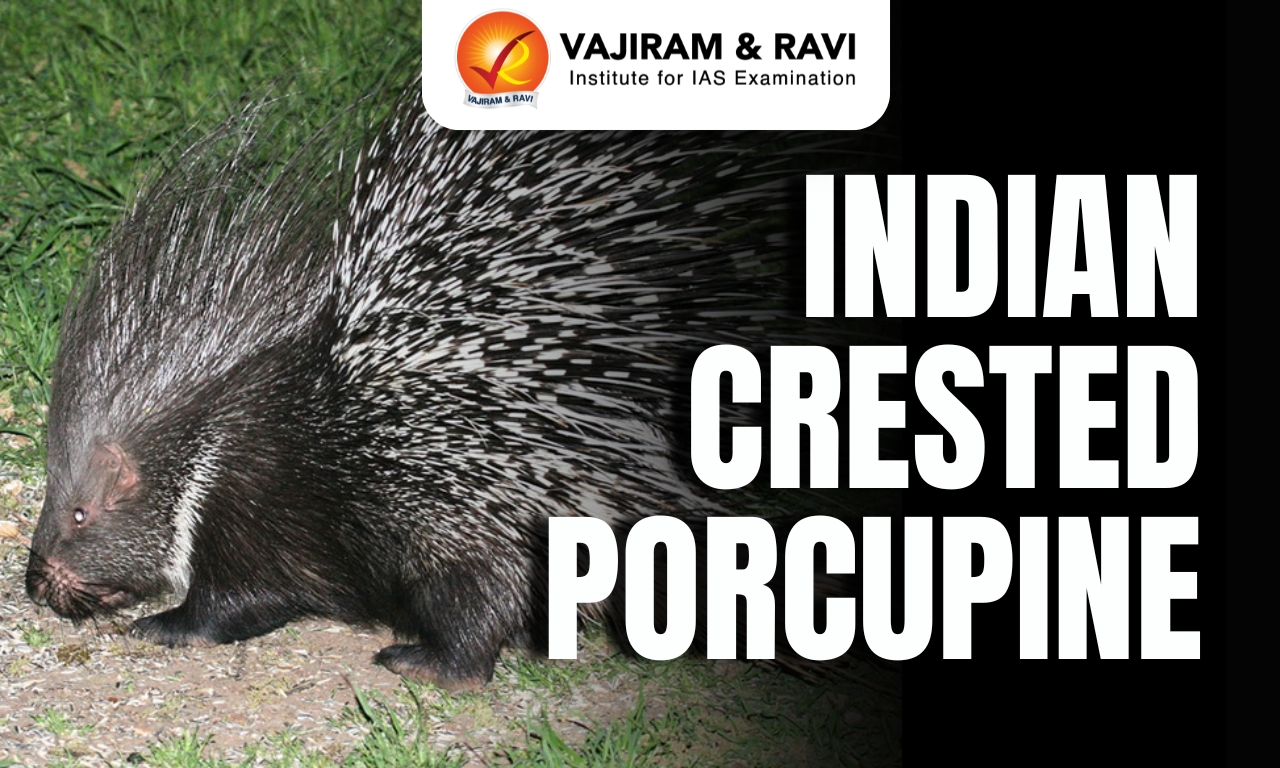
Indian Crested Porcupine

Indian Crested Porcupine

Indian Crested Porcupine Latest News

Recently, it was observed that the Indian crested porcupine has begun feeding on saffron corms beneath the soil, hollowing out harvests before they can bloom in Kashmir.

About Indian Crested Porcupine

  • It is a large rodent belonging to the Old World porcupine family, Hystricidae.
  • Habitat
    • It mainly occurs on rocky hill sides but is also found in tropical and temperate scrublands, grasslands, and forests.
    • They are also found throughout the Himalayan Mountains, reaching up to elevations of 2400 meters. 
  • Distribution: It is found throughout southeast and central Asia and in parts of the Middle East, including such countries as India, Nepal, Bhutan, Bangladesh, Sri Lanka, Pakistan, Israel, Iran, and Saudi Arabia.
  • Features
    • Lifespan: 18 to 20 years
    • Quills: A porcupine’s best defense is the formidable set of quills on its back. But it can’t “throw” them. When alarmed, the Indian Porcupine launches its quill for a backward attack. 
    • The feet and hands are broad, with long claws that are used for burrowing.
    • It is nocturnal, with the species seeking shelter in caves, between rocks, or in its burrow during the day.
    • Diet: They have a very broad and mostly herbivorous diet. They primarily feed on fruits, grains, roots, and other vegetable material.
    • Conservation Status IUCN Red List: Least Concerned.

Source: TOI

Indian Crested Porcupine FAQs

Q1: What is the scientific name of the Indian Crested Porcupine?

Ans: Hystrix indica

Q2: Where is the Indian Crested Porcupine primarily found?

Ans: Indian subcontinent and parts of Asia

New Nematode Species

New Nematode Species

New Nematode Species Latest News

Recently, researchers from the Zoological Survey of India (ZSI) have identified two new species of free-living marine nematodes off the coast of Tamil Nadu and named them Corononema dhriti and Epacanthion indica.

About Corononema dhriti and Epacanthion indica

Corononema dhriti

  • It is a free-living marine nematodes found off the coast of Tamil Nadu
  • It is named in honor of Dr. Dhriti Banerjee, Director of the Zoological Survey of India,
  • It is only the fourth known species of this genus globally.
  • It was previously documented only in Australia, Thailand, and Vietnam.

Epacanthion indica

  • It is named after the nation of its discovery; this species stands out due to its complex anatomy.
  • Unlike many nematodes that feed on microbes, E. indica possesses specialized mandibles and “teeth,” positioning it as a microscopic predator within the benthic food web.

What are Nematodes?

  • These are any worm of the phylum Nematoda.
  • They occur as parasites in animals and plants or as free-living forms in soil, fresh water, marine environments, and even such unusual places as vinegar, beer malts, and water-filled cracks deep within Earth’s crust.
  • Features
    • Nematodes are bilaterally symmetrical, elongate, and usually tapered at both ends.
    • Some species possess a pseudocoel, a fluid-filled body cavity between the digestive tract and the body wall.
    • Distribution: They have been reported from every continent on earth and occur in deserts, swamps, the oceans, the tropics and Antarctica.
  • Significance of marine nematodes
    • Nutrient Cycling: Breaking down organic waste and recycling essential nutrients back into the ocean.
    • Sediment Health: Maintaining the stability and productivity of coastal sediments.
    • Bio-Indicators: Serving as vital markers for environmental health and climate change impact.

Source: IBG News

New Nematode Species FAQs

Q1: Where were Corononema dhriti and Epacanthion indica discovered?

Ans: Off the coast of Tamil Nadu

Q2: What is distinctive about Epacanthion indica?

Ans: Its complex anatomy and predatory behavior

Government e Marketplace

Government e Marketplace

Government e Marketplace Latest News

The Government e Marketplace (GeM) has achieved a cumulative Gross Merchandise Value (GMV) of ₹18.4 lakh crore, including crossing ₹5 lakh crore GMV in the financial year 2025–26.  

About Government e Marketplace

  • It is India’s national public procurement portal launched in 2016 by the Ministry of Commerce & Industry.
  • It enhances transparency, efficiency and inclusivity in procurement.
  • It is the portal for procurement of goods and services for all Central Government and State Government Ministries, Departments, Public Sector Units (PSUs) and affiliated.
  • Features
    • It is a fully digital, cashless and system-driven platform that offers an end-to-end solution for all government buyers and sellers.
    • It uses AI-powered tools and a multilingual Learning Management System (LMS) to facilitate access to public procurement.
    • It also features voice-enabled navigation and region-specific training modules that support onboarding and transactions for sellers, including those in remote and underserved areas.

Objectives of GeM Portal

  • To increase efficiency, transparency and speed in public procurement
  • To provide multiple modes of procurement like direct purchase; bidding with reverse e-auction; e-bidding and direct reverse auction.
  • To make ministries/ government departments to mandatorily procure goods and services from the portal
  • To enable efficient price discovery; economies of scale and dissemination of best practices

Source: PIB

Government e Marketplace FAQs

Q1: What are the benefits of GeM?

Ans: Enhanced transparency and efficiency

Q2: Who can register on GeM?

Ans: Proprietor firms, startups, MSMEs, companies, and service providers

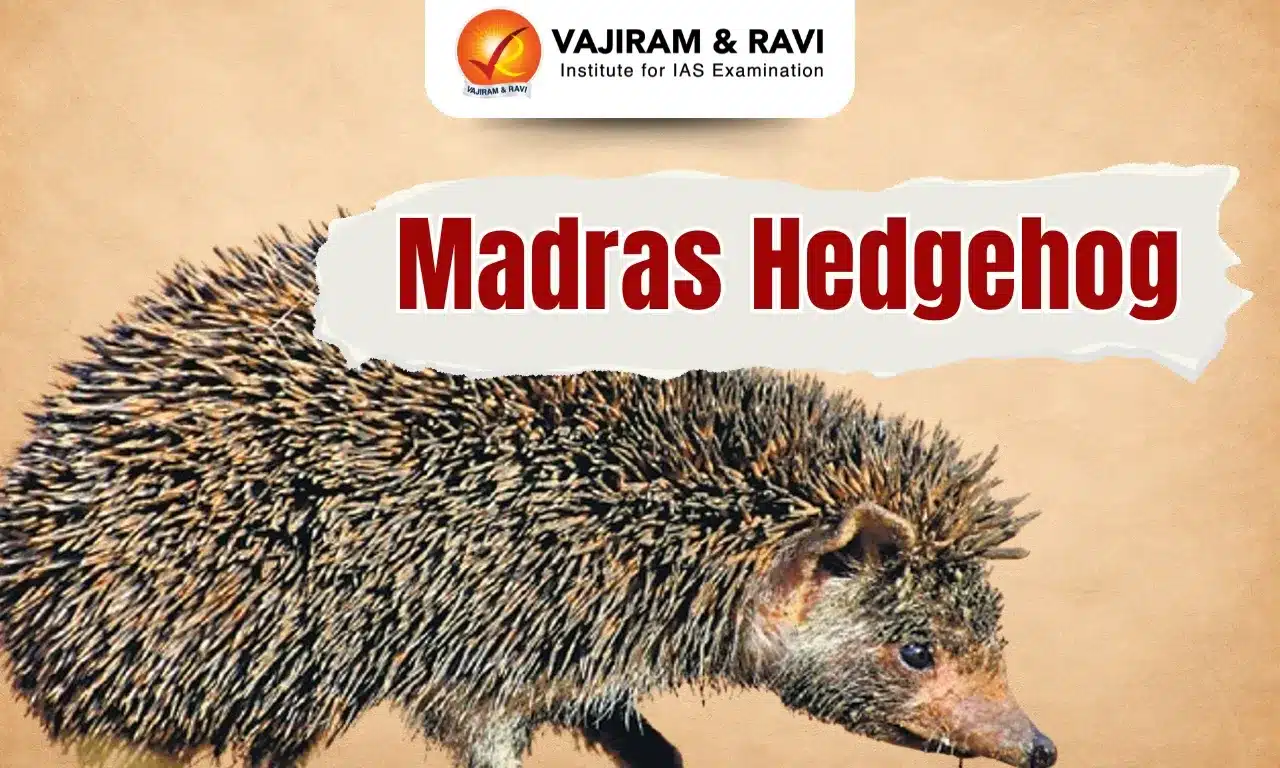
Madras Hedgehog

Madras Hedgehog

Madras Hedgehog Latest News

The first analysis of the complete mitochondrial genome of the Madras hedgehog (Paraechinus nudiventris) has helped shed some more valuable insight into the evolutionary history of the enigmatic species.

About Madras Hedgehog

  • Madras Hedgehog, locally known as Mulleli is a tiny mammal.
  • It is also known as the bare-bellied hedgehog, discovered in 1851.
  • Habitat: The species prefers dry scrublands, thorn forests, grasslands and the edges of farmlands. 
  • Distribution: It is found only in peninsular India, primarily across Tamil Nadu, Kerala, Andhra Pradesh and parts of Karnataka.
  • Features
    • It has sharp spines on its back and soft white fur on its belly.
    • Its spines offer protection from predators such as foxes, jackals and mongooses.
    • It is a nocturnal species curls into a ball to protect itself from danger.
    • It has mastered survival in some of the harshest and driest landscapes.
    • Life Span: It has a short lifespan of five to six years.
    • Diet: It feeds on insects such as beetles, ants, earthworms and termites, apart from plants.
    • Conservation Status: IUCN: Least Concern
  • Ecological Role
    • It controls insect populations and aerates soil.
    • It supports the delicate web of life in India’s dry ecosystems.
  • Threats: Its population declined largely due to hunting driven by mythical beliefs that its quills and meat have medicinal value.

Source: TH

Madras Hedgehog FAQs

Q1: What is distinctive about the Madras Hedgehog's appearance?

Ans: Its spines or quills

Q2: Where is the Madras Hedgehog primarily found?

Ans: Southern India

Psychedelics

Psychedelics

Psychedelics Latest News

Recent study revealed that Psychedelics can temporarily ‘loosen’ the brain patterns that support the feeling of a ‘me’, allowing researchers to watch that system reorganise itself in real time.

About Psychedelics

  • These are drugs that induce states of altered perception, behaviour, consciousness and thought, often with increased awareness of the senses.
  • Psychedelics are non-addictive and non-toxic. Compared to illicit drugs, psychedelics cause much less harm to the end user.
  • The term ‘psychedelic’ comes from two Greek words denoting mind or soul and manifesting.
  •  It is a subset of psychotropic substances that can alter a person’s thoughts and perceptions, and elicit intense hallucinations.
  • Most psychedelics work by increasing the availability of serotonin—a mood stabilising hormone—in the brain by binding to serotonin receptors (a molecule on the cell surface that binds to a specific chemical, causing a specific effect).
  • Regulation in India: In India, the Narcotic Drugs and Psychotropic Substances Act 1985 prohibits the use of psychedelic substances. 
  • These are categorised into two broad categories
    • Classical psychedelics: These are thought to trigger hallucinations by activating a receptor called serotonin 5-HT, which is widely present in the human body, from the gastrointestinal tract to platelets to the nervous system. Examples: LSD, psilocybin and DMT
    • Nonclassical psychedelics: These psychedelics bind to varied receptors. Examples: ketamine and MDMA
  • Used for research: Five psychedelics are the subject of clinical research for use in treating mental health problems: psilocybin; lysergic acid diethylamide (LSD); 3,4-methylenedioxy-N-methamphetamine (MDMA); ketamine and N, N-dimethyltryptamine (DMT).

Source: TH

Psychedelics FAQs

Q1: What is a common characteristic of psychedelics?

Ans: They alter perception, thought, and mood

Q2: What is a potential therapeutic use of psychedelics?

Ans: Treating depression

Tar Balls

Tar Balls

Tar Balls Latest News

Recently, the Ministry of Environment, Forest, and Climate Change has released draft rules aimed at managing ‘tar balls’ to protect the coastline and marine environment from oil spills

About Tar Balls

  • Tar balls are small, dark, sticky blobs of weathered oil that form in marine environments due to oil spills or natural seeps.
  • Formation
    • Tar balls are formed by weathering of crude oil in marine environments. They are transported from the open sea to the shores by sea currents and waves.
    • They undergo physical, chemical, and biological processes, resulting in semi-solid or solid lumps that often wash ashore, causing environmental damage and posing risks to human health. ​
    • Some of the balls are as big as a basketball while others are smaller globules.
  • Composition: These tar balls contain toxic contaminants, such as heavy metals, trace elements, and persistent organic pollutants, 
  • Impacts of Tar Balls
    • Biodiversity: They often accumulate on beaches and pose a danger to seabirds, fish, and marine animals, such as sea turtles, which may mistakenly ingest them, thinking they are food.
    • India’s western coast, particularly the area from Gujarat to Goa, is significantly affected by tar balls, especially during the seasonal period from April to September.

Source: NIE

Tar Balls FAQs

Q1: Where are tar balls commonly found?

Ans: On beaches and coastlines

Q2: How are tar balls formed?

Ans: Through natural weathering of oil spills

All India Services, Background, Provisions, Importance

All India Services

All India Services are a unique administrative system in India where officers serve both the Centre and the States, ensuring uniform governance and national integration. Their foundation lies in Part XIV of the Constitution of India, which deals with services under the Union and States. Article 312 provides for the creation of All India Services in the national interest, while other provisions ensure recruitment, protection, and service conditions. These services play a vital role in maintaining administrative efficiency, continuity, and coordination across the country.

All India Services Historical Background

All India Services have evolved over time to create a strong and unified administrative system in India. Their origin can be traced back to the British period, where a centralized civil service was established to maintain control and ensure efficient governance.

  • Charter Act of 1833: Marked an important beginning by introducing the idea of a centralized administrative system in India and laying the foundation for a uniform civil service structure; it also opened the door (in principle) for Indians to enter government services based on merit
  • Macaulay Report (1854): Thomas Babington Macaulay laid the foundation of modern civil services by introducing a merit-based system and open competitive examinations, replacing the earlier patronage-based system
  • Indian Civil Service (ICS): Established as the backbone of British administration, it handled revenue collection, law and order, and governance, earning the title of the “steel frame”
  • Entry of Indians into ICS: Initially dominated by British officers, but gradually Indians were allowed entry due to rising demand for Indianisation of services
  • Government of India Act 1919: Introduced dyarchy in provinces, dividing subjects into reserved and transferred categories, which increased Indian participation in administration
  • Significance of 1919 Act: Highlighted the growing need for a structured and representative civil service system to manage expanding governance responsibilities
  • Lee Commission (1924): Recommended Indianisation of civil services and proposed a 40% British, 40% Indians (direct recruitment), and 20% promotion quota
  • Recommendation for Public Service Commission: Suggested the creation of an independent recruitment body to ensure fair and merit-based selection
  • Public Service Commission (1926): Established as the first independent body for recruitment, later evolving into the Union Public Service Commission
  • Government of India Act 1935: Introduced provincial autonomy and classified services into Federal, Provincial, and All India Services, strengthening the administrative framework
  • Significance of 1935 Act: Provided a clear federal structure and formally recognized the importance of All India Services in maintaining administrative uniformity
  • Federal Public Service Commission: Established under the 1935 Act to ensure merit-based recruitment at the federal level
  • Demand during Freedom Movement: Increased emphasis on representative, accountable, and national-oriented civil services
  • Role of Sardar Vallabhbhai Patel: Strongly supported continuation of All India Services and called them the “steel frame of India”, emphasizing their role in national unity and integrity
  • Constituent Assembly Debates: Recognized the importance of strong administrative services for maintaining unity in a diverse country
  • Inclusion in Constitution of India: Led to constitutional backing under Article 312, ensuring legal status and protection
  • All India Services Act, 1951: Provided a legal framework for recruitment and service conditions
  • Post-Independence Transition: ICS was replaced by IAS and IPS, ensuring continuity with reforms suited to democratic governance
  • Creation of IFoS (1966): Added to manage forest and environmental administration, expanding the scope of All India Services
  • Evolution of Civil Services: Transitioned from a colonial administrative system to a democratic, merit-based, and impartial system
  • Present Significance: All India Services act as a link between Union and States, ensuring uniform policy implementation, administrative efficiency, and national integration

All India Services Constitutional Provisions

The Constitution of India provides a strong legal and institutional framework for the creation, regulation, and protection of All India Services, ensuring administrative stability and federal balance.

  • Article 312 – Creation of All India Services: Parliament can create new All India Services if the Rajya Sabha passes a resolution with a two-thirds majority, ensuring it is in the national interest
  • All India Services Act, 1951: Provides the statutory framework for recruitment and service conditions of All India Services under Article 312
  • Article 309 – Recruitment and Service Conditions: Empowers Parliament to regulate recruitment, service rules, promotions, and salaries, ensuring uniformity across India
  • Article 310 – Doctrine of Pleasure: States that civil servants hold office during the pleasure of the President, reflecting executive control, but not absolute
  • Article 311 – Safeguards to Civil Servants: Provides protection against arbitrary dismissal or removal, ensuring due process and right to be heard
  • Article 315 – Public Service Commissions: Establishes the Union Public Service Commission for independent and merit-based recruitment
  • Article 320 – Functions of UPSC: Defines the role of UPSC in conducting examinations and advising on recruitment, promotions, and disciplinary matters

All India Services Features

All India Services have several distinctive features that make them unique and essential for maintaining a strong administrative system in India. These features ensure coordination between the Union and the States, uniform governance, and administrative efficiency under the framework of the Constitution of India.

  • Dual Control System: Officers work under both the Central and State Governments, where the Centre handles recruitment, training, and discipline, while the State manages day-to-day administration
  • Centralized Recruitment: Recruitment is conducted at the national level by the Union Public Service Commission, ensuring merit-based, transparent, and competitive selection
  • State Cadre Allocation: Officers are allotted to state cadres, where they spend most of their careers, promoting administrative familiarity and national integration
  • Uniform Service Conditions: All officers follow common rules, pay structure, training, and promotion policies, ensuring consistency in administration across the country
  • Deputation System: Officers can be deputed to the Central Government, international organizations, or other states, enhancing experience and coordination
  • Constitutional Safeguards: All India Services enjoy constitutional protection against arbitrary actions, ensuring independence, neutrality, and stability
  • All India Character: Officers serve outside their home states, promoting national unity, impartial governance, and a broader administrative outlook

Roles and Responsibilities

All India Service officers perform a wide range of functions that are essential for effective governance, policy implementation, and maintaining law and order.

  • Policy Implementation: Execute government policies and schemes at the ground level and ensure that benefits reach the intended population effectively
  • Administrative Governance: Manage district and state administration, including revenue collection, public services, and overall governance
  • Law and Order Maintenance: Maintain peace and security, handle emergencies, control riots, and ensure internal stability (especially by police services)
  • Development Administration: Promote economic and social development by implementing programs in sectors like health, education, infrastructure, and rural development
  • Public Service Delivery: Ensure efficient delivery of essential services such as welfare schemes, subsidies, and citizen services
  • Environmental Protection: Conserve forests, wildlife, and natural resources, and ensure sustainable development (especially by forest services)
  • Crisis and Disaster Management: Handle natural disasters, pandemics, and emergencies, and coordinate relief and rehabilitation efforts
  • Centre-State Coordination: Act as a link between the Centre and States, ensuring smooth communication and proper implementation of national policies
  • Advisory Role: Provide expert advice to political executives in policy formulation and decision-making

Role of Rajya Sabha in All India Services Creation

The Rajya Sabha plays a crucial role in the creation of All India Services under Article 312 of the Constitution of India. It must pass a resolution with a two-thirds majority declaring that the creation of a new service is necessary in the national interest. This ensures that states have a voice in such decisions, maintaining the federal balance. Only after this approval can Parliament create a new All India Service.

Challenges Faced by All India Services

All India Services, despite being the backbone of India’s administrative system, face several challenges that affect their efficiency and independence.

  • Political Interference: Frequent transfers and postings and external pressure in decision-making affect the independence and neutrality of officers
  • Centre-State Conflicts: Differences between the Centre and States create administrative tensions, especially due to the dual control system
  • Workload and Administrative Pressure: Officers handle multiple responsibilities including law and order, development, and crisis management, leading to high stress and burnout
  • Accountability Issues: The dual reporting system sometimes creates confusion in accountability, making decision-making complex
  • Limited Specialization: Officers often work in diverse sectors without deep specialization, affecting efficiency in technical areas
  • Public Expectations and Scrutiny: Increasing public awareness and media scrutiny put pressure on officers to deliver quick and effective results
  • Implementation Challenges: Ground-level issues like lack of resources, infrastructure gaps, and bureaucratic delays hinder effective policy implementation

Reforms Needed in All India Services

To make All India Services more efficient, transparent, and responsive to modern governance needs, several reforms are necessary. These reforms aim to strengthen accountability, reduce interference, and improve overall administrative performance within the framework of the Constitution of India.

  • Fixed Tenure System: Ensure a minimum fixed tenure for officers to reduce frequent transfers and provide stability in administration
  • Reduction of Political Interference: Establish clear guidelines to protect officers from undue political pressure, ensuring independent and impartial decision-making
  • Performance-Based Evaluation: Introduce a transparent performance appraisal system based on measurable outcomes rather than seniority alone
  • Specialization in Services: Encourage officers to develop domain expertise in sectors like health, education, finance, and infrastructure for better policy implementation
  • Transparency in Transfers and Postings: Implement a fair and transparent transfer policy to avoid misuse and favoritism
  • Capacity Building and Training: Provide continuous training and skill development to officers to adapt to changing administrative and technological needs
  • Use of Technology and E-Governance: Promote digital governance tools to improve efficiency, transparency, and service delivery
  • Strengthening Accountability Mechanisms: Introduce better systems for monitoring performance and fixing responsibility in case of failures

All India Services FAQs

Q1: What are All India Services?

Ans: All India Services are a group of civil services whose officers serve both the Central and State Governments, ensuring uniform administration and effective governance across India.

Q2: Which constitutional provision deals with All India Services?

Ans: Article 312 of the Constitution of India deals with the creation of All India Services.

Q3: Why are All India Services important?

Ans: They ensure administrative unity, policy implementation, national integration, and efficient governance across the country.

Q4: Can new All India Services be created?

Ans: Yes, Parliament can create new All India Services under Article 312, with approval from the Rajya Sabha in the national interest.

Q5: Which are the All India Services in India?

Ans: There are three All India Services: Indian Administrative Service (IAS), Indian Police Service (IPS), and Indian Forest Service (IFoS).

Annual Survey of Incorporated Services Sector Enterprises

Annual Survey of Incorporated Services Sector Enterprises

Annual Survey of Incorporated Services Sector Enterprises Latest News

Recently, the National Statistics Office (NSO) has launched the first-ever Annual Survey of Incorporated Services Sector Enterprises (ASISSE).

About Annual Survey of Incorporated Services Sector Enterprises

  • It is launched by the National Statistics Office, under the Ministry of Statistics and Programme Implementation (MoSPI).
  • It is aimed at developing a comprehensive database of the incorporated services sector of the country.
  • The survey uses the Goods and Services Tax Network (GSTN) database as a sampling frame.
  • The survey covers corporate entities in the services sector – companies registered under the Companies Act, 1956/2013 or Limited Liability Partnership Act, 2008. 
  • The ASISSE will survey over 1.21 lakh enterprises, making it one of the largest exercises of its kind.
  • It will be conducted under the provisions of Collection of Statistics Act, 2008, as amended in 2017 and through the Jan Vishwas (Amendment of Provisions) Act, 2023.

Key Facts about National Statistical Office

  • It is the central statistical agency of India responsible for collecting, processing, and disseminating official statistical data.
  • The NSO was formed in 2019 by merging two key statistical bodies to improve efficiency, coordination, and data quality in India’s statistical system.
  • It plays a crucial role in evidence-based policymaking, planning, and governance.
  • The NSO is headed by the Chief Statistician of India (CSI), who oversees all statistical activities and ensures coordination between departments..
  • It functions under the Ministry of Statistics and Programme Implementation.

Source: PIB

Annual Survey of Incorporated Services Sector Enterprises FAQs

Q1: What are incorporated service sector enterprises?

Ans: Entities registered under Companies Act, 1956 or Companies Act, 2013 or Limited Liability Partnership (LLP) Act, 2008

Q2: What is the aim of the Annual Survey of Incorporated Services Sector Enterprises?

Ans: It is aimed at developing a comprehensive database of the incorporated services sector of the country.

Per- and Polyfluoroalkyl Substances

Per- and Polyfluoroalkyl Substances

Per- and Polyfluoroalkyl Substances Latest News

Recently, the European Union (EU) Parliament approved updated EU water pollution standards and added Per- and polyfluoroalkyl substances (PFAS) into the pollutants list which needs to be monitored.

About Per- and Polyfluoroalkyl Substances

  • These are toxic, man-made, hazardous chemicals. 
  • These are also known as the Forever Chemicals, are a large chemical family of over 4,700
  • They are a large family of fluorinated chemicals that have partially or completely fluorinated carbon chains of varied lengths. 
  • Because the carbon-fluorine bond is one of the strongest, these chemicals do not degrade easily in the environment.
  • Subgroups: Perfluorooctane sulfonic acid (PFOS) and Perfluorooctanoic acid (PFOA), and persistent organic pollutants (POPs).
  • These subgroups are currently listed under the Stockholm Convention as industrial POPs.
  • How Are People Exposed to PFAS?
    • They are ingredients in various everyday products. For example, PFAS are used to keep food from sticking to packaging or cookware, make clothes and carpets resistant to stains
    • PFAS are used in the aerospace, automotive, construction, and electronics industries. Over time, PFAS may leak into the soil, water, and air.
    • People are most likely exposed to these chemicals by consuming PFAS-contaminated water or food, using products made with PFAS, or breathing air containing PFAS. 
  • Impacts of PFAS on Human Health: Decreased fertility, developmental effects in children, interference with body hormones, increased cholesterol levels, and increased risk of some cancers.
  • Regulation: The Stockholm Convention has listed some PFAS, such as Perfluorooctane sulfonic acid (PFOS) and Perfluorooctanoic acid (PFOA), as persistent organic pollutants (POPs).

Source: DTE

Per- and Polyfluoroalkyl Substances FAQs

Q1: What is a major environmental concern associated with PFAS?

Ans: They persist in the environment and contaminate water

Q2: What are PFAS

Ans: A group of synthetic chemicals used in various products

Guru Tegh Bahadur

Guru Tegh Bahadur

Guru Tegh Bahadur Latest News

Recently, the Prime Minister of India offered homage to Sri Guru Tegh Bahadur Ji, a towering spiritual great of our civilization, on the sacred occasion of Parkash Purab. 

About Guru Tegh Bahadur

  • Guru Tegh Bahadur (1621–1675) was the ninth of ten Gurus of the Sikh religion.
  • He was born as Tyaga Mal.
  • He came to be known by the name Teg Bahadur (Mighty of The Sword), given to him by Guru Hargobind after he showed his valour in a battle against the Mughals.
  • In 1664, Guru Teg Bahadur succeeded Guru Har Krishan Ji as the ninth Sikh Guru. 
  • He was revered with the honour of 'Hind Di Chadar'.
  • He  raised an army against the Mughals and introduced the concept of warrior saints.
  • Life and Works
    • He built the city of Anandpur Sahib (in Rupnagar/Ropar district, on the edge of Shivalik Hills, near the Sutlej River, in Punjab). 
      • Here the last two Sikh Gurus lived and where Guru Gobind Singh Ji founded the Khalsa Panth in 1699.
    • He contributed more than 100 poetic hymns to the Granth Sahib, which cover various topics, such as the nature of God, human attachments, body, mind, dignity, service, etc.
  • His martyrdom is remembered as the Shaheedi Divas of Guru Tegh Bahadur every year on 24 November, according to the Nanakshahi calendar released by the Shiromani Gurdwara Parbandhak Committee in 2003.

Source: PIB

Guru Tegh Bahadur FAQs

Q1: Who is Guru Tegh Bahadur?

Ans: 9th Sikh Guru

Q2: What is Guru Tegh Bahadur known for?

Ans: His martyrdom for religious freedom

CBSE AI Curriculum and Student Preparedness

CBSE AI Curriculum

CBSE AI Curriculum Latest News

  • On 1 April 2026, the government launched a CBSE curriculum on Computational Thinking (CT) and AI for Classes 3–8. 
  • The aim is to build skills like logical reasoning, problem-solving, and pattern recognition, and introduce students to AI in daily life. 
  • The programme will begin from the 2026–27 academic session and is seen as a step toward future-ready education. 
  • While the initiative is ambitious and welcome, its success depends on proper implementation and sequencing.

The Missing Foundation: LSRW Skills in AI Learning

  • Importance of LSRW Skills - Listening, Speaking, Reading, Writing (LSRW) form the core of meaningful learning. They are the cognitive foundation for understanding, processing, and expressing ideas across all subjects, including AI.
  • CT Curriculum Built on Language - Computational Thinking (CT) is integrated across subjects, not a standalone discipline. It is delivered through language, requiring students to read, interpret, and respond to text.
  • Learning Activities Depend on Comprehension - Curriculum includes puzzles, pattern exercises, and problem-solving tasks embedded in textbooks. Students must interpret texts and analyse information to complete these tasks.
  • Assessment Requirements - Evaluations involve: Written tests with CT questions; Group activities; Teacher observations. All require basic reading and comprehension skills.
  • Core Concern - The CT curriculum effectively functions as a literacy-based learning tool. Students who lack grade-level reading ability will face it as a reading challenge rather than a thinking exercise.

What the Data Reveals: Learning Deficit Across Schools

  • Evidence from ASER 2024 - The ASER 2024 report shows that over half of Class 5 students in government schools cannot read a Class 2-level text. This basic reading benchmark has remained unchanged since 2006.
  • Persistent Literacy Gap - Even after five years of schooling, many children fail to achieve foundational reading skills. This highlights a serious gap in basic learning outcomes.
  • Not Limited to Rural or Government Schools - The assumption that private or urban schools perform better is incorrect. Learning deficits exist across different school types.
  • Findings from PARAKH 2024 - The national assessment covering 23 lakh students found that:
    • Urban private school students performed worse than rural counterparts at Grade 3 level. 
    • Government school students scored higher in Language and Mathematics.
  • Implication for CBSE Students - Students entering CBSE classrooms are not insulated from the literacy crisis. They are directly affected by the same foundational learning challenges.

A Promise and a Deadline: Literacy Goals vs Reality

  • NIPUN Bharat Mission - Launched in 2021 to ensure foundational literacy and numeracy by Grade 3. Target year set as 2026–27.
  • Current Status of Learning Levels - ASER 2024 shows improvement since 2022. However, more than half of Class 5 students still cannot read a Class 2-level text.
  • Gap Between Target and Achievement - The literacy goal remains incomplete as of the latest data. Foundational learning levels are still below expectations.
  • Overlap with CT Curriculum Launch - The CT curriculum is introduced in the same year the literacy target was to be achieved. This creates a mismatch between policy goals and ground reality.

What the Curriculum Assumes: Dependence on Foundational Skills

  • Focus on Higher-Order Cognitive Skills - The CT curriculum aims to develop logical, critical, and analytical thinking. These are advanced skills that depend on basic comprehension.
  • Comprehension as a Prerequisite - Abstract reasoning cannot develop without the ability to understand written text and instructions. Weak reading skills hinder the development of computational thinking.
  • Increasing Complexity in Class 6 - From Class 6, assessments include: Project presentations; Reflective journals; Written assignments. AI concepts are also introduced at this stage.
  • Risk of Early Learning Breakdown - Students struggling with reading in earlier classes may fail to build foundational CT skills. The gap becomes visible later, indicating an early breakdown in the learning pipeline.
  • Assessment Challenges - Evaluation methods require strong written and oral skills (LSRW). Without these, assessments measure literacy gaps instead of computational thinking ability.

The Unfulfilled Parallel: LSRW and CT

  • Foundational Priority of LSRW - Foundational literacy and numeracy were identified as the highest priority under NEP 2020. NIPUN Bharat was launched to achieve this goal.
  • Gap Between Policy and Outcomes - Despite policy focus, LSRW has not been achieved at scale. Data shows that foundational learning gaps still persist.
  • CT as the New Priority - Computational Thinking (CT) is now being promoted as a key educational priority. The curriculum is:  Well-designed and ambitious; Developed by leading academic institutions; Based on activity-based and ethical approaches.

The Sequencing Question: Literacy Before AI

  • Global Experience - Countries like Finland, Singapore, and South Korea introduced AI education after achieving strong foundational literacy. Curriculum reforms followed literacy, not preceded it.
  • India’s Current Position - India has institutional momentum with initiatives like NIPUN Bharat. ASER 2024 shows improvement in reading levels, though gaps remain.
  • Need for Careful Sequencing - The issue is not whether to introduce CT and AI, but whether students are ready. Foundational literacy must support the rollout. 
  • Ground Reality in Classrooms - Students in Class 3 face CT tasks alongside existing reading gaps. The effectiveness of the curriculum depends on the child’s readiness.

Conclusion

  • A curriculum’s success depends on learning foundations. Addressing CT without fixing literacy gaps does not achieve true transformation.

Source: TH

CBSE AI Curriculum FAQs

Q1: What is the aim of CBSE AI Curriculum and Student Preparedness initiative?

Ans: CBSE AI Curriculum and Student Preparedness aims to build computational thinking skills like reasoning and problem-solving, preparing students for AI-driven learning from early classes.

Q2: Why is CBSE AI Curriculum and Student Preparedness linked to literacy?

Ans: CBSE AI Curriculum and Student Preparedness relies heavily on reading and comprehension, as students must interpret instructions, solve problems, and express ideas through language-based activities.

Q3: What do ASER and PARAKH data reveal about CBSE AI Curriculum and Student Preparedness?

Ans: Data shows many students lack basic reading skills, meaning CBSE AI Curriculum and Student Preparedness may face challenges as students struggle with foundational literacy requirements.

Q4: What is the main risk in CBSE AI Curriculum rollout?

Ans: The key risk is implementing advanced cognitive learning without strong literacy foundations, leading students to face reading barriers instead of developing computational thinking skills.

Q5: What is the importance of sequencing in CBSE AI Curriculum and Student Preparedness?

Ans: Sequencing ensures literacy is achieved before introducing AI learning, making CBSE AI Curriculum and Student Preparedness effective and preventing repetition of earlier foundational learning failures.

Understanding India’s Internet Censorship Regime: Laws, ISP Blocking, and Challenges in Internet Censorship Regime

Internet Censorship

Internet Censorship Law Latest News

  • Internet access in India depends on the Internet Service Provider (ISP), not just in terms of price and quality, but also which websites are accessible.
  • ISPs block websites based on government and court orders, but implementation differs, leading to varying blocklists across providers.
  • Under the Information Technology Act, 2000 (Sections 69A and 79), the government has the power to order such blocks.
  • ISP licensing agreements require providers to comply with blocking orders, which are confidential and binding.

Internet Censorship in India

  • Internet censorship refers to the control or suppression of what can be accessed, published, or viewed on the internet. 
  • In India, it sits at the intersection of free speech, national security, public order, and digital governance.

Constitutional Basis

  • Article 19(1)(a) guarantees freedom of speech and expression, which courts have extended to online speech.
  • Article 19(2) permits reasonable restrictions on grounds of sovereignty, security of state, public order, decency, and morality.
  • Internet shutdown or censorship must pass the test of reasonableness and proportionality.

Legal Framework

  • Information Technology Act, 2000
    • Section 69A — Empowers the Central Government to block websites/content in the interest of sovereignty, security, public order, etc.
    • Section 66A (now struck down) — Criminalised "offensive" online speech; declared unconstitutional in Shreya Singhal v. Union of India (2015).
    • Section 79 — Safe harbour provision for intermediaries.
  • IT (Intermediary Guidelines and Digital Media Ethics Code) Rules, 2021
    • Mandates traceability of message originators (threatens end-to-end encryption).
    • Requires significant social media intermediaries to appoint Grievance Officers.
    • Controversial for placing heavy compliance burdens on platforms.
  • Telecom Act, 2023
    • Replaces the Telegraph Act; consolidates powers related to telecom suspension, including internet services.

Types of Censorship Practiced in India

  • Website Blocking — Blocking of URLs/domains by ISPs on government orders (e.g., pornographic sites, piracy sites, separatist content).
  • Internet Shutdowns — Suspension of mobile/broadband internet in specific regions during unrest (e.g., Jammu & Kashmir, Manipur).
  • Social Media Takedowns — Government directives to platforms to remove specific posts, accounts, or content.
  • App Bans — Banning of Chinese apps (e.g., TikTok, PUBG Mobile) under Section 69A citing national security.

How ISPs Block Websites: DNS and Protocols

  • The Internet works through protocols like Hypertext Transfer Protocol (HTTP), Transport Layer Security (TLS), and Domain Name System (DNS) among others. ISPs can use any of these to block websites.
  • DNS (Domain Name System) is the first step when accessing a website, converting domain names into IP addresses.
  • ISPs often block websites at the DNS level using DNS poisoning, where incorrect addresses are returned instead of the real ones.
  • As a result, users are redirected away from the actual website.
  • Most Indian ISPs prefer DNS blocking because it is cheap and easy to implement without advanced inspection.

What the Data Shows: Inconsistent and Opaque Website Blocking

  • Scale of the Study - Analysis of 294 million domains across six ISPs in 2025 found 43,083 blocked domains.
  • Lack of Uniform Blocking - Only 1,414 domains were blocked by all six ISPs. ISPs do not block the same websites despite receiving similar orders. 
  • Variation by Content Type - Majority of blocked sites include: Piracy, peer-to-peer sharing, pornography, and gambling. Blocking is inconsistent across ISPs for these categories.
  • Higher Consistency in Sensitive Cases - Domains related to terrorism and militancy show higher blocking consistency. Some cases (e.g., Weibo, The Kashmir Walla) show uniform enforcement.
  • Arbitrary and Uneven Implementation - ISPs engage in arbitrary blocking practices. Lack of standard guidelines leads to a haphazard blocking system.
  • Issue of Opacity - The blocking system is non-transparent. There is a need for disclosure of blocked domains, except in sensitive cases.

Source: TH

Internet Censorship FAQs

Q1: What is India’s Internet Censorship Regime?

Ans: India’s Internet Censorship Regime involves controlling online content through legal provisions, ISP-level blocking, and government directives to restrict access to certain websites and platforms.

Q2: Which laws govern India’s Internet Censorship Regime?

Ans: India’s Internet Censorship Regime is governed mainly by the IT Act, 2000, especially Sections 69A and 79, along with intermediary rules and telecom regulations.

Q3: How do ISPs implement India’s Internet Censorship Regime?

Ans: ISPs implement India’s Internet Censorship Regime using methods like DNS blocking, where users are redirected away from websites based on government or court orders.

Q4: What does data reveal about India’s Internet Censorship Regime?

Ans: Data shows inconsistent blocking across ISPs, with only a small number of domains blocked uniformly, highlighting uneven enforcement within India’s Internet Censorship Regime.

Q5: What are the key issues in India’s Internet Censorship Regime?

Ans: Major issues include lack of transparency, inconsistent implementation, arbitrary blocking practices, and absence of standardised guidelines, making India’s Internet Censorship Regime opaque and unpredictable.

Fast Breeder Reactor and Criticality – Kalpakkam Nuclear Milestone

Fast Breeder Reactor

Fast Breeder Reactor Latest News

  • India’s Prototype Fast Breeder Reactor (PFBR) at Kalpakkam has achieved criticality, marking a key milestone in the nuclear programme. 

About Fast Breeder Reactor

  • A Fast Breeder Reactor (FBR) is a type of nuclear reactor that generates more fissile material than it consumes.
  • Unlike conventional reactors, which use thermal (slow) neutrons, FBRs use fast neutrons to sustain nuclear fission. This allows efficient utilisation of fuel and enhances energy output.
  • FBRs typically use plutonium-based fuel, often in the form of Mixed Oxide (MOX), along with fertile materials such as uranium-238. These fertile materials are converted into fissile material (like plutonium-239) during reactor operation.
  • A key feature of FBRs is the “breeding” process. In this process, non-fissile material is transformed into fissile material through neutron absorption, thereby creating additional fuel.
  • FBRs are crucial for countries like India that have limited uranium reserves but abundant thorium resources. 
  • They form the second stage of India’s three-stage nuclear programme, enabling the transition toward thorium-based energy systems.

Significance of Fast Breeder Reactors

  • Fast breeder reactors play a critical role in ensuring long-term energy security.
  • They significantly improve fuel efficiency by extracting more energy from available uranium resources.
  • They also reduce nuclear waste by utilising materials that would otherwise remain unused.
  • In India’s context, FBRs are essential for converting thorium into uranium-233, which is vital for the third stage of the nuclear programme. 

Criticality in Nuclear Reactors

  • Criticality refers to the state in which a nuclear reactor achieves a self-sustaining chain reaction.
  • At this stage, each fission event produces enough neutrons to sustain further fission reactions without external intervention.
  • Criticality is a crucial milestone in reactor commissioning. It indicates that the reactor core is functioning as designed and is ready to move toward power generation. 
  • There are three states associated with criticality:
    • Subcritical state, where the reaction dies out over time. 
    • Critical state, where the reaction is stable and self-sustaining. 
    • Supercritical state, where the reaction increases rapidly. 
  • Achieving controlled criticality is essential for the safe and efficient operation of nuclear reactors.

News Summary

  • India’s 500 MWe Prototype Fast Breeder Reactor (PFBR) at Kalpakkam in Tamil Nadu has attained criticality, marking a defining step in the country’s nuclear energy programme. 
  • The reactor is located at the Indira Gandhi Centre for Atomic Research and is operated by Bharatiya Nabhikiya Vidyut Nigam Limited (BHAVINI), a public sector enterprise under the Department of Atomic Energy. 
  • The PFBR is a sodium-cooled, pool-type fast breeder reactor that uses mixed oxide (MOX) fuel consisting of uranium-238 and plutonium-239. It is designed to generate more fissile material than it consumes, thereby enhancing fuel sustainability. 
  • Achieving criticality means that the reactor has initiated a self-sustaining nuclear fission chain reaction, indicating readiness for eventual power generation. 
  • The project is a key component of India’s three-stage nuclear programme
    • In the first stage, Pressurised Heavy Water Reactors (PHWRs) produce plutonium. 
    • In the second stage, fast breeder reactors like PFBR use this plutonium to generate additional fissile material. 
    • The third stage aims to use thorium to produce uranium-233 for long-term energy security. 
  • India is now among a select group of countries possessing advanced fast breeder reactor technology, with Russia being the only other nation operating commercial-scale FBRs. 
  • The reactor also incorporates important safety features such as a negative void coefficient, which reduces reaction rates in case of overheating, enhancing operational safety. 
  • Overall, the achievement of criticality at Kalpakkam marks a significant step toward India’s goal of developing a closed nuclear fuel cycle and reducing dependence on imported uranium.

Source: TH | IE

Fast Breeder Reactor FAQs

Q1: What is a Fast Breeder Reactor?

Ans: It is a nuclear reactor that produces more fissile material than it consumes.

Q2: What does criticality mean in nuclear terms?

Ans: It refers to a self-sustaining nuclear chain reaction within the reactor core.

Q3: Where is India’s PFBR located?

Ans: It is located at Kalpakkam in Tamil Nadu.

Q4: What fuel is used in the PFBR?

Ans: It uses mixed oxide (MOX) fuel comprising uranium and plutonium.

Q5: Why are FBRs important for India?

Ans: They enable efficient fuel use and support the transition to thorium-based nuclear energy.

World Health Day 2026, Theme, Objectives, Importance

World Health Day 2026

World Health Day 2026, observed every year on 7 April, carries a powerful global message: “Together for health. Stand with science.” Led by the World Health Organization, this year’s campaign emphasizes the importance of science, collaboration, and trust in building a healthier future for all. 

World Health Day 2026

World Health Day is celebrated annually on 7 April to mark the founding of the World Health Organization in 1948. The day raises awareness about key global health issues and encourages collective action to improve public health systems worldwide. Each year, a specific theme is chosen to address pressing health concerns. In 2026, the focus is on science-driven healthcare solutions and global cooperation.

World Health Day 2026 Theme

The theme of World Health Day 2026 is “Together for health. Stand with science.”, announced by the World Health Organization. It highlights the importance of trusting science and using evidence-based solutions to improve global health. The theme also promotes collaboration between countries, scientists, and communities. Overall, it encourages everyone to work together for a healthier and safer future.

World Health Day 2026 Objectives

World Health Day 2026 aims to promote trust in science and encourage global cooperation to improve public health. Led by the World Health Organization, the campaign focuses on using evidence-based solutions to build a healthier future for all.

  • Stand with Science: Encourage people to rely on facts, research, and scientific guidance for health decisions.
  • Rebuild Trust in Public Health: Strengthen confidence in healthcare systems, scientists, and medical institutions.
  • Promote Evidence-Based Policies: Urge governments to create health policies based on scientific data and research.
  • Support Global Collaboration: Foster partnerships between countries, organizations, and researchers to tackle health challenges.
  • Strengthen One Health Approach: Promote integrated efforts connecting human, animal, and environmental health.
  • Combat Misinformation: Reduce the spread of false health information through awareness and education.
  • Encourage Innovation: Support research, technology, and new solutions in healthcare.
  • Engage Communities: Motivate individuals to participate in health awareness campaigns and adopt healthy practices.

What is the One Health Approach?

The One Health Approach means that human health, animal health, and environmental health are all connected. It is promoted by the World Health Organization to solve health problems in a combined way. This approach helps prevent diseases that spread between animals and humans. It also encourages experts from different fields to work together for a healthier world.

World Health Day 2026 Importance

World Health Day 2026 highlights the critical role of science and global cooperation in improving public health. Led by the World Health Organization, it encourages people to trust scientific evidence and work together for a healthier future.

  • Promotes Scientific Awareness: Educates people about the importance of science in preventing diseases and improving healthcare outcomes.
  • Strengthens Global Cooperation: Encourages countries and organizations to collaborate in solving global health challenges.
  • Builds Trust in Healthcare Systems: Helps restore public confidence in doctors, researchers, and health institutions.
  • Encourages Evidence-Based Decisions: Motivates individuals and governments to rely on verified data and research.
  • Supports the One Health Approach: Highlights the connection between human, animal, and environmental health.
  • Combats Health Misinformation: Raises awareness against myths and false information related to health.
  • Promotes Preventive Healthcare: Encourages healthy lifestyles, vaccination, and early diagnosis.
  • Inspires Community Participation: Engages people worldwide to take part in awareness campaigns and health initiatives.

World Health Day 2026 FAQs

Q1: When is World Health Day 2026 celebrated?

Ans: World Health Day 2026 is celebrated on 7 April 2026.

Q2: What is the theme of World Health Day 2026?

Ans: The theme is “Together for health. Stand with science.”

Q3: Who organizes World Health Day?

Ans: It is organized by the World Health Organization.

Q4: What is the One Health approach?

Ans: It is a collaborative approach that connects human, animal, and environmental health to solve global health challenges.

Q5: How can people participate in World Health Day?

Ans: People can spread awareness, support scientific initiatives, and engage in global campaigns using hashtags like #StandWithScience.

Daily Editorial Analysis 7 April 2026

Daily-Editorial-Analysis

A Disturbing Step for Rights, Dignity and Mental Health

Context

  • The Transgender Persons (Protection of Rights) Amendment Bill, 2026 appears to have sparked confusion, fear, and serious concern in certain quarters.
  • At its core lies a fundamental question: who determines an individual’s gender identity?
  • The amendment shifts this authority away from the individual and places it in the hands of institutions, raising concerns about autonomy, dignity, and constitutional rights.

The Question of Gender Ownership

  • For most cisgender individuals, gender identity is self-evident and never subjected to scrutiny. In everyday life, people simply declare their gender without verification or evaluation.
  • However, the amendment imposes a different standard on transgender individuals by requiring them to prove their identity.
  • This creates inequality and undermines self-identification, reinforcing a system where one group enjoys unquestioned freedom while another faces institutional barriers.

The Critique of Transgender Persons (Protection of Rights) Amendment Bill, 2026

  • From Progressive Jurisprudence to Regression
    • The 2014 NALSA judgment established self-identification as a fundamental principle, recognising gender identity as an aspect of personal liberty and freedom of expression.
    • It aligned with constitutional guarantees such as equality, non-discrimination, and the right to life.
    • The 2019 Act, despite limitations, retained this principle and introduced welfare measures aimed at inclusion.
    • The 2026 amendment represents a clear regression. By introducing medical boards and bureaucratic certification, it replaces self-declaration with state control.
    • This shift weakens constitutional morality and reverses progress made in law, policy, and institutional practices.
  • The Problem of Medicalisation and Bureaucratic Control
    • Gender identity cannot be determined through medical evidence or biomarkers.
    • It is a deeply personal experience, not subject to external validation. The requirement to undergo assessment by medical boards reflects a flawed understanding of gender.
    • Practical challenges further complicate the process.
    • Many districts lack functioning boards, and existing systems are already overburdened. In the absence of clear criteria, the process risks becoming arbitrary, invasive, and even abusive.
    • The possibility of physical examination threatens privacy, bodily autonomy, and human dignity. Such measures may discourage individuals from seeking recognition altogether.

Impact on Welfare and Accessibility and Mental Health Consequence

  • Impact on Welfare and Accessibility
    • Instead of improving access to state support, the amendment introduces barriers that may reduce engagement with welfare systems.
    • Fear of scrutiny and humiliation could deter individuals from accessing healthcare, education, and employment support.
    • This undermines the purpose of inclusive governance and risks deepening social exclusion.
  • Mental Health Consequences
    • The transgender community already faces significant vulnerability, including high rates of violence, harassment, and social rejection.
    • The introduction of additional layers of verification and suspicion is likely to intensify mental distress.
    • Uncertainty surrounding access to ongoing healthcare services further increases risk. Many individuals may avoid seeking help due to fear of invalidation or legal complications.
    • These conditions create the potential for a broader mental health crisis, particularly among vulnerable groups such as adolescents.

Some Other Problematic Aspects of the Amendment Bill

  • Criminalisation and Ethical Dilemmas
    • The amendment introduces penalties for undue influence in matters of gender identity, creating serious risks for mental health professionals, educators, and community organisations.
    • In situations where families disagree, supportive guidance may be misinterpreted as coercion.
    • This creates an ethical dilemma, discouraging professionals from providing necessary care.
    • As a result, transgender individuals may be pushed away from formal support systems, increasing isolation and limiting access to affirmative care.
  • Erasure of Identity Diversity
    • The amendment collapses distinctions between transgender, intersex, and hijra identities, ignoring their unique cultural and social contexts.
    • This erasure reduces visibility and fails to address specific needs.
    • Additionally, the lack of recognition for trans men highlights gaps in representation, further marginalising certain groups within the community.

Conclusion

  • The amendment risks undoing years of progress by replacing self-identification with bureaucratic control and medical gatekeeping.
  • Its implications extend beyond legal procedure, affecting mental health, access to welfare, and social inclusion.
  • Addressing misuse, if any, should involve administrative reforms, not restrictions on identity.
  • Policies must uphold constitutional values and ensure that governance frameworks promote inclusion, respect, and equality.
  • Safeguarding the rights of all individuals requires reaffirming that gender identity belongs to the individual, not the state.

A Disturbing Step for Rights, Dignity and Mental Health

Q1. What is the main concern regarding the 2026 amendment?
Ans. The main concern is that it removes self-identification and gives the state control over determining gender identity.

Q2. How did the 2014 NALSA judgment define gender identity?
Ans. The 2014 NALSA judgment defined gender identity as a matter of self-identification and personal autonomy.

Q3. Why is medical verification of gender identity criticised?
Ans. Medical verification is criticised because there are no scientific biomarkers to determine a person’s gender identity.

Q4. How might the amendment affect transgender individuals’ mental health?
Ans. The amendment may increase stress, fear, and mental health risks due to added scrutiny and barriers.

Q5. What is a key recommendation for addressing issues in the system?
Ans. A key recommendation is to improve administrative systems instead of restricting individuals’ right to self-identify.

Source: The Hindu


Climate Change as a Public Health Emergency

Context

  • Climate change discussions usually focus on sea-level rise, extreme weather, and economic impacts, but often ignore its health consequences.
  • It is creating a broad medical crisis by worsening existing diseases and enabling new ones to emerge.
  • In India, frequent urban flooding (e.g., Mumbai) leads to waterlogging, which:
    • Damages sanitation systems
    • Contaminates drinking water
    • Increases diseases like cholera, typhoid, hepatitis A, and leptospirosis
  • At the same time, drought-affected areas face water scarcity, forcing people to use unsafe water, leading to: Higher cases of diarrhoeal diseases; Chronic dehydration.
  • Thus, climate change is intensifying health risks through both excess water and water scarcity.
  • This article highlights how climate change has evolved into a major public health emergency in India, impacting disease patterns, air quality, food security, and overall human health.

Expanding Disease Risk Due to Climate Change

  • Changing Seasonal Patterns
    • Shifts in temperature and rainfall are increasing infections, allergies, and vector-borne diseases.
    • Longer pollen seasons and altered cycles are expanding disease timelines and spread.
  • Wider Geographic Spread
    • Diseases are reaching new regions where populations lack immunity.
    • Health systems in these areas are often unprepared to handle outbreaks.
  • Rise in Mosquito-Borne Diseases
    • Warmer conditions are making new regions suitable for mosquito breeding.
    • In Delhi-NCR, dengue cases now peak later (November instead of September) due to prolonged favourable conditions.
  • Rise in Mosquito-Borne Diseases
    • Warmer conditions are making new regions suitable for mosquito breeding.
    • In Delhi-NCR, dengue cases now peak later (November instead of September) due to prolonged favourable conditions.

Climate Change Threats to Human Health

  • Rising Air Pollution and Emissions - Higher temperatures increase air conditioning use, leading to more greenhouse gas emissions. This raises levels of PM2.5, which harms multiple organs.
  • Impact on Respiratory Health - Fine particles penetrate deep into the lungs, causing: Inflammation and reduced lung function; Worsening of asthma and COPD.
  • Cardiovascular and Kidney Effects - PM2.5 damages blood vessels, increasing risks of Hypertension, heart attack, and stroke. Long-term exposure also harms kidneys, leading to reduced filtration and chronic kidney disease.
  • Heat Stress and Feedback Loop - Greenhouse gases trap heat, intensifying warming. Heat stress forces the heart to work harder, increasing cardiovascular strain and related illnesses.
  • Vulnerable Populations and Heat Impact - Outdoor workers and those without shelter face higher risks. Regions like Odisha, Telangana, and Vidarbha report rising heatstroke deaths. Rising night temperatures reduce recovery time after heat exposure.
  • Impact on Infant Health - Extreme heat and pollution are linked to: Preterm births; Low birth weight.

Impact of Climate Change on Food Security and Health

  • Disruption of Agriculture and Food Supply - Extreme weather and unseasonal rains disrupt crop cycles and reduce agricultural productivity. This leads to food shortages and rising prices.
  • Declining Nutritional Quality - Reduced crop quality and higher costs create: Micronutrient deficiencies; Chronic malnutrition, especially among children.
  • Impact on Dairy and Nutrition - Heat stress reduces milk production in cattle. This affects infant and child nutrition.
  • Health Consequences - Food insecurity leads to: Weakened immunity; Increased disease vulnerability, particularly among children and the elderly.

Climate Change as a Present Health Crisis

  • Climate change is no longer a distant threat but a current public health issue in India.
  • It is a multifaceted challenge, and recognising it as a medical emergency is essential for urgent action.

Climate Change as a Public Health Emergency FAQs

Q1. How does climate change affect disease patterns in India?

Ans. Climate change alters temperature and rainfall patterns, expanding disease spread, increasing infections, and enabling vector-borne diseases like dengue and malaria to reach new regions.

Q2. Why is climate change considered a public health emergency?

Ans. It worsens existing diseases, creates new health risks, affects food and water security, and strains healthcare systems, making it an immediate and widespread health crisis.

Q3. How does climate change impact air quality and health?

Ans. Rising temperatures increase emissions and PM2.5 levels, leading to respiratory issues, cardiovascular diseases, kidney damage, and higher risks of chronic illnesses.

Q4. What is the impact of climate change on food security?

Ans. Extreme weather reduces crop productivity and nutritional quality, increases prices, and causes malnutrition, weakening immunity and increasing vulnerability to diseases.

Q5. Which populations are most vulnerable to climate-related health risks?

Ans. Children, the elderly, outdoor workers, and low-income groups are most affected due to higher exposure, weaker immunity, and limited access to healthcare and resources.

Source: TH


Sixteenth Finance Commission and the Erosion of Fiscal Federalism

Context

  • The recommendations of the Sixteenth Finance Commission (2026–31), accepted by the Union government, have sparked serious concerns regarding the future of fiscal federalism in India.
  • While retaining the states’ share at 41%, the Commission’s structural changes in devolution, grants, and fiscal design indicate a shift toward centralisation and discretionary control.

Key Changes in Fiscal Architecture

  • Shrinking effective devolution:
    • Although the nominal share of states remains 41%, the effective share has declined from about 36% to 32%.
    • This is attributed to expansion of cesses and surcharges (outside divisible pool), and reduced scope of statutory transfers.
    • Several states (especially smaller and northeastern states) face reduced tax shares (e.g., about 15.5% drop for Northeast [NE] states).
  • Alteration in horizontal distribution criteria:
    • Revised devolution formula has adversely impacted 14 states, particularly fiscally weaker ones.
    • The formula does not adequately account for the regional disparities, and the special needs of backward regions.
  • Discontinuation of Statutory grants (Article 275):
    • Revenue deficit grants, sector-specific grants, and state-specific grants have been discontinued.
    • Traditionally, these grants ensured equity-based fiscal support, assistance for tribal welfare and special area administration.
  • Rise of discretionary transfers (Article 282):
    • Increased reliance on discretionary grants, which is less transparent, conditional and performance-linked.
    • Marks a shift from the entitlement-based transfers to conditional transfers, and from predictability to uncertainty.
  • Increased allocation to third tier:
    • Allocation of about ₹7.91 lakh crore to panchayats and urban local bodies, with 80% basic grants, and 20% performance-based grants.
    • While decentralisation is strengthened, it alters the constitutional balance by treating local bodies as parallel stakeholders in vertical distribution. 

Constitutional Concerns

  • Misinterpretation of Article 275 vs Article 282:
    • Article 275: Statutory, need-based, and accountable grants to the States, charged on the Consolidated Fund of India.
    • Article 282: Discretionary and non-binding grants to the States. The 16th Finance Commission’s approach of treating both (Statutory and Discretionary grants) as interchangeable undermines constitutional intent.
  • Weakening of federal structure:
    • Shift from equity-driven to efficiency-driven criteria, from State-centric to Centre-controlled transfers, undermining the autonomy of states, a core feature of the basic structure
  • Distortion in federal hierarchy:
    • States (constitutional entities under Part VI) are being equated with the local bodies (products of 73rd & 74th Amendments). Risks diluting the federal compact.

Key Challenges

  • Rising regional inequality: Reduced support for fiscally weaker and special category states. Inadequate recognition of post-GST fiscal asymmetries.
  • GST-induced fiscal distortions:
    • Shift to a destination-based tax regime, for instance, producer states lose revenue advantage.
    • The Finance Commission failed to address GST Council dynamics, IGST settlement issues, and the cost of tax collection disparities.
  • Centralisation via cesses and schemes: Growing use of cesses and surcharges reduces the divisible pool. Expansion of Centrally Sponsored Schemes (CSS) increases conditionality.
  • Weakening equalisation principle: Aggregated fiscal deficit (0.3% of GDP) used to deny the need for grants. It ignores State-specific needs, and the social justice obligations (for SC/ST welfare).

Way Forward

  • Restore equity-based transfers: Reintroduce Article 275 grants as equalisation grants, based on multi-dimensional criteria (poverty, SC/ST population, geography).
  • Rationalise divisible pool: Bring cesses and surcharges partially into the divisible pool. Ensure true 41% devolution in practice.
  • Align with GST realities: Incorporate consumption-based tax dynamics, IGST settlement reforms, and strengthen coordination with the GST Council.
  • Balance decentralisation with federalism: Strengthen local bodies through states, not at their expense. Maintain a clear constitutional hierarchy.
  • Enhance transparency and accountability: Limit excessive reliance on Article 282 discretionary grants. Ensure parliamentary oversight and predictability.

Conclusion

  • The Sixteenth Finance Commission’s recommendations mark a paradigm shift from cooperative to controlled federalism, privileging central discretion over constitutional guarantees.
  • While fiscal efficiency and decentralisation are important, they must not come at the cost of equity, predictability, and state autonomy.
  • A balanced approach—anchored in constitutional principles and responsive to evolving fiscal realities—is essential to preserve India’s federal spirit and unity in diversity.

Sixteenth Finance Commission FAQs

Q1. How has the Sixteenth Finance Commission altered the nature of fiscal federalism in India?

Ans. It shifts fiscal federalism from equity-based statutory transfers to discretionary, increasing central control.

Q2. Why is the discontinuation of Article 275 grants considered detrimental to cooperative federalism?

Ans. Because it removes need-based, statutory and predictable support to fiscally weaker states, weakening equalisation.

Q3. What are the implications of the shrinking effective divisible pool despite maintaining 41% devolution?

Ans. The rising share of cesses and surcharges reduces actual transfers to states, undermining their fiscal autonomy.

Q4. How does the 16th FC’s approach challenge the constitutional distinction between Articles 275 and 282?

Ans. By substituting statutory grants with discretionary ones, it blurs constitutional intent and reduces accountability.

Q5. What is the impact of increased transfers to local bodies on India’s federal structure?

Ans. While promoting decentralisation, it risks diluting state authority and distorting the constitutional federal hierarchy.

Source: IE

Daily Editorial Analysis 7 April 2026 FAQs

Q1: What is editorial analysis?

Ans: Editorial analysis is the critical examination and interpretation of newspaper editorials to extract key insights, arguments, and perspectives relevant to UPSC preparation.

Q2: What is an editorial analyst?

Ans: An editorial analyst is someone who studies and breaks down editorials to highlight their relevance, structure, and usefulness for competitive exams like the UPSC.

Q3: What is an editorial for UPSC?

Ans: For UPSC, an editorial refers to opinion-based articles in reputed newspapers that provide analysis on current affairs, governance, policy, and socio-economic issues.

Q4: What are the sources of UPSC Editorial Analysis?

Ans: Key sources include editorials from The Hindu and Indian Express.

Q5: Can Editorial Analysis help in Mains Answer Writing?

Ans: Yes, editorial analysis enhances content quality, analytical depth, and structure in Mains answer writing.

Insolvency and Bankruptcy Code (Amendment) Bill 2025, Key Features

Insolvency and Bankruptcy Code (Amendment) Bill 2025

The Insolvency and Bankruptcy Code (Amendment) Bill, 2025, has been recently passed by Parliament to strengthen India’s insolvency framework. The parent law, the Insolvency and Bankruptcy Code, was enacted in 2016 to create a time-bound mechanism to deal with companies that default on their loans by reviving them through resolution or liquidating them if resolution is not possible. However, nearly a decade of implementation has revealed persistent challenges such as delays, excessive litigation, and lack of clarity in certain provisions. The Insolvency and Bankruptcy Code (Amendment) Bill, 2025 seeks to address these issues while strengthening the overall insolvency ecosystem. Before this amendment, the IBC had already been amended six times to address the pressing issues of the time and incorporate the needs of the stakeholders.

Insolvency and Bankruptcy Code (Amendment) Bill, 2025 Need 

While the IBC has improved recovery rates and altered borrower behaviour, its performance has been uneven.

  • Although the IBC was designed as a time-bound mechanism, in practice, many cases have exceeded the prescribed limit of 330 days, often taking more than 600 days for completion, leading to deterioration in asset value. 
  • A large number of cases continue to end in liquidation rather than revival, indicating inefficiencies in the resolution process. 
  • Additionally, recovery rates have remained modest, and the process has been burdened by heavy litigation before the National Company Law Tribunal (NCLT).

These challenges have highlighted the need for reforms that can reduce procedural delays, enhance clarity in legal interpretation, and provide alternative mechanisms for resolution. The 2025 Amendment Bill seeks to respond to these issues while aligning the Code more closely with global best practices.

Insolvency and Bankruptcy Code (Amendment) Bill, 2025 Key Features

The Insolvency and Bankruptcy Code (Amendment) Bill, 2025 introduces several landmark reforms aimed at speeding up insolvency resolution, enhancing creditor control, and aligning India’s insolvency framework with global best practices.

Strict Timelines for Faster Resolution

  • The Bill mandates that the process of liquidating a company should be completed within 180 days. In exceptional cases, this period can be extended by an additional 90 days.
  • Once a company defaults on its obligations and meets all legal conditions, the adjudicating authority (NCLT) must admit the insolvency application within 14 days.
  • After a resolution plan is submitted, the adjudicating authority is required to approve or reject it within 30 days. This ensures that decisions on whether a company will continue or be liquidated happen quickly, maintaining business continuity. 
  • If any party appeals the decision of the adjudicating authority, the National Company Law Appellate Tribunal (NCLAT) must dispose of the appeal within 3 months. This prevents prolonged litigation from delaying the resolution process.

Creditor-Initiated Insolvency Resolution Process (CIIRP)

The Bill allows certain financial creditors to start insolvency proceedings without going to court first, provided they have the approval of at least 51% of creditors. The company’s existing management can continue running the business, but creditors supervise their decisions. This approach aims to keep the business running smoothly and complete the resolution within 150 days.

Empowering the Committee of Creditors (CoC) in Liquidation

When no resolution plan works, the company goes into liquidation, meaning its assets (land, machinery, inventory, etc.) are sold off and the money is distributed to creditors (banks, lenders). Once liquidation began, the CoC (the group of lenders/banks) had no say in what happened next. A liquidator was appointed by the court (NCLT) and worked independently. If the liquidator was slow, inefficient, or not acting in creditors’ interest, creditors could do nothing about it. What Changes Now:

  • Creditors choose the liquidator: Instead of the court just appointing someone, the CoC now recommends who should be the liquidator. They pick someone they trust.
  • Creditors can fire the liquidator: If the liquidator is underperforming, 66% of the CoC can vote to replace them. This accountability didn’t exist before.
  • Claims process simplified: Earlier, the liquidator had to individually verify, admit, or reject every creditor’s claim (how much money each creditor is owed). This was time-consuming and caused disputes. Now that burden is removed from the liquidator, making the process faster.

Group Insolvency Framework

When a large conglomerate collapses (like Videocon), multiple related companies go insolvent simultaneously, but each was handled as a separate case, causing delays and value loss. The Bill introduces coordinated insolvency proceedings for such corporate groups, allowing decisions to be taken jointly, reducing duplication, and preventing assets from being lost in fragmented litigation across different benches.

Cross-Border Insolvency

When an Indian company has assets or operations abroad (or a foreign company has assets in India), current law has no clear mechanism to coordinate with foreign courts or protect assets overseas. The Bill creates a legal framework for this ensuring Indian insolvency orders are recognised abroad and vice versa. This boosts investor confidence, especially for foreign lenders and multinational businesses.

Clarification on Government Dues (Statutory Dues)

There was long-standing confusion about whether government dues (taxes, levies, penalties owed to the state) rank as secured creditors which would give them priority over banks and other lenders. The Bill clearly states they do not have secured creditor status. This gives banks and financial creditors more certainty about their recovery position and removes a major litigation trigger.

Penalties to Prevent Misuse

The Bill introduces penalties ranging from ₹1 lakh to ₹2 crore for filing frivolous or vexatious applications, aimed at curbing misuse of the insolvency process and reducing unnecessary delays.

Insolvency and Bankruptcy Code (Amendment) Bill, 2025 Significance 

The IBC (Amendment) Bill, 2025 is a significant step in strengthening India’s insolvency framework and improving corporate debt resolution.

  • Faster and Efficient Resolution: By enforcing strict timelines for admission, resolution approval, and appeals, the Bill ensures that decisions are made quickly, reducing delays and maintaining business continuity.
  • Enhanced Creditor Participation: Empowering the Committee of Creditors (CoC) in both resolution and liquidation ensures greater accountability and aligns decision-making with the interests of financial stakeholders, improving recovery outcomes.
  • Business Continuity: The Creditor-Initiated Insolvency Resolution Process (CIIRP) and debtor-in-possession model allow companies to continue operations during resolution, reducing disruption and preserving value.
  • Clarity and Predictability: By clarifying the status of government dues and introducing penalties for frivolous litigation, the Bill makes the insolvency process more predictable and less prone to misuse.
  • Global Alignment: Provisions for group insolvency and cross-border insolvency bring India closer to international best practices, enhancing investor confidence and promoting foreign investment.
  • Macro-Economic Impact: Faster resolutions and higher recovery rates help reduce non-performing assets, strengthen the banking sector, improve credit availability, and support overall economic growth.

Insolvency and Bankruptcy Code (Amendment) Bill, 2025 Key Issues 

Despite its comprehensive reforms, the IBC (Amendment) Bill, 2025 has some challenges and areas of concern that need attention:

  • CIIRP Not Available to All Creditors: Only specified large financial creditors, like banks, can initiate CIIRP, leaving small suppliers, contractors, and employees to use the slower court-based CIRP.
  • Simultaneous Processes Create Conflicts: If CIIRP and regular CIRP run at the same time, the Bill does not clarify which process takes precedence or who controls the company, creating potential legal confusion.
  • Existing Management Remains in Control: Under CIIRP, the company’s current management continues operations, which may be risky in cases of fraud, willful default, or mismanagement.
  • Strict Timelines May Be Ineffective: Tighter deadlines are unlikely to succeed unless systemic issues in NCLT, such as staff shortages and frequent adjournments, are addressed.
  • Group and Cross-Border Insolvency Rules Are Pending: Provisions exist only on paper; actual rules for corporate groups or foreign assets are yet to be notified, offering no immediate practical benefit.
  • Small Creditors and Suppliers Remain Disadvantaged: Operational creditors have limited influence in CIIRP, minimal say in CoC decisions, and low priority during liquidation, perpetuating long-standing inequities.
  • Penalties May Discourage Genuine Claims: Large fines for “frivolous” applications could deter legitimate creditors with weak documentation from filing claims, undermining the purpose of the IBC.

Insolvency and Bankruptcy Code (Amendment) Bill 2025 FAQs

Q1: What is the purpose of the Insolvency and Bankruptcy Code (Amendment) Bill, 2025?

Ans: The Insolvency and Bankruptcy Code (Amendment) Bill, 2025 seeks to strengthen India’s insolvency framework by reducing procedural delays, improving recovery rates, enhancing creditor control, and aligning the process with global best practices.

Q2: How does the Insolvency and Bankruptcy Code (Amendment) Bill, 2025 change liquidation procedures?

Ans: The Bill empowers the Committee of Creditors (CoC) to recommend and replace the liquidator during liquidation, simplifies claims verification, and ensures greater creditor supervision, making the liquidation process faster and more accountable.

Q3: What is the Creditor-Initiated Insolvency Resolution Process (CIIRP) under the Insolvency and Bankruptcy Code (Amendment) Bill, 2025?

Ans: Under the Bill, CIIRP allows specified financial creditors to initiate insolvency resolution outside court while the company continues operations under supervision, aiming for faster resolution and preservation of business continuity.

Q4: How does the Insolvency and Bankruptcy Code (Amendment) Bill, 2025 address group and cross-border insolvency?

Ans: The Bill introduces a framework for coordinated insolvency of corporate groups and foreign assets, allowing joint decision-making across multiple companies or jurisdictions, though actual rules are yet to be notified.

Q5: What are the key challenges in the Insolvency and Bankruptcy Code (Amendment) Bill, 2025?

Ans: Despite reforms, the Bill faces limitations such as restricted access to CIIRP for small creditors, risks of existing management continuing in control, pending rules for group and cross-border cases, strict timelines without court capacity reform, and penalties that may discourage genuine claims.

Enquire Now